

Submitted:
03 May 2026
Posted:
05 May 2026
You are already at the latest version
Abstract
We develop a theoretical framework in which spacetime geometry and gravitational dynamics emerge from a non-associative spinor algebra defined on the sixteen-dimensional sedenion structure. In this approach, the spacetime metric is constructed from bilinear combinations of fundamental spinor fields, leading naturally to an effective four-dimensional geometry despite the higher-dimensional algebraic foundation. A central role is played by the associator, which measures the failure of associativity and introduces additional geometric degrees of freedom. Incorporation of the associator into the gravitational action yields modified Einstein equations with an effective geometric stress–energy contribution. In the weak-field limit, this leads to a Yukawa-type correction to the Newtonian potential, providing a geometric origin for phenomena commonly attributed to dark matter. The framework also suggests a natural interpretation of dark energy through associator vacuum contributions and establishes a connection between galactic dynamics and cosmological expansion scales. Furthermore, the model offers a pathway toward understanding early-universe coherence and the emergence of large-scale structure. These results indicate that non-associative spinor geometry may provide a unified algebraic foundation for quantum gravity and cosmology.
Keywords:
quantum gravity
; non-associative geometry
; sedenion algebra
; spinor geometry
; emergent spacetime
; modified gravity
; dark matter
; cosmology
1. Introduction
Understanding the fundamental nature of spacetime and gravity remains one of the central challenges in modern theoretical physics. General relativity [1] provides an exceptionally successful description of gravitational phenomena across a wide range of scales, yet it treats spacetime geometry as a classical continuum and does not incorporate quantum principles at a fundamental level. Conversely, quantum field theory [2] successfully describes the other fundamental interactions but assumes a fixed spacetime background. Reconciling these two frameworks into a consistent theory of quantum gravity [3] remains an open problem.
At the same time, a range of observational phenomena in astrophysics and cosmology suggests that our current understanding of gravity may be incomplete. These include the flat rotation curves of galaxies [4], the dynamics of galaxy clusters [5], and the accelerated expansion of the Universe [6]. Within the standard cosmological model, these effects are attributed to dark matter [7] and dark energy [8], whose physical nature remains unknown. This motivates the exploration of alternative approaches in which gravitational dynamics itself may be modified [9].
Recent developments of string theory [10] and loop quantum gravity [11] have explored the possibility of quantum gravity. More recently, other developments have shown that spacetime geometry and gravitational interactions could emerge from deeper algebraic structures. Hypercomplex algebras [12], including quaternionic [13], octonionic [12], and sedenionic [14] higher Cayley–Dickson extensions [15], provide a natural framework in which non-commutativity and non-associativity arise. Such structures have been investigated as candidates for unifying gauge interactions [16], such as electromagnetic, weak, and strong interactions [17], fermion structure [18], and spacetime geometry within a common algebraic setting.
In two recent unpublished companion studies, we investigated phenomenological consequences of a hypercomplex steering–spinor framework based on a sixteen-dimensional sedenion algebra. The first study showed that non-associative corrections can generate a Yukawa-type modification of gravitational potential, reproducing galaxy rotation curves and cluster dynamics without invoking particle dark matter. The second demonstrated that the same framework can reproduce key features of ΛCDM cosmology [19], including an effective cosmological constant [20] and scale-dependent corrections that may contribute to resolving the Hubble tension [21], while also providing connections to gauge interactions [22] and fermion structure [23].
The purpose of the present work is to develop the underlying quantum-gravity foundation of this framework. We address how spacetime geometry, gravitational dynamics, and quantum structure may emerge from a non-associative spinor algebra. In this approach, the fundamental degrees of freedom are spinor fields defined on a sedenion algebra, and the spacetime metric arises from bilinear combinations of these fields. The non-associative structure introduces an additional geometric quantity, the associator—which modifies the connection and curvature and leads to corrections to the classical Einstein equations.
In this picture, spacetime is not fundamental but emerges from algebraic relations among spinor components. An effective four-dimensional geometry arises from a projection of the underlying sixteen-dimensional structure, while the remaining degrees of freedom encode internal interactions. Gravity appears as a collective geometric manifestation of spinor dynamics, and deviations from classical behavior reflect the non-associative structure of the algebra.
This framework also provides a unified perspective on several open problems in cosmology. The associator field contributes to gravitational dynamics and may account for phenomena attributed to dark matter, while its vacuum contribution can generate an effective cosmological constant. In addition, the global spinor structure suggests possible non-local correlations in the early universe, with implications for large-scale uniformity and structure formation.
The paper is organized as follows. Section 2 introduces the sedenion algebra and steering–spinor structure. Section 3 develops the bilinear construction of spacetime geometry. Section 4 derives gravitational action and modified field equations including associator contributions. Section 5 examines the classical limit. Section 6 discusses implications for force hierarchies. Section 7 explores early-universe physics. Section 8 summarizes phenomenological applications. Section 9 and Section 10 present the discussion and conclusions.
2. Sedenion Algebra and Steering–Spinor Structure
2.1. Sedenion Algebra
We begin by introducing a sixteen-dimensional hypercomplex algebra obtained through the Cayley–Dickson construction. The algebra is generated by a set of basis elements [14]
where is the identity element, and the remaining basis elements satisfy
A general element of the algebra can be written as
where are real-valued coefficients.
Unlike lower-dimensional algebras such as the complex numbers and quaternions, the sedenion algebra is non-associative, meaning that for three arbitrary elements ,
The deviation from associativity is quantified by the associator
This non-associative structure plays a central role in the present framework, as it introduces additional geometric degrees of freedom beyond those present in associative algebras.
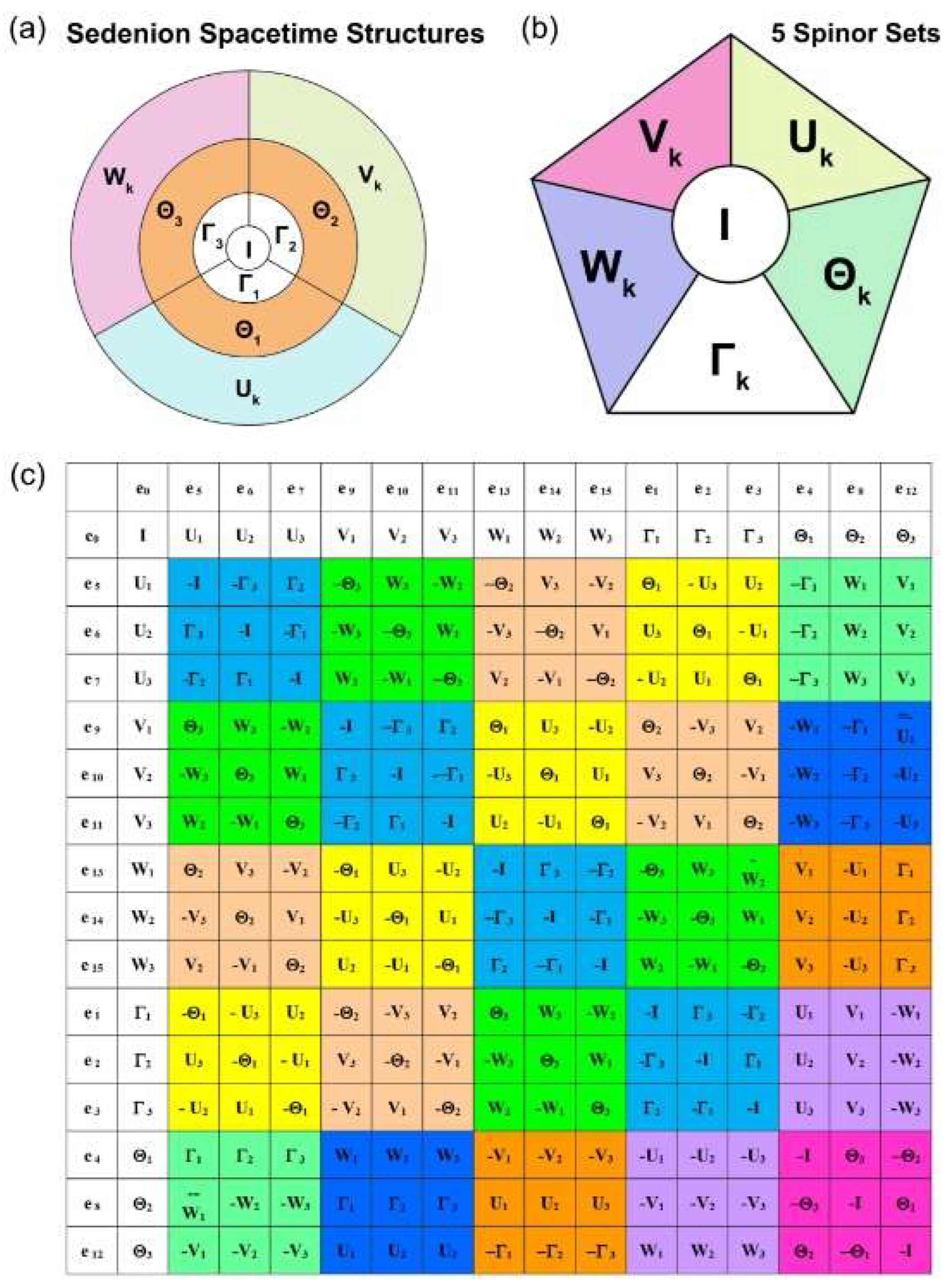
The multiplication table of the sedenion basis elements in the following figure reveals their mutual anti-commutative relationships. This structure serves as the algebraic foundation for modeling gauge bosons and three generations of quarks and leptons. In particular, the spatial spinor sets (U, V, W, Γ) [24] are used to construct Gell-Mann’s SU(3) generators [25], while the multiplicity of spinor combinations governs the generation-wise pattern of quark mass hierarchy.
Figure 1.
(a) Layered representation of the sedenionic spacetime structure showing five spinor sets—external spatial spinor (Γ), internal sptatial spatial (U, V, W), and internal temporal spinor —surrounding the central unit element . (b) Pentagonal organization of the five spinor sets, illustrating their symmetry and grouping within the 16-dimensional algebra. (c) Multiplication table of the sedenion basis, consisting of the scalar unit and 15 imaginary elements arranged into five spinor triplets. Off-diagonal entries display mutual anti-commutativity between sets. This structure supports the construction of gauge bosons and fermions, with color–spinor multiplicity linked to the three-generation mass hierarchy.
Figure 1.
(a) Layered representation of the sedenionic spacetime structure showing five spinor sets—external spatial spinor (Γ), internal sptatial spatial (U, V, W), and internal temporal spinor —surrounding the central unit element . (b) Pentagonal organization of the five spinor sets, illustrating their symmetry and grouping within the 16-dimensional algebra. (c) Multiplication table of the sedenion basis, consisting of the scalar unit and 15 imaginary elements arranged into five spinor triplets. Off-diagonal entries display mutual anti-commutativity between sets. This structure supports the construction of gauge bosons and fermions, with color–spinor multiplicity linked to the three-generation mass hierarchy.
2.2. Steering–Spinor Sector Decomposition
The fifteen imaginary basis elements can be naturally grouped into five triplets, defining five fundamental spinor sectors (external spatial spinor (Γ), internal sptatial spatial (U, V, W), and internal temporal spinor ) [24]:
Together with the identity element , this decomposition satisfies
which accounts for all degrees of freedom of the algebra.
Each triplet defines a three-component spinor sector representing an internal direction in the hypercomplex space. This decomposition provides the basis for the steering–spinor structure underlying the theory.
2.3. Definition of Steering Spinors
A steering spinor is defined as a linear combination of basis elements within a given sector. For example, a spinor in the sector can be written as
Similarly, spinors can be defined for the other sectors:
The full spinor field is then expressed as
This spinor represents the fundamental dynamical variable of the theory.
2.4. Bilinear Structure and Geometric Operators
A key feature of the framework is that geometric and physical quantities arise from bilinear combinations of spinors. Given two spinors and , their product
defines a second-rank object that plays the role of a geometric operator.
In particular, the symmetric part of this bilinear can be associated with an effective spacetime metric, while antisymmetric components encode additional geometric structure related to the non-associative properties of the algebra.
This bilinear construction provides the mechanism through which spacetime geometry emerges from the underlying spinor fields.
2.5. Physical Interpretation of Spinor Sectors
The decomposition into spinor sectors admits a natural physical interpretation. The different sectors correspond to distinct internal structures that can be associated with interactions and degrees of freedom:
| Spinor sector | Interpretation |
| external spacetime / electromagnetic structure | |
| internal temporal degrees of freedom | |
| generation-like internal spatial degrees of freedom |
While a detailed treatment of gauge interactions and fermion structure lies beyond the scope of the present work, this sector decomposition suggests that both spacetime geometry and internal symmetries may arise from a common algebraic origin.
2.6. Role of Non-Associativity
The most important feature of the sedenion algebra for the present framework is its non-associativity. The associator
defines a new algebraic object that has no analogue in associative theories.
When applied to spinor fields, the associator generates additional contributions to geometric quantities such as the connection and curvature. These contributions will be shown in later sections to modify the gravitational dynamics and lead to corrections to the classical Einstein equations.
Thus, while the bilinear spinor structure generates the classical geometric background, the associator encodes deviations from classical gravity and provides a candidate mechanism for quantum gravitational effects.
2.7. Conceptual Structure
The overall structure of the theory may be summarized as
sedenion algebra (16D)
↓
steering–spinor decomposition
↓
spinor field S
↓
bilinear geometric operators
↓
emergent spacetime geometry
↓
associator corrections → modified gravity
This hierarchy illustrates how both classical geometry and its quantum corrections arise from the same underlying algebraic structure.
3. Emergent Metric Geometry and Tetrad Construction
3.1. Emergence of the Spacetime Metric
In the present framework, spacetime geometry is not assumed a priori but arises from bilinear combinations of the underlying steering–spinor fields. Let denote the spinor field defined on the sedenion algebra. The fundamental geometric object is constructed from the bilinear product
The symmetric part of this bilinear defines an effective spacetime metric
This construction ensures that is symmetric and can therefore be interpreted as the metric tensor of an emergent spacetime manifold.
Unlike in general relativity, where the metric is a fundamental field, here it arises as a composite object constructed from more elementary spinor degrees of freedom.
3.2. Reduction to Effective Four-Dimensional Geometry
Although the underlying algebra is sixteen-dimensional, the bilinear structure restricts the number of independent spacetime directions. The spinor decomposition
contains internal degrees of freedom associated with the five sectors. However, only a subset of these combinations contributes to the effective spacetime metric.
In particular, the bilinear products that define involve four independent directions, leading to an effective four-dimensional spacetime. The remaining degrees of freedom correspond to internal structure rather than additional spacetime dimensions.
Thus, spacetime dimensionality emerges dynamically from the algebraic structure:
3.3. Tetrad (Vierbein) Construction
To relate the emergent metric to local inertial frames, we introduce a tetrad field , which satisfies
where is the Minkowski metric.
In the present framework, the tetrad can be constructed from spinor bilinears of the form
where are generators of the local Lorentz algebra and denotes a suitable conjugation of the spinor field.
This expression shows that the tetrad, and therefore the local spacetime frame, is determined entirely by the spinor field.
3.4. Spin Connection
The tetrad defines a spin connection , which governs the parallel transport of spinors:
The covariant derivative acting on the spinor field is then given by
Because the tetrad itself is constructed from , the spin connection becomes a nonlinear function of the spinor field.
3.5. Curvature Tensor
The curvature [26] associated with the spin connection is defined by
From this, the Ricci scalar [27] is obtained as
This scalar curvature describes the gravitational geometry of the emergent spacetime.
3.6. Emergent Geometry as a Collective Phenomenon
The construction above demonstrates that all geometric quantities—metric, tetrad, connection, and curvature—are derived from the underlying spinor field.
The hierarchy of emergence can be summarized as
spinor field S
↓
bilinear products
↓
tetrad e
↓
metric gμν
↓
connection ω
↓
curvature R
Thus, spacetime geometry appears as a collective macroscopic structure arising from more fundamental spinor degrees of freedom.
3.7. Role of Non-Associativity
While the bilinear construction generates the classical geometric structure, the non-associative nature of the sedenion algebra introduces additional corrections.
Specifically, the associator
contributes to the connection and curvature, leading to deviations from the classical geometric relations. These contributions will be incorporated into the gravitational action in the next section.
3.8. Transition to Gravitational Dynamics
Having established the emergence of spacetime geometry from spinor bilinears, we now turn to the dynamics of the theory. In the following section, we construct the gravitational action and derive the modified field equations that include contributions from the associator.
4. Gravitational Action and Associator-Induced Dynamics
4.1. Construction of the Gravitational Action
Having established that spacetime geometry emerges from bilinear combinations of the spinor field, we now construct the dynamical action governing the system. The classical geometric contribution is given by the Einstein–Hilbert action [28]
where is the Ricci scalar derived from the emergent metric .
In the present framework, however, this term represents only the leading contribution arising from the associative part of the underlying algebra. The non-associative structure introduces additional geometric degrees of freedom that must also be included in the action.
4.2. Associator field as a Geometric Quantity
The fundamental non-associative structure is encoded in the associator
For the spinor field , we define the associator field
This object measures the local failure of associativity in the spinor algebra and acts as a new geometric field defined over spacetime.
Unlike the metric, which arises from bilinear combinations, the associator is inherently cubic in the spinor field and therefore represents a higher-order geometric structure.
4.3. Associator Invariant
To incorporate the associator into the action, we construct a scalar invariant analogous to curvature invariants:
This quantity measures the magnitude of the non-associative structure and can be interpreted as an energy density [29] associated with the underlying algebra.
4.4. Total Action
The full gravitational action is taken to be
where is a coupling constant that determines the strength of the non-associative contribution.
The first term reproduces classical general relativity, while the second term encodes corrections arising from the associator field.
4.5. Variation and Field Equations
Varying the action with respect to the metric yields the modified gravitational field equations [30]
where is the Einstein tensor [31] and is the effective stress [32]–energy tensor associated with the associator field.
The associator contribution is given by
This term represents a purely geometric source of gravity arising from the non-associative structure of spacetime.
4.6. Modified Connection and Curvature
In addition to contributing to the stress–energy tensor, the associator modifies the geometric structure itself. The covariant derivative of the spinor field acquires an additional term
where is the usual spin connection and represents a correction induced by the associator.
As a result, the curvature tensor can be written schematically as
with
Thus, non-associativity directly modifies the curvature of spacetime.
4.7. Weak-Field Limit
In the weak-field approximation, the modified field equations reduce to a generalized Poisson equation [33]
where the parameter is determined by the magnitude of the associator field:
The solution of this equation yields a Yukawa-type gravitational potential
where .
4.8. Physical Interpretation
The gravitational dynamics in this framework consist of two distinct contributions:
| Component | Origin |
| Einstein term | associative algebra |
| Yukawa correction | non-associative associator |
Thus, classical gravity emerges as the leading approximation, while deviations from it reflect the deeper algebraic structure of spacetime.
4.9. Conceptual Structure
The role of the associator in gravitational dynamics can be summarized as
spinor algebra
↓
bilinear metric → classical gravity
↓
associator field → corrections
↓
modified Einstein equations
↓
dark matter + dark energy phenomena
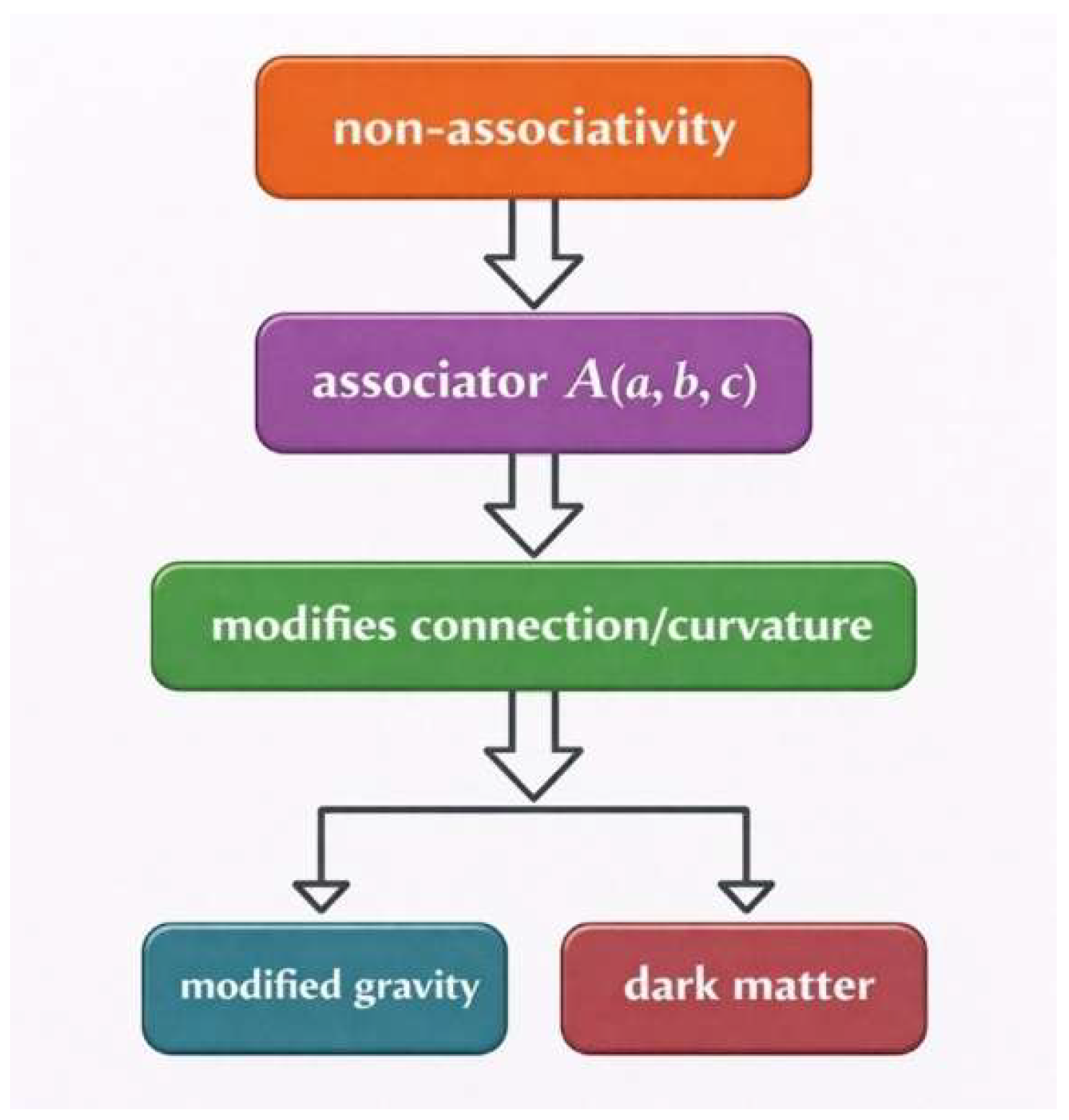
The non-associative nature of the underlying sedenion algebra plays a central role in the present framework by introducing additional geometric structure beyond that of classical spacetime. This structure is characterized by the associator, which quantifies the failure of associativity in the algebra and acts as a higher-order geometric object. When applied to the spinor field, the associator generates corrections to the connection and curvature, thereby modifying the effective gravitational dynamics. These modifications provide a natural mechanism for deviations from classical general relativity and offer a unified geometric interpretation of phenomena typically attributed to dark matter and dark energy.
Figure 2.
Schematic illustration of the role of non-associativity in modifying gravitational dynamics. The failure of associativity gives rise to the associator field , which introduces corrections to the spacetime connection and curvature. These corrections lead to modified gravitational behavior and provide a geometric origin for phenomena commonly associated with dark matter and dark energy.
Figure 2.
Schematic illustration of the role of non-associativity in modifying gravitational dynamics. The failure of associativity gives rise to the associator field , which introduces corrections to the spacetime connection and curvature. These corrections lead to modified gravitational behavior and provide a geometric origin for phenomena commonly associated with dark matter and dark energy.
4.10. Transition to Classical Limit
To establish consistency with known physics, it is necessary to show how classical general relativity emerges from this framework in the appropriate limit. In the next section, we analyze the conditions under which the associator contributions become negligible and recover the standard Einstein equations.
5. Classical Limit and Recovery of General Relativity
5.1. Associative Limit of the Algebra
The proposed framework is based on a non-associative sedenion algebra. However, any viable theory of gravity must reproduce classical general relativity in the appropriate limit. This requirement is satisfied when the non-associative contributions become negligible.
In the limit where the associator vanishes,
the algebra effectively reduces to an associative structure. In this regime, the additional geometric degrees of freedom associated with non-associativity disappear, and the dynamics are governed solely by the bilinear spinor structure.
5.2. Reduction of the Action
In the associative limit, the associator invariant satisfies
The total action, therefore, reduces to
which is precisely the Einstein–Hilbert action.
Thus, the present framework naturally recovers classical general relativity when non-associative effects are suppressed.
5.3. Recovery of Einstein Field Equations
With the associator contribution vanishing, the modified field equations reduce to
This demonstrates that the standard Einstein equations emerge as the leading-order approximation of the theory.
In this sense, general relativity appears as the low-energy, large-scale limit of the underlying non-associative spinor geometry.
5.4. Geometric Interpretation
In the classical limit, the spacetime geometry is determined entirely by the bilinear spinor construction. The metric, connection, and curvature reduce to their standard forms, and spacetime behaves as a smooth four-dimensional manifold.
The role of the associator becomes negligible, and the geometry is effectively governed by associative algebraic relations.
Thus, classical spacetime can be viewed as an emergent structure corresponding to a regime in which the deeper non-associative features of the underlying algebra are not dynamically relevant.
5.5. Physical Conditions for the Classical Regime
The suppression of non-associative effects is expected to occur under conditions where:
- characteristic length scales are much larger than the associator scale ,
- curvature is weak,
- quantum fluctuations of the spinor field are small.
In such regimes, the Yukawa-type corrections derived earlier become negligible, and gravitational dynamics follow the Newtonian and Einsteinian behavior.
5.6. Emergence of Newtonian Gravity
In the weak-field and low-velocity limit, the Einstein equations reduce to the Newtonian Poisson equation
This limit is also recovered in the present framework when both curvature and associator contributions are small. Thus, Newtonian gravity appears as the lowest-order approximation in a hierarchy:
non-associative spinor geometry
↓
modified gravity
↓
general relativity
↓
Newtonian gravity
5.7. Consistency with Observational Tests
Because the theory reduces to general relativity in the appropriate limit, it is consistent with classical tests of gravity, including:
- perihelion precession of Mercury
- gravitational redshift
- light deflection
- gravitational time delay
Deviations from general relativity arise only at scales where the associator contributions become significant.
5.8. Conceptual Interpretation
The recovery of general relativity demonstrates that spacetime geometry in this framework is an effective macroscopic description. The underlying reality is governed by spinor algebra and its non-associative structure, while classical geometry emerges as an approximation.
Thus, the relationship between the two descriptions can be viewed as
microscopic level: spinor algebra + associator
macroscopic level: smooth spacetime geometry
5.9. Transition to Fundamental Implications
Having established the classical limit of the theory, we now turn to its implications for deeper physical questions. In particular, the algebraic structure suggests new insights into hierarchy problems and the relative strengths of fundamental interactions.
6. Hierarchy of Forces and Fundamental Scales
6.1. The Hierarchy Problem
One of the longstanding problems in theoretical physics is the enormous disparity between the strengths of the fundamental interactions. In particular, the ratio of the electromagnetic (Coulomb) force to the gravitational force between two electrons is approximately [34]
This large dimensionless number has no fundamental explanation within classical general relativity or the Standard Model and is typically treated as an empirical fact.
6.2. Algebraic Origin of the Force Ratio
Within the present framework, this hierarchy may be interpreted as a consequence of the underlying algebraic structure of spacetime. In particular, the sixteen-dimensional sedenion algebra introduces a natural scaling associated with its internal degrees of freedom.
We propose that the ratio of electromagnetic to gravitational interaction strengths can be expressed in the form
where 137 is close to the inverse of the fine structure constant [35], or equivalently
Here, the exponent reflects the dimensionality of the underlying algebra, while the numerical factors arise from the internal structure of the spinor sectors.
6.3. Interpretation of the Exponent
The appearance of the exponent suggests that the hierarchy of forces may be related to the multiplicity of internal degrees of freedom in the sedenion algebra.
In this interpretation:
- gravitational interaction corresponds to a collective, averaged effect over all spinor components,
- electromagnetic interaction arises from a more localized projection within specific spinor sectors.
Thus, the large ratio of forces reflects the difference between global and sector-specific contributions within the algebraic structure.
6.4. Geometric Interpretation of Numerical Factors
The numerical factor , which appears in the expression above, is close to the inverse fine-structure constant. In the present framework, this number can be related to the internal geometry of the spinor space.
In particular, one may associate the Pythagorean prime 137 with
which can be interpreted as defining a unit scale in an internal spacetime structure. Similarly, based on quantization or the 4-vector potential gauge [40], the number
can be viewed as an effective volume element in a four-dimensional internal space.
While these relations are suggestive, they should be interpreted as indications of an underlying geometric structure rather than exact identities.
6.5. Emergence of Fundamental Scales
The hierarchy between forces can also be expressed in terms of characteristic length scales. In the present framework:
- the Planck scale [36] corresponds to the regime where non-associative effects become dominant,
- the electron scale corresponds to a lower-energy projection of the spinor geometry.
The large ratio between these scales may therefore arise from the exponential sensitivity of the algebraic structure to the number of internal dimensions.
6.6. Connection to Gravitational Weakness
From this perspective, gravity appears weak not because it is intrinsically small, but because it represents an averaged geometric effect over the full algebraic structure. In contrast, gauge interactions correspond to more localized algebraic sectors and therefore appear stronger.
This interpretation provides a qualitative explanation for the relative weakness of gravity compared to other interactions.
6.7. Conceptual Summary
The hierarchy of forces in this framework can be summarized as
sedenion algebra (16D structure)
↓
internal spinor sectors
↓
localized interactions → strong/electromagnetic forces
↓
global averaging → gravitational interaction
↓
large force hierarchy
6.8. Limitations and Outlook
The relations proposed in this section are currently heuristic and require further development to establish a precise quantitative derivation. In particular, a deeper understanding of the dynamical role of the spinor sectors and their normalization is needed.
Nevertheless, the appearance of large dimensionless ratios in connection with the algebraic structure suggests that the hierarchy of forces may have a geometric origin.
6.9. Transition to Cosmology
The existence of large hierarchies and internal structure in the spinor framework also has implications for the early universe. In particular, the global nature of the spinor field suggests the possibility of long-range correlations that may influence the large-scale uniformity of the cosmos.
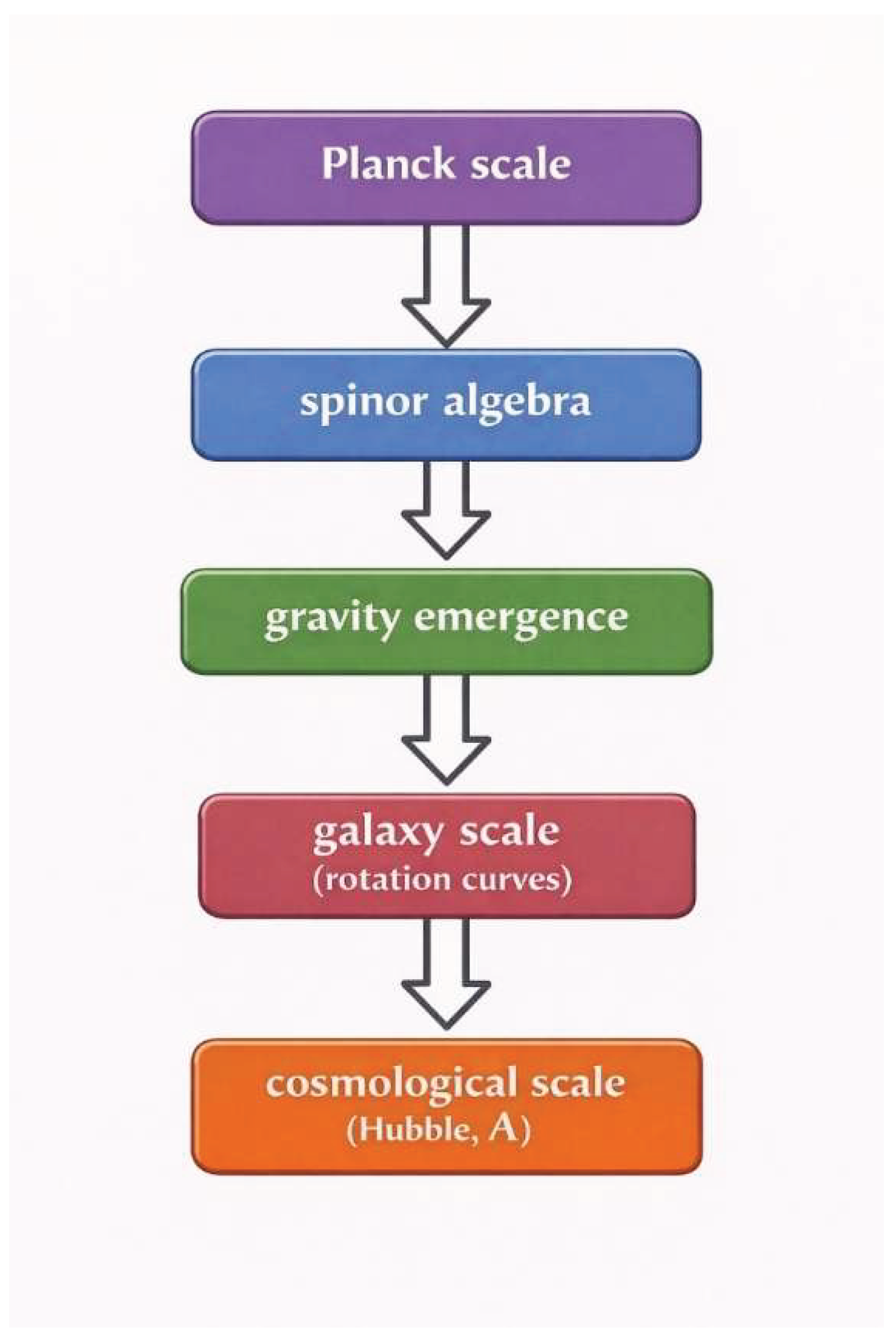
The proposed framework establishes a connection between physical phenomena across a wide range of scales, from the microscopic regime associated with fundamental interactions to the largest cosmological structures. In this picture, the underlying spinor algebra provides the foundational structure at the smallest scales, from which gravitational dynamics emerge as an effective macroscopic phenomenon. The same geometric framework then extends naturally to describe galactic dynamics and cosmological expansion, suggesting that seemingly disparate observations may be unified within a single algebraic description. This multi-scale coherence is a key feature of the model and highlights its potential to bridge quantum gravity and cosmology.
Figure 3.
Schematic representation of the hierarchy of physical scales in the sedenion spinor framework. Starting from the Planck scale, the underlying spinor algebra gives rise to emergent gravitational dynamics, which govern structures at galactic scales, such as rotation curves, and extend further to cosmological scales characterized by the Hubble expansion and the cosmological constant. The diagram illustrates how the same algebraic structure underlies physical phenomena across different orders of magnitude.
Figure 3.
Schematic representation of the hierarchy of physical scales in the sedenion spinor framework. Starting from the Planck scale, the underlying spinor algebra gives rise to emergent gravitational dynamics, which govern structures at galactic scales, such as rotation curves, and extend further to cosmological scales characterized by the Hubble expansion and the cosmological constant. The diagram illustrates how the same algebraic structure underlies physical phenomena across different orders of magnitude.
7. Early-Universe Implications and Large-Scale Coherence
7.1. The Problem of Cosmic Uniformity
Observations of the cosmic microwave background (CMB) [37] reveal that the Universe is highly homogeneous and isotropic on large scales, with temperature fluctuations at the level of [38]
In the standard cosmological model, this uniformity is explained by cosmic inflation, a period of rapid exponential expansion in the early universe that stretches initially small, causally connected regions to cosmological scales.
However, the inflationary paradigm introduces additional fields and parameters, and its fundamental origin remains an open question. This motivates the exploration of alternative mechanisms for generating large-scale coherence.
7.2. Global Spinor Structure of Spacetime
In the present framework, spacetime is not fundamental but emerges from an underlying spinor field defined on a non-associative algebra. The spinor field represents a global object whose components are defined over the entire manifold.
Because the metric itself is constructed from bilinear combinations of the spinor field, correlations within the spinor structure can translate directly into correlations in spacetime geometry.
This suggests that large-scale coherence in the universe may originate from the underlying algebraic structure rather than from dynamical expansion [39] alone.
7.3. Non-Local Correlations and Quantum Coherence
A key feature of spinor-based formulations is the possibility of non-local correlations. In the present framework, the components of the spinor field are not independent local variables but are related through the algebraic structure of the sedenion basis.
This raises the possibility that different regions of the early universe may have been correlated through a form of quantum coherence encoded in the spinor field.
Such correlations could, in principle, extend across regions that are not causally connected in the classical spacetime picture, providing an alternative explanation for large-scale uniformity.
7.4. Role of the Associator in Early-Universe Dynamics
The non-associative structure introduces additional degrees of freedom through the associator field
In the high-energy regime of the early universe, the associator contributions are expected to be significant. These contributions modify the effective connection and curvature, potentially influencing the dynamics of the early expansion.
In particular, the associator may introduce:
- scale-dependent corrections to the expansion rate,
- additional coupling between spinor components,
- enhanced correlations across large distances.
These effects could contribute to establishing the initial conditions required for large-scale uniformity.
7.5. Emergent Horizon-Scale Correlations
In standard cosmology, the horizon problem arises because regions of the universe that appear uniform today were not in causal contact at early times.
In the present framework, this problem may be alleviated if the underlying spinor field possesses a global structure that enforces correlations across different regions. Because spacetime itself is emergent, the notion of causal separation at very early times may not be fundamental.
Instead, the early universe may be described by a pre-geometric phase in which the spinor field defines correlations that later manifest as spacetime uniformity.
7.6. Acoustic Oscillations and Early-Universe Structure
The acoustic oscillations observed in the cosmic microwave background provide a sensitive probe of early-universe physics. In the standard picture, these oscillations arise from the dynamics of a coupled photon–baryon plasma in the presence of gravitational potentials.
In the present framework, the associator-induced modification of gravity introduces additional contributions to the effective gravitational potential. These contributions may influence the formation of acoustic oscillations and modify the sound horizon scale.
In particular:
- the effective gravitational coupling may differ from the standard Newtonian value,
- the expansion rate may be altered by associator vacuum contributions,
- the amplitude of oscillations may be affected by scale-dependent corrections.
A detailed quantitative analysis of the resulting CMB power spectrum is beyond the scope of the present work and will be addressed in future studies.
7.7. Conceptual Picture of the Early Universe
The early-universe scenario suggested by this framework can be summarized as
pre-geometric spinor phase
↓
global spinor correlations
↓
emergence of spacetime metric
↓
modified early expansion dynamics
↓
large-scale coherence of the universe
This picture differs from the standard inflationary paradigm by emphasizing the role of algebraic structure rather than purely dynamical expansion.
7.8. Limitations and Future Directions
The ideas presented in this section are preliminary and require further development. In particular:
- a quantitative treatment of cosmological perturbations is needed,
- detailed predictions for the CMB power spectrum should be derived,
- connections to structure formation must be explored.
Nevertheless, the framework provides a new perspective on early-universe physics in which large-scale coherence arises from the underlying spinor structure.
7.9. Transition to Phenomenology
Having explored the conceptual implications of the theory for early-universe physics, we now briefly summarize its previously established phenomenological consequences at galactic and cosmological scales.
8. Summary of Astrophysical and Cosmological Applications
8.1. Overview
The primary focus of the present work is the foundational quantum-gravity structure of the non-associative spinor framework. However, important phenomenological implications of this approach have been developed in two recent companion studies. In this section, we briefly summarize these results to provide context for the theoretical construction presented here.
8.2. Modified Gravitational Dynamics
In the first study, the non-associative structure of the sedenion algebra was shown to generate corrections to gravitational dynamics through the associator field. In the weak-field limit, these corrections lead to a modified Poisson equation and a Yukawa-type gravitational potential
This modification enhances the gravitational interaction at large distances and provides a natural explanation for the observed flattening of galaxy rotation curves without invoking dark matter particles or the MOND (Modified Newtonian Dynamics) hypothesis [41].
8.3. Galactic and Cluster-Scale Phenomena
The same framework was applied to a range of astrophysical systems. It was shown that the associator-induced corrections can reproduce:
- flat rotation curves of spiral galaxies,
- mass profiles of galaxy clusters,
- scaling relations such as the baryonic Tully–Fisher relation,
- the radial acceleration relation observed in galaxy surveys.
These results suggest that the phenomena commonly attributed to dark matter halos may instead arise from modifications of gravitational dynamics.
8.4. Gravitational Lensing
The modified spacetime curvature associated with the associator field also affects the propagation of light. The resulting enhancement of gravitational lensing [42] can account for observations in galaxies and clusters that are typically interpreted as evidence for additional unseen mass.
Thus, both dynamic and lensing observations may be explained within a unified geometric framework.
8.5. Cosmological Implications
In the second companion study, the same spinor framework was extended to cosmology. It has been shown that the vacuum structure of the spinor manifold can generate an effective cosmological constant, providing a geometric origin of cosmic acceleration.
The resulting cosmological dynamics reproduce the phenomenology of the ΛCDM model while introducing scale-dependent corrections to the expansion rate. These corrections may contribute to resolving the observed Hubble tension between early- and late-universe measurements.
8.6. Connection to Gauge Interactions
In addition to its gravitational and cosmological implications, the hypercomplex spinor structure provides a natural framework for the emergence of gauge interactions. Different spinor sectors correspond to distinct interaction types, and bilinear combinations generate gauge bosons.
While a detailed treatment of particle physics lies beyond the scope of the present paper, this feature suggests the possibility of a unified algebraic origin for both spacetime geometry and fundamental interactions.
8.7. Unified Interpretation
Taking together, these results indicate that a wide range of astrophysical and cosmological phenomena may be understood as manifestations of the underlying non-associative spinor geometry. In this view:
spinor algebra
↓
associator corrections
↓
modified gravity
↓
galactic dynamics + lensing
↓
cosmological expansion
Thus, the same algebraic structure that gives rise to spacetime geometry also governs its large-scale behavior.
8.8. Scope of the Present Work
The purpose of the present paper is not to reproduce these phenomenological results in detail, but to provide the underlying quantum-gravity foundation from which they arise. The previous studies should therefore be viewed as applications of the general framework developed here.
9. Discussion
The framework developed in this work proposes that spacetime geometry and gravitational dynamics emerge from an underlying non-associative spinor algebra defined on the sixteen-dimensional sedenion structure. This approach differs fundamentally from conventional formulations of gravity, in which the spacetime metric is treated as a primary dynamical field. Instead, the present theory suggests that the metric, connection, and curvature arise as composite quantities derived from more fundamental spinor degrees of freedom.
A central feature of the theory is the role of non-associativity. While associative algebraic structures underlie most conventional physical theories, the sedenion algebra introduces an additional geometric object, the associator, which measures the failure of associativity. In this framework, the associator acts as a new dynamical field that modifies the gravitational interaction. The resulting corrections to the Einstein equations provide a geometric mechanism for phenomena that are otherwise attributed to dark matter and dark energy.
The emergence of spacetime from bilinear spinor combinations places the theory within a broader class of approaches in which geometry is not fundamental but arises from deeper structures. However, the present framework is distinguished by its use of a non-associative algebra, which naturally introduces higher-order geometric contributions absent in associative theories. This feature provides a new avenue for incorporating quantum effects into gravitational dynamics without directly quantizing the spacetime metric.
In comparison with other approaches to quantum gravity, the present theory occupies a distinct conceptual position. General relativity describes gravity as classical spacetime curvature but does not include quantum structure. Loop quantum gravity attempts to quantize geometry itself, leading to discrete spacetime structures. String theory introduces extended objects in higher-dimensional spacetime and unifies interactions through vibrational modes of strings. In contrast, the present framework begins from an algebraic structure in which both spacetime geometry and interactions emerge from spinor relations. The non-associative nature of the algebra provides an additional layer of structure that is not central to these other approaches.
To place the present framework in context, it is useful to compare it with existing approaches to gravitational physics and quantum gravity. While general relativity treats spacetime geometry as fundamental, loop quantum gravity attempts to quantize this geometry, and string theory introduces extended objects in higher-dimensional spacetime. In contrast, the present approach begins from a non-associative algebraic structure in which spacetime geometry itself emerges from spinor bilinears. The key conceptual and structural differences are summarized in Table 1.
The above table presents the comparison of the present sedenion spinor framework with major approaches to gravity and quantum gravity. Unlike general relativity, loop quantum gravity, and string theory, the present model is based on a non-associative algebraic structure from which both spacetime geometry and gravitational dynamics emerge. The associator plays a central role in generating modifications to gravity that may account for phenomena commonly attributed to dark matter and dark energy.
One of the notable aspects of the theory is its ability to connect phenomena across widely different scales. At galactic scales, associator-induced corrections to gravity can reproduce rotation curves and scaling relations. At cosmological scales, the same structure gives rise to an effective cosmological constant and modified expansion dynamics. At the most fundamental level, the algebraic structure offers a possible explanation for the hierarchy of forces and the relative weakness of gravity. This multi-scale coherence suggests that the underlying algebraic framework captures essential features of gravitational physics.
The framework also offers a new perspective on early-universe physics. The global nature of the spinor field and its non-associative structure suggest the possibility of non-local correlations that could contribute to the observed large-scale uniformity of the universe. While these ideas remain preliminary, they point toward a potential alternative to inflationary explanations of cosmic coherence.
Despite these promising features, several important challenges remain. A more complete formulation of the dynamics of the associator field is needed, including its coupling to matter and its role in cosmological perturbations. In particular, detailed predictions for the cosmic microwave background and large-scale structure must be developed to provide stringent tests of the theory. In addition, the connection between the spinor algebra and the gauge structure of the Standard Model requires further clarification and quantitative development.
Another open question concerns the mathematical structure of the sedenion algebra itself. Unlike lower-dimensional division algebras, the sedenions contain zero divisors and lack many of the properties typically associated with well-behaved number systems. Understanding how physical consistency is maintained within such a framework is an important direction for future research.
In summary, the present work introduces a novel perspective on quantum gravity in which spacetime, and gravitational dynamics emerge from a non-associative algebraic structure. While further development is required to establish the theory and its observational consequences fully, the framework provides a unified approach that connects geometry, gravity, and cosmology within a common mathematical foundation.
10. Conclusions and Outlook
In this work, we have developed a theoretical framework in which spacetime geometry and gravitational dynamics emerge from a non-associative spinor algebra defined on the sixteen-dimensional sedenion structure. In contrast to conventional formulations of gravity, where the spacetime metric is treated as a fundamental field, the present approach derives the metric from bilinear combinations of spinor fields, thereby providing a natural mechanism for the emergence of an effective four-dimensional spacetime.
A key feature of the framework is the role of the associator, which encodes the non-associative structure of the underlying algebra. When incorporated into the gravitational action, the associator generates additional geometric contributions that modify the Einstein equations. In the weak-field limit, these modifications lead to Yukawa-type corrections to the gravitational potential, offering a geometric explanation for galactic dynamics without invoking particle dark matter. At the same time, the vacuum expectation value of the associator field provides an effective cosmological constant, linking dark energy to the algebraic structure of spacetime.
The theory further suggests that the hierarchy of fundamental interactions may have an algebraic origin associated with the dimensional structure of the sedenion algebra, and that large-scale coherence in the early universe may arise from global correlations in the underlying spinor field. These features indicate that a wide range of gravitational and cosmological phenomena may be understood within a unified algebraic framework.
Outlook
Despite these promising results, the present work represents an initial step toward a more complete theory. Several important directions remain for future investigation. A detailed dynamical formulation of the associator field is required, including its coupling to matter and its role in cosmological perturbations. Quantitative predictions for the cosmic microwave background and large-scale structure must be developed to provide stringent observational tests. In addition, further work is needed to clarify the connection between the spinor algebra and the gauge structure of the Standard Model.
An important direction for future research concerns the behavior of the theory in strong-gravity regimes, particularly in the context of black hole [43] physics. In classical general relativity, the formation of spacetime singularities signals a breakdown of the theory, while quantum effects give rise to phenomena such as Hawking radiation [44]. In the present framework, the non-associative structure of the underlying algebra and the presence of the associator field may provide a mechanism for modifying spacetime geometry at small scales, potentially regularizing singularities or altering horizon-scale dynamics. In this context, it would be of particular interest to investigate whether the spinor–associator structure can lead to a consistent description of black hole evaporation, information flow, and the microscopic origin of entropy. These questions remain open and require a more complete dynamic and quantum formulation of the theory.
From a mathematical perspective, the properties of non-associative algebras, including the role of zero divisors and their physical interpretation, warrant deeper investigation. Understanding how these features can be consistently incorporated into a physical theory is essential for establishing the robustness of the framework.
In conclusion, the present work proposes a new perspective on quantum gravity in which spacetime, and its dynamics emerge from an underlying non-associative algebraic structure. By linking geometry, gravity, and cosmology within a common framework, the theory opens new avenues for exploring the fundamental nature of spacetime and its role in the physical universe.
Author Contributions
J. Tang initiated the project, derived the equations, and wrote the manuscripts with Q. Tang. All authors have read and agreed to the published version of the manuscript.
Funding
This research received no external funding.
Conflicts of Interest Statement
The authors declare no conflict of interest.
References
- Einstein, A. The foundation of the general theory of relativity . Ann. Der Phys. 1916, 49, 769–822. [Google Scholar] [CrossRef]
- Peskin, M. E.; Schroeder, D. V. An Introduction to Quantum Field Theory; Addison-Wesley, 1995. [Google Scholar]
- Kiefer, C. Quantum Gravity, 3rd ed.; Oxford University Press, 2012. [Google Scholar]
- Rubin, V. C.; Ford, W. K.; Thonnard, N. Rotational properties of 21 SC galaxies . Astrophys. J. 1980, 238, 471–487. [Google Scholar] [CrossRef]
- Zwicky, F. Die Rotverschiebung von extragalaktischen Nebeln . Helv. Phys. Acta 1933, 6, 110–127. [Google Scholar]
- Riess, A. G.; et al. Observational evidence for an accelerating universe . Astron. J. 1998, 116, 1009–1038. [Google Scholar] [CrossRef]
- Bertone, G.; Hooper, D.; Silk, J. Particle dark matter: Evidence and candidates . Phys. Rep. 2005, 405, 279–390. [Google Scholar] [CrossRef]
- Weinberg, S. The cosmological constant problem . Rev. Mod. Phys. 1989, 61, 1–23. [Google Scholar] [CrossRef]
- Clifton, T.; Ferreira, P. G.; Padilla, A.; Skordis, C. Modified gravity and cosmology . Phys. Rep. 2012, 513, 1–189. [Google Scholar] [CrossRef]
- Green, M. B.; Schwarz, J. H.; Witten, E. Superstring Theory; Cambridge University Press, 1987. [Google Scholar]
- Rovelli, C. Quantum Gravity; Cambridge University Press, 2004. [Google Scholar]
- Baez, J. C. The octonions . Bull. AMS 2002, 39, 145–205. [Google Scholar] [CrossRef]
- Hamilton, W. R. On quaternions . Philos. Mag. 1844, 25, 489–495. [Google Scholar]
- Conway, J. H.; Smith, D. A. On Quaternions and Octonions; A K Peters, 2003. [Google Scholar]
- Schafer, R. D. An Introduction to Nonassociative Algebras; Dover, 1995. [Google Scholar]
- Gürsey, F.; Tze, H. C. On the Role of Algebras in Particle Physics; World Scientific, 1996. [Google Scholar]
- Weinberg, S. The Quantum Theory of Fields, Vol. II; Cambridge University Press, 1995. [Google Scholar]
- Georgi, H. Lie Algebras in Particle Physics, 2nd ed.; Westview Press, 1999. [Google Scholar]
- Planck Collaboration. Planck 2018 results. VI . Astron. Astrophys. 2020, 641, A6. [Google Scholar] [CrossRef]
- Peebles, P. J. E.; Ratra, B. The cosmological constant and dark energy . Rev. Mod. Phys. 2003, 75, 559–606. [Google Scholar] [CrossRef]
- Verde, L.; Treu, T.; Riess, A. G. Tensions between early and late Universe . Nat. Astron. 2019, 3, 891–895. [Google Scholar] [CrossRef]
- Gross, D. J. The role of symmetry in fundamental physics . PNAS 1996, 93, 14256–14259. [Google Scholar] [CrossRef]
- Peskin, M. E. Concepts of Elementary Particle Physics; Oxford University Press, 2018. [Google Scholar]
- Tang, Q.; Tang, J. Sedenion algebra and SU(5) symmetry: A unified algebraic framework for fundamental interactions. Symmetry 2024, 16, 1234. [Google Scholar]
- Baez, J. C.; Huerta, J. The algebra of grand unified theories . Bull. AMS 2010, 47, 483–552. [Google Scholar] [CrossRef]
- Wald, R. M. General Relativity; University of Chicago Press, 1984. [Google Scholar]
- Carroll, S. M. Spacetime and Geometry; Addison-Wesley, 2004. [Google Scholar]
- Einstein, A. Die Feldgleichungen der Gravitation . In Preussische Akademie; 1915. [Google Scholar]
- Landau, L. D.; Lifshitz, E. M. The Classical Theory of Fields; Pergamon, 1975. [Google Scholar]
- Misner, C. W.; Thorne, K. S.; Wheeler, J. A. Gravitation; Freeman, 1973. [Google Scholar]
- Einstein, A. Die Grundlage der allgemeinen Relativitätstheorie . Ann. Der Phys. 1916, 49, 769–822. [Google Scholar] [CrossRef]
- Hawking, S. W.; Ellis, G. F. R. The Large Scale Structure of Space-Time; Cambridge University Press, 1973. [Google Scholar]
- Jackson, J. D. Classical Electrodynamics, 3rd ed.; Wiley, 1999. [Google Scholar]
- Griffiths, D. J. Introduction to Electrodynamics, 4th ed.; Cambridge University Press, 2017. [Google Scholar]
- CODATA. Fundam. Phys. Constants 2018.
- Planck, M. Über irreversible Strahlungsvorgänge . In Preussische Akademie; 1899. [Google Scholar]
- Penzias, A. A.; Wilson, R. W. Measurement of excess antenna temperature . Astrophys. J. 1965, 142, 419–421. [Google Scholar] [CrossRef] [PubMed]
- Smoot, G. F.; et al. Structure in COBE maps . Astrophys. J. Lett. 1992, 396, L1–L5. [Google Scholar] [CrossRef]
- Guth, A. H. Inflationary universe . Phys. Rev. D. 1981, 23, 347–356. [Google Scholar] [CrossRef]
- Tang, J.; Tang, B. The links of 137 to the fine structure constant, Planck length, Coulomb and gravitational constants, and mass ratios of elementary particles/. Res. Gate. [CrossRef]
- Milgrom, M. A modification of Newtonian dynamics . Astrophys. J. 1983, 270, 365–370. [Google Scholar] [CrossRef] [PubMed]
- Bartelmann, M.; Schneider, P. Weak gravitational lensing . Phys. Rep. 2001, 340, 291–472. [Google Scholar] [CrossRef]
- Schwarzschild, K. On the gravitational field of a mass point . In Preussische Akademie; 1916. [Google Scholar]
- Hawking, S. W. Particle creation by black holes . Commun. Math. Phys. 1975, 43, 199–220. [Google Scholar] [CrossRef]

Table 1.
Comparison of Gravitational Theories.
| Feature | General Relativity (Einstein) | Loop Quantum Gravity (LQG) | String Theory | Sedenion Spinor Geometry (This Work) |
|---|---|---|---|---|
| Fundamental entity | Metric tensor gμν | Spin networks / quantum geometry | One-dimensional strings | Sedenion spinor field S |
| Mathematical framework | Differential geometry | Non-perturbative quantum geometry | Higher-dimensional QFT / string theory | Non-associative algebra (Cayley–Dickson) |
| Nature of spacetime | Continuous manifold | Discrete (quantized) geometry | Emergent from string dynamics | Emergent from spinor bilinears |
| Dimensional structure | 4D spacetime | 4D (quantized) | 10–11D spacetime | 16D algebra → emergent 4D spacetime |
| Origin of gravity | Spacetime curvature | Quantum geometry dynamics | Graviton excitations | Bilinear spinor metric + associator |
| Role of algebra | Lie groups | SU(2) gauge algebra | Supersymmetry, conformal algebra | Non-associative sedenion algebra |
| Non-associativity | Absent | Not fundamental | Appears in special cases | Fundamental and central |
| Quantum gravity mechanism | Not quantized | Geometry quantized | Strings quantized | Geometry emerges from algebra |
| Additional geometric structure | Curvature tensor | Spin networks | Extra dimensions, branes | Associator field A(a,b,c) |
| Cosmological connection | Standard ΛCDM | Requires extensions | Landscape cosmology | Unified via associator dynamics |
Disclaimer/Publisher’s Note: The statements, opinions and data contained in all publications are solely those of the individual author(s) and contributor(s) and not of MDPI and/or the editor(s). MDPI and/or the editor(s) disclaim responsibility for any injury to people or property resulting from any ideas, methods, instructions or products referred to in the content. |
© 2026 by the authors. Licensee MDPI, Basel, Switzerland. This article is an open access article distributed under the terms and conditions of the Creative Commons Attribution (CC BY) license (http://creativecommons.org/licenses/by/4.0/).
Copyright: This open access article is published under a Creative Commons CC BY 4.0 license, which permit the free download, distribution, and reuse, provided that the author and preprint are cited in any reuse.


