

Submitted:
03 May 2026
Posted:
05 May 2026
You are already at the latest version
Abstract
The fractional flow function in the Buckley--Leverett equation is conventionally assumed to be S-shaped. Rastegaev recently established a sufficient condition for this property based on monotonicity of \(m''/m'\), and showed that strict convexity of the phase mobilities alone is not sufficient. This note demonstrates that Rastegaev's criterion is not necessary, by exhibiting an explicit one-parameter polynomial family of strictly convex mobility functions, \[ m_\alpha(s)=s^2(1+\alpha s^4)=s^2+\alpha s^6,\qquad \alpha\ge 0, \] for which the symmetric fractional flow function \[ f_\alpha(s)=\frac{m_\alpha(s)}{m_\alpha(s)+m_\alpha(1-s)} \] retains its S-shape for every \(\alpha\ge 0\): \(f_\alpha''>0\) on \((0,1/2)\), \(f_\alpha''(1/2)=0\), and \(f_\alpha''<0\) on \((1/2,1)\). The mobility lies outside Rastegaev's class once \(\alpha>(5-2\sqrt 5)/15\approx 0.0352\). The proof reduces the sign of \(f_\alpha''\) to four explicit polynomial inequalities on \([0,1/4]\), certified by the convex-hull property of Bernstein coefficients. The same Bernstein certificate applies, without modification, to \(m_\alpha(s)=s^2(1+\alpha s^q)\) for every integer \(q\in\{2,3,4,5,6\}\); at \(q=7\) the certificate just fails.
Keywords:
Buckley–Leverett equation
; fractional flow function
; S-shape
; convex mobility
; Welge tangent construction
; relative permeability
; Bernstein-coefficient certificate
; logarithmic curvature condition
MSC: 26C99 (primary); 35L65; 76S05; 26D05 (secondary)
1. Introduction
In the classical two-phase Buckley–Leverett model of immiscible displacement, the normalized wetting-phase saturation (after the usual endpoint scaling) satisfies the scalar conservation law
where the fractional flow function takes the standard form
and are nonnegative phase mobilities, positive away from their endpoint zeros. In reservoir-engineering convention, is the wetting-phase mobility, namely the relative permeability divided by viscosity, written as a function of normalized water saturation, and is the analogous mobility of the non-wetting phase. The geometric shape of f controls the textbook shock–rarefaction construction: in particular, for the ideal one-dimensional incompressible Buckley–Leverett displacement with zero initial normalized saturation, the Welge tangent construction [6] selects the front saturation from , the shock speed , and the breakthrough pore-volume injected. In that standard setting one assumes that f is S-shaped, that is, f is strictly increasing on and changes sign exactly once, from positive to negative.
Castañeda observed that S-shapedness is not automatic for arbitrary convex mobility functions [2]. Rastegaev later gave a sufficient class of mobilities for which the Buckley–Leverett function is S-shaped, and constructed convex counterexamples showing that convexity alone is insufficient [5]. In Rastegaev’s notation, if satisfies
If , Rastegaev’s main theorem yields the S-shapedness of f [5]. Corey-type relative-permeability power laws, with absorbing endpoint relative permeability and viscosity and , belong to [3,5].
Rastegaev’s counterexamples in [5] (§3) use mobilities of the form with p just above 1 and q large (specifically ), and they produce three inflection points of f. The present note shows that, in the same general form, the choice yields a one-parameter family that remains S-shaped for every , while leaving Rastegaev’s class once exceeds an explicit threshold. The proof is by reducing the sign of to four polynomial inequalities on a single scalar variable, certified by Bernstein coefficients. The same S-shape argument applies, without modification, to , and the certificate just fails at ; we discuss this q-dichotomy in Section 4.
2. Setup and Statement
Let
and define the symmetric fractional flow function
Both phases use the same mobility law (the unit end-point mobility ratio case), and consequently . By symmetry, is forced to be an inflection point if it is the only one.
Theorem 1.
For every , the function is on with and , is strictly increasing on , and has exactly one inflection point in , located at . More precisely,
Furthermore, satisfies Rastegaev’s conditions – for every , and satisfies if and only if
3. Proof of 1
A direct computation gives
Hence , and for ; in fact , so is strictly convex throughout . This proves –.
Set . For ,
so the function is on with and . Furthermore
which is non-negative on and strictly positive on . Hence, for ,
and is strictly increasing on .
We next prove the sign pattern of . A direct differentiation gives
where is symmetric under . Indeed, gives , while and . Every polynomial invariant under is a polynomial in
For example, with , invariance means an even polynomial in y, hence a polynomial in . Therefore lifts uniquely to a polynomial in u. Symbolic computation gives the exact reduction
with
The -degree of is exactly 3: each of is degree 1 in , so each summand of the numerator
of has -degree at most 3, and the -coefficient is not identically zero in s.
We now certify that each is non-positive on , with bounded strictly away from zero. Set and write for the Bernstein basis on . Since on and , every polynomial lies in the convex hull of its Bernstein coefficients ; in particular on , with both inequalities strict on unless all coincide [4] (§2). Routine computation gives the Bernstein coefficients of for :
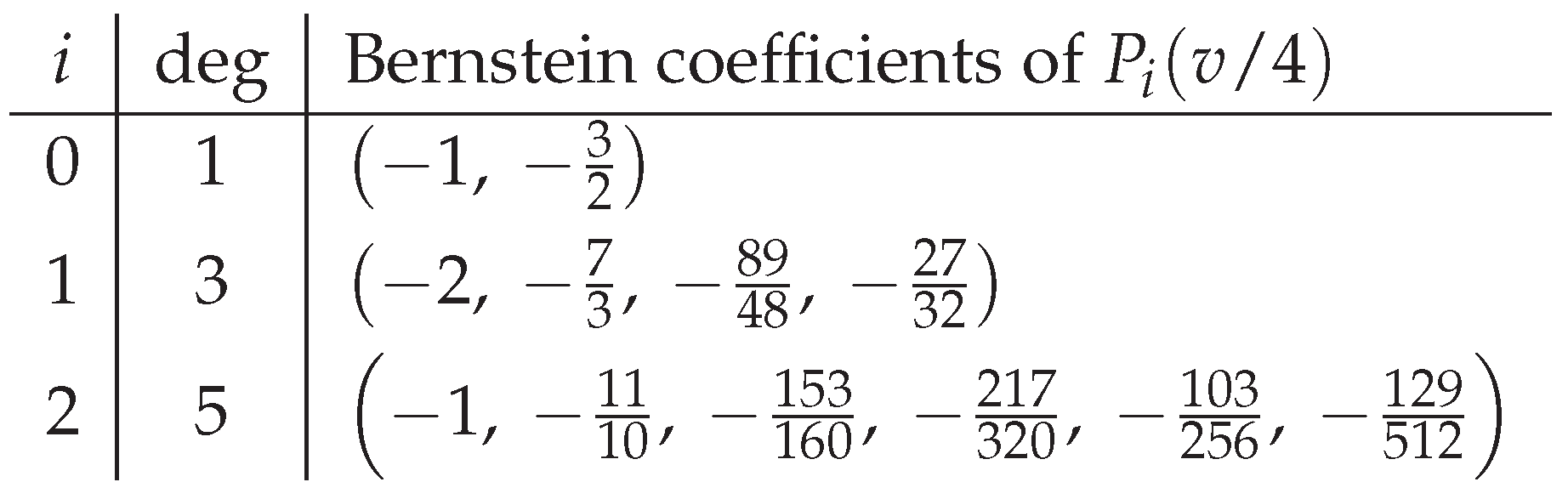 All coefficients are strictly negative; hence on . For we use the factorization
Combining the four certificates, since each for and , we obtain the uniform bound
In particular strictly on for every . Since on , Equation (3) gives
Hence on , , and on . Since strictly, the only zero of in is , and the inflection at is genuine because the sign of changes there.
Remark 1.
The inflection at is non-degenerate: a direct computation gives
which is strictly negative for every , since the numerator’s discriminant equals , the leading coefficient is negative, and the denominator is positive. Hence is a sign-changing inflection of multiplicity exactly 1.
It remains to verify the (C4) threshold. From the formulas for and ,
Differentiating,
Set . The numerator is , with roots
and q is negative exactly on . If , then for , so the right-hand side of Equation (6) is non-positive on and strictly negative on (it can vanish only in the limit when ). Hence is strictly decreasing on and (C4) holds.
If , pick (the interval is nonempty because and ) and set . Then , so the right-hand side of Equation (6) is positive at this s; thus fails to be monotonically decreasing on , and (C4) is violated. Since , this completes the proof.□
Remark 2.
Rastegaev’s analysis [5, Lemma 1] shows that implies that is also decreasing on . For our family, a short computation gives
The numerator is non-positive for if and only if . Thus for the mobility lies outside solely because (C4) fails; for , both monotonicities fail. In every case , the family lies outside .
4. Discussion
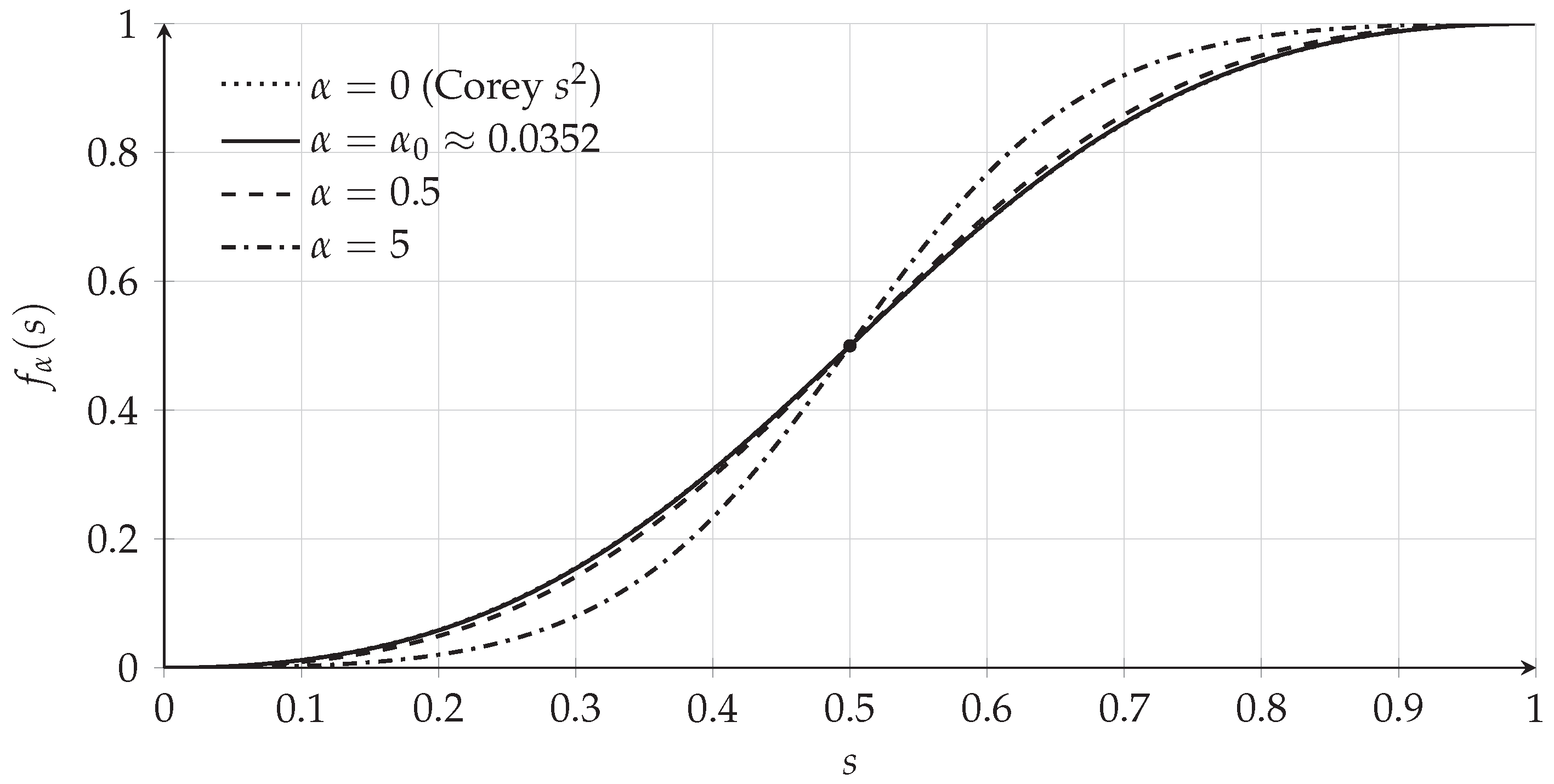
Theorem 1 gives a small but explicit positive answer in the direction of weakening Rastegaev’s condition (C4): the strictly convex polynomial mobility generates an S-shaped symmetric Buckley–Leverett flux for every , even though it lies outside Rastegaev’s class once . The certificate is exact (rational arithmetic on Bernstein coefficients) and avoids any plotting argument. Figure 1 shows the qualitative behaviour.
In the standard zero-initial-saturation normalization, Theorem 1 also makes the Welge tangent construction [6] well posed. Indeed, with , one has , , and ; hence h has a unique zero , equivalently . Thus the associated front saturation and shock speed are uniquely selected in the ideal one-dimensional incompressible/no-capillary/no-gravity setting. Once a relative-permeability fit drifts outside a class for which S-shape is guaranteed, this construction is no longer automatically justified. The exact polynomial certificate above shows that the standard analytical waterflood workflow extends to a one-parameter perturbation of the quadratic Corey law without invoking (C4).
The same proof for a wider polynomial family.
The proof technique is algorithmic. For symmetric polynomial mobilities, is anti-symmetric about ; a single division by reduces the sign question to a polynomial in on , which is then certifiable by Bernstein coefficients. Applying this recipe to for integer q, one obtains the same decomposition Equation (4) with four polynomials in u. For every Bernstein coefficient of on is non-positive, and ; hence the same bound proves the S-shape conclusion of Theorem 1 for these q’s. At the polynomial acquires a strictly positive Bernstein coefficient at , and the four-polynomial sign certificate as stated fails. We leave open whether remains S-shaped for (and at which q the property genuinely breaks). Rastegaev’s counterexample shows that, in the broader form , the property does fail for some p close to 1 and [5, §3]. The verification script accompanying this note checks the Bernstein-coefficient signs for .
Question 2.
Does the S-shape conclusion of Theorem 1 extend to scalar endpoint-mobility asymmetry? For and , is
S-shaped for every and every constant mobility multiplier (equivalently, after endpoint scaling, every viscosity-ratio factor)? This scalar-ratio question is weaker than the fully general case of unrelated laws . When the symmetry argument breaks, and the polynomial in acquires an antisymmetric companion in ; a refined Bernstein-form analysis appears to be required.
References
- Buckley, S. E.; Leverett, M. C. Mechanism of fluid displacement in sands. Trans. AIME 1942, 146(01), 107–116. [Google Scholar] [CrossRef]
- Castañeda, P. Dogma: S-shaped. Math. Intell. 2016, 38(2), 10–13. [Google Scholar] [CrossRef]
- Corey, A. T. The interrelation between gas and oil relative permeabilities. Prod. Mon. CiNii record. 1954, 19(11), 38–41. [Google Scholar]
- Farouki, R. T. The Bernstein polynomial basis: a centennial retrospective. Comput. Aided Geom. Des. 2012, 29(6), 379–419. [Google Scholar] [CrossRef]
- Rastegaev, N. V. On the sufficient conditions for the S-shaped Buckley–Leverett function. Zap. Nauchn. Sem. POMI 2024, arXiv:2303.16803536, 247–260. [Google Scholar]
- Welge, H. J. A simplified method for computing oil recovery by gas or water drive. J. Pet. Technol. 4(04) (1952), 91–98. [CrossRef]
Figure 1.
The symmetric, unit-endpoint-mobility-ratio Buckley–Leverett fractional flow function for at four values of , plotted against normalized saturation s. The single inflection point is forced by symmetry to lie at (marked). The S-shape persists for every , even when , where Rastegaev’s logarithmic-curvature condition (C4) fails.
Disclaimer/Publisher’s Note: The statements, opinions and data contained in all publications are solely those of the individual author(s) and contributor(s) and not of MDPI and/or the editor(s). MDPI and/or the editor(s) disclaim responsibility for any injury to people or property resulting from any ideas, methods, instructions or products referred to in the content. |
© 2026 by the authors. Licensee MDPI, Basel, Switzerland. This article is an open access article distributed under the terms and conditions of the Creative Commons Attribution (CC BY) license (http://creativecommons.org/licenses/by/4.0/).
Copyright: This open access article is published under a Creative Commons CC BY 4.0 license, which permit the free download, distribution, and reuse, provided that the author and preprint are cited in any reuse.