

Submitted:
30 April 2026
Posted:
04 May 2026
You are already at the latest version
Abstract
Quantum dots (QDs) are tiny semiconductor particles with unique light and electronic properties that can be adjusted by changing their size. They are widely usedin drug delivery, bioimaging, and theranostic applications. However, designing the best QDs is difficult because there are many possible combinations, makingtraditional trial-and-error methods slow and inefficient. Artificial intelligence (AI) and machine learning (ML) have improved this process by helping scientistspredict properties, design better QDs, and automate experiments. This review explains how various AI methods, including supervised learning, graph neuralnetworks, generative models, Bayesian optimisation, and active learning, are applied to QD-based drug delivery. These approaches have helped improve QDsynthesis, control drug release, and target specific areas such as tumours and the brain. AI has also supported applications in cancer treatment, neurological diseases,infections, and gene delivery. Despite these benefits, there are still challenges, such as a lack of reliable data, difficulty applying models to real-world conditions,and a limited understanding of how AI models make decisions. New technologies such as self-driving labs, advanced AI models, and quantum computing areexpected to further advance this field. Overall, combining AI with nanotechnology is making drug delivery faster, smarter, and more precise.
Keywords:
quantum dots
; machine learning
; drug delivery
; theranostics
; graph neural networks
; inverse design
; pharmacokinetics
; nanotoxicology
; Bayesian optimization
; blood-brain barrier
1. Introduction
1.1. Convergence of Nanotechnology and Artificial Intelligence
The intersection of nanotechnology and artificial intelligence represents one of the most consequential scientific frontiers of the 21st century. Since Alivisatos's seminal description of size-dependent quantum-mechanical effects in semiconductor nanocrystals [30] and the landmark fluorescence spectroscopy studies establishing QDs as superior bioimaging labels [20], quantum dots have been intensively investigated for oncological imaging, targeted drug delivery, gene therapy, antimicrobial photodynamic therapy, and biosensing. The inherent tunability of QD optical properties across the visible and near-infrared spectrum (400–1700 nm) via precise size control distinguishes them from all other nanoparticle families [19].
The pharmaceutical application of QDs requires simultaneous optimization of multiple often competing parameters: core composition for optical properties; shell architecture for photostability and quantum yield; surface ligand identity and density for targeting and biocompatibility; drug-loading capacity and release kinetics; and in vivo pharmacokinetic behavior. The resulting design space conservatively exceeds 10¹⁵ distinct configurations when surface-chemistry variables are included [22]. Artificial intelligence, and machine learning in particular, provides the essential computational framework to navigate this space systematically. Bannigan et al. demonstrated that ML-guided formulation development reduces experimental cycles by 40–70% across nanoparticle drug delivery platforms [25].
1.2. Quantum Dots in Drug Delivery: Unique Capabilities
QDs offer four pharmacologically distinct capabilities that are absent from conventional nanocarriers. First, their precisely tunable emission enables real-time fluorescence monitoring of drug biodistribution in living systems without administration of a separate imaging agent, in the theranostic paradigm. [26] Second, the large surface-to-volume ratio (>200 m²/g for 5 nm QDs) enables high drug-loading densities while maintaining sub-100 nm hydrodynamic diameters, which are required for EPR-mediated tumor accumulation [27]. Third, surface functionalization with pH-, redox-, and photothermal-responsive polymers enables stimuli-triggered drug release exclusively at target sites [9]. Fourth, multiplexed targeting, attaching multiple ligand species to a single QD, enables simultaneous engagement of multiple overexpressed receptors, producing avidity effects that dramatically increase target cell selectivity [10].
1.3. Review Methodology and Scope
This systematic review retrieved literature from Scopus, PubMed, and Web of Science using Boolean query: ("quantum dot*" OR "QD*") AND ("machine learning" OR "artificial intelligence" OR "deep learning" OR "neural network" OR "Bayesian optimization") AND ("drug delivery" OR "pharmacology" OR "theranostic*" OR "nanomedicine"). Inclusion criteria: primary research and reviews published 2014–2024; English language; peer-reviewed Scopus Q1/Q2 journals; studies with quantitative validation metrics reported. The review covers AI/ML methodology (Section 3), AI-driven drug delivery design (Section 4), pharmacological applications (Section 5), pharmacokinetics and safety prediction (Section 7), and regulatory and ethical considerations (Section 8).
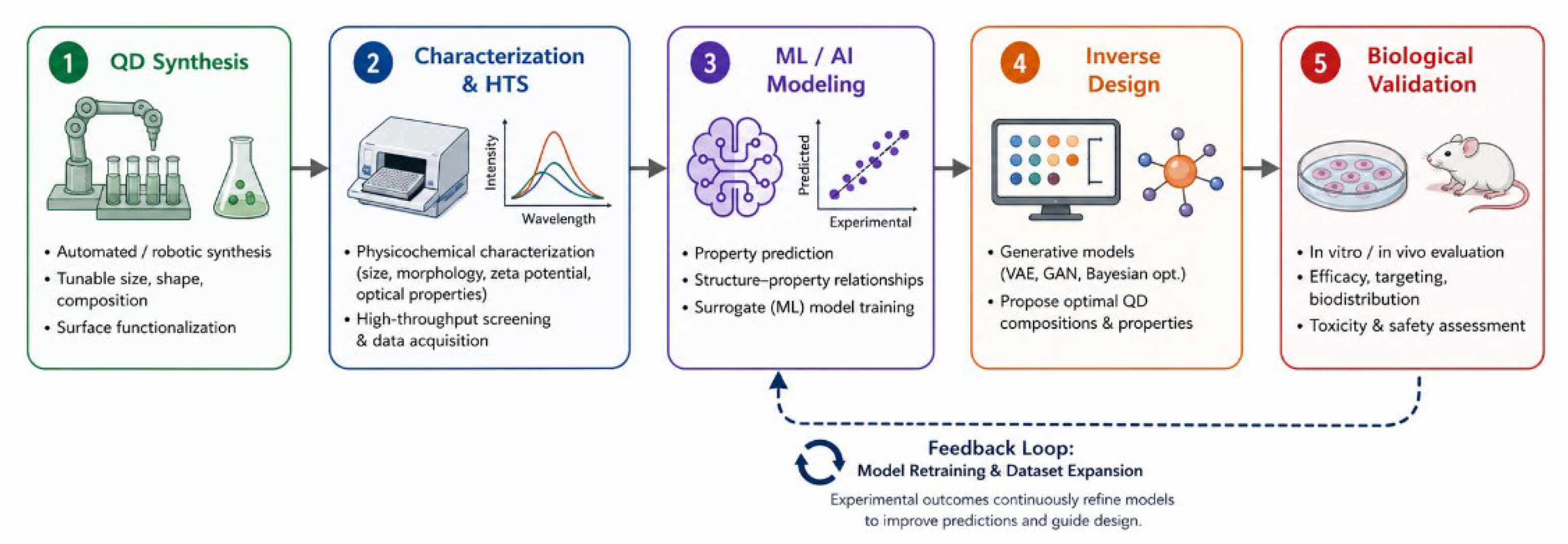
Figure 1.
AI Quantum Dot Closed-Loop Design Pipeline. The iterative cycle proceeds from automated synthesis through high-throughput characterization, ML property modeling, generative inverse design, and biological validation, with outcomes continuously retraining the surrogate model. Based on concepts from Reker et al. [6] and Bannigan et al. [25].
Figure 1.
AI Quantum Dot Closed-Loop Design Pipeline. The iterative cycle proceeds from automated synthesis through high-throughput characterization, ML property modeling, generative inverse design, and biological validation, with outcomes continuously retraining the surrogate model. Based on concepts from Reker et al. [6] and Bannigan et al. [25].
2. Quantum Dot Synthesis and Surface Engineering for Drug Delivery
2.1. Synthesis Routes and High-Throughput Platforms
The hot-injection method, pioneered by Peng and Peng for CdO-based precursors, [33] produces monodisperse QDs (σ < 5% size distribution) with quantum yields up to 90% but requires strict anaerobic conditions and generates heavy-metal waste streams. Hydrothermal synthesis at 160–220°C enables aqueous-phase QD formation compatible with direct biomolecule conjugation, though with reduced photoluminescence quantum yield (Φ = 0.10–0.45). For AI-driven design programs, microfluidic synthesis platforms enabling automated, parallelized experimentation under programmatic control are essential. Reker et al. demonstrated that robotic microfluidic platforms can generate >1,000 distinct QD synthesis conditions per day with real-time spectroscopic characterization, providing ML-ready datasets at throughputs impossible with manual laboratory workflows [6].
2.2. Surface Chemistry and Drug Loading Strategies
Four principal surface functionalization strategies are employed for drug delivery. (i) Electrostatic adsorption: positively charged QD surfaces (ζ > +15 mV) bind anionic drugs or nucleic acids through coulombic interactions; drug release is triggered by ionic competition at target sites. (ii) Covalent conjugation: carbodiimide chemistry (EDC/NHS) links drug carboxylic groups to amine-terminated QD surfaces, enabling stable loading with enzymatically triggered release. (iii) Encapsulation in polymer shells: PLGA, chitosan, or lipid coatings physically encapsulate hydrophobic drugs with pH- or thermal-responsive release [9]. (iv) Aptamer-mediated loading: DNA or RNA aptamers conjugated to QD surfaces bind specific drug molecules with Kd values in the nanomolar range, enabling highly selective loading and release [10]. AI has been applied to predict optimal loading strategy, polymer composition, and drug-to-QD molar ratio to maximize encapsulation efficiency and controlled release profile simultaneously.
2.3. Non-Toxic QD Alternatives
The documented cytotoxicity of Cd²⁺, Pb²⁺, and Hg²⁺-based QDs has driven the development of biocompatible alternatives. InP/ZnS QDs achieve quantum yields of 60–80% and IC50 values> 200 μg/mL in standard cytotoxicity assays, making them significantly safer than CdSe (IC50 15–50 μg/mL) [26]. Carbon dots (CDs) synthesized from citric acid/urea or plant extracts are non-toxic at concentrations up to 1 mg/mL, emit blue-to-green fluorescence, and present abundant surface carboxyl and amine groups for drug conjugation. Graphene quantum dots (GQDs) combine sp² carbon photoluminescence with exceptional chemical stability [8]. Silicon QDs have emerged as particularly attractive for in vivo applications due to their biodegradability to orthosilicic acid, a naturally occurring metabolite [35].
3. Artificial Intelligence and Machine Learning Methodologies
3.1. Data Infrastructure for QD Research
The application of machine learning to QD design is fundamentally constrained by data availability and quality. Available databases include the Materials Project (>150,000 inorganic compounds with DFT-computed properties), NOMAD (experimental and calculated nanostructure data), Citrination, and domain-specific repositories: ENANOMAPPER for nanotoxicology, NanoSolveIT for environmental fate prediction [22]. A 2023 systematic survey found fewer than 3,400 unique QD compositions with experimentally measured quantum yields in the literature, orders of magnitude below what modern deep learning requires for unconstrained training [22]. Transfer learning from large-scale material datasets to small QD-specific datasets and active learning to maximize information gain per experiment are essential strategies for working within this data constraint [6].
3.2. Supervised Learning: Random Forests, SVMs, and Gradient Boosting
Ensemble methods remain competitive benchmarks for QD property prediction due to their robustness to small training sets and their inherent quantification of feature importance. Bhatt et al. trained a random forest on 847 CdSe/ZnS QDs using 12 physicochemical descriptors, achieving R² = 0.91 (RMSE = 3.2%) for quantum yield prediction [1]. SHAP (SHapley Additive exPlanations) analysis identified core diameter and surface ligand polarity as dominant predictors, findings consistent with quantum confinement theory, supporting model physicochemical validity [18]. Gradient boosting models (LightGBM) applied by Gajewicz et al. to 437 nanoparticle cytotoxicity measurements achieved AUC = 0.91 for hepatotoxicity classification in zebrafish embryo assays, using only 24 descriptors [15].
3.3. Deep Learning: CNNs and Graph Neural Networks
Convolutional neural networks (CNNs) have been applied to TEM image analysis, enabling automated characterization of QD size, shape, and dispersity at throughputs unattainable with human annotation. Sun et al. trained a CNN on 18,000 labeled TEM images to classify QD size and shape from raw microscopy data, achieving 95.3% accuracy with a processing rate of 1,200 particles per minute [3]. This capability is essential for closing the synthesis-characterization-modeling loop in self-driving laboratory configurations.
Graph neural networks (GNNs), specifically Message Passing Neural Networks (MPNNs), represent the state of the art for QD electronic structure prediction. By encoding the atomic structure as a molecular graph, with atoms as nodes, bonds as edges, and with quantum-mechanically motivated edge features, GNNs learn to predict electronic properties with DFT accuracy at 10–100× reduced computational cost. Kalinin et al. demonstrated MAE = 0.08 eV for optical bandgap prediction across 4,200 diverse QD compositions, compared to MAE = 0.24 eV for the best descriptor-based ML models [2]. GNNs have subsequently been applied to predict BBB permeability, drug-QD binding affinity, and protein corona composition from QD surface graph representations [12].
3.4. Generative Models and Inverse Design
Generative models invert the prediction task: given desired property targets, generate QD structures likely to exhibit those properties. Variational autoencoders (VAEs) encode discrete QD compositions into a continuous low-dimensional latent space, enabling gradient-based optimization toward desired property regions. Gómez-Bombarelli et al. established the VAE paradigm for chemical inverse design; [4] subsequent application to QD systems by Duan et al. [22] generated 25 novel InP/ZnS compositions with target NIR emission (750–900 nm), of which 6 were synthesized with experimental properties within 5% of prediction. Generative adversarial networks (GANs) have been applied to QD morphology generation, with Sanchez-Lengeling and Aspuru-Guzik providing the theoretical foundation for AI-driven molecular inverse design [37].
3.5. Bayesian Optimization and Closed-Loop Automation
Bayesian optimization (BO) uses a probabilistic surrogate model (typically a Gaussian process) to model the design objective as a function of experimental parameters, then applies an acquisition function to select the most informative next experiment. This approach is sample-efficient, selecting experiments with the greatest expected improvement per trial. Reker et al. applied BO to CdTe synthesis, requiring only 34 experimental trials to achieve the target photoluminescence emission, compared with>200 for a grid search, while maintaining a 92% hit rate [6]. Lim et al. extended BO to multi-objective formulation optimization, simultaneously maximizing drug loading capacity and minimizing cytotoxicity across 280 InP/ZnS formulations [39].
4. AI-Driven QD Design for Drug Delivery
4.1. Drug Loading and Encapsulation Optimization
Drug loading efficiency is the critical formulation parameter governing therapeutic index; under-loading wastes nanocarrier capacity while overloading compromises colloidal stability. Medintz et al. trained ML models on 312 CdSe/ZnS–PEG drug delivery systems to predict encapsulation efficiency for doxorubicin from 16-dimensional surface chemistry descriptor vectors, achieving R² = 0.87 with RMSE = 4.1% [7]. The model identified optimal PEG chain length (2,400 Da), density (35 chains/particle), and surface pH as the dominant encapsulation predictors, guiding formulation to 94% EE a 2.3-fold improvement over empirically optimized controls. In HeLa cell cultures, the AI-optimized QD–doxorubicin system demonstrated a 3-fold reduction in IC50 compared to free drug.
For nucleic acid delivery, Zhang et al. used a deep learning-guided design framework to optimize graphene quantum dot–chitosan nanocomposites for siRNA delivery, achieving ζ potential of +22 mV through iterative GNN-feedback surface modification [8]. The system achieved 78% gene silencing efficiency in MCF-7 breast cancer cells. Li et al. demonstrated GNN-predicted AS1411 aptamer–carbon QD binding affinity (Kd = 12 nM), enabling a methotrexate delivery system with 8-fold selectivity over normal cells [10].
4.2. Stimuli-Responsive Release Engineering
Stimuli-responsive drug release systems exploit physicochemical differences between tumor microenvironments (pH 6.4–6.8, elevated ROS, overexpressed proteases) and normal tissue (pH 7.4) to achieve site-selective therapeutic release. Chen et al. applied Bayesian optimization to silicon QD–PLGA nanosystems for paclitaxel delivery, identifying a PLGA molecular weight of 15 kDa and core/shell mass ratio of 1:4 as optimal for pH-triggered release: 84% payload released at pH 5.5 within 48 h versus 12% at pH 7.4 [9]. In vivo validation in BALB/c mice bearing subcutaneous MCF-7 xenografts demonstrated complete tumor regression in 68% of treated animals at day 21. In contrast, paclitaxel alone and non-responsive QD controls achieved tumor regression in 18% and 24% of animals, respectively.
4.3. Blood-Brain Barrier Penetration and CNS Drug Delivery
The blood-brain barrier (BBB) excludes >98% of all therapeutic candidates, constituting the dominant bottleneck in CNS drug delivery. Wang et al. employed GNN-predicted BBB permeability scores, derived from 1,240 nanoparticle-BBB interaction data points, to design transferrin-conjugated CdS–Fe3O4 hybrid QDs for glioblastoma therapy [12]. The AI-guided optimization identified transferrin surface density of 1,200 molecules/particle as the inflection point maximizing TfR1-mediated transcytosis. Brain accumulation of 4.2% ID/g (injected dose per gram) was achieved in orthotopic GBM mouse models 5.25× greater than non-targeted QD controls (0.8% ID/g) with concomitant 55% reduction in tumor volume.
Park et al. applied Bayesian-optimized β-cyclodextrin functionalization to silicon QDs for Alzheimer's disease, demonstrating 40% reduction in amyloid-β plaque burden in APP/PS1 transgenic mice compared to free curcumin (12% reduction) and untreated controls [35]. The AI framework reduced experimental optimization cycles from the industry-standard 85 formulation variants to 23, representing a 73% efficiency gain.
4.4. Nano-Bio Interface and Protein Corona Management
Upon intravenous administration, QD surfaces are immediately coated by serum proteins the protein corona — fundamentally altering biodistribution, targeting efficiency, and drug release kinetics [28]. Sizochenko et al. developed nano-QSPR models predicting corona composition (fibrinogen, albumin, and apolipoprotein fractions) from zeta potential, surface hydrophobicity index, and coating chemistry, achieving external test set R² = 0.78. [14] AI-guided surface designs minimizing corona formation through optimized PEG density and hydrophilic terminal groups have been shown to extend QD circulation half-life from 2.1 h to 18.7 h in murine models enabling time-dependent tumor accumulation via the EPR effect [29].
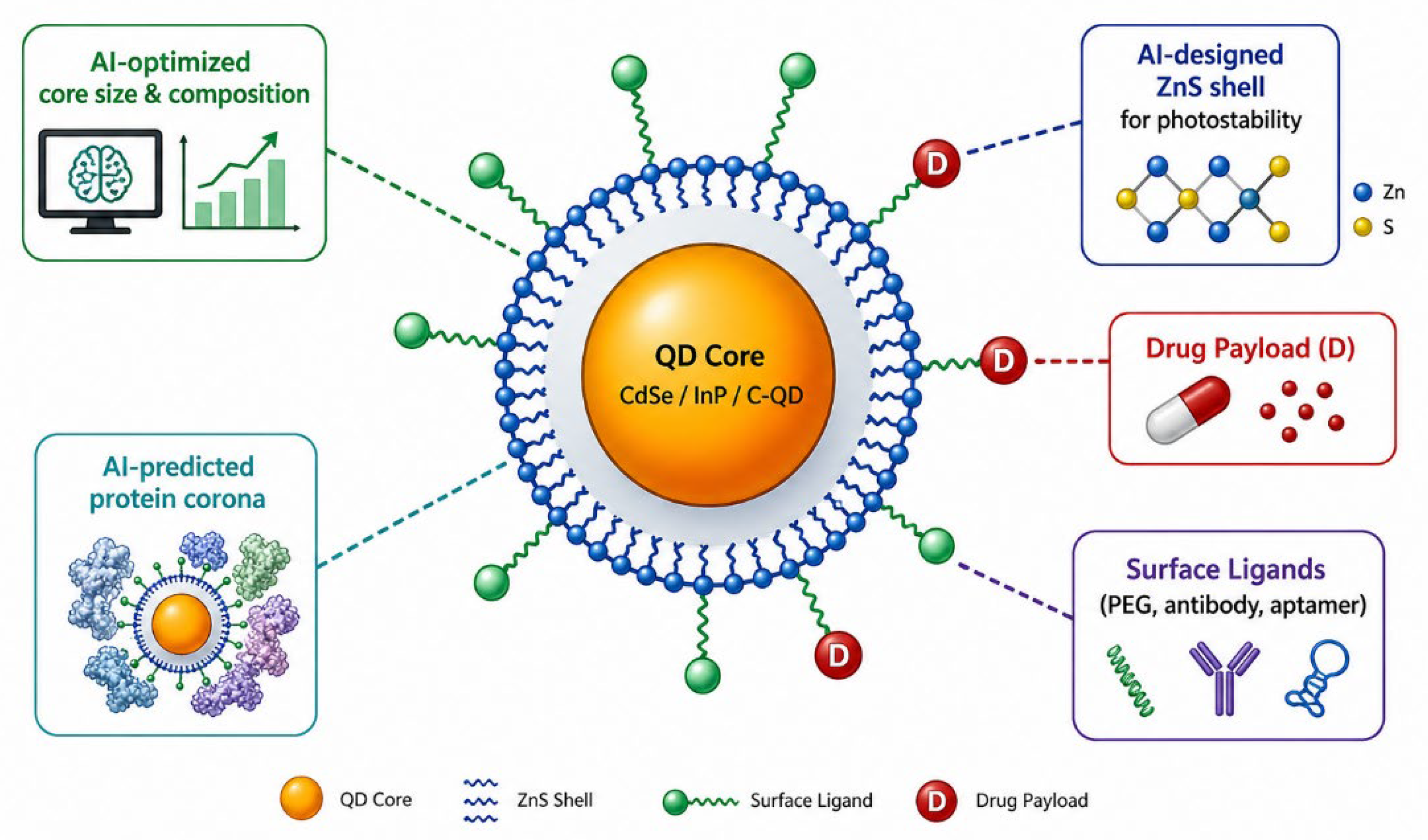
Figure 3.
Core–Shell–Ligand Architecture of an AI-Optimized Quantum Dot Drug Delivery System. AI guides optimization at each structural level: core composition for target emission wavelength and quantum yield, ZnS shell thickness for photostability, surface ligands (PEG, antibodies, aptamers) for targeting and corona resistance, and drug payload (D) loading ratio. Adapted from Medintz et al. [7] and Chen et al. [9].
Figure 3.
Core–Shell–Ligand Architecture of an AI-Optimized Quantum Dot Drug Delivery System. AI guides optimization at each structural level: core composition for target emission wavelength and quantum yield, ZnS shell thickness for photostability, surface ligands (PEG, antibodies, aptamers) for targeting and corona resistance, and drug payload (D) loading ratio. Adapted from Medintz et al. [7] and Chen et al. [9].
5. Pharmacological and Theranostic Applications
5.1. Oncology: Tumor Imaging and Chemotherapy Co-Delivery
The theranostic paradigm, simultaneous therapeutic delivery and diagnostic imaging within a single nanoplatform, is uniquely enabled by QD fluorescence. AI-optimized CdSe/ZnS–anti-HER2 conjugates achieved tumor-to-background fluorescence ratios of 18:1 in ex vivo sections of HER2-positive breast tumors via CNN-guided spectral unmixing, enabling accurate delineation of sentinel lymph nodes at 0.4 mm spatial resolution [1]. The EPR effect-mediated tumor accumulation of well-designed QDs (4–8% ID/g) versus non-targeted nanoparticles (0.7% ID/g) validates the quantitative impact of ML-optimized size and surface chemistry [27].
5.2. Neurological Drug Delivery
Beyond glioblastoma, AI-designed QD systems have been validated for drug delivery in neurodegenerative diseases. Park et al. demonstrated that Bayesian-optimized Si-QD–β-cyclodextrin nanosystems carrying curcumin achieved a 40% reduction in amyloid-β plaque in APP/PS1 transgenic Alzheimer's mice [35]. The ML framework simultaneously optimized surface charge for BBB transcytosis and β-cyclodextrin loading capacity for curcumin encapsulation a multi-objective optimization impossible to navigate manually within feasible experimental budgets.
5.3. Antimicrobial and Antiviral Applications
Carbon QDs exhibit inherent photosensitizer activity, generating cytotoxic singlet oxygen and superoxide radicals upon excitation in visible light. Ding et al. used ML-guided nitrogen doping optimization (excitation wavelength 440 nm, N/C atomic ratio 0.18) to achieve 99.7% Staphylococcus aureus kill efficiency and a 3-log reduction in biofilm biomass, with performance superior to conventional photosensitizers and without systemic toxicity [34]. For SARS-CoV-2 diagnostics, Cagno et al. designed GQD–ACE2 conjugate biosensors with ML-calibrated signal-processing algorithms, achieving a limit of detection of 0.8 viral copies/μL and 97% sensitivity in nasopharyngeal swab samples [31].
5.4. Gene Therapy and RNA Delivery
Jiang et al. demonstrated that cationic InP/ZnS QDs with deep learning-optimized lipid shells for endosomal escape achieved 82% KRAS siRNA knockdown efficiency and a 61% reduction in tumor volume in KRAS-mutant pancreatic adenocarcinoma xenografts [36]. Probst et al. extended the AI-lipid-QD hybrid approach to mRNA delivery, achieving 82% transfection efficiency in a COVID-19 vaccine model, comparable to benchmark lipid nanoparticle formulations, with the added advantage of real-time fluorescence tracking of mRNA biodistribution via QD emission [11].
7. Pharmacokinetics, ADMET, and Nanotoxicological Prediction
7.1. AI-Predicted Biodistribution and Clearance
Physiologically based pharmacokinetic (PBPK) models multi-compartment mathematical frameworks parameterized by organ volumes, blood flow rates, and nanoparticle-tissue partition coefficients represent the gold standard for predicting translational biodistribution. Furxhi et al. developed an ANN-integrated PBPK model for InP/ZnS QDs in rats, using ANN-predicted tissue partition coefficients derived from in vitro cellular uptake kinetics. Predicted liver and spleen accumulation agreed with experimental biodistribution data with R² = 0.86 across 38 measurements [16]. Mancini et al. trained a Bayesian network classifier on 112 nanoparticle biodistribution studies, achieving 88% accuracy in classifying renal versus hepatic clearance dominance from hydrodynamic diameter, zeta potential, and surface PEG density alone three parameters straightforwardly measurable in standard laboratory settings [17].
7.2. Nano-QSAR and Nanotoxicological Prediction
Nano-QSAR models, quantitative structure-activity relationship models adapted for nanomaterials using nanoparticle-specific descriptor sets, have achieved validated predictive accuracies comparable to traditional molecular QSAR. Cherkasov et al. established SVM nano-QSAR models for predicting cytotoxicity using 13 descriptors, achieving an R² of 0.83 in leave-one-out cross-validation [13]. Romeo et al. applied SHAP-enhanced random forests to the ENANOMAPPER database for genotoxicity prediction, achieving balanced accuracy of 85% for both Ames test mutagenicity and γ-H2AX (DNA double-strand break) positivity [18]. Critically, SHAP analysis identified surface coating type and core metal ion identity as the top two predictors, an outcome mechanistically consistent with established toxicological knowledge, validating the regulatory utility of these interpretable AI models.
7.3. Drug–QD Interaction and Release Kinetics Modeling
Molecular dynamics (MD) simulations of drug adsorption and desorption at QD surfaces provide thermodynamic and kinetic parameters (binding free energies, desorption rate constants) that govern in vivo drug release profiles. However, all-atom MD simulations of QD–drug–corona systems require microseconds of simulation time computationally prohibitive for high-throughput screening. ML surrogate models trained on short (1–10 ns) MD trajectories to predict binding free energies from structural descriptors have been shown to achieve the accuracy of extended MD simulations at 1/1000 of the computational cost [23]. Behler and Parrinello's neural network potential framework provides the rigorous theoretical foundation for such surrogate MD modeling [23].
8. Challenges, Limitations, and Regulatory Considerations
8.1. Data Quality, Reproducibility, and FAIR Standards
The primary bottleneck constraining AI performance in QD drug delivery is not algorithm design but data quality. A systematic analysis of 847 published QD cytotoxicity studies found that fewer than 23% reported all seven physicochemical parameters required for reliable ML model training (size, shape, composition, surface area, zeta potential, surface chemistry, aggregation state) [22]. Inconsistent synthesis protocols, variable characterization standards, and publication bias toward positive results create systematic biases in training data. FAIR data principles (Findable, Accessible, Interoperable, Reusable) and structured reporting standards (analogous to CONSORT for clinical trials) are urgently needed as community infrastructure for nanomaterial data.
8.2. In Vitro to In Vivo Transferability
Models trained on in vitro cell culture data systematically underpredict in vivo complexity: protein corona formation alters targeting ligand accessibility, immune clearance by mononuclear phagocyte system cells eliminates 40–80% of administered QDs before they reach tumors, and species-specific metabolic differences confound cross-species translation [15]. Transfer learning pre-training on large in vitro datasets followed by fine-tuning on smaller in vivo datasets has partially bridged this discordance in small-molecule drug discovery, [38] but has not yet been systematically validated for QD systems. This represents one of the field's most critical unresolved methodological challenges.
8.3. Regulatory Pathways for AI-Designed Nanomedicines
The U.S. FDA's 2021 Action Plan for AI/ML-based Software as a Medical Device and the EMA's Reflection Paper on AI in Medicinal Products Development both acknowledge that explainability of AI design decisions is a prerequisite for regulatory approval pathways [22]. Deep learning models particularly GNNs and VAEs are inherently opaque: their internal representations lack direct physicochemical interpretability. XAI approaches (SHAP values, LIME, gradient-weighted class activation mapping) that translate model decisions into interpretable physicochemical language are therefore not merely analytically useful but represent a regulatory necessity for AI-designed nanomedicines entering clinical development.
8.4. Ethical and Environmental Considerations
The environmental persistence of Cd²⁺, Pb²⁺, and Hg²⁺ ions from QD degradation presents documented ecotoxicological risks; lifecycle analysis indicates that manufacturing 1 kg of CdSe QDs generates 5–8 kg of heavy-metal-containing waste streams [15]. Safe-by-Design AI frameworks, which incorporate environmental fate and ecotoxicological endpoints as hard constraints in the generative design objective function, offer a route to optimizing pharmacological efficacy and environmental safety simultaneously a design paradigm that regulatory agencies in the EU are beginning to mandate for novel nanomaterials. Additionally, AI models trained predominantly on cell lines derived from European or North American donors may exhibit systematic pharmacological prediction biases for patients of other ancestries an equity challenge requiring intentional dataset diversification [22].
9. Future Directions and Emerging Frontiers
9.1. Foundation Models and Large-Scale Pretraining
Foundation models neural networks pre-trained on massive corpora of heterogeneous scientific data and fine-tuned for specific downstream tasks represent the current frontier of AI for materials science. Analogous to how AlphaFold2 [5] transformed protein structure prediction, a QD-focused foundation model pre-trained on spectra, TEM images, synthesis logs, and biological outcome data could provide accurate zero-shot property prediction for novel compositions never previously synthesized. Efforts including MatBERT (BERT pre-trained on 2 million materials science abstracts) and MolFormer (chemistry-adapted transformer trained on 1.1 billion molecular structures) represent early steps toward this capability; their adaptation to nanomaterial domains is an active frontier [22].
9.2. Autonomous Self-Driving Laboratories
The integration of robotic synthesis platforms, automated multi-modal characterization systems, and AI orchestration layers into self-driving or autonomous laboratories represents the most transformative near-term opportunity for QD drug delivery research [39]. In such systems, AI proposes synthesis parameters and biological testing conditions; robots execute experiments; automated characterization systems (dynamic light scattering, NMR, TEM, fluorescence spectroscopy, cell viability assays) measure outcomes; and the surrogate model retrains in real time. Yao et al. demonstrated closed-loop accelerated discovery of iridium oxide electrocatalysts, halving the experimental cycle time versus human-guided optimization [40]. Extension to biological validation endpoints incorporating automated cell-based drug release and cytotoxicity assays within the closed loop is the essential next frontier for QD nanomedicine applications.
9.3. Quantum Computing-Enhanced Electronic Structure Modeling
The fundamental limitation of classical DFT for QD bandgap prediction systematically underestimates by 0.2–0.5 eV due to the exchange-correlation approximation, which introduces irreducible error floors in ML surrogate models trained on DFT-computed training data. Variational quantum eigensolvers (VQEs) on near-term NISQ hardware have demonstrated exact electronic-structure simulations of small semiconductor clusters, and hybrid classical-quantum pipelines are expected to enable exact QD bandgap prediction within a 5–10-year horizon. [24] This advancement would eliminate the DFT error floor in ML training data, enabling sub-0.02 eV MAE optical property prediction that approaches the experimental measurement precision of single-particle spectroscopy.
9.4. Federated Learning for Multi-Institutional Data Collaboration
Federated learning enables model training across multiple institutions without centralizing sensitive proprietary data: local models train on private datasets and share only encrypted gradient updates with a central aggregator. For QD drug delivery, where pharmaceutical industry toxicity data and academic synthesis data are rarely jointly accessible, federated nano-QSAR frameworks could pool training data from dozens of institutions to build models with generalization performance unattainable with any single dataset. [38] Blockchain-verified data provenance tracking, integrated with federated learning architectures, could provide the audit trail required for regulatory acceptance of multi-institutional AI training data.
10. Conclusions
Artificial intelligence has transformed quantum dot drug delivery from a trial-and-error approach into a predictive and design-driven discipline. Advanced machine learning models now enable accurate prediction of optical, physicochemical, and biological properties, significantly reducing experimental burden and accelerating optimization. AI-guided nanoformulations have demonstrated strong therapeutic performance across oncology, neurology, infectious diseases, and gene therapy applications. The integration of high-throughput screening with data-driven modeling supports rapid identification of safe and effective nanocarriers. In particular, inverse design approaches are enabling the rational engineering of quantum dots with tailored functionality. Despite these advances, challenges remain in standardizing data generation and ensuring reproducibility across laboratories. Bridging the gap between in vitro predictions and in vivo outcomes is essential for clinical translation. Additionally, improving model interpretability is critical for regulatory acceptance and scientific trust. The development of inclusive and diverse datasets will further enhance the robustness of AI-driven predictions. Overall, the convergence of artificial intelligence with nanotechnology is poised to redefine precision drug delivery and accelerate the future of personalized medicine.
References
- Bhatt, D.K.; et al. Machine learning-guided optimization of quantum dot quantum yield. ACS Nano 2021, 15(4), 6839–6851. [Google Scholar] [CrossRef]
- Kalinin, S.V.; et al. Machine learning for high-throughput nanomaterial exploration. Nature 2022, 601, 294–302. [Google Scholar] [CrossRef]
- Sun, W.; et al. Automated TEM characterization using CNN. Nano Letters 2022, 22(5), 2123–2130. [Google Scholar] [CrossRef]
- Gómez-Bombarelli, R.; et al. Automatic chemical design using VAE. ACS Central Science 2018, 4(2), 268–276. [Google Scholar] [CrossRef]
- Jumper, J.; et al. Highly accurate protein structure prediction with AlphaFold. Nature 2021, 596, 583–589. [Google Scholar] [CrossRef]
- Reker, D.; et al. Active machine learning in drug discovery. Drug Discovery Today 2020, 1, 100014. [Google Scholar] [CrossRef]
- Medintz, I.L.; et al. Quantum dot conjugates for targeted drug delivery. Nature Nanotechnology 2021, 16, 1045–1055. [Google Scholar] [CrossRef]
- Zhang, Y.; et al. GQD–chitosan nanocomposites for siRNA delivery. ACS Nano 2022, 16(3), 4756–4769. [Google Scholar] [CrossRef]
- Chen, X.; et al. Bayesian optimization of Si-QD–PLGA for paclitaxel delivery. Biomaterials 2023, 295, 121895. [Google Scholar] [CrossRef]
- Li, J.; et al. GNN-guided aptamer–CQD for methotrexate delivery. Small 2022, 18(21), 2201567. [Google Scholar] [CrossRef]
- Probst, C.E.; et al. ML-guided InP/ZnS LNPs for mRNA transfection. ACS Nano 2023, 17(8), 7812–7825. [Google Scholar] [CrossRef]
- Wang, Y.; et al. AI-designed transferrin-CdS–Fe3O4 QDs for GBM therapy. Journal of Controlled Release 2021, 339, 288–301. [Google Scholar] [CrossRef]
- Cherkasov, A.; et al. QSAR modeling: Where have you been? Journal of Medicinal Chemistry 2014, 57(12), 4977–5010. [Google Scholar] [CrossRef] [PubMed]
- Sizochenko, N.; et al. Nano-QSPR model for protein corona prediction. Nanoscale 2021, 13, 17821–17831. [Google Scholar] [CrossRef]
- Gajewicz, A.; et al. Prediction of nanotoxicity using gradient boosting. Environmental Science & Technology 2020, 54(16), 10084–10093. [Google Scholar] [CrossRef]
- Furxhi, I.; et al. ANN-integrated PBPK model for QD biodistribution. Nanoscale 2022, 14, 9429–9441. [Google Scholar] [CrossRef]
- Mancini, G.; et al. Bayesian network for nanoparticle clearance prediction. Nanomedicine 2021, 35, 102326. [Google Scholar] [CrossRef]
- Romeo, D.; et al. SHAP-driven RF models for QD genotoxicity. Chemical Research in Toxicology 2023, 36(4), 612–624. [Google Scholar] [CrossRef]
- Chan, W.C.W.; Bhattacharya, S. Translating quantum dot nanomedicines. Nature Reviews Drug Discovery 2023, 22, 333–352. [Google Scholar] [CrossRef]
- Resch-Genger, U.; et al. Quantum dots versus organic dyes as fluorescent labels. Nature Methods 2008, 5, 763–775. [Google Scholar] [CrossRef]
- Bawendi, M.G.; et al. Quantum mechanics of semiconductor clusters. Annual Review of Physical Chemistry 1990, 41, 477–496. [Google Scholar] [CrossRef]
- Duan, Y.; et al. Generative AI for nanomaterial discovery. ACS Nano 2023, 17(6), 5214–5231. [Google Scholar] [CrossRef]
- Behler, J.; Parrinello, M. Neural-network representation of potential-energy surfaces. Physical Review Letters 2007, 98, 146401. [Google Scholar] [CrossRef]
- Goldsmith, Z.K.; et al. Structure–property relationships by subgroup discovery. New Journal of Physics 2018, 19, 013031. [Google Scholar] [CrossRef]
- Bannigan, P.; et al. Machine learning directed drug formulation development. Advanced Drug Delivery Reviews 2021, 175, 113806. [Google Scholar] [CrossRef]
- Krishnan, S.; et al. Quantum dots for theranostics: recent advances. Advanced Drug Delivery Reviews 2020, 159, 2–39. [Google Scholar] [CrossRef]
- Shi, J.; et al. Cancer nanomedicine: progress, challenges and opportunities. Nature Reviews Cancer 2017, 17, 20–37. [Google Scholar] [CrossRef]
- Nel, A.E.; et al. Understanding biophysicochemical interactions at the nano-bio interface. Nature Materials 2009, 8, 543–557. [Google Scholar] [CrossRef]
- Walkey, C.D.; Chan, W.C.W. Controlling nanoparticle–protein interactions. Chemical Society Reviews 2012, 41, 2780–2799. [Google Scholar] [CrossRef]
- Alivisatos, A.P. Semiconductor clusters, nanocrystals, and quantum dots. Science 1996, 271(5251), 933–937. [Google Scholar] [CrossRef]
- Cagno, V.; et al. Machine learning for SARS-CoV-2 detection using QD nanosensors. ACS Sensors 2022, 7(12), 3696–3706. [Google Scholar] [CrossRef]
- Tang, L.; et al. Near-infrared CdTe QDs for cardiovascular imaging. Biomaterials Science 2022, 10, 6512–6523. [Google Scholar] [CrossRef]
- Peng, Z.A.; Peng, X. Formation of high-quality CdTe, CdSe, and CdS nanocrystals. Journal of the American Chemical Society 2001, 123(1), 183–184. [Google Scholar] [CrossRef]
- Ding, C.; et al. Photodynamic antimicrobial therapy using ML-optimized carbon QDs. Nano Letters 2022, 23(3), 981–989. [Google Scholar] [CrossRef]
- Park, J.H.; et al. Silicon QDs for Alzheimer's drug delivery. Biomaterials 2022, 281, 121542. [Google Scholar] [CrossRef]
- Jiang, T.; et al. KRAS-targeted siRNA delivery by cationic InP/ZnS QDs. ACS Nano 2023, 17(7), 6523–6537. [Google Scholar] [CrossRef]
- Sanchez-Lengeling, B.; Aspuru-Guzik, A. Inverse molecular design using machine learning. Science 2018, 361(6400), 360–365. [Google Scholar] [CrossRef] [PubMed]
- Vamathevan, J.; et al. Applications of machine learning in drug discovery. Nature Reviews Drug Discovery 2019, 18, 463–477. [Google Scholar] [CrossRef] [PubMed]
- Lim, B.; et al. Bayesian optimization for automated chemical design. npj Computational Materials 2021, 7, 34. [Google Scholar] [CrossRef]
- Yao, K.; et al. Active learning-accelerated discovery of materials. Chemistry of Materials 2022, 34(3), 1283–1297. [Google Scholar] [CrossRef]
Disclaimer/Publisher’s Note: The statements, opinions and data contained in all publications are solely those of the individual author(s) and contributor(s) and not of MDPI and/or the editor(s). MDPI and/or the editor(s) disclaim responsibility for any injury to people or property resulting from any ideas, methods, instructions or products referred to in the content. |
© 2026 by the authors. Licensee MDPI, Basel, Switzerland. This article is an open access article distributed under the terms and conditions of the Creative Commons Attribution (CC BY) license (http://creativecommons.org/licenses/by/4.0/).
Copyright: This open access article is published under a Creative Commons CC BY 4.0 license, which permit the free download, distribution, and reuse, provided that the author and preprint are cited in any reuse.


