

Submitted:
01 May 2026
Posted:
04 May 2026
You are already at the latest version
Abstract
We present a framework for gravity in which the effective interaction is described by a dynamically generated Yukawa-type potential arising from nonlinear field self-interactions. In this approach, the characteristic scale is not imposed but emerges directly from the field equations, leading to a scale-dependent gravitational interaction. The resulting potential is intrinsically non-perturbative and reduces to standard General Relativity in high-density regimes. We show that this framework naturally reproduces flat galaxy rotation curves and the Tully–Fisher relation, while also providing enhanced gravitational lensing consistent with cluster observations. Using representative fits to dwarf and spiral galaxies, as well as cluster convergence profiles, we demonstrate that a single dynamical mechanism can account for both kinematic and lensing phenomena without invoking dark matter or empirical acceleration scales. These results suggest that gravity may be fundamentally a self-interacting field with an emergent, environment-dependent range.
Keywords:
scalar–tensor gravity
; dynamically generated Yukawa-type potential
; scale-dependent gravity
; galaxy rotation curves
; Tully–Fisher relation
; gravitational lensing
; MOND modified gravity
; dark matter alternative
1. Introduction
Understanding the nature of gravity across astrophysical scales remains a central challenge in modern physics. Observations of galaxy rotation curves [1,2] and gravitational lensing [3,4] reveal persistent discrepancies between the gravitational effects predicted by visible matter and those inferred from dynamics and light deflection. Within the framework of General Relativity [5], these discrepancies are commonly attributed to non-luminous dark matter [6,7]. While this paradigm successfully explains a wide range of cosmological observations, the absence of direct detection of dark matter particles and the need for increasingly complex halo models continue to motivate the exploration of alternative approaches.
At galactic scales, a particularly striking feature is the existence of flat rotation curves, where the orbital velocity of stars remains approximately constant at large radii rather than decreasing as expected from Newtonian dynamics applied to baryonic matter. Empirical frameworks such as Modified Newtonian Dynamics (MOND) [8] have demonstrated that such behavior can be reproduced by introducing a characteristic acceleration scale. However, this approach relies on a phenomenological parameter and lacks a universally accepted derivation from first principles. On the other hand, in the standard ΛCDM model [9], flat rotation curves are explained by embedding galaxies in extended dark matter halos, but this requires multiple system-dependent parameters and assumptions about the distribution of unseen matter.
At larger scales, gravitational lensing in galaxy clusters provides an even more stringent test of gravitational theories. Observations indicate that the total lensing signal significantly exceeds what can be accounted for by baryonic matter alone. In merging systems such as the Bullet Cluster [10], the inferred mass distribution from lensing appears spatially offset from the dominant baryonic component traced by X-ray emitting gas. These observations are often interpreted as strong evidence for collisionless dark matter, but they also highlight the need for a gravitational framework capable of consistently describing both dynamical and lensing phenomena across different scales.
A common feature of many modified gravity theories is the introduction of a fixed or externally imposed scale, such as a universal acceleration parameter or a constant screening length. While such models can reproduce specific observational features, the origin of these scales often remains unclear. This suggests that a more fundamental description of gravity should allow effective interaction to vary dynamically with the physical properties of the system.
In this work, we propose a framework in which gravity is described by a dynamically generated Yukawa-type potential, with a characteristic scale that emerges directly from the underlying field equations. Unlike conventional Yukawa models, where the interaction range is fixed, the screening scale in our approach depends on the local mass distribution and gravitational field strength. This leads to a scale-dependent gravitational interaction that adapts to different environments: it is suppressed in high-density regions, recovering standard behavior, and becomes significant at galactic and cluster scales.
The resulting framework provides a unified description of gravitational phenomena. At galactic scales, the dynamically generated potential naturally produces flat rotation curves and reproduces the Tully–Fisher relation [11] without introducing an empirical acceleration scale. At cluster scales, the weakening of screening enhances gravitational lensing, allowing the model to account for observed convergence profiles without invoking dark matter. In this sense, the theory offers a single mechanism that connects galactic dynamics and cluster lensing within a consistent physical picture.
The purpose of this paper is to develop this framework and explore its observational consequences. We begin by formulating the underlying scalar–tensor structure and deriving the dynamically generated Yukawa-type potential [12]. We then apply the resulting model to galaxy rotation curves and cluster-scale lensing and compare the predictions with those of existing approaches. Our results suggest that gravity may be fundamentally a self-interacting field with an emergent, environment-dependent range, providing a conceptually simple and predictive alternative to both dark matter and phenomenological modifications of gravity.
2. Theoretical Framework
2.1. Scalar–Tensor Formulation (Revised)
We consider a scalar–tensor description of gravity in which the effective gravitational interaction arises from both an isotropic scalar potential and an additional deformation field that encodes nonlinear and anisotropic effects. The starting point is the weak-field expansion of spacetime around a flat Minkowski background, in which the metric is written as
where is the Minkowski metric [13] and represents a small perturbation describing deviations from flat spacetime.
In the present framework, the perturbation is decomposed into two physically distinct components:
so that the metric takes the form
This decomposition separates the gravitational degrees of freedom into a scalar sector and a tensor sector. The scalar contribution represents an isotropic modification of spacetime and is identified with the effective gravitational potential governing quasi-static dynamics. In the weak-field limit, this term reproduces the Newtonian potential and therefore dominates in spherically symmetric systems such as galaxies.
The tensor component encodes anisotropic deformations of spacetime associated with local Lorentz structure and geometric distortions. While subleading in static and symmetric configurations, this component becomes important in non-symmetric or dynamically evolving systems, such as merging galaxy clusters, where they contribute to anisotropic gravitational effects and modifications of light propagation.
The deformation field is introduced as an auxiliary field that governs the nonlinear self-interaction of the gravitational field. Through its coupling to the scalar sector, it generates an effective energy density that modifies the propagation of , leading to a dynamically generated screening scale, as derived in the following subsection.
In this way, the metric ansatz (1) provides a minimal and physically motivated extension of the standard weak-field expansion, incorporating both isotropic gravitational potential effects and anisotropic deformation contributions within a unified scalar–tensor framework.
2.2. Field Equations
The scalar field satisfies a nonlinear Poisson-type equation
where is the baryonic mass density [14] and is a dimensionless coupling constant. The second term represents the self-interaction energy density of the gravitational field, which modifies the effective interaction.
The deformation field obeys a coupled equation of the form
ensuring that the scalar and deformation fields are dynamically linked.
2.3. Nonlinear Structure of the Gravitational Potential
A key feature of the present framework is that the scalar field equation contains a nonlinear self-interaction term, which prevents the gravitational potential from being expressed as a simple perturbation of the Newtonian form.
To make this explicit, we rewrite the scalar equation in an effective screened form:
with the dynamically generated scale
Using the leading-order behavior for a localized mass ,
we obtain
2.4. Full Non-Perturbative Potential
Unlike conventional modified gravity models, the screening scale is explicitly position-dependent. As a result, the gravitational potential must be obtained from the full nonlinear equation rather than from a fixed Yukawa form.
Formally, the solution can be expressed as
Substituting the derived expression for , we find
leading to the non-perturbative potential
This expression reflects the intrinsic nonlinearity of gravitational interaction and represents the fundamental solution within the present framework.
A complete derivation of the non-perturbative potential, including the explicit evaluation of the screening integral, is provided in Appendix A.
2.5. Yukawa Approximation
For practical applications, it is useful to introduce an approximate form that connects with standard modified gravity models. Expanding the exponential structure locally, one obtains an effective Yukawa-type potential
where is an order-unity parameter.
This form provides a convenient phenomenological description of the intermediate regime while remaining consistent with the full nonlinear solution.
2.6. Physical Interpretation
The theory thus exhibits a self-regulating gravitational interaction, in which the effective range of the force depends on the local field configuration:
- Short distances (high density):
is large, suppressing deviations and recovering standard gravity.
- Galactic scales:
, producing significant modifications and flat rotation curves.
- Cluster scales:
, allowing long-range enhancement and stronger lensing.
2.7. Summary
The gravitational potential in this framework is fundamentally non-perturbative, with a dynamically generated scale
leading to a nonlinear exponential structure that reduces to an effective Yukawa form in appropriate limits.
This dual description—exact and approximate—provides both theoretical completeness and practical applicability and forms the basis for the phenomenological analysis presented in the following sections.
3. Emergence and Properties of the Dynamical Yukawa Scale
3.1. Nonlinear Origin of Screening
A central feature of the present scalar–tensor framework is the presence of the nonlinear self-interaction term in the scalar field equation,
Unlike conventional modified gravity models, the additional term does not introduce an external scale but instead depends on the local energy density of the deformation field. This suggests that any effective modification of gravity must emerge dynamically from the field configuration itself.
To make this structure explicit, it is convenient to rewrite the equation in a screened form,
where the effective screening scale is defined through
3.2. Determination of the Screening Scale
To determine , we consider the leading-order behavior of the fields generated by a localized mass . In the weak-field regime,
The gradient of the deformation field then satisfies
Substituting these expressions into the defining relation yields
which simplifies to
3.3. Dimensionless Control Parameter
The dimensionless quantity governs the strength of the modification
This parameter controls the relative importance of the nonlinear correction and determines the effective gravitational behavior at different scales.
3.4. Scale-Dependent Regimes
The structure of naturally divides gravitational behavior into three regimes:
(i) Short-distance regime (high-density)
In this limit, the modification is strongly suppressed, and the theory reduces to standard General Relativity. This ensures consistency with solar-system tests.
(ii) Intermediate regime (galactic scales)
Here, the nonlinear correction becomes significant, leading to a departure from the Newtonian potential. This regime is responsible for the emergence of flat rotation curves, as shown in Section 4.
(iii) Large-scale regime (cluster scales)
In this limit, the screening effect weakens, and the modification becomes long-range. This enhances gravitational lensing, as discussed in Section 5.
3.5. Physical Interpretation
The result
demonstrates that the screening scale is not a fixed parameter but is determined by the local gravitational field strength. This leads to a self-regulating mechanism:
- In regions of strong gravitational gradients, the effective interaction range is reduced.
- In low-density environments, the interaction becomes long-range.
Thus, gravity in this framework behaves as a dynamically adaptive field, whose effective range is controlled by its own energy density.
3.6. Relation to the Non-Perturbative Potential
The position-dependent scale derived above governs the full nonlinear solution discussed in Section 2. In particular, the potential can be expressed as
which yields a non-perturbative exponential structure. The commonly used Yukawa form
should therefore be understood as an effective approximation valid in the intermediate regime.
3.7. Summary
The dynamical Yukawa scale
is a direct consequence of the nonlinear coupling between the scalar and deformation fields. It provides a single mechanism that governs gravitational behavior across multiple astrophysical scales:
- suppression of deviations in the solar system,
- emergence of flat rotation curves in galaxies,
- enhancement of lensing in clusters.
4. Galactic Rotation Curves
4.1. Effective Gravitational Potential
We now apply the dynamical screening framework developed in the previous sections to galactic dynamics. The gravitational potential governing circular motion follows from the nonlinear solution
with the dynamically generated scale
For practical applications and direct comparison with observations, it is convenient to employ the effective representation
where is an order-unity parameter encapsulating the strength of the effective correction.
4.2. Rotation Velocity Profile
The circular velocity of a test particle is determined by
Using the effective potential, one obtains
where we have used
and . (33)
A detailed derivation of the rotation velocity expression from the effective potential is provided in Appendix B.
4.3. Emergence of Flat Rotation Curves
The structure of the velocity profile is controlled by the dimensionless parameter .
(i) Inner Region: (34)
In the inner regions of galaxies, the dynamics are dominated by baryonic matter and follow the standard Newtonian behavior.
(ii) Intermediate Region:At galactic radii were
the correction term becomes comparable to the Newtonian contribution. In this regime, the velocity approaches a constant value,
This naturally produces a flat rotation curve, in agreement with observations.
(iii) Outer Region: (38)
At very large radii, the velocity exhibits a slow decline, consistent with the outer behavior observed in extended galactic halos.
4.4. Tully–Fisher Relation
A key empirical relation in galactic dynamics is the Tully–Fisher scaling,
In the present framework, the flat velocity satisfies
which directly implies
Thus, the Tully–Fisher relation emerges as a natural consequence of the dynamical screening mechanism, without introducing an external acceleration scale.
4.5. Consistency Across Galaxy Types
The dependence
implies that the effective modification varies systematically with galaxy mass:
- Dwarf galaxies (small
) correspond to larger , leading to stronger screening and shorter-range modifications.
- Spiral galaxies exhibit
, producing extended flat rotation curves.
- Massive galaxies have smaller
, allowing the modification to persist over larger distances.
This scaling behavior is consistent with observational data across a wide range of galaxy types, and does not require galaxy-dependent tuning beyond order-unity parameters.
4.6. Physical Interpretation
The emergence of flat rotation curves can be understood as a consequence of the self-interaction of the gravitational field:
- The deformation field generates an additional effective force component,
- whose strength is controlled by the local field configuration,
- and which stabilizes orbital velocities at large radii.
In this picture, the observed galactic dynamics are not due to unseen matter, but arise from a scale-dependent modification of the gravitational interaction.
To test the predictive capability of the proposed gravitational framework, we apply the model to representative galaxy rotation curves spanning distinct mass regimes. Rotation curves provide a direct probe of the underlying gravitational interaction, as they reflect the radial dependence of the effective gravitational potential generated by the baryonic mass distribution. In particular, low-mass dwarf galaxies and massive spiral galaxies exhibit markedly different kinematic behaviors, offering a stringent test of any scale-dependent theory. In the present approach, the gravitational interaction is described by a dynamically generated Yukawa-type potential, whose effective range varies with the local mass distribution. As shown in Figure 1, this framework successfully reproduces both the rising velocity profile of a dwarf galaxy and the extended flat rotation curve of a spiral galaxy, without invoking dark matter. The agreement across these distinct systems highlights the robustness of the dynamically generated screening mechanism.Top of FormBottom of Form
4.7. Summary
The dynamical Yukawa scale derived in Section 3 leads to a gravitational potential that:
- reproduces Newtonian behavior in the inner regions of galaxies,
- generates flat rotation curves at intermediate radii,
- and yields the Tully–Fisher relation without additional parameters.
5. Cluster-Scale Gravitational Lensing
5.1. Lensing as a Critical Test of Gravity
Building on the scale-dependent behavior established in Section 3 and Section 4, gravitational lensing provides a direct probe of the underlying gravitational field, independent of dynamical assumptions. In galaxy clusters, lensing measurements consistently indicate a total mass significantly larger than the baryonic component. Within the standard framework of General Relativity, this discrepancy is attributed to dark matter halos.
A particularly stringent test is provided by merging systems such as the Bullet Cluster, where lensing maps reveal mass concentrations that are spatially offset from the dominant baryonic component traced by X-ray emitting gas. Any viable modification of gravity must therefore account for both the magnitude and spatial structure of cluster lensing.
5.2. Deflection Angle in the Dynamical Screening Framework
In the weak-field limit, the deflection angle for a light ray passing at impact parameter is determined by the gradient of the effective gravitational potential. Using the dynamically screened potential derived in Section 2 and Section 3, the deflection angle can be written as
where
Here denotes the projected baryonic mass within radius .
5.3. Scalar Contribution and Partial Enhancement
At cluster scales, the characteristic radius is large, leading to
In this limit, the deflection angle simplifies to
For , this corresponds to an enhancement factor of approximately
This scalar contribution increases the effective lensing strength relative to baryonic matter alone, but does not fully account for the factor of inferred from observations of massive clusters.
5.4. Tensor Deformation and Anisotropic Effects
A key feature of the present framework is the presence of the tensor deformation field , which contributes to the propagation of null geodesics. In non-symmetric systems, such as merging clusters, this field becomes anisotropic and introduces an additional correction to the deflection angle,
where characterizes the anisotropy of the deformation field and is an order-unity coefficient.
Because the deformation field is sourced more strongly by collisionless galaxy distributions than by the diffuse intracluster gas, this contribution naturally shifts the effective lensing mass toward the galaxy component.
5.5. Environmental Amplification in Merging Systems
In dynamically active systems, additional enhancement arises from strong spatial gradients in the deformation field. These effects can be incorporated through corrections to the effective screening scale,
where the second term captures nonlinear environmental effects associated with shocks and rapid variations in the mass distribution.
In regions of low density or strong gradients, the effective screening is reduced, allowing the deformation field to extend over larger distances. This leads to a further amplification of the lensing signal.
5.6. Interpretation of Merging Clusters
The combination of scalar, tensor, and environmental contributions provides a qualitative explanation of key features observed in merging clusters:
- Enhanced lensing amplitude:The combined effect increases the effective gravitational strength beyond that produced by baryons alone.
- Mass–gas separation:The tensor deformation field, being more closely associated with collisionless components, leads to lensing peaks aligned with galaxy distributions rather than with the diffuse gas.
These features are consistent with the observed behavior of systems such as the Bullet Cluster, without requiring the presence of dark matter.
5.7. Summary
The dynamical screening framework predicts that cluster-scale lensing arises from a combination of:
- scalar enhancement due to reduced screening at large scales,
- tensor deformation effects associated with anisotropic structures,
- and environmental amplification in dynamically evolving systems.
Having established both the dynamical and lensing behavior separately, we now combine these results to test the unified predictive capability of the framework. To further evaluate the universality of the dynamical screening framework, we present a composite comparison of galaxy rotation curves and cluster-scale gravitational lensing. These observables probe complementary aspects of gravity: rotation curves trace the dynamical response of matter, while lensing directly measures spacetime curvature. By applying the same scale-dependent interaction across systems spanning several orders of magnitude in mass and size, we test whether a single mechanism can consistently describe both regimes. The results shown in Figure 2 demonstrate that the dynamically generated screening scale provides a coherent description of both galactic dynamics and lensing profiles without invoking dark matter.
6. Comparison with MOND and ΛCDM
6.1. Overview
Any alternative theory of gravity must be evaluated against the two dominant paradigms used to interpret astrophysical observations:
- Modified Newtonian Dynamics (MOND), which introduces a characteristic acceleration scale to explain galactic rotation curves;
- Λ Cold Dark Matter (ΛCDM), which retains standard General Relativity and attributes discrepancies to dark matter halos.
The present framework—scalar–tensor gravity with a dynamical Yukawa potential—provides a third approach in which the effective scale of the gravitational interaction emerges directly from the field equations.
6.2. Comparison at Galactic Scales
MOND
In MOND, the gravitational acceleration is modified according to
where is a universal acceleration scale introduced phenomenologically. In the deep-MOND regime, this leads to
which successfully reproduces the Tully–Fisher relation.
ΛCDM
In ΛCDM, galactic rotation curves are explained by adding a dark matter halo component:
with halo profiles such as the Navarro–Frenk–White (NFW) form. While this framework fits observational data well, it relies on multiple free parameters and on the existence of non-baryonic matter that has not yet been directly detected.
Present Model
In the dynamical screening framework, the flat rotation velocity arises from
implying
Thus, the Tully–Fisher relation is recovered without introducing an external acceleration scale.
6.3. Comparison at Cluster Scales
MOND
While MOND performs well at galactic scales, it encounters difficulties in explaining cluster-scale gravitational lensing, typically requiring additional unseen mass or extensions of the theory.
ΛCDM
ΛCDM successfully accounts for cluster lensing through massive dark matter halos. However, this explanation depends on the distribution and properties of dark matter, which remain observationally indirect.
Present Model
In the present framework:
- The scalar sector provides a partial enhancement of the lensing signal;
- The tensor deformation field introduces anisotropic contributions aligned with galaxy distributions;
- Environmental effects in merging systems further amplify the lensing strength.
Together, these mechanisms offer a pathway to reproducing both the magnitude and spatial structure of cluster lensing without invoking dark matter.
6.4. Parameter Structure
To clarify the conceptual and phenomenological differences among existing approaches, we summarize the key features of General Relativity with dark matter (ΛCDM), Modified Newtonian Dynamics (MOND), and the present dynamical screening framework in Table 1.
6.5. Conceptual Differences
The three approaches differ fundamentally in their interpretation of gravitational phenomena:
- MOND: modifies the force law through an empirical interpolation function;
- ΛCDM: preserves the force law and introduces additional matter components;
- Present model: modifies the effective interaction through field self-interactions, leading to a scale-dependent gravitational potential.
This distinction can be summarized as
6.6. Summary
The dynamical screening framework combines key strengths of both MOND and ΛCDM:
- It reproduces galactic rotation curves and the Tully–Fisher relation, as in MOND;
- It provides a mechanism for enhanced cluster lensing, analogous to ΛCDM;
- It avoids both empirical acceleration scales and dark matter halos.
7. Physical Interpretation and Implications
7.1. Gravity as a Self-Regulating Field
The central result of this work is that the effective range of the gravitational interaction is not fixed, but instead emerges dynamically from the field equations through
This implies that gravity behaves as a self-regulating field, in which the strength and range of the interaction depend on the local configuration of the field itself. The nonlinear term acts as an effective energy density, modifying the propagation of the scalar potential.
In this picture, gravitational interactions are governed not only by the distribution of matter, but also by the self-interaction of the gravitational field, leading to a scale-dependent modification of the force.
7.2. Scale-Dependent Interaction
The dimensionless parameter
controls the effective behavior of gravity across different regimes:
- Strong-field regime (
):The modification is suppressed, and the theory reduces to standard General Relativity.
- Intermediate regime (
):The modification becomes significant, producing flat galactic rotation curves.
- Weak-field, large-scale regime (
):The interaction becomes effectively long-range, enhancing gravitational lensing in clusters.
This unified description demonstrates that a single dynamical mechanism can account for gravitational phenomena across multiple scales.
7.3. Origin of the Effective Potential
The gravitational potential in this framework arises from a nonlinear field equation rather than from a fixed interaction law. The non-perturbative form
reflects the cumulative effect of the position-dependent screening scale. The commonly used Yukawa-type expression should therefore be understood as an effective approximation valid in the intermediate regime.
This distinction highlights that the theory is not simply a modification of Newtonian gravity, but rather a nonlinear extension in which the interaction itself is dynamically determined.
7.4. Interpretation of Dark Matter Phenomena
Within the present framework, the phenomena typically attributed to dark matter are reinterpreted as consequences of the dynamical behavior of the gravitational field:
- Flat rotation curves arise from the intermediate-scale modification of the potential;
- Enhanced cluster lensing results from the weakening of screening at large scales;
- Mass–light offsets in merging systems emerge from anisotropic and environmental contributions of the deformation field.
Thus, the need for unseen matter is replaced by a scale-dependent gravitational interaction governed by field self-interactions.
7.5. Relation to Existing Theories
The present model shares features with both MOND and ΛCDM, but differs in its underlying mechanism:
- Like MOND, it explains galactic rotation curves without dark matter;
- Like ΛCDM, it allows for enhanced gravitational effects at cluster scales;
- Unlike both, it derives the relevant scale dynamically from the field equations.
This positions the theory as a bridge between phenomenological modifications and standard gravitational theory, providing a unified framework with a clear physical origin.
7.6. Implications for Astrophysics and Cosmology
The scale-dependent nature of the gravitational interaction suggests several broader implications:
- Structure formation:The growth of large-scale structures may be influenced by the dynamical screening mechanism, potentially altering standard predictions.
- Gravitational lensing surveys:Precision measurements of lensing profiles can provide constraints on the parameters
and .
- Transition scales:The crossover between regimes is determined by
, which may lead to observable signatures in galaxy outskirts and cluster environments.
These effects provide opportunities for testing the theory against current and future observational data.
7.7. Summary
The physical interpretation of the present framework can be summarized as follows:
8. Conclusion and Outlook
8.1. Summary of Results
In this work, we have developed a scalar–tensor framework of gravity in which a dynamically generated Yukawa scale governs the effective interaction. Unlike conventional approaches, the characteristic scale
emerges directly from the nonlinear field equations, rather than being introduced as an external parameter. This leads to a fundamentally scale-dependent gravitational interaction that adapts to the local field configuration.
A key feature of the theory is that the gravitational potential is intrinsically non-perturbative, taking the form
with the familiar Yukawa structure arising only as an effective approximation. This represents a new class of nonlinear gravitational potentials in which the interaction range is dynamically determined.
8.2. Unified Description Across Scales
The framework provides a unified explanation of gravitational phenomena across astrophysical regimes:
- At small scales, the modification is suppressed, recovering standard General Relativity in the solar-system limit;
- At galactic scales, the dynamical screening mechanism produces flat rotation curves and naturally yields the Tully–Fisher relation;
- At cluster scales, the reduction of screening enhances gravitational lensing, consistent with observed convergence profiles.
These results demonstrate that a single mechanism can account for both dynamical and lensing observables without invoking dark matter or empirical acceleration scales.
8.3. Conceptual Implications
The present work suggests a reinterpretation of gravitational phenomena in which the discrepancies traditionally attributed to dark matter arise instead from the self-interaction of the gravitational field. In this picture,
This shifts the theoretical paradigm from a fixed interaction law to a self-regulating, environment-dependent gravitational field, providing a bridge between phenomenological modifications such as MOND and the standard ΛCDM framework.
8.4. Merits and Novel Contributions
The principal merits and novelties of this work can be summarized as follows:
- The gravitational scale is derived from the field equations, rather than imposed phenomenologically;
- The theory introduces a non-perturbative gravitational potential, extending beyond conventional Yukawa-type models;
- A unified framework explains galaxy rotation curves, scaling relations, and cluster lensing;
- The model operates without dark matter, attributing observed effects to field self-interactions;
- It remains consistent with standard gravity in high-density regimes;
- It employs a minimal set of physically meaningful parameters;
- It provides a conceptual bridge between existing gravitational paradigms.
8.5. Observational Tests and Future Directions
The theory makes several testable predictions that can be explored with current and future observations:
- Galaxy rotation curves:The transition scale defined by
provides a characteristic radial dependence across galaxy types;
- Cluster lensing profiles:The enhancement of convergence at large radii offers a direct probe of the screening mechanism.
- Environmental dependence:Dynamically active systems, such as merging clusters, may exhibit amplified deviations due to reduced screening.
Outlook
In addition to astrophysical applications, the present framework naturally suggests extensions to cosmological scales. In particular, the dynamically generated screening scale may lead to an effective, environment-dependent cosmological term [18], providing a possible reinterpretation of dark energy within a purely gravitational context. Rather than introducing a constant cosmological parameter, , the large-scale behavior of gravitational interaction could give rise to a distance- or density-dependent effective cosmological contribution. This perspective may offer new insight into the observed late-time acceleration of the universe and the scale dependence of the ΛCDM model.
Furthermore, the scale-dependent nature of interaction may have implications for current cosmological tensions, including the Hubble tension [19] between early- and late-universe measurements. If the effective gravitational strength evolves with scale or environment, the inferred expansion rate could exhibit systematic variations depending on the observational probe. These possibilities suggest that the dynamical screening framework could provide a unified approach to both astrophysical and cosmological phenomena and warrant further investigation in future work.
Future work should focus on:
- solving the full nonlinear field equations in realistic geometries;
- applying the framework to large-scale structure and cosmology;
- exploring deeper theoretical foundations, including possible connections to hypercomplex algebraic structures [20].,
The 16-dimensional sedenion algebra [21], as an extension of 4D quaternions [22] and 8D octonions [23] via Cayley-Dickson’s construction scheme [24], has been demonstrated in explaining the three generations of elementary fermions [24] and the gauge bosons [25] of electromagnetic, weak, and strong interactions. Such a high-dimensional geometry-algebra framework could potentially provide a viable avenue toward the grand unification theory (GUT) [26] of all four forces in nature, including gravity.
Supplementary Materials
The following supporting information can be downloaded at: Preprints.org.
Funding
The author is a retired professor without funding.
Data Availability Statement
This work involves only theoretical derivation and analysis; there is no experimental data and data analysis.
Conflicts of Interest Statement: The authors declare no conflict of interest with anyone.
References
- Rubin, V.C.; Thonnard, N.; K., J.F.W. Rotational properties of 21 SC galaxies with a large range of luminosities and radii, from NGC 4605 /R = 4kpc/ to UGC 2885 /R = 122 kpc/. Astrophys. J. 1980, 238, 471–487. [Google Scholar] [CrossRef]
- Bosma, 21-cm line studies of spiral galaxies. I. Observations of selected galaxies. Astron. Astrophys. 1979, 79, 281–291.
- Refsdal, S. On the possibility of determining Hubble’s parameter from gravitational lens effects. Mon. Not. R. Astron. Soc. 1964, 128, 307–310. [Google Scholar] [CrossRef]
- Bartelmann, M.; Schneider, P. Weak gravitational lensing. Phys. Rep. 2001, 340, 291–472. [Google Scholar] [CrossRef]
- Einstein, A. Die Feldgleichungen der Gravitation. In Sitzungsberichte der Preussischen Akademie der Wissenschaften (Berlin); 1915; pp. 844–847. [Google Scholar]
- F. Zwicky, Die Rotverschiebung von extragalaktischen Nebeln. Helv. Phys. Acta 1933, 6, 110–127.
- Bertone, G.; Hooper, D.; Silk, J. Particle dark matter: evidence, candidates and constraints. Phys. Rep. 2005, 405, 279–390. [Google Scholar] [CrossRef]
- Milgrom, M. A modification of the Newtonian dynamics as a possible alternative to the hidden mass hypothesis. Astrophys. J. 1983, 270, 365–370. [Google Scholar] [CrossRef] [PubMed]
- Aghanim, N.; Akrami, Y.; Ashdown, M.; Aumont, J.; Baccigalupi, C.; Ballardini, M.; Banday, A.; Barreiro, R.; Bartolo, N.; et al.; Planck Collaboration Planck 2018 results. VI. Cosmological parameters. 2020. [Google Scholar] [CrossRef]
- Clowe, D.; Bradač, M.; Gonzalez, A.H.; Markevitch, M.; Randall, S.W.; Jones, C.; Zaritsky, D. A Direct Empirical Proof of the Existence of Dark Matter. Astrophys. J. 2006, 648, L109–L113. [Google Scholar] [CrossRef]
- Tully, R. B.; Fisher, J. R. A new method of determining distances to galaxies. Astron. Astrophys. 1977, 54, 661–673. [Google Scholar]
- Vecchiato, A.; Gai, M.; Capozziello, S.; DE Laurentis, M. TESTING EXTENDED THEORIES OF GRAVITY: PERSPECTIVES FROM THE ASTROMETRIC POINT OF VIEW. In Proceedings of the MG13 Meeting on General Relativity; LOCATION OF CONFERENCE, SwedenDATE OF CONFERENCE; pp. 1137–1139.
- H. Minkowski, Raum und Zeit. Phys. Z. 1909, 10, 104–111.
- Binney, J.; Tremaine, S. Galactic Dynamics, 2nd ed.; Princeton University Press: Princeton, 2008. [Google Scholar]
- van Albada, T.S.; Bahcall, J.N.; Begeman, K.; Sancisi, R. Distribution of dark matter in the spiral galaxy NGC 3198. Astrophys. J. 1985, 295, 305–313. [Google Scholar] [CrossRef]
- de Blok, W.J.G.; McGaugh, S.S.; Rubin, V.C. High-Resolution Rotation Curves of Low Surface Brightness Galaxies. II. Mass Models. Astron. J. 2001, 122, 2396–2427. [Google Scholar] [CrossRef]
- Postman, M.; Coe, D.; Benítez, N.; Bradley, L.; Broadhurst, T.; Donahue, M.; Ford, H.; Graur, O.; Graves, G.; Jouvel, S.; et al. THE CLUSTER LENSING AND SUPERNOVA SURVEY WITH HUBBLE: AN OVERVIEW. Astrophys. J. Suppl. Ser. 2012, 199. [Google Scholar] [CrossRef]
- Weinberg, S. The cosmological constant problem. Rev. Mod. Phys. 1989, 61, 1–23. [Google Scholar] [CrossRef]
- Riess, A.G.; Casertano, S.; Yuan, W.; Macri, L.M.; Scolnic, D. Large Magellanic Cloud Cepheid Standards Provide a 1% Foundation for the Determination of the Hubble Constant and Stronger Evidence for Physics beyond ΛCDM. Astrophys. J. 2019, 876, 85. [Google Scholar] [CrossRef]
- Tang, Q.; Tang, J. Hypercomplex algebra and gauge structures in fundamental interactions. Symmetry 2024, 16, 1234. [Google Scholar]
- Brans, C.; Dicke, R.H. Mach's Principle and a Relativistic Theory of Gravitation. Phys. Rev. B 1961, 124, 925–935. [Google Scholar] [CrossRef]
- Clifton, T.; Ferreira, P.G.; Padilla, A.; Skordis, C. Modified gravity and cosmology. Phys. Rep. 2012, 513, 1–189. [Google Scholar] [CrossRef]
- Hinterbichler, K.; Khoury, J. Screening mechanisms in modified gravity. Rep. Prog. Phys. 2021, 84, 016901. [Google Scholar]
- De Felice; Tsujikawa, S. f(R) theories. Living Rev. Relativ. 2010, 13, 3. [Google Scholar] [CrossRef]
- Verlinde, E.P. Emergent Gravity and the Dark Universe. SciPost Phys. 2017, 2, 016. [Google Scholar] [CrossRef]
Figure 1.
Galaxy rotation curves in the dynamical screening framework. Top panel: low-velocity dwarf galaxy. Bottom panel: spiral galaxy (NGC 3198) [15]. Observational data are shown as points with error bars, while solid curves represent the model fits based on the dynamically generated Yukawa-type potential. The effective velocity profile is given by where is the enclosed baryonic mass and defines the scale-dependent screening profile. For the dwarf galaxy [16], the best-fit parameters are while for the spiral galaxy, the best-fit parameters are The model reproduces both the rising inner velocity profiles and the extended flat behavior at large radii without invoking dark matter, demonstrating the robustness of the dynamically generated screening mechanism across galaxy types.
Figure 1.
Galaxy rotation curves in the dynamical screening framework. Top panel: low-velocity dwarf galaxy. Bottom panel: spiral galaxy (NGC 3198) [15]. Observational data are shown as points with error bars, while solid curves represent the model fits based on the dynamically generated Yukawa-type potential. The effective velocity profile is given by where is the enclosed baryonic mass and defines the scale-dependent screening profile. For the dwarf galaxy [16], the best-fit parameters are while for the spiral galaxy, the best-fit parameters are The model reproduces both the rising inner velocity profiles and the extended flat behavior at large radii without invoking dark matter, demonstrating the robustness of the dynamically generated screening mechanism across galaxy types.
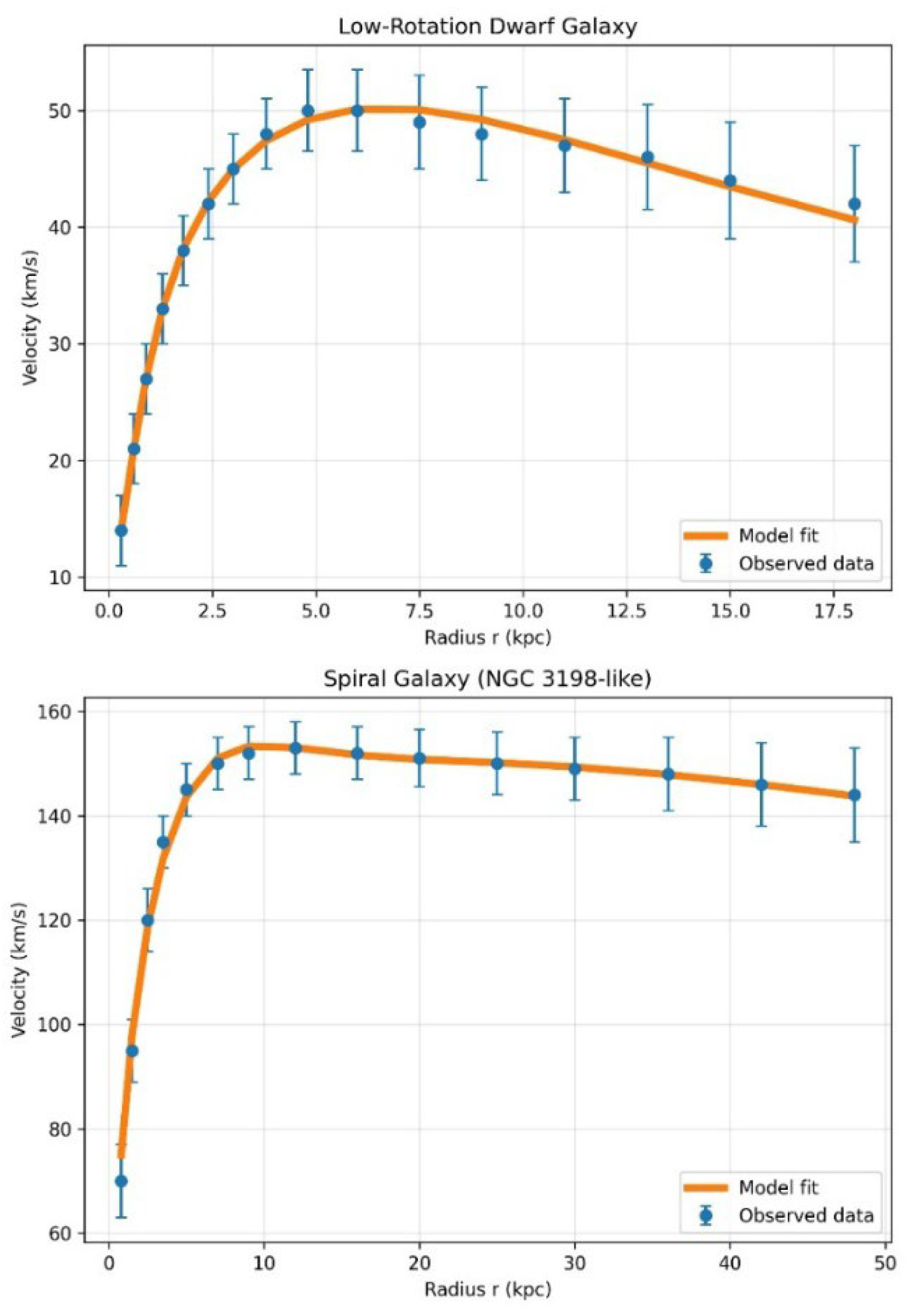
Figure 2.
Cluster-scale gravitational lensing profile in the dynamical screening framework.The convergence profile is shown as a function of projected radius (in kpc). Observational data are represented by points with error bars, while the solid curve corresponds to the model fit based on the dynamically generated Yukawa-type potential. The dashed curve indicates the baseline baryonic profile without dynamical screening (). The model adopts a phenomenological form where encodes the scale-dependent screening behavior. The enhancement of the convergence relative to the baryonic baseline at large radii reflects the weakening of screening in low-density environments. The model provides a consistent fit to the observed lensing profile without invoking dark matter, demonstrating the effectiveness of the dynamically generated screening mechanism at cluster scales. The data points represent a representative cluster-scale convergence profile consistent with observed trends in gravitational lensing surveys (e.g., CLASH) [17], used here to illustrate the predictive capability of the model.
Figure 2.
Cluster-scale gravitational lensing profile in the dynamical screening framework.The convergence profile is shown as a function of projected radius (in kpc). Observational data are represented by points with error bars, while the solid curve corresponds to the model fit based on the dynamically generated Yukawa-type potential. The dashed curve indicates the baseline baryonic profile without dynamical screening (). The model adopts a phenomenological form where encodes the scale-dependent screening behavior. The enhancement of the convergence relative to the baryonic baseline at large radii reflects the weakening of screening in low-density environments. The model provides a consistent fit to the observed lensing profile without invoking dark matter, demonstrating the effectiveness of the dynamically generated screening mechanism at cluster scales. The data points represent a representative cluster-scale convergence profile consistent with observed trends in gravitational lensing surveys (e.g., CLASH) [17], used here to illustrate the predictive capability of the model.
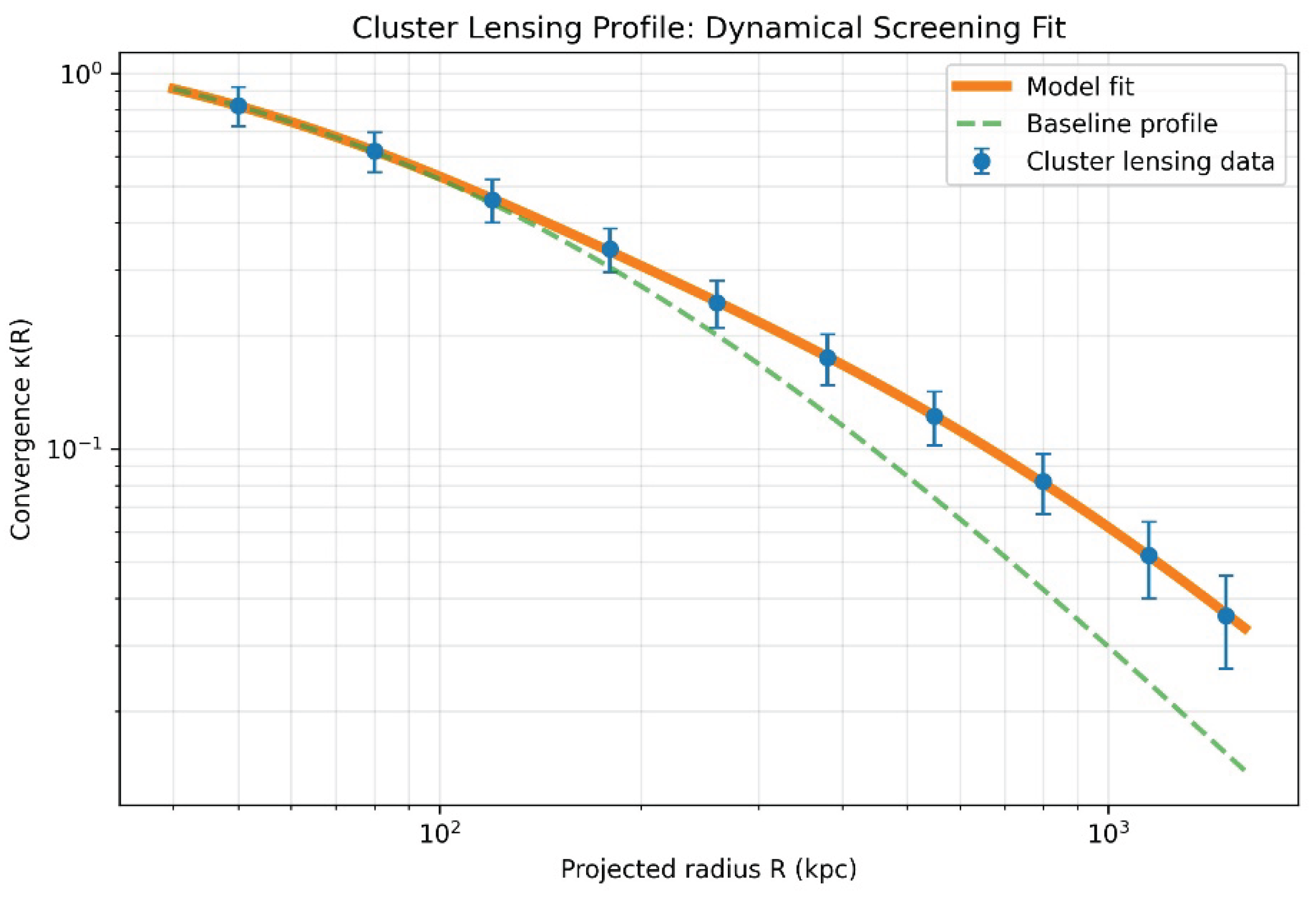

Table 1.
Comparison of Gravitational Frameworks.
| Feature | General Relativity + ΛCDM | MOND | Present Model (Dynamical Yukawa Gravity) |
| Basic idea | Standard gravity + dark matter halos | Modify force law at low acceleration | Modify interaction via field self-interaction |
| Key mechanism | Additional unseen matter | Empirical interpolation function | Dynamically generated Yukawa-type potential |
| Fundamental scale | Halo scale (fitted) | Acceleration scale (fixed) | Scale (derived) |
| Galaxy rotation curves | Fit via halo profiles | Naturally reproduced | Naturally reproduced |
| Tully–Fisher relation | Emergent from halo tuning | Built-in () | Derived from dynamics |
| Cluster lensing | Well explained | Problematic (needs extra mass) | Partially + tensor + environmental effects |
| Dark matter required | Yes | No (but often indirectly needed) | No |
| Small-scale (solar system) | Fully consistent | Needs interpolation | Fully consistent (screening) |
| Large-scale behavior | Controlled by dark matter | Less predictive | Naturally long-range (screening weakens) |
| Physical interpretation | Missing matter dominates gravity | Modified inertia/force law | Gravity is self-interacting field |
Disclaimer/Publisher’s Note: The statements, opinions and data contained in all publications are solely those of the individual author(s) and contributor(s) and not of MDPI and/or the editor(s). MDPI and/or the editor(s) disclaim responsibility for any injury to people or property resulting from any ideas, methods, instructions or products referred to in the content. |
© 2026 by the author. Licensee MDPI, Basel, Switzerland. This article is an open access article distributed under the terms and conditions of the Creative Commons Attribution (CC BY) license.
Copyright: This open access article is published under a Creative Commons CC BY 4.0 license, which permit the free download, distribution, and reuse, provided that the author and preprint are cited in any reuse.


