

Submitted:
30 April 2026
Posted:
04 May 2026
You are already at the latest version
Abstract
Radiotherapy remains one of the main pillars of cancer treatment and is used in more than half of all oncological patients. Despite continuous technological improvements, ionizing radiation inevitably causes damage to surrounding healthy tissues, leading to acute and chronic complications affecting multiple organs, including the skin, mucosa, heart, lungs, and gastrointestinal tract. Radiation-induced injuries significantly impair patients’ quality of life, limit therapeutic doses, and represent a major unmet clinical challenge. Hydrogels have emerged as a highly promising class of biomaterials for the management of radiation-associated tissue damage due to their high water content, tunable mechanical properties, biocompatibility, and ability to mimic the extracellular matrix. In recent years, significant advances have been made in the design of functional hydrogels, including stimuli-responsive, injectable, adhesive, and bioactive systems capable of delivering drugs, growth factors, antioxidants, or living cells. This review provides a comprehensive overview of radiation-induced injuries in different organs and summarizes current strategies employing hydrogel-based systems for their treatment. We discuss both therapeutic and preventive applications of hydrogels, highlighting their potential to protect healthy tissues, reduce inflammation and fibrosis, and promote tissue regeneration.
Keywords:
biomaterial
; hydrogel
; radiotherapy
; skin
; mucosa
; heart
; lungs
; gastrointestinal tract
1. Introduction
Hydrogels are three-dimensional crosslinked networks of hydrophilic polymers that can absorb and retain large amounts of water or biological fluids without dissolving, owing to the presence of polar functional groups such as –OH, –COOH, –NH₂, –CONH₂ and –SO₃H along the polymer backbone [1]. These networks are formed by physical entanglements or chemical covalent bonds between polymer chains, resulting in a highly hydrated, porous matrix that closely mimics the extracellular matrix of native tissues (Figure 1) [2].
The foundational development of synthetic hydrogels dates back to the pioneering work of Wichterle and Lím, who introduced crosslinked poly(glycolmethacrylate) for soft-contact-lens applications [3]. Since then, hydrogels have evolved into versatile biomaterials with tunable physicochemical properties. Their most distinctive feature is the equilibrium water content, which frequently exceeds 90% by weight [4] and confers softness, elasticity and high permeability to oxygen, nutrients and metabolites. Swelling behaviour is governed by the balance between osmotic forces driving water uptake and elastic restoring forces of the crosslinked network; consequently, swelling ratio, pore size and mechanical modulus can be precisely modulated by varying polymer concentration, crosslink density, hydrophilic/hydrophobic balance or environmental conditions [1]. Many hydrogel systems further exhibit stimuli-responsive (smart) characteristics, undergoing reversible volume phase transitions in response to changes in pH, temperature, ionic strength or light, thereby enabling controlled drug release, cell encapsulation and dynamic tissue-mimetic scaffolds [5]. Collectively, these properties render hydrogels uniquely suited for biomedical applications ranging from wound dressings and drug-delivery vehicles to regenerative-medicine platforms.
2. Advantages and Disadvantages of Hydrogels in Wound Treatment, with Specific Emphasis on Radiation Wounds
Hydrogels excel in maintaining a moist wound environment, which promotes keratinocyte migration, fibroblast proliferation, autolytic debridement, and re-epithelialization while preventing eschar formation. They are non-adherent, reduce pain during dressing changes, provide a cooling sensation, permit gas exchange, and absorb moderate exudate without causing periwound maceration [6,7].
Key disadvantages include limited absorbency in heavily exudative wounds, risking maceration, inferior mechanical strength relative to foam dressings, and higher cost than basic gauze [8]. Some hydrogels exhibit variable performance in moist desquamation phases or faster degradation under ionizing radiation exposure, with isolated reports of no benefit or slight delays in healing versus dry approaches in specific contexts [9,10]. Certain natural-based variants may show adhesion or reduced durability post-radiation.
Overall, despite these limitations, the excellent biocompatibility of hydrogels, the ability to tailor their properties, and compelling evidence of their effectiveness make them the preferred method of wound treatment, emphasizing patient comfort and improved tissue regeneration. Many of these limitations can be effectively minimized through structural modifications, composite formulations, crosslinking optimizations, and incorporation of functional additives such as nanoparticles or bioactive agents [11,12].
3. Hydrogel Classification Based on Their Mechanism of Action in the Pathophysiology of Damage
Hydrogels can be classified according to multiple criteria, reflecting their diverse physicochemical properties and synthesis strategies. Common categorizations include source of origin (natural, synthetic, or hybrid) [13], cross-linking mechanism (physical versus chemical) [14] and responsiveness to external stimuli (e.g., pH-sensitive, temperature-responsive, or redox-responsive) [1]. These frameworks are widely employed in comprehensive reviews of hydrogel design for biomedical applications, particularly in tissue engineering, drug delivery, and general wound healing, where emphasis is placed on material composition, mechanical tunability, and environmental adaptability. However, in the context of the present review focused on hydrogels for healing radiation-injured tissues and organs, we developed a hydrogels classification based on their mechanism of action in the pathophysiology of radiation-induced damage which provides a more clinically relevant and mechanistically aligned organizational structure.
3.1. Hydrogels Preventing Oxidative Stress
Ionizing radiation induces a rapid and sustained overproduction of reactive oxygen species (ROS) primarily through water radiolysis and secondary through mitochondrial dysfunction and protein misfolding, creating an overwhelming oxidative burden that exceeds endogenous antioxidant capacity [15,16,17,18]. This excess ROS directly inflicts oxidative damage on essential cellular components, including DNA (base modifications, single-strand breaks, and particularly lethal double-strand breaks), lipids (peroxidation leading to membrane destabilization), and proteins (carbonylation, fragmentation, and loss of function) [19,20,21,22,23]. Such macromolecular lesions disrupt genomic stability, mitochondrial energy metabolism, and cellular redox homeostasis, establishing a self-amplifying cycle of oxidative injury [16,17,24].
Persistently elevated ROS levels further activate redox-sensitive signaling cascades (e.g., MAPK pathways) and transcription factors, while upregulating pro-oxidant enzymes such as NADPH oxidase, lipoxygenases, cyclooxygenases, and nitric oxide synthase [22,24]. These events drive a chronic inflammatory response characterized by persistent cytokine release, immune cell recruitment, matrix metalloproteinase activation, extracellular matrix degradation, and fibroblast dysfunction [25,26,27]. The resulting microenvironment impedes timely re-epithelialization, collagen organization, and angiogenesis, ultimately manifesting as delayed wound closure, chronic ulceration, fibrosis, telangiectasia, and increased risk of carcinogenesis in severe or repeated exposures [18,26,28].
In response to the radiation-induced ROS → damage → inflammation axis, innovative hydrogel platforms have been engineered to intercept and neutralize excessive ROS directly at the injury site. These systems transition from passive dressings to active therapeutic interventions by incorporating ROS-responsive chemistries and antioxidant payloads, effectively modulating the local microenvironment to interrupt the cycle of chronic oxidative stress. Recent advancements in this field focus on several strategic approaches to ROS scavenging. One prominent strategy involves the integration of natural antioxidants, where hydrogel matrices, such as those based on carbomers or sodium alginate, are functionalized with polyphenols and natural acids, including ferulic acid or resveratrol [29,30]. These formulations effectively combine the physical benefits of a biocompatible matrix with the innate ability of the payload to suppress oxidative stress and neutralize free radicals. Parallel to this, more sophisticated catalytic systems have emerged, involving the embedding of nanoparticles with multi-enzyme mimetic activities directly into the hydrogel network. Examples such as Prussian blue nanoparticles or polydopamine exhibit peroxidase- and catalase-like properties, creating “smart” hydrogels that provide sustained, localized antioxidant defense superior to conventional symptomatic treatments [31]. Furthermore, the scope of ROS-responsive designs has expanded to include bioactive and cell-derived payloads. In these systems, hydrogels serve as carriers for biological mediators, such as ADSC-derived (adipose-derived stem cell) exosomes or specific functional proteins like IFI6. Such platforms do not merely scavenge ROS but also target downstream immunomodulatory pathways, effectively promoting a metabolic shift from a pro-inflammatory to a regenerative microenvironment [31,32].
3.2. Immunomodulatory Hydrogels
Radiation-induced wounds are characterized by chronic inflammation, driven by dysregulated cytokine profiles and persistent dominance of pro-inflammatory M1 macrophages, which hinder tissue regeneration and exacerbate fibrosis [33,34]. In normal wound healing, macrophages play a pivotal role, initially polarizing to the M1 phenotype to combat pathogens through secretion of reactive oxygen species and pro-inflammatory cytokines such as tumor necrosis factor α (TNF-α), interleukin 1β (IL-1β), IL-6, followed by a transition to the anti-inflammatory M2 phenotype that promotes resolution of inflammation, angiogenesis, and extracellular matrix remodeling [34,35,36,37]. However, in radiation burns, this balance is disrupted, with prolonged M1 activation leading to non-resolving inflammation, impaired phagocytosis, and sustained release of neurotoxic mediators like IFN-γ and FasL, perpetuating tissue damage [36,37,38,39]. Low-dose ionizing radiation has shown potential to modulate this by reducing pro-inflammatory cytokines (e.g., IL-1β, IL-6) and upregulating anti-inflammatory ones (e.g., IL-10, transforming growth factor-β1 (TGF-β), IL-4), facilitating M1-to-M2 shifts and enhancing neuroprotection [36]. Similarly, targeting pathways like Janus Kinase/Signal Transducer and Activator of Transcription (JAK/STAT) or Nuclear Factor kappa-light-chain-enhancer of activated B cells (NF-κB) can reprogram macrophages toward M2 dominance, inhibiting fibrosis and boosting natural killer cell activity against tumors [40,41,42].
Immunomodulatory hydrogels offer innovative strategies to restore cytokine balance and macrophage polarization in radiation-damaged tissues by providing spatiotemporal control over inflammatory microenvironments [43]. These biomaterials mimic extracellular matrices, enabling sustained release of bioactive agents that recruit M1 macrophages to exert an antimicrobial effect, then promote their phenotypic switch to M2 for regeneration (Figure 2).
For instance, a curcumin@tannic acid nanoparticle-loaded gelatin methacryloyl hydrogel patch scavenges ROS chemically, shields against radiation physically via high water content, and drives M2 polarization, demonstrating enhanced repair in radiation dermatitis models through anti-inflammatory and adhesive properties [44]. An all-natural protocatechuic aldehyde-hybridized collagen hydrogel exhibits bioadhesive, antibacterial, and ROS-scavenging capabilities, directly converting M1 to M2 macrophages without external interventions, accelerating wound healing by shortening inflammation [45]. Temporal control is achieved in a zinc-hydroxyapatite nanoparticle-incorporated protein-alginate hydrogel, where early Ca²⁺ release enhances M1 activity for infection control, followed by sustained Zn²⁺ promoting M2-driven osteogenesis and angiogenesis [46].
Further innovations include DNA-inspired adenine-thymine paired self-healing hydrogels that activate STAT3/STAT6 pathways to polarize M1 to M2, fostering wound repair via dynamic Schiff base and hydrogen bonding for mechanical resilience [47]. Mechanoresponsive zwitterionic sulfobetaine methacrylate hydrogels with keratin-exfoliated MoS₂ and phenytoin-loaded bee-wax nanoparticles respond to force by enhancing M2 polarization, proliferation, and antibacterial effects, addressing wounds through antifouling and adhesive features [48]. Catalyst-mediated acylhydrazone-crosslinked lysozyme-PEG hydrogels decouple viscoelasticity from equilibrium, activating JAK/STAT to suppress M1 markers (CD86, IL-1β) while upregulating M2 (CD204, VEGF) for improved healing [41]. Quercetin-solid lipid nanoparticle-embedded hyaluronic acid hydrogels inhibit M1 and elevate M2 polarization in vitro and in vivo, promoting osteogenesis by modulating inflammatory cytokines in bone immunomodulation [49]. These hydrogels innovatively integrate natural-derived components for biocompatibility, offering targeted immunomodulation to mitigate radiation-induced chronic inflammation and restore tissue homeostasis.
3.3. Proangiogenic Hydrogels
In the pathophysiology of radiation-induced tissue damage, ionizing radiation directly injures the vasculature, provoking endothelial cell detachment, apoptosis, and loss of key markers such as vascular endothelial cadherin and endothelial nitric oxide synthase (eNOS). These changes culminate in reduced capillary density, microvascular regression, and persistent ischemia that markedly delay regeneration and compromise wound healing [50,51,52]. Radiation further disrupts physiological angiogenesis by decreasing the expression of vascular endothelial growth factor (VEGF), angiopoietin-1, and Tie-2 while increasing angiopoietin-2 expression, collectively limiting endothelial proliferation and sprouting [53], while suppressing VEGFA and eNOS [51]. Compensatory responses such as elevated VEGF and HIF-1α expression may occur in normal tissue exposed to radiation, potentially accelerating repair, yet therapeutic regimens often reduce serum angiogenic cytokines and favor fibrosis [54,55,56]. Low-dose irradiation, however, can paradoxically promote neovascularization in ischemic limbs through mast-cell-derived VEGF release in a matrix metalloproteinase-9-dependent manner, underscoring VEGF’s pivotal role in orchestrating vascular regeneration [57]. Collectively, these processes highlight that angiogenesis constitutes the indispensable biological link between restored perfusion and successful tissue repair following radiation injury [58].
Targeted delivery of growth factors, above all VEGF, represents a cornerstone strategy to overcome radiation-induced vascular deficits. Hydrogels excel in this context as injectable or printable depots that provide localized, sustained VEGF presentation, function as tunable controlled-release systems, and replicate the extracellular matrix architecture to guide endothelial cell migration, tube formation, and neovessel maturation. Several innovative proangiogenic hydrogel platforms have been engineered to harness these properties. A composite hydrogel comprising human umbilical cord blood-derived mesenchymal stromal cells and porcine small intestinal submucosa promotes healing in radiation-wound models by amplifying angiogenic factor secretion from the stromal cells, particularly hepatocyte growth factor, which in turn recruits damaged endothelial cells and drives neovascularization [59]. A photo-crosslinked methacrylate hyaluronic acid hydrogel covalently functionalized with a prominin-1-binding peptide forms in situ under brief ultraviolet exposure. The tethered peptide markedly enhances VEGF recruitment, endothelial tubular formation, and cell migration in vitro, while in vivo studies in burn and excisional wounds demonstrate robust neovascularization and accelerated closure via VEGF-Akt pathway activation [60]. Cryogenically 3D-printed scaffolds integrating decellularized small intestinal submucosa, mesoporous bioactive glass, and exosome cargo enable prolonged exosome release that elevates local VEGF production, expands CD31-positive vessel area, augments blood perfusion, and stimulates angiogenesis, resulting in faster closure of full-thickness wounds [61]. Light-responsive 3D-printed hydrogel patches incorporating VEGF-decorated tetrapodal zinc oxide microparticles achieve on-demand VEGF release upon UV/visible-light activation while exerting antibacterial activity. These patches display low cytotoxicity, minimal immunogenicity, and improved wound closure in vivo [62]. A gelatin-methacrylate/dopamine-methacrylate hydrogel crosslinked with Zn²⁺ ions via metal coordination provides sustained zinc release together with potent antibacterial action. The composite accelerates infected wound resolution by enhancing vascularization, collagen deposition, and dermal regeneration [63]. Finally, a hierarchically structured DNA hydrogel (Agilegel) exploits covalent, base-pair and pore-level interactions to achieve sequential release of VEGF-α, silver nanoclusters, and IL-10. The initial VEGF-α wave directly stimulates endothelial proliferation, angiogenesis, and extracellular matrix assembly, thereby promoting rapid neovascularization and closure of wounds while simultaneously addressing infection and oxidative stress [64].
3.4. Hydrogels Promoting Regeneration and Remodeling
Biomimetic hydrogels are engineered to replicate the native extracellular matrix (ECM) architecture and mechanics, facilitating integrin-mediated focal adhesions that are essential for guiding cell migration and mechanotransduction. These matrices offer a compliant, porous microenvironment that helps restore cytoskeletal dynamics and paxillin-rich adhesions, which are typically impaired in irradiated cells [65]. Beyond structural support, regenerative hydrogels are designed to modulate the immune microenvironment, specifically promoting macrophage polarization toward pro-regenerative M2 phenotypes, a transition crucial for the secretion of factors that support angiogenesis and physiological collagen remodeling [66].
Within this therapeutic framework, several specialized strategies have emerged to enhance the regenerative potential of these scaffolds. One prominent approach involves the development of ECM-derived systems, where hydrogels incorporating components like decellularized dermal matrices, keratin, or fibronectin directly supply missing matrix proteins and growth-factor binding sites to the damaged tissue [67]. This structural mimicry is often complemented by the use of functionalized dynamic carriers, where the incorporation of cells or cell-derived exosomes adds a layer of paracrine signaling. These carriers significantly prolong the retention of pro-regenerative cargo, such as miR-221-3p, at the injury site, thereby sustaining the delivery of signals that enhance fibroblast migration and keratinocyte epithelialization [67,68].
Furthermore, the field has seen the rise of innovative multifunctional synthetic designs, including self-assembling heparin-mimetic peptides and gene-engineered Janus polypeptides. The platforms integrate ECM mimicry with advanced features such as ROS scavenging, on-demand oxygenation, and mechanical tension relief to further optimize the biological performance of the graft [69]. By integrating these diverse features, regenerative hydrogels effectively address both the structural deficits and the dysregulated cellular crosstalk characteristic of damaged tissues, orchestrating a comprehensive transition from chronic inflammation to orchestrated tissue repair. Building on these mechanistic foundations, the subsequent sections review the therapeutic application of hydrogels in radiation-induced injuries across various tissues and organ systems. We first focus on cutaneous and mucosal damage, which represent the most common and clinically visible manifestations of radiation toxicity, and then discuss hydrogel-based approaches developed for the internal organs commonly compromised during radiotherapy, namely the gastrointestinal tract, lungs, heart, and bone.
4. Hydrogel-Based Strategies in the Treatment of Radiation-Induced Injuries Across Different Tissues and Organ Systems
4.1. Skin
Despite its many advantages, radiotherapy, which is often the basis for cancer treatment and is used in approximately 50–60% of all cancer patients [70], can cause radiation dermatitis. These reactions occur in approximately 85% of treated patients and can vary in intensity, from mild erythema and skin peeling to ulceration [71]. Such radiation-induced skin injuries (RISI) represent a significant problem during and after radiotherapy treatment [12]. The skin is highly susceptible to damage caused by ionizing radiation due to its constant renewal and the presence of rapidly multiplying and differentiating cells [72]. Hydrogels offer targeted benefits in dealing with the adverse effects of radiotherapy by neutralizing ROS, modulating inflammatory responses, supporting vascular regeneration, and serving as carriers for antioxidants, antimicrobials, or growth factors [12,73]. Multifunctional formulations demonstrate accelerated closure, higher healing rates, reduced pain, and lower infection risk compared to conventional dry dressings in radiation-damaged tissues [11] (Figure 3).
A strategy involving the prior elimination of reactive oxygen species followed by tissue repair is of significant importance in the treatment of skin wounds caused by ionizing radiation [74]. Hence, effective treatment requires increasing the antioxidant capacity of the skin and preventing cell aging [75]. In the treatment of irregular wounds, injectable hydrogels offer many advantages [30]. A carbomer-based ferulic acid (FA) hydrogel markedly accelerates RISI recovery by suppressing oxidative stress, reducing inflammation, and inactivating the NLRP3 inflammasome at both in vitro and in vivo levels, where multiple FA concentrations promote collagen deposition, tissue reconstruction, and normalization of skin blood flow [29]. Similarly, an IFI6-functionalized hydrogel incorporating polydopamine and sodium alginate combines excellent ROS scavenging, bioadhesion, and antibacterial properties with targeted activation of the SSBP1/HSF1 signaling axis, which reduces ROS accumulation, improves the immune microenvironment, and stimulates fibroblast proliferation and vascularization [31]. Further innovation is seen in dual-network photocrosslinkable hydrogels (PHF@Res) embedding polyvinylpyrollidone-modified Prussian blue nanoparticles and resveratrol, which exhibit broad free-radical scavenging 2-diphenyl-1-picrylhydrazyl and 2,2’-azinobis(3-ethylbenzothiazoline-6-sulfonic acid) together with peroxidase- and catalase-mimetic activities to support fibroblast migration and promote limb regeneration [30]. Beyond skin-specific applications, adipose-derived stem cell exosomes delivered via biocompatible carriers alleviate RISI by attenuating oxidative stress, modulating macrophage polarization, and inhibiting apoptosis or pyroptosis [32].
The therapeutic potential of regenerative hydrogels is further evidenced by acellular dermal matrix hydrogels prepared from porcine dermis, which significantly accelerate healing by decreasing wound area and radiation-injury scores, increasing epithelial thickness and hair-follicle regeneration, and shifting macrophages to IL-10-high M2 cells while down-regulating IL-1β and IL-6 [76]. Decellularized porcine dermal hydrogels similarly rescue radiation-induced capsule fibrosis, normalize tissue architecture, and support adipogenesis without enhancing unwanted fibroblast infiltration [77]. Human-adipose-ECM hydrogels further alleviate late fibrosis by driving endothelial-cell-mediated M2 polarization [78]. Additionally, keratin-based hydrogels derived from hair promote post-radiation wound closure by enhancing fibroblast proliferation and ordered collagen deposition, while topical fibronectin augments angiogenesis and reduces inflammatory infiltrate when delivered in supportive matrices [79,80]. Advanced multifunctional platforms, such as the gene-engineered Janus polypeptide hydrogel, combine bacterial-clearance and on-demand oxygenation modules with RGD motifs that relieve mechanical tension, yielding near-complete (98.83%) wound closure by day 21 and an eight-fold increase in dermal appendages [81].
The use of polyphenols like epigallocatechin gallate (EGCG) is also crucial, as this compound removes superoxide anions, hydroxyl radicals, and hydrogen peroxide while protecting DNA and inhibiting the proteasome, a key regulator of inflammation that controls cytokines such as IL-1β, IL-6, IL-8, and TNFα [82,83]. To overcome challenges of direct spraying, a hydrogel composed of chitosan and gelatin grafted with photosensitive methacrylic anhydride was developed to deliver EGCG via minimally invasive injection, enhancing the expression of genes related to angiogenesis [84]. Tannic acid is another antioxidant used in hydrogels containing N-acryloyl glycinamide and N-hydroxyethyl acrylamide, which exhibit self-healing capabilities and mechanical stability, often incorporating live Lactobacillus reuteri strains to respond to the wound microenvironment [74,85]. Other formulations include caffeoyl chitosan and boronic acid-grafted gelatin methacrylate for radiation burns, which strengthen the expression of CD31 [86], as well as interpenetrating networks made of gelatin grafted with dopamine and curcumin-containing nanoparticles for real-time drug tracking [11]. Flavonoids like baicalin, delivered via temperature-sensitive liposome systems, and dihydromyricetin nanocapsules also show efficacy in protecting against DNA damage [87,88,89]. Finally, phycocyanin-based copper sulfide nanoparticles encapsulated in alginate microspheres demonstrate antibacterial properties and accelerate epidermal regeneration [90], while topical gels with 10% hesperetin protect animal skin from UVA-UVB damage without causing erythema or lipid peroxidation [91]. Collectively, these interventions counteract hypoxia-driven myofibroblast persistence and TGF-β1/Smad-mediated ECM overproduction, restoring the regenerative cascade in radiation-damaged skin [92,93].
4.2. Mucosa
Radiation-induced oral mucositis (RIOM) represents one of the most debilitating complications in patients undergoing radiotherapy for head and neck cancers. The condition arises from the direct DNA damage of basal epithelial cells and the subsequent generation of reactive oxygen species, which trigger complex inflammatory cascades involving NF-κB, TNF-α, and various interleukins [94]. This process leads to mucosal atrophy, ulceration, and severe pain, often necessitating treatment interruptions and compromising the patient’s nutritional status. A significant therapeutic challenge in managing RIOM lies in overcoming the suboptimal retention of drug delivery systems within the highly dynamic and moist environment of the oral cavity [95]. Continuous saliva secretion and mechanical movements of tissues associated with speaking, chewing, and swallowing lead to rapid washout of conventional formulations, such as rinses or sprays, preventing the maintenance of therapeutic concentrations of active substances at the ulcer site. Therefore, a key issue is the development of carriers with high wet adhesion, capable of stable binding to mucin present in the mucus. The choice of materials is of particular importance here. For instance, positively charged natural polymers, such as chitosan (often cross-linked with genipin to improve bioavailability), demonstrate the ability to interact strongly with negatively charged sialic acid residues in mucin [96]. This electrostatic matching significantly extends the residence time of the therapeutic load on the moist surfaces of the oral cavity. Another example are hydrogels functionalized with catechol groups, inspired by the chemistry of marine organisms [97]. The catechol groups mediate strong mucosal tissue binding through mechanisms such as hydrogen bonding, electrostatic interactions, Michael addition reactions, or Schiff base formation [98,99].
Radiotherapy not only damage the body’s physical barriers, such as skin and mucosal tissues, but also induce systemic immunosuppression, which makes these tissues highly susceptible to bacterial infections [11,100,101]. These infections, particularly those caused by drug-resistant pathogens such as Pseudomonas aeruginosa or methicillin-resistant Staphylococcus aureus (MRSA), significantly exacerbate inflammation, delay healing processes, and can lead to deep tissue necrosis [101]. Consequently, effective infection control is one of the greatest challenges in the clinical management of radiation-induced wounds and oral mucositis. Although hydrogels represent a promising platform for supporting tissue regeneration, traditional dressings of this type often lack sufficient antimicrobial properties, which in some cases could promote the formation of protective bacterial biofilms on the wound surface, preventing antibiotic penetration [11]. To overcome this limitation, contemporary research focuses on designing multifunctional hydrogels that actively combat bacterial colonization by incorporating specific antibacterial agents or modifying the hydrogel matrix itself. One leading approach involves local delivery of broad-spectrum antibiotics, such as minocycline hydrochloride, embedded within hydrogels responsive to wound-environment stimuli [100]. In the context of oral mucositis treatment, it has been shown that hydrogels releasing minocycline in response to elevated reactive oxygen species levels are highly effective at inhibiting the growth of both Gram-positive and Gram-negative bacteria, including Escherichia coli and MRSA [100]. This intelligent, sustained drug release prevents secondary infections and synergistically mitigates inflammatory responses, actively supporting the regeneration of damaged tissues and breaking the vicious cycle of oxidative stress and inflammation. Concurrently, researchers are exploring the use of natural plant extracts, such as baicalin, which exhibit strong antibacterial activity against drug-resistant strains while presenting a low risk of inducing microbial resistance [101]. Integration of baicalin with positively charged polymeric hydrogel matrices generates a synergistic bactericidal effect, where cationic polymer segments disrupt the negatively charged bacterial cell membranes, drastically reducing bacterial populations within irradiated wounds [101]. Furthermore, innovative strategies include the use of materials with inherent antibacterial properties, such as chitosan or graphene oxide polymers, as well as incorporation of metal nanoparticles, significantly expanding the repertoire of modern infection-resistant dressings [11,96,101].
Multifunctional hydrogels can actively participate in therapy also by scavenging ROS and enabling targeted drug release [100]. An example of an advanced solution is the QTMP-Gel, based on the dynamic crosslinking of quaternized chitosan with tannic acid. This hydrogel exhibits strong adhesion to moist mucosal tissues, resulting from the formation of numerous hydrogen bonds and dynamic cationic interactions between polymer chains and the negatively charged mucosal surface [100,102]. The material exploits the oxidation sensitivity of the catechol structures in tannic acid, allowing controlled degradation of the polymer network in the presence of high ROS concentrations and intelligent release of active substances directly at the site of inflammation. The effectiveness of such systems is enhanced by incorporating components with catalytic and anti-inflammatory properties. Platinum nanoparticles embedded in the hydrogel matrix exhibit enzyme-mimicking activity, similar to natural enzymes such as superoxide dismutase and catalase, enabling continuous decomposition of harmful superoxide anions and hydrogen peroxide into safe water and oxygen [100]. Another innovative approach involves the rearrangement of cholesterol micelles in the EPBA@PC-HD hydrogel, which allows water displacement from the tissue interface and achieves stable mucosal adhesion [98].
Complementing these strategies are composite G-PVA hydrogels containing core-shell microgels, enabling simultaneous delivery of lidocaine for pain relief and epidermal growth factor to stimulate tissue repair [99]. Aggregated research results indicate that such designed biomaterial platforms significantly accelerate regeneration, reducing the ulcerated area by more than half [102]. Supporting the repair processes are systems like PFP-BA@Gel, which, due to the presence of ferrocenyl groups, provide long-lasting antioxidant activity and effectively eliminate drug-resistant Pseudomonas aeruginosa bacteria [101]. Equally important for restoring tissue homeostasis are biomimetic hydrogels such as oCP@As, which, through the release of acetylsalicylic acid, stimulate RAD51 protein expression, directly supporting the repair of DNA double-strand breaks [103]. The development of these dual and responsive systems represents a significant breakthrough, offering the potential to avoid interruptions in radiotherapy and substantially improve the quality of life for oncology patients by effectively interrupting the pathological cycle of damage and supporting the body’s natural regenerative mechanisms [101,103].
The ability to simultaneously relieve pain and stimulate epithelial regeneration is realized in composite hydrogels based on hyaluronic acid and polyvinyl alcohol, where the incorporation of core-shell microgels allows spatial and temporal separation of lidocaine and growth factor release, such as EGF [98,99]. The use of minocycline hydrochloride provides a synergistic antibacterial and anti-inflammatory effect by inhibiting the activity of bacteria such as Escherichia coli and MRSA, as well as reducing matrix metalloproteinase activity [100]. In the context of regenerating deeper injuries, studies highlight the benefits of hierarchical therapeutic strategies that combine immediate ROS scavenging by tannic acid with subsequent release of bioactive probiotics, such as Lactobacillus reuteri [74]. This system, designated Gel/LT, exploits the pH sensitivity of a polyphenol-metal coating in the wound bed, enabling sequential action: first, elimination of more than 93% of free radicals and inhibition of tissue necrosis, followed by stimulation of angiogenesis and collagen regeneration [74].
In advanced stages of damage where fibrosis dominates, a key strategy is the use of mesenchymal stem cells (MSCs) embedded in hydrogel scaffolds. Materials such as hyaluronic acid or silanized hydroxypropyl methylcellulose isolate MSCs from the aggressive inflammatory environment, providing them with conditions for survival and the secretion of growth factors [104,105,106]. In the context of radiation-induced mucosal damage (including oral mucositis, esophageal injury, and intestinal or colorectal damage) MSCs encapsulated in hydrogels have proven highly effective by improving cell survival, retention, paracrine activity, and targeted delivery [107]. A fundamental mechanism behind this efficacy is the modulation of the immune microenvironment. Several studies directly demonstrate that MSCs delivered in hydrogels inhibit pro-inflammatory M1 macrophages (CD68 markers) and promote reparative M2 phenotypes [106,108]. Specifically, in vivo evidence shows that hydrogel-encapsulated MSCs reduce the presence of M1 macrophages while increasing the population of M2 macrophages [108]. For instance, the use of YIGSR/RGD hydrogels in combination with MSCs has been shown to significantly increase the infiltration of CD206 macrophages while simultaneously decreasing CD68 infiltration [106,109]. Due to the appropriate porosity and bioactive properties of the scaffolds, these cells further stimulate angiogenesis and the regeneration of basal epithelial cells. Ultimately, these synergistic effects result in the restoration of organ functionality and the prevention of irreversible tissue scarring [105,106].
4.3. Gastrointestinal Tract
Irradiation of abdomino-pelvic malignancies can result in both acute and chronic damage to organs of the gastrointestinal tract. These injuries arise from direct interactions of ionizing radiation with cellular macromolecules, as well as indirect effects mediated by reactive oxygen species, leading to DNA and RNA damage, altered gene expression, protein modification, cellular senescence, and genomic instability [24,110,111]. The gastrointestinal tract is one of the most radiosensitive organs. This high sensitivity arises from the rapid turnover of epithelial stem cells located at the base of intestinal crypts. Reactive oxygen species generated by ionizing radiation trigger crypt cell apoptosis and compromise epithelial barrier integrity, resulting in increased mucosal permeability, nutrient and fluid loss, and bacterial translocation, which collectively amplify local inflammation [112]. The persistent inflammatory milieu, together with stem cell depletion and ischemic conditions, ultimately impairs tissue repair and may lead to chronic pathological outcomes such as ulceration, fibrosis, or fistula formation [113].
One promising approach to reducing radiation toxicity is the physical separation of target tissues from adjacent organs at risk. Hydrogels have emerged as particularly attractive materials for this purpose. Due to their biocompatibility and tissue-like radiological properties, hydrogels can absorb radiation in a manner similar to normal tissues. When implanted between the tumor and radiosensitive structures, they effectively reduce the radiation dose delivered to healthy organs. Experimental and clinical studies have demonstrated that hydrogel spacers can decrease radiation exposure to salivary glands in head and neck cancer [114,115], to the rectum in prostate cancer [116], and to the duodenum in pancreatic cancer [117], with associated improvements in gastrointestinal symptoms following radiotherapy [118,119]. By reducing radiation exposure to organs at risk, they enable dose escalation, hypofractionation, and potentially better tumor control.
The most extensive clinical experience with hydrogel spacers has been gained in prostate cancer. Since its approval by the US Food and Drug Administration, the SpaceOAR system has been widely adopted in radiotherapy protocols. This biodegradable polyethylene glycol (PEG) hydrogel creates a temporary space between the prostate and rectum, thereby reducing radiation exposure to the anterior rectal wall [120]. Clinical studies have shown that hydrogel implantation can achieve several millimeters of separation, leading to significant reductions in rectal dose parameters and lower rates of acute and late gastrointestinal toxicity [121,122,123,124]. These dosimetric benefits have been observed across different radiotherapy modalities, including external beam radiotherapy, stereotactic body radiotherapy (SBRT), and brachytherapy. In prostate brachytherapy, both hydrogel and balloon spacers have been reported to reduce rectal dose metrics by approximately 15–50%, accompanied by a marked decrease in clinically significant gastrointestinal toxicity. Similar dose-sparing effects have been documented in gynecological cancers, where spacer balloons or injectable gels reduced radiation exposure to the bladder and rectum without compromising tumor coverage. Overall, spacer use has been associated with fewer late complications and improved patient-reported quality of life [125]. In the context of high-dose SBRT, hydrogel spacer placement significantly reduced the incidence of rectal ulcers [126]. Among the biomaterials evaluated for this purpose, PEG-based hydrogels have gained preference over earlier materials such as hyaluronic acid or collagen, as PEG hydrogels tend to maintain their volume and structural integrity for longer periods under irradiation [127,128,129]. Hydrogel-based spacing has also been explored in pancreatic cancer, where gastrointestinal toxicity remains a major limiting factor for dose escalation. It has been demonstrated that endoscopic ultrasound-guided injection of PEG hydrogel is feasible and increases the distance between the pancreatic head and the duodenum. The hydrogel is clearly visible on imaging and undergoes gradual resorption within a few months, providing a suitable temporal window for radiotherapy [130]. Similarly, computed tommography-guided or endoscopic hydrodissection techniques have been proposed to allow higher radiation doses in pancreatic adenocarcinoma by physically separating the tumor from adjacent gastrointestinal structures, potentially improving treatment outcomes without the need for surgically implanted spacers [131]. Despite their advantages, traditional preshaped hydrogels often require surgical implantation, whereas injectable hydrogels offer minimally invasive delivery but may carry risks such as inflammation or material displacement [132]. To address these limitations, ongoing research focuses on improving hydrogel formulations by incorporating anti-inflammatory agents or using alternative cross-linking strategies. Examples include photo-cross-linkable hydrogels that modulate hypoxia-related pathways [133], drug-loaded hydrogels for targeted anti-inflammatory therapy [134,135,136,137], and multimodal injectable hydrogels with enhanced imaging visibility [138].
While hydrogel spacers primarily function as physical barriers to reduce radiation-induced damage, their clinical implementation does not fully eliminate late tissue toxicity, particularly in radiosensitive organs such as the gastrointestinal tract. Thus, beyond strategies aimed at dose optimization and organ protection, there remains a critical need for therapeutic approaches capable of actively promoting tissue repair and regeneration after radiation injury.
In this regenerative context, hydrogels have gained increasing attention as bioactive scaffolding platforms designed to support localized cell delivery and tissue reconstruction. Beyond serving as passive matrices, they may actively modulate the post-irradiation niche by enhancing cell retention, protecting transplanted cells from inflammatory stress, and enabling sustained paracrine signaling. Such properties are particularly relevant for cell-based regenerative strategies, including those employing mesenchymal stromal cells [139]. Hydrogels can serve as supportive platforms for localized cell delivery as their high-water content and structural similarity to the extracellular matrix allow them to provide a permissive microenvironment for cell survival and function [140]. Moreover, their injectability and in situ crosslinking properties enable minimally invasive administration and spatially controlled delivery at the site of injury. A notable example is the silanized hydroxypropylmethyl cellulose (Si-HPMC) hydrogel, developed as an injectable scaffold for MSC encapsulation and colonoscopic delivery [104]. In a rat model of radiation-induced colonic injury, local administration of adipose-derived MSCs embedded in Si-HPMC resulted in improved epithelial architecture and reduced hyperpermeability compared to systemic or non-encapsulated cell delivery. Nevertheless, even when delivered locally, MSC survival remains challenged by the hostile post-irradiation microenvironment characterized by hypoxia, oxidative stress, and persistent inflammation. To further enhance therapeutic outcomes, combined approaches integrating matrix-mimetic molecules have been proposed. In this context, Moussa et al. demonstrated that conditioning the injured tissue with heparan sulfate mimetics, aimed at restoring extracellular matrix organization and growth factor signaling, in combination with hydrogel-protected MSC delivery, significantly improved tissue regeneration in two relevant animal models [141]. This strategy led to a marked reduction in injury scores and promoted epithelial repair, supporting the concept that engineered biomaterial niches can actively modulate the regenerative microenvironment and potentiate cell-based therapies.
Beyond cell therapy, hydrogels have also been explored as vehicles for localized delivery of bioactive compounds to mitigate radiation-induced gastrointestinal toxicity. Radiation-induced proctitis (RIP), a common adverse effect in patients treated for pelvic cancers, exemplifies a condition where local inflammation, oxidative stress, and impaired mucosal healing converge. Semi-synthetic glycosaminoglycans derived from hyaluronic acid exhibit anti-inflammatory and tissue-protective properties but suffer from limited tissue penetration. To address this, Jensen et al. developed an in situ gelling rectal delivery system based on silk-elastin-like protein polymers, enabling sustained release and enhanced local accumulation of glycosaminoglycans in rectal tissue [142]. This system simultaneously targeted multiple pathological mechanisms underlying RIP, including reactive oxygen species scavenging, cytokine modulation, and epithelial regeneration, illustrating the therapeutic versatility of hydrogel-based platforms.
Polysaccharide-based hydrogels represent another class of biomaterials with significant translational potential due to their intrinsic biocompatibility, biodegradability, and mucoadhesive properties. Chemically modified Moringa oleifera gum, for example, has been combined with chitosan or synthetic polymers to produce hydrogel systems exhibiting prolonged mucosal retention and sustained release behavior [143,144]. Radiation-induced grafting of vinyl monomers onto moringa gum further yielded hydrogels characterized by antioxidant activity and controlled release profiles without an initial burst effect [145]. Although originally developed for conventional gastrointestinal drug delivery, such properties suggest that these materials could also serve as adaptable carriers for therapeutic agents aimed at alleviating radiation-induced intestinal damage.
More advanced regenerative strategies have employed synthetic hydrogels as delivery vehicles for complex biological constructs. Cruz-Acuña et al. demonstrated that an engineered PEG-based hydrogel (PEG-4MAL) could effectively deliver human intestinal organoids to colonic wounds, significantly enhancing mucosal repair compared to organoids or hydrogel alone [146]. This work provided proof-of-concept that synthetic hydrogels can support localized engraftment of tissue-engineered constructs and promote functional tissue regeneration in vivo.
Hydrogel platforms have also been applied to microbiota-based interventions. Fecal microbiota transplantation and probiotic therapies have shown potential in mitigating radiation-induced bowel injury, yet their clinical application is limited by poor microbial viability and safety concerns. Gu et al. addressed these challenges by encapsulating Lactobacillus rhamnosus GG in a chitosan-based hydrogel system, which protected bacterial viability and enhanced epithelial barrier function while reducing inflammatory cytokine levels in irradiated models [147]. This approach underscores the capacity of hydrogel systems to act not only as passive carriers, but also as active modulators of the intestinal microenvironment (Figure 4).
Finally, recent developments in injectable and stimuli-responsive hydrogels further expand their therapeutic relevance. Next-generation injectable systems enable minimally invasive delivery and can be engineered to incorporate anti-inflammatory or bioactive components [132]. Examples include photo-crosslinkable hydrogels that restore hypoxia-related signaling pathways [133], pectin-based systems for colon-targeted drug delivery [134], and tannic acid-crosslinked hydrogels with intrinsic anti-inflammatory properties [135]. Collectively, these advances highlight the growing potential of engineered hydrogel systems as multifunctional platforms for the localized treatment of radiation-induced gastrointestinal injury [110].
4.4. Lungs
Radiation-induced lung injury (RILI) results from a cascade of damage initiated by ionizing radiation in alveolar and endothelial cells, leading to oxidative stress, inflammation, and fibrotic remodeling of the lung. RILI is the most common non-malignant complication of radiation therapy for thoracic malignancies. According to Global Cancer Statistics cancer incidence estimates (GLOBOCAN 2020), breast cancer, lung cancer, and esophageal cancer rank first, second, and seventh worldwide. More than 80% of these patients undergo thoracic radiotherapy, and about 30% (approximately 1.4 million) develop RILI [148]. RILI is a major dose-limiting factor in the treatment of thoracic malignancies. To reduce the risk and severity of RILI, the treatment plans are modified by narrowing the irradiation field or lowering the radiation dose. However, this could adversely affect local tumor control rates. The prognosis of patients with RILI is often poor, with a median survival time of less than 3 years [149]. Therefore, developing new strategies to prevent, delay, or halt the development of RILI is essential to improve tumor control, overall survival, and maintain the quality of life of patients receiving thoracic radiotherapy.
The pathology of RILI was originally described in 1925 by Evans who classified acute RILI as radiation pneumonitis and chronic RILI as radiation pulmonary fibrosis [150]. The early, acute phase typically occurs within the first six months after radiotherapy and is characterized by an inflammatory response in the pulmonary tissue. The late phase generally develops beyond six months post-irradiation and is defined by irreversible fibrotic remodeling, excessive extracellular matrix deposition, and permanent scarring of the lung parenchyma. Radiotherapy damages normal cells by both direct and indirect means. As a direct effect of ionizing radiation on lung tissue, nuclear and mitochondrial DNA damage and the generation of reactive oxygen and nitrogen species are described [151]. Such damage initiates multidimensional DNA damage responses within hours and leads mainly to a transient arrest of the cell cycle [152]. In case of low damage, the transient cell cycle arrest allows for DNA repair and cell recovery. However, if damage is too significant for repair, cells might undergo permanent cell cycle arrest and enter a senescent state or undergo acute or delayed forms of cell death. ROS are generated in various lung cell types, including endothelial cells, neutrophils, eosinophils, alveolar macrophages, and alveolar epithelial cells [153]. Excessive ROS production results in oxidative stress, which damages endothelial cells, disrupts the integrity of intercellular junctions, and increases vascular permeability, thereby facilitating the transmigration of leukocytes into lung tissue. At the molecular level, DNA damage and oxidative stress activate numerous signaling pathways, most notably the NF-κB signaling pathway, as well as pro-inflammatory mediators such as TGF-β, IL-1 and platelet-derived growth factor [154]. Persistent activation of these pathways promotes the transition from the inflammatory phase to fibrotic remodeling. ROS and inflammatory mediators can induce epithelial-to-mesenchymal transition (EMT) in alveolar epithelial cells and stimulate the proliferation of fibroblasts as well as their differentiation into myofibroblasts. Myofibroblasts produce large amounts of ECM components, including collagen and fibronectin, leading to excessive ECM deposition and lung tissue remodeling [155]. Simultaneously, TGF-β overexpression increases the levels of protease inhibitors, thereby limiting ECM degradation and promoting its accumulation [156]. Consequently, progressive fibrosis of the alveolar septa occurs, accompanied by thickening and stiffening of the lung parenchyma, reduction of alveolar spaces, and impaired gas exchange. Progressive remodeling of lung architecture ultimately leads to reduced respiratory capacity and loss of lung function [150].
Zhao et al. proposed the use of hydrogel as a radiation barrier in brachytherapy [157]. They engineered a composite hydrogel by self-assembling nickel nanoparticles on the surface of liquid metal particles and embedding them into an injectable hydrogel matrix. Results revealed that the hydrogel effectively protected surrounding healthy tissues from damage. At the same time, the embedded magnetic nanoparticles generated heat when exposed to a magnetic field, enabling controlled magnetic hyperthermia that can enhance the therapeutic efficacy against tumor cells.
In recent years, some research tested the use of hydrogels as materials supporting the protection and regeneration of lung tissue in the context of RILI. Zhou et al. demonstrated that lung tissue extracellular matrix-derived hydrogel can reduce the severity of lung damage after irradiation [158]. In the study, after irradiation rats received intratracheal injection of ECM-derived hydrogel. It was observed that hydrogel treatment improved the histopathological image of lung tissue and reduced pulmonary edema. The protective mechanism was associated with the inhibition of epithelial-mesenchymal transition and reduction in oxidative stress and levels of cytokines (TNF-α, IL-6, and TGF-β1). The gels also exerted an antifibrotic effect. Similar study was also performed to investigate the protective potential of a hydrogel composed of chitosan and tragacanth enriched with cellulose nanoparticles [159]. In the study performed on rat models, the hydrogel injection was performed intraperitoneally. The addition of cellulose nanoparticles increased the structural stability of the hydrogel. The formulation resulted in markedly lower levels of inflammation, mucus secretion, and hemorrhage within the lung tissue. In addition, the treatment alleviated the thickening of alveolar walls and reduced the radiation-induced increase in the thickness of the alveolar septum.
The described hydrogel-based strategies for the prevention or treatment of RILI rely on injectable formulations (Figure 5). Such approaches are relatively invasive and may require specialized procedures, potentially limiting patient comfort and clinical feasibility, particularly when long-term treatment is required. Because of this, the development of a less invasive pulmonary delivery route is highly desirable. In the case of RILI the other way of hydrogel delivery can be inhalation. For example, microparticles from crosslinked hyaluronic acid have been proposed as carriers for controlled pulmonary drug delivery, demonstrating the feasibility of formulating hydrogel-derived particles suitable for aerosol administration and sustained drug release in lung tissue [160]. In addition, recent conceptual work has suggested that extracellular matrix–derived microgels, such as those based on amniotic ECM, could potentially be adapted for pulmonary delivery to mitigate RILI by modulating inflammatory responses and fibrotic remodeling processes [161].
4.5. Heart
Radiation-induced heart disease (RIHD) is a complication following irradiation of chest tumors, such as Hodgkin’s lymphoma, esophageal cancer, lung cancer or breast cancer, and includes cardiac conditions such as cardiomyopathy, pericarditis, coronary artery disease, arrhythmia, valvular heart disease and conduction system abnormalities [162,163,164,165]. Endothelial cells in the capillaries of the myocardium are damaged by the absorption of ionizing radiation, which leads to the obstruction of microvascular circulation and, consequently, to ischemia and the development of myocardial fibrosis [166]. The mechanism of RIHD development is not fully understood. RIHD is likely the result of radiation-induced damage to cardiac cell organelles, including mitochondria and the endoplasmic reticulum. As cardiac myocytes receive repeated doses of radiation, the endoplasmic reticulum releases excessive amounts of calcium ions into the cytoplasm. This, in turn, leads to calcium overload in the mitochondria, which damages the cell membrane and releases factors leading to cell apoptosis. Chronic inflammation and excess ROS in the body, which are formed as a result of water breakdown under the influence of radiation, are also important for heart cells [162,165]. The degree of cell damage resulting from radiation exposure increases exponentially with increasing radiation doses [165]. Although modern radiotherapy methods administer lower doses of radiation to patients than in the past to reduce the risk of radiation complications as much as possible, this unfortunately does not eliminate the problem of RIHD occurrence [162,163]. Therefore, it is important to look for tools to combat the negative impact of radiation on heart cells when using radiotherapy. The key cellular and microvascular mechanisms underlying radiation-induced heart disease, together with emerging hydrogel-based therapeutic strategies, are illustrated in (Figure 6).
The application of hydrogels for treating cardiac complications following radiotherapy remains an emerging field, therefore clinical and experimental data on this subject are limited. However, in 2025 Wang et al. developed an injectable sericin silk hydrogel OSA/SS-ADH/PPy@Exo, which could be a potential weapon in the fight against the effects of RIHD [163]. This hydrogel is composed of oxidized sodium alginate (OSA), a naturally occurring polymer characterized by high biocompatibility and water solubility, and sericin modified with adipic dihydrazide (SS-ADH). This last component has a positive effect on the mechanical properties of alginate hydrogel, improving its elasticity and flexibility, but also increasing the porosity of the hydrogel and its swelling capacity [167]. The gel also contains polypyrrole (PPy), which is a component that gives the hydrogel electrical conductivity. The key components of OSA/SS-ADH/PPy@Exo hydrogel are MSC exosomes extracted from the bone marrow stem cells. They can regulate the secretion of pro-inflammatory cytokines and reduce the level of ROS. Furthermore, they are characterized by high pro-regenerative abilities since miRNA contained in MSC exosomes promotes the repair of DNA fragments damaged by ionizing radiation. Notably, MSC-derived exosomes can cross biological barriers and exhibit low immunogenicity, allowing them to evade immune clearance and maintain a prolonged circulation half-life necessary to exert their therapeutic effects [163,168]. Owing to its pro-regenerative, antioxidant, and electroconductive properties, combined with a sustained release profile, the OSA/SS-ADH/PPy@Exo hydrogel represents a promising candidate for the treatment of RIHD.
4.6. Bones
The skeletal system is highly susceptible to radiation-induced complications [169,170]. Ionizing radiation triggers a cascade of detrimental effects, primarily mediated by persistent oxidative stress and vascular disruption. Elevated levels of ROS impair the proliferation and differentiation of bone marrow mesenchymal stem cells, which are essential for osteoblastogenesis [171]. This leads to a profound imbalance in bone remodeling: while osteoblast activity decreases, radiation simultaneously enhances osteoclast-mediated bone resorption [172,173]. The resulting deterioration of bone microarchitecture, characterized by reduced trabecular volume and increased spacing, significantly elevates the risk of osteoporosis and pathological fractures [171,174]. A critical factor in this pathology is vascular damage. Radiation-induced endothelial dysfunction leads to increased permeability, thrombosis, and impaired blood supply to bone tissue [175]. Reduced oxygen and nutrient delivery promotes tissue hypoxia and fibrosis, which can eventually culminate in osteoradionecrosis, a severe complication exemplified by radiation-associated injury of the mandible [176]. Although early clinical signs in the jaw may be limited, the rapid disruption of microvascular integrity and enhanced inflammatory signaling make therapeutic intervention in this area particularly challenging [172,173].
To address these challenges, recent research has focused on hydrogels that deliver therapeutic ions or proteins to the injured site. The magnesium-based hydrogel has shown significant promise in mitigating early bone loss [177]. The hydrogel was produced by crosslinking sodium alginate with magnesium ions (Mg@Alg). By enabling the gradual release of Mg²⁺ during the critical early phase of the radiation response, the hydrogel stabilizes HIF-1α, which in turn promotes reparative macrophage polarization and enhances microvascular maturation. In vivo models demonstrate that this approach reduces osteocyte apoptosis and attenuates excessive osteoclast activation, effectively improving trabecular microarchitecture without disrupting systemic mineral homeostasis [177]. Similarly, the incorporation of enamel matrix proteins like amelogenin into calcium alginate hydrogels (CA+AM) provides a dual-action therapeutic platform [178]. These scaffolds offer a porous 3D structure that is beneficial for tissue regeneration because it facilitates cell infiltration, nutrient diffusion, and oxygen exchange within the scaffold. The hydrogel demonstrated a high swelling capacity, appropriate mechanical strength and durability, decomposing over a period of approximately six weeks. However, a key advantage of this material lies in its dual mechanism of action. By promoting M2 macrophage polarization and increasing the expression of anti-inflammatory markers (e.g., IL-10, TGF-β1), CA+AM hydrogels significantly reduce bone resorption and upregulate osteogenic markers.
Hydrogels are also being utilized as targeted drug delivery platforms in complex scenarios, such as bone metastases treated with radiotherapy. The ROS-responsive hydrogel, developed to enhance the efficacy of radiotherapy in the treatment of breast cancer bone metastases, was a material referred to as R/P@Gel [179]. The hydrogel structure is based on hyaluronic acid conjugated with 3-aminophenylboronic acid (HA-AMPB). Mixing HA-AMPB with polyvinyl alcohol allowed the system to be administered through injection and formed through a crosslinking-mediated gelation process at the target location. The R/P@Gel system co-delivers the Toll-like receptor 7/8 agonist R848 and S-nitroso-N-acetyl-DL-penicillamine as a nitric oxide (NO) donor [179]. This combination reduces hypoxia through NO-mediated vasodilation and reprograms the tumor microenvironment. In vivo experiments demonstrated that the combination of hydrogel administration and radiotherapy resulted in a more pronounced inhibition of tumor growth within bone compared with radiotherapy alone. At the same time, a reduction in bone tissue destruction was observed. Histological analyses indicated improved microcirculation within the tumor area and enhanced tissue oxygenation, which may contribute to increased sensitivity of tumor cells to ionizing radiation. Furthermore, tissue analyses revealed increased infiltration of immune cells, including T lymphocytes, suggesting activation of antitumor immune responses. At the same time, a reduction in immunosuppressive cell populations and tumor promoting processes was observed [179].
Advanced hydrogels, that are currently being designed, respond to the specific biochemical conditions of the irradiated niche, such as acidity or high ROS levels. Zinc-energized dynamic composite hydrogels (GelMA/HA-CHO) utilize pH-sensitive Schiff-base reactions to trigger the release of Zn and Si ions in the acidic environment typically found in bone defects [180]. This process not only delivers bioactive ions directly to the defect site but also contributes to the improvement of the local biochemical microenvironment, thereby supporting bone regeneration. Cells cultured in the presence of the hydrogel showed increased alkaline phosphatase activity, formation of mineralized nodules, and enhanced expression of osteogenic genes, indicating a strong osteoinductive potential. Furthermore, the material significantly stimulated endothelial cell migration and tube formation, confirming its pro-angiogenic properties [180]. Through these mechanisms, the hydrogel enhances both osteogenesis and angiogenesis, two processes that are closely interconnected during bone healing. Hydrogel-based strategies for bone regeneration are summarized in Figure 7.
5. Summary
In conclusion, radiation-induced wounds represent a unique therapeutic challenge due to the complex interplay of chronic oxidative stress, impaired vascularization, and a persistent inflammatory microenvironment. Traditional wound dressings often fail in these scenarios, as they cannot address the deep-seated cellular dysfunction characteristic of irradiated tissues. The recent development of bioactive and responsive hydrogels has opened new avenues for effective intervention. Hydrogels are no longer merely passive physical barriers. Instead, they serve as dynamic “instructive” scaffolds that can actively neutralize ROS, restore microcirculation, and re-establish the balance between tissue formation and destruction. While preclinical results in animal models are highly promising, the transition to clinical practice remains the next major frontier. Future research should prioritize the development of multi-functional, injectable systems that can be easily applied in oncological settings, ensuring that cancer survivors achieve a significantly better quality of life through enhanced tissue repair.
Author Contributions
Conceptualization, J.T, J.W., and E.J.; writing—original draft preparation, D.P., K.S., J.T., M.P., K.K., J.W. and E.J.; writing—review and editing, D.P., K.S., J.T., M.P., K.K., J.W. and E.J.; visualization, D.P. and K.S..; supervision, J.W. and E.J. All authors have read and agreed to the published version of the manuscript.
Funding
This research received no external funding.
Institutional Review Board Statement
Not applicable.
Data Availability Statement
No new data were created or analyzed in this study.
Acknowledgments
During the preparation of this manuscript, the authors used Artlist [AI Suite 16.5K] for the purposes of figure preparation. The authors have reviewed and edited the output and take full responsibility for the content of this publication.
Conflicts of Interest
The authors declare no conflicts of interest.
Abbreviations
The following abbreviations are used in this manuscript:
| ADSC | Adipose-derived stem cell |
| eNOS | Endothelial nitric oxide synthase |
| ECM | Extracellular matrix |
| EMT | Epithelial-to-mesenchymal transition |
| GF | Growth factor |
| IL | Interleukin |
| JAK/STAT | Janus kinase/signal transducer and activator of transcription |
| MSC | Mesenchymal stem cell |
| NF-kB | Nuclear factor kappa-light-chain-enhancer of activated B cells |
| PEG | Polyethylene glycol |
| RIHD | Radiation-induced heart disease |
| RILI | Radiation-induced lung injury |
| RIOM | Radiation-induced oral mucositis |
| ROS | Reactive oxygen species |
| TGF | Transforming growt factor |
| TNF | Tumor necrosis factor |
| VEGF | Vascular endothelial growth factor |
References
- Ho, T.-C.; Chang, C.-C.; Chan, H.-P.; Chung, T.-W.; Shu, C.-W.; Chuang, K.-P.; Duh, T.-H.; Yang, M.-H.; Tyan, Y.-C. Hydrogels: Properties and Applications in Biomedicine. Molecules 2022, 27, 2902. [Google Scholar] [CrossRef]
- Ahmed, E.M. Hydrogel: Preparation, characterization, and applications: A review. J. Adv. Res. 2015, 6, 105–121. [Google Scholar] [CrossRef]
- Wichterle, O.; Lím, D. Hydrophilic Gels for Biological Use. Nature 1960, 185, 117–118. [Google Scholar] [CrossRef]
- Xiang, J.; Shen, L.; Hong, Y. Status and future scope of hydrogels in wound healing: Synthesis, materials and evaluation. Eur. Polym. J. 2020, 130. [Google Scholar] [CrossRef]
- Cao, H.; Duan, L.; Zhang, Y.; Cao, J.; Zhang, K. Current hydrogel advances in physicochemical and biological response-driven biomedical application diversity. Signal Transduct. Target. Ther. 2021, 6, 1–31. [Google Scholar] [CrossRef] [PubMed]
- Song, A.; Rane, A.A.; Christman, K.L. Antibacterial and cell-adhesive polypeptide and poly(ethylene glycol) hydrogel as a potential scaffold for wound healing. Acta Biomater. 2012, 8, 41–50. [Google Scholar] [CrossRef]
- Gounden, V.; Singh, M. Hydrogels and Wound Healing: Current and Future Prospects. Gels 2024, 10, 43. [Google Scholar] [CrossRef]
- Britto, E.J.; Nezwek, T.A.; Popowicz, P.; Robins, M. Wound Dressings 2024. In StatPearls [Internet]; StatPearls Publishing: Treasure Island (FL), 2025. [Google Scholar]
- Macmillan, M.S.; Wells, M.; MacBride, S.; Raab, G.M.; Munro, A.; MacDougall, H. Randomized Comparison of Dry Dressings Versus Hydrogel in Management of Radiation-Induced Moist Desquamation. Int. J. Radiat. Oncol. 2007, 68, 864–872. [Google Scholar] [CrossRef]
- Demeter, M.; Scărișoreanu, A.; Călina, I. State of the Art of Hydrogel Wound Dressings Developed by Ionizing Radiation. Gels 2023, 9, 55. [Google Scholar] [CrossRef]
- Su, Y.; Cui, H.; Yang, C.; Li, L.; Xu, F.; Gao, J.; Zhang, W. Hydrogels for the treatment of radiation-induced skin and mucosa damages: An up-to-date overview. Front. Mater. 2022, 9. [Google Scholar] [CrossRef]
- Wang, Y.; Liu, H.; He, Y.; Li, M.; Gao, J.; Han, Z.; Zhou, J.; Li, J. Hydrogel-Based Strategies for the Prevention and Treatment of Radiation-Induced Skin Injury: Progress and Mechanistic Insights. Biomimetics 2025, 10, 758. [Google Scholar] [CrossRef] [PubMed]
- Ahmad, Z.; Salman, S.; Khan, S.A.; Amin, A.; Rahman, Z.U.; Al-Ghamdi, Y.O.; Akhtar, K.; Bakhsh, E.M.; Khan, S.B. Versatility of Hydrogels: From Synthetic Strategies, Classification, and Properties to Biomedical Applications. Gels 2022, 8, 167. [Google Scholar] [CrossRef] [PubMed]
- Ullah, F.; Othman, M.B.H.; Javed, F.; Ahmad, Z.; Akil, H.M. Classification, processing and application of hydrogels: A review. Mater. Sci. Eng. C 2015, 57, 414–433. [Google Scholar] [CrossRef]
- Xue, J.; Yu, C.; Tang, Y.; Mo, W.; Tang, Z.; Sheng, W.; Jiao, Y.; Zhu, W.; Cao, J. NF-E2-Related Factor 2 (Nrf2) Ameliorates Radiation-Induced Skin Injury. Front. Oncol. 2021, 11. [Google Scholar] [CrossRef]
- Averbeck, D.; Rodriguez-Lafrasse, C. Role of Mitochondria in Radiation Responses: Epigenetic, Metabolic, and Signaling Impacts. Int. J. Mol. Sci. 2021, 22, 11047. [Google Scholar] [CrossRef]
- Azzam, E.I.; Jay-Gerin, J.-P.; Pain, D. Ionizing radiation-induced metabolic oxidative stress and prolonged cell injury. Cancer Lett. 2012, 327, 48–60. [Google Scholar] [CrossRef] [PubMed]
- Liu, C.; Wei, J.; Wang, X.; Zhao, Q.; Lv, J.; Tan, Z.; Xin, Y.; Jiang, X. Radiation-induced skin reactions: oxidative damage mechanism and antioxidant protection. Front. Cell Dev. Biol. 2024, 12, 1480571. [Google Scholar] [CrossRef]
- Tang, R.; Yin, J.; Liu, Y.; Xue, J. FLASH radiotherapy: A new milestone in the field of cancer radiotherapy. Cancer Lett. 2024, 587, 216651. [Google Scholar] [CrossRef]
- Calaf, G.M.; Crispin, L.A.; Muñoz, J.P.; Aguayo, F.; Narayan, G.; Roy, D. Cell Adhesion Molecules Affected by Ionizing Radiation and Estrogen in an Experimental Breast Cancer Model. Int. J. Mol. Sci. 2022, 23, 12674. [Google Scholar] [CrossRef]
- Melia, E.; Parsons, J.L. DNA damage and repair dependencies of ionising radiation modalities. Biosci. Rep. 2023, 43. [Google Scholar] [CrossRef]
- Dent, P.; Yacoub, A.; Fisher, P.B.; Hagan, M.P.; Grant, S. MAPK pathways in radiation responses. Oncogene 2003, 22, 5885–5896. [Google Scholar] [CrossRef]
- Liermann-Wooldrik, K.T.; Kosmacek, E.A.; McDowell, J.A.; Takkar, S.; Murthy, D.; Singh, P.K.; Schott, M.B.; Ponnusamy, M.P.; Oberley-Deegan, R.E. Radiation Promotes Acute and Chronic Damage to Adipose Tissue. Int. J. Mol. Sci. 2025, 26, 5626. [Google Scholar] [CrossRef]
- Wei, J.; Wang, B.; Wang, H.; Meng, L.; Zhao, Q.; Li, X.; Xin, Y.; Jiang, X. Radiation-Induced Normal Tissue Damage: Oxidative Stress and Epigenetic Mechanisms. Oxidative Med. Cell. Longev. 2019, 2019, 1–11. [Google Scholar] [CrossRef]
- Cheng, J.; Dong, J.; Fang, Y.; Zhang, X.; Dang, X. Radiation-induced skin injury: a review of pathophysiology, assessment, management, and re-irradiation protocols. Front. Oncol. 2026, 15. [Google Scholar] [CrossRef]
- Cui, J.; Wang, T.-J.; Zhang, Y.-X.; She, L.-Z.; Zhao, Y.-C. Molecular biological mechanisms of radiotherapy-induced skin injury occurrence and treatment. Biomed. Pharmacother. 2024, 180, 117470. [Google Scholar] [CrossRef] [PubMed]
- Zhou, L.; Zhu, J.; Liu, Y.; Zhou, P.; Gu, Y. Mechanisms of radiation-induced tissue damage and response. Medcomm 2024, 5, e725. [Google Scholar] [CrossRef] [PubMed]
- Martin, M.T.; Vulin, A.; Hendry, J.H. Human epidermal stem cells: Role in adverse skin reactions and carcinogenesis from radiation. 2016, 770, 349–368. [Google Scholar] [CrossRef]
- Huang, C.; Huangfu, C.; Bai, Z.; Zhu, L.; Shen, P.; Wang, N.; Li, G.; Deng, H.; Ma, Z.; Zhou, W.; et al. Multifunctional carbomer based ferulic acid hydrogel promotes wound healing in radiation-induced skin injury by inactivating NLRP3 inflammasome. J. Nanobiotechnology 2024, 22, 1–18. [Google Scholar] [CrossRef]
- Shen, J.; Jiao, W.; Yang, J.; Zhuang, B.; Du, S.; Wu, Y.; Huang, G.; Zhang, Y.; Wang, Y.; Xu, C.; et al. In situ photocrosslinkable hydrogel treats radiation-induced skin injury by ROS elimination and inflammation regulation. Biomaterials 2024, 314, 122891. [Google Scholar] [CrossRef] [PubMed]
- Hao, J.; Sun, M.; Li, D.; Zhang, T.; Li, J.; Zhou, D. An IFI6-based hydrogel promotes the healing of radiation-induced skin injury through regulation of the HSF1 activity. J. Nanobiotechnology 2022, 20, 1–14. [Google Scholar] [CrossRef]
- Liu, Z.; Gu, J.; Gao, Y.; Hu, H.; Jiang, H. ADSC-derived exosomes mitigate radiation-induced skin injury by reducing oxidative stress, inflammation and cell death. Front. Public Heal. 2025, 13, 1603431. [Google Scholar] [CrossRef] [PubMed]
- Nathan, C.; Ding, A. Nonresolving Inflammation. Cell 2010, 140, 871–882. [Google Scholar] [CrossRef]
- Peña, O.A.; Martin, P. Cellular and molecular mechanisms of skin wound healing. Nat. Rev. Mol. Cell Biol. 2024, 25, 599–616. [Google Scholar] [CrossRef]
- Murray, P.J.; Allen, J.E.; Biswas, S.K.; Fisher, E.A.; Gilroy, D.W.; Goerdt, S.; Gordon, S.; Hamilton, J.A.; Ivashkiv, L.B.; Lawrence, T.; et al. Macrophage Activation and Polarization: Nomenclature and Experimental Guidelines. Immunity 2014, 41, 14–20. [Google Scholar] [CrossRef]
- Au, N.P.B.; Wu, T.; Kumar, G.; Jin, Y.; Li, Y.Y.T.; Chan, S.L.; Lai, J.H.C.; Chan, K.W.Y.; Yu, K.N.; Wang, X.; et al. Low-dose ionizing radiation promotes motor recovery and brain rewiring by resolving inflammatory response after brain injury and stroke. Brain Behav. Immun. 2023, 115, 43–63. [Google Scholar] [CrossRef]
- Chen, J.; Liu, X.; Zeng, Z.; Li, J.; Luo, Y.; Sun, W.; Gong, Y.; Zhang, J.; Wu, Q.; Xie, C. Immunomodulation of NK Cells by Ionizing Radiation. Front. Oncol. 2020, 10, 874. [Google Scholar] [CrossRef]
- Nakashima, H.; Nakashima, M.; Kinoshita, M.; Ikarashi, M.; Miyazaki, H.; Hanaka, H.; Imaki, J.; Seki, S. Activation and increase of radio-sensitive CD11b+ recruited Kupffer cells/macrophages in diet-induced steatohepatitis in FGF5 deficient mice. Sci. Rep. 2016, 6, 34466. [Google Scholar] [CrossRef] [PubMed]
- Gupta, K.; Vuckovic, I.; Zhang, S.; Xiong, Y.; Carlson, B.L.; Jacobs, J.; Olson, I.; Petterson, X.-M.; Macura, S.I.; Sarkaria, J.; et al. Radiation Induced Metabolic Alterations Associate With Tumor Aggressiveness and Poor Outcome in Glioblastoma. Front. Oncol. 2020, 10, 535. [Google Scholar] [CrossRef] [PubMed]
- Yi, M.; Li, T.; Niu, M.; Zhang, H.; Wu, Y.; Wu, K.; Dai, Z. Targeting cytokine and chemokine signaling pathways for cancer therapy. Signal Transduct. Target. Ther. 2024, 9, 1–48. [Google Scholar] [CrossRef]
- Mai, Y.; Wang, H.; Lu, J.; Shi, S.; Cai, Y.; Zhang, W.; Xie, S.; Huang, R.; Ji, S.; Qu, X. Catalyst-modulated hydrogel dynamics for decoupling viscoelasticity and directing macrophage fate for diabetic wound healing. Bioact. Mater. 2025, 52, 878–895. [Google Scholar] [CrossRef]
- Chou, R.; Dana, T.; Bougatsos, C.; Blazina, I.; Starmer, A.J.; Reitel, K.; Buckley, D.I. Pressure Ulcer Risk Assessment and Prevention. Ann. Intern. Med. 2013, 159, 28–38. [Google Scholar] [CrossRef] [PubMed]
- Rakotoarisoa, M.; Angelov, B.; Drechsler, M.; Nicolas, V.; Bizien, T.; Gorshkova, Y.E.; Deng, Y.; Angelova, A. Liquid crystalline lipid nanoparticles for combined delivery of curcumin, fish oil and BDNF: In vitro neuroprotective potential in a cellular model of tunicamycin-induced endoplasmic reticulum stress. Smart Mater. Med. 2022, 3, 274–288. [Google Scholar] [CrossRef]
- Huang, R.; Sun, W.; Li, W.; Hu, R.; Meng, R.; Peng, Z.; Yang, R.; Huang, T.; Du, J.; Shang, L.; et al. Immunomodulatory hydrogel patches loaded with curcumin and tannic acid assembled nanoparticles for radiation dermatitis repair and radioprotection. Chem. Eng. J. 2024, 500. [Google Scholar] [CrossRef]
- Fu, Y.; Shi, Y.; Wang, L.; Zhao, Y.; Wang, R.; Li, K.; Zhang, S.; Zha, X.; Wang, W.; Zhao, X.; et al. All-Natural Immunomodulatory Bioadhesive Hydrogel Promotes Angiogenesis and Diabetic Wound Healing by Regulating Macrophage Heterogeneity. Adv. Sci. 2023, 10. [Google Scholar] [CrossRef]
- Jin, C.; Liang, J.; Wu, J.; Han, X.; Zhou, Y.; Li, B.; Sun, W.; Su, J.; Sun, J.; Wan, S.; et al. Temporal Immunomodulatory Hydrogel Regulating the Immune-Osteogenic Cascade for Infected Bone Defects Regeneration. Adv. Mater. 2025, 38, e14419. [Google Scholar] [CrossRef]
- Yang, P.; Hu, Y.; Ju, Y.; Hsiung, N.; Ye, J.; Jian, A.; Lei, L.; Fang, B. DNA-Inspired Multi-Functional Double-Cross-Linking Self-Healing Hydrogel Promotes the Healing of Diabetic Wounds. Adv. Sci. 2025, 13, e13784. [Google Scholar] [CrossRef]
- Mehnath, S.; Karthikeyan, K.; Jeyaraj, M. Mechanical Force on Hydrogel Implication on Enhanced Drug Release, Antibacterial, and M2 Macrophage Polarization: New Insights Alleviate Diabetic Wound Healing. ACS Appl. Mater. Interfaces 2024. [Google Scholar] [CrossRef]
- Zhou, P.; Yan, B.; Wei, B.; Fu, L.; Wang, Y.; Wang, W.; Zhang, L.; Mao, Y. Quercetin-solid lipid nanoparticle-embedded hyaluronic acid functionalized hydrogel for immunomodulation to promote bone reconstruction. Regen. Biomater. 2023, 10, rbad025. [Google Scholar] [CrossRef]
- Abe, J.-I.; Allen, B.G.; Beyer, A.M.; Lewandowski, D.; Mapuskar, K.A.; Subramanian, V.; Tamplin, M.R.; Grumbach, I.M. Radiation-Induced Macrovessel/Microvessel Disease. Arter. Thromb. Vasc. Biol. 2024, 44, 2407–2415. [Google Scholar] [CrossRef] [PubMed]
- Choi, D.-H.; Oh, D.; Na, K.; Kim, H.; Choi, D.; Jung, Y.H.; Ahn, J.; Kim, J.; Kim, C.-H.; Chung, S. Radiation induces acute and subacute vascular regression in a three-dimensional microvasculature model. Front. Oncol. 2023, 13, 1252014. [Google Scholar] [CrossRef]
- Lee, M.-O.; Song, S.-H.; Jung, S.; Hur, S.; Asahara, T.; Kim, H.; Kwon, S.-M.; Cha, H.-J. Effect of Ionizing Radiation Induced Damage of Endothelial Progenitor Cells in Vascular Regeneration. Arter. Thromb. Vasc. Biol. 2012, 32, 343–352. [Google Scholar] [CrossRef]
- Lee, W.H.; Cho, H.J.; Sonntag, W.E.; Lee, Y.W. Radiation Attenuates Physiological Angiogenesis by Differential Expression of VEGF, Ang-1, Tie-2 and Ang-2 in Rat Brain. Radiat. Res. 2011, 176, 753–760. [Google Scholar] [CrossRef] [PubMed]
- Kurtman, C.; Özbilgin, M.K.; Tek, I.; Toprak, S.K. An Experimental Study of Radiation Effect on Normal Tissue: Analysis of HIF-1α, VEGF, eIF2, TIA-1, and TSP-1 Expression. Turk. J. Hematol. 2013, 30, 371–378. [Google Scholar] [CrossRef]
- Müller-Seubert, W.; Ostermaier, P.; Horch, R.E.; Distel, L.; Frey, B.; Erber, R.; Arkudas, A. The Influence of Different Irradiation Regimens on Inflammation and Vascularization in a Random-Pattern Flap Model. J. Pers. Med. 2023, 13, 1514. [Google Scholar] [CrossRef]
- Ria, R.; Cirulli, T.; Giannini, T.; Bambace, S.; Serio, G.; Portaluri, M.; Ribatti, D.; Vacca, A.; Dammacco, F. Serum levels of angiogenic cytokines decrease after radiotherapy in non-Hodgkin lymphomas. Clin. Exp. Med. 2008, 8, 141–145. [Google Scholar] [CrossRef]
- Heissig, B.; Rafii, S.; Akiyama, H.; Ohki, Y.; Sato, Y.; Rafael, T.; Zhu, Z.; Hicklin, D.J.; Okumura, K.; Ogawa, H.; et al. Low-dose irradiation promotes tissue revascularization through VEGF release from mast cells and MMP-9–mediated progenitor cell mobilization. J. Exp. Med. 2005, 202, 739–750. [Google Scholar] [CrossRef]
- Veith, A.P.; Henderson, K.; Spencer, A.; Sligar, A.D.; Baker, A.B. Therapeutic strategies for enhancing angiogenesis in wound healing. Adv. Drug Deliv. Rev. 2019, 146, 97–125. [Google Scholar] [CrossRef]
- Lee, C.; Shim, S.; Jang, H.; Myung, H.; Lee, J.; Bae, C.-H.; Myung, J.K.; Kim, M.-J.; Lee, S.B.; Jang, W.-S.; et al. Human umbilical cord blood–derived mesenchymal stromal cells and small intestinal submucosa hydrogel composite promotes combined radiation-wound healing of mice. Cytotherapy 2017, 19, 1048–1059. [Google Scholar] [CrossRef] [PubMed]
- Zhang, W.; Qian, S.; Chen, J.; Jian, T.; Wang, X.; Zhu, X.; Dong, Y.; Fan, G. Photo-Crosslinked Pro-Angiogenic Hydrogel Dressing for Wound Healing. Int. J. Mol. Sci. 2024, 25, 9948. [Google Scholar] [CrossRef] [PubMed]
- Hu, Y.; Wu, B.; Xiong, Y.; Tao, R.; Panayi, A.C.; Chen, L.; Tian, W.; Xue, H.; Shi, L.; Zhang, X.; et al. Cryogenic 3D printed hydrogel scaffolds loading exosomes accelerate diabetic wound healing. Chem. Eng. J. 2021, 426. [Google Scholar] [CrossRef]
- Siebert, L.; Luna-Cerón, E.; García-Rivera, L.E.; Oh, J.; Jang, J.; Rosas-Gómez, D.A.; Pérez-Gómez, M.D.; Maschkowitz, G.; Fickenscher, H.; Oceguera-Cuevas, D.; et al. Light-Controlled Growth Factors Release on Tetrapodal ZnO-Incorporated 3D-Printed Hydrogels for Developing Smart Wound Scaffold. Adv. Funct. Mater. 2021, 31, 2007555. [Google Scholar] [CrossRef]
- Tao, B.; Lin, C.; Qin, X.; Yu, Y.; Guo, A.; Li, K.; Tian, H.; Yi, W.; Lei, D.; Chen, Y.; et al. Fabrication of gelatin-based and Zn2+-incorporated composite hydrogel for accelerated infected wound healing. Mater. Today Bio 2022, 13, 100216. [Google Scholar] [CrossRef]
- Li, W.; Xie, H.; Gou, L.; Zhou, Y.; Wang, H.; Li, R.; Zhang, Y.; Liu, S.; Liu, J.; Lu, Y.; et al. DNA-Based Hydrogels with Multidrug Sequential Release for Promoting Diabetic Wound Regeneration. JACS Au 2023, 3, 2597–2608. [Google Scholar] [CrossRef]
- Mottareale, R.; Frascogna, C.; La Verde, G.; Arrichiello, C.; Muto, P.; Netti, P.A.; Fusco, S.; Panzetta, V.; Pugliese, M. Impact of ionizing radiation on cell-ECM mechanical crosstalk in breast cancer. Front. Bioeng. Biotechnol. 2024, 12, 1408789. [Google Scholar] [CrossRef]
- Zhu, Y.; Ma, Z.; Kong, L.; He, Y.; Chan, H.F.; Li, H. Modulation of macrophages by bioactive glass/sodium alginate hydrogel is crucial in skin regeneration enhancement. Biomaterials 2020, 256, 120216. [Google Scholar] [CrossRef] [PubMed]
- Wang, W.; Cheng, Z.; Yu, M.; Liu, K.; Duan, H.; Zhang, Y.; Huang, X.; Li, M.; Li, C.; Hu, Y.; et al. Injectable ECM-mimetic dynamic hydrogels abolish ferroptosis-induced post-discectomy herniation through delivering nucleus pulposus progenitor cell-derived exosomes. Nat. Commun. 2025, 16, 1–22. [Google Scholar] [CrossRef] [PubMed]
- Jin, W.; Li, Y.; Yu, M.; Ren, D.; Han, C.; Guo, S. Advances of exosomes in diabetic wound healing. Burn. Trauma 2025, 13, tkae078. [Google Scholar] [CrossRef] [PubMed]
- Hao, Y.; Li, H.; Guo, J.; Wang, D.; Zhang, J.; Liu, J.; Yang, C.; Zhang, Y.; Li, G.; Liu, J. Bio-Inspired Antioxidant Heparin-Mimetic Peptide Hydrogel for Radiation-Induced Skin Injury Repair. Adv. Heal. Mater. 2023, 12, e2203387. [Google Scholar] [CrossRef]
- Cytlak, U.M.; Dyer, D.P.; Honeychurch, J.; Williams, K.J.; Travis, M.A.; Illidge, T.M. Immunomodulation by radiotherapy in tumour control and normal tissue toxicity. Nat. Rev. Immunol. 2021, 22, 124–138. [Google Scholar] [CrossRef]
- Salvo, N.; Barnes, E.; van Draanen, J.; Stacey, E.; Mitera, G.; Breen, D.; Giotis, A.; Czarnota, G.; Pang, J.; De Angelis, C. Prophylaxis and Management of Acute Radiation-Induced Skin Reactions: A Systematic Review of the Literature. Curr. Oncol. 2010, 17, 94–112. [Google Scholar] [CrossRef]
- Nie, S.; Ren, C.; Liang, X.; Cai, H.; Sun, H.; Liu, F.; Ji, K.; Wang, Y.; Liu, Q. Supramolecular Hydrogel-Wrapped Gingival Mesenchymal Stem Cells in Cutaneous Radiation Injury. Cells 2022, 11, 3089. [Google Scholar] [CrossRef]
- Cui, X.; Wang, J.; Xu, X.; Cao, X.; Zhou, Y.; Guo, J. Progress and Application of Multifunctional Hydrogel in Radioactive Skin Injury. Adv. Mater. Interfaces 2025, 12. [Google Scholar] [CrossRef]
- Han, X.; Zhou, C.; Xu, R.; Jia, Z.; Liu, Y.; Chen, S.; Tang, W.; Li, X.; Zhou, L.; Sun, Y. Functionalized hydrogel sequentially deliver tannic acid and bioactive probiotics for radiation-induced skin injury. Mater. Today Bio 2025, 36, 102753. [Google Scholar] [CrossRef]
- Zhu, M.; Shi, G.; Chen, R.; Li, Z.; Wang, J.; Wu, Z.; Guo, L.; Wei, Y.; Li, J. A multifunctional parathyroid hormone-related supramolecular peptide-loaded dual network hydrogel for radiation-induced wound repair. Mater. Today Bio 2025, 32, 101807. [Google Scholar] [CrossRef]
- Liu, X.; Guo, T.; Huang, Z.; Chen, S.; Chen, L.; Li, C.; Tian, T.; Qian, Y.; Yang, L.; Xiang, J.; et al. Acellular dermal matrix hydrogels promote healing of radiation-induced skin injury in a rat model. J. Mater. Chem. B 2024, 12, 11218–11229. [Google Scholar] [CrossRef] [PubMed]
- DeCostanza, L.; Grogan, G.M.; Bruce, A.C.; Peachey, C.M.; Clark, E.A.; Atkins, K.; Tylek, T.; Solga, M.D.; Spiller, K.L.; Peirce, S.M.; et al. Decellularized porcine dermal hydrogel enhances implant-based wound healing in the setting of irradiation. Acta Biomater. 2024, 191, 260–275. [Google Scholar] [CrossRef]
- Chinnapaka, S.; Yang, K.S.; Surucu, Y.; Bengur, F.B.; Arellano, J.A.; Tirmizi, Z.; Malekzadeh, H.; Epperly, M.W.; Hou, W.; Greenberger, J.S.; et al. Human adipose ECM alleviates radiation-induced skin fibrosis via endothelial cell-mediated M2 macrophage polarization. iScience 2023, 26, 107660. [Google Scholar] [CrossRef]
- Chen, X.; Zhai, D.; Wang, B.; Hao, S.; Song, J.; Peng, Z. Hair keratin promotes wound healing in rats with combined radiation-wound injury. J. Mater. Sci. Mater. Med. 2020, 31, 1–9. [Google Scholar] [CrossRef]
- Johnson, M.B.; Pang, B.; Gardner, D.J.; Niknam-Benia, S.; Soundarajan, V.; Bramos, A.; Perrault, D.P.; Banks, K.; Lee, G.K.; Baker, R.Y.; et al. Topical Fibronectin Improves Wound Healing of Irradiated Skin. Sci. Rep. 2017, 7, 1–10. [Google Scholar] [CrossRef] [PubMed]
- Xie, X.-T.; Gao, C.-H.; Tan, L.-F.; Chen, L.-X.; Fan, J.-X.; Xiong, W.; Cheng, K.; Zhao, Y.-D.; Liu, B. Gene-engineered polypeptide hydrogels with on-demand oxygenation and ECM-cell interaction mimicry for diabetic wound healing. Biomaterials 2024, 316, 122984. [Google Scholar] [CrossRef]
- Zhu, W.; Jia, L.; Chen, G.; Zhao, H.; Sun, X.; Meng, X.; Zhao, X.; Xing, L.; Yu, J.; Zheng, M. Epigallocatechin-3-gallate ameliorates radiation-induced acute skin damage in breast cancer patients undergoing adjuvant radiotherapy. Oncotarget 2016, 7, 48607–48613. [Google Scholar] [CrossRef]
- Nam, S.; Smith, D.M.; Dou, Q.P. Ester Bond-containing Tea Polyphenols Potently Inhibit Proteasome Activity in Vitro and in Vivo. J. Biol. Chem. 2001, 276, 13322–13330. [Google Scholar] [CrossRef]
- Wang, J.; Gao, L.; Song, J.; Li, S. Study of EGCG composite hydrogel for the treatment of radiation-induced skin injuries. J. Appl. Biomater. Funct. Mater. 2023, 21. [Google Scholar] [CrossRef]
- Dong, L.; Jia, R.; Liu, Z.; Aiyiti, W.; Shuai, C.; Li, Z.; Fu, Q.; Li, X. Tannic acid based multifunctional hydrogels with mechanical stability for wound healing. Colloids Surf. B Biointerfaces 2024, 243, 114127. [Google Scholar] [CrossRef] [PubMed]
- Fang, D.; Chen, S.; Wu, C.; Zuo, J.; Wang, W.; Zhang, Y.; Liu, J.; Feng, H.; Chu, W.; Jin, Y. In situ photocrosslinking ROS-adaptive caffeoyl chitosan/boronic acid-grafted gelatin hydrogels for treatment of combined radiation-burn injury. Mater. Sci. Eng. C 2026, 183, 214760. [Google Scholar] [CrossRef]
- Wen, Y.; Wang, Y.; Zhao, C.; Zhao, B.; Wang, J. The Pharmacological Efficacy of Baicalin in Inflammatory Diseases. Int. J. Mol. Sci. 2023, 24, 9317. [Google Scholar] [CrossRef]
- Liu, X.; Shu, W.; Zhong, Q.; Zeng, A.; Zeng, Y.; Gu, H.; Chen, P.; Li, X. A Baicalin Liposome-Based Temperature-Sensitive Hydrogel for Treating Ultraviolet-Induced Skin Damage. Int. J. Nanomed. 2025, ume 20, 7935–7951. [Google Scholar] [CrossRef] [PubMed]
- Dalcin, A.J.F.; Roggia, I.; Felin, S.; Vizzotto, B.S.; Mitjans, M.; Vinardell, M.P.; Schuch, A.P.; Ourique, A.F.; Gomes, P. UVB photoprotective capacity of hydrogels containing dihydromyricetin nanocapsules to UV-induced DNA damage. Colloids Surf. B Biointerfaces 2021, 197, 111431. [Google Scholar] [CrossRef] [PubMed]
- Dong, J.; Lang, Y.; He, J.; Cui, J.; Liu, X.; Yuan, H.; Li, L.; Zhou, M.; Wang, S. Phycocyanin-based multifunctional microspheres for treatment of infected radiation-induced skin injury. Biomaterials 2024, 317, 123061. [Google Scholar] [CrossRef]
- Andrade, T.d.A.; Heimfarth, L.; dos Santos, D.M.; dos Santos, M.R.V.; de Albuquerque-Júnior, R.L.C.; dos Santos-Neto, A.G.; de Araujo, G.R.S.; Lira, A.A.M.; Matos, S.S.; Frank, L.A.; et al. Hesperetin-Based Hydrogels Protect the Skin against UV Radiation-Induced Damage. Aaps Pharmscitech 2022, 23, 1–14. [Google Scholar] [CrossRef]
- Schultze-Mosgau, S.; A Blaese, M.; Grabenbauer, G.; Wehrhan, F.; Kopp, J.; Amann, K.; Rodemann, H.; Rödel, F. Smad-3 and Smad-7 expression following anti-transforming growth factor beta 1 (TGFβ1)-treatment in irradiated rat tissue. Radiother. Oncol. 2004, 70, 249–259. [Google Scholar] [CrossRef]
- Gallet, P.; Phulpin, B.; Merlin, J.-L.; Leroux, A.; Bravetti, P.; Mecellem, H.; Tran, N.; Dolivet, G. Long-Term Alterations of Cytokines and Growth Factors Expression in Irradiated Tissues and Relation with Histological Severity Scoring. PLoS ONE 2011, 6, e29399. [Google Scholar] [CrossRef] [PubMed]
- Maria, O.M.; Eliopoulos, N.; Muanza, T. Radiation-Induced Oral Mucositis. Front. Oncol. 2017, 7, 89. [Google Scholar] [CrossRef] [PubMed]
- Peng, Y.; Jiang, Z.; Xu, S.; He, L.; Jiang, T.; Yang, Y.; Xie, X.; Lei, L. Designing adhesive hydrogels for oral diseases treatment. Mater. Today Bio 2026, 37, 102911. [Google Scholar] [CrossRef]
- Mndlovu, H.; du Toit, L.C.; Kumar, P.; Choonara, Y.E.; Marimuthu, T.; Kondiah, P.P.D.; Pillay, V. Bioplatform Fabrication Approaches Affecting Chitosan-Based Interpolymer Complex Properties and Performance as Wound Dressings. Molecules 2020, 25, 222. [Google Scholar] [CrossRef] [PubMed]
- Wang, Z.; Han, X.; Xiao, W.; Wang, P.; Wang, J.; Zou, D.; Luo, X.; Shi, L.; Wu, J.; Guo, L.; et al. Mussel-inspired adhesive drug-loaded hydrogels for oral ulcers treatment. Acta Biomater. 2024, 187, 98–109. [Google Scholar] [CrossRef]
- Zhang, Q.; Liu, D.; Gao, J.; Wu, X.; Hu, W.; Han, L. Surface-engineered hydrophobic hydrogels via cholesterol micelle rearrangement for robust wet adhesion and oral mucositis therapy. Mater. Today Bio 2025, 34, 102126. [Google Scholar] [CrossRef]
- Wu, Y.; Jiang, L.; Li, K.; Liu, J.; Chen, P.; Xu, J.; Zhang, J. Hyaluronic acid-based composite hydrogels embedded with core-shell microgels with properties of mucosal adhesion and combined drug administration for chemoradiotherapy induced oral mucositis. Int. J. Biol. Macromol. 2025, 322, 146575. [Google Scholar] [CrossRef]
- Shi, M.; Huang, C.; Peng, Y.; Yang, C.; Sun, M. Multifunctional Hydrogel with Dual Functions of ROS Scavenging and Responsive Antibiotic Release for Synergistic Oral Mucositis Treatment. ACS Omega 2026, 11, 11961–11970. [Google Scholar] [CrossRef]
- Yuan, R.; Du, S.; Pan, S.; Lin, Z.; Zhang, N.; Zhang, C.; Zeng, Q.; Wei, Y.; Wu, Y.; Tao, L. Multifunctional hydrogel encapsulated with baicalin for full-layer regeneration of drug-resistant bacteria-infected wounds after radiotherapy. Bioact. Mater. 2025, 53, 20–31. [Google Scholar] [CrossRef]
- Ding, Z.; Hu, X.; Liang, W.; Zheng, S.; Luo, X.; Zhao, H. Correction: Dual-functional guanosine-based hydrogel: high-efficiency protection in radiation-induced oral mucositis. J. Mater. Chem. B 2025, 14, 374–375. [Google Scholar] [CrossRef]
- Guo, J.; Zhang, X.; Mao, R.; Li, H.; Hao, Y.; Zhang, J.; Wang, W.; Zhang, Y.; Liu, J. Multifunctional Glycopeptide-Based Hydrogel via Dual-Modulation for the Prevention and Repair of Radiation-Induced Skin Injury. ACS Biomater. Sci. Eng. 2024, 10, 5168–5180. [Google Scholar] [CrossRef]
- Moussa, L.; Pattappa, G.; Doix, B.; Benselama, S.-L.; Demarquay, C.; Benderitter, M.; Sémont, A.; Tamarat, R.; Guicheux, J.; Weiss, P.; et al. A biomaterial-assisted mesenchymal stromal cell therapy alleviates colonic radiation-induced damage. Biomaterials 2017, 115, 40–52. [Google Scholar] [CrossRef]
- Mathieu, E.; Lamirault, G.; Toquet, C.; Lhommet, P.; Rederstorff, E.; Sourice, S.; Biteau, K.; Hulin, P.; Forest, V.; Weiss, P.; et al. Intramyocardial Delivery of Mesenchymal Stem Cell-Seeded Hydrogel Preserves Cardiac Function and Attenuates Ventricular Remodeling after Myocardial Infarction. PLoS ONE 2012, 7, e51991. [Google Scholar] [CrossRef]
- Kim, I.G.; Cho, H.; Shin, J.; Cho, J.H.; Cho, S.-W.; Chung, E.-J. Regeneration of irradiation-damaged esophagus by local delivery of mesenchymal stem-cell spheroids encapsulated in a hyaluronic-acid-based hydrogel. Biomater. Sci. 2021, 9, 2197–2208. [Google Scholar] [CrossRef] [PubMed]
- Kim, W.H.; Yoo, J.H.; Yoo, I.K.; Kwon, C.I.; Hong, S.P. Effects of Mesenchymal Stem Cells Treatment on Radiation-Induced Proctitis in Rats. Yonsei Med. J. 2023, 64, 167–174. [Google Scholar] [CrossRef] [PubMed]
- Dunn, C.M.; Kameishi, S.; Grainger, D.W.; Okano, T. Strategies to address mesenchymal stem/stromal cell heterogeneity in immunomodulatory profiles to improve cell-based therapies. Acta Biomater. 2021, 133, 114–125. [Google Scholar] [CrossRef] [PubMed]
- Han, Q.; Ai, S.; Hong, Q.; Zhang, C.; Song, Y.; Wang, X.; Wang, X.; Cui, S.; Li, Z.; Zhu, H.; et al. A supramolecular hydrogel based on the combination of YIGSR and RGD enhances mesenchymal stem cells paracrine function via integrin α2β1 and PI3K/AKT signaling pathway for acute kidney injury therapy. Chem. Eng. J. 2022, 436. [Google Scholar] [CrossRef]
- Chen, G.; Han, Y.; Zhang, H.; Tu, W.; Zhang, S. Radiotherapy-Induced Digestive Injury: Diagnosis, Treatment and Mechanisms. Front. Oncol. 2021, 11. [Google Scholar] [CrossRef]
- Sharma, R.; Lewis, S.; Wlodarski, M.W. DNA Repair Syndromes and Cancer: Insights Into Genetics and Phenotype Patterns. Front. Pediatr. 2020, 8, 570084. [Google Scholar] [CrossRef]
- Moussa, L.; Usunier, B.; Demarquay, C.; Benderitter, M.; Tamarat, R.; Sémont, A.; Mathieu, N. Bowel Radiation Injury: Complexity of the Pathophysiology and Promises of Cell and Tissue Engineering. Cell Transplant. 2016, 25, 1723–1746. [Google Scholar] [CrossRef]
- Usunier, B.; Benderitter, M.; Tamarat, R.; Chapel, A. Management of Fibrosis: The Mesenchymal Stromal Cells Breakthrough. Stem Cells Int. 2014, 2014, 1–26. [Google Scholar] [CrossRef] [PubMed]
- Rao, A.D.; Coquia, S.; De Jong, R.; Gourin, C.; Page, B.; Latronico, D.; Dah, S.; Su, L.; Clarke, S.; Schultz, J.; et al. Effects of biodegradable hydrogel spacer injection on contralateral submandibular gland sparing in radiotherapy for head and neck cancers. 15th International Wolfsberg Meeting on Molecular Radiation Biology/Oncology; LOCATION OF CONFERENCE, COUNTRYDATE OF CONFERENCE; pp. 96–99.
- Rucinski, A.; Brons, S.; Richter, D.; Habl, G.; Debus, J.; Bert, C.; Haberer, T.; Jäkel, O. Ion therapy of prostate cancer: daily rectal dose reduction by application of spacer gel. Radiat. Oncol. 2015, 10, 56–56. [Google Scholar] [CrossRef] [PubMed]
- van Wijk, Y.; Vanneste, B.G.; Walsh, S.; van der Meer, S.; Ramaekers, B.; van Elmpt, W.; Pinkawa, M.; Lambin, P. Development of a virtual spacer to support the decision for the placement of an implantable rectum spacer for prostate cancer radiotherapy: Comparison of dose, toxicity and cost-effectiveness. Radiother. Oncol. 2017, 125, 107–112. [Google Scholar] [CrossRef]
- Rao, A.D.; Feng, Z.; Shin, E.J.; He, J.; Waters, K.M.; Coquia, S.; DeJong, R.; Rosati, L.M.; Su, L.; Li, D.; et al. A Novel Absorbable Radiopaque Hydrogel Spacer to Separate the Head of the Pancreas and Duodenum in Radiation Therapy for Pancreatic Cancer. Int. J. Radiat. Oncol. 2017, 99, 1111–1120. [Google Scholar] [CrossRef] [PubMed]
- Pinkawa, M.; Berneking, V.; Schlenter, M.; Krenkel, B.; Eble, M.J. Quality of Life After Radiation Therapy for Prostate Cancer With a Hydrogel Spacer: 5-Year Results. Int. J. Radiat. Oncol. 2017, 99, 374–377. [Google Scholar] [CrossRef]
- Chao, M.; Ho, H.; Chan, Y.; Tan, A.; Pham, T.; Bolton, D.; Troy, A.; Temelcos, C.; Sengupta, S.; McMillan, K.; et al. Prospective analysis of hydrogel spacer for patients with prostate cancer undergoing radiotherapy. BJU Int. 2018, 122, 427–433. [Google Scholar] [CrossRef]
- Armstrong, N.; Bahl, A.; Pinkawa, M.; Ryder, S.; Ahmadu, C.; Ross, J.; Bhattacharyya, S.; Woodward, E.; Battaglia, S.; Binns, J.; et al. SpaceOAR Hydrogel Spacer for Reducing Radiation Toxicity During Radiotherapy for Prostate Cancer. A Systematic Review. Urology 2021, 156, e74–e85. [Google Scholar] [CrossRef]
- van Gysen, K.; Kneebone, A.; Alfieri, F.; Guo, L.; Eade, T. Feasibility of and rectal dosimetry improvement with the use of SpaceOAR® hydrogel for dose-escalated prostate cancer radiotherapy. J. Med. Imaging Radiat. Oncol. 2014, 58, 511–516. [Google Scholar] [CrossRef]
- Uhl, M.; Herfarth, K.; Eble, M.J.; Pinkawa, M.; van Triest, B.; Kalisvaart, R.; Weber, D.C.; Miralbell, R.; Song, D.Y.; DeWeese, T.L. Absorbable hydrogel spacer use in men undergoing prostate cancer radiotherapy: 12 month toxicity and proctoscopy results of a prospective multicenter phase II trial. Radiat. Oncol. 2014, 9, 96–96. [Google Scholar] [CrossRef]
- Ardekani, M.A.; Ghaffari, H. Optimization of prostate brachytherapy techniques with polyethylene glycol–based hydrogel spacers: A systematic review. Brachytherapy 2020, 19, 13–23. [Google Scholar] [CrossRef]
- Kundu, P.; Lin, E.Y.; Yoon, S.M.; Parikh, N.R.; Ruan, D.; Kishan, A.U.; Lee, A.; Steinberg, M.L.; Chang, A.J. Rectal Radiation Dose and Clinical Outcomes in Prostate Cancer Patients Treated With Stereotactic Body Radiation Therapy With and Without Hydrogel. Front. Oncol. 2022, 12, 853246. [Google Scholar] [CrossRef] [PubMed]
- Sadeghi, M.H.; Siavashpour, Z.; Sina, S. Tissue spacers in brachytherapy: A systematic review and meta-analysis. Crit. Rev. Oncol. 2025, 213, 104790. [Google Scholar] [CrossRef]
- Folkert, M.R.; Zelefsky, M.J.; Hannan, R.; Desai, N.B.; Lotan, Y.; Laine, A.M.; Kim, D.W.N.; Neufeld, S.H.; Hornberger, B.; Kollmeier, M.A.; et al. A Multi-Institutional Phase 2 Trial of High-Dose SAbR for Prostate Cancer Using Rectal Spacer. Int. J. Radiat. Oncol. 2021, 111, 101–109. [Google Scholar] [CrossRef]
- Mahal, B.A.; O'LEary, M.P.; Nguyen, P.L. Hydrogel Spacing for Radiotherapy of Prostate Cancer: A Review of the Literature. Urol. Pr. 2014, 1, 79–85. [Google Scholar] [CrossRef]
- Hatiboglu, G.; Pinkawa, M.; Vallée, J.; Hadaschik, B.; Hohenfellner, M. Application technique: placement of a prostate–rectum spacer in men undergoing prostate radiation therapy. BJU Int. 2012, 110, E647–E652. [Google Scholar] [CrossRef] [PubMed]
- Pinkawa, M.; Piroth, M.D.; Holy, R.; Escobar-Corral, N.; Caffaro, M.; Djukic, V.; Klotz, J.; Eble, M.J. Spacer stability and prostate position variability during radiotherapy for prostate cancer applying a hydrogel to protect the rectal wall. Radiother. Oncol. 2013, 106, 220–224. [Google Scholar] [CrossRef] [PubMed]
- Kim, S.; Ding, K.; Rao, A.; He, J.; Bhutani, M.S.; Herman, J.M.; Narang, A.; Shin, E.J. EUS-guided hydrogel microparticle injection in a cadaveric model. J. Appl. Clin. Med. Phys. 2021, 22, 83–91. [Google Scholar] [CrossRef]
- Wu, Y.-H.; Shen, S.-H.; Wang, Y.-P.; Chang, N.-W.; Lee, P.-C.; Li, C.-P.; Lan, K.-L.; Shiau, C.-Y.; Hu, Y.-W.; Huang, P.-I.; et al. Feasibility estimation of injected hydrodissection before definitive radiotherapy of pancreatic adenocarcinoma. J. Chin. Med. Assoc. 2024, 87, 511–515. [Google Scholar] [CrossRef]
- Cirillo, G.; Spizzirri, U.G.; Curcio, M.; Nicoletta, F.P.; Iemma, F. Injectable Hydrogels for Cancer Therapy over the Last Decade. Pharmaceutics 2019, 11, 486. [Google Scholar] [CrossRef]
- Pang, L.; Tian, P.; Cui, X.; Wu, X.; Zhao, X.; Wang, H.; Wang, D.; Pan, H. In Situ Photo-Cross-Linking Hydrogel Accelerates Diabetic Wound Healing through Restored Hypoxia-Inducible Factor 1-Alpha Pathway and Regulated Inflammation. ACS Appl. Mater. Interfaces 2021, 13, 29363–29379. [Google Scholar] [CrossRef]
- Pandey, M.; Choudhury, H.; Singh, S.K.D.S.; Annan, N.C.; Bhattamisra, S.K.; Gorain, B.; Amin, M.C.I.M. Budesonide-Loaded Pectin/Polyacrylamide Hydrogel for Sustained Delivery: Fabrication, Characterization and In Vitro Release Kinetics. Molecules 2021, 26, 2704. [Google Scholar] [CrossRef]
- Qiao, Y.; Zhang, Q.; Wang, Q.; Li, Y.; Wang, L. Filament-anchored hydrogel layer on polypropylene hernia mesh with robust anti-inflammatory effects. Acta Biomater. 2021, 128, 277–290. [Google Scholar] [CrossRef] [PubMed]
- Machado, V.S.; Camponogara, C.; Oliveira, S.M.; Baldissera, M.D.; Sagrillo, M.R.; Gundel, S.D.S.; Ourique, A.F.; Klein, B.; Wagner, R.; Santos, R.C.; et al. Topical hydrogel containing Achyrocline satureioides oily extract (free and nanocapsule) has anti-inflammatory effects and thereby minimizes irritant contact dermatitis. An. Da Acad. Bras. De Cienc. 2020, 92, e20191066. [Google Scholar] [CrossRef] [PubMed]
- Wang, Q.-S.; Xu, B.-X.; Fan, K.-J.; Li, Y.-W.; Wu, J.; Wang, T.-Y. Dexamethasone-Loaded Thermosensitive Hydrogel Suppresses Inflammation and Pain in Collagen-Induced Arthritis Rats. Drug Des. Dev. Ther. 2020, ume 14, 4101–4113. [Google Scholar] [CrossRef] [PubMed]
- Kerdsirichairat, T.; Narang, A.K.; Thompson, E.; Kim, S.-H.; Rao, A.; Ding, K.; Shin, E.J. Feasibility of Using Hydrogel Spacers for Borderline-Resectable and Locally Advanced Pancreatic Tumors. Gastroenterology 2019, 157, 933–935. [Google Scholar] [CrossRef]
- Sémont, A.; François, S.; Mouiseddine, M.; François, A.; Saché, A.; Frick, J.; Thierry, D.; Chapel.
- Slaughter, B.V.; Khurshid, S.S.; Fisher, O.Z.; Khademhosseini, A.; Peppas, N.A. Hydrogels in Regenerative Medicine. Adv. Mater. 2009, 21, 3307–3329. [Google Scholar] [CrossRef]
- Moussa, L.; Demarquay, C.; Réthoré, G.; Benadjaoud, M.A.; Siñeriz, F.; Pattapa, G.; Guicheux, J.; Weiss, P.; Barritault, D.; Mathieu, N. Heparan Sulfate Mimetics: A New Way to Optimize Therapeutic Effects of Hydrogel-Embedded Mesenchymal Stromal Cells in Colonic Radiation-Induced Damage. Sci. Rep. 2019, 9, 164. [Google Scholar] [CrossRef]
- Jensen, M.M.; Jia, W.; Isaacson, K.J.; Schults, A.; Cappello, J.; Prestwich, G.D.; Oottamasathien, S.; Ghandehari, H. Silk-elastinlike protein polymers enhance the efficacy of a therapeutic glycosaminoglycan for prophylactic treatment of radiation-induced proctitis. J. Control. Release 2017, 263, 46–56. [Google Scholar] [CrossRef]
- Rimpy; Abhishek; Ahuja, M. Evaluation of carboxymethyl moringa gum as nanometric carrier. Carbohydr. Polym. 2017, 174, 896–903. [Google Scholar] [CrossRef]
- Abhishek; Rimpy; Ahuja, M. Moringa gum-g-poly(N-vinyl-2-pyrrolidone) – a potential buccoadhesive polymer. Int. J. Biol. Macromol. 2018, 109, 732–739. [Google Scholar] [CrossRef]
- Singh, B.; Kumar, A. Radiation-induced graft copolymerization of N-vinyl imidazole onto moringa gum polysaccharide for making hydrogels for biomedical applications. Int. J. Biol. Macromol. 2018, 120, 1369–1378. [Google Scholar] [CrossRef] [PubMed]
- Cruz-Acuña, R.; Quirós, M.; Farkas, E.A.; Dedhia, P.H.; Huang, S.; Siuda, D.; García-Hernández, V.; Miller, A.J.; Spence, J.R.; Nusrat, A.; et al. Synthetic hydrogels for human intestinal organoid generation and colonic wound repair. Nat. Cell Biol. 2017, 19, 1326–1335. [Google Scholar] [CrossRef]
- Gu, X.; Yu, L.; Wang, X.; Yin, S.; Zheng, Y.; Zheng, Z.; Zhang, Y.; Chen, K.; Zhang, Y.; Ding, Y. CS@LGG as a therapeutic biomaterial for acute radiation-induced bowel injury alleviation. Adv. Radiother. Nucl. Med. 2025, 025230026. [Google Scholar] [CrossRef]
- Sung, H.; Ferlay, J.; Siegel, R.L.; Laversanne, M.; Soerjomataram, I.; Jemal, A.; Bray, F. Global Cancer Statistics 2020: GLOBOCAN Estimates of Incidence and Mortality Worldwide for 36 Cancers in 185 Countries. CA A Cancer J. Clin. 2021, 71(3), 209–249. [Google Scholar] [CrossRef]
- Chang, S.; Lv, J.; Wang, X.; Su, J.; Bian, C.; Zheng, Z.; Yu, H.; Bao, J.; Xin, Y.; Jiang, X. Pathogenic mechanisms and latest therapeutic approaches for radiation-induced lung injury: A narrative review. Crit. Rev. Oncol. 2024, 202, 104461. [Google Scholar] [CrossRef] [PubMed]
- Hanania, A.N.; Mainwaring, W.; Ghebre, Y.T.; Hanania, N.A.; Ludwig, M. Radiation-Induced Lung Injury. Chest 2019, 156, 150–162. [Google Scholar] [CrossRef]
- Giuranno, L.; Ient, J.; De Ruysscher, D.; Vooijs, M.A. Radiation-Induced Lung Injury (RILI). Front. Oncol. 2019, 9, 877. [Google Scholar] [CrossRef]
- Maier, P.; Hartmann, L.; Wenz, F.; Herskind, C. Cellular Pathways in Response to Ionizing Radiation and Their Targetability for Tumor Radiosensitization. Int. J. Mol. Sci. 2016, 17, 102. [Google Scholar] [CrossRef]
- Yan, Y.; Fu, J.; Kowalchuk, R.O.; Wright, C.M.; Zhang, R.; Li, X.; Xu, Y. Exploration of radiation-induced lung injury, from mechanism to treatment: a narrative review. Transl. Lung Cancer Res. 2022, 11, 307–322. [Google Scholar] [CrossRef]
- Zhang, X.; Zhang, Z.; Huang, M.; Jin, Y.; Huang, Y.; Ji, P.; Ma, Z. Pathological Mechanisms of Radiation-Induced Lung Injury and Novel Nano-Drug Delivery Therapeutic Strategies. Int. J. Nanomed. 2025, ume 20, 12431–12465. [Google Scholar] [CrossRef]
- Shi, Y.; Wang, S.; Yang, R.; Wang, Z.; Zhang, W.; Liu, H.; Huang, Y. ROS Promote Hypoxia-Induced Keratinocyte Epithelial-Mesenchymal Transition by Inducing SOX2 Expression and Subsequent Activation of Wnt/β-Catenin. Oxidative Med. Cell. Longev. 2022, 2022, 1084006. [Google Scholar] [CrossRef]
- Robert, S.; Gicquel, T.; Victoni, T.; Valenca, S.S.; Barreto, E.; Bailly-Maître, B.; Boichot, E.; Lagente, V. Involvement of matrix metalloproteinases (MMPs) and inflammasome pathway in molecular mechanisms of fibrosis. Biosci. Rep. 2016, 36. [Google Scholar] [CrossRef] [PubMed]
- Zhao, R.; Liu, C.; Luo, H.; Zhao, J.; Zhang, J.; He, Y.; Li, Z.; Yang, P.; Xu, L.; Wan, Y. Nanoengineered Injectable Hydrogel: An Advanced Radioprotective Barrier with Magnetic Hyperthermia Synergy. ACS Appl. Mater. Interfaces 2024, 16, 50188–50201. [Google Scholar] [CrossRef] [PubMed]
- Zhou, J.; Wu, P.; Sun, H.; Zhou, H.; Zhang, Y.; Xiao, Z. Lung tissue extracellular matrix-derived hydrogels protect against radiation-induced lung injury by suppressing epithelial–mesenchymal transition. J. Cell. Physiol. 2019, 235, 2377–2388. [Google Scholar] [CrossRef]
- Lasboo, S.A.; Eslami, H.; Razavi-Tousi, S.M.T.; Ansari, M.; Bazghaleh, A.A. The affinity of cellulose nanoparticle toward hydrogel based on chitosan/tragacanth for radiation protection: Study of pulmonary damages on rats. J. Polym. Sci. 2024, 62, 4456–4471. [Google Scholar] [CrossRef]
- Nikjoo, D.; van der Zwaan, I.; Brülls, M.; Tehler, U.; Frenning, G. Hyaluronic Acid Hydrogels for Controlled Pulmonary Drug Delivery—A Particle Engineering Approach. Pharmaceutics 2021, 13, 1878. [Google Scholar] [CrossRef]
- Tan, B.; He, Y. Amniotic extracelluar matrix microgels for attenuation of radiation-induced lung injury. Med. Hypotheses 2024, 186. [Google Scholar] [CrossRef]
- Wang, H.; Wei, J.; Zheng, Q.; Meng, L.; Xin, Y.; Yin, X.; Jiang, X. Radiation-induced heart disease: a review of classification, mechanism and prevention. Int. J. Biol. Sci. 2019, 15, 2128–2138. [Google Scholar] [CrossRef]
- Wang, L.; Zhao, L.-Y.; Wen, D.-W.; Guo, Y.-Y.; Wang, Z.-Y.; Li, S.-Q.; Wen, M.-L.; Liu, Y. Development of an injectable conductive silk sericin hydrogel loaded with exosomes for potential treatment of radiation-induced heart disease. Mater. Chem. Phys. 2025, 350. [Google Scholar] [CrossRef]
- Abouegylah, M.; Braunstein, L.Z.; El-Din, M.A.A.; Niemierko, A.; Salama, L.; Elebrashi, M.; Edgington, S.K.; Remillard, K.; Napolitano, B.; Naoum, G.E.; et al. Evaluation of radiation-induced cardiac toxicity in breast cancer patients treated with Trastuzumab-based chemotherapy. Breast Cancer Res. Treat. 2018, 174, 179–185. [Google Scholar] [CrossRef]
- Zhao, C.; Xu, S.; Yang, Y.; Shen, X.; Wang, J.; Xing, S.; Yu, Z. Intersection of Cardio-Oncology: An Overview of Radiation-Induced Heart Disease in the Context of Tumors. J. Am. Hear. Assoc. 2025, 14, e040937. [Google Scholar] [CrossRef] [PubMed]
- Umezawa, R.; Takase, K.; Jingu, K.; Takanami, K.; Ota, H.; Kaneta, T.; Takeda, K.; Matsushita, H.; Ariga, H.; Takahashi, S.; et al. Evaluation of radiation-induced myocardial damage using iodine-123 -methyl-iodophenyl pentadecanoic acid scintigraphy. J. Radiat. Res. 2013, 54, 880–889. [Google Scholar] [CrossRef]
- Tarsitano, M.; Ming, C.L.C.; Idais, D.; Mahmodi, H.; Wyllie, K.; Isella, B.; Cox, T.R.; Kabakova, I.; Paolino, D.; Gentile, C. Sericin improves alginate-gelatin hydrogels’ mechanical properties, porosity, durability and viability of fibroblast in cardiac spheroids. Int. J. Bioprinting 2024, 5678. [Google Scholar] [CrossRef]
- Pu, X.; Ma, S.; Gao, Y.; Xu, T.; Chang, P.; Dong, L. Mesenchymal Stem Cell-Derived Exosomes: Biological Function and Their Therapeutic Potential in Radiation Damage. Cells 2020, 10, 42. [Google Scholar] [CrossRef] [PubMed]
- Liu, R.; Bian, Y.; Liu, L.; Liu, L.; Liu, X.; Ma, S. Molecular pathways associated with oxidative stress and their potential applications in radiotherapy (Review). Int. J. Mol. Med. 2022, 49, 1–11. [Google Scholar] [CrossRef]
- Li, Y.; Zhou, Z.; Xu, S.; Jiang, J.; Xiao, J. Review of the Pathogenesis, Diagnosis, and Management of Osteoradionecrosis of the Femoral Head. Med. Sci. Monit. 2023, 29, e940264–e940264-13. [Google Scholar] [CrossRef]
- Zhai, J.; He, F.; Wang, J.; Chen, J.; Tong, L.; Zhu, G. Influence of radiation exposure pattern on the bone injury and osteoclastogenesis in a rat model. Int. J. Mol. Med. 2019, 44, 2265–2275. [Google Scholar] [CrossRef]
- Delanian, S.; Lefaix, J.-L. The radiation-induced fibroatrophic process: therapeutic perspective via the antioxidant pathway. Radiother. Oncol. 2004, 73, 119–131. [Google Scholar] [CrossRef] [PubMed]
- Zhao, W.; Robbins, M.E. Inflammation and Chronic Oxidative Stress in Radiation-Induced Late Normal Tissue Injury: Therapeutic Implications. Curr. Med. Chem. 2009, 16, 130–143. [Google Scholar] [CrossRef]
- Wang, Y.; Turkstani, H.; Alfaifi, A.; Akintoye, S.O. Diagnostic and Therapeutic Approaches to Jaw Osteoradionecrosis. Diagnostics 2024, 14, 2676. [Google Scholar] [CrossRef] [PubMed]
- Topkan, E.; Kucuk, A.; Somay, E.; Yilmaz, B.; Pehlivan, B.; Selek, U. Review of Osteoradionecrosis of the Jaw: Radiotherapy Modality, Technique, and Dose as Risk Factors. J. Clin. Med. 2023, 12, 3025. [Google Scholar] [CrossRef]
- Chronopoulos, A.; Zarra, T.; Tröltzsch, M.; Mahaini, S.; Ehrenfeld, M.; Otto, S. Osteoradionecrosis of the mandible: A ten year single-center retrospective study. J. Cranio-Maxillofac. Surg. 2015, 43, 837–846. [Google Scholar] [CrossRef] [PubMed]
- Wang, Q.; Hu, X.; Xiao, Z.; Ye, K.; Li, J.; Tan, J.; Rao, N.; Zhang, D.; Sun, G.; Cai, M.; et al. Magnesium ion hydrogel enhances resistance to radiation-induced bone injury by modulating the bone immune microenvironment and promoting microvascularization. Regen. Biomater. 2025, 12. [Google Scholar] [CrossRef]
- Zhao, T.; Chen, L.; Yu, C.; He, G.; Lin, H.; Sang, H.; Chen, Z.; Hong, Y.; Sui, W.; Zhao, J. Effect of injectable calcium alginate–amelogenin hydrogel on macrophage polarization and promotion of jawbone osteogenesis. RSC Adv. 2024, 14, 2016–2026. [Google Scholar] [CrossRef]
- Li, L.; Gu, Z.; Wu, Y.; Lin, S.; Cheng, X.; Zhang, L.W.; Qin, J.; Dong, Q.; Wang, Y.; Wang, Y. Hyaluronic acid and polyvinyl alcohol-based radioresponsive hydrogel for combined radioimmunotherapy of breast cancer bone metastasis. Carbohydr. Polym. 2025, 368, 124108. [Google Scholar] [CrossRef] [PubMed]
- Lv, N.; Zhou, Z.; Hong, L.; Li, H.; Liu, M.; Qian, Z. Zinc-energized dynamic hydrogel accelerates bone regeneration via potentiating the coupling of angiogenesis and osteogenesis. Front. Bioeng. Biotechnol. 2024, 12, 1389397. [Google Scholar] [CrossRef]
Figure 1.
Schematic representation of a three-dimensional crosslinked hydrogel network showing polymer chains, crosslinking points, hydrophilic functional groups, water molecules, and hydrated pores.
Figure 1.
Schematic representation of a three-dimensional crosslinked hydrogel network showing polymer chains, crosslinking points, hydrophilic functional groups, water molecules, and hydrated pores.
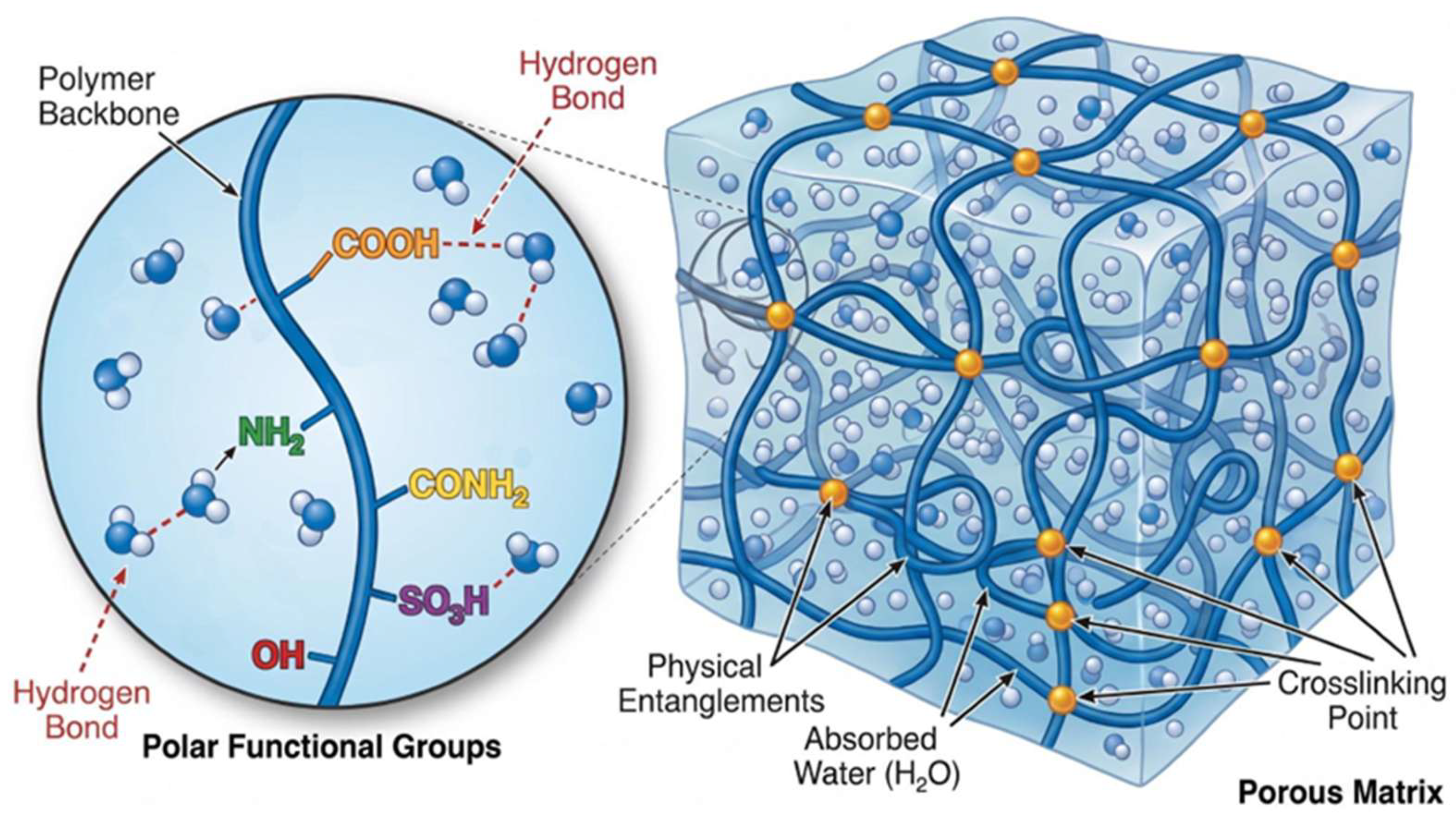
Figure 2.
Hydrogel-induced macrophage polarization from pro-inflammatory M1 to pro-regenerative M2 phenotype. The immunomodulatory hydrogel releases bioactive molecules and scavenges ROS, inhibiting NF-κB and JAK/STAT pathways associated with M1 polarization while activating STAT3/STAT6 signaling to promote M2 markers (IL-10, TGF-β, VEGF, Arg-1).
Figure 2.
Hydrogel-induced macrophage polarization from pro-inflammatory M1 to pro-regenerative M2 phenotype. The immunomodulatory hydrogel releases bioactive molecules and scavenges ROS, inhibiting NF-κB and JAK/STAT pathways associated with M1 polarization while activating STAT3/STAT6 signaling to promote M2 markers (IL-10, TGF-β, VEGF, Arg-1).
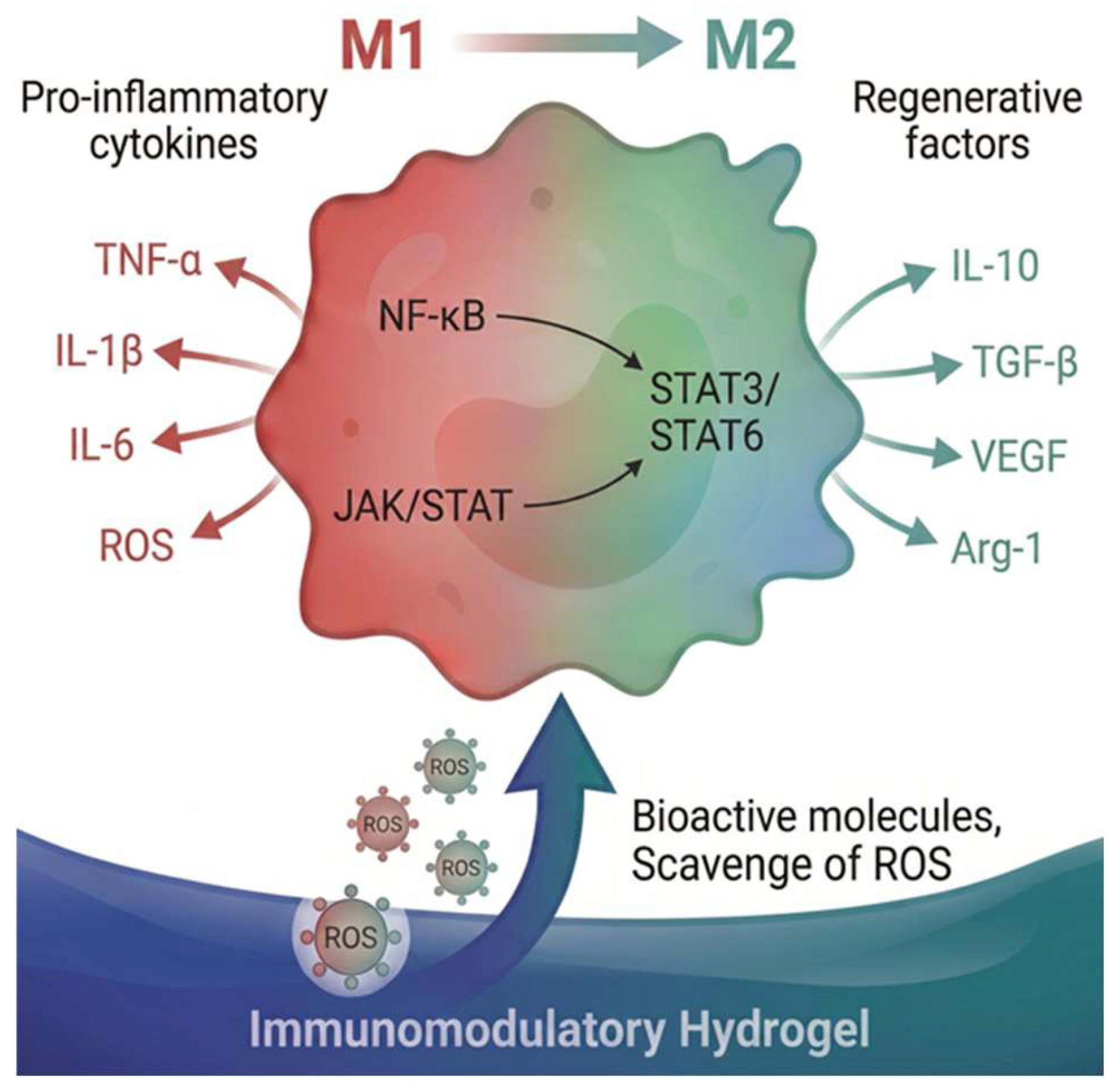
Figure 3.
Schematic representation of hydrogel action in a post-radiotherapy wound. The illustration shows a cross-section of skin with hydrogel applied on the wound.
Figure 3.
Schematic representation of hydrogel action in a post-radiotherapy wound. The illustration shows a cross-section of skin with hydrogel applied on the wound.
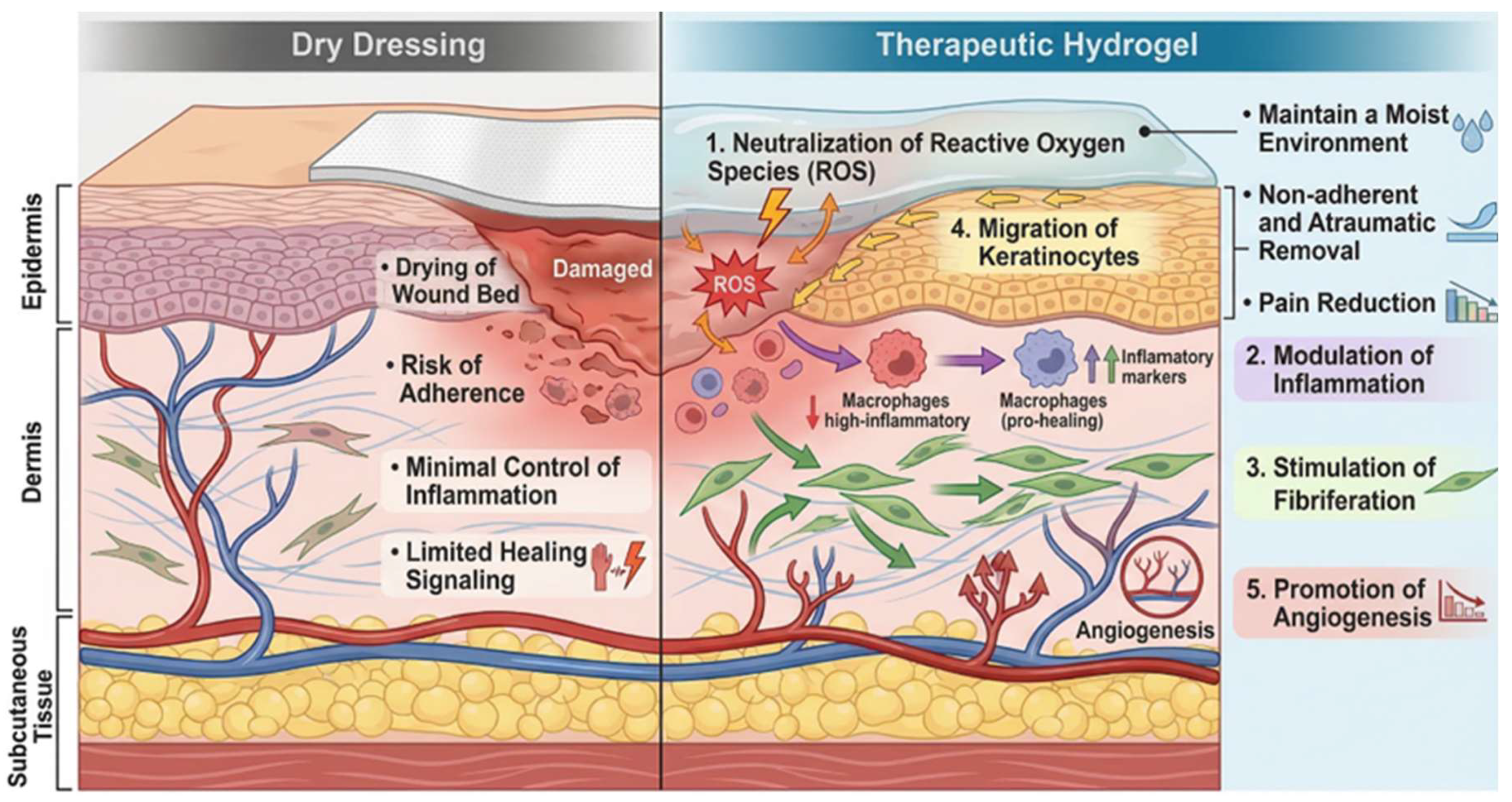
Figure 4.
Hydrogel-based strategies for mitigating radiation-induced gastrointestinal damage. The schematic summarizes the dual approach of hydrogel technology: radiation protection via anatomical displacement (spacer hydrogels) and therapeutic intervention via advanced delivery systems. These systems facilitate the delivery of MSCs, bioactive molecules, and probiotics to repair the irradiated epithelial layer and mitigate the symptoms of radiation-induced proctitis.
Figure 4.
Hydrogel-based strategies for mitigating radiation-induced gastrointestinal damage. The schematic summarizes the dual approach of hydrogel technology: radiation protection via anatomical displacement (spacer hydrogels) and therapeutic intervention via advanced delivery systems. These systems facilitate the delivery of MSCs, bioactive molecules, and probiotics to repair the irradiated epithelial layer and mitigate the symptoms of radiation-induced proctitis.
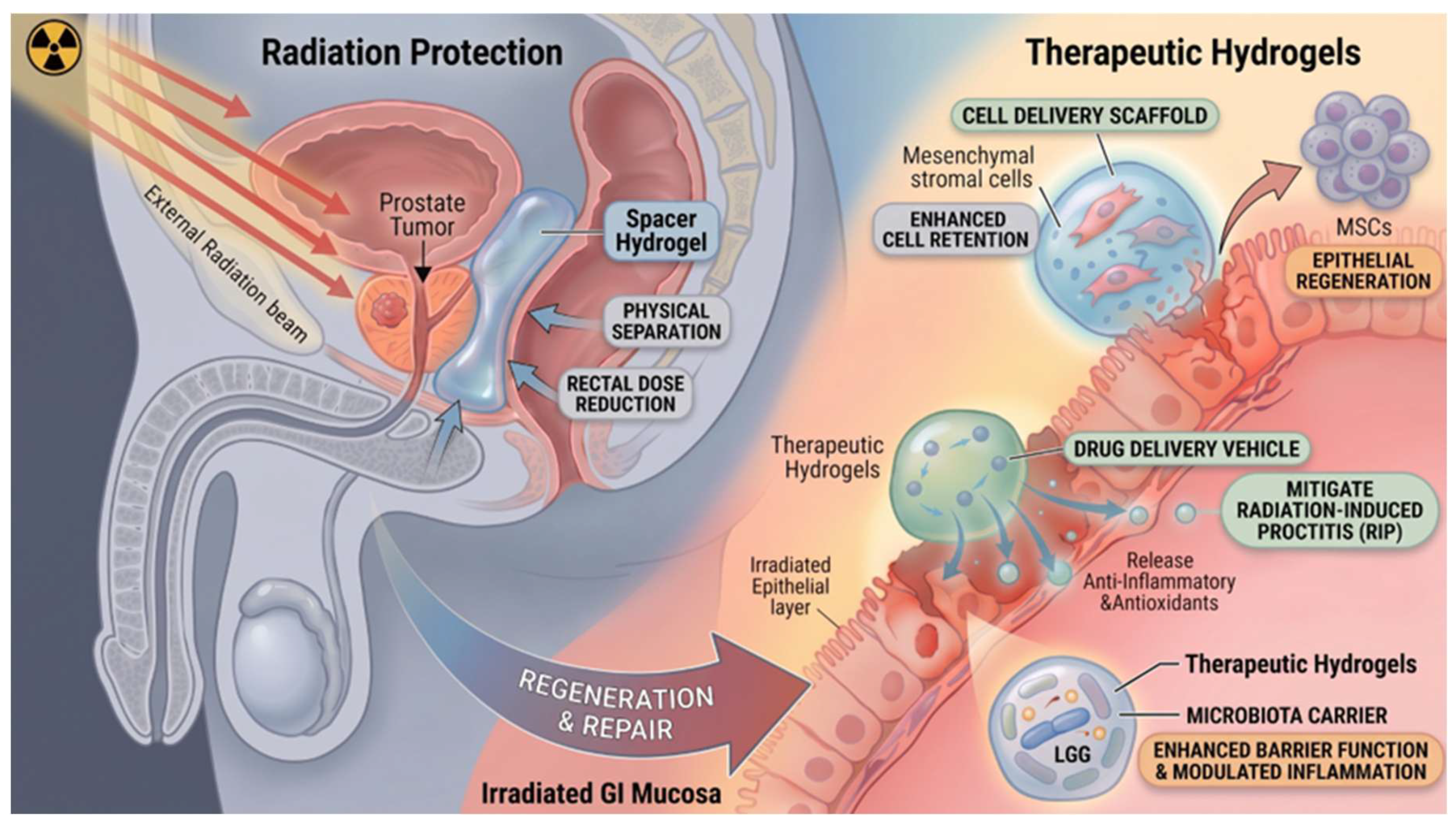
Figure 5.
Multifunctional hydrogel strategies for radiation lung therapy. This platform utilizes nanoengineered barriers for radiotherapy shielding, ECM scaffolds for EMT inhibition and protection against fibrosis, and chitosan/CNP composites for reducing inflammation and alveolar thickening, enabling synergistic lung protection and repair transmission.
Figure 5.
Multifunctional hydrogel strategies for radiation lung therapy. This platform utilizes nanoengineered barriers for radiotherapy shielding, ECM scaffolds for EMT inhibition and protection against fibrosis, and chitosan/CNP composites for reducing inflammation and alveolar thickening, enabling synergistic lung protection and repair transmission.
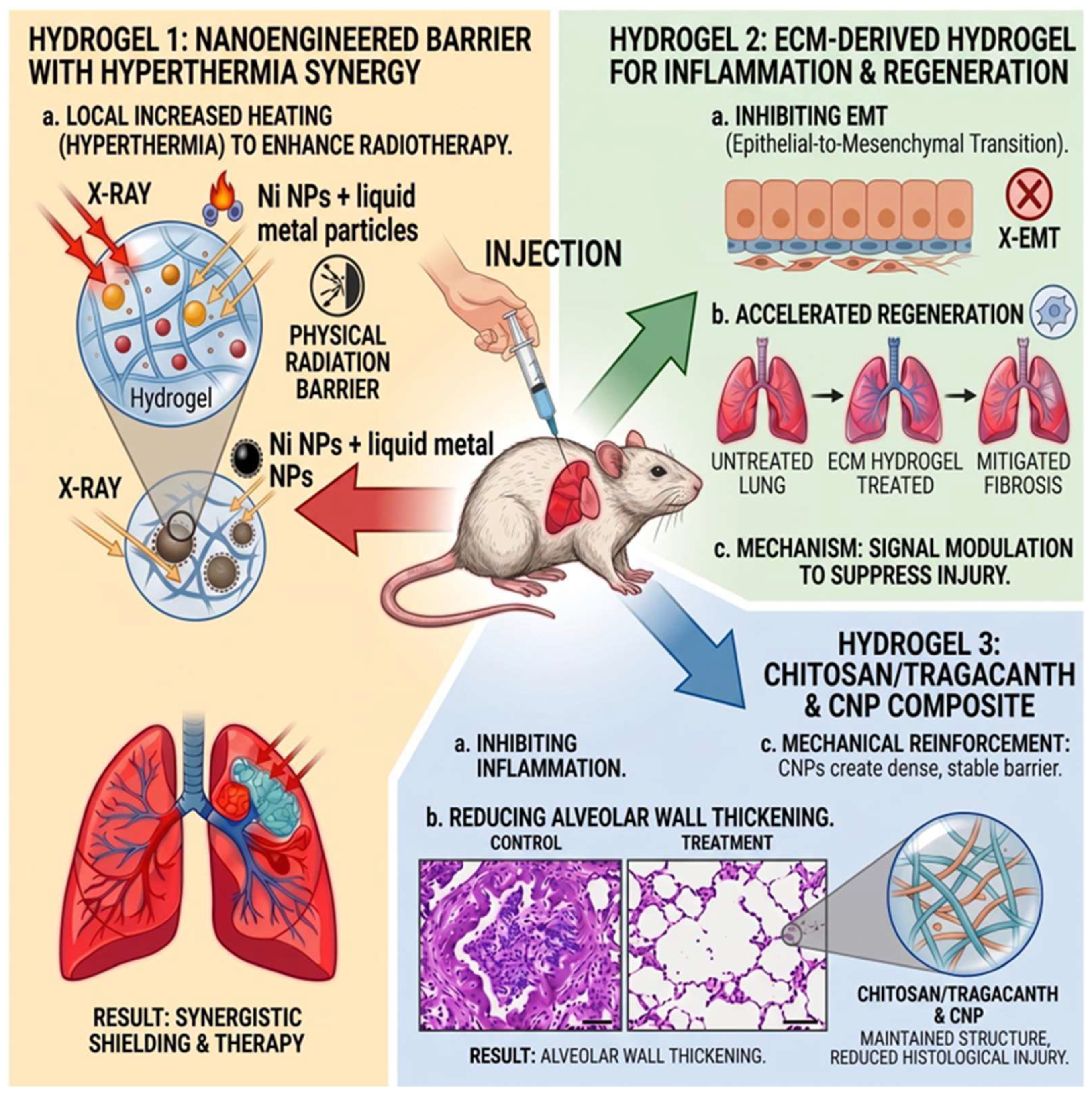
Figure 6.
Radiation-induced cardiomyocyte damage and hydrogel-based therapeutic intervention. Radiation exposure leads to ROS generation, endothelial dysfunction, and microvascular ischemia.
Figure 6.
Radiation-induced cardiomyocyte damage and hydrogel-based therapeutic intervention. Radiation exposure leads to ROS generation, endothelial dysfunction, and microvascular ischemia.
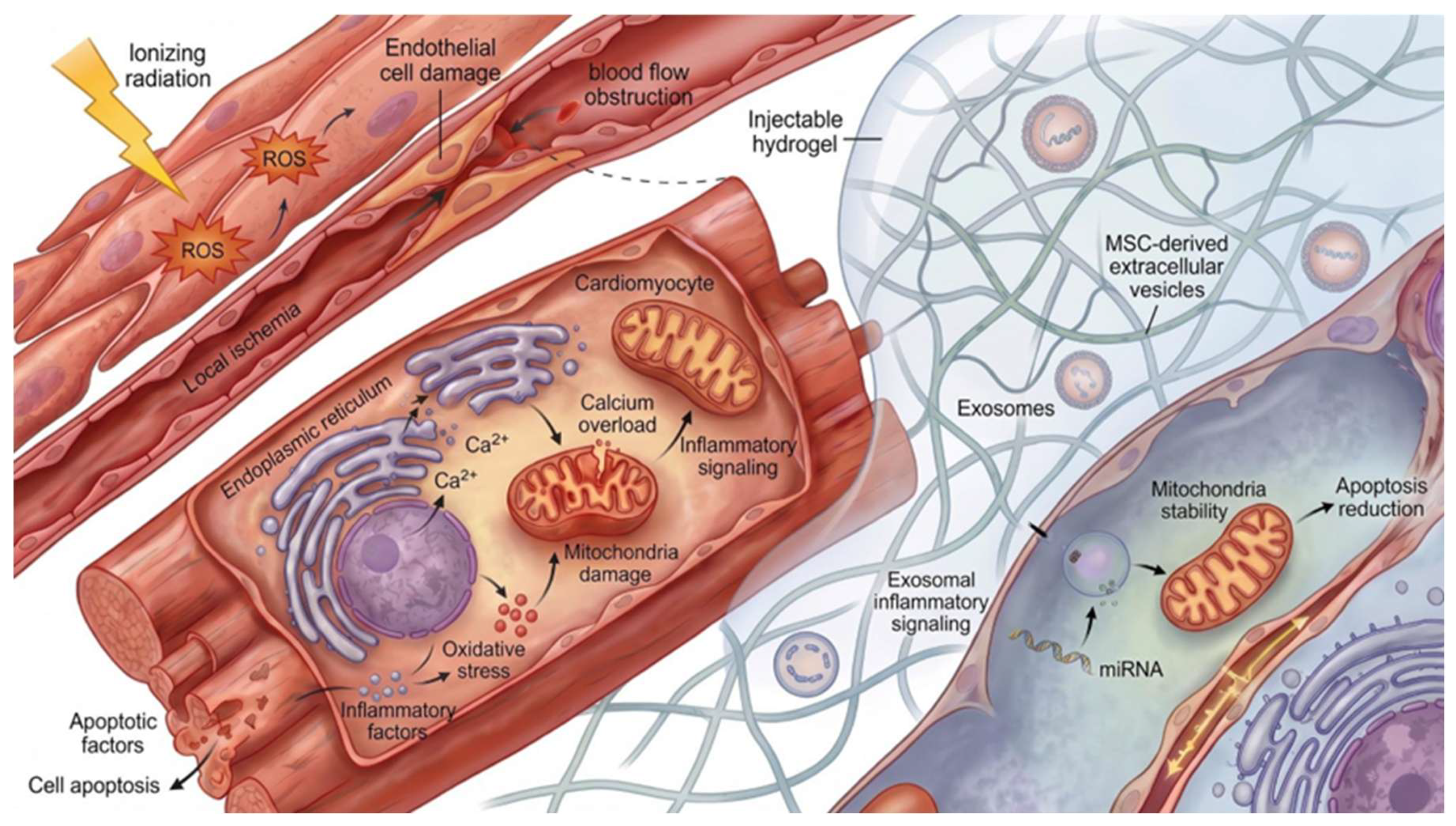
Figure 7.
Schematic illustration of hydrogel-based strategies for bone regeneration. Zn-HG promotes angiogenesis–osteogenesis coupling, Mg-HG regulates immune–vascular responses, radiosensitive HA/PVA hydrogel supports tumor therapy, and injectable Ca-Alg/Am-HG enhances macrophage polarization and osteogenic differentiation.
Figure 7.
Schematic illustration of hydrogel-based strategies for bone regeneration. Zn-HG promotes angiogenesis–osteogenesis coupling, Mg-HG regulates immune–vascular responses, radiosensitive HA/PVA hydrogel supports tumor therapy, and injectable Ca-Alg/Am-HG enhances macrophage polarization and osteogenic differentiation.
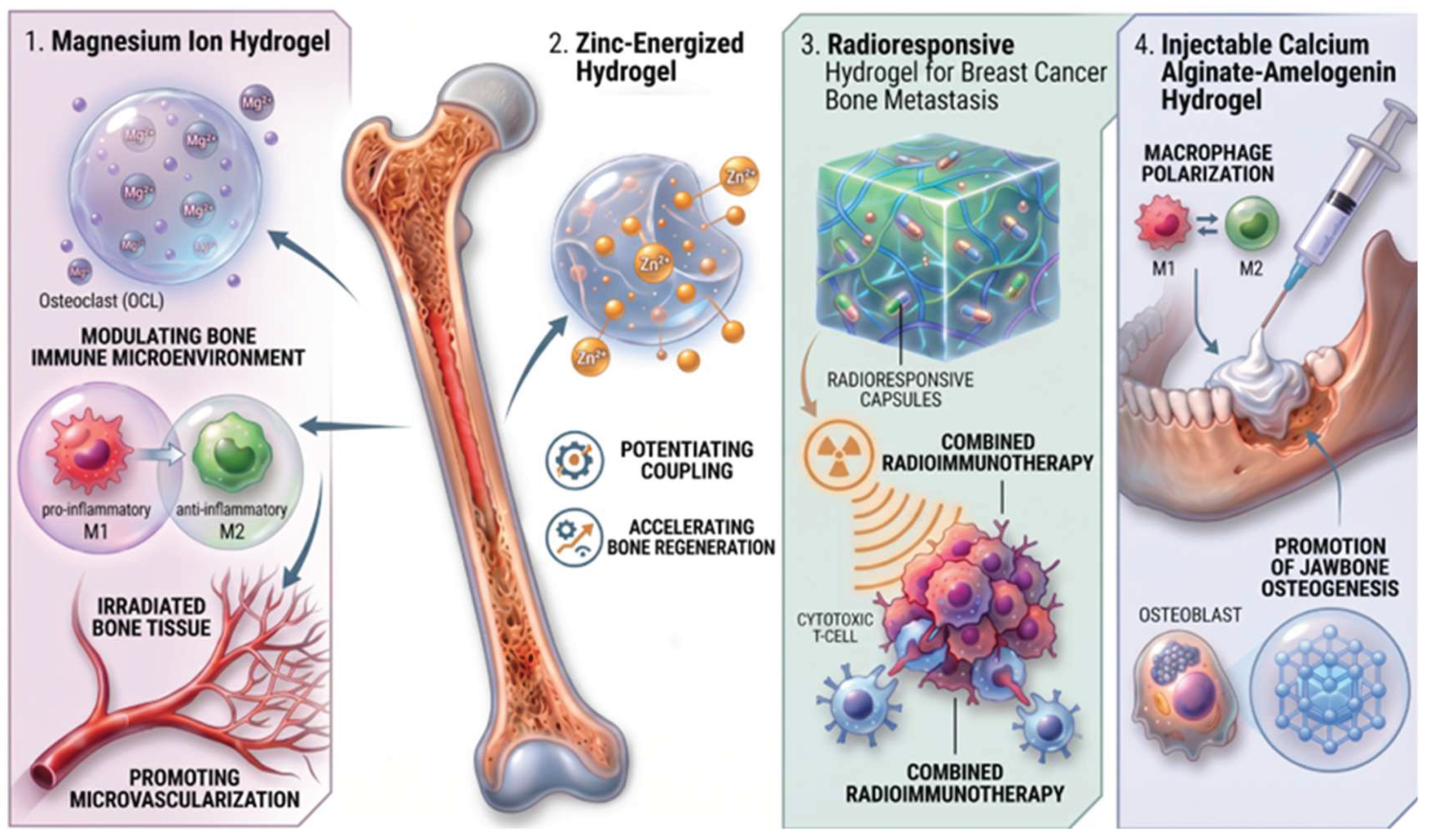
Disclaimer/Publisher’s Note: The statements, opinions and data contained in all publications are solely those of the individual author(s) and contributor(s) and not of MDPI and/or the editor(s). MDPI and/or the editor(s) disclaim responsibility for any injury to people or property resulting from any ideas, methods, instructions or products referred to in the content. |
© 2026 by the authors. Licensee MDPI, Basel, Switzerland. This article is an open access article distributed under the terms and conditions of the Creative Commons Attribution (CC BY) license.
Copyright: This open access article is published under a Creative Commons CC BY 4.0 license, which permit the free download, distribution, and reuse, provided that the author and preprint are cited in any reuse.


