

Submitted:
30 April 2026
Posted:
01 May 2026
You are already at the latest version
Abstract
Bulky, non-photosynthetic plant tissues such as stems, fruits, seeds, and storage organs frequently experience restricted gas diffusion, leading to internal oxygen limitation and the accumulation of respired CO2. Under these conditions, mitochondrial ATP production is constrained, and classical models predict increased carbon loss through enhanced substrate consumption and fermentation. However, many such tissues maintain high carbon-use efficiency and continue to accumulate storage products, indicating that alternative metabolic configurations must operate.Here, we develop a conceptual framework that integrates energy limitation and carbon recycling in diffusion-limited plant tissues. We propose that fermentative metabolism, pyrophosphate (PPi)-dependent reactions, and internal CO2 reassimilation via phosphoenolpyruvate carboxylase (PEPC) and, in specific contexts, Rubisco, function as components of a coordinated metabolic system. Within this system, reduced ATP yield increases substrate demand, but carbon loss is not necessarily proportional. Instead, PPi-dependent metabolism reduces ATP requirements, while internal CO2 recycling promotes carbon retention.This integrated configuration leads to a partial decoupling between substrate consumption and net CO2 release, providing a mechanistic basis for maintaining carbon-use efficiency under hypoxia. We further outline testable predictions arising from this framework, including spatial coordination of PPi-dependent metabolism and carboxylation pathways, and measurable divergence between substrate flux and CO2 efflux under oxygen limitation.This work provides a unified perspective on metabolism in diffusion-limited tissues and establishes a framework for linking energy economy, carbon balance, and sink strength in plant systems.
Keywords:
hypoxia
; pyrophosphate
; fermentation
; PEPC
; rubisco
; internal CO2 recycling
; carbon-use efficiency
1. Introduction
Plant metabolism is commonly described within a conceptual framework that assumes tissues operate under fully aerobic conditions, in which oxygen supply does not limit mitochondrial respiration and carbon dioxide readily diffuses to and from the atmosphere. However, this assumption is unlikely to apply to a large proportion of plant tissues. In many organs, internal gas exchange is constrained by tissue structure, diffusion path length, and limited connectivity with the external atmosphere. As a result, oxygen availability within plant tissues is frequently restricted, and hypoxia should be considered a common physiological condition rather than an exceptional stress.
Bulky and metabolically active organs such as stems, fruits, seeds, storage roots, and woody tissues are particularly prone to diffusion limitation. In these systems, oxygen must diffuse over relatively long distances to reach respiring cells, while continuous metabolic activity consumes oxygen along the diffusion pathway. At the same time, carbon dioxide produced by respiration accumulates internally because its efflux is similarly restricted. Consequently, steep internal gradients in both O2 and CO2 are commonly established (Armstrong 1980; Geigenberger 2003; Ho et al. 2010; van Dongen et al. 2003; Verboven et al. 2008). These tissues therefore operate within a coupled environment characterised by low oxygen and elevated carbon dioxide concentrations.
A key consequence of this diffusion-limited environment is that it simultaneously constrains energy production and alters carbon availability. Reduced oxygen supply limits mitochondrial oxidative phosphorylation, leading to decreased ATP production and changes in adenylate balance, redox state, and metabolic flux. Under these conditions, glycolytic flux must increase to sustain cellular energy demand, often supported by fermentative pathways that regenerate NAD+. This response is typically interpreted as an energetic limitation, in which reduced ATP yield necessitates increased substrate consumption to maintain metabolic activity (Drew 1997; Geigenberger 2003).
In parallel, the accumulation of respiratory CO2 creates conditions that favour internal carbon recycling. Dissolved CO2 equilibrates with bicarbonate, providing substrate for carboxylation reactions catalysed by enzymes such as phosphoenolpyruvate carboxylase (PEPC). In addition, ribulose-1,5-bisphosphate carboxylase/oxygenase (Rubisco) is present in many non-photosynthetic tissues, where it can contribute to the reassimilation of internally released CO2 (Moroney et al. 2001; Schwender et al. 2004). These processes indicate that respiratory carbon loss may be partially mitigated under diffusion-limited conditions.
A further layer of metabolic adjustment involves the use of pyrophosphate (PPi)-dependent reactions, which can substitute for ATP-dependent steps in central metabolism. Enzymes such as PPi-dependent phosphofructokinase and vacuolar H+-translocating pyrophosphatases enable metabolic flux to be maintained with a reduced ATP requirement, particularly when oxidative phosphorylation is constrained (Igamberdiev and Kleczkowski 2021; Stitt 1998). This alternative energy economy has the potential to buffer the energetic cost of hypoxia by lowering the ATP demand per unit of metabolic flux.
Despite substantial progress in understanding these processes individually, they have largely been considered in isolation. Hypoxia research has focused primarily on energy limitation and fermentative metabolism, whereas studies of non-foliar carbon fixation have emphasised CO2 reassimilation and anaplerotic pathways. The integrative consequences of diffusion limitation—namely the simultaneous occurrence of ATP limitation and enhanced internal carbon availability—have received comparatively little attention.
Here, we propose that PPi-dependent metabolism, fermentative pathways, and internal CO2 recycling via PEPC and Rubisco function as components of an integrated metabolic system that supports continued metabolic activity under diffusion-limited conditions. Within this framework, reduced ATP yield increases substrate demand, but carbon loss is not necessarily proportional, leading to a decoupling between energy demand and net CO2 release. This perspective provides a unified conceptual basis for understanding how plant tissues maintain carbon-use efficiency, sink strength, and metabolic function in environments where gas exchange is inherently restricted.
In this review, we first examine the physical basis of diffusion limitation and the development of internal O2 and CO2 gradients in plant tissues. We then consider the metabolic consequences of oxygen limitation, including changes in ATP production and glycolytic flux. This is followed by an analysis of PPi-dependent metabolism as an alternative energy system, and the role of internal CO2 accumulation in supporting carbon recycling through PEPC and Rubisco. Finally, we integrate these processes into a conceptual framework that links energy economy and carbon balance in diffusion-limited tissues, and discuss the implications for plant growth, storage, and productivity.
2. Diffusion Limitation and Internal Oxygen–Carbon Dioxide Gradients
2.1. Restricted Gas Exchange Is a Common Feature of Plant Tissues
Gas exchange in plants is governed by diffusion and is therefore strongly influenced by tissue structure, diffusion path length, and the availability of external interfaces. In well-aerated tissues such as leaves, stomata provide direct connections to the atmosphere, allowing relatively rapid exchange of O2 and CO2. Oxygen diffuses inward from both leaf surfaces, while respiratory CO2 diffuses outward, resulting in relatively shallow internal gradients (Figure 1A).
In contrast, many plant organs—including stems, fruits, seeds, storage roots, tubers, and woody tissues—lack such direct exchange pathways and are characterised by long diffusion distances, dense cellular organisation, and limited intercellular air spaces (Geigenberger 2003; van Dongen et al. 2003). In these tissues, oxygen must diffuse through multiple cell layers or be supplied indirectly via vascular transport, while CO2 must diffuse outward through the same constrained pathways.
As a consequence, internal gas composition is determined by the balance between diffusion and metabolic activity. Continuous respiratory consumption of oxygen leads to declining O2 concentrations with increasing distance from the site of supply, while ongoing CO2 production generates opposing gradients. These gradients are spatially structured, combining longitudinal components along vascular pathways with radial gradients extending into surrounding parenchyma (Figure 1B). Under these conditions, metabolically active regions of bulky tissues frequently operate under chronically reduced oxygen availability.
Importantly, these internal gradients are not exceptional or restricted to stress conditions such as flooding. Rather, they arise as a direct consequence of organ structure and function. In this context, hypoxia should be regarded as a common physiological state in many plant tissues, particularly those characterised by high metabolic activity and restricted gas exchange.
2.2. Diffusion Limitation Creates a Coupled O2–CO2 Environment
A central consequence of restricted gas exchange is that oxygen limitation and carbon dioxide accumulation occur simultaneously. While the effects of declining O2 have been widely studied, the parallel accumulation of CO2 has received comparatively less attention.
If respiratory oxygen consumption exceeds the rate of diffusive supply, internal O2 concentration declines along diffusion pathways. At the same time, respiratory CO2 production continues, and when its rate of generation exceeds diffusive loss, CO2 accumulates within the tissue. These processes are intrinsically coupled: the same structural constraints that limit oxygen entry also restrict carbon dioxide exit.
Diffusion-limited tissues should therefore be viewed as systems characterised by both low O2 and elevated CO2, rather than by oxygen deficiency alone. This dual constraint has important metabolic implications. Reduced oxygen availability constrains mitochondrial ATP production, while elevated CO2 increases the local availability of dissolved inorganic carbon, potentially favouring carboxylation reactions.
Although these outcomes follow directly from diffusion–reaction principles, they have largely been treated independently in the literature. Hypoxia research has focused primarily on energy limitation, redox balance, and survival responses, whereas studies of internal carbon fixation have emphasised PEPC activity, bicarbonate utilisation, and, in some systems, Rubisco-mediated reassimilation. The metabolic consequences of these two features occurring together remain insufficiently integrated.
2.3. Developmental and Functional Significance of Internal Gradients
Internal gradients in O2 and CO2 are not merely passive consequences of tissue structure but influence metabolic strategy and developmental processes. In developing seeds, fruits, and storage tissues, restricted gas exchange coincides with high biosynthetic demand, creating conditions in which both energy supply and carbon conservation become limiting factors (Schwender et al. 2004; ?).
In these systems, the accumulation of internal CO2 provides a substrate pool for reassimilation, while reduced oxygen availability constrains ATP production. This combination creates a metabolic context in which energy economy and carbon economy are intrinsically linked.
Experimental evidence from developing seeds and other heterotrophic tissues demonstrates that internally generated CO2 can be reassimilated, improving carbon conversion efficiency during biosynthesis (Rangan et al. 2024; Schwender et al. 2004). These findings indicate that diffusion limitation does not simply impose constraints on metabolism, but also creates opportunities for metabolic integration.
2.4. A Conceptual Gap in Current Understanding
Taken together, current evidence supports three key propositions: (i) diffusion limitation is a common feature of many plant tissues; (ii) this limitation leads to the coupled occurrence of low O2 and elevated CO2; and (iii) plants possess metabolic systems capable of responding to both conditions, including fermentative pathways, PPi-dependent reactions, and CO2 reassimilation via PEPC and Rubisco.
What remains largely missing is a unified framework that treats these processes as components of a coordinated metabolic strategy. Existing studies have typically addressed energy limitation and carbon recycling separately, without explicitly considering how they interact under diffusion-limited conditions.
A central consequence of this separation is that the relationship between energy demand and carbon balance remains poorly defined. Reduced oxygen availability decreases the efficiency of ATP generation, implying that a greater quantity of respiratory substrate is required to sustain metabolic activity. At the same time, internal CO2 accumulation creates the potential for partial reassimilation of respiratory carbon. The net outcome depends on the balance between these opposing processes, yet this balance has rarely been quantified in a unified manner.
This issue is particularly relevant when considering the partitioning of respiration into growth-associated and maintenance-associated components. Growth respiration is directly linked to biosynthetic processes and biomass accumulation, whereas maintenance respiration reflects the energetic cost of sustaining existing cellular structures and metabolic function. Under diffusion-limited conditions, constraints on ATP production are expected to differentially affect these components, with potential consequences for both biomass accumulation and carbon-use efficiency.
Here, we argue that diffusion limitation necessitates an integrated analysis in which carbon flux, energy demand, and respiratory partitioning are considered simultaneously. Such an approach allows the effects of reduced ATP yield, altered metabolic pathways, and internal carbon recycling to be evaluated within a common framework. In subsequent sections, we develop this perspective by linking gas diffusion constraints to quantitative descriptions of substrate demand, respiratory partitioning, and carbon-use efficiency in plant tissues.
3. Metabolic Consequences of Oxygen Limitation
Reduced oxygen availability alters several key aspects of plant metabolism. A primary effect is the restriction of flux through the mitochondrial electron transport chain, which limits ATP production via oxidative phosphorylation (Drew 1997; Geigenberger 2003; Gupta et al. 2009). As a consequence, the energetic yield per unit of respiratory substrate declines, altering the balance between energy supply and metabolic demand (Plaxton and Podestá 2006; Stitt 1998; van Dongen and Licausi 2015).
To compensate for reduced ATP generation, cells typically increase glycolytic flux. Glycolysis can proceed in the absence of oxygen but produces substantially less ATP per molecule of substrate than mitochondrial respiration. Under conditions of severe oxygen limitation, fermentative pathways are activated to regenerate NAD+, thereby sustaining glycolytic flux (Bailey-Serres and Voesenek 2008; Drew 1997; Geigenberger 2003, 2011; ?). These adjustments allow continued metabolic activity but are associated with reduced energetic efficiency and increased substrate consumption per unit of ATP generated.
Changes in oxygen availability also influence decarboxylating reactions within central metabolism. Several steps in the tricarboxylic acid cycle involve the release of CO2, and restriction of mitochondrial flux modifies the balance between carbon oxidation and biosynthetic processes (Geigenberger 2003). In parallel, shifts in metabolic pathway utilisation may alter the relative contributions of biosynthesis and respiratory carbon loss.
Despite these adjustments, respiration continues to generate CO2. In diffusion-limited tissues, this CO2 may accumulate internally, increasing the local concentration of dissolved inorganic carbon and creating the potential for reassimilation through carboxylation reactions (Schwender et al. 2004). This introduces an additional layer of complexity, as carbon loss through decarboxylation may be partially offset by internal recycling.
From a systems perspective, these responses highlight a central consequence of oxygen limitation: a reduction in the efficiency with which substrate is converted into ATP, coupled with continued carbon flux through decarboxylating pathways. This combination implies that a greater quantity of substrate is required to sustain metabolic processes, with potential implications for the partitioning of respiration between growth-associated and maintenance-associated functions. Processes associated with maintenance, which are continuous and less flexible, may become proportionally more significant as energetic constraints intensify, whereas growth-related fluxes may be more strongly constrained by reduced ATP availability.
These considerations emphasise the need to evaluate oxygen limitation not only in terms of metabolic pathway changes, but also in terms of its impact on substrate demand, respiratory partitioning, and carbon-use efficiency. In the following sections, these relationships are examined in the context of alternative energy systems and internal carbon recycling.
4. Fermentation and Redox Balancing
Under conditions of severe oxygen limitation, fermentative metabolism becomes essential for sustaining glycolytic flux by regenerating cytosolic NAD+ (Drew 1997; Geigenberger 2003). In plant tissues, pyruvate may initially be reduced to lactate via lactate dehydrogenase; however, this pathway is typically transient. As cytosolic pH declines, metabolism shifts towards ethanolic fermentation, in which pyruvate is decarboxylated to acetaldehyde and subsequently reduced to ethanol, thereby maintaining redox balance while permitting continued glycolysis (Drew 1997; Felle 2005).
Fermentation is often described as a low-efficiency emergency pathway due to the limited ATP yield per mole of substrate. However, in diffusion-limited tissues this characterisation is incomplete. Reduced ATP generation via oxidative phosphorylation necessitates an increase in glycolytic flux to sustain cellular energy demand. In a response dominated by ethanolic fermentation, this increased flux is inherently coupled to carbon loss through decarboxylation, leading to reduced carbon-use efficiency.
Importantly, fermentative metabolism represents only one possible configuration of metabolic adjustment under oxygen limitation. Alternative pathways contribute to redox balancing while partially conserving carbon, particularly through the diversion and recycling of pyruvate and related intermediates. One prominent route is the conversion of pyruvate to alanine via alanine aminotransferase. This reaction does not involve decarboxylation and therefore conserves carbon while providing a temporary sink for pyruvate and nitrogen. Accumulation of alanine is a consistent feature of hypoxic plant tissues and is considered a key mechanism for maintaining metabolic stability under oxygen limitation (Miyashita et al. 2007; Rocha et al. 2010).
In parallel, organic acid metabolism provides additional flexibility in redox and carbon management. Pyruvate and phosphoenolpyruvate can be channelled into malate synthesis via anaplerotic reactions, including phosphoenolpyruvate carboxylase (PEPC). Malate can serve as a temporary carbon store and redox buffer, and its interconversion with other tricarboxylic acid cycle intermediates allows redistribution of reducing equivalents between cellular compartments (??). Under hypoxia, partial operation of the tricarboxylic acid cycle and associated shuttle systems can therefore contribute to maintaining redox balance without complete oxidation of substrates.
Sucrose metabolism is also closely integrated into these responses. In storage tissues, sucrose breakdown via sucrose synthase is generally favoured over invertase under oxygen limitation, as it conserves energy by coupling cleavage to UDP formation rather than ATP-dependent phosphorylation (Koch 2004; Sturm and Tang 1999). The resulting UDP-glucose can be recycled through reversible reactions involving UDP-glucose pyrophosphorylase, linking sucrose metabolism to the cellular PPi pool. This facilitates continued carbon flux through glycolysis while reducing ATP demand. In addition, the reversible nature of several steps in sucrose metabolism allows partial re-synthesis of sucrose, thereby contributing to carbon retention under conditions where net export or utilisation is constrained.
The utilisation of inorganic pyrophosphate (PPi) as an alternative phosphoryl donor further reinforces these adjustments. PPi-dependent enzymes, such as pyrophosphate:fructose-6-phosphate 1-phosphotransferase, can substitute for ATP-dependent steps in glycolysis, reducing the overall ATP requirement for maintaining metabolic flux (Plaxton 1996; Stitt et al. 2010). By lowering ATP demand, these pathways decrease the glycolytic flux required to sustain cellular energy balance, thereby indirectly reducing carbon loss through fermentation.
Fermentation also interacts with cellular pH, proton balance, and the distribution of reducing equivalents. The coordinated operation of alanine synthesis, organic acid metabolism, and sucrose cycling contributes to stabilising cytosolic pH and redox state. In addition, CO2 released through decarboxylating reactions may accumulate in diffusion-limited tissues and become available for reassimilation via carboxylation reactions, further enhancing carbon retention (Schwender et al. 2004; ?).
Collectively, these processes demonstrate that fermentative metabolism cannot be considered in isolation. Instead, it forms part of an integrated metabolic network in which PPi-dependent reactions, amino acid synthesis, organic acid interconversions, and sucrose metabolism collectively determine the balance between energy production, redox stability, and carbon conservation under oxygen limitation.
5. Pyrophosphate-Dependent Metabolism Under Energy Constraint
The metabolic adjustments described above, including the accumulation of alanine, malate and sucrose, primarily reflect changes in carbon partitioning under oxygen limitation. However, these changes cannot be understood independently of the underlying energetic constraint. Reduced oxygen availability decreases ATP yield, increasing the substrate demand required to sustain metabolic flux.
Consequently, the observed shifts in carbon metabolism and the engagement of alternative pathways must be considered alongside mechanisms that reduce ATP demand. One such mechanism is the utilisation of inorganic pyrophosphate (PPi) as an alternative phosphoryl donor. In this context, PPi-dependent metabolism does not represent a separate response, but rather an integral component of a coordinated adjustment that links energy conservation with carbon retention
Another important adaptation to energy limitation involves the use of pyrophosphate (PPi) as an alternative energy source. Several plant enzymes are capable of using PPi in place of ATP to drive metabolic reactions. This offers an attractive framework for understanding how metabolism may continue under oxygen limitation while reducing ATP demand (Geigenberger 2003; Igamberdiev and Kleczkowski 2021; Lee and Jeon 2020; Stitt 1998).
One example is PPi-dependent phosphofructokinase, which catalyzes:
This reaction provides a glycolytic step that does not require ATP. Similarly, vacuolar proton-pumping pyrophosphatases use PPi to generate proton gradients across membranes. Together these systems can lower the ATP cost of metabolism during periods when oxidative phosphorylation is restricted by limited oxygen availability.
Effective ATP Yield Under Hypoxia
Under conditions where oxidative phosphorylation is partially constrained, the effective ATP yield per unit metabolic flux can be expressed as a weighted combination of oxidative and non-oxidative pathways:
where:
- is the effective ATP yield per unit glycolytic flux under hypoxia,
- is the fraction of ATP derived from oxidative phosphorylation (dimensionless, 0–1),
- is the ATP yield associated with oxidative metabolism,
- is the ATP yield associated with anaerobic ATP production (e.g. glycolysis-linked substrate-level phosphorylation).
As oxygen availability declines, decreases and approaches , resulting in a reduction in energetic efficiency.
Glucose Demand Under Hypoxia
To maintain a given metabolic ATP demand, a reduction in ATP yield must be compensated by increased substrate flux. The relative glucose demand under hypoxia can therefore be expressed as:
where:
- is the glucose demand under hypoxic conditions,
- is the glucose demand under fully aerobic conditions.
This formulation captures the increasing substrate requirement as ATP yield declines.
Damping of Glucose Demand by PPi-Dependent Metabolism
Pyrophosphate-dependent reactions reduce the requirement for ATP by substituting PPi in key metabolic steps. This effect can be represented conceptually as a damping of glucose demand:
where:
- is the glucose demand under hypoxia with PPi-dependent metabolism,
- is a dimensionless damping coefficient representing the extent to which PPi metabolism reduces ATP demand (0–1).
Importantly, is expected to increase under stronger energetic limitation, reflecting a greater relative contribution of PPi-dependent reactions.
This perspective shifts the role of PPi metabolism from that of an auxiliary pathway to that of an integral component of metabolic regulation in diffusion-limited tissues. The consequences of this shift can be understood by explicitly separating the effects of hypoxia on ATP yield, substrate demand and carbon loss, as illustrated conceptually in Figure 2.
This energetic buffering provides a mechanistic basis for the retention of carbon within central metabolism, thereby supporting the accumulation of metabolites such as alanine, malate and sucrose under conditions where fermentative carbon loss would otherwise predominate.
5.1. Origin, Turnover and Steady-State Levels of PPi in Plant Cells
Inorganic pyrophosphate (PPi) is a ubiquitous by-product of biosynthetic metabolism, generated during a wide range of anabolic reactions including nucleic acid synthesis, protein synthesis, and the activation of sugars and other metabolites. Many of these reactions involve the cleavage of ATP to AMP and PPi, resulting in the continuous production of PPi in metabolically active cells (Heinonen 2001; Stitt 1998).
In most non-plant systems, PPi is rapidly hydrolysed by soluble inorganic pyrophosphatases, maintaining cytosolic PPi concentrations at very low levels and effectively rendering PPi a thermodynamic sink (Heinonen 2001). This rapid hydrolysis is often considered essential to drive biosynthetic reactions forward by removing one of the reaction products.
In plant cells, however, the metabolism of PPi differs in important respects. Cytosolic PPi concentrations are maintained at levels that are sufficiently high to support PPi-dependent enzymatic reactions (Stitt 1998). In addition to soluble pyrophosphatases, plants possess membrane-bound H+-translocating pyrophosphatases (V-PPases) that utilize PPi as an energy source to drive proton transport across endomembranes, particularly the tonoplast (Maeshima 2000). This provides a direct mechanism by which PPi can be conserved and utilized, rather than dissipated.
The steady-state level of PPi in plant cells therefore reflects a balance between its production in biosynthetic reactions, its hydrolysis by pyrophosphatases, and its utilization in PPi-dependent processes. Under conditions where ATP availability is constrained, such as hypoxia or high metabolic demand, the relative importance of PPi-dependent reactions may increase, allowing continued metabolic flux while reducing the reliance on ATP.
These features distinguish plant PPi metabolism from that of many other organisms and support the concept of a PPi-based energy economy. Under diffusion-limited conditions, this system provides a mechanism to reduce ATP demand while maintaining metabolic flux, thereby linking energy status directly to carbon economy. In this context, PPi-dependent reactions are not simply substitutes for ATP-dependent processes, but integral components of a coordinated metabolic strategy that balances ATP availability, oxygen supply, and carbon conservation.
While PPi-dependent metabolism reduces the energetic cost of maintaining metabolic flux, it does not by itself determine the fate of carbon within the system. Under diffusion limitation, the accumulation of internal CO2 creates additional opportunities for carbon retention through reassimilation pathways, which are considered in the following section.
6. Internal CO2 Accumulation and Refixation
Respiratory metabolism continuously produces CO2 through oxidative decarboxylation reactions. In tissues where gas diffusion is limited, CO2 concentrations within the intercellular spaces and cells can increase substantially above atmospheric levels (Geigenberger 2003; Schwender et al. 2004).
Carbon dioxide dissolved in the aqueous phase rapidly equilibrates with bicarbonate through the action of carbonic anhydrase. This conversion creates the possibility for metabolic refixation of respiratory CO2 through carboxylation reactions that utilize bicarbonate as a substrate (DiMario et al. 2017; Moroney et al. 2001).
The accumulation of internal CO2 therefore represents both a metabolic challenge and an opportunity within the broader context of oxygen limitation and constrained ATP supply. Elevated CO2 levels may influence cellular pH and enzyme activities, but they also provide a substrate pool that could potentially be reassimilated into organic metabolites (Kurkdjian and Guern 1989; Raven 1985).
The decoupling between glucose consumption and CO2 release under hypoxic conditions (Figure 3) provides a mechanistic basis for this opportunity. Where carbon is retained through metabolic recycling rather than lost via fermentation, internally generated CO2 may accumulate to high concentrations while remaining available for reassimilation. This situation contrasts with classical views of fermentation as a pathway associated with substantial carbon loss. Instead, it supports a model in which hypoxia promotes a shift towards internal carbon retention and recycling, thereby increasing the potential importance of anaplerotic carboxylation and Rubisco-mediated refixation in non-photosynthetic tissues.
6.1. Internal CO2 Accumulation in Diffusion-Limited Tissues
The principles outlined above can be generalised across a range of diffusion-limited tissues. Respiratory metabolism continuously produces CO2, and in plant tissues where gas exchange is restricted this CO2 may accumulate internally to concentrations substantially above those of the external atmosphere. This phenomenon is not confined to specialised storage organs, but arises whenever the rate of respiratory CO2 production exceeds the capacity for diffusive transport to the surrounding environment. Such conditions are common in a wide range of plant tissues, including stems, roots, fruits, seeds and other bulky or densely structured organs (Geigenberger 2003; van Dongen et al. 2003).
The internal atmosphere of plant tissues is determined by the balance between metabolic gas exchange and physical diffusion. Where diffusion path lengths are long, intercellular air spaces are limited or poorly connected, or external barriers to gas exchange are present, steep gradients in both O2 and CO2 can develop. These gradients are an inherent consequence of diffusion–reaction coupling and do not require extreme environmental conditions (Geigenberger 2003).
Woody stems provide a clear demonstration of this principle. Measurements across multiple species indicate that internal CO2 concentrations within stems commonly reach several percent and may exceed 10% in some cases. The radial movement of gases is restricted by bark, phloem and xylem tissues, while ongoing respiration in living cells contributes to substantial internal CO2 accumulation.
A similar situation occurs in fruits, tubers and seeds, where dense tissue structure and high respiratory activity combine to limit gas exchange. Developing oilseeds, for example, represent a particularly informative system because internal CO2 accumulation has been linked directly to carbon reassimilation by Rubisco, improving carbon conversion efficiency during storage product synthesis (Schwender et al. 2004).
These observations indicate that internal CO2 accumulation should be regarded as a normal feature of many metabolically active plant tissues rather than an exceptional stress response. The extent to which accumulated CO2 is lost, buffered, transported or reassimilated is likely to depend on tissue structure, developmental stage and metabolic state.
6.2. CO2–Bicarbonate Equilibrium and Carbonic Anhydrase
From a metabolic perspective, this equilibrium is important because it determines the availability of bicarbonate for carboxylation reactions that contribute to carbon retention. Once CO2 accumulates within plant tissues, its physiological significance depends not only on its gaseous concentration but also on its behaviour in the aqueous phase. Dissolved CO2 is in reversible equilibrium with bicarbonate and protons:
This reaction establishes a dynamic pool of dissolved inorganic carbon, comprising CO2, and, to a lesser extent, . Under physiological pH conditions typical of plant cells, bicarbonate represents a major component of this pool, linking respiratory CO2 production directly to both proton generation and the availability of carboxylation substrates (Raven 1985; Smith and Raven 1979).
Although the interconversion of CO2 and bicarbonate can occur spontaneously, the reaction is strongly accelerated by carbonic anhydrase, a widely distributed enzyme present in multiple cellular compartments, including the cytosol, plastids and mitochondria (DiMario et al. 2017; Moroney et al. 2001). The presence of carbonic anhydrase ensures that equilibrium between CO2 and is achieved rapidly relative to metabolic fluxes, effectively coupling respiratory CO2 production to intracellular acid–base chemistry and metabolic processes (Badger and Price 1994; Fabre et al. 2007).
The distribution of carbonic anhydrase across cellular compartments suggests that CO2/ interconversion is not confined to a single location but may occur throughout the cell. This has important implications for the spatial dynamics of dissolved inorganic carbon, particularly in tissues where internal CO2 concentrations are elevated. Under such conditions, localised increases in CO2 may be rapidly translated into changes in bicarbonate concentration and proton availability within different compartments (DiMario et al. 2017; Moroney et al. 2001; ?).
The equilibrium between CO2 and bicarbonate is strongly influenced by pH, such that shifts in cytosolic or organellar pH will alter the relative proportions of CO2 and . Conversely, increases in CO2 concentration will tend to drive proton production through hydration reactions, potentially contributing to changes in intracellular pH depending on buffering capacity (Kurkdjian and Guern 1989; Raven 1985). The CO2–bicarbonate system therefore represents a bidirectional link between carbon metabolism and acid–base regulation.
From a metabolic perspective, the generation of bicarbonate is particularly significant because it provides substrate for carboxylation reactions. Phosphoenolpyruvate carboxylase, which utilises rather than CO2 as a substrate, is widely expressed in plant tissues and plays a central role in anaplerotic carbon fixation (Chollet et al. 1996; O’Leary 1982). Elevated internal CO2 concentrations may therefore increase the availability of bicarbonate for PEPC-mediated reactions, linking respiratory CO2 production directly to carbon reassimilation pathways.
In addition to PEPC, bicarbonate may influence other metabolic processes either as a substrate or through indirect effects on enzyme activity and proton balance. The extent to which these processes contribute to overall carbon economy in diffusion-limited tissues remains an open question, but the presence of a substantial and dynamic dissolved inorganic carbon pool provides a mechanistic basis for potential recycling of respiratory CO2 (Geigenberger 2003; Schwender et al. 2004).
Together, these considerations indicate that internal CO2 accumulation cannot be viewed solely in terms of gaseous diffusion, but must be understood within the context of aqueous chemistry, enzyme-catalysed equilibration and metabolic utilisation of dissolved inorganic carbon. This framework provides the foundation for examining how CO2 accumulation may influence intracellular pH and metabolic regulation in the following section.
6.3. Consequences for Intracellular pH and Buffering
The consequences of CO2 accumulation for intracellular pH must be interpreted in the context of hypoxia-induced metabolic reconfiguration, where changes in carbon flux, proton balance and energy status occur simultaneously.
The interconversion of CO2 and bicarbonate is intrinsically linked to proton production and consumption, and therefore to intracellular pH regulation. As a consequence, accumulation of CO2 within plant tissues has the potential to influence cellular acid–base balance, particularly in environments where diffusion constraints and metabolic activity coincide. However, the extent to which internal CO2 accumulation translates into measurable changes in cytosolic pH depends on the buffering capacity of the cell and the integration of multiple metabolic processes (Kurkdjian and Guern 1989; Raven 1985).
Cytosolic pH in plant cells is typically maintained within a relatively narrow range, often close to neutrality, despite substantial fluctuations in metabolic activity and environmental conditions. This stability reflects the operation of several buffering and regulatory systems, including phosphate buffers, organic acids, protein charge groups and active proton transport across cellular membranes (Felle 2001; Smith and Raven 1979). The vacuole, in particular, plays a central role as a dynamic reservoir for protons and organic acids, allowing adjustments in cytosolic pH through controlled exchange across the tonoplast (Martinoia et al. 2007).
Under conditions where internal CO2 concentrations are elevated, hydration of CO2 may contribute to proton generation, potentially influencing cytosolic pH. At the same time, ongoing metabolic processes such as glycolysis, mitochondrial respiration and, under more severe oxygen limitation, fermentative pathways also contribute to proton production or consumption. The resulting cytosolic pH therefore reflects the balance between multiple interacting processes rather than the effect of CO2 alone (Geigenberger 2003; Gout et al. 2001).
Experimental evidence indicates that cytosolic pH can shift under conditions of hypoxia or metabolic perturbation, although these changes are often moderate and transient due to effective buffering. In root tissues and other actively metabolising systems, decreases in cytosolic pH have been observed during oxygen limitation, frequently accompanied by adjustments in metabolic fluxes and ion transport (Drew 1997; Felle 2005). Similar responses may occur in other diffusion-limited tissues where respiratory CO2 accumulation and restricted oxidative phosphorylation coincide.
Organic acids, particularly malate, play a dual role in this context. In addition to serving as intermediates in central carbon metabolism, they contribute to cellular buffering capacity and can participate in proton-coupled transport processes. The interconversion between organic acids and their conjugate bases provides a mechanism for stabilising cytosolic pH while simultaneously linking acid–base balance to carbon metabolism (Igamberdiev and Eprintsev 2016; Raven and Smith 1976).
The interaction between CO2 accumulation, bicarbonate formation and intracellular pH regulation is therefore best understood as part of an integrated system in which carbon metabolism and proton balance are closely coupled. Rather than acting as an isolated driver of acidification, CO2 contributes to a broader network of processes that collectively determine cytosolic pH and its stability.
These considerations are particularly relevant for diffusion-limited tissues, where elevated internal CO2, altered respiratory metabolism and changes in energy status occur simultaneously. In such environments, even modest shifts in cytosolic pH may have significant consequences for enzyme activity, metabolite partitioning and transport processes. At the same time, the buffering capacity of the cell constrains the magnitude of these changes, allowing metabolic function to be maintained within viable limits.
Understanding how intracellular pH is regulated under these conditions provides an essential foundation for analysing the metabolic consequences of CO2 accumulation. In particular, the sensitivity of key enzymes and pathways to pH and bicarbonate availability will determine how carbon flux is redistributed in diffusion-limited tissues.
6.4. PEPC-Mediated Carboxylation in Heterotrophic Tissues
In this context, PEPC-mediated fixation provides a direct link between internally generated CO2 and the accumulation of organic acids such as malate, thereby integrating carbon reassimilation with the alternative metabolic pathways described in the preceding section.
Phosphoenolpyruvate carboxylase catalyzes the irreversible fixation of bicarbonate into oxaloacetate using phosphoenolpyruvate as substrate:
This reaction is widespread in plant metabolism and occurs in many non-photosynthetic tissues. The oxaloacetate produced can be converted to malate or aspartate, providing intermediates for several metabolic processes (Chollet et al. 1996; O’Leary 1982).Plants may express different forms of PEPC in a tissue specific way (Millsteed et al. 2025; ?). The forms in the photosynthetic leaves of C4 plants may support accumulation of higher levels of C4 product due to reduced affinity for the product (malate) resulting from a single amino acid substitution in the PEPC Paulus et al. (2013). The patterns of cell or tissue specific expression of different PEPC genes in relation to hypoxia needs to investigated.
In heterotrophic tissues PEPC is often associated with anaplerotic replenishment of tricarboxylic acid cycle intermediates, particularly during periods of active nitrogen assimilation and amino acid synthesis. However, PEPC-mediated fixation alone does not necessarily lead to long-term carbon retention. If the resulting C4 acids are subsequently decarboxylated, the carbon may ultimately be released again as CO2 (Chollet et al. 1996; O’Leary 1982).
Consequently, additional pathways may be required to convert fixed carbon into metabolites that can contribute to carbohydrate storage. This is one reason why PEPC is most compelling when considered alongside transport, compartmentation and downstream reassimilation pathways rather than as a stand-alone carbon-conserving mechanism Ting et al. (2017); Walker et al. (2011); Zhi et al. (2021).
6.5. Rubisco in Non-Green Tissues
The operation of this pathway under hypoxia implies that carbon reassimilation can occur even when ATP availability is constrained, particularly if supported by PPi-dependent metabolism and reduced energetic costs elsewhere in the network.
Although Rubisco is traditionally associated with photosynthetic carbon fixation in chloroplasts of leaf tissues, the enzyme is also present in many non-green plant organs. Developing seeds, fruit tissues and stems may contain Rubisco even when chlorophyll content is low (Henry et al. 2020; Schwender et al. 2004; ?).
In these tissues Rubisco does not necessarily function in classical photosynthesis driven by light reactions. Instead, ATP and reducing equivalents required for the Calvin cycle may be supplied by respiratory metabolism or by local plastid metabolism (Schwender et al. 2004).
Rubisco-mediated carboxylation produces two molecules of 3-phosphoglycerate:
These intermediates can re-enter central carbon metabolism and contribute to synthesis of sugars or starch. In this way Rubisco may function as part of a carbon recycling system that reassimilates internally released CO2 and improves carbon conversion efficiency in heterotrophic tissues (Schwender et al. 2004).
7. Contribution of Photosynthesis in Outer Tissues
In some cases, highly photosynthetic tissues may be found in outer parts of the plant to which light can penetrate Henry et al. (2020).These tissues may suffer from limited potential for gas exchange with the atmosphere due to barriers to water loss. Examples include seeds and stems with an outer photosynthetic layer surrounding large amounts of highly hypoxic tissues. The photosynthetic pericarp of seeds is surrounded by a seed coat that limits gas exchange. Tree trunks are often green due to similar surface photosynthesis. This provides an opportunity to alleviate some of the hypoxia and re-fix some of the carbon in these organs. Photosynthesis in the wheat pericarp peaks at mid seed development when respiration to support biosynthesis of seed storage proteins and carbohydrates peaks in the endosperm. PEPC is highly active in the endosperm and Rubisco in the pericarp at this time Millsteed et al. (2025). However, the deep tissues in these organs are likely to remain highly limited in O2 and have excess CO2. A significant proportion of the photosynthate from the leaves entering the developing seed is respired to support the synthesis of the starch, proteins and lipids stored in the seed. Without effective re-fixation this would result in a significant loss of carbon and yield in a crop. The extent of contribution of photosynthesis in these systems to the metabolic processes described here remains to be established.
Taken together, these processes indicate that internal CO2 accumulation, bicarbonate equilibration and carboxylation reactions are integral components of a coordinated metabolic response to oxygen limitation. Rather than representing isolated biochemical pathways, PEPC- and Rubisco-mediated reactions provide mechanisms for retaining carbon within central metabolism under conditions where fermentative loss might otherwise dominate. When considered alongside PPi-dependent energy conservation and alternative carbon sinks such as alanine and sucrose, these processes support a model in which hypoxia promotes a shift towards integrated carbon recycling and energetic efficiency in diffusion-limited tissues.
8. Integration of Metabolic Pathways in Diffusion-Limited Tissues
8.1. A Unified Framework for Energy Limitation and Carbon Balance
The preceding sections highlight two fundamental consequences of diffusion limitation in plant tissues: a reduction in oxygen availability, which constrains ATP production, and an accumulation of respiratory carbon dioxide, which increases the availability of inorganic carbon. These two features are intrinsically linked but have rarely been considered together.
This framework indicates that metabolism in diffusion-limited tissues is best understood as an integrated system in which energy limitation and carbon availability are simultaneously modified. Within this framework, fermentative pathways, PPi-dependent reactions, and CO2 reassimilation via PEPC and Rubisco do not operate as independent responses, but as interacting components of a coordinated metabolic strategy.
This perspective shifts the interpretation of hypoxia from a purely limiting condition to a context in which alternative energy economies and carbon recycling pathways become central to maintaining metabolic function.
8.2. Role of PPi-Dependent Metabolism in Energy Buffering
Pyrophosphate-dependent metabolism plays a central role in this decoupling by reducing ATP demand. By substituting PPi for ATP in key metabolic steps, PPi-dependent enzymes effectively lower the energetic cost of maintaining metabolic flux under oxygen limitation.
This reduction in ATP requirement dampens the increase in substrate demand that would otherwise be necessary to compensate for reduced ATP yield. In doing so, PPi-dependent metabolism partially offsets the energetic penalty of hypoxia and contributes to maintaining metabolic continuity.
Importantly, the contribution of PPi-dependent reactions is expected to increase as ATP availability declines, making this pathway particularly relevant under more severe diffusion limitation.
8.3. Internal CO2 Recycling and Carbon Retention
At the same time, the accumulation of internal CO2 provides a substrate pool for carbon recycling. Through the action of carbonic anhydrase, CO2 is rapidly converted to bicarbonate, which can be fixed by PEPC into oxaloacetate and subsequently into organic acids.
These intermediates may serve as temporary carbon reservoirs or be further metabolized through pathways that lead to reassimilation via Rubisco or incorporation into biosynthetic processes. In this way, internally generated CO2 can be partially retained within the metabolic network rather than being lost to the atmosphere.
The extent to which this recycling contributes to overall carbon balance will depend on the relative rates of fixation, decarboxylation and transport, as well as the spatial organisation of metabolic processes within tissues and cells.
8.4. Integrated Consequences for Metabolism and Sink Strength
The combined effects of reduced ATP demand and enhanced carbon retention define a distinct metabolic mode characteristic of diffusion-limited tissues. In this mode, metabolic flux is maintained through increased glycolytic activity and alternative energy pathways, while carbon loss is constrained through recycling mechanisms.
This integrated system provides a potential explanation for how metabolically active tissues can sustain growth, storage and biosynthesis under conditions that would otherwise appear energetically unfavourable. By decoupling energy demand from carbon loss, plants may maintain higher carbon-use efficiency and sustain sink strength even when oxygen availability is limited.
This perspective also suggests that diffusion limitation should not be viewed solely as a constraint on metabolism, but as a condition that favours the emergence of coordinated energy and carbon management strategies.
8.5. Conceptual Synthesis
The relationships described above are illustrated in Figure 3, which separates the effects of hypoxia on ATP yield, substrate demand and carbon loss. This framework highlights three key features of diffusion-limited metabolism: (i) declining ATP yield increases substrate demand, (ii) PPi-dependent metabolism dampens this increase by reducing ATP requirements, and (iii) carbon recycling pathways reduce net CO2 loss relative to substrate flux.
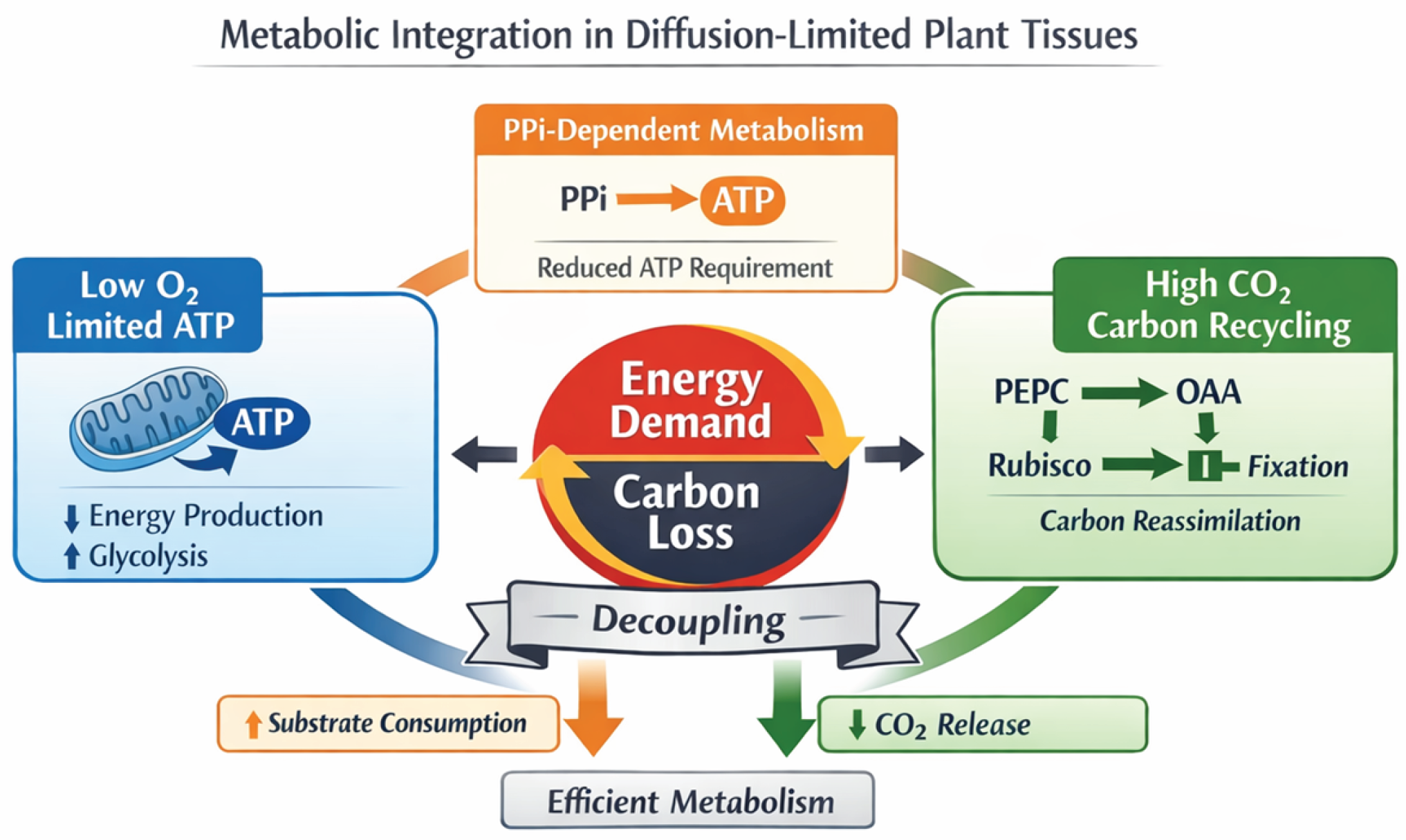
Together, these processes define a metabolic system in which energy limitation and carbon conservation are tightly integrated. Recognizing this integration provides a new conceptual basis for understanding metabolism in plant tissues where gas exchange is inherently restricted. This integrated perspective is further distilled into a conceptual diagram in Figure 4, which summarizes how diffusion limitation simultaneously reshapes energy demand and carbon balance in plant tissues.
9. Conclusions and Future Directions
Diffusion limitation is an inherent feature of many plant tissues and results in a coupled internal environment characterised by reduced oxygen availability and elevated carbon dioxide. This dual constraint fundamentally alters the relationship between energy metabolism and carbon balance by simultaneously limiting mitochondrial ATP production and increasing the local availability of respired carbon.
The evidence synthesised in this review indicates that plant metabolism is not passively constrained under these conditions but is actively reconfigured. Fermentative metabolism, pyrophosphate (PPi)-dependent reactions, and internal CO2 recycling via PEPC and, in specific contexts, Rubisco, should therefore be viewed not as independent responses but as components of an integrated metabolic system. Within this framework, reduced ATP yield under hypoxia increases substrate demand, but carbon loss is not necessarily proportional. Instead, PPi-dependent metabolism reduces ATP requirements, while internal CO2 reassimilation promotes carbon retention.
A central outcome of this integration is the partial decoupling between substrate consumption and net CO2 release. Under reduced oxygen availability, declining ATP yield from oxidative phosphorylation necessitates increased glycolytic flux to sustain cellular energy demand (Drew 1997; Geigenberger 2003). In a fermentation-dominated response, this increased substrate flux is accompanied by proportional carbon loss through decarboxylation and ethanol production, maintaining a tight coupling between energy demand and CO2 release (Drew 1997). However, this coupling is not obligatory. When metabolic configurations favour carbon retention—through reduced decarboxylation, diversion of carbon into organic acid pools, or reassimilation of internally generated CO2—net carbon loss can be substantially lower than predicted from substrate demand alone (Schwender et al. 2004). In such cases, substrate consumption increases to meet energetic requirements, while CO2 release remains constrained.
This decoupling provides a mechanistic basis for maintaining carbon-use efficiency in tissues where gas exchange is restricted, allowing continued metabolic activity, growth, and storage despite energetic constraints. The conceptual relationships emerging from this synthesis are summarised in Figure 4, which integrates the effects of oxygen limitation, PPi-dependent energy buffering, and carbon recycling into a unified framework. This perspective shifts the interpretation of hypoxia from a purely limiting condition to one that favours coordinated metabolic adaptation, in which energy economy and carbon conservation are jointly optimised.
Several key questions remain unresolved. Quantitative estimates of the contribution of PPi-dependent reactions to whole-tissue energy balance are limited, and the extent to which internal CO2 reassimilation contributes to long-term carbon retention remains poorly constrained. In addition, the spatial organisation of these processes within tissues, cells, and organelles is not well understood. A critical limitation of current knowledge is that most studies rely on bulk tissue measurements that obscure spatial heterogeneity in gas availability and metabolic activity.
Recent advances in spatially resolved and cell-type-specific approaches provide an opportunity to address these limitations. Techniques such as spatial transcriptomics, single-cell RNA sequencing, and imaging-based metabolite profiling enable the integration of gene expression, metabolic activity, and tissue structure within their native spatial context (Long et al. 2021; Tao et al. 2026; ?; ?). These approaches are particularly well suited to diffusion-limited systems, where steep gradients in O2 and CO2 occur over short distances.
In this context, spatially resolved analysis offers a promising route for testing and refining the framework proposed here. Gradients in oxygen and carbon dioxide are inherently spatial, varying across vascular pathways, storage parenchyma, and subcellular compartments. Resolving how enzyme activity, metabolite pools, and fluxes are distributed across these gradients will be essential for understanding how metabolic regulation is achieved in vivo. In particular, coordinated analysis of glycolytic flux, PPi-dependent metabolism, and carboxylation pathways may reveal how energy economy and carbon recycling are partitioned across tissues and cell types.
Integration of spatial transcriptomic and metabolomic data with gas profiling and quantitative flux analysis has the potential to move beyond bulk measurements toward a mechanistic understanding of diffusion-limited metabolism. Such approaches may ultimately enable identification of spatially organised metabolic networks that underpin sink strength, carbon-use efficiency, and biomass accumulation. These insights will be essential for evaluating the extent to which coordinated energy conservation and carbon recycling can be exploited to improve productivity in crop systems.
9.1. Testable Predictions Emerging from the Framework
The integrated framework proposed here generates several experimentally testable predictions that distinguish it from classical models of hypoxic metabolism.
Prediction 1: Decoupling of substrate consumption and CO2 release under hypoxia. If carbon recycling and PPi-dependent metabolism are active, increases in substrate flux required to sustain ATP demand under reduced oxygen availability will not be matched by proportional increases in net CO2 efflux. This can be tested by simultaneous measurements of substrate utilisation and CO2 release across controlled oxygen gradients.
Prediction 2: Spatial coordination of PPi-dependent metabolism and carboxylation pathways. The framework predicts that expression and activity of PPi-dependent enzymes (e.g. PFP, V-PPase) and carboxylation pathways (PEPC, Rubisco where present) will be spatially correlated with regions of low oxygen and elevated CO2 within tissues. Spatially resolved transcriptomic, proteomic, and metabolite profiling should reveal co-localisation of these processes along oxygen gradients.
Prediction 3: Enhanced retention of carbon in organic acid and amino acid pools under hypoxia. Under diffusion limitation, metabolic flux is predicted to favour accumulation of intermediates such as malate and alanine as temporary carbon reservoirs. Quantitative flux analysis should demonstrate increased partitioning of carbon into these pools relative to ethanol and CO2 under conditions where PPi-dependent metabolism is active.
Prediction 4: Reduced ATP cost per unit metabolic flux in PPi-engaged systems. Systems with active PPi-dependent metabolism should exhibit a lower ATP requirement per unit of glycolytic flux compared with systems relying solely on ATP-dependent pathways. This can be assessed through combined measurements of adenylate energy charge, PPi levels, and metabolic flux.
Testing these predictions will be essential for evaluating the extent to which coordinated energy conservation and carbon recycling contribute to metabolic efficiency in diffusion-limited plant tissues.
10. Financial Support
RH was supported by funds from the ARC Research Hub for Engineering Plants to Replace Fossil Carbon (Grant IH230100006).
References
- William Armstrong. Aeration in higher plants. In Advances in Botanical Research, volume 7, pages 225–332. Elsevier, 1980. ISBN 0065-2296.
- Murray R. Badger and G. Dean Price. The role of carbonic anhydrase in photosynthesis. Annual Review of Plant Physiology and Plant Molecular Biology, 45:369–392, 1994. [CrossRef]
- J. Bailey-Serres and L.A.C.J. Voesenek. Flooding stress: Acclimations and genetic diversity. Annual Review of Plant Biology, 59(Volume 59, 2008):313–339, 2008. ISSN 1545-2123. [CrossRef]
- Raymond Chollet, Javier Vidal, and Marion H. O’Leary. Phosphoenolpyruvate carboxylase: A ubiquitous, highly regulated enzyme in plants. Annual Review of Plant Physiology and Plant Molecular Biology, 47:273–298, 1996. [CrossRef]
- Robert J. DiMario, Heather Clayton, Baisakhi Mukherjee, Marcus Ludwig, and James V. Moroney. Plant carbonic anhydrases: Structures, locations, evolution, and physiological roles. Molecular Plant, 10(1):30–46, 2017. [CrossRef]
- Malcolm C. Drew. Oxygen deficiency and root metabolism: Injury and acclimation under hypoxia and anoxia. Annual Review of Plant Physiology and Plant Molecular Biology, 48:223–250, 1997. [CrossRef]
- Nicolas Fabre, Isabelle M. Reiter, Natacha Becuwe-Linka, Bernadette Genty, and Delphine Rumeau. Characterization and expression analysis of genes encoding α and β carbonic anhydrases in Arabidopsis. Plant, Cell & Environment, 30(5):617–629, 2007. [CrossRef]
- Hubert H. Felle. pH: Signal and messenger in plant cells. Plant Biology, 3(6):577–591, 2001. [CrossRef]
- Hubert H. Felle. pH regulation in anoxic plants. Annals of Botany, 96(4):519–532, 2005. [CrossRef]
- Peter Geigenberger. Response of plant metabolism to too little oxygen. Current opinion in plant biology, 6(3):247–256, 2003. ISSN 1369-5266. [CrossRef]
- Peter Geigenberger. Regulation of starch biosynthesis in response to a fluctuating environment. Plant physiology, 155(4):1566–1577, 2011. ISSN 1532-2548. [CrossRef]
- Elisabeth Gout, Anne-Marie Boisson, Stéphane Aubert, Roland Douce, and Richard Bligny. Origin of the cytoplasmic pH changes during anaerobic stress in higher plant cells: Carbon-13 and phosphorus-31 nuclear magnetic resonance studies. Plant Physiology, 125(2):912–925, 2001. [CrossRef]
- Kapuganti J Gupta, Ana Zabalza, and Joost T Van Dongen. Regulation of respiration when the oxygen availability changes. Physiologia plantarum, 137(4):383–391, 2009. ISSN 0031-9317. [CrossRef]
- Jukka K Heinonen. Regulatory Roles of PPi. In Biological Role of Inorganic Pyrophosphate, pages 123–188. Springer, 2001.
- Robert J Henry, Agnelo Furtado, and Parimalan Rangan. Pathways of photosynthesis in non-leaf tissues. Biology, 9(12):438, 2020. ISSN 2079-7737. [CrossRef]
- Q Tri Ho, Pieter Verboven, Bert E Verlinden, Ann Schenk, Mulugeta A Delele, Hardy Rolletschek, Jef Vercammen, and Bart M Nicolaï. Genotype effects on internal gas gradients in apple fruit. Journal of experimental botany, 61(10):2745–2755, 2010. ISSN 1460-2431. [CrossRef]
- Abir U. Igamberdiev and Alexander T. Eprintsev. Organic acids: The pools of fixed carbon involved in redox regulation and energy balance in higher plants. Frontiers in Plant Science, 7:1042, 2016. [CrossRef]
- Abir U. Igamberdiev and Leszek A. Kleczkowski. Pyrophosphate as an alternative energy currency in plants. Biochemical Journal, 478(8):1515–1524, 2021. ISSN 0264-6021. [CrossRef]
- Karen Koch. Sucrose metabolism: Regulatory mechanisms and pivotal roles in sugar sensing and plant development. Current opinion in plant biology, 7(3):235–246, 2004. ISSN 1369-5266. [CrossRef]
- Armine Kurkdjian and Jean Guern. Intracellular pH: Measurement and importance in cell activity. Annual Review of Plant Physiology and Plant Molecular Biology, 40:271–303, 1989. [CrossRef]
- Sang-Kyu Lee and Jong-Seong Jeon. Review: Crucial role of inorganic pyrophosphate in integrating carbon metabolism from sucrose breakdown to starch synthesis in rice endosperm. Plant Science, 298:110572, 2020. ISSN 0168-9452. [CrossRef]
- Yanping Long, Zhijian Liu, Jinbu Jia, Weipeng Mo, Liang Fang, Dongdong Lu, Bo Liu, Hong Zhang, Wei Chen, and Jixian Zhai. FlsnRNA-seq: Protoplasting-free full-length single-nucleus RNA profiling in plants. Genome biology, 22(1):66, 2021. ISSN 1474-760X. [CrossRef]
- Masayoshi Maeshima. Vacuolar H+-pyrophosphatase. Biochimica et biophysica acta (BBA)-biomembranes, 1465(1-2):37–51, 2000. ISSN 0005-2736. [CrossRef]
- Enrico Martinoia, Masayoshi Maeshima, and H. Ekkehard Neuhaus. Vacuolar transporters and their essential role in plant metabolism. Journal of Experimental Botany, 58(1):83–102, 2007. [CrossRef]
- Tori Millsteed, David Kainer, Robert Sullivan, Xiaohuan Sun, Ka Leung Li, Likai Mao, Arlie Macdonald, and Robert J Henry. Spatial transcriptomics of developing wheat seed reveals concentric gene expression zones and subgenome biased expression of key genes. Plant Biotechnology Journal, 23(12):5934–5949, 2025. ISSN 1467-7644. [CrossRef]
- Yo Miyashita, Rudy Dolferus, Kathleen P Ismond, and Allen G Good. Alanine aminotransferase catalyses the breakdown of alanine after hypoxia in Arabidopsis thaliana. The Plant Journal, 49(6):1108–1121, 2007. ISSN 0960-7412. [CrossRef]
- James V. Moroney, Scott G. Bartlett, and G. Samuelsson. Carbonic anhydrases in plants and algae. Plant, Cell & Environment, 24(2):141–153, 2001. [CrossRef]
- Marion H. O’Leary. Phosphoenolpyruvate carboxylase: An enzymologist’s view. Annual Review of Plant Physiology, 33:297–315, 1982. [CrossRef]
- Judith Katharina Paulus, Daniel Schlieper, and Georg Groth. Greater efficiency of photosynthetic carbon fixation due to single amino-acid substitution. Nature communications, 4(1):1518, 2013. ISSN 2041-1723. [CrossRef]
- William C. Plaxton. The organization and regulation of plant glycolysis. Annual Review of Plant Biology, 47(Volume 47, 1996):185–214, 1996. ISSN 1545-2123. [CrossRef]
- William C Plaxton and Florencio E Podestá. The functional organization and control of plant respiration. Critical reviews in plant sciences, 25(2):159–198, 2006. ISSN 0735-2689. [CrossRef]
- Parimalan Rangan, Agnelo Furtado, Viswanathan Chinnusamy, and Robert Henry. A multi-cell model for the c4 photosynthetic pathway in developing wheat grains based upon tissue-specific transcriptome data. BioSystems, 238:105195, 2024. ISSN 0303-2647. [CrossRef]
- J. A. Raven. Regulation of pH and generation of osmolarity in vascular land plants: Costs and benefits in relation to efficiency of use of water, energy and nitrogen. New Phytologist, 101(1):25–77, 1985. [CrossRef]
- J. A. Raven and F. A. Smith. Nitrogen assimilation and transport in vascular land plants in relation to the regulation of pH. New Phytologist, 76(3):415–431, 1976. [CrossRef]
- Marcio Rocha, Francesco Licausi, Wagner L Araújo, Adriano Nunes-Nesi, Ladaslav Sodek, Alisdair R Fernie, and Joost T Van Dongen. Glycolysis and the tricarboxylic acid cycle are linked by alanine aminotransferase during hypoxia induced by waterlogging of Lotus japonicus. Plant Physiology, 152(3):1501–1513, 2010. ISSN 1532-2548. [CrossRef]
- Jörg Schwender, Federico Goffman, John B. Ohlrogge, and Yair Shachar-Hill. Rubisco without the Calvin cycle improves the carbon efficiency of developing green seeds. Nature, 432:779–782, 2004. [CrossRef]
- F. A. Smith and J. A. Raven. Intracellular pH and its regulation. Annual Review of Plant Physiology, 30:289–311, 1979. [CrossRef]
- M. Stitt. Pyrophosphate as an Energy Donor in the Cytosol of Plant Cells: An Enigmatic Alternative to ATP. Botanica Acta, 111(3):167–175, 1998. ISSN 0932-8629. [CrossRef]
- Mark Stitt, Ronan Sulpice, and Joost Keurentjes. Metabolic networks: How to identify key components in the regulation of metabolism and growth. Plant physiology, 152(2):428–444, 2010. ISSN 1532-2548. [CrossRef]
- Arnd Sturm and Guo-Qing Tang. The sucrose-cleaving enzymes of plants are crucial for development, growth and carbon partitioning. Trends in plant science, 4(10):401–407, 1999. ISSN 1360-1385. [CrossRef]
- Xiao-Yuan Tao, Cong Tan, Yifan Liu, Yuanyuan Wang, Ali Raza, Jing He, Lulu Wang, Keke Xia, Yan Yan, and Sha Liao. The potential of wheat spatial omics. Nature Genetics, pages 1–12, 2026. ISSN 1061-4036.
- Michael KY Ting, Yi-Min She, and William C Plaxton. Transcript profiling indicates a widespread role for bacterial-type phosphoenolpyruvate carboxylase in malate-accumulating sink tissues. Journal of Experimental Botany, 68(21-22):5857–5869, 2017. ISSN 0022-0957. [CrossRef]
- Johannes T. van Dongen and Francesco Licausi. Oxygen sensing and signaling. Annual Review of Plant Biology, 66:345–367, 2015. [CrossRef]
- Johannes T. van Dongen, Uwe Schurr, Markus Pfister, and Peter Geigenberger. Phloem metabolism and function have to cope with low internal oxygen. Plant Physiology, 131(4):1529–1543, 2003. [CrossRef]
- Pieter Verboven, Greet Kerckhofs, Hibru Kelemu Mebatsion, Quang Tri Ho, Kristiaan Temst, Martine Wevers, Peter Cloetens, and Bart M Nicolaï. Three-dimensional gas exchange pathways in pome fruit characterized by synchrotron X-ray computed tomography. Plant physiology, 147(2):518–527, 2008. ISSN 1532-2548. [CrossRef]
- Robert P Walker, Franco Famiani, Alessandro Baldicchi, Juan G Cruz-Castillo, and Paolo Inglese. Changes in enzymes involved in photosynthesis and other metabolic processes in the fruit of Opuntia ficus-indica during growth and ripening. Scientia horticulturae, 128(3):213–219, 2011. ISSN 0304-4238. [CrossRef]
- Cao Zhi, Muhammad Moaaz Ali, Shariq Mahmood Alam, Shaista Gull, Sajid Ali, Ahmed F Yousef, Mohamed AA Ahmed, Songfeng Ma, and Faxing Chen. Genome-wide in silico analysis and expression profiling of Phospho enol pyruvate carboxylase genes in loquat, apple, peach, strawberry and pear. Agronomy, 12(1):25, 2021. ISSN 2073-4395. [CrossRef]
Figure 1.
Conceptual model of gas diffusion and metabolic consequences in plant tissues with contrasting aeration. (A) Well-aerated tissues such as leaves allow rapid gas exchange with the atmosphere through stomata on both leaf surfaces. Oxygen diffuses inward from the adaxial and abaxial sides, generating a bidirectional gradient with high O2 near the surfaces and lower concentrations toward the internal mesophyll, while CO2 produced by respiration readily diffuses outward. (B) Poorly aerated bulky tissues such as stems, fruits, and seeds lack direct gas exchange with the atmosphere. Oxygen supply is primarily dependent on vascular transport and declines along both longitudinal (from leaves and roots toward sink tissues) and radial (from vascular bundles into surrounding storage parenchyma) pathways due to continuous respiratory consumption. This results in localised hypoxia in storage tissues. Restricted diffusion also leads to the accumulation of internally produced CO2. The combined effect is reduced oxidative phosphorylation, lower ATP availability, and increased reliance on hypoxic metabolism. The lower panel illustrates the longitudinal oxygen gradient across the plant, with oxygen supplied from both leaves and roots and reaching a minimum in bulky sink tissues.
Figure 1.
Conceptual model of gas diffusion and metabolic consequences in plant tissues with contrasting aeration. (A) Well-aerated tissues such as leaves allow rapid gas exchange with the atmosphere through stomata on both leaf surfaces. Oxygen diffuses inward from the adaxial and abaxial sides, generating a bidirectional gradient with high O2 near the surfaces and lower concentrations toward the internal mesophyll, while CO2 produced by respiration readily diffuses outward. (B) Poorly aerated bulky tissues such as stems, fruits, and seeds lack direct gas exchange with the atmosphere. Oxygen supply is primarily dependent on vascular transport and declines along both longitudinal (from leaves and roots toward sink tissues) and radial (from vascular bundles into surrounding storage parenchyma) pathways due to continuous respiratory consumption. This results in localised hypoxia in storage tissues. Restricted diffusion also leads to the accumulation of internally produced CO2. The combined effect is reduced oxidative phosphorylation, lower ATP availability, and increased reliance on hypoxic metabolism. The lower panel illustrates the longitudinal oxygen gradient across the plant, with oxygen supplied from both leaves and roots and reaching a minimum in bulky sink tissues.
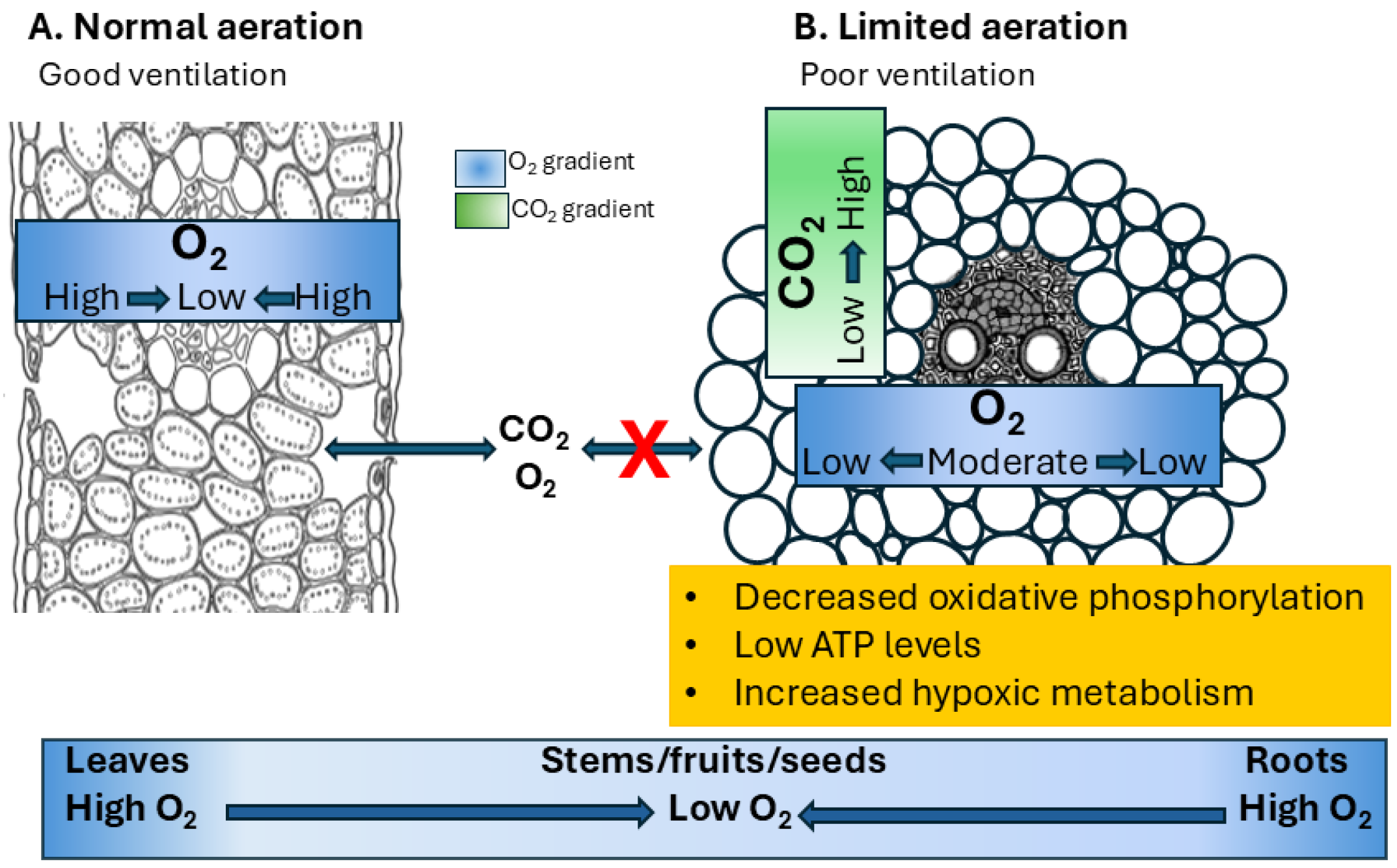
Figure 2.
Illustrative effect of declining oxidative phosphorylation on glucose demand under hypoxia in slow- and fast-growth tissues. Bars show mean ± SD from the simplified test dataset. Dark bars show the increase in glucose demand expected from reduced effective ATP yield as the contribution of oxidative phosphorylation declines from 75% to 5%. The figure is intended as a conceptual review figure showing how PPi metabolism can buffer the energetic penalty of hypoxia rather than as a fully parameterised mechanistic simulation.
Figure 2.
Illustrative effect of declining oxidative phosphorylation on glucose demand under hypoxia in slow- and fast-growth tissues. Bars show mean ± SD from the simplified test dataset. Dark bars show the increase in glucose demand expected from reduced effective ATP yield as the contribution of oxidative phosphorylation declines from 75% to 5%. The figure is intended as a conceptual review figure showing how PPi metabolism can buffer the energetic penalty of hypoxia rather than as a fully parameterised mechanistic simulation.
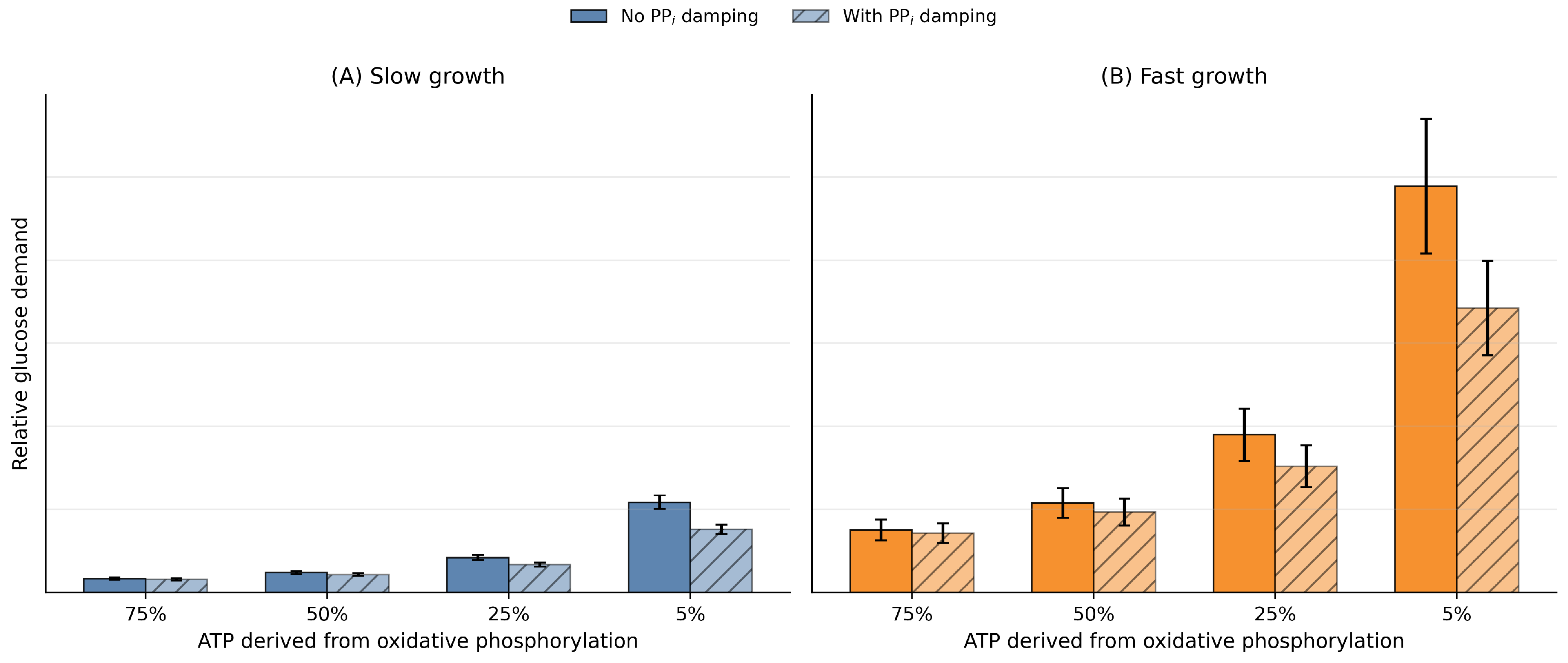
Figure 3.
Conceptual framework illustrating the decoupling of energy demand and carbon loss in diffusion-limited plant tissues. (A) Declining oxygen availability reduces the contribution of oxidative phosphorylation, resulting in lower ATP yield per unit substrate and an increased glucose requirement to sustain metabolic flux. (B) In a fermentation-dominated response, increased substrate consumption is accompanied by proportional carbon loss through decarboxylation. In contrast, when carbon is retained within the metabolic network through recycling pathways, net CO2 release does not increase proportionally with substrate demand. (C) Pyrophosphate (PPi)-dependent metabolism reduces ATP requirements by substituting PPi for ATP in key reactions, thereby dampening the increase in glucose demand under hypoxia. (D) The combined effects of reduced ATP demand and internal carbon recycling result in a decoupling between substrate consumption and CO2 release. This integrated metabolic response allows diffusion-limited tissues to maintain metabolic activity while limiting carbon loss.
Figure 3.
Conceptual framework illustrating the decoupling of energy demand and carbon loss in diffusion-limited plant tissues. (A) Declining oxygen availability reduces the contribution of oxidative phosphorylation, resulting in lower ATP yield per unit substrate and an increased glucose requirement to sustain metabolic flux. (B) In a fermentation-dominated response, increased substrate consumption is accompanied by proportional carbon loss through decarboxylation. In contrast, when carbon is retained within the metabolic network through recycling pathways, net CO2 release does not increase proportionally with substrate demand. (C) Pyrophosphate (PPi)-dependent metabolism reduces ATP requirements by substituting PPi for ATP in key reactions, thereby dampening the increase in glucose demand under hypoxia. (D) The combined effects of reduced ATP demand and internal carbon recycling result in a decoupling between substrate consumption and CO2 release. This integrated metabolic response allows diffusion-limited tissues to maintain metabolic activity while limiting carbon loss.
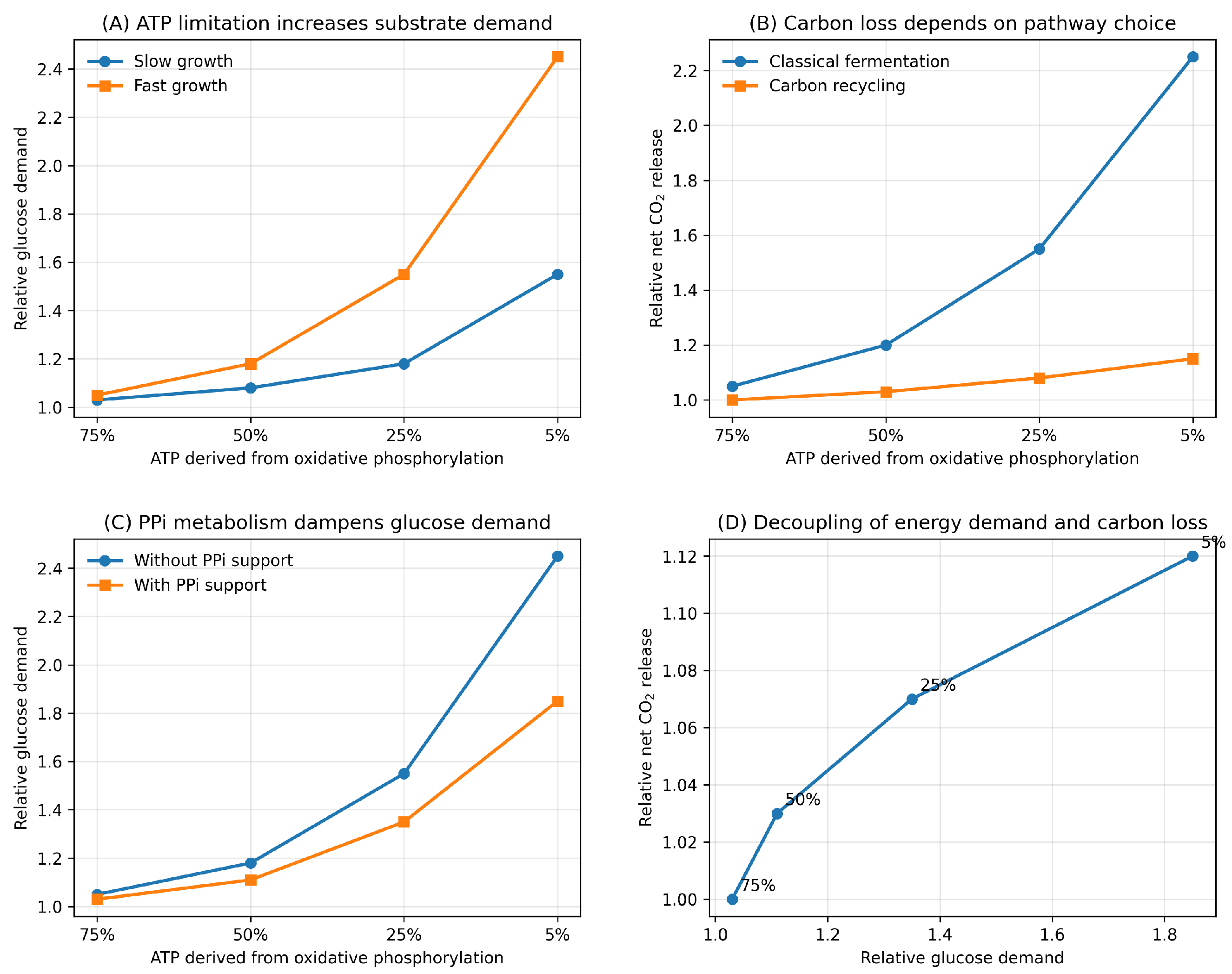
Figure 4.
Conceptual diagram illustrating the integration of energy metabolism and carbon balance in diffusion-limited plant tissues. Restricted gas exchange leads to a coupled environment of low O2 and elevated internal CO2. Reduced oxygen availability constrains mitochondrial ATP production, increasing reliance on glycolysis and raising substrate demand. In parallel, elevated internal CO2 provides a substrate for reassimilation via PEPC and Rubisco, promoting carbon retention. Pyrophosphate (PPi)-dependent metabolism reduces ATP requirements by substituting PPi for ATP in key reactions, thereby buffering the energetic cost of hypoxia. The combined effect of reduced ATP demand and enhanced carbon recycling results in a decoupling between substrate consumption and net CO2 release, allowing diffusion-limited tissues to maintain metabolic activity while limiting carbon loss.
Figure 4.
Conceptual diagram illustrating the integration of energy metabolism and carbon balance in diffusion-limited plant tissues. Restricted gas exchange leads to a coupled environment of low O2 and elevated internal CO2. Reduced oxygen availability constrains mitochondrial ATP production, increasing reliance on glycolysis and raising substrate demand. In parallel, elevated internal CO2 provides a substrate for reassimilation via PEPC and Rubisco, promoting carbon retention. Pyrophosphate (PPi)-dependent metabolism reduces ATP requirements by substituting PPi for ATP in key reactions, thereby buffering the energetic cost of hypoxia. The combined effect of reduced ATP demand and enhanced carbon recycling results in a decoupling between substrate consumption and net CO2 release, allowing diffusion-limited tissues to maintain metabolic activity while limiting carbon loss.
Disclaimer/Publisher’s Note: The statements, opinions and data contained in all publications are solely those of the individual author(s) and contributor(s) and not of MDPI and/or the editor(s). MDPI and/or the editor(s) disclaim responsibility for any injury to people or property resulting from any ideas, methods, instructions or products referred to in the content. |
© 2026 by the authors. Licensee MDPI, Basel, Switzerland. This article is an open access article distributed under the terms and conditions of the Creative Commons Attribution (CC BY) license (http://creativecommons.org/licenses/by/4.0/).
Copyright: This open access article is published under a Creative Commons CC BY 4.0 license, which permit the free download, distribution, and reuse, provided that the author and preprint are cited in any reuse.


