

Submitted:
29 April 2026
Posted:
30 April 2026
You are already at the latest version
Abstract
Olive leaf spot, caused by Pseudocercospora cladosporioides, is one of the main foliar diseases affecting olive crops. This study determined the sensitivity of eighteen Uruguayan isolates of P. cladosporioides to eighteen fungicides belonging to eight chemical groups. Mycelial growth inhibition assays were performed on PDA with increasing fungicide concentrations, and the EC₅₀ for each isolate-fungicide combination was calculated. Copper-based fungicides showed moderate levels of inhibition. Among contact fungicides, mancozeb exhibited the best inhibition compared with ziram and captan, while dodine showed a similar level of inhibition to ziram. Most fungicides from the benzimidazole, strobilurin and triazole groups demonstrated the highest efficacy with carbendazim, trifloxystrobin and mefentrifluconazole showing the greatest inhibitory activity. These findings guide the selection of fungicides for cercospora leaf spot management within sustainable pest control programs and establish a reference framework for future resistance monitoring.
Keywords:
Olea europaea
; copper fungicides
; dithiocarbamates
; benzimidazole
; strobilurins
; triazoles
1. Introduction
Uruguay is one of the most recently expanded olive-growing regions in South America [1]. Currently, olive cultivation ranks as the third most important fruit crop in this country, covering approximately 5,800 hectares [2]. Production is primarily oriented toward high-quality olive oil destined for export markets [3].
Olive cercospora leaf spot (CLS), caused by Pseudocercospora cladosporioides, has emerged as one of the most significant phytosanitary threats (Lombardo et al., 2023), along with olive scab, caused by Venturia oleagina [4], and anthracnose mainly associated with Colletotrichum acutatum and other species within this genus [5]. Symptoms typically manifest as yellow spots on the upper surface of olive leaves and grey blotches on the lower surface, which can progress to severe defoliation of the shoots. The impact of CLS can result in considerable reductions in yield and decreased oil quality [6,7,8].
Despite its recognized importance, specific integrated management strategies for CLS in Uruguay remain limited. Historically, control measures for this disease have been implemented jointly with those targeting olive scab, often following a calendar-based fungicide spray program throughout the year. This lack of information has limited the development of rational, effective, and sustainable management strategies, potentially leading to ineffective or unnecessary applications and increasing the risk of fungicide resistance development.
Recent epidemiological studies conducted by Lombardo et al. [9], have improved the understanding of CLS disease cycle under Uruguay conditions, which is characterized by moderate temperatures and frequent days with high relative humidity along the year. In these studies, two periods of increased inoculum production and infection risk were identified throughout the year, one of them from late spring to early summer and the other during autumn. These studies were conducted in ‘Arbequina’, the most planted cultivar in Uruguay. This improved understanding of the CLS epidemiology provides support to transition from calendar-based sprays to a more integrated management approach, focusing on the fungicide’s applications mainly in these two critical infection periods.
Furthermore, the efficacy of fungicides against local populations of P. cladosporioides has not yet been explored. Consequently, their evaluation is essential in order to prioritize those that are both effective and more environmentally sustainable. Therefore, the objective of this study was to determine the in vitro susceptibility of Uruguayan isolates of P. cladosporioides to eighteen fungicides belonging to eight chemical group currently used in olive production. The fungicides were evaluated and compared by estimating EC₅₀ values.
2. Materials and Methods
2.1. Fungal Isolates
Eighteen single spore isolates of P. cladosporioides preserved as mycelial plugs in 15% glycerol at -80 °C in the fungal collection of the Experimental Station of the Faculty of Agronomy, Universidad de la República (UdelaR), Salto, Uruguay [8], were selected for this study. The isolates were obtained during the 2017–2018 growing season from olive leaves with typical CLS symptoms growing season, collected from different varieties and production areas representing the country’s main olive-growing regions (Table 1). For the experiments, each isolate was growing on Petri dishes containing potato dextrose agar (PDA, Oxoid Ltd. Hampshire, England) and incubated at 21.5 ± 1.5 °C in darkness for 20 days prior to the experiments.
2.2. Fungicides
Eighteen commercial fungicide formulations belonging to eight chemical groups were evaluated (Table 2). These chemical groups included four groups with contact and penetrant fungicides (copper-based products, dithiocarbamates, phthalimides, and guanidines) and four groups with systemic fungicides (anilino-pyrimidines, benzimidazoles, strobilurins (quinone outside inhibitors, QoIs), and Triazoles (demethylation inhibitors: DMIs). Fungicides were selected based on their commercial availability and their relevance for olive disease management programs [10,11,12,13].
2.3. Mycelial Growth Inhibition Assay
Stock solutions of each fungicide were prepared in sterile distilled water. Subsequently, appropriate volumes of each fungicide were added to sterile PDA medium, maintained at 45 °C to obtain the desired final concentrations. The final concentrations of the active ingredients (a.i.) were: 0.1, 1, 10, and 100 mg L⁻¹ for anilino-pyrimidine, benzimidazole, QoIs, and DMIs; 50, 150, 300, and 600 mg L⁻¹ for dithiocarbamates, phthalimides, and guanidines, and 125, 250, 500, and 1000 mg L⁻¹ of metallic copper for the copper-based fungicides.
Due to the slow growth rate of this fungus, 3.7-mm-diameter mycelial discs were taken from the margins of actively growing 20-day-old P. cladosporioides colonies and placed at the center of each fungicide-amended plate. Three replicates were performed per each combination of isolate, fungicide, and concentration. Three PDA plates per isolate but without fungicide served as controls. Plates were incubated at 21.5 ± 1.5 °C in darkness. After 30 days, two perpendicular colony diameters were measured using a digital caliper (CALDI-6MP, TRUPER®), and the average colony radius was calculated. The experiment was repeated twice.
2.4. Data Analysis
The percentage of mycelial growth inhibition was calculated for each isolate-fungicide-concentration combination, relative to the control, using the formula: Growth inhibition (%) = [(Rcontrol − Rtreatment) / Rcontrol] × 100 where R represents to the colony radius. The inhibition data were analyzed using probit regression by plotting the percentages of mycelial growth inhibition against the log10-transformed fungicide concentrations. From the fitted probit regression model [14], the effective concentration 50% of mycelial growth (EC₅₀) was estimated.
The EC₅₀ values for systemic and contact or penetrant fungicides were modeled separately. Data were analyzed using a Generalized Linear Mixed Model (GLMM) via the glmmTMB package, specifying a Gamma distribution and a log link function [15]. This distribution was selected as it is appropriate for continuous, strictly positive data where the variance increases with the mean. Fungicide treatment was evaluated as a fixed effect. To account for the experimental design and data clustering, experiment repetition and fungal isolate were included as random effects, with isolates nested within each experiment repetition. Model assumptions were validated using the DHARMa package [16]. Post-hoc comparisons of estimated marginal means were conducted using the emmeans package [17]. Pairwise mean comparisons were adjusted using Tukey's method, and significant differences (P < 0.05) were grouped using a compact letter display (CLD). All data visualizations were generated using the ggplot2 package [18]. Statistical analyses were performed in R software (v. 4.5.3) [19].
3. Results
Significant differences were observed among fungicides in their ability to inhibit the mycelial growth of P. cladosporioides (Table 3). All the isolates behaved as moderately sensitive to the four copper-based fungicides, copper oxychloride, copper oxychloride flowable, cuprous oxide, and copper calcium sulfate, and no major differences were registered between them, considering the four a.i. the EC₅₀ values ranging from 57 to 221 mg L⁻¹ (Table 3, Figure 1.A, Figure 2.A).
Regarding the dithiocarbamate and phthalimide fungicides evaluated, mancozeb showed the highest inhibitory activity with EC50 = 30 mg L-1 differing significantly from the other two compounds, Ziram with EC50 = 71 mg L-1 and Captan with EC50 = 185 mg L-1 with the last being the least effective (Table 3, Figure 1.A). Dodine, a guanidine fungicide with translaminar activity, showed an inhibitory effect similar to that of ziram with EC50 of 53 mg L-1, and both differed significantly from mancozeb and captan (Figure 2.A).
The four DMIs evaluated showed high efficacy in inhibiting mycelial growth. Among them, mefentrifluconazole was the most efficient, with an EC₅₀ of 0.03 mg L-1, significantly lower than those of the other three fungicides (Table 3, Figure 1.B). Difenoconazole, propiconazole, and tebuconazole exhibited similar performance, with EC₅₀ values ranging from 0.19 to 0.56 and no significant differences among them (Figure 2.B).
Most of the QoIs fungicides demonstrated high inhibitory capacity. Within this group, trifloxystrobin exhibited the highest efficacy with EC50 of 0.006 mg L-1 following by pyraclostrobin with EC50 of 0.19 mg L-1 and azoxystrobin and kresoxim-methyl with EC50 of 1.05 and 0.96 mg L-1 respectively. Furthermore, statistically differences were found between them except between azoxystrobin and kresoxim-methyl (Table 3, Figure 1.B, Figure 2.B).
Carbendazim, from the benzimidazole chemical group, exhibited high inhibitory activity with EC50 = 0.03 mg L⁻¹ and statistically similar to mefentrifluconazole (Table 3). Finally, pyrimethanil, the anilino-pyrimidine, showed the lowest inhibitory efficacy among the systemic fungicides evaluated, with a EC50 value of 25.3 mg L⁻¹ (Table 3, Figure 1.B, Figure 2.B).
4. Discussion
As in other olive-growing regions worldwide, fungicide applications remain the primary strategy for controlling CLS in Uruguay. Recent epidemiological studies have characterized the local disease cycle, identifying two critical periods of high inoculum production and infection risk [9]. This provides a framework for transitioning from calendar-based spray programs to more precise integrated diseases management strategies based on epidemiological risk. However, the practical implementation of these approaches has been limited by the lack of information on the sensitivity of the Uruguayan population of P. cladosporioides to available fungicides. In response to the lack of data, the present study provides the first comprehensive characterization of the sensitivity of the local P. cladosporioides population. For that, eighteen isolates collected from different olive-growing regions of Uruguay [8] were evaluated against eighteen fungicides belonging to eight chemical groups considering contact, penetrant and systemic compound.
Our results indicate that copper-based fungicides showed relatively high EC50 values, indicating low intrinsic activity; however, their multisite mode of action and low resistance risk support their continued use in olive disease management programs. These findings align with previous studies reporting low levels of mycelial growth inhibition for these compounds under in vitro conditions [12]. This is in agreement with the current understanding that copper-based fungicides exert a primarily fungistatic, rather than fungicidal, effect on this pathogen and are not effective in controlling established infections [11,20]. However, their value in integrated disease management programs should not be underestimated, particularly as preventive treatments during the key infection periods. Also, they are often among the few fungicides that can be applied after flowering without leading problematic residues in olive oil [21,22]. Furthermore, field studies have demonstrated their effectiveness in reducing CLS incidence, particularly when used preventatively or in rotation or combination with other fungicides [11,12]. Nevertheless, a major limitation of copper-based fungicides is their tendency to accumulate in soil, leading to potential environmental impacts. Consequently, strategies to reduce their use are highly recommended [11,12,23,24]. This concern has led to stricter regulations, particularly in the European Union, where copper applications are currently limited to an average of 4 kg Cu ha⁻¹ year⁻¹ over a seven-year period, reflecting a broader global trend toward more sustainable plant protection practices [25].
Regarding the ditiocarbamate and phthalimide fungicides evaluated, mancozeb exhibited the highest inhibitory activity, being significantly more effective than ziram and captan. This result is consistent with previous studies reporting greater efficacy of mancozeb compared to captan against P. cladosporioides [12]. The strong performance of mancozeb, also supported by field trials demonstrating reduced CLS incidence when applied in mixtures with other fungicides [11], highlights its value as a preventive tool in disease management programs. In addition, its multisite mode of action and low resistance risk make it particularly suitable for inclusion in resistance management strategies [26].
Dodine, which has a translaminar activity [26], showed a level of efficacy comparable to ziram. This suggests a potential role not only in preventive applications but also in the management of latent infections; however, this hypothesis requires validation under field conditions.
Quinone outside inhibitors (QoI) showed high intrinsic activity against P. cladosporioides, with low mean EC₅₀ values across the evaluated compounds. However, a marked variability in sensitivity was observed, particularly for azoxystrobin, which exhibited a wide range of EC₅₀ values among isolates. This heterogeneity suggests differences in sensitivity within the population and may indicate the presence of subpopulations with reduced sensitivity. Given the high resistance risk associated with QoIs, due to their site-specific mode of action, this pattern could represent early shifts in sensitivity within the population. In contrast, other QoI compounds such as trifloxystrobin and kresoxim-methyl showed more consistent responses, suggesting a more uniform sensitivity profile. These findings highlight the need for cautious use of QoIs in olive disease management, particularly avoiding repeated applications and favoring their inclusion in rotation or mixture strategies to delay resistance development. This is especially relevant in olive production systems, where the limited number of effective fungicides and restrictions related to residues in olive oil may increase the reliance on a reduced set of active ingredients, thereby intensifying the selection pressure for resistance.
The high efficacy of QoIs, particularly trifloxystrobin and pyraclostrobin, is consistent with previous studies. Although no previous studies were found for azoxystrobin in the control of CLS on olive, its effectiveness has been widely documented [27,28,29,30]. The strong performance of pyraclostrobin corroborates previous in vitro and field studies, where commercial formulations significantly reduced P. cladosporioides [11]. Similarly, mixtures containing trifloxystrobin have proven effective under field conditions [11,12].
Despite their high efficacy, QoIs are considered high-risk for resistance development due to their single-site mode of action [26]. Resistance to azoxystrobin, pyraclostrobin, and trifloxystrobin has already been reported in other Pseudocercospora species [31,32]. Therefore, their incorporation into management programs in Uruguay should be carefully managed through anti-resistance strategies, including limiting the number of applications per season, using them in mixtures or rotations with fungicides of different modes of action, and monitoring changes in pathogen sensitivity over time. This is particularly relevant in olive production system, where the limited number of effective fungicides and restrictions related to residues in olive oil may increase reliance on a reduced set of active ingredients, thereby intensifying selection pressure for resistance.
The notable efficacy of carbendazim against the Uruguayan P. cladosporioides population aligns with previously reported activity against other Pseudocercospora species, such as P. macadamiae [33], P. eumusae [34], and P. angolensis [35]. Previous studies have demonstrated that carbendazim, particularly when applied in mixture with multisite fungicides such as copper or mancozeb, can provide effective disease control under field conditions. For example, early applications of carbendazim in combination with copper significantly reduced disease incidence and severity caused by P. macadamiae [33], while carbendazim-mancozeb mixture were highly effective againts P. eumusae [34]. Similarly, Hong et al. [35] identified carbendazim as one of the most effective compounds against P. angolensis on sweet orange (Citrus sinensis). However, the high efficacy of this single-site benzimidazole fungicide is coupled with a high risk of resistance development under repeated use [35]. Therefore, despite its strong intrinsic activity, its use should be carefully managed and, where permitted, restricted to mixtures or rotation schemes to mitigate resistance development.
The four DMIs evaluated, difenoconazole, propiconazole, tebuconazole and mefentrifluconazole, demonstrated high efficacy, particulary mefentrifluconazole showing the highest activity, and consistent with previous studies developed whit this pathogen [12] and related species, such as P. pistacina [36] and Cercospora sojina [37]. However, despite its excellent efficacy and favorable toxicological profile, cross-resistance among DMIs has been reported. Ishii et al [38] demonstrated positive cross-resistance between mefentrifluconazole and other DMIs such as propiconazole and difenoconazole with several other fungal pathogens, including Cercospora beticola, a finding further supported by more recent studies [39]. This is particularly relevant given that DMI are associated with a moderate risk of resistance development, typically involving gradual shifts in sensitivity rather than the rapid qualitative resistance observed for QoI or benzimidazole fungicides [26]. Resistance to DMIs has also been reported in other Pseudocercospora species [40,41,42,43,44]. Therefore, while mefentrifluconazole and other triazoles represent valuable tools for disease control, their use in olive diseases management programs should be carefully managed through rotation or mixture with fungicides of different modes of action to mitigate the selection of sensitive populations.
This study identified the fungicide active ingredients to which the Uruguayan P. cladosporioides population is sensitive, providing a baseline for resistance monitoring. Establishing such baseline sensitivity data is crucial for the early detection of shifts in fungicide efficacy. Ours results constitute the first reference framework for monitoring changes in sensitivity in P. cladosporioides populations associated with olive CLS disease in Uruguay, highlighting the need for continuous surveillance to support effective resistance management.
The high efficacy observed for several systemic fungicides, including trifloxystrobin, mefentrifluconazole, and carbendazim, indicates strong potential for CLS management. However, their single-site modes of action require strict adherence to anti-resistance strategies.
In contrast, multi-site fungicides, particularly mancozeb and copper compounds, despite their lower intrinsic activity in vitro, remain essential components of resistance management and should form the backbone of preventive programs.
While our results confirm the biological efficacy of several fungicides, an important practical limitation must be considered, many of these ingredients are not currently registered for use in olive crop production in Uruguay. This highlights a key aspect of disease management, namely the gap between biological efficacy and regulatory availability and underscores the importance of generating local data to support both technical recommendations and registration processes [45].
Finally, the data generated in this study provide a rational basis for selecting fungicides for further evaluation under field conditions, as well as for optimizing application timings according to epidemiological risk periods previously defined for Uruguay [9]. Overall, these findings contribute to the development of integrated and sustainable management strategies for CLS in Uruguay, aiming to maximize diseases control while minimizing fungicide inputs, environmental impact and the risk of resistance development.
Author Contributions
P. Lombardo, S. Alaniz, and P. Mondino conceived and designed the research. All authors participated in the analysis and interpretation of the data, the writing of the article, and the critical review of the intellectual content. All authors approved the final version of the manuscript for publication and agreed to be accountable for all aspects of the work.
Funding
This research was funded by the Commission Sectorial the Investigation Scientific (CSIC – Uruguay).
Data Availability Statement
The data that support the findings of this study are available from the corresponding author upon reasonable request.
Acknowledgments
We thank the students of the Agronomic Engineering program, Faculty of Agronomy, UDELAR, Fernanda Rattin and Ismael Álvarez, for their collaboration in carrying out the laboratory tests.
Conflicts of Interest
The authors declare no conflict of interest.
Abbreviations
The following abbreviations are used in this manuscript:
| CLS | Olive cercospora leaf spot |
| EC50 | Effective concentration (mg L-1) that inhibits 50% of mycelial growth |
| QoIs | Strobilurins fungicides (quinone outside inhibitors) |
| DMIs | Triazoles fungicides (demethylation inhibitors) |
References
- Conde, P.; Montelongo, M.; Leoni, C. Enfermedades del Olivo. In Aceites de oliva: de la planta al consumidor, 1ra. ed.; INIA: Montevideo, Uruguay, 2013; Vol. 1, pp. 183–214. [Google Scholar]
- Ministerio de Ganadería; Agricultura y Pesca-Oficina de Estadísticas Agropecuarias (MGAP-DIEA). Anuario estadístico agropecuario 2025; MGAP-DIEA: Montevideo, Uruguay, 2025. Available online: https://www.gub.uy/ministerio-ganaderia-agricultura-pesca/comunicacion/publicaciones/anuario-estadistico-agropecuario-2025.
- Ministerio de Ganadería; Agricultura y Pesca-Oficina de Estadísticas Agropecuarias (MGAP-DIEA). Censo nacional de olivos 2023; MGAP-DIEA: Montevideo, Uruguay, 2023. Available online: https://www.gub.uy/ministerio-ganaderia-agricultura-pesca/sites/ministerio-ganaderia-agricultura-pesca/files/documentos/noticias/Comunicado_final.pdf.
- Bernaschina, Y.; Leoni, C.; Alaniz, S. Genetic diversity evidence a mixed reproduction mode in Venturia oleaginea populations in Uruguay. J. Plant Pathol. 2020, 102, 123–133. [Google Scholar] [CrossRef]
- Moreira, V.; Mondino, P.; Alaniz, S. Olive anthracnose caused by Colletotrichum in Uruguay: symptoms, species diversity and pathogenicity on flowers and fruits. Eur. J. Plant Pathol. 2021, 160, 663–681. [Google Scholar] [CrossRef]
- Trapero, A.; López, F.J.; Blanco, M.A. Enfermedades. In El cultivo del olivo, 7th ed.; Barranco, D., Fernández-Escobar, R., Rallo, L., Eds.; Mundi-Prensa: Madrid, Spain, 2017; pp. 733–798. [Google Scholar]
- Ávila, A.; Romero, J.; Agustí-Brisach, C.; Abdellatif, B.; Roca, L.F.; Trapero, A. Phenotypic and pathogenic characterization of Pseudocercospora cladosporioides, the causal agent of Cercospora leaf spot of olives. Eur. J. Plant Pathol. 2020, 156, 45–65. [Google Scholar] [CrossRef]
- Lombardo, P.; Leoni, C.; Alaniz, S.; Mondino, P. Cercospora leaf spot of olive in Uruguay. Phytopathol. Mediterr. 2023, 62(3), 413–426. [Google Scholar] [CrossRef]
- Lombardo, P.; Paredes, J.A.; Pugliese, B.D.; González, P.; Alaniz, S.; Mondino, P. Cercospora leaf spot of olive: inoculum production and infections timing throughout the year. Int. J. Pest. Manag. 2024, 71(1), 1–9. [Google Scholar] [CrossRef]
- Moral, J.; Agustí-Brisach, C.; Agalliu, G.; De Oliveira, R.; Pérez-Rodríguez, M.; Roca, L.F.; Romero, J.; Trapero, A. Preliminary selection and evaluation of fungicides and natural compounds to control olive anthracnose caused by Colletotrichum species. Crop Prot. 2018, 114, 167–176. [Google Scholar] [CrossRef]
- Nigro, F.; Antelmi, I.; Sion, V. Integrated control of aerial fungal diseases of olive. Acta Hortic. 2018, 1199, 327–332. Available online: https://<b>www</b>.actahort.org/books/1199/1199_51.htm. [CrossRef]
- Romero, J.; Ávila, A.; Agustí-Brisach, C.; Roca, L.F.; Trapero, A. Evaluation of fungicides and management strategies against Cercospora leaf spot of olive caused by Pseudocercospora cladosporioides. Agronomy 2020, 10, e271. [Google Scholar] [CrossRef]
- Moreira, V.; Carbone, M.J.; Ferronato, B.; Mondino, P.; Alaniz, S. Role of fungicides to control blossom blight and fruit rot the main symptoms of olive anthracnose in Uruguay. Int. J. Pest. Manag. 2024, 71(1), 24–41. [Google Scholar] [CrossRef]
- Finney, D.J. Probit Analysis: A Statistical Treatment of the Sigmoid Response Curve, 2nd ed.; Cambridge University Press: Cambridge, UK, 1952; Available online: https://www.cambridge.org/core/journals/journal-of-the-institute-of-actuaries/article/abs/probit-analysis-by-d-j-finney-ma-scd-2nd-ed-pp-xiv-318-cambridge-university-press-1952-35s/6A77C4EDFD67D3FD9269C796BCB74A0E.
- Brooks, M.E.; Kristensen, K.; van Benthem, K.J.; Magnusson, A.; Berg, C.W.; Nielsen, A.; Skaug, H.J.; Mächler, M.; Bolker, B.M. glmmTMB balances speed and flexibility among packages for zero-inflated generalized linear mixed modeling. R. J. 2017, 9(2), 378–400. Available online: https://journal.r-project.org/articles/RJ-2017-066/index.html. [CrossRef]
- Hartig, F. DHARMa: Residual diagnostics for hierarchical (multi-level/mixed) regression models. R package version 0.4.7, 2024. Available online: https://CRAN.R-project.org/package=DHARMa (accessed on 28 April 2026).
- Lenth, R.; Singmann, H.; Love, J.; Buerkner, P.; Herve, M. Package 'emmeans'. R package version 1.3.2. 2019. [Google Scholar]
- Wickham, H. Ggplot2; Springer International Publishing: Cham, Switzerland, 2016. [Google Scholar] [CrossRef]
- R Core Team. R: A Language and Environment for Statistical Computing; R Foundation for Statistical Computing: Vienna, Austria, 2024; Available online: https://www.R-project.org/.
- Nigro, F.; Ferrara, M. Olive cercosporiosis. In Olive Diseases and Disorders; Scherna, L., Agosteo, G.E., Cacciola, S.O., Eds.; Transworld Research Network: Kerala, India, 2011; pp. 247–258. [Google Scholar]
- Moral, J.; Xavier, C.; Roca, L.F.; Romero, J.; Moreda, W.; Trapero, A. Olive anthracnosis and its effect on oil quality. Grasas Aceites 2014, 65(2), e028. [Google Scholar] [CrossRef]
- Roca, L.F.; Moral, J.; Viruega, J.R.; Ávila, A.; Oliveira, R.; Trapero, A. Copper fungicides in the control of olive diseases. Olea 2007a, 26, 48–50. Available online: https://www.researchgate.net/publication/284371685_Copper_fungicides_in_the_control_of_olive_diseases.
- Roca, L.; Viruega, J.R.; Ávila, A.; Oliveira, R.; Marchal, F.; Moral, J.; Trapero, A. Los fungicidas cúpricos en el control de las enfermedades del olivo. Vida Rural 2007b, 256, 52–56. Available online: https://www.researchgate.net/publication/309761862_Los_fungicidas_cupricos_en_el_control_de_las_enfermedades_del_olivo.
- Roca, L.F.; Viruega, J.R.; Ávila, A.; Moral, J.; Marchal, F.; Romero, J.; Agustí, C.; Trapero, A. El cobre: materia activa básica en el control de las enfermedades del olivo. In Proceedings of the 14 Symposium Sanidad Vegetal: hacia el cambio, Sevilla, Spain, 25–27 January 2017; pp. 233–239. Available online: https://www.researchgate.net/publication/317004250_EL_COBRE_MATERIA_ACTIVA_BASICA_EN_EL_CONTROL_DE_LAS_ENFERMEDADES_DEL_OLIVO.
- EUR-Lex. Commission Implementing Regulation (EU) 2018/1981. Off. J. Eur. Union. 2018. Available online: https://eur-lex.europa.eu/eli/reg_impl/2018/1981/oj/eng.
- Fungicide Resistance Action Committee (FRAC). FRAC Code List: Fungal control agents sorted by cross-resistance pattern and mode of action, 2025. Available online: https://www.frac.info/media/ljsi3qrv/frac-code-list-2025.pdf.
- Carmona, M.; Gally, M.; Sautua, F.; Abello, A.; López, P. Uso de mezclas de azoxistrobina y triazoles para controlar enfermedades de fin de ciclo de la soja. Summa Phytopathol. 2011, 37(2), 134–139. [Google Scholar] [CrossRef]
- Manicom, B.Q.; Schoeman, M.H. Fungicides for Pseudocercospora control on avocados: a review, a trial and observations. S. Afr. Avocado Grow. Assoc. Yearb. 2008, 31, 37–43. Available online: https://www.avocadosource.com/Journals/SAAGA/SAAGA_2008/SAAGA_2008_31_PGS_37-43_Manicom.pdf.
- Silva, T.S.; Da Fonseca, L.F.; Yamada, J.K.; Pontes, N.C. Flutriafol and azoxystrobin: an efficient combination to control fungal leaf diseases in corn crops. Crop Prot. 2021, 140, 105394. [Google Scholar] [CrossRef]
- Willis, A.; Duvenhage, J.A. Evaluation of alternative fungicides for control of Cercospora spot on 'Fuerte'. Proceedings V World Avocado Congress (Actas V Congreso Mundial del Aguacate), 2003; pp. 579–583. Available online: https://www.avocadosource.com/WAC5/Papers/WAC5_p579.pdf.
- Oliveira, T.Y.K.; Silva, T.C.; Moreira, S.I.; Christiano, F.S., Jr.; Gasparoto, M.C.G.; Fraaije, B.A.; Ceresini, P.C. Evidence of resistance to QoI fungicides in contemporary populations of Mycosphaerella fijiensis, M. musicola and M. thailandica from banana plantations in southeastern Brazil. Agronomy 2022, 12(12), 2952. [Google Scholar] [CrossRef]
- Oliver, J.E.; Lewis, K.J.; Aktaruzzaman, M.; Ali, M.E. First report of resistance to pyraclostrobin in Pseudocercospora spp. from blackberry (Rubus fruticosus) in Georgia, United States. Plant Health Prog. 2023, 24(3), 394–396. Available online: https://apsjournals.apsnet.org/doi/pdf/10.1094/PHP-12-22-0127-BR. [CrossRef]
- Akinsanmi, O.A.; Miles, A.K.; Drenth, A. Alternative fungicides for controlling husk spot caused by Pseudocercospora macadamiae in macadamia. Australas. Plant Pathol. 2008, 37, 141–147. Available online: https://era.dpi.qld.gov.au/id/eprint/764/1/AlternativeFungicides-Akinsanmi-sec.pdf. [CrossRef]
- Kaewjan, P.; Sittikul, C.; Cheewangkoon, R.; Hyde, K.; Akarapisan, A. Mycosphaerella and other fungi associated with banana leaf diseases from Northern Thailand. Chiang Mai Univ. J. Nat. Sci. 2012, 11(1), 25–32. Available online: https://www.thaiscience.info/journals/Article/CMUJ/10887422.pdf.
- Hong, S.; Hwang, S.; Adriko, J.; Semalulu, O.; Nampamya, D.; Lee, J.W.; Park, T.S. Effect of Pseudocercospora spot disease control and soil moisture management on citrus production in Teso Region, Uganda. J. Korean Soc. Int. Agric. 2020, 32(3), 199–205. [Google Scholar] [CrossRef]
- Sarpkaya, K.; Erkılıç, A. Studies on biology, epidemiology and control of Pseudocercospora pistacina in pistachio. Acta Hortic. 2020, 1269, 33–40. [Google Scholar] [CrossRef]
- Kumar Vishwakarma, V.; Saxena, M.; Kumar Kashyap, V.; Jatav, R.B. In vitro evaluation of strobilurin and triazole fungicides against frogeye leaf spot caused by Cercospora sojina Hara. Int. J. Curr. Microbiol. Appl. Sci. 2021, 10(1), 794–798. [Google Scholar] [CrossRef]
- Ishii, H.; Bryson, P.K.; Kayamori, M.; Miyamoto, T.; Yamaoka, Y.; Schnabel, G. Cross-resistance to the new fungicide mefentrifluconazole in DMI-resistant fungal pathogens. Pestic. Biochem. Physiol. 2021, 171, 1–9. [Google Scholar] [CrossRef] [PubMed]
- Hernandez, A.P.; Ruth, S.; Satoh-Cruz, M.; Bublitz, D.; Hanson, L.E.; Willbur, J.F. Characterization of fungicide resistance in Cercospora beticola populations from sugarbeet (Beta vulgaris) in Michigan. PhytoFrontiers 2025, 5, 651–662. [Google Scholar] [CrossRef]
- Balaga, K.M.B.; Rey, J.D.; Dacones, L.S. Genetic basis of pathogen establishment and fungicide resistance of phylogenetically related Pseudocercospora spp. through comparative genomics. Philipp. J. Sci. 2022, 151(5), 1857–1876. Available online: https://philjournalsci.dost.gov.ph/genetic-basis-of-pathogen-establishment-and-fungicide-resistance-of-phylogenetically-relate-pseudocercospora-spp-through-comparative-genomics/. [CrossRef]
- Brito, F.S.D.; Santos, J.R.P.; Azevedo, V.C.R.; Peixouto, Y.S.; De Oliveira, S.A.; Ferreira, C.F.; Haddad, F.; Amorim, E.P.; Fraaije, B.; Miller, R.N.G. Genetic diversity and azole fungicide sensitivity in Pseudocercospora musae field populations in Brazil. Front. Microbiol. 2020, 11, e99. [Google Scholar] [CrossRef]
- Chong, P.; Essoh, J.N.; Arango Isaza, R.E.; Keizer, P.; Stergiopoulos, I.; Seidl, M.F.; Guzman, M.; Sandoval, J.; Verweij, P.E.; Scalliet, G.; et al. A world-wide analysis of reduced sensitivity to DMI fungicides in the banana pathogen Pseudocercospora fijiensis. Pest. Manag. Sci. 2021, 77(7), 3273–3288. [Google Scholar] [CrossRef]
- Diaz-Trujillo, C.; Chong, P.; Stergiopoulos, I.; Cordovez, V.; Guzman, M.; De Wit, P.J.G.M.; Meijer, H.J.G.; Scalliet, G.; Sierotzki, H.; Peralta, L.E.; et al. A new mechanism for reduced sensitivity to demethylation-inhibitor fungicides in the fungal banana black Sigatoka pathogen Pseudocercospora fijiensis. Mol. Plant Pathol. 2018, 19(6), 1491–1503. [Google Scholar] [CrossRef]
- Martínez-Bolaños, L.; Téliz-Ortiz, D.; Rodríguez-Maciel, C.; Mora-Aguilera, A.; Nieto-Ángel, D.; Cortéz-Flores, J.I.; Mejía-Sánchez, D.; Nava-Diaz, C.; Silva-Aguayo, G. Resistencia a fungicidas en poblaciones de Mycosphaerella fijiensis del sureste mexicano. Agrociencia 2012, 46(7), 707–717. Available online: http://www.scielo.org.mx/scielo.php?script=sci_arttext&pid=S1405-31952012000700006&lng=es&tlng=es.
- Petrović, E.; Vrandečić, K.; Ćosić, J.; Godena, S. Chemical control of olive fungal diseases: strategies and risks. Poljoprivreda 2024, 30(1), 44–53. [Google Scholar] [CrossRef]
Figure 1.
Heatmap of EC50 values (mg L⁻¹) for eighteen Uruguayan isolates of Pseudocercospora cladosporioides in response to different fungicides. Fungicides are grouped into (A) contact fungicides, including dodine (which has translaminar activity), and (B) systemic fungicides. The numerical values within each cell represent the absolute EC₅₀. To highlight intra-fungicide variation, color gradients are scaled individually for each row (fungicide) using Z-scores. Red shades indicate relatively higher EC₅₀ values (lower sensitivity) for that specific active ingredient, blue shades correspond to relatively lower EC₅₀ values (higher sensitivity), and white indicates intermediate, near-mean values.
Figure 1.
Heatmap of EC50 values (mg L⁻¹) for eighteen Uruguayan isolates of Pseudocercospora cladosporioides in response to different fungicides. Fungicides are grouped into (A) contact fungicides, including dodine (which has translaminar activity), and (B) systemic fungicides. The numerical values within each cell represent the absolute EC₅₀. To highlight intra-fungicide variation, color gradients are scaled individually for each row (fungicide) using Z-scores. Red shades indicate relatively higher EC₅₀ values (lower sensitivity) for that specific active ingredient, blue shades correspond to relatively lower EC₅₀ values (higher sensitivity), and white indicates intermediate, near-mean values.
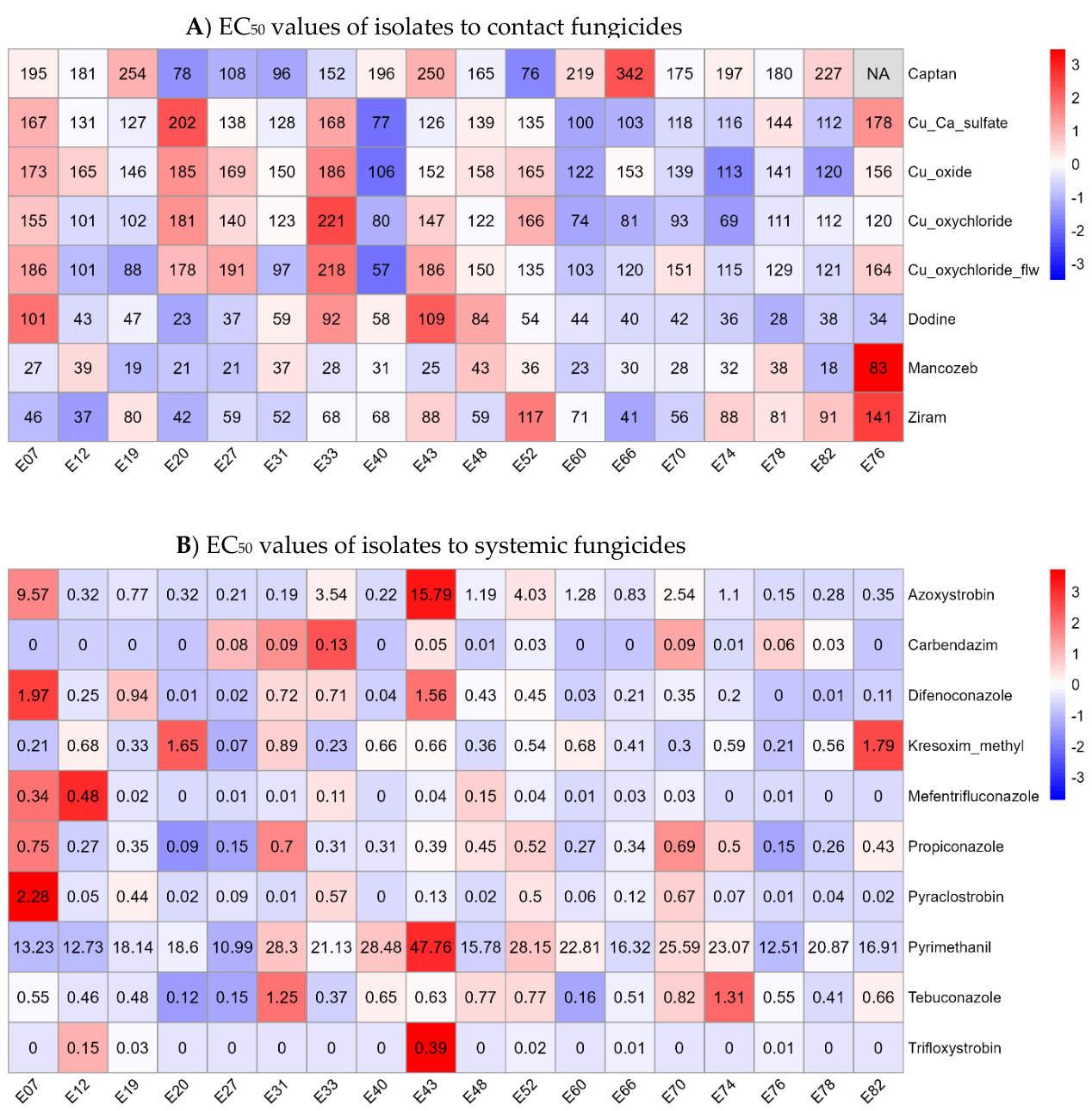
Figure 2.
Distribution of EC50 values (mg L⁻¹) for Uruguayan isolates of Pseudocercospora cladosporioides (n = 18) in response to different fungicides. (A) Contact fungicides, including dodine (which has translaminar activity). (B) Systemic fungicides. Each boxplot represents the distribution of EC50 values for a given fungicide across all isolates. Boxes indicate the interquartile range, horizontal lines within boxes represent medians, and whiskers indicate the range of values (excluding outliers). Different letters indicate significant differences among fungicides within each panel according to Tukey’s test (P < 0.05).
Figure 2.
Distribution of EC50 values (mg L⁻¹) for Uruguayan isolates of Pseudocercospora cladosporioides (n = 18) in response to different fungicides. (A) Contact fungicides, including dodine (which has translaminar activity). (B) Systemic fungicides. Each boxplot represents the distribution of EC50 values for a given fungicide across all isolates. Boxes indicate the interquartile range, horizontal lines within boxes represent medians, and whiskers indicate the range of values (excluding outliers). Different letters indicate significant differences among fungicides within each panel according to Tukey’s test (P < 0.05).
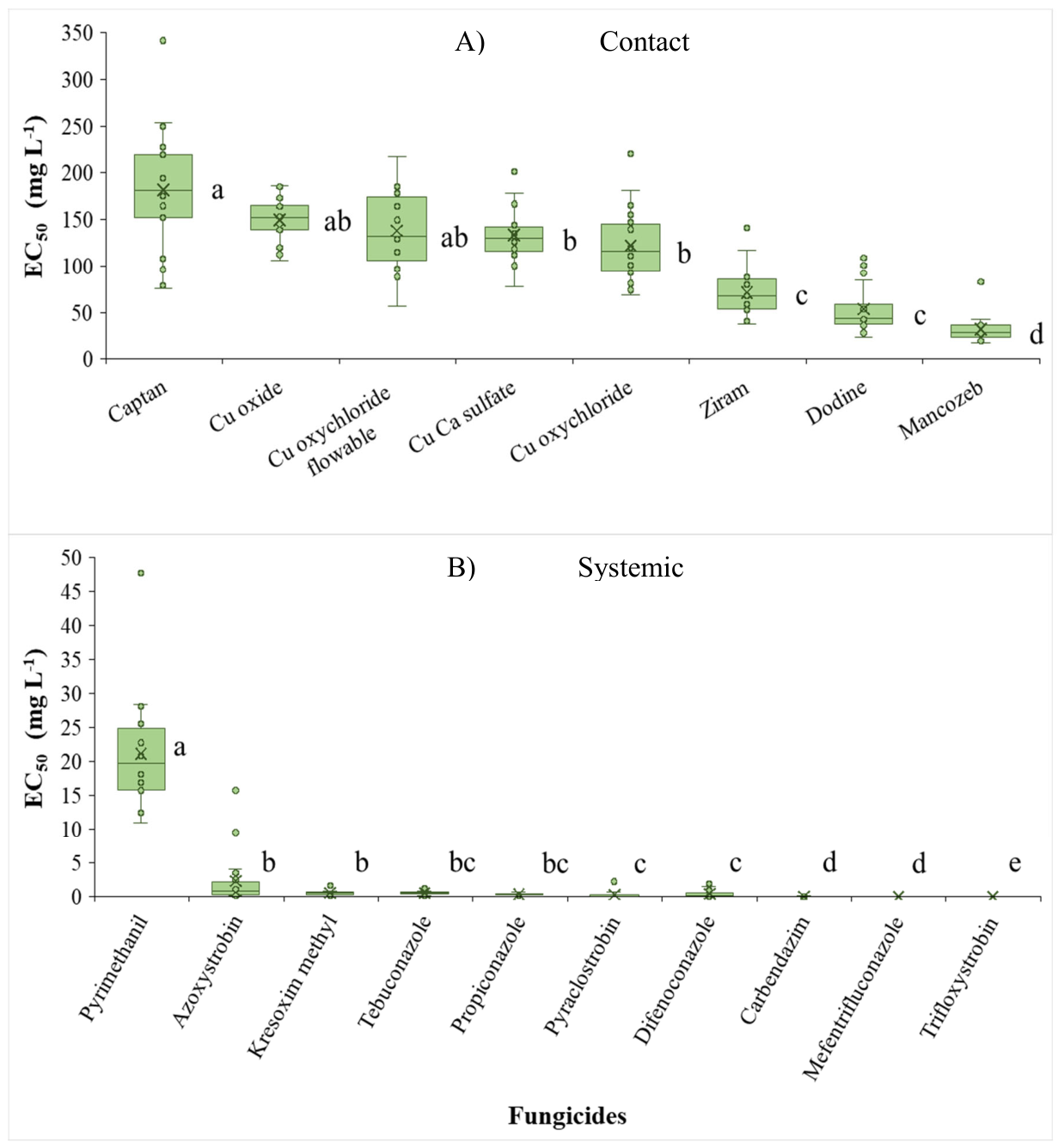

Table 1.
Geographic origin and characteristics of Uruguayan isolates of Pseudocercospora cladosporioides used in this study.
Table 1.
Geographic origin and characteristics of Uruguayan isolates of Pseudocercospora cladosporioides used in this study.
| Locality | Isolate | WGS84 a | Cultivarb |
|---|---|---|---|
| Salto, Olivares Salteños | E07 E12 |
S 31°19’19”, W 54°04’12 | Arbequina Arbequina |
| Salto, Puntas de Valentín | E19 E20 E27 |
S 31°32’55”, W 57°10’28” | n.d. n.d. n.d. |
| Rocha, Nuevo Manantiales | E31 E33 E40 |
S 34°16’26”, W 54°04’12” | Arbequina Arbequina Coratina |
| Maldonado, Agroland | E43 E48 E52 |
S 34°37’24”, W 54°36’56” | Manzanilla Leccino Coratina |
| Montevideo, ARU | E60 E62 |
S 34°43’00”, W 56°16’00” | Arbequina Pendolino |
| Canelones, INIA Las Brujas | E70 E74 |
S 34°40’05”, W 56°20’37” | Leccino Seggianese |
| Montevideo, FAgro | E76 | S 34°50’14”, W 56°13’40” | n.d. |
| Colonia, San Pedro | E78 E82 |
S 34°21’05”, W 57°47’50” S 34°21’30”, W 57°30’09” |
Arbequina Arbequina |
a WGS84: World Geodetic System 1984; b n.d.: not determined.
Table 2.
Characteristics of the commercial fungicides evaluated in this study.
| Chemical group (FRAC)1 | Active ingredient | Trade name | Company | Formulation 2 |
|---|---|---|---|---|
| Inorganic Cupric (M 01) |
Copper calcium sulfate | Bordeles AR Caldo Bordeles F |
Agro Regional Fanaproqui |
74 % wp (Cu 20 %) 68 % wp (Cu 20 %) |
| Copper oxychloride | Oxicloruro Cu AR Fanavid 85 |
Agro Regional Fanaproqui |
85 % wp (Cu 50 %) | |
| Copper oxychloride flowable | Fanavid Flowable | Fanaproqui | 68 % SC (Cu 40 %) | |
| Cuprous oxide | Cuproxido 75 PM Cobre Nordox S75 | Agro Regional Lanafil S.A. |
85 % wp (Cu 75 %) 86 % wp (Cu 75 %) |
|
| Ditiocarbamate (M 03) |
Mancozeb | Mancozeb AR Sancozeb 80 pm |
Agro Regional Lanafil S.A. |
80 % wp |
| Ziram | Ziram Tafirel Ziram Granuflo |
La Forja S.A. Taminco Uy S.A. |
80 % dg 76 % dg |
|
| F-talimide (M04) | Captan | Captan 80 Dikebell Merpan 80 DF |
Agro Regional Lanafil S.A. |
80 % dg |
| Guanidine (U 12) |
Dodine | Dodin Flo Syllit 400 SC |
Agro Regional Lanafil S.A. |
40 % 410 g L-1 cs 39.4 % 400 g L-1 cs |
| Anilino-pyrimidine (9) | Pyrimethanil | Venthos SC | Ineplus S.A. (Proquimur S.A) | 28.3 % 300 g L-1 cs |
| Benzimidazol (1) | Carbendazim | Bencarb - L | Saudu | 45 % 500 g L-1 cs |
| Qol-fungicide Strobilurins 3 (11) |
Azoxystrobin * | Mirador 25 SC Amistar |
Lanafil S.A. Syngenta |
22,9 % 250 g L-1 cs 23.3 % 250 g L-1 cs |
| Pyraclostrobin * | Comet Classic |
Basf S.A. Lanafil S.A. |
23,8 % 250 g L-1 ec | |
| Kresoxim-methyl | Ardent 50 SC | Lanafil S.A. | 46,2 % 500 g L-1 cs | |
| Trifloxystrobin * | Flint 50 WG | Bayer S.A. | 50 % wg | |
| DMI-fungicide Triazole EBI 4 (3) |
Difenoconazole | Score 250 EC | Syngenta Agro Uruguay S.A. | 24 % 250 g L-1 ec |
| Mefentriflucona-zole | Cevya | Basf S.A. | 35 % 400 g L-1 cs | |
| Tebuconazole * | Tebuzate 43 SC | La Forja S.A. | 39,1 % 430 g L-1 cs | |
| Propiconazole * | Quick 250 EC | Saudu S.A. | 25,5 % 250 g L-1 ec |
1FRAC: Fungicide Resistance Action Committee (FRAC, 2025) code based on mode of action; 2 Formulation: WP= Wettable Powder; WG= Water-dispersible Granules; DG= Dispersible Granules; CS= Concentrated Suspension; EC= Emulsifiable Concentrate;3QoI: Quinone outside Inhibitors; 4DMI: DeMethylation Inhibitors, EBI: Ergosterol Biosynthesis Inhibitors; * Resistance known in Pseudocercospora spp.
Table 3.
EC50 values for inhibition of mycelial growth of Pseudocercospora cladosporioides isolates exposed to different fungicides in vitro.
Table 3.
EC50 values for inhibition of mycelial growth of Pseudocercospora cladosporioides isolates exposed to different fungicides in vitro.
| Chemical group | Active ingredient | EC50 a,b ± SEc | EC50 range | ||
|---|---|---|---|---|---|
| Contact fungicides and dodine | |||||
| F-talimide | Captan | 185 | ± 19 | a | 76-342 |
| Cupric | Cuprous oxide | 150 | ± 15 | ab | 106-186 |
| Cupric | Copper oxychloride flowable | 138 | ± 14 | ab | 57-218 |
| Cupric | Copper calcium sulfate | 131 | ± 13 | b | 77-202 |
| Cupric | Copper oxychloride | 123 | ± 12 | b | 69-221 |
| Ditiocarbamate | Ziram | 71 | ± 7 | c | 37-141 |
| Guanidine | Dodine | 53 | ± 5 | c | 23-109 |
| Ditiocarbamate | Mancozeb | 30 | ± 3 | d | 27-83 |
| Systemic Fungicides | |||||
| Anilino-Pyrimidine | Pyrimethanil | 25.3 | ± 12.5 | a | 11.0-47.8 |
| Strobilurin | Azoxystrobin | 1.05 | ± 0.52 | b | 0.15-15.8 |
| Strobilurin | Kresoxim-methyl | 0.96 | ± 0.49 | b | 0.07-1.79 |
| Triazole | Tebuconazole | 0.56 | ± 0.28 | bc | 0.12-1.31 |
| Triazole | Propiconazole | 0.44 | ± 0.22 | bc | 0.09-0.75 |
| Strobilurin | Pyraclostrobin | 0.19 | ± 0.10 | c | 0.003-2.28 |
| Triazole | Difenoconazole | 0.19 | ± 0.10 | c | 0.003-1.97 |
| Benzimidazol | Carbendazim | 0.03 | ± 0.02 | d | <0.001-0.13 |
| Triazole | Mefentrifluconazole | 0.03 | ± 0.01 | d | <0.001-0.48 |
| Strobilurin | Trifloxystrobin | 0.006 | ± 0.003 | e | <0.001-0.39 |
aec50: effective concentration (mg L-1) that inhibits 50% of mycelial growth, the values correspond to estimated mean obtained from the fitted model. b Statistical analyses for mean comparisons were performed separately for contact fungicides (including dodine) and systemic fungicides. Within each group, means followed by the same letter are not significantly different (Tukey’s test, P < 0.05); cSE: Standard Error.
Disclaimer/Publisher’s Note: The statements, opinions and data contained in all publications are solely those of the individual author(s) and contributor(s) and not of MDPI and/or the editor(s). MDPI and/or the editor(s) disclaim responsibility for any injury to people or property resulting from any ideas, methods, instructions or products referred to in the content. |
© 2026 by the authors. Licensee MDPI, Basel, Switzerland. This article is an open access article distributed under the terms and conditions of the Creative Commons Attribution (CC BY) license.
Copyright: This open access article is published under a Creative Commons CC BY 4.0 license, which permit the free download, distribution, and reuse, provided that the author and preprint are cited in any reuse.


