

Submitted:
28 April 2026
Posted:
30 April 2026
You are already at the latest version
Abstract
Vibroacoustic monitoring provides a measurement-based approach for investigating heritage spaces in which architectural morphology, environmental conditions and sound-related practices are physically interrelated. This study applies a portable and non-invasive monitoring protocol to the medieval cave sanctuary of San Michele di Mezzo, located in Fisciano, Southern Italy. The site consists of stratified natural and built spaces, including a lower cave, an upper cave and a later upper church, and rep-resents a relevant case study for assessing the acoustic behaviour of small, irregular and fragile cultural heritage environments. The experimental procedure combined calibrated microphone recordings, time-domain signal inspection, third-octave-band analysis and impulse-response-derived room-acoustic indicators, including reverbera-tion, clarity and definition parameters. The results show that the lower and upper caves are acoustically differentiated, with the lower cave displaying more favourable clarity and definition values in selected low–mid frequency bands relevant to vocal practices. At higher frequencies, the differences become less systematic, indicating that the acoustic distinction between the two spaces is frequency-dependent rather than absolute. Comparative data from other cave and cave-like environments further con-textualize the measured response of San Michele di Mezzo. The findings do not imply intentional acoustic design; rather, they show that the long-lasting devotional central-ity of the lower cave is compatible with measurable acoustic conditions supporting spoken or sung ritual practices. More broadly, the study contributes to applied vi-broacoustics by demonstrating that low-invasive field monitoring can provide repro-ducible acoustic indicators for heritage interpretation, conservation-oriented docu-mentation and the investigation of intangible sound-related dimensions of cultural heritage.
Keywords:
vibroacoustic monitoring
; cave acoustics
; cultural heritage
; acoustic indicators
; field measurements
; intangible heritage
1. Introduction
Vibroacoustic monitoring provides an integrated physical framework for investigating the generation, propagation and reception of mechanical waves across different media, frequency ranges and spatial scales. Although acoustics and mechanical vibrations have often developed as partially separated research domains, many real systems cannot be fully understood through this distinction. Built environments, natural cavities, structural components and human perceptual contexts frequently interact through airborne and structure-borne wave phenomena, producing measurable responses that depend on geometry, material properties, boundary conditions, environmental excitations and patterns of use. For this reason, vibroacoustic monitoring is increasingly relevant not only in civil, industrial and environmental applications, but also in interdisciplinary domains where physical measurements are required to interpret complex interactions between human communities, built structures and the surrounding environment.
Cultural heritage sites represent particularly meaningful contexts for this integrated approach. Historic buildings, churches, caves, theatres, crypts and rock-cut sanctuaries are not only material structures, but also spaces where sound, ritual, movement and perception have contributed to the historical experience of the place. The acoustic response of such environments may therefore constitute a measurable component of their intangible dimension, especially when the use of the human voice, chant, music or liturgical sound was central to their function. This perspective is consistent with the broader understanding of cultural heritage as a system that includes both tangible and intangible dimensions, as emphasized by international heritage frameworks and by theoretical discussions on the evolution of the concept of cultural heritage [1,2]. In this sense, sound is not merely an ephemeral sensory phenomenon, but can become part of the way in which communities experience, transmit and reinterpret places through time.
The acoustics of historic spaces has already been recognized as a relevant component of intangible cultural heritage [3]. Research on ancient theatres, churches and other performance or worship spaces has shown that acoustic properties, including sound level, reverberation, clarity and speech transmission, can influence intelligibility, audibility, perceived acoustic comfort and the suitability of spaces for collective listening practices [4,5,6]. In religious buildings, in particular, indicators derived from room-acoustic studies, such as reverberation time, clarity and definition, have been widely used to evaluate the acoustic conditions for speech, chant and music, highlighting the close relationship between architectural configuration, liturgical function and auditory experience. These studies demonstrate that acoustic measurements can provide information that is not accessible through visual inspection alone and can contribute to a more complete interpretation of heritage environments.
Within this broader field, cave and rock-cut environments are of special interest. Their irregular geometry, heterogeneous boundaries, variable surface roughness and partial enclosure can produce highly site-specific acoustic responses, which are difficult to infer from architectural description alone. Experimental studies on cave acoustics have suggested that acoustic features may be associated with the spatial organization, perception and ritualization of prehistoric and historic places [7,8]. In such contexts, measurement-based approaches are particularly valuable because they allow acoustic hypotheses to be tested without reducing the interpretation of the site to purely formal, architectural or documentary evidence. At the same time, the acoustic characterization of caves and small rock-cut spaces remains methodologically challenging because these environments often deviate from the assumptions underlying conventional room-acoustic models developed for regular architectural volumes. Therefore, the vibroacoustic assessment of small heritage spaces requires field protocols that are physically grounded, conservative and compatible with the constraints of fragile sites. Many cultural heritage environments are difficult to access, geometrically irregular and unsuitable for invasive instrumentation or extensive measurement grids. Moreover, the use of professional omnidirectional sound sources and complex acquisition systems may be impractical in preliminary surveys or in contexts where conservation, logistics and accessibility impose severe constraints. For these reasons, portable and cost-effective measurement strategies based on calibrated microphones, controlled acoustic excitation and reproducible signal processing can provide a useful first level of quantitative documentation, provided that their limits are clearly stated and that interpretations remain directly linked to measured indicators. This approach is particularly relevant for field vibroacoustic monitoring, where the aim is not necessarily to produce a complete acoustic certification of a space, but to identify measurable acoustic behaviours that can support interpretation, comparison and future investigation.
The present study applies this perspective to the medieval cave sanctuary of San Michele di Mezzo, located in the municipality of Fisciano, Campania, Southern Italy. The sanctuary includes a lower cave, an upper cave and a later upper church, forming a stratified religious complex in which natural cavities and built elements coexist. The rock-cut nucleus of the site is traditionally associated with long-lasting devotional use, while the upper church belongs to a later architectural phase completed in the 19th century. The lower cave preserves one of the oldest devotional elements of the sanctuary, including a fresco above the altar depicting the Virgin and Child, probably dating to the end of the 12th century, whereas the upper cave and the upper church reflect later transformations of the religious complex. This stratification makes the site suitable for investigating whether the historically privileged use of specific spaces was compatible with measurable acoustic conditions.
The objective of this work is to test whether a portable and non-invasive vibroacoustic monitoring protocol can identify measurable acoustic differences between the main cave spaces of the sanctuary and provide physically grounded information for heritage interpretation. The study does not aim to derive a complete acoustic model of the sanctuary. Rather, it focuses on directly measured acoustic responses, including time-domain recordings, third-octave-band distributions and standard acoustic indicators. The experimental protocol combines calibrated microphone measurements, sine-sweep impulse-response acquisition and signal processing procedures aimed at evaluating acoustic parameters related to reverberation, clarity and definition. The analysis specifically compares the lower and upper caves, with attention to frequency bands relevant to vocal practices, such as spoken prayer, chant and liturgical recitation.
The novelty of the work lies in the use of field monitoring as a conservative metrological bridge between physical measurements, architectural stratification and intangible functional aspects related to the potential sound-related practices occurred in the past of this medieval cave sanctuary. The contribution of the paper is threefold. First, it provides the first experimental acoustic characterization of the San Michele di Mezzo cave sanctuary using a portable and reproducible measurement setup. Second, it compares the lower and upper caves through objective acoustic indicators, avoiding unsupported assumptions on acoustic transfer between spaces. Third, it discusses how measured vibroacoustic evidence can support, within clearly defined limits, the interpretation of intangible heritage dimensions associated with ritual sound and historical spatial use. In doing so, the study contributes to the development of vibroacoustic monitoring as an applied-physics tool for cultural heritage, where tangible structures, environmental conditions and human practices are investigated within a unified measurement-based framework.
2. Materials and Methods
2.1. Case Study and Research Hypothesis
The Sanctuary of San Michele di Mezzo is located in the municipality of Fisciano, in the province of Salerno, Campania, Southern Italy. Dedicated to St. Michael the Archangel, the sanctuary belongs to the widespread tradition of Michaelic devotion in rock-cut and elevated places, where natural morphology, religious practice and spatial isolation often converged in the construction of sacred landscapes. The site is today composed of a stratified system of natural and built spaces, including a lower cave, an upper cave and a later upper church. This spatial organization makes the sanctuary a particularly relevant case study for investigating how acoustic behaviour, architectural configuration and historical use may interact in a complex heritage environment.
The earliest documentary references to the sacred site date back to the mid-seventeenth century, when it is mentioned with the name of S. Angelo in Panicola. However, the devotional nucleus of the sanctuary appears to be older than the surviving documentary evidence. The rock-cut core was originally a karst hermitage-cave, divided into two principal cave spaces, and later integrated into a more articulated religious complex (Figure 1). The coexistence of natural cavities and later architectural additions is a key feature of the site, because it allows the acoustic response of spaces with different morphologies, materials and historical phases to be compared within the same sacred complex.
The lower cave represents the most significant devotional space of the sanctuary. Its present arrangement dates to the late eighteenth or early nineteenth century, but the space preserves an older liturgical and iconographic layer. Above the altar, the lower cave contains a fresco depicting the Virgin and Child, also known as the Virgin Mary Odigitria, probably dating to the end of the twelfth century. This element indicates the presence of an early devotional focus in the lower space and supports the interpretation of the lower cave as one of the oldest and most historically relevant nuclei of the sanctuary. The preservation of this pictorial evidence is particularly important for the present study because it suggests that the lower cave was not a marginal or secondary space, but a place of sustained ritual and devotional significance.
The upper cave forms the second rock-cut component of the sanctuary. It preserves visible frescoes, including a depiction of Christ as the Good Shepherd, and contains an altar whose origin has been associated with the same broad chronological horizon as the original lower altar, before later modifications. Compared with the lower cave, the upper cave shows a different spatial configuration and a different relationship with the later built components of the sanctuary. These differences are relevant from a vibroacoustic perspective because the two caves are not only historically distinct spaces, but also acoustic environments characterized by different geometries, boundary conditions and degrees of enclosure.
The upper church was added in a later phase, between the end of the eighteenth century and the beginning of the nineteenth century, and was completed in 1843, as indicated by an inscription engraved in the churchyard. Its construction transformed the perception and organization of the sanctuary, creating a more conventional built worship space above the older rock-cut nucleus. The resulting complex is therefore not a homogeneous architectural object, but a stratified sacred site in which natural cavities, devotional images, altars and later masonry additions coexist. This stratification provides the historical and architectural framework for the experimental vibroacoustic monitoring presented in this study.
The historical and architectural stratification of San Michele di Mezzo raises a specific research question: whether the long-lasting devotional relevance, especially considering the lower cave, was compatible with acoustic conditions favourable to vocal ritual practices. The question is not whether the natural space was intentionally transformed according to explicit acoustic principles. Such an interpretation would exceed the available historical evidence. Rather, the question is whether the measured acoustic response of the caves and especially the lower one is consistent with its historical role as a privileged devotional space, especially for practices involving spoken prayer, chant or liturgical recitation.
This hypothesis is grounded in the broader understanding of acoustic heritage as a component of intangible cultural heritage. In worship spaces, sound is not an accessory phenomenon, but part of the embodied and collective experience of ritual. Speech intelligibility, vocal clarity, reverberation and perceived acoustic support can influence how a space is used, remembered and transmitted as a place of devotion. For this reason, acoustic monitoring can provide an additional layer of evidence for interpreting the relationship between tangible architecture and intangible practices.
In the present study, this interpretive question is addressed through a portable and non-invasive vibroacoustic monitoring protocol. The comparison between the lower and upper caves is based on directly measured acoustic indicators, including time-domain recordings, third-octave-band analysis and room-acoustic parameters related to reverberation, clarity and definition. The analysis is therefore intentionally limited to measurable and reproducible quantities. Historical interpretation is introduced only after the acoustic evidence has been established, in order to avoid circular reasoning between the presumed ritual importance of the lower cave and its measured acoustic behaviour.
2.2. Experimental Data Collection
The experimental campaign was designed as a portable and non-invasive field-monitoring procedure aimed at comparing the local acoustic response of the main accessible spaces of the sanctuary. The measurement strategy was intentionally based on a limited and repeatable setup, suitable for a fragile heritage environment characterized by small volumes, irregular boundaries and restricted accessibility. Rather than reconstructing the complete sound propagation within the whole complex, the protocol focused on directly measurable acoustic quantities in the lower cave and upper cave, with additional background recordings collected in the surrounding sanctuary area.
Acoustic signals were acquired using a miniDSP UMIK-1 class-I USB measurement microphone. Before the field measurements, the equivalent sound pressure level was checked using an ND9B class-I digital sound level calibrator, operating at 1 kHz with available calibration levels of 94 dB and 114 dB. This preliminary calibration step was introduced to ensure consistency in the recorded sound-pressure data and to allow comparison between the investigated spaces. The use of a single calibrated microphone was selected as a conservative and practical solution for the present field campaign. Given the small dimensions of the cave spaces and the exploratory character of the monitoring protocol, a denser microphone array was not adopted. This choice also reduced the duration of the measurements and limited possible variations in the internal environmental conditions during the acquisition phase.
The microphone position was defined according to the general criteria of ISO 3382-1 for room-acoustic measurements [9]. In each investigated space, the receiver was placed approximately 1.20 m above the floor and at least 1.00 m from the nearest reflecting surface, compatibly with the geometric constraints of the caves. This position was chosen to represent the listening area of the assembly, while avoiding direct proximity to walls, altars or irregular rock surfaces. During the measurements, only one operator was present inside the site, and possible anthropogenic noise sources in the vicinity of the sanctuary were avoided as far as possible.
Two complementary sets of recordings were collected. First, uncompressed two-minute background recordings in *.wav format were acquired outside the sanctuary and inside the investigated spaces, using a sampling frequency of 44.1 kHz. These recordings were used to inspect the time-domain behaviour of the measured signals and to characterize the ambient acoustic conditions during the field campaign. Second, controlled impulse-response measurements were performed in the lower and upper caves using Room EQ Wizard software, version 5.31.1. The excitation signal was an ISO envelope-equalized sine sweep generated at a sampling frequency of 48 kHz and covering the frequency range from 0 to 20 kHz. The sweep duration was set to 20 s and the signal was reproduced through a portable directional loudspeaker connected to a laptop computer.
The use of a directional loudspeaker, rather than a professional omnidirectional source, was considered acceptable for the scope of the present study, which aimed at a comparative and non-invasive acoustic characterization rather than a full standard certification of the rooms. Similar cost-effective approaches based on common loudspeakers have been proposed for impulse-response measurements when logistical or economic constraints make standard omnidirectional sources impractical [10]. In the present configuration, the sound source was positioned near the altar area, corresponding to the expected position of the officiant or speaker, whereas the microphone was placed in a representative listening position within the cave. This source–receiver configuration was adopted in both the lower and upper caves to allow a consistent comparison between the two spaces.
The impulse-response measurements were used to estimate acoustic indicators related to reverberation, clarity and definition. Although the complex geometry of the caves and the use of a single source–receiver configuration do not allow a complete spatial characterization of the acoustic field, the limited duration of the excitation signal and the controlled measurement conditions support the use of a linear time-invariant approximation for the local room response. This assumption is consistent with common practice in room-acoustic measurements based on swept-sine excitation, provided that the results are interpreted as representative of the adopted measurement configuration and not as exhaustive descriptors of the entire sanctuary.
2.3. Signal Processing and Acoustic Indicators
The recorded signals were processed in MATLAB in order to extract both broadband and frequency-dependent descriptors of the acoustic response of the investigated spaces. First, the background recordings were inspected in the time domain to identify possible transient disturbances and to verify the absence of relevant anthropogenic noise during the acquisition windows. The calibrated microphone signals were then converted into A-weighted equivalent sound pressure levels, expressed in dBA, using a MATLAB sound-pressure-level processing routine. This step provided a first quantitative description of the overall acoustic environment associated with each measurement condition.
To complement the broadband sound-pressure analysis, the frequency distribution of the measured signals was evaluated using third-octave-band processing. Third-octave-band spectra were computed in MATLAB by means of the ‘poctave’ function, allowing the comparison of the acoustic content of the lower cave and upper cave over standard frequency bands. This representation was selected because it provides a compact and physically interpretable description of the frequency-dependent behaviour of the spaces and is widely used in environmental and room-acoustic assessments.
The impulse-response measurements acquired through the swept-sine procedure were used to estimate a set of room-acoustic indicators related to reverberation, clarity and definition. The parameters considered in this study were Early Decay Time (EDT), reverberation times T20 and T30, speech clarity C50, music clarity C80 and definition D50. These descriptors are commonly adopted in room-acoustic studies and have been extensively used in the acoustic assessment of churches and historical worship spaces, where the balance between reverberation, intelligibility and acoustic support is essential for speech, chant and music [9,13]. In the present work, these indicators were not used to certify the acoustic quality of the sanctuary according to performance-space standards, but as comparative descriptors of the measured response of the lower and upper caves.
Table 1 summarizes the acoustic indicators adopted in this study, their units of measurement and their physical interpretation, based on the relevant literature on this topic [5]. The reference ranges reported in the last column should be understood as indicative values derived from room-acoustic literature and not as strict design targets for the investigated cave sanctuary. This distinction is important because irregular rock-cut environments differ substantially from conventional performance spaces in terms of geometry, surface roughness and boundary conditions.
The complete set of measured values for all frequency bands is reported in the Appendix A. In the main text, the discussion focuses on the bands that are most relevant for comparing the two cave spaces and for interpreting their possible suitability for voice-related practices.
2.4. Methodological Scope and Limitations
The experimental protocol adopted in this study was designed as a first-level field vibroacoustic monitoring procedure for a fragile and geometrically irregular heritage site. Its objective was not to provide a complete spatial mapping of the acoustic field, nor to certify the sanctuary according to the standards normally applied to performance halls. Rather, the aim was to obtain directly measured and reproducible acoustic indicators capable of supporting a comparative assessment of the lower and upper caves under controlled field conditions.
Several methodological choices follow from this objective. A single calibrated microphone was used in order to reduce the invasiveness and duration of the measurements, while maintaining the same source–receiver logic in the investigated spaces. Similarly, a portable directional loudspeaker was adopted instead of a professional omnidirectional sound source. This choice limits the generalization of the results to the whole acoustic field of each cave, but remains consistent with the purpose of comparing local acoustic responses in a cost-effective and repeatable monitoring configuration.
No acoustic transfer function between adjacent spaces was estimated. In the present field conditions, such an analysis would require a denser measurement grid, multiple source–receiver configurations and a more detailed control of source directivity and boundary conditions. The study therefore relies only on directly measured quantities, including time-domain recordings, third-octave band distributions and room-acoustic indicators derived from impulse-response measurements. This conservative approach avoids unsupported assumptions on acoustic coupling between the different parts of the sanctuary.
Consequently, the results should be interpreted as representative of the adopted measurement configuration and as comparative indicators of acoustic differentiation between the lower and upper caves. Within these limits, the protocol provides a reproducible basis for assessing whether the historically privileged use of the lower cave is compatible with its measured acoustic behaviour, and for defining future campaigns based on extended spatial sampling, repeated seasonal measurements or numerical acoustic modelling.
3. Results and Discussion
3.1. Results
The experimental campaign produced three groups of data: time-domain recordings, third-octave-band spectra and room-acoustic indicators derived from impulse-response measurements. The measurements considered in this section refer to the lower cave and upper cave of the San Michele di Mezzo sanctuary.
Figure 2 shows the time histories recorded in the investigated spaces during the field campaign. The signals are reported in the time domain using the same time scale, in order to allow direct visual comparison between the acquisition windows. The recorded traces correspond to the measurement configurations described in Section 2.2.
Figure 3 reports the third-octave-band representation of the recorded signals. The spectra are shown for the lower cave and upper cave over the standard frequency bands considered in the analysis. Where available, the background or external recording is included as a reference condition.
The acoustic indicators obtained from the impulse-response measurements are summarized in Table 2 for selected frequency bands. In particular, the indicators reported in Table 2 are EDT, T20, T30, C50, C80 and D50. Values are shown for the lower cave and upper cave at 250, 500, 1000, 2000, 4000 and 8000 Hz.
The full experimental dataset includes additional values at 50, 63, 80, 315 and 400 Hz. In the lower cave, the measured EDT values are 14.73 s at 50 Hz, 8.028 s at 63 Hz and 8.179 s at 80 Hz. In the upper cave, the corresponding EDT values are 13.47 s at 50 Hz, 17.88 s at 63 Hz and 17.42 s at 80 Hz.
3.2. Discussion
The experimental results show that the lower and upper caves of the San Michele di Mezzo sanctuary cannot be considered acoustically equivalent spaces. Although they belong to the same religious complex and share a rock-cut origin, the measured acoustic indicators reveal different frequency-dependent behaviours. This outcome is relevant from a vibroacoustic monitoring perspective because it confirms that portable and non-invasive field measurements can distinguish measurable acoustic responses within a small and irregular heritage site, even when only a conservative source–receiver configuration is adopted.
A first relevant difference concerns the low–mid frequency range. At 250 Hz, the lower cave shows markedly higher clarity and definition values than the upper cave, with C50 = 2.11 dB, C80 = 5.19 dB and D50 = 61.90%, whereas the corresponding values in the upper cave are C50 = −4.05 dB, C80 = −1.71 dB and D50 = 28.30%. This difference is particularly meaningful because low–mid frequency bands contribute to the perceived body and support of the human voice, while clarity and definition parameters describe the balance between early and late acoustic energy. In this sense, the measured response of the lower cave is more consistent with voice-related ritual practices than that of the upper cave in this specific frequency band.
The comparison becomes more nuanced at higher frequencies. At 500 Hz, the two caves show very close values for C50 and D50, whereas at 1000 Hz and above the differences are less systematic. At 4000 Hz and 8000 Hz, the upper cave even shows higher C50 and D50 values than the lower cave. This trend indicates that the acoustic advantage of the lower cave is not absolute across the whole spectrum. Rather, the distinction between the two environments is frequency-dependent. Such a result is important because it prevents an oversimplified interpretation of the lower cave as globally “better” from an acoustic point of view. The measured data support a more precise conclusion: the lower cave exhibits more favourable clarity and definition values in selected low–mid frequency bands, while the two spaces become more comparable, and in some cases inverted, in the medium–high and high-frequency ranges.
To place the San Michele di Mezzo results in a broader acoustic context, the measured indicators were compared with published datasets from selected cave and cave-like environments, reported in Appendix A [11,12,13]. This comparison is not intended to define universal reference values for caves, because the considered sites differ in volume, morphology, surface conditions, measurement protocols and cultural function. Rather, it provides an interpretative frame for evaluating whether the measured behaviour of San Michele falls within the variability already observed in analogous environments.
The reverberation-related indicators show that San Michele occupies an intermediate position between highly reverberant large cave spaces and smaller or more acoustically controlled cave environments. At 1000 Hz, EDT is 1.309 s in the lower cave and 1.271 s in the upper cave. These values are close to those reported for La Pasiega Turret cave and Tito Bustillo cave, both equal to 1.40 s, and higher than La Garma cave, equal to 0.56 s. They are also lower than the values reported for the Pertosa caves, where EDT at 1000 Hz ranges from 1.61 s in the Castle Hall to 3.83 s in the Large Hall. This comparison indicates that the San Michele caves do not behave as extremely reverberant large cavities, but rather as compact rock-cut spaces with moderate mid-frequency decay.
The same pattern emerges from T30. At 1000 Hz, T30 is 1.600 s in the lower cave and 1.592 s in the upper cave, close to the Castle Hall of Pertosa, equal to 1.46 s, and lower than the Large Hall and Throne Hall of Pertosa, equal to 3.83 s and 2.81 s, respectively. At 4000 Hz, San Michele shows T30 values of 1.079 s in the lower cave and 0.993 s in the upper cave, again below the values reported for the larger Pertosa spaces. This comparison supports the interpretation of San Michele as a small cave sanctuary with measurable reverberant behaviour, but without the long decay times typical of larger cave halls.
The clarity indicators provide an even more informative comparison. At 250 Hz, the lower cave of San Michele shows C50 = 2.11 dB, which is higher than the values reported for several cave sites in the comparative dataset, including El Castillo, La Pasiega Turret and Tito Bustillo, and close to the range of sites with more favourable early-to-late energy balance, such as Las Chimeneas and La Garma. In contrast, the upper cave shows C50 = −4.05 dB at the same frequency. This comparison reinforces the internal differentiation between the two San Michele spaces: the lower cave is not only different from the upper cave, but also shows clarity values that, in selected bands, are comparable with or higher than those of several cave environments reported in the literature.
A similar observation can be made for C80. At 250 Hz, the lower cave reaches C80 = 5.19 dB, whereas the upper cave has C80 = −1.71 dB. The lower cave value is higher than those reported for the Hall of Bulls in Lascaux IV and for the Pertosa halls at the same frequency. At 1000 Hz, the lower cave shows C80 = 1.89 dB and the upper cave C80 = 2.04 dB, while the Pertosa halls range from −3.88 dB to 1.17 dB and Lascaux IV shows −3.5 dB. These values suggest that, in the considered frequency bands, the San Michele caves are not characterized by the very low clarity values observed in some larger or more reverberant cave environments.
The D50 comparison further highlights the specific behaviour of the lower cave. At 250 Hz, D50 is 61.90% in the lower cave and 28.30% in the upper cave. The lower cave value is substantially higher than those reported for the Pertosa halls at the same frequency, which range from 12.78% to 23.27%, whereas the upper cave is closer to that comparative range. At 1000 Hz and 4000 Hz, both San Michele caves show D50 values comparable with or higher than several Pertosa spaces, with the exception of the low 2000 Hz value reported for the upper cave. This confirms that the lower cave presents a relatively high early-energy fraction in selected frequency bands, consistently with the measured C50 and C80 values.
Overall, the comparative analysis strengthens the interpretation of San Michele di Mezzo as an acoustically differentiated cave sanctuary. The lower cave does not merely perform better than the upper cave in an internal comparison; in selected frequency bands, it also exhibits clarity and definition values that are favourable when placed beside published datasets from other cave or cave-like environments. At the same time, the comparison confirms the need for caution: the acoustic response of caves is highly site-specific, and no single parameter can be used to define the acoustic quality of a heritage space independently of morphology, volume, measurement setup and historical use.
This frequency-dependent behaviour is compatible with the irregular morphology of cave-like environments. In such spaces, the acoustic response is controlled by a combination of volume, enclosure, surface roughness, local cavities, openings and non-uniform boundary conditions. Unlike regular halls, rock-cut spaces do not necessarily exhibit smooth or predictable acoustic trends over the frequency spectrum. Experimental studies on cave acoustics have shown that local acoustic responses may vary substantially within the same site and may be associated with specific spatial positions, ritual areas or perceptual effects. The San Michele di Mezzo results are consistent with this broader evidence: the two caves belong to the same sanctuary, but their measured acoustic responses differ in selected bands because their geometries and boundary conditions are not equivalent.
From the point of view of cultural heritage interpretation, the most relevant finding is the acoustic differentiation of the lower cave. The lower cave preserves one of the oldest devotional nuclei of the sanctuary and contains the fresco of the Virgin and Child, probably dating to the end of the twelfth century. The experimental data do not demonstrate intentional acoustic design, nor do they prove that the space was selected because of its acoustic properties. Such conclusions would exceed the available evidence. However, the measured indicators show that the long-lasting ritual centrality of the lower cave is compatible with acoustic conditions that, in selected frequency bands, support vocal clarity and early sound definition. This compatibility is sufficient to connect the physical measurements with the historical use of the space without falling into deterministic or speculative interpretations.
This point is particularly important for the study of intangible heritage. In worship spaces, sound is not merely a physical by-product of ritual action. Spoken prayer, chant, liturgical recitation and collective listening are embodied practices that depend on the acoustic behaviour of the place in which they occur. Previous research on ancient theatres, churches and other performance or worship spaces has shown that acoustic properties, including sound level, reverberation, clarity and speech transmission, can influence intelligibility, audibility, perceived acoustic comfort and the suitability of spaces for collective listening practices. In the present case, vibroacoustic monitoring provides a quantitative layer of evidence that complements the historical and architectural reading of the sanctuary. The tangible features of the lower cave—its morphology, enclosure and devotional apparatus—are therefore linked to an intangible sound-related dimension that can be investigated through physical measurement.
The methodological contribution of this study lies in the conservative use of field vibroacoustic monitoring. The work does not rely on unsupported transfer-function estimates between adjacent spaces, nor on a numerical model of the sanctuary. Instead, it uses directly measured quantities: time histories, third-octave-band spectra and room-acoustic indicators derived from impulse-response measurements. This approach is less ambitious than a complete acoustic mapping or a calibrated numerical simulation, but it is more robust for a first-level investigation of a fragile heritage site. It also responds to a practical need in cultural heritage research: the availability of non-invasive, portable and cost-effective procedures that can be applied in sites where extensive instrumentation is not feasible.
The relevance of these results is not limited to heritage interpretation. Natural caves and artificial cavity-like spaces are relevant in several applied contexts where acoustic response affects communication, safety, comfort and spatial use. In tourist and show caves, room-acoustic indicators such as EDT, T20, C80, D50 and STI have been used to evaluate visitor experience, guided-tour communication, performance suitability and emergency information systems. Recent studies on karst tourist caves have shown that in situ impulse-response measurements, combined with geometric documentation, can support acoustic optimization for guided tours and safety communications [14]. Similarly, acoustic measurements in Italian caves used for concerts and theatrical performances have demonstrated the relevance of reverberation, clarity and definition parameters for assessing the functional suitability of natural underground spaces [12].
A further field of transferability is represented by underground transport infrastructure and other long or irregular artificial enclosures. Subway stations, tunnels, underground passages and similar confined spaces are characterized by non-diffuse sound fields, complex geometries and strong dependence of speech intelligibility on reverberation and source–receiver configuration. For example, studies on underground railway stations and subway platforms have shown that sound-field characteristics directly affect public-address systems, emergency communication, perceived comfort and acoustic design strategies [15,16]. Another potential related application can be identified in underground mining environments, where high background noise and confined geometries can reduce verbal communication effectiveness and make acoustic intelligibility a relevant factor for ordinary operational communication, safety and occupational acoustic comfort [17,18]. From this perspective, the protocol adopted in the present study, based on portable measurements, time-domain inspection, third-octave-band analysis and impulse-response-derived indicators, can be regarded as a first-level monitoring approach potentially transferable to other confined or semi-confined spaces where rapid, non-invasive acoustic assessment is required for different purposes.
This transferability does not imply that the same interpretative criteria can be applied unchanged across different domains. Heritage caves, tourist caves, subway platforms and artificial tunnels differ in scale, material properties, occupancy, background noise and functional requirements. However, they share a common vibroacoustic problem: the need to characterize how irregular or elongated cavities shape mechanical-wave propagation and how this affects human perception, information transmission and use of space. In this sense, the San Michele di Mezzo case study contributes not only to heritage interpretation, but also to the broader development of applied vibroacoustic monitoring procedures for complex cavity-like environments.
At the same time, the limitations of the study must be clearly acknowledged. The use of a single microphone position and a single source–receiver configuration does not allow the reconstruction of the full spatial variability of the acoustic field. The use of a directional loudspeaker, although compatible with the comparative scope of the work, does not reproduce the ideal conditions of standardized measurements based on omnidirectional sources. Moreover, the complex geometry of the caves prevents the direct generalization of the measured values to the entire volume of each space. For these reasons, the results should be interpreted as representative of the adopted monitoring configuration and as comparative indicators of acoustic differentiation, not as exhaustive acoustic certification of the sanctuary.
These limitations do not invalidate the main result of the study. The objective was not to produce a complete acoustic model of San Michele di Mezzo, but to verify whether a portable vibroacoustic monitoring protocol could identify measurable differences between the lower and upper caves. This objective was achieved. The comparison between the two spaces shows that the lower cave has a distinct acoustic response in selected frequency bands relevant to vocal practices, especially at 250 Hz, while the higher-frequency behaviour is more comparable between the two caves. The outcome is therefore not a generic claim of acoustic superiority, but a measured and frequency-dependent distinction between two historically and architecturally different spaces.
Future research should extend the monitoring protocol by increasing the number of source and receiver positions, repeating measurements under different environmental conditions and integrating the experimental data with three-dimensional geometric documentation of the cave spaces. A denser spatial sampling would allow the variability of acoustic indicators within each cave to be assessed, while numerical modelling could help distinguish the effects of volume, surface morphology and openings on the measured response. Additional perceptual tests or voice-based measurements could also be useful to evaluate more directly the relationship between acoustic indicators and ritual vocal practices. Within this broader research path, the present study provides a first experimental basis for interpreting San Michele di Mezzo as a heritage site in which architecture, acoustic response and intangible devotional use are physically and historically interconnected.
4. Conclusions
This study shows that vibroacoustic monitoring can provide more than a technical description of a heritage space. When applied to a stratified medieval cave sanctuary, it becomes a tool for making measurable a part of the relationship between architecture, ritual use and sound experience that would otherwise remain largely qualitative. The main impact of the work is therefore methodological: it demonstrates that portable and non-invasive acoustic measurements can support heritage interpretation without replacing historical or archaeological evidence, but by adding a physically grounded layer of information.
From a scientific perspective, the study contributes to the extension of vibroacoustic monitoring beyond its conventional engineering and industrial domains. The San Michele di Mezzo case confirms that small, irregular and historically stratified spaces can be investigated through field measurements, even when standard laboratory-like conditions are not available. This is particularly relevant for cultural heritage sites, where the impossibility of using invasive instrumentation or dense measurement grids often limits quantitative assessment. The proposed approach shows that directly measured acoustic indicators can still identify meaningful differences between spaces and can guide more advanced future investigations.
A second impact concerns metrology. The work supports the use of conservative, reproducible and low-invasive measurement protocols for the first-level characterization of fragile heritage environments. By focusing on directly measured quantities rather than on unsupported transfer-function estimates or over-simplified acoustic models, the study provides a robust framework for preliminary vibroacoustic assessment. This has potential relevance for the development of future monitoring procedures for cave churches, crypts, chapels, rock-cut sanctuaries and other heritage sites where acoustic response is part of the historical function of the place.
The results also have an impact on heritage interpretation. The measured acoustic differentiation between the lower and upper caves allows the historical centrality of the lower cave to be discussed from a new physical perspective. The study does not claim intentional acoustic design; rather, it shows that the long-lasting devotional use of the lower cave is compatible with measurable acoustic conditions favourable to vocal practices in selected frequency bands. This distinction is important because it avoids speculative interpretations while demonstrating that sound-related practices can be investigated as part of the intangible dimension of cultural heritage.
From an applied heritage-management perspective, the approach can support documentation, conservation and valorisation strategies. Acoustic measurements can help identify spaces whose sensory properties contribute to their cultural significance, inform the design of visitor routes, guide the use of sound in interpretation activities and support decisions concerning future interventions. In fragile sites, such as cave sanctuaries, acoustic monitoring can also become part of a broader non-invasive diagnostic framework, complementing visual, architectural and historical analyses.
Finally, the work has a broader social and cultural impact. By making the sound dimension of a medieval sanctuary measurable and communicable, vibroacoustic monitoring can contribute to a richer public understanding of heritage. It helps shift attention from heritage as a purely visual or material object to heritage as a lived environment shaped by perception, ritual, memory and community use. In this sense, the San Michele di Mezzo case study confirms the potential of vibroacoustics as a bridge between applied physics, cultural heritage research and the sustainable transmission of tangible and intangible heritage values.
Author Contributions
Conceptualization, M.C., F.B.; methodology, M.C.; validation, F.B.; formal analysis, M.C., F.B.; investigation, F.B.; data curation, M.C.; writing—original draft preparation, M.C.; writing—review and editing, F.B.; supervision, F.B. All authors have read and agreed to the published version of the manuscript.
Funding
This research received no external funding.
Data Availability Statement
The data supporting the findings of this study are reported within the article and in Appendix A. No additional datasets were generated or deposited in public repositories.
Acknowledgments
The authors express their gratitude to the administration and volunteers of the San Michele di Mezzo Sanctuary, particularly the Rector, Rev. Fr. Vincenzo Serpe, for granting permission to conduct the measurements and for the logistical support provided by the volunteers.
Conflicts of Interest
The authors declare no conflicts of interest.
Appendix A
This appendix reports comparative acoustic data used to contextualize the results obtained for the lower and upper caves of the San Michele di Mezzo sanctuary. The selected indicators include EDT, T30, C50, C80 and D50, reported by frequency band for San Michele di Mezzo and for selected cave or cave-like environments available in the literature. The comparison is intended only as a contextual reference, since the considered sites differ in volume, morphology, surface conditions, measurement protocols and cultural function. Therefore, the values reported in Table A1 should not be interpreted as universal reference ranges for cave acoustics, but as a comparative framework supporting the discussion of the measured response of San Michele di Mezzo.

Table A1.
Comparative EDT values [s] for the lower and upper caves of San Michele di Mezzo and selected cave or cave-like environments. Missing values indicate that the corresponding data were not available in the comparative dataset.
Table A1.
Comparative EDT values [s] for the lower and upper caves of San Michele di Mezzo and selected cave or cave-like environments. Missing values indicate that the corresponding data were not available in the comparative dataset.
| Location | 63 Hz | 125 Hz | 250 Hz | 500 Hz | 1000 Hz | 2000 Hz | 4000 Hz | 8000 Hz |
| San Michele—Lower cave | 8.028 | 2.896 | 1.189 | 1.978 | 1.309 | 1.302 | 0.872 | 0.641 |
| San Michele—Upper cave | 17.880 | 1.950 | 1.947 | 1.672 | 1.271 | 1.232 | 0.946 | 0.713 |
| La Pasiega Turret cave | – | 1.920 | 1.620 | 1.580 | 1.400 | 1.160 | – | – |
| Tito Bustillo cave | – | 1.920 | 1.620 | 1.580 | 1.400 | 1.160 | – | – |
| Paphos | – | 2.020 | 1.850 | 1.820 | 1.710 | 1.550 | – | – |
| El Castillo cave | – | 1.330 | 1.200 | 1.280 | 1.150 | 1.120 | – | – |
| La Garma cave | – | 1.200 | 0.680 | 0.650 | 0.560 | 0.420 | – | – |
| Hall of Bulls, Lascaux IV | – | – | 2.600 | 2.800 | 2.400 | 1.900 | 1.300 | 0.800 |
| Large Hall, Pertosa | 3.730 | 3.850 | 5.460 | 4.570 | 3.830 | 3.290 | 2.600 | – |
| Castle Hall, Pertosa | 3.490 | 2.770 | 2.400 | 1.660 | 1.610 | 1.220 | 3.380 | – |
| Throne Hall, Pertosa | 6.240 | 5.710 | 3.890 | 3.690 | 3.180 | 2.580 | 1.990 | – |
Table A2.
Comparative T30 values [s] for the lower and upper caves of San Michele di Mezzo and selected cave or cave-like environments. Missing values indicate that the corresponding data were not available in the comparative dataset.
Table A2.
Comparative T30 values [s] for the lower and upper caves of San Michele di Mezzo and selected cave or cave-like environments. Missing values indicate that the corresponding data were not available in the comparative dataset.
| Location | 63 Hz | 125 Hz | 250 Hz | 500 Hz | 1000 Hz | 2000 Hz | 4000 Hz | 8000 Hz |
| San Michele—Lower cave | 4.911 | – | 2.383 | 1.842 | 1.600 | 1.443 | 1.079 | 0.709 |
| San Michele—Upper cave | 0.233 | – | 1.834 | 1.810 | 1.592 | 1.405 | 0.993 | 0.703 |
| Large Hall, Pertosa | 6.940 | 5.900 | 5.260 | 4.790 | 3.830 | 3.290 | 2.600 | – |
| Castle Hall, Pertosa | 4.000 | 2.740 | 2.140 | 1.730 | 1.460 | 1.260 | 1.050 | – |
| Throne Hall, Pertosa | 8.110 | 4.950 | 3.780 | 3.260 | 2.810 | 2.360 | 1.870 | – |
Table A3.
Comparative C50 values [dB] for the lower and upper caves of San Michele di Mezzo and selected cave or cave-like environments. Missing values indicate that the corresponding data were not available in the comparative dataset.
Table A3.
Comparative C50 values [dB] for the lower and upper caves of San Michele di Mezzo and selected cave or cave-like environments. Missing values indicate that the corresponding data were not available in the comparative dataset.
| Location | 63 Hz | 125 Hz | 250 Hz | 500 Hz | 1000 Hz | 2000 Hz | 4000 Hz | 8000 Hz |
| San Michele—Lower cave | −17.60 | – | 2.11 | −2.87 | −1.79 | 0.12 | 1.43 | 2.33 |
| San Michele—Upper cave | −11.70 | −3.87 | −4.05 | −2.68 | −0.36 | −1.87 | 2.07 | 4.14 |
| Las Chimeneas | −8.30 | −3.70 | 0.00 | 2.00 | 2.00 | 4.90 | 8.20 | 12.00 |
| El Castillo | −22.20 | −26.40 | −32.20 | −30.20 | −31.80 | −37.30 | −37.50 | −39.50 |
| La Garma | −2.90 | −1.80 | 3.60 | 3.30 | 4.20 | 7.30 | 11.10 | 12.30 |
| La Pasiega Turret | −15.30 | −16.90 | −22.50 | −26.70 | −32.00 | −35.70 | −35.30 | −36.40 |
| Tito Bustillo | −13.70 | −18.90 | −19.40 | −24.40 | −28.50 | −34.50 | −32.40 | −32.60 |
Table A4.
Comparative C80 values [dB] for the lower and upper caves of San Michele di Mezzo and selected cave or cave-like environments. Missing values indicate that the corresponding data were not available in the comparative dataset.
Table A4.
Comparative C80 values [dB] for the lower and upper caves of San Michele di Mezzo and selected cave or cave-like environments. Missing values indicate that the corresponding data were not available in the comparative dataset.
| Location | 63 Hz | 125 Hz | 250 Hz | 500 Hz | 1000 Hz | 2000 Hz | 4000 Hz | 8000 Hz |
| San Michele—Lower cave | −15.36 | – | 5.19 | −0.50 | 1.89 | 2.79 | 5.36 | 6.29 |
| San Michele—Upper cave | −11.63 | −1.00 | −1.71 | −1.93 | 2.04 | 1.74 | 4.96 | 6.88 |
| Hall of Bulls, Lascaux IV | – | – | −5.00 | −3.60 | −3.50 | −3.30 | −0.80 | 3.50 |
| Large Hall, Pertosa | −2.40 | −2.50 | −5.20 | −4.29 | −2.50 | −2.21 | −1.57 | – |
| Castle Hall, Pertosa | −3.03 | −2.92 | −2.32 | 0.07 | 1.17 | 2.75 | 3.38 | – |
| Throne Hall, Pertosa | −4.93 | −6.35 | −5.68 | −4.25 | −3.88 | −1.95 | −1.53 | – |
Table A4.
Comparative D50 values [%] for the lower and upper caves of San Michele di Mezzo and selected cave or cave-like environments. Missing values indicate that the corresponding data were not available in the comparative dataset.
Table A4.
Comparative D50 values [%] for the lower and upper caves of San Michele di Mezzo and selected cave or cave-like environments. Missing values indicate that the corresponding data were not available in the comparative dataset.
| Location | 63 Hz | 125 Hz | 250 Hz | 500 Hz | 1000 Hz | 2000 Hz | 4000 Hz | 8000 Hz |
| San Michele—Lower cave | 1.70 | – | 61.90 | 34.00 | 39.90 | 50.70 | 58.20 | 63.10 |
| San Michele—Upper cave | 6.30 | 29.10 | 28.30 | 35.10 | 47.90 | 4.60 | 61.70 | 72.20 |
| Large Hall, Pertosa | 31.92 | 29.73 | 19.12 | 24.98 | 33.68 | 34.33 | 34.05 | – |
| Castle Hall, Pertosa | 15.57 | 24.82 | 23.27 | 35.05 | 41.17 | 43.84 | 55.05 | – |
| Throne Hall, Pertosa | 8.54 | 8.81 | 12.78 | 20.13 | 21.16 | 30.83 | 29.44 | – |
References
- Vecco, M. A Definition of Cultural Heritage: From the Tangible to the Intangible. J. Cult. Herit. 2010, 11, 321–324. [Google Scholar] [CrossRef]
- United Nations Educational, Scientific and Cultural Organization (UNESCO) Basic Texts of the 2003 Convention for the Safeguarding of the Intangible Cultural Heritage. Available online: https://ich.unesco.org/doc/src/2003_Convention_Basic_Texts-_2022_version-EN_.pdf (accessed on 9 January 2022).
- Brezina, P. Acoustics of Historic Spaces as a Form of Intangible Cultural Heritage. Antiquity 2013, 87, 574–580. [Google Scholar] [CrossRef]
- Chourmouziadou, K.; Kang, J. Acoustic Evolution of Ancient Greek and Roman Theatres. Appl. Acoust. 2008, 69, 514–529. [Google Scholar] [CrossRef]
- Girón, S.; Álvarez-Morales, L.; Zamarreño, T. Church Acoustics: A State-of-the-Art Review after Several Decades of Research. J. Sound. Vib. 2017, 411, 378–408. [Google Scholar] [CrossRef]
- Domenighini, P.; Belloni, E.; Buratti, C. Experimental Subjective and Objective Analysis of Speech Intelligibility and Acoustic Comfort Conditions in an Unchanged XVII Century Italian Church. Appl. Acoust. 2023, 205, 109267. [Google Scholar] [CrossRef]
- Fazenda, B.; Scarre, C.; Till, R.; Pasalodos, R.J.; Guerra, M.R.; Tejedor, C.; Peredo, R.O.; Watson, A.; Wyatt, S.; Benito, C.G.; et al. Cave Acoustics in Prehistory: Exploring the Association of Palaeolithic Visual Motifs and Acoustic Response. J. Acoust. Soc. Am. 2017, 142, 1332–1349. [Google Scholar] [CrossRef] [PubMed]
- Rainio, R.; Hytönen-Ng, E. Ringing Tone and Drumming Sages in the Crevice Cave of Pirunkirkko, Koli, Finland. Open. Archaeol. 2023, 9, 20220328. [Google Scholar] [CrossRef]
- International Organization for Standardization ISO 3382-1; Acoustics—Measurement of the Room Acoustic Parameters 2009.
- Papadakis, N.; Stavroulakis, G. Low Cost Omnidirectional Sound Source Utilizing a Common Directional Loudspeaker for Impulse Response Measurements. Appl. Sci. 2018, 8, 1703. [Google Scholar] [CrossRef]
- Till, R. Sound Archaeology: A Study of the Acoustics of Three World Heritage Sites, Spanish Prehistoric Painted Caves, Stonehenge, and Paphos Theatre. Acoustics 2019, 1, 661–692. [Google Scholar] [CrossRef]
- Iannace, G.; Trematerra, A. The Acoustics of the Caves. Appl. Acoust. 2014, 86, 42–46. [Google Scholar] [CrossRef]
- Commins, D.E.; Coppens, Y.; Hidaka, T. Acoustics of the Lascaux Cave and Its Facsimile Lascaux IV. J. Acoust. Soc. Am. 2020, 148, 918–924. [Google Scholar] [CrossRef] [PubMed]
- Zhao, W.; Li, Q.; Wang, Y.; Huang, X.; Du, Y.; Du, L. Acoustics of Karst Tourist Caves: A Case Study in Guizhou Province, China. Sci. Rep. 2025, 15, 42067. [Google Scholar] [CrossRef] [PubMed]
- Shimokura, R.; Soeta, Y. Sound Field Characteristics of Underground Railway Stations—Effect of Interior Materials and Noise Source Positions. Appl. Acoust. 2012, 73, 1150–1158. [Google Scholar] [CrossRef]
- Zhao, W.; Zhu, X.; Kang, J.; Xu, H. Sound Field of Subway Platforms with Complex Forms. Tunn. Undergr. Space Technol. 2024, 147, 105701. [Google Scholar] [CrossRef]
- McBride, D.I. Noise-Induced Hearing Loss and Hearing Conservation in Mining. Occup. Med. 2004, 54, 290–296. [Google Scholar] [CrossRef] [PubMed]
- Li, J.; Qin, Y.; Yang, L.; Wang, Z.; Han, K.; Guan, C. A Simulation Experiment Study to Examine the Effects of Noise on Miners’ Safety Behavior in Underground Coal Mines. BMC Public Health 2021, 21, 324. [Google Scholar] [CrossRef] [PubMed]
Figure 1.
Views of the San Michele di Mezzo sanctuary in Fisciano (Salerno Province, Italy): (a) External view of the 19th century church; (b) Internal view of the 19th century church; (c) Internal view of the upper cave; (d) Internal view of the lower cave.
Figure 1.
Views of the San Michele di Mezzo sanctuary in Fisciano (Salerno Province, Italy): (a) External view of the 19th century church; (b) Internal view of the 19th century church; (c) Internal view of the upper cave; (d) Internal view of the lower cave.
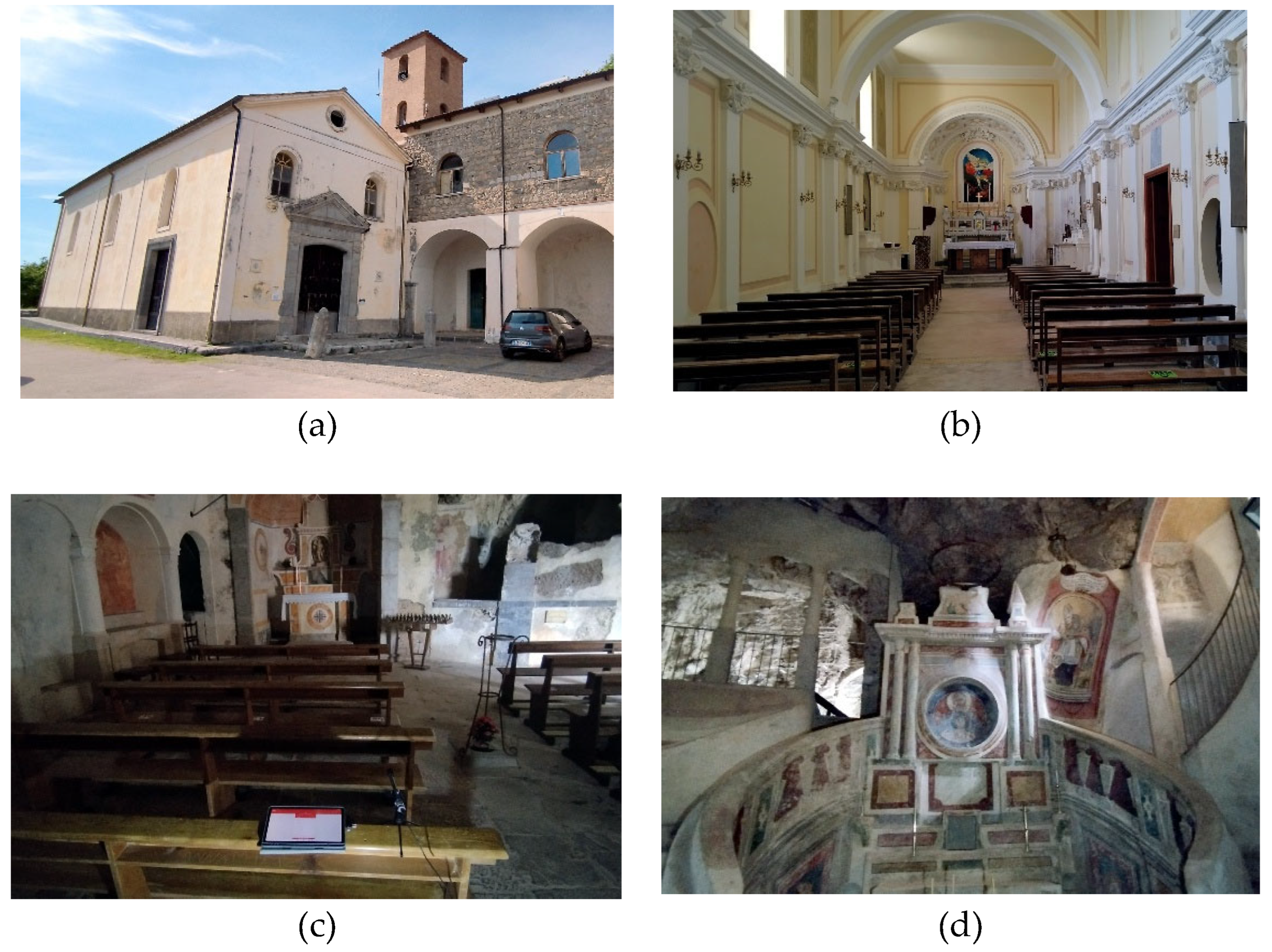
Figure 2.
Time histories of the acoustic signals recorded during the field campaign: (a) Outdoor (background reference); (b) Church; (c) Upper cave; (d) Lower cave.
Figure 2.
Time histories of the acoustic signals recorded during the field campaign: (a) Outdoor (background reference); (b) Church; (c) Upper cave; (d) Lower cave.
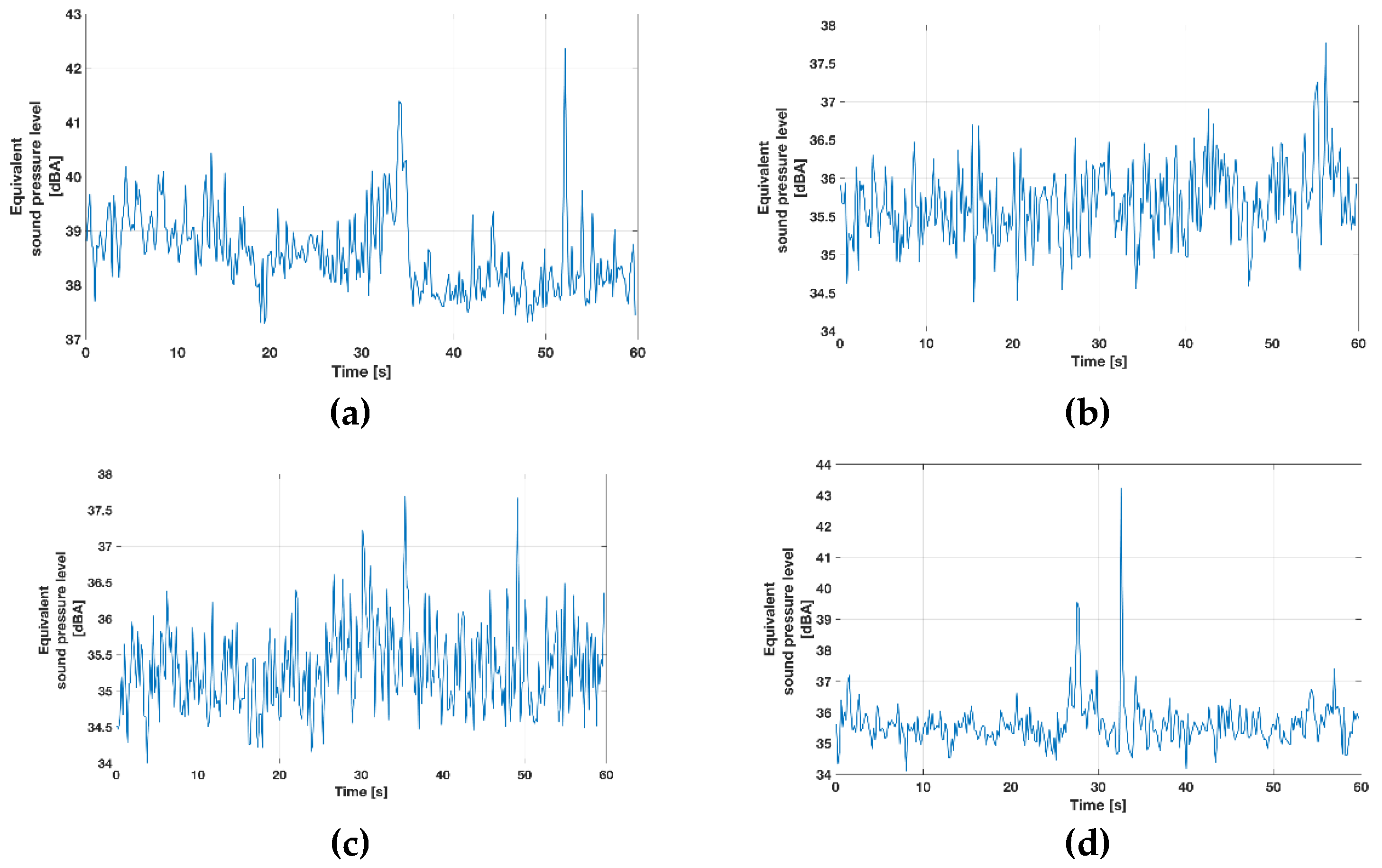
Figure 3.
Third-octave-band spectra of the recorded acoustic signals: : (a) Outdoor (background reference); (b) Church; (c) Upper cave; (d) Lower cave.
Figure 3.
Third-octave-band spectra of the recorded acoustic signals: : (a) Outdoor (background reference); (b) Church; (c) Upper cave; (d) Lower cave.
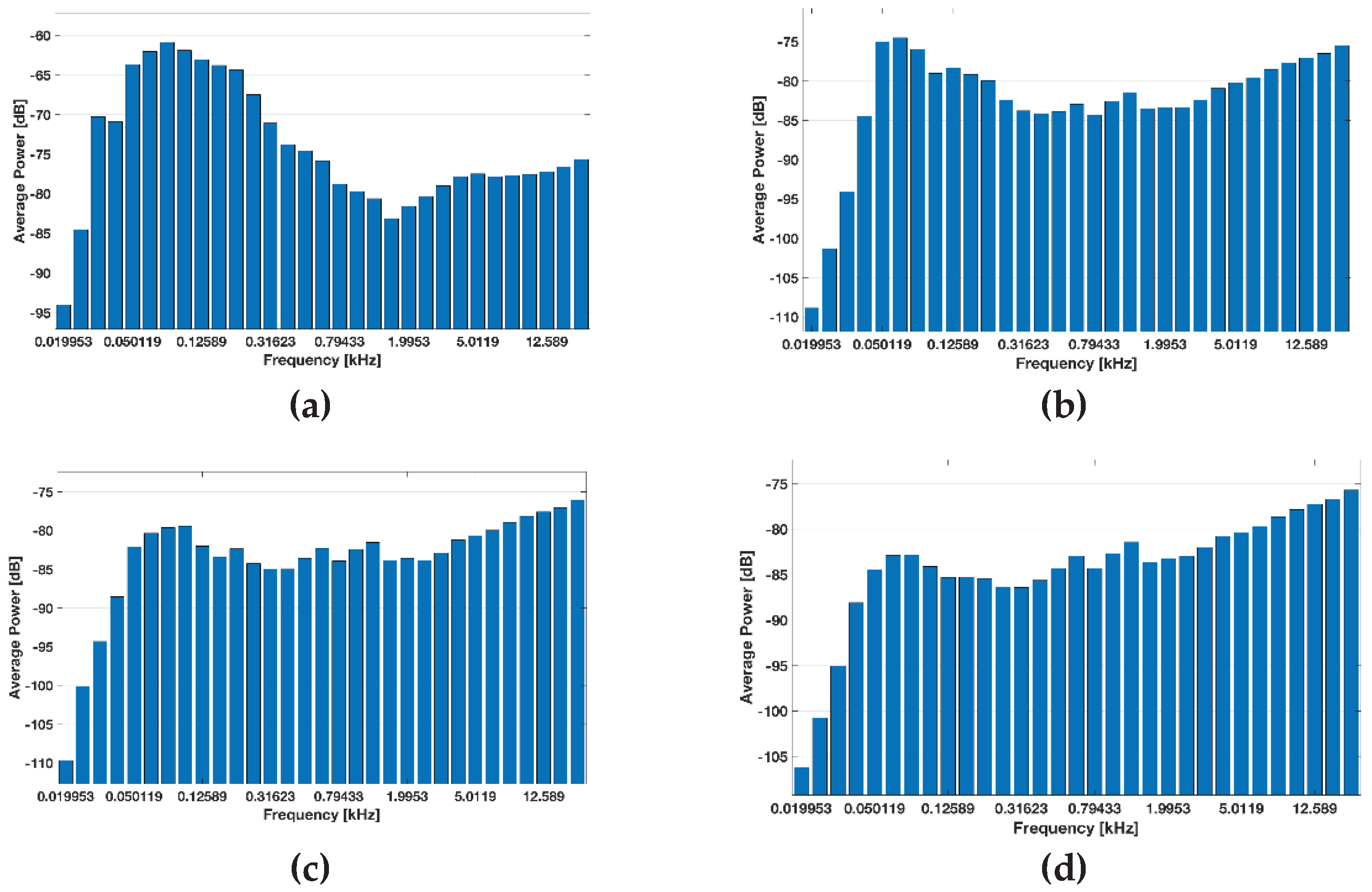
Table 1.
Acoustic indicators used for the experimental characterization of the cave spaces.
| Indicator | Measure Unit | Physical meaning | Interpretative reference |
| EDT | s | Early Decay Time, estimated from the first 10 dB of the decay curve and extrapolated to 60 dB. It is related to the perceived reverberance of the space and is often more closely connected to subjective impression than later reverberation estimates. | Values close to reverberation time indicate a more uniform decay; large deviations may suggest non-uniform decay or early/late energy imbalance. |
| T20 | s | Reverberation time estimated from the decay between −5 dB and −25 dB and extrapolated to 60 dB. | In worship and performance spaces, values around 1–3 s are commonly discussed as reference ranges, depending on volume and function. |
| T30 | s | Reverberation time estimated from the decay between −5 dB and −35 dB and extrapolated to 60 dB. | Provides a more extended estimate of reverberant decay when a sufficient dynamic range is available. |
| C50 | dB | Speech clarity, defined as the logarithmic ratio between early sound energy arriving within 50 ms and late energy arriving after 50 ms. | Higher values generally indicate better speech intelligibility; values above approximately −2 dB are often considered favourable for speech-oriented use. |
| C80 | dB | Music clarity, defined as the logarithmic ratio between early sound energy arriving within 80 ms and late energy arriving after 80 ms. | Values close to 0 dB, or moderately positive/negative depending on the musical function, are commonly used to interpret the balance between clarity and reverberant support. |
| D50 | % | Definition, expressed as the percentage ratio between early sound energy arriving within 50 ms and total sound energy. | Higher values indicate a larger proportion of early energy and are generally associated with improved speech definition. |
Table 2.
Values of selected acoustic indicators measured in the lower cave and upper cave.
| Space | Frequency [Hz] | EDT [s] | T20 [s] | T30 [s] | C50 [dB] | C80 [dB] | D50 [%] |
| Lower cave | 250 | 1.189 | 2.278 | 2.383 | 2.11 | 5.19 | 61.90 |
| Upper cave | 250 | 1.947 | 1.668 | 1.834 | −4.05 | −1.71 | 28.30 |
| Lower cave | 500 | 1.978 | 1.725 | 1.842 | −2.87 | −0.50 | 34.00 |
| Upper cave | 500 | 1.672 | 1.759 | 1.810 | −2.68 | −1.93 | 35.10 |
| Lower cave | 1000 | 1.309 | 1.547 | 1.600 | −1.79 | 1.89 | 39.90 |
| Upper cave | 1000 | 1.271 | 1.477 | 1.592 | −0.36 | 2.04 | 47.90 |
| Lower cave | 2000 | 1.302 | 1.356 | 1.443 | 0.12 | 2.79 | 50.70 |
| Upper cave | 2000 | 1.232 | 1.343 | 1.405 | −1.87 | 1.74 | 4.60 |
| Lower cave | 4000 | 0.872 | 1.043 | 1.079 | 1.43 | 5.36 | 58.20 |
| Upper cave | 4000 | 0.946 | 0.946 | 0.993 | 2.07 | 4.96 | 61.70 |
| Lower cave | 8000 | 0.641 | 0.709 | 0.709 | 2.33 | 6.29 | 63.10 |
| Upper cave | 8000 | 0.713 | 0.712 | 0.703 | 4.14 | 6.88 | 72.20 |
Disclaimer/Publisher’s Note: The statements, opinions and data contained in all publications are solely those of the individual author(s) and contributor(s) and not of MDPI and/or the editor(s). MDPI and/or the editor(s) disclaim responsibility for any injury to people or property resulting from any ideas, methods, instructions or products referred to in the content. |
© 2026 by the authors. Licensee MDPI, Basel, Switzerland. This article is an open access article distributed under the terms and conditions of the Creative Commons Attribution (CC BY) license (http://creativecommons.org/licenses/by/4.0/).
Copyright: This open access article is published under a Creative Commons CC BY 4.0 license, which permit the free download, distribution, and reuse, provided that the author and preprint are cited in any reuse.


