
Submitted:
29 April 2026
Posted:
30 April 2026
You are already at the latest version
Abstract
A two-year field experiment was conducted in an organic vineyard in Tuscany (Italy), to evaluate the effects of micronized biochar (0.5% v/v) applied via fertigation on soil fertility/biological quality and Vitis vinifera performance. The biochar, derived from pyrogasified mixed wood, was compared to watered controls (CTR) following a randomized plot design. Soil chemical properties, dehydrogenase (DHA) and alkaline phosphatase (APA) activities, and plant parameters (biomass, leaf area, gas exchange, chlorophyll, flavonols, and foliar nutrients) were assessed in samples collected in July and September (2021 and 2022). Biochar did not significantly alter total and dissolved organic carbon contents or nitrogen fractions but enhanced DHA and APA activities, alongside increased available phosphorous content (+37.5%) and exchangeable potassium content (+7.1 and +19.7% in September 2021 and July 2022, respectively), indicating improved microbial activity and nutrient availability. Conversely, exchangeable calcium and magnesium contents decreased, likely due to biochar adsorption properties. Plant responses included increased leaf area and dry biomass in 2022, elevated net photosynthesis rate (+14.4%) and apparent carboxylation efficiency, and transient increases in foliar nitrogen, phosphorous and potassium contents, with reduced magnesium concentration (–27%) but stable chlorophyll levels. These findings suggest that low doses of micronized biochar may enhance soil quality and vine physiology, supporting its efficient and effective use in organic vineyards.
Keywords:
nutrient availability
; photosynthetic performances
; pyrogasification
; soil enzymatic activity
; soil fertility
1. Introduction
Climatic changes are dramatically undermining soil fertility and vineyard productivity worldwide. Severe drought periods alternated by extreme rainfall (including drought-flood abrupt alternation) or disaster events combined with anthropogenic activities are inducing degradation or compaction of soils, loss of Soil Organic Matter (SOM) and nutrient content, thus reducing plant productivity [1]. For these reasons, the management of vineyard soils is essential to preserve biodiversity, soil fertility and productivity. In these terms, conventional agriculture in vineyard, utilizing repeated tillage/plowing operations, crop residues removal, strict weed and pest control treatments, worsens this scenario, inducing soil nutrient imbalances, salinization and sodification, contamination, acidification, waterlogging, impacted soil structure, reduced air circulation, SOM content, soil microbial biomass and microbial driven functions [2,3].
Grape processing stands out as one of the most important and promising sectors that has recently emerged within the field of organic agriculture. In 2020, the global organic vineyard area accounted for 506,400 hectares, representing 7.3% of the world vineyard surface. The vast majority of this - around 430,000 ha, i.e., 85% of the total - is in Europe (as reviewed by Homet et al., [4]). The management of organic vineyard entails restrictions on input use and the adoption of specific cultivation practices. Borsato et al. [5] evaluated indicators such as water footprint, carbon footprint, and other aspects of organic vineyard management. Results showed that conventional vineyards had higher water and carbon footprints and an overall environmental impact 11% greater than that of organic vineyards, considering factors such as fertilizer use, erosion, SOM depletion, soil compaction, pesticide application, and landscape effects [5]. Even in organic viticulture, as in conventional systems, significant weaknesses in soil management persist, particularly regarding the long-term decline in soil fertility [6]. Weed control through mechanical means poses another challenge, as it requires more frequent tractor passes, resulting in greater inter-row compaction than in integrated or conventional systems. Soil compaction reduces the available water capacity due to a decrease in pore volume [6]. To maintain yield and quality over time while reducing environmental impact, it is essential to adopt innovative, low-impact cultivation techniques and integrated soil management strategies.
The use of biochar, admitted in organic agriculture, was already tested in vineyards by several authors [2,3,7,8,9], reporting encouraging results. For instance, García-Jamarillo et al. [2] fond that the use of biochar (both 18 and 35 tons ha–1) in two vineyards in Oregon characterized by different soil characteristics, modified the chemical and physical composition of soils at both the studied locations, increasing the bioavailability of Total Organic Carbon (TOC) and dissolved inorganic nitrogen, their gravimetric water content and the concentration of plant available nutrients when compared with both no-tillage and tillage trials as controls. Moreover, Giagnoni et al. [3] in a two-year experiment in vineyard amended with 22 tons biochar ha–1 showed a significant increase in respiration, TOC, nitrate and total phosphorous content in soil already in the first year of the experiment, despite the long wait to highlight an increase in soil enzymatic activities, which occurred exclusively after two years of experiment.
Biochar amendment can also affect plant physiological performances. Indeed, a meta-analysis conducted by Gao et al. [10], by including 965 pairwise comparisons from 135 studies, found that generally biochar application enhanced leaf photosynthetic rate by 23% on average. Recent studies suggested that the enhanced plant physiological responses of biochar-amended plants can be due to multiple factors, including improved soil water and nutrient availability, leaf nutrient concentrations, improved stomatal conductance and higher leaf chlorophyll concentration [10,11,12,13,14]. Moreover, an experiment conducted in the vineyard found that long-term biochar effects on plant physiology (i.e., higher photosynthetic rates compared to untreated plants) were still observable 10 years after application [11]. However, responses are not universally advantageous; for instance, in some vineyard trials, plant responses of biochar-amended plants were small or not statistically different from controls [2,9]. This suggests that outcomes could be highly context-dependent (i.e., site conditions, biochar particles size, biochar chemical properties such as pH), highlighting the need for further investigation into the topic.
Given the significant quantities usually indicated for its use (8-45 tons ha–1, Baronti et al., [7]; Giagnoni et al., [3]; García-Jaramillo et al., [2]) and, consequently, the high and prohibitive cost of this kind of amendment, the consumption of biochar on the market is within the reach of agricultural production sectors with very high qualitatively/quantitatively marketable production. Therefore, the present two-year experiment aimed to assess the effect of micronized biochar, a product applicable with precision fertigation, aiming at lowering the biochar amount in the vineyard but still testing its positive effect on soil fertility and plant growth. We hypothesized that (i) micronized biochar enhances soil health parameters, and (ii) these improvements lead to higher plant biomass, enhancing the plant physiological processes.
2. Materials and Methods
2.1. Experimental Site and Plant Growth Conditions
The experiment was realised in a vineyard located in Civitella Val di Chiana, Tuscany region, Italy (43°24′19″N 11°46′14″E). Two-year-old ‘Ciliegiolo’ vines (Vitis vinifera L.) were planted on May 2021; the trellis system was a single curtain with plant-row spacing of 0.8 and 2.4 m.
Meteorological parameters were collected constantly by an automatic weather station installed close to the experimental field. Figure 1 reports monthly precipitation (mm) and average of maximum and minimum temperatures (°C) from April to September (in 2021 and 2022).
2.2. Micronized Biochar and Experimental Trial
The micronized biochar utilized in the present experiment was a commercial product provided by BioDea (Civitella in Val di Chiana, Arezzo, Italy). The product was obtained by pyrogasification with partial combustion at 1200 °C of mixed waste wood from forestry cuts. The combusted material was collected from the bottom of the reactor, micronized and solubilized in water, producing a liquid solution. Thanks to its aqueous characteristic and the microscopic (> Ø 40 μm) dimension of its particles, the micronized biochar can be utilized in fertigation. Indeed, the resulting micronized biochar is suspended into water at a dose of 300 ml L–1, with a pH of 6.8 and Electric Conductivity (EC) of 1.10 mS cm–1.
A randomized plot experiment, with two treatments, was setup in 2021 and 2022. The treatments were: (i) fertigation with only water (5 L plant–1; CTR) and (ii) fertigation with micronized biochar (0.5% v/v; 5 L plant–1; B). The fertigation was carried out every 15 days from April to September in both the experimental years. A total of 10 fertigation events per year, for two years, was performed. Soil and plant sampling for each treatment were performed on a row consisting of 150 young grapevine cuttings. Soil samples were obtained every 30 young grapevine cuttings, for a total of 5 soil samples for each treatment.
2.3. Analysis of Soil Chemical Properties
Soil was sampled in July and in September in both 2021 and 2022. Soil samples were collected at a depth between 10 and 15 cm, refrigerated, air dried, crushed and sieved with a specific Ø 2 mm-sieve. Soil was characterized prior to the start of the experiment (Table 1). Physical and chemical properties of the soil, such as pH, texture, Cation Exchange Capacity (CEC), were determined by standard methods (Colombo and Miano, [15]). Water holding capacity was calculated by wetting the soil until saturation. For the total CaCO3 content, a gas-volumetric analysis with Scheibler calcimeter was performed.
For the other analyses, the same procedure was adopted for both soil characterization and leaf samples. Soil chemical parameters such as pH, TOC, Dissolved Organic Carbon (DOC), total nitrogen (Ntot), nitrates (NO3--N), available phosphorous (available P) and exchangeable K, Ca and Mg (Kex, Caex, Mgex) contents, as well as enzymatic activities (Dehydrogenase; DHA and Alkaline phosphatase; APA – detailed below) were performed in B and CTR samples. Three or five replicates were performed for each assay.
Ntot and total C analyses were carried out using an Elementar Vario Micro Elemental Analyzer (Elementaler, Comazzo, Co, Italy). About 200 mg of leaf or 10 mg of soil powdered dry samples were analyzed. TOC was assayed by subtracting the CaCO3 content from C content.
DOC was measured by agitating soil samples in distilled water (soil-to-water ratio of 1:20, v/v) for 24 hours at ambient temperature. The resulting suspension was centrifuged at 10,000 × g for 10 minutes, filtered through a 0.45-μm glass fiber membrane, and analyzed for carbon content using a liquid-sample OC analyzer (Hach QbD1200). Nitrate (NO3--N) concentrations were determined using a Dionex DX120 ion exchange chromatograph with IonPac AG4A and AS4A columns. The eluent (1.8 mM Na2CO3, 1.7 mM NaHCO3) flowed at 2 mL min⁻¹, with a 50 mN H2SO4 regenerant (3–5 mL min⁻¹) and a conductivity detector (15–20 μS background). Soil (0.2 g) was extracted with 25 mL Milli-Q water at 60 °C for 1 hour, using a 5 ppm NaNO3 standard for calibration. Available P was determined spectrophotometrically (Perking Elmer Lambda 25, Italy, Mila) by the modified molybdenum blue method on acid extracts (Colombo and Miano, [15]). K+, Ca2+ and Mg2+ content was quantified by extracting cations with ammonium acetate solution 1:50 and atomic absorption reading with Thermo Scientific ICE 3000 series (Thermo Scientific, Waltham, US).
2.4. Soil Enzymatic Activities
Dehydrogenase (n = 3) activity followed the method of Tabatabai [16], based on the spectrophotometric measurement at 488 nm of 2,3,5- triphenyformazan. Therefore, the metabolic potential index (MPI) was calculated as a ratio between DOC and DHA activity [17].
Alkaline phosphatase (n = 5) activity was assessed following the method described by Eivazi and Tabatabai [18] based on the hydrolysis of p-nitrophenyl phosphate by soil enzymes and spectrophotometric measurement at 410 nm.
2.5. Plant Biomass and Biometric Parameters
Five plants from each treatment (CTR and B) were collected from the field trial, transported in the laboratory and samples for the biometric measurements. Dried plant biomass (n = 5) was obtained by weighing the leaf, branches and trunk biomasses, separately. Moreover, for each plant, the total number of leaves (n = 5) was annotated, and the leaf area (LA; n = 5) was measured using a ruler, measuring the length (L) of the midrib and the width (W) of the leaf blade and utilizing the following formula [19]:
LA = - 0.465 + 0.914 (L × W)
Then, shoots and leaves, separately, were oven dried (Memmert GmbH Co. KG Universal Oven UN30, Schwabach, Germany) at 105 °C until reaching a constant weight and the shoot and leaf dry weight was annotated.
2.6. Leaf Gas Exchange Parameters
Leaf gas exchange measurements were performed using a portable infrared gas analyzer (LI-6400XT System, Li-Cor, Lincoln, NE, USA). Measurements (n = 7) were taken on fully expanded leaves between 10:00 and 12:00 a.m. under ambient light conditions with a photosynthetic photon flux density of 1,700 μmol m⁻² s⁻¹. Within the leaf chamber, CO₂ concentration was maintained at 400 μmol mol⁻¹ using a CO₂ mixer, and the flow rate was set to 500 μmol s⁻¹. Once steady-state conditions were achieved, net photosynthetic rate (Pn), stomatal conductance to water vapor (gs), intercellular CO₂ concentration (Ci) and apparent carboxylation efficiency (Pn/Ci) were recorded.
2.7. Leaf Chlorophyll (Chl) and Flavonol (Flav) Content
DUALEX® Scientific analyser (Force-A, Orsay, France) was used to analyze the chlorophyll content and flavonol index through non-destructive measurements (n = 70). The measurements were carried out on the adaxial leaf side.
2.8. Concentration of N, P, K, Ca and Mg in Leaves
Total nitrogen content was determined with the same method utilized for soil samples. P in leaves was measured spectrophotometrically by an Ultrospec 2100 Pro spectrophotometer (GE Healthcare Ltd., Little Chalfont, England) following the molybdenum blue method according to Benini et al. [20]. For leaf K+, Ca2+ and Mg2+ content, about 0.2 g of dry powdered leaf samples were put in Teflon tubes with 2 mL of H2O2 (30%, w/v) and 8 mL of HNO3 (70%, v/v) and incubated overnight at room temperature. Then, samples were mineralized at 200 °C for 60 min using a microwave digestion system (Start D, Milestone Srl, Sorisole, BG, Italy). Samples were then transferred to a final volume of 25 mL, reached by the addition of double-distilled water. After mineralization, cation content was measured using the atomic absorption spectrometer.
2.9. Statistical Analysis
The obtained data were elaborated and checked for normality of distribution (Shapiro–Wilk test, 95% confidence interval) and for homoscedasticity (Bartlett’s test). Data are expressed as mean ± standard deviation. Results were compared with a two-tailed Student’s t-test using a significance level of 0.05, considering the treatment with the micronized biochar as variability factor. Data not normally distributed (i.e., gs in July 2021, Ci in September 2021; Pn in July 2022 and Ci in July 2022) were subjected to Welch’s t-test prior further analysis Chl and Flav data were analyzed using the non-parametric Mann-Whitney test. The statistical analyses were conducted using GraphPad (GraphPad, La Jolla, CA, USA).
3. Results
3.1. Soil Analysis
Figure 2 shows the TOC and DOC of soil sampled during 2021 and 2022 (in July and September) in the vineyard irrigated with water (CTR) or with micronized biochar (B). No significant differences were found between CTR and B in both TOC and DOC determinations in both years, nor in both seasons.
Differently, both DHA activity and MPI exclusively revealed a significant difference between CTR and B in September of the second experimental year (+26.9% and +17.1%, respectively), whilst no significant differences were reported during July in both experimental years for both DHA activity and MPI and in September 2021 for DHA activity (Figure 3).
Similarly to DOC and TOC contents, total N and nitrates content did not report significant differences between CTR and B soils in both July and September of both experimental years (Figure 4).
Differently, available P content was increased by the B treatment in both seasons and in both experimental years, showing the highest values in September 2021 (26.0 mg kg–1 soil) and in July 2022 (26.3 mg kg–1 soil; Figure 5). Moreover, APA activity was increased by B treatments in soils sampled in September 2021 (+49.9%) and in both July (+56.8%) and September in 2022 (+54.8%; Figure 5).
Lastly, Kex content was increased by the B treatment in September 2021 (+7.1%) and in July 2022 (+19.7%). Caex content was slightly reduced by B treatment during July 2022 and Mgex was reduced by B treatment during both seasons in both experimental years with an average decrement of 18.4% (Figure 6).
3.2. Plant Analyses
Table 2 shows leaf, branches, trunk and total dry biomasses of vine plants cultivated in soils irrigated with only water (CTR) or treated with micronized biochar (B) and totally sampled in 2021 and 2022. No significant differences were found in dry branches and trunk biomasses in both experimental years, whilst leaf dry biomass increased exclusively in 2022 in B vines (+43.9%), inducing a significant increase of total dry biomass in the same year (+23.9%; Table 2). Furthermore, although no significant differences were shown in leaf number in both experimental years between CTR and B vines, an increase in LA was observed in B respect to CTR vine plants in both years (+21.8% and +31.0%, respectively; Table 2).
*The presence of asterisks indicates significant differences among means using the post-hoc LSD test (*p ≤ 0.05), whilst the lack of asterisks indicates no significant differences among means using the same post-hoc test.
Figure 7 represents the results of gas exchange in vine plants cultivated in soils irrigated with only water (CTR) or amended with micronized biochar (B). For this analysis, samplings were collected in September and July in the years 2021 and 2022. Pn was higher in B vines with respect to CTR ones in both sampling months in both years with an average increase of 14.4%, averaging the increase percentages during the comparison between B-treated vines and CTR vines for each season and each year of the experiment, separately (Figure 7a). However, gs increased in B-treated vines exclusively in July 2021 (+14.3%; Figure 7b). Ci was reduced by B treatment in September 2021 (–5.0%) and July 2022 (–10.3%; Figure 7c). Finally, similarly to Pn, the Pn/Ci ratio resulted increased by B treatment in both sampling months in both experimental years with an average increase of 20.6% (Figure 7d).
Figure 8 shows Chl and Flav content determined using Dualex® instrument. A significant decrease in Chl content was noted in B-treated leaf vines during July 2021, whilst no significant differences were noted in the other experimental months in both 2021 and 2022 years. Flav content was lower in B-treated leaf vines when compared to CTR plants during 2021 in both experimental months (July and September). No significant differences were found in Flav content during 2022 (Figure 8).
Finally, the leaf N content increased in B vines in September 2021 (+5.2%) and July 2022 (+4.2%; Figure 9a), whilst no significant differences were found in leaf N content during July 2021 and September 2022. Leaf P increased exclusively in July 2022 (+19.0%; Figure 9b). Differently, K content increased in leaves of B vines at all the sampling dates with an average increase of 23.8% in 2021 and of 31.4% in 2022 (Figure 9c). Ca content decreased in leaves of B-treated vines exclusively in July 2022 (Figure 9d), whilst Mg content decreased in leaves of B vines at all the sampling dates with an average decrease of 29.0% and the decrease of 45.2% during September 2021 (Figure. 9e). In general, the highest values of leaf P, K, Ca and Mg contents were found during the second experimental year (2022).
4. Discussion
This study thoroughly assessed the effects of B (0.5% v/v) application on the soil-plant system in a Tuscan vineyard in Italy in a 2-year experiment with 10 fertigation events with B per year. Although no differences were noted in terms of SOM and N (total and nitrate contents), the soil quality was positively influenced by B as revealed by enhanced enzymatic activity, and the plant performances were improved in terms of net photosynthesis rate and leaf biomass. The latter increased exclusively during 2022. Interestingly, the application of B reduced the Mg availability in the soil with a consequent decrease of the Mg uptake by plants, that, however, did not influence the Chl content. Below, the mechanistic explanation for these ameliorative aspects of B application in the soil-plant system is depicted.
4.1. Soil P and K Availability and Soil Enzymatic Activity Were Enhanced by the Application of Micronized Biochar
The results of the present experiment on TOC and DOC in a vineyard treated with B at 0.5% v/v (at doses comparable to 0.9 t ha⁻¹) over two years showed no significant changes compared to CTR, contrasting with previous studies. Research by Idbella et al. [8] and Giagnoni et al. [3] reported significant increases in TOC in vineyards amended with solid biochar at higher doses (18-35 t ha⁻¹) over longer periods (up to 10 years), due to biochar ability to stabilize soil OC and protect plant-derived inputs. Moreover, García-Jaramillo et al. [2] observed elevated TOC within six months of biochar application (34 t ha–1), while Hagemann et al. [21] noted that biochar ageing forms a nutrient-rich organic cover, enhancing OC stabilization. The short experimental duration in the current study likely limited OC mineralization changes, as biochar slow mineralization rate (10–100 times slower than uncharred biomass) supports long-term carbon sequestration [22]. Similarly, no significant DOC increase was observed, unlike findings by Becagli et al. [23], who reported a 50% DOC increase in biochar-amended soils, and Schulz and Glaser [24], who demonstrated biochar capacity to adsorb and stabilize labile OC. Hailengnaw et al. [25] and Koga et al. [26] highlighted that biochar impact on DOC depends on pyrolysis temperature, feedstock type, and soil properties (e.g., texture, pH, CEC), with higher biochar doses and specific soil conditions enhancing DOC retention. The minimal biochar dose and micronized form used here likely explain the lack of observed effects, suggesting that longer-term studies with higher doses could better elucidate biochar role in OC dynamics when applied via fertigation.
Despite no significant differences in DOC and TOC content, enzymatic activities (i.e., DHA and APA activities) were positively affected by B fertigation, especially in the second year of experiment. After a meta-analysis, Pokharel et al. [27] noted that DHA activity is usually enhanced by biochar applications. It has been reported that activity was increased by biochars produced in similar conditions to those applied for obtaining our micronized biochar (low pyrolysis temperature; < 350 °C C/N ratio < 50) [27]. The ratio DHA/DOC defines the MPI that serves as a soil quality indicator, reflecting the vitality of the microbial biomass through its enzymatic activity on organic compounds [17]. Higher MPI values, as found in the present experiment during the second year in B-treated soil, indicate greater microbial activity and, consequently, enhanced soil microbiological fertility.
The responses of APA activity, which facilitate the breakdown of P-containing organic compounds, to biochar application exhibited significant variability in literature [28]. This variability in enzyme activity responses is linked to differences in soil characteristics and biochar properties, as already seen for DHA activity. In the present experiment, APA activity was enhanced in September 2021 and during 2022 (in both seasons), and this enhancement can justify the continuous P availability during both experimental years. Indeed, B treatment promoted the growth of microbial population responsible for the APA catalysis, leading to the release of H2PO4- e HPO4-- from SOM. Results are consistent with scientific literature; Idbella et al. [8] registered a significant increase of available P with growing B doses, while Becagli et al. [23] underlined that APA enzyme is specific for the substrate and attributes the increase in available P to several factors such as the promotion of a stimulant environment for specific microbial populations and/or biochar retention of mobile P forms. Carril et al. [29] demonstrated that the association of biochar with liquid vermicompost (i.e., highly active microbiological material) enhanced APA activity and P availability, probably due to a synergic effect of the interaction between vermicompost and biochar which improved environment for microbial community, confirming the positive response of APA activity to biochar application in soil.
In the present experiment, nitrification process was not affected by B application to the soil, with no significant variations in Ntot and NO3--N content during both experimental years. These results are in line with the results of other experiments which utilized different doses of biochar [23,30,31]. For instance, Sorrenti et al. [30] reported no effect on N fractions after three years of investigation, while Liu et al. [31] studied the effect of biochar application on nitrification /ammonification, reporting that biochar can contain a little amount of inorganic N, while the organic N fraction is recalcitrant to availability; thus biochar cannot be considered an efficient N source, explaining the results of the present experiment. Becagli et al. [23] reported a NO3--N increase with biochar treatment, probably due to microbial community associated with nitrification, but also a lower nutrient leaching. The lower NO3–-N leaching through the B use was also confirmed in paddy field by Chen et al. [32].
Kex showed a significant increase during the experiment in B treated soil, confirming the positive effect on soil chemical fertility. Lo Piccolo et al. [13] reported the same behaviour in a study conducted on Tilia × europaea L. treated with 1.5% (w/w) biochar, observing that solid biochar brings beneficial changes in bacterial community, accelerating the conversion of slowly available K in Kex. Xiu et al. [33], in an experiment with growing rates of biochar (0, 10, 20, and 30 g·kg−1soil), reported an increase in available, water-soluble, exchangeable and non-exchangeable K, demonstrating that not only biochar is effective to increase this nutrient, but that this effect is dose dependent. All together, these findings confirm that biochar treatment can be an effective solution to increase K availability in low-fertile soils.
In parallel with the increase in available P and Kex, we noticed, instead, that the content of Ca and Mg were reduced in B-treated soils. Levels of Ca were lower in July 2022, whilst Mg content declined in both the experimental years and seasons. The decrease in Ca is in contrast with previous literature, since some authors hypothesized that the Ca bridging, facilitated by Ca ions derived from biochar, can facilitate the formation of the biochar-SOM-soil particles complex during the aggregate formation [34]. This Ca-based bridge is of upmost importance for SOM stabilization (as reviewed by Lützow et al. [35].
The decline in Mg content in the soil was noted during all sampling dates. This trend was also reported by Sadowska et al. [36] who found the lowest Mg content in the soil treated with a biochar dose of 45 t ha–1. These authors hypothesized that the adsorption/desorption Mg2+ processes were probably responsible for the observed concentrations of cation in the soil, reducing the soluble Mg [36]. Likely, biochar alkaline nature or its interaction with soil pH and other nutrients (e.g., Ca or K) could alter Mg solubility or uptake competitiveness, leading to a temporary decrease in Mg in plant tissues as described in the next paragraph.
4.2. Leaf Biomass and Net Photosynthetic Process Were Improved by Continuous B Application in Both Experimental Years
In the present experiment, total dry biomass was enhanced by B treatment in the second year of the experiment. Similarly, Lo Piccolo et al. [13] recorded that the total biomass of biochar treated plants was 22% greater than that of controls. The authors correlated this biomass growth to the improved physiological status observed in treated trees, promoted by greater macronutrient availability relative to controls, as observed during the present experiment. Despite this trend, in our case study, analyses of shoot biomass show no statistically significant differences between CTR and B and, thus, the increment in total biomass was attributable to the marked difference in leaf biomass. Indeed, analyses performed on leaf sampling showed highly positive results for B-treated plants in 2022. The leaves were not only larger in size but also thicker than those of CTRs, despite the total number of leaves per plant being similar for both treatments. In fact, the LA in B-treated plants was greater than that in untreated plants, justifying the values obtained in 2022 for biomass of B leaves. Moreover, Liao et al. [37] demonstrated that biochar (specifically from lignocellulosic biomass) increased the LA in Rosa tomentosa and Cattleya edithiae. while Guo et al. [38] further confirmed the same pattern in Schefflera arboricola. Indeed, the addition of lignocellulosic biochar to the soil provided benefits to the physiological processes of leaf expansion in grapevine cuttings, acting on multiple key factors. Those includes i) the water retention capacity by biochar [37,38,39,40] leading to higher leaf water potential during drought periods [40] and ii) the capability of biochar to result in plant hormonal changes, as recent studies indicate that biochar stimulates growth pathways associated with change in auxins, key hormones regulating cell elongation and leaf expansion [41].
The Pn values obtained in the present study were higher in B-treated plants compared to CTRs, with a statistically significant variance between the two treatments in favor of B in the both years. According to Lo Piccolo et al. [13], the higher Pn value in B justified the superior results in Pn/Ci ratio. Similarly, Tanazawa et al. [42] and Wang et al. [43] reported a greater ability of B to increase Pn and Pn/Ci in oaks and Chinese apple, respectively. In the present experiment, the Ci was lower in B compared to the CTR in both September 2021 and July 2022. Analyzing the trend of gs over the two years of the experiment, the values recorded in B-treated individuals were higher than those obtained for CTR plants exclusively in July 2021. In the other sampling dates, no significant differences were found for this parameter. The gs values found in the present experiment highlight that, despite high summer temperatures, the stomatal overture of B-treated plants is more efficient compared to CTRs. Zhang et al. [44] noted similar findings in terms of gs values in rice growth under drought stress and treated with biochar coating. They observed an improving stomatal density and aperture in biochar-treated plants, justifying the higher or stable gs level also at high temperatures [44].
Results for leaf Chl show no statistically significant variations between the two treatments, neither in 2021 nor in 2022. This is supportive of the lack of negative effects induced by lower level of Mg ions (core of tetraphyrrolic ring of Chl) in B-treated plants. Bozzolo et al. [45], in a study on the effects of moderate and high doses of solid biochar on grapevine growth in a greenhouse, emphasized the importance of Chl content as practical indicator of both potential photosynthetic productivity and plant vigor. This aspect also appears to be directly correlated with N concentration and is used as a measure of crop response to the application of N fertilizers and the soil nutritional status. The importance of macronutrients (N, P, and K) remains a critical indicator of plants physiological state and their ability to withstand biotic and abiotic stresses. In this regard, Lo Piccolo et al. [13] demonstrate that plants treated with biochar exhibited a better physiological state and improved management of water due to a greater availability of N, P, and K observed in plants after treatment with biochar. More specifically, they proposed a direct correlation between the increased Pn rate in biochar treated plants and the higher N and K contents observed in biochar treated plants [13]. This is also supported by Xiong and Flexas [46] findings, who argue that key biochemical leaf characteristics for photosynthesis, such as Chl and ribulose-1,5-bis-phosphate carboxylase/oxygenase content, are strongly influenced by leaf N content.
The results of Lo Piccolo et al. [13] validate the effect of biochar in increasing soil properties [10,47], stimulating the soil bacterial community and thus accelerating the conversion of slowly available K into readily available K [48], as observed in the present experiment. The increase in P content was observed in the B-treated plots in July 2022, which, however, was not sustained by September 2022. when P levels returned to values similar to those of CTR. This pattern does not indicate a P deficiency in the leaf tissues, as the recorded values were positive in both 2021 and 2022, considering the age of the young vines, which were two years old in July–September 2021 and three years old in July–September 2022.
Notably, despite the lower content in Ca and Mg found in leaves of B plants, this does not result in any negative effect as, for example, the level of Chl was retained, suggesting some N compensatory mechanisms to biosynthesize these pigments. Although the promising outcomes reported by the present experiment with the use on B on vines, further investigation must be done in this direction, analyzing in-depth the nutrient release/adsorption by biochar and the effect of the micronized biochar form in long-term experiments.
5. Conclusions
The present two-year field experiment demonstrated that micronized biochar applied via fertigation at 0.5% (v/v) exerted selective positive effects on soil fertility and vine performance in an organic vineyard setting. While no significant alterations were observed in soil TOC, DOC, Ntot, or NO3--N contents, biochar enhanced enzymatic activities, such as DHA and APA activities, alongside increased available P and Kex, indicative of improved microbial vitality and nutrient cycling. Conversely, Caex and Mgex were reduced, potentially due to biochar adsorption properties and interactions with soil pH and cations.
At the plant level, biochar promoted vegetative growth, evidenced by increased leaf area and leaf dry biomass in the second year. Physiological enhancements included elevated Pn and Pn/Ci across both years, with constant gs values and reductions in Ci, suggesting improved carbon assimilation efficiency under ambient conditions. Leaf nutrient profiles reflected soil trends, with transient increases in N, P, and K, and consistent decreases in Mg content, yet chlorophyll content remained stable, implying sufficient Mg thresholds for pigment synthesis. These findings underscore micronized biochar potential as a low-dose, sustainable amendment in organic viticulture to mitigate soil degradation and enhance productivity, particularly in nutrient-limited systems. Micronized biochar applied via fertigation (dozens of times lower in quantity than the doses commonly used) is effective and more economically sustainable. However, the experimental duration of the present experiment may have constrained long-term carbon sequestration and nutrient stabilization effects. Further studies should extend trial periods and investigate microbial community dynamics to optimize biochar role in resilient vineyard management and climate challenges.
Author Contributions
Conceptualization, C.C., E.L.P. M.B., R.C. and M.L.; methodology, E.L.P., M.B., R.C. and M.L.; software, L.D.; validation, C.C., M.B., R.C., L.D., and M.L.; formal analysis, E.L.P., M.B. and L.B.; investigation, E.L.P., M.B. and L.B.; resources, M.L., R.C.; data curation, E.L.P. and M.B.; writing—original draft preparation, C.C., G.B., L.D; writing—review and editing, C.C., E.L.P., M.B., R.C., L.G., L.B., L.D. and M.L.; visualization, C.C.; supervision, E.L.P., M.B., R.C. and M.L.; project administration, M.L., R.C.; funding acquisition, M.L., R.C. All authors have read and agreed to the published version of the manuscript.
Funding
This research received no external funding.
Data Availability Statement
The original contributions presented in this study are included in the article. Further inquiries can be directed to the corresponding author(s).
Acknowledgments
The authors wish to thank the Bio-Esperia S.r.l. (Arezzo, Italy) for having produced and provided the micronized biochar.
Conflicts of Interest
The authors declare that they have no known competing financial interests or personal relationships that could have appeared to influence the work reported in this paper.
Abbreviations
The following abbreviations are used in this manuscript:
| APA | Alkaline Phosphatase Activities |
| available P | Available Phosphorous |
| B | Micronized Biochar |
| Caex | Exchangeable Ca |
| CEC | Cation Exchange Capacity |
| Chlindex | Chlorophyll Index |
| Ci | Intercellular CO2 Concentration |
| CTR | Control |
| DHA | Dehydrogenase Activities |
| DOC | Dissolved Organic Carbon |
| EC | Electric Conductivity |
| Flavindex | Flavonol Index |
| gs | Stomatal Conductance to Water Vapor |
| Kex | Exchangeable K |
| L | Length |
| Mgex | Exchangeable Mg |
| MPI | Metabolic Potential Index |
| NO3--N | Nitrates |
| Ntot | Total Nitrogen |
| Pn | Net Photosynthetic |
| Pn/Ci | Apparent Carboxylation Efficiency |
| SOM | Soil Organic Matter |
| TOC | Total Organic Carbon |
| W | Width |
References
- Lazcano, C.; Decock, C.; Wilson, S.G. Defining and Managing for Healthy Vineyard Soils, Intersections With the Concept of Terroir. Front. Environ. Sci. 2020, 8. [Google Scholar] [CrossRef]
- García-Jaramillo, M.; Meyer, K.M.; Phillips, C.L.; Acosta-Martínez, V.; Osborne, J.; Levin, A.D.; Trippe, K.M. Biochar Addition to Vineyard Soils: Effects on Soil Functions, Grape Yield and Wine Quality. Biochar 2021, 3, 565–577. [Google Scholar] [CrossRef]
- Giagnoni, L.; Maienza, A.; Baronti, S.; Vaccari, F.P.; Genesio, L.; Taiti, C.; Martellini, T.; Scodellini, R.; Cincinelli, A.; Costa, C.; et al. Long-Term Soil Biological Fertility, Volatile Organic Compounds and Chemical Properties in a Vineyard Soil after Biochar Amendment. Geoderma 2019, 344, 127–136. [Google Scholar] [CrossRef]
- Homet, P.; Gallardo-Reina, M.Á.; Aguiar, J.F.; Liberal, I.M.; Casimiro-Soriguer, R.; Ochoa-Hueso, R. Viticulture and the European Union’s Common Agricultural Policy (CAP): Historical Overview, Current Situation and Future Perspective. J. Sustain. Agric. Environ. 2024, 3, e12099. [Google Scholar] [CrossRef]
- Borsato, E.; Zucchinelli, M.; D’Ammaro, D.; Giubilato, E.; Zabeo, A.; Criscione, P.; Pizzol, L.; Cohen, Y.; Tarolli, P.; Lamastra, L.; et al. Use of Multiple Indicators to Compare Sustainability Performance of Organic vs Conventional Vineyard Management. Sci. Total. Environ. 2020, 711, 135081. [Google Scholar] [CrossRef]
- Hendgen, M.; Döring, J.; Stöhrer, V.; Schulze, F.; Lehnart, R.; Kauer, R. Spatial Differentiation of Physical and Chemical Soil Parameters under Integrated, Organic, and Biodynamic Viticulture. Plants 2020, 9, 1361. [Google Scholar] [CrossRef] [PubMed]
- Baronti, S.; Vaccari, F.P.; Miglietta, F.; Calzolari, C.; Lugato, E.; Orlandini, S.; Pini, R.; Zulian, C.; Genesio, L. Impact of Biochar Application on Plant Water Relations in Vitis Vinifera (L.). Eur. J. Agron. 2014, 53, 38–44. [Google Scholar] [CrossRef]
- Idbella, M.; Baronti, S.; Vaccari, F.P.; Abd-ElGawad, A.M.; Bonanomi, G. Long-Term Application of Biochar Mitigates Negative Plant–Soil Feedback by Shaping Arbuscular Mycorrhizal Fungi and Fungal Pathogens. Microorganisms 2024, 12, 810. [Google Scholar] [CrossRef]
- Schmidt, H.-P.; Kammann, C.; Niggli, C.; Evangelou, M.W.H.; Mackie, K.A.; Abiven, S. Biochar and Biochar-Compost as Soil Amendments to a Vineyard Soil: Influences on Plant Growth, Nutrient Uptake, Plant Health and Grape Quality. Agric. Ecosyst. Environ. 2014, 191, 117–123. [Google Scholar] [CrossRef]
- Gao, Y.; Shao, G.; Yang, Z.; Zhang, K.; Lu, J.; Wang, Z.; Wu, S.; Xu, D. Influences of Soil and Biochar Properties and Amount of Biochar and Fertilizer on the Performance of Biochar in Improving Plant Photosynthetic Rate: A Meta-Analysis. Eur. J. Agron. 2021, 130, 126345. [Google Scholar] [CrossRef]
- Baronti, S.; Magno, R.; Maienza, A.; Montagnoli, A.; Ungaro, F.; Vaccari, F.P. Long Term Effect of Biochar on Soil Plant Water Relation and Fine Roots: Results after 10 Years of Vineyard Experiment. Sci. Total. Environ. 2022, 851, 158225. [Google Scholar] [CrossRef]
- He, Y.; Yao, Y.; Ji, Y.; Deng, J.; Zhou, G.; Liu, R.; Shao, J.; Zhou, L.; Li, N.; Zhou, X.; et al. Biochar Amendment Boosts Photosynthesis and Biomass in C3 but Not C4 Plants: A Global Synthesis. GCB Bioenergy 2020, 12, 605–617. [Google Scholar] [CrossRef]
- Lo Piccolo, E.; Becagli, M.; Lauria, G.; Cantini, V.; Ceccanti, C.; Cardelli, R.; Massai, R.; Remorini, D.; Guidi, L.; Landi, M. Biochar as a Soil Amendment in the Tree Establishment Phase: What Are the Consequences for Tree Physiology, Soil Quality and Carbon Sequestration? Sci. Total. Environ. 2022, 844, 157175. [Google Scholar] [CrossRef]
- Wang, S.; Zheng, J.; Wang, Y.; Yang, Q.; Chen, T.; Chen, Y.; Chi, D.; Xia, G.; Siddique, K.H.M.; Wang, T. Photosynthesis, Chlorophyll Fluorescence, and Yield of Peanut in Response to Biochar Application. Front. Plant Sci. 2021, 12. [Google Scholar] [CrossRef]
- Violante, P. Metodi di analisi chimica del suolo; Franco Angeli, 2000; ISBN 978-88-464-2240-8. [Google Scholar]
- Tabatabai, M. a. Soil Enzymes. In Methods of Soil Analysis; John Wiley & Sons, Ltd, 1994; pp. 775–833. ISBN 978-0-89118-865-0. [Google Scholar]
- Riffaldi, R.; Saviozzi, A.; Levi-Minzi, R.; Cardelli, R. Biochemical Properties of a Mediterranean Soil as Affected by Long-Term Crop Management Systems. Soil. Tillage Res. 2002, 67, 109–114. [Google Scholar] [CrossRef]
- Eivazi, F.; Tabatabai, M.A. Phosphatases in Soils. Soil. Biol. Biochem. 1977, 9, 167–172. [Google Scholar] [CrossRef]
- Buttaro, D.; Rouphael, Y.; Rivera, C.M.; Colla, G.; Gonnella, M. Simple and Accurate Allometric Model for Leaf Area Estimation in Vitis Vinifera L. Genotypes. Photosynthetica 2015, 53, 342–348. [Google Scholar] [CrossRef]
- Benini, O.; Saba, A.; Ferretti, V.; Gianfaldoni, D.; Kalantar-Zadeh, K.; Cupisti, A. Development and Analytical Evaluation of a Spectrophotometric Procedure for the Quantification of Different Types of Phosphorus in Meat Products. J. Agric. Food Chem. 2014, 62, 1247–1253. [Google Scholar] [CrossRef] [PubMed]
- Hagemann, N.; Joseph, S.; Schmidt, H.-P.; Kammann, C.I.; Harter, J.; Borch, T.; Young, R.B.; Varga, K.; Taherymoosavi, S.; Elliott, K.W.; et al. Organic Coating on Biochar Explains Its Nutrient Retention and Stimulation of Soil Fertility. Nat. Commun. 2017, 8, 1089. [Google Scholar] [CrossRef]
- Paustian, K.; Lehmann, J.; Ogle, S.; Reay, D.; Robertson, G.P.; Smith, P. Climate-Smart Soils. Nature 2016, 532, 49–57. [Google Scholar] [CrossRef]
- Becagli, M.; Santin, M.; Cardelli, R. Co-Application of Wood Distillate and Biochar Improves Soil Quality and Plant Growth in Basil (Ocimum Basilicum). J. Plant Nutr. Soil. Sci. 2022, 185, 120–131. [Google Scholar] [CrossRef]
- Schulz, H.; Glaser, B. Effects of Biochar Compared to Organic and Inorganic Fertilizers on Soil Quality and Plant Growth in a Greenhouse Experiment. J. Plant Nutr. Soil. Sci. 2012, 175, 410–422. [Google Scholar] [CrossRef]
- Hailegnaw, N.S.; Mercl, F.; Pračke, K.; Száková, J.; Tlustoš, P. Mutual Relationships of Biochar and Soil pH, CEC, and Exchangeable Base Cations in a Model Laboratory Experiment. J. Soils Sediments 2019, 19, 2405–2416. [Google Scholar] [CrossRef]
- Koga, N.; Shimoda, S.; Iwata, Y. Biochar Impacts on Crop Productivity and Greenhouse Gas Emissions from an Andosol. J. Environ. Qual. 2017, 46, 27–35. [Google Scholar] [CrossRef]
- Pokharel, P.; Ma, Z.; Chang, S.X. Biochar Increases Soil Microbial Biomass with Changes in Extra- and Intracellular Enzyme Activities: A Global Meta-Analysis. Biochar 2020, 2, 65–79. [Google Scholar] [CrossRef]
- Ouyang, L.; Tang, Q.; Yu, L.; Zhang, R. Effects of Amendment of Different Biochars on Soil Enzyme Activities Related to Carbon Mineralisation. Soil. Res. 2014, 52, 706–716. [Google Scholar] [CrossRef]
- Carril, P.; Becagli, M.; Celletti, S.; Fedeli, R.; Loppi, S.; Cardelli, R. Biofertilization with Liquid Vermicompost-Activated Biochar Enhances Microbial Activity and Soil Properties. Soil. Syst. 2024, 8, 54. [Google Scholar] [CrossRef]
- Sorrenti, G.; Ventura, M.; Toselli, M. Effect of Biochar on Nutrient Retention and Nectarine Tree Performance: A Three-Year Field Trial. J. Plant Nutr. Soil. Sci. 2016, 179, 336–346. [Google Scholar] [CrossRef]
- Liu, Q.; Zhang, Y.; Liu, B.; Amonette, J.E.; Lin, Z.; Liu, G.; Ambus, P.; Xie, Z. How Does Biochar Influence Soil N Cycle? A Meta-Analysis. Plant Soil. 2018, 426, 211–225. [Google Scholar] [CrossRef]
- Chen, X.; Yang, S.-H.; Jiang, Z.-W.; Ding, J.; Sun, X. Biochar as a Tool to Reduce Environmental Impacts of Nitrogen Loss in Water-Saving Irrigation Paddy Field. J. Clean. Prod. 2021, 290, 125811. [Google Scholar] [CrossRef]
- Xiu, L.; Sun, Y.; Han, X. Effects of Biochar Amendment on Potassium Supply Capacity and Potassium Accumulation in Soybean Across Diverse Soils. Plants 2025, 14, 1959. [Google Scholar] [CrossRef]
- Butnan, S.; Deenik, J.L.; Toomsan, B.; Vityakon, P. Biochar Properties Affecting Carbon Stability in Soils Contrasting in Texture and Mineralogy. Agr. Nat. Resour. 2017, 51, 492–498. [Google Scholar] [CrossRef]
- Lützow, M. v.; Kögel-Knabner, I.; Ekschmitt, K.; Matzner, E.; Guggenberger, G.; Marschner, B.; Flessa, H. Stabilization of Organic Matter in Temperate Soils: Mechanisms and Their Relevance under Different Soil Conditions – a Review. Eur. J. Soil. Sci. 2006, 57, 426–445. [Google Scholar] [CrossRef]
- Sadowska, U.; Domagała-Świątkiewicz, I.; Żabiński, A. Biochar and Its Effects on Plant–Soil Macronutrient Cycling during a Three-Year Field Trial on Sandy Soil with Peppermint (Mentha Piperita L.). Part I: Yield and Macro Element Content in Soil and Plant Biomass. Agronomy 2020, 10, 1950. [Google Scholar] [CrossRef]
- Liao, J.X.; So, P.S.; Bordoloi, S.; Li, D.N.; Yuan, H.R.; Chen, Y.; Xin, L.Q. Plant Performance and Soil–Plant Carbon Relationship Response to Different Biochar Types. Biochar 2024, 6, 75. [Google Scholar] [CrossRef]
- Guo, H.; Zhang, Q.; Chen, Y.; Lu, H. Effects of Biochar on Plant Growth and Hydro-Chemical Properties of Recycled Concrete Aggregate. Sci. Total. Environ. 2023, 882, 163557. [Google Scholar] [CrossRef]
- Feng, W.; Yang, F.; Cen, R.; Liu, J.; Qu, Z.; Miao, Q.; Chen, H. Effects of Straw Biochar Application on Soil Temperature, Available Nitrogen and Growth of Corn. J. Environ. Manag. 2021, 277, 111331. [Google Scholar] [CrossRef]
- Genesio, L.; Miglietta, F.; Baronti, S.; Vaccari, F.P. Biochar Increases Vineyard Productivity without Affecting Grape Quality: Results from a Four Years Field Experiment in Tuscany. Agric. Ecosyst. Environ. 2015, 201, 20–25. [Google Scholar] [CrossRef]
- Jaiswal, A.K.; Alkan, N.; Elad, Y.; Sela, N.; Philosoph, A.M.; Graber, E.R.; Frenkel, O. Molecular Insights into Biochar-Mediated Plant Growth Promotion and Systemic Resistance in Tomato against Fusarium Crown and Root Rot Disease. Sci. Rep. 2020, 10, 13934. [Google Scholar] [CrossRef] [PubMed]
- Tanazawa, Y.; Tomotsune, M.; Suzuki, T.; Koizumi, H.; Yoshitake, S. Photosynthetic Response of Young Oaks to Biochar Amendment in Field Conditions over 3 Years. J. For. Res. 2021, 26, 116–126. [Google Scholar] [CrossRef]
- Wang, Y.; Pan, F.; Wang, G.; Zhang, G.; Wang, Y.; Chen, X.; Mao, Z. Effects of Biochar on Photosynthesis and Antioxidative System of Malus hupehensis Rehd. Seedlings under Replant Conditions. Sci. Hortic. 2014, 175, 9–15. [Google Scholar] [CrossRef]
- Zhang, K.; Han, X.; Fu, Y.; Khan, Z.; Zhang, B.; Bi, J.; Hu, L.; Luo, L. Biochar Coating Promoted Rice Growth under Drought Stress through Modulating Photosynthetic Apparatus, Chloroplast Ultrastructure, Stomatal Traits and ROS Homeostasis. Plant Physiol. Biochem. 2024, 216, 109145. [Google Scholar] [CrossRef] [PubMed]
- Bozzolo, A.; Pizzeghello, D.; Cardinali, A.; Francioso, O.; Nardi, S.; Bozzolo, A.; Pizzeghello, D.; Cardinali, A.; Francioso, O.; Nardi, S. Effects of Moderate and High Rates of Biochar and Compost on Grapevine Growth in a Greenhouse Experiment. AIMS agric. Food 2017, 2, 113–128. [Google Scholar] [CrossRef]
- Xiong, D.; Flexas, J. Leaf Anatomical Characteristics Are Less Important than Leaf Biochemical Properties in Determining Photosynthesis Responses to Nitrogen Top-Dressing. J. Exp. Bot. 2021, 72, 5709–5720. [Google Scholar] [CrossRef]
- Jindo, K.; Sonoki, T.; Matsumoto, K.; Canellas, L.; Roig, A.; Sanchez-Monedero, M.A. Influence of Biochar Addition on the Humic Substances of Composting Manures. Waste Manag. 2016, 49, 545–552. [Google Scholar] [CrossRef] [PubMed]
- Zhang, M.; Riaz, M.; Liu, B.; Xia, H.; El-desouki, Z.; Jiang, C. Two-Year Study of Biochar: Achieving Excellent Capability of Potassium Supply via Alter Clay Mineral Composition and Potassium-Dissolving Bacteria Activity. Sci. Total. Environ. 2020, 717, 137286. [Google Scholar] [CrossRef]
Figure 1.
Climatic conditions during the experimental period (from April to September during the years 2021 and 2022): average of minimum temperatures (Avg min T), average of maximum temperatures (Avg max T) and the rainfall.
Figure 1.
Climatic conditions during the experimental period (from April to September during the years 2021 and 2022): average of minimum temperatures (Avg min T), average of maximum temperatures (Avg max T) and the rainfall.
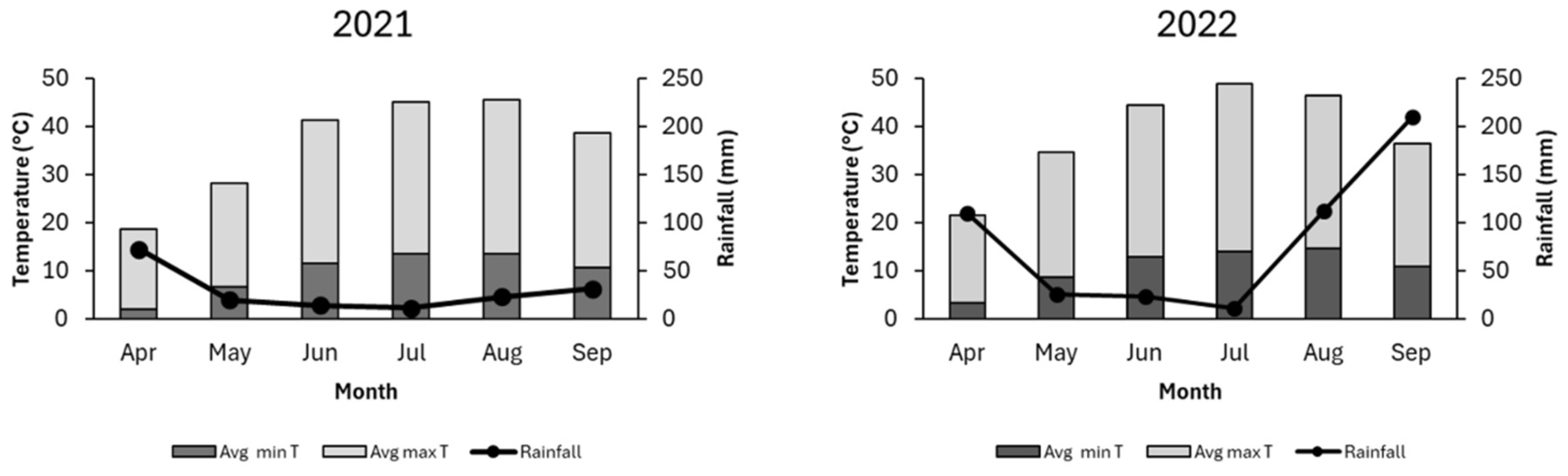
Figure 2.
Total organic carbon (TOC, on the left) and dissolved organic carbon (DOC, on the right) content in soil irrigated with only water (open bars) or with micronized biochar (closed bars) and sampled in July and September in the years 2021 and 2022. Means were subjected to a one-way ANOVA with the use of micronized biochar as variability factor. The lack of asterisks indicates no significant differences among means at p ≤ 0.05 using the post-hoc LSD test.
Figure 2.
Total organic carbon (TOC, on the left) and dissolved organic carbon (DOC, on the right) content in soil irrigated with only water (open bars) or with micronized biochar (closed bars) and sampled in July and September in the years 2021 and 2022. Means were subjected to a one-way ANOVA with the use of micronized biochar as variability factor. The lack of asterisks indicates no significant differences among means at p ≤ 0.05 using the post-hoc LSD test.
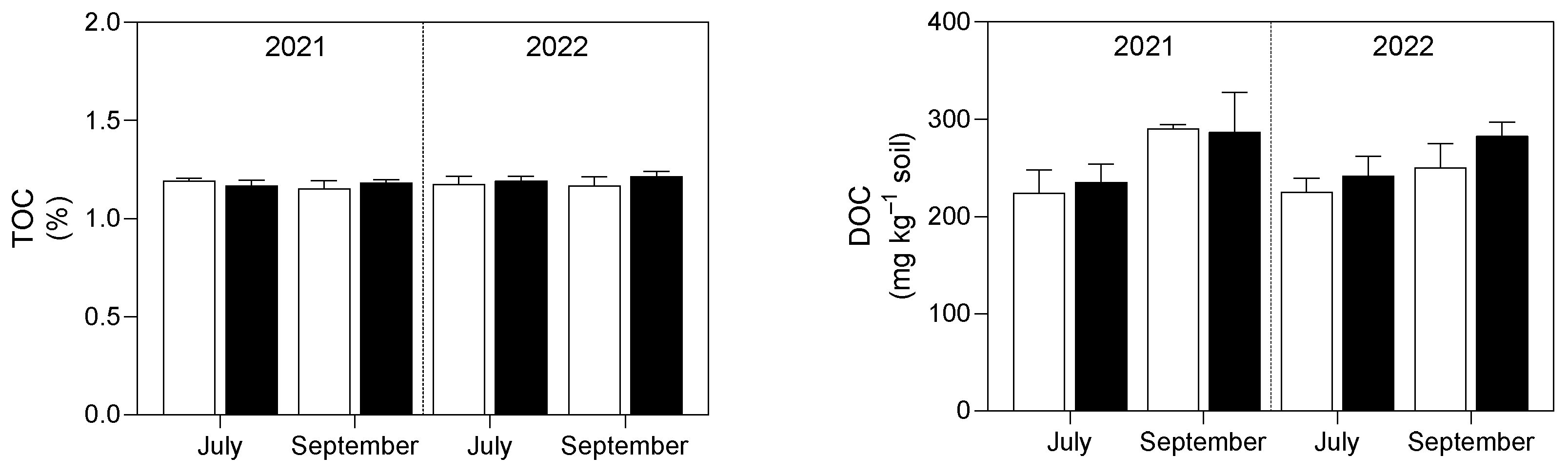
Figure 3.
Dehydrogenase activity (DHA activity; on the left) and metabolic potential index (MPI; on the right) in soil irrigated with only water (open bars) or with micronized biochar (closed bars) and sampled in July and September in the years 2021 and 2022. Means were subjected to a one-way ANOVA with the use of micronized biochar as variability factor. The presence of asterisks indicates significant differences among means at p ≤ 0.05 using the post-hoc LSD test, whilst the lack of asterisks indicates no significant differences among means at p ≤ 0.05 using the same post-hoc test. **: p ≤ 0.01; ***: p ≤ 0.001.
Figure 3.
Dehydrogenase activity (DHA activity; on the left) and metabolic potential index (MPI; on the right) in soil irrigated with only water (open bars) or with micronized biochar (closed bars) and sampled in July and September in the years 2021 and 2022. Means were subjected to a one-way ANOVA with the use of micronized biochar as variability factor. The presence of asterisks indicates significant differences among means at p ≤ 0.05 using the post-hoc LSD test, whilst the lack of asterisks indicates no significant differences among means at p ≤ 0.05 using the same post-hoc test. **: p ≤ 0.01; ***: p ≤ 0.001.
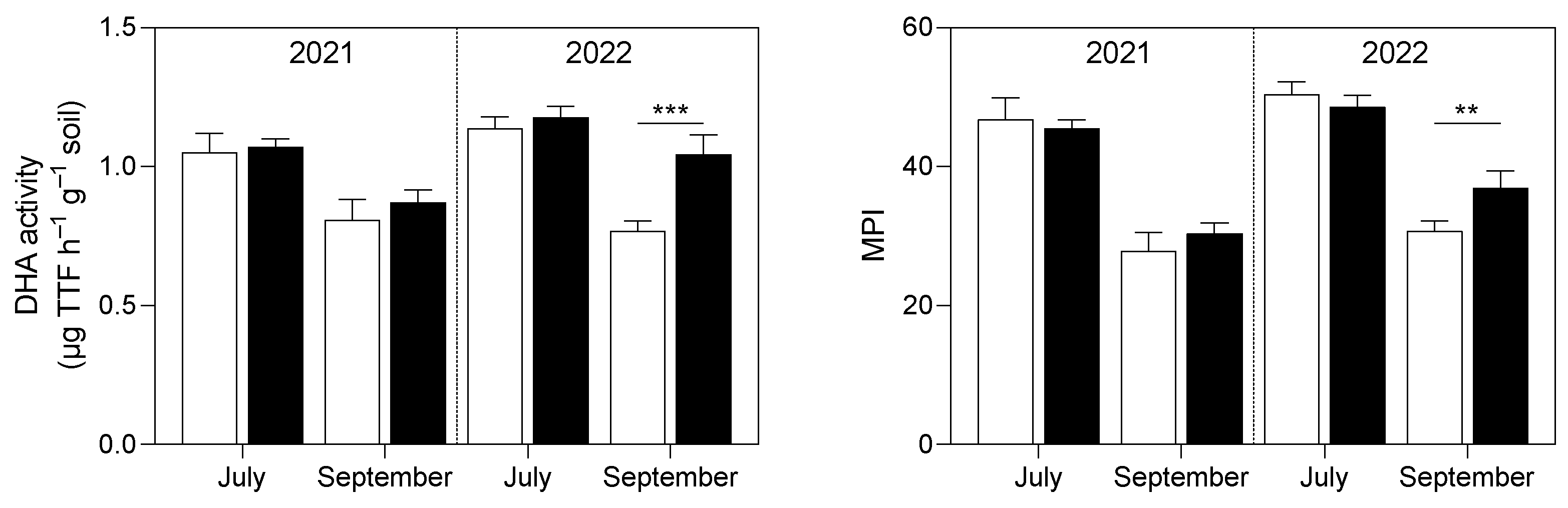
Figure 4.
Total nitrogen (Ntot; on the left) and nitrates (NO3--N; on the right) contents in soil irrigated with only water (open bars) or with micronized biochar (closed bars) and sampled in July and September in the years 2021 and 2022. Means were subjected to a one-way ANOVA with the use of micronized biochar as variability factor. The lack of asterisks indicates no significant differences among means at p ≤ 0.05 using the post-hoc LSD test.
Figure 4.
Total nitrogen (Ntot; on the left) and nitrates (NO3--N; on the right) contents in soil irrigated with only water (open bars) or with micronized biochar (closed bars) and sampled in July and September in the years 2021 and 2022. Means were subjected to a one-way ANOVA with the use of micronized biochar as variability factor. The lack of asterisks indicates no significant differences among means at p ≤ 0.05 using the post-hoc LSD test.
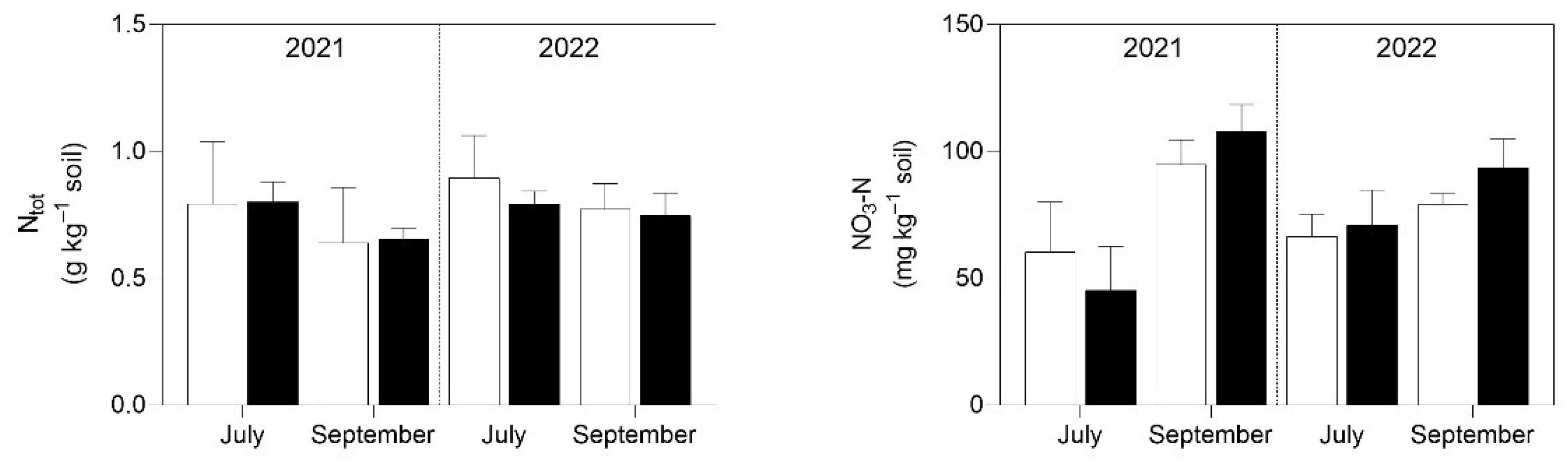
Figure 5.
Available phosphorus (on the left) content and alkaline phosphomonoesterase (APA activity, on the right) in soil irrigated with only water (open bars) or with micronized biochar (closed bars) and sampled in July and September in the years 2021 and 2022. Means were subjected to a one-way ANOVA with the use of micronized biochar as variability factor. The presence of asterisks indicates significant differences among means at p ≤ 0.05 using the post-hoc LSD test, whilst the lack of asterisks indicates no significant differences among means at p ≤ 0.05 using the same post-hoc test. ***: p ≤ 0.001.
Figure 5.
Available phosphorus (on the left) content and alkaline phosphomonoesterase (APA activity, on the right) in soil irrigated with only water (open bars) or with micronized biochar (closed bars) and sampled in July and September in the years 2021 and 2022. Means were subjected to a one-way ANOVA with the use of micronized biochar as variability factor. The presence of asterisks indicates significant differences among means at p ≤ 0.05 using the post-hoc LSD test, whilst the lack of asterisks indicates no significant differences among means at p ≤ 0.05 using the same post-hoc test. ***: p ≤ 0.001.
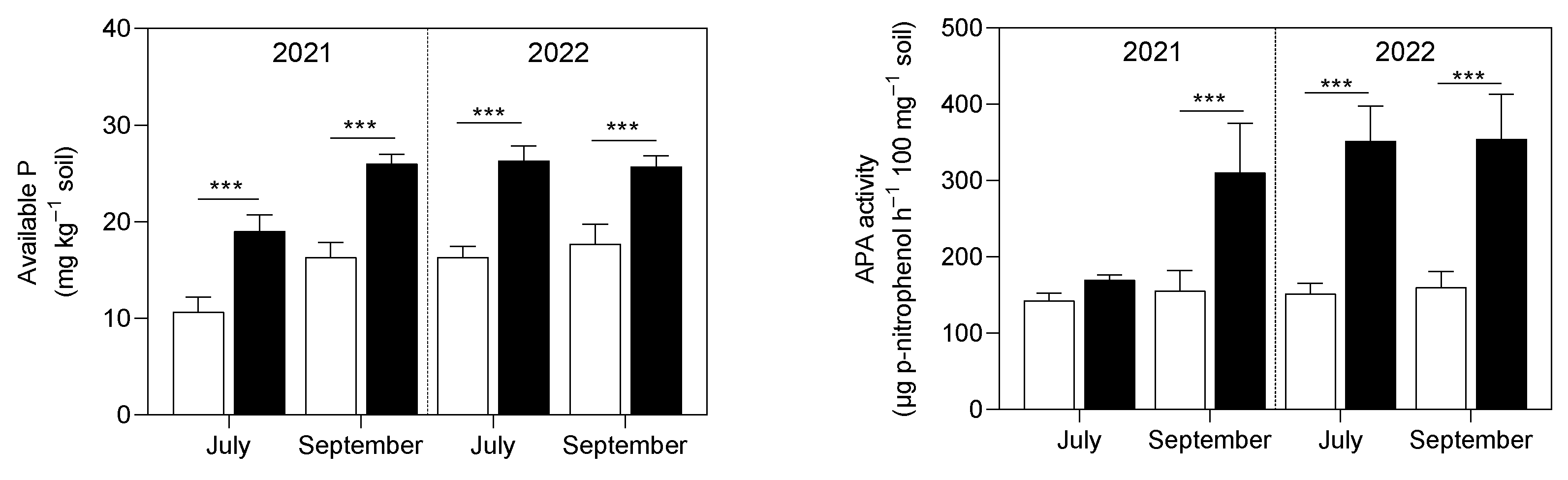
Figure 6.
Exchangeable potassium (Kex, on the left), calcium (Caex, in the middle) and magnesium (Mgex, on the right) contents in soil irrigated with only water (open bars) or with micronized biochar (closed bars) and sampled in July and September in the years 2021 and 2022. Means were subjected to a one-way ANOVA with the use of micronized biochar as variability factor. The presence of asterisks indicates significant differences among means at p ≤ 0.05 using the post-hoc LSD test, whilst the lack of asterisks indicates no significant differences among means at p ≤ 0.05 using the same post-hoc test. *: p ≤ 0.05; **: p ≤ 0.01; ***: p ≤ 0.001.
Figure 6.
Exchangeable potassium (Kex, on the left), calcium (Caex, in the middle) and magnesium (Mgex, on the right) contents in soil irrigated with only water (open bars) or with micronized biochar (closed bars) and sampled in July and September in the years 2021 and 2022. Means were subjected to a one-way ANOVA with the use of micronized biochar as variability factor. The presence of asterisks indicates significant differences among means at p ≤ 0.05 using the post-hoc LSD test, whilst the lack of asterisks indicates no significant differences among means at p ≤ 0.05 using the same post-hoc test. *: p ≤ 0.05; **: p ≤ 0.01; ***: p ≤ 0.001.

Figure 7.
Gas exchanges parameters analyzed in vines cultivated in soils irrigated with only water (open bars) or with micronized biochar (closed bars). Vine plants were sampled in July and September in the years 2021 and 2022. Gas exchanges were determined at ambient light and CO2 conditions: net photosynthesis:(Pn; a), stomatal conductance (gs; b), intercellular CO2 concentration (Ci; c) and apparent carboxylation efficiency (Pn/Ci; d). Means were subjected to a one-way ANOVA with the use of micronized biochar as variability factor. The presence of asterisks indicates significant differences among means at p ≤ 0.05 using the post-hoc LSD test, whilst the lack of asterisks indicates no significant differences among means at p ≤ 0.05 using the same post-hoc test. *: p ≤ 0.05; **: p ≤ 0.01; ***: p ≤ 0.001.
Figure 7.
Gas exchanges parameters analyzed in vines cultivated in soils irrigated with only water (open bars) or with micronized biochar (closed bars). Vine plants were sampled in July and September in the years 2021 and 2022. Gas exchanges were determined at ambient light and CO2 conditions: net photosynthesis:(Pn; a), stomatal conductance (gs; b), intercellular CO2 concentration (Ci; c) and apparent carboxylation efficiency (Pn/Ci; d). Means were subjected to a one-way ANOVA with the use of micronized biochar as variability factor. The presence of asterisks indicates significant differences among means at p ≤ 0.05 using the post-hoc LSD test, whilst the lack of asterisks indicates no significant differences among means at p ≤ 0.05 using the same post-hoc test. *: p ≤ 0.05; **: p ≤ 0.01; ***: p ≤ 0.001.
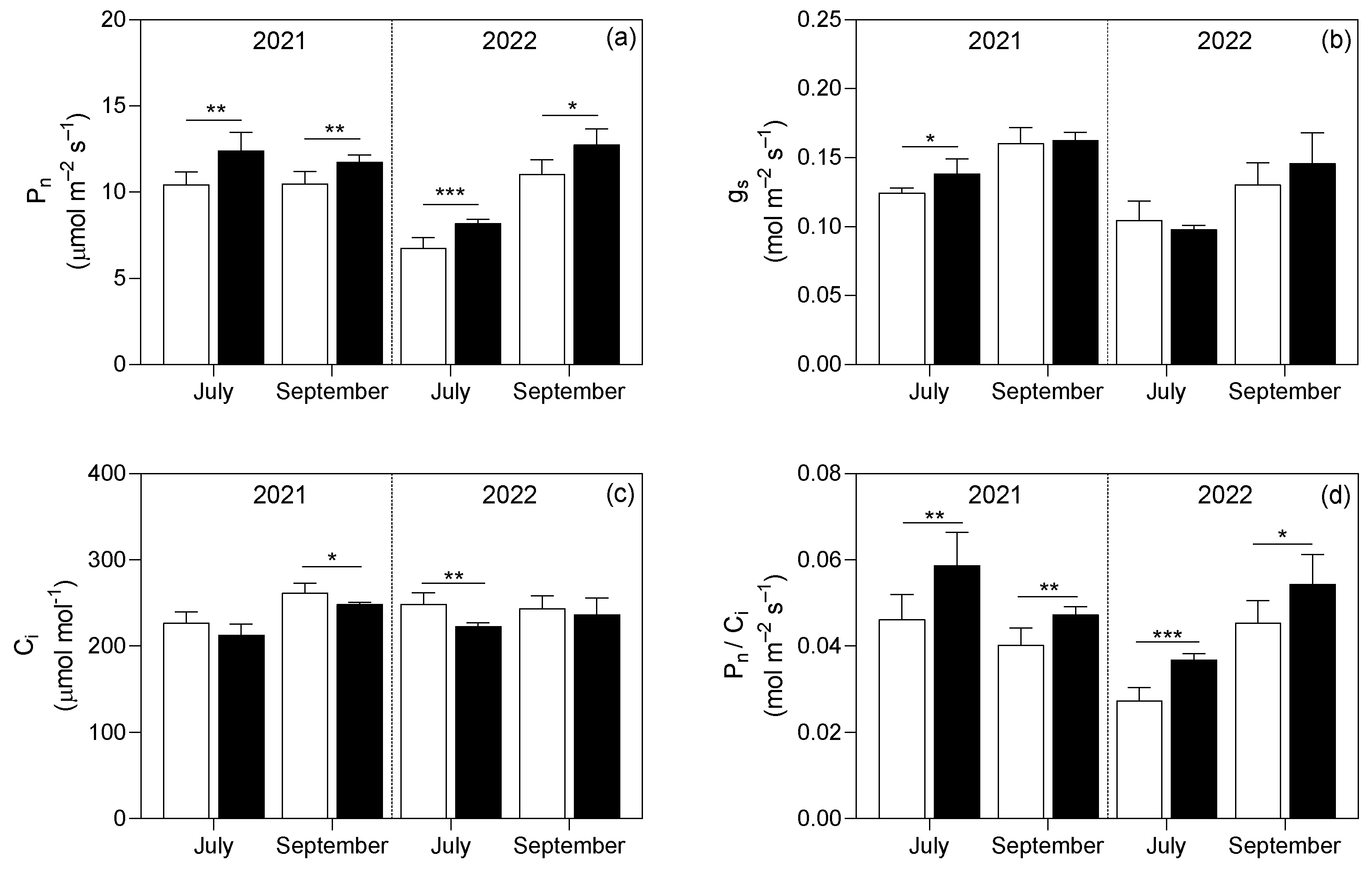
Figure 8.
Chlorophyll index (Chlindex, on the left) and flavonoid index (Flavindex, on the right) content in leaf vines cultivated in soil irrigated with only water (open bars) or with micronized biochar (closed bars) and sampled in July and September in the years 2021 and 2022. Means were subjected to a one-way ANOVA with the use of micronized biochar as variability factor. The lack of asterisks indicates no significant differences among means at p ≤ 0.05 using the post-hoc LSD test. **: p ≤ 0.01; ***: p ≤ 0.001.
Figure 8.
Chlorophyll index (Chlindex, on the left) and flavonoid index (Flavindex, on the right) content in leaf vines cultivated in soil irrigated with only water (open bars) or with micronized biochar (closed bars) and sampled in July and September in the years 2021 and 2022. Means were subjected to a one-way ANOVA with the use of micronized biochar as variability factor. The lack of asterisks indicates no significant differences among means at p ≤ 0.05 using the post-hoc LSD test. **: p ≤ 0.01; ***: p ≤ 0.001.
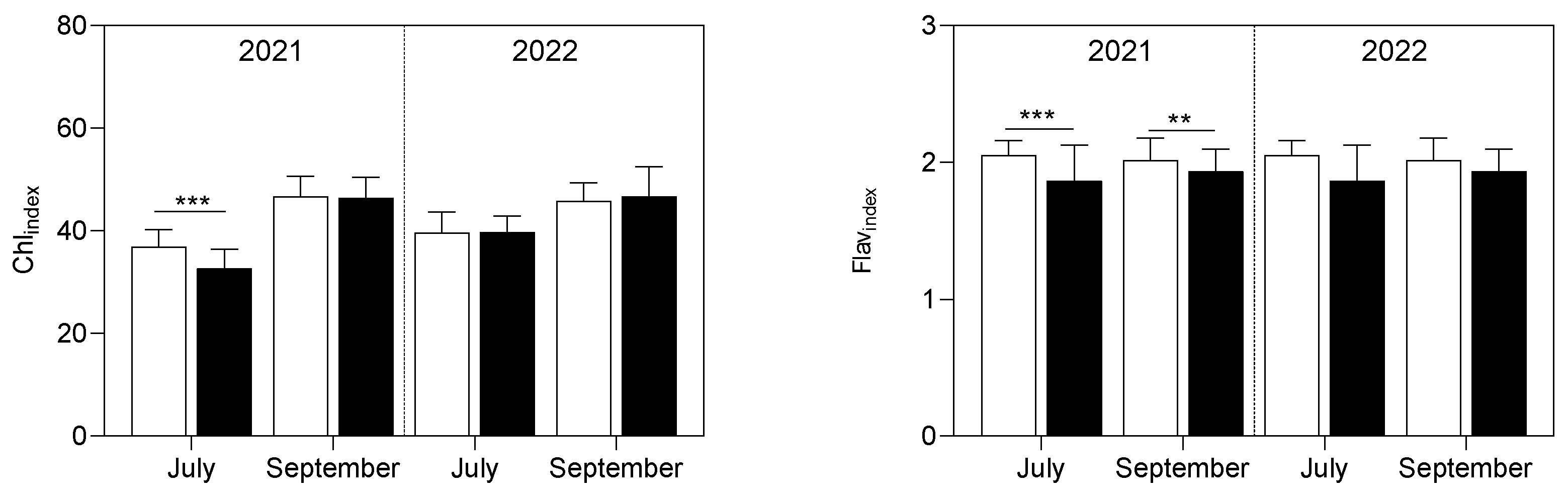
Figure 9.
Total nitrogen (N, a), phosphorous (P, b), potassium (K, c), calcium (Ca, d) and magnesium (Mg, e) content of leaves of vine plants cultivated in soils irrigated with only water (open bars) or with micronized biochar (closed bars). Vine plants were sampled in July and September in the years 2021 and 2022. Means were subjected to a one-way ANOVA with the use of micronized biochar as variability factor. The presence of asterisks indicates significant differences among means at p ≤ 0.05 using the post-hoc LSD test, whilst the lack of asterisks indicates no significant differences among means at p ≤ 0.05 using the same post-hoc test. *: p ≤ 0.05; ***: p ≤ 0.001.
Figure 9.
Total nitrogen (N, a), phosphorous (P, b), potassium (K, c), calcium (Ca, d) and magnesium (Mg, e) content of leaves of vine plants cultivated in soils irrigated with only water (open bars) or with micronized biochar (closed bars). Vine plants were sampled in July and September in the years 2021 and 2022. Means were subjected to a one-way ANOVA with the use of micronized biochar as variability factor. The presence of asterisks indicates significant differences among means at p ≤ 0.05 using the post-hoc LSD test, whilst the lack of asterisks indicates no significant differences among means at p ≤ 0.05 using the same post-hoc test. *: p ≤ 0.05; ***: p ≤ 0.001.
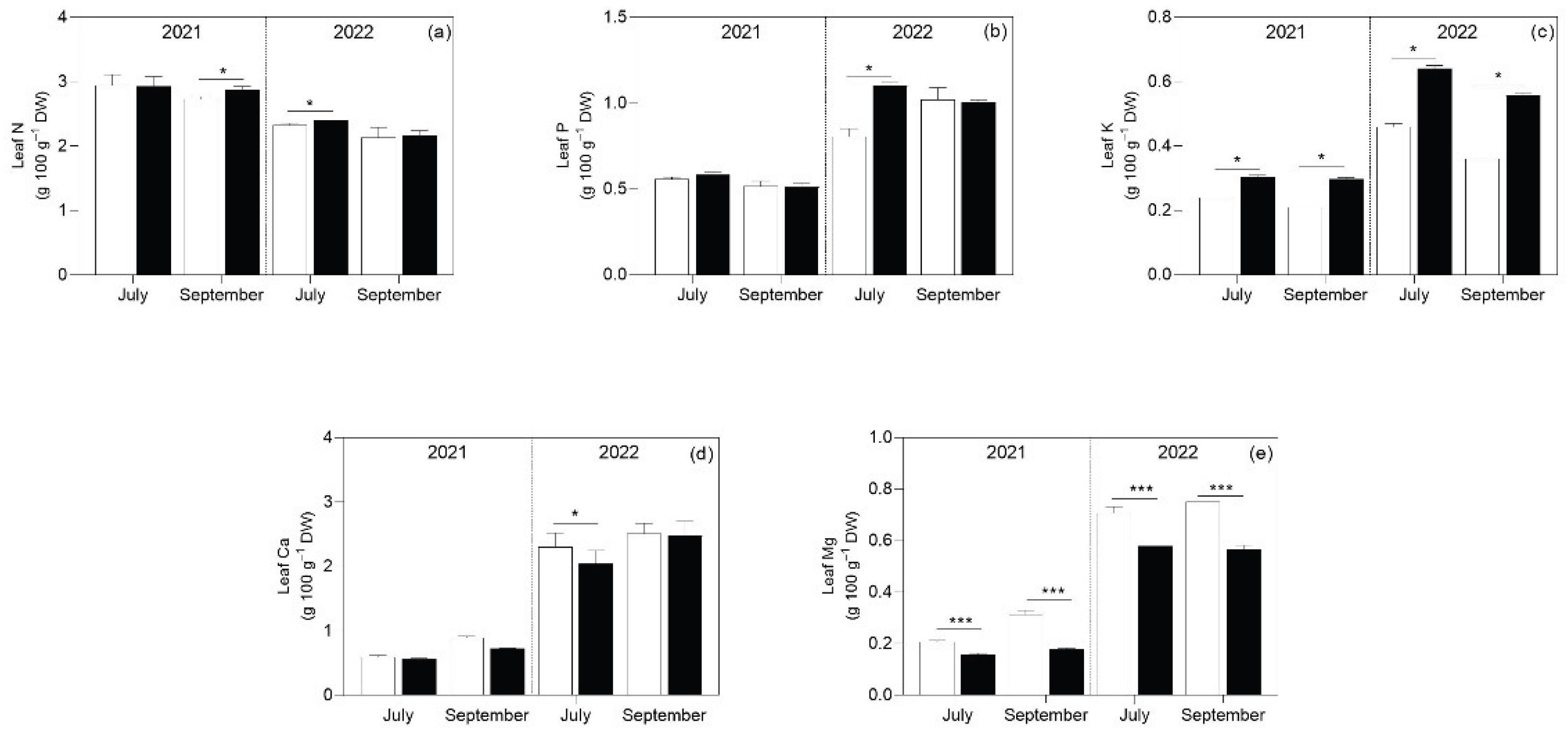

Table 1.
Soil characteristics of experimental vineyard. Abbreviations: f, infiltration rate; CEC, Cation Exchange Capacity; TOC, Total Organic Carbon; Ntot, Nitrogen total content.
Table 1.
Soil characteristics of experimental vineyard. Abbreviations: f, infiltration rate; CEC, Cation Exchange Capacity; TOC, Total Organic Carbon; Ntot, Nitrogen total content.
| Title 1 | Unit | Value |
|---|---|---|
| Sand | % | 69.0 |
| Silt | % | 25.0 |
| Clay | % | 6.0 |
| pH | 6.1 | |
| f | % | 35.0 |
| CEC | meq 100 g–1 | 38.0 |
| CaCO3 | % | <1.0 |
| TOC | % | 1.13 |
| Ntot | g kg–1 | 0.98 |
| C/N ratio | 11.5 | |
| Available P | mg kg–1 | 13.0 |
| Exchangeable K | mg kg–1 | 113.0 |
| Exchangeable Mg | mg kg–1 | 480.0 |
| Exchangeable Ca | mg kg–1 | 2111.0 |
Table 2.
Leaf, branches, trunk and total dry biomass, leaf area and leaf number of vines cultivated in soils irrigated with only water (CTR) or with micronized biochar (B). Vine plants were sampled in the years 2021 and 2022. Means were subjected to a one-way ANOVA with the use of micronized biochar as variability factor. DW: dry weight; LA: leaf area.his is a table.
Table 2.
Leaf, branches, trunk and total dry biomass, leaf area and leaf number of vines cultivated in soils irrigated with only water (CTR) or with micronized biochar (B). Vine plants were sampled in the years 2021 and 2022. Means were subjected to a one-way ANOVA with the use of micronized biochar as variability factor. DW: dry weight; LA: leaf area.his is a table.
| 2021 | 2022 | |||
|---|---|---|---|---|
| CTR | B | CTR | B | |
| Leaf biomass (g DW plant–1) | 20.1 ± 5.2 | 17.0 ± 2.0 | 20.5 ± 5.3 | 36.6 ± 5.7 * |
| Branches biomass (g DW plant–1) | 21.0 ± 2.7 | 25.0 ± 5.5 | 24.8 ± 3.1 | 30.1 ± 6.6 |
| Trunk biomass (g DW plant–1) | 40.6 ± 5.9 | 46.5 ± 9.9 | 46.7 ± 6.8 | 54.4 ± 11.6 |
| Total biomass (g DW plant–1) | 81.7 ± 12.5 | 88.5 ± 15.6 | 91.9 ± 11.1 | 121.1 ± 20.7 * |
| Leaf number (n° plant–1) | 88.4 ± 16.2 | 76.8 ± 19.2 | 116.0 ± 12.4 | 124.6 ± 9.9 |
| LA (cm2) | 40.1 ± 6.3 | 51.3 ± 7.1 * | 40.4 ± 0.5 | 58.6 ± 0.3 * |
Disclaimer/Publisher’s Note: The statements, opinions and data contained in all publications are solely those of the individual author(s) and contributor(s) and not of MDPI and/or the editor(s). MDPI and/or the editor(s) disclaim responsibility for any injury to people or property resulting from any ideas, methods, instructions or products referred to in the content. |
© 2026 by the authors. Licensee MDPI, Basel, Switzerland. This article is an open access article distributed under the terms and conditions of the Creative Commons Attribution (CC BY) license (http://creativecommons.org/licenses/by/4.0/).
Copyright: This open access article is published under a Creative Commons CC BY 4.0 license, which permit the free download, distribution, and reuse, provided that the author and preprint are cited in any reuse.


