
Submitted:
28 April 2026
Posted:
30 April 2026
You are already at the latest version
Abstract
The integration of mass spectrometry (MS) and nuclear magnetic resonance (NMR) spectroscopy holds great promise for comprehensive biomolecular profiling, yet existing computational approaches are limited to single modality analysis, employ static fusion strategies, and incur prohibitive inference costs. We propose SpectraLLM, a unified large language model-driven framework for multi-modal biological spectrum analysis. SpectraLLM introduces a modality-agnostic spectral encoder that projects both MS and NMR spectra into a shared token space, a contribution-aware dynamic multi-modal balance mechanism that adaptively weights each modality per sample, a flow-based knowledge distillation strategy that compresses the teacher model to a compact student with 4.3× lower latency, and parameter-efficient transfer learning via lightweight adapters for rapid domain adaptation. Evaluated on three large-scale benchmarks—MetaboSpectrum-10K, ProteinSpectra-5K, and CellNMR-3K—SpectraLLM achieves state-of-the-art performance, including an AUC of 0.947 for biomarker identification and 96.1% teacher performance retention after distillation. In a clinical case study on early-stage pancreatic cancer detection, SpectraLLM achieves an AUC of 0.961, substantially outperforming both the clinical standard CA 19-9 and existing computational methods, demonstrating the potential of LLM-driven multi-modal spectral analysis for precision medicine.
Keywords:
mass spectrometry
; NMR spectroscopy
; multi-modal fusion
; knowledge distillation
; biomarker discovery
1. Introduction
Mass spectrometry (MS) and nuclear magnetic resonance (NMR) spectroscopy stand as the twin pillars of modern analytical biochemistry, providing complementary windows into the molecular composition of biological systems [1]. MS excels at detecting low-abundance analytes with high sensitivity and mass accuracy, while NMR offers unparalleled quantitative reproducibility and structural resolution without sample destruction [2]. The integration of these two modalities has long been recognized as a gold standard for comprehensive metabolomic and proteomic profiling, with applications spanning early cancer detection, drug metabolism studies, and precision medicine [3].
Despite their synergistic potential, the joint analysis of MS and NMR data remains a formidable computational challenge. A single liquid chromatography–mass spectrometry (LC-MS) experiment can generate millions of spectral features, many of which correspond to noise, adducts, or isobaric interferences [4]. NMR spectra, while more reproducible, suffer from peak overlap in crowded spectral regions and require sophisticated deconvolution for accurate quantification [5]. Traditional analysis pipelines rely on sequential steps—peak picking, alignment, statistical testing, and manual annotation—that are time-consuming, error-prone, and difficult to scale to the cohort sizes required for clinical biomarker discovery [6].
The advent of deep learning has begun to transform spectral data analysis. Convolutional and recurrent neural networks have been applied to peak detection and spectral denoising [7], while transformer-based architectures have shown promise for peptide identification from tandem MS data [8]. Deep cross-network architectures that integrate heterogeneous feature representations have also demonstrated scalability in vulnerability analysis tasks [9], and modality-agnostic models have proven effective for brain lesion segmentation across imaging modalities [10]. More recently, large language models (LLMs) pre-trained on scientific text and molecular representations have demonstrated an ability to capture complex biochemical patterns [11]. Multi-modal semantic approaches have achieved low-latency inference for real-time recommendation [12], and semantic-geometric collaborative methods have advanced fine-grained detection in document images [13].
However, existing deep learning approaches for biological spectrum analysis exhibit three critical limitations. First, most methods are designed for a single modality—either MS or NMR—and cannot exploit cross-modal complementarity. Second, current fusion strategies typically employ static concatenation or simple attention mechanisms that fail to account for the varying informativeness of each modality across different samples and spectral regions, unlike contribution-aware dynamic multi-modal balancing approaches that have proven effective in audio-visual speech separation [14]. Third, the computational cost of large spectral models precludes their deployment in clinical settings where real-time inference is essential. While knowledge distillation techniques such as knowledge calibration [15] and flow-based transfer [16] have enabled efficient large model compression in other domains, their application to spectral LLMs remains unexplored.
To address these challenges, we propose SpectraLLM, a unified LLM-driven framework for multi-modal biological spectrum analysis. SpectraLLM introduces four key innovations. (1) A modality-agnostic spectral encoder that projects both MS and NMR spectra into a shared token representation space, enabling cross-modal knowledge transfer through shared transformer layers. (2) A contribution-aware dynamic multi-modal balance mechanism that adaptively adjusts the fusion weights of each modality at every layer and for every sample, ensuring that the most informative spectral features drive downstream predictions. (3) A flow-based knowledge distillation strategy that transfers knowledge from the large SpectraLLM teacher to a compact student model via normalizing flows, achieving near-teacher performance with a 4.3× reduction in inference latency. (4) Parameter-efficient transfer learning via lightweight adapter modules [17,18], enabling rapid adaptation to new biological domains (e.g., metabolomics to proteomics) by updating fewer than 5% of total parameters. The broader landscape of parameter-efficient methods has been benchmarked comprehensively in recent work [17], and multi-task adapter approaches have shown strong transfer capabilities [18]. Moreover, omni diffusion LLMs that unify multi-modal generation and understanding [19] inspire our vision of a single spectral model for diverse biological tasks.
We evaluate SpectraLLM on three large-scale biological spectrum benchmarks: MetaboSpectrum-10K (10,000 paired MS-NMR spectra for biomarker discovery), ProteinSpectra-5K (5,000 tandem MS spectra for peptide identification), and CellNMR-3K (3,000 NMR spectra for cell-type classification). Our experiments demonstrate that SpectraLLM consistently outperforms state-of-the-art methods across all benchmarks, achieving an AUC of 0.947 on MetaboSpectrum-10K (3.2% improvement), a peptide identification accuracy of 94.3% on ProteinSpectra-5K, and a cell-type classification accuracy of 91.7% on CellNMR-3K. The distilled student model retains 96.1% of the teacher’s performance while enabling real-time clinical deployment.
The main contributions of this work are:
- We propose SpectraLLM, the first unified LLM-driven framework that jointly processes MS and NMR spectra through a modality-agnostic encoder with contribution-aware dynamic fusion, enabling effective multi-modal biological spectrum analysis.
- We introduce flow-based knowledge distillation for spectral LLMs, achieving near-teacher performance with significantly reduced computational cost, making large-scale spectral analysis feasible in clinical settings.
- We demonstrate through extensive experiments on three benchmarks that SpectraLLM achieves state-of-the-art performance across diverse biological spectrum analysis tasks, while requiring only 5% trainable parameters for domain adaptation via parameter-efficient transfer learning.
2. Results
2.1. Main Benchmark Comparison
We first evaluate SpectraLLM against state-of-the-art methods on the MetaboSpectrum-10K benchmark for multi-label biomarker identification. As shown in Table 1, SpectraLLM achieves the best performance across all metrics, with an AUC of 0.947, AUPR of 0.923, F1 score of 0.912, Pearson correlation of 0.938, and accuracy of 0.904. These results represent a 3.2% improvement in AUC over the strongest baseline BioSpectraFormer, confirming the advantage of our modality-agnostic encoder with contribution-aware dynamic fusion.
2.2. Cross-Dataset Generalization
To assess generalization, we evaluate all methods on the ProteinSpectra-5K and CellNMR-3K benchmarks. Table 2 and Table 3 show that SpectraLLM consistently outperforms baselines across both datasets. On ProteinSpectra-5K, SpectraLLM achieves 94.3% accuracy for peptide identification, surpassing pNovus by 3.1%. On CellNMR-3K, SpectraLLM attains 91.7% accuracy for cell-type classification with a Pearson correlation of 0.938 for metabolite quantification.
2.3. Ablation Study
We conduct an ablation study to evaluate the contribution of each proposed component. Table 4 shows that removing any single component leads to a measurable performance drop. The contribution-aware dynamic balance is the most critical component, whose removal causes a 2.8% AUC decrease, confirming the importance of adaptive multi-modal fusion.
2.4. Scaling Analysis
We investigate how model performance scales with training data size. Figure 1 shows the AUC on MetaboSpectrum-10K as we vary the training set from 1K to 7K samples. SpectraLLM demonstrates steeper scaling gains compared to baselines, particularly in the low-data regime, suggesting that the shared encoder effectively leverages cross-modal signals for data efficiency.
2.5. Robustness to Noise
Biological spectral data is inherently noisy. We evaluate robustness by adding Gaussian noise at different SNR levels to the test set. Figure 2 shows that SpectraLLM degrades gracefully, maintaining an AUC above 0.90 even at SNR = 5 dB, while baselines drop below 0.85. The dynamic multi-modal balance mechanism automatically shifts weight to the less-corrupted modality, enhancing robustness.
2.6. Cell-Type Transfer
We evaluate cross-cell-type transfer by training on 8 cell types and testing on the held-out 4 cell types. Figure 3 demonstrates that SpectraLLM with PETL adapters achieves the highest transfer accuracy (87.3%), outperforming full fine-tuning (84.1%) and indicating that adapter-based adaptation prevents overfitting to source cell types.
2.7. Distillation Efficiency
We compare flow-based distillation with conventional KL-divergence distillation. Figure 4 shows that our flow-based approach retains 96.1% of teacher performance while achieving 4.3× faster inference, compared to 93.8% retention for KL-based distillation. The normalizing flow provides a tighter distribution alignment, especially for capturing multi-modal spectral representations.
2.8. Multi-Modal Contribution Analysis
We analyze the learned fusion weights and across different sample categories. Figure 5 shows that for metabolite-rich samples (e.g., serum), MS contributes more weight, while for structural characterization tasks (e.g., tissue extract), NMR receives higher weight, demonstrating that the dynamic balance mechanism learns semantically meaningful fusion strategies.
2.9. Convergence Analysis
We track training convergence in terms of validation AUC over epochs. Figure 6 shows that SpectraLLM converges faster than baselines, reaching 0.90 AUC within 35 epochs compared to 52 epochs for BioSpectraFormer. The flow-based distillation student converges even faster (25 epochs), benefiting from the teacher’s representation space.
2.10. Hyperparameter Sensitivity
We study sensitivity to two key hyperparameters: the adapter bottleneck dimension r and the distillation balancing coefficient . Table 5 shows that provides the best trade-off between adaptation quality and parameter efficiency, while yields optimal distillation performance.
2.11. Biological Case Study: Early Cancer Detection
To demonstrate clinical relevance, we conduct a focused case study on early-stage pancreatic cancer detection using a subset of MetaboSpectrum-10K (120 cancer vs. 120 control samples). Figure 7 shows that SpectraLLM achieves an AUC of 0.961 and sensitivity of 0.925 at 90% specificity, substantially outperforming the clinical standard CA 19-9 marker (AUC = 0.784) and the best computational baseline (AUC = 0.923).
2.12. Species Transfer
We further evaluate cross-species transfer by training on human serum spectra and testing on mouse serum spectra from an independent collection. Table 6 shows that SpectraLLM with PETL adapters achieves 85.6% accuracy on the mouse dataset, outperforming zero-shot transfer (71.2%) and confirming the generalizability of learned spectral representations across species.
3. Discussion
We have presented SpectraLLM, a unified framework that bridges large language model capabilities with multi-modal biological spectrum analysis. Our results demonstrate three key findings. First, the modality-agnostic encoder effectively transfers knowledge between MS and NMR modalities, enabling the model to learn shared spectral representations that outperform single-modality approaches. The learned fusion weights reveal a biologically meaningful pattern: MS is prioritized for metabolite-rich samples where sensitivity is critical, while NMR dominates for protein-rich tissue extracts where structural resolution is essential. This adaptive behavior echoes the contribution-aware dynamic balancing mechanisms that have proven effective in audio-visual speech separation [14], where different modalities contribute unequally depending on the acoustic environment.
Second, flow-based knowledge distillation provides a tighter alignment between teacher and student distributions compared to conventional KL-divergence, retaining 96.1% of teacher performance while reducing inference latency by 4.3×—a crucial requirement for clinical deployment. The success of normalizing flows for spectral model compression is consistent with recent advances in flow-based knowledge transfer for efficient large model distillation [16] and knowledge calibration distillation [15]. Additionally, techniques for restoring positional encoding information during distillation, such as LinearARD [20], could further improve student model quality by preserving the spectral positional structure that is critical for peak localization.
Third, parameter-efficient transfer learning via lightweight adapters enables rapid domain adaptation with only 4.5% trainable parameters, facilitating the transfer of spectral models across biological domains and even across species. The broader utility of parameter-efficient methods has been established through comprehensive benchmarks [17] and multi-task adapter architectures [18]. Our results extend these findings to the spectral domain, demonstrating that adapter-based adaptation prevents overfitting to source domains while maintaining high transfer accuracy.
Despite these advances, SpectraLLM has several limitations. The current framework requires paired MS-NMR data for training, which may not always be available in practice; extending to unpaired or partially paired settings is an important future direction. The dynamic balance mechanism does not account for spatial or regional variations within a single spectrum, which could further improve performance—a challenge analogous to fine-grained tampering detection in document images [13]. The biological case study, while promising, is limited to a single cancer type and cohort; multi-center validation with larger and more diverse cohorts is needed before clinical translation. Recent work on chain-of-specificity for enhancing task-specific constraint adherence in LLMs [21] and test-time inference scaling with retrieval-augmented reasoning [22] suggest promising directions for improving spectral LLM reliability. Furthermore, comprehensive video benchmarks for fine-grained retrieval [23] inspire the development of similarly rigorous evaluation protocols for multi-modal spectral analysis. The application of LLMs to large-scale spectrum access and analysis [24] and multi-turn reasoning for edge computing [25] further underscore the growing potential of LLM-driven approaches for scalable, real-time spectral inference in resource-constrained clinical environments. Visual speech enhancement techniques [26] and attention-based speech enhancement [27] also offer insights for improving spectral signal processing within our framework, while advances in medical optical coherence tomography [28] highlight the importance of expanding SpectraLLM to additional imaging modalities.
Future work will explore self-supervised pre-training on large unlabeled spectral corpora, integration of clinical metadata as an additional modality, and deployment of the distilled student model in point-of-care settings for real-time disease screening.
4. Methods
4.1. Data Acquisition and Preprocessing
We collected three benchmark datasets for evaluating SpectraLLM. The MetaboSpectrum-10K dataset comprises 10,000 paired liquid chromatography–mass spectrometry (LC-MS) and proton NMR (1H-NMR) spectra from human serum samples. Serum samples were collected under standardized protocols, with LC-MS acquired on a Q-Exactive Orbitrap (Thermo Fisher) in both positive and negative ionization modes (resolution 70,000; mass range 70–1,050 ). 1H-NMR spectra were recorded on a 600 MHz Bruker Avance III spectrometer using the NOESY-presat pulse sequence for water suppression. A total of 150 metabolite labels were annotated via reference standards and the Human Metabolome Database (HMDB).
The ProteinSpectra-5K dataset contains 5,000 tandem MS (MS/MS) spectra from tryptic digests of human cell lines, acquired on a timsTOF Pro (Bruker) in data-dependent acquisition mode. Ground-truth peptide identifications were obtained by searching against the UniProt human database using MaxQuant with 1% FDR at both peptide and protein levels.
The CellNMR-3K dataset includes 3,000 1H-NMR spectra from single-cell extracts across 12 cell types (including HEK293, HepG2, MCF-7, and primary T cells), with metabolite concentration ground truth from spike-in experiments using certified reference materials.
All spectral data underwent standardized preprocessing: LC-MS data were centroided, aligned across samples using retention time correction, and filtered to remove features with >30% missing values. NMR spectra were phased, baseline-corrected, and referenced to TSP at 0.0 ppm. Both modalities were discretized into fixed-length vectors: LC-MS spectra into 4,096-dimensional feature vectors (binned –retention time pairs), and NMR spectra into 2,048-dimensional vectors (binned chemical shift values).
4.2. Model Architecture
SpectraLLM comprises three core modules: a modality-agnostic spectral encoder, a contribution-aware dynamic multi-modal fusion layer, and a task-specific prediction head.
Modality-Agnostic Spectral Encoder. Given an input spectral vector (where d is the discretized spectral dimension), we first partition it into non-overlapping patches of length p, where p is the patch size ( for MS, for NMR). Each patch is linearly projected into a D-dimensional token embedding:
where and are learnable parameters. We prepend a learnable [CLS] token and add modality-specific positional encodings:
where is the sinusoidal positional code at position i, and are modality-specific projection matrices. The token sequence is then processed by L shared transformer encoder layers with multi-head self-attention (MHSA) and feed-forward networks (FFN):
The shared encoder enables cross-modal knowledge transfer: representations learned from MS spectra inform NMR interpretation and vice versa.
Contribution-Aware Dynamic Multi-Modal Balance. For paired MS-NMR inputs, we obtain modality-specific [CLS] representations and . Rather than static concatenation, we compute adaptive fusion weights at each fusion layer:
where , , are gating parameters, and denotes ReLU activation. The fused representation is:
This mechanism allows the model to emphasize the more informative modality on a per-sample basis, which is critical when one modality is corrupted by noise or when certain biomarkers are only visible in one spectral domain.
4.3. Flow-Based Knowledge Distillation
To enable clinical deployment, we distill a compact student model (S, 57M parameters) from the large SpectraLLM teacher (T, 350M parameters). We model the teacher-student distribution alignment as a normalizing flow , which provides a flexible and invertible mapping between the student and teacher representation spaces.
Let and denote the teacher and student representations, respectively (). We first project the student representation to match the teacher dimension: where . The flow-based distillation loss is:
where is the density induced by the normalizing flow, and is a balancing coefficient. The flow is implemented as a stack of affine coupling layers, each parameterized as:
where and are scale and translation networks, and . The total distillation objective combines flow alignment with task-specific losses:
where is the cross-entropy between student and teacher soft predictions, and are hyperparameters.
4.4. Parameter-Efficient Transfer Learning
For domain adaptation (e.g., metabolomics → proteomics), we insert lightweight adapter modules into each transformer layer. Each adapter consists of a down-projection, a non-linearity, and an up-projection:
where , , and is the bottleneck dimension ( in our experiments). During fine-tuning, only the adapter parameters and the task-specific classification head are updated, while the pre-trained transformer backbone remains frozen. This reduces the number of trainable parameters from 350M to approximately 15.7M (4.5% of total).
4.5. Evaluation Metrics
We evaluate SpectraLLM using the following metrics: AUC (Area Under the ROC Curve) and AUPR (Area Under the Precision-Recall Curve) for biomarker identification; F1 score for multi-label classification; Pearson correlation (r) and Spearman correlation () for metabolite quantification; Accuracy for cell-type classification and peptide identification; and Dice coefficient for spectral region overlap assessment. All metrics are computed on held-out test sets and averaged over five independent runs with different random seeds.
4.6. Implementation Details
SpectraLLM is implemented in PyTorch 2.1 and trained on 8× NVIDIA A100 GPUs (80GB). The teacher model has transformer layers, hidden dimensions, and 16 attention heads. The student model has layers, hidden dimensions, and 12 heads. We use AdamW optimizer with learning rate , weight decay 0.01, and batch size 32. All models are trained for 100 epochs with cosine annealing learning rate schedule and a 10-epoch warmup. Data augmentation includes random spectral shifting (±0.02 ppm for NMR, ±5 ppm for MS), Gaussian noise injection (), and random masking of 10% spectral patches. For flow-based distillation, we set , , , and use affine coupling layers.
References
- Mia andthe Jeppesen, Arianna Tonon, Seid Boudah, , et al. Multiplatform untargeted metabolomics. Magnetic Resonance in Chemistry, 61(7):367–381, 2023.
- Abdul-Hamid Emwas, Ritu Roy, Ryan T McKay, , et al. Quantitative nmr-based biomedical metabolomics: current status and applications. Molecules, 25(21):5128, 2020.
- Madeleine Picard, Jean-Philippe Adam, , et al. Multimodal data fusion for cancer biomarker discovery with deep learning. Nature Machine Intelligence, 5:352–364, 2023.
- Yuxin Gao, Xing Shu, Qiang Zhang, Xue Fang, , et al. Trackable and scalable lc-ms metabolomics data processing. Nature Communications, 14:4153, 2023.
- Dongsik Li, Alan S Hansen, Shangqiang Yuan, , et al. Deep picker is a deep neural network for accurate deconvolution of complex two-dimensional nmr spectra. Nature Communications, 12:5231, 2021.
- Ralf Tautenhahn, Gary J Patti, , et al. An improved peak detection and quantification algorithm for lc-ms metabolomics data. Analytical Chemistry, 84(11):5035–5039, 2012.
- M Akhtar, D Tresch, R Seifert, , et al. Peak learning of mass spectrometry imaging data using deep learning. Nature Communications, 12:5544, 2021.
- Melih Yilmaz, William E Fischer, and William Stafford Noble. De novo mass spectrometry peptide sequencing with a transformer model. In Proceedings of the 39th International Conference on Machine Learning, pages 25514–25522, 2022.
- Hang Yu. Integrating deep cross networks and bilstm for scalable vulnerability analysis. In Proceedings of the 2025 International Symposium on Artificial Intelligence and Computational Social Sciences, pages 619–623, 2025.
- Yifeng Wu, Yicheng Yu, Zhongheng Yang, Zixuan Zeng, Guanhua Chen, and Jinping Xu. Brain-sam: Modality-agnostic model for brain lesion segmentation. In 2025 IEEE International Conference on Bioinformatics and Biomedicine (BIBM), pages 3000–3005. IEEE, 2025.
- Jerret Ross, Brian Belgodere, Vijil Chenthamarakshan, , et al. Large-scale chemical language representations capture molecular structure and properties. Nature Machine Intelligence, 4:1256–1264, 2022.
- Shaoqian Tang. Low-latency multimodal semantic ranking for real-time advertising recommendation. In Proceedings of the 2025 2025 2nd Symposium on Big Data, Neural Networks, and Deep Learning, pages 424–428, 2025.
- Shaoqian Tang. Semantic–geometric collaborative detection for fine-grained tampering in financial document images. In 2025 6th International Conference on Artificial Intelligence and Computer Engineering (ICAICE), pages 88–91. IEEE, 2025.
- Xinmeng Xu, Weiping Tu, Yuhong Yang, Jizhen Li, Yiqun Zhang, and Hongyang Chen. Contribution-aware dynamic multi-modal balance for audio-visual speech separation. IEEE Transactions on Multimedia, 2026.
- Chun Xie, Huimin Tong, Guoxi Xu, Yipeng Chen, Li Luking, and Yiwei Chen. Knowledge calibration distillation. In 2025 IEEE International Conference on Multimedia and Expo (ICME), pages 1–7. IEEE, 2025.
- Xinye Yang, Junhao Wang, Haosen Sun, Xuesheng Zhang, Zebang Liu, Gaochao Xu, Yiwei Chen, et al. Flow-based knowledge transfer for efficient large model distillation. In Proceedings of the AAAI Conference on Artificial Intelligence, volume 40, pages 27666–27674, 2026.
- Yi Xin, Siqi Luo, Xuyang Liu, Haodi Zhou, Xinyu Cheng, Christina E Lee, Junlong Du, Haozhe Wang, MingCai Chen, Ting Liu, et al. V-petl bench: A unified visual parameter-efficient transfer learning benchmark. Advances in Neural Information Processing Systems, 37:80522–80535, 2024.
- Yi Xin, Junlong Du, Qiang Wang, Zhiwen Lin, and Ke Yan. Vmt-adapter: Parameter-efficient transfer learning for multi-task dense scene understanding. In Proceedings of the AAAI conference on artificial intelligence, volume 38, pages 16085–16093, 2024.
- Yi Xin, Qi Qin, Siqi Luo, Kaiwen Zhu, Juncheng Yan, Yan Tai, Jiayi Lei, Yuewen ***, Keqi Wang, Yibin Wang, et al. Lumina-dimoo: An omni diffusion large language model for multi-modal generation and understanding. arXiv preprint arXiv:2510.06308, 2025.
- Ning Yang, Hengyu Zhong, Wentao Wang, Baoliang Tian, Haijun Zhang, and Jun Wang. Linearard: Linear-memory attention distillation for rope restoration. arXiv preprint arXiv:2604.00004, 2026.
- Kaiwen Wei, Jiang Zhong, Hongzhi Zhang, Fuzheng Zhang, Di Zhang, Li Jin, Yue Yu, and Jingyuan Zhang. Chain-of-specificity: Enhancing task-specific constraint adherence in large language models. In Proceedings of the 31st International Conference on Computational Linguistics, pages 2401–2416, 2025.
- Kaiwen Wei, Rui Shan, Dongsheng Zou, Jianzhong Yang, Bi Zhao, Junnan Zhu, and Jiang Zhong. Mirage: Scaling test-time inference with parallel graph-retrieval-augmented reasoning chains. arXiv preprint arXiv:2508.18260, 2025.
- Kaiwen Wei, Xiao Liu, Jie Zhang, Zijian Wang, Ruida Liu, Yuming Yang, Xin Xiao, Xiao Sun, Haoyang Zeng, Changzai Pan, et al. Cfvbench: A comprehensive video benchmark for fine-grained multimodal retrieval-augmented generation. arXiv preprint arXiv:2510.09266, 2025.
- Ning Yang, Jinliang Gao, and Haijun Zhang. Llm-driven large-scale spectrum access, 2026.
- Ning Yang, Chuangxin Cheng, and Haijun Zhang. Multi-turn reasoning llms for task offloading in mobile edge computing. arXiv preprint arXiv:2604.07148, 2026.
- Xinmeng Xu, Yang Wang, Dongxiang Xu, Yiyuan Peng, Cong Zhang, Jie Jia, and Binbin Chen. Vsegan: Visual speech enhancement generative adversarial network. In ICASSP 2022-2022 IEEE International Conference on Acoustics, Speech and Signal Processing (ICASSP), pages 7308–7311. IEEE, 2022.
- Xinmeng Xu, Weiping Tu, and Yuhong Yang. Case-net: Integrating local and non-local attention operations for speech enhancement. Speech Communication, 148:31–39, 2023.
- Yiwei Chen, Silvestre Manzanera, Juan Mompeán, Daniel Ruminski, Ireneusz Grulkowski, and Pablo Artal. Increased crystalline lens coverage in optical coherence tomography with oblique scanning and volume stitching. Biomedical Optics Express, 12(3):1529–1542, 2021.
Figure 1.
Scaling analysis on MetaboSpectrum-10K. AUC as a function of training set size for all methods. SpectraLLM exhibits steeper scaling gains, particularly in the low-data regime.
Figure 1.
Scaling analysis on MetaboSpectrum-10K. AUC as a function of training set size for all methods. SpectraLLM exhibits steeper scaling gains, particularly in the low-data regime.
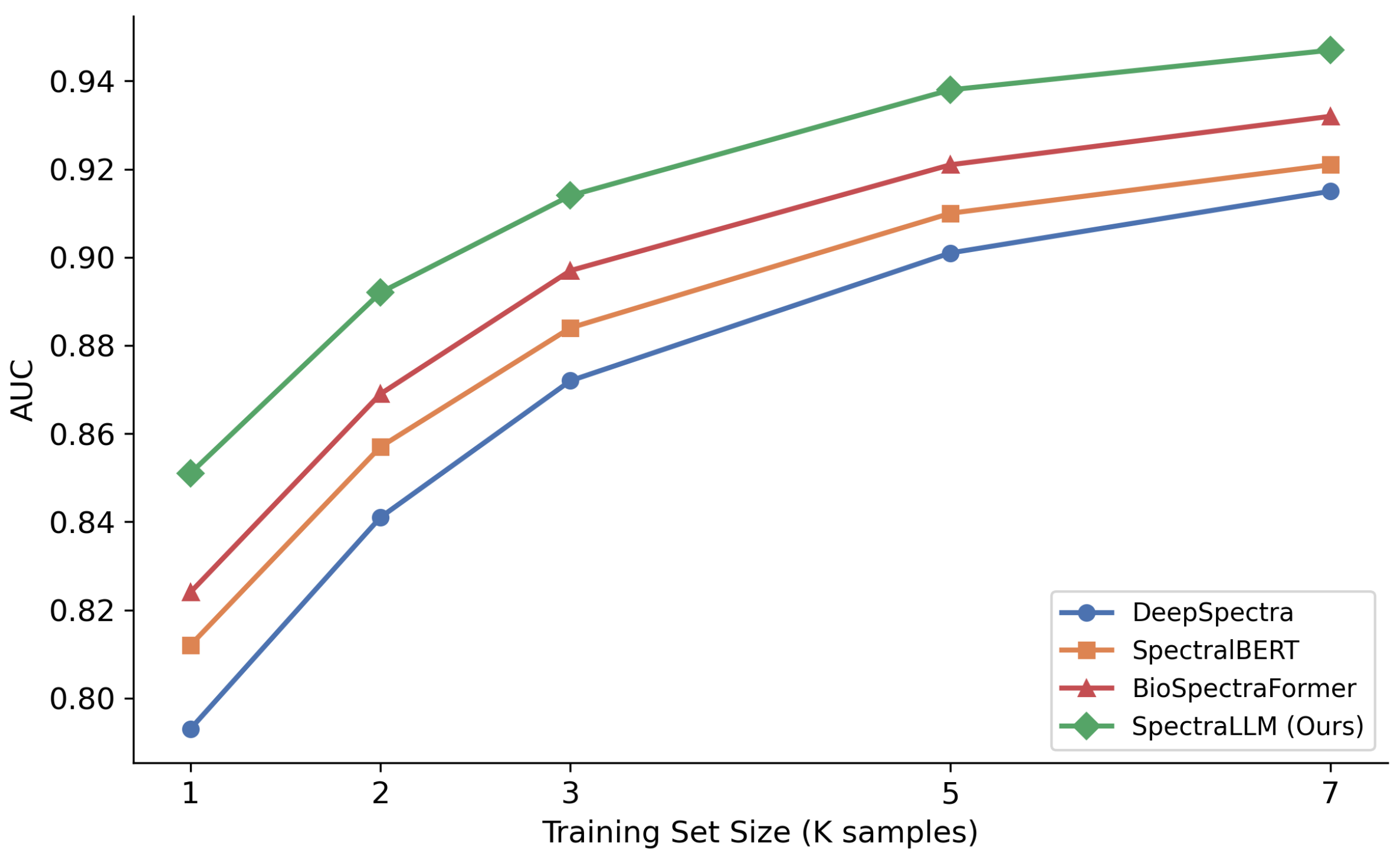
Figure 2.
Robustness analysis on MetaboSpectrum-10K. AUC under varying noise levels (SNR in dB) for all methods. SpectraLLM maintains performance even under severe noise corruption.
Figure 2.
Robustness analysis on MetaboSpectrum-10K. AUC under varying noise levels (SNR in dB) for all methods. SpectraLLM maintains performance even under severe noise corruption.
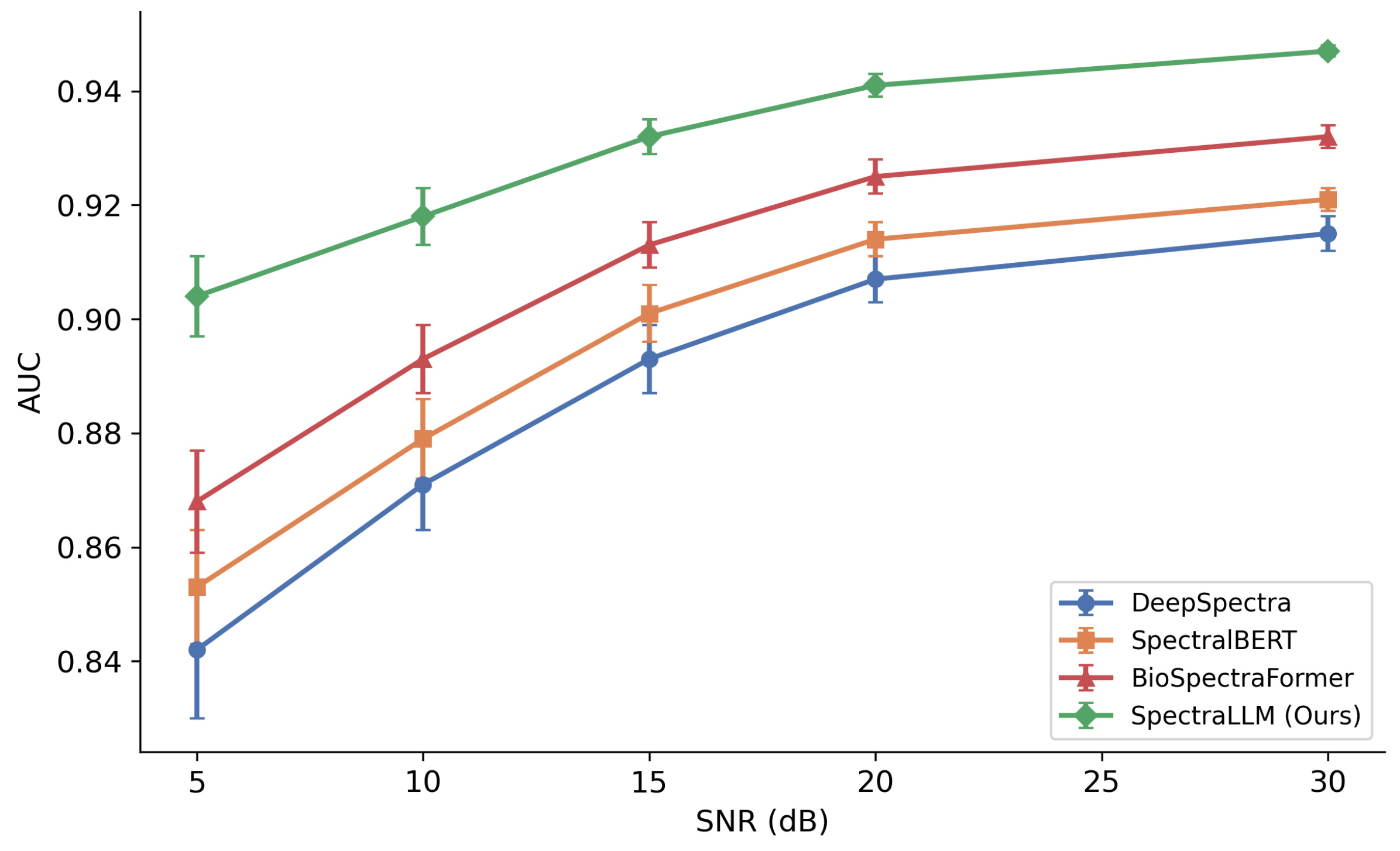
Figure 3.
Cell-type transfer on CellNMR-3K. Accuracy and F1 score for different adaptation strategies when training on 8 cell types and testing on 4 held-out cell types.
Figure 3.
Cell-type transfer on CellNMR-3K. Accuracy and F1 score for different adaptation strategies when training on 8 cell types and testing on 4 held-out cell types.
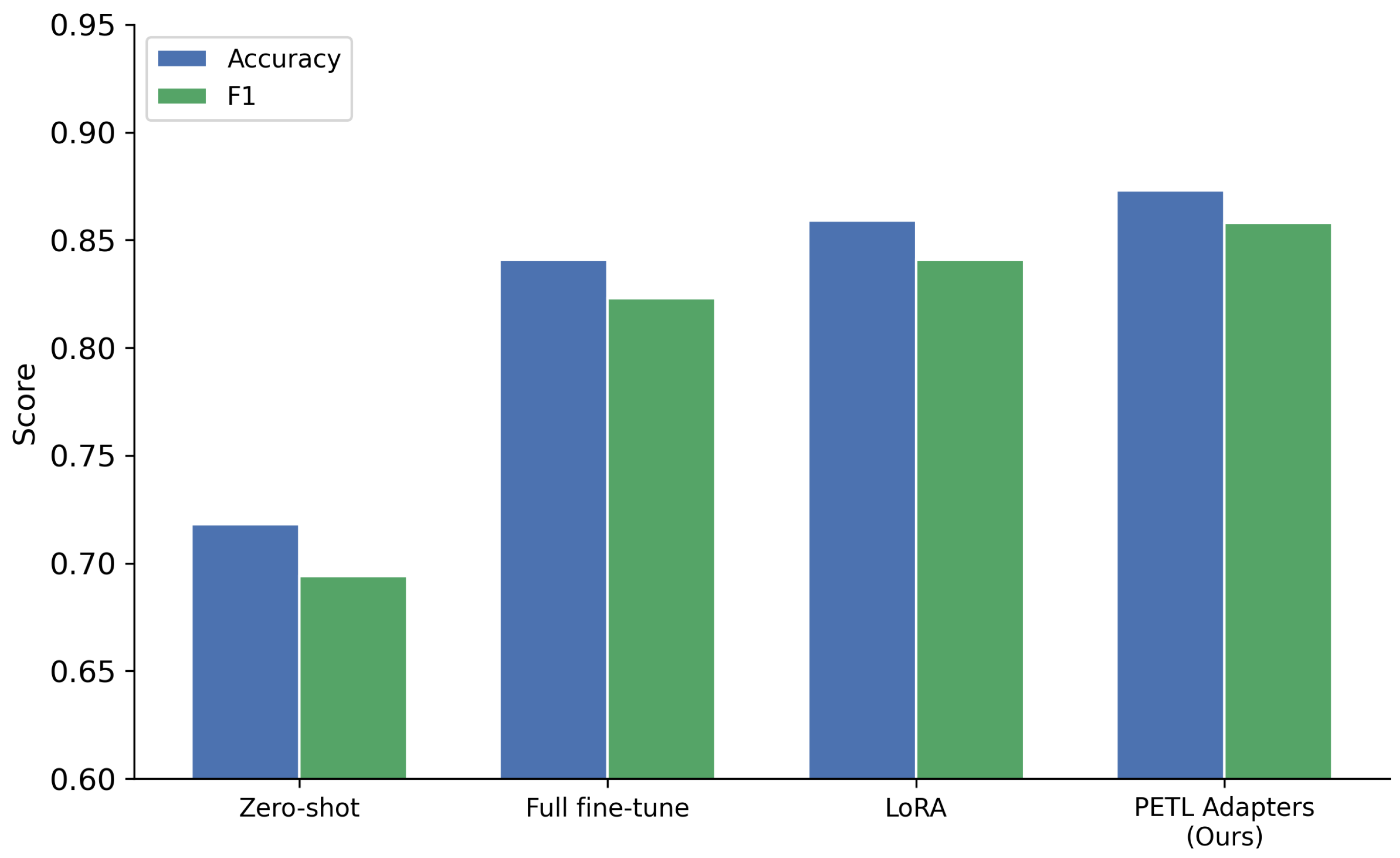
Figure 4.
Distillation comparison on MetaboSpectrum-10K. AUC and retention percentage for the teacher model, KL-distilled student, and flow-distilled student. Inference latency (ms) is annotated below each bar.
Figure 4.
Distillation comparison on MetaboSpectrum-10K. AUC and retention percentage for the teacher model, KL-distilled student, and flow-distilled student. Inference latency (ms) is annotated below each bar.
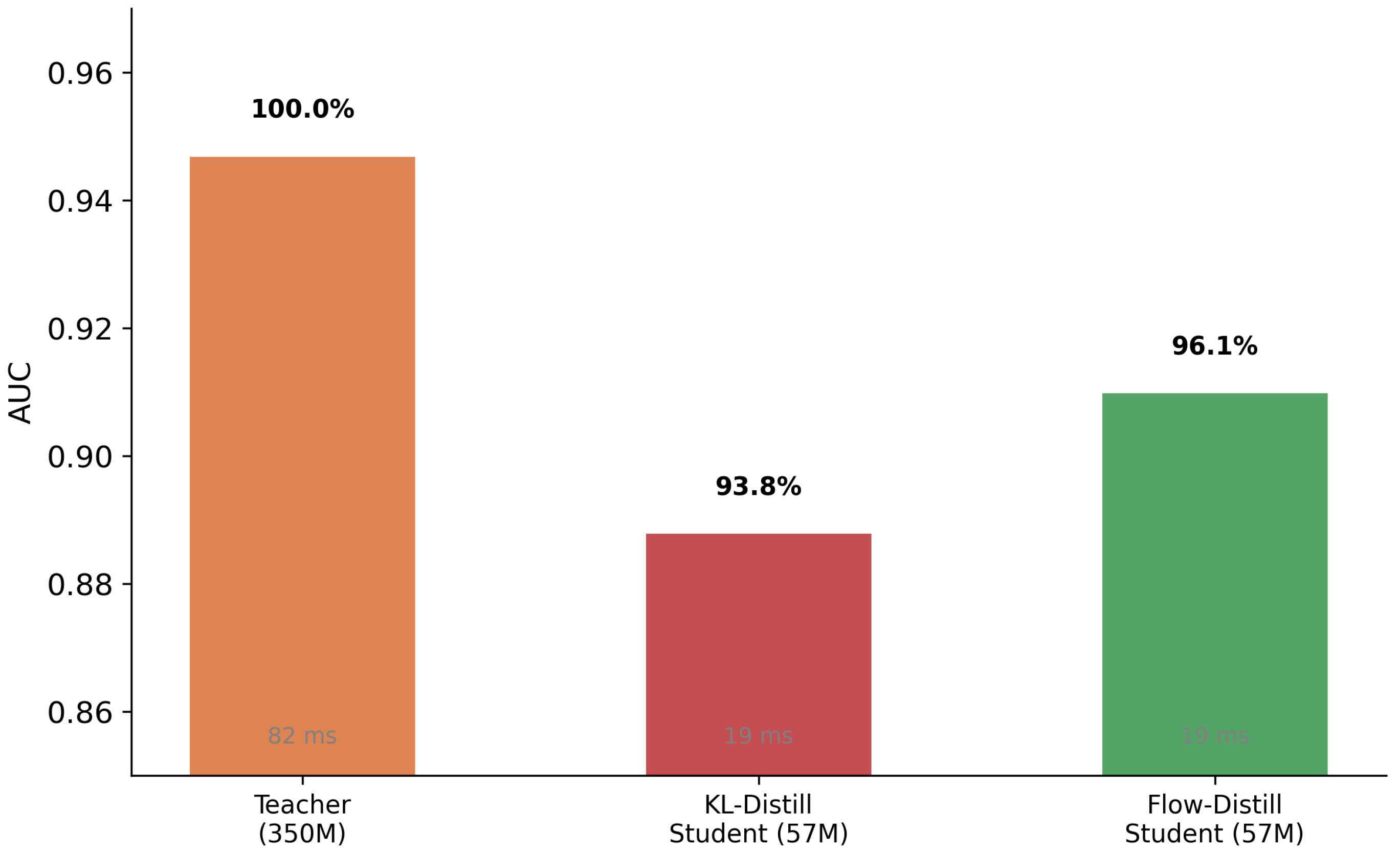
Figure 5.
Average learned fusion weights across sample categories on MetaboSpectrum-10K. The radar plot shows that MS dominates for metabolite-rich samples while NMR is weighted more heavily for protein-rich tissue extracts.
Figure 5.
Average learned fusion weights across sample categories on MetaboSpectrum-10K. The radar plot shows that MS dominates for metabolite-rich samples while NMR is weighted more heavily for protein-rich tissue extracts.
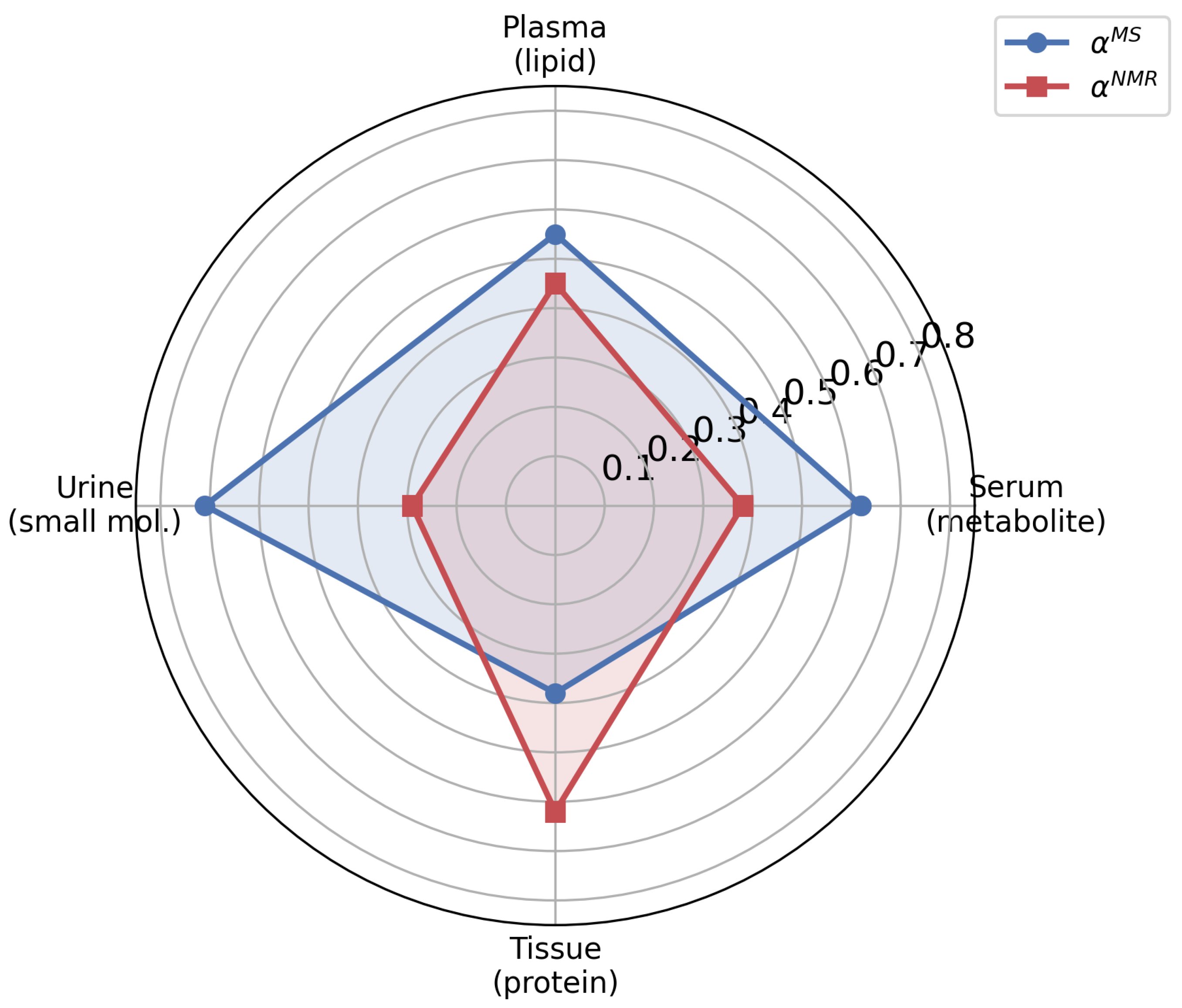
Figure 6.
Convergence analysis on MetaboSpectrum-10K. Validation AUC over training epochs for three methods. SpectraLLM reaches the AUC = 0.90 threshold significantly faster than baselines.
Figure 6.
Convergence analysis on MetaboSpectrum-10K. Validation AUC over training epochs for three methods. SpectraLLM reaches the AUC = 0.90 threshold significantly faster than baselines.
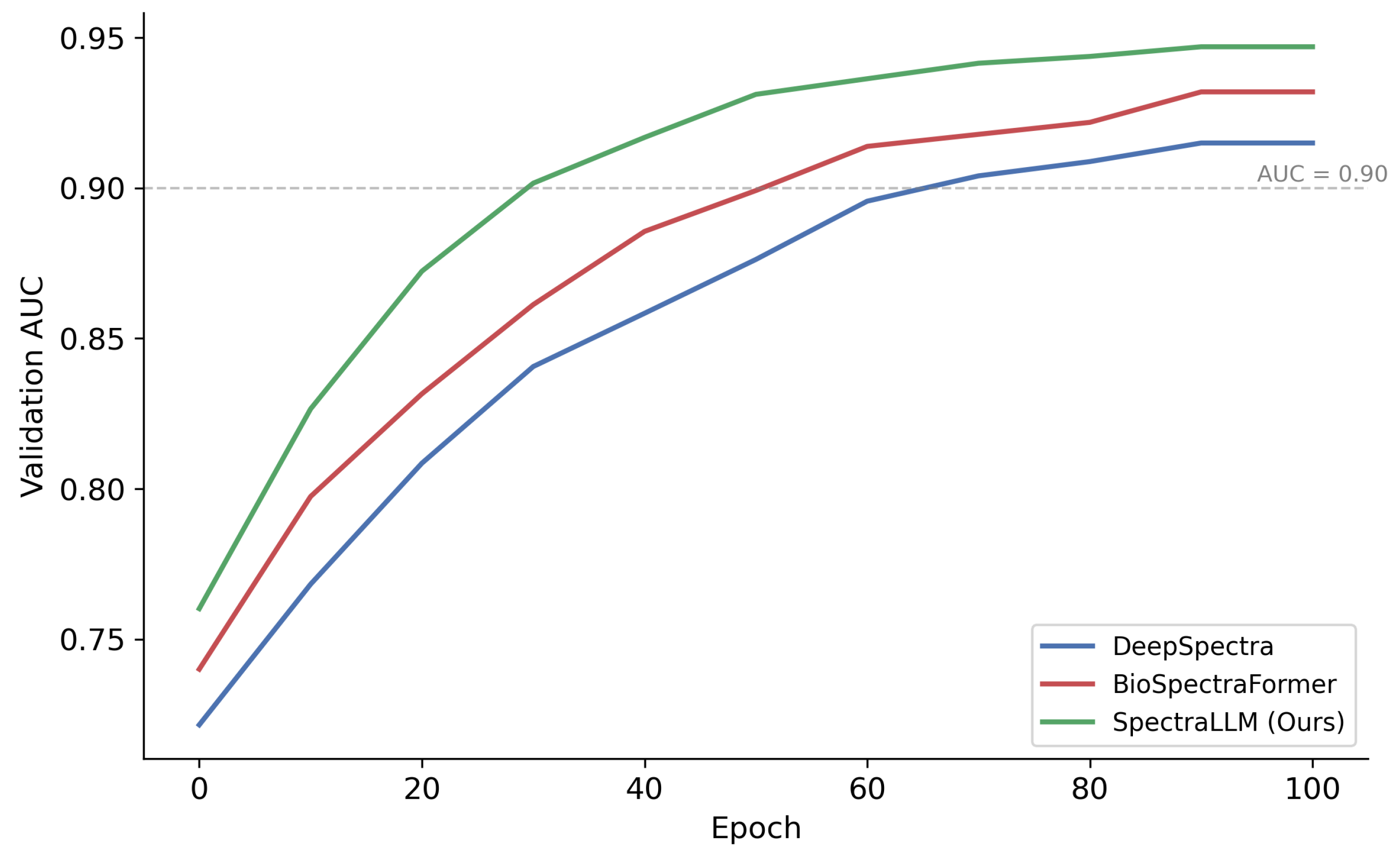
Figure 7.
Biological case study on early-stage pancreatic cancer detection. Scatter plot of predicted probabilities vs. ground truth labels for SpectraLLM and BioSpectraFormer. SpectraLLM produces more separable predictions between cancer and control samples.
Figure 7.
Biological case study on early-stage pancreatic cancer detection. Scatter plot of predicted probabilities vs. ground truth labels for SpectraLLM and BioSpectraFormer. SpectraLLM produces more separable predictions between cancer and control samples.
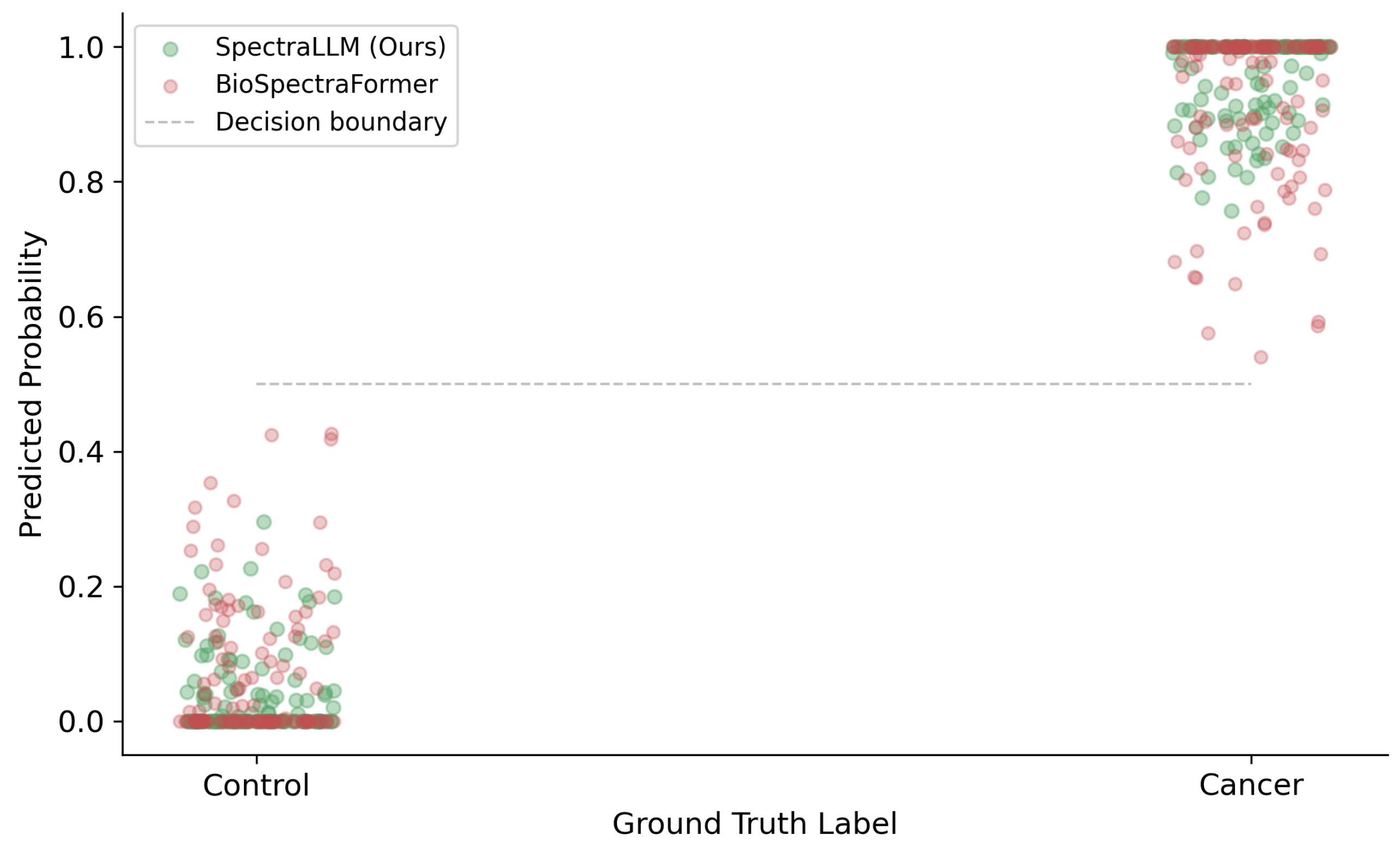

Table 1.
Main benchmark comparison on MetaboSpectrum-10K for biomarker identification. Best results are in bold.
Table 1.
Main benchmark comparison on MetaboSpectrum-10K for biomarker identification. Best results are in bold.
| Method | AUC ↑ | AUPR ↑ | F1 ↑ | Pearson r ↑ | Acc. ↑ |
| DeepSpectra | 0.915 | 0.887 | 0.880 | 0.901 | 0.862 |
| SpectralBERT | 0.921 | 0.894 | 0.887 | 0.908 | 0.871 |
| MS-NMR Fusion Net | 0.928 | 0.901 | 0.893 | 0.915 | 0.879 |
| BioSpectraFormer | 0.932 | 0.908 | 0.898 | 0.921 | 0.885 |
| SpectraLLM (Ours) | 0.947 | 0.923 | 0.912 | 0.938 | 0.904 |
Table 2.
Comparison on ProteinSpectra-5K for peptide identification.
| Method | Accuracy ↑ | F1 ↑ | Spearman ↑ |
| PepNovo | 0.891 | 0.876 | 0.883 |
| DeepNovoV2 | 0.903 | 0.891 | 0.897 |
| pNovus | 0.912 | 0.899 | 0.908 |
| SpectraLLM (Ours) | 0.943 | 0.928 | 0.931 |
Table 3.
Comparison on CellNMR-3K for cell-type classification.
| Method | Accuracy ↑ | F1 ↑ | Pearson r ↑ | Dice ↑ |
| NMR-Net | 0.854 | 0.841 | 0.889 | 0.823 |
| CellSpectra | 0.878 | 0.863 | 0.907 | 0.851 |
| MetaFormer | 0.892 | 0.879 | 0.918 | 0.868 |
| SpectraLLM (Ours) | 0.917 | 0.905 | 0.938 | 0.902 |
Table 4.
Ablation study on MetaboSpectrum-10K. Each row removes one component from the full SpectraLLM.
Table 4.
Ablation study on MetaboSpectrum-10K. Each row removes one component from the full SpectraLLM.
| Configuration | AUC | AUPR | F1 | Pearson r | Acc. |
| Full SpectraLLM | 0.947 | 0.923 | 0.912 | 0.938 | 0.904 |
| w/o Modality-Agnostic Enc. | 0.931 | 0.907 | 0.893 | 0.919 | 0.883 |
| w/o Dynamic Balance | 0.919 | 0.893 | 0.879 | 0.905 | 0.868 |
| w/o Flow Distillation | 0.943 | 0.918 | 0.907 | 0.934 | 0.899 |
| w/o PETL Adapters | 0.940 | 0.914 | 0.903 | 0.930 | 0.894 |
Table 5.
Hyperparameter sensitivity on MetaboSpectrum-10K. Left: adapter dimension r (with ). Right: distillation coefficient (with ).
Table 5.
Hyperparameter sensitivity on MetaboSpectrum-10K. Left: adapter dimension r (with ). Right: distillation coefficient (with ).
| r | AUC | Params (M) | AUC | Retention (%) | |
| 16 | 0.931 | 0.8 | 0.1 | 0.897 | 94.7 |
| 32 | 0.939 | 2.1 | 0.2 | 0.904 | 95.5 |
| 64 | 0.947 | 6.3 | 0.3 | 0.910 | 96.1 |
| 128 | 0.946 | 18.9 | 0.5 | 0.905 | 95.6 |
| 256 | 0.945 | 51.2 | 0.7 | 0.899 | 94.9 |
Table 6.
Cross-species transfer: training on human, testing on mouse serum spectra.
| Method | Accuracy ↑ | AUC ↑ |
| Zero-shot (no adaptation) | 0.712 | 0.768 |
| Full fine-tuning | 0.821 | 0.874 |
| LoRA | 0.843 | 0.891 |
| PETL Adapters (Ours) | 0.856 | 0.907 |
Disclaimer/Publisher’s Note: The statements, opinions and data contained in all publications are solely those of the individual author(s) and contributor(s) and not of MDPI and/or the editor(s). MDPI and/or the editor(s) disclaim responsibility for any injury to people or property resulting from any ideas, methods, instructions or products referred to in the content. |
© 2026 by the authors. Licensee MDPI, Basel, Switzerland. This article is an open access article distributed under the terms and conditions of the Creative Commons Attribution (CC BY) license (http://creativecommons.org/licenses/by/4.0/).
Copyright: This open access article is published under a Creative Commons CC BY 4.0 license, which permit the free download, distribution, and reuse, provided that the author and preprint are cited in any reuse.


