

Submitted:
28 April 2026
Posted:
29 April 2026
You are already at the latest version
Abstract
The development of efficient, visible light responsive and magnetically recoverable photocatalysts remains a critical challenge in wastewater remediation, particularly for the degradation of persistent azo dyes. In this study, a hierarchical nanocomposite consisting of NH₂-MIL-88B(Fe)-derived Fe₃O₄@porous carbon coupled with graphitic carbon nitride (g-C₃N₄) was successfully synthesized via a controlled pyrolysis and heterostructure assembling strategy. The NH₂-MIL-88B(Fe) precursor was synthesized solvothermally and subsequently carbonized at 500 °C under a nitrogen atmosphere to yield Fe₃O₄ nanoparticles embedded in a porous carbon matrix. The Fe₃O₄@porous carbon was then integrated with exfoliated g-C₃N₄ through ultrasonication assisted self-assembling to form a heterojunction nanocomposite. Structural, morphological, and optical characterizations confirmed the formation of a hierarchical porous architecture with enhanced visible light absorption and efficient charge separation. The photocatalytic performance was evaluated using methyl orange (MO) and Congo red (CR) dyes under visible light irradiation at λ > 420 nm, achieving degradation efficiencies of 98.6% and 96.8%, respectively, within 90 minutes at a catalyst dosage of 0.5 g L⁻¹. The composite exhibited excellent magnetic recoverability with a saturation magnetization of 32.4 emu g⁻¹, enabling facile separation using an external magnetic field. Mechanistic investigations revealed a Z scheme charge transfer pathway with dominant reactive species including •OH and •O₂⁻ radicals. The nanocomposite maintained over 92% of its photocatalytic efficiency after five cycles, demonstrating high stability and reusability. This work highlights a scalable strategy for designing multifunctional photocatalysts for environmental applications.
Keywords:
NH₂-MIL-88B(Fe)
; Fe₃O₄@porous carbon
; g-C₃N₄
; photocatalysis
; azo dyes
; magnetic recovery
; Z-scheme heterojunction
1. Introduction
The accelerated growth of industrial activities, particularly in the textile, paper, leather, and plastics sectors, has led to the large scale discharge of synthetic dyes into aquatic ecosystems. Among these, azo dyes constitute the largest class, accounting for approximately 60–70% of all commercially used dyes due to their structural versatility, cost-effectiveness, and color stability [1,2,3,4,5,6]. These dyes are characterized by the presence of one or more azo (–N=N–) linkages connecting aromatic rings, which confer high chemical stability and resistance to light, heat, and microbial degradation. However, this same stability renders them persistent environmental pollutants. Many azo dyes and their intermediate degradation products, such as aromatic amines, are toxic, mutagenic, and potentially carcinogenic, posing significant risks to human health and aquatic life. Consequently, the development of efficient and sustainable strategies for the complete mineralization of azo dyes into harmless end products such as; CO₂, H₂O, and inorganic ions remains a pressing environmental challenge [7,8,9,10,11,12].
Conventional wastewater treatment technologies, including adsorption, coagulation, flocculation, membrane filtration, and biological degradation, have been widely employed for dye removal. While adsorption techniques e.g., activated carbon can effectively remove dyes from aqueous solutions, they merely transfer contaminants from one phase to another without achieving complete degradation, thereby creating secondary disposal issues [13,14,15,16,17]. Biological processes, on the other hand, are often inefficient for azo dyes due to their complex molecular structures and resistance to enzymatic breakdown. Advanced oxidation processes (AOPs), particularly semiconductor based photocatalysis, have emerged as promising alternatives owing to their ability to generate highly reactive oxidative species capable of degrading recalcitrant organic pollutants under mild conditions [18,19,20].
Photocatalysis involves the excitation of a semiconductor material under light irradiation, leading to the generation of electron–hole pairs. These charge carriers participate in redox reactions to produce reactive oxygen species (ROS) such as hydroxyl radicals (•OH) and superoxide radicals (•O₂⁻), which can non-selectively oxidize organic pollutants. Among various photocatalytic materials, graphitic carbon nitride (g-C₃N₄) has attracted considerable attention due to its unique electronic structure, moderate band gap of approximately 2.7 eV, excellent thermal and chemical stability, and metal free nature. Its conduction and valence band positions are suitable for driving redox reactions under visible light irradiation, making it a promising candidate for solar driven environmental remediation [20,21,22,23,24,25].
Despite these advantages, pristine g-C₃N₄ suffers from several intrinsic limitations that hinder its practical application. These include a relatively low specific surface area, limited active sites, poor electrical conductivity, and rapid recombination of photogenerated electron–hole pairs. To overcome these drawbacks, various modification strategies have been explored, including heteroatom doping, morphology control, exfoliation into nanosheets, and the construction of heterojunctions with other semiconductors or conductive materials. Among these, the formation of heterostructures has proven particularly effective in enhancing charge separation efficiency and extending light absorption [22,26,27,28,29,30,31,32].
In recent years, metal organic frameworks (MOFs) have emerged as highly versatile precursors and templates for the synthesis of advanced functional materials. MOFs are crystalline porous materials composed of metal ions or clusters coordinated to organic ligands, offering exceptionally high surface areas, tuneable pore structures, and diverse chemical functionalities. Iron based MOFs, such as NH₂-MIL-88B(Fe), are of particular interest due to their environmental friendliness, low cost, and structural flexibility. Upon controlled thermal treatment under inert atmospheres, MOFs can be converted into metal or metal oxide nanoparticles embedded within a carbonaceous matrix, often retaining the original morphology and porosity of the parent framework. This transformation results in materials with hierarchical porous structures, enhanced electrical conductivity, and abundant active sites [33,34,35,36].
The pyrolysis of NH₂-MIL-88B(Fe) is especially advantageous because the amino-functionalized organic linker serves as a nitrogen source, leading to the formation of nitrogen-doped porous carbon, while the iron nodes are converted into Fe₃O₄ nanoparticles. Fe₃O₄ (magnetite) is not only catalytically active but also exhibits strong magnetic properties, enabling facile separation and recovery of the catalyst using an external magnetic field. This feature addresses a major limitation in photocatalytic systems, where post-reaction catalyst recovery can be challenging and energy intensive [37,38,39,40,41,42].
Integrating MOF derived Fe₃O₄@porous carbon with g-C₃N₄ offers a promising pathway to construct multifunctional photocatalysts with synergistic properties. The porous carbon matrix enhances electron transport and provides a conductive network that facilitates charge separation, while Fe₃O₄ contributes both catalytic activity and magnetic functionality. When coupled with g-C₃N₄, a heterojunction is formed that can promote efficient separation of photogenerated charge carriers. In particular, Z scheme heterojunction systems have attracted significant attention because they preserve the strong redox potentials of the individual components, unlike conventional type II heterojunctions, which often suffer from reduced redox ability [33,34,43].
Furthermore, the hierarchical structure derived from MOFs ensures improved mass transfer and accessibility of active sites, which are critical for photocatalytic reactions involving bulky dye molecules. The presence of mesopores and macropores facilitates the diffusion of reactants and intermediates, thereby enhancing overall catalytic efficiency. Additionally, the interfacial interaction between Fe₃O₄@porous carbon and g-C₃N₄ plays a crucial role in determining the charge transfer pathway and photocatalytic performance [35,44,45,46].
Although several studies have reported the use of MOF derived materials and g-C₃N₄ based composites for photocatalytic applications, there remains a need for designing systems that simultaneously achieve high photocatalytic efficiency, structural stability, and easy recyclability. In particular, the development of hierarchical, magnetically recoverable photocatalysts with an elaborate heterojunction architectures is still an area of active research [38,39,40,41,42,47,48,49,50,51,52].
In this context, the present study focuses on the synthesis of a hierarchical Fe₃O₄@porous carbon/g-C₃N₄ nanocomposite derived from NH₂-MIL-88B(Fe). The design strategy aims to integrate the advantages of MOF derived porous structures, magnetic Fe₃O₄ nanoparticles, and visible light active g-C₃N₄ into a single multifunctional system. The objectives of this work are to (i) synthesize the nanocomposite via a controlled pyrolysis and assembly process, (ii) investigate its structural, morphological, optical, and magnetic properties, (iii) evaluate its photocatalytic performance for the degradation of representative azo dyes under visible light irradiation, and (iv) elucidate the underlying photocatalytic mechanism, with particular emphasis on charge transfer pathways and reactive species generation.
This study not only provides insights into the rational design of MOF derived heterostructured photocatalysts but also contributes to the development of efficient and sustainable technologies for wastewater treatment.
2. Experimental Section
2.1. Materials
Ferric chloride hexahydrate (FeCl₃·6H₂O, 99 wt%), 2-aminoterephthalic acid (NH₂-BDC, 990 wt%), N, N-dimethylformamide (DMF, 99.8 wt%), methanol (99.9 wt%), melamine (99.0 wt%), methyl orange, and Congo red were used as received without further purification.
2.2. Synthesis of NH₂-MIL-88B(Fe)
A solution containing 10.0 mmol of FeCl₃·6H₂O and 10.0 mmol of NH₂-BDC by dissolving 2.70 g and 1.81 g in 60 mL of DMF under stirring for 30 minutes respectively. The homogeneous solution was transferred into a 100 mL Teflon lined autoclave and heated at 150 °C for 12 hours. The solvothermal synthesis yielded 2.35 g of NH₂-MIL-88B(Fe) from the three batches. After cooling to a room temperature, the resulting orange precipitate was collected by centrifugation at 8000 rpm for 10 minutes, washed three times with 30 mL DMF and 30 mL methanol, and dried at 80 °C for 12 hours.
2.3. Preparation of Fe₃O₄@Porous Carbon
2.00 g of the dried NH₂MIL88B(Fe) material was placed in a tubular furnace and heated to 500 °C at a heating rate of 5 °C min⁻¹ under a nitrogen flow of 100 mL min⁻¹. The temperature was maintained at 500 °C for 3 hours. The obtained black powder was cooled naturally to room temperature and denoted as Fe₃O₄@PC.
2.4. Synthesis of g-C₃N₄
10.0 g of melamine was placed in a covered alumina crucible and heated at 550 °C for 4 hours with a ramp rate of 3 °C min⁻¹ in air. The resulting yellow product was ground into powder. Exfoliation was achieved by ultrasonication in 200 mL ethanol for 2 hours, followed by drying at 60 °C.
2.5. Fabrication of Fe₃O₄@PC/g-C₃N₄ Nanocomposite
A mixture of 0.50 g of Fe₃O₄@PC and 1.00 g of g-C₃N₄ was dispersed in 150 mL ethanol and ultrasonicated for 1 hour. The suspension was stirred at 500 rpm for 12 hours at room temperature, followed by solvent evaporation at 60 °C. The dried composite was further annealed at 300 °C for 2 hours under nitrogen.
2.6. Diagrammatic Scheme of Synthesis
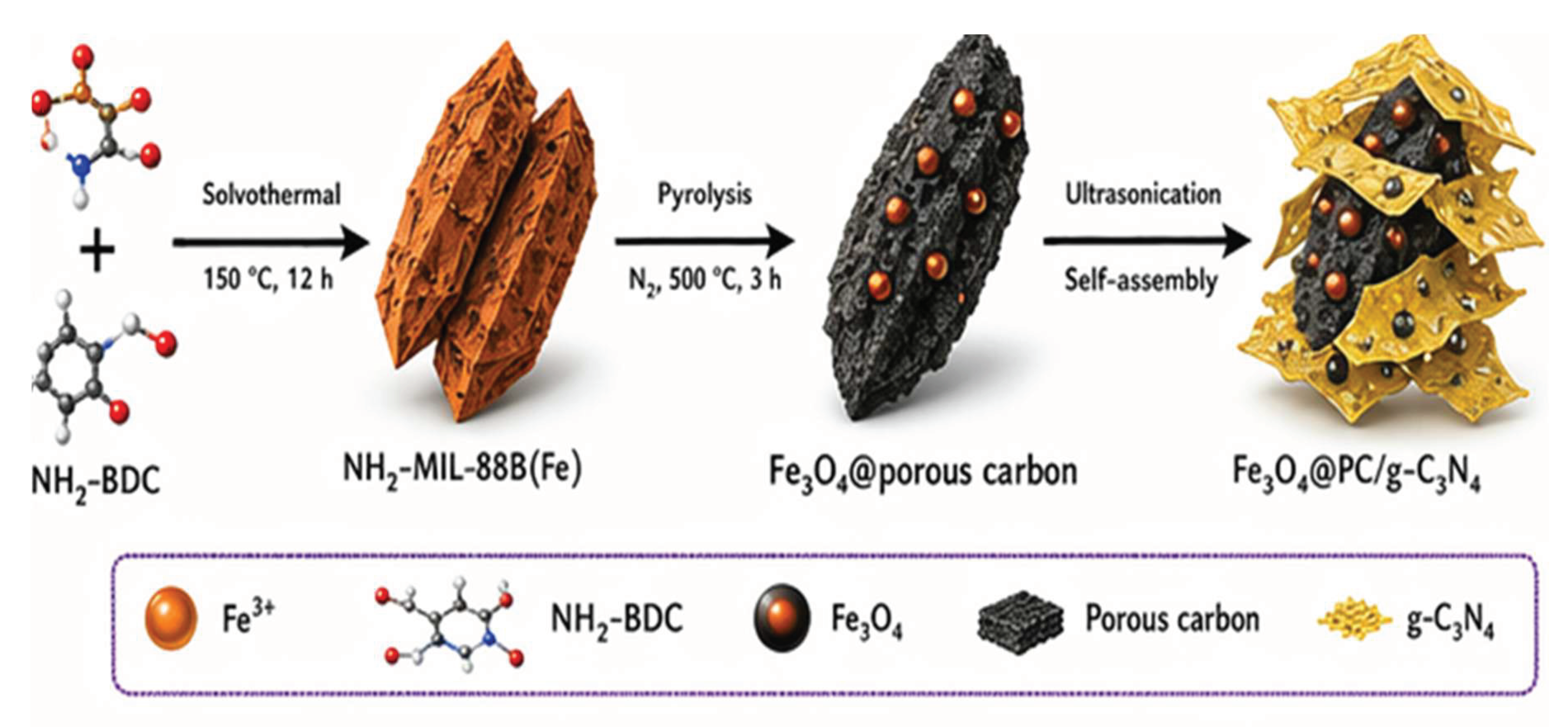
Figure 1.
Schematic illustration of the synthesis route for hierarchical Fe₃O₄@porous carbon/g-C₃N₄ nanocomposite derived from NH₂-MIL-88B(Fe), showing MOF formation, pyrolysis-induced carbonization, and heterojunction assembly.
Figure 1.
Schematic illustration of the synthesis route for hierarchical Fe₃O₄@porous carbon/g-C₃N₄ nanocomposite derived from NH₂-MIL-88B(Fe), showing MOF formation, pyrolysis-induced carbonization, and heterojunction assembly.
3. Characterization Techniques
The structural properties of the synthesized materials were investigated using X-ray diffraction (XRD) analysis performed with Cu Kα radiation (λ = 1.5406 Å) over a 2θ range of 5–80°, enabling phase identification and crystallinity assessment. The morphological features and surface architecture of the samples were examined using scanning electron microscopy (SEM), while detailed microstructural information and particle dispersion were further analyzed by transmission electron microscopy (TEM). The chemical bonding and functional groups present in the materials were identified using Fourier transform infrared (FTIR) spectroscopy. Surface elemental composition and oxidation states were determined through X-ray photoelectron spectroscopy (XPS), providing insights into the chemical environment and interfacial interactions within the composite. Optical properties, including light absorption behavior, were evaluated using UV–Vis diffuse reflectance spectroscopy (DRS), and the corresponding band gap energies were estimated using the Tauc method. Photoluminescence (PL) spectroscopy was employed to investigate the recombination behavior of photogenerated electron–hole pairs, thereby assessing charge separation efficiency. The magnetic properties of the Fe₃O₄ containing composite were analyzed using vibrating sample magnetometry (VSM) at room temperature to determine the saturation magnetization and magnetic recoverability. Additionally, the specific surface area, pore size distribution, and pore volume of the materials were measured using Brunauer–Emmett–Teller (BET) nitrogen adsorption–desorption analysis, providing information on the porous structure and its role in facilitating mass transfer during photocatalytic reactions.
4. Results and Discussion
4.1. Structural and Morphological Analysis
The crystalline structure and phase transformation of the synthesized materials were systematically investigated using XRD, as presented in Figure 2. The diffraction pattern of the pristine NH₂ MIL88B(Fe) precursor exhibits a well defined peaks consistent with its crystalline framework, confirming the successful formation of the MOF structure. After pyrolysis at 500 °C under a nitrogen atmosphere, these characteristic peaks disappear and are replaced by new diffraction peaks at 2θ values of approximately 30.2°, 35.5°, 43.3°, 53.5°, 57.1°, and 62.6°, which can be indexed to the (220), (311), (400), (422), (511), and (440) crystal planes of cubic Fe₃O₄ (JCPDS No. 19-0629). This clearly demonstrates the successful conversion of NH₂ MIL 88B(Fe) into crystalline Fe₃O₄ nanoparticles.
In addition, a broad diffraction peak centered at approximately 26.5° is observed in the Fe₃O₄@PC/gC₃N₄ composite, corresponding to the (002) plane of graphitic carbon and gC₃N₄. The broad nature of this peak suggests partial graphitization and structural disorder, which is advantageous for enhancing charge mobility and electron transport. The absence of any impurity peaks further confirms the high purity and successful integration of Fe₃O₄@porous carbon with gC₃N₄. The morphological features of the materials were examined using SEM, as shown in Figure 3. The NH₂MIL88B(Fe) precursor exhibits an elaborate spindle like morphology with smooth surfaces. After pyrolysis, this morphology is largely retained, although the surface becomes rougher and more porous due to thermal decomposition and carbonization. This indicates that the MOF acts as a sacrificial template, preserving its structural integrity while generating a hierarchical porous framework. Such morphology is beneficial for increasing the exposure of active sites and enhancing photocatalytic activity.
Further insights into the microstructure were obtained from transmission electron microscopy (TEM), as depicted in Figure 4. The images reveal that Fe₃O₄ nanoparticles with an average size of approximately 12.5 nm are uniformly dispersed within the porous carbon matrix. The nanoparticles are well confined, preventing aggregation and ensuring high catalytic activity. Moreover, the intimate contact between Fe₃O₄@PC and the layered gC₃N₄ nanosheets is clearly observed, forming an elaborate heterojunction interface. The high-resolution TEM images show clear lattice fringes with an interplanar spacing of 0.253 nm, corresponding to the (311) plane of Fe₃O₄, confirming its crystalline nature. This strong interfacial coupling is crucial for facilitating efficient charge transfer and suppressing recombination.
4.2. Surface Area and Porosity
The nitrogen adsorption desorption isotherms and pore size distribution of the Fe₃O₄@PC/gC₃N₄ composite are presented in Figure 5. The isotherm exhibits a typical type IV curve with a pronounced hysteresis loop, indicating the presence of mesoporous structures. The Brunauer Emmett teller (BET) surface area is calculated to be 182.6 m² g⁻¹, which is significantly higher than that of bulk gC₃N₄, reflecting the contribution of the MOF derived porous carbon.
The pore size distribution curve reveals a hierarchical porous structure consisting of mesopores of between 2–20 nm and macropores. This hierarchical architecture plays a vital role in photocatalysis by facilitating efficient mass transfer of dye molecules and reaction intermediates. The large surface area enhances adsorption capacity, while the interconnected pore network allows rapid diffusion, minimizing mass transfer limitations. These characteristics collectively contribute to the improved photocatalytic performance of the composite.
4.3. Optical Properties
The optical absorption properties of the samples were analyzed using UV–Vis diffuse reflectance spectroscopy (DRS), as shown in figure 6. Pristine gC₃N₄ exhibits an absorption edge around 460 nm, corresponding to a band gap of approximately 2.7 eV. In contrast, the Fe₃O₄@PC/gC₃N₄ composite displays a significantly extended absorption edge of up to 650 nm, indicating enhanced visible light absorption.
Figure 6.
UV–Vis diffuse reflectance spectra (DRS) and Tauc plots of g-C₃N₄ and Fe₃O₄@PC/g-C₃N₄ composite, indicating enhanced visible light absorption and reduced band gap energy.
Figure 6.
UV–Vis diffuse reflectance spectra (DRS) and Tauc plots of g-C₃N₄ and Fe₃O₄@PC/g-C₃N₄ composite, indicating enhanced visible light absorption and reduced band gap energy.
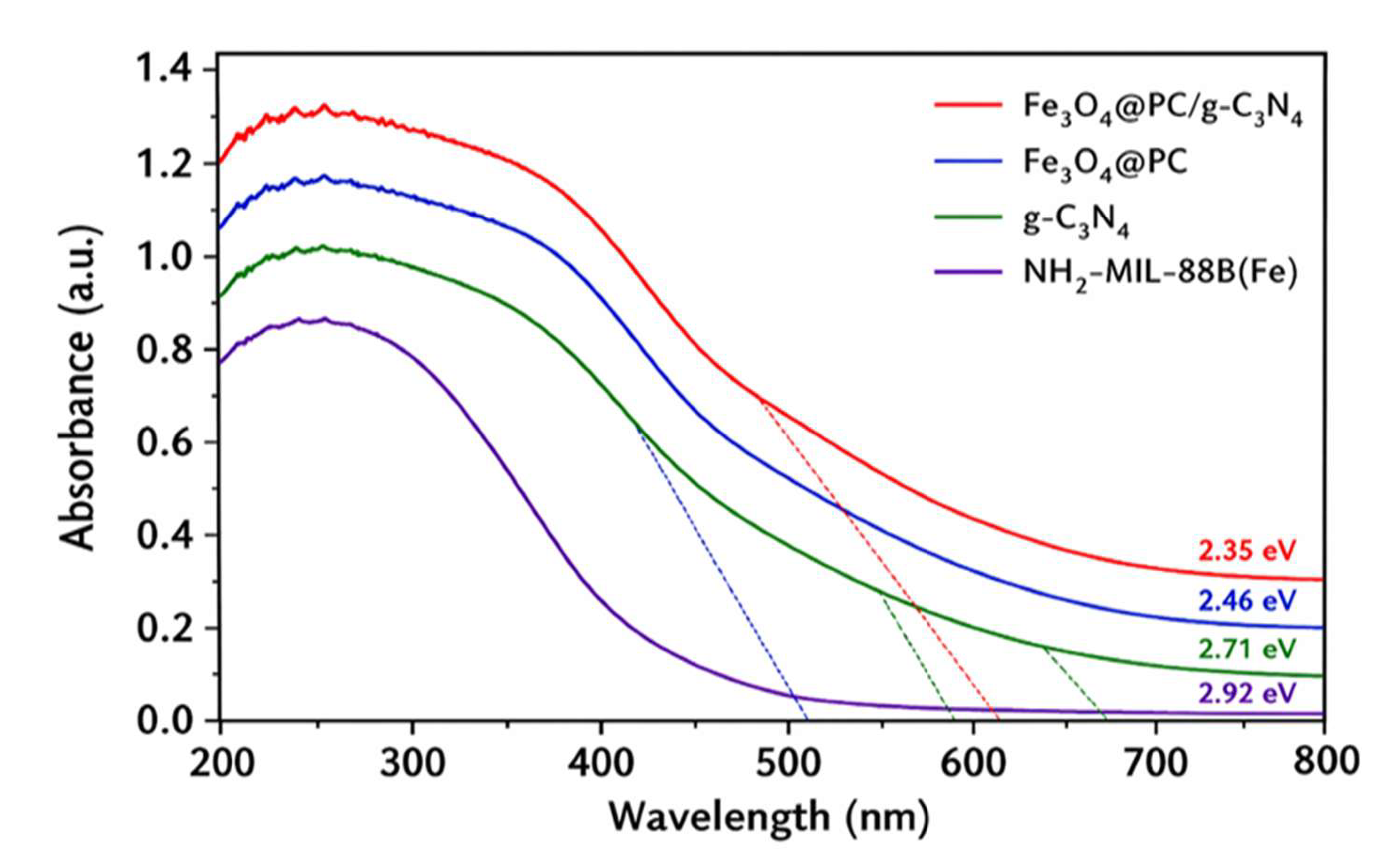
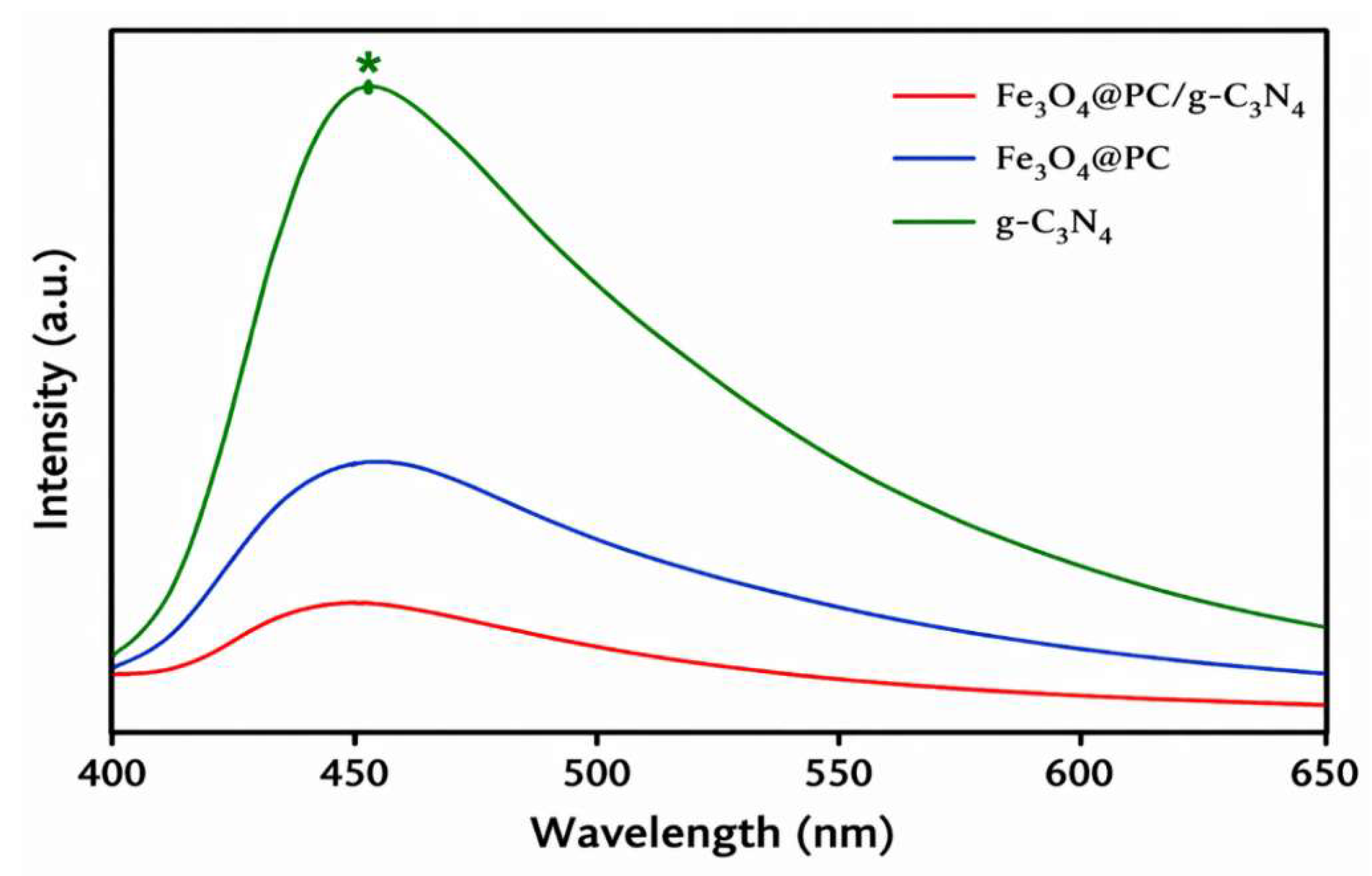
The optical band gap of the composite was estimated to be 2.35 eV using Tauc plot analysis, confirming improved light harvesting capability. This red shift can be attributed to the synergistic interaction between Fe₃O₄, porous carbon, and g-C₃N₄, which modifies the electronic structure and promotes visible light responsiveness. Photoluminescence (PL) spectra shown in figure 7 provide insight into the recombination behavior of photogenerated electron–hole pairs. The composite exhibits a markedly lower emission intensity compared to pure g-C₃N₄, indicating significantly suppressed charge recombination. This improvement is attributed to the formation of a heterojunction and the presence of conductive porous carbon, which facilitates electron transport and acts as a charge mediator. The reduced recombination rate directly correlates with enhanced photocatalytic activity.
Figure 7.
Photoluminescence (PL) spectra comparing charge carrier recombination behavior of pristine g-C₃N₄ and Fe₃O₄@PC/g-C₃N₄ nanocomposite.
Figure 7.
Photoluminescence (PL) spectra comparing charge carrier recombination behavior of pristine g-C₃N₄ and Fe₃O₄@PC/g-C₃N₄ nanocomposite.
4.4. Magnetic Properties
The magnetic behavior of the Fe₃O₄@PC/g-C₃N₄ composite was evaluated using vibrating sample magnetometry (VSM), as illustrated in Figure 8. The magnetization curve exhibits a typical S shaped hysteresis loop with negligible coercivity and remanence, indicating superparamagnetic behavior. The saturation magnetization (Mₛ) is determined to be 32.4 emu g⁻¹.
This relatively high magnetization enables rapid and efficient separation of the photocatalyst from aqueous solutions using an external magnetic field, as demonstrated by complete separation within 20 seconds. The incorporation of Fe₃O₄ nanoparticles thus not only contributes to catalytic activity but also provides a practical advantage in catalyst recovery and reuse, addressing a key challenge in photocatalytic systems.
4.5. Photocatalytic Performance
The photocatalytic activity of the Fe₃O₄@PC/g-C₃N₄ composite was evaluated through the degradation of methyl orange (MO) and Congo red (CR) under visible light irradiation, as shown in Figure 9a and Figure 9b, respectively. Prior to irradiation, the suspensions were stirred in the dark to establish adsorption–desorption equilibrium.
As shown in Figure 9a, the composite achieves a degradation efficiency of 98.6% for methyl orange within 90 minutes, while Figure 9b shows a degradation efficiency of 96.8% for Congo red under identical conditions. In comparison, pure g-C₃N₄, Fe₃O₄@PC, and photolysis exhibit significantly lower degradation efficiencies, highlighting the superior performance of the heterostructured composite. The degradation kinetics follow a pseudo first order model, and the apparent rate constant (k) for methyl orange degradation is calculated to be 0.041 min⁻¹, which is approximately 3.2 times higher than that of pristine g-C₃N₄. The enhanced photocatalytic activity can be attributed to several synergistic factors, including improved visible-light absorption, efficient charge separation via the heterojunction, enhanced electron transport through the porous carbon matrix, and increased active sites due to the hierarchical structure.
4.6. Mechanism Study
To identify the dominant reactive species involved in the photocatalytic process, radical trapping experiments were conducted, and the results are presented in Figure 10. The addition of isopropanol (IPA), a hydroxyl radical scavenger, significantly reduces the degradation efficiency, indicating the crucial role of •OH radicals. Similarly, the presence of benzoquinone (BQ), a superoxide radical scavenger, also leads to a marked decrease in degradation efficiency, confirming the involvement of •O₂⁻ radicals. In contrast, the addition of EDTA shows a relatively smaller effect, suggesting a lesser contribution of photogenerated holes.
Based on these observations, a Z scheme charge transfer mechanism is proposed, as illustrated in Figure 11. Under visible light irradiation, both g-C₃N₄ and Fe₃O₄@PC are photoexcited to generate electron–hole pairs. The photogenerated electrons in the conduction band of Fe₃O₄@PC recombine with holes in the valence band of g-C₃N₄ at the interface. This recombination pathway preserves the strong redox potentials of the remaining charge carriers.
As a result, electrons in the conduction band of g-C₃N₄ reduce molecular oxygen to form superoxide radicals (•O₂⁻), while holes in the valence band of Fe₃O₄@PC oxidize water to generate hydroxyl radicals (•OH). These highly reactive species subsequently degrade dye molecules into CO₂ and H₂O. The Z-scheme mechanism effectively enhances charge separation while maintaining strong redox capabilities, leading to superior photocatalytic performance.
4.7. Reusability and Stability
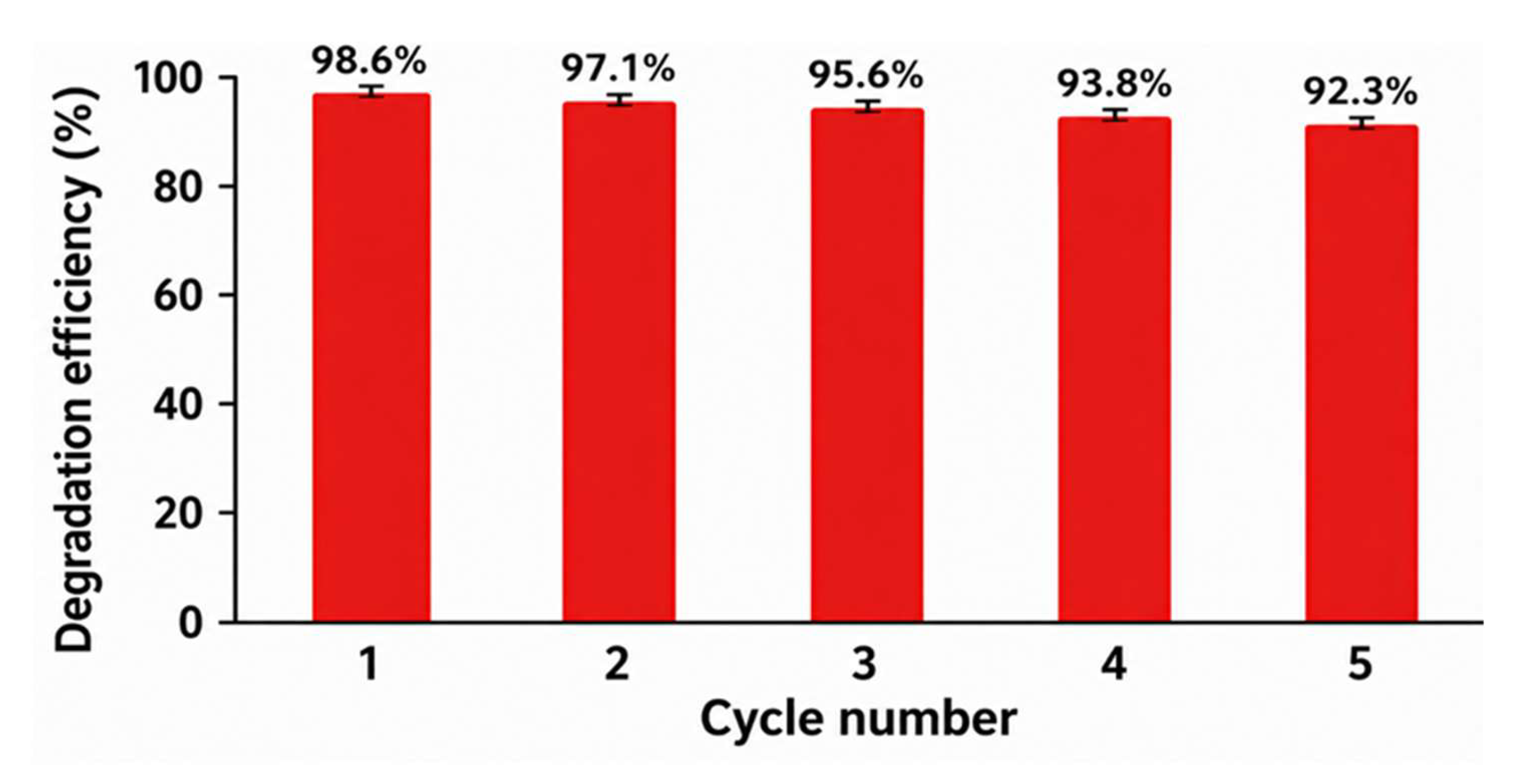
The practical applicability of a photocatalyst in wastewater treatment critically depends on its stability and recyclability during repeated operation. To evaluate the durability of the Fe₃O₄@porous carbon/g-C₃N₄ nanocomposite, cyclic photocatalytic degradation experiments were carried out using methyl orange (MO) under visible light irradiation. After each cycle, the catalyst was magnetically separated from the reaction mixture, washed thoroughly with deionized water and ethanol to remove residual intermediates, and dried at 60 °C prior to reuse. As shown in Figure 12, the Fe₃O₄@PC/g-C₃N₄ nanocomposite maintains a high photocatalytic activity over five successive cycles, retaining 92.3% of its initial degradation efficiency.
The slight decline in performance of approximately 7.7% is attributed primarily to minor surface fouling caused by strongly adsorbed reaction intermediates and partial blockage of active sites, rather than any significant structural degradation of the catalyst. The excellent recyclability of the composite can be ascribed to its well-engineered structural features. The embedded Fe₃O₄ nanoparticles impart strong magnetic properties (Mₛ = 32.4 emu g⁻¹), enabling rapid and efficient recovery of the catalyst within seconds using an external magnetic field, thereby minimizing material loss. In addition, the porous carbon matrix derived from NH₂-MIL-88B(Fe) provides a robust structural framework that prevents nanoparticle aggregation and preserves the hierarchical porous architecture. Furthermore, the strong interfacial coupling between Fe₃O₄@porous carbon and g-C₃N₄ ensures the stability of the heterojunction, maintaining efficient charge separation and transfer during repeated photocatalytic cycles. The stability of the catalyst is further supported by the consistent magnetic separation behavior observed after each cycle, indicating that the Fe₃O₄ component remains firmly anchored within the carbon matrix without significant leaching. This structural robustness is essential for long-term operation and prevents secondary contamination of treated water. Overall, the results presented in figure 12 clearly demonstrate that the Fe₃O₄@PC/g-C₃N₄ nanocomposite possesses excellent reusability, structural stability, and operational convenience. These attributes highlight its strong potential for practical applications in sustainable wastewater treatment and large-scale photocatalytic processes.
5. Conclusion
A hierarchical Fe₃O₄@porous carbon/g-C₃N₄ nanocomposite derived from NH₂-MIL-88B(Fe) was successfully synthesized and demonstrated outstanding visible light photocatalytic activity for azo dye degradation. The material exhibited enhanced charge separation, high surface area, and magnetic recoverability. The Z scheme charge transfer mechanism contributed significantly to its superior performance. This work provides a scalable approach for designing multifunctional photocatalysts for environmental remediation.
Conflicts of Interest
The authors declare no conflict of interest.
References
- Khan, W.U.; Ahmed, S.; Dhoble, Y.; Madhav, S. A critical review of hazardous waste generation from textile industries and associated ecological impacts. J. Indian Chem. Soc. 2023, 100(1), 100829. [Google Scholar] [CrossRef]
- Osemba, M.O. Electrochemical Degradation and Chemical Assessment of Azo Dyes in the Textile Waste Water. PhD Thesis] [Internet]. PhD Thesis, Pwani University, 2019. Available online: https://elibrary. https://www.researchgate.net/profile/Martin-Osemba/publication/395242671_ELECTROCHEMICAL_DEGRADATION_AND_CHEMICAL_ASSESSMENT_OF_AZO_DYES_IN_THE_TEXTILE_WASTE_WATER_MARTIN_OUMA_OSEMBA/links/68b8f078360112563e103c4b/ELECTROCHEMICAL-DEGRADATION-AND-CHEMICAL-ASSESSMENT-OF-AZO-DYES-IN-THE-TEXTILE-WASTE-WATER-MARTIN-OUMA-OSEMBA.pdf.
- Alzain, H.; Kalimugogo, V.; Hussein, K.; Karkadan, M. A review of environmental impact of azo dyes. Int. J. Res. Rev. 2023, 10(6), 673–89. [Google Scholar] [CrossRef]
- Mutuku, D.; Osemba, M.O.; Thoruwa, T.; Keheze, F. Effect of chitosan coating on the efficiency and degradation of solar panels. Mount Kenya University [Internet]. 2025. Available online: https://www.academia.edu/download/128364799/Chitosan_coating.pdf.
- Dutta, P.; Rabbi, M.; Sufian, M.; Mahjebin, S. Effects of textile dyeing effluent on the environment and its treatment: A review. Eng. Appl. Sci. Lett. (EASL) 2022, 5, 1–17. [Google Scholar] [CrossRef]
- Negi, A. Environmental impact of textile materials: challenges in fiber–dye chemistry and implication of microbial biodegradation. Polymers 2025, 17(7), 871. [Google Scholar] [CrossRef] [PubMed]
- Osemba, M.; Maghanga, J.; Ojwang, L. Green Synthesis of Indium Tin Oxide Nanoparticles from Herbal Extracts for Photocatalytic Dye Degradation [Internet]. 2025. Available online: https://www.researchgate.net/profile/Martin-Osemba/publication/399824967_Green_Synthesis_of_Indium_Tin_Oxide_Nanoparticles_from_Herbal_Extracts_for_Photocatalytic_Dye_Degradation/links/696a08c5abecff2489ec1de0/Green-Synthesis-of-Indium-Tin-Oxide-Nanoparticles-from-Herbal-Extracts-for-Photocatalytic-Dye-Degradation.pdf.
- Islam, T.; Repon, MdR; Islam, T.; Sarwar, Z.; Rahman, M.M. Impact of textile dyes on health and ecosystem: a review of structure, causes, and potential solutions. Env. Sci. Pollut. Res. 2022, 30(4), 9207–42. [Google Scholar] [CrossRef] [PubMed]
- Oguanobi, N.C.; Aniagor, C.O.; Okoronkwo, G.; Ude, C.N.; Onu, C.E.; Anike, E.N. Industrial dye effluent sources, generation, and value-added products. In Engineered Biocomposites for Dye Adsorption [Internet]; Elsevier, 2025 [cited 2026 Apr 26; pp. 1–10. Available online: https://www.sciencedirect.com/science/article/pii/B9780443298776000019.
- as Electrocatalyst SN. International Journal of Advanced Research [Internet]. 2024. Available online: https://www.academia.edu/download/128364783/electrochemical_removal.pdf.
- onto Indium SNEE. International Journal of Pure and Applied Chemistry [Internet]. 2026. Available online: https://www.researchgate.net/profile/Martin-Osemba/publication/399824133_Silver_Nanoparticle_Elecrocatalyst_Embedded_onto_Indium_Tin_Oxide_Electrodes_for_Degradation_of_Azo_Dyes/links/6969fcd9abecff2489ec167d/Silver-Nanoparticle-Elecrocatalyst-Embedded-onto-Indium-Tin-Oxide-Electrodes-for-Degradation-of-Azo-Dyes.pdf.
- Osemba, M.O. Microwave-assisted starch stabilization & Chitosan green synthesis of zinc oxide nanoparticles for the photocatalytic applications [Internet]. 2026. Available online: https://www.researchsquare.com/article/rs-9131972/latest.
- Nidheesh, P.V.; Couras, C.; Karim, A.V.; Nadais, H. A review of integrated advanced oxidation processes and biological processes for organic pollutant removal. Chem. Eng. Commun. 2022, 209(3), 390–432. [Google Scholar] [CrossRef]
- Osemba, M.O.; Huerta, A.C. Waste-Derived Biochar/Graphene Oxide–Sulfur Carbon Nitride Nanocomposite for Enhanced Visible-Light Photocatalytic Degradation of Emerging Pollutants [Internet]. 2026. Available online: https://www.researchsquare.com/article/rs-9209007/latest.
- Silva, J.A. Advanced oxidation process in the sustainable treatment of refractory wastewater: a systematic literature review. Sustainability 2025, 17(8), 3439. [Google Scholar] [CrossRef]
- OSEMBA, M.O. SYNTHESIS AND CHARACTERIZATION OF SILVER NANOPARTICLE ELECROCATALYST EMBEDDED ONTO INDIUM TIN OXIDE ELECTRODES FOR DEGRADATION OF AZO DYES [Internet]. 2025. Available online: https://www.academia.edu/download/131940347/MARTIN_OUMA_OSEMBA_THESIS_1_.pdf.
- Manna, M.; Sen, S. Advanced oxidation process: a sustainable technology for treating refractory organic compounds present in industrial wastewater. Env. Sci. Pollut. Res. 2022, 30(10), 25477–505. [Google Scholar] [CrossRef] [PubMed]
- Wang, Y.; Liu, Y.; Zhang, H.; Duan, X.; Ma, J.; Sun, H.; et al. Carbonaceous materials in structural dimensions for advanced oxidation processes. Chem. Soc. Rev. 2025, 54(5), 2436–82. [Google Scholar] [CrossRef]
- Pandis, P.K.; Kalogirou, C.; Kanellou, E.; Vaitsis, C.; Savvidou, M.G.; Sourkouni, G.; et al. Key points of advanced oxidation processes (AOPs) for wastewater, organic pollutants and pharmaceutical waste treatment: A mini review. ChemEngineering 2022, 6(1), 8. [Google Scholar] [CrossRef]
- Osemba, M.O.; Huerta, A.C. Visible-Light-Driven Photocatalytic Degradation of Methylene Blue Using a Graphene Oxide/Sulfur Carbon Nitride (GO/SCN) Nanocomposite [Internet]. 2026. Available online: https://www.researchsquare.com/article/rs-9207538/latest.
- Pavel, M.; Anastasescu, C.; State, R.N.; Vasile, A.; Papa, F.; Balint, I. Photocatalytic degradation of organic and inorganic pollutants to harmless end products: assessment of practical application potential for water and air cleaning. Catalysts 2023, 13(2), 380. [Google Scholar] [CrossRef]
- Osemba, M.O.; Huerta, A.C. Surface-Engineered Fe₃O₄/Graphene Oxide/Polymer Magnetic Nanocomposites for Efficient and Reusable Removal of Pb^2+ and Cd^2+ from Wastewater [Internet]. 2026. Available online: https://www.researchsquare.com/article/rs-9248702/latest.
- Osemba, M.O.; Huerta, A.C.; Karenga, S.; Keru, G. Surface Functionalization and Interfacial Chemistry in PVDF/BaTiO₃/Graphene Nanocomposites for Enhanced Dielectric Performance [Internet]. 2026. Available online: https://www.researchsquare.com/article/rs-9370521/latest.
- Rasool, B.S.; Abbas, A.K.; Haddad, R. Photocatalytic innovations in environmental remediation: mechanisms, materials, and challenges for persistent organic pollutant removal. Env. Monit. Assess. 2025, 197(10), 1086. [Google Scholar] [CrossRef]
- Roslan, N.N.; Lau, H.L.H.; Suhaimi, N.A.A.; Shahri, N.N.M.; Verinda, S.B.; Nur, M.; et al. Recent advances in advanced oxidation processes for degrading pharmaceuticals in wastewater—a review. Catalysts 2024, 14(3), 189. [Google Scholar] [CrossRef]
- Osemba, M.O. Recent Advances Of PVA/Chitosan/ITO Nanocomposites in Structural, Optical, Dielectric, And Nonlinear Optical Properties [Internet]. 2026. Available online: https://www.researchsquare.com/article/rs-9131821/latest.
- Genius, G.M. Surface Functionalization and Plasmonic Interactions in PVA–TiO₂–Silver Nanoparticle Hybrid Nanocomposites [Internet]. 2026. Available online: https://www.researchsquare.com/article/rs-9424010/latest.
- Jorge, A.M.; Athira, K.K.; Alves, M.B.; Gardas, R.L.; Pereira, J.F. Textile dyes effluents: A current scenario and the use of aqueous biphasic systems for the recovery of dyes. J. Water Process Eng. 2023, 55, 104125. [Google Scholar] [CrossRef]
- Patti, A.; Acierno, D. Towards the sustainability of the plastic industry through biopolymers: Properties and potential applications to the textiles world. Polymers 2022, 14(4), 692. [Google Scholar] [CrossRef]
- Osemba, M.O.; Huerta, A.C. Structural, Optical, Dielectric and Nonlinear Properties of PVA/Na-Alg/ITO Nanocomposite Films [Internet]. 2026. Available online: https://www.researchsquare.com/article/rs-9366243/latest.
- Islam, M.T.; Islam, T.; Islam, T.; Repon, M.R. Synthetic dyes for textile colouration: Process, factors and environmental impact. Text. Leather Rev. 2022, 5, 327–73. [Google Scholar] [CrossRef]
- Akter, T.; Protity, A.T.; Shaha, M.; Al Mamun, M.; Hashem, A. The Impact of Textile Dyes on the Environment. In Nanohybrid Materials for Treatment of Textiles Dyes [Internet]; Ahmad, A., Jawaid, M., Mohamad Ibrahim, M.N., Yaqoob, A.A., Alshammari, M.B., Eds.; Springer Nature Singapore: Singapore, 2023 [cited 2026 Apr 26; pp. 401–31. Available online: https://link.springer.com/10.1007/978-981-99-3901-5_17.
- Al-dolaimy, F.; Kzar, M.H.; Hussein, S.A.; Dakheel, A.H.; Ramadan, M.F.; Abdulwahid, A.S.; et al. Advancements in Exploring Metal-Organic Gels: Structure, Synthesis, and Characterization with a Focus on Preparation Conditions. J. Clust. Sci. 2024, 35(3), 741–63. [Google Scholar] [CrossRef]
- Li, D.; Yadav, A.; Zhou, H.; Roy, K.; Thanasekaran, P.; Lee, C. Advances and Applications of Metal-Organic Frameworks (MOFs) in Emerging Technologies: A Comprehensive Review. Glob. Chall. 2024, 8(2), 2300244. [Google Scholar] [CrossRef]
- Li, T.; Pan, Y.; Shao, B.; Zhang, X.; Wu, T.; He, Q.; et al. Covalent–Organic Framework (COF)-Core–Shell Composites: Classification, Synthesis, Properties, and Applications. Adv. Funct. Mater. 2023, 33(45), 2304990. [Google Scholar] [CrossRef]
- Chen, C.; Shen, L.; Wang, B.; Lu, X.; Raza, S.; Xu, J.; et al. Environmental applications of metal–organic framework-based three-dimensional macrostructures: a review. Chem. Soc. Rev. 2025, 54(5), 2208–45. [Google Scholar] [CrossRef]
- Cui, Y.; Zhao, Y.; Wu, J.; Hou, H. Heterogeneous Nanosized Metal (Metallic Compound)@Metal-Organic Framework Composites: Recent Advances in the Preparation and Applications. Adv. Funct. Mater. 2023, 33(36), 2302573. [Google Scholar] [CrossRef]
- Yao, Y.; Zhao, X.; Chang, G.; Yang, X.; Chen, B. Hierarchically Porous Metal–Organic Frameworks: Synthetic Strategies and Applications. Small Struct. 2023, 4(1), 2200187. [Google Scholar] [CrossRef]
- Liu, X.; Verma, G.; Chen, Z.; Hu, B.; Huang, Q.; Yang, H.; et al. Metal-organic framework nanocrystal-derived hollow porous materials: Synthetic strategies and emerging applications. The Innovation [Internet]. 2022, 3. Available online: https://www.cell.com/the-innovation/fulltext/S2666-6758(22)00077-7.
- Pathak, P.K.; Ghosh, A.; Dasgupta Ghosh, B. Metal–Organic Frameworks and Their Derived Materials for Energy Storage and Harvesting: Recent Advances and Future Perspectives. Energy Fuels 2026, 40(16), 8517–52. [Google Scholar] [CrossRef]
- Tsang, M.Y.; Sinelshchikova, A.; Zaremba, O.; Schöfbeck, F.; Balsa, A.D.; Reithofer, M.R.; et al. Multilength Scale Hierarchy in Metal-Organic Frameworks: Synthesis, Characterization and the Impact on Applications. Adv. Funct. Mater. 2024, 34(43), 2308376. [Google Scholar] [CrossRef]
- Xie, Y.; Zhang, T.; Wang, B.; Wang, W. The application of metal–organic frameworks in water treatment and their large-scale preparation: a review. Materials 2024, 17(9), 1972. [Google Scholar] [CrossRef] [PubMed]
- Guo, B.; Wang, Y.; Shi, D.; Han, S.; Xiong, L. A review on shaped monolithic MOFs for photocatalytic environmental remediation and fuel and energy production. Ionics 2026, 32(4), 3791–828. [Google Scholar] [CrossRef]
- Gautam, J.; Kale, A.M.; Rawal, J.; Varma, P.; Lee, S.J.; Lee, S.; et al. Biomass-Derived Carbon Photocatalysts for Organic Pollutant Degradation: Strategies and Perspectives. Carbon Neutraliz. 2026, 5(1), e70109. [Google Scholar] [CrossRef]
- Bibi, F.; Zubair, M.; Kalsoom, A.; Hossain, I.; Yasmeen, K.; Aldosari, E.; et al. Development of a high-performance La/Cu Co-doped BiFeO₃/g-C₃N₄ nanocomposite for efficient degradation of moxifloxacin and crystal violet dye for environmental applications. J. Sol.-Gel Sci. Technol. 2025, 116(3), 3030–53. [Google Scholar] [CrossRef]
- Haris, F.F.P.; Rajeev, A.; Poyil, M.M.; Kelappan, N.K.; Sasi, S. Development of a MOF-5/g-C3N4 nanocomposite: an effective type 2 heterojunction photocatalyst for rhodamine B dye degradation. Env. Sci. Pollut. Res. 2024, 31(50), 60298–313. [Google Scholar] [CrossRef]
- Roushree, R.R.; Haimbodi, R. Recent Advances in ZnO-Based Nanocomposites for Amoxicillin Photocatalytic Degradation and Adsorption in Wastewater: A Review. J. Inorg. Organomet. Polym. 2026, 36(1), 26–63. [Google Scholar] [CrossRef]
- Zeinali, A.; Moradi, L. Rational design and fabrication of g-C₃N₄/CS/MOF-5 nanocomposite as a green, recyclable and efficient catalyst for the rapid synthesis of novel benzo [a] pyrano [2, 3-c] phenazine derivatives. Scientific Reports [Internet]. 2025. Available online: https://www.nature.com/articles/s41598-025-32332-z.
- Jallouli, N.; Mansouri, F.; Roy, S.; Ahmaruzzaman, Md; Cheema, W.; Ksibi, M. Photocatalytic membranes for pharmaceutical removal: advancements and future directions. Emergent Mater. 2026, 9(1–3), 51. [Google Scholar] [CrossRef]
- Ramalingam, G.; Arunkumar, P.; Alqahtani, M.D.; Elgarahy, A.M. Photocatalytic activity of microwave-assisted synthesized MoS₂/g-C₃N₄ composite for efficient decomposition of aniline green dye. J. Clust. Sci. 2025, 36(5), 171. [Google Scholar] [CrossRef]
- Li, S.; Huang, X.; Teng, C.; Xue, X.; Ma, H.; Zhang, B.; et al. Multifunctional Ti₃C₂/g-C₃N₄-PAO hydrogel (PTCH) for closed-loop uranium recycling: Synergistic adsorption, self-reporting sensing, and solar-driven photocatalytic recovery. Chem. Eng. J. 2025, 167131. [Google Scholar] [CrossRef]
- Bissenova, M.; Idrissov, N.; Kuspanov, Z.; Umirzakov, A.; Daulbayev, C. Hybrid adsorption–photocatalysis composites: a sustainable route for efficient water purification. Mater. Renew. Sustain Energy 2025, 14(2), 44. [Google Scholar] [CrossRef]
Figure 2.
X-ray diffraction (XRD) patterns of NH₂-MIL-88B(Fe), Fe₃O₄@porous carbon, and Fe₃O₄@PC/g-C₃N₄ nanocomposite confirming phase transformation and successful composite formation.
Figure 2.
X-ray diffraction (XRD) patterns of NH₂-MIL-88B(Fe), Fe₃O₄@porous carbon, and Fe₃O₄@PC/g-C₃N₄ nanocomposite confirming phase transformation and successful composite formation.
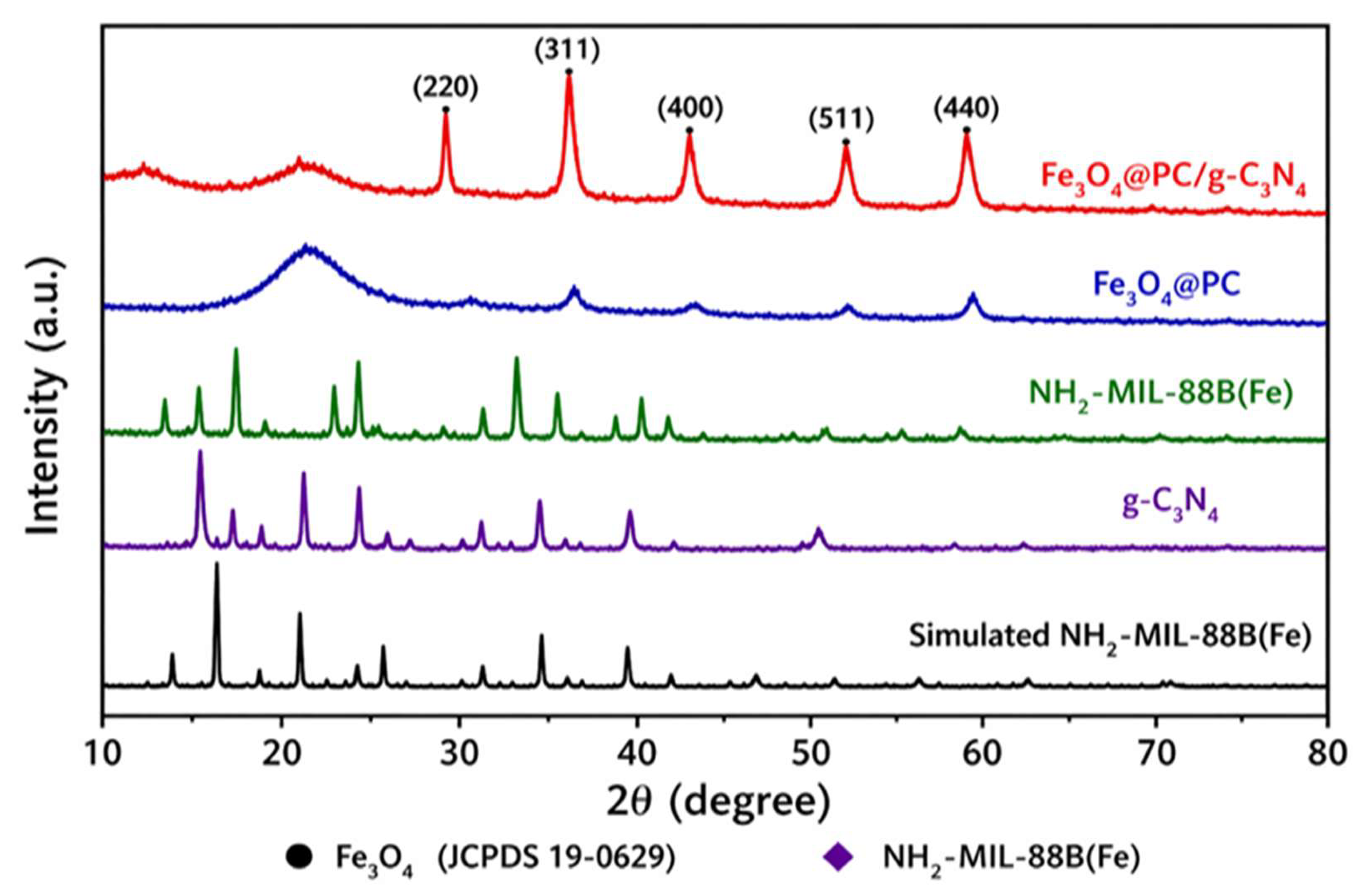
Figure 3.
Scanning electron microscopy images illustrating the morphological evolution from NH₂ MIL88B(Fe) precursor to Fe₃O₄@porous carbon and the assembled Fe₃O₄@PC/gC₃N₄ composite.
Figure 3.
Scanning electron microscopy images illustrating the morphological evolution from NH₂ MIL88B(Fe) precursor to Fe₃O₄@porous carbon and the assembled Fe₃O₄@PC/gC₃N₄ composite.
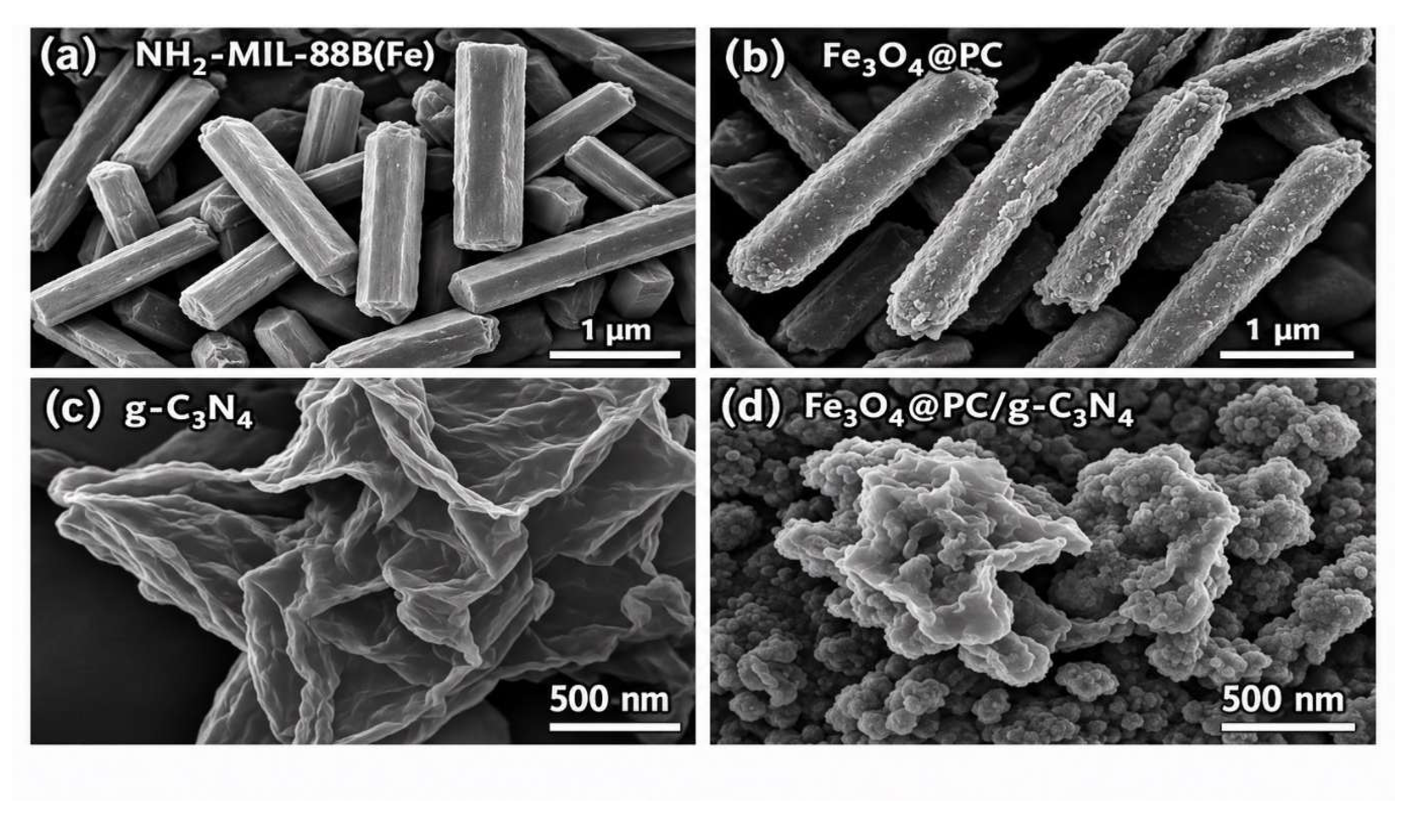
Figure 4.
Transmission electron microscopy (TEM) and the high resolution TEM images showing the dispersion of Fe₃O₄ nanoparticles within porous carbon and the formation of intimate heterojunction interfaces with gC₃N₄ nanosheets.
Figure 4.
Transmission electron microscopy (TEM) and the high resolution TEM images showing the dispersion of Fe₃O₄ nanoparticles within porous carbon and the formation of intimate heterojunction interfaces with gC₃N₄ nanosheets.
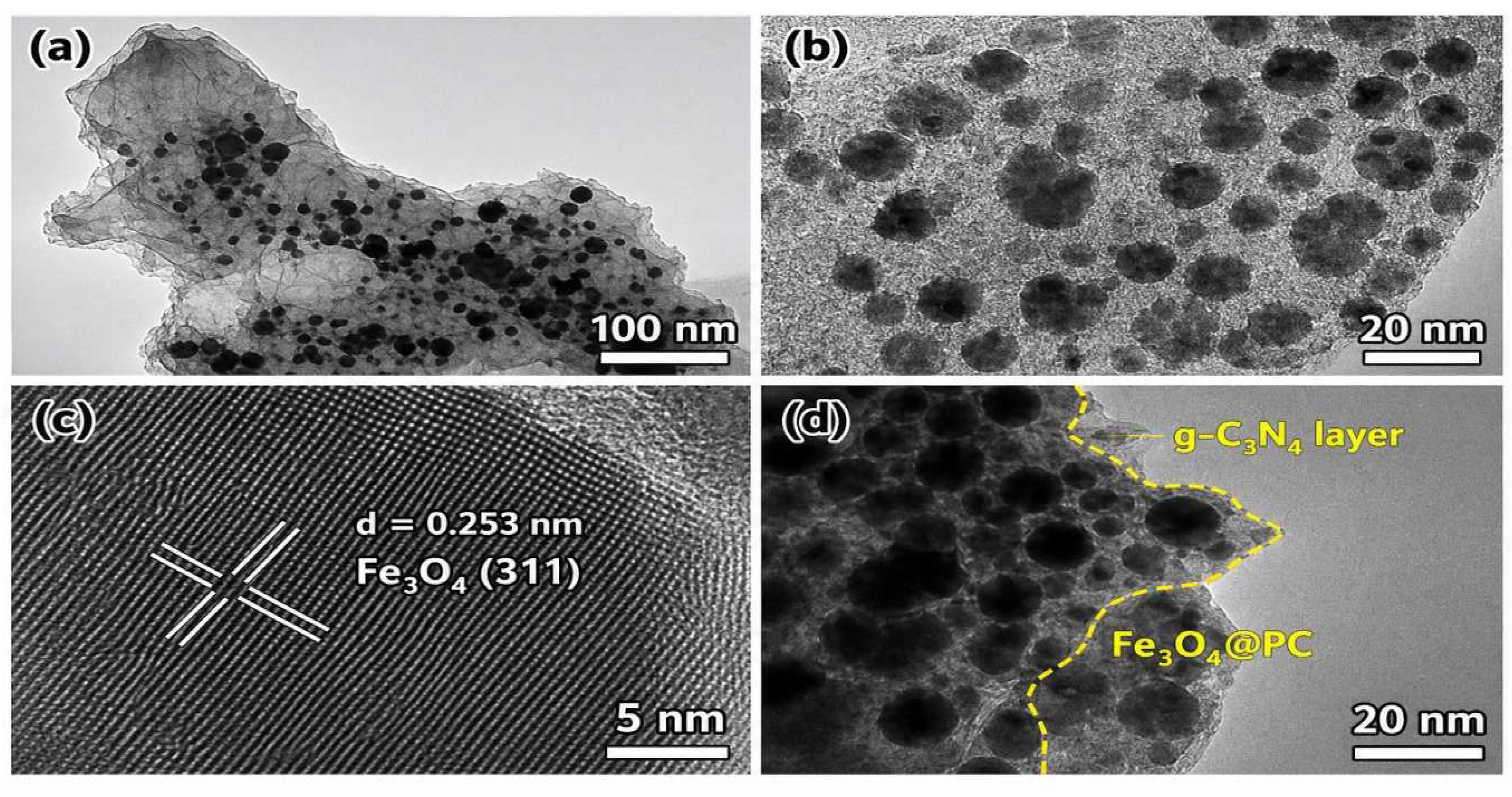
Figure 5.
Nitrogen adsorption–desorption isotherms and corresponding pore size distribution of Fe₃O₄@PC/g-C₃N₄ nanocomposite, demonstrating hierarchical mesoporous structure and high surface area.
Figure 5.
Nitrogen adsorption–desorption isotherms and corresponding pore size distribution of Fe₃O₄@PC/g-C₃N₄ nanocomposite, demonstrating hierarchical mesoporous structure and high surface area.
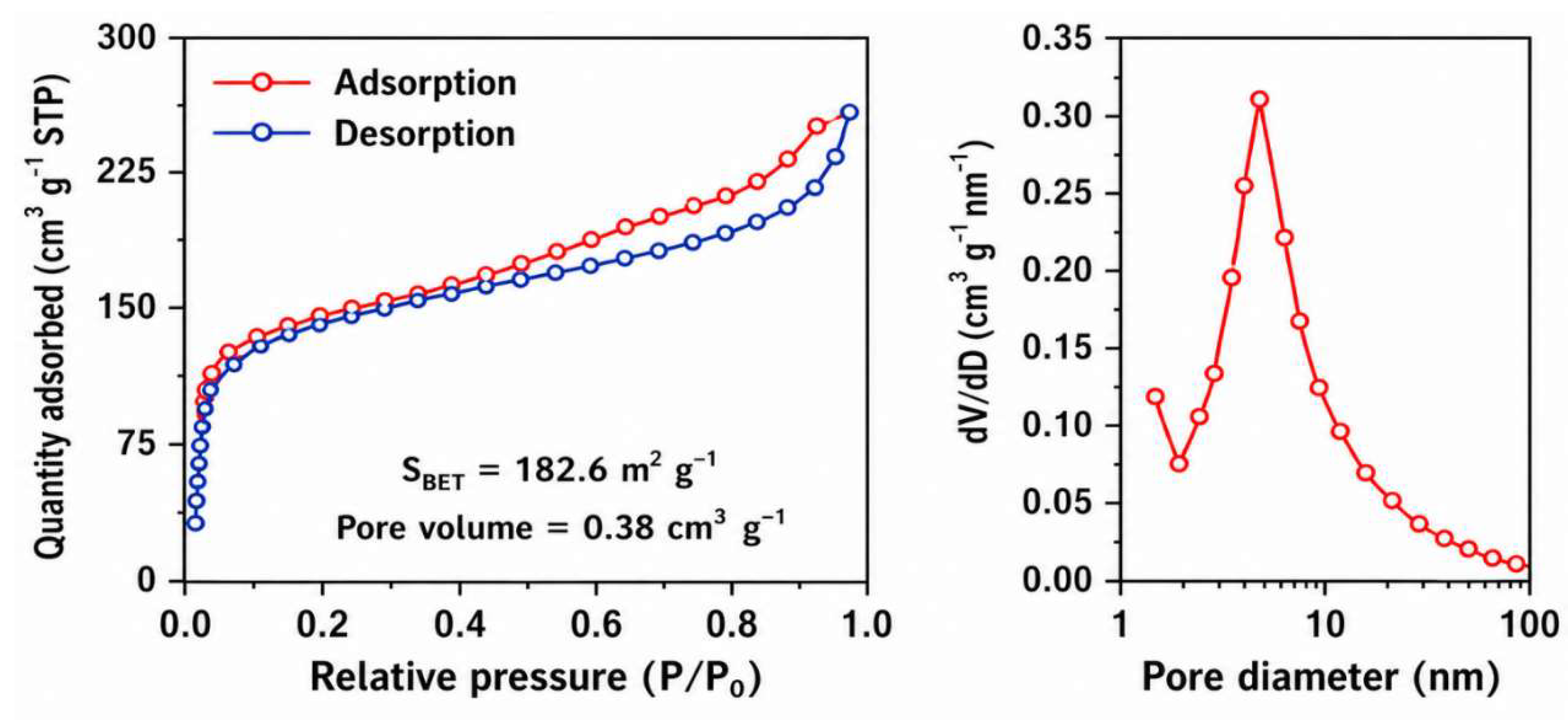
Figure 8.
Vibrating sample magnetometry (VSM) curve of Fe₃O₄@PC/g-C₃N₄ composite showing superparamagnetic behavior and high saturation magnetization for magnetic recovery.
Figure 8.
Vibrating sample magnetometry (VSM) curve of Fe₃O₄@PC/g-C₃N₄ composite showing superparamagnetic behavior and high saturation magnetization for magnetic recovery.
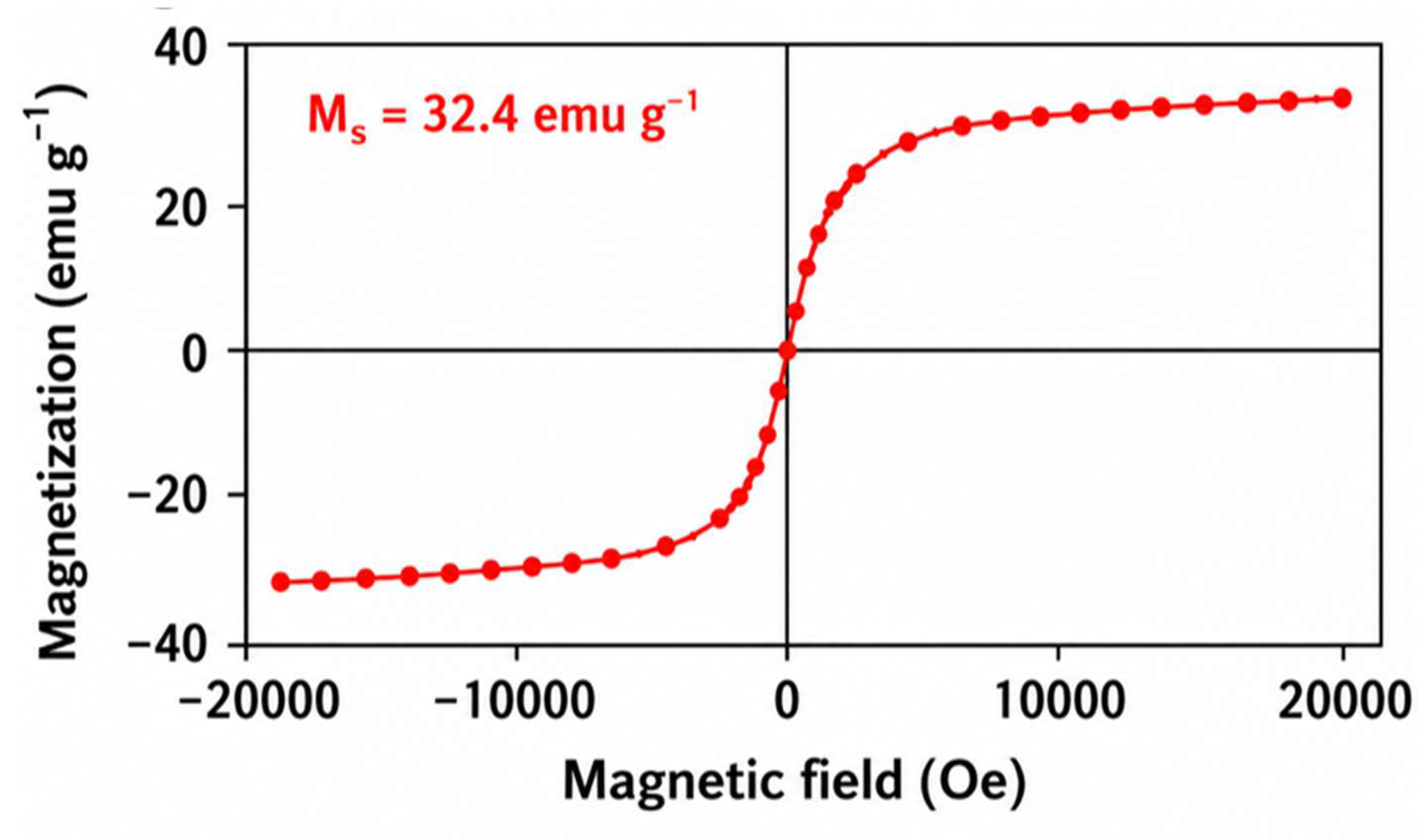
Figure 9.
Photocatalytic degradation performance under visible light irradiation: (a) methyl orange (MO) and (b) Congo red (CR) degradation profiles using Fe₃O₄@PC/g-C₃N₄ and control samples.
Figure 9.
Photocatalytic degradation performance under visible light irradiation: (a) methyl orange (MO) and (b) Congo red (CR) degradation profiles using Fe₃O₄@PC/g-C₃N₄ and control samples.
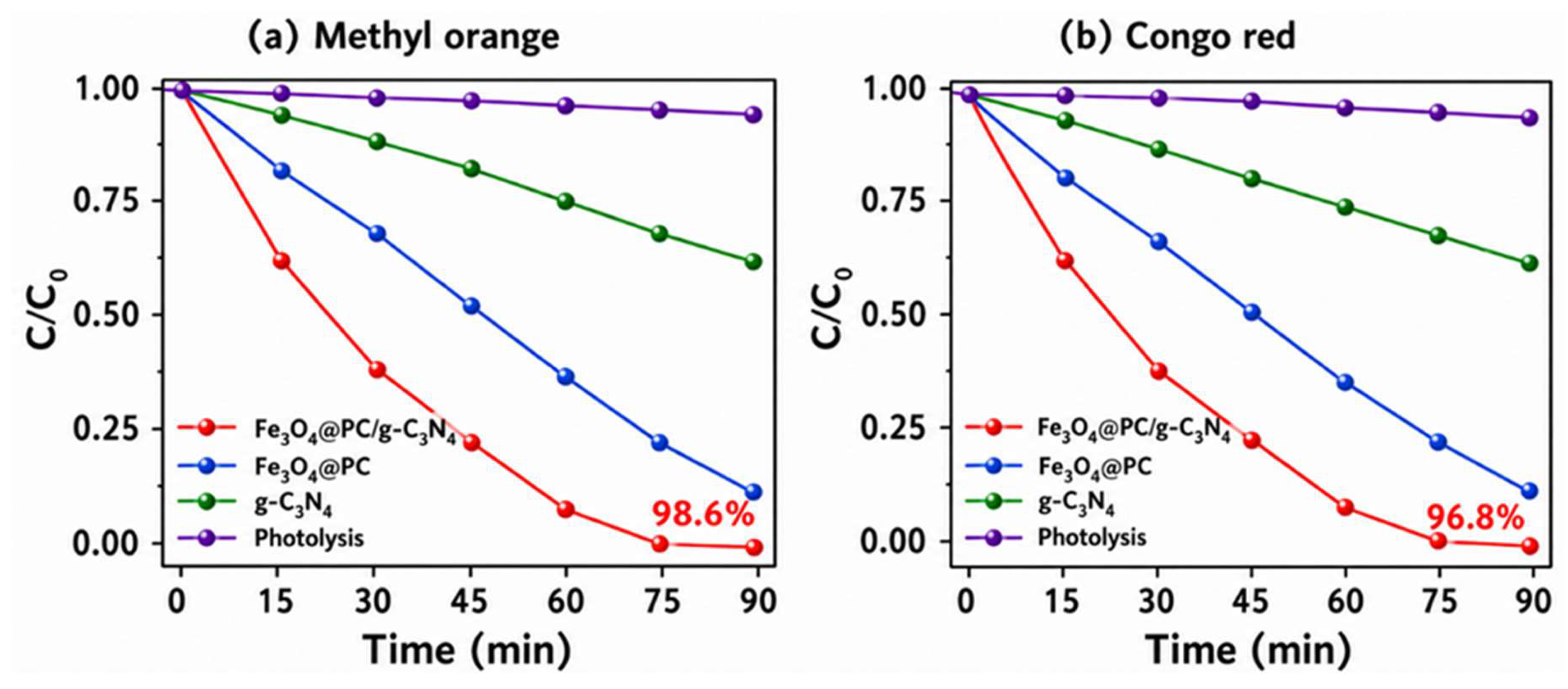
Figure 10.
Radical scavenging experiments identifying the dominant reactive species involved in photocatalytic degradation over Fe₃O₄@PC/g-C₃N₄ nanocomposite.
Figure 10.
Radical scavenging experiments identifying the dominant reactive species involved in photocatalytic degradation over Fe₃O₄@PC/g-C₃N₄ nanocomposite.
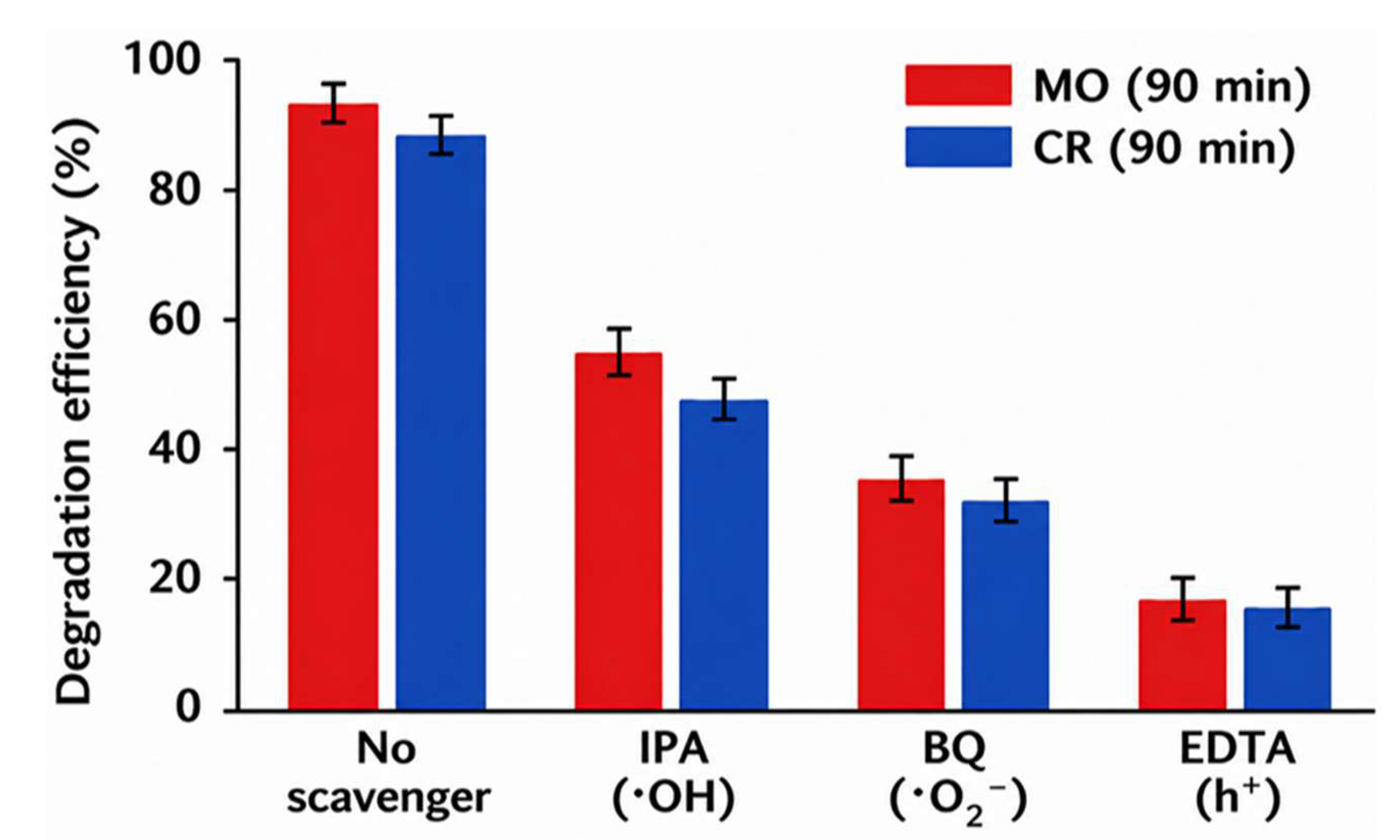
Figure 11.
Proposed Z-scheme charge transfer mechanism illustrating charge separation pathways and reactive oxygen species generation in the Fe₃O₄@PC/g-C₃N₄ heterojunction system.
Figure 11.
Proposed Z-scheme charge transfer mechanism illustrating charge separation pathways and reactive oxygen species generation in the Fe₃O₄@PC/g-C₃N₄ heterojunction system.
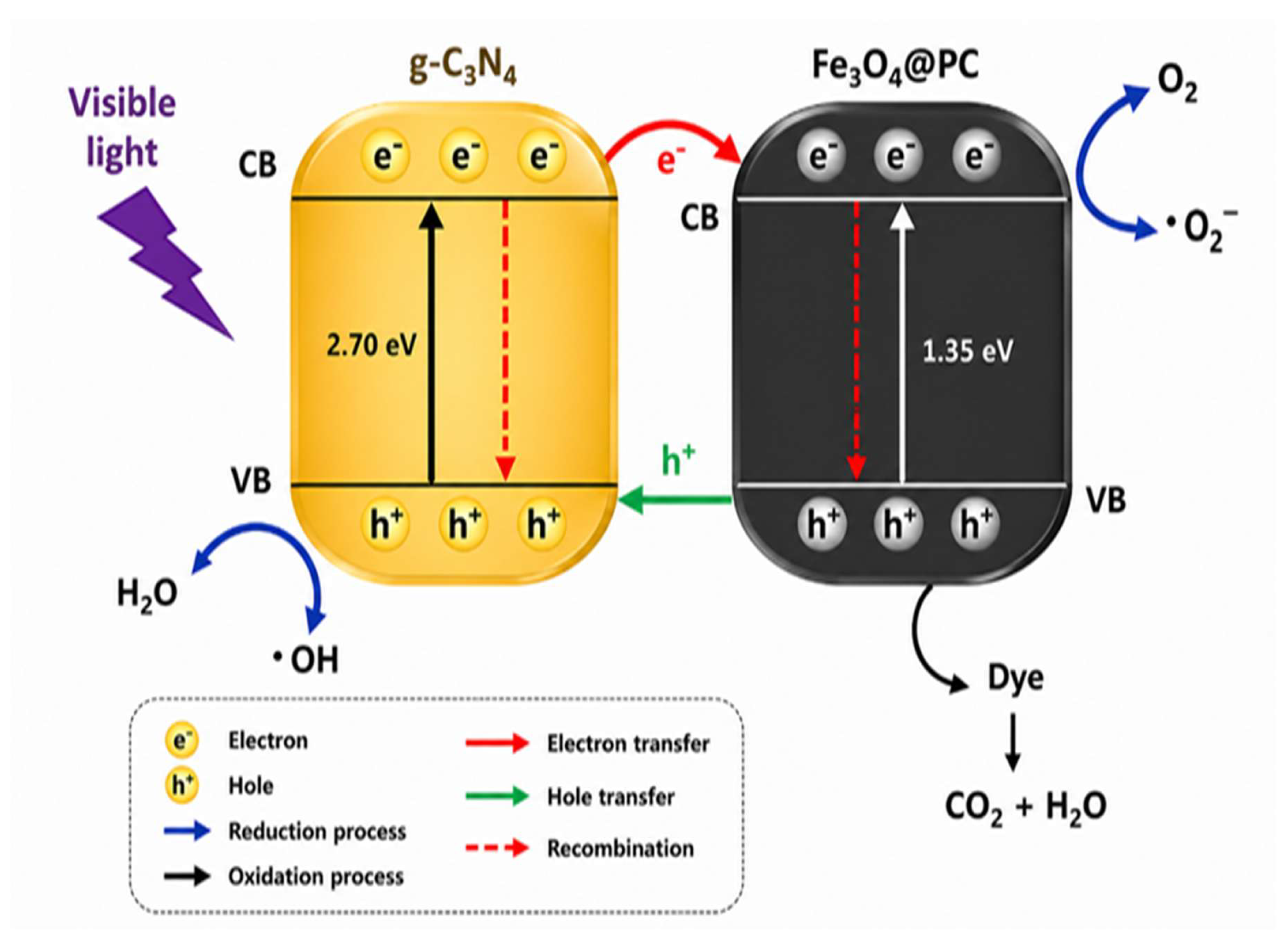
Figure 12.
Reusability and stability of Fe₃O₄@PC/g-C₃N₄ nanocomposite over five consecutive photocatalytic cycles.
Figure 12.
Reusability and stability of Fe₃O₄@PC/g-C₃N₄ nanocomposite over five consecutive photocatalytic cycles.
Disclaimer/Publisher’s Note: The statements, opinions and data contained in all publications are solely those of the individual author(s) and contributor(s) and not of MDPI and/or the editor(s). MDPI and/or the editor(s) disclaim responsibility for any injury to people or property resulting from any ideas, methods, instructions or products referred to in the content. |
© 2026 by the authors. Licensee MDPI, Basel, Switzerland. This article is an open access article distributed under the terms and conditions of the Creative Commons Attribution (CC BY) license.
Copyright: This open access article is published under a Creative Commons CC BY 4.0 license, which permit the free download, distribution, and reuse, provided that the author and preprint are cited in any reuse.


