

Submitted:
27 April 2026
Posted:
28 April 2026
You are already at the latest version
Abstract
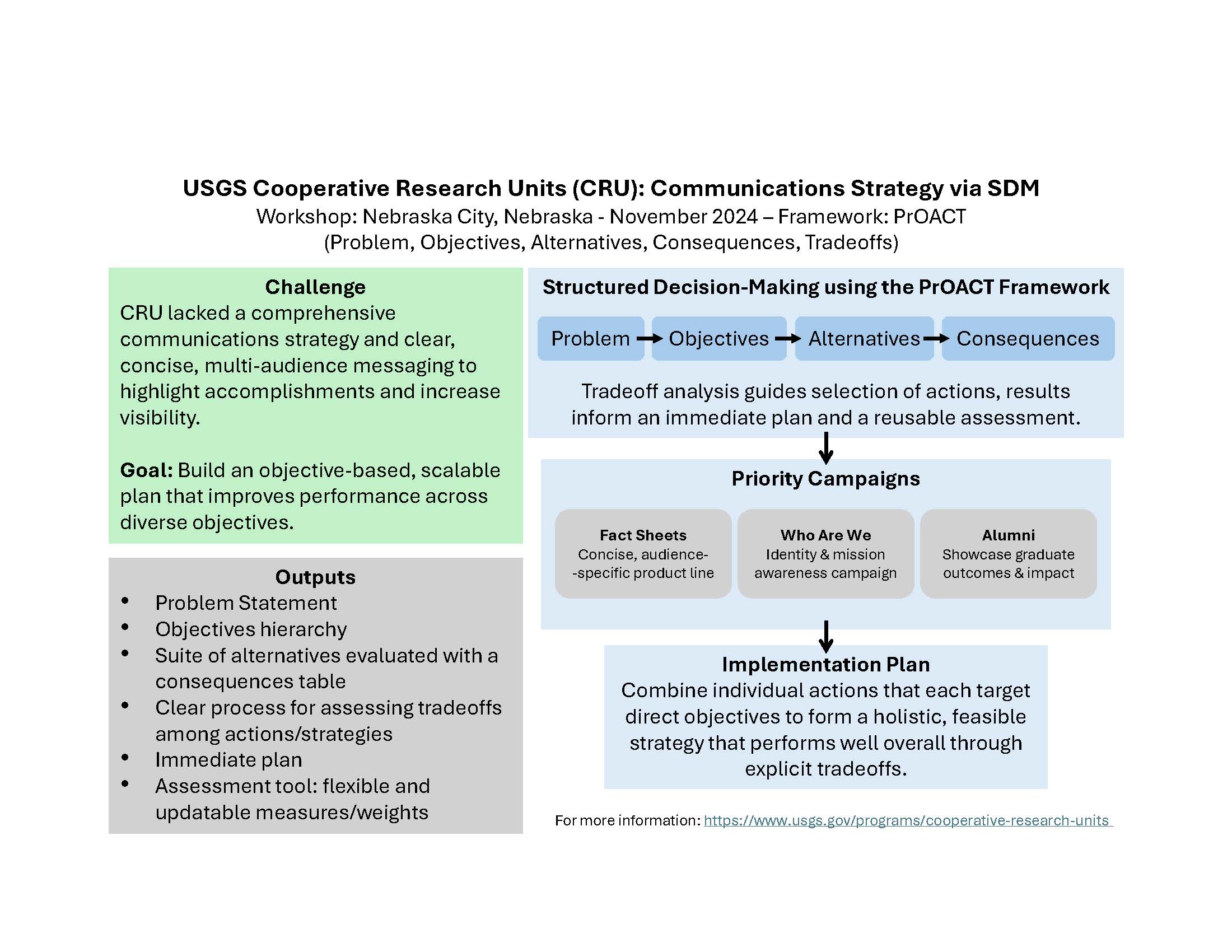
Communication regarding the mission of the U.S. Geological Survey (USGS) Cooperative Research Units Program (CRU) can take many forms, yet clear and concise messaging for various audiences is critical to highlight program accomplishments and increase visibility. Before the work described in this report, CRU did not have a communication strategy; therefore, CRU leadership supported a structured decision-making (SDM) workshop to develop a comprehensive strategy for multiple audiences. The workshop was conducted in November 2024, in Nebraska City, Nebraska. The working group for this SDM process included CRU Program leadership, the CRU Communications Team lead, Unit scientists, a Unit administrative assistant, a representative of the Wildlife Management Institute (WMI), a member of the USGS Ecosystems Mission Area (EMA), Office of Communications and Publishing (OCAP) team, and the team lead for the CRU Program strategic planning process, as well as three facilitators who were also Unit scientists as well as experts in SDM. Over the course of a week, the SDM team followed the PrOACT framework which identified the problem, objectives, alternatives, consequences, and tradeoffs to guide us toward a strategy for implementation of a set of actions for CRU communications. Results of the SDM workshop included the development of a problem statement, an objectives hierarchy, a suite of alternatives that were evaluated using a consequences table and a clear process for assessing tradeoffs among alternative communication actions and strategies. Through the evaluation of consequences of each action or campaign, the team developed both the assessment tool (for the future) and an immediate plan for communication product development and distribution. The consequences table for this problem was meant to be flexible to accommodate changes in CRU thematic priorities and can be easily updated with new objectives, measures, and alternatives. In addition, the weight placed on objectives may change as the Team moves forward; the ranking and scoring system used in the workshop can be easily updated. Overall, the working group identified three different actions or campaigns—Fact Sheets, Who Are We Campaign, and Alumni Campaign—that scored high in the prototype decision framework. However, the tradeoffs analysis indicated that each action(s) performed better on some objectives than others. The working group identified a need to therefore develop an implementation plan that is composed of individual actions that each target different objectives to potentially create a holistic and feasible communications strategy that performs well for all objectives. In addition, the SDM prototype developed a scalable, objective-based framework for effective communication of the value and accomplishments of the CRU program.
Keywords:
Cooperative Research Units (CRU)
; structured decision-making (SDM)
; outreach planning
; communication strategy
; PrOACT framework
; consequences table
; implementation plan
Introduction and Background
Overview
Effective communication is paramount for the U.S. Geological Survey (USGS) Cooperative Research Units (CRU) Program. Effective communications demonstrate the Program’s efficacy in fulfilling its tripartite mission in graduate education, applied research, and technical assistance. Communications can maximize impact and visibility of the CRU Program across local, state, federal, and global scales. Communicating to ensure clear and consistent messages helps demonstrate the credibility and integrity of the CRU Program. Altogether, effective communications can help build and maintain support for the CRU Program, contributing to its sustainability.
Communications about the CRU Program must reach a variety of audiences, including the U.S. Congress, cooperators (personnel from signatory agencies of Cooperative Agreements), stakeholders and rightsholders [which include nongovernmental organizations (NGOs) and professional societies, such as the Association of Fish and Wildlife Agencies (AFWA) and the National Association of University Fish and Wildlife Programs (NAUFWP)], The Department of the Interior (DOI), the USGS Ecosystems Mission Area (EMA), Tribes, CRU scientists and staff members, universities, and the general public. These audiences can vary in importance, related to influence over the CRU mission and funding (e.g., Congress, DOI, cooperators), support from professional interests (e.g., professional associations) or general interest in CRU science delivery. Therefore, different communication products and venues will be needed to reach each. Notwithstanding, some communication products and venues may be able to help reach multiple audiences, which can help increase efficiency in communications.
Regardless of the target audience, communications are effective when they lead to meaningful engagement. For example, communication outcomes can be passive (e.g., audiences receive the message only), or can be active, for example, by leading to greater CRU Program recognition. Increased effective communication can help lead audiences to seek additional interaction with the CRU Program. Examples of this are; sharing or “liking” social media posts, contacting CRU scientists for information about their program, and/or seeking CRU expertise for technical assistance.
At the national level, communication decisions for the CRU Program are primarily made by headquarters personnel, including the Chief, Deputy Chief, and members of the CRU Communications Team, who collectively oversee the strategic direction of communications efforts. The Outreach Coordinator for the USGS EMA plays a vital role in integrating ecosystem-focused messaging into the broader USGS communication strategy, ensuring that ecological considerations are front and center in communications. Additionally, the USGS Office of Communications and Publishing (OCAP) team is integral in aligning CRU Program communications with national priorities (e.g., USGS, DOI, Congress) and initiatives. In instances involving critical issues, coordinating communications across the DOI is essential for maintaining a unified message across all levels of government. This collaborative approach both enhances the effectiveness of communications and fosters a cohesive narrative that supports the goal of the CRU Program for daily striving to meet the Program’s Mission.
At the Unit level, federal scientists play a crucial role in managing communications within their respective Units. They are responsible for disseminating information, addressing inquiries, and ensuring that the messaging aligns with the broader objectives of the CRU Program. This includes collaborating with the CRU Communications Team to develop tailored communications plans that resonate with cooperators and address specific state and regional needs. The Unit scientists must also be proactive in identifying potential communication challenges and opportunities, ensuring that their Units remain well-informed and engaged with the mission of the CRU Program, as well as with the needs of Unit staff, students, and cooperators.
Challenges for CRU Program Communications
Numerous challenges and constraints affect decisions and strategies about CRU Program communications. Understanding how to communicate most effectively creates an ongoing challenge. Changes to approved USGS themes and platforms for communications and relative efficacy of each (e.g., social media platforms) can create confusion. Similarly, changes over time in approved platforms and the associated rules for their use can compound this uncertainty. Regardless of the platform, it can be difficult to attract the attention of target audiences due to different levels of receptivity. There is also uncertainty in how communications will be interpreted by the audiences who receive those communications. Communications have the risk of being misinterpreted, or unintendedly misleading. Science continues to appear to be devalued by some members of society (Funk et al 2019). Without careful messaging through CRU Program communications, people can have a difficult time seeing the relevancy of CRU Program work (research, education, technical assistance) to their daily lives. Altogether, these challenges require a carefully constructed and implemented communications strategy.
In communicating scientific results, Unit scientists must strive to be unbiased, factual, and plainly presented. A challenge is that not all Unit scientists are comfortable communicating to a broader audience more than they already do (e.g., through peer-reviewed publications or presentations delivered at professional society meetings).
Unit students, staff, and other affiliates could be better leveraged to help communicate the successes in fulfilling the CRU Program’s tripartite mission.
When sharing CRU Program’s science, there are also challenges in data sovereignty, particularly related to Tribes. The CRU Program has many Tribal partners and must take care in science communications for work completed in collaboration with or influencing Tribes. The same is true for other sensitive data, such as for species listed under the Endangered Species Act, as well as data provided by collaborating agencies and organizations. These data considerations necessitate careful, proactive outreach planning co-produced in-step with project collaborators.
A further challenge is that the logistics of increasing CRU Program communications would require more staff and time. The CRU Communications Team could collaborate with the USGS OCAP team for some communications but would need to handle other communication needs internally. Several challenges for CRU communications relate to broader policies within the federal government. Federal and state administrations will place rules on how CRU Program science is completed and shared. Each administration has different priorities, and this can shift from one administration to the next. Likewise, the CRU Program also needs to be able to communicate its results and value more broadly, while complying with applicable laws (e.g., the Anti-Lobbying or Hatch Acts).
Finally, the CRU Program has a need to communicate on various geographic (e.g.,state cooperators versus national, and temporal (e.g., immediate interesting news versus a year in review circular) scales with multiple audiences. Scale-specific communications need to be tailored to specific audiences with consideration to the specific social context. Each scale requires its own strategy and tactics to accomplish communication objectives. Each scale has existing tools and resources that need to be evaluated in terms of the new planning frameworks including the one described in this report (CRU Program Communications Strategy) and an ongoing CRU Program Strategic Plan. Frequency of communication ranges from immediate to regular intervals up to 5-years and each tool (or product) needs its own schedule of publication to maximize staff time for preparation and minimize the preparation of reports that have a limited audience or are not useful for durable periods of time. Review of existing strategies implemented could be conducted as appropriate for products at timely and relevant intervals.
As a result of the complex landscape in which the CRU Communications Team must operate, as well as the challenges associated with developing and implementing a communications plan, leadership of the CRU Program and the CRU Communications Team engaged in a structured decision-making (SDM) process over the course of one week. The workshop was conducted November 18–22, 2024, in Nebraska City, NE. The working group for this SDM process included CRU Program leadership, the CRU Communications Team lead (the team is comprised of two CRU staff members, each with other non-comms duties), Unit scientists, a Unit administrative assistant, a representative of the Wildlife Management Institute (WMI), a member of the USGS Ecosystems Mission Area (EMA) Communications Team, and the team lead for the CRU Program strategic planning process, as well as three facilitators who were also Unit scientists as well as experts in SDM (Table 1). Throughout the week, the working group was facilitated through the steps of the SDM process (see below), with the goal of developing a strategy and framework for creating a communications plan. Here we report on the SDM workshop and the results of this process.
Structured Decision-Making Overview
Structured decision making (SDM or decision analysis) is a formal framework for aiding decision makers and other interested parties (e.g., cooperators and / or rightsholders) in working through a series of steps to identify a best course of action for a decision problem (Gregory et al. 2012). The SDM process is value-based, in that it enables the decision maker and associated working group to first identify the problem and the things that they care about and want to achieve, prior to identifying actions (Keeney 1992). In this way, SDM is a decision-aiding tool that allows the decision maker and any other participants to better understand how well particular actions will achieve their specific objectives (values) and how to tradeoff differential levels of achievement.
Structured decision making is often implemented using the “PrOACT” process, which stands for problem, objectives, alternatives, consequences, and tradeoffs (Hammond et al. 1999, Hemming et al. 2022; Figure 1).
Problem−In step 1, the group identified the decision that needed to be made. Problem definition is often one of the most difficult steps of the process for groups, because the group must agree on the decision at hand, as well as identify the spatial and temporal scales of the decision, who should be involved in or would be affected by the decision process, the reasons for bringing the problem to the table, the uncertainties that hinder decision making, as well as other issues that may be affecting the group’s ability to make the decision.
Objectives−In step 2, the values of the decision maker and stakeholders are identified and turned into a set of objectives that they would like to achieve in solving the problem. In this step, measurable attributes, which are the metrics by which objective achievement is measured, are also identified.
Alternatives−In step 3 (alternatives), the group is able to identify a suite of alternatives or actions that could be implemented to achieve the objectives. The group is often asked to be as creative as possible during this step, leaving measures of feasibility for later steps. Asking decision makers to consider objectives up front and letting those determine the alternatives to be considered is known as “value-focused thinking” and is a hallmark of SDM (Keeney 1992).
Consequences−In step 4, each of the alternatives is evaluated relative to achievement of each objective. In natural resources decision problems, this step often involves predictive modeling to simulate populations of animals or other organisms into the future under different actions. Yet, this can also be accomplished through other types of qualitative or quantitative models, elicitation of expert knowledge, survey instruments or focus group conversations, or other means that may depend on the measurable attribute.
Tradeoffs−In step 5, the relative importance of each of the objectives must then be evaluated. We often determine that there is not one action that can best achieve all objectives, so the group must consider how to tradeoff among objectives given this differential achievement across actions. The information gained from the consequences step, along with decision maker and other stakeholders and rightsholders preferences, is used to place weight on the different objectives. This process can allow the decision maker to see how well different actions might perform at achieving different objectives, integrate their values and those of stakeholders and rightsholders into the decision, and identify an action or set of actions that are optimal or preferred. The SDM process is also iterative, such that previous steps can be revisited throughout the decision process as new information becomes available or changes need to be made.
We used the PrOACT framework to walk through the steps of the SDM process for developing a communications strategy for the CRU Program during the course of a week-long workshop.
Problem
The problem framing step accounts for not only the decision that must be made, but all aspects of the scope of the problem. We focused our discussions on the considerations outlined above in detail. Based on these conversations and the concerns articulated by the group, the problem statement was defined as,
“The CRU Communications Team needs to develop a cohesive, scalable, and adaptable communications strategy at the programmatic level to increase visibility and amplify the relevance of the CRU Program mission locally, regionally, and nationally to ensure the sustainability of the CRU Program and its tripartite mission.”
Objectives
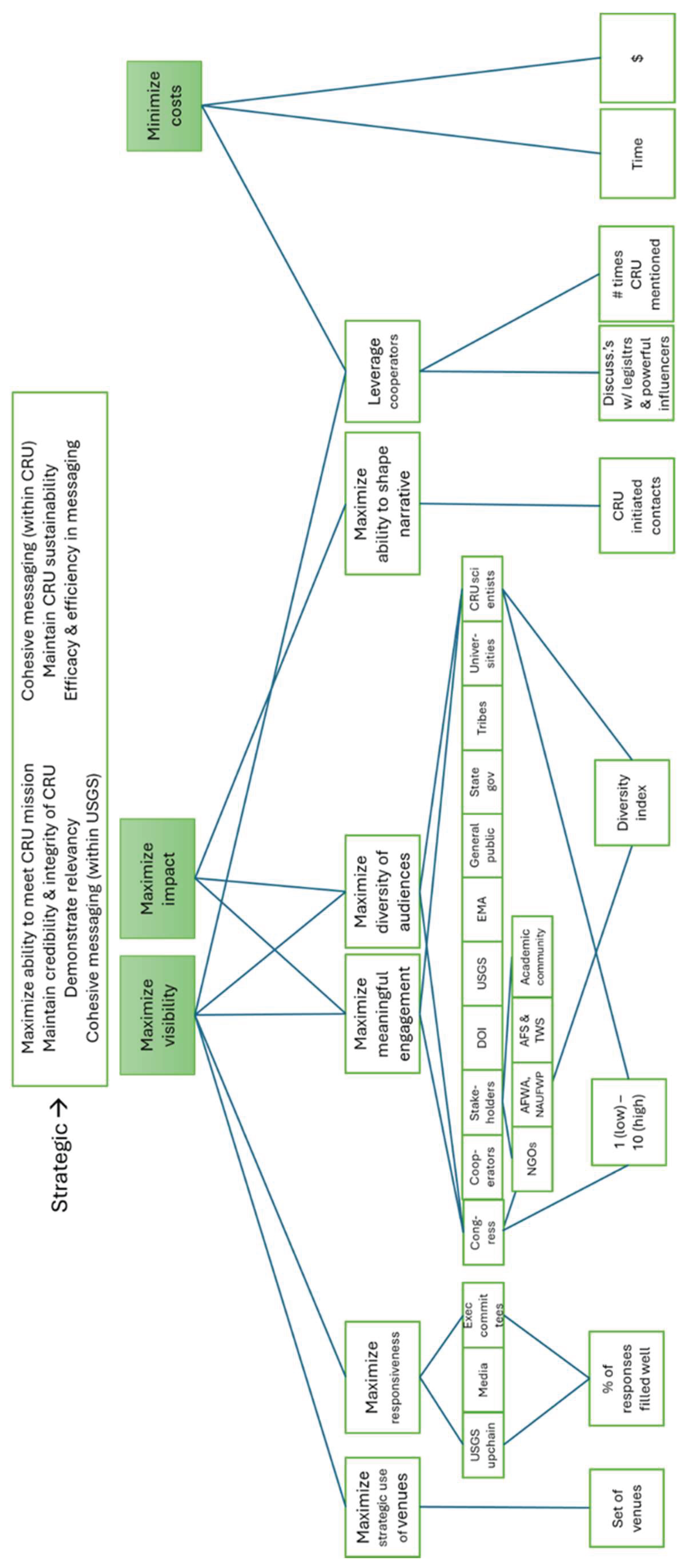
Objectives are developed to describe what the decision maker, stakeholders, and rightsholders ultimately want to achieve. All elicited objectives are included in this step, regardless of whether some objectives are at odds with others or whether some working group members do not value a particular objective. During this step, we identified the full list of objectives and categorized them to develop an objectives hierarchy. This hierarchy included fundamental objectives, which are the objectives that the group fundamentally cares about, means objectives, which describe how to achieve the fundamental objectives, and strategic objectives, which describe objectives that would apply to all decisions made by the CRU Communications Team. The final objectives hierarchy that resulted from the SDM workshop is shown (Figure 2). Ultimately, this hierarchy of objectives consisted of strategic and fundamental objectives, although initially we identified means objectives (see Appendix I, Figure A1), these were ultimately elevated to fundamental objectives.
In addition to the objectives for this decision problem, the group identified objectives that are inherently part of any strategy, as well as objectives to consider as part of a linked decision related to implementation at the unit level. As part of any strategy, the Team wanted to maximize proactiveness in communications, which included considerations for having to reach out to unit scientists to gather information, creating new documents on the fly, time spent discussing communications, and creating scalable communications products, as well as having the ability to update the plan and knowing when to do so. After strategy development, the group identified a need to maximize understanding of the chosen strategy by Unit scientists and the management team, as well as their participation in science communication efforts.
Alternatives
The goal of the alternatives step is to describe a set of actions that could be implemented to achieve the objectives. The facilitators asked the group to be creative to identify actions and their timing, first creating a list prior to consideration of feasibility. This list was then used to identify a set of actions that could be evaluated in the consequences step. The group first discussed the “status quo” for communications to identify the types of actions currently being taken and as a jumping off point for what could be changed, omitted, or added (Table 2). The status quo for communications included creating summaries of activities in different levels of detail (e.g., an abstract book that is produced every five years, a year in review document for cooperators that highlights all three aspects of the CRU mission, multiple fact sheets for congressional liaisons, prospective students, cooperators, and the Coop Catch-up newsletter), developing directories and summaries of unit scientist expertise for cooperators, a monthly article in WMI’s Outdoor News Bulletin by unit scientists, and two websites (Watermark populated and USGS CRU). In addition, the status quo included some social media presence, occasional articles in wildlife and fisheries magazines, tables at conferences, and responses to inquiries from other parts of USGS and the DOI, as necessary. The group then developed a list of potential communications actions and strategies that could be implemented, including actions like having a more selective and targeted strategy for socials and tables at conferences, a fact sheet on the value of the CRU Program, a more holistic and deliberate social media strategy, overhaul of the USGS CRU website, and a photo contest. The full list of alternatives described by the group is provided (Appendix 1). A subset of this list was evaluated during the workshop based on existing capacity of the CRU Communication Team and group discussion (Table 3).
In addition to the individual actions that were evaluated, the group decided to more fully describe four different communications tactics as a first step towards creating a more finalized set of actions to consider. The four tactics were: 1) social media, website, and newsletter (“Social Media”), 2) Alumni Campaign, 3) Who Are We? Campaign, and 4) Fact Sheets. Each of these tactics is still under development, but we describe the first draft and discussions of the tactics below.
The social media, website, and newsletter tactic focused on communicating CRU’s tripartite mission with numerous audiences. The social media aspect included considerations of a goal of building awareness of the CRU Program by increasing the number of followers and designing effective campaigns. There would be a need for a consistent frequency of posting engaging content and consistent campaigns, as well as monitoring the apps and pivoting as needed, all of which would require an investment. The website aspect was focused on updating the USGS CRU website (https://www.usgs.gov/programs/cooperative-research-units). The suggested update for the website would be comprehensive and would require developing a tactic for rewriting existing content and creating new content, developing a communication plan including what messaging is to be conveyed (i.e., who we are and why, and what do we want to convey on graduate education, applied research, and technical assistance and how we can help). The group also described creating a monthly newsletter to highlight the three parts of the CRU Program’s mission, perhaps by choosing information from the revamped website, highlighting work from Units, among other tactics.
The goal of the alumni campaign would be to leverage Unit trainees (past and present) to form an alumni organization to communicate the tripartite mission and CRU Program activities. This organization could develop alumni and student awards and find creative ways to get the word out about the research, education, and technical assistance conducted by the Units. Potential audiences could range from prospective students to members of Congress.
The “Who Are We?” campaign was developed with the goal of ensuring that those who support and fund the CRU Program (e.g., AFWA members, Congress and their staff) understand the function of the CRU Program. The group identified potential actions within the campaign of producing videos and creating story maps (e.g., CRU Program’s tripartite mission, the history of the CRU Program, how we achieve the mission, how can we serve you better). The Fact Sheets tactic was developed for a similar set of audiences named above but would provide at-a-glance information to these groups. These would be focused on describing the value of the CRU Program.
Consequences and Tradeoffs
The goal of the consequences step is to project the potential outcomes of implementing each action in terms of the measurable attributes for each objective. Different methods, including quantitative modeling, surveys, readily available data, and expert elicitation, can be used to project the consequences. In the case of the CRU Program communications decision process, the consequences for most objectives were developed through a combination of expert knowledge and evaluation of available data. During the workshop, the group developed a set of measurable attributes that could be easily scored for the SDM team’s prototype decision framework.
After determining the consequences of each action or tactic in terms of each objective, the tradeoffs step allowed the decision maker or working group to place weights on the objectives to better reflect how much they valued each objective considering the potential for achievement with the suite of alternatives available. There are formalized methods for developing the weights for the objectives, but at its core, this is a value-based part of the process. Therefore, a goal for these methods is to be transparent about the way in which the weights were identified.
The group (all participants, except the facilitators) decided to first evaluate individual alternatives that were either part of the status quo portfolio strategy or that could be implemented in the future, based on the list of alternatives (Appendix I). This would then allow for the group to take advantage of the iterative nature to then devise and describe tactics that represent combinations of individual actions that scored well or that individually achieved objectives. We present the results for a combination of some individual actions and the four campaigns that emerged from the consequences step (Table 3).
As a first step at this stage, the group predicted consequences of each alternative for each objective (Table 4). Predictions were based on simple scales and each prediction represented the expected value (EV) of the alternative for the objective. For example, for the objective of communicating CRU Program applied research, the group entered an EV of “1” for “yes” and “0” for “no” to predict how each alternative communication action or tactic would meet this objective. As another example, for the objective of minimizing costs in terms of time, the group entered an EV of “1” for the most costly, “2” for moderately costly, and “3” for least costly.
After predicting consequences, we normalized the EV (from Table 4) into a consistent 0 – 1 scale (Table 5) using the formula:
These calculations allowed for easier comparison across objectives and began to clearly reveal which alternatives do the best or worst job at meeting the 11 objectives.
Our approach to this point (Table 5) assumed that all objectives were of equal importance, so as a next step, we elicited importance weights on objectives from the group (Table 6). To complete this step, the group first ranked objectives in order of importance (1 = most important) and added scores of the relative importance of meeting each objective, compared to the top ranked objective’s score of 100. We then calculated the relative weights of objectives by dividing each score by the sum of scores. This step revealed that maximizing meaningful engagement was the most important objective (14% of weights), followed closely by the 3 objectives of communicating CRU Program graduate education, applied research, and technical assistance (13% of weights on each), and then minimizing costs in terms of time (12% of weight).
In the final step, we calculated weighted, normalized scores (Table 7) by multiplying the predicted consequence (in Table 5) by the respective weights on objectives (in Table 6). We then summed each column for each alternative to reveal the final scores (Figure 3). Alternatives with the highest scores are those that best meet objectives, although tradeoffs are apparent in the scores for each objective.
This approach revealed that the top performing alternative, Fact Sheets (final score = 0.88), performs best on meeting numerous objectives (Table 7). However, it comes with tradeoffs, as it is predicted to perform only moderately at leveraging cooperators and minimizing costs in terms of dollars and time. The next best alternatives are the Who are we? campaign (score = 0.86) and Alumni campaign (score = 0.84). Both scored best on numerous objectives. However, the Who are we? campaign entails tradeoffs of worst performance on the objectives of maximizing responsiveness and minimizing costs (dollars) and performs moderately at minimizing costs (time). In contrast, the Alumni campaign was predicted to perform worst on the two objectives related to targeting audience tiers, and on objectives for maximizing responsiveness and minimizing the risk of losing the narrative; it performed moderately at minimizing costs (time). At-a-Glance and Website Overhaul were dominated by the Fact Sheets alternative; each performed equal or worse on each objective. Another observation was that the objective of communicating science was redundant in that it was equally scored for each alternative.
Discussion and Next Steps
During the week-long SDM workshop, the working group developed a framework for identifying and evaluating communications tactics and campaigns to meet the multiple objectives of the Communications Team, and the CRU Program. The outcome of this workshop was meant to be a rapid prototype that can be refined as the Communications Team moves forward to implement a decision analytic approach to developing their overall communications strategy. The use of SDM for development of a durable and flexible communications strategy can allow for transparency related to meeting objectives and the influence of implementation of various communication campaigns on those objectives. The development of the consequences table for assessing the influence of individual actions or portfolios of actions on the stated objectives will allow for assessment of proposed products and actions. The iterative nature of the SDM process allows for updating of all steps. We anticipate as the Communications Team develops their communications strategy, there may be changes to the hierarchy of objectives, which likely will lead to new ideas for actions and strategies that could be evaluated in the consequences step. We used relatively simple constructed scales to measure achievement of each objective, but these measures can be updated as the Communications Team hones the objectives and identifies sources of data that could inform their predictions of how particular actions may perform. The consequences table (and associated set of spreadsheets) for this problem was meant to be flexible to accommodate these changes and can be easily updated with new objectives, measures, and alternatives. In addition, the weighting of the objectives may change as the Team moves forward, and the ranking and scoring system used in the workshop can be easily updated.
Overall, the working group identified three different strategies—Fact Sheets, Who Are We Campaign?, and Alumni Campaign—that scored high in the prototype decision framework. However, the tradeoffs analysis showed that each tactic or campaign performed better on some objectives than others. The working group keenly identified a need to therefore develop a strategy that is composed of individual products that each target different objectives to potentially create a holistic and feasible communications strategy that performs well for all objectives.
The planned next steps for the Communications Team are to implement the outcomes; implementation of the decision process was broken down into near, medium, and long-term action items. The working group suggested that near-term actions could focus on ensuring that all Units are aware of this effort and the value and importance of good communication for the CRU Program. They also identified the development of a “Value of the CRU Program” fact sheet (already completed post workshop; Irwin et al. 2025) and the CRU Program Communications Strategy as near-term steps. Medium-term actions included considering how to ensure that all data that are necessary or useful for communications are efficiently transferred from the individual Units to the Communications Team through the use of the internal Watermark website [or other potential mechanisms (e.g, Microsoft forms, internal Sharepoint)]. Finally, longer-term actions included an overhaul of the U.S. Geological Survey website for the CRU Program and development of an alumni campaign.
Acknowledgements
Thanks to all of the workshop participants and to the CRU leadership who supported this exercise. Jenn Malpass and Abby Lawson provided critical and insightful technical reviews of the report. Any use of trade, firm, or product names is for descriptive purposes only and does not imply endorsement by the U.S. Government.
Conflicts of Interest
The authors declare no conflict of interest.
List of Acronyms
| AFWA | Association of Fish and Wildlife Agencies |
| AI | Artificial Intelligence |
| BAO | Bureau Approving Official |
| CASC | Climate Adaptation Science Center (USGS) |
| CRU | Cooperative Research Units Program |
| DOI | Department of the Interior |
| DU | Ducks Unlimited |
| EMA | Ecosystems Mission Area |
| NAUFWP | National Association of University Fish and Wildlife Programs |
| NGO | Non-governmental Organization |
| OAG | Office of Acquisition and Grants |
| OCAP | Office of Communications and Publishing |
| OMB | Office Budget and Management |
| OSQI | Office of Science Quality and Integrity (USGS) |
| PrOACT | Problem, Objectives, Alternatives, Consequences, and Tradeoffs |
| SDM | Structured Decision Making |
| USFWS | U.S. Fish and Wildlife Service |
| USGS | U.S. Geological Survey |
| WMI | Wildlife Management Institute |
Appendix I
This appendix includes annotated notes complied during the SDM workshop for CRU Communications, Nebraska City, NE, November 18–22, 2024, by the facilitators and participants. They were edited to highlight components that were not included in the SDM analysis conducted during the workshop, and also includes potential future tasks and actions. Any use of trade, firm, or product names is for descriptive purposes only and does not imply endorsement by the U.S. Government.
Day 1:
Why are you here / what do you hope to get out of the workshop?
- Start of a framework for decision making for communications
- What is the best way to get our message out to various audiences?
- Learning about CRU-specific approach to comms given our different structure
- CRU is the best kept secret in DOI
- Thinking about the future, effective communications, support the comms team
- Learn where we all fit in in the process
- Importance of comms for CRU
- Strategic plan will include communication tactics- good fit with this workshop
- Universities have a hard time understanding what the Coop Unit is
- Communications currently very reactionary, and our work is in development for years, so we need to be more proactive and strategic
- Increasingly common discussion for most Unit meetings
- Good to think about with many new technologies available (e.g., AI)
- Each Unit has a different approach to communicating with cooperators, which is often necessary. Would be good to start from a common message, etc.
Problem Framing
- Uncertainty- how are the products that we develop received / used?
- Discussions among comms team have not gone far
- Implies a lot of work for comms to be “good”
- Best portfolio of products to develop, avoiding sunk costs
- Who is it serving?
-
Trigger: abstracts book – all CRU projects w/ pics and project descriptions (every 5 years). 7 downloads in last 18 months. Is this worth the effort? Unsure how many views
- ο
- Is it because no one knows it’s there?
- Trigger: change in CRU leadership- how do we advertise the successes of the program. More than just science. Are all of these equal missions? Uniqueness of CRU program (grad ed, etc.)
-
How does the CRU program meet its mission? How does what we do dovetail with the cooperators needs, leadership needs, priorities (relevance)
- ο
- University
- ο
- Federal government
- ο
- NGO partners
- Other groups in EMA are doing cool things, and there are a lot of missed opportunities within CRU comms
-
USGS great at disseminating info, less good at communicating info
- ο Great comms requires more than a single individual can do
- What is the call to action for each audience and each thing you want to communicate?
- Does everyone in the CRU system know the mission and work for that?
- Universities moving to accreditation that prioritizes big national funding sources
- Differences in motivations and priorities that different orgs have- requires different modes of communication
-
Hierarchy of linked decisions- national, Unit-specific
- ο Different people need to know different things about the program
- Big question: why are we doing this? Improve understanding of what the CRUs do. Why is what we do relevant? How CRU scientists can help with partners’ missions
-
Who should be doing communications for different partners?
- ο A place to find the specifics needed for comms
- Careful to not overpromise on outcomes or timelines
-
Best kept secret: programs that are unknown are at risk of going away
- ο So many good things to choose from to communicate for CRU
- Need to be more nimble for things that come up and need immediate action
Who are the rightsholders for this decision?
-
State cooperators
- ο Agency directors
- ο Regional associations (AFWA)
- ο Agency staff with whom scientists interact (often this is how it gets to the agency directors- scientists in CRU)
- ο Lacking visibility for what the CRUs are doing (we do not brand what we do often). Or the scientists are identified in press, etc., as faculty at a university
- Universities
- All signatory entities (USFWS, state agencies, University, WMI, USGS)
- Governors’ offices and commissioners (depends on authorities)
- General public
- Congress
- OMB
- Affiliate faculty and grad students
- Other federal agency personnel
-
USGS components
- ο Director
- ο EMA-, other programs, CASCs, 5 programs
- ο OCAP team
- ο Science Centers
- ο Among-unit (internal)
- ο Other mission areas / regional directors
- ο BAO, Office of Science Quality and Integrity (OSQI)
- ο Office of Acquisition and Grants (OAG)
- ο Ethics
- ο Would these organizations / entities remember us?
- Other non-profits that could become a bigger source of funding, good communicators / advocates
Legal / Regulatory Constraints?
- FSP
-
Hatch Act
- ο Liaisons, OCAP
- Anti-Lobbying Act
- Unified Framework within USGS
- Guidelines related to scientists being contacted by members of Congress
- How to talk to the media in your official capacity, opinion pieces
- Ethics? (more about making sure that we’re following Hatch Act, Anti-Lobbying Act)
-
Logistical- time available, number of people doing the comms
- ο How much should we be using OCAP vs doing things internally?
-
Frequency at which we need to communicate with different partners is somewhat unpredictable (changes in cooperators’ leadership, etc.)
- ο What we do
- ο What is feasible to change
- ο Have this info ready to go
- ο Difficulty in getting their attention in the first place (receptivity issue)
- ο Understanding the chain of communication
- USGS web pages run by a content management system- need to be certified to do it (2 trained within CRU)
- Other software options that are used- graphic design, etc.
Other ways / entities for communication:
- WMI Outdoor News Bulletin (~3500 people- agencies, non-profits, other outdoor writers)
- Wildlife Professional, Fisheries Magazine
- Conferences (exhibit booths, special sessions)
- States and universities have communications teams that we could work with as well
- Relevance and science are both important but perhaps cannot be achieved through the same actions
Temporal Scale for this Decision Framework? How long will this last / when to be revisited?
- First time wehave done this- a little bit unsure
-
Should this be robust to changes in leadership or would it be revisited with change?
- ο Would be best to be robust- set up for measuring impact
- ο Need a “monitoring” plan – may need to be adaptive
- ο Hierarchical approach to changes in plans. National strategy may be more enduring than the smaller regional strategies, which can be more nimble / pivot more easily
- Tie this to the timescale of the strategic plan for revisitation (5-year plan)- have a team of pro communicators for strategic plan dissemination
Other thoughts:
- Working more directly with OCAP for short-term needs (e.g., the frog project)
- Cannot do one and dones- Campaigns
- “It’s amazing what you can get done if you don’t care about who gets the credit”
- Difference between keeping them happy and keeping yourself relevant
- Maintenance Assistance Teams (MAT)- groups within National Park Service, FWS that focus on maintenance projects that do a lot to show good governance. Small program that can tell a good message
- Range of interest among CRU scientists to conduct sci comm / ability to do comms
- We are a herd of unicorns
Uncertainties:
-
Receptivity of those with whom we are communicating
- ο Different people will be influenced by different people- understanding levels of influence (school director ->dean)
- ο “influencers”
- ο Asking about whether CRUs need to meet with certain entities- signatory should be first stop. Working within the hierarchy
- ο Understanding the chain of communication within each organization
- Is the current level of communication the right level, or do we need to look at other tactics / strategies?
- How often do messages get all the way up when things are going well vs. not well?
-
Audience for each comms product? (project book, year in review, coop catch-up)
- ο Individual Units have products, too (newsletters, annual review docs)
- Staffing and resources (could be part of this decision process)
- Changes in approved social media platforms (e.g., Bluesky is not approved yet), understanding of which platform is best for different audiences and info. DOI in the process of exploring Bluesky
Day 2
Recap discussion
- Challenge because of the multiple levels we have
- Limited time / budget might mean prioritizing actions or audiences
Draft problem statement:
The CRU Communications Team needs to develop a cohesive, scalable, and adaptable communications strategy at the programmatic level to increase visibility and amplify the relevance of the CRU mission locally, regionally, and nationally to ensure the sustainability of the CRU Program and its tripartite mission.
Objectives discussion:
-
Max visibility of CRU successes at fulfilling its tripartite mission
- ο Reinforces credibility of the program
- ο Maximizes the efficacy of the comms
- ο Awareness>opportunities>more successes
- ο Justifies the investment of our cooperators / US tax payers
- ο Outside funding
- ο Visible demonstration of relevancy
-
Max Amplification of the relevance of CRU program
- ο Max integration of our comms with internal (e.g., EMA) comms (can go with efficiency too)
- ο Max integration of our comms with external (e.g., AFWA) comms
- ο Creating internal strategy
- Maintain sustainability of CRU program (strategic / fundamental)
- Maximize effectiveness of CRU program at achieving our mission (strategic / fundamental)
- Max # of people aware of the CRU program (means- visibility)
-
Max effectiveness / reach of comms products (means)
-
ο Max scalability of products (min redundancy)
- ▪ Create products that can be used at multiple levels
-
- Make Comms team happy (strategic)
-
Max proactive communication (means to being more efficient)
- ο Control the message- get ahead of things
- ο Creates excitement, hitting touch points throughout the project, increases visibility
- ο Allows for strategic decision making for communication
-
Create strategic messaging for each audience (max engagement of different audiences- means)
- ο Identify and prioritize audiences (max impact of comms products by targeting the right audience)
- ο Max consistency of the comms messaging
- Inform decision making for internal and external partners (product of the program- strategic objective of the Unit program)
-
Reinforce the credibility and integrity of the program (goal for comms- strategic- would never do anything to detract from this)
- ο Credibility- the science, ed, and assistance are credible, trustworthy
- ο Integrity- fulfilling our mission the right way
- ο Accountability contributes to both of these- could be more measurable
-
Min cost to successfully implement comms plan ($ and time, fundamental)
- ο Be efficient, get best bang for buck (optimizing across objectives)
- ο Min the workload of communicating within the CRU program
Max ways to implement comms plan- Provide comms guidance for Units (action)
-
Max capacity of the comms team (means efficiency)
- ο Max comms team’s skill set
- ο Max the diversity of the comms team’s skill set
-
ο Max integration with other comms programs
- ▪ Identify resources within and outside of the comms team for implementation (actions)
- ▪ Coordinate messaging across entities about CRU program (action)
Max the diversity of the types of comms products-
Strategic obj: comms within the national external comms framework (USGS)
- ο Max alignment with USGS messaging themes
-
Strategic: Communicate as a program (One CRU)
- ο Max consistency of the comms messaging
- Create Partner-centric messaging (action)
-
Max communication by our partners to outside entities (engagement rather than awareness; means- amplification)
-
ο Max stakeholder engagement (means- amplification)
- ▪ Leverage cooperator and rightsholder excitement for program
- ▪ Third-party validation of the program
- ο
Max stakeholder satisfaction (Means, potentially omit?)
-
-
Min response time for info requests (at the national level) (means- efficiency)
- ο Min effort to be able to effectively respond
- ο Max info content
- Prioritize the stories that we tell (action?) (means – proactive)
- Max availability of pertinent project data for comms team (means- efficiency, proactive)
- Max efficiency of internal comms up chain (means- efficient)
- Max funding for the CRU program (means- sustainability)
- Max scientists’ understanding of the comms strategy and how they fit in (means- one message, efficiency, proactive)
Alternatives:
** = priority product
Status Quo: lacks strategery
-
Year in review (national)**- Cooperators, stakeholders
- ο Highlighting all three mission areas as of this year
- Social media: Facebook, Instagram, Twitter (national)- public, stakeholders
Abstract book (national)-every 5 years- ?? intended- Congress + liaisons- At-a-Glance summary – cooperators
- Fact Sheets – congressional liaisons, prospective students, stakeholders (multiple)
- Expertise Directory – cooperators & funding entities
- CRU website populated from DM**- all audiences; CRU scientists (needs discussion)
- USGS website** – all audiences
- Friday Findings seminar series (have 3 slots in coming year)- USGS, DOI
-
Outdoor News ** (monthly; written by scientists)- Cooperators, stakeholders, public- could be useful to look at the analytics for this to see if it is reaching many viewers
- ο No current process for deciding the articles to be written
- Occasional articles- Wildlife Professional, DU mag, etc.- stakeholders + public
- OCAP press releases- public, congress, cooperators
- Participate in special days / weeks for habitat or species- public
-
Coop Catchup- goes to everyone in DM + Sally
- ο Is this supposed to be internal to CRU scientists?
-
Highlights**
- ο Keeps EMA aware
- Databases: Digital Measures database and other project databases; other available data from scientists’ google scholar pages to send up chain
- Materials supplied for USGS table at conferences (haphazardly)
- Create strategic messaging and talking points- write a comms plan
-
Conference activities
- ο Selectively supply materials for USGS table, have scientists sit at it
- ο Own table at conferences (leverage cooperators for swag)
- ο Social at conferences
- ο Special sessions about CRU science, collabs, etc.
- Communications plan for projects from the start
-
Theme: alumni (current and previous student highlights)
- ο Develop an outstanding alumni award
- ο Develop an alumni database
- ο Alumni: where are they now? Diversity of careers of alumni
- ο Alumni newsletter or magazine
- ο Baseball cards of alumni and scientists
- ο Current excellent student award
- ο How to get in touch with alumni?
-
Fact sheet on value of CRU program- focus on Congress and Transition Team
- ο Budget (fed, state)
- ο Partnerships
- ο Students trained
- Experiment station magazines and television- pitch projects for this
-
Podcasts (go on podcasts, produce a podcast)- students
- ο OCAP can provide media training
- Videos
- Adventures of a stuffed animal named Cru the slug
-
Newsletters:
- ο Quarterly newsletter to USGS Associate Directors and Regional Directorss
- ο Monthly newsletter- rotate among the three prongs
-
Graphical
- ο Graphical abstracts for papers- useful for social media
- ο Consistent application of logo
- ο Story maps (from Libby for Congress)
-
Fact Sheets
- ο State fact sheets
- ο Topical FAQs
- ο 1-page fact sheets (from Libby for Congress)
- CRU campaign- who are we?- video, pull from other comms stuff
- Evaluation and prioritization of venues for comms
-
Create a social media strategy
- ο LinkedIn
- Communicate with / use the National Cooperators Committee
- Photo contest
Day 4:
What is the order of communications: start with the audience, then identify / evaluate messaging strategies
Evaluating strategies: efficacy as conveying the range of science vs the outcomes and importance of the science
Add something about riskiness of an action? (e.g., podcasts could be risky, or students with a mascot could not be wearing their personal safety equipment.
Reach out to CRU scientists for new comms ideas
Discussion about strategies:
- Grad education- highlight that the courses we teach are taken by more than Unit students, scientists are on other students’ committees. Highlight number of students “trained”
Social Media, Website, and Newsletter
-
USGS website and its functionality with Digital Measures website
- ο Leverage the existing web tools (pubs tab, etc.), but it needs to be completely redone
- ο Needs a strategy to be rewritten- what is the messaging- who are we and what do we want to convey? (video, photos)
- ο Links related to the 3 parts of the mission (Learn more about our science…)
- ο Use some other USGS webpages as a template / for ideas (EMA, others)
- ο Link our program ACCURATELY to other USGS program websites (CASCs, EMA, etc)
- ο Branding- Unit presentations, etc. all going to the same website
- ο All web content needs to be reviewed before publishing
- ο Grad Education tab- could include graduate opportunities (MS, PhD announcements). Also a link to scientists’ expertise.
- ο Agency- listing all the cooperators and their websites
- ο Think about what someone coming to our website might want to accomplish, and get them to that point with as few clicks as possible
-
ο Pictures throughout (e.g., field pics / videos submitted by students)
- ▪ Field Day Fridays
- ο Sketch out how to change, inventory all the pages to not lose info, then retag it all.
- ο Would be pretty time-intensive. Need someone with Drupal training and familiar with CRU- content management system.
- ο Monitoring analytics and pivoting as needed
- A better website will help with feeding the newsletters
-
Social media- OCAP has documents that can be helpful
- ο What is the goal? Increase followers, build awareness
-
ο Design a content strategy
- ▪ What stories?
- ▪ What visual content? Reels get more engagement but are more time intensive (could engage students on this)
- ο Competition for most posts, etc. from students
- ο Award for most likes for a Cru the slug post
-
ο Tactics- what increases growth, engagement
- ▪ What calls to action do we want?
- ▪ Getting people to click through
- ο Consistent posting frequency, but requires engaging content, consistent campaigns
- ο Monitoring and pivoting as needed
- ο Can pull content from fact sheets or other new material produced for other items
- ο Requires a time investment
-
Monthly newsletter alternating among the 3
- ο Picking things out of the website via Drupal
- ο Low hanging fruit
- ο Or could do a Unit spotlight
- ο Example from the California Water Science Center
Alumni Campaign
- Leverage trainees to be friends of the CRUs
-
Do not currently have a good database of alumni- need to build it out. Ask units, crowdsourcing- ask to share / be involved
- ο TWS, AFS meetings
- Form an alumni organization that they can run. Students can be members. Run the alumni and student awards out of their Friends of the CRU organization
- Influencer help- recently retired folks
- Baseball cards- include the species
- Dovetail into web and social media platforms
Who are we?
- Mission centric across multiple levels (Units > webpage)
- Produce a video with leaders- main cooperators
-
Associated story maps with calls to action, also use in social media campaigns
- ο Three missions, examples, point map of all the Units
- ο History of the program
- ο Map of each mission- how we go about achieving the mission (e.g., about a student, a project- beginning to end, tech assistance)
- Include quotes from cooperators
- Points / story maps: who we are, what we do in research, Technical Assistance, graduate education, how can we serve you / how can we help?
- Common paragraph / statement at the end of articles, etc.
Fact sheets:
- What’s the value of CRU?
- 2024 at a glance
- Comms team has a list of topics that should be prioritized
Day 5:
CRU vs CFWRU (Cooperative Fish and Wildlife Research Unit), etc.- need to be consistent
Action Items / Plan- will update as more items are evaluated
Immediate actions
-
Email to scientists / listening session regarding importance of data into DM (Monday after Thanksgiving)
- ο Importance of working with admins for DM entry
- ο Engaging scientists and students for brainstorming
- Value of CRUs fact sheet (template from Sally) (Jan. 15)
-
CRU Comms Plan- Messaging first (Jan. 10)
- ο Include tactics for Units
- ο Communicate comms plan to scientists
- ο Request to scientists to relay to their cooperators
- ο Have a comms strategy template from OCAP (see building a message below)
-
Continue Fact Sheets
- ο Prioritize Topics
- Branding- Who Are We?
-
Low hanging fruit on the USGS.gov website (April 15)
- ο Carousel- who are we, how are we serving you- each piece of tripartite mission, how can we serve you?
- ο Carousel serves as outline for the front page- three boxes (who are we, how are we serving you, how can we serve you better?)
- ο Revise first paragraph
- ο Science page: 3 boxes at top for science, ed, tech assist
- ο -
- ο After cleanup- ask someone less familiar with the program to evaluate the website- usability study
Medium
- Evaluation of DM- look at all current fields, consider what else could be in there (e.g., photos)
- Photo release form- likeness and using photos
Long term actions
- Overhaul USGS.gov website
- Alumni campaign (target conferences in 2026)
- Conservation story telling as session at next All Hands Meeting
- Pacific Coastal and Marine (videographer)
Facilitator Actions:
- Draft of the workshop report by Jan. 10- put into CSS?
- Draft of publication- consider the angle beyond our comms example- Decision Analysis for public agency communications
- Clean up the spreadsheet- can be an addendum to CSS
- Column in Outdoor News or something similar- something for AFWA
- Add as much as we can from our notes to the comms template
Potential sticking points-
- Implementation and potential barriers
Messaging and talking points
- We have a plan
- Follow up meeting of the group on Teams (maybe in a few months)
- Mission / message is resilient, robust, but the tactics might change
Building a message:
- What makes us unique- 43 unicorns
- What do we do
- How it can benefit other groups- about serving our cooperators
- SWOT analysis
- Who and when for building the message?
- With the assistance of communications professionals
Engaging scientists / students / admin assistants / other staff:
- Which Units have reports and what do they look like?
- Which Units have a brochure / fact sheet? Other tools for improving visibility and impact?
-
Which Units have a social media presence / platforms
- ο Teams Form
-
Photos – create a digital repository / photo library (Digital Asset Management system- implemented by Digital Services)
- ο FWS uses Flicker
- Ideas for communications campaigns (especially students)
- How many want year in review extractions (own pages)?
- Are you doing anything with alumni? Current list? Alumni and student awards? Prominent alumni?
- Any videos / podcasts to be used for “who are we” campaign
- Do they work with university comms? State agency comms?
- Do you have a logo?
- Any skills / interests?
References
- Funk, C.; Hefferon, M.; Kennedy, B.; Johnson, C. Trust and mistrust in Americans’ views of scientific experts; Pew Research Center: Washington, DC, 2019; Vol. 24. [Google Scholar]
- Gregory, R.; Failing, L.; Harstone, M.; Long, G.; Mcdaniels, Tim; Ohlson, Dan. Structured Decision Making: A Practical Guide to Environmental Management Choices; 2012. [Google Scholar] [CrossRef]
- Hammond, J. S.; Keeney, R. L.; Raiffa, H. Smart choices: a practical guide to making better life decisions; Broadway Books: New York, NY, 1999. [Google Scholar]
- Hemming, V.; Camaclang, A. E.; Adams, M. S.; Burgman, M.; Carbeck, K.; Carwardine, J.; Chadès, I.; Chalifour, L.; Converse, S. J.; Davidson, L. N. K.; Garrard, G. E.; Finn, R.; Fleri, J. R.; Huard, J.; Mayfield, H. J.; Madden, E. M. D.; Naujokaitis-Lewis, I.; Possingham, H. P.; Rumpff, L.; Runge, M. C.; Stewart, D.; Tulloch, V. J. D.; Walshe, T.; Martin, T. G. An introduction to decision science for conservation. Conserv. Biol. 2022, 36(1), 1–16. [Google Scholar] [CrossRef] [PubMed]
- Irwin, E.R.; McConnell, T.M.; Dennerline, D.C.; Pope, K.L.; Mawdsley, J.R. U.S. Geological Survey Cooperative Research Units program: U.S. Geological Survey Fact Sheet 2025–3010 2025, 4 p. [CrossRef]
- Keeney, R. L. Value-focused thinking: a path to creative decision making; Harvard University Press: Cambridge, MA, 1992. [Google Scholar]
Figure 1.
A diagram representing the PrOACT framework used in the structured decision-making workshop for CRU Communications.
Figure 1.
A diagram representing the PrOACT framework used in the structured decision-making workshop for CRU Communications.
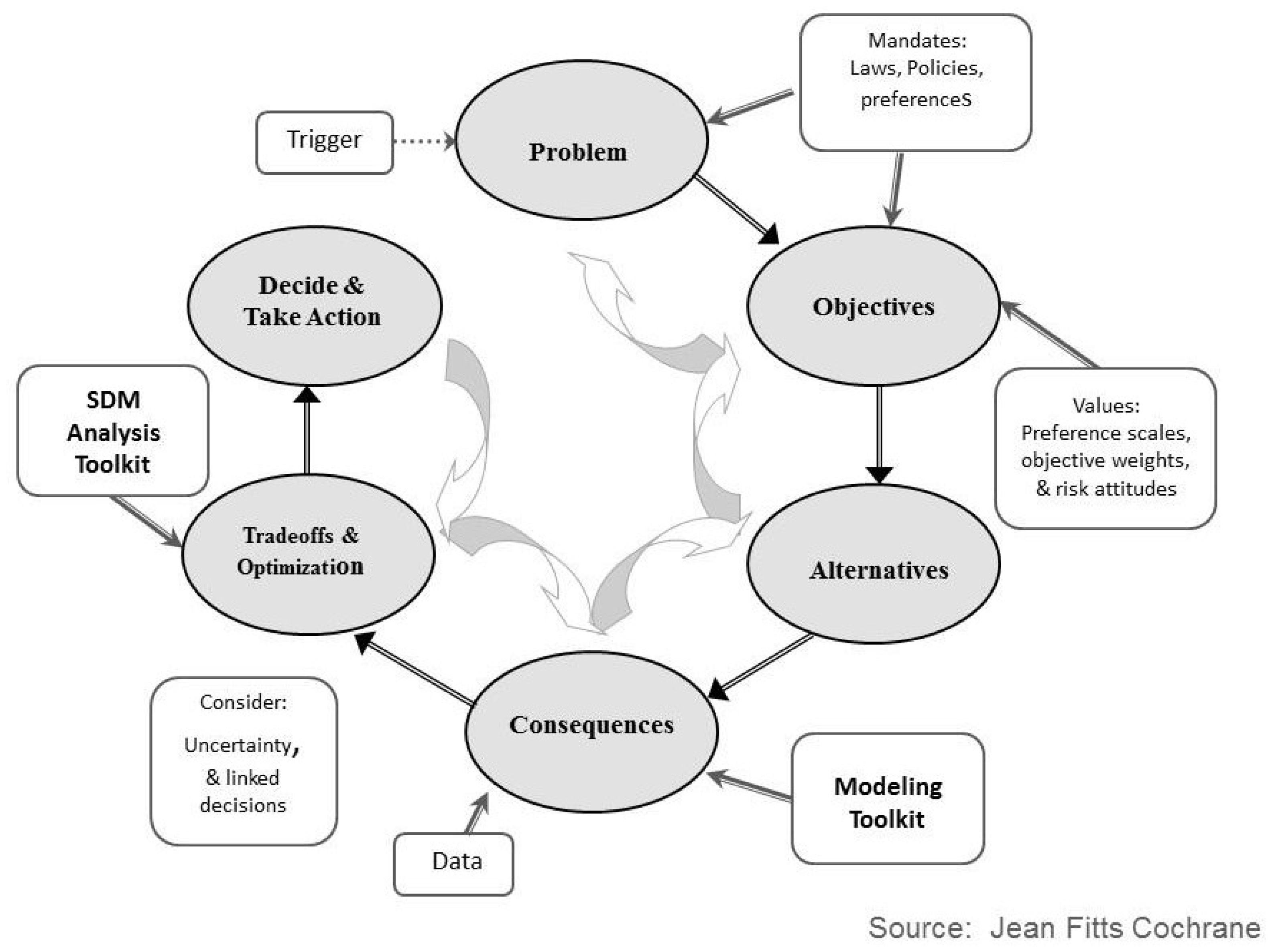
Figure 2.
Objectives hierarchy for the decision of how best to develop a communications strategy for the Cooperative Research Units (CRU) Program at the national level. Green boxes denote fundamental objectives, white boxes below the fundamental objectives are measurable attributes for each objective. The blue box at the top denotes strategic objectives. Tier 4 audiences are the highest level in importance and tier 1 is the lowest. DOI; Department of the Interior; USGS, United States Geological Survey; EMA, Ecosystems Mission Area; NGO, Non-governmental Organization; AFWA, Association of Fish and Wildlife Agencies; NAUFWP, National Association of University Fish and Wildlife Programs; AFS, American Fisheries Society; TWS, The Wildlife Society.
Figure 2.
Objectives hierarchy for the decision of how best to develop a communications strategy for the Cooperative Research Units (CRU) Program at the national level. Green boxes denote fundamental objectives, white boxes below the fundamental objectives are measurable attributes for each objective. The blue box at the top denotes strategic objectives. Tier 4 audiences are the highest level in importance and tier 1 is the lowest. DOI; Department of the Interior; USGS, United States Geological Survey; EMA, Ecosystems Mission Area; NGO, Non-governmental Organization; AFWA, Association of Fish and Wildlife Agencies; NAUFWP, National Association of University Fish and Wildlife Programs; AFS, American Fisheries Society; TWS, The Wildlife Society.
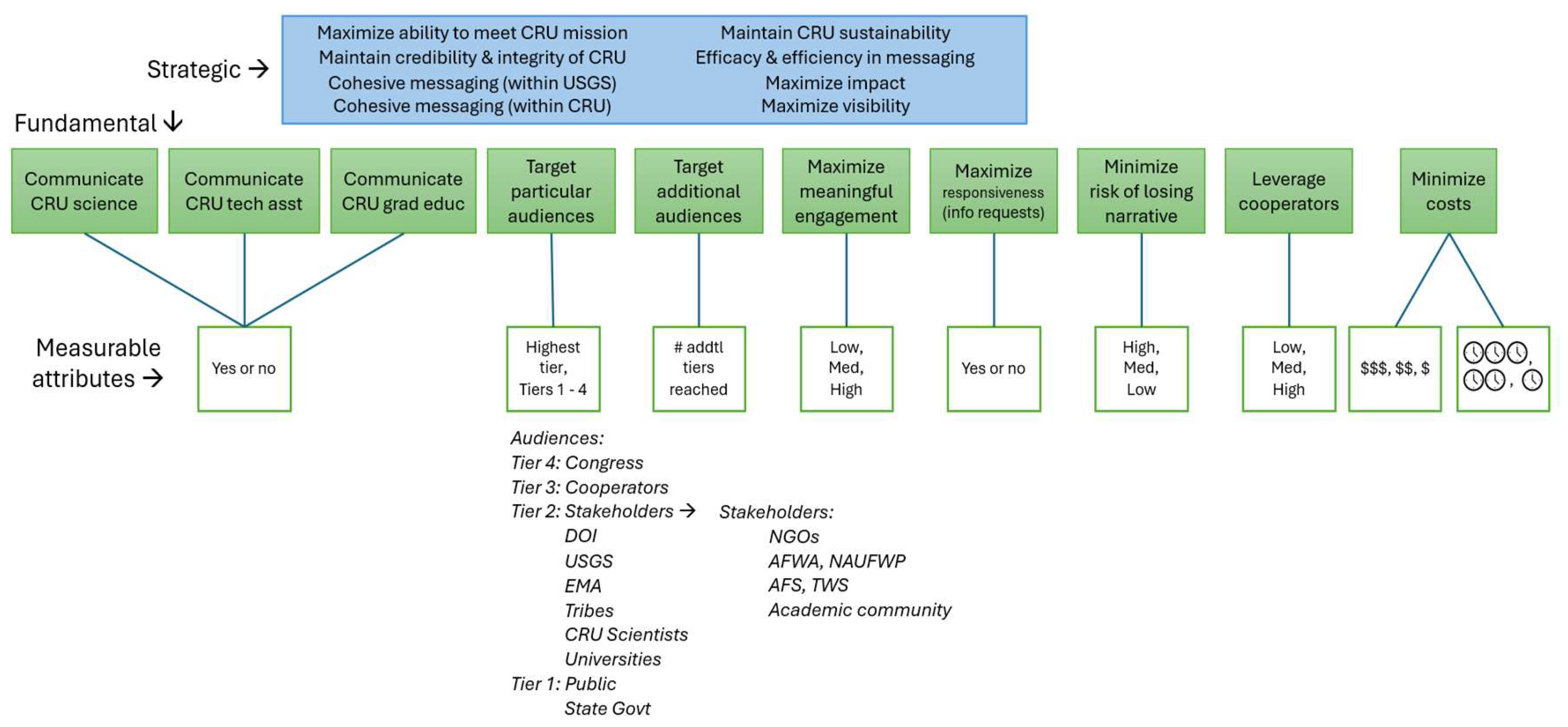
Figure 3.
Final scores for each alternative, based on the predicted consequences for each alternative in terms of the objectives, and the relative importance of each objective.
Figure 3.
Final scores for each alternative, based on the predicted consequences for each alternative in terms of the objectives, and the relative importance of each objective.
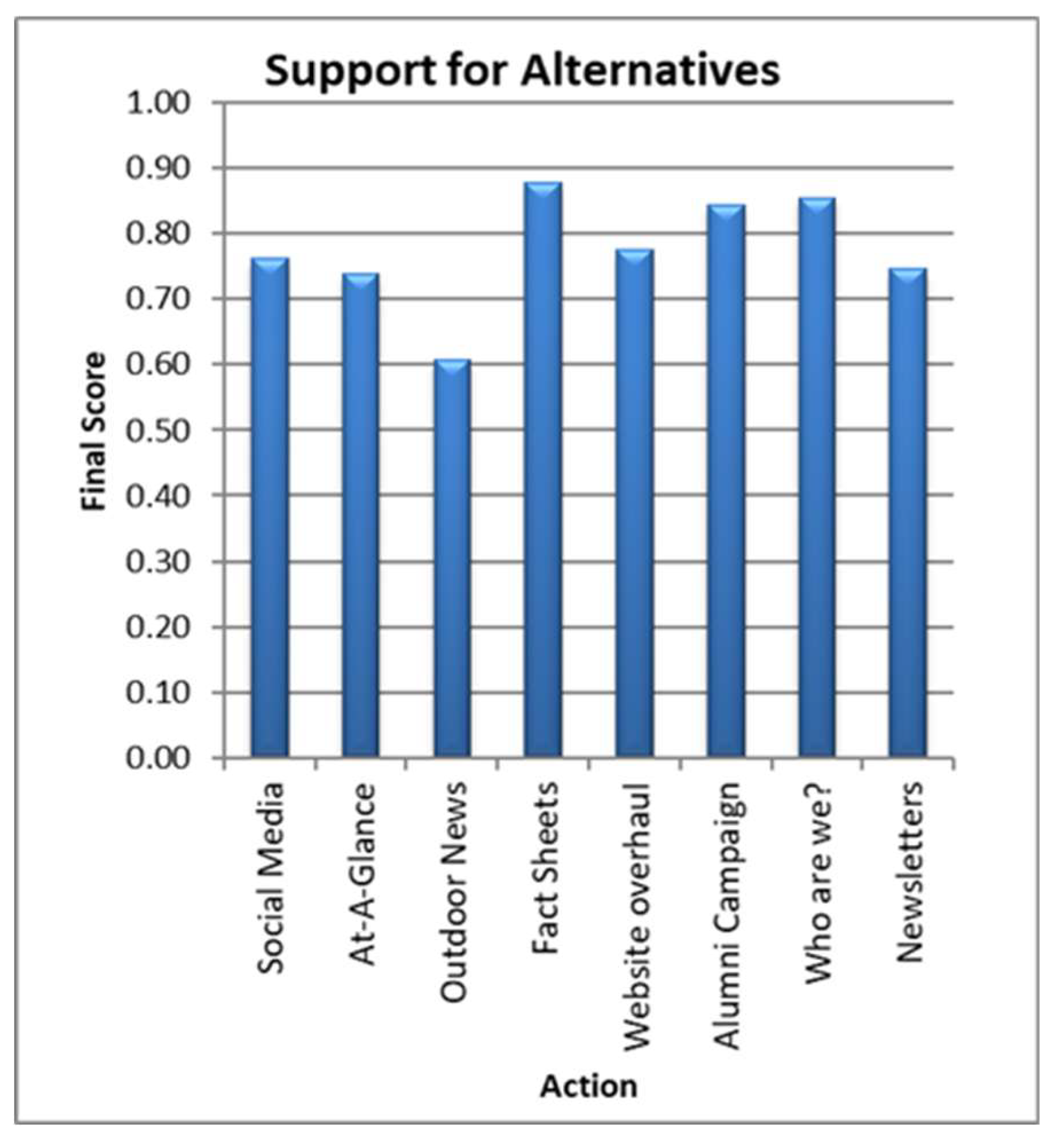

Table 1.
Participants in the structured decision-making workshop for developing a communications plan for the United States Geological Survey (USGS), Cooperative Research Unit (CRU) Program.
Table 1.
Participants in the structured decision-making workshop for developing a communications plan for the United States Geological Survey (USGS), Cooperative Research Unit (CRU) Program.
| Name | Affiliation | Role |
| Rena Carey | Administrative Assistant, University of Maine, Maine Cooperative Fish and Wildlife Research Unit | Participant |
| Margaret Everson | Executive Director, Oak Grove Initiative | Participant |
| Sally House | Public Affairs Specialist, USGS, Ecosystems Mission Area | Participant |
| Elise Irwin | CRU Communications Team Lead, U.S. Geological Survey CRU Program | Participant and Project Initiator |
| Sammy King | Unit Leader, USGS Louisiana Cooperative Fish and Wildlife Research Unit | Participant |
| Jonathan Mawdsley | Chief, USGS CRU Program | Participant |
| Conor McGowan | Assistant Unit Leader, USGS Florida Cooperative Fish and Wildlife Research Unit | Facilitator |
| Bill Moritz | Midwest Field Representative, Wildlife Management Institute (WMI) | Participant |
| Kevin Pope | Deputy Chief, USGS CRU Program | Participant |
| Kelly Robinson | Assistant Unit Leader, USGS Georgia Cooperative Fish and Wildlife Research Unit | Facilitator |
| Sarah Sells | Assistant Unit Leader, USGS Montana Cooperative Wildlife Research Unit | Facilitator |
| Lisa Webb | Regional Supervisor, USGS CRU Program | Participant |
Table 2.
Products produced by the Cooperative Research Units Program (CRU) that represent the status-quo case.
Table 2.
Products produced by the Cooperative Research Units Program (CRU) that represent the status-quo case.
| Product | Frequency | Audience |
| Abstract Book | 5 years | Congress, Cooperators, CRU |
| Year in Review Circular | Yearly | Congress, Cooperators, CRU, Public |
| Thematic Fact Sheets | On-demand | Congress, Cooperators, Public |
| Expertise Directory | Updated often | Cooperators |
| WMI ONB | Monthly | Cooperators, Public |
| Watermark Website | Monthly | Congress, Cooperators, CRU, Public |
| USGS Website | Infrequent | Congress, Cooperators, CRU, Public |
| Coop Catch-up | Monthly | CRU |
| Social Media | Monthly | Congress, Cooperators, CRU, Public |
| Booths at Meetings | Infrequent | Cooperators |
| Articles in Professional Society Publications | Infrequent | Cooperators |
Table 3.
List of actions (A) and tactics (T) that were developed and evaluated during the week-long Structured Decision-Making (SDM) workshop for Cooperative Research Unit (CRU) Communications Team.
Table 3.
List of actions (A) and tactics (T) that were developed and evaluated during the week-long Structured Decision-Making (SDM) workshop for Cooperative Research Unit (CRU) Communications Team.
| Action, Tactic | Description |
| Social Media, Website (T) | Development of a holistic social media campaign, as well as revamping the website and the newsletters |
| At-A-Glance (A) | Summary of activities from each unit |
| Outdoor News (A) | Monthly articles written for the Outdoor News Bulletin by Unit scientists |
| Fact Sheets (T) | 1–2-page documents on various topics (e.g., value of the CRU Program, 2024 summary) |
| Website Overhaul (A) | Completely renovating the U.S. Geological Survey website for the CRU Program |
| Alumni Campaign (T) | Form alumni organization that can get the word out about the CRU Program |
| Who Are We? Campaign (T) | Developing outreach materials specifically to ensure that those who support and fund the CRU Program understand the function of the program |
| Newsletters (A) | Quarterly to monthly newsletter to U.S. Geological Survey Center Directors/other leadership |
Table 4.
Predicted consequences of each alternative (columns with blue shading indicate the alternative names) and each objective (rows). Predictions were on the scale of the measurable attribute, defined as scales of 1/0, 1 - 3 or 1 - 4, depending on the objective. The scale of prediction varied such that “1” means best for objective 1, but means worst for objective 4. Colors convey score value; blue is best, white, is moderate, red is worst.
Table 4.
Predicted consequences of each alternative (columns with blue shading indicate the alternative names) and each objective (rows). Predictions were on the scale of the measurable attribute, defined as scales of 1/0, 1 - 3 or 1 - 4, depending on the objective. The scale of prediction varied such that “1” means best for objective 1, but means worst for objective 4. Colors convey score value; blue is best, white, is moderate, red is worst.
| Consequence Table | Actions | |||||||||||
| Obj # | Objectives | Goal of Scale | Social Media | At-A-Glance | Outdoor News | Fact Sheets | Website Overhaul | Alumni Campaign | Who are we? | Newsletters | Range: Min | Range: Max |
| 1 | Communicate CRU* Science | max | 1 | 1 | 1 | 1 | 1 | 1 | 1 | 1 | 0 | 1 |
| 2 | Communicate CRU* Tech. Assistance | max | 1 | 1 | 0 | 1 | 1 | 1 | 1 | 1 | 0 | 1 |
| 3 | Communicate CRU* Grad Education | max | 1 | 1 | 0 | 1 | 1 | 1 | 1 | 1 | 0 | 1 |
| 4 | Target Particular Audience Tiers | max | 3 | 3 | 3 | 4 | 4 | 3 | 4 | 3 | 1 | 4 |
| 5 | Target Additional Audience Tiers | max | 2 | 1 | 2 | 3 | 3 | 1 | 3 | 1 | 0 | 3 |
| 6 | Maximize Meaningful Engagement | max | 3 | 2 | 2 | 3 | 3 | 3 | 3 | 2 | 1 | 3 |
| 7 | Maximize Responsiveness | max | 0 | 0 | 0 | 1 | 0 | 0 | 0 | 0 | 0 | 1 |
| 8 | Minimize Risk of Losing Narrative | max | 2 | 3 | 3 | 3 | 3 | 2 | 3 | 3 | 1 | 3 |
| 9 | Leverage Cooperators | max | 2 | 2 | 3 | 2 | 1 | 3 | 3 | 1 | 1 | 3 |
| 10 | Minimize Costs (Dollars) | max | 3 | 2 | 3 | 2 | 2 | 3 | 1 | 3 | 1 | 3 |
| 11 | Minimize Costs (Time) | max | 1 | 2 | 3 | 2 | 1 | 2 | 2 | 2 | 1 | 3 |
*CRU, Cooperative Research Units Program.
Table 5.
Based on the predictions (provided in Table 4), we normalized values to a 0 – 1 scale to make all predicted consequences numerically comparable. Blue shading indicates the alternatives performing best (relative to other alternatives) for a particular objective, whereas red indicates the opposite. White cells indicate those performing neither best nor worst.
Table 5.
Based on the predictions (provided in Table 4), we normalized values to a 0 – 1 scale to make all predicted consequences numerically comparable. Blue shading indicates the alternatives performing best (relative to other alternatives) for a particular objective, whereas red indicates the opposite. White cells indicate those performing neither best nor worst.
| NORMALIZED SCORES | Actions | |||||||||
| Obj # | Objectives | Social Media | At-A-Glance | Outdoor News | Fact Sheets | Website Overhaul | Alumni Campaign | Who are we? | Newsletters | |
| 1 | Communicate CRU* Science | 1.0 | 1.0 | 1.0 | 1.0 | 1.0 | 1.0 | 1.0 | 1.0 | |
| 2 | Communicate CRU* Tech. Assistance | 1.0 | 1.0 | 0.0 | 1.0 | 1.0 | 1.0 | 1.0 | 1.0 | |
| 3 | Communicate CRU* Grad Education | 1.0 | 1.0 | 0.0 | 1.0 | 1.0 | 1.0 | 1.0 | 1.0 | |
| 4 | Target Particular Audience Tiers | 0.7 | 0.7 | 0.7 | 1.0 | 1.0 | 0.7 | 1.0 | 0.7 | |
| 5 | Target Additional Audience Tiers | 0.7 | 0.3 | 0.7 | 1.0 | 1.0 | 0.3 | 1.0 | 0.3 | |
| 6 | Maximize Meaningful Engagement | 1.0 | 0.5 | 0.5 | 1.0 | 1.0 | 1.0 | 1.0 | 0.5 | |
| 7 | Maximize Responsiveness | 0.0 | 0.0 | 0.0 | 1.0 | 0.0 | 0.0 | 0.0 | 0.0 | |
| 8 | Minimize Risk of Losing Narrative | 0.5 | 1.0 | 1.0 | 1.0 | 1.0 | 0.5 | 1.0 | 1.0 | |
| 9 | Leverage Cooperators | 0.5 | 0.5 | 1.0 | 0.5 | 0.0 | 1.0 | 1.0 | 0.0 | |
| 10 | Minimize Costs (Dollars) | 1.0 | 0.5 | 1.0 | 0.5 | 0.5 | 1.0 | 0.0 | 1.0 | |
| 11 | Minimize Costs (Time) | 0.0 | 0.5 | 1.0 | 0.5 | 0.0 | 0.5 | 0.5 | 0.5 | |
| Sum of scores: | 7.3 | 7.0 | 6.8 | 9.5 | 7.5 | 8.0 | 8.5 | 7.0 | ||
*CRU, Cooperative Research Units Program.
Table 6.
The group ranked objectives in order of importance (1 = most important) and added scores of the relative importance of meeting each objective, compared to the top ranked objective. They then calculated the relative weights of objectives by dividing each score by the sum of scores.
Table 6.
The group ranked objectives in order of importance (1 = most important) and added scores of the relative importance of meeting each objective, compared to the top ranked objective. They then calculated the relative weights of objectives by dividing each score by the sum of scores.
| Obj # | Objective | Rank | Score | Weight |
| 1 | Communicate CRU* Science | 2 | 90 | 0.13 |
| 2 | Communicate CRU* Tech. Assistance | 2 | 90 | 0.13 |
| 3 | Communicate CRU* Grad Education | 2 | 90 | 0.13 |
| 4 | Target Particular Audience Tiers | 3 | 85 | 0.12 |
| 5 | Target Additional Audience Tiers | 8 | 10 | 0.01 |
| 6 | Maximize Meaningful Engagement | 1 | 100 | 0.14 |
| 7 | Maximize Responsiveness | 8 | 10 | 0.01 |
| 8 | Minimize Risk of Losing Narrative | 6 | 45 | 0.07 |
| 9 | Leverage Cooperators | 7 | 40 | 0.06 |
| 10 | Minimize Costs (Dollars) | 5 | 50 | 0.07 |
| 11 | Minimize Costs (Time) | 4 | 80 | 0.12 |
| Sum: | 690 | |||
*CRU, Cooperative Research Units Program.
Table 7.
The final scores for each alternative (bottom row) are based on the normalized values (from Table 5) and the weights on objectives (from Table 6). Alternatives with the highest scores are those that best meet objectives, although tradeoffs are apparent in the scores for each objective.
| WEIGHTED SCORES | Actions | |||||||||
| Obj # | Objectives | Weight | Social Media | At-A-Glance | Outdoor News | Fact Sheets | Website Overhaul | Alumni Campaign | Who are we? | Newsletters |
| 1 | Communicate CRU* Science | 0.130 | 0.130 | 0.130 | 0.130 | 0.130 | 0.130 | 0.130 | 0.130 | 0.130 |
| 2 | Communicate CRU* Tech. Assistance | 0.130 | 0.130 | 0.130 | 0.000 | 0.130 | 0.130 | 0.130 | 0.130 | 0.130 |
| 3 | Communicate CRU* Grad Education | 0.130 | 0.130 | 0.130 | 0.000 | 0.130 | 0.130 | 0.130 | 0.130 | 0.130 |
| 4 | Target Particular Audience Tiers | 0.123 | 0.082 | 0.082 | 0.082 | 0.123 | 0.123 | 0.082 | 0.123 | 0.082 |
| 5 | Target Additional Audience Tiers | 0.014 | 0.010 | 0.005 | 0.010 | 0.014 | 0.014 | 0.005 | 0.014 | 0.005 |
| 6 | Maximize Meaningful Engagement | 0.145 | 0.145 | 0.072 | 0.072 | 0.145 | 0.145 | 0.145 | 0.145 | 0.072 |
| 7 | Maximize Responsiveness | 0.014 | 0.000 | 0.000 | 0.000 | 0.014 | 0.000 | 0.000 | 0.000 | 0.000 |
| 8 | Minimize Risk of Losing Narrative | 0.065 | 0.033 | 0.065 | 0.065 | 0.065 | 0.065 | 0.033 | 0.065 | 0.065 |
| 9 | Leverage Cooperators | 0.058 | 0.029 | 0.029 | 0.058 | 0.029 | 0.000 | 0.058 | 0.058 | 0.000 |
| 10 | Minimize Costs (Dollars) | 0.072 | 0.072 | 0.036 | 0.072 | 0.036 | 0.036 | 0.072 | 0.000 | 0.072 |
| 11 | Minimize Costs (Time) | 0.116 | 0.000 | 0.058 | 0.116 | 0.058 | 0.000 | 0.058 | 0.058 | 0.058 |
| Sum of Weights | 1.000 | |||||||||
| Final Score (sum of weighted scores) | 0.762 | 0.739 | 0.606 | 0.877 | 0.775 | 0.844 | 0.855 | 0.746 | ||
*CRU, Cooperative Research Units Program.
Disclaimer/Publisher’s Note: The statements, opinions and data contained in all publications are solely those of the individual author(s) and contributor(s) and not of MDPI and/or the editor(s). MDPI and/or the editor(s) disclaim responsibility for any injury to people or property resulting from any ideas, methods, instructions or products referred to in the content. |
© 2026 by the authors. Licensee MDPI, Basel, Switzerland. This article is an open access article distributed under the terms and conditions of the Creative Commons Attribution (CC BY) license (http://creativecommons.org/licenses/by/4.0/).
Copyright: This open access article is published under a Creative Commons CC BY 4.0 license, which permit the free download, distribution, and reuse, provided that the author and preprint are cited in any reuse.


