

Submitted:
27 April 2026
Posted:
28 April 2026
You are already at the latest version
Abstract
The study is grounded on information as a property of the constituent elements of both material and non-material systems. Through these interactions, a function is performed, or a structure is formed, which in turn performs a function analogous to the behavior of an intelligent agent. Information and self-organization give rise to modules at the molecular, cellular, and individual levels. Species, likewise, can be understood as modules, real and objective units of life, that emerge as cognitive, linguistic, and biological modules. In the framework of the biological module concept, species can be viewed as a temporal chain of living organisms, where each link comprises three successive populations that behave among themselves as intelligent agents. The intelligent agent is zygotic information in sexually reproducing organisms and an affordance of the environment in asexually reproducing organisms. However, a new model has been developed in which the stability of the species is argued, analogous to the stability observed in other biological modules.
Keywords:
information
; intelligent agent
; module
; affordance
; species
; species stability
1. Introduction
Modularity serves as a comprehensive organizing principle across both material and immaterial systems. Living organisms are composed of units, i.e., modules, that contribute to survival and reproduction [1]. Likewise, the brain exhibits modularity in both structure and function [2] as do languages [3]. In the case of language, the semantic triangle can be cited as a mental model [4] that is, an internal reflection of external reality [5].
In a previous study [6] was proposed the semantic triad as a linguistic module. In this study, it is accepted that the idea, the concept, the image formed in our brain constitutes a unit of information of an intelligent agent (A) about an object (O), from which a word is generated as an effector (E) of that agent. As it is established, an intelligent agent (A) perceives an object or environment (O), collects and stores the resulting information, and according to this input it generates an effector (E) that carries out a function [7].
There is no doubt that, through behavior, humans have formed concepts of both the living and non-living world, and this is no different for other species.
The well-known evolutionist E. Mayr [8] observed that the popular names of birds given by the inhabitants of an Aboriginal clan in Oceania closely corresponded to the scientific names used by ornithologists. Even species function as modular units, encompassing not only cognitive and linguistic modules, but also biological modules.
In this regard, a problem arises. If the species is not recognized as a biological module exhibiting intelligent-agent-like behavior, is it possible to construct a scientifically coherent and accurate concept of what a species truly is? The answer to this question may lie in analogy to what happened with the naming of elements in chemistry before and after the recognition of the atomic number.
In the philosophical concept, it is acknowledged that the cognitive process unfolds from emergence to essence, where the newly formed essence serves as the emergence for the next one. Thus, the chain of emergence-essence-emergence persists. Specifically, chemists have also named chemical elements based on their external features, just like biologists do nowadays. At that time, the concept of chemical elements was largely nominal or a module of words. Nevertheless, almost a century and a half has passed since chemists began classifying chemical elements based on atomic number. Are biologists expected to find and use an atomic number similar to that of chemists?
In the present, we still do not have an answer to this question, but it is important to recognize that atoms and molecules are modules [9,10,11]. The second problem of this study is the speciation that occurs in the self-organization-selection marriage [12]. Furthermore, the speciation analysis will be conducted according to a model in which evolutionary factors form modules, and the events of this speciation are interpreted through the interactions among these factors and their temporal dynamics.
2. Specie as a Module
2.1. The RNA World and Three Worlds Hypothesis
The RNA World Hypothesis [13] it is regarded as one of the most likely and plausible starting points for the emergence of life. This is further reinforced from the perspective of modules as units of construction and function in living organisms. In earlier studies [10,11] it was suggested that there is not one but three worlds of which the RNA World module is composed. These include: The world of performed functions (O), which involves the elongation of RNA fragments, the world of effectors (E), comprising oligonucleotides that mediate this RNA fragment elongation, and the world of information (A), representing an intelligent agent (Figure 1a).
In Figure 1a, the idea of the American biologist [14] that RNA molecules were produced in the early Earth environment and acquired the enzymatic function of self-replication is schematically illustrated as a module. Later, this view was discussed by several well-known scientists until it was introduced, with the term coined by W. Gilbert [13] (1986), as the RNA world. Another term in Figure 1a is affordance, introduced by the psychologist J.J. Gibson [15] and its meaning in biology is recognized as a property, resource, or asset of the environment that offers a living organism the means to live or not live. In our case, an affordance is a property of the environment at that time, in a shallow marine setting, that enabled the behavior of some RNA nucleotides or oligonucleotides as ribozymes catalyzing the elongation of the RNA polymer chain. Affordance, as a property of a given environment, can be interpreted as a form of information about the environment, specifically as information about the ecological niche of a species. From this perspective, it will be accepted that, in the RNA World module, the affordance functions as the intelligent agent (A), the RNA fragment represents the performed function (O), while the oligonucleotide serves as the effector (E). In Figure 1b, the module of a later material system is depicted, in which the RNA world consists of polymers of mRNA and tRNA that interact not only with each other but also with the amino acids of proteins or with some genetically uncoded polypeptide chains.
With this hypothesis, we can explain the role of polymer fencing by polypeptide chains and other substances as providing opportunities for intensive interactions within the so-called coacervate. It is also possible that over time, the uncoded protein envelope of the coacervate was gradually replaced by a membrane composed of genetically encoded proteins.
In Figure 1c, the RNA world time at which spontaneous binary fission occurs is shown. Naturally, the states of these systems have been far more diverse, but this scenario serves as a model that allows for assumptions of several other states up to the point at which the RNA world, characterized by heterocatalytic processes, is complemented by the inclusion of DNA as a new medium of information storage (Figure 1d).
2.2. Definition of Species
Traditionally, the origin of life has been understood as the formation of a material system or living organism, rather than the simultaneous emergence of a new species. However, it is evident that the emergence of life cannot be understood without considering the mechanism by which a species forms a module, that is, a real unit within the living world.
This concept enables us to understand that, just as an effector within a module performs a specific function, all the effectors within an individual’s module work together to ensure survival and reproduction. Similarly, individuals of a species can be viewed as modules of a species. This idea is depicted in Figure 2.
In Figure 2, it is shown that the similarity between the modules lies in the formation of effectors according to the information gathered about the function by intelligent agents. The key difference between them lies in the nature of the agent. Namely, this distinction concerns organisms that reproduce sexually versus those that do not. For this reason, the core aim of this study is to identify a common point from which the differences between them can be delineated. We believe there is compatibility between the concept of affordance and the species’ modulome, understood as the set of all information available to the agent. Let us consider, for example, how the tobacco mosaic virus develops within tobacco leaves.
Just as the zygote in sexually reproducing organisms enables the formation of offspring from ancestors, so too do affordances, understood as environmental properties or environmental information, enable binary fission and the formation of offspring. This similarity is reflected in the ancestor-descendant relationship of some populations across both forms of reproduction, as both affordances and the modulome contribute to maintaining the successive chain of populations, whether sexual or asexual. So, by equating the concept of affordance with that of modules, the same chain of populations across the entire living world with and without sexual reproduction is ensured From this a species can be defined as follows: A species can be understood as a chain of populations of living organisms, where each link represents a reproductive community consisting of three successive, interconnected populations that collectively behave as an intelligent agent.
2.3. Advantages of the Modular Concept of Species
Defining the species concept in terms of the modules that constitute living organisms offers several advantages over other concepts. The modular concept, like the biological one, defines a species as a reproductive community and consequently distinguishes species based on reproductive isolation. On the other hand, the modular concept offers an advantage over the biological concept, since it applies to agametic, asexual organisms as well. The concept of affordance, as a property of the environment, is compatible with the concept that nucleic acids represent the environmental information that living organisms have fixed over time, serving as an analogous role to genetic information carried by the individual [16]. This fact makes us pay more attention to the area where a species grows and develops, regardless of whether it reproduces sexually or asexually. The modular concept of species, like the linear, evolutionary, and phylogenetic concepts, distinguishes one species from another, whether or not it forms a chain of populations over time. Nevertheless, the modular concept of species has an advantage over other concepts because the three successive populations, as links in the chain, behave among themselves as intelligent agents. In several previous studies [10,11] it has been argued that modules’ stability and autonomy are maintained only when they function as intelligent agents. From here, it follows that the mechanism of modular evolution is the formation of module structure through self-organizing processes and natural selection, that is, the emergence of a special order arising from the marriage of self-organization and natural selection [12]. In this case, we have to mention that
a) The variation-selection dyad should be substituted with the self-organization-selection dyad.
b) The objects on which the selection operates are the modules.
c) Selection acts on modules in two distinct stages: first, during the formation of their structure, and second, during the performance of their function.
d) modules are formed at different levels of biological organization, and that
e) natural selection occurs at different levels of biological organization.
In all these processes, the question is how a species acquires static persistence or stability, as it does with other objects such as atoms, molecules, minerals, biological modules, individuals, linguistic modules, or social and cultural modules.
This fact demonstrates that it was no coincidence that Ch. Darwin gave his major work a title indicating that the origin of species is as much related to natural selection as to its preservation. Finally, we believe that the above formulation of species has an advantage over other concepts because it helps determine species and know their biology.
3. Model of Speciation and Species Stability
3.1. Description of the Model
The model of speciation and species stability is built on the interactions among the factors involved in species formation, including matter, energy, information, natural selection, and self-organization.
Figure 3.
Model of speciation and species stability. (Explanation can be found in the text).
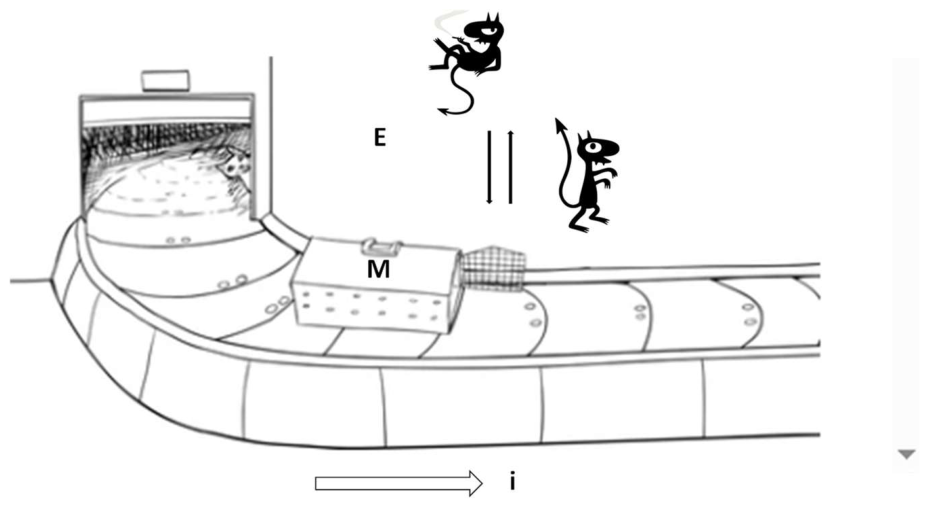
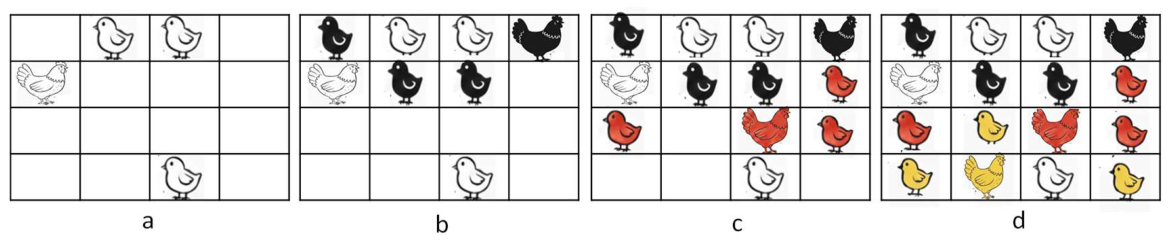
Matter (M), as the number of individuals of a species is a weight placed on a conveyor belt, whose motion velocity is determined by the value of i in the formula E = M*i [10,11]. The core idea of this model is that a viable species must periodically make a “jump” to a specific height that falls within a certain space (area) of the conveyor belt. The jump to the appropriate height is determined by the amount of energy available to the species at that moment. This implies that the number of individuals in a species (M) determines the height of the curve (E), which represents the energy corresponding to the conveyor belt’s motion velocity, given i, according to the formula M = E/i. The interrelations among the three categories of the universe are shaped by the formation of modules through self-organization (so) and their survival, as well as their reproduction under the pressure of natural selection (ns). A key role in this process appears to be played by the decision-making mechanisms of the modules formed through self-organization. It is widely acknowledged that the two fundamental molecular processes are information or molecular recognition and self-organization [17]. We think that in the formation of the module’s structure, such as species, both information and self-organization participate. What is self-organization? By self-organization, we refer to the interaction among the lowest-level elements of a system, from which its global behavior arises [18,19]. As an example, we describe below how interactions among individuals of the same species can, through self-organization, give rise to a modular structure in hens. The model we will present illustrates how global behavior emerges from the behavior of four hens and three chicks, each assigned hypothetical fitness values such as 3, 2, and 1, while the hens themselves have the value of 4. Initially, the first hen appears in the meadows, around which chicks 3, 2, and 1 follow it at varying distances. (Figure 4a).
What happens with the other three hens is a 4x4 Sudoku game. Remember that in the 4x4 grid, that is, the 16 squares will be filled with numbers in such a way that the four columns and four rows of this grid have different numbers. Thus, according to the Sudoku game, just as one marks the corresponding numbers, so too does the second hen with its three chicks approach the first hen. (Figure 4b). So too do the other two hens behave. (Figure 4b–d). The behavior of the hens and their chicks, placing themselves as close as possible to one another, enables the performance of two functions. This modular structure provides better protection against predators, facilitates foraging in the pastures, and is therefore favored by natural selection. Understandably, selection does not always achieve the optimal structural arrangement in which all four sides of the chicks’ group are guarded by the four hens. Nevertheless, it achieves a sufficiently favorable configuration to perform the function of protection and efficient foraging.
3.2. Species Stability
As mentioned above, in the title of his work, Ch. Darwin pointed out, on the one hand, the role of selection in species formation, and, on the other hand, the importance of maintaining species stability. In physics, matter stability refers to the controlled balance between positively and negatively charged particles. This balance enables, for example, the existence of the hydrogen atom. Likewise, the covalent chemical bonds between two hydrogen atoms enable the hydrogen molecule to exist as an autonomous unit.
These autonomous units of inert matter are also found as modules in the living world. The species itself can be considered a module, whose identity is preserved through its behavior as an intelligent agent, as illustrated in Figure 4. In the context of the model, matter can be considered the number of individuals of a population of species x, while the energy of this population, according to the formula E=M*i, is given by the product of this number with the value of i at a specific point in time. In the language of the model, we must accept that the value of I as the motion velocity of the conveyor belt must be matched with the energy as a jump from above, because in this way, the individuals of the population can fall after jumping on the same surface of the conveyor belt. The fact that information increases during evolution means that there is always a dynamic difference between energy (E) and the value of I, just as this dynamic appears in the formula M =E/I [10,11]. From this formula, it follows that, during evolution, a trade-off between matter and information emerged, or that species exhibit strategic K and r behavior. Let us suppose that two marksmen possess different abilities or access to different information. One requires at most 4 bullets to hit the target, whereas the other needs at least 16. Similarly, in two species, achieving stability requires producing 4 and 16 offspring, respectively. However, the situation changes entirely in a different environment. Suppose two groups of children, one consisting of four individuals and the other of sixteen, have just finished playing football on the beach. In each group, one child has lost a key, and the group begins to search for it. Which group has the greater advantage in finding the key first? In this case, it becomes necessary to accept the idea proposed by G.G. Williams [20], who regarded the offspring of a species as lottery tickets.
4. Conclusions
The concept of the module in biology gives rise to modular thinking—a new framework of reasoning, positioned alongside population thinking, phylogenetic thinking, lineage or tree thinking, selection thinking, and others [21].
Based on this way of thinking, biological structures and functions represent two sides of the same coin. From a structural perspective, a module is a material or immaterial system in which constituent elements interact through various forms of information. The other side of the coin, or the functional perspective, involves the execution of a function or the formation of an effector that carries out a specific function based on these interactions [22].
In the case of a species, the populations of a living organism form a chain, whose links constitute a reproductive community composed of three populations. These populations together form a module that functions as an intelligent agent.
A living organism reproducing asexually can be considered a module that behaves as an intelligent agent when accepting the concept of affordance, analogous to the information carried by zygotes formed from two gametes in sexually reproducing organisms.
In fact, this analogy should not surprise us, as affordance also occurs in reproductive processes. Several phenomena of this nature can be listed, such as the formation of the atom as a controlled balancing of positive and negative charges, the formation of covalent bonds in hydrogen atoms, enzyme-substrate binding, the development of the tobacco mosaic virus within tobacco leaves, external fertilization in some animal species, the nature of ecological niches, and so on.
An environment, by its very nature, becomes the source of a biological event. Through this event, the previously insurmountable boundary between asexual and sexual organisms is eliminated. From a modular perspective, a species can be understood as a biological, cognitive, and linguistic module.
As a biological module, the species, like all other modules, has acquired stability and autonomy. As a cognitive module, the species represents a mental model within the human brain, that is, an internal representation of external reality. Thus, the species, through these properties, is perceived and distinguished as a distinct category within the living world. Finally, based on these perceptions and categorizations, species may be given a unique name or one shared with similar entities. In the case of species as a cognitive and linguistic module, it is understood as a social construct.
Within the modular framework, race does not qualify as a biological module, as it never constitutes a link in a continuous chain of distinct reproductive communities. Individuals belonging to different so-called races interbreed and produce viable offspring, thereby lacking the reproductive isolation characteristic of biological modules such as species. Furthermore, by accepting the modular concept of species, the view that multiple species concepts coexist becomes untenable. Ultimately, based on current scientific knowledge, higher taxonomic categories do not constitute biological modules and, as such, should be considered merely nominal units.
Author Contributions
Conceptualization, Z.B.; writing—original draft preparation, A.B; N.B; F.M; Z.B.; writing—review and editing, A.B. All authors have read and agreed to the published version of the manuscript.
Funding
This research received no external funding.
Data Availability Statement
No new data were created or analyzed in this study.
Acknowledgments
We are grateful to our colleagues in the Department of Biology at the University of Tirana for their valuable insights.
Conflicts of Interest
The authors declare no conflicts of interest.
References
- Szathmáry, E.; Smith, J.M. The Major Evolutionary Transitions. Nature 1995, 374, 227–232. [CrossRef]
- Fodor, J. The Modularity of Mind: An Essay on Faculty Psychology; Cambridge, MA: MIT Press, 1983;
- Armstrong, D.F.; Wilcox, S.E. The Gestural Origin of Language; Oxford University Press, 2007;
- McElvenny, J. Ogden and Richards’ The Meaning of Meaning and Early Analytic Philosophy. Lang. Sci. 2014, 41, 212–221. [CrossRef]
- N, E.; Craik, K.J.W. The Nature of Explanation. J. Philos. 1943, 40, 667. [CrossRef]
- Bajrami, Z.; Rrokaj, S. Modular Evolution: A Hypothesis for Language Acquisition. International Journal of Language and Linguistic 2023, 10, 16–26.
- Russell, S.; Norvig, P. Artificial Intelligence: A Modern Approach; 3rd edition.; Pearson: Boston Columbus Indianapolis New York San Francisco Upper Saddle River Amsterdam Cape Town Dubai London Madrid Milan Munich Paris Montreal Toronto Delhi Mexico City Sao Paulo Sydney Hong Kong Seoul Singapore Taipei Tokyo, 2009; ISBN 978-0-13-604259-4.
- Mayr, E. Animal Species and Evolution:; Harvard University Press, 1963; ISBN 978-0-674-86530-3.
- Bajrami, Z. The Modular Concept of Gene. Journal of Natural Sciences Research 2013, 3, 125–130.
- Bajrami, Z. Informacioni dhe evolucioni modular; Akademia e Shkencave të Shqipërisë: Tiranë, 2024; ISBN 9789928809193.
- Bajrami, Z. Information and Modular Universal Evolution. IPI Lett. 2025, 25–43. [CrossRef]
- Kauffman, S.A. The Origins of Order: Self-Organization and Selection in Evolution; 1st edition.; Oxford University Press: New York, 1993; ISBN 978-0-19-507951-7.
- Gilbert, W. Origin of Life: The RNA World. Nature 1986, 319, 618–618. [CrossRef]
- Lehman, N. The RNA World: 4,000,000,050 Years Old. Life 2015, 5, 1583–1586. [CrossRef]
- Gibson, J.J. The Ecological Approach to Visual Perception: Classic Edition; 1st ed.; Psychology Press, 2014; ISBN 978-1-315-74021-8.
- Adami, C. The Evolution of Biological Information: How Evolution Creates Complexity, from Viruses to Brains; Princeton University Press; ISBN 978-0-691-24115-9.
- Sugita, M.; Onishi, I.; Irisa, M.; Yoshida, N.; Hirata, F. Molecular Recognition and Self-Organization in Life Phenomena Studied by a Statistical Mechanics of Molecular Liquids, the RISM/3D-RISM Theory. Molecules 2021, 26, 271. [CrossRef]
- Camazine, S. Self-Organization in Biological Systems; Princeton University Press, 2003;
- Yukalov, V.I.; Sornette, D. Self-Organization in Complex Systems as Decision Making. Adv. Complex Syst. 2014, 17, 1450016. [CrossRef]
- Williams, G.C. Sex and Evolution. Monogr. Popul. Biol. 1975, 3–200.
- Bajrami, Z. Te menduarit modular ne biologji. Buletini i Shkencave te Natyres 2018, 26, 78–91.
- Modularity in Development and Evolution; Schlosser, G., Wagner, G.P., Eds.; University of Chicago Press: Chicago, 2004; ISBN 978-0-226-73853-6.
Figure 1.
Possible transitions from the RNA World to the emergence of the first living organisms, coinciding simultaneously with the appearance of the first species (Explanations in the text).
Figure 1.
Possible transitions from the RNA World to the emergence of the first living organisms, coinciding simultaneously with the appearance of the first species (Explanations in the text).
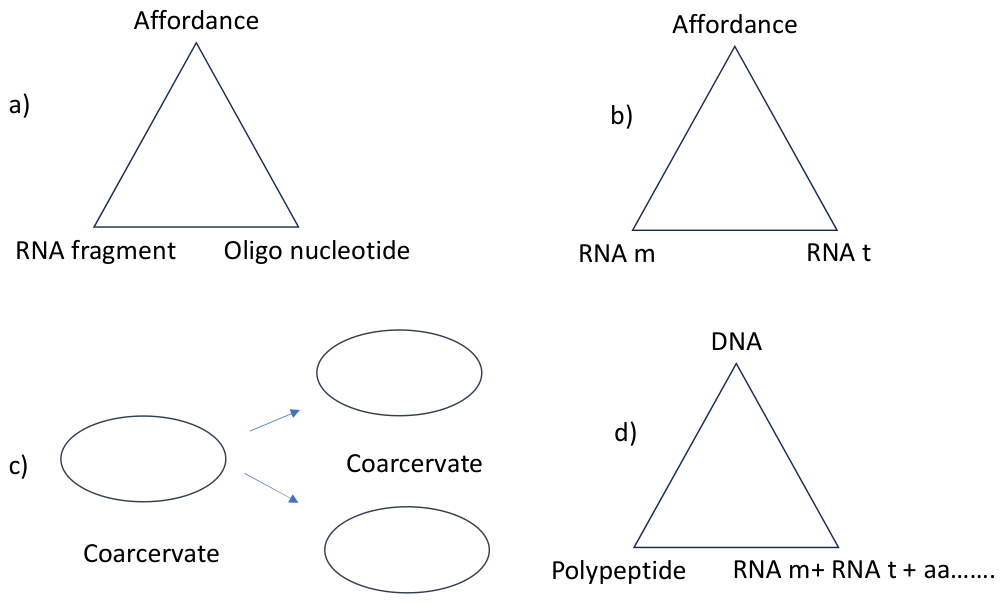
Figure 2.
The model of a module as an intelligent agent, specifically a genetic module, (a) of an organism as an individual; (b) with asexual reproduction; (c) sexual reproduction; and (d) the model of a species.
Figure 2.
The model of a module as an intelligent agent, specifically a genetic module, (a) of an organism as an individual; (b) with asexual reproduction; (c) sexual reproduction; and (d) the model of a species.
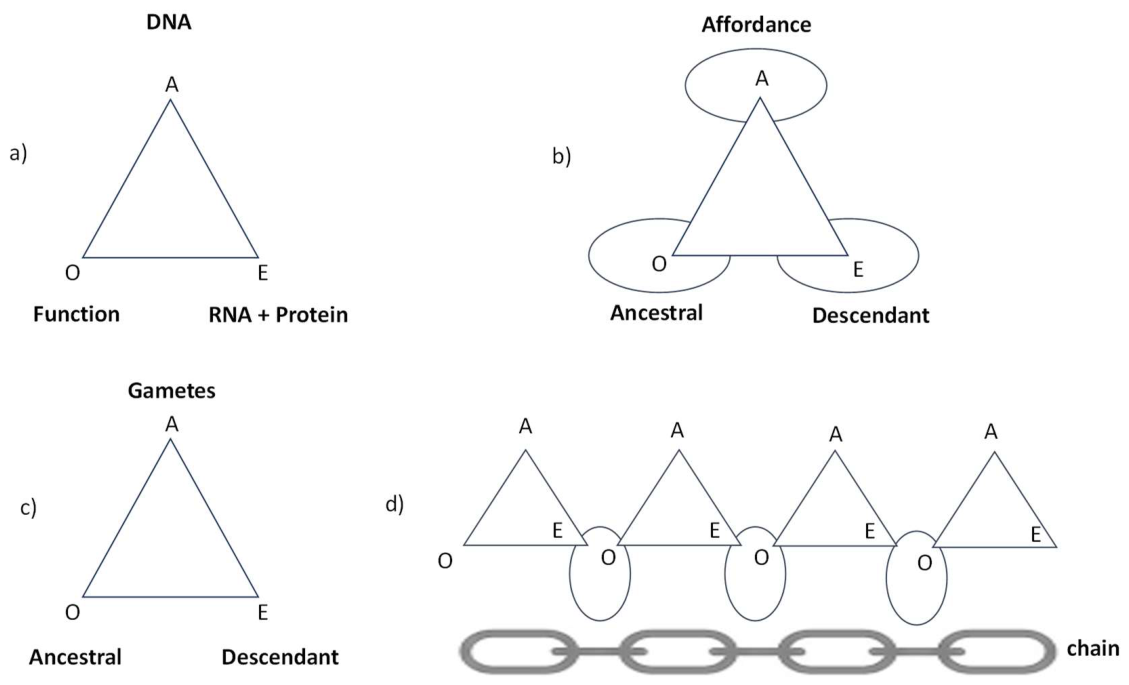
Figure 4.
The emergence of a global behavior from the behavior of four hens and their three chicks.
Disclaimer/Publisher’s Note: The statements, opinions and data contained in all publications are solely those of the individual author(s) and contributor(s) and not of MDPI and/or the editor(s). MDPI and/or the editor(s) disclaim responsibility for any injury to people or property resulting from any ideas, methods, instructions or products referred to in the content. |
© 2026 by the authors. Licensee MDPI, Basel, Switzerland. This article is an open access article distributed under the terms and conditions of the Creative Commons Attribution (CC BY) license.
Copyright: This open access article is published under a Creative Commons CC BY 4.0 license, which permit the free download, distribution, and reuse, provided that the author and preprint are cited in any reuse.


