
Submitted:
24 April 2026
Posted:
27 April 2026
You are already at the latest version
Abstract
In recent years, the rapid expansion of low-temperature facilities—such as cold storage and indoor ice and snow venues—has underscored their pronounced vulnerability to fire, as evidenced by multiple severe incidents. Due to their distinct environmental conditions, existing theoretical frameworks, technical approaches, and standards exhibit limited applicability. Consequently, the fire risk characteristics of such facilities remain insufficiently defined, and systematic methods for hazard identification and assessment are lacking. This study conducts a detailed analysis of fire incident data from representative low-temperature facilities to identify the fire risks characteristics across all lifecycle stages, including construction, renovation and expansion, operation, maintenance, and demolition. An integrated framework combining the WBS/RBS matrix and CN methods is then proposed to establish a structured methodology for full lifecycle fire hazard identification and classification. The results address critical gaps, including the absence of clearly defined lifecycle fire risk profiles and a robust scientific basis for hazard identification, and provide a technical foundation for lifecycle fire risk management in low-temperature facilities.
Keywords:
low-temperature facilities
; full lifecycle
; fire risk characteristic
; fire hazard identification
; classification
1. Introduction
Low-temperature facilities generally refer to production and commercial premises in which the indoor temperature of buildings or structures remains significantly below normal levels on a long-term or seasonal basis, either because of active cooling technologies or exposure to external low-temperature environments. In recent years, the overall market size of typical low-temperature facilities, such as cold storage and indoor ice and snow venues, has grown steadily [1,2,3], and the associated fire safety challenges cannot be overlooked. Although fire risks remain prominent in traditional warehousing facilities and large indoor entertainment venues, low-temperature environments further increase the complexity and uncertainty of these risks. Existing theoretical frameworks, technical methods, and standards are not well suited to the specific context of fire risks in low-temperature facilities. Consequently, the characteristics of fire risks in such environments remain insufficiently understood, and systematic methods for identifying and classifying fire hazards are still lacking.
The concept of the “full lifecycle” was originally developed in the field of product management, where it emphasizes the management of the entire process from design, production, use and scrap [4,5,6]. In recent years, this concept has been systematically introduced into the field of safety risk management for buildings and facilities[7,8]. Under the full lifecycle approach, a building or facility is regarded as a macro-level system that evolves dynamically over time. Accordingly, fire prevention and control measures should be tailored to the characteristics and risks present at each stage of the lifecycle and should be continuously adjusted and optimized. In low-temperature environments, unique environmental conditions and the extensive use of insulation materials not only increase the complexity of fire ignition and propagation, but also create distinct challenges for fire protection equipment and emergency response. Moreover, low-temperature facilities exhibit different fire risk characteristics across various stages, including construction, renovation and expansion, operation, maintenance, and decommissioning/demolition. Therefore, systematic and differentiated fire risk management throughout the entire lifecycle is particularly important.
At present, research on fire risk prevention and control in low-temperature facilities remains limited. Most existing studies focus instead on fire safety in other types of storage facilities. For example, Li et al. [9] employed a fusion of Support Vector Machines (SVM) and Electrostatic Discharge Analysis (ESDA) to process real-time sensor data from warehouses and proposed a dynamic intelligent risk assessment method to improve process safety management and storage security in chemical hazardous material warehouses. Han et al. [10] collected and analyzed 338 heat of combustion (HOC) data points and 613 bulk density measurements of packaged products, and proposed a method for classifying fire load density according to commodity categories, thereby enabling quantitative assessment of warehouse fire hazards. Xie et al. [11] developed a comprehensive model combining Bayesian Networks (BN) and expert assessment to evaluate fire risks in lithium-ion battery warehouses. Their model incorporates fire causes, factors affecting fire spread, and fire consequences, enabling dynamic analysis of fire evolution and outcomes. Chen et al. [12] proposed an intelligent early-stage fire detection system specifically designed for large-scale warehouse environments. By integrating YOLOv7 object detection with infrared thermal imaging technology, the system can detect smoldering heat sources during the incipient stage of a fire that are typically undetectable by traditional smoke sensors. Mei et al. [13] investigated the progressive collapse behavior of automated racking warehouses under fire conditions using a performance-based approach. They proposed a three-step numerical method combining static, dynamic implicit, and dynamic explicit analyses to capture phenomena such as large displacements, buckling, and contact interactions, thereby laying the foundation for more effective and economical fire recovery strategies for fire-resistant structural walls. Sun et al. [14] proposed a multi-source data-driven adaptive fire hazard assessment method. Based on a fusion strategy involving evidence-based reasoning and the artificial fish swarm algorithm, the method can automatically generate hazard assessment rules associated with each fire-related factor and identify hazardous zones in logistics warehouses under sudden fire scenarios. Hanifi et al. [15] developed a fire propagation assessment model for chemical warehouses. Using Fire Dynamics Simulation (FDS), they simulated fire scenarios with and without ventilation systems, evaluated fire propagation using the domino effect method, and employed Bayesian Networks to update the fire propagation rate.
In the field of fire safety research for cold storage facilities and indoor ice and snow venues, Zhan et al. [16] proposed an intelligent framework based on the Industrial Internet of Things (IIoT) and Digital Twin (DT) technologies to enable real-time occupational safety monitoring in cold storage operating environments. Li et al. [17] conducted a qualitative analysis of fire safety risks in cold storage facilities through case studies of several typical fires in Shanghai and special inspections of such facilities. The study identified hot work operations and non-compliant construction management as the most common causes of fires. Ding et al. [18] systematically analyzed fire compartment design, fire load calculations, evacuation planning, and smoke exhaust strategies for indoor snow parks. The study identified potential fire hazards and corresponding prevention measures, and quantitatively assessed fire risks by coupling fire dynamics with evacuation simulation. Liu et al. [19] used Pathfinder software to conduct evacuation simulations for an indoor snow venue. Based on the simulation results, the study proposed a more suitable evacuation strategy and maximum occupancy level for the venue. The study also pointed out that evacuation speeds in indoor ski venues are highly uncertain, and therefore evacuation design cannot be approached in the same manner as for general commercial spaces.
Based on the above review, research on fire risks in conventional warehousing facilities is relatively comprehensive. In contrast, research on cold storage facilities still lacks targeted studies on the mechanisms of fire ignition and development, as well as systematic fire hazard identification methods. As a relatively new type of building, indoor ice and snow venues have received even less attention, with very limited relevant research available. To address these gaps, this study first conducts an in-depth analysis of fire case data from typical low-temperature facilities, in order to clarify the fire risk characteristics associated with different life cycle stages, including construction, renovation and expansion, operation, maintenance, and decommissioning/demolition. Next, by constructing an integrated WBS/RBS-CN framework, the study establishes a method for identifying and classifying fire hazards across the entire lifecycle of low-temperature facilities. The research results can effectively address current issues such as the lack of in-depth study on the characteristics of fire risks in low-temperature facilities and the absence of scientific basis for identifying potential fire hazards, thereby providing a direct reference for fire risk management throughout the lifecycle of such facilities.
2. Methods
2.1. Data Collection
The data used in this study are primarily derived from officially released investigation reports on typical fire accidents in low-temperature facilities between 2015 and 2025 in China. The selected cases involve fires in cold storage facilities and indoor ice and snow venues classified as “significant”, namely incidents resulting in three or more deaths, ten or more serious injuries, or direct economic losses of at least 10 million yuan (approximately USD 1.43 million). Selecting and conducting in-depth analyses of such significant cases helps identify the key fire hazards and underlying causes in low-temperature facilities.
Based on the collected accident investigation reports, the key data information examined in this study are summarized in Table 1. By analyzing indicators related to ignition risk, fire spread risk, and loss escalation risk in each incident, provides a basis for understanding fire causes and identifying hazards in low-temperature facilities.
2.2. Identification of Fire Hazards Based on the WBS/RBS Method
In the field of risk management, the combined use of the Work Breakdown Structure (WBS) and the Risk Breakdown Structure (RBS) provides an effective approach for comprehensively identifying and managing systemic risks. WBS is a tool for hierarchically analyzing workflows and system functions, breaking down overall system functions from top to bottom into multiple subfunctions and submodules. Within this framework, the scope of system functions at each level becomes increasingly specific. Similarly, RBS takes risk categories as its starting point and uses a hierarchical tree structure to provide a clear inventory of potential risks [20,21].
For the identification of fire hazards throughout the lifecycle of low-temperature facilities, a WBS/RBS matrix can be constructed for each specific scenario. For example, during the new construction phase of a cold storage facility, the WBS can be decomposed across dimensions such as cold storage structure, refrigeration system design, construction working process, and fire safety management. Meanwhile, the RBS can be divided according to the general evolution process of fire, namely ignition risk, spread risk, and loss escalation risk. By coupling the WBS and RBS into an integrated matrix, the smallest risk units in the RBS can be matched one-to-one with the smallest functional units in the WBS, thereby enabling the precise identification of fire risks and hazards in specific scenarios.
2.3. Mechanism Analysis and Major Fire Hazards Identification Based on CN Method
The complex network is a topological structure composed of multiple nodes and the complex connections among them, where the edges between nodes represent interactions among different factors. Changes in the structural properties of the network—such as the addition or removal of nodes, or the creation or deletion of edges—can be used to reflect the dynamic behavior of the overall system. Owing to their ability to characterize interdependent relationships and system evolution, complex networks have been recognized as one of the most effective methods for modeling and analyzing complex systems, and they have been widely applied in the field of risk assessment[22,23].
After constructing a complex network model, node metrics can be used to evaluate the importance of individual nodes within the network. Common metrics, including degree, betweenness centrality, and closeness centrality, measure node importance from different perspectives. The Gephi complex network analysis tool can be used for network modeling and for calculating these node metrics. The principles underlying each metric are described as follows.
- Degree. Degree refers to the number of nodes directly connected to a given node. A higher degree indicates greater involvement in the formation and evolution of a fire, as shown in Equation (1).
In the equation, Dj represents the degree of node j; Wij represents the number of edges connected to node j, namely in-degree; and Wji represents the number of edges originating from node j and connecting to other nodes, namely out-degree.
- Betweenness Centrality. Betweenness centrality refers to the number of shortest paths that pass through a given node among all shortest paths connecting pairs of nodes in the network. Nodes with high betweenness centrality play a more significant mediating role in the formation and evolution of fires, as shown in Equation (2).
In the equation, Bj represents the betweenness centrality of node j; Nik(j) represents the number of shortest paths between nodes i and k that pass through node j; and Nik represents the total number of shortest paths between nodes i and k.
- Closeness Centrality. Closeness centrality is mainly used to describe the reachability of nodes within the network, that is, the average distance from a given node to all other nodes in the network. A node with high closeness centrality can interact with other nodes more quickly and directly, as shown in Equation (3).
In the equation, dij represents the shortest distance from node j to node i, and n represents the total number of nodes in the network.
Building on the identification of fire hazards in low-temperature facilities through WBS/RBS decomposition, a complex network model describing the chain reaction of fire evolution in such facilities can be further established based on the formation and progression of fires. By analyzing node importance metrics within the complex network, critical fire hazards and key influencing factors can be identified.
2.4. General Framework for Identifying and Classifying Fire Hazards Throughout the Full Lifecycle of Low-Temperature Facilities
Based on the above data collection and processing procedures, a framework for identifying and classifying fire hazards in low-temperature facilities is proposed, as shown in Figure 1. The framework first applies WBS analysis to decompose the workflow across the entire lifecycle of low-temperature facilities, thereby identifying the submodules and functional components associated with each stage. Next, RBS analysis is used to determine the dimensions of risk composition, and the WBS/RBS matrix is constructed to support the identification of fire hazards throughout the entire lifecycle of low-temperature facilities. On this basis, the interactive effects and coupled disaster-causing relationships among various hazards are analyzed to establish a fire evolution mechanism model for different lifecycle stages of low-temperature facilities. Finally, based on the analysis of node importance metrics in complex networks, developing the classification and assessment criteria of fire hazards.
3. Results
This section may be divided by subheadings. It should provide a concise and precise description of the experimental results, their interpretation, as well as the experimental conclusions that can be drawn.
3.1. Typical Causes of Fires in Low-Temperature Facilities
Based on an investigation of 11 typical significant-to-major fire incidents involving low-temperature facilities, the common causes of these fires are summarized in Figure 2. Among the incidents, 64% involved the illegal construction of cold storage facilities within existing buildings. This practice resulted in inherent deficiencies in the newly construction cold storage, particularly with respect to fire compartment and the configuration of fire protection systems.
With regard to ignition sources, 45% of the fires were caused by unauthorized or unsafe hot work, while 36% resulted from electrical faults. Together, these two factors represented the primary causes of fires in low-temperature facilities. The remaining two incidents were attributed to static electricity and arson.
Once an initial fire occurred, flammable polyurethane insulation materials were identified as the main factor contributing to rapid fire spread, accounting for 82% of the incidents. In addition, failure of fire compartment was observed in 82% of the cases, allowing smoke to spread rapidly throughout the facility. This problem, combined with the widespread presence of blocked evacuation routes in 73% of the incidents, contributed significantly to the severity of casualties.
It was also noteworthy that, in all 11 incidents, fire protection systems failed to function effectively. This failure was due to factors such as lack of installation, equipment failure, or artificially closed. As a result, once the fire began to spread, there were no effective measures available to contain it.
3.1.1. Illegal Hot Work Operations
During the construction and maintenance of low-temperature facilities, hot work operations, such as insulation materials installation, electrical wiring, and pipe welding, are often carried out concurrently. Sparks and slag generated by welding and cutting can easily ignite combustible insulation materials. In many low-temperature facilities, hot work operations do not strictly adhere to the approval system; combustible materials in the surrounding area are not cleared before work begins; appropriate temporary firefighting equipment is not provided; dedicated personnel are not assigned to monitor operations; and there are even instances where workers lack the necessary qualifications yet perform work in violation of regulations.
3.1.2. Electrical Circuit and Equipment Failures
The main causes of electrical fires in low-temperature facilities include poor power line design, non-standard construction practices, excessive loads on circuits or equipment, failure to provide fire protection measures such as metal conduits where electrical lines pass through insulation materials layers, and disorganized wiring within storage areas. In addition, when electric heating cables for fire hydrant pipelines in cold storage facilities pass through combustible insulation materials layers without adequate fireproofing or thermal insulation protection, localized overheating may occur. This can cause the insulation material to smolder and eventually ignite.
3.1.3. Flammability of Insulation Materials
To maintain a stable low-temperature environment, low-temperature facilities commonly use organic insulation materials such as polyurethane foam and polystyrene. Although these materials provide excellent thermal insulation performance, they are inherently flammable and can ignite easily when exposed to open flames, resulting in rapid fire spread. Moreover, the combustion of insulation materials produces large quantities of toxic smoke and harmful gases, creating significant obstacles for both personnel evacuation and fire rescue.
3.1.4. Lack of Fire Compartments
Failure to install effective fire partition and fire doors between cold storage areas and adjacent zones, as well as between underground and above-ground stairwells, in accordance with regulations may lead to the rapid spread of smoke and fire. Indoor ice and snow venues often contain large open areas that are not well suited to conventional fire compartment, such as curling rinks, skating rinks, and ski slopes. If fire partition and fire rolling shutters are forcibly installed in these areas, the continuity and functionality of the spaces may be adversely affected. In particular, the presence of ski slopes within such facilities makes the installation of substance fire compartment especially difficult in practice.
3.1.5. Failure of Fire Protection Systems
Investigations into multiple fire incidents in low-temperature facilities have shown that automatic fire suppression systems, fire alarm systems, and mechanical smoke exhaust systems were either not installed in accordance with regulations, shut down without authorization, or failed to switch to automatic mode during emergencies. In addition, fire protection equipment and systems in low-temperature facilities may be improperly selected or configured because insufficient attention is given to environmental temperature, relative humidity, and fire water supply duration requirements. Fire water systems in such facilities are particularly vulnerable to freezing when ambient temperatures remain below 0°C for extended periods, which can result in system failure, insufficient water pressure, or a complete loss of water supply.
3.1.6. Inadequate Evacuation Conditions
Multiple fire incidents involving cold storage facilities have shown that blocked emergency exits, obstructed evacuation routes, security grilles on exterior windows, and complex internal layouts can significantly increased the necessary time for safe evacuation. Compared with cold storage facilities and other low-temperature environments, indoor ice and snow venues present greater evacuation risks because of the large number of occupants and feature expansive interior spaces. Their environmental and structural characteristics create higher requirements and greater challenges for emergency evacuation in the event of a fire.
3.2. Fire risk Characteristics Throughout the Full Lifecycle
Based on the analysis of the fire causes in low-temperature facilities, the fire risk characteristics at different lifecycle stages are further sorted out as shown in Figure 3.
3.2.1. Fire Risk Characteristics During the New Construction Stage: Illegal Construction and Inherent Deficiencies in Building Fire Safety
Among the five significant and above fire incidents involving low-temperature facilities that occurred during the new construction phase, four involved illegal alterations or expansions. Three of these incidents occurred in mixed-use commercial and residential buildings, while the fourth involved the illegal conversion of an existing warehouse. From the perspective of ignition risk, illegal insulation materials installation and related activities—such as static discharge, electrical short circuits, and welding—can generate ignition sources. In addition, polyurethane insulation materials are combustible and can easily ignite. Once ignited, they burn rapidly and produce large quantities of toxic smoke.
With respect to fire spread and loss escalation risk, the four buildings involving illegal constructions generally exhibited serious deficiencies in fire safety design. These included inadequate or completely absent fire compartment, a lack of fire partition in stairwells connecting underground and above-ground levels, missing or obstructed emergency exits and evacuation routes, and insufficient fire protection equipment and systems. In addition, deficiencies in fire protection systems further increased the risks of fire spread and loss escalation. In four of the five incidents, the buildings were not equipped with fire detection and alarm systems, and the fires were discovered only by on-site personnel.
3.2.2. Fire Risk Characteristics During the Expansion and Renovation Stage: The Overlapping Effects of Illegal Renovation Construction and Damage to the Existing Fire Safety Design
In terms of ignition risk, the renovation and expansion stage shares many characteristics with the new construction stage. Illegal hot work and the accumulation of combustible insulation materials remain common problems, while disorganized temporary power supply further increase the likelihood of electrical fires. However, the most significant fire risk during the renovation and expansion stage lies in the potential to damage or weaken existing fire protection measures. For example, existing fire compartments may be breached or removed to create larger open spaces, while original emergency exits and evacuation routes may be blocked or reduced in order to increase usable floor area. Such modifications can significantly increase the risk of rapid fire and smoke spread and may lead to more severe casualties and property losses.
In addition, when building layouts or structural elements are altered, fire protection systems are often not upgraded or reconfigured accordingly, which reducing the building’s overall fire response capability.
3.2.3. Fire Risk Characteristics During the Operation Stage: Inherent Deficiencies in Building Fire Safety Coupled with Electrical Faults and High Fire Loads
All three incidents that occurred during this stage involved buildings with construction violations and mixed-use occupancy, indicating that the inherent deficiencies introduced during the new construction and renovation stage continued influencing normal operation. The most typical fire risks during the operational stage are associated with electrical faults and high fire loads resulting from the storage of goods. Two of the three incidents were caused by electrical short circuits. Low-temperature facilities typically contain large amounts of high-power electrical equipment, particularly refrigeration systems. Aging electrical wiring, improper operation of electrical equipment, and long-term illegal use of electricity can all significantly increase the likelihood of electrical fires.
Unlike the new construction and renovation stages, the operational stage of cold storage facilities involves the storage of large quantities of goods, which substantially increases the fire load. Improper stacking of stored goods may obstruct evacuation routes, while safety exits may be locked or restricted for inventory management purposes. In addition, the accumulation of combustible goods can accelerate fire growth and spread. Together, these factors increase the difficulty of occupant evacuation and can lead to more severe casualties and property losses. Indoor ice and snow venues present even greater evacuation challenges during the operational stage because of the large number of tourists typically present within the building. The high personnel density and complex spatial layout of these facilities can significantly complicate emergency evacuation during a fire.
It should also be noted that one of the incidents was caused by arson. This suggests that, in addition to fire safety management, greater attention should be given to security measures and personnel management during the operation stage.
3.2.4. Fire Risk Characteristics During the Maintenance Stage: Mutual Influence Between Maintenance and Operations Leads to Amplified Risks
In addition to the persistent hazards associated with illegal hot work and the ignition of combustible insulation materials, when maintenance activities are carried out during normal operation, the fire risks associated with the maintenance stage are superimposed on those already present during the operational stage. In particular, maintenance work may require the temporary removal or alteration of fire compartment measures, thereby increasing the potential for rapid fire and smoke spread within the building. In many cases, operating entities regard maintenance work as low risk and fail to implement adequate safety management procedures. Investigations of typical fire incidents have shown that fire protection systems were sometimes shut down without authorization during maintenance activities. As a result, fire protection systems failed to activate promptly after a fire broke out, allowing the fire to spread more rapidly and leading to more severe losses.
3.2.5. Fire Risk Characteristics During the Demolition Stage: High Building Vulnerability Coexists with Illegal Hot Work
Typical fire risks during the demolition stage stem from the inherent vulnerability of the building. Decommissioned low-temperature facility buildings may have structural instability issues, making them more likely to collapse following a fire. At the same time, fire protection systems are typically no longer operational during the demolition stage, while existing fire compartment may be partially or completely removed. As a result, once a fire occurs, both fire and smoke can spread rapidly throughout the structure, leading to more severe damage.
Because buildings undergoing demolition already possess a high degree of fire vulnerability, the extensive hot work activities required during demolition—such as cutting, welding, and dismantling—further increase the likelihood of ignition. On this basis, the accumulation of combustible insulation materials and demolition debris remaining on site, which can significantly accelerate fire growth and spread.
3.3. Criteria for Identifying Fire Hazards: A Case Study of the New Construction Stage of Cold Storage Facilities
3.3.1. System Functional Breakdown for the New Construction Stage of Cold Storage Facilities
Cold storage facility is a storage building that uses artificial refrigeration to maintain low temperatures. It typically includes storage rooms, refrigeration machine rooms, and electrical distribution rooms. Based on the characteristics and functional requirements of the new construction stage, the workflow for this phase can be divided into three main aspects: architectural planning and design, on-site construction operations, and temporary fire equipment and fire safety management. The preliminary WBS breakdown is presented in Figure 4 and is described in detail below.
- Architectural Planning and Design
The design of cold storage facilities primarily includes architectural structures, refrigeration systems, electrical systems, and fire protection systems. The purpose of architectural and structural design is to create an enclosed space capable of maintaining a constant temperature. Fire risk considerations in this area mainly involve the flammability of thermal insulation materials and the design of fire compartments. In refrigeration system design, fire risk considerations mainly include the potential for electrical fires caused by overloaded refrigeration equipment, as well as leak detection measures for flammable ammonia refrigerants. In electrical system design, fire risk considerations are primarily associated with electrical wiring and the power supply required for fire protection equipment. Fire protection system design mainly includes automatic fire detection and alarm systems, fire hydrants, automatic fire suppression systems, and smoke control and exhaust systems.
- 2.
- On-site construction operations
Cold storage construction primarily involves the thermal insulation layers construction, electrical wiring, hot work operations, and refrigeration systems installation. Insulation work mainly includes the spraying of polyurethane insulation, spray-filling of joints, and the installation of polyvinyl chloride (PVC) film. These processes involve the stacking of large quantities of combustible materials, the release of flammable gases, and the accumulation of static electricity, all of which pose significant fire hazards. Hot work operations, such as welding, cutting, baking, and heating, are frequently carried out during the cold storage construction stage and represent the highest fire risk category of activities. Electrical wiring installation is also a common construction activity, with the primary fire risks arising from potential electrical short circuits in the presence of flammable insulation materials. The installation of refrigeration systems presents additional fire risks due to the use of flammable refrigerants.
- 3.
- Temporary fire control facility and fire safety management
During the construction stage of new cold storage facilities, fire protection system design and installation must comply with relevant regulations. Temporary fire control facilities mainly include firefighting equipment, dedicated power distribution circuits for fire protection, and temporary emergency lighting. Fire safety management primarily includes safety management systems for hazardous operations, fire emergency response plans, and fire safety inspections. Temporary fire control facilities should also be provided based on the construction schedule and site conditions. In addition, fire safety management should be strictly implemented throughout the entire construction stage. Temporary fire control facilities mainly include firefighting equipment, dedicated power distribution circuits for fire protection, and temporary emergency lighting. Fire safety management primarily includes safety management systems for hazardous operations, fire emergency response plans, and fire safety inspections.
3.3.2. Identification of Fire Hazards in Cold Storage Facilities Based on the WBS/RBS Matrix
Based on the fundamental principles of the WBS/RBS method and the WBS decomposition structure established above, the identified risks are further classified into three major categories through RBS decomposition: ignition risk, spread risk, and loss escalation risk. Ignition risk refers to the likelihood of an initial fire. It mainly includes factors such as ignition sources and combustible materials. Spread risk refers to the likelihood and severity of the fire expanding further. It generally includes factors such as fire compartment and the operational status of fire protection systems. Loss escalation risk refers to the likelihood and severity of major casualties and property damage caused by a fire. It generally includes factors such as evacuation safety and the effectiveness of emergency rescue.

Table 2.
Fire Hazards identification results of the cold storage new construction stage based on the WBS/RBS framework.
Table 2.
Fire Hazards identification results of the cold storage new construction stage based on the WBS/RBS framework.
| Dimensions | Risk of Ignition | Risk of Spread | Risk of Expanded Losses |
|---|---|---|---|
| Architectural structures design | N1: Illegal change in building use; N2: Illegal basement cold storage construction | N18: Inadequate structural fire compartment; N19: Excessive fire compartment area; N20: Lack of fire separation for evacuation stairwells; N21: Building fire resistance rating deviates from regulations | N40: Complex internal spatial layout; N41: Insufficient number or width of exits; N42: Evacuation travel distances deviates from regulations; N43: Co-location with high-occupancy areas |
| Refrigeration systems design | N3: Overloaded refrigeration system design | N22: Unsealed pipe penetrations through walls; N23: Inadequate separation between equipment rooms and storage areas | — |
| Electrical systems design | N4: Incorrect electrical circuit selection and load calculations | — | N44: Non-compliant power load for fire protection equipment; N45: No dedicated circuits for fire protection power supply |
| Fire protection systems design | — | N24: Automatic fire alarm system improperly installed; N25: Fire hydrant system or automatic fire suppression system improperly installed; N26: Smoke control and exhaust system improperly installed | N46: Deficiencies in evacuation signage and emergency lighting; N47: No fire truck access route |
| Thermal insulation layers construction | N5: Lack of anti-static measures; N6: No forced ventilation during foaming agent joint filling; N7: No real-time monitoring of combustible gas concentration during joint filling; N8: Simultaneous sheet metal or equipment installation work on site; N9: Presence of open flame sources on site | N27: Use of combustible materials for insulation protection layers; N28: Use of combustible wall and floor materials; N29: Insulation materials deviates from regulations; N30: Joint-filling materials deviates from regulations | — |
| Electrical wiring | N10: Unprotected electrical wiring passing through insulation layers; N11: Illegal temporary electrical wiring | N31: Unsealed electrical distribution lines passing through fire compartments | — |
| Hot work operations | N12: Illegal hot work; N13: No fire separation measures at hot work sites | N32: Lack of on-site supervision; N33: Lack of fire extinguishing equipment at work sites; N34: Storage of combustible materials near work sites | — |
| Refrigeration system installation | N14: No combustible gas concentration alarm devices installed as required | — | — |
| Temporary fire control facility | — | N35: Temporary fire control facilities not provided as required; N36: Fire hydrant pumps not connected to dedicated fire protection power circuits during construction; N37: Temporary fire control facilities configured out of step with construction progress | N48: No reliable firefighting water supply near the construction site;N49: No freeze protection for temporary firefighting water systems in cold regions; N50: No temporary emergency lighting on site |
| Fire safety management | N15: No safety management system for hazardous operations; N16: Neglected to enforce fire safety management responsibilities; N17: Neglected to inspect fire hazards on-site | N38: No effective fire emergency response plan established; N39: No fire safety education and training implemented | N51: Obstructed evacuation routes or blocked exits; N52: Security bars, billboards, or similar obstructions affecting evacuation and rescue |
3.3.3. Classification of Fire Hazards in Cold Storage Facilities Based on Node Importance Measures in Complex Networks
Complex network is a topological structure composed of multiple nodes and the complex connections among them. The edges between nodes represent the interactions among different factors. Based on the results of fire hazard identification during the new construction stage of cold storage facilities, a complex network model of fire evolution mechanisms was established. In this model, fire hazards serve as nodes, while the coupling relationships between hazards that may lead to accidents serve as edges, as shown in Figure 5. In this model, N51, N52, and N53 represent the outcome nodes corresponding to fire initiation risk, spread risk, and loss escalation risk, respectively.
Based on the node importance measurement methods for complex networks described in Section 4.3, the degree, betweenness centrality, and closeness centrality of each node were calculated, as shown in Figure 6.
As shown in Figure 6(a), N1 (illegal change of building use) has the highest degree. This is because an illegal change of building use is the underlying cause of inherent deficiencies in fire compartment and the provision of fire protection systems. Nodes N16 (failure to implement the fire safety responsibility system) and N17 (failure to conduct on-site fire patrols) also have relatively high degree. These two factors directly affect the fire hazards that may arise during different construction activities. As shown in Figure 6(b), N32 (failure to implement on-site supervision measures during hot work operations), N33 (failure to provide fire extinguishing equipment at the hot work site), N34 (storage of combustible materials near the work site), and N35 (failure to provide temporary firefighting equipment as required) have the highest betweenness centrality values. This is because illegal hot work operations are the primary factor contributing to the occurrence of fires in cold storage facilities during the construction stage. As a result, these nodes occupy a critical position in the overall fire initiation and evolution chain. As shown in Figure 6(c), the closeness centrality values of the nodes are relatively similar. Except for certain indirect fire risks, such as non-compliant building design and inadequate fire safety management, most risk factors have a direct influence on the occurrence and development of fires.
Based on the node importance measurement method for complex networks, a method for calculating the combined importance value of hazard nodes was then proposed, as shown in Equation (4), and the results are presented in Table 3. On this basis, a proposed classification standard for fire hazards during the new construction stage of cold storage facilities is presented in Table 4.
4. Summary and Discussion
4.1. Significant Fire Risks in Low-Temperature Facilities
Based on an in-depth analysis of typical fire accident cases in low-temperature facilities, this study identifies the fire risk characteristics throughout the entire lifecycle of such facilities and proposes methods for identifying and classifying potential hazards. Overall, the following issues and challenges remain key priorities for fire risk prevention and control in low-temperature facilities.
- Fire risks associated with flammable insulation materials
Low-temperature facilities contain large quantities of thermal insulation materials, such as polystyrene and polyurethane foam. During operations, welding slag may fall onto the surface of insulation panels. Due to its high temperature and momentum, the slag can easily penetrate the panels. Once embedded, it may continue to thermally decompose the internal insulation material for a period of time. Under high temperatures, this process generates combustible gases inside the panels. When these gases mix with air, they may cause the insulation panels to burn continuously for an extended period.
- 2.
- Fire risks associated with goods storage
Different storage types, cargo densities, and cargo categories all affect fire development and spread. After a facility has been completed and put into operation, fire risk management plans should be adjusted according to the storage mode and type of goods. In addition, the load-bearing capacity of shelving is usually determined based on the actual weight and packaging volume of stored goods. Problems such as structural collapse may also occur when stored goods absorb water from sprinkler systems or fire hoses and become significantly heavier.
- 3.
- Fire risks in ammonia refrigeration systems
Ammonia refrigerant presents a significant fire hazard, ammonia leaks are are often difficult to detect in the early stages. Once a leak occurs, ammonia gas may penetrate the polyurethane insulation layer of the cold storage facility and explode when exposed to an ignition source.
- 4.
- Electrical fire risks
Electrical fire risks exist throughout the entire lifecycle of low-temperature facilities. The main causes of electrical fires include illegal design and installation of power supply lines; wiring or equipment that is unsuitable for low-temperature environment or has deteriorated over time; damaged insulation or exposed conductors; overloaded equipment and circuits; electrical wiring passing through the insulation layer without metal conduit protection; and disorganized wiring and cable routing.
- 5.
- Risk of limited performance of fire protection system in low-temperature environments
Conventional fire protection facilities face greater challenges in low-temperature environments. Fire sprinkler systems are highly susceptible to freezing. Similarly, the exhaust outlets, fire dampers, and ductwork of mechanical smoke exhaust systems may freeze, preventing them from operating properly during a fire.
- 6.
- Safety management risks associated with illegal operations
Many fire incidents indicate that illegal hot work operations are the primary cause of direct ignition in low-temperature facilities. This highlights the importance of management measures such as hot work permits and on-site supervision. In addition, some cold storage facilities and indoor ice and snow venues are located within mixed-use project. This may result in unclear responsibilities and management blind spots during construction activities.
- 7.
- Complex evacuation process
Potential deficiencies in fire compartment, combined with the large amounts of toxic smoke generated by flammable insulation materials, make emergency evacuation in cold storage facilities extremely difficult. Indoor ice and snow venues often have multiple functional zones, large floor areas, and complex building layouts. As a result, evacuation distances in some areas may exceed the limits specified in relevant standards. Complex evacuation routes may also reduce visibility and increase the likelihood of personnel becoming disoriented. In addition, research indicates that visitors to indoor ice and snow venues experience a 30% to 50% reduction in effective walking speed when moving on ice or snow while wearing heavy clothing. They are also more likely to slip and fall, which further increases the time required for safe evacuation.
4.2. Emerging Fire Risks and Challenges
Due to the limited availability of accident case data, as well as the rapid development of new form of business and technologies in low-temperature facilities, some emerging fire risks have not been analyzed in detail in this paper. These risks require further attention in future research and mainly include the following aspects.
- Risk of insufficient firefighting water supply
Case studies of firefighting and rescue operations at warehouses indicate that insufficient firefighting water supply may be a significant issue in cold storage fire scenarios. Therefore, it’s necessary to verify whether existing cold storage facilities of different types and sizes have sufficient water supply capacity to respond to large-scale fires. In addition, the reliability of current fire flow calculation methods in cold storage fire protection design requires further evaluation.
- 2.
- Fire risks in cold storage facilities with ultra-high racking and extra-large floor areas
The use of ultra-high racking systems can affect lighting conditions inside cold storage facilities. In the event of a fire, smoke may rapidly fill the entire space and descend, thereby increasing the difficulty of personnel evacuation and firefighting operations. Smoke control in extra-large cold storage facilities is also more challenging, while traditional standards and regulations may not be fully applicable to such scenarios.
- 3.
- Fire risks associated with ASRS (automated storage and retrieval systems)
As ASRS become more widely used, the lithium-ion batteries in related equipment may change the speed and extent of traditional fire spread. The resulting fire risks, along with the need for adjustments to fixed fire suppression systems and firefighting strategies, require further attention. In addition, the movement of combustible goods by automated equipment during a fire may create additional fire hazards. If the power supply is not cut off after a fire occurs, new risks of electrical fires may also arise.
5. Conclusions
This study begins with an in-depth analysis of fire case data from typical low-temperature facilities to identify the characteristic fire risks associated with these facilities throughout their entire lifecycle, including new construction, renovation and expansion, operation, maintenance, and decommissioning and demolition. By integrating the WBS/RBS-CN methodologies, the study establishes a framework for identifying and classifying fire hazards at each lifecycle stage of low-temperature facilities. The specific conclusions are as follows.
- An in-depth analysis of 11 major fire incidents involving low-temperature facilities showed that 64% of the cases involved the illegal construction of cold storage facilities within existing buildings. Illegal hot work and electrical faults were identified as the primary causes of fire initiation, while inadequate fire compartment and the use of flammable insulation materials were the main factors contributing to rapid fire spread. Blocked evacuation routes and the ineffective operation of fire protection systems further intensified fire losses.
- Low-temperature facilities exhibit distinct fire risk characteristics at different stages of their lifecycle. During the new construction stage, the primary risk arises from the amplifying effect of inherent fire safety deficiencies caused by illegal construction operations and illegal changes in building use. During the renovation and expansion stage, additional risks result from the disruption of existing fire compartment and protection systems. During the operational stage, fire risks mainly arise from the combined effects of inherent deficiencies in facility fire safety systems, electrical faults, and high fire loads. During the maintenance stage, fire risks further increase due to the interaction between maintenance activities and ongoing operations. During the demolition stage, fire risks are characterized by the high facility vulnerability and illegal hot work operations.
- Using the construction stage of a new cold storage facility as an example, this study establishes criteria for identifying serious and major fire hazards related to architectural structure and functional design, hot work operations, insulation installation, emergency evacuation, fire safety management, and temporary fire control facilities. The most critical hazards include illegal changes in building use, illegal hot work operations, and temporary fire control facilities not provided as required.
Author Contributions
Conceptualization, Qinpei Chen and Qirui Wang; methodology, Qirui Wang; software, Qirui Wang and Zhuoer Sun; validation, Qinpei Chen, Xiaoying Zhang and Zhuoer Sun; formal analysis, Qinpei Chen, Qirui Wang and Xiaoying Zhang; investigation, Qinpei Chen and Xiaoying Zhang; resources, Qinpei Chen and Xiaoying Zhang; data curation, Qinpei Chen and Qirui Wang; writing—original draft preparation, Qirui Wang; writing—review and editing, Qinpei Chen and Zhuoer Sun; visualization, Qirui Wang; supervision, Qinpei Chen and Xiaoying Zhang; project administration, Qinpei Chen; funding acquisition, Qinpei Chen. All authors have read and agreed to the published version of the manuscript.
Funding
This research was funded by NATIONAL KEY R&D PROGRAM OF CHINA, grant number 2024YFC3014600.
Data Availability Statement
All research data are shown in figures and tables and are represented in the paper.
Acknowledgments
This work was supported by the National Key R&D Program of China (2024YFC3014600), and Tianjin Fire Science and Technology Research Institute of MEM.
Conflicts of Interest
We declare that we have no known competing financial interests or personal relationships that could have appeared to influence the work reported in this paper.
References
- Jin, H.; Zhang, X.; Ji, G. Research and Application Advances in Novel Cold Storage Refrigerated Warehouses. J. Energy Storage 2026, 141, 119061. [Google Scholar] [CrossRef]
- Wu, Q.; Zhang, X.; Wu, H. Research Progress on Cold Store Technology in the Context of Dual Carbon. J. Energy Storage 2024, 86, 111291. [Google Scholar] [CrossRef]
- Yang, Y.; Xing, N. Transforming Ice-Snow Ecological Resources into Economic Benefits: Three-Dimensional Analysis of China’s Ice-Snow Economic Policy Texts. Environ. Technol. Innov. 2025, 40, 104467. [Google Scholar] [CrossRef]
- Sun, B.; Ooi, K.T.; Su, M. Wind Turbine Blade Damage: A Systematic Review of Detection, Diagnosis, Performance Impact, and Lifecycle Health Management. Renew. Sustain. Energy Rev. 2026, 230, 116668. [Google Scholar] [CrossRef]
- Saxena, V. Enhancing EV Battery Lifecycle Management: Robotic Disassembly, Design for Disassembly, and Sustainable Solutions. J. Energy Storage 2025, 119, 116368. [Google Scholar] [CrossRef]
- Riascos Castaneda, R.A.; Ostrosi, E.; Stjepandic, J. Dynamic Product Risk Management in Product Lifecycle Management of Medical Products. J. Ind. Inf. Integr. 2025, 48, 100977. [Google Scholar] [CrossRef]
- Shi, Y.; Lu, Z.; Huang, H.; Liu, Y.; Li, Y.; Zio, E.; Zhou, Y. A New Preventive Maintenance Strategy Optimization Model Considering Lifecycle Safety. Reliab. Eng. Syst. Saf. 2022, 221, 108325. [Google Scholar] [CrossRef]
- Liu, J.; Yu, W.; Yang, M.; Liu, F. Generative AI for Transportation Safety and Resilience: A Comprehensive Review from a Lifecycle Perspective. Saf. Sci. 2026, 196, 107090. [Google Scholar] [CrossRef]
- Li, Y.; Wang, H.; Bai, K.; Chen, S. Dynamic Intelligent Risk Assessment of Hazardous Chemical Warehouse Fire Based on Electrostatic Discharge Method and Improved Support Vector Machine. Process Saf. Environ. Prot. 2021, 145, 425–434. [Google Scholar] [CrossRef]
- Han, H.-S.; Hwang, C.-H. Categorization of Fire Load Density Based on the Fire Hazard Classification of Warehouse Commodities. Case Stud. Therm. Eng. 2026, 78, 107666. [Google Scholar] [CrossRef]
- Xie, J.; Li, J.; Wang, J.; Jiang, J.; Shu, C.-M. Fire Risk Assessment in Lithium-Ion Battery Warehouse Based on the Bayesian Network. Process Saf. Environ. Prot. 2023, 176, 101–114. [Google Scholar] [CrossRef]
- Chen, W.-D.; Chen, Y.-C.; Yu, K.-M.; Lee, C.-L.; Wu, M.-L.; Feng, M.-Z.; Chiu, W.-F.; Lei, M.-Y.; Wang, S.-C. Intelligent Early-Stage Fire Detection System for Enhanced Safety in Large Warehouse Environments. Fire Saf. J. 2026, 160, 104618. [Google Scholar] [CrossRef]
- Mei, A.; Salvatori, L.; Orlando, M. Robustness of Automated Rack-Supported Warehouses in Case of Localized Fires. J. Constr. Steel Res. 2026, 236, 110004. [Google Scholar] [CrossRef]
- Sun, B.; Guo, T. Adaptive Dynamic Fire Danger Evaluation of Logistics Warehouses with Fusion of Evidential Reasoning and Smart Optimization. J. Build. Eng. 2024, 93, 109897. [Google Scholar] [CrossRef]
- Moradi Hanifi, S.; Laal, F.; Ghashghaei, M.; Ahmadi, O.; Mandali, H. Providing a Model to Evaluate the Spread of Fire in a Chemical Warehouse Using Numerical Simulation and Bayesian Network. Process Saf. Environ. Prot. 2024, 183, 124–137. [Google Scholar] [CrossRef]
- Zhan, X.; Wu, W.; Shen, L.; Liao, W.; Zhao, Z.; Xia, J. Industrial Internet of Things and Unsupervised Deep Learning Enabled Real-Time Occupational Safety Monitoring in Cold Storage Warehouse. Saf. Sci. 2022, 152, 105766. [Google Scholar] [CrossRef]
- Li, W. Study on Fire Safety Risk and Countermeasures of Cold Storage in Shanghai. Fire Sci. Technol. 2021, 40, 1829–1831. [Google Scholar]
- Ding, P.; Luo, H.; Yang, J.; Jiang, M.; Cheng, Y.; Chen, A. Investigation of Fire Risks and Safety Strategies in Large Indoor Snow Parks. Case Stud. Therm. Eng. 2025, 73, 106707. [Google Scholar] [CrossRef]
- Liu, J. Evacuation of Indoor Ski Hall under Fire Situation Based on Pathfinder. Fire Sci. Technol. 2016, 35, 775–777. [Google Scholar]
- Jeong, J.; Jeong, J. Novel Approach of the Integrated Work & Risk Breakdown Structure for Identifying the Hierarchy of Fatal Incident in Construction Industry. J. Build. Eng. 2021, 41, 102406. [Google Scholar] [CrossRef]
- Li, T.; Huang, W. Risk-Accident Emergence and Prevention Method of High-Speed Railway System: Based on an Improved Functional Resonance Analysis Method. Reliab. Eng. Syst. Saf. 2025, 264, 111438. [Google Scholar] [CrossRef]
- Liu, J.; Xiong, Q.; Shi, W.; Shi, X.; Wang, K. Evaluating the Importance of Nodes in Complex Networks. Phys. A Stat. Mech. Its Appl. 2016, 452, 209–219. [Google Scholar] [CrossRef]
- Chen, H.; Zhang, L.; Ran, L. Vulnerability Modeling and Assessment in Urban Transit Systems Considering Disaster Chains: A Weighted Complex Network Approach. Int. J. Disaster Risk Reduct. 2021, 54, 102033. [Google Scholar] [CrossRef]
Figure 1.
A Framework for identifying and classifying fire hazards throughout the full Lifecycle of low-temperature facilities.
Figure 1.
A Framework for identifying and classifying fire hazards throughout the full Lifecycle of low-temperature facilities.
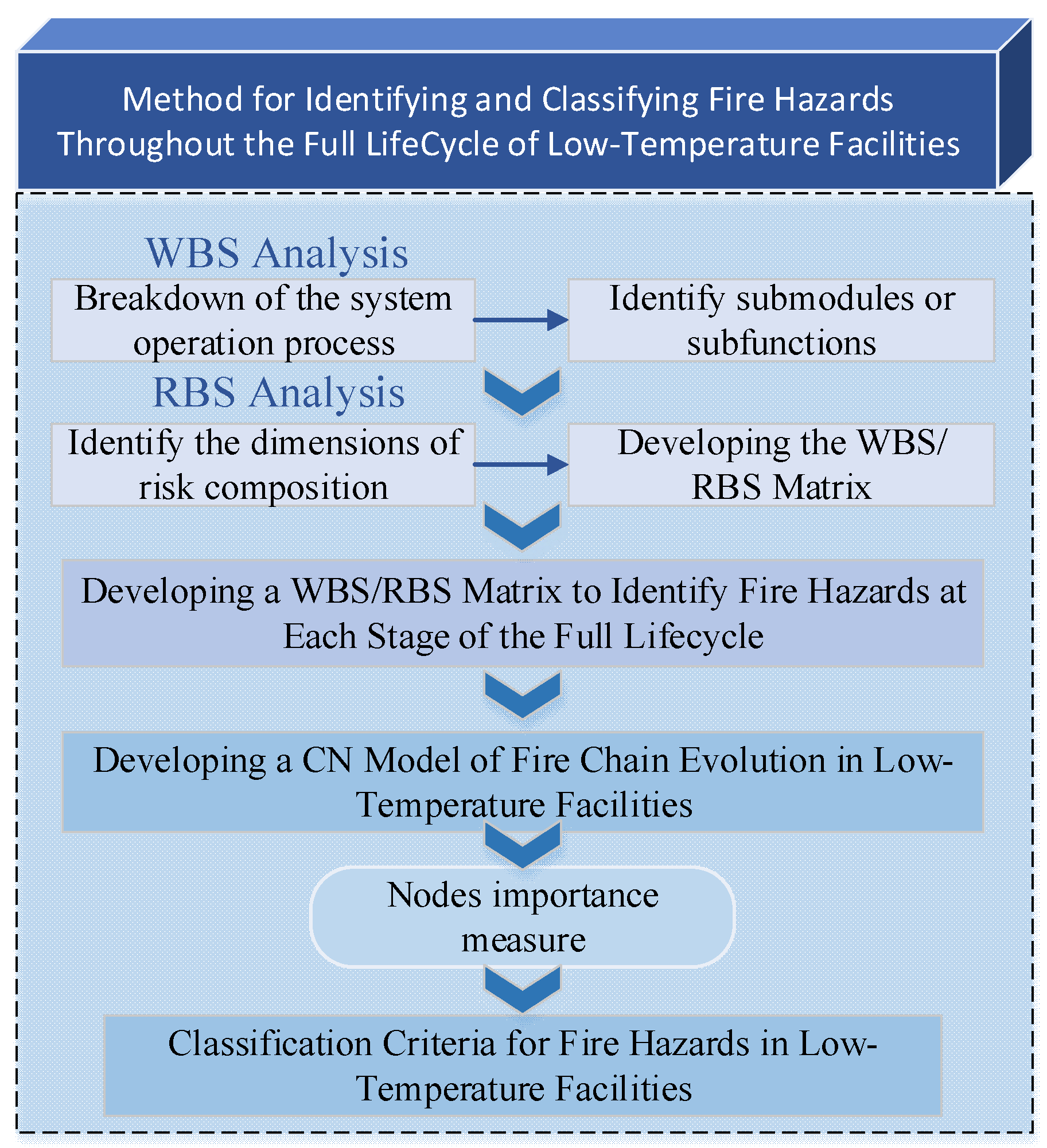
Figure 2.
Typical causes of fires in low-temperature facilities.
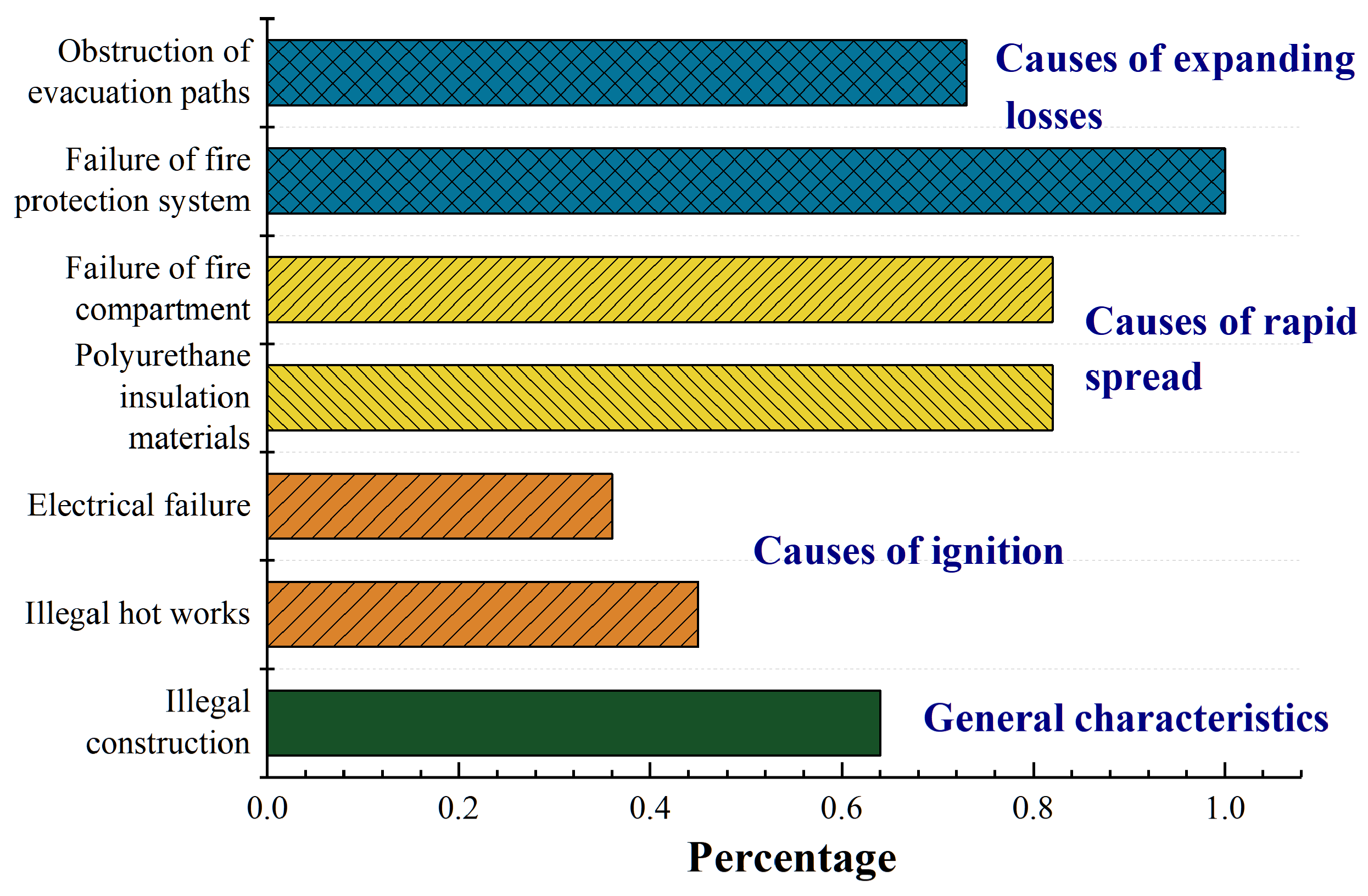
Figure 3.
Fire risk characteristics throughout the full lifecycle of low-temperature facilities.
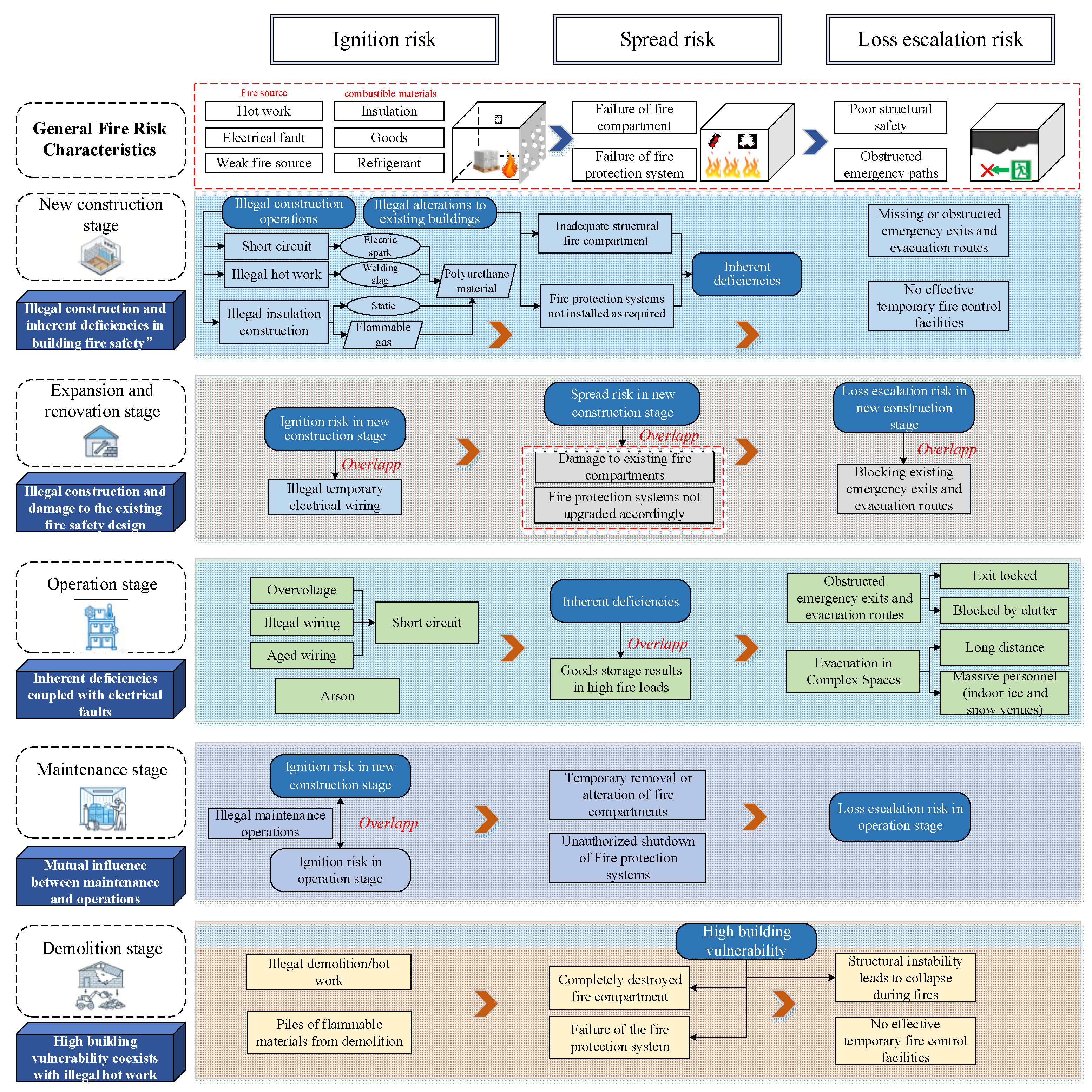
Figure 4.
Functional Breakdown of the new construction stage of cold storage facilities.
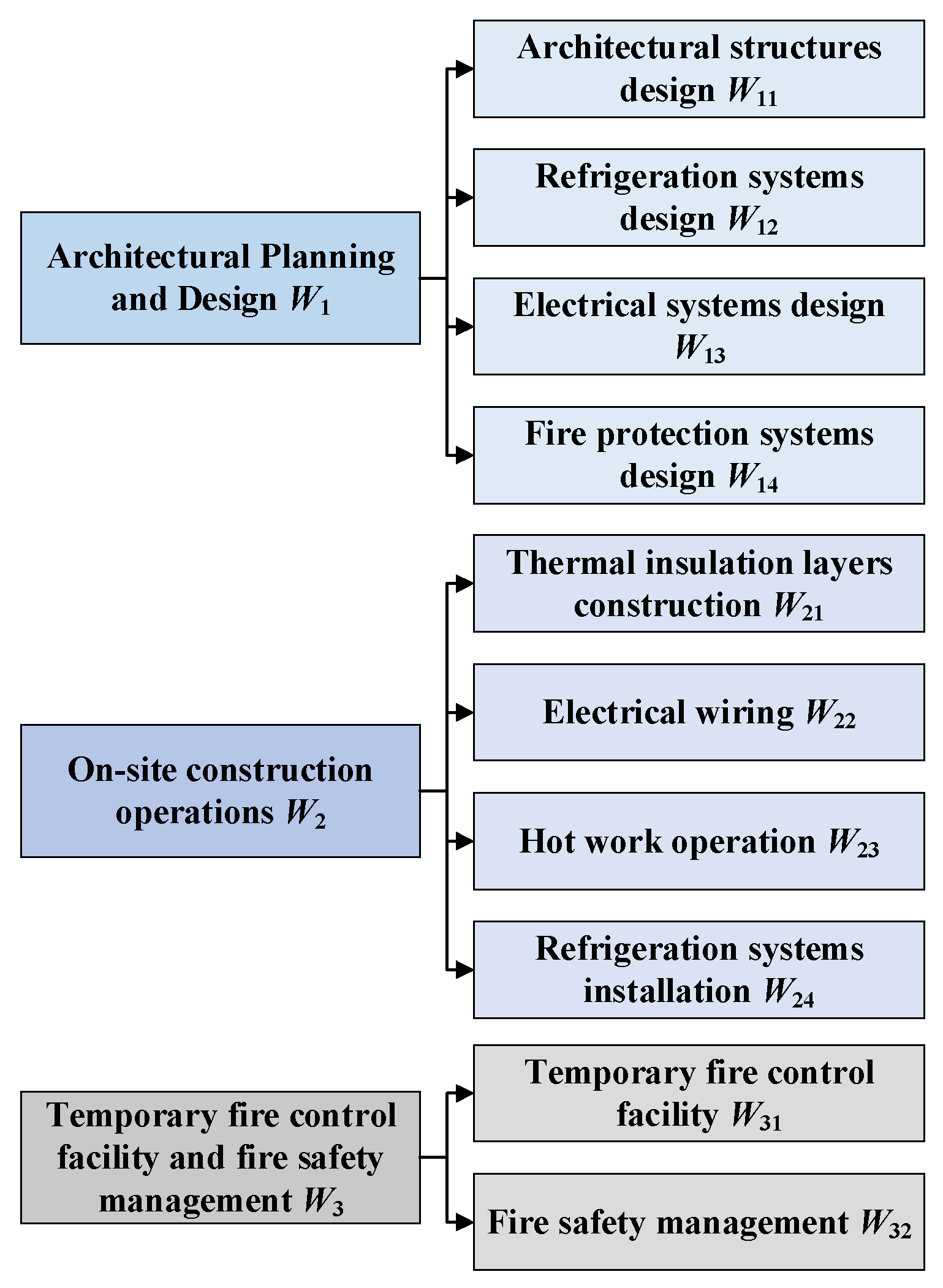
Figure 5.
The CN model of fire evolution during the construction stage of cold storage facilities.
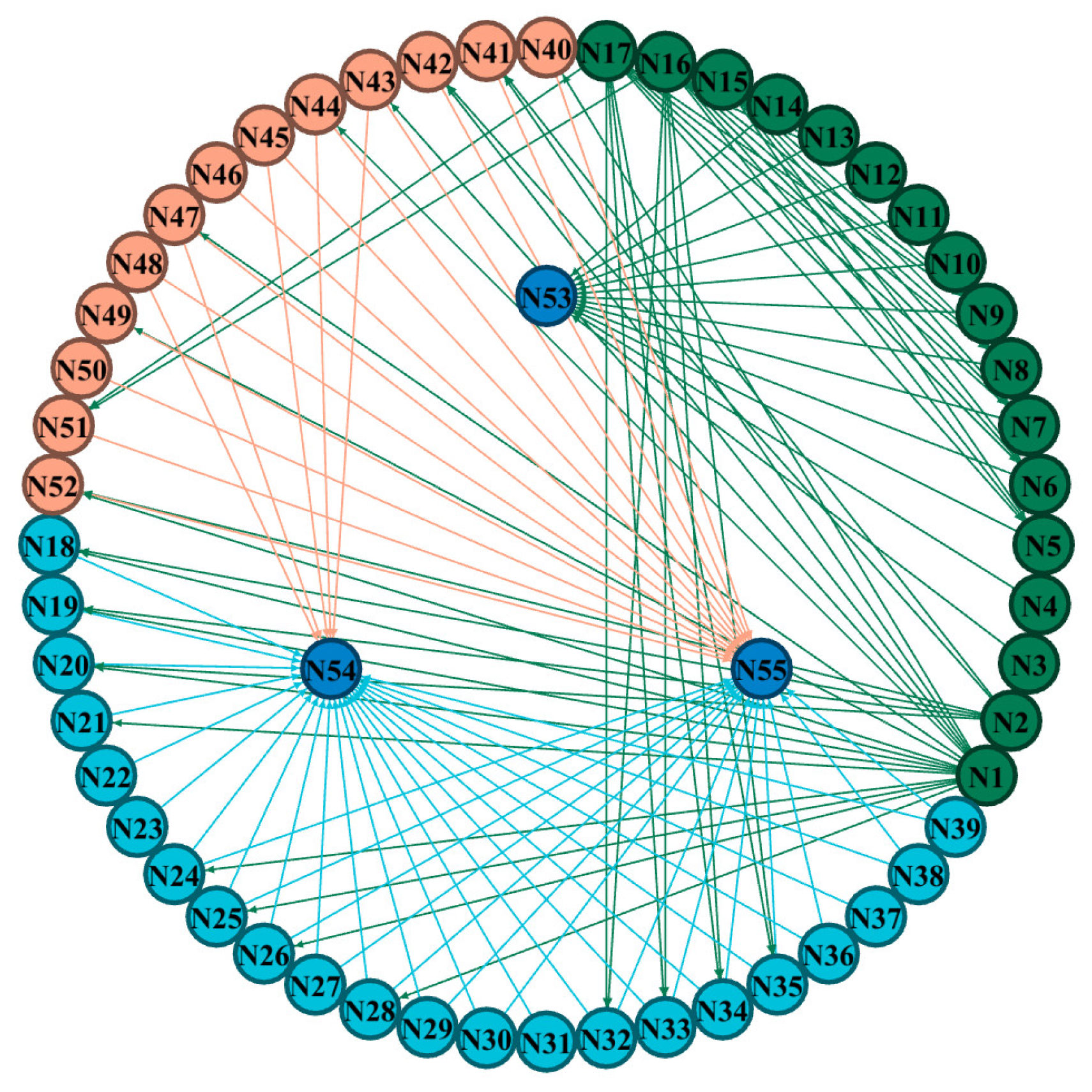
Figure 6.
Results of the nodes importance measure.
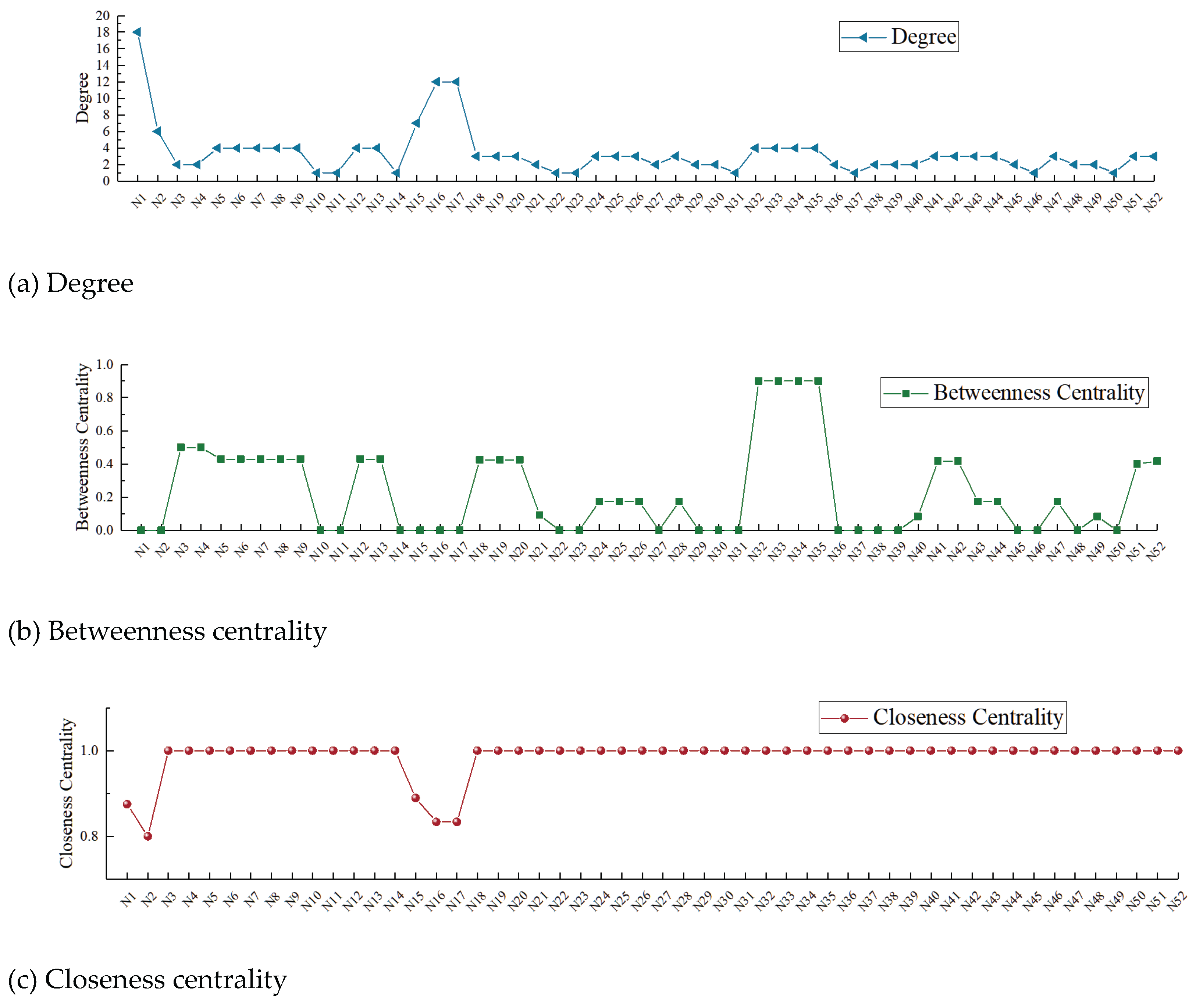
Table 1.
Data dimensions for accident case analysis.
| Dimensions | Data Information Types | Description |
|---|---|---|
| Basic information | Background information | General information of the building and the condition of the building when the fire occurred |
| Building type | Conventional construction, prefabricated construction, mixed-use residential and commercial buildings, etc. | |
| Full lifecycle stage | New construction, expansion and renovation, operation, maintenance, demolition | |
| Losses | Casualties and direct economic losses | |
| Ignition situation | Ignition Source | Initial ignition source of the fire |
| Combustible material | Type of combustible material ignited | |
| Spread situation | Fire spread conditions | Fire spread after the initial outbreak |
| Fire detection and alarm conditions | Automatic detection, manual discovery, etc. | |
| Performance of fire protection systems | Automatic fire suppression systems, smoke control and exhaust systems, etc. | |
| Fire compartment conditions | Fire compartment conditions within the affected building | |
| Expansion of losses | Emergency response conditions | Initial firefighting and emergency rescue organization after the initial fire |
| Emergency evacuation conditions | Emergency evacuation process, evacuation routes, and emergency exits | |
| Accident causes | Direct cause | Officially reported direct cause of the fire based on investigation |
| Indirect cause | Officially reported indirect cause of the fire based on investigation |
Table 3.
Importance calculation results of the fire hazards.
| Node | Importance | Node | Importance | Node | Importance |
|---|---|---|---|---|---|
| N1 | 3.98% | N19 | 2.40% | N37 | 0.84% |
| N2 | 1.66% | N20 | 2.40% | N38 | 1.03% |
| N3 | 2.42% | N21 | 1.28% | N39 | 1.03% |
| N4 | 2.42% | N22 | 0.84% | N40 | 1.26% |
| N5 | 2.60% | N23 | 0.84% | N41 | 2.38% |
| N6 | 2.60% | N24 | 1.70% | N42 | 2.38% |
| N7 | 2.60% | N25 | 1.70% | N43 | 1.70% |
| N8 | 2.60% | N26 | 1.70% | N44 | 1.70% |
| N9 | 2.60% | N27 | 1.03% | N45 | 1.03% |
| N10 | 0.84% | N28 | 1.70% | N46 | 0.84% |
| N11 | 0.84% | N29 | 1.03% | N47 | 1.70% |
| N12 | 2.60% | N30 | 1.03% | N48 | 1.03% |
| N13 | 2.60% | N31 | 0.84% | N49 | 1.26% |
| N14 | 0.84% | N32 | 3.91% | N50 | 0.84% |
| N15 | 1.90% | N33 | 3.91% | N51 | 2.33% |
| N16 | 2.81% | N34 | 3.91% | N52 | 2.38% |
| N17 | 2.81% | N35 | 3.91% | ||
| N18 | 2.40% | N36 | 1.03% |
Table 4.
Classification of fire hazards in the cold storage new construction stage.
| Classification | Dimensions | Composition |
|---|---|---|
| Level I: Major | Architectural structures and functional design | N1, N3, N4, N18, N19 |
| Hot work operations | N12, N13, N32, N33,N34 | |
| Thermal insulation layers construction | N5, N6, N7, N8, N9 | |
| Personnel evacuation | N20, N41, N42, N51, N52 | |
| Fire safety management and temporary fire control facility | N16, N17, N35 | |
| Level II: Serious | Architectural structures and functional design | N2, N21, N27, N28,N29, N30 |
| Fire protection systems design | N24, N25, N26, N44, N45, N47, N49 | |
| Fire safety management and temporary fire control facility | N15, N48, N36, N38, N39 | |
| Personnel evacuation | N40, N43 | |
| Level III: Significant | Other construction defects | N10, N11, N22, N31, N50 |
| Other design defects | N14, N23, N46 |
Disclaimer/Publisher’s Note: The statements, opinions and data contained in all publications are solely those of the individual author(s) and contributor(s) and not of MDPI and/or the editor(s). MDPI and/or the editor(s) disclaim responsibility for any injury to people or property resulting from any ideas, methods, instructions or products referred to in the content. |
© 2026 by the authors. Licensee MDPI, Basel, Switzerland. This article is an open access article distributed under the terms and conditions of the Creative Commons Attribution (CC BY) license.
Copyright: This open access article is published under a Creative Commons CC BY 4.0 license, which permit the free download, distribution, and reuse, provided that the author and preprint are cited in any reuse.


