
Submitted:
26 April 2026
Posted:
27 April 2026
You are already at the latest version
Abstract
The expansion of captive breeding of the forest musk deer (Moschus berezovskii)—a first-class protected species in China with significant economic and medicinal value—has led to escalating disease threats, underscoring the need for intelligent disease management based on knowledge graphs. However, the unstructured nature of veterinary texts, characterized by nested entities, ambiguous boundaries, and sparse relations, poses substantial challenges to accurate joint entity-relation extraction. To address these issues, this study proposes BRW-GPLinker, an enhanced joint extraction model built upon the GPLinker framework. This model integrates a Boundary-Aware Module (BAM) for precise entity boundary detection, a Relative Distance Bias Module (RDBM) to minimize pairing errors in dense contexts, and a Weighted Sparse Multi-label Cross-Entropy (WSMCE) loss function to improve recall for infrequent relations. Experimental results on the constructed MS-Data dataset demonstrate that BRW-GPLinker achieves an F1 score of 0.887, outperforming the baseline GPLinker by 2.0 percentage points. It also exhibits strong generalization, with an F1 score of 0.590 on the general-domain CMeIE-V2 dataset. These findings confirm that the proposed model provides reliable support for constructing disease knowledge graphs in forest musk deer farming.
Keywords:
forest musk deer
; joint entity-relationship extraction
; boundary-aware module
; relative distance bias module
; knowledge graph
1. Introduction
The Forest musk deer (Moschus berezovskii) [1], a Class I protected wildlife species in China, produces musk that has exceptionally high value as both a fragrance and an essential component in traditional Chinese medicine [2] However, the rapid expansion of captive breeding operations has precipitated severe health crises. Mortality and morbidity among farmed musk deer have increased markedly, driven by common conditions, including suppurate abscesses, respiratory infections, parasitic infestations, stress-related disorders, gastrointestinal pathological and traumatic infections. These challenges substantially compromise survival and reproductive performance, restricting the development of the sustainable industry [3]. Among these diseases, abscesses caused by mixed bacterial infections occur throughout the year without an obvious age trend and can lead to systemic infection and hinder population growth in severe cases [4,5,6]. Of these, pneumonia exhibits high morbidity with a significant mortality risk, occurs throughout the year in age groups, and can progress to systemic infections that impede population recovery in severe cases [7,8]; poly-parasitism in juveniles commonly results in growth retardation and elevated death rates [9,10,11]; and stress responses frequently precipitate immunosuppression and secondary infections [12]. Collectively, these threats to the health of the population pose substantial obstacles to population sustainability and industry viability, necessitating more effective approaches to disease knowledge management.
Currently, knowledge about disease prevention and treatment remains scattered across disparate unstructured sources, including clinical records, academic publications, and specialist manuals. Traditional manual organization proves prohibitively time-consuming and ineffective in establishing cross-document entity relationships and performing inferential reasoning [12,14]. These limitations underscore the need for automated approaches. Consequently, natural language processing (NLP) technologies that automatically extract entities and relationships from heterogeneous texts to construct structured knowledge representations have emerged as a critical avenue for elucidating diagnostic and therapeutic patterns and advancing intelligent husbandry management [15]. This is particularly crucial given the fragmented nature of knowledge of musk deer disease, which has made its efficient integration and utilization extremely difficult.The construction of knowledge graphs via joint entity and relation extraction provides a promising framework for integrating these fragmented knowledge sources. Although these techniques have proven effective in crop production [16,17] and livestock raising [18] for intelligent disease diagnosis and precision breeding management, their application to forest musk deer diseases encounters specific obstacles. Domain texts exhibit intricate entity nesting, ambiguous span boundaries, and extreme relation sparsity, all of which compromise the accuracy of generic joint extraction approaches.
Joint extraction has emerged as the dominant paradigm for the construction of domain-specific knowledge graphs, replacing traditional pipeline methods that suffer from error propagation between the sequential recognition stages of entities and the classification of relationships [19]. Contemporary approaches differ primarily in decoding strategy. Cascade architectures such as CasRel employ hierarchical binary tagging to extract head entities prior to conditional tail entity and relation annotation [20]. Token-pair-linking methods exemplified by TPLinker reformulate extraction as matrix-based linking operations for end-to-end single-stage processing [21]. Decomposition-based strategies, such as PRGC partition the task into subtasks such as relation determination, entity extraction, and subject-object alignment [22]. More recent advancements include unified triplet classification through OneRel [23] and bidirectional extraction processes through BiRTE [24]. However, adapting these methods to texts that exhibit intricate nesting of entities, ambiguous span boundaries, and extreme sparsity of relationships remains challenging, particularly in the clinical documentation of animals.
Improving joint extraction performance in specialized domains requires accurate entity boundary detection and effective modeling of relative positional relationships. In entity boundary detection, multi-scale feature extraction has shown promise for capturing discriminate characteristics. Lou et al [25]. demonstrated that multi-scale convolution operations enhance dairy cattle disease entity identification, while Zhang et al [26]. advanced this approach through entity-aware visual prompt injection for Chinese agricultural disease terminology. Explicit boundary modeling offers a complementary strategy: Wang et al [27]. developed parallel frameworks for simultaneous boundary detection and category classification, and Guo et al [28]. employed boundary-aware large language models to address low-resource named entity recognition scenarios. For modeling of positional relationships, Zhu et al [29]. incorporated relative position encoding within cascade decoders for the extraction of biomedical relationships, Su et al [30]. introduced rotational position embedding to model relative dependencies via rotation matrices, and Raffel et al [31]. proposed relative positional bias mechanisms employing logarithmic binning and directional decay to capture local distance dependencies. Despite advances in both research lines, existing frameworks typically have modular boundary detection and positional modeling. This architectural separation, though effective in general domains, complicates joint optimization for veterinary texts exhibiting coupled challenges of entity nesting and relation sparsity.
To address the challenges in joint entity disease and the extraction of relationships between musk deer, this study proposes BRW-GPLinker, an ensemble framework built on the Global Pointer architecture [32]. To tackle the issue of nested and ambiguous entity spans, we design a Boundary-Aware Module (BAM) that strengthens entity edge features through multi-scale convolutions and gating mechanisms, enabling precise span detection. To address the limitation of high-density local pairing errors prevalent in densely annotated veterinary texts, we propose a Relative Distance Bias Module (RDBM) that embeds distance-aware bias and directional decay into the token-pair linking process, effectively rectifying erroneous local associations. To overcome the challenge of sparsity-induced omission caused by long-tail relation distributions, we introduce a Weighted Sparse Multi-label Cross-Entropy (WSMCE) loss that rebalances class weights, substantially mitigating relation omission in imbalanced scenarios.Experimental results indicate that our proposed model is superior to baselines in dealing with the joint extraction task for musk deer diseases. Furthermore, cross-domain validation on CMeIE-V2 demonstrates robust generalization in various biomedical domains.
2. Materials and Methods
2.1. Materials and Methods
We employed a multi-source data collection strategy encompassing: (1) clinical records from standardized captive breeding facilities documenting disease presentation and therapeutic management; (2) authoritative veterinary manuals and professional monographs endorsed by regulatory institutions; and (3) systematically retrieved academic publications from established databases.
Clinical records. Clinical records from standardized captive breeding facilities constitute the primary data source. These documents capture granular details of disease presentation, progression, and therapeutic management in agricultural populations.
Specialized monograph. We consulted authoritative veterinary manuals and professional monographs published by recognized industry experts and regulatory institutions. Primary references included "Forest Musk Deer Breeding Technology and Musk Production" and "Artificial Breeding and Scientific Farming of Forest Musk Deer". These complementary sources provide comprehensive, evidence-based veterinary protocols and breeding guidelines covering captive propagation, health management, behavioral enrichment, and sustainable musk extraction, all officially endorsed by the relevant authorities.
Academic publications. We systematically retrieved peer-reviewed publications from established databases under strict ethical compliance protocols. Cross-verification ensures the reliability and currency of the source. This multi-source corpus encompasses disease etiology, clinical manifestation, and intervention strategies for forest musk deer.
Given the severe fragmentation of existing text resources related to forest musk deer diseases, we developed a specialized corpus MS-Data tailored for joint entity-relation extraction tasks. Data coloration followed a three-tier sourcing strategy designed to maximize authenticity, professional authority, and topical comprehensiveness. Table 1, Includes MS-Data definitions of entity types, relationship types, and examples of triples.
The MS-data covers seven entity types (e.g., disease, symptoms, drug) and seven relation types (e.g., disease-symptoms, drug-treatment), comprising 8,310 labeled entities and 7,074 annotated relational pairs. A detailed statistical analysis of the Dataset is presented in Figure 1, including the distribution of entity types, relation frequencies, and data volume.
To ensure corpus quality and usability, the raw data was subjected to rigorous filtering and standardized preprocessing. Specifically, redundant and invalid entries were removed, professional terminology and data formats were normalized, and inconsistent expressions were corrected to eliminate noise. Following preprocessing, approximately 50,000 characters of structured text were organized and partitioned into training and validation sets in an 8:2 ratio, comprising 903 and 212 valid records, respectively. This partition provides sufficient data for model training, hyper parameter tuning, and performance evaluation. Additionally, the CMeIE-V2 Dataset [33], a widely recognized benchmark for the extraction of Chinese medical information, was used as an auxiliary test to assess the cross-domain generalization capacity of the proposed model.
2.2. Model
2.2.1. Boundary-Aware Module
The general architecture of our proposed BRW-GPLinker model is presented in Figure 2. As an improved variant of GPLinker, this joint extraction model is specifically designed to enhance entity recognition and relation extraction performance in forest musk deer disease texts. The model consists of four core components: a feature layer, an encoding layer, an extraction layer, and a loss function. In the encoding layer, the pre-trained BERT model [34] is used to extract contextual semantic representations from the input text sequence. In the feature layer, the Boundary-Aware Module deceptively enhances entity edge features using multi-scale convolutions and a gated boundary detector, enabling precise localization of nested and ambiguous entity spans. Concurrently, the Relative Distance Bias Module in the extraction layer introduces learnable positional constraints into the global pointer scoring matrices, effectively correcting entity pairing errors in high-density regions and strengthening spatial position associations. Finally, an asymmetric weighted loss function is applied to alleviate the long-tail relation sparsity issue, outputting the globally optimal set of entity-relation triples for the given input.
Following the acquisition of semantic representations with enhanced entity boundary features at the feature layer, the encoding layer employs multi-scale feature extraction and a dedicated boundary detector to project these features into start and end point vectors corresponding to each entity type, thereby providing a solid foundation for subsequent entity span scoring and relational triple computation. Figure 3 illustrates the detailed structure of the Boundary-Aware Module.
Although the BERT model excels at capturing long-range contextual semantics, it often exhibits insensitivity to local features when processing medical texts. Medical entities vary significantly in length; for instance, "fever" is a short word, whereas "purulent pneumonia" is a compound term. A single-sized convolution kernel struggles to capture these diverse features simultaneously. Therefore, this paper proposes a parallel multi-scale extraction module. Given a sentence that contains tokens, we first employ the BERT encoder to extract context-aware high-dimensional latent representations for each token in , yielding a representation matrix , where denotes the embedding dimension. This process establishes semantic mappings within a continuous vector space, providing the foundational basis for multi-scale feature reconstruction, which is represented as follows:

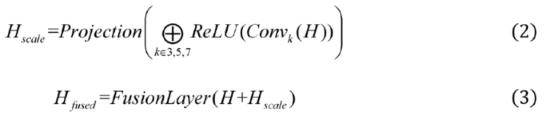
where denotes the convolution kernel size. This paper employs this mechanism to construct a parallel multi-scale scanning architecture, where the module concatenates multi-scale convolutional features, and the fuses the original feature map with to mitigate potential semantic information loss.
This paper presents a boundary detector based on gated attention. Its key innovation lies in using the sum of the predicted probabilities of the ‘B’ (beginning) and ‘I’ (inside) tags from the BIO tagging scheme as gating signals, which offers clearer physical interpretability than conventional weights. To deceptively enhance entity boundaries for musk deer disease entities of varying lengths, the detector incorporates parallel multi-scale convolutions. Specifically, the model first predicts BIO labels [35] for each token, then computes the gating weight as the combined probability of the start and inner positions of the entity. This design achieves a high signal-to-noise ratio, effectively highlighting entity regions while suppressing background noise. By strengthening entity feature discrimination, it notably improves recall for long-tailed and complex-boundary entities, which is represented as follows:

where denotes the boundary prediction matrix, which is the matrix of predicted results output by the model. The maps high-dimensional input features into the BIO three class classification space, while and map the entity head and tail vectors into probability distributions respectively.
The final enhanced features are obtained by element-wise multiplication of the fused features with the boundary weights, which are represented as follows:

2.2.2. Encoding Layer
The resulting sentence representation is obtained as follows, employing two feedforward layers, which are represented as follows:
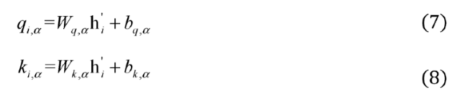
The score for an entity of type α over the span from position is calculated as follows, which is represented as follows:
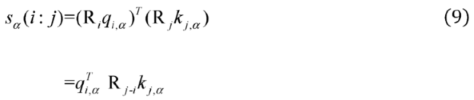
where is used primarily to determine the position information of an entity or relation within the matrix, denotes the rotation matrix for position and injects position information into the start vector and injects position information into the end vector.
2.2.3. Relative Distance Bias Module
Building upon the GPLinker framework, this study proposes a Relative Distance Bias Module specifically designed for high-density entity scenarios commonly found in forest musk deer disease texts. Inspired by the relative position bias of T5 [31], this module injects a relation-specific distance bias into the scoring matrix. Its design incorporates four key components: a logarithmic binning function, directional discrimination, learnable per-relation parameters, and adaptive fusion via the Residual Zer`ro) mechanism [36]. The detailed architecture of the Relative Distance Bias Module is illustrated in Figure 4.
GPLinker decomposes the extraction of the relationship into a combination of scores across five components, thereby transforming the extraction of the relationship into a scoring function for quintuples, which is represented as follows:

where and the head and tail indices of the subject, and denote the head and tail indices of the object, denotes the start and end scores of the subject entity, denotes the start and end scores of the object entity, and denotes a predefined relation type.
The original GPLinker loss function has been modified, which is represented as follows:

where and denote the relation mapping score enhanced by the relative distance bias module, calculated as follows.

where denotes the learnable scaling parameter of the ReZero module, and represents the distance bias term.
By introducing ReZero, the initialization scheme is introduced, where the residual weight is initialized to zero. This configuration ensures that the model initially degenerates into a standard GPLinker architecture during the early training phase, thus prioritizing the learning of robust semantic features before progressively incorporating positional biases through the learnable parameter once semantic convergence is achieved.
Regarding the Relative distance bias term , it is formulated as a hybrid structure integrating discrete embedding components with continuous functional mappings, expressed as follows:

where denotes the relative distance between the positions of the subject and the object, represents the logarithmic binning function and denotes the directional discrimination function.The logarithmic binning function is denoted as , which is represented as follows:
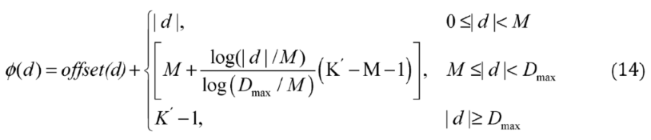
where denotes the guaranteed model considering neighboring entity pairs, represents the maximum perception distance, and entity pairs exceeding this distance are grouped into the same long-range bucket, denotes the total number of unilateral buckets; and maps the forward and backward distances to non-overlapping numerical spaces.
The directional discrimination function is denoted as , which is represented as follows:

Following [37], to incorporate physical prior knowledge, the distance decay parameters are learned independently for each relation, which is represented as follows:

where and denote the learnable weights for local enhancement and global suppression, respectively, and controls the decay rate of the local correlation strength.
When processing variable-length sequences, the Transformer model pads short sentences to a uniform length. To prevent the bias term from being incorrectly applied to these invalid positions, an attention mask is employed to ensure computations are performed solely on valid token pairs, which is represented as follows:

where denotes the vector of the attention mask of the sentence.
2.2.3. Weighted Sparse Multi-Label Cross-Entropy
This study modifies the original GPLinker loss function to address severe sample imbalance and extreme sparsity in the forest musk deer disease corpus. Following [38], the refined weighted sparse multi-label cross-entropy loss introduces asymmetric weighting factors to address class imbalance by imposing stronger penalties for false negatives, particularly in the loss of entity boundary classification. To prevent training oscillations resulting from insufficient positive samples, a fixed prior weighting strategy is employed to ensure that the model consistently prioritizes long-tail positive samples and avoids local optima throughout the training process, which is represented as follows:

where denotes the score matrix generating predicted score for all possible entity-relation triples; T represents the true label set; denotes the positive sample penalty weight, which amplifies the positive sample loss term; represents the tolerance level for incorrectly predicting a negative sample as positive; is the natural constant; denotes the set of positive samples with true labels; denotes the set of negative samples with true labels.
The S scoring function is responsible for measuring entity boundaries and triplet relationships in the feature space, with its output serving directly as the input variable for the weighted sparse multi-label cross-entropy loss function . The asymmetric weight coefficients introduced via the loss function enable closed-loop optimization of prediction evaluation and parameter updating, which is represented as follows:

where denotes the total loss for multi-task joint training; represents the loss for entity span recognition; and and correspond to the discrimination losses for the start and end positions within a triplet, respectively.
Single-task loss, which is represented as follows:

where denotes the score matrix size; represents global index traversal; and denotes the raw prediction matrix reflecting the model preliminary assessment of whether a specific head/tail entity pair will form a particular relation.
Entity span loss, which is represented as follows:

where denotes the task ground truth label matrix; and represents the normalization factor denoting the total number of possible entities span combinations; denotes the collection of predefined entity types; performs a double traversal over all possible start positions and end positions in the sentence; and denotes the raw score generated by the entity scoring function.
2.3. Experimental Setup
2.3.1. Parameters
We utilized PyTorch to implement our proposed BRW-GPLinker model on an RTX4090D GPU. The versions of Python and PyTorch were 3.12.1 and 2.5.1, respectively. The maximum number of iterations was set to 100. The parameters of our model are illustrated in Table 2.
For the MS-data dataset, we configured a batch size of 8 and trained for 100 epochs, whereas for the larger-scale CMeIE-V2 dataset, we increased the batch size to 16 and reduced the training epochs to 50. In particular, the core architectural parameters remained consistent across both datasets: BERT dimension of 768 and hidden layer size of 64. This design strategy allows the model to adapt to varying dataset scales while maintaining architectural uniformity for fair comparison.
The results were evaluated using the F1 score metric. The F1 score is calculated based on the global True Positive (TP), False Negative (FN), and False Positive (FP) rates, reflecting the model classification performance across the entire set of relation triples, which is represented as follows:
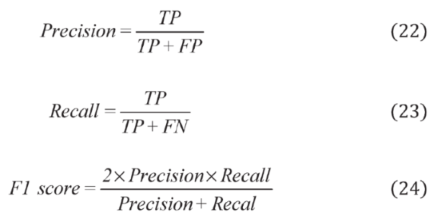
2.3.2. Models
To comprehensively evaluate the effectiveness of the proposed model, we perform comparative experiments against seven representative joint-relation extraction methods, including CasRel [20], TPLinker [21], PRGC [22], PURE [39], OneRel [23], BiBRT [24], and GPLinker [32]. All competing models are implemented with the BERT-base Chinese pre-training language model as the backbone encoder to ensure a fair comparison. In addition, we perform ablation studies to assess the individual contributions of each key component in our model. Specifically, we systematically remove or add the Boundary-Aware Module, the Relative Distance Bias Module, and the asymmetric weighted loss function to construct several model variants. These variants are evaluated under identical experimental conditions to isolate the effect of each proposed enhancement.
3. Results
3.1. Recognition Performances of Different Models
The proposed BRW-GPLinker model on the MS-data benchmark, BRW-GPLinker achieves an F1 score of 0.887, yields a 2.0 percentage point improvement over GPLinker, and shows favorable results relative to CasRel, OneRel, and BiBRT. As shown in Table 3, this performance indicates that the integration of BAM and RDBM improves the location of the entity boundary and reduces the ambiguity of the pairing in nested scenarios. Furthermore, the WSMCE loss function effectively addresses the sparse relation distribution inherent in the forest musk deer disease domain. These results suggest that the proposed components contribute to a more reliable
Although the performance of all models on the CMeIE-V2 dataset is generally lower than that on the MS-data dataset, which can be attributed to the distributional discrepancies between general medical corpora and domain-specific collections, the proposed BRW-GPLinker model achieves an F1 score of 0.590. Compared to GPLinker and other baseline methods, this model shows consistent improvements in both the F1 score and precision. These results suggest that the BAM, RDBM, and WSMCE strategies possess certain generalization capabilities. This indicates that the proposed enhancements are not limited to the extraction of forest musk deer disease, but also demonstrate potential utility in broader medical text processing scenarios.
3.2. Ablation Study
Comprehensive ablation experiments were conducted on the GPLinker baseline to systematically evaluate the contribution of each proposed component. As detailed in Table 4, eight model variants were constructed by selectively incorporating BAM, RDBM, and WSMC.
Individual component analysis reveals distinct functional improvements. BAM independently improved F1 by 0.8% and recall by 1.6%, primarily improving the precision of the entity boundary detection. RDBM contributed a 0.7% improvement in F1 and a 0.4% precision gain, optimizing relative positional modeling between pair entities. WSMC alone increased both F1 and recall by 1.0%, effectively mitigating class imbalance through asymmetric loss weighting.
The combinations of modules pairs yielded F1 improvements ranging from 1.1% to 1.2%, demonstrating additive effects between components. The complete integration of BRW-GPLinker achieved a cumulative gain in F1 of 2.0% with balanced improvements in both precision and recall.
These results demonstrate that the three modules exhibit complementary synergies in feature extraction, positional modeling, and loss optimization, forming an effective closed-loop enhancement mechanism.
3.3. Performance on Different Triples by Relation Category
BRW-GPLinker achieves consistent performance gains across all seven relation categories in forest musk deer disease texts compared to the baseline GPLinker model. As shown in Figure 5, our model extracts substantially more correct entity-relation triples while simultaneously reducing errors in every category.
The model demonstrates particular strength in critical relation categories. For Drug Dosage, correct triples increased from approximately 100 to 128 with erroneous predictions decreasing from 29 to 1. The DiseaseSymptom relation improved from 179 to 198 correct triples, with errors decreasing from 68 to 49. Disease Treatment and Prevention also demonstrated significant enhancement, with error reduction exceeding one third.
These results indicate that the proposed modules, namely boundary aware feature extraction, relative distance bias, and weighted sparse loss, collectively mitigate the challenges of nested entities, ambiguous boundaries, and relation sparsity in domain specific veterinary texts. The substantial reduction in errors in critical categories, such as DrugDosage, suggests enhanced reliability for intelligent husbandry management applications.
3.4. Performance on Different Triples by Relation Category
We evaluated BRW-GPLinker against seven baseline models in the seven relation categories in the forest musk deer disease knowledge graph. As shown in Figure 6, BRW-GPLinker achieves the highest F1 score in all categories. The model demonstrates particular strength in extracting medication-related entities, attaining F1 scores of 99.4% for ’DrugDosage’ and 97.3% for ’TreatmentDrug,’ along with 86.2% for DiseaseSymptom.
Compared to the highest performance baseline in each specific category, BRW-GPLinker shows consistent and objective performance gains. For DrugDosage, it improves the strongest baseline, OneRel, by 4.2 percentage points. For TreatmentDrug, it advances beyond GPLinker by 2.2 percentage points. In the DiseaseSymptom category, it exceeds BiBRT by 2.4 percentage points, suggesting that boundary-aware feature extraction effectively handles the complex entity nesting often found in symptom descriptions.
Consistent improvements are also observed across the remaining categories, where GPLinker serves as the strongest baseline. BRW-GPLinker surpasses it by 3.8 percentage points in DiseasePrevention, 2.7 percentage points in DiseaseTreatment, and 1.1 percentage points in Complication/Secondary. In particular, while DiseaseCause exhibits the lowest overall score across all models due to the inherent complexity of extracting causal relationships from veterinary texts, BRW-GPLinker still achieves a 1.2 percentage point improvement over GPLinker.
Overall, these results indicate that the integration of boundary-aware feature extraction, relative distance bias, and weighted sparse loss contributes to improved performance across various types of relation. These results demonstrate the effectiveness and practical utility of BRW-GPLinker, proving its suitability to construct the forest musk deer disease knowledge graph.
3.5. Qualitative Analysis
Qualitative comparisons between the baseline GPLinker (red arrows) and the proposed BRW-GPLinker (green arrows) in representative forest musk deer clinical texts are illustrated in Figure 7. In the bacterial pulmonary inflammation case, while the baseline fails to recognize the core entity "inflammation"—resulting in incomplete triple extraction - BRW-GPLinker successfully identifies the complete nested entity "pulmonary tissue inflammation" and correctly extracts the semantically consistent relation. In the medication regimen case, the baseline completely misses the streptomycin administration relationship and misclassifies dosage information, while BRW-GPLinker accurately captures all valid triples with precise relational structures. These results demonstrate that the proposed model effectively remediates critical extraction failures of the baseline approach, including entity boundary detection errors, relation omission, and attribute misclassification, thereby delivering improved performance for accurate veterinary knowledge graph construction.
4. Discussion
4.1. Model Performance
From the experimental results, BRW-GPLinker performs quite well. In the MS-Data data set, it outperforms the baseline GPLinker by 2 percentage points in the F1 score. This gain mainly comes from the three modules we added: the Boundary-Aware Module helps the model more accurately locate entity boundaries; the Relative Distance Bias Module reduces pairing errors in dense text; and the asymmetric loss function puts an extra penalty on missing rare relations, which is a common pain point in medical texts. The ablation study confirms that these three components work well together; each contributes something, but their combination gives the biggest boost.
Looking at different types of relations, our model shows consistent improvements. For sparse relations such as "DrugDosage", it even drove extraction errors down to zero. For "DiseaseSymptom", which often involves nested entities, the number of correctly extracted triples increased noticeably. Qualitative analysis also shows that while the baseline fragmented "pulmonary tissue inflammation", our model extracts the full nested entity correctly, confirming that boundary detection really helps.
However, the F1 score for certain relations (e.g., some less frequent or more complex ones) is still relatively low, indicating room for improvement. In future work, we plan to focus on boosting performance on these challenging relation types. Overall, BRW-GPLinker is well suited for specialized veterinary texts such as forest musk deer disease records, and it also transfers reasonably well to general medical data.
4.2. Partial Construction of the Forest Musk Deer Disease Knowledge Graph
Using the triples extracted by BRW-GPLinker from the MS-Data corpus, we constructed a partial knowledge graph for forest musk deer diseases, as shown in Figure 8. The graph schema comprises seven entity types—Cause, Disease, Dosage, Drug, Prevention, Symptom, and Treatment—and seven predefined relation categories, including Disease Symptom, Disease Treatment, Treatment Drug, Drug dosage, Disease Cause, Disease Prevention, and Complication/Secondary Disease. In total, the current graph contains 1,359 entity nodes and 3,386 relation triples, capturing core clinical knowledge such as symptom-disease associations (e.g., “rapid shallow breathing” linked to “pneumonia”), treatment regimens and drug-dosage chains. This structured representation enables preliminary intelligent querying and decision support for forest musk deer health management. However, due to the inherent challenges of nested entities and sparse relations, the graph remains incomplete, particularly for low-frequency relation types like DrugDosage and DiseaseCause. However, the partial graph serves as a valuable foundation for further expansion, and future efforts will focus on incorporating external veterinary knowledge bases and annotating additional samples to enhance coverage and reasoning capability.
5. Conclusions
This paper presents BRW-GPLinker, an improved joint entity-relation extraction model for forest musk deer diseases based on the fusion of boundary-aware representation, relative distance bias mechanism, and asymmetric weighted loss optimization. We introduce a boundary-aware module to tackle the problem of ambiguous entity boundaries and nested structures that commonly exist in veterinary clinical texts, employ a relative distance bias mechanism to capture relational dependencies while reducing pairing error rates, and utilize an asymmetric weighted loss function to address the challenge of sparse relation distributions. Experimental results demonstrate that the F1 score of our proposed model reached 0.887 with precision and recall of 0.893 and 0.881, respectively, in the self-constructed MS-Data dataset. Our model outperformed the baseline GPLinker and joint extraction models and was demonstrated to be suitable for the forest musk deer disease corpus with moderate generalization ability on the general medical CMeIE-V2 benchmark. However, our model still has limitations that need to be addressed in future work: (1) It was demonstrated in our experiments that pre-training large language models have advantages in medical knowledge-intensive tasks. Therefore, we will explore the integration of domain-specific large language models to enhance entity boundary detection and relation reasoning capabilities. (2) In addition to the common challenges mentioned in this paper, there exist complex cross-sentence relations and implicit causal associations in the corpus of forest musk deer disease. We will explore solutions to address these challenges in our future work. (3) Our model still has room for improvement in computational efficiency when processing lengthy clinical documents, and our aim is to explore more lightweight architectures to reduce the inference burden while maintaining extraction accuracy.
Author Contributions
Conceptualization, D.G.; Methodology, D.G., X.F. and C.Z.; Software, X.F. and M.T.; Validation, C.Z. and D.Z., Z.W; Formal analysis, D.Z., M.T. and Z.W.; Investigation, C.Z.; Resources, D.G., C.Z. and D.Z.; Writing–original draft, X.F.; Writing–review \& editing, D.G. and M.T.; Supervision, D.G., D.Z. and Z.W.; Funding acquisition, D.G. All authors have read and agreed to the published version of the manuscript.
Funding
This research was funded in part by the Sichuan Science and Technology Program under Grant 2024YFNH0018, 2026YFHZ0159, 2024YFHZ0088, 2023YFN0009, Xizang Science and Technology Department Project: XZ202601ZY0078, XZ202401ZY00018, Sichuan Province Unmanned System Intelligent Sensing and Control Technology Engineering Laboratory Open project: WRXT2023-2, Key Laboratory of Agricultural Equipment Technology for Hilly and Mountainous Areas, Ministry of Agriculture and Rural Affairs,P.R.China: 2024QSNZ04.
Institutional Review Board Statement
Not applicable.
Informed Consent Statement
Not applicable.
Data Availability Statement
The data presented in this study are available on request from the corresponding author. Due to commercial confidentiality and licensing agreements, the raw dataset is not publicly distributable.
Acknowledgments
The author would like to thank the editor and reviewers for their comments.
Conflicts of Interest
The authors declare no conflicts of interest.
References
- Lu, X.; Sheng, Y.; Ye, H.; Yang, Z.; Meng, X. Development of Stereotypic Behaviors and Personality Traits of Captive Male Forest Musk Deer and Relationships with Musk Secretion. Vet. Sci. 2026, 13, 261. [Google Scholar] [CrossRef]
- Liu, K.; Xie, L.; Deng, M.; Zhang, X.; Luo, J.; Li, X. Zoology, chemical composition, pharmacology, quality control and future perspective of Musk (Moschus): A review. Chin. Med. 2021, 16, 46. [Google Scholar] [CrossRef]
- Liu, H.; Xiao, L.; Liu, Z.; Deng, Y.; Zhu, J.; Yang, C.; Liu, Q.; Tian, D.; Cui, X.; Peng, J. Impacts of Captive Domestication and Geographical Divergence on the Gut Microbiome of Endangered Forest Musk Deer. Animals 2025, 15, 1954. [Google Scholar] [CrossRef]
- Hu, J.; An, X.; Yang, P.; Tan, R.; Chen, T.; Chen, J.; Tao, Y.; Li, X.; Sun, K.; Zhang, S.; et al. Analysis of the Primary Pathogenic Bacteria in Abscess Disease of Musk Deer Using Metagenomic Approaches. Animals 2025, 15, 1105. [Google Scholar] [CrossRef]
- Yang, N.; Li, H.; Yang, X.; Wu, Y.; Lv, Z.; Zhang, Z.; Ma, X.; Zhou, X.; Zhang, X.; Zhao, K.; et al. Furazolidone reduces the pathogenesis of Trueperella pyogenes and Pseudomonas aeruginosa co-infection in a mouse model. Heliyon 2024, 10. [Google Scholar] [CrossRef] [PubMed]
- Lu, G.; Wang, Z.; Zhang, B.; Zhou, Z.; Hu, D.; Zhang, D. Detecting forest musk deer abscess disease pathogens using 16S rRNA high-throughput sequencing technology. Animals 2023, 13, 3142. [Google Scholar] [CrossRef] [PubMed]
- Zhang, Y.; Wang, R.; Hu, Q.; Lv, N.; Zhang, L.; Yang, Z.; Zhou, Y.; Wang, X. Characterization of Pseudomonas aeruginosa bacteriophages and control hemorrhagic pneumonia on a mice model. Front. Microbiol. 2024, 15, 1396774. [Google Scholar] [CrossRef] [PubMed]
- Zhao, W.; Ren, Z.; Luo, Y.; Cheng, J.; Wang, J.; Wang, Y.; Yang, Z.; Yao, X.; Zhong, Z.; Yang, W.; et al. Metagenomics analysis of the gut microbiome in healthy and bacterial pneumonia forest musk deer. Genes. Genom. 2021, 43, 43–53. [Google Scholar] [CrossRef]
- Achhami, B.; Gurung, S.; Deshar, S.; Khaiju, S.; Thapa, L.K.; Gurung, S. Silent predators: Revealing the parasites of Himalayan musk deer (Moschus leucogaster) in Manaslu Conservation Area, Nepal. Int. J. Parasitol. Parasites Wildl. 2025, 101119. [Google Scholar] [CrossRef]
- Gao, Y.; Fu, Y.; Yan, L.; Hu, D.; Jiang, B.; Zhang, D. First record of traumatic myiasis obtained from forest musk deer (Moschus berezovskii). Int. J. Parasitol. Parasites Wildl. 2021, 16, 70–74. [Google Scholar] [CrossRef]
- Deng, L.; Chen, S.; Meng, W.; Zhou, Z.; Liu, H.; Zhong, Z.; Fu, H.; Shen, L.; Cao, S.; Tan, K.S.; et al. Changes in gut microbiota composition associated with the presence of enteric Protist Blastocystis in captive Forest musk deer (Moschus Berezovskii). Microbiol. Spectr. 2022, 10, e02269-21. [Google Scholar] [CrossRef]
- Shi, X.; Cheng, Z.; Zheng, C.; Wang, K.; Yang, J.; Jie, H.; Li, Y.; Zhang, M. The blood transcriptome of musk deer under heat stress condition reveals the regulatory mechanism of genes to maintain homeostasis metabolism. BMC Genom. 2025, 26, 400. [Google Scholar] [CrossRef]
- Yang, C.; Wang, H.; Sai, J.; Zhang, P.; Yan, M. Construction of knowledge graph of forest musk deer based on BiLSTM-CRF model and DPA method. In Proceedings of the Proceedings of the IOP Conference Series: Earth and Environmental Science, Chengdu, China, 21–23 August 2020; Vol. 615, p. 012008. [Google Scholar]
- Hao, Y.; Wang, H.; Zhang, D. Chinese Named Entity Recognition Method for Musk Deer Domain Based on Cross-Attention Enhanced Lexicon Features. Comput. Mater. Contin. 2025, 83, 2989. [Google Scholar] [CrossRef]
- Feng, H.; Wang, L.; Cao, F.; Ma, J.; Tang, J.; Feng, C.; Su, Z. Forest musk deer (Moschus berezovskii) in China: Research and protection. J. Vertebr. Biol. 2023, 72, 22067-1. [Google Scholar] [CrossRef]
- Yuan, W.; Wang, H.; Pe, L.; Zhang, T.; Hao, Y.; Lu, J.; Yan, W. Research on Entity and Relationship Extraction with Small Training Samples for Cotton Pests and Diseases. Agriculture 2024, 14, 457. [Google Scholar] [CrossRef]
- Huang, J.; Hao, X.; Wang, Y.; Song, R.; Mu, Z.; Niu, G.; Guo, X. Joint topic entity and intent recognition model for multimodal agricultural diseases and pests question answering. Comput. Electron. Agric. 2026, 241, 111253. [Google Scholar] [CrossRef]
- Gao, Y.; Li, X.; Wang, M.; Li, S. SemSynJE: Semantic and syntactic enhanced joint extraction of entity and relation for sheep disease prevention and treatment. Comput. Electron. Agric. 2025, 237, 110607. [Google Scholar] [CrossRef]
- De, S.; Sanyal, D.K.; Mukherjee, I. Fine-tuned encoder models with data augmentation beat ChatGPT in agricultural named entity recognition and relation extraction. Expert Syst. Appl. 2025, 277, 127126. [Google Scholar] [CrossRef]
- Wei, Z.; Su, J.; Wang, Y.; Tian, Y.; Chang, Y. A novel cascade binary tagging framework for relational triple extraction. In Proceedings of the Proceedings of the 58th Annual Meeting of the Association for Computational Linguistics (ACL), Seattle, USA, 5–10 July 2020; pp. 1476–1488. [Google Scholar]
- Wang, Y.; Yu, B.; Zhang, Y.; Liu; Tingwen bit Zhu, H.; Sun, L. TPLinker: Single-stage joint extraction of entities and relations through token pair linking. In Proceedings of the 28th International Conference on Computational Linguistics (COLING), Barcelona, Spain, 8–13 December 2020; pp. 1572–1582. [Google Scholar]
- Zheng, H.; Wen, R.; Chen, X.; Yang, Y.; Zhang, Y.; Zhang, Z.; Zhang, N.; Qin, B.; Ming, X.; Zheng, Y. PRCC: Potential relation and global correspondence based joint relational triple extraction. In Proceedings of the 59th Annual Meeting of the Association for Computational Linguistics and the 11th International Joint Conference on Natural Language Processing (ACL-IJCNLP), Bangkok, Thailand, 1–6 August 2021; pp. 6225–6235. [Google Scholar]
- Shang, Y.M.; Huang, K.; Mao, X. Onerel: Joint entity and relation extraction with one module in one step. In Proceedings of the 36th AAAI Conference on Artificial Intelligence (AAAI), Vancouver, Canada, 22 February–1 March 2022; Vol. 36, pp. 11285–11293. [Google Scholar]
- Ren, F.; Zhang, L.; Zhao, X.; Yin, S.; Liu, S.; Li, B. A simple but effective bidirectional framework for relational triple extraction. In Proceedings of the Proceedings of the 15th ACM International Conference on Web Search and Data Mining (WSDM), Phoenix, USA, 21–25 February 2022; pp. 824–832. [Google Scholar]
- Lou, Y.; Gao, M.; Zhang, S.; Yang, F.; Wang, S.; He, Y.; Yang, J.e.a. Chinese Named Entity Recognition for Dairy Cow Diseases by Fusion of Multi-Semantic Features Using Self-Attention-Based Deep Learning. Animals 2025, 15, 822. [Google Scholar] [CrossRef] [PubMed]
- Zhang, C.; Zhang, L.; Wu, H.; Wang, C.; Chen, C.; Zhu, H.; Liang, F. Chinese named entity recognition for agricultural diseases based on entity-related visual prompts injection. Comput. Electron. Agric. 2024, 227, 109493. [Google Scholar] [CrossRef]
- Wang, Y.; Tong, H.; Zhu, Z.; Hou, F.; Li, Y. Enhancing biomedical named entity recognition with parallel boundary detection and category classification. BMC Bioinform. 2025, 26, 63. [Google Scholar] [CrossRef]
- Guo, Q.; Dong, Y.; Tian, L.; Kang, Z.; Zhang, Y.; Wang, S. BANER: Boundary-aware LLMs for few-shot named entity recognition. In Proceedings of the Proceedings of the 31st International Conference on Computational Linguistics (COLING), Abu Dhabi, UAE, 19–24 January 2025; pp. 10375–10389. [Google Scholar]
- Zhu, W.; Fu, Y. Biomedical relation extraction based on a cascade binary tagging framework with varied decoders. Expert Syst. Appl. 2026, 295, 128838. [Google Scholar] [CrossRef]
- Su, J.; Ahmed, M.; Lu, Y.; Pan, S.; Bo, W.; Liu, Y. Roformer: Enhanced transformer with rotary position embedding. Neurocomputing 2024, 568, 127063. [Google Scholar] [CrossRef]
- Raffel, C.; Shazeer, N.; Roberts, A.; Lee, K.; Narang, S.; Matena, M.; Zhou, Y.; Li, W.; Liu, P.J. Exploring the limits of transfer learning with a unified text-to-text transformer. J. Mach. Learn. Res. 2020, 21, 1–67. [Google Scholar]
- Su, J.; Murtadha, A.; Pan, S.; Hou, J.; Sun, J.; Huang, W.; Wen, B.; Liu, Y. Global pointer: Novel efficient span-based approach for named entity recognition. arXiv 2022, arXiv:2208.03054. [Google Scholar] [CrossRef]
- Guan, T.; Zan, H.; Zhou, X.; Xu, H.; Zhang, K. CMelE: Construction and evaluation of Chinese medical information extraction dataset. In Proceedings of the Proceedings of the 9th CCF International Conference on Natural Language Processing and Chinese Computing (NLPCC), Zhengzhou, China, 14–18 October 2020; pp. 270–282. [Google Scholar]
- Devlin, J.; Chang, M.W.; Lee, K.; Toutanova, K. Bert: Pre-training of deep bidirectional transformers for language understanding. In Proceedings of the Proceedings of the 2019 Conference of the North American Chapter of the Association for Computational Linguistics: Human Language Technologies (NAACL-HLT), Minneapolis, MN, USA, 2–7 June 2019; pp. 4171–4186. [Google Scholar]
- Tang, R.; Chen, Y.; Qin, Y.; Huang, R.; Zheng, Q. Boundary regression model for joint entity and relation extraction. Expert Syst. Appl. 2023, 229, 120441. [Google Scholar] [CrossRef]
- Bachlechner, T.; Majumder, B.P.; Mao, H.; Cottrell, G.; McAuley, J. Rezero is all you need: Fast convergence at large depth. In Proceedings of the Proceedings of the 37th Conference on Uncertainty in Artificial Intelligence (UAI), Mexico City, Mexico, 27–30 July 2021; pp. 1352–1361. [Google Scholar]
- Wang, L.; Wu, F.; Liu, X.; Cao, J.; Ma, M.; Qu, Z. Relationship extraction between entities with long distance dependencies and noise based on semantic and syntactic features. Sci. Rep. 2025, 15, 15750. [Google Scholar] [CrossRef]
- Long, T.; Yu, R.; You, X.; Shen, W.; Wei, X.; Gu, Z. FSCA-YOLO: An Enhanced YOLO-Based Model for Multi-Target Dairy Cow Behavior Recognition. Animals 2025, 15, 2631. [Google Scholar] [CrossRef]
- Zhong, Z.; Chen, D. A frustratingly easy approach for entity and relation extraction. In Proceedings of the Proceedings of the 2021 Conference of the North American Chapter of the Association for Computational Linguistics: Human Language Technologies (NAACL-HLT), Toronto, ON, Canada, 6–11 June 2021; pp. 50–61. [Google Scholar]
Figure 1.
This shows the distribution of disease data for musk deer. Panel (A) shows the distribution of disease data for musk deer entity types, while panel (B) shows the distribution of disease data for musk deer relationship types.
Figure 1.
This shows the distribution of disease data for musk deer. Panel (A) shows the distribution of disease data for musk deer entity types, while panel (B) shows the distribution of disease data for musk deer relationship types.
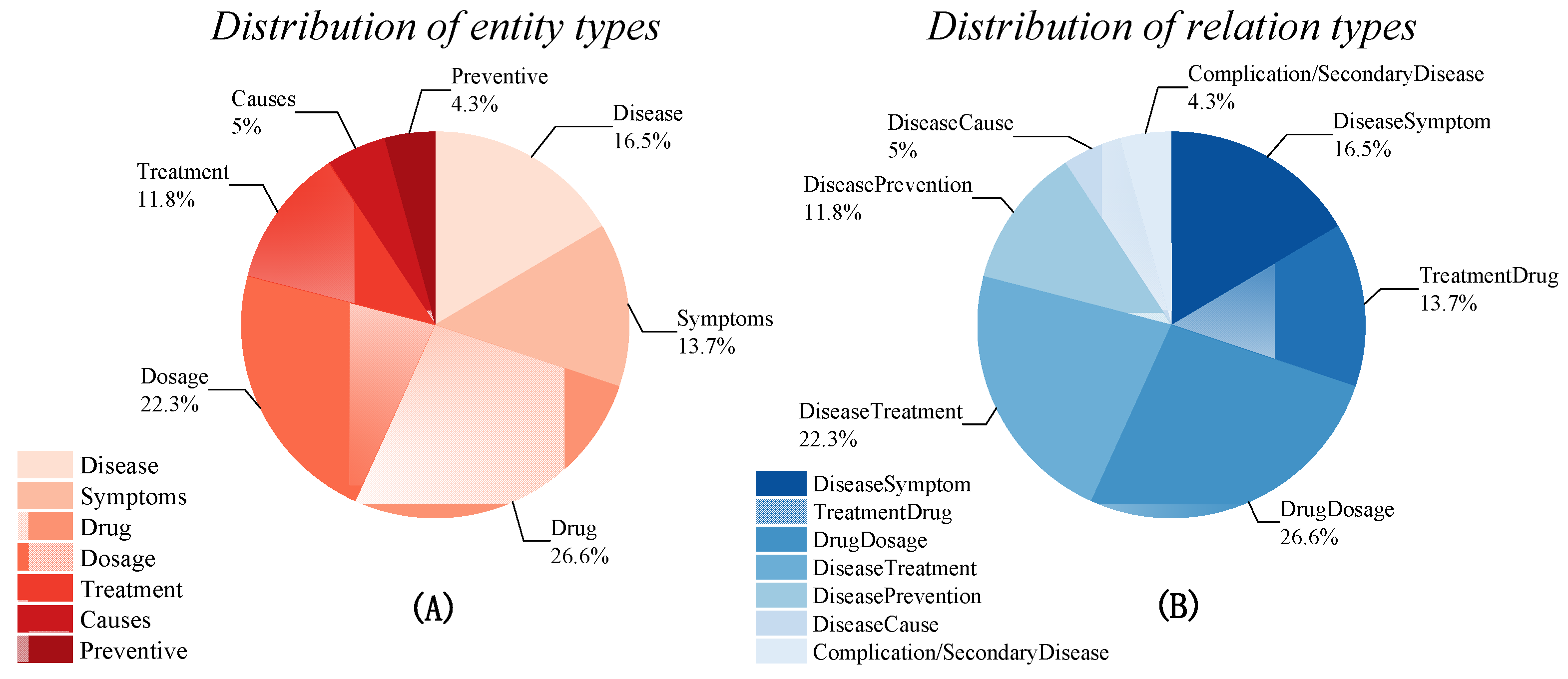
Figure 2.
The BRW-GPLinker architecture. The framework integrates a Boundary-Aware Module with multi-scale convolutions and boundary detection for accurate nested entity recognition, alongside a Relative Distance Bias Module for fine-grained spatial relationship modeling, enabling accurate extraction of complex entity-relation triples.
Figure 2.
The BRW-GPLinker architecture. The framework integrates a Boundary-Aware Module with multi-scale convolutions and boundary detection for accurate nested entity recognition, alongside a Relative Distance Bias Module for fine-grained spatial relationship modeling, enabling accurate extraction of complex entity-relation triples.
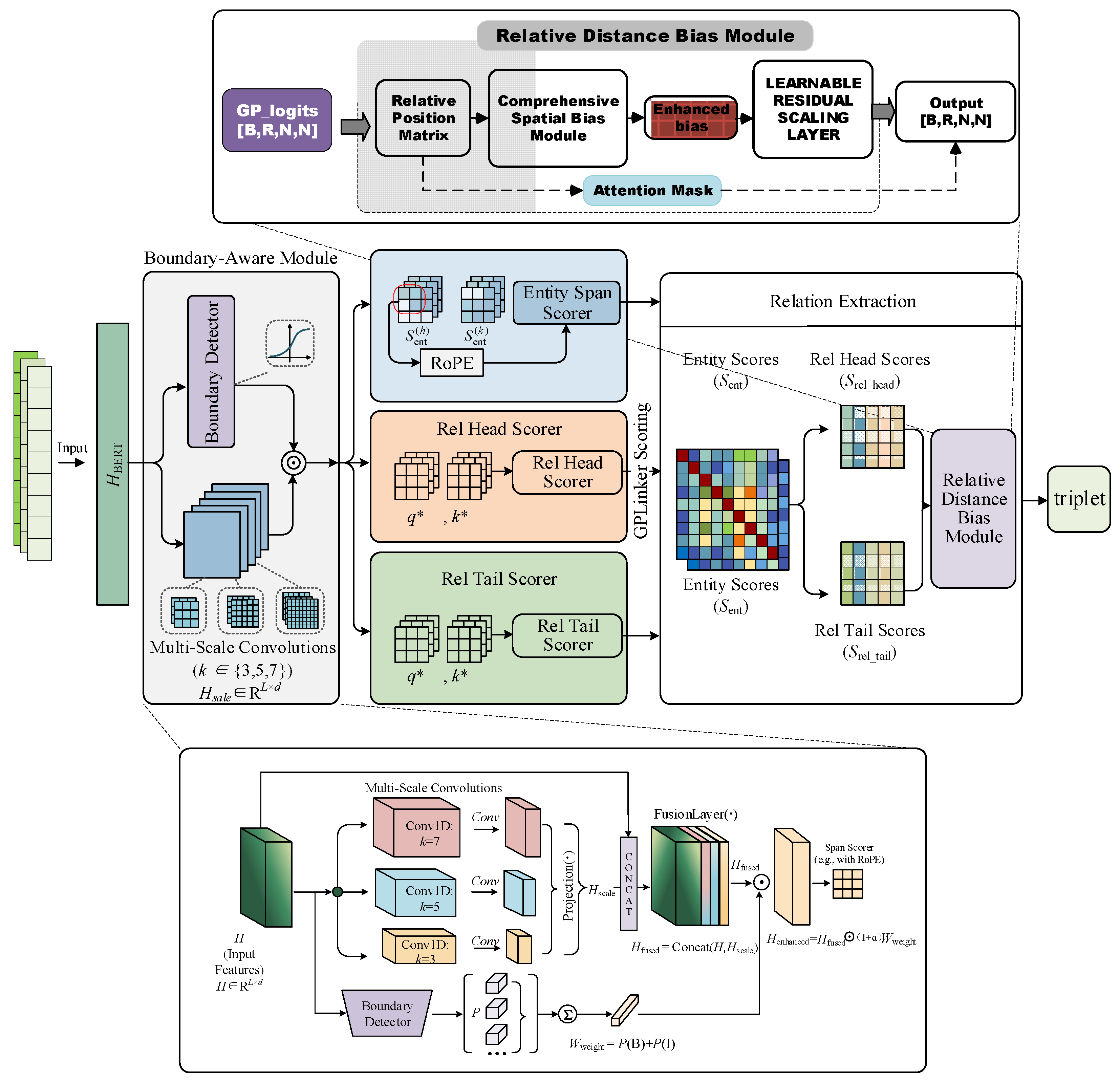
Figure 3.
depicts the Boundary-Aware Module where multi-scale feature extraction and a dedicated boundary detector are integrated to map the enhanced features to the start and end point vectors for each entity type.
Figure 3.
depicts the Boundary-Aware Module where multi-scale feature extraction and a dedicated boundary detector are integrated to map the enhanced features to the start and end point vectors for each entity type.
Figure 4.
Structure of the Relative Distance Bias Module with adaptive fusion.
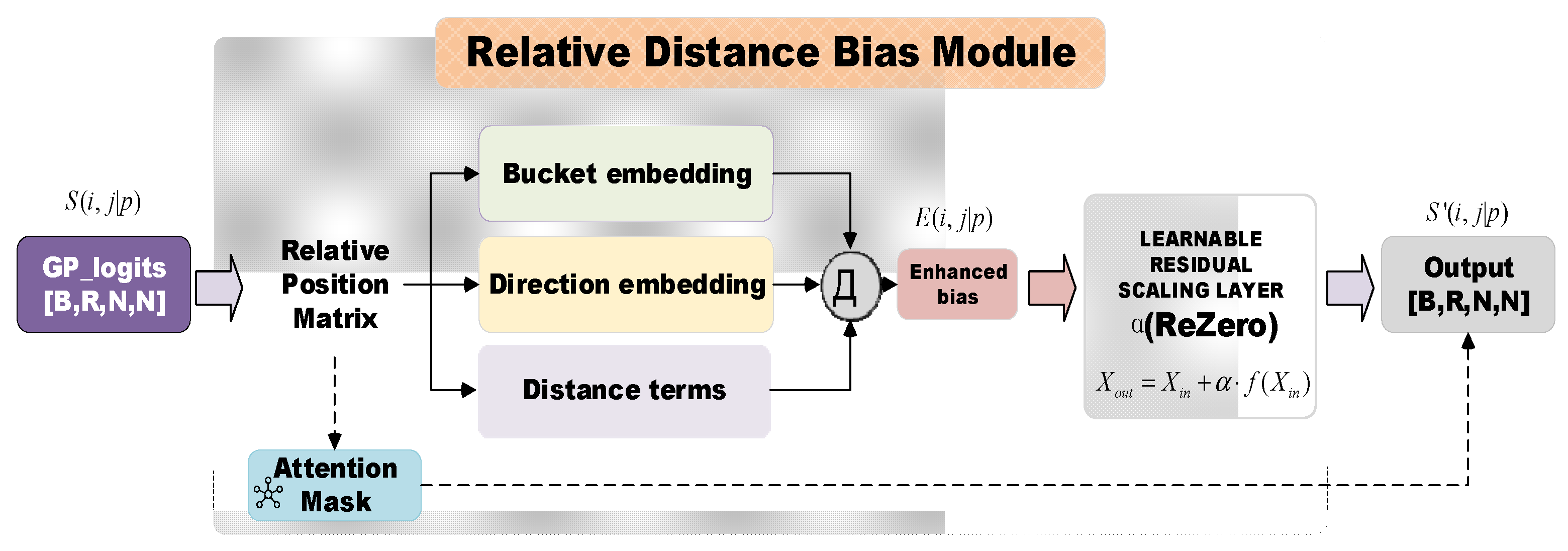
Figure 5.
Structure of the Relative Distance Bias Module with adaptive fusion.
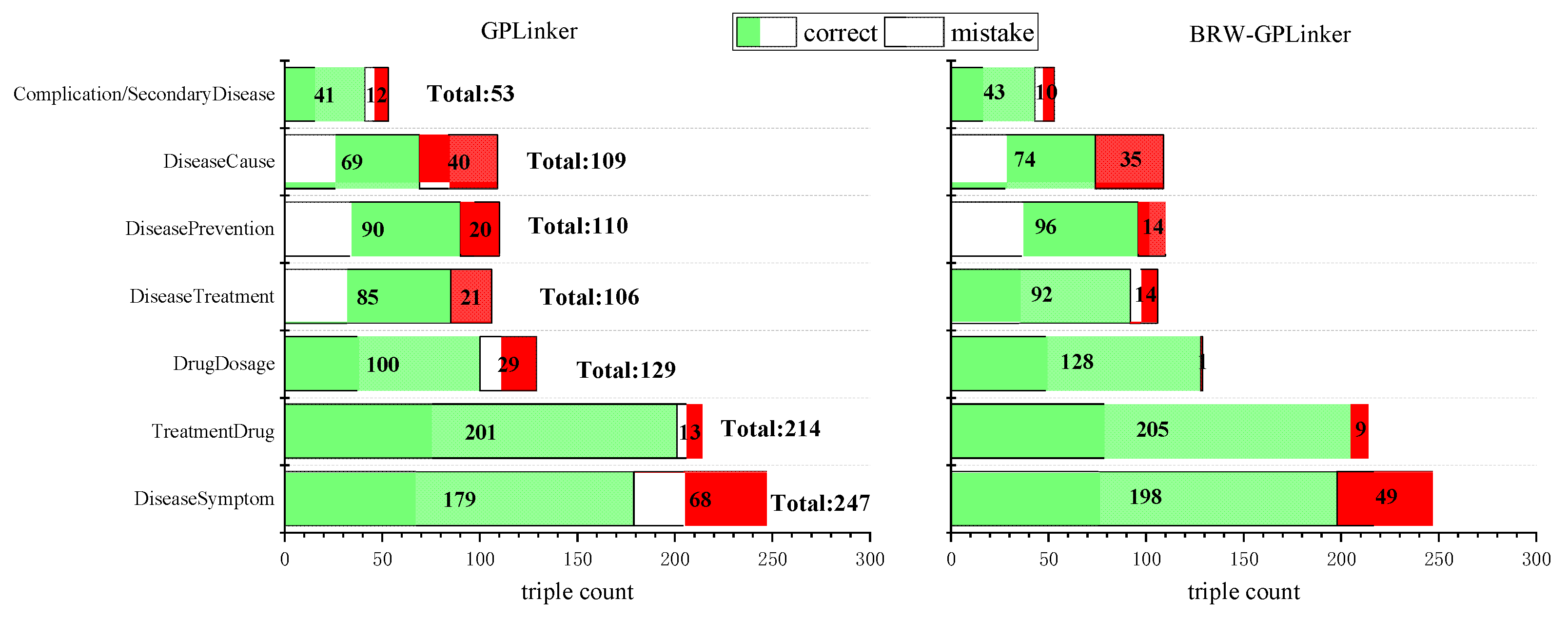
Figure 6.
Comparison of Correct and Incorrect Triples by Relation Category.
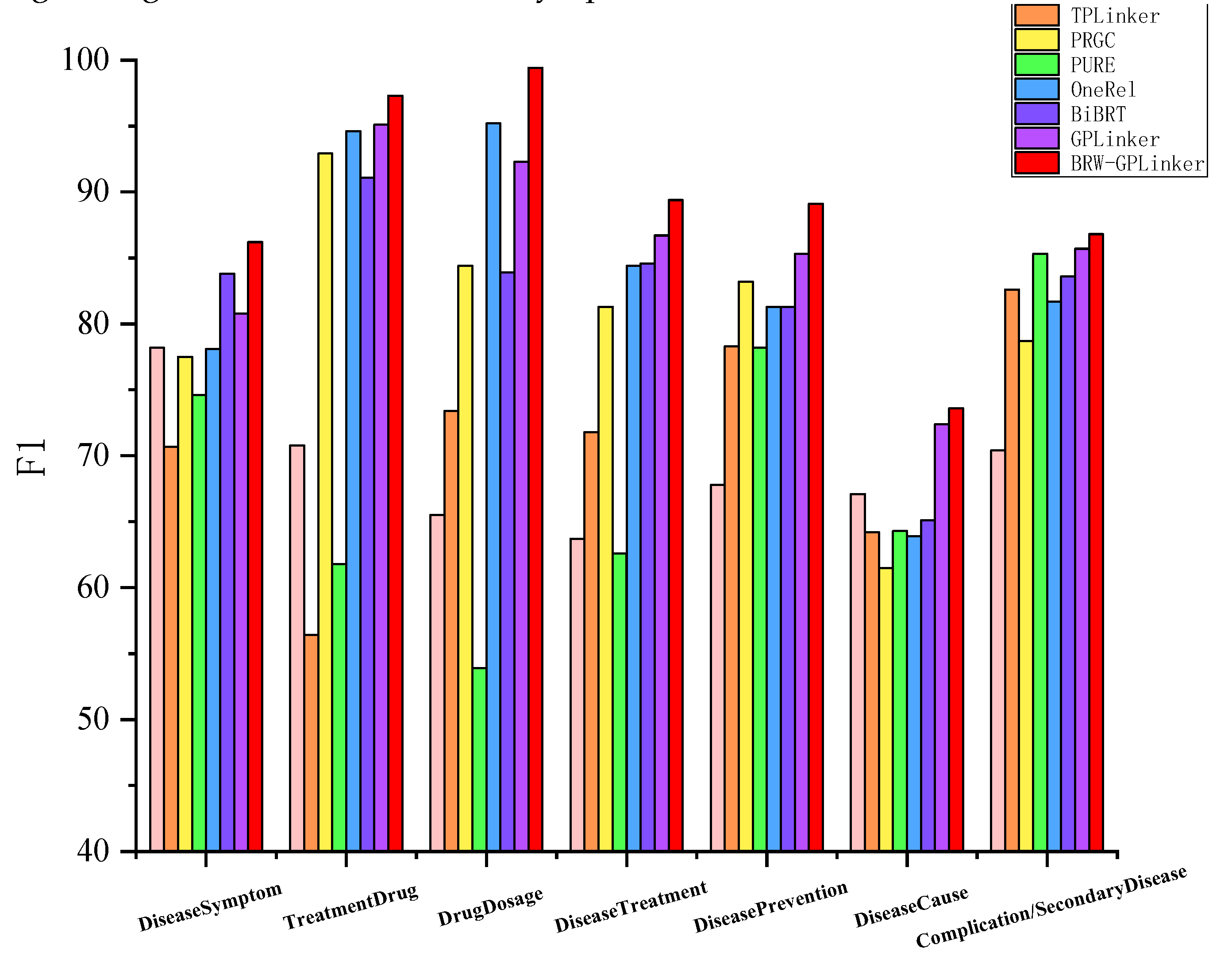
Figure 7.
Qualitative analysis.
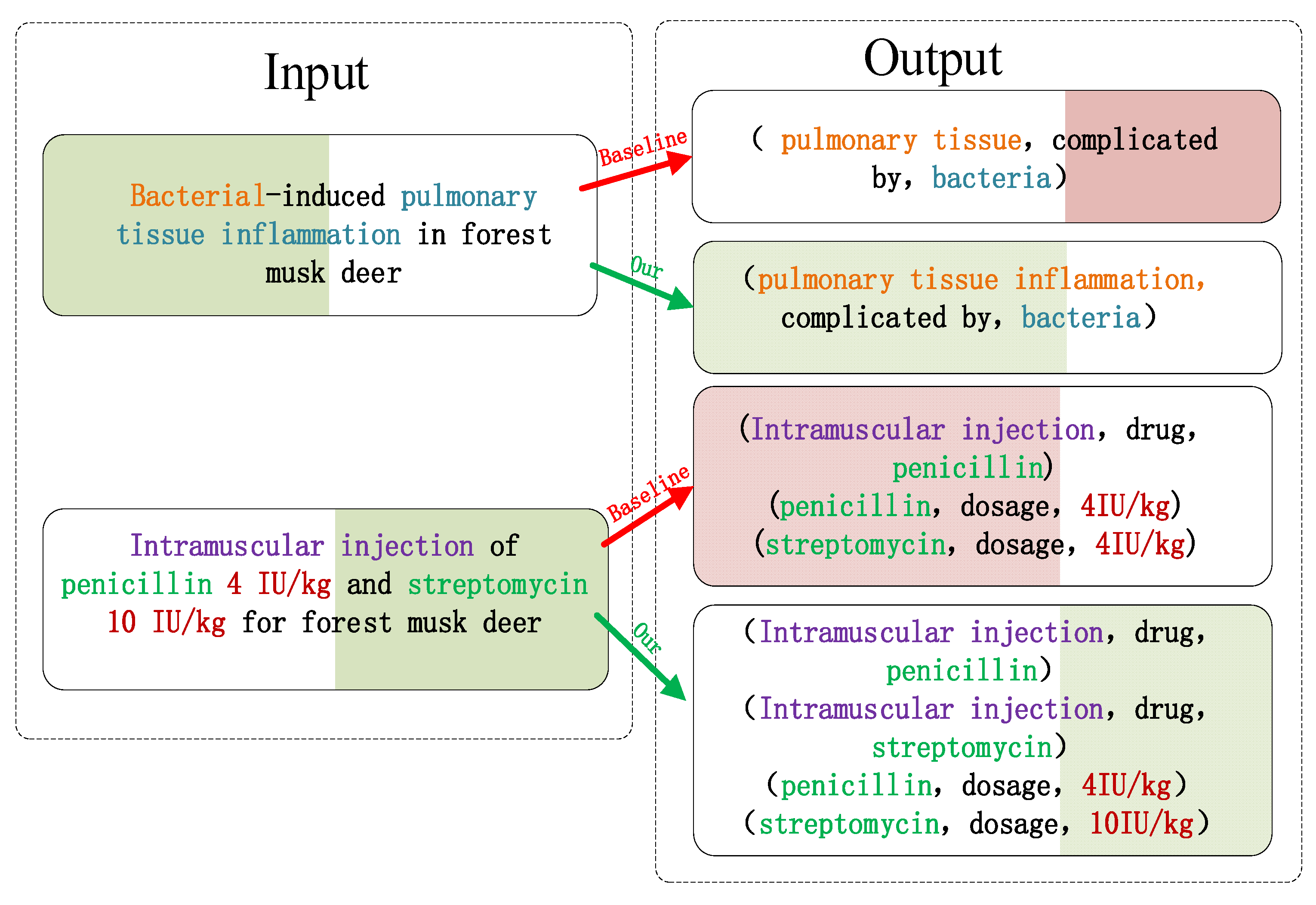
Figure 8.
Partial knowledge graph of forest musk deer diseases.
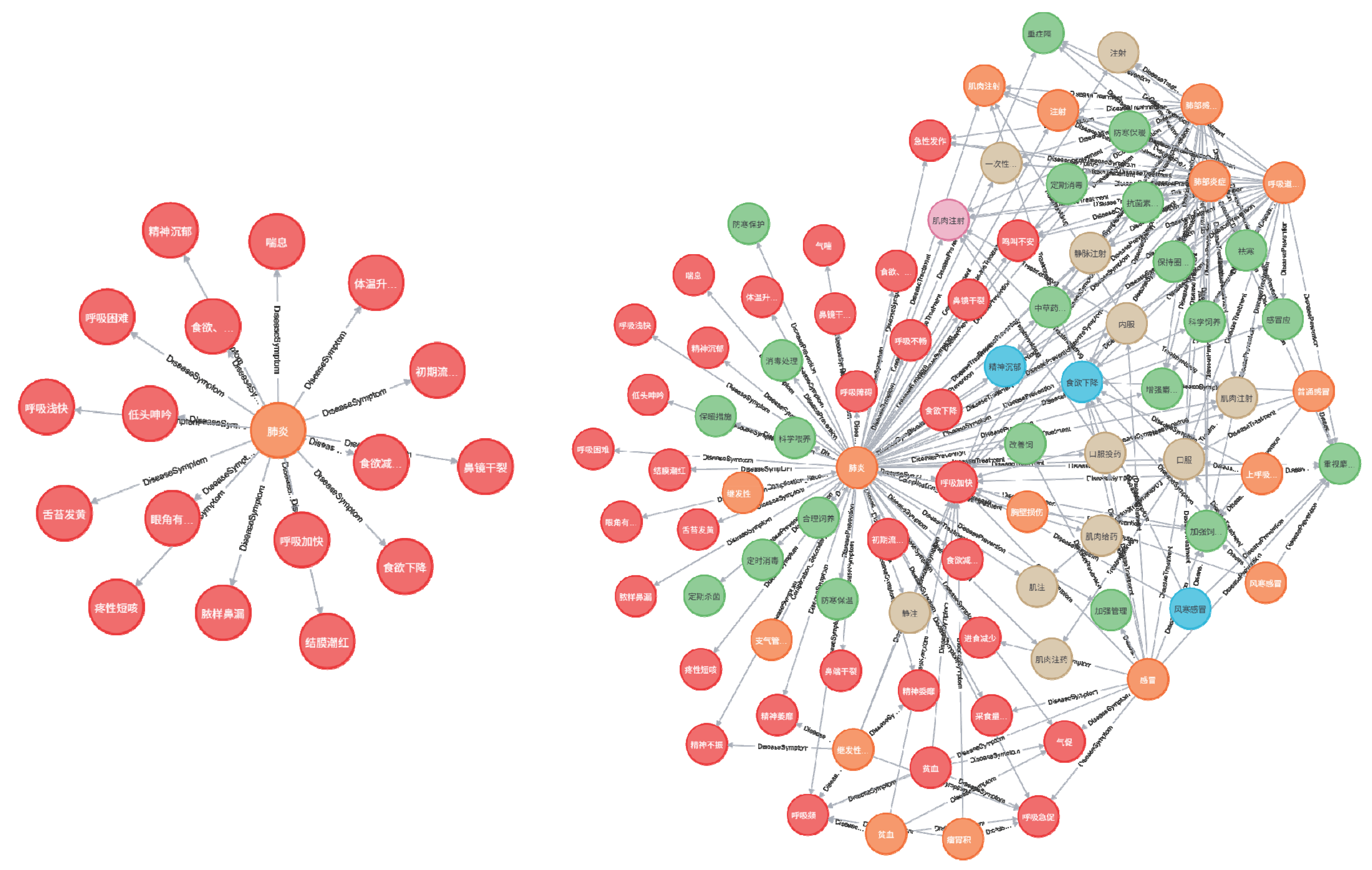

Table 1.
Definitions of entity types and relation categories in the MD-Data.
| Entity Type | Definition | Relation Type | Definition of Relation | Example (Triplet) |
|---|---|---|---|---|
| Disease | Pathological conditions of forest musk deer. | DiseaseCause | The pathological or environmental origin of a disease. | (Gastroenteritis, DiseaseCause, Bacteria) |
| Symptoms | Clinical signs of a specific disease. | DiseaseSymptom | The correlation between a disease and its clinical manifestations. | (Pneumonia, DiseaseSymptom, Dyspnea) |
| Drug | Agents used for clinical intervention prescribed for a condition. | TreatmentDrug | Medication prescribed for a condition. | (Abscess, TreatmentDrug, Penicillin) |
| Dosage | Amount or frequency of medication for a drug. | DrugDosage | Administration details for a drug. | (Amoxicillin, DrugDosage, 20mg/kg) |
| Treatment | Therapeutic procedures or strategies approach to treat a disease. | DiseaseTreatment | Strategies for prophylaxis and health management. | (Fracture, DiseaseTreatment, Splinting) |
| Prevention | Actions taken to inhibit disease spread. | DiseasePrevention | Strategies for prophylaxis and health management. | (Parasitism, DiseasePrevention, Deworming) |
| Causes | Clinical causes of disease. | Complication/ SecondaryDisease |
Secondary conditions arising from a primary disease. | (Pneumonia, Complication/Secondary Disease, Laryngitis) |
Table 2.
Parameters of Our Proposed BRW-GPLinker Model.
| MS-data | CMeIE-V2 | ||
|---|---|---|---|
| Parameters | Value | Parameters | Value |
| Batch size | 8 | Batch size | 16 |
| Learning rate | 2e-5 | Learning rate | 2e-5 |
| Bert dim | 768 | Bert dim | 768 |
| epochs | 100 | epochs | 50 |
| hidden_size | 64 | hidden_size | 64 |
| Optimization algorithm | Adam | Optimization algorithm | Adam |
Table 3.
Comparative experiments results on MS-data and CMeIE-V2 datasets.
| Model | MS-data | CMeIE-V2 | ||||
|---|---|---|---|---|---|---|
| F1 | Re | P | F1 | Re | P | |
| CasRel | 0.702 | 0.654 | 0.764 | 0.482 | 0.477 | 0.488 |
| TPLinker | 0.781 | 0.776 | 0.798 | 0.502 | 0.498 | 0.507 |
| PRGC | 0.836 | 0.846 | 0.826 | 0.579 | 0.572 | 0.586 |
| PURE | 0.743 | 0.753 | 0.724 | 0.532 | 0.548 | 0.527 |
| Onerel | 0.842 | 0.808 | 0.879 | 0.585 | 0.586 | 0.583 |
| BiBRT | 0.844 | 0.824 | 0.864 | 0.539 | 0.504 | 0.579 |
| GPlinker | 0.867 | 0.833 | 0.903 | 0.583 | 0.525 | 0.630 |
| Our | 0.887 | 0.861 | 0.918 | 0.590 | 0.551 | 0.633 |
Table 4.
Ablation study of different modules in the BRW-GPLinker model.
| Version | BAM | WSMCE | RDBM | F1 | Re | P |
|---|---|---|---|---|---|---|
| GPLinker | 0.867 | 0.833 | 0.903 | |||
| Version1 | √ | 0.875 | 0.849 | 0.898 | ||
| Version2 | √ | 0.877 | 0.843 | 0.904 | ||
| Version3 | √ | 0.876 | 0.838 | 0.907 | ||
| Version4 | √ | √ | 0.878 | 0.855 | 0.905 | |
| Version5 | √ | √ | 0.878 | 0.823 | 0.914 | |
| Version6 | √ | √ | 0.881 | 0.854 | 0.910 | |
| BRW-GPLinker | √ | √ | √ | 0.887 | 0.861 | 0.916 |
Disclaimer/Publisher’s Note: The statements, opinions and data contained in all publications are solely those of the individual author(s) and contributor(s) and not of MDPI and/or the editor(s). MDPI and/or the editor(s) disclaim responsibility for any injury to people or property resulting from any ideas, methods, instructions or products referred to in the content. |
© 2026 by the authors. Licensee MDPI, Basel, Switzerland. This article is an open access article distributed under the terms and conditions of the Creative Commons Attribution (CC BY) license.
Copyright: This open access article is published under a Creative Commons CC BY 4.0 license, which permit the free download, distribution, and reuse, provided that the author and preprint are cited in any reuse.


