
Submitted:
24 April 2026
Posted:
27 April 2026
You are already at the latest version
Abstract
Electrochemical treatment of sulfide‑containing industrial effluents and gas emissions remains a pressing challenge for the development of clean technologies, whose solution requires anodes with low operating potential, stable performance, and facile, cost‑effective fabrication. The paper studies the influence of the substrate nature on the structural and electrochemical characteristics of lead dioxide anodes in sulfide-containing aqueous systems using the electrolysis of an aqueous solution of sodium sulfide Na₂S as an example. The substrates used were composite materials based on polylactic acid with the addition of 7 and 10 wt.% multiwalled carbon nanotubes, designated as PLA (7% mCNT)/PbO₂ and PLA (10% mCNT)/PbO₂, as well as a PLA (Graphite)/PbO₂ composite containing dispersed graphite as a conducting phase; PbO₂ coatings were applied to all of the above polymer substrates by electrochemical deposition. For comparison, a traditional Ti/PbO₂ anode and a graphite electrode without a lead dioxide coating, used as a standalone anode, were also considered. Cyclic voltammetry in a Na₂S solution was used to evaluate the anodic reaction overpotential, specific current densities, and current-voltage curve shapes on various substrates, as well as to analyze the influence of the conductive composite composition on the electrochemical behavior of the PbO₂ layer. It was shown that the PLA (7% mCNT)/ PbO₂, PLA (10% mCNT)/PbO₂, and especially PLA (Graphite)/PbO₂ anodes provide operating potentials, ohmic resistance, and cyclic stability comparable to or superior to those of the traditional Ti/PbO₂ anode in a sulfide-containing electrolyte, whereas the uncoated graphite electrode is inferior to the composite PbO₂ electrodes in terms of a combination of parameters. The obtained results allow us to conclude that the nature and composition of the substrate play a key role in the formation of the morphology, conductivity and electrochemical properties of PbO₂ anodes and confirm their high potential for use in electrochemical systems for treating sulfide-containing aqueous media and gas emissions.
Keywords:
PbO₂ coatings
; nature of the substrate
; PLA composites
; multiwalled carbon nanotubes
; graphite-containing composites
; electrolysis of sulfide-containing solutions
; structural and electrochemical characteristics
1. Introduction
The study of the structural and electrochemical characteristics of lead dioxide anodes in sulfide-containing aqueous systems is of significant interest for the development of electrochemical technologies for the utilization of sulfur-containing flows and the associated production of energy-intensive products [1,2,3]. In such systems, the anode material must ensure stable operation in the presence of sulfide ions, be characterized by a sufficiently high oxygen overpotential, and demonstrate acceptable durability under cyclic and long-term polarization [4,5]. The most important factor determining the combination of these properties is the nature of the substrate onto which the active lead dioxide layer is applied, since it is the substrate that largely determines the conditions for the formation of the coating, its adhesion, stress distribution, and resistance to subsurface corrosion [6,7].
Lead dioxide anodes are traditionally considered to be effective inert anodes, widely used in electrochemical wastewater treatment processes and advanced oxidation processes [8,9]. According to literature data, PbO₂ coatings allow achieving significant current densities at relatively high potentials of the onset of the oxygen evolution reaction, which ensures that the process is focused on the target oxidation reactions of pollutants or anions present in the electrolyte [10,11]. For PbO₂ anodes operating in various electrolytes, Tafel slope values of about 60–120 mV/dec are reported for oxygen evolution, which corresponds to electrochemically controlled stages of the process and indicates a high sensitivity of the anodic reaction rate to polarization [12,13]. In sulfide-containing systems, an additional contribution to the total anodic kinetics is made by the oxidation stages of sulfide ions, which complicates the interpretation of Tafel dependences and increases the requirements for the stability and homogeneity of the PbO₂ layer [14].
Classic solutions in the field of substrates for PbO₂ anodes are based on the use of titanium, graphite, lead alloys and a number of other metals and ceramic materials [15,16]. Titanium substrates provide high mechanical strength, good corrosion resistance and matching of thermal expansion coefficients with PbO₂, which has a beneficial effect on the integrity of the coating under thermodynamic and mechanical loads [17]. At the same time, Ti substrates are characterized by high cost and a tendency to passivation with the formation of dielectric oxide films, leading to an increase in the operating voltage of the cell and a potential reduction in the service life of the anode [18]. Graphite substrates are distinguished by lower cost and satisfactory chemical resistance, but are usually inferior to titanium in ensuring reliable adhesion of the PbO₂ layer; cracking and peeling of the coating, as well as interface degradation during long-term operation, are observed, especially in environments that promote oxidation and erosion of the binder phase [19,20].
Against this background, conductive polymer- carbon composites, considered as alternative substrates for PbO₂ anodes, have attracted considerable interest [21,22]. In [23], it was shown that a polymer- carbon composite material containing a thermoplastic matrix and a carbon filler can serve as a basis for the formation of lead dioxide coatings with characteristics comparable to Ti/PbO₂ anodes, while ensuring a reduction in the specific cost of the anode and sufficient stability under conditions of electrochemical oxidation of organic compounds. For such composite substrates, anodes with a high potential for the onset of the oxygen evolution reaction and Tafel slope values characteristic of PbO₂ systems were obtained, which confirms the possibility of using polymer-carbon composites as a base for available anode materials [23].
A special place among polymer- carbon composites is occupied by materials based on polylactic acid modified with multiwall carbon nanotubes [24,25,26,27,28]. PLA composites exhibit a combination of satisfactory mechanical properties, processability, and compatibility with 3D printing methods, making them convenient for the production of customized and small-scale electrode structures [24,25]. It has been shown that with a multiwall carbon nanotube content of about 5–7 wt.% in the PLA matrix, the formation of a percolation conductive network is achieved, leading to a sharp increase in specific conductivity to values sufficient for using the material as a conductive substrate [26]. With a further increase in the nanotube content to 10 wt.%, the conductivity of the composite increases, but the risk of deterioration in processability and heterogeneity of filler distribution increases, which requires a compromise choice of composition [27,28]. Thus, PLA compositions with 7 and 10 wt.% of multiwall carbon nanotubes represent two characteristic filling levels, allowing us to compare the influence of the degree of development of the conductive network and the structural features of the substrate on the formation and behavior of the PbO2 layer [29].
In parallel with nanotube systems, PLA composites with graphite filler are being considered, in which dispersed graphite forms a conducting phase of a different morphology [30,31]. Such materials are potentially capable of providing comparable electrical conductivity when using a more affordable filler, but may differ in the structure of conductive paths, adhesion properties and the nature of interaction with the deposited PbO₂ layer [32,33]. A comparative study of PLA (7% mCNT)/PbO₂, PLA (10% mCNT)/PbO₂ and PLA (Graphite)/PbO₂ anodes under identical conditions of a sulfide-containing electrolyte allows us to quantitatively evaluate the influence of the nature of the conductive filler on the parameters of anodic processes, including the values of the Tafel slopes and current densities at given potentials.
In the context of the electrochemical utilization of sulfur-containing emissions and sulfide-containing wastewater, an important object is the electrolysis of aqueous solutions of Na₂S, used as a model system for testing the modes of anodic oxidation of sulfide ions [34]. Under such conditions, reactions of oxidation of S²⁻ to elemental sulfur and more oxidized forms of sulfur occur at the anode, and hydrogen and alkaline products can be obtained at the cathode, which creates the prerequisites for combining the processes of purification and energy-technological processing of sulfur-containing streams [35,36]. The electrochemical behavior of PbO₂ anodes in a Na₂S solution is characterized by a set of processes including the competition of oxygen evolution and oxidation of sulfide ions; in this case, the values of the effective Tafel slopes and the shape of the polarization curves depend on both the structure and phase composition of the PbO₂ layer and the nature of the substrate [37,38]. In this regard, it seems relevant to develop anode materials based on available conductive substrates that ensure stable formation of the PbO₂ layer and reduced energy intensity of anodic processes in sulfide-containing electrolytes [39,40].
The aim of this work is to establish the regularities governing the influence of the substrate nature on the structure of the lead dioxide coating and on the parameters of anodic processes in Na₂S solutions, including the formation of Tafel regions on cyclic voltammetric curves, the values of Tafel slopes, and the specific current densities at given potentials. To achieve this aim, the following objectives were addressed: fabrication of anodes on PLA(7 wt% mCNT)/PbO₂, PLA(10 wt% mCNT)/PbO₂, PLA(Graphite)/PbO₂, and Ti/PbO₂ substrates with reproducible coating characteristics [41]; comparative electrochemical investigation in Na₂S solution by cyclic voltammetry; analysis of Tafel regions and determination of the kinetic parameters of the anodic processes; and establishment of the relationship between the substrate nature, the properties of the PbO₂ coating, and the parameters of anodic processes in a sulfide-containing aqueous medium.
The scientific novelty of this work lies in a comprehensive comparison of lead dioxide anodes on PLA composite substrates with different conductive phases, a traditional Ti/PbO₂ anode, and a graphite electrode under the electrolysis of Na₂S solutions. Particular attention is paid to the analysis of Tafel characteristics and the influence of substrate structure on the formation of polarization dependences.
The practical significance lies in the fact that the identified patterns can be used in the selection and design of anode systems for electrochemical reactors for treating sulfide-containing wastewater and gas condensate streams. Demonstrating comparable electrochemical characteristics of anodes on PLA composite substrates relative to Ti/PbO₂ provides a basis for the practical implementation of available structurally optimized anodes.
This work lays the foundation for several promising research directions. First, the obtained regularities can be used for scaling up the process to flow-type electrolyzers for the treatment of real H₂S- and sulfide-containing gas streams from petrochemical plants. Second, the demonstrated manufacturability of PLA-based composite substrates opens up the possibility of additive manufacturing of electrodes with complex geometry by three-dimensional printing, which is hardly achievable for conventional titanium anodes. Third, the results on the kinetics of anodic sulfide oxidation provide a basis for modelling and optimizing the operating regimes of electrochemical reactors integrated with fuel cells or green hydrogen production systems.
2. Materials and Methods
In the present work, the influence of the substrate nature on the structural and electrochemical characteristics of PbO₂ anodes in sulfide-containing aqueous systems is the focus of the study. PLA (7% mCNT), PLA (10% mCNT) and PLA (Graphite) were used as composite substrates, for which the specific conductivity, according to the results of impedance measurements, was 7.5 ⋅ 10⁻⁴, 1.1 ⋅ 10⁻³ and 6.0 ⋅ 10⁻⁴ S/cm, respectively [42]. Lead dioxide layers were deposited on these substrates, as well as on a traditional titanium substrate, by the electrodeposition method, after which their behavior was studied during the electrolysis of an aqueous Na₂S solution, chosen as a model sulfide-containing system. A graphite electrode without a PbO₂ coating was additionally studied.
2.1. Materials
Polylactide (PLA, FDplast, Russia) intended for three-dimensional printing was used as the base polymer material. As conductive fillers, multi-walled carbon nanotubes (mCNTs, NanoTechCenter LLC, Russia) and dispersed graphite (TEMSEN LLC, Russia) were employed; on their basis, PLA(7 wt% mCNT), PLA(10 wt% mCNT), and PLA(Graphite) composites were prepared. The compositions were selected taking into account literature data on the formation of a percolation conducting network and the achievement of the required level of electrical conductivity at mCNT loadings of about 7–10 wt%. For PbO₂ electrodeposition, lead nitrate Pb(NO₃)₂ (reagent grade, Vekton, Russia) and nitric acid HNO₃ (chemically pure, Vekton, Russia) were used. Sodium sulfide Na₂S·9H₂O (reagent grade, SpektrChim Group, Russia) dissolved in distilled water served as the model electrolyte.
2.2. Electrode Preparation and PbO₂ Electrodeposition
Titanium substrates were plates of commercially pure titanium grade VT-1-0 (GOST 19807-91, Russia) with a surface area of 2 cm² and a thickness of 1 mm. Graphite electrodes were made of grade MG-1 graphite (ENERGOPROM – Novocherkassk Electrode Plant JSC, Russia) with a comparable surface area. A chemically resistant insulating varnish PLASTIK-71 (SOLINS, Russia) was used to mask the non-working parts of all samples. Composite substrates PLA(7 wt% mCNT), PLA(10 wt% mCNT), and PLA(Graphite) were obtained by dissolving PLA granules in chloroform (reagent grade, ECOS-1 JSC, Russia). After complete dissolution, the calculated amount of mCNTs or dispersed graphite was added to the solution and the mixture was homogenized using an ultrasonic homogenizer (Ultrasonic Homogenizer HOM-30K-HH-P3, Sino Sonics, China). The resulting suspension was cast into molds. After solvent evaporation, the plates were removed from the molds and the working surface was polished with fine-grit sandpaper. The active area was defined by an insulating varnish mask, leaving an uncoated zone of 2 cm².
The working surface of the titanium substrate was likewise pre-polished with sandpaper, etched in 10% nitric acid solution (HNO₃, chemically pure, Vekton, Russia) at 25 °C for 5 min, rinsed with distilled water, and degreased. The graphite electrode was a rod with a diameter of 6 mm; its working surface was polished, rinsed with distilled water, and degreased in the same way. The non-working parts of all electrode types were insulated with the same electrical insulating varnish.
The deposition of PbO₂ onto all types of substrates was carried out in two stages. In the first stage, the substrates were anodized in an aqueous solution of 10% (wt.) Pb(NO₃)₂ at a temperature of 60 °C, using a graphite cathode. The anode current density for composite substrates was 7 mA/cm², for titanium — 20 mA/cm²; the deposition time in both cases was 1200 s. In the second stage, the coating was grown in an electrolyte containing 10% Pb(NO₃)₂ and 3% (wt.) HNO₃, at the same temperature of 60 °C. The current density for composite substrates was 10 mA/cm², for titanium — 25 mA/cm², the deposition time was 600 s. The obtained electrodes were designated as PLA (7% mCNT)/PbO₂, PLA (10% mCNT)/PbO₂, PLA (Graphite)/ PbO₂, and Ti/PbO₂.
2.3. Surface Characterization and Electrochemical Measurements
The morphology of the coatings was examined by optical microscopy at 100× magnification using a digital microscope (SKATA, China). All electrochemical measurements were carried out in a three-electrode glass cell using a P-45X potentiostat–galvanostat (Electrochemical Instruments, Russia). The investigated anode (geometric area 2.0 cm²) served as the working electrode, a graphite rod as the counter electrode, and an Ag/AgCl/3 M KCl electrode as the reference; all potentials were converted to the standard hydrogen electrode (SHE) scale. Cyclic voltammetry (CV) was performed in a freshly prepared 0.1 M Na₂S solution in galvanodynamic mode with a linear current sweep from 0.02 to 200 mA at a rate of 2 mA s⁻¹; six consecutive cycles were recorded for each electrode.
When processing by the cyclic voltammetry (CV) method, linear Tafel regions were identified on the anodic branch of the curves in the region of development of the reaction of oxygen evolution and oxidation of sulfide ions, according to which Tafel slopes and potentials of the onset of anodic processes were determined for comparison of the electrodes under study.
3. Results and Discussion
3.1. Morphology of PbO₂ Coatings
Electrodeposition of lead dioxide on titanium and PLA composite substrates yielded coatings with different macroscopic morphologies, as shown in Figure 1.
Ti/PbO₂ surface is a relatively homogeneous dense layer with limited microrelief, whereas on PLA composites, rougher structures with a developed granular texture are formed. This is particularly pronounced for the PLA (7% mCNT)/PbO₂ and PLA (10% mCNT)/PbO₂ electrodes, where the presence of a developed carbon conductive phase in the substrate leads to the formation of a rougher and more structured PbO₂ coating. The PLA (Graphite)/PbO₂ electrode exhibits a more contrasting, "flaky" morphology with pronounced crystallites, indicating a different combination of PbO₂ growth conditions on a graphite-containing substrate. Taken together, these morphological differences create the preconditions for discrepancies in the specific charge, ohmic resistance, and working potential of the anodes.
Thus, the differences in the morphology of the PbO₂ layers induced by the nature of the substrate create a basis for analysing the kinetic parameters of the anodic processes.
3.2. Tafel Analysis and Kinetics of the Anodic Process
An experimental study of anodic processes in a Na₂S solution using cyclic voltammetry allowed us to obtain Tafel characteristics for all the electrodes studied. Figure 2 shows the polarization curves for the Graphite, Ti/PbO₂, PLA (7% mCNT)/PbO₂, and PLA (10% mCNT)/PbO₂ electrodes in a 0.1 M Na₂S solution.
The anodic polarization curves in 0.1 M Na₂S for all electrodes clearly show linear sections in the log (I) – E coordinates, indicating the Tafel nature of the dependence and the correctness of the kinetic analysis. The curves for the Graphite, Ti/PbO₂, PLA (7% mCNT)/PbO₂, and PLA (10% mCNT)/PbO₂ electrodes are located in a close potential region and have a similar slope, whereas the PLA (Graphite)/PbO₂ curve is shifted toward lower anodic potentials and has a flatter slope, indicating a decrease in the polarization required to achieve the specified current densities.

Table 1.
Tafel equation parameters and correlation coefficients for the electrodes studied.
| Electrode | a(V) | b (V/Dec) | R² |
| Graphite | 2.129 | 0.323 | 0.984 |
| Ti/ PbO ₂ | 2.153 | 0.315 | 0.988 |
| PLA (7% mCNT)/ PbO ₂ | 2.182 | 0.331 | 0.992 |
| PLA (10% mCNT)/ PbO ₂ | 2.175 | 0.327 | 0.991 |
| PLA (Graphite) / PbO ₂ | 1.619 | 0.195 | 0.993 |
Analysis of the parameters of the Tafel equations shows that the composite electrode PLA (Graphite)/PbO₂ has the minimum slope b (b = 0.195 V/dec), whereas for uncoated graphite and PbO₂ electrodes on titanium and PLA substrates, the b values are in the range of 0.315–0.331 V/dec. This indicates the most favorable kinetics of the anodic process on the lead dioxide layer formed on the graphite-containing composite base and simultaneously emphasizes the decisive role of the PbO₂ coating in the formation of the Tafel region: for Ti/PbO₂, PLA (7% mCNT)/PbO₂ and PLA (10% mCNT)/PbO₂ the slopes are almost identical, despite the different nature of the substrate. The slightly higher slope on uncoated graphite reflects the larger contribution of kinetic overpotential with increasing current density compared to PbO₂ electrodes under the same conditions.
Thus, the comparative study by CV in 0.1 M Na₂S made it possible to identify the Tafel regions and determine the kinetic parameters of the anodic processes for each electrode.
3.3. Operating Potential and Energy Efficiency
For practical evaluation of anode efficiency, potential values corresponding to given current densities are most informative. Figure 3 shows electrode potential values at 10, 25, 50, 75, and 100 mA/cm².
For all the current densities considered, the PLA (Graphite)/PbO₂ electrode exhibits the lowest potential values.
At 50 mA/cm², its potential is 2.73 V, while that of the uncoated graphite electrode is 3.95 V, and that of Ti/PbO₂ is 4.26 V, which corresponds to a decrease in the working potential by 31% compared to graphite and by 36% compared to the titanium substrate.
At 100 mA/cm², the potential of PLA (Graphite)/PbO₂ remains significantly lower than that of PLA (7% mCNT)/PbO₂ and Ti/PbO₂, corresponding to a potential reduction of 29% and 40%, respectively. This indicates a significant reduction in the overall overpotential of the anodic process when using a graphite-containing composite substrate, consistent with its higher conductivity and the morphological features of the PbO₂ layer.
The uncoated graphite electrode at 50 mA/cm² occupies an intermediate position: its potential is 8% lower than that of Ti/PbO₂, but 45% higher than that of PLA (Graphite)/ PbO₂, which emphasizes the importance of the presence of an active oxide layer for controlling the anodic process in a sulfide-containing electrolyte.
The obtained data make it possible to quantitatively assess the influence of the substrate nature on the energy efficiency of the anodic process in the sulfide-containing electrolyte.
3.4. Specific Charge and Ohmic Resistance
Integration of cyclic voltammetric curves allows us to determine the specific charge (Q/S), which characterizes the overall electrochemical activity of the electrode surface. Figure 4 shows the specific charge values for the electrodes studied.
The obtained values of the specific charge of the electrodes for all electrodes are within a narrow range of approximately 5 C/cm², indicating comparable total electrochemical capacity of the surface layer under the selected measurement conditions. A slightly increased specific charge for the PLA (10% mCNT)/PbO₂ electrode may be due to a more developed microrelief structure of the PbO₂ coating with an increased content of nanotubes in the substrate, whereas PLA (Graphite)/PbO₂, Ti/PbO₂, PLA (7% mCNT)/PbO₂, and the graphite electrode demonstrate virtually identical values of the specific charge of the electrodes, which allows us to consider their surface layers as similar in terms of the total ability to accumulate charge in the potential- current window under consideration.
Analysis of the specific charge Q/S characterizes the electrochemical activity of the surface layer and reflects the influence of the substrate composition on the overall capacitance of the PbO₂ coating.
The ohmic resistance of the system was estimated from the slope of the linear dependence of potential on current in the low-current region (I ≤ 0.007 A), where the contribution of kinetic overvoltage is minimal and the potential change is determined primarily by the ohmic drop in the electrolyte, contacts, and substrate. Figure 5 shows the specific resistance values R·S for all electrodes.
For titanium and mCNT -containing PLA anodes with a PbO₂ layer, the resistivity ranges from 90–110 Ohm*cm2, indicating a comparable contribution of electrolyte resistance and interphase transitions to the overall voltage drop. Against this background, the PLA (Graphite)/PbO₂ composite electrode exhibits significantly lower resistance, consistent with the high conductivity of the graphite-containing substrate and more efficient charge transfer to the active PbO₂ layer. The uncoated graphite electrode has an ohmic resistance close to that of the titanium system, highlighting the significant contribution of solution resistance and cell geometry in the absence of a highly conductive substrate beneath the oxide layer.
It should be noted that during prolonged electrolysis in 0.1 M Na₂S, partial peeling of lead dioxide from the titanium substrate was observed on the Ti/PbO₂ electrode, as evidenced visually and by changes in the shape of the cyclic current-voltage curves. This indicates the limited mechanical and adhesive stability of the traditional Ti/PbO₂ anode under simulated sulfide-containing conditions and emphasizes the need to find alternative substrates that provide more reliable retention of the PbO₂ layer during long-term operation. In contrast, PLA composite substrates showed no signs of coating peeling over the studied time interval, which is indirectly confirmed by the high reproducibility of the electrochemical characteristics across cycles.
Evaluation of the ohmic resistance of the system makes it possible to determine the contribution of the substrate nature to the overall voltage drop in the cell and to identify electrodes with the most efficient charge transfer.
3.5. Stability and Reproducibility over CV Cycles
The stability of the electrochemical behavior of the electrodes was assessed using a series of six consecutive CV cycles; for comparison, current density values of 50 mA/cm2 were taken for each cycle; the comparison results are presented in Figure 6.
The graph shows that the potentials for the PLA (Graphite)/PbO₂ and PLA (10% mCNT)/PbO₂ electrodes are virtually identical across all six cycles: the curves form a narrow beam without a noticeable shift, indicating a stable surface condition and good response reproducibility. For the Ti/PbO₂ and graphite electrodes, on the contrary, a noticeable change in potential is recorded with an increase in the number of cycles: for the titanium anode, this is associated with partial destruction and peeling of the PbO₂ coating, while in the case of graphite, it is due to the degradation of the carbon material itself and exposure of the less active surface; the PLA (7% mCNT)/PbO₂ electrode occupies an intermediate position between these groups in terms of potential drift.
For quantitative analysis of reproducibility, the relative deviation and maximum potential deviation were calculated over six cycles at a fixed current density, the values are presented in Figure 7.
The obtained data show that the shape of the current-voltage curves for all electrodes is preserved, but the magnitudes of potential fluctuations vary depending on the nature of the substrate. Minimum values of the relative potential deviation and the smallest spread of the maximum potential deviation are characteristic of the PLA (Graphite)/PbO₂ and PLA (10% mCNT)/PbO₂ electrodes, indicating high stability of the PbO₂ layer on composite substrates and the absence of noticeable degradation during cycling. For titanium and graphite electrodes, relative potential fluctuations are somewhat higher, which can be associated, respectively, with a violation of the adhesion of the PbO₂ coating on Ti and more pronounced structural changes in the graphite surface during multiple polarization.
Analysis of stability over CV cycles makes it possible to assess the long-term reproducibility of the coating parameters as a function of the substrate nature.
3.6. Comprehensive Comparative Assessment of the Electrodes
To comprehensively evaluate a set of parameters – Tafel slopes, potential at 50 mA/cm², ohmic resistance, reproducibility and specific charge – a heat map of ratings was constructed, presented in Figure 8 and Table 2 – a summary table of characteristics.
Figure 8 illustrates the final ranking of the studied anodes based on the five key indicators presented in Table 2: anodic process kinetics, energy efficiency, ohmic resistance, cyclic reproducibility, and specific surface charge. The heat map highlights the electrodes with the lowest ratings for each criterion, allowing for visual identification of the system with the optimal combination of characteristics.
The obtained results show that the uncoated graphite electrode exhibits moderately favorable kinetics and relatively low working potentials. However, in terms of a combination of parameters, including the stability and controllability of the anode process, it is inferior to PbO₂ systems and is less suitable for targeted oxidative electrolysis applications. The PLA (Graphite)/PbO₂ electrode exhibits the most favorable combination of minimum working potentials, lowest ohmic resistance, and good reproducibility. In this study, it can be considered the most energy-efficient option among PbO₂ anodes. PLA (7% mCNT)/PbO₂ and PLA (10% mCNT)/PbO₂ electrodes occupy an intermediate position: they provide a noticeable reduction in the working potential relative to Ti/PbO₂ with comparable specific charge values and satisfactory cyclic stability, with PLA (10% mCNT)/PbO₂ demonstrating the best statistical reproducibility indicators. The titanium Ti/PbO₂ anode retains its role as a conventional standard for specific charge, but requires the highest working potentials and, in a sulfide-containing electrolyte, exhibits a tendency to deteriorate the adhesion of the PbO₂ coating, which limits its durability compared to composite substrates.
4. Conclusions
It has been established that the nature of the substrate significantly influences the electrochemical characteristics of PbO₂ anodes in sulfide-containing aqueous systems: with similar Tafel slopes for Ti/PbO₂ and PbO₂ electrodes on PLA composites, differences in operating potentials and ohmic resistance are determined primarily by the conductivity and morphology of the substrate.
The PLA (Graphite)/PbO₂ composite electrode exhibits a combination of minimal working potentials and the lowest ohmic resistance of the system, which leads to a 30–40% reduction in the anode potential compared to Ti/PbO₂ in the range of 50–100 mA/cm² and makes it the most energy-efficient option among the studied PbO₂ anodes.
The uncoated graphite electrode has favorable kinetics and relatively low potentials, but in terms of operating voltage and stability it is inferior to composite PbO₂ electrodes, which limits its use in modes requiring high oxidizing capacity and coating durability.
The PLA (7% mCNT)/PbO₂ and PLA (10% mCNT)/PbO₂ electrodes provide a reduction in the working potential relative to Ti/PbO₂ while maintaining a comparable specific surface charge, while PLA (10% mCNT)/PbO₂ is characterized by the highest reproducibility over cycles, and PLA (7% mCNT)/PbO₂ provides the lowest potentials among the mCNT- containing composites.
The Ti/PbO₂ anode maintains high values of specific charge and can be considered as a conventional standard PbO₂ electrode, but requires the highest working potentials and, under electrolysis conditions of 0.1 M Na₂S, shows signs of deterioration in the adhesion of the PbO₂ layer, which reduces its durability in sulfide-containing environments.
The analysis of reproducibility over six CV cycles shows that the smallest potential spread and the best statistical stability indicators are achieved for PLA (Graphite)/PbO₂ and PLA (10% mCNT)/ PbO ₂, whereas for Ti/PbO₂ and graphite the potential variations are significantly higher, which is consistent with their lower mechanical and structural stability during cycling.
The obtained results demonstrate that PLA composite substrates with carbon nanotubes and graphite enable the formation of PbO₂ anodes that, in terms of a combination of parameters (operating potential, ohmic resistance, specific charge, and cyclic stability), are comparable to or superior to traditional Ti/PbO₂ anodes, while potentially being less expensive and more easily manufactured using 3D printing methods. This makes these materials a promising basis for electrochemical systems for the disposal of sulfide-containing gas emissions and the deep treatment of sulfide-containing aqueous media, while simultaneously providing a scientific basis for the further targeted design of affordable, high-performance anode materials based on PLA composites with PbO₂ coatings.
Author Contributions
Conceptualization, A.A.F., H.I.B. and I.K.I.; methodology, A.A.F; software, A.M.K.; validation, A.A.F, I.H.B.; formal analysis, I.K.I. and H.I.B.; resources, A.A.F.; data curation, A.M.K; writing—original draft preparation, A.M.K.; writing—review and editing, A.M.K.; visualization, A.A.F.; supervision, I.K.I., I.H.B. and H.I.B.; project administration, I.K.I. and H.I.B. All authors have read and agreed to the published version of the manuscript.
Funding
This research was funded by RUSSIAN SCIENCE FOUNDATION, grant number 25-29-00026 https://grant.rscf.ru/site/user/forms?rid=000000000000010379092-1_. This study is co-financed by the European Union-NextGenerationEU, through the National Recovery and Resilience Plan of the Republic of Bulgaria, project # BG-RRP-2.013-0001-C01.
Data Availability Statement
The original contributions presented in this study are included in the article. Further inquiries can be directed to the corresponding author(s).
Conflicts of Interest
The authors declare no conflict of interest.
Abbreviations
The following abbreviations are used in this manuscript:
| mCNT | Multi-walled carbon nanotubes |
| PLA | Polylactic Acid |
| CV | Cyclic voltammetry |
References
- Cui, J.; Zhang, Y.; Wang, Y.; Li, Z.; Liu, B.; Zhao, Y. A Comprehensive Review of PbO₂ Electrodes in Electrocatalytic Degradation of Organic Pollutants: Recent Advances, Challenges and Prospects. Environmental Research 2025, 279, 121885. [Google Scholar] [CrossRef]
- Guo, H.; Hu, W.; Xu, Z.; Guo, S.; Qiao, D.; Wang, X.; Xu, H.; Yan, W. How to Improve Lead Dioxide Anodes Performance in Organic Wastewater Treatment: Review and Prospect. Process Safety and Environmental Protection 2022, 161, 599–621. [Google Scholar] [CrossRef]
- Li, X.; Cui, Y.; Feng, Y.; Xie, Z.; Li, Y. Application of Lead Oxide Electrodes in Wastewater Treatment: A Review. Science of the Total Environment 2022, 808, 152110. [Google Scholar] [CrossRef]
- Yu, B.; Xu, R.; Wang, X.; He, S.; Chen, B. Electrodeposition of MnO ₂ Doped Pb–0.6%Sb/ α PbO ₂/ β PbO₂ Novel Composite Energy Saving Anode for Zinc Electrowinning. Journal of Energy Storage 2023, 61, 106264. [Google Scholar] [CrossRef]
- Feng, Z.; Yang, L.; Liu, J.; Wang, Y.; Chen, X. Electrochemical Technologies for Wastewater Treatment and Resource Reclamation. Environmental Science: Water Research & Technology 2016, 2, 800–831. [Google Scholar] [CrossRef]
- Alon Davidy CFD Simulation of H2S Desulfurization Using Ionic Liquids and Graphene Oxide Membrane // Fuels (MDPI) — 2023. [CrossRef]
- Velichenko, A.B.; Amadelli, R.; Gruzdeva, E.V.; Luk'yanenko, T.V.; Danilov, F. I. Electrodeposition of Lead Dioxide from Methanesulfonate Solutions. Journal of Power Sources 2009, 191, 103–110. [Google Scholar] [CrossRef]
- Martínez -Huitle, C.A.; Rodrigo, M.A.; Sires, I.; Scialdone, O. Single and Coupled Electrochemical Processes and Reactors for the Abatement of Organic Water Pollutants: A Critical Review. Chemical Reviews 2015, 115, 13362–13407. [Google Scholar] [CrossRef]
- Chen, G. Electrochemical Technologies in Wastewater Treatment. Separation and Purification Technology 2004, 38, 11–41. [Google Scholar] [CrossRef]
- Chen, X.; Chen, G. Fabrication and Electrochemical Treatment Application of a Novel Lead Dioxide Anode with Superhydrophobic Surfaces, High Oxygen Evolution Potential, and Oxidation Capability. Environmental Science & Technology 2010, 44, 1754–1759. [Google Scholar] [CrossRef] [PubMed]
- Zhou, M.; Dai, Q.; Lei, L.; Ma, C.; Yu, P. Long Life Modified Lead Dioxide Anode for Organic Wastewater Treatment: Electrochemical Characteristics and Degradation Mechanism. Environmental Science & Technology 2005, 39, 363–370. [Google Scholar] [CrossRef]
- Electrochemistry for the Environment; Comninellis, C., Chen, G., Eds.; Springer: New York, NY, USA, 2010; p. 578. [Google Scholar] [CrossRef]
- Vassiliev, V. P.; Lysenko, V. A. A New Approach for the Study of Thermodynamic Properties of Lanthanide Compounds. Electrochimica Acta 2016, 222, 1770–1777. [Google Scholar] [CrossRef]
- Liang, Z.; Liu, J.; Huang, W.; Wang, Y.; Xu, H. Electrochemical Oxidation of Sulfide on a Ti/PbO₂Electrode in Alkaline Solution. Electrochimica Acta 2011, 56, 8851–8856. [Google Scholar] [CrossRef]
- Amadelli, R.; Armelao, L.; Velichenko, A.B.; Girenko, D.V.; Kovalyov, S.; Franchuk, A.G.; Danilov, F.I. Oxygen and Ozone Evolution at Fluoride Modified Lead Dioxide Electrodes. Electrochimica Acta 1999, 45, 713–720. [Google Scholar] [CrossRef]
- Chen, S.; Chu, X.; Wu, L.; Foord, J. S.; Hu, J.; Hou, H.; Yang, J. Three-Dimensional PbO2-Modified Carbon Felt Electrode for Efficient Electrocatalytic Oxidation of Phenol Characterized with In Situ ATR-FTIR. The Journal of Physical Chemistry C 2022, 126(2), 912–921. [Google Scholar] [CrossRef]
- Duan, X.; Ning, Z.; Wang, W.; et al. Y-mediated optimization of 3DG-PbO2 anode for electrochemical degradation of PFOS. BMC Chemistry 2023, 17, 146. [Google Scholar] [CrossRef] [PubMed]
- Wang, J.; Li, H.; Wang, Y.; Li, X.; Zhang, J. Electrochemical Oxidation Treatment of Coal Tar Wastewater with Lead Dioxide Anodes. Water Science and Technology 2020, 81, 1820–1829. [Google Scholar] [CrossRef]
- Panizza, M.; Cerisola, G. Application of Diamond Electrodes to Electrochemical Processes. Electrochimica Acta 2005, 51, 191–199. [Google Scholar] [CrossRef]
- Neeraj, V.S.; Yashwanth, M.; Pavan Kalyan, B.; Appusamy, Arunagiri; Muthukumar, Karuppan. Improved kitchen wastewater treatment using PbO2-coated graphite electrode. Journal of the Indian Chemical Society 2024, Volume 101(Issue 11), 101453. [Google Scholar] [CrossRef]
- Bi, Qiang; Sun, Yifei; Yang, Bo; Zhao, Yilin; Zhang, Zekun; Xue, Juanqin. Preparation of an ultra-long-life porous bilayer Ti/Sb-SnO2 electrode modified by nano- TiC for degradation of phenol. Materials Today Communications, Volume 2023, Volume 35, 106307. [Google Scholar] [CrossRef]
- Contreras-Naranjo, J. E.; Pérez-González, V. H.; Mata-Gómez, M.A.; Aguilar, O. 3D Printed HybridCarbonBased Electrodes for Electroanalytical Sensing Applications. Electrochimica Acta 2021, 388, 138611. [Google Scholar] [CrossRef]
- Zhao, L.; Zhang, Y.; Liu, Q.; Li, Y. Affordable PbO₂ Anode on Conductive Polymer–Carbon Composite Material for Wastewater Treatment. Journal of Electroanalytical Chemistry 2020, 877, 114610. [Google Scholar] [CrossRef]
- Cardoso, R. M.; Silva, P.R.L.; Lima, A.P.; Rocha, D.P.; Richter, E.M.; Muñoz, R.A.A. 3D Printed Graphene/Polylactic Acid Electrode for Bioanalysis: Biosensing of Glucose and Simultaneous Determination of Uric Acid and Nitrite. Sensors and Actuators B: Chemical 2020, 307, 127621. [Google Scholar] [CrossRef]
- Nguyen, T.T.; Sheridan, E.; Gilmartin, N.; Killard, A.D. Mixed Graphite/Carbon Black Recycled PLA Conductive Additive Manufacturing Filament for the Electrochemical Detection of Oxalate. Analytical Chemistry 2023, 95, 14753–14761. [Google Scholar] [CrossRef]
- Vaněčková, Eva; Bouša, Milan; Nováková Lachmanová, Stěpánka; Rathouský, Jiří; Gál, Miroslav; Sebechlebská, Táňa; Kolivoška, Viliam. 3D printed polylactic acid/carbon black electrodes with nearly ideal electrochemical behavior. Journal of Electroanalytical Chemistry 2020, Volume 857, 113745. [Google Scholar] [CrossRef]
- Richter, E. M.; Rocha, D.P.; Cardoso, R. M.; Tormin, T.F.; de Oliveira, A.P.; Muñoz, R.A.A. Complete Additively Manufactured (3D Printed) Electrochemical Sensing Platform. Analytical Chemistry 2019, 91, 12844–12851. [Google Scholar] [CrossRef] [PubMed]
- Filimonova, A.A.; Vlasova, A.Yu.; Kamalieva, R.F.; Mayorov, E.S.; Filimonov, A.A. Creation Electricity supply Composite with Polymers Materials for 3D Printing Basis Surface Modifications. Bulletin Voronezhsky State University Engineering Tekhnologiy 2025, 87, 241–248. [Google Scholar] [CrossRef]
- Martínez- Huitle, C.A.; Brillas, E. Decontamination of Wastewaters Containing Synthetic Organic Dyes by Electrochemical Methods: A General Review. Applied Catalysis B: Environmental 2009, 87, 105–145. [Google Scholar] [CrossRef]
- Farkhutdinov, M.M.; Fetisov, L.V. Materialy, Primenyaemye for 3D Printing in Electrical Engineering Devices. Modern Innovatsii 2020, 2(30), 11–17. [Google Scholar] [CrossRef]
- Brillas, E.; Sires, I.; Oturan, M.A. Electro Fenton Process and Related Electrochemical Technologies Based on Fenton's Reaction Chemistry. Chemical Reviews 2009, 109, 6570–6631. [Google Scholar] [CrossRef]
- Yu, B.; Xu, R.; Wang, X.; Wang, W.; Feng, S. Study of simultaneously electrodepositing α/β-PbO2 coating materials in methanesulfonic acid and its application in novel flow battery. Renewable Energy 2020, 159, 885–892. [Google Scholar] [CrossRef]
- He, Z.; Hayat, M. D.; Huang, S.; Wang, X.; Cao, P. Physicochemical Characterization of PbO2 Coatings Electrosynthesized from a Methanesulfonate Electrolytic Solution. Journal of The Electrochemical Society 2018, 165(14), D670–D675. [Google Scholar] [CrossRef]
- Filimonova, A.A.; Chichirov, A.A.; Khairutdinov, A.M. Study of the Influence of Electrode Material and Electrolyte Composition on Cathode and Anodic Overvoltage during Electrolysis. Surf. Engin. Appl.Electrochem 2025, 61, 832–841. [Google Scholar] [CrossRef]
- Sires, I.; Brillas, E.; Oturan, M.A.; Rodrigo, M.A.; Panizza, M. Electrochemical Advanced Oxidation Processes: Today and Tomorrow. Environmental Science and Pollution Research 2014, 21, 8336–8367. [Google Scholar] [CrossRef]
- Radjenovic, J.; Sedlak, D. L. Challenges and Opportunities for Electrochemical Processes as Next Generation Technologies for the Treatment of Contaminated Water. Environmental Science & Technology 2015, 49, 11292–11302. [Google Scholar] [CrossRef]
- Anglada, B.; Urtiaga, A.; Ortiz, I. Contributions of Electrochemical Oxidation to Wastewater Treatment: Fundamentals and Review of Applications. Journal of Chemical Technology and Biotechnology 2009, 84, 1747–1755. [Google Scholar] [CrossRef]
- Manzanares- Palenzuela, C.L.; Kadara, R.O.; Jenkinson, N.; Rawson, F. J. 3D Printed Graphene/Polylactic Acid Electrodes Promise High Sensitivity in Electroanalysis. Analytical Chemistry 2018, 90, 5753–5759. [Google Scholar] [CrossRef]
- Foster, C. W.; Down, M.P.; Zhang, Y.; Ji, X.; Rowley-Neale, S. J.; Smith, G. C.; Kelly, P.J.; Banks, C.E. 3D Printed Graphene Based Energy Storage Devices. Electroanalysis 2017, 29, 409–417. [Google Scholar] [CrossRef] [PubMed]
- Bi, H.; Yu, C.; Gao, W.; Cao, P. Physicochemical Characterization of Electrosynthesized PbO2Coatings: The Effect of Pb2+Concentration and Current Density. Journal of The Electrochemical Society 2014, 161(6), D327–D332. [Google Scholar] [CrossRef]
- Zhao, W.; Xing, J.; Chen, D.; Shen, J. Comparative studies on the performance of porous Ti/Sno2-Sb2O3/Pbo2 enhanced by CNT and Bi Co-doped electrodes for methyl orange oxidation. Journal of Advanced Oxidation Technologies 2017, 20(1). [Google Scholar] [CrossRef]
- Filimonova, A.A.; Vlasova, A.Yu.; Mayorov, E.S.; Filimonov, A.A.; Kamalieva, R.F.; Khayrutdinov, A.M. Sozdanie elektroprovodyashchego kompozita na osnove materialov dlya 3D-pechati. Khimicheskaya Promyshlennost' Segodnya 2026, 1, 33–43. [Google Scholar]
Figure 1.
Morphology of anodic coatings: a – Ti/ PbO ₂; b –PLA (7% mCNT)/ PbO ₂; c – PLA (10% mCNT)/ PbO ₂; d – PLA (Graphite)/ PbO ₂.
Figure 1.
Morphology of anodic coatings: a – Ti/ PbO ₂; b –PLA (7% mCNT)/ PbO ₂; c – PLA (10% mCNT)/ PbO ₂; d – PLA (Graphite)/ PbO ₂.
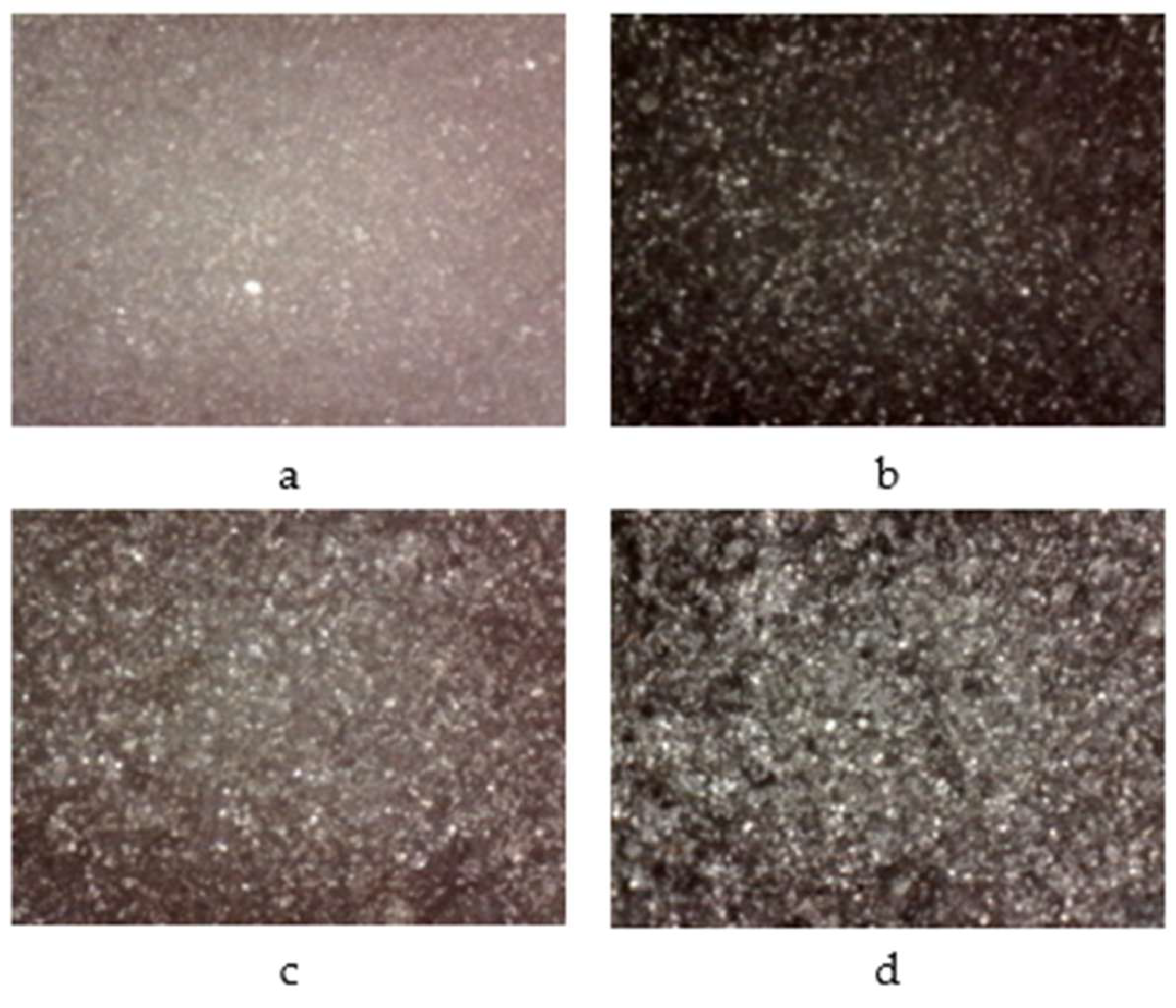
Figure 2.
Anodic polarization curves in 0.1 M Na₂S solution.
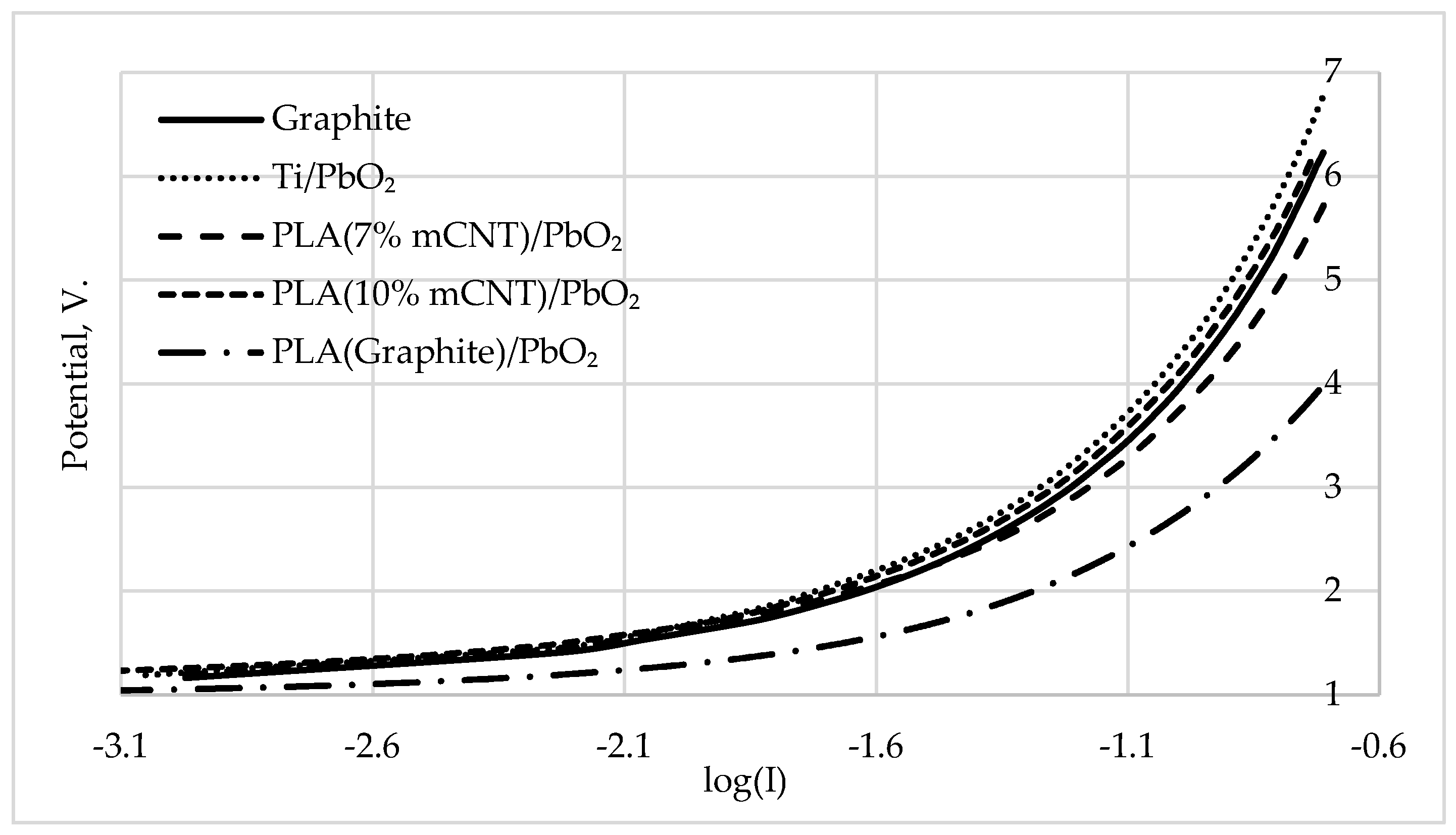
Figure 3.
Electrode potentials at fixed current densities in a 0.1 M Na₂S solution.
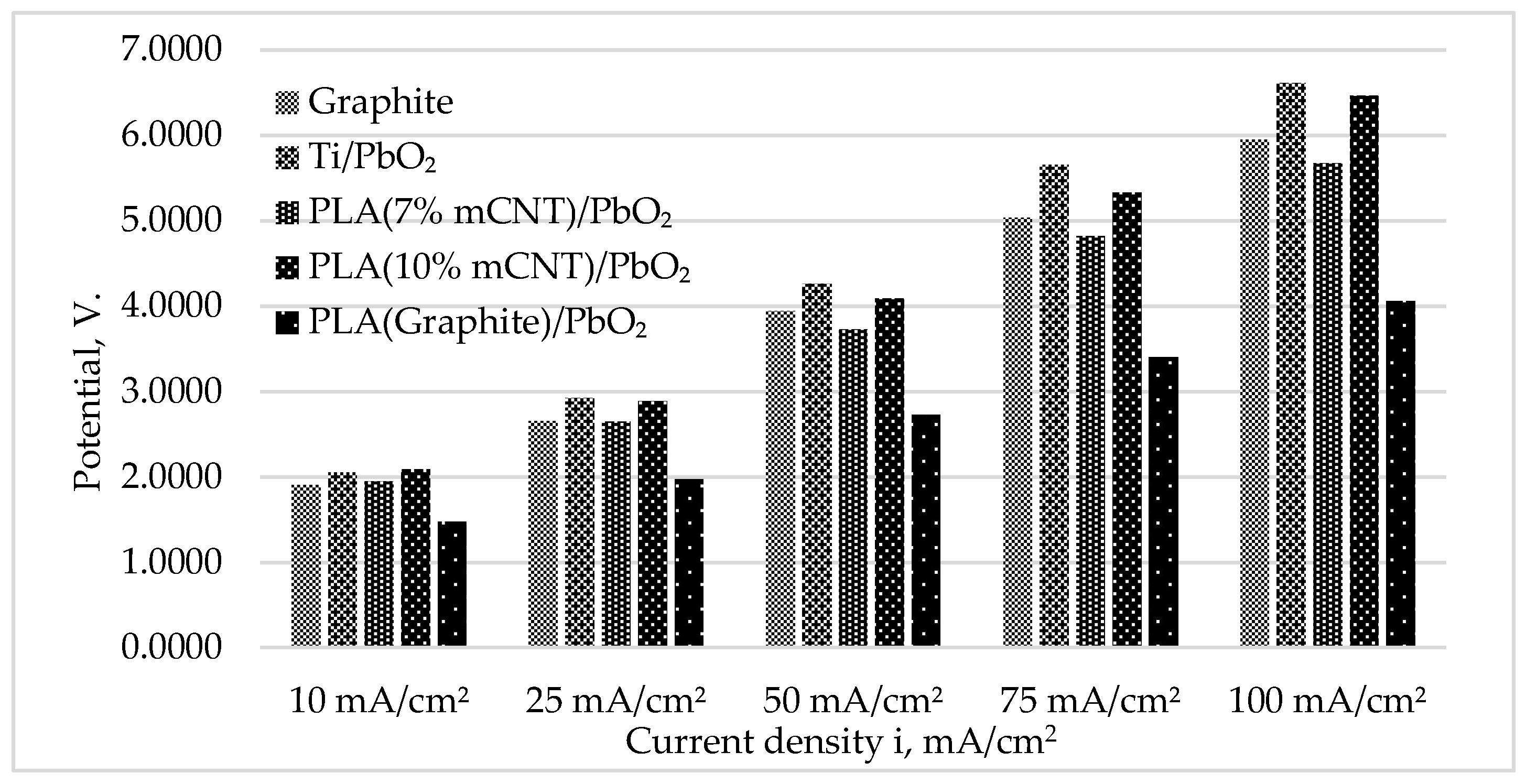
Figure 4.
Specific charge Q/S for the electrodes under study.
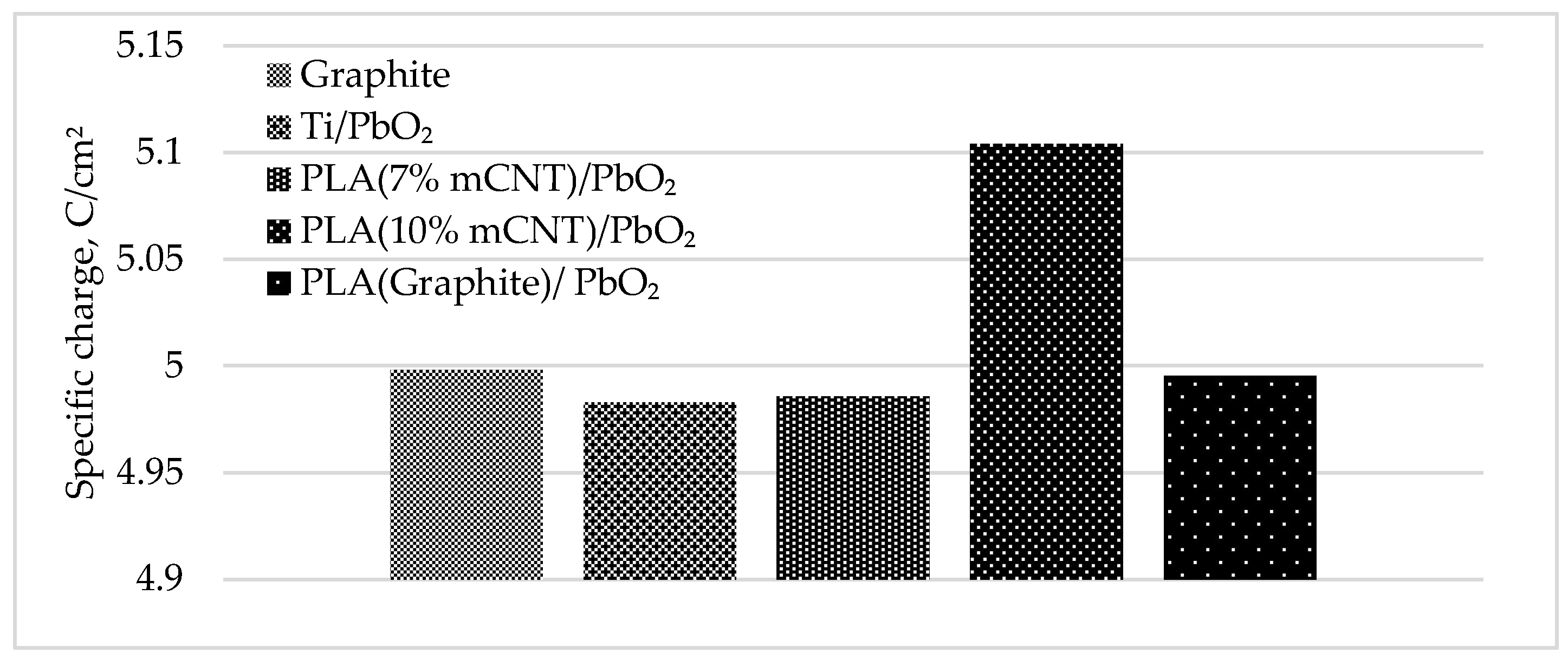
Figure 5.
Specific ohmic resistance of electrodes (R·S, Ohm·cm²).
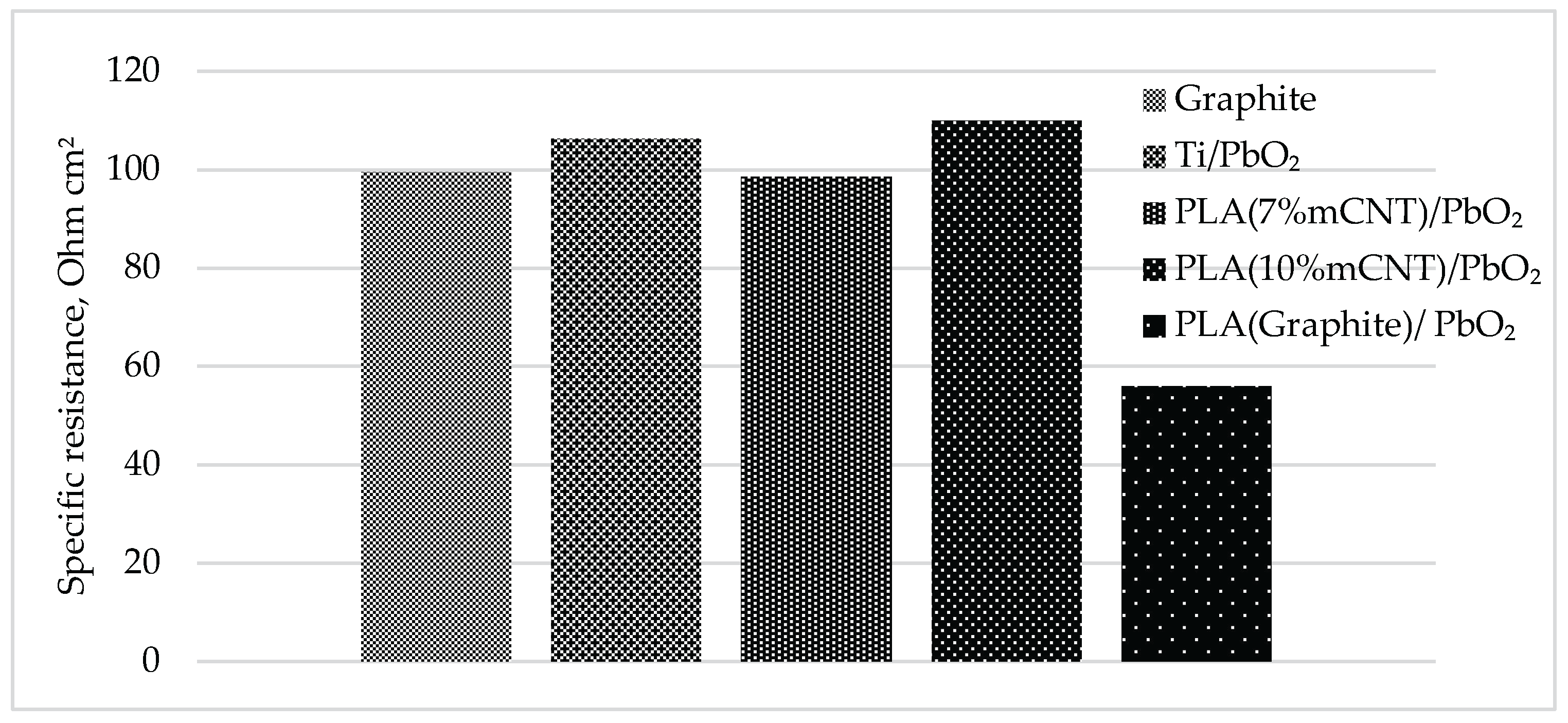
Figure 6.
Reproducibility of electrode potentials over 6 CV cycles.
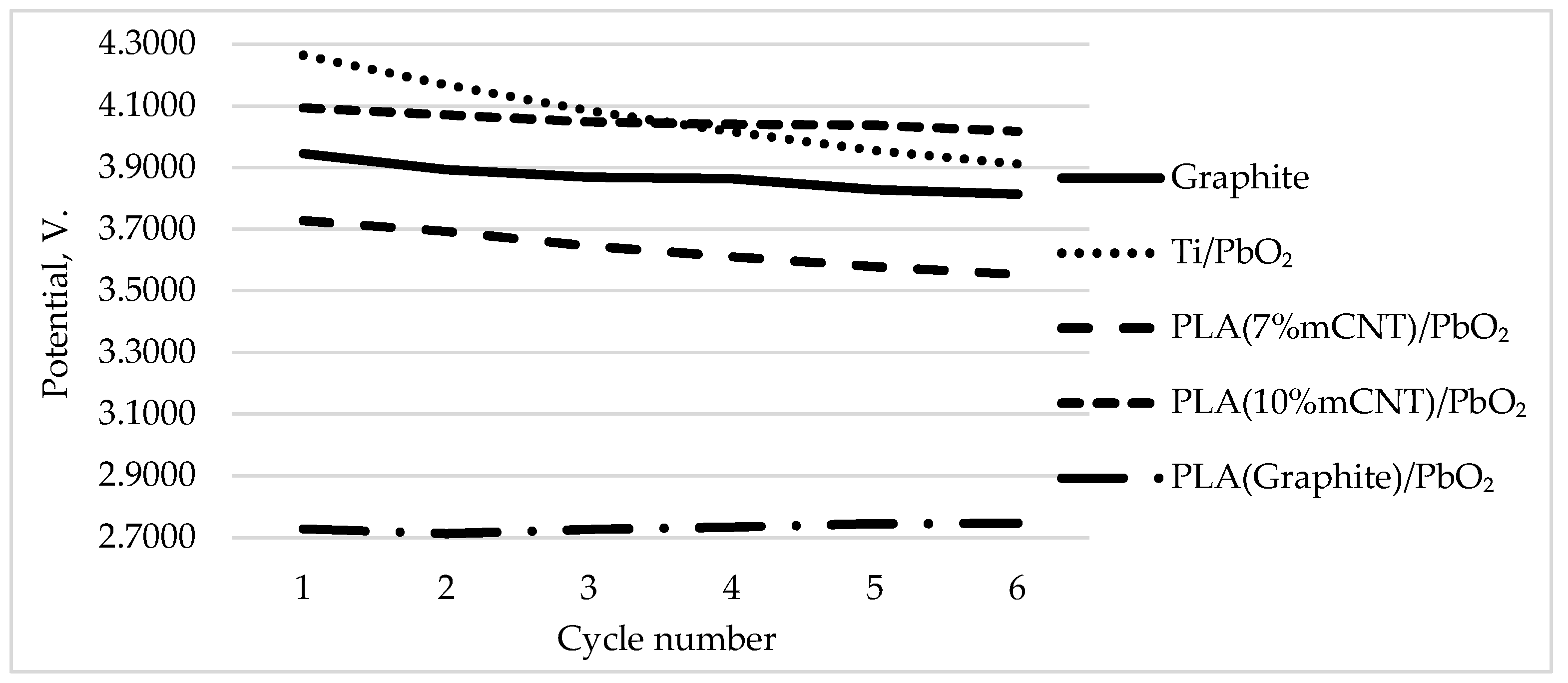
Figure 7.
Statistical indicators of reproducibility: maximum potential deviation and relative deviation.
Figure 7.
Statistical indicators of reproducibility: maximum potential deviation and relative deviation.
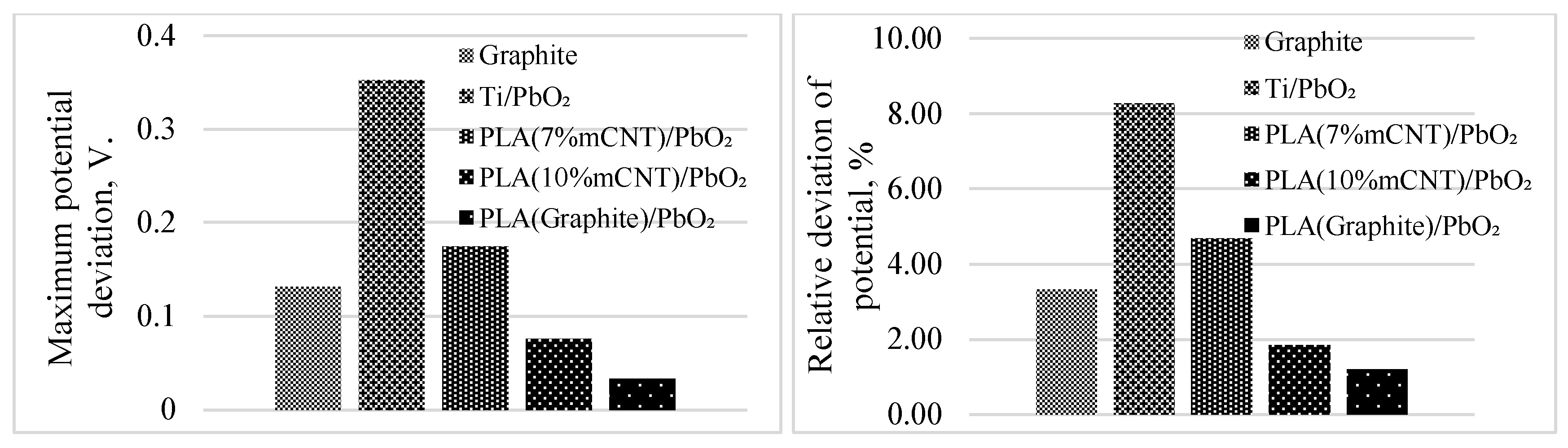
Figure 8.
Heat map of electrode ratings by characteristics.
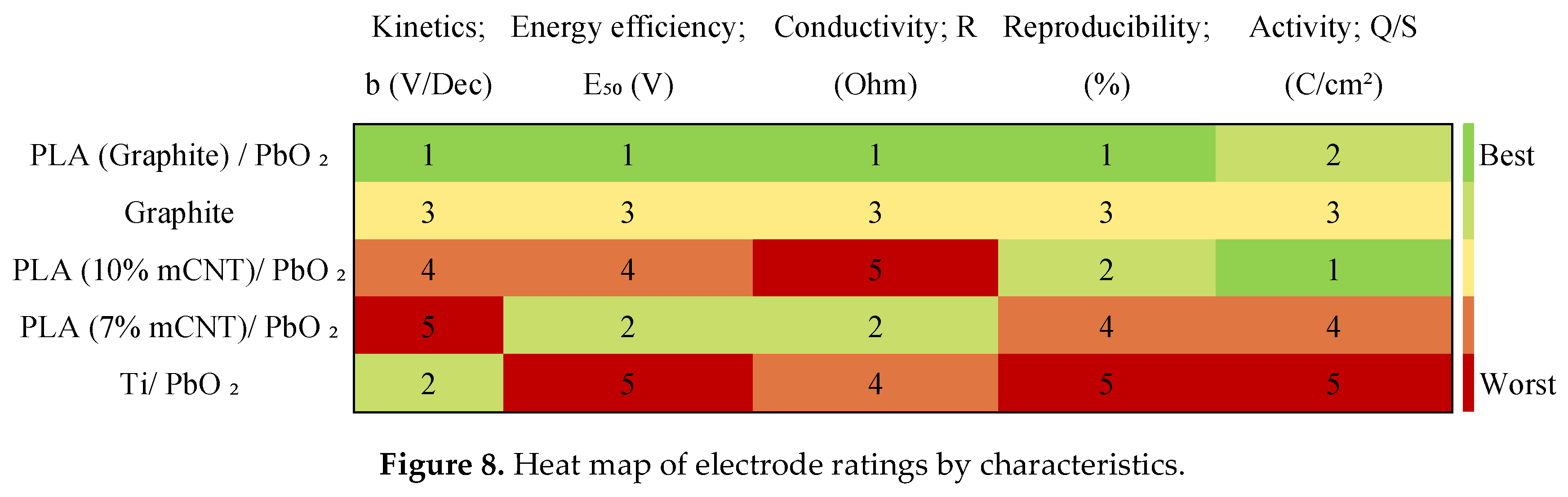
Table 2.
Summary table of electrode characteristics.
| Electrode | a (V) | b (V/Dec) | R² | E₅₀ (V) | Q/S (C/cm²) | R (Ohm) | Potential deviation (%) | Potential deviation (V) |
| Graphite | 2.1290 | 0.3230 | 0.9228 | 3.8683 | 4.9982 | 49.8000 | 3.3391 | 0.1317 |
| Ti/PbO ₂ | 2.1530 | 0.3150 | 0.9242 | 4.0664 | 4.9829 | 53.2000 | 8.2724 | 0.3527 |
| PLA (7% mCNT)/PbO ₂ | 2.1820 | 0.3310 | 0.9498 | 3.6344 | 4.9857 | 49.3000 | 4.6799 | 0.1744 |
| PLA (10% mCNT)/PbO ₂ | 2.1750 | 0.3270 | 0.9719 | 4.0508 | 5.1039 | 55.0000 | 1.8589 | 0.0761 |
| PLA (Graphite)/PbO ₂ | 1.6190 | 0.1950 | 0.9932 | 2.7321 | 4.9953 | 28.0000 | 1.2160 | 0.0334 |
Disclaimer/Publisher’s Note: The statements, opinions and data contained in all publications are solely those of the individual author(s) and contributor(s) and not of MDPI and/or the editor(s). MDPI and/or the editor(s) disclaim responsibility for any injury to people or property resulting from any ideas, methods, instructions or products referred to in the content. |
© 2026 by the authors. Licensee MDPI, Basel, Switzerland. This article is an open access article distributed under the terms and conditions of the Creative Commons Attribution (CC BY) license (http://creativecommons.org/licenses/by/4.0/).
Copyright: This open access article is published under a Creative Commons CC BY 4.0 license, which permit the free download, distribution, and reuse, provided that the author and preprint are cited in any reuse.


