
Submitted:
22 April 2026
Posted:
23 April 2026
You are already at the latest version
Abstract
Geometric and topological methods play an increasingly important role in quantum information science and quantum computation. Beyond the conventional Hilbert space formalism, a variety of mathematical frameworks, including group representations, mapping class groups, modular tensor categories, and character varieties, have been proposed to describe quantum states and quantum gates in a structurally robust manner. This review surveys the development of topological and geometric approaches to quantum information, with particular emphasis on representations of fundamental groups into SL(2,C), their associated character varieties, and the algebraic surfaces arising from trace coordinates, such as Fricke and Cayley cubic surfaces. These structures provide a geometric encoding of quantum degrees of freedom and offer alternative perspectives on topological quantum computing beyond anyon-based models. We also examine connections with integrable systems and isomonodromic deformations, where Painlevé equations and monodromy data supply a dynamical viewpoint on quantum state evolution. A critical comparison is provided with other geometric and topological approaches to quantum information, including geometric quantum mechanics, information geometry, tensor network geometry, and category-theoretic formulations. By synthesising results from topology, algebraic geometry, and mathematical physics, this review aims to clarify the conceptual landscape of topological quantum information geometry and to identify open problems and emerging directions in the field.
Keywords:
topological quantum computing
; quantum
; information geometry
; SL(2
; C) character varieties
; Fricke surfaces
; Cayley cubic
; integrable systems
; Painlevé equations
; geometric quantum mechanics
1. Introduction
Quantum information science has developed primarily within the Hilbert space formalism of quantum mechanics, where quantum states are vectors in complex projective space and quantum evolutions are unitary transformations. Beyond this foundational framework, increasing attention has been devoted to geometric and topological structures underlying quantum systems. Geometric formulations of quantum mechanics interpret pure states as points of complex projective space endowed with the Fubini–Study metric and symplectic structure [1,2], allowing quantum dynamics to be described as Hamiltonian flows on Kähler manifolds.
Parallel developments in topological quantum field theory and low-dimensional topology have motivated topological approaches to quantum computation. Kitaev’s toric code model [3] and subsequent proposals for anyon-based topological quantum computing [4,5] demonstrate that braiding operations of quasiparticles can realise fault-tolerant quantum gates protected by topological invariance. These ideas are naturally formulated in terms of modular tensor categories and modular functors [6,7], with conceptual roots in Chern–Simons topological quantum field theory [8].
More broadly, representation theory and moduli spaces of flat connections provide a geometric language for describing quantum systems. Representations of the fundamental group of a manifold into Lie groups such as or lead to character varieties, which parametrise equivalence classes of group homomorphisms modulo conjugation [9,10]. In low-dimensional topology, character varieties play a central role in the study of knot and link complements and in the construction of geometric structures on three-manifolds [11,12]. Their algebraic description in terms of trace coordinates often gives rise to well-studied surfaces, including Fricke surfaces and the Cayley cubic [10].
Mapping class groups act naturally on these representation varieties via the Dehn–Nielsen–Baer correspondence [13], relating surface diffeomorphisms to automorphisms of the fundamental group. Such actions generate modular transformations that are structurally analogous to quantum gate operations in topological settings. Moreover, the moduli spaces of flat connections carry natural symplectic structures [14,15], which underpin both classical and quantised topological field theories.
Another mathematical direction relevant to quantum information geometry arises from integrable systems and isomonodromic deformations. Painlevé equations, originally classified as nonlinear ordinary differential equations with the Painlevé property [16,17], appear in diverse areas of mathematical physics, including conformal field theory, random matrix theory, and quantum field theory [18,19]. Their formulation in terms of monodromy-preserving deformations of flat connections links integrable dynamics to moduli spaces of representations and character varieties [20,21], and their geometry is naturally organised by the theory of rational surfaces and affine root systems [22].
A distinctive line of investigation has proposed that topological quantum computing can be grounded directly in character varieties of link complements, offering a concrete alternative to anyon-based models. This approach was developed in a series of papers connecting the Hopf link and arithmetic two-bridge links to the Cayley cubic [23], extending the framework to three-bridge links and Fricke surfaces [24], and establishing the dynamical role of Painlevé VI on the associated cubic moduli spaces [25]. Earlier contributions explored quantum computation via Seifert surfaces and Bianchi groups [26,27].
The purpose of this review is to synthesise these developments and connect them to the broader landscape of geometric and topological methods in quantum information science. We first outline the geometric foundations of quantum information and summarise established topological approaches to quantum computation. We then review the role of character varieties and associated algebraic surfaces in modelling quantum degrees of freedom, including explicit worked examples. Subsequently, we examine connections with integrable systems and isomonodromic methods. A critical comparison is provided with alternative geometric frameworks, including information geometry [28], tensor network geometry [29], and category-theoretic formulations of quantum theory [30].
By structuring the discussion in this way, we aim to distinguish clearly between established mathematical results and the author’s own research contributions, while highlighting open problems and possible avenues for further investigation.
2. Geometric Foundations of Quantum Information
2.1. Projective Hilbert Space and Geometric Quantum Mechanics
In standard quantum mechanics, pure states are represented by unit vectors in a Hilbert space , modulo global phase. The physically meaningful space of pure states is therefore the complex projective space . This observation leads naturally to geometric formulations of quantum mechanics, in which is endowed with the Fubini–Study metric and a compatible symplectic structure [1,2].
Within this framework, Schrödinger evolution corresponds to Hamiltonian flow generated by the expectation value of the Hamiltonian operator. Observables become real-valued functions on projective Hilbert space, and quantum dynamics acquires a symplectic-geometric interpretation. This approach clarifies the role of geometric phases, curvature, and metric structures in quantum theory, and provides a bridge between quantum mechanics and classical Hamiltonian geometry.
2.2. Group-Theoretic and Representation-Theoretic Structures
Group theory is fundamental to quantum mechanics at multiple levels. Symmetry transformations are described by unitary representations of Lie groups, while composite systems are governed by tensor product structures constrained by representation theory. In quantum information science, the study of entanglement classes, stabiliser codes, and Clifford operations relies heavily on algebraic properties of unitary groups and finite subgroups thereof.
Beyond compact unitary groups, non-compact groups such as arise naturally in mathematical physics. The group is the double cover of the Lorentz group and appears in the theory of spinors, relativistic quantum mechanics, and gauge theory. Representations of discrete groups into lead to moduli spaces known as character varieties, which have been extensively studied in low-dimensional topology [9,10].
Given a finitely generated group , the representation variety and its quotient by conjugation define algebraic varieties encoding equivalence classes of representations. When , these character varieties admit explicit descriptions in terms of trace coordinates, often satisfying polynomial relations that define algebraic surfaces.
2.3. Topology, Mapping Class Groups, and Modular Structures
Topological methods enter quantum information prominently through topological quantum field theory (TQFT) and topological quantum computing. In these settings, quantum states are associated with surfaces, and quantum gates correspond to elements of mapping class groups acting on state spaces [6,7]. The Dehn–Nielsen–Baer theorem establishes a correspondence between mapping class groups of surfaces and outer automorphisms of their fundamental groups [13], linking topological transformations to algebraic automorphisms.
The moduli space of flat connections on a surface carries natural symplectic structures [14,15], which play a central role in both classical gauge theory and its quantisation. In related developments, coordinate systems adapted to Poisson structures (including cluster-type coordinates) provide explicit charts on moduli spaces of local systems [31], strengthening the interface between algebraic geometry, topology, and dynamics.
2.4. From Geometric Structures to Quantum Information Modelling
The convergence of geometric quantum mechanics, representation theory, and low-dimensional topology suggests a broader geometric perspective on quantum information. Projective Hilbert space geometry describes local quantum structure, while representation varieties and moduli spaces introduce global, topological degrees of freedom. Although traditional topological quantum computing focuses on quasiparticle braiding in two-dimensional systems [3,4], the research programme reviewed here explores algebraic and geometric structures derived from surface groups and character varieties to encode quantum states and logical operations [23,24]. These developments motivate a systematic examination of character varieties and associated algebraic surfaces in the context of quantum information, reviewed in the following sections.
3. Topological Quantum Computing
3.1. Anyon-Based Approaches and Modular Tensor Categories
Topological quantum computing (TQC) is a fault-tolerant paradigm in which quantum information is encoded in global, topological degrees of freedom of many-body systems. The foundational idea is that quasiparticle excitations in certain two-dimensional systems exhibit anyonic statistics, and that their braiding implements unitary transformations on a protected Hilbert space [3,4,5].
In this framework, computational states are associated with fusion spaces of non-Abelian anyons. Braiding operations correspond to representations of the braid group acting on these spaces, and the resulting unitary transformations are insensitive to local perturbations. The mathematical structure underlying such models is that of modular tensor categories and modular functors [6,7]. Conceptually, these structures are closely related to Chern–Simons topological quantum field theory, which provides a field-theoretic origin for quantum link invariants and modular data [8].
3.2. Mapping Class Groups and Surface-Based Constructions
Beyond particle braiding, topological quantum computation can be described in terms of mapping class groups of surfaces. In TQFT-inspired approaches, quantum states are associated with surfaces, and quantum gates correspond to diffeomorphisms of these surfaces modulo isotopy [6]. The Dehn–Nielsen–Baer correspondence identifies the mapping class group of a surface with a subgroup of the outer automorphism group of its fundamental group [13], linking topological transformations to algebraic automorphisms.
Surface-based constructions emphasise the role of topology at the level of manifolds and their fundamental groups rather than solely at the level of particle statistics. In this perspective, quantum information may be modelled through algebraic and geometric structures associated with surfaces and three-manifolds, including moduli spaces of flat connections whose symplectic geometry is well understood [14,15].
3.3. Character Varieties and Algebraic Structures in TQC
Character varieties arise naturally in the study of representations of fundamental groups into Lie groups such as or . For a finitely generated group , the representation space and its quotient by conjugation define algebraic varieties that parametrise equivalence classes of representations [9,10].
In low-dimensional topology, character varieties encode geometric structures of knot and link complements and are closely connected with hyperbolic geometry [11,12]. When expressed in trace coordinates, these varieties often satisfy polynomial relations defining algebraic surfaces. Classical examples include Fricke surfaces associated with surface groups and the Cayley cubic arising in the study of two-generator groups [10]. A complementary viewpoint emphasises coordinate systems and Poisson structures on moduli of local systems, including cluster-type descriptions [31], which make mapping class group actions and quantisation questions more explicit.
3.4. Comparison of Topological Paradigms
Anyon-based TQC and surface-based geometric approaches share common mathematical ingredients: braid groups, mapping class groups, and representation theory, but differ in emphasis. Anyon models are closely tied to specific physical realisations in two-dimensional condensed matter systems and are grounded in modular tensor categories derived from quantum field theory. By contrast, character-variety-based perspectives emphasise representation spaces of surface and manifold groups and the associated algebraic and symplectic geometry. This interplay motivates further investigation of representation varieties and algebraic surfaces in quantum information, developed in the next section.
4. Character Varieties and Algebraic Surfaces
4.1. Representation Varieties and Trace Coordinates
Let be a finitely generated group, such as the fundamental group of a surface or a three-manifold. The representation variety
consists of group homomorphisms from into a Lie group G, typically considered as an algebraic set when G is an algebraic group. The quotient by conjugation,
defines the G-character variety of [9]. For , this quotient can often be described explicitly using trace functions, since traces are invariant under conjugation. For two-generator groups, classical trace identities lead to cubic relations in trace coordinates; mapping class group actions on such varieties have been systematically studied [10].
4.2. Fricke Surfaces and the Cayley Cubic
For the free group , trace coordinates
satisfy polynomial relations (Fricke-type relations) defining families of cubic surfaces. A particularly prominent case is the Cayley cubic
a singular cubic surface with four nodes and a rich symmetry structure [10,23]. Such surfaces arise as components of character varieties in low-dimensional topology and provide explicit algebraic models for moduli of representations.
More generally, one considers the one-parameter family of Fricke surfaces
which interpolates between different topological settings as d varies. The surfaces for are smooth, while acquires four nodal singularities.
Qubits as points on the Cayley cubic.
A key observation [23,24] is that representations satisfying the reality condition are conjugate to representations. Since double-covers , such a representation defines a unit quaternion, that is, a qubit state up to global phase.
To make this concrete, consider the Hopf link whose complement has fundamental group . A representation is determined by two commuting unit quaternions:
giving , , . One verifies directly that these satisfy (1):
an identity that follows from the sum-to-product formula. Thus the real bounded component parametrises the space of one-qubit states associated with the Hopf link complement; deforming continuously traces a path on the Cayley cubic. Non-Abelian generalisations, corresponding to non-trivial link complements, require off-diagonal matrices and lead to richer character varieties with both reducible component and irreducible components for [23,24].
4.3. Character Varieties of Surfaces and Three-Manifolds
For an orientable surface, the character variety of representations carries natural Poisson and symplectic structures. Goldman identified a canonical symplectic structure on the smooth locus of the moduli space of flat connections [14], while Atiyah and Bott provided a gauge-theoretic symplectic framework for moduli spaces of connections over Riemann surfaces [15]. These foundational results place character varieties within a broader symplectic and Hamiltonian context.
In three-dimensional topology, Thurston’s theory of hyperbolic structures [11] established deep connections between character varieties and geometric structures on three-manifolds. For hyperbolic knot complements, discrete faithful representations correspond to hyperbolic metrics, and deformation spaces of such representations are encoded within the character variety [12].
The case of the four-punctured sphere (the Riemann sphere with four marked points) is of particular relevance. Its fundamental group is a free group of rank three, and the character variety is a cubic surface parametrised by traces, with automorphisms governed by the Painlevé VI equation, a theme developed further in Section 5. Several arithmetic two-bridge links (including the Whitehead link , the Bergé link , and the double-eight link ) yield character varieties containing both the reducible Cayley component and an irreducible Fricke component for some [23].
4.4. Algebraic Surfaces, Coordinates, and Quantisation Perspectives
Algebraic surfaces arising from character varieties often admit additional structures compatible with group actions. Mapping class groups act by algebraic automorphisms induced from outer automorphisms of [13]. In many settings, Poisson structures admit explicit coordinate descriptions. Cluster-type and higher Teichmüller frameworks provide coordinate systems on moduli spaces of local systems and make their Poisson geometry explicit [31]. Related quantisation ideas motivate the study of “quantum” versions of these moduli spaces.
The nodal singularities of the Cayley cubic deserve special attention. They correspond to parabolic representations, i.e. those with unipotent monodromy around boundary components. At these singular points, the usual symplectic structure degenerates, signalling a topological transition. Recent work has argued that these parabolic loci carry physically distinct information, acting as “shadows” in a non-semisimple extension of the moduli space [32].
4.5. Relevance for Quantum Information Modelling
The identification of qubit states with points on Fricke and Cayley cubic surfaces, described in Section 4.2, opens several concrete directions for quantum information modelling.
Quantum state space. The real bounded component of (with ), defined by , provides a three-dimensional algebraic model for the space of two-generator representations. This is an alternative to the Bloch sphere description of a single qubit: while the Bloch ball models the density matrix of one two-level system, the Fricke surface encodes the pair of generators producing the state, together with their product’s trace. The transition from (Hopf link, Abelian topology) to with (non-Abelian link groups) corresponds to an increase in entanglement between the two generators.
Quantum gates. Mapping class group automorphisms of the surface (Dehn twists and their compositions) act as polynomial automorphisms of the trace coordinates , generating a discrete dynamical system on the character variety. These transformations have been proposed as analogues of topological quantum gates, realised not via physical anyon braiding but via algebraic symmetries of the moduli space [23,24].
Seifert surfaces and singular fibres. Earlier work in this programme identified quantum states with components of Seifert surfaces of knots, and related singular fibres of elliptic fibrations to qubit errors [26]. Bianchi groups, which are arithmetic subgroups of , provide additional examples of groups whose character varieties encode discrete quantum structures [27].
These considerations motivate the study of dynamical structures on character varieties, particularly those arising from isomonodromic deformations and integrable systems, to which we now turn.
5. Integrable Systems and Isomonodromic Deformations
5.1. Flat Connections and Monodromy
Moduli spaces of representations of fundamental groups into may be interpreted as moduli spaces of flat connections on principal bundles over punctured surfaces. A flat connection defines a monodromy representation
and the corresponding character variety parametrises equivalence classes of such flat connections. The symplectic geometry of these moduli spaces is foundational in gauge theory and geometric topology [14,15].
5.2. Isomonodromic Deformations
An isomonodromic deformation is a deformation of a linear differential system that preserves its monodromy data. For Fuchsian systems with four regular singular points on the Riemann sphere, the compatibility conditions for preserving monodromy lead to the Painlevé VI equation [18]. More generally, the Painlevé equations arise as nonlinear differential equations governing monodromy-preserving deformations of regular or irregular linear systems [17,20].
5.3. Painlevé VI, Fricke Surfaces, and the Four-Punctured Sphere
The Painlevé VI equation (PVI) is directly linked to the four-punctured sphere . An representation of is a quadruple of matrices satisfying . Setting
the character variety is a (generalised) Fricke–Painlevé cubic surface
where the right-hand side depends on the local monodromy eigenvalues (boundary conditions) [20]. Isomonodromic deformations of this system define a flow on , governed precisely by PVI.
This connection has a rich structure of special (algebraic) solutions. Among the finite-branching solutions of PVI, one finds:
- one Cayley–Picard solution (the fixed-point locus of the nodal );
- three continuous platonic solutions (the tetrahedron, cube, and icosahedron), associated with del Pezzo surfaces of degree 3;
- fourty-five icosahedral solutions (including the Klein quartic and Valentiner solutions), parametrised by surfaces of icosahedral symmetry.
5.4. Symplectic and Hamiltonian Structure
Isomonodromic systems admit Hamiltonian formulations compatible with the symplectic structure on moduli spaces of flat connections [14]. Boalch developed a symplectic viewpoint on isomonodromic deformations, clarifying their interpretation as flows on complex symplectic manifolds [21]. These results provide a coherent geometric setting in which character varieties serve not only as static algebraic objects but also as phase spaces for integrable dynamics. The Okamoto symmetry group of PVI, an affine Weyl group of type , acts on the cubic surface (5) as a group of Cremona transformations, generating a discrete integrable structure that parallels the action of mapping class groups on the surface group character variety.
5.5. Connections with Quantum Theory
Integrable systems and monodromy-preserving deformations appear in various areas of quantum theory. Notable examples include relations between Painlevé transcendents and conformal blocks [19], the appearance of PVI in the computation of quantum correlation functions [18], and the role of monodromy data in topological field theories [8]. In quantisation frameworks for gauge theories, moduli spaces of flat connections provide classical phase spaces whose quantisation yields Hilbert spaces relevant to TQFT [8].
In the quantum information context reviewed here, the isomonodromic dynamics on Fricke–Painlevé cubics furnishes a dynamical model for how qubit states, identified with points on these surfaces, may evolve under parameter variation. The algebraic solutions of PVI (platonic, icosahedral, and Cayley–Picard) correspond to geometrically distinguished orbits on the moduli space, singled out by symmetry. Exploring whether these special orbits admit interpretation as protected quantum computational states, by analogy with the topological protection of anyon braiding, remains an open and intriguing problem [25].
6. Comparison with Alternative Geometric and Topological Approaches
The geometric and topological perspective developed in the preceding sections is part of a broader landscape of mathematically structured approaches to quantum information science. In this section, we briefly compare character-variety-based frameworks with several alternative geometric formulations that have been influential in the field.
6.1. Geometric Quantum Mechanics
Geometric quantum mechanics reformulates quantum theory on complex projective Hilbert space equipped with the Fubini–Study metric and symplectic structure [1,2]. In this setting, quantum states are points on a Kähler manifold, observables correspond to real-valued functions, and time evolution is described by Hamiltonian flows.
This framework emphasises local differential geometry and metric structure. By contrast, character-variety-based approaches emphasise global algebraic and topological structures arising from representations of discrete groups. While geometric quantum mechanics operates within a fixed Hilbert space, character varieties introduce moduli spaces that encode global constraints and symmetries associated with fundamental groups. The two perspectives are complementary: the former focuses on intrinsic geometry of state space, whereas the latter foregrounds representation-theoretic and topological degrees of freedom.
6.2. Information Geometry
Information geometry studies statistical manifolds equipped with Riemannian metrics derived from divergence functions, most notably the Fisher information metric [28]. In quantum information, quantum analogues of Fisher geometry and monotone metrics provide tools for analysing distinguishability, entanglement, and quantum statistical inference.
Information geometry is primarily concerned with metric properties and statistical distinguishability. Character-variety frameworks, by contrast, are fundamentally algebraic and topological. Their central objects are moduli spaces defined by polynomial relations and group actions rather than statistical distance functions. Nevertheless, both approaches share an emphasis on geometric structure and may intersect in contexts where quantum states are parametrised by moduli spaces with natural metric or symplectic forms.
6.3. Tensor Network Geometry
Tensor network methods, including matrix product states and projected entangled pair states, provide efficient representations of many-body quantum states and are widely used in condensed matter physics and quantum simulation [29]. Recent developments interpret tensor networks in geometric terms, relating entanglement structure to network geometry and, in some cases, to discrete approximations of curved spaces.
Tensor networks emphasise combinatorial and graph-theoretic structure adapted to efficient numerical computation. Their geometry is typically discrete and algorithmic. In contrast, character varieties and moduli spaces are continuous algebraic varieties equipped with symplectic or Poisson structures. While tensor networks provide practical tools for approximating quantum states, character-variety-based models focus on structural and topological aspects of representation spaces. These approaches address different levels of description and may be viewed as complementary rather than competing frameworks.
6.4. Categorical Quantum Mechanics
Categorical quantum mechanics formulates quantum theory in terms of symmetric monoidal categories, emphasising compositional structure and diagrammatic reasoning [30]. In this approach, morphisms represent physical processes, and tensor products encode system composition. This abstract perspective has clarified structural aspects of entanglement, measurement, and quantum protocols.
Topological quantum field theories and modular tensor categories, which underpin topological quantum computing, already fit naturally within categorical language [6]. Character varieties, however, are typically studied within algebraic geometry and representation theory rather than categorical frameworks. The two viewpoints differ in emphasis: categorical formulations highlight compositional structure, while character varieties highlight algebraic and geometric constraints arising from group representations.
6.5. Higher Teichmüller Theory and Cluster Structures
Moduli spaces of local systems on surfaces have also been studied within higher Teichmüller theory and cluster algebra frameworks [31]. These approaches provide coordinate systems adapted to Poisson structures and mapping class group actions. They emphasise positivity structures, coordinate atlases, and quantisation procedures that make moduli spaces computationally accessible.
Character varieties of representations can often be described within this broader framework. While the present review focuses on algebraic surfaces arising from trace relations, cluster-type coordinates provide alternative descriptions that may be advantageous for quantisation or computational purposes.
6.6. Summary of Comparisons
Table 1 collects the main features of these approaches for easy reference.
Across these approaches, several recurring themes emerge: the importance of symmetry, the role of group actions, and the presence of geometric structures such as metrics, symplectic forms, or Poisson brackets. Character-variety-based perspectives contribute to this landscape by foregrounding algebraic surfaces, moduli spaces of representations, and mapping class group actions as organising principles. Rather than replacing alternative geometric frameworks, they provide an additional viewpoint rooted in low-dimensional topology and algebraic geometry. A complete understanding of geometric structures in quantum information likely requires integrating insights from several of these complementary approaches.
7. Figure: Conceptual Map of the Framework
Figure 1 below provides a structural overview of the relationships among the main objects reviewed in this paper, from the fundamental group of a link complement through to quantum information applications.
8. Conclusion
This review has examined the interplay between geometry, topology, and quantum information science, with particular emphasis on character varieties, algebraic surfaces defined by trace relations, and their connections with integrable systems and isomonodromic deformations. By situating these structures within the broader context of geometric quantum mechanics, topological quantum computing, and moduli theory, we have aimed to clarify their mathematical foundations and conceptual scope.
Character varieties provide explicit algebraic models for moduli spaces of group representations and flat connections. Their description in terms of polynomial relations—notably Fricke cubic surfaces and the Cayley singular cubic —makes them accessible to techniques from algebraic geometry, symplectic geometry, and representation theory. The identification of the real bounded locus on these surfaces with the space of representations (qubit states) provides a concrete geometric model for quantum information encoding, going beyond the Bloch sphere picture by incorporating the topology of the underlying link complement [23,24].
Integrable systems, particularly those arising from isomonodromic deformations, enrich this picture by introducing canonical dynamical flows on moduli spaces of flat connections. The appearance of Painlevé VI as the governing equation of monodromy-preserving deformations of the four-punctured sphere demonstrates that Fricke–Painlevé cubic surfaces are not merely static parameter spaces but also phase spaces for integrable dynamics. The finite set of algebraic solutions of PVI—classified by platonic and icosahedral symmetry—singles out geometrically and algebraically distinguished orbits, whose interpretation as protected quantum computational states merits further investigation [25].
In comparison with alternative geometric frameworks in quantum information—geometric quantum mechanics, information geometry, tensor network geometry, and categorical formulations—the character-variety perspective emphasises global algebraic and topological structures derived from fundamental groups and moduli spaces. Rather than competing with these approaches, it complements them by providing a representation-theoretic and geometric viewpoint rooted in low-dimensional topology.
Several directions remain open for further investigation. These include the systematic study of quantisation procedures for Fricke–Painlevé surfaces, the role of Poisson and cluster structures in computational settings, and the clarification of possible links between algebraic solutions of PVI and protected gate sets. The extension of the framework to higher-rank groups (beyond ) and to higher-dimensional representations, which would describe multi-qubit systems, is a natural and as yet largely unexplored direction.
Overall, the synthesis presented here highlights the richness of geometric and topological methods in quantum information science. By integrating insights from algebraic geometry, representation theory, and integrable systems, character varieties offer a coherent mathematical framework that may contribute to a broader structural understanding of quantum information and its foundations.
Funding
This research received no external funding.
Data Availability Statement
The paper is self-contained.
Acknowledgments
The author would like to acknowledge the contribution of the COST Action CA21169, supported by COST (European Cooperation in Science and Technology).
Conflicts of Interest
The author declares no conflicts of interest.
References
- Ashtekar, A.; Schilling, T.A. Geometrical formulation of quantum mechanics. In On Einstein’s Path: Essays in Honor of Engelbert Schücking; Harvey, A., Ed.; Springer: New York, NY, USA, 1999; pp. 23–65. [Google Scholar]
- Brody, D.C.; Hughston, L.P. Geometric quantum mechanics. J. Geom. Phys. 2001, 38, 19–53. [Google Scholar] [CrossRef]
- Kitaev, A.Yu. Fault-tolerant quantum computation by anyons. Ann. Phys. 2003, 303, 2–30. [Google Scholar] [CrossRef]
- Nayak, C.; Simon, S.H.; Stern, A.; Freedman, M.; Das Sarma, S. Non-Abelian anyons and topological quantum computation. Rev. Mod. Phys. 2008, 80, 1083–1159. [Google Scholar] [CrossRef]
- Freedman, M.H.; Kitaev, A.; Larsen, M.J.; Wang, Z. Topological quantum computation. Bull. Am. Math. Soc. 2003, 40, 31–38. [Google Scholar] [CrossRef]
- Turaev, V.G. Quantum Invariants of Knots and 3-Manifolds; de Gruyter: Berlin, Germany, 1994. [Google Scholar]
- Bakalov, B.; Kirillov, A. Lectures on Tensor Categories and Modular Functors; American Mathematical Society: Providence, RI, USA, 2001. [Google Scholar]
- Witten, E. Quantum field theory and the Jones polynomial. Commun. Math. Phys. 1989, 121, 351–399. [Google Scholar] [CrossRef]
- Culler, M.; Shalen, P.B. Varieties of group representations and splittings of 3-manifolds. Ann. Math. 1983, 117, 109–146. [Google Scholar] [CrossRef]
- Goldman, W.M. The modular group action on real SL(2)-characters of the one-holed torus. Geom. Topol. 2003, 7, 443–486. [Google Scholar] [CrossRef]
- Thurston, W.P. Three-Dimensional Geometry and Topology; Princeton University Press: Princeton, NJ, USA, 1997; Vol. 1. [Google Scholar]
- Kapovich, M. Hyperbolic Manifolds and Discrete Groups; Birkhäuser: Boston, MA, USA, 2009. [Google Scholar]
- Farb, B.; Margalit, D. A Primer on Mapping Class Groups; Princeton University Press: Princeton, NJ, USA, 2012. [Google Scholar]
- Goldman, W.M. The symplectic nature of fundamental groups of surfaces. Adv. Math. 1984, 54, 200–225. [Google Scholar] [CrossRef]
- Atiyah, M.F.; Bott, R. The Yang–Mills equations over Riemann surfaces. Philos. Trans. R. Soc. Lond. A 1983, 308, 523–615. [Google Scholar] [CrossRef]
- Painlevé, P. Sur les équations différentielles du second ordre et d’ordre supérieur dont l’intégrale générale est uniforme. Acta Math. 1902, 25, 1–85. [Google Scholar] [CrossRef]
- Gromak, V.I.; Laine, I.; Shimomura, S. Painlevé Differential Equations in the Complex Plane; de Gruyter: Berlin, Germany, 2002. [Google Scholar]
- Jimbo, M.; Miwa, T. Monodromy preserving deformation of linear ordinary differential equations with rational coefficients. II. Physica D 1981, 2, 306–352. [Google Scholar] [CrossRef]
- Gamayun, O.; Iorgov, N.; Lisovyy, O. Conformal field theory of Painlevé VI. J. High Energy Phys. 2012, 2012, 038. [Google Scholar] [CrossRef]
- Iwasaki, K.; Kimura, H.; Shimomura, S.; Yoshida, M. From Gauss to Painlevé: A Modern Theory of Special Functions; Friedr. Vieweg & Sohn: Braunschweig, Germany, 1991. [Google Scholar]
- Boalch, P. Symplectic manifolds and isomonodromic deformations. Adv. Math. 2002, 163, 137–205. [Google Scholar] [CrossRef]
- Sakai, H. Rational surfaces associated with affine root systems and geometry of the Painlevé equations. Commun. Math. Phys. 2001, 220, 165–229. [Google Scholar] [CrossRef]
- Planat, M.; Amaral, M.M.; Fang, F.; Chester, D.; Aschheim, R.; Irwin, K. Character varieties and algebraic surfaces for the topology of quantum computing. Symmetry 2022, 14, 915. [Google Scholar] [CrossRef]
- Planat, M.; Chester, D.; Amaral, M.M.; Irwin, K. Fricke topological qubits. Quantum Rep. 2022, 4, 523–532. [Google Scholar] [CrossRef]
- Planat, M.; Chester, D.; Amaral, M.M.; Irwin, K. Dynamics of Fricke–Painlevé VI surfaces. Dynamics 2023, 3, 1–11. [Google Scholar] [CrossRef]
- Planat, M.; Aschheim, R.; Amaral, M.M.; Irwin, K. Quantum computing, Seifert surfaces and singular fibres. Quantum Rep. 2019, 1, 12–22. [Google Scholar] [CrossRef]
- Planat, M.; Aschheim, R.; Amaral, M.M.; Irwin, K. Quantum computation and measurements from an exotic space-time R4. Symmetry 2020, 12, 736. [Google Scholar] [CrossRef]
- Amari, S. Information Geometry and Its Applications; Springer: Tokyo, Japan, 2016. [Google Scholar]
- Orús, R. A practical introduction to tensor networks: matrix product states and projected entangled pair states. Ann. Phys. 2014, 349, 117–158. [Google Scholar] [CrossRef]
- Abramsky, S.; Coecke, B. A categorical semantics of quantum protocols. In Proceedings of the 19th Annual IEEE Symposium on Logic in Computer Science (LICS 2004); IEEE: Piscataway, NJ, USA, 2004; pp. 415–425. [Google Scholar]
- Fock, V.V.; Goncharov, A.B. Moduli spaces of local systems and higher Teichmüller theory. Publ. Math. Inst. Hautes Études Sci. 2006, 103, 1–211. [Google Scholar] [CrossRef]
- Planat, M. Murakamian ombre: non-semisimple topology, Cayley cubics, and the foundations of a conscious AGI. Symmetry 2026, 18, 36. [Google Scholar] [CrossRef]
- Boalch, P. The fifty-two icosahedral solutions of Painlevé VI. J. Reine Angew. Math. 2006, 596, 183–214. [Google Scholar] [CrossRef]
- Lisovyy, O.; Tykhyy, Y. Algebraic solutions of the sixth Painlevé equation. J. Geom. Phys. 2014, 85, 124–163. [Google Scholar] [CrossRef]
Figure 1.
Conceptual map of topological quantum information geometry. Blue: topological input (link complement, fundamental group, representations into ). Green: algebraic-geometric core (character variety, Fricke/Cayley cubic , mapping class group action). Orange: integrable dynamics (Painlevé VI, Okamoto symmetry, rational surface geometry). Purple: quantum information output (qubit states on the locus, topological gates via MCG automorphisms, topological quantum computing). Dashed arrow: proposed connection between special (algebraic) orbits of Painlevé VI and protected gate sets.
Figure 1.
Conceptual map of topological quantum information geometry. Blue: topological input (link complement, fundamental group, representations into ). Green: algebraic-geometric core (character variety, Fricke/Cayley cubic , mapping class group action). Orange: integrable dynamics (Painlevé VI, Okamoto symmetry, rational surface geometry). Purple: quantum information output (qubit states on the locus, topological gates via MCG automorphisms, topological quantum computing). Dashed arrow: proposed connection between special (algebraic) orbits of Painlevé VI and protected gate sets.
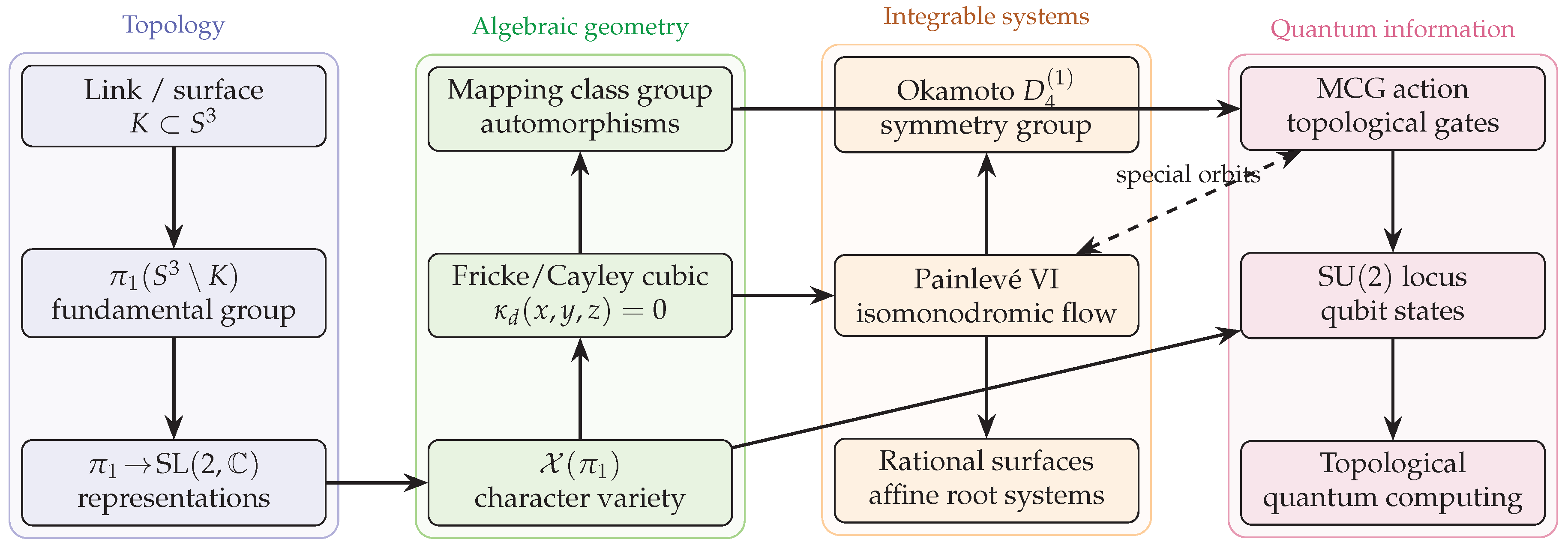

Table 1.
Comparison of geometric and topological approaches to quantum information. “MCS” = mapping class group symmetry; “QI model” = proposed role in quantum information.
Table 1.
Comparison of geometric and topological approaches to quantum information. “MCS” = mapping class group symmetry; “QI model” = proposed role in quantum information.
| Approach | Key object | Core structure | MCS? | QI model |
|---|---|---|---|---|
| Geom. QM | Kähler / symplectic | No | State space | |
| Info. geometry | Stat. manifold | Fisher metric | No | Distinguishability |
| Tensor networks | Graph / MPS | Entanglement entropy | No | Simulation |
| Categorical QM | Monoidal category | Composition | Partial | Protocols |
| Higher Teichmüller | Cluster variety | Poisson / positivity | Yes | Quantisation |
| Character varieties | Fricke / Cayley cubic | Symplectic / polynomial | Yes | TQC gates, qubits |
| Anyon / MTC | Fusion categories | Braiding | Yes | Fault-tolerant gates |
Disclaimer/Publisher’s Note: The statements, opinions and data contained in all publications are solely those of the individual author(s) and contributor(s) and not of MDPI and/or the editor(s). MDPI and/or the editor(s) disclaim responsibility for any injury to people or property resulting from any ideas, methods, instructions or products referred to in the content. |
© 2026 by the authors. Licensee MDPI, Basel, Switzerland. This article is an open access article distributed under the terms and conditions of the Creative Commons Attribution (CC BY) license (http://creativecommons.org/licenses/by/4.0/).
Copyright: This open access article is published under a Creative Commons CC BY 4.0 license, which permit the free download, distribution, and reuse, provided that the author and preprint are cited in any reuse.


