
Submitted:
21 April 2026
Posted:
22 April 2026
You are already at the latest version
Abstract
This article provides general expressions for the phase velocity and the Doppler shift of the electromagnetic fields radiated from a uniformly moving Hertzian dipole measured by a uniformly moving observer. The results show that the phase velocity of the electromagnetic wave is always equal to when measured exactly in the direction pointing to the birthplace of the field. The expression for the Doppler effect is of the same form of the Newtonian type classical formula, which implies that it might be not proper to consider that the classical formula for the Doppler shift is the low speed approximation of the conventional relativistic formula.
Keywords:
Doppler shift
; moving object
; electromagnetic fields
; Lorentz transformations
1. Introduction
We have derived in [1] the electromagnetic fields of a uniformly moving Hertzian dipole by making use of a simple model shown in Figure 1. The dipole consists of two anti-phase harmonic charges with small spacing . According to the current continuity law, there is a very short current filament between the two charges, the density of which is , where is the oscillating angular frequency of the charges. The electric dipole moment is expressed by [2], in which the polarization unit vector points from to .
In the vacuum, when the dipole moves uniformly with velocity in the direction perpendicular to , the radiation fields can be derived utilizing the Lienard-Wiechert potentials [3,4,5]. The far fields at the position and time instant are expressed by [1]:
The electromagnetic fields are generated by the source at the position and the time instant . In the expressions, is the radius vector from the source position to the observation position, , . The normalized velocity is denoted by , where is the light velocity in the vacuum. The retarded time can be expressed in terms of the present time and the distance . They satisfy the following governing equation,
The amplitude in (1) is a source-related constant. and are respectively the permittivity and wavenumber in the vacuum.
As depicted in Figure 1, we have used to denote the observation angle with respect to the position where the fields are generated, namely, the birthplace of the fields. We have used for the observation angle with respect to the position where the source is currently located.
For motionless observers, the electromagnetic pulse generated at will propagate away from its birthplace with in all directions. When the source moves along its trajectory, it will radiate continuously, and the electromagnetic pulses generated at each time instant will be superimposed to form a continuous electromagnetic wave in the vacuum. The phase velocity of the wave may change with respect to the reference point or the observation direction. However, the Doppler shift measured at a specified observation space-time point is independent of the reference point and the observation direction.
In this paper, we consider a more general situation that the source moves uniformly with velocity , and in the meantime, the observer moves uniformly with velocity . We focus on discussing the phase velocity and the Doppler shift of the fields far away from the birthplace of the source, that is, we choose the birthplace of the fields as the reference point.
2. The General Expressions for the Phase Velocity and Doppler Effect
Assume that the Hertzian dipole is located at . It uniformly moves with velocity of . We are to evaluate the phase velocity and the angular frequency at the observation point far away from the origin. The observer uniformly moves with velocity . The far electric field of the Hertzian dipole is expressed with (1). Obviously, the propagation property of the wave is mainly described by the term . Denote the phase function of the wave as
For the fields measured at , the time is a function of and satisfies the governing equation (3). Since we take the birthplace of the field as the reference position, that is, we take it as the origin of the coordinate system, the far field is approximately a spherical wave, so the phase function can be expressed by
The angular frequency measured at can then be evaluated from the phase function with
Generally, the phase velocity is defined as the propagation velocity of the equi-phase surface in its normal direction, which can be derived by making use of the gradient of the phase function. From (5) we obtain that
For a moving source and observer, we can derive with the same techniques discussed in [1] that
where . Substituting them into (6), we can obtain the formula for the Doppler effect
and from (7) we get the wave vector
Obviously, the normal direction of the equi-phase surface is . Equation (11) clearly demonstrates that the phase velocity in the direction of is always and is independent of the moving velocity of the source and the observer.
3. About the Phase Velocity and the Pulse Propagation Velocity
In the derivation, we have taken the birthplace of the field as the origin. In practical measurements, we have to adjust the measurement system to ensure that we can point correctly to the birthplace of the fields that we are measuring. After each adjustment, we may manage to finish our measurement within a short time period during which the moving source can be considered to be very close to the origin. For example, when we measure the light from remote stars, we have to adjust the direction of the telescopes to ensure that it correctly points to the star during the measurement. The electromagnetic fields we are measuring can be approximately treated as a spherical wave pulse that propagates from the origin with phase velocity . We can estimate the time that the pulse reaches the observation point with . Assume that when , the star is at the origin, both the observer Jia and Sang are at . Sang keeps staying at , while Jia moves uniformly with velocity . As shown in Figure 2. The electromagnetic pulse will take time to reach Sang, and the phase velocity measured by Sang is . The pulse will take time to reach Jia, and the phase velocity measured by Jia is still .
We have emphasized in [1] that represents the propagation velocity of the electromagnetic pulse with respect to its birthplace. For observers who stay stationary relative to the birthplace, the propagation velocity of the electromagnetic pulse measured by them is definitely . Contrarily, for observers who are not motionless with respect to the birthplace of the pulse, the relative propagation velocity of the pulse may be not equal to . However, the phase velocity is always if we can manage to measure the star light in the direction exactly pointing to its birthplace.
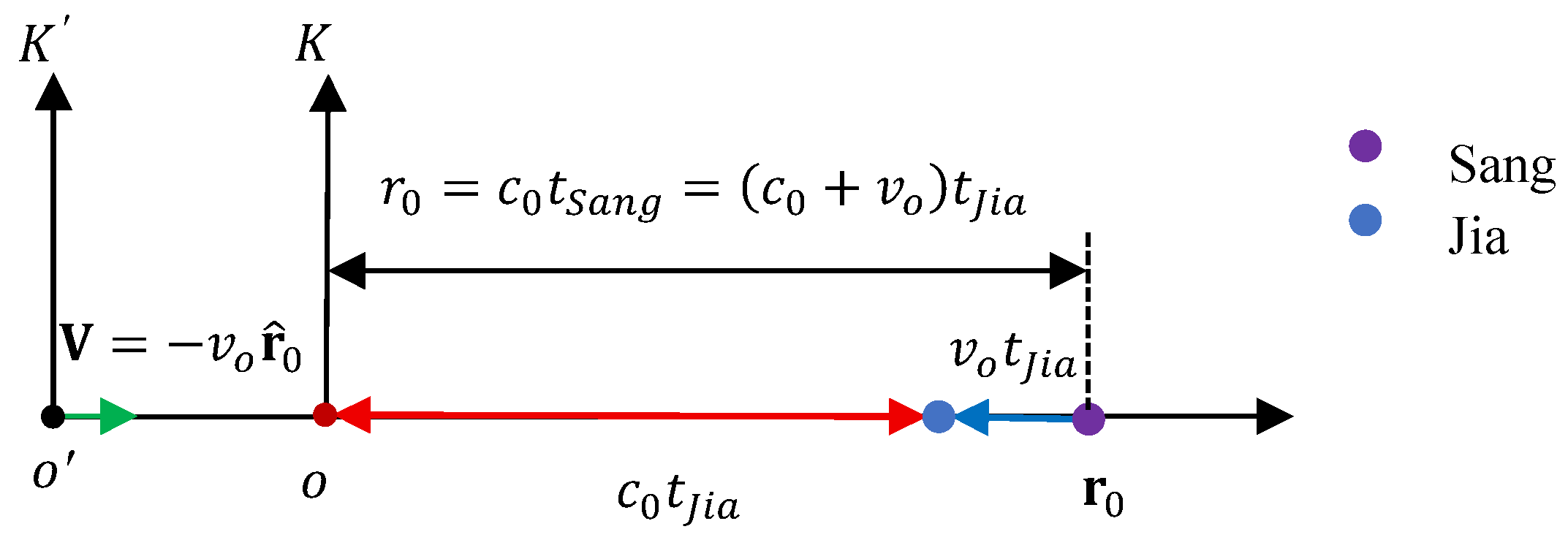
Consider the problem in the laboratory frame where a star is assumed to stay motionless with respect to the earth. The light pulse from that star generated at travels directly to the earth with speed . The observer Sang measures the star light at her room on the earth while Jia does her measurement on a plane flying in the direction to the star with velocity , as shown in Figure 3. The time for the star light to reach Sang’s detector is simply , while the time for the pulse to reach Jia’s detector is . When measured by Jia, the relative speed of the light pulse with respect to her is . Obviously, it is larger than the light speed in the vacuum. Although not compatible with the theory of special relativity (TSR), this result is the natural outcome by solving the Maxwell’s equations in the laboratory frame. Note that the phase velocity measured by the observers are both .
If we try to explain it with TSR, we may need to transform the space-time events in the laboratory frame to the inertial frame in which the observer Jia is at rest, as shown in Figure 3, where moves away from with velocity . We choose the three events at the laboratory frame to illustrate the explanation in TSR. The first event: the pulse is generated at and . The second event: the pulse reaches Jia at and . The third event: the pulse reaches Sang at and . The three events can be respectively transformed to with the Lorentz transformations [6,7]
where is the Lorentz factor. We can check that in the rest frame the pulse is generated at and . It reaches Jia at and . It reaches Sang at and . We can check that, when explained with TSR, the pulse travels with the propagation velocity to Sang and Jia even if Jia moves uniformly away from Sang. The phase velocity still remains to be . Note that we have used the standard Lorentz transformations for space-time and velocity in the derivation [8,9,10,11].
4. About the Formulae for Doppler Effect
Doppler effect in electromagnetic waves has been widely applied in radar systems for detecting flying objects or meteorological phenomena [12,13,14,15]. It is also a very powerful tool for astronomers to investigate the universe by measuring the Doppler shift in the stars [16,17,18].
However, when an object moves very fast, the relativistic effect has to be taken into account in the Doppler shift according to TSR. Conventionally, making use of the hypothesis of phase invariant of plane waves [19,20] among inertial frames, the relativistic formula for the Doppler shift is derived to be
Obviously, it is not same as the formula (10). The main differences between formula (10) and formula (13) are:
- (1)
- The Doppler shift due to the motion of the observer is included in (10) but not included in (13);
- (2)
- Even for motionless observer, the two formulae still differ by a Lorentz factor .
- (3)
- When the source and observer both move in directions perpendicular to the connecting line between them, namely, and , we can obtain from (10) that . However, the conventional relativistic formula (13) clearly shows that there is still a Doppler shift in this case due to the effect of the Lorentz factor. This is the transverse Doppler shift that is considered as a pure relativistic effect.
5. Conclusions
The electromagnetics of moving objects is still of great significance to revisit [1,10]. In particular, we have analyzed the electromagnetic properties of the fields of a moving source with the classical electromagnetic theory. We have two main findings through the analysis:
- (1)
- The electromagnetic pulse propagates away from its birthplace with velocity in all directions. The phase velocity of the electromagnetic wave is always when measured in the direction pointing exactly to the birthplace of the wave. The two velocities are independent of the observers, whether they are motionless or they are moving. However, the relative velocity between the electromagnetic pulse and the observer is not constant: the velocity of the electromagnetic pulse and the moving velocity of the observer should be added like vectors.
- (2)
- The derived expression for the Doppler shift is similar to the classical Newtonian type formula instead of the relativistic one. The motion of the observer also has significant impact on the Doppler shift.
We would like to remind that the Maxwell’s equations can either be solved by staying in the laboratory frame and making use of the Lienard-Wiechert potentials, or be solved with the frame-hopping technique based on Lorentz transformations. The numerical examples provided in [21,22] have demonstrated that the two methods are equivalent. Consequently, equation (10) is valid for arbitrarily moving sources as their far fields share the same form of phase term as (5).
Since (10) is strictly derived based on the Maxwell’s theory, we argue that its inconsistency with the conventional relativistic formula is just one of the many inconsistencies between the Maxwell’s theory and the TSR.
Funding
This research was funded by National Natural Science Foundation of China, grant number 62471286. The APC was funded by 62471286.
Conflicts of Interest
The authors declare no conflicts of interest.
References
- Xiao, G.B. Re-interpreting the properties of the fields of a uniformly moving hertzian dipole in the vacuum. Next Research 2025, 2(4), 100856. [Google Scholar] [CrossRef]
- Kong, J. A. Electromagnetic Wave Theory; EMW Publishing: Cambridge, MA, 2008. [Google Scholar]
- Rohrlich, F. Classical Charged Particles, 3rd ed; World Scientific Publishing: Singapore, 2007. [Google Scholar]
- Heras, J.A. Jefimenko’s formulas with magnetic monopoles and the Liénard–Wiechert fields of a dual-charged particle. Am. J. Phys. 1994, 62, 525–531. [Google Scholar] [CrossRef]
- Ellis, J.R. Electromagnetic fields of moving dipoles and multipoles. J. Math. Phys. 1966, 7, 1185–1197. [Google Scholar] [CrossRef]
- Van Bladel, J. Relativity and engineering, 1st ed; Springer: Berlin, Germany, 1984. [Google Scholar]
- Chaichian, M.; Merches, I.; Radu, D.; Tureanu, A. Electrodynamics. An Intensive Course; Springer-Verlag: Berlin Heidelberg, 2016. [Google Scholar]
- Einstein, A. On the electrodynamics of moving bodies, in The Principle of Relativity - A collection of original memoirs on the special and general theory of relativity; Dover Publications, Inc., 1923. [Google Scholar]
- Miller, A. I. Albert Einstein’s Special Theory of Relativity-Emergence (1905) and Early Interpretation (1905-1911); Springer: New York, 1997. [Google Scholar]
- Janssen, M.; Stachel, J. The optics and electrodynamics of moving bodies. Preprint 2004, 265. [Google Scholar]
- Lorentz, H. A. Electromagnetic phenomena in a system moving with any velocity smaller than that of light. Proceedings of the Netherlands Royal Academy of Arts and Sciences 1904, 6, 809–831. [Google Scholar]
- Fitzgerald, R. J. Effects of range-Doppler coupling on chirp radar tracking accuracy. IEEE Trans. Aerospace Electron. Systems 1974, 10(4), 528–532. [Google Scholar] [CrossRef]
- Barbary, M.; et al. Extended drones tracking from ISAR images with Doppler effect and orientation based robust sub-random matrices algorithm. IEEE Trans. Vehicular Techn 2022, 71(12), 12648–12666. [Google Scholar] [CrossRef]
- Ptak, P.; Hartikka, J.; Ritola, M.; Kauranne, T. Long-distance multistatic aircraft tracking with VHF frequency doppler effect. IEEE Trans. Aerospace Electron. Systems 2014, 50(3), 2242–2252. [Google Scholar] [CrossRef]
- Jameson, A.R.; Larsen, M.L.; Wolff, D.B. Improved estimates of the vertical structures of rain using single frequency Doppler radars. Atmosphere 2021, 12, 699. [Google Scholar] [CrossRef]
- Franklin, R. G.; Birx, D. L. A study of natural electromagnetic phenomena for space navigation. Proc. IRE 1960, 48(4), 532–541. [Google Scholar] [CrossRef]
- Riess, A.G. The expansion of the universe is faster than expected. Nat. Rev. Phys. 2020, 2, 10–12. [Google Scholar] [CrossRef]
- Renshaw, C. Explanation of the anomalous Doppler observations in Pioneer 10 and 11. IEEE Aerospace Conference. Proceedings (Cat. No.99TH8403), Snowmass, CO, USA; 1999; 2, pp. 59–63. [Google Scholar] [CrossRef]
- Landau, L. D.; Lifshitz, E. M. The Classical Theory of Fields, 4th ed.; Hamermesh, M., Translator; Elsevier Ltd, 1975. [Google Scholar]
- Jackson, J. D. Classical Electrodynamics, 3rd ed; Wiley: New York, 1998. [Google Scholar]
- Liu, G.; Xiao, G.B.; Hu, M.; Zhu, J. Electromagnetic Scattering of Uniformly Moving PEC Objects-Part I: Integral Equation Formulations. IEEE Trans. Antennas Propag. Early access. [CrossRef]
- Liu, G.; Xiao, G.B.; Hu, M.; Zhu, J. Electromagnetic Scattering of Uniformly Moving PEC Objects-Part Ⅱ: Marching-on in Time Algorithm. IEEE Trans. Antennas Propag. Early access. [CrossRef]
Figure 1.
Trajectory of a moving Hertzian dipole for .
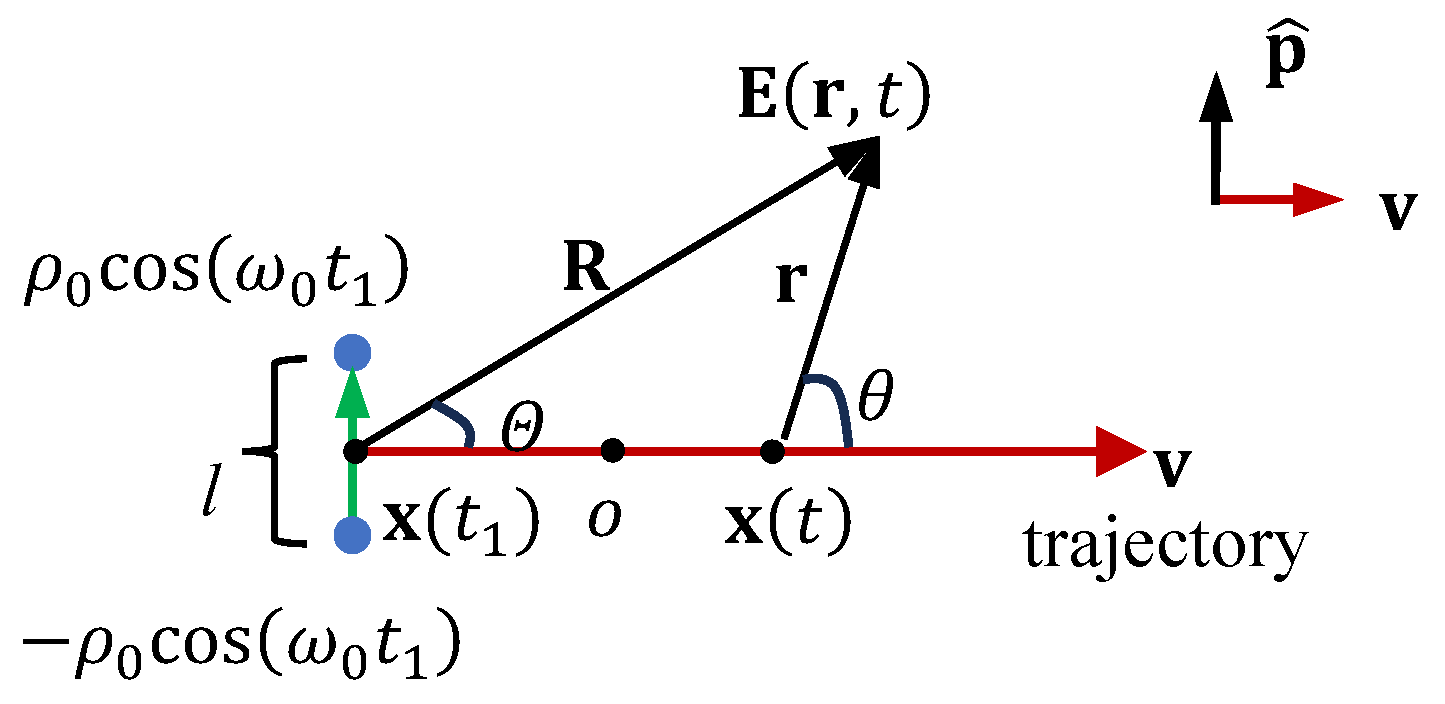
Figure 2.
The electromagnetic pulse generated by the dipole in the period .
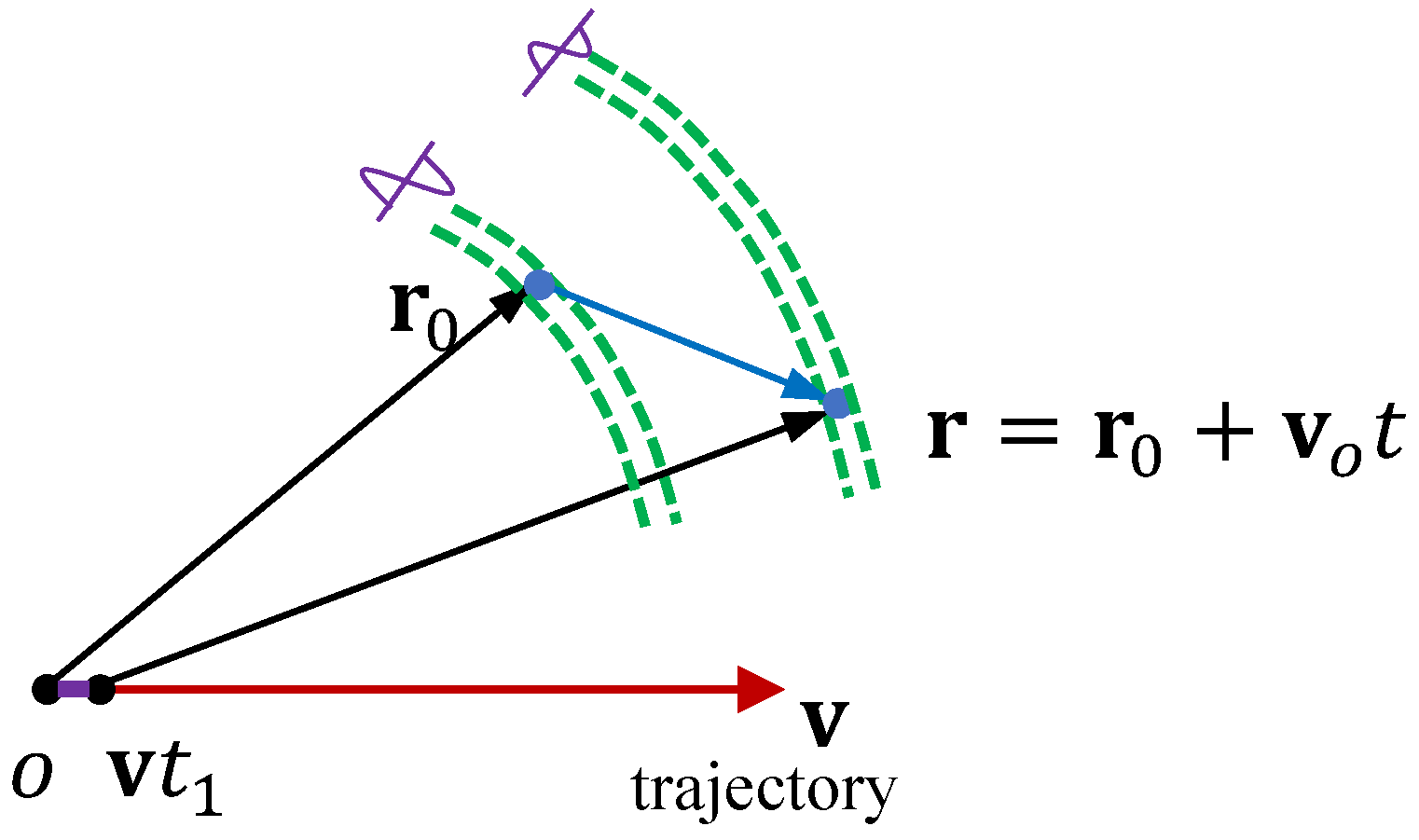
Figure 3.
The relative motion of electromagnetic pulse and the observers.
Disclaimer/Publisher’s Note: The statements, opinions and data contained in all publications are solely those of the individual author(s) and contributor(s) and not of MDPI and/or the editor(s). MDPI and/or the editor(s) disclaim responsibility for any injury to people or property resulting from any ideas, methods, instructions or products referred to in the content. |
© 2026 by the authors. Licensee MDPI, Basel, Switzerland. This article is an open access article distributed under the terms and conditions of the Creative Commons Attribution (CC BY) license (http://creativecommons.org/licenses/by/4.0/).
Copyright: This open access article is published under a Creative Commons CC BY 4.0 license, which permit the free download, distribution, and reuse, provided that the author and preprint are cited in any reuse.


