
Submitted:
21 April 2026
Posted:
27 April 2026
You are already at the latest version
Abstract
Medicinal plants have long served as a source of therapeutic agents in Libya and worldwide. This study investigated the in vitro antibacterial activity of twenty-two medicinal plant species against a panel of pathogenic bacteria previously isolated from food of animal origin in Libya. Plant materials were collected or purchased from different regions of Libya and extracted using three solvents of varying polarity: methanol, petroleum ether, and ethyl acetate. The extracts were screened for antibacterial activity against Escherichia coli (EC 56, EC 184), Staphylococcus aureus (SA 121), Klebsiella pneumoniae (KP 243), and Bacillus cereus (BC 4) using the agar well diffusion method. Extracts showing inhibition zones >11 mm were further evaluated for minimum inhibitory concentration (MIC) and minimum bactericidal concentration (MBC) using the broth microdilution method. Initial screening revealed that extracts from Thymus capitatus, Punica granatum, Syzygium aromaticum, Cinnamomum verum, Rosmarinus officinalis, and Myrtus communis exhibited notable antibacterial activity. The strongest effects were observed with petroleum ether and ethyl acetate extracts. Extracts of C. verum (R2, R3) and S. aromaticum (P2) showed the lowest MIC values, reaching 1.875 mg/mL against S. aureus (SA 121) and B. cereus (BC 4). MBC values were generally one- to two-fold higher than MIC values, indicating predominantly bactericidal effects. B. cereus (BC 4) was the most susceptible organism, whereas most extracts showed limited or no activity against E. coli strains. These findings confirm the strong antibacterial potential of several medicinal plants, particularly C. verum (cinnamon), S. aromaticum (clove), and T. capitatus (thyme). The results support their traditional use and highlight their potential as sources of natural antibacterial agents and food preservatives. Further studies are required to isolate and characterize the active compounds.
Keywords:
antibacterial activity
; foodborne bacteria
; extracts
; Libya
; medicinal plants
1. Introduction
The global health crisis of antimicrobial resistance (AMR) has created an urgent need for new and effective antimicrobial agents. The excessive and inappropriate use of antibiotics has accelerated the emergence of multidrug-resistant pathogens, including methicillin-resistant Staphylococcus aureus (MRSA) (Naas et al., 2019) and extended-spectrum β-lactamase (ESBL)-producing Escherichia coli (Sherif et al., 2025), which pose significant therapeutic challenges worldwide.
Medicinal plants have long been recognized as valuable sources of biologically active compounds for therapeutic applications. Natural products continue to play a crucial role in the development of modern drugs, particularly antibacterial and antitumor agents (Pinto and Ayala-Zavala, 2024). Plants synthesize a wide range of secondary metabolites, including terpenoids, flavonoids, alkaloids, and phenolic compounds, which exhibit diverse biological activities. These metabolites can inhibit bacterial growth through multiple mechanisms, such as disruption of cell membranes, inhibition of DNA gyrase, and interference with protein biosynthesis.
Libya possesses a rich and diverse flora with a long history of traditional medicinal use. Previous studies have reported antimicrobial activity in several Libyan medicinal plants, including Thymus capitatus and Rosmarinus officinalis (Tayeb et al., 2022; Al-Siddiq et al., 2023). However, despite this traditional knowledge, many plant species used in Libya have not been systematically evaluated for their antibacterial potential using different extraction solvents.
Therefore, the present study aimed to evaluate the antibacterial activity of 22 medicinal plant species belonging to families such as Lamiaceae, Myrtaceae, and Lauraceae using extracts prepared with solvents of varying polarity (methanol, petroleum ether, and ethyl acetate). The study further determined inhibition zones, minimum inhibitory concentrations (MIC), and minimum bactericidal concentrations (MBC) of active extracts against foodborne bacterial strains. These findings provide a scientific basis for the traditional use of these plants and highlight their potential as sources of natural antimicrobial agents for food preservation.
2. Results
2.1. Screening of Antibacterial Activity by Agar Well Diffusion
The antibacterial activity of 22 medicinal plant extracts prepared using solvents of different polarity was evaluated against five bacterial strains. The results demonstrated that 16 extracts derived from 8 plant species—Cistus salvifolius (B), Rosmarinus officinalis (G), Ziziphus vulgaris (H), Thymus capitatus (I), Punica granatum (L), Myrtus communis (M), Syzygium aromaticum (P), and Cinnamomum verum (R)—exhibited antibacterial activity against at least one of the tested isolates (Figure 1A,B). The remaining plant extracts showed no detectable activity (inhibition zone = 0 mm) (Data not shown). The negative control (DMSO) showed no inhibitory effect, whereas the positive control (ertapenem) exhibited variable antibacterial activity.
Notably, petroleum ether and ethyl acetate extracts generally demonstrated stronger antibacterial activity than methanol extracts, suggesting that the bioactive compounds are likely of low to medium polarity. For example, the petroleum ether (R2) and ethyl acetate (R3) extracts of C. verum produced large inhibition zones ranging from 17.5 to 26.5 mm against all tested bacterial strains (Figure 1A).
2.2. Comparative Activity of Extracts by Solvent Type
Figure 1A compares the antibacterial activity of extracts obtained using different solvents for the four most active plant species. The results clearly indicate that petroleum ether and ethyl acetate extracts consistently produced larger inhibition zones than methanol extracts, particularly in Cinnamomum verum and Syzygium aromaticum. This suggests that the principal bioactive compounds are more efficiently extracted using intermediate- to low-polarity solvents.
2.3. Minimum Inhibitory Concentration (MIC) and Minimum Bactericidal Concentration (MBC)
The minimum inhibitory concentration (MIC) and minimum bactericidal concentration (MBC) were determined for all extracts that exhibited antibacterial activity in the initial screening. The results are presented in Table 1 and Table 2, with graphical visualization of MIC values for the most active extracts against all tested bacterial strains.
The most potent antibacterial activity was observed in petroleum ether and ethyl acetate extracts. The lowest MIC value (1.875 mg/mL) was recorded for Cinnamomum verum (R2, R3) against Staphylococcus aureus (SA 121), Bacillus cereus (BC 4), and Escherichia coli (EC 184), as well as for Syzygium aromaticum (P2) against S. aureus (SA 121) and B. cereus (BC 4). Notably, the ethyl acetate extract of C. verum (R3) exhibited the most consistent and potent activity across all tested bacterial strains, with MIC values of 1.875 mg/mL for all five isolates. Thymus capitatus (I1, I2) and S. aromaticum (P1, P2) also showed strong antibacterial activity, with MIC values as low as 3.75 mg/mL.
Bacillus cereus (BC 4) was the most susceptible strain, with many extracts showing MIC values ranging from 1.875 to 12.5 mg/mL. The MBC values were generally equal to or two-fold higher than the corresponding MIC values, suggesting a predominantly bactericidal mode of action, consistent with previous reports on plant-derived antimicrobial agents.
3. Discussion
The present study systematically evaluated the antibacterial potential of 22 medicinal plant species collected from different regions of Libya. Several plants, particularly Cinnamomum verum (cinnamon), Syzygium aromaticum (clove), Thymus capitatus (thyme), and Punica granatum (pomegranate), exhibited significant in vitro activity against multiple foodborne bacterial pathogens.
The exceptionally low MIC values (1.875 mg/mL) observed for C. verum and S. aromaticum are notable and compare favorably with previous reports. Iftikhar et al. (2025) reported that methanolic and acetonic extracts of C. verum produced inhibition zones of 22.3 mm against Staphylococcus aureus, which is consistent with the inhibition zones observed in the present study for petroleum ether and ethyl acetate extracts (17.5–26.5 mm). The strong antibacterial activity of cinnamon is largely attributed to cinnamaldehyde, a bioactive compound with well-documented antimicrobial and anti-inflammatory properties.
For S. aromaticum (clove), MIC values of 1.875–3.75 mg/mL against S. aureus and Bacillus cereus are consistent with previous studies reporting MIC ranges of 1.25–5 µL/mL. The antimicrobial activity of clove is primarily attributed to eugenol, which constitutes the major component of its essential oil. Justice-Alucho and Braide (2026) demonstrated that solvent polarity significantly influences extraction efficiency and antimicrobial activity, with polar organic solvents yielding stronger inhibitory effects. The pronounced activity of petroleum ether extracts in the present study further highlights the importance of solvent selection in optimizing bioactive compound recovery.
Thymus capitatus also exhibited strong antibacterial activity, with MIC values ranging from 3.75 to 6.25 mg/mL against most tested strains. These findings are in agreement with previous studies on Libyan T. capitatus, where MIC values as low as 1.25 mg/mL have been reported (Tayeb et al., 2022). Similarly, Aouadhi et al. (2024) reported that T. capitatus essential oil produced inhibition zones of 20–45 mm against various Staphylococcus species and exerted bactericidal effects through disruption of bacterial cell walls and membranes. The antimicrobial activity of T. capitatus is mainly associated with its high content of thymol and carvacrol, which are well-known bioactive monoterpenes.
The results for Punica granatum extracts showed MIC values ranging from 12.5 to 100 mg/mL depending on solvent type and bacterial strain. Bagchi et al. (2025) similarly reported that extraction solvent significantly affects the antimicrobial efficacy of pomegranate peel extracts, with methanolic extracts showing comparatively stronger activity. The antibacterial properties of P. granatum are attributed to its high content of phenolic compounds, particularly tannins and ellagic acid, which can disrupt bacterial membranes and inhibit enzyme activity.
A clear trend observed in this study was the higher antibacterial activity of petroleum ether and ethyl acetate extracts compared to methanol extracts. This suggests that the major bioactive constituents in the investigated plants are predominantly of medium to low polarity, such as essential oils, terpenoids, and flavonoid aglycones. This finding is important for guiding future phytochemical investigations and the targeted isolation of antibacterial compounds.
Regarding bacterial susceptibility, Gram-positive Bacillus cereus was generally the most susceptible organism, whereas Gram-negative Escherichia coli showed the highest resistance. This difference is well documented and is primarily attributed to the outer membrane of Gram-negative bacteria, which limits the penetration of many antimicrobial compounds. Notably, the ability of certain extracts, particularly those of C. verum and S. aromaticum, to inhibit E. coli suggests the presence of compounds capable of overcoming this permeability barrier, indicating potential for broad-spectrum antimicrobial activity.
Overall, the findings of this study support the traditional medicinal use of these plants in Libya. The strong activity of T. capitatus against S. aureus and Klebsiella pneumoniae supports its ethnopharmacological use in treating skin and respiratory infections. Similarly, the activity of P. granatum against enteric bacteria is consistent with its traditional use in managing diarrhea and gastrointestinal disorders.
4. Materials and Methods
4.1. Plant Collection and Identification
Twenty-two traditionally used medicinal plant species were collected from different regions of northern, southern, and eastern Libya (Table 3). The plant materials were taxonomically identified at the Biotechnology Research Centre, Tripoli, Libya. Voucher specimens were prepared and deposited for reference.
4.2. Preparation of Plant Extracts
Plant materials were air-dried in the shade at room temperature until completely dry and then separately ground into a fine powder using a laboratory grinder. Crude extracts were prepared by macerating 100 g of powdered plant material in 500 mL of solvent (methanol, petroleum ether, or ethyl acetate) at room temperature for 3 days under continuous agitation using an orbital shaker (Feudjio et al., 2020).
The resulting mixtures were filtered, and the filtrates were concentrated under reduced pressure using a rotary evaporator (Heidolph, Germany). Extract codes (e.g., I1, I2, I3) were assigned according to plant identity and extraction solvent, where methanol, petroleum ether, and ethyl acetate extracts were designated as 1, 2, and 3, respectively.
4.3. Bacterial Strains
The bacterial strains used in this study were obtained from the Foodborne Libyan-Type Bacterial Collection (FLBC), maintained at the Department of Food Hygiene and Control, Faculty of Veterinary Medicine. The isolates were previously characterized as multidrug-resistant (MDR) strains and included Escherichia coli (EC 56 and EC 184; Garbaj et al., 2016), Staphylococcus aureus (SA 121; Naas et al., 2019), Klebsiella pneumoniae (KP 243; Azwai et al., 2024), and Bacillus cereus (BC 4; Naas et al., 2018).
Prior to use, all bacterial strains were re-cultured on nutrient agar and incubated at 37 °C for 24 h.
4.4. Determination of Antibacterial Activity (Agar Well Diffusion Method)
The antibacterial activity of the plant extracts was evaluated using the agar well diffusion method. Each extract was dissolved in dimethyl sulfoxide (DMSO) to obtain a concentration of 100 mg/mL. Bacterial suspensions were adjusted to the 0.5 McFarland standard (1–2 × 10⁸ CFU/mL) using a MicroScan turbidity meter (Beckman Coulter, USA).
The standardized inoculum was evenly spread over the surface of Mueller–Hinton agar (Liofilchem, Italy) plates using a sterile cotton swab. Wells (6 mm in diameter) were aseptically punched into the agar using a sterile cork borer, and 50 µL of each plant extract was added to the wells.
The plates were incubated at 37 °C for 24 h. Ertapenem (30 µg/disc) was used as a positive control, while DMSO served as a negative control. Antibacterial activity was assessed by measuring the diameter of the inhibition zones (mm). All tests were performed in duplicate, and extracts producing inhibition zones >11 mm were considered active (Asfa et al., 2025).
4.5. Minimum Inhibitory Concentration (MIC) and Minimum Bactericidal Concentration (MBC) Determination
The minimum inhibitory concentration (MIC) was determined for all extracts that exhibited an inhibition zone >11 mm in the initial screening. MIC values were assessed using the broth microdilution method in sterile 96-well round-bottom microplates.
A stock solution of each active extract was prepared at 200 mg/mL in dimethyl sulfoxide (DMSO). Two hundred microliters of each stock solution were added to the first row of the microplate, followed by 100 µL of Mueller–Hinton broth (Liofilchem, Italy) in the remaining wells. Serial two-fold dilutions were performed to obtain final concentrations ranging from 100 mg/mL to 1.875 mg/mL. Subsequently, 100 µL of standardized bacterial suspension (1 × 10⁸ CFU/mL) were added to each well. The plates were incubated at 37 °C for 24 h.
The MIC was defined as the lowest concentration of extract that completely inhibited visible bacterial growth, as indicated by the absence of turbidity.
For determination of the minimum bactericidal concentration (MBC), 10 µL from wells showing no visible growth were subcultured onto nutrient agar plates and incubated at 37 °C for 24 h. The MBC was defined as the lowest concentration at which no bacterial growth was observed on the agar plates.
5. Conclusions
This study provides scientific evidence supporting the traditional use of several medicinal plants from Libya and identifies Cinnamomum verum, Syzygium aromaticum, and Thymus capitatus as promising sources of potent antibacterial compounds with potential application as natural food preservatives against foodborne bacterial pathogens.
Petroleum ether and ethyl acetate extracts consistently exhibited higher antibacterial activity than methanol extracts, indicating that the major bioactive constituents are likely of medium to low polarity. The low MIC and MBC values observed, particularly against Bacillus cereus and Staphylococcus aureus, suggest a predominantly bactericidal effect that warrants further investigation.
Further studies are required to isolate and characterize the bioactive compounds responsible for the observed activity through bioassay-guided fractionation, to elucidate their mechanisms of action at the molecular level, and to evaluate their safety, toxicity, and in vivo efficacy.
Author Contributions
Conceptualization, K.M.N., A.K.A., A.A.H., A.A.E., S.M.A., A.M.G., and I.M.E.; methodology, K.M.N., A.K.A., A.A.H., A.A.E., S.M.A., A.M.G., S.A.F., F.T.G. and I.M.E.; validation, K.M.N., A.K.A., A.A.H., A.A.E., S.M.A., A.M.G., and I.M.E.; investigation, K.M.N., A.K.A., A.A.H., and A.A.E.; resources, K.M.N., A.K.A., A.A.H., and A.A.E.; data curation, K.M.N., A.K.A., S.M.A., A.M.G., and I.M.E.; writing—original draft preparation, K.M.N., A.K.A., S.M.A., and I.M.E.; writing—review and editing, K.M.N., A.K.A., A.A.H., A.A.E., S.M.A., A.M.G., S.A.F., F.T.G. and I.M.E.; supervision, K.M.N., and I.M.E.; project administration, K.M.N., A.K.A., A.; funding acquisition, K.M.N., A.K.A., A.A.H., A.A.E.. All authors have read and agreed to the published version of the manuscript.
Funding
This research received no external funding. Plants collection was performed by authors.
Data Availability Statement
All data generated or analyzed during this study are included in this manuscript.
Acknowledgments
The authors would like to thank the Libyan Center for Biotechnology Research and the Faculty of Veterinary Medicine, University of Tripoli for providing the facilities to carry out this research.
Conflicts of Interest
The authors declare no conflict of interest regarding the publication of this study.
Abbreviations
The following abbreviations are used in this manuscript:
| MIC | Minimum Inhibitory Concentration |
| MBC | Minimum Bactericidal Concentration |
| AMR | Antimicrobial Resistance |
| MRSA | Methicillin-Resistant Staphylococcus aureus |
| ESBL | Extended-Spectrum β-Lactamase |
| FLBC | Foodborne Libyan-Type Bacterial Collection |
References
- Al-Siddiq, M.S.; Omran, M.L.; Youssef, H.H. Efficacy of aqueous and alcoholic ginger extract on some types of pathogenic bacteria. Libyan J. Ecol. Environ. Sci. Technol. 2023, 5, 65–68. [Google Scholar]
- Al-Zereini, W.A.; Al-Trawneh, I.N.; Al-Qudah, M.A.; TumAllah, H.M.; Abudayeh, Z.H.; Hijazin, T. Antibacterial, antioxidant, and cytotoxic activities of Syzygium aromaticum (L.) Merr. & Perry essential oil with identification of its chemical constituents. Z. Naturforsch. C. 2023, 78, 105–112. [Google Scholar] [CrossRef] [PubMed]
- Aouadhi, C.; Jouini, A.; Maaroufi, K. Antibacterial effect of eight essential oils against bacteria implicated in bovine mastitis and characterization of primary action mode of Thymus capitatus essential oil. Antibiotics 2024, 13, 237. [Google Scholar] [CrossRef] [PubMed]
- Asfa, B.; Woldemichael, D.N.; Tesfaw, L.; Asefa, L.; Desta, S.; Girma, S.; Tolera, T.S.; Tufa, T.B. Evaluating antimicrobial activity of selected medicinal plant extracts against pasteurellosis-causing bacteria in small ruminants. Front. Vet. Sci. 2025, 12, 1–9. [Google Scholar] [CrossRef] [PubMed]
- Azwai, S.M.; Lawila, A.F.; Eshamah, H.L.; Sherif, J.A.; Farag, S.A.; Naas, H.T.; Garbaj, A.M.; El Salabi, A.A.; Gammoudi, F.T.; Eldaghayes, I.M. Antimicrobial susceptibility profile of Klebsiella pneumoniae isolated from some dairy products in Libya as a foodborne pathogen. Vet. World 2024, 17, 1168–1176. [Google Scholar] [CrossRef] [PubMed]
- Bagchi, S.; Tiwari, N.; Dutta, S. Study on the antibacterial and antioxidant activities of Punica granatum (pomegranate) peel extracts. J. Integr. Sci. Technol. 2025, 13, 1126. [Google Scholar] [CrossRef]
- Feudjio, C.; Yameen, M.A.; Njateng, G.S.S.; Khan, M.A.; Tamekou, S.L.; Mpetga, J.D.S.; Kuiate, J.R. The influence of solvent, host and phenological stage on the yield, chemical composition, and antidiabetic and antioxidant properties of Phragmanthera capitata (Spengel) S. Balle. Evid.-Based Complement. Altern. Med. 2020, 2020, 1–16. [Google Scholar] [CrossRef]
- Garbaj, A.M.; Awad, E.M.; Azwai, S.M.; Abolghait, S.K.; Naas, H.T.; Moawad, A.A.; Gammoudi, F.T.; Barbieri, I.; Eldaghayes, I.M. Enterohemorrhagic Escherichia coli O157 in milk and dairy products from Libya: Isolation and molecular identification by partial sequencing of 16S rDNA. Vet. World 2016, 9, 1184–1189. [Google Scholar] [CrossRef] [PubMed]
- Iftikhar, A.; Saleem, M.; Riaz, A. Determination of antibacterial and antioxidant potential of organic crude extracts from Malus domestica, Cinnamomum verum and Trachyspermum ammi. Sci. Rep. 2025, 15, 976. [Google Scholar] [CrossRef] [PubMed]
- Justice-Alucho, C.H.; Braide, W. Antimicrobial activity of Syzygium aromaticum (clove) against Staphylococcus aureus and Listeria monocytogenes is enhanced by optimized extraction methods. bioRxiv 2026. [Google Scholar] [CrossRef]
- Maniki, E.; Kostoglou, D.; Paterakis, N.; Nikolaou, A.; Kourkoutas, Y.; Papachristoforou, A.; Giaouris, E. Chemical composition, antioxidant, and antibiofilm properties of essential oil from Thymus capitatus plants organically cultured on the Greek island of Lemnos. Molecules 2023, 28, 1154. [Google Scholar] [CrossRef] [PubMed]
- Muhaisen, H.M.H.; Ab-Mous, M.M.; Ddeeb, F.A.; Rtemi, A.A.; Taba, O.M.; Parveen, M. Antimicrobial agents from selected medicinal plants in Libya. Chin. J. Integr. Med. 2016, 22, 177–184. [Google Scholar] [CrossRef] [PubMed]
- Naas, H.T.; Edarhoby, R.A.; Garbaj, A.M.; Azwai, S.M.; Abolghait, S.K.; Gammoudi, F.T.; Moawad, A.A.; Barbieri, I.; Eldaghayes, I.M. Occurrence, characterization, and antibiogram of Staphylococcus aureus in meat, meat products and some seafood from Libyan retail markets. Vet. World 2019, 12, 925–931. [Google Scholar] [CrossRef] [PubMed]
- Naas, H.T.; Zurghani, M.M.; Garbaj, A.M.; Azwai, S.M.; Eshamah, H.L.; Gammoudi, F.T.; Abolghait, S.K.; Moawad, A.A.; Barbieri, I.; Eldaghayes, I.M. Bacillus cereus as an emerging public health concern in Libya: Isolation and antibiogram from food of animal origin. Libyan J. Med. Sci. 2018, 2, 61–65. [Google Scholar]
- Pinto, L.; Ayala-Zavala, J.F. Application of plant antimicrobials in the food sector: Where do we stand? Foods 2024, 13, 1–6. [Google Scholar] [CrossRef] [PubMed]
- Saeed, M.; Naveed, M.; Bibi, J.; Kamboh, A.A.; Arain, M.A.; Shah, Q.A.; Alagawany, M.; El-Hack, M.E.A.; Abdel-Latif, M.A.; Yatoo, M.I.; Tiwari, R.; Chakraborty, S.; Dhama, K. The promising pharmacological effects and therapeutic applications of Punica granatum L. (pomegranate). Recent Pat. Food Nutr. Agric. 2023, 12, 1–12. [Google Scholar] [CrossRef]
- Sherif, J.A.; Farag, S.A.A.; Abureema, S.F.; Azwai, S.M.; Garbaj, A.M.; Gammoudi, F.T.; El Salabi, A.A.; Eldaghayes, I.M. Emergence of extended-spectrum beta-lactamase producer and colistin-resistant E. coli in animal-origin foods in Libya. World Vet. J. 2025, 15, 597–611. [Google Scholar] [CrossRef]
- Tayeb, Y.A.; Al Sharif, H.A.; Mansour, S.; Ashour, A.S.; Tayeb, A.Y. Effect of aqueous and alcoholic extract of Capparis spinosa L. leaves on pathogenic bacteria and comparison with antibiotics. Glob. Libyan J. 2022, 57, 1–15. [Google Scholar]
Figure 1.
Inhibition zones of different plant extracts against tested bacterial isolates. (A) Plant extracts exhibiting stronger antibacterial activity. (B) Plant extracts exhibiting weaker antibacterial activity.
Figure 1.
Inhibition zones of different plant extracts against tested bacterial isolates. (A) Plant extracts exhibiting stronger antibacterial activity. (B) Plant extracts exhibiting weaker antibacterial activity.
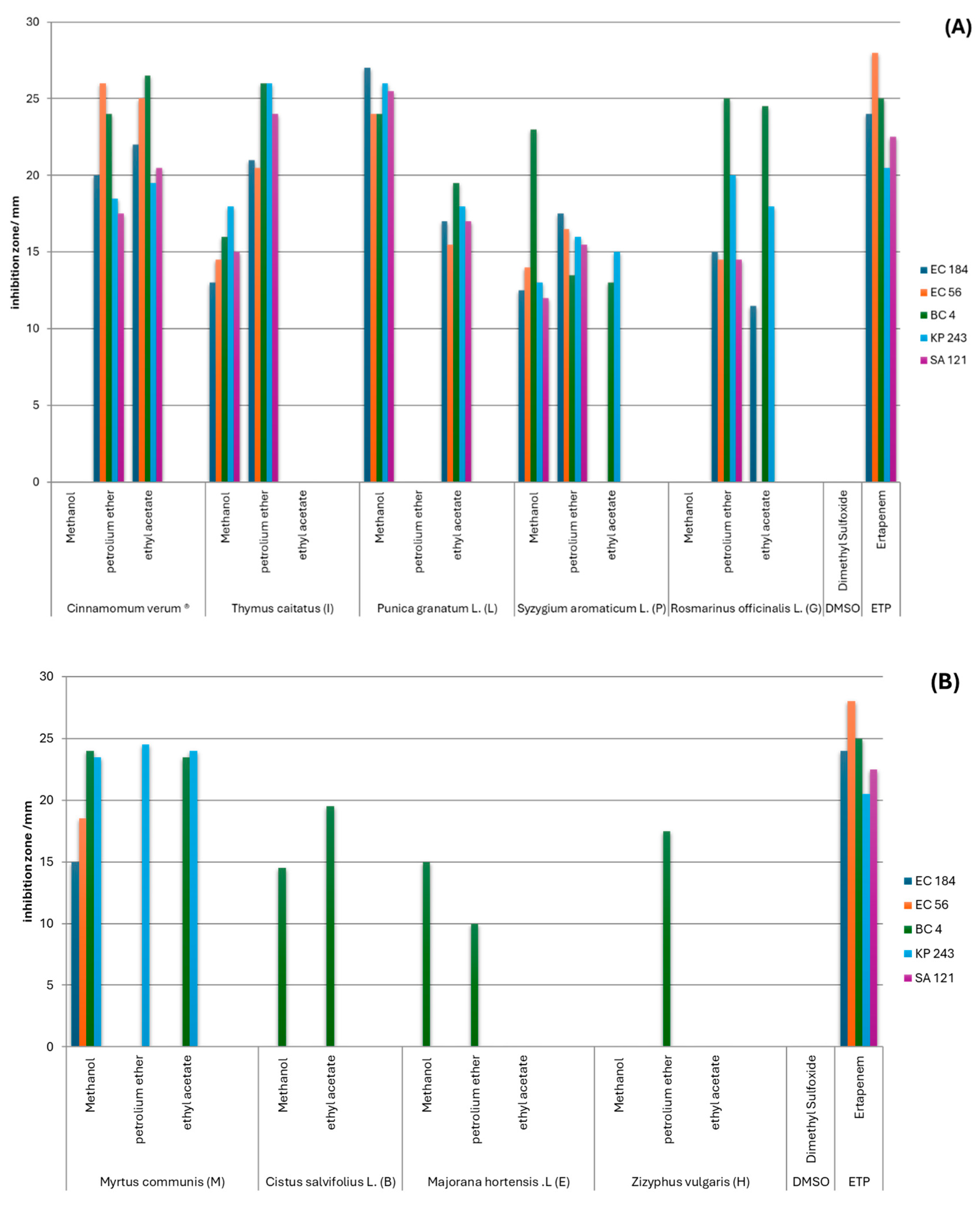

Table 1.
Minimum inhibitory concentrations (MIC) (mg/ml) of plant extracts with greatest activity.
| Plant name | Solvent | MIC (mg/ml) | ||||
|---|---|---|---|---|---|---|
| EC184 | EC56 | BC4 | KP243 | SA121 | ||
| Rosmariums officinalis L. (G) | P | - | - | - | - | - |
| E | 50 | ND | 50 | - | ND | |
| Cistus salvifolius L. (B) | M | ND | ND | 12.5 | ND | ND |
| E | ND | ND | 6.25 | ND | ND | |
| Majorana hortensis L. (E) | M | ND | ND | 25 | ND | ND |
| P | ND | ND | 25 | ND | ND | |
| Zizyphus vulgaris (H) | P | ND | ND | 50 | ND | ND |
| Thymus capitatus (I) | M | 3.125 | 1.5625 | 1.5625 | 1.5625 | 3.125 |
| P | 6.25 | 1.5625 | 1.5625 | 3.125 | 6.25 | |
| Punica granatum L. (L) | M | 6.25 | 6.25 | 6.25 | 6.25 | 6.25 |
| E | 50 | 50 | 25 | 50 | 25 | |
| Myrtus communis (M) | M | 25 | 25 | 12.5 | 12.5 | ND |
| P | ND | ND | ND | 12.5 | ND | |
| E | ND | ND | 6.25 | 12.5 | ND | |
| Syzygium aromaticum L. (P) | M | 1.5625 | 1.5625 | 0.78125 | 3.125 | 3.125 |
| P | 1.5625 | 1.5625 | 0.78125 | 3.125 | 0.78125 | |
| E | ND | ND | 3.125 | 3.125 | ND | |
| Cinnamomum verum (R) | P | 0.78125 | 1.5625 | 0.78125 | 0.78125 | 0.78125 |
| E | 0.78125 | 0.78125 | 0.78125 | 0.78125 | 0.78125 | |
M: methanol; P: petroleum; E: ethyl acetate; -: no activity; ND: not done.
Table 2.
Minimum Bactericidal concentrations (mg/ml) of plant extracts with greatest activity.
| Plant name | Solvent | MBC (mg/ml) | ||||
|---|---|---|---|---|---|---|
| EC184 | EC56 | BC4 | KP243 | SA121 | ||
| Rosmariums officinalis L. (G) | P | - | - | - | - | - |
| E | 100 | ND | 100 | - | ND | |
| Cistus salvifolius L. (B) | M | ND | ND | 25 | ND | ND |
| E | ND | ND | 12.5 | ND | ND | |
| Majorana hortensis L. (E) | M | ND | ND | 50 | ND | ND |
| P | ND | ND | 50 | ND | ND | |
| Zizyphus vulgaris (H) | P | ND | ND | 100 | ND | ND |
| Thymus capitatus (I) | M | 6.25 | 3.125 | 3.125 | 3.125 | 6.25 |
| P | 12.5 | 3.125 | 3.125 | 6.25 | 12.5 | |
| Punica granatum L. (L) | M | 12.5 | 12.5 | 12.5 | 12.5 | 12.5 |
| E | 100 | 100 | 50 | 100 | 50 | |
| Myrtus communis (M) | M | 50 | 50 | 25 | 25 | ND |
| P | ND | ND | ND | 25 | ND | |
| E | ND | ND | 12.5 | 25 | ND | |
| Syzygium aromaticum L. (P) | M | 3.125 | 3.125 | 1.5625 | 6.25 | 6.25 |
| P | 3.125 | 3.125 | 1.5625 | 6.25 | 1.5625 | |
| E | ND | ND | 6.25 | 6.25 | ND | |
| Cinnamomum verum (R) | P | 1.5625 | 3.125 | 1.5625 | 1.5625 | 1.5625 |
| E | 1.5625 | 1.5625 | 1.5625 | 1.5625 | 1.5625 | |
M: methanol; P: petroleum; E: ethyl acetate; -: no activity; ND: not done.
Table 3.
Selected medicinal plants screened.
| Code | Family | Plant Name | Common English Name |
|---|---|---|---|
| B | Cistaceae | Cistus salvifolius L. | Sage-leaved rockrose |
| E | Labiatae | Majorana hortensis L. | Sweet marjoram |
| F | Cupressineae | Juniperus communis | Common juniper |
| G | Lamiaceae | Rosmarinus officinalis L. | Rosemary |
| H | Rhamneae | Zizyphus vulgaris | Christ's thorn jujube |
| I | Lamiaceae | Thymus capitatus | Cone head thyme |
| J | Ranunculaceae | Nigella sativa L. | Black seed |
| K | Urticaceae | Urtica sp. | Italian Nettle |
| L | Punicaceae | Punica granatum L. | Pomegranate |
| M | Myrtaceae | Myrtus communis | Common myrtle |
| N | Apiaceae | Pituranthos tortuosus | Desert thyme |
| O | Zingiberaceae | Curcurma sp | Turmeric |
| P | Myrtaceae | Syzygium aromaticum L. | Clove |
| Q | Zingiberaceae | Zingiber officinale | Ginger |
| R | Lauraceae | Cinnamomum verum | Ceylon cinnamon |
| S | Malvaceae | Malva parviflora | Cheeseweed mallow |
| T | Urticaceae | Urtica dioica | Stinging nettle |
| U | Rutaceae | Citrus aurantium | Bitter orange |
| V | Caesalpinioideae | Ceratonia siliqua | Carob |
| X | Fabaceae | Retama raetam | White broom |
| Y | Asteraceae | Phagnalon rupestre L. | Rock phagnalon |
| Z | Rutaceae | Haplophyllum tuberculatum | Rue-leaved haplophyllum |
Disclaimer/Publisher’s Note: The statements, opinions and data contained in all publications are solely those of the individual author(s) and contributor(s) and not of MDPI and/or the editor(s). MDPI and/or the editor(s) disclaim responsibility for any injury to people or property resulting from any ideas, methods, instructions or products referred to in the content. |
© 2026 by the authors. Licensee MDPI, Basel, Switzerland. This article is an open access article distributed under the terms and conditions of the Creative Commons Attribution (CC BY) license (http://creativecommons.org/licenses/by/4.0/).
Copyright: This open access article is published under a Creative Commons CC BY 4.0 license, which permit the free download, distribution, and reuse, provided that the author and preprint are cited in any reuse.


