

Submitted:
21 April 2026
Posted:
22 April 2026
You are already at the latest version
Abstract
Emodin is a naturally occurring anthraquinone and has been of great interest as a multi-target anticancer agent with potential anti-metastatic effects. There is a growing body of evidence that emodin inhibits the progression of cancer by regulating essential events of epithelial–mesenchymal transition (EMT) and extracellular matrix remodeling. It suppresses matrix metalloproteinases and other associated proteolytic enzymes, thus hindering tumor invasion and metastatic spread. Emodin also suppresses key EMT-related transcription factors, such as Snail, Slug and Twist resulting in lower expression of mesenchymal markers, recovery of epithelial phenotype and lack of cellular motility. These effects are mechanistically mediated by disrupting central oncogenic pathways including transforming growth factor-β (TGF-β)/Smad, Akt/mTOR, MAPK and other signaling pathways that promote EMT plasticity. Recent research also indicates that emodin has a role in regulating cytoskeletal organization, ROS signal, and interactions with the tumor microenvironment that promote metastatic behavior. Although there is strong preclinical evidence, there are still a number of translational gaps. This limits its possible therapeutic use due to low bioavailability, low stability, and inconsistent tumor responsiveness. Possible resistance mechanisms, such as the compensatory activation of other pathways such as Wnt/ β-catenin and survival signaling cascades, are not sufficiently characterized. There is also lack of clinical validation with few controlled trials assessing safety and anti-metastatic efficacy across different types of cancer. The future directions are to focus on optimization of formulation and delivery, improvement of the pharmacokinetics, patient stratification, biomarker-based guided, and rigorous comparisons of combination regimens with chemotherapy, radiotherapy, and targeted agents. These approaches can be used to achieve the full potential of emodin as a therapeutic candidate, which is a metastasis-modulating agent.
Keywords:
emodin
; metastasis
; epithelial-mesenchymal transition
; MMP-2
; MMP-9
; TGF-β
1. Introduction
Metastasis is the main characteristic of malignant tumors and is responsible for about 90% of cancer deaths [1]. The EMT is a vital biological phenomenon in which epithelial tumor cells gain fibroblast-like and mesenchymal cell properties, leading to increased migration, invasiveness, and resistance to apoptosis [2]. Plasticity in the EMT phenotype facilitates tumor cells to separate from the primary tumor mass, invade the adjacent tissue, intravasate into the circulation, and seed at distant organ sites. EMT is managed through intricate regulatory networks, where important transcription factors like Snail, Slug, Twist, and ZEB1/ZEB2 play a major role by repressing epithelial markers (E-cadherin) and at the same time promoting mesenchymal ones (N-cadherin, vimentin) [3]. Furthermore, the signaling of the TGF-β and matrix metalloproteinases (MMPs) are also very important in the process of breaking down the extracellular matrix and invading tumor cells.
In general, EMT can be divided into three main categories: Types I, II, and III. Type I is described as the process by which cells move from one area of the embryo to another during early development to form organs and other tissues. Type II is related to wound healing with fibroblasts repairing and rebuilding damaged tissues. Type III is a pathological process in which epithelial cells undergo changes similar to those in development (Type I) and wound healing (Type II), but instead, this transition leads to the formation and spread of cancerous cells through the same signaling pathways [3].
The highly aggressive behavior of metastatic tumors underscores the critical need for successful therapeutic interventions interfering with the pathways of EMT. Currently, conventional therapies are incapable to halt metastasis, which has led to the search for new anti-metastatic agents. Due to their lower incidence of unwanted effects compared with conventional therapies and the possibility of affecting multiple signaling pathways, the use of natural products has become a popular alternative to synthetic or chemically developed medicines. Emodin, a novel bioactive anthraquinone obtained from different medicinal herbs like Rheum palmatum, Polygonum cuspidatum, and Cassia obtusifolia, among others, has captured attention as a potential medicinal agent for treating cancer [4]. Several investigations have revealed the various ways in which emodin impacts biological processes, contributing to its anticancer and anti-metastatic effects, including the downregulation of EMT transcription factors, suppression of MMP activity, and inhibition of TGF-β pathways, which are implicated in the metastatic process.
Moreover, the heterogeneity of tumors is another important obstacle to treating cancer as different subpopulations develop various resistance mechanisms [5]. Emodin is promising in overcoming this by acting on the ATP-binding cassettes transporters like P-glycoprotein, which inhibits intracellular excretion of chemotherapeutics like cisplatin and paclitaxel. It also enhances the sensitivity of drugs by regulating the apoptosis-related pathways, such as Rap1 and PI3K/Akt [6]. Although these are the advantages, poor pharmacokinetics, rapid glucuronidation and low bioavailability limit the clinical translation of emodin. Emerging methods, including co-administration with adjuvants like piperine and the development of nanoparticle-based delivery systems (e.g., PLGA and Fe3O4-PEG), have shown improved solubility, tumor targeting, and cellular uptake [7,8]. Nonetheless, a significant translational gap remains due to limited human data, underscoring the need for further preclinical and clinical validation.
In view of these observations, this review thoroughly assesses the present knowledge of emodin’s molecular mechanisms in the suppression of EMT and metastasis, analyzes its potential as a therapy in various cancers, and considers future possibilities of clinical translation. By synthesizing evidence from various preclinical and clinical studies, we intend to highlight the contribution of emodin as an anti-metastatic therapeutic agent with great promise.
2. Research Objectives and Scope
This review aims to: (i) collate evidence on the anti-metastatic mechanisms of emodin, with a special focus on EMT regulation; (ii) assess the quality of evidence currently available in preclinical in vitro and in vivo experiments; (iii) identify gaps in research and the limitations in clinical translations; and (iv) recommend further research to facilitate the research and development of emodin as an anti-metastatic treatment.
2.1. Literature Search Strategy
This narrative review is based on peer-reviewed journals published between 2015-2025 and includes studies on the effect of emodin on cancer metastasis or EMT. A systematic search was accomplished in the following three databases: PubMed, Web of Science and Scopus. Searching terms used included “emodin” combined with either “epithelial-mesenchymal transition” or “EMT” (i.e., primary terms), along with secondary terms which were “metastasis”, “invasion” or “migration”. Additional analytical terms used were “matrix metalloproteinase (MMP)”, “TGF-β”, “Snail”, “Slug” and “Twist”. The studies were selected based on relevance to emodin’s anti-metastatic mechanisms, especially molecular pathway elucidation and therapeutic potential. Through this analysis, we aim to provide an integrated perspective on emodin’s potential as an anti-metastatic agent and highlights its relevance for the development of novel cancer treatment strategies.
2.2. Inclusion Criteria
Articles with original research, as well as review type of articles that were published in English and examined both the impact of emodin on EMT, cancer metastasis, or related molecular pathways, were considered. The criteria for inclusion encompassed both in vitro and in vivo experiments, along with clinical trials and case reports related to emodin.
2.3. Exclusion Criteria
The conference abstracts without full-text access, studies concentrating solely on other anthraquinone derivatives, papers lacking substantial mechanistic elucidation, and duplicate publications were among the categories from which, the studies were excluded.
3. Overview of Emodin’s Anti-Metastatic Properties
The literature search identified several relevant studies, where the analyses revealed three primary mechanisms by which emodin inhibits cancer metastasis:(i) inhibition of EMT transcription factors, (ii) suppression of MMP activity, and (iii) disruption of TGF-β signaling pathways.
3.1. Mechanisms of Metastasis and EMT in Cancer
The EMT is a physiological process which is essential for embryogenesis, wound healing, and tissue repair. Epithelial cells adopt a mesenchymal-like cell phenotype via the EMT which liberates them to migrate and invade the tissues. In contrast, during cancer progression, EMT is inappropriately triggered, allowing neoplastic epithelial cells to acquire mesenchymal cell-like characteristics which, again, makes them more capable of migrating, invading, and moving to other places forming new tumors. Hence, it is a vital act in the process of metastasis The transcription factors Snail, Slug, Twist, and the zinc finger E-box binding homeobox proteins (ZEB1/2) are the main controllers and drivers of the EMT in cancer. These regulators downregulate the expression of epithelial markers while simultaneously upregulating the expression of mesenchymal markers. The epithelial marker E-cadherin is involved in cell adhesion, while N-cadherin and vimentin are the indicators of mesenchymal character. Tumor cells are transformed into a mesenchymal type, allowing them to detach from the primary tumor and subsequently metastasize [10]. Tumor cells start acquiring mesenchymal characteristics, i.e., EMT, when they receive signals from the tumor or the surrounding microenvironment. These signals can be inflammation, low oxygen, or growth factors. TGF-β is the main trigger for EMT (Figure 1), making tumor cells more adaptable, better at avoiding the immune system, and more resistant to treatment [11].
One more essential element of metastasis is the loosening of the extracellular matrix (ECM) which is the component providing support to the tissues. The ECM is degraded by the increased activity of MMPs, especially MMP-2 and MMP-9, thus allowing the tumor cells to spread. The transcription factors related to EMT and the MMP-induced ECM degradation assist in tumor invasion and metastasis to the distant organs [12]. As a result, therapeutic strategies targeting EMT and invasion-related pathways including natural compounds such as emodin have gained increasing attention [13].
Key Molecular Players:
- E-cadherin to N-cadherin Switch: During EMT, E-cadherin levels decrease while N-cadherin levels increase. This change facilitates cell detachment and migration.
- Cytoskeletal Reorganization: EMT causes major changes in the cytoskeleton. Cells lose epithelial cytokeratin networks and gain mesenchymal vimentin filaments.
- Extracellular Matrix Remodeling: MMPs, especially MMP-2 and MMP-9, degrade basement membrane components, creating pathways for tumor cell invasion.
The dynamic plasticity of cancer cells, enabling transitions between epithelial and mesenchymal states, allows them to bypass EMT inhibition by activating compensatory signaling pathways that sustain invasiveness [14]. However, due to the redundancy and complexity of EMT regulation, cancer cells may activate alternative pathways (e.g., Wnt/β-catenin, Notch, and PI3K/Akt), to preserve their metastatic potential. Although emodin can inhibit downstream targets of Wnt/β-catenin signaling, such as Cyclin D1 and c-MYC, persistent activation of these pathways may contribute to therapeutic resistance [15]. Therefore, effectively targeting EMT-driven metastasis requires a multi-targeted approach, where emodin is combined with inhibitors of parallel signaling pathways to ensure comprehensive suppression of tumor progression.
3.2. Emodin-Directed downregulation of MMP-2 and MMP-9
Among the MMPs, MMP-2 (gelatinase A) and MMP-9 (gelatinase B) serve as the main tumor invasion and metastasis drivers due to their ability to degrade the ECM. Various signaling pathways, including NF-κB, MAPK, and TGF-β, have been identified as regulators of the expression of these proteases [16,17]. Emodin prevents MMP-2 and MMP-9 activity by blocking their transcriptional regulators instead of directly affecting the enzymes. Specifically, emodin prevents NF-κB from activating MMP gene expression by stabilizing its cytoplasmic inhibitor, IκBα, thereby preventing NF-κB from translocating to the nucleus, which leads to a decrease in MMP production [18,19]. In addition, emodin can inhibit both ERK1/2 and p38 activation to block MAPK pathways which leads to decreased MMP transcription and reduced invasive potential [20]. Emodin also inhibits the phosphorylation of Smad2/3, thus inhibiting TGF-β signaling. This pathway has previously been established to be one of the major pathways driving EMT. By inhibiting Smad2/3 phosphorylation, emodin suppresses TGF-β–driven transcriptional programs, including MMP expression (Figure 2) [21,22,23]. These mechanisms may represent an overall decrease in ECM degradation and inhibition of metastasis signalling.
Although emodin demonstrates strong capacity to block both MMP-2 and MMP-9 in several different cancer models, the effectiveness of emodin’s role may significantly rely on a number of factors including the type of tumor, the structure and characteristics of the microenvironment around the malignant cell(s), and other potential inhibitors that may act as caveats. For example, the phenomenon of “invasion redundancy” remains a significant challenge, as aggressive cancer cells may utilize alternative mechanisms such as urokinase plasminogen activator (uPA) or cathepsins or MMP-independent ECM degradation to sustain invasiveness [24], and thus adversely affecting emodin’s overall inhibition potential on MMP activity. To overcome this limitation, emodin also modulates multiple upstream signaling pathways, including p38, Akt, ERK1/2, and DNMT, contributing to a wider suppression of the metastatic cascade [25]. Preclinical studies further support its efficacy in reducing tumor invasion in cancers such as breast and pancreatic models [25,26]. Nevertheless, to enhance its clinical potential, emodin’s multi-targeted action should be complemented with agents that inhibit parallel proteolytic pathways, ensuring more comprehensive control of tumor progression.
3.3. Cancer Type-Specific Effects
Emodin has shown anti-metastatic effects in several cancer models. In breast cancer cell lines like MDA-MB-231 and MCF-7, treatment with emodin (25-100 µM) reduced MMP-2 activity by 60-80% and MMP-9 expression by 70-85%. This was linked to less cell invasion in the Matrigel assay [27]. In hepatocellular carcinoma cells (HepG2 and MHCC-97H), emodin also lowered MMP-2 and MMP-9 levels in a dose-dependent way and reduced cancer cell migration and invasion at 50 µg/mL concentration [28]. In vivo studies with xeno-transplantation models showed a clear drop in the metastatic potential of these cancer cells. Likewise, in NSCLC, A549, and NCI-H-460 lung cancer cell lines, emodin at concentrations of 25, 50, and 75 μM decreases cell proliferation in a dose- and time-dependent manner. It also induces concentration-dependent apoptosis [29].
Though, these findings may underscore the context-dependent but broadly conserved anti-metastatic activity of emodin, they also highlight the importance of identifying tumor subtypes that most likely respond to emodin. Responsiveness is closely linked to specific pathway dependencies, particularly tumors with elevated TGF-β activity or strong EMT gene signatures [30]. The subtypes like non-small cell lung cancer and triple-negative breast cancer are more vulnerable since they are highly dependent on Smad/TGF-B signaling that is targeted by emodin [31]. Furthermore, biomarkers such as elevated baseline levels of MMP-2/9 and elevated levels of EMT markers like vimentin and Snail can also be used to predict sensitivity to therapy [32]. Cancer cells that employ tyrosine kinase or aryl hydrocarbon receptor pathways have also demonstrated enhanced apoptotic responses to emodin [33,34]. Thus, molecular stratification using these signatures will be essential in selecting the patients with the highest likelihood of responding to emodin as an adjuvant anti-metastatic agent.
4. Emodin-mediated suppression of EMT by blocking Snail, Slug, and Twist
Apart from ECM remodeling, emodin also blocks metastasis by inhibiting the transcriptional regulators of EMT. Snail, Slug, and Twist are transcription factors that suppress epithelial identity and promote mesenchymal differentiation of tumor cells. This increases their motility and spread [35]. Several reports suggest that emodin inhibits EMT by suppressing the activation of these factors and their associated pathways [36]. Emodin reduces Snail and Slug protein levels, blocks their nuclear entry, and promotes their proteasomal degradation (Figure 3). As a result, E-cadherin expression and epithelial tissue integrity are restored [37,38]. This effect involves activation of glycogen synthase kinase-3β (GSK-3β), which phosphorylates β-catenin and leads to its ubiquitin-mediated proteasomal degradation. Supporting this mechanism, Hu et al. showed that emodin exerts anti-invasion effects on A2780 and SK-OV-3 epithelial ovarian cancer cell lines. Specifically, it reduced GSK-3β phosphorylation at Ser9 and decreased total β-catenin levels. These changes downregulated EMT in vitro [39].
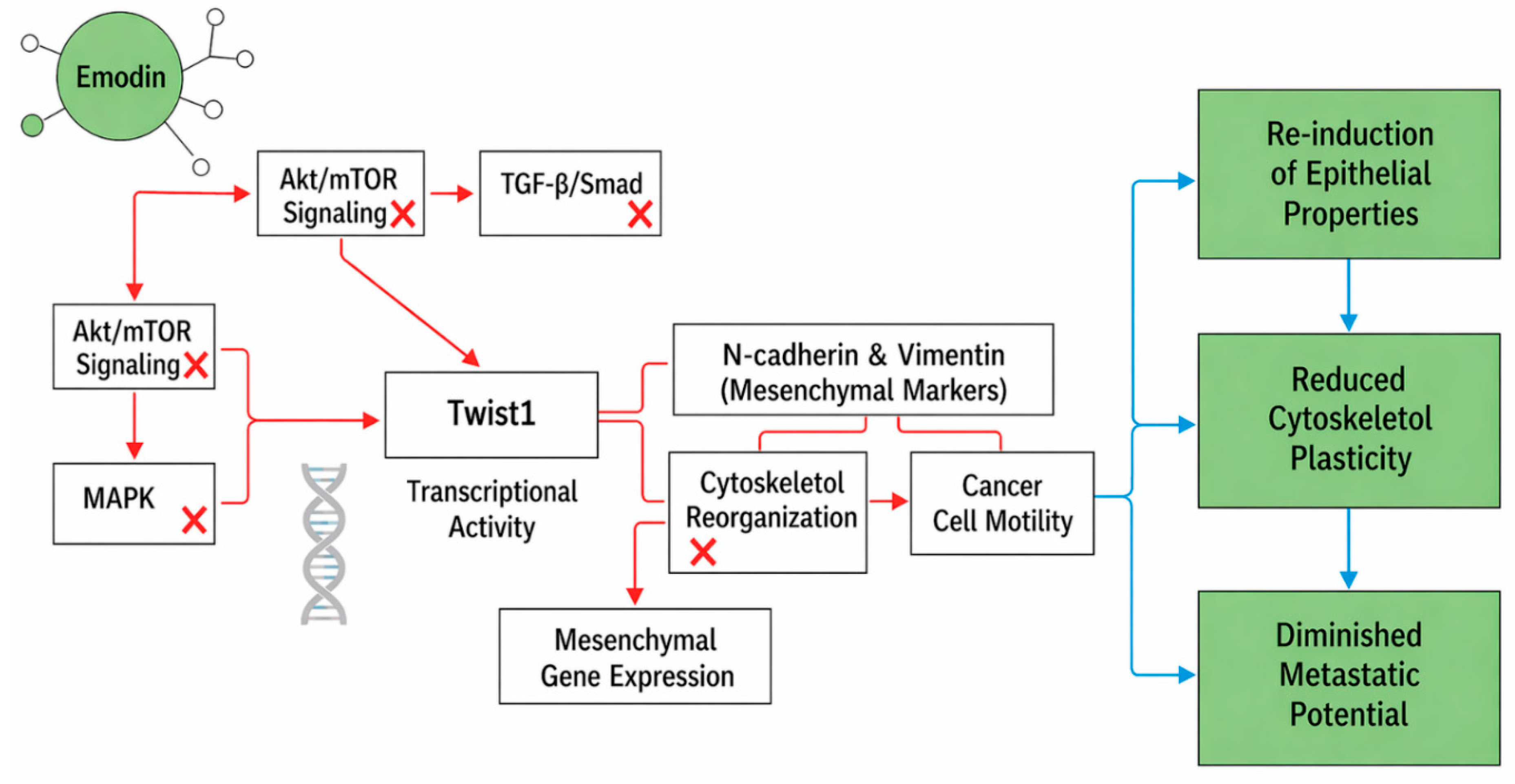
Emodin also downregulates Twist1, a key pro-EMT regulator that increases mesenchymal markers, such as N-cadherin and vimentin, by reorganizing the cytoskeleton and enhancing cancer cell motility. Emodin inhibits Twist1 by blocking the Akt/mTOR signaling pathway, thereby reducing its transcriptional activity and suppressing mesenchymal gene expression (Figure 4) [40,41]. In parallel, emodin inhibits TGF-β/Smad, NF-κB, and MAPK signaling pathways, previously discussed as central EMT regulators, thereby exerting coordinated control over EMT induction and maintenance [42,43]. The net outcome of these actions is re-establishment of epithelial characteristics, reduced cytoskeletal plasticity, and diminished metastatic potential. However, there is variability of emodin after treatment among various cancer types as well as variability in effective breast cancer treatment due to resistance developing with compensatory mechanisms associated with Wnt/β-catenin signaling.
Inhibitors of these compensatory pathways when used together with emodin can inhibit such adaptive escape mechanisms. Moreover, emodin can be used to augment therapeutic efficacy by serving as a chemosensitizer, blocking drug efflux transporters such as P-glycoprotein, and thereby amplifying intracellular concentrations of chemotherapeutic agents’ cisplatin and doxorubicin [44]. This synergistic strategy not only accelerate the retention of drugs but also rehydrates apoptotic sensitivity in resistant tumor subpopulations, which allows a more efficient blockage of metastatic progression and control of tumor heterogeneity [45]. Nevertheless, its bioavailability and stability in vivo require further optimization. Additional scientific investigations must be conducted to improve its therapeutic capabilities and treatment efficiency for metastatic cancer.
5. Transforming Growth Factor-Beta
The TGF-β exhibits a dual role in cancer, functions as a tumor suppressor during cancer initiation by slowing down cell growth yet promotes EMT along with metastasis in advanced malignancies. Sustained TGF-β signaling induces mesenchymal marker expression and suppresses epithelial adhesion, facilitating tumor dissemination [46]. Emodin inhibits TGF-β signaling by decreasing Smad2/3 phosphorylation and nuclear translocation, which are key mediators of TGF-β-induced EMT. Once phosphorylated by the TGF-β receptors (TβRI/TβRII), SMAD2 and SMAD3 translocate to the nucleus to promote the transcription of EMT-promoting genes Snail, Slug, and Twist. By inhibiting this process, emodin preserves epithelial consistency through the suppression of mesenchymal gene expression. Beyond canonical Smad, emodin interferes with the TGF-β action through non-Smad pathways as well, such as PI3K/Akt and MAPK/ERK signaling [47,48]. In concert with TGF-β action, these non-Smad signaling pathways contribute to cancer cell invasion by promoting cell survival and motility. This dual inhibitory approach highlights the potential of the broader spectrum of intervention offered by emodin in TGF-β-related malignancy action.
Consistent with its anti-EMT effects, emodin not only suppresses the expression of tumor conditioned medium (TCM) induced Arg1 and colony stimulating factor (CSFr1) but also the expression of MMP-2 and MMP-9 [49], stabilizes E-cadherin-mediated cell adhesion [50], and inhibits actin cytoskeletal remodeling [51]. Preclinical studies further indicate that emodin attenuates TGF-β–induced cancer stem cell phenotypes associated with chemoresistance and metastatic progression [52]. Even with TGF-β inhibition, resistance mechanisms remain challenging. Some cancer cells activate other EMT inducers, such as the Notch or Wnt signaling pathways. Others switch to an integrin-mediated invasion route by upregulating these pathways. This compensatory path undermines TGF-β inhibition [53]. There is also variability in TGF-β dependency across different types of cancer, making it difficult to assess the effectiveness of emodin. Combination therapy targeting compensatory pathways, such as with PI3K inhibitors or anti-integrin agents, may further enhance emodin’s ability to inhibit invasion. Key mechanisms, effects, and supporting studies, including preclinical and related clinical highlights, have been summarized in the table below.

Table 1.
Overview of Previously Reported Preclinical Studies Highlighting the Key Mechanisms of Emodin Across Various Cancer Types.
Table 1.
Overview of Previously Reported Preclinical Studies Highlighting the Key Mechanisms of Emodin Across Various Cancer Types.
| Mechanism | Molecular Target | Effect |
Cancer Type |
Key Findings | Clinical Relevance |
| Smad2/3 Phosphorylation Inhibition | TβRI kinase activity | Blocks nuclear translocation and EMT gene transcription | Breast Cancer (MDA-MB-231) | 65% reduction in Smad2/3 phosphorylation; restored E-cadherin expression | Potential biomarker for treatment response |
| Non-Smad PI3K/Akt Suppression | PI3K/Akt signaling | Decreases cell survival and motility | Hepatocellular Carcinoma (HepG2) | 70% reduction in Akt phosphorylation; enhanced apoptosis | Combination potential with PI3K inhibitors |
| Non-Smad MAPK/ERK Inhibition | ERK1/2 phosphorylation | Limits migratory and invasive capacity | Colorectal Cancer (SW480) | 60% decrease in ERK activation; reduced MMP-9 expression | Predictive biomarker for MAPK pathway dependency |
| MMP-2/MMP-9 Downregulation | MMP transcription | Reduces ECM degradation and invasion | Lung Cancer (A549) | 80% reduction in MMP activity; decreased invasion by 75% | Monitoring biomarker for therapeutic efficacy |
| E-cadherin Stabilization | Adherens junction integrity | Maintains cell-cell adhesion | Pancreatic Cancer (PANC-1) | 3-fold increase in E-cadherin; reduced cytoskeletal remodeling | Prognostic indicator for treatment response |
| CSC Property Suppression | CD44+/CD24- population | Reduces self-renewal and chemoresistance | Breast Cancer (MCF-7) | 50% decrease in CSC population; 2-fold enhanced doxorubicin sensitivity | Combination therapy with chemotherapy |
| Resistance Mechanism | Notch/Wnt pathway activation | Compensatory EMT induction | Glioblastoma (U87) | Partial EMT restoration via Notch signaling upregulation | Need for combination with pathway inhibitors |
Emodin has specific, albeit limited mechanisms, by which it can inhibit TGF-β-mediated cancer cell invasion, for example emodin may suppress Smad2/3 phosphorylation through binding to, or inhibiting TβRI kinase, or inducing Smad7 an inhibitory regulator, possibly minimizing off-target effects as compared to broad spectrum TGF-β inhibitors [54]. It also inhibits non-Smad pathways, including the PI3K/Akt and MAPK/ERK pathways, that drive invasion and associate TGF-β with angiogenesis via vascular endothelial growth factor receptor 2. This points to the possibility of an additive effect of emodin’s anti-invasive and anti-angiogenic activities [55]. Moreover, by inhibiting CSC-related features driven by TGF-β, emodin could also reduce metastatic seeding and long-term recurrence, improving survivorship for some metastatic disease [56]. Although clinical trials of emodin are limited, TGF-β inhibitors (galunisertib) were an effective adjunct therapy for metastatic cancers; thus far, however, few therapies have effectively used this mechanism [57].
While this information is promising, multiple challenges exist to achieve the full potential of emodin. The TGF-β signaling-directed biomarker-guided selection can be used to determine patients who may respond best to emodin therapy. Tumors that express high levels of TGF-β1, high phosphorylation of Smad2/3, and high expression of TGF-β receptors (TβRI/TβRII) are associated with active canonical TGF-β signaling and are thus more responsive to the inhibitory action of emodin [58]. Increased nuclear localization of Smad complexes is also indicative of pathway activation and possible sensitivity. Moreover, cancers with pronounced TGF-β-mediated EMT characteristics, including decreased E-cadherin and increased mesenchymal markers, might be especially vulnerable to emodin-mediated repression. Non-invasive markers such as liquid biopsy-based measurements of circulating TGF-β1, and phosphorylated Smad proteins could be used to stratify patients, and monitor them [59]. Thus, selecting patients based on TGF-β pathway activity can improve therapeutic precision and maximize the clinical benefit of emodin. However, the majority of available data and results are described from cell lines, therefore the efficacy of emodin will need thorough investigation and validation in animal models of orthotopic or human-derived xenografts.
6. Translational Evidence for Emodin in Tumor Progression and Metastasis
A growing body of preclinical evidence demonstrates the translational importance of emodin as an anti-metastatic agent. In numerous in vitro experiments, emodin has been found to effectively inhibit the migration and invasion of cancer cells, primarily due to its action in reducing EMT-related traits and modifying the extracellular matrix, rather than simply exerting cytotoxic effects [60,61,62,63,64]. These results are confirmed and backed by in vivo studies. Specifically, emodin-treated xenograft models demonstrate that tumors grow more slowly, fewer cancer cells spread throughout the body, and there is a reduced formation of blood vessels, indicating that both the cells and the tumor microenvironment are affected [65,66,67]. However, the degree of impact depends on the type of cancer, dose, administration, and experimental model. This highlights the need for optimized delivery methods and standardized evaluations.
Tumor heterogeneity is still the most important factor for determining the effect of the treatment. The partial resistance that has been seen in some models seems to be related to the activation of the alternative Wnt/β-catenin and PI3K/Akt signaling pathways [68], which may allow the cells to go through EMT and invade the tissues even under emodin treatment. Moreover, the unfavorable pharmacokinetic properties of this compound, like rapid metabolism and low systemic bioavailability, prevent it from effectively exposing the tumor in vivo. Nevertheless, new methods, such as the use of nanoparticles in drug delivery and the structural modification of emodin, are providing promising ways to enhance drug stability, bioavailability, and tumor targeting [69,70,71].
The use of emodin to augment the efficacy of conventional cancer therapies is one of the promising directions. Research has shown that emodin can be used along with chemotherapeutic agents like cisplatin and doxorubicin to enhance cancer cell-apoptosis and inhibit drug resistance mechanisms (72,73). It is especially applicable in malignant cancers where EMT helps in developing chemoresistance. Similarly, emodin has been shown to enhance the efficacy of radiation therapies by blocking the DNA repair signaling pathways and causing an increase in cancer cell death [74,75]. The emodin-based combinatorial products with the inhibitors of kinase or immunotherapeutic products could be a more effective way to approach the reduction of tumor growth and metastatic spread. However, it still requires rigorous clinical evaluation so as to determine optimal dose schedules and the potential toxicity of its interaction with other medications [76].
Taken together, these results establish emodin as a biologically active anti-metastatic agent with promising translational prospects, as well as underscore the critical barriers that need to be overcome before clinical implementation. Although nanoparticle-based delivery systems and structural changes have enhanced its stability, bioavailability and tumor targeting, and combination strategies with chemotherapeutic, radiotherapeutic, and targeted agents have shown enhanced efficacy, these approaches alone may not be sufficient to overcome the challenges that tumor heterogeneity and resistance mechanisms present. Thus, rigorous validation of emodin translation into clinical activity in terms of well-designed clinical trials, optimization of dosing schedules, and accurate patient stratification will eventually determine successful translation of emodin into clinical outcomes.
7. Clinical Applications and Future Prospects
The capability of emodin to influence the various pathways related to the processes of EMT and metastasis has shown its promise as an anti-metastatic drug along with other therapies. Nevertheless, the clinical conversion entails numerous hurdles such as poor pharmacokinetics, the interdependency of different tumors on EMT-related pathways, and scant safety data in humans. The future clinical development should focus on biomarker-driven patient selection which would help in recognizing tumor subtypes that are most likely to benefit from emodin-based treatment. Through rational combination treatment strategies like, combining emodin with chemotherapy, EMT inhibitors, targeted kinase inhibitors, or immunotherapeutic agents, one might be able to augment the effectiveness of the treatment while simultaneously dismantling the resistance mechanisms. Such pairs might be much more useful especially in cancer cases where EMT is one of the contributing factors to the resistance to chemo and immune therapy.
In order to expedite clinical validation, early-phase trials must focus on safety, pharmacokinetics, biomarker responses and optimal dosing as opposed to relying only on tumor shrinkage, with special emphasis on patients with EMT- or TGF-β–driven tumors. Pharmacokinetic factors, such as rapid metabolism and glucuronidation can be overcome with the use of modern delivery systems like nanoparticles, liposomes, and targeted carriers, which increase stability, circulation time, and tumor selectivity. The interpatient variability in metabolic pathways also emphasizes the importance of tailored dosing regimen. Also, the combination regimens (controlled dosage or lower dose) could minimize gastrointestinal and hepatic toxicity. In this context, emodin would best suit as a chemosensitizer in combination therapies, enhancing the effectiveness while minimizing adverse effects and overcoming resistance mechanisms.
8. Conclusions
Emodin demonstrates significant potential as an anti-metastatic agent by disrupting key processes involved in cancer spread, including EMT regulation, ECM remodeling, and pro-invasive signaling. Studies in preclinical phases have indicated that emodin can prevent metastasis in a variety of cancer models, but the therapeutic results vary with the context and the method of drug delivery. The main obstacles to the transfer of this treatment to the clinic are the poor bioavailability of emodin, tumor-specific resistance, and lack of clinical validation. Improving bioavailability, investigating combined treatments, and using molecular stratification in clinical trials can be the distances to be covered in order to explore the full potential of emodin in the clinic. With further preclinical and clinical research, emodin could serve as an adjuvant anti-metastatic therapy, especially for EMT-driven tumors.
Author Contributions
Conceptualization: LK, AGB; Investigation: SD, GG, SRK, JK; Formal Analysis: SRK, SDB, PS; Writing - Original Draft Preparation: SD, GG, JK; Writing - Review & Editing: SK, AG, LK; Supervision: LK, AGB. All authors have read and approved the final manuscript.
Funding
The authors did not receive support from any organization for the submitted work.
Institutional Review Board Statement
The study does not involve human participants, and hence not applicable.
Informed Consent Statement
Not applicable.
Data Availability Statement
The data supporting the findings of this study are available within the manuscript.
Acknowledgments
None.
Conflicts of Interest
The authors have no competing interests to declare.
References
- Castaneda, M., Den Hollander, P., Kuburich, N. A., Rosen, J. M., & Mani, S. A. (2022). Mechanisms of cancer metastasis. Seminars in Cancer Biology, 87, 17–31. [CrossRef]
- Ribatti, D., Tamma, R., & Annese, T. (2020). Epithelial-Mesenchymal Transition in Cancer: A Historical Overview. Translational Oncology, 13(6), 100773. [CrossRef]
- Serrano-Gomez, S. J., Maziveyi, M., & Alahari, S. K. (2016). Regulation of epithelial-mesenchymal transition through epigenetic and post-translational modifications. Molecular Cancer, 15(1), 18. [CrossRef]
- Tuli, H. S., Aggarwal, V., Tuorkey, M., Aggarwal, D., Parashar, N. C., Varol, M., Savla, R., Kaur, G., Mittal, S., & Sak, K. (2021). Emodin: A metabolite that exhibits anti-neoplastic activities by modulating multiple oncogenic targets. Toxicology in Vitro, 73, 105142. [CrossRef]
- Zhang, A., Miao, K., Sun, H., & Deng, C. X. (2022). Tumor heterogeneity reshapes the tumor microenvironment to influence drug resistance. International Journal of Biological Sciences, 18(7), 3019–3033. [CrossRef]
- Zhang, R., Jiao, Y., Wang, S., Wang, L., Leng, Y., Xiong, Z., & Yang, M. (2026). Mechanistic study of the role of emodin in targeting and inhibiting the Rap1 signaling pathway to regulate epithelial-mesenchymal transition and reverse cisplatin resistance in hepatocellular carcinoma. Transl Cancer Res, 15(2), 93. https://tcr.amegroups.org/article/view/112975.
- Ren, S., Song, L., Tian, Y., Zhu, L., Guo, K., Zhang, H., & Wang, Z. (2021). Emodin-Conjugated PEGylation of Fe3O4 Nanoparticles for FI/MRI Dual-Modal Imaging and Therapy in Pancreatic Cancer. Int J Nanomedicine, 16, 7463-7478. [CrossRef]
- Sherekar, P., Suke, S. G., Dani, R., Upadhyay, A., & Ahmad, S. (2024). Nanoformulation, Characterization, and In Vivo Pharmacokinetic Studies of Diosgenin- and Emodin-Loaded Polymeric Nanoparticles. BioNanoSci. 14, 164–174. [CrossRef]
- Huang, Y., Hong, W., & Wei, X. (2022). The molecular mechanisms and therapeutic strategies of EMT in tumor progression and metastasis. J Hematol Oncol, 15, 129. [CrossRef]
- Zhang, Y., & Weinberg R. A. (2018). Epithelial-to-mesenchymal transition in cancer: complexity and opportunities. Front Med, 12(4), 361–373. [CrossRef]
- Kuburich, N. A., Sabapathy, T., Demestichas, B. R., Maddela, J. J., Den Hollander, P., & Mani, S. A. (2023). Proactive and reactive roles of TGF-β in cancer. Seminars in Cancer Biology, 95, 120–139. [CrossRef]
- Gonzalez-Avila, G., Sommer, B., Mendoza-Posada, D. A., Ramos, C., Garcia-Hernandez, A. A., & Falfan-Valencia, R. (2019). Matrix metalloproteinases participation in the metastatic process and their diagnostic and therapeutic applications in cancer. Critical Reviews in Oncology/Hematology, 137, 57–83. [CrossRef]
- Liu, S., Li, L., & Ren, D. (2023). Anti-Cancer Potential of Phytochemicals: The Regulation of the Epithelial-Mesenchymal Transition. Molecules, 28(13), 5069. [CrossRef]
- Ghorbian, S. (2025). Cancer cell plasticity and therapeutic resistance: mechanisms, crosstalk, and translational perspectives. Hereditas, 162(1), 188. [CrossRef]
- Zheng, Q., Li, S., Li, X., & Liu, R. (2021). Advances in the study of emodin: an update on pharmacological properties and mechanistic basis. Chin Med, 16(1), 102. [CrossRef]
- Kessenbrock, K., Wang, C.-Y., & Werb, Z. (2015). Matrix metalloproteinases in stem cell regulation and cancer. Matrix Biology, 44(46), 184–190. [CrossRef]
- Taherkhani, S., Sheibani, M., Mohammadkhanizadeh, A., Virag, JAI., de Castro Braz L., & Azizi, Y. (2025). Metalloproteinases (MMPs) in hypertensive disorders: role, function, pharmacology, and potential strategies to mitigate pathophysiological changes. Front Pharmacol, 16, 1559288. [CrossRef]
- Shoari, A., Ashja Ardalan, A., Dimesa, A. M., & Coban, M. A. (2024). Targeting Invasion: The Role of MMP-2 and MMP-9 Inhibition in Colorectal Cancer Therapy. Biomolecules, 15(1), 35. [CrossRef]
- Baojiang Lv., Kenan Zheng., Yifan Sun., Lulu Wu., Lijun Qiao., Zhibing Wu., Yuanqi Zhao., & Zequan Zheng. (2022). Network Pharmacology Experiments Show That Emodin Can Exert a Protective Effect on MCAO Rats by Regulating Hif-1α/VEGF-A Signaling. ACS Omega, 7(26), 22577–22593. [CrossRef]
- Guo, Y., Pan, W., Liu, S., Shen, Z., Xu, Y., & Hu, L. (2020). ERK/MAPK signalling pathway and tumorigenesis (Review). Experimental and Therapeutic Medicine. [CrossRef]
- Liao, J., Chen, R., Lin, B., Deng, R., Liang, Y., Zeng, J., Ma, S., & Qiu, X. (2024). Cross-Talk between the TGF-β and Cell Adhesion Signaling Pathways in Cancer. International Journal of Medical Sciences, 21(7), 1307–1320. [CrossRef]
- Thacker, P. C., & Karunagaran, D. (2015). Curcumin and Emodin Down-Regulate TGF-β Signaling Pathway in Human Cervical Cancer Cells. PLOS ONE, 10(3), e0120045. [CrossRef]
- Luo, N., Fang, J., Wei, L., Sahebkar, A., Little, P. J., Xu, S., Luo, C., & Li, G. (2020). Emodin in atherosclerosis prevention: Pharmacological actions and therapeutic potential. European Journal of Pharmacology, 890, 173617. [CrossRef]
- Bharadwaj, A. G., Holloway, R. W., Miller, V. A., & Waisman, D. M. (2021). Plasmin and Plasminogen System in the Tumor Microenvironment: Implications for Cancer Diagnosis, Prognosis, and Therapy. Cancers, 13(8), 1838. [CrossRef]
- Manimaran, A., Manoharan, S., & Neelakandan, M. (2016). EMODIN EFFICACY ON THE AKT, MAPK, ERK AND DNMT EXPRESSION PATTERN DURING DMBA-INDUCED ORAL CARCINOMA IN GOLDEN SYRIAN HAMSTERS. Afr J Tradit Complement Altern Med, 13(6), 186–193. [CrossRef]
- Jia, X., Yu, F., Wang, J., Iwanowycz, S., Saaoud, F., Wang, Y., Hu, J., Wang, Q., & Fan, D. (2014). Emodin suppresses pulmonary metastasis of breast cancer accompanied with decreased macrophage recruitment and M2 polarization in the lungs. Breast Cancer Res Treat, 148(2), 291–302. [CrossRef]
- Sun, Y., Wang, X., Zhou, Q., Lu, Y., Zhang, H., Chen, Q., Zhao, M., & Su, S. (2015). Inhibitory effect of emodin on migration, invasion and metastasis of human breast cancer MDA-MB-231 cells in vitro and in vivo. Oncol Rep, 33(1), 338–46. [CrossRef]
- Yang, M., Xiong, Z., Deng, H., Chen, X., Lai, Q., Wang, H., & Leng, Y. (2023). Effect of emodin combined with cisplatin on the invasion and migration of HepG2 hepatoma cells. J Physiol Pharmacol, 74(4). https://pubmed.ncbi.nlm.nih.gov/37865957/.
- Wahi, D., Soni, D., & Grover, A. (2021). A Double-Edged Sword: The Anti-Cancer Effects of Emodin by Inhibiting the Redox-Protective Protein MTH1 and Augmenting ROS in NSCLC. Journal of Cancer, 12(3), 652–681. [CrossRef]
- Gordian, E., Welsh, E. A., Gimbrone, N., Siegel, E. M., Shibata, D., Creelan, B. C., Cress, W. D., Eschrich, S. A., Haura, E. B., & Muñoz-Antonia, T. (2021). Correction: Transforming growth factor β-induced epithelial-to-mesenchymal signature predicts metastasis-free survival in non-small cell lung cancer. Oncotarget, 12, 1325–1325. Retrieved from https://www.oncotarget.com/article/28004/.
- Hsu, H. C., Liu, L. C., Wang, H. Y., Hung, C. M., Lin, Y. C., Ho, C. T., & Way, T. D. (2017). Stromal Fibroblasts from the Interface Zone of Triple Negative Breast Carcinomas Induced Epithelial-Mesenchymal Transition and its Inhibition by Emodin. PLoS One, 12(1), e0164661. [CrossRef]
- Thakral, F., Prasad, B., Sehgal, R., Gupta, S., Sharma, U., Singh, B. J., Sharma, B., Tuli, H. S., Haque, S., & Ahmad, F. (2025). Role of emodin to prevent gastrointestinal cancers: recent trends and future prospective. Discov Oncol, 16(1), 468. [CrossRef]
- Wei, W., Lin, S., Liu, D., & Wang, Z. (2013). The distinct mechanisms of the antitumor activity of emodin in different types of cancer (Review). Oncology Reports, 30, 2555–2562. [CrossRef]
- Rijo, P., Athanassopoulos, C. M., & Carpinella, M. C. (2022). Editorial: Considering plant metabolites and their synthetic derivatives as candidates for the development of drugs against multidrug resistant (MDR) tumors. Front. Pharmacol, 13, 1108252. [CrossRef]
- Seo, J., Ha, J., Kang, E., & Cho, S. (2021). The role of epithelial–mesenchymal transition-regulating transcription factors in anti-cancer drug resistance. Archives of Pharmacal Research, 44(3), 281–292. [CrossRef]
- Lu, J., Xu, Y., Wei, X., Zhao, Z., Xue, J., & Liu, P. (2016). Emodin Inhibits the Epithelial to Mesenchymal Transition of Epithelial Ovarian Cancer Cells ILK/GSK-3 β /Slug Signaling Pathway. BioMed Research International, 2016, 6253280. [CrossRef]
- Loh, C.-Y., Chai, J. Y., Tang, T. F., Wong, W. F., Sethi, G., Shanmugam, M. K., Chong, P. P., & Looi, C. Y. (2019). The E-Cadherin and N-Cadherin Switch in Epithelial-to-Mesenchymal Transition: Signaling, Therapeutic Implications, and Challenges. Cells, 8(10), 1118. [CrossRef]
- Qin, B., Zeng, Z., Xu, J., Shangwen, J., Ye, Z. J., Wang, S., Wu, Y., Peng, G., Wang, Q., Gu, W., & Tang, Y. (2022). Emodin inhibits invasion and migration of hepatocellular carcinoma cells via regulating autophagy-mediated degradation of snail and β-catenin. BMC Cancer, 22(1), 671. [CrossRef]
- Hu, C., Dong, T., Li, R., Lu, J., Wei, X., & Liu, P. (2016). Emodin inhibits epithelial to mesenchymal transition in epithelial ovarian cancer cells by regulation of GSK-3β/β-catenin/ZEB1 signaling pathway. Oncology Reports, 35, 2027–2034. [CrossRef]
- Ponnusamy, L., Kothandan, G., & Manoharan, R. (2020). Berberine and Emodin abrogates breast cancer growth and facilitates apoptosis through inactivation of SIK3-induced mTOR and Akt signaling pathway. Biochim Biophys Acta Mol Basis Dis, 1866(11), 165897. [CrossRef]
- Zhang, J., Hu, Z., Horta, C. A., & Yang, J. (2023). Regulation of epithelial-mesenchymal transition by tumor microenvironmental signals and its implication in cancer therapeutics. Seminars in Cancer Biology, 88, 46–66. [CrossRef]
- Qin, M. Y., Huang, S. Q., Zou, X. Q., Zhong, X. B., Yang, Y. F., Zhang, Y. T., Mi, Z. C., Zhang, Y. S., & Huang, Z. G. (2021). Drug-containing serum of rhubarb-astragalus capsule inhibits the epithelial-mesenchymal transformation of HK-2 by downregulating TGF-β1/p38MAPK/Smad2/3 pathway. J Ethnopharmacol, 280, 114414. [CrossRef]
- Jiang, J., Zhou, N., Ying, P., Zhang, T., Liang, R., & Jiang, X. (2019). Emodin Promotes Apoptosis of Human Endometrial Cancer Through Regulating the MAPK and PI3K/ AKT Pathways. Open Life Sci, 13, 489–496. [CrossRef]
- Peng, S., Wang, J., Lu, C., Xu, Z., Chai, J., Ke, Q., & Deng, X. (2021). Emodin enhances cisplatin sensitivity in non-small cell lung cancer through Pgp downregulation. Oncology Letters, 21, 230. [CrossRef]
- Bhattacharjee, M., Upadhyay, P., Sarker, S., Basu, A., Das, S., Ghosh, A., Ghosh, S., & Adhikary, A. (2020). Combinatorial therapy of Thymoquinone and Emodin synergistically enhances apoptosis, attenuates cell migration and reduces stemness efficiently in breast cancer. Biochim Biophys Acta Gen Subj, 1864(11), 129695. [CrossRef]
- Carver, W., Fix, E., Fix, C., Fan, D., Chakrabarti, M., & Azhar, M. (2021). Effects of emodin, a plant-derived anthraquinone, on TGF-β1-induced cardiac fibroblast activation and function. J Cell Physiol, 236(11), 7440–7449. [CrossRef]
- Lin, W., Zhong, M., Liang, S., Chen, Y., Liu, D., Yin, Z., Cao, Q., Wang, C., & Ling, C. (2016). Emodin inhibits migration and invasion of MHCC-97H human hepatocellular carcinoma cells. Exp Ther Med, 12(5), 3369–3374. [CrossRef]
- Stompor-Gorący, M. (2021). The Health Benefits of Emodin, a Natural Anthraquinone Derived from Rhubarb-A Summary Update. Int J Mol Sci, 22(17), 9522. [CrossRef]
- Iwanowycz, S., Wang, J., Hodge, J., Wang, Y., Yu, F., Fan, D. (2016). Emodin Inhibits Breast Cancer Growth by Blocking the Tumor-Promoting Feedforward Loop between Cancer Cells and Macrophages. Mol Cancer Ther, 15(8), 1931–1942. [CrossRef]
- McDonald, S. J., VanderVeen, B. N., Velazquez, K. T., Enos, R. T., Fairman, C. M., Cardaci, T. D., Fan, D., & Murphy, E. A. (2022). Therapeutic Potential of Emodin for Gastrointestinal Cancers. Integrative Cancer Therapies, 21, 15347354211067469. [CrossRef]
- Trybus, W., Trybus, E., & Król, T. (2022). Emodin Sensitizes Cervical Cancer Cells to Vinblastine by Inducing Apoptosis and Mitotic Death. International Journal of Molecular Sciences, 23(15), 8510. [CrossRef]
- Dong, X., Fu, J., Yin, X., Cao, S., Li, X., Lin, L., Huyiligeqi, & Ni, J. (2016). Emodin: A Review of its Pharmacology, Toxicity and Pharmacokinetics. Phytotherapy Research, 30(8), 1207–1218. [CrossRef]
- Brown, N. F., & Marshall, J. F. (2019). Integrin-Mediated TGFβ Activation Modulates the Tumour Microenvironment. Cancers, 11(9), 1221. [CrossRef]
- Liu, J., Vaziri, D. N., Miao, H., & Zhao, Y. (2025). The Renoprotective Effect, Nephrotoxicity, and Molecular Mechanisms of Emodin. Integrative Medicine in Nephrology and Andrology, 13, e25-00036. [CrossRef]
- Li, F., Song, X., Zhou, X., Chen, L., & Zheng, J. (2023). Emodin attenuates high lipid-induced liver metastasis through the AKT and ERK pathways in vitro in breast cancer cells and in a mouse xenograft model. Heliyon; 9(6), e17052. [CrossRef]
- Liu, Q., Hodge, J., Wang, J., Wang, Y., Wang, L., Singh, U., Li, Y., Yao, Y., Wang, D., Ai, W., Nagarkatti, P., Chen, H., Xu, P., Murphy, E. A., & Fan, D. (2020). Emodin reduces Breast Cancer Lung Metastasis by suppressing Macrophage-induced Breast Cancer Cell Epithelial-mesenchymal transition and Cancer Stem Cell formation. Theranostics, 10(18), 8365–8381. [CrossRef]
- de Streel, G., & Lucas, S. (2021). Targeting immunosuppression by TGF-β1 for cancer immunotherapy. Biochem Pharmacol, 192, 114697. [CrossRef]
- Lin, S. Z., Xu, J. B., Ji, X., Chen, H., Xu, H. T., Hu, P., Chen, L., Guo, J. Q., Chen, M. Y., Lu, D., Wang, Z. H., & Tong, H. F. (2015). Emodin inhibits angiogenesis in pancreatic cancer by regulating the transforming growth factor-β/drosophila mothers against decapentaplegic pathway and angiogenesis-associated microRNAs. Mol Med Rep, 12(4), 5865–5871. [CrossRef]
- Liu, C., Li, Z., Wu, D., Li, C., & Zhang, Y. (2016). Smad3 and phospho-Smad3 are potential markers of invasive nonfunctioning pituitary adenomas. Onco Targets Ther, 9, 2265–2271. [CrossRef]
- Long, H., Chen, H., Yan, J., & Cheng, H. (2022). Emodin exerts antitumor effects in ovarian cancer cell lines by preventing the development of cancer stem cells via epithelial mesenchymal transition. Oncol Lett, 23(3), 95. [CrossRef]
- Chen, R., Zhang, H., Zhao, X., Zhu, L., Zhang, X., Ma, Y., & Xia, L. (2024). Progress on the mechanism of action of emodin against breast cancer cells. Heliyon; 10(21), e38628. [CrossRef]
- Ma, L., Li, H., Zhang, S., Xiong, X., Chen, K., Jiang, P., Jiang, K., & Deng, G. (2018). Emodin ameliorates renal fibrosis in rats via TGF-β1/Smad signaling pathway and function study of Smurf 2. Int Urol Nephrol, 50, 373–382. [CrossRef]
- Zhang, Q., Chen, W. W., Sun, X., Qian, D., Tang, D. D., Zhang, L. L., Li, M. Y., Wang, L.Y., Wu, C. J., & Peng, W. (2022). The versatile emodin: A natural easily acquired anthraquinone possesses promising anticancer properties against a variety of cancers. Int J Biol Sci, 18(8), 3498–3527. https://www.ijbs.com/v18p3498.htm.
- Zheng, Q., Xu, Y., Lu, J., Zhao, J., Wei, X., & Liu, P. (2016). Emodin inhibits migration and invasion of human endometrial stromal cells by facilitating the mesenchymal-epithelial transition through targeting ILK. Reprod Sci, 23(11), 1526–35. [CrossRef]
- Wei, W., Tang, J., Hu, L., Feng, Y., Li, H., Yin, C., & Tang, F. (2021). Experimental anti-tumor effect of emodin in suspension – in situ hydrogels formed with self-assembling peptide. Drug Delivery, 28(1), 1810–1821. [CrossRef]
- Zou, G., Zhang, X., Wang, L., Li, X., Xie, T., Zhao, J., Yan, J., Wang, L., Ye, H., Jiao, S., Xiang, R., & Shi, Y. (2020). Herb-sourced emodin inhibits angiogenesis of breast cancer by targeting VEGFA transcription. Theranostics, 10(15), 6839–6853. https://www.thno.org/v10p6839.htm.
- Akkol, E. K., Tatlı, I. I., Karatoprak, G. Ş., Ağar, O. T., Yücel, Ç., Sobarzo-Sánchez, E., & Capasso, R. (2021). Is Emodin with Anticancer Effects Completely Innocent? Two Sides of the Coin. Cancers, 13(11), 2733. [CrossRef]
- Zhao, X., Ma, Y., Luo, J., Xu, K., Tian, P., Lu, C., & Song, J. (2024). Blocking the WNT/β-catenin pathway in cancer treatment:pharmacological targets and drug therapeutic potential. Heliyon, 10(16), e35989. [CrossRef]
- Liu, J., Xiao, S., Huang, C., Zhang, X., Cai, R., Qu, S., Peng, Y., & Xie, L. (2025). Emodin nanoparticles-loaded injectable hydrogel with deep tumor penetration for triple-negative breast cancer therapy. Biomater Adv, 177, 214380. [CrossRef]
- Lv, Y., Li, W., Liao, W., Jiang, H., Liu, Y., Cao, J., Lu, W., & Feng, Y. (2024). Nano-Drug Delivery Systems Based on Natural Products. International Journal of Nanomedicine, 19, 541–569. [CrossRef]
- Ai, Z., Liu, B., Chen, J., Zeng, X., Wang, K., Tao, C., Chen, J., Yang, L., Ding, Q., & Zhou, M. (2024). Advances in nano drug delivery systems for enhanced efficacy of emodin in cancer therapy. International Journal of Pharmaceutics: X, 9, 100314. [CrossRef]
- Tang, C., Zou, Y., Meng, H., Xu, J., Long, F., Chen, X., Xiao, Q., Su, K., Nan, Z., Guo, Y., & Li, C. (2025). Synergistic anticancer effects of carrier-free self-assembled doxorubicin and emodin nanoparticles in non-small cell lung cancer. Sci Rep; 15(1), 40205. [CrossRef]
- Lande, P. S., Adhao, V. S., Ambhore, J. P., Gaikwad, K. P., Chandak, C. S., & Joge, L. P. (2023). Anticancer action of naturally occurring emodin for the controlling of cervical cancer. Explor Target Antitumor Ther, 4, 690–8. [CrossRef]
- Wu, C.-C., Chen, M.-S., & Chen, J.-Y. (2024). The Application of Emodin Treatment on Nasopharyngeal Carcinoma Therapy. Biomedicines, 12(3), 486. [CrossRef]
- Hwang, S. Y., Heo, K., Kim, J. S., Im, J. W., Lee, S. M., Cho, M., Kang, D. H., Heo, J., Lee, J. W., Choi, C. W., & Yang, K. (2015). Emodin attenuates radioresistance induced by hypoxia in HepG2 cells via the enhancement of PARP1 cleavage and inhibition of JMJD2B. Oncology Reports, 33, 1691-1698. [CrossRef]
- Sougiannis, A. T., Enos, R. T., VanderVeen, B. N., Velazquez, K. T, Kelly, B., McDonald, S., Cotham, W., Chatzistamou, I., Nagarkatti, M., Fan, D., & Murphy, E. A. (2021). Safety of natural anthraquinone emodin: an assessment in mice. BMC Pharmacol Toxicol, 22(1), 9. [CrossRef]
Figure 1.
TGF-β–driven induction of EMT in cancer. The illustration depicts TGF-β signaling as a central inducer of EMT, promoting loss of epithelial cell junctions and polarity while activating EMT-associated transcription factors (SNAIL, SLUG, TWIST). These molecular and cytoskeletal changes promote a transformation to the mesenchymal phenotype that is characterized by increased migratory potential, invasive capacity, stem cell properties, degradation of extracellular matrix, evasion from the immune system and increased resistance to therapy.
Figure 1.
TGF-β–driven induction of EMT in cancer. The illustration depicts TGF-β signaling as a central inducer of EMT, promoting loss of epithelial cell junctions and polarity while activating EMT-associated transcription factors (SNAIL, SLUG, TWIST). These molecular and cytoskeletal changes promote a transformation to the mesenchymal phenotype that is characterized by increased migratory potential, invasive capacity, stem cell properties, degradation of extracellular matrix, evasion from the immune system and increased resistance to therapy.
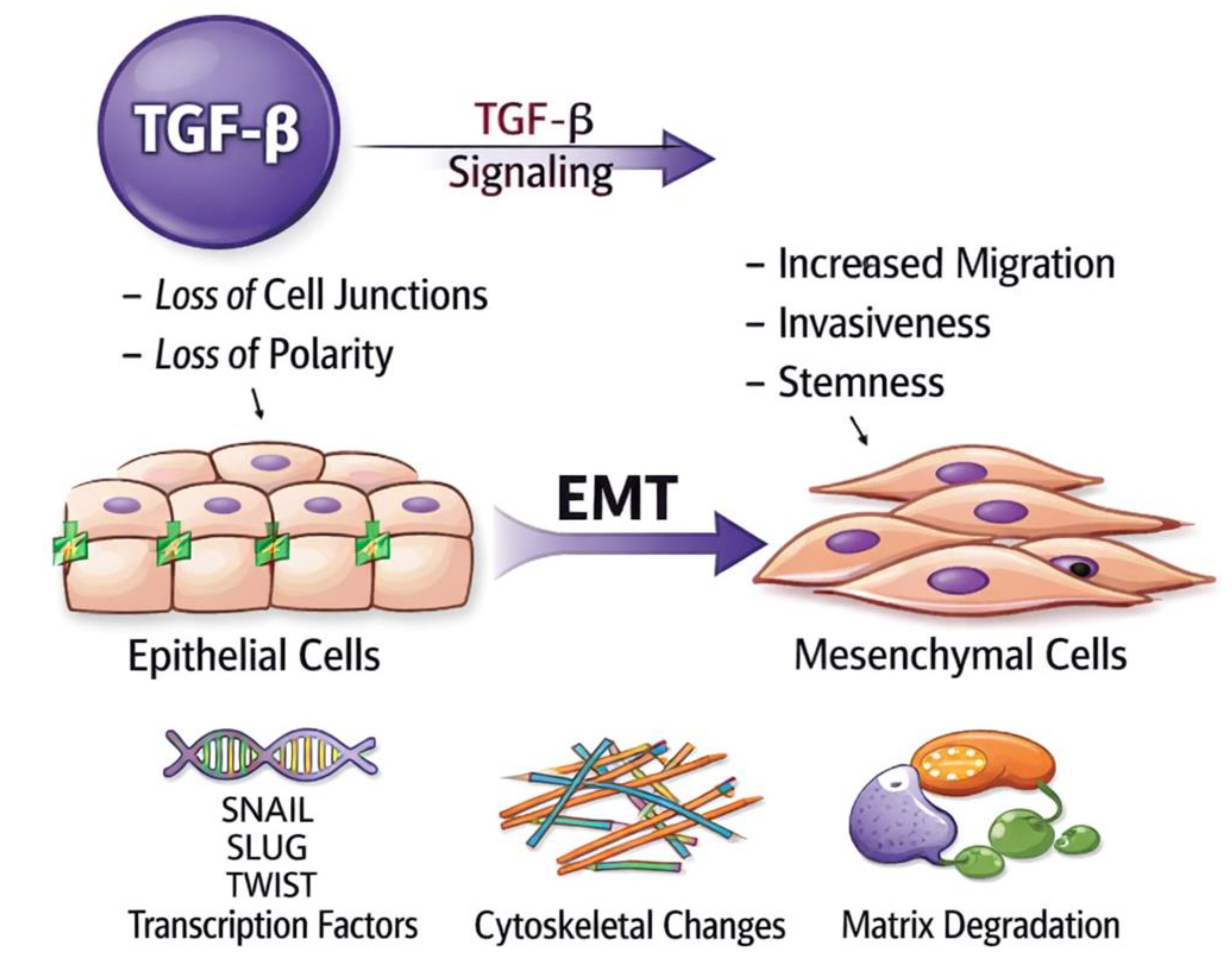
Figure 2.
Emodin-mediated downregulation of MMP-2 and MMP-9 expression through inhibition of NF-κB, MAPK, and TGF-β signaling. Emodin prevents NF-κB (p65/p50) nuclear translocation and MMP gene transcription by stabilizing the cytoplasmic inhibitor IκBα. Emodin also reduces MMP transcription through inhibition of MAPK signaling via suppression of ERK1/2 and p38 activation. Additionally, the TGF-β signaling pathway is disrupted by emodin because it prevents Smad2/3 from undergoing phosphorylation, which leads to reduced MMP expression, and diminished ECM breakdown, as well as, decreased tumor invasion and metastatic potential.
Figure 2.
Emodin-mediated downregulation of MMP-2 and MMP-9 expression through inhibition of NF-κB, MAPK, and TGF-β signaling. Emodin prevents NF-κB (p65/p50) nuclear translocation and MMP gene transcription by stabilizing the cytoplasmic inhibitor IκBα. Emodin also reduces MMP transcription through inhibition of MAPK signaling via suppression of ERK1/2 and p38 activation. Additionally, the TGF-β signaling pathway is disrupted by emodin because it prevents Smad2/3 from undergoing phosphorylation, which leads to reduced MMP expression, and diminished ECM breakdown, as well as, decreased tumor invasion and metastatic potential.
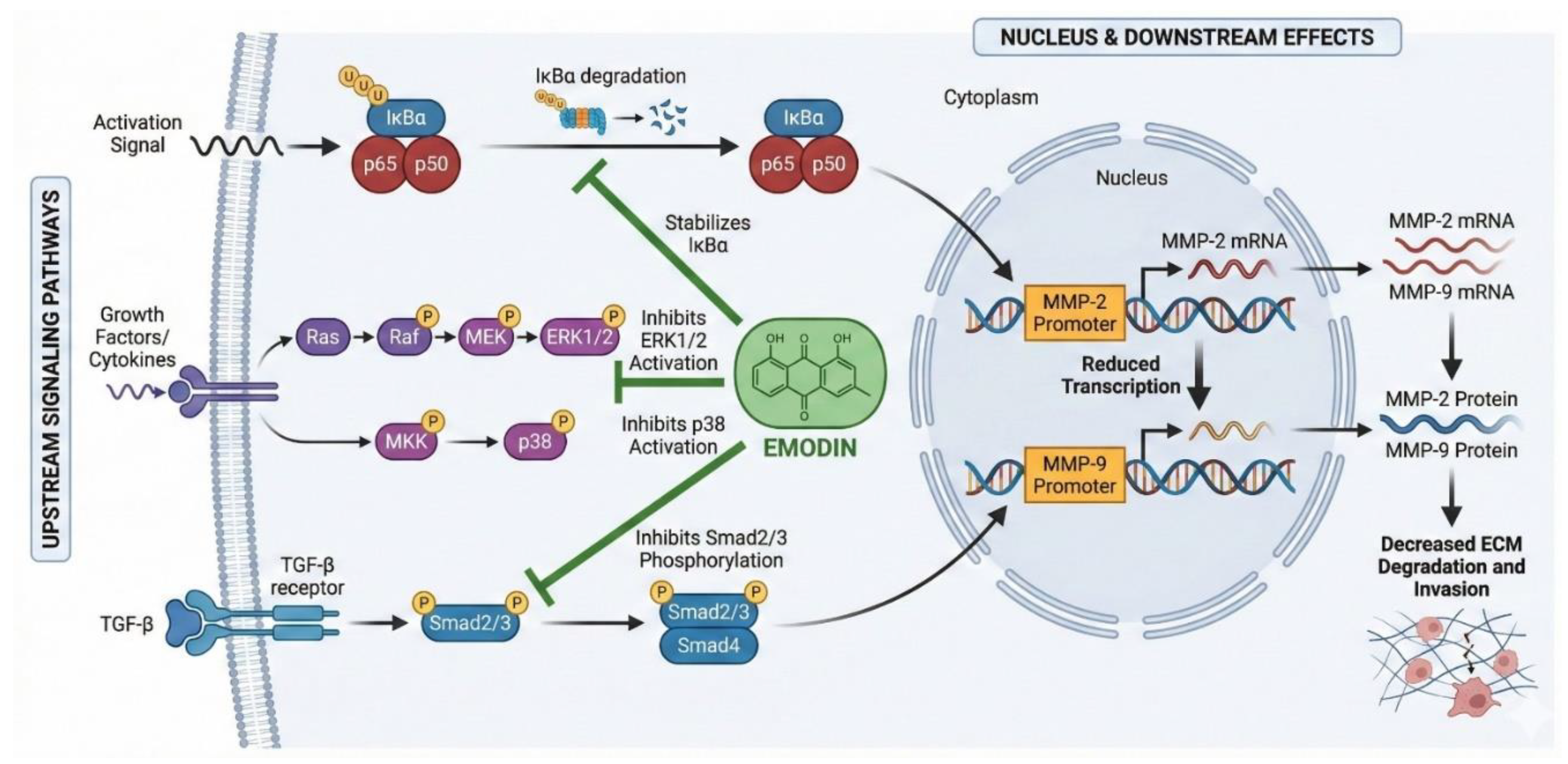
Figure 3.
Inhibition of EMT by Emodin via inhibition of major EMT transcriptional regulators. The figure shows that emodin inhibits EMT by preventing the activation and nuclear activity of the transcription factors Snail, Slug, and Twist and associated Akt/mTOR signaling. It leads to decreased mesenchymal marker (N-cadherin and vimentin) expression, normalization of E-cadherin expression and re-differentiating to an epithelial phenotype, which restricts the tumor cell motility and metastatic potential.
Figure 3.
Inhibition of EMT by Emodin via inhibition of major EMT transcriptional regulators. The figure shows that emodin inhibits EMT by preventing the activation and nuclear activity of the transcription factors Snail, Slug, and Twist and associated Akt/mTOR signaling. It leads to decreased mesenchymal marker (N-cadherin and vimentin) expression, normalization of E-cadherin expression and re-differentiating to an epithelial phenotype, which restricts the tumor cell motility and metastatic potential.
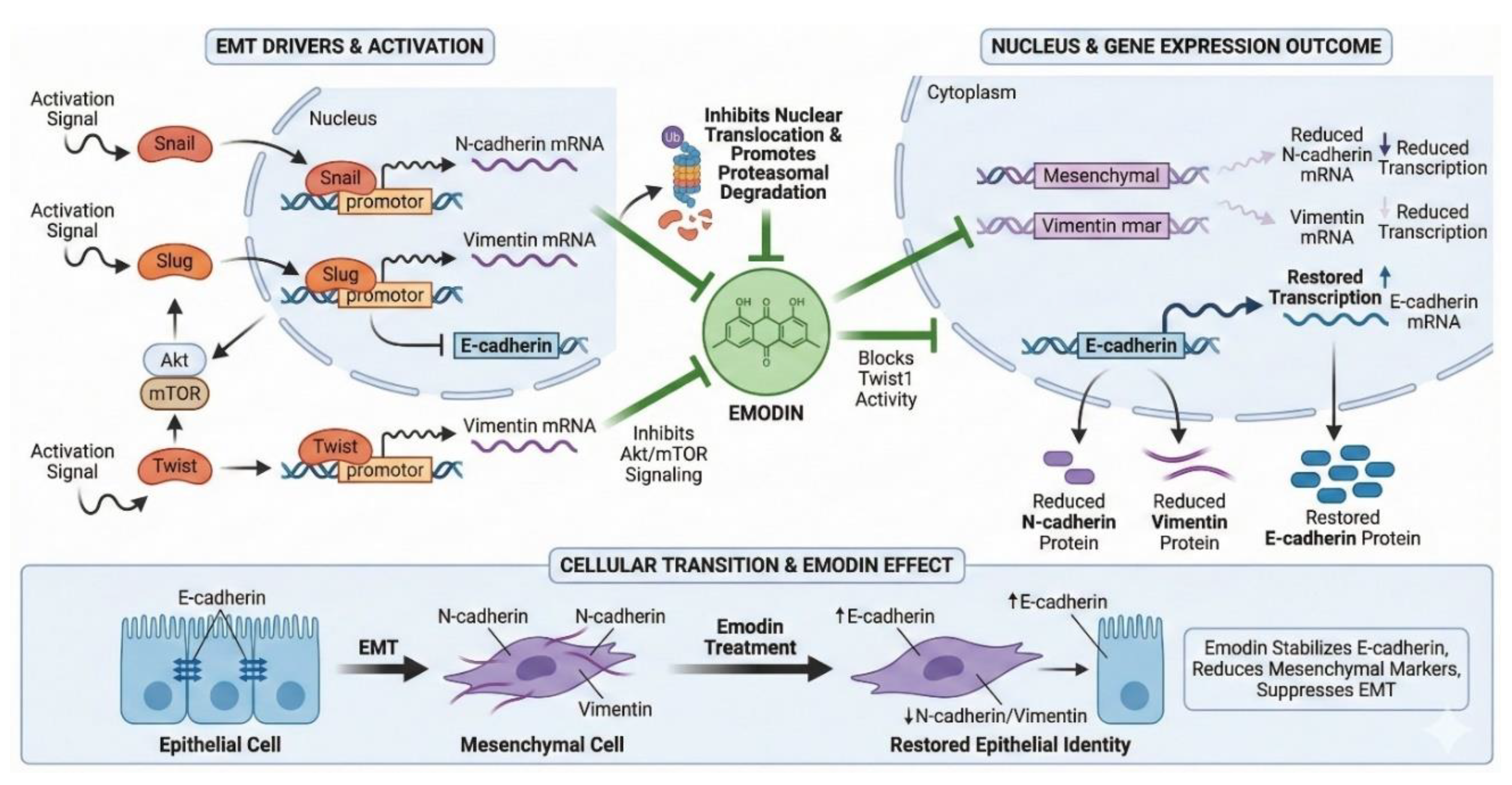
Figure 4.
Emodin suppresses the Akt/mTOR and related signalling pathways that inhibit Twist1 (an EMT regulator) and transcription. This downregulates mesenchymal gene expression and expression of N-cadherin and vimentin, inhibits reorganization of cytoskeleton and motility of cancer cells, and enhances re-induction of epithelial properties with decreased metastatic capacity.
Figure 4.
Emodin suppresses the Akt/mTOR and related signalling pathways that inhibit Twist1 (an EMT regulator) and transcription. This downregulates mesenchymal gene expression and expression of N-cadherin and vimentin, inhibits reorganization of cytoskeleton and motility of cancer cells, and enhances re-induction of epithelial properties with decreased metastatic capacity.
Disclaimer/Publisher’s Note: The statements, opinions and data contained in all publications are solely those of the individual author(s) and contributor(s) and not of MDPI and/or the editor(s). MDPI and/or the editor(s) disclaim responsibility for any injury to people or property resulting from any ideas, methods, instructions or products referred to in the content. |
© 2026 by the authors. Licensee MDPI, Basel, Switzerland. This article is an open access article distributed under the terms and conditions of the Creative Commons Attribution (CC BY) license (http://creativecommons.org/licenses/by/4.0/).
Copyright: This open access article is published under a Creative Commons CC BY 4.0 license, which permit the free download, distribution, and reuse, provided that the author and preprint are cited in any reuse.


