

Submitted:
21 April 2026
Posted:
22 April 2026
You are already at the latest version
Abstract
This study examined the mediating role of negative stress in the relationship between Psychological Capital (PsyCap) a higher-order construct comprising hope, self-efficacy, resilience, and optimism and psychological distress indicators among Ecuadorian uni-versity students. A cross-sectional survey was conducted with 1,732 students (55% women; M = 20.44, SD = 2.29), using validated self-report measures. Structural equa-tion modeling showed a good model fit (CFI = 0.947; TLI = 0.942; RMSEA = 0.055; SRMR = 0.040)
Results indicated that PsyCap was negatively associated with negative stress (β = −0.261), which in turn showed strong positive effects on anxiety–depression symptoms (β = 0.782) and psychological inflexibility (β = 0.781). Direct effects of PsyCap on both outcomes were significant but comparatively small (β = −0.115 and β = −0.086, respec-tively), whereas indirect effects through stress were substantial and significant (β = −0.204), supporting a partial mediation model. The model explained 67.2% of the vari-ance in anxiety–depression and 65.2% in psychological inflexibility.
These findings suggest that PsyCap operates primarily as a protective factor through its capacity to reduce negative stress, which subsequently influences downstream psy-chological outcomes. The results highlight the importance of stress-focused mecha-nisms in understanding how positive psychological resources impact mental health.
From an applied perspective, the findings underscore the relevance of implementing strengths-based interventions in higher education that enhance PsyCap components while simultaneously targeting stress reduction. Such inter-ventions may contribute to decreasing psychological distress and improving students’ adaptive functioning and well-being. This study provides robust evidence from the Latin American context, advancing the understanding of transdiagnostic mechanisms linking positive resources and mental health in university populations.
Keywords:
psychological capital
; negative stress
; anxiety and depression
; psychological inflexibility
; university students
1. Introduction
The growing deterioration of mental health among young people has become a pressing public health concern (Copeland et al., 2013; Gómez-Restrepo et al., 2025). In recent years, psychological disorders such as anxiety and depression have shown a sustained increase among adolescents and young adults, significantly affecting academic performance, social functioning, and overall well-being (Moreta-Herrera, 2021). The COVID-19 pandemic further intensified psychological distress in this population (Finch et al., 2025; Moreno-Montero et al., 2024). University students, in particular, face multiple stressors including academic demands, financial strain, sociocultural adjustment, and uncertainty about their professional future, which heighten their vulnerability to emotional difficulties and academic disengagement (Spence et al., 2022; Galve-González et al., 2024; Moreno-Montero et al., 2024).
Mental health is best conceptualized as a continuum ranging from optimal well-being to severe dysfunction (Khan et al., 2024; Visser, 2021). Although psychological research has traditionally focused on psychopathology, recent perspectives emphasize the importance of fostering psychological strengths that promote resilience and adaptation (Khan et al., 2024). In Latin America, additional risk factors such as poverty, inequality, urban violence, and displacement further exacerbate vulnerability to emotional distress among students (Gómez-Restrepo et al., 2025). Recent large-scale evidence in Ecuador indicates that psychological inflexibility and perceived stress operate as key transdiagnostic processes that strongly contribute to the presence of anxiety and depressive symptoms in university students (Vaca-Gallegos et al., 2025).
Perceived stress is one of the most studied predictors of psychological difficulties in university populations. It refers to the appraisal of life situations as unpredictable, uncontrollable, and overwhelming, exceeding the individual’s coping resources (Remor, 2006; Ruisoto et al., 2020). Persistent stress perceptions are frequently associated with depressive symptoms, particularly when linked to hopelessness and low perceived control (Ruisoto et al., 2022). However, not all stress responses are equivalent, and recent research highlights the importance of distinguishing maladaptive forms of stress, particularly those associated with negative cognitive appraisals and hopelessness. In this context, negative stress (conceptualized as stress-related hopelessness) represents a more specific and clinically relevant dimension linked to psychological distress. Importantly, beyond its role as a direct predictor, negative stress has been increasingly conceptualized as a central transdiagnostic mechanism that explains how psychological resources and vulnerabilities influence downstream mental health outcomes (Anyan & Hjemdal, 2016; Vaca-Gallegos et al., 2025).
Depression involves low mood, anhedonia, fatigue, cognitive impairments, appetite or sleep changes, feelings of worthlessness, and sometimes suicidal ideation (APA, 2022). Anxiety is a natural emotional response characterized by heightened physiological arousal, anticipation of potential threats, and increased vigilance, which can be adaptive in short durations. However, when excessive, persistent, or disproportionate to the situation, anxiety becomes maladaptive, interfering with attention, academic performance, and interpersonal functioning, and is often accompanied by somatic symptoms such as tachycardia, muscle tension, and gastrointestinal discomfort (American Psychiatric Association, 2022). Both conditions are common among university students and often co-occur.
Psychological inflexibility represents another transdiagnostic vulnerability factor, characterized by rigid avoidance of unpleasant internal experiences, even when such strategies hinder actions aligned with personal values (Bond et al., 2011; Ruiz et al., 2013; Coletti & Teti, 2015). Limited psychological flexibility reduces adaptive functioning and may heighten susceptibility to distress in demanding academic contexts. Empirical findings in Ecuador confirm that psychological inflexibility exacerbates stress perceptions, which in turn significantly increase the risk of anxiety and depressive symptomatology in students (Vaca-Gallegos et al., 2025). These findings support a sequential pathway in which stress—and more specifically negative stress—operates as an intermediary process linking psychological vulnerabilities to emotional outcomes.
Sociodemographic characteristics also influence mental health outcomes. Evidence shows that women, younger students, and single individuals frequently report higher levels of anxiety, depression, and stress (Parlapani et al., 2020; Rodríguez-Rey et al., 2020; De Abreu & Angelucci, 2023; Ruisoto et al., 2022; Yan et al., 2021; Nkire et al., 2021; Wang et al., 2020). Nevertheless, the explanatory power of sociodemographic factors appears modest compared to the transdiagnostic role of stress and psychological inflexibility, which emerge as more consistent predictors of depression and anxiety in student populations (Vaca-Gallegos et al., 2025).
Within the framework of positive psychology, emphasis has shifted toward identifying and strengthening resources that contribute to well-being. Psychological Capital (PsyCap) is conceptualized as a higher-order construct composed of self-efficacy, hope, optimism, and resilience (Luthans et al., 2004; López-Guerra et al., 2023). Self-efficacy denotes confidence in mobilizing resources to meet situational demands (Luthans et al., 2004, 2015). Hope comprises agency and pathways toward goal attainment (Luthans et al., 2015). Optimism reflects the expectation of favorable outcomes despite obstacles (Seligman, 2002; Luthans et al., 2015), while resilience describes the ability to adapt to adversity and maintain performance under stress (Coutu, 2002; Luthans et al., 2015; King et al., 2020). Unlike personality traits, these components are considered state-like and open to development through training and psychoeducational interventions (Luthans et al., 2007; King et al., 2020).
In university populations, PsyCap has been associated with academic engagement, satisfaction, adaptation, and emotional well-being (Datu & Valdez, 2016; Siu et al., 2014; López-Guerra et al., 2023). Evidence also links PsyCap to reduced depression and anxiety, healthier coping strategies, and more adaptive lifestyle behaviors (Finch et al., 2020; King et al., 2020; Li, 2020; Moreno-Montero et al., 2024; Zewude et al., 2024). However, despite consistent evidence of its protective role, the mechanisms through which PsyCap influences psychological distress remain insufficiently understood, particularly in Latin American contexts.
From a theoretical perspective, PsyCap may not only exert direct protective effects on mental health outcomes but may also operate indirectly by reducing levels of negative stress. In this sense, negative stress can be conceptualized as a key mediating mechanism through which positive psychological resources influence anxiety–depression symptoms and psychological inflexibility. This mediational perspective is consistent with transdiagnostic frameworks, which emphasize shared processes underlying different forms of psychological distress (Anyan & Hjemdal, 2016; Shen et al., 2024).
Despite this evidence, research on PsyCap in Latin America remains limited, particularly in Ecuador. Therefore, the present study aims to examine a mediational model in which negative stress is positioned as a central mechanism linking Psychological Capital with anxiety–depression symptoms and psychological inflexibility in Ecuadorian university students, contributing to the understanding of protective processes in mental health within higher education contexts.
Based on the theoretical and empirical background, the following hypotheses were proposed:
H1. Psychological Capital will be negatively associated with negative stress.
H2. Negative stress will be positively associated with anxiety–depression symptoms and psychological inflexibility.
H3. Psychological Capital will show negative direct effects on anxiety–depression and psychological inflexibility.
H4. Negative stress will mediate the relationship between Psychological Capital and both anxiety–depression symptoms and psychological inflexibility.
H5. The indirect effects of Psychological Capital on psychological distress outcomes through negative stress will be stronger than the direct effects, supporting a partial mediation model.
2. Materials and Methods
2.1. Participants
The study sample consisted of 1,732 undergraduate students enrolled in face-to-face programs at three universities in Loja, Ecuador: Universidad Técnica Particular de Loja (n = 792), Universidad Nacional de Loja (n = 753), and Universidad Internacional del Ecuador – Loja campus (n = 187). Participants were recruited through non-probability convenience sampling.
Inclusion criteria were: (a) being enrolled in the university for at least one academic year, (b) being 18 years of age or older, (c) having internet access, (d) possessing sufficient cognitive capacity to complete the questionnaire independently, and (e) providing informed consent.
The sample was nearly balanced between public and private institutions (50% each). Of the participants, 55% were women and 45% men, with a mean age of 20.44 years (SD = 2.29). Most students identified as Ecuadorian nationals (99%), single (96.7%), and without children (94%). Regarding perceived socioeconomic status, 47% classified themselves as middle class and 46.8% as upper class. No monetary incentives were provided. The average response rate across institutions was 42%
2.2. Instruments
Sociodemographic Questionnaire. An ad hoc questionnaire was designed to gather information on age, gender, marital status, and perceived socioeconomic status.
Psychological Capital Questionnaire (PCQ-12). The PCQ-12 (Martínez et al., 2019) assesses four dimensions of psychological capital: self-efficacy, hope, resilience, and optimism. It includes 12 items rated on a six-point Likert scale (1 = strongly disagree; 6 = strongly agree). Higher scores reflect greater psychological capital. In Ecuadorian university students, the scale demonstrated excellent internal consistency (α = .941; ω = .942) and adequate construct validity, supporting a second-order four-factor structure (López-Guerra et al., 2023).
Perceived Stress Scale – Negative Stress Dimension (PSS-10). The Perceived Stress Scale (PSS-10) (Cohen et al., 1983), adapted for Ecuador by Ruisoto et al. (2020), was used to assess perceived stress. The instrument consists of 10 items rated on a five-point Likert scale (0 = never; 4 = very often), with higher scores indicating greater perceived stress.
In accordance with the theoretical framework of the present study, only the negative stress dimension was retained, as it reflects perceived distress, emotional overload, and lack of control. This dimension includes six items (items 1, 2, 3, 6, 9, and 10), which capture the extent to which individuals perceive their lives as unpredictable, overwhelming, and uncontrollable.
This decision is supported by prior research suggesting that the PSS-10 is better represented by a two-factor structure distinguishing perceived distress and perceived self-efficacy, and is also consistent with transdiagnostic models of psychological distress, where stress plays a central role as a vulnerability factor.
Confirmatory factor analysis supported the adequacy of this dimension, with standardized factor loadings ranging from .694 to .812 , all statistically significant, indicating strong relationships between the items and the latent construct.
The internal consistency of the negative stress dimension was satisfactory (ω = .907; α = .891), and convergent validity was supported by an average variance extracted (AVE = .641), exceeding recommended thresholds.
Taken together, these findings provide robust empirical support for the use of the negative stress dimension as a reliable and valid indicator of perceived distress in the present structural model.
Patient Health Questionnaire (PHQ-4). The PHQ-4 (Kroenke et al., 2009) is a four-item measure of anxiety (GAD-2) and depression (PHQ-2). Items are scored on a four-point Likert scale (0 = not at all; 3 = nearly every day). Higher scores indicate greater psychological distress. Validation in Ecuadorian students confirmed a bifactorial structure and adequate reliability (α = .879; ω = .880; López-Guerra et al., 2022).
Acceptance and Action Questionnaire–II (AAQ-II). The AAQ-II (Bond et al., 2011) evaluates psychological inflexibility using 7 items scored on a seven-point Likert scale (1 = never; 7 = always). Higher scores reflect greater inflexibility. The Ecuadorian version showed unidimensionality and excellent internal consistency (α = .919; ω = .928; Paladines-Costa et al., 2021).
2.3. Procedure
This was a cross-sectional, non-experimental study. Data collection was conducted over a five-month period in 2020. Participants were contacted via institutional email lists and mobile messaging platforms, where they received a link to an online survey hosted on Google Forms.
The survey began with an introductory section describing the study’s objectives and including an informed consent form. Only those who explicitly provided consent were granted access to the questionnaires. The average completion time was approximately 12 minutes. Responses were automatically recorded by the platform and exported to Microsoft Excel for statistical analysis.
The study adhered to the ethical principles of the Declaration of Helsinki (World Medical Association, 2013). Participation was voluntary, anonymous, and confidential, and participants could withdraw at any time without repercussions.
2.4. Data Analysis
Data were processed using IBM SPSS Statistics (version 26.0; IBM Corp., Armonk, NY, USA) and Jamovi (version 2.3.23). Descriptive statistics (mean, minimum, maximum, standard deviation, skewness, and kurtosis) were computed for all variables. Normality was assessed with Kolmogorov–Smirnov and Shapiro–Wilk tests (both p < .001), indicating deviations from normality. Nevertheless, skewness and kurtosis values were within acceptable thresholds (|skewness| < 2; |kurtosis| < 7; Finney & DiStefano, 2006), so the data were treated as approximately normal.
Cases with incomplete data (< 5%) were excluded via listwise deletion, under the assumption that data were missing completely at random (MCAR).
The structural equation model (SEM) was estimated using Maximum Likelihood (ML). Missing data were handled using the Full Information Maximum Likelihood (FIML) procedure, which provides unbiased parameter estimates under the assumption of missing at random. Given evidence of heteroscedasticity in some observed variables, a nonparametric bootstrap procedure with 1,000 resamples was applied to obtain bias-corrected standard errors and more robust confidence intervals (Byrne, 2016).
The proposed model specified Psychological Capital (PsyCap) as a higher-order latent construct, composed of self-efficacy, hope, resilience, and optimism, consistent with prior theoretical and empirical research (Luthans et al., 2007; Luthans et al., 2015). In contrast to simpler modeling approaches, perceived stress was operationalized as a latent variable reflecting the negative stress dimension of the PSS-10, indicated by six items (PSS1, PSS2, PSS3, PSS6, PSS9, and PSS10), capturing perceived distress and lack of control.
Furthermore, anxiety–depression and psychological inflexibility were modeled as latent constructs, each represented by their respective observed indicators. This specification allows for a more accurate estimation of measurement error and improves the validity of structural relationships.
The structural model tested a mediational (cascade) framework, in which PsyCap predicts negative stress, which in turn predicts anxiety–depression and psychological inflexibility. Direct paths from PsyCap to both outcomes were also included to evaluate partial mediation. Indirect effects were estimated using bootstrap procedures and considered significant when the 95% confidence interval did not include zero.
Model fit was evaluated using the chi-square to degrees of freedom ratio (χ²/df), the Comparative Fit Index (CFI), the Tucker–Lewis Index (TLI), the Root Mean Square Error of Approximation (RMSEA), and the Standardized Root Mean Square Residual (SRMR), following the guidelines of Hu and Bentler (1999) and Byrne (2016). Acceptable fit was defined as χ²/df ≤ 3, CFI and TLI ≥ .90, RMSEA and SRMR ≤ .08; excellent fit as χ²/df ≤ 2, CFI and TLI ≥ .95, RMSEA and SRMR ≤ .05.
3. Results
3.1. Descriptive Analysis
Table 1 presents the descriptive statistics for the study variables and their respective dimensions, including measures of central tendency (mean and median), dispersion (standard deviation and coefficient of variation), and distributional characteristics (skewness and kurtosis).
Regarding overall Psychological Capital (PsyCap), the mean score was 53.68 (SD = 13.81) out of a maximum of 72 points, indicating a moderately high level of this psychological resource among university students. The coefficient of variation (CV = 25.73%) suggests moderate dispersion and relative homogeneity in PsyCap levels within the sample.
The four PsyCap dimensions demonstrated favorable levels. To account for the different number of items comprising each subscale (hope = 4 items, self-efficacy = 3, resilience = 3, optimism = 2), mean scores were interpreted relative to their item count. Based on this adjustment, self-efficacy showed the highest average level (M/item = 4.62), followed by optimism (M/item = 4.59) and hope (M/item = 4.53), while resilience presented the lowest relative score (M/item = 4.17). Coefficients of variation ranged from 27% to 31%, indicating moderate dispersion. All dimensions exhibited negative skewness, suggesting a concentration of scores toward higher levels of PsyCap. Additionally, kurtosis values (ranging from 0.606 to 2.229) indicate moderately leptokurtic distributions, reflecting clustering around the mean with limited extreme values. These patterns support the presence of relatively stable and well-developed psychological resources in the sample.
In terms of psychological distress indicators, psychological inflexibility showed a mean score of 24.55 (SD = 11.08; max = 49), reflecting moderate levels. The relatively high coefficient of variation (CV = 45.14%) indicates substantial heterogeneity across participants. The distribution was approximately symmetric (skewness = 0.216) and platykurtic (kurtosis = −0.859), suggesting a relatively dispersed distribution of scores.
Regarding negative perceived stress (PSS-10 negative dimension), the mean score was 12.24 (SD = 5.32; max = 24), indicating a moderate level of stress associated with perceived lack of control and emotional overload. The coefficient of variation (CV = 43.5%) suggests considerable variability in stress levels across participants, which is particularly relevant for the proposed mediation model. The distribution was approximately symmetric (skewness = −0.140) and slightly platykurtic (kurtosis = −0.298), indicating an adequate approximation to normality and supporting the use of structural equation modeling with maximum likelihood estimation.
Finally, symptoms of anxiety and depression showed a mean of 4.27 (SD = 3.09) on a scale from 0 to 12, indicating generally low levels of emotional symptomatology. However, the coefficient of variation was high (CV = 72.47%), reflecting substantial interindividual variability. The distribution was positively skewed (skewness = 0.472), suggesting that most participants reported low symptom levels, although a subgroup exhibited moderate to high symptomatology. Kurtosis was slightly positive (0.387), indicating near-normal distribution with some extreme values.
Taken together, these findings support the assumptions underlying the mediation model, as the negative perceived stress dimension exhibits sufficient variability and an approximately normal distribution, making it a suitable mediator between PsyCap and psychological distress outcomes. Moreover, the coexistence of relatively high PsyCap and heterogeneous levels of stress and distress suggests differential vulnerability patterns within the student population, reinforcing the relevance of examining indirect (mediated) effects.
3.2. Structural Model
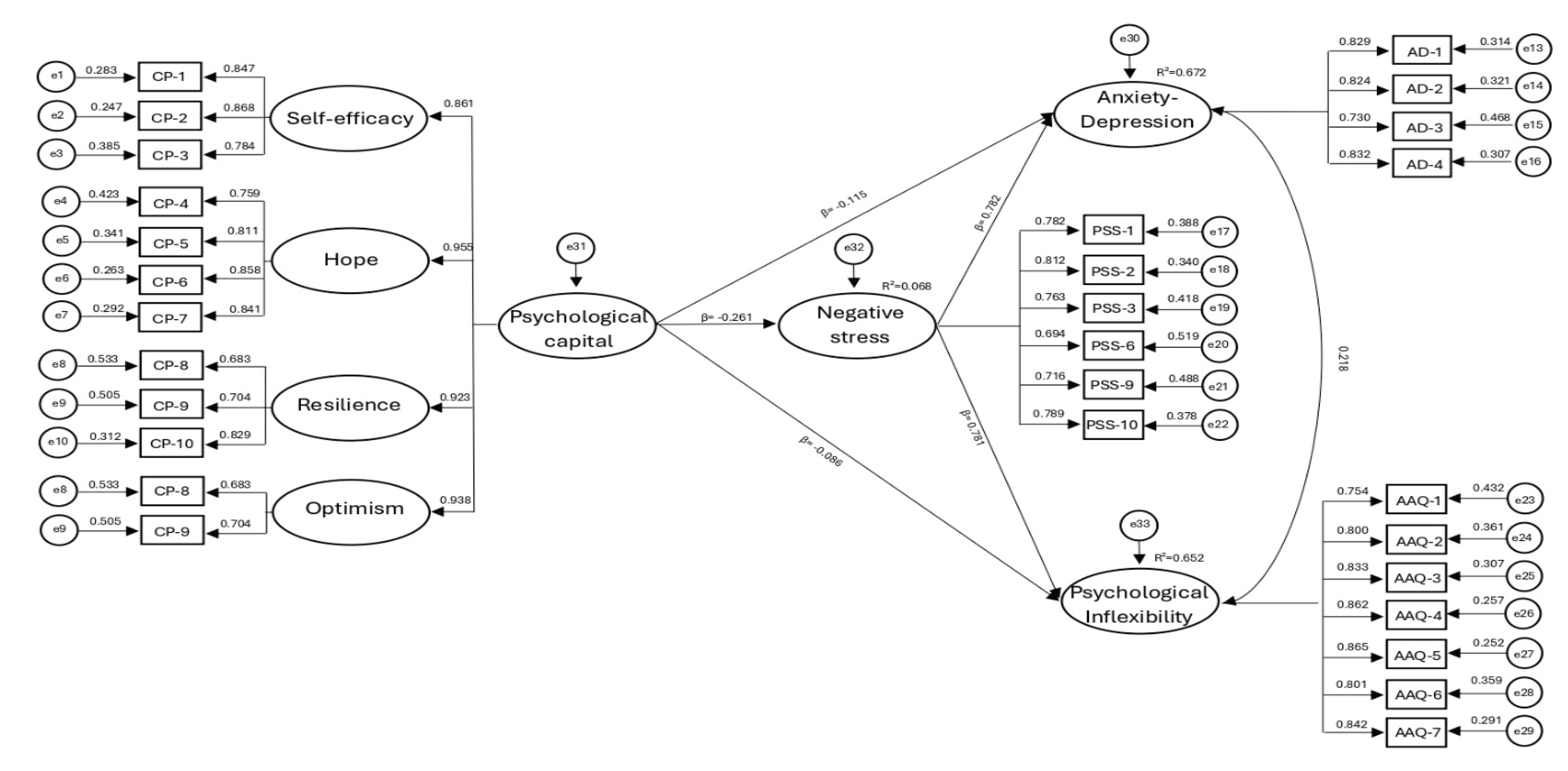
The structural equation modeling (SEM) analysis supported both the measurement and structural components of the proposed mediational model. The overall model demonstrated a good fit to the data: χ²(367) = 1732, p < .001; CFI = 0.947; TLI = 0.942; SRMR = 0.040; RMSEA = 0.055 (90% CI [0.053, 0.057]). Although the chi-square statistic was significant, this is expected given the large sample size; therefore, greater emphasis was placed on incremental and residual-based fit indices, which indicated an acceptable model fit.
Regarding the measurement model, all latent constructs exhibited strong psychometric properties. Factor loadings were high and statistically significant across all indicators (λ ranging from 0.683 to 0.868 for Psychological Capital dimensions, 0.694 to 0.812 for negative stress, 0.730 to 0.832 for anxiety–depression, and 0.754 to 0.865 for psychological inflexibility; all ps < .001), supporting indicator reliability.
Convergent validity was further confirmed through the Average Variance Extracted (AVE), with all constructs exceeding the recommended threshold of 0.50. Specifically, AVE values were 0.693 for self-efficacy, 0.670 for hope, 0.546 for resilience, and 0.725 for optimism. At the higher-order level, Psychological Capital was well represented by its four dimensions, with strong loadings (λ = 0.861–0.955). Additionally, the AVE values for the remaining constructs were satisfactory: 0.581 for negative stress, 0.649 for anxiety–depression, and 0.678 for psychological inflexibility. These findings provide robust evidence of convergent validity and internal consistency of the measurement model.
Turning to the structural model, Psychological Capital showed a significant negative effect on negative stress (β = –0.261, p < .001), indicating that higher levels of psychological resources are associated with lower perceived stress. In turn, negative stress had strong positive effects on both anxiety–depression (β = 0.782, p < .001) and psychological inflexibility (β = 0.781, p < .001), highlighting its central mediating role.
Direct effects from Psychological Capital to anxiety–depression (β = –0.115, p < .001) and psychological inflexibility (β = –0.086, p < .001) were statistically significant but comparatively small. In contrast, the indirect effects through negative stress were substantial and significant (β = –0.204, p < .001 for both outcomes), indicating that negative stress partially mediates the relationship between Psychological Capital and psychological distress.
The total effects of Psychological Capital were also significant (β = –0.319 for anxiety–depression and β = –0.290 for psychological inflexibility), supporting the theoretical relevance of this construct as a protective factor operating primarily through stress reduction mechanisms.
The model accounted for 6.8% of the variance in negative stress, 67.2% in anxiety–depression, and 65.2% in psychological inflexibility. These results suggest that while Psychological Capital modestly predicts stress, stress itself plays a dominant role in explaining downstream psychological outcomes.
Finally, a significant positive covariance was observed between anxiety–depression and psychological inflexibility (r = 0.216, p < .001), indicating that these constructs are related but empirically distinguishable. This supports their conceptualization as interconnected yet distinct components of psychological distress.
Figure 1.
Structural equation model depicting the mediating role of negative stress in the relationship between psychological capital and psychological distress outcomes (anxiety–depression and psychological inflexibility).
Figure 1.
Structural equation model depicting the mediating role of negative stress in the relationship between psychological capital and psychological distress outcomes (anxiety–depression and psychological inflexibility).
4. Discussion
The results supported a well-fitting structural model in which PsyCap showed significant negative associations with all indicators of psychological distress. These findings are framed within a structural equation modeling approach, which allows the simultaneous estimation of relationships among latent variables, providing a more precise and robust understanding of both direct and indirect effects. These results are consistent with international research that positions PsyCap as a key personal resource for managing emotional adversity, reducing uncertainty, and promoting psychological well-being in young populations (Finch et al., 2025; Moreno-Montero et al., 2024; Prasath et al., 2021).
Descriptive analyses revealed moderately high levels of PsyCap. Given that each dimension of the PCQ-12 comprises a different number of items (hope = 4, self-efficacy = 3, resilience = 3, optimism = 2), comparisons were interpreted relative to their scale ranges. When adjusted for item count, self-efficacy showed the highest level, followed closely by optimism and hope, while resilience presented the lowest relative score. These findings highlight self-efficacy as a salient strength, reflecting students’ confidence in their ability to handle academic and life demands (Luthans et al., 2015; King et al., 2020). Optimism and hope also emerged as relevant resources, capturing positive outcome expectancies and the capacity to set goals, generate pathways, and sustain motivation (Luthans et al., 2007; Youssef-Morgan & Luthans, 2015; López-Guerra et al., 2023). By contrast, resilience appeared comparatively weaker, suggesting a potential vulnerability in coping with setbacks and adapting to adversity, which underscores the need for interventions that strengthen this dimension in student populations.
Regarding psychological distress, students reported moderate levels of stress and relatively low levels of emotional symptoms, though with substantial variability. Importantly, the present study operationalized stress as a latent construct reflecting negative stress (i.e., perceived uncontrollability and distress), which enhances conceptual precision and avoids conflating stress with perceived coping capacity. This distinction is theoretically meaningful and aligns with previous psychometric and substantive findings. This heterogeneity is consistent with previous research in Latin American university populations (Moreta-Herrera et al., 2021; Torres et al., 2017). Likewise, mid-range levels of psychological inflexibility suggest that while some students struggle with rigid responses, others may benefit from greater psychological flexibility—a resource likely enhanced by PsyCap.
From a transdiagnostic perspective, the strong interrelationships between negative stress, emotional symptoms, and inflexibility underscore the presence of shared underlying mechanisms (Bond et al., 2011; Ruisoto et al., 2022; Chuquitarco & López-Guerra, 2025). The SEM results provide empirical support for a mediation model in which negative stress plays a central role in explaining how PsyCap is associated with anxiety–depression and psychological inflexibility. In line with this, recent findings from Ecuadorian university students indicate that psychological inflexibility and perceived stress jointly explain a significant proportion of the variance in anxiety and depression, further reinforcing their role as central transdiagnostic processes in student mental health (Vaca-Gallegos et al., 2025). These results complement the present study by highlighting the importance of PsyCap as a protective factor capable of buffering the impact of such mechanisms.
Consistent with the SEM framework, the results indicated partial mediation, as both direct and indirect effects of PsyCap on psychological outcomes were statistically significant. This suggests that PsyCap not only exerts a direct protective influence but also operates indirectly through the reduction of negative stress. This pattern strengthens the theoretical interpretation of PsyCap as a multidimensional resource with both immediate and process-based effects on mental health (Byrne, 2016; Finch et al., 2020).
The model accounted for a substantial proportion of variance in key outcomes. Specifically, approximately 67% of the variance in anxiety–depression and 65% in psychological inflexibility were explained, indicating a strong explanatory capacity of the model. These findings highlight the advantage of modeling constructs as latent variables, which allows for more accurate estimation by controlling for measurement error. Confirming PsyCap as a second-order construct composed of self-efficacy, hope, resilience, and optimism supports its theoretical foundation (Martínez et al., 2019; Luthans et al., 2007) and its relevance as a unified strength-based resource in academic settings.
Overall, these findings underscore the importance of promoting PsyCap as a protective factor to buffer stress, reduce emotional symptoms, and foster psychological flexibility. From an applied perspective, interventions should prioritize reducing negative stress—particularly perceptions of uncontrollability and overload—while strengthening PsyCap components, as this dual approach may enhance both direct and indirect pathways to psychological well-being. This approach may contribute to improving student well-being and academic persistence in demanding university contexts.
4.1. Practical Implications
The findings of this study offer important practical implications for higher education institutions in Latin America, particularly in light of the structural equation model that identifies perceived stress (specifically negative perceived stress) as a key mediating mechanism linking Psychological Capital (PsyCap) to psychological distress outcomes.
Universities are encouraged not only to implement evidence-based psychoeducational programs aimed at strengthening PsyCap (Luthans et al., 2007; Youssef-Morgan & Luthans, 2015), but also to prioritize interventions that directly target maladaptive stress appraisal processes, given their central role in the model. This implies a dual intervention strategy: enhancing personal psychological resources while simultaneously reducing vulnerability to stress-related emotional dysregulation.
Programs designed to foster PsyCap may include goal-setting workshops to strengthen hope (Luthans et al., 2015), self-regulated learning strategies to enhance self-efficacy (King et al., 2020), adaptive coping practices to build resilience (Coutu, 2002), and cognitive restructuring or positive reappraisal techniques to promote optimism (Seligman, 2002). However, based on the present findings, these interventions should be integrated with stress management components, such as mindfulness-based interventions, stress inoculation training, and cognitive-behavioral techniques aimed at reducing negative perceived stress.
Embedding these combined interventions within university counseling and student support services is particularly relevant in contexts where stress, anxiety, and depressive symptoms are highly prevalent (Moreta-Herrera et al., 2021; Vaca-Gallegos et al., 2025). Importantly, the results suggest that reductions in psychological distress may be achieved not only through direct enhancement of PsyCap but also indirectly through its buffering effect on perceived stress, reinforcing the importance of targeting both pathways in intervention design.
Furthermore, strengthening PsyCap and reducing negative stress perceptions may contribute to improved academic engagement, persistence, and overall well-being, consistent with prior research in both Latin American and international contexts (Datu & Valdez, 2016; Ortega-Maldonado & Salanova, 2017; Moreno-Montero et al., 2024).
In settings characterized by socioeconomic instability and limited access to mental health services, this integrated approach represents a cost-effective and scalable strategy, as PsyCap-based interventions can be delivered through brief, structured programs and digital platforms. This is particularly relevant in Latin America, where structural inequalities and contextual stressors increase students’ vulnerability (Gómez-Restrepo et al., 2025).
Overall, incorporating PsyCap development alongside targeted stress reduction strategies into university policies and preventive mental health programs may provide a sustainable and theoretically grounded pathway to reduce psychological distress and enhance adaptive functioning among university students.
4.2. Limitations
Several limitations should be acknowledged. First, the structural equation model was specified with a single latent variable (PsyCap) predicting observed indicators of distress. This asymmetry may have constrained the explanatory power of the model, as measurement error was not accounted for in the outcomes. Future studies would benefit from modeling both predictors and outcomes as latent constructs.
Second, the cross-sectional, non-experimental design limits the ability to draw conclusions about directionality. While PsyCap was negatively associated with stress, anxiety, depression, and inflexibility, these associations cannot establish temporal precedence or infer causality. Longitudinal and experimental designs are needed to determine the stability of these relationships over time and in high-risk contexts (Finch et al., 2025; Moreno-Montero et al., 2024).
Third, the reliance on self-report questionnaires may introduce biases such as social desirability and inaccuracies in recall (Brenner & De Lamater, 2016). The incorporation of complementary methods, including behavioral measures or informant reports, would strengthen future research (Rosenman et al., 2011).
Finally, the non-probabilistic sample, drawn exclusively from students in Loja, Ecuador, limits generalizability. Replication in other regions and among diverse sociocultural groups—including rural, Indigenous, and socioeconomically vulnerable populations—is essential (Moreno-Montero et al., 2024). Moreover, the study did not investigate potential mediating or moderating mechanisms, such as coping strategies, emotion regulation, or social support, which may explain how PsyCap exerts its protective effects (Khan et al., 2024).
5. Conclusions
This study provides robust empirical evidence supporting the protective role of Psychological Capital (PsyCap) in relation to psychological distress among Ecuadorian university students. The structural equation model demonstrated good fit indices and revealed meaningful direct and indirect associations between PsyCap and key indicators of mental health, including perceived stress, anxiety and depression symptoms, and psychological inflexibility.
First, PsyCap showed significant negative associations with perceived stress, emotional symptoms, and psychological inflexibility, reinforcing its role as a core psychological resource that promotes emotional regulation and adaptive functioning in demanding academic contexts. Importantly, the findings extend previous research by demonstrating that perceived stress (particularly negative perceived stress) acts as a significant mediating mechanism through which PsyCap influences psychological distress outcomes. This highlights the central role of stress appraisal processes in understanding how positive psychological resources translate into better mental health.
Second, the strong intercorrelations among distress indicators confirmed their conceptual overlap and supported a transdiagnostic perspective. These results suggest the presence of shared underlying psychological processes, with perceived stress emerging as a key integrative mechanism linking different forms of distress, thereby reinforcing the need for preventive approaches that simultaneously target multiple dimensions of psychological vulnerability.
Third, the results supported the second-order structure of PsyCap, with substantial contributions from its four dimensions—hope, self-efficacy, resilience, and optimism. This finding is consistent with theoretical models that conceptualize PsyCap as a dynamic and malleable construct, capable of being enhanced through targeted psychoeducational interventions.
Taken together, these findings contribute to the growing body of positive psychology research in Latin America, a region that remains underrepresented in the literature. Moreover, the study provides empirical support for a theoretically grounded model in which PsyCap not only exerts direct protective effects on mental health but also indirectly reduces psychological distress by buffering the impact of perceived stress.
Finally, these results highlight the importance of promoting PsyCap within higher education settings through evidence-based interventions that strengthen its core dimensions while also addressing maladaptive stress processes. Future research should adopt longitudinal and experimental designs to further examine causal relationships and to clarify the dynamic interplay between PsyCap, stress, and mental health outcomes over time.
6. Patents
This section is not mandatory but may be added if there are patents resulting from the work reported in this manuscript.
Supplementary Materials
The following supporting information can be downloaded at the website of this paper posted on Preprints.org, Figure S1: title; Table S1: title; Video S1: title.
Author Contributions
Dolores Lucía Quinde and Sandra Guevara Mora contributed to the conceptualization of the study, investigation, drafting of the manuscript, and critical revision of the manuscript. Víctor López-Guerra contributed to the conceptualization, methodology, formal data analysis, investigation, and drafting and critical revision of the manuscript. All authors read and approved the final version of the manuscript.
Funding
This research received no external funding
Institutional Review Board Statement
The study was conducted in accordance with the ethical principles of the Declaration of Helsinki (World Medical Association, 2013) and complied with international standards for research involving human participants. All participants were adult volunteers who provided informed consent prior to participation. Given the minimal-risk and non-invasive nature of the study, formal approval from an institutional ethics committee was not required under local regulations. However, the research protocol was reviewed and authorized by the Universidad Técnica Particular de Loja to ensure adherence to ethical research standards.
Informed Consent Statement
Informed consent was obtained from all subjects involved in the study. Confidentiality and anonymity were strictly maintained throughout data collection, handling, and analysis.
Data Availability Statement
The data presented in this study are available on reasonable request from the corresponding author. Restrictions apply due to confidentiality agreements and institutional regulations. The author will provide anonymized datasets to qualified researchers for purposes of verification, replication, or further academic inquiry.
Acknowledgments
The author gratefully acknowledges the support of the Universidad Técnica Particular de Loja (UTPL), Ecuador, for providing the academic environment and institutional resources that made this research possible
Conflicts of Interest
The author declares no conflicts of interest. This research received no external funding.
Abbreviations
The following abbreviations are used in this manuscript:
| AAQ-II Acceptance and Action Questionnaire-II APA American Psychiatric Association CFI Comparative Fit Index CV Coefficient of Variation DOI Digital Object Identifier EJIHPE European Journal of Investigation in Health, Psychology and Education GAD-2 Generalized Anxiety Disorder-2 items ML Maximum Likelihood PCQ-12 Psychological Capital Questionnaire-12 PHQ-2 Patient Health Questionnaire-2 items PHQ-4 Patient Health Questionnaire-4 items PsyCap Psychological Capital PSS-10 Perceived Stress Scale-10 items RMSEA Root Mean Square Error of Approximation SD Standard Deviation SEM Structural Equation Modeling SRMR Standardized Root Mean Square Residual TLI Tucker–Lewis Index UTPL Universidad Técnica Particular de Loja |
References
- American Psychiatric Association. Diagnostic and statistical manual of mental disorders, 5th ed., text rev.; 2022. [Google Scholar] [CrossRef]
- Bond, F.; Hayes, S.; Baer, R.; Zettle, R.; Carpenter, K.; Guenole, N.; Waltz, H. O. Preliminary psychometric properties of the Acceptance and Action Questionnaire–II: A revised measure of psychological inflexibility and experiential avoidance. Behavior Therapy 2011, 42(4), 678–688. [Google Scholar] [CrossRef]
- Brenner, P. S.; DeLamater, J. Lies, damned lies, and survey self-reports? Identity as a cause of measurement bias. Social Psychology Quarterly 2016, 79(4), 333–354. [Google Scholar] [CrossRef]
- Byrne, B. Structural equation modeling with AMOS, 3rd ed.; Routledge, 2016. [Google Scholar]
- Carmona-Halty, M.; Villegas-Robertson, J. M. El capital psicológico predice el bienestar y desempeño en estudiantes secundarios chilenos. Revista Interamericana de Psicología 2018, 52(3), 399–409. [Google Scholar] [CrossRef]
- Chuquitarco Marín, M. J.; López-Guerra, V. M. Variables transdiagnósticas y depresión en una muestra de mujeres ecuatorianas. Eureka. Revista Científica de Psicología 2025, 22(1), 121–142. [Google Scholar] [CrossRef]
- Cohen, S.; Kamarck, T.; Mermelstein, R. A global measure of perceived stress. Journal of Health and Social Behavior 1983, 24(4), 385–396. [Google Scholar] [CrossRef]
- Coletti, J.; Teti, G. Terapia de Aceptación y Compromiso (ACT): conductismo, mindfulness y valores. Vertex. Revista Argentina de Psiquiatría 2015, 26(119), 37–42. Available online: https://pubmed.ncbi.nlm.nih.gov/26323112/. [PubMed]
- Copeland, W. E.; Adair, C. E.; Smetanin, P.; Konold, T.; Krueger, K.; Costello, E. J.; Angold, A.; Jones, D. E.; Zeanah, C. H. Diagnostic transitions from childhood to adolescence to early adulthood. Journal of Child Psychology and Psychiatry 2013, 54(7), 791–799. [Google Scholar] [CrossRef] [PubMed]
- Coutu, D. How resilience works. Harvard Business Review 2002, 80(5), 46–55. Available online: https://pubmed.ncbi.nlm.nih.gov/12024758/.
- Datu, J. A. D.; Valdez, J. P. M. Psychological capital predicts academic engagement and well-being in Filipino high school students. The Asia-Pacific Education Researcher 2016, 25(3), 399–405. [Google Scholar] [CrossRef]
- De Abreu Da Silva, Y.; Angelucci Bastidas, L. T. Predictores de la salud mental durante la cuarentena por la COVID-19. Revista de Psicopatología y Psicología Clínica 2023, 28(1), 27–38. [Google Scholar] [CrossRef]
- Finch, J.; Farrell, L. J.; Waters, A. M. Searching for the HERO in youth: Does psychological capital (PsyCap) predict mental health symptoms and subjective wellbeing in Australian school-aged children and adolescents? Child Psychiatry & Human Development 2020, 51(6), 1025–1036. [Google Scholar] [CrossRef]
- Finch, J.; Waters, A. M.; Farrell, L. J. Adolescent anxiety, depression and flourishing before and during COVID-19 and the predictive role of baseline psychological capital (PsyCap) on student mental health and subjective wellbeing during the pandemic. Child Psychiatry & Human Development 2025, 56(2), 392–404. [Google Scholar] [CrossRef]
- Finney, S.; DiStefano, C. Non-normal and categorical data in structural equation modeling. In Structural equation modeling: A second course; Hancock, G., Mueller, R., Eds.; Information Age Publishing, 2006; pp. 269–314. [Google Scholar]
- Galve-González, C.; Bernardo, A. B.; Núñez, J. C. Academic trajectories: The role of engagement as a mediator in the decision of university dropout or persistence. Revista de Psicodidáctica 2024, 29(1), 130–138. [Google Scholar] [CrossRef]
- Gómez-Restrepo, C.; Diez-Canseco, F.; Brusco, L. I.; Jassir Acosta, M. P.; Olivar, N.; Carbonetti, F. L.; Hidalgo-Padilla, L.; Toyama, M.; Uribe-Restrepo, J. M.; Rodríguez Malagon, N.; Niño-Torres, D.; Godoy Casasbuenas, N.; Stanislaus Sureshkumar, D.; Fung, C.; Bird, V.; Morgan, C.; Araya, R.; Kirkbride, J.; Priebe, S. Mental distress among youths in low-income urban areas in South America. JAMA Network Open 2025, 8(3), e250122. [Google Scholar] [CrossRef] [PubMed]
- González-Cantero, J. O.; Oropeza-Tena, R.; Padrós-Blázquez, F.; Colunga-Rodríguez, C.; Montes-Delgado, R.; González-Becerra, V. H. Capital psicológico y su relación con el estilo de vida de universitarios mexicanos. Nutrición Hospitalaria 2017, 34(2), 439–443. [Google Scholar] [CrossRef]
- Hu, L. T.; Bentler, P. M. Cutoff criteria for fit indexes in covariance structure analysis: Conventional criteria versus new alternatives. Structural Equation Modeling 1999, 6(1), 1–55. [Google Scholar] [CrossRef]
- Junmei, X.; Man, H.; Jintao, W.; Ye, L.; Guangrong, J. Cumulative risk and mental health in Chinese adolescents: The moderating role of psychological capital. School Psychology International 2020, 41(5), 409–429. [Google Scholar] [CrossRef]
- Khan, A.; Zeb, I.; Zhang, Y.; Fazal, S.; Ding, J. Relationship between psychological capital and mental health at higher education: Role of perceived social support as a mediator. Heliyon 2024, 10(4), e29472. [Google Scholar] [CrossRef]
- King, R.; Pitliya, R.; Datu, J. A. Psychological capital drives optimal engagement via positive emotions in work and school contexts. Asian Journal of Social Psychology 2020, 23(4), 457–468. [Google Scholar] [CrossRef]
- Kroenke, K.; Spitzer, R.; Williams, J.; Löwe, B. An ultra-brief screening scale for anxiety and depression: The PHQ–4. Psychosomatics 2009, 50(6), 613–621. [Google Scholar] [CrossRef] [PubMed]
- Li, D. Influence of the youth’s psychological capital on social anxiety during the COVID-19 pandemic outbreak: The mediating role of coping style. Iranian Journal of Public Health 2020, 49(11), 2060–2068. [Google Scholar] [CrossRef]
- Liu, C.; Zhao, Y.; Tian, X.; Zou, G.; Li, P. Negative life events and school adjustment among Chinese nursing students: The mediating role of psychological capital. Nurse Education Today 2015, 35(6), 754–759. [Google Scholar] [CrossRef]
- López-Guerra, V.; Aguirre Mejía, Á J.; Guerrero Alcedo, J. M. Propiedades psicométricas y estructura factorial del cuestionario de salud del paciente PHQ-4 en estudiantes universitarios ecuatorianos. Revista Cubana de Enfermería 2022, 38(3), e4885. [Google Scholar] [CrossRef]
- López-Guerra, V.; Ocampo-Vásquez, K.; Quinde, L.; Guevara-Mora, S.; Guerrero-Alcedo, J. Psychometric properties and factorial structure of the Spanish version of the psychological capital scale in Ecuadorian university students. PLOS ONE 2023, 18(5), e0285842. [Google Scholar] [CrossRef]
- López-Guerra, V. M.; López-Núñez, C.; Vaca-Gallegos, S. L.; Torres-Carrión, P. V. Psychometric properties and factor structure of the Patient Health Questionnaire-9 as a screening tool for depression among Ecuadorian college students. Frontiers in Psychology 13 2022, 813894. [Google Scholar] [CrossRef] [PubMed]
- Luthans, F.; Avolio, B. J.; Avey, J. B.; Norman, S. M. Positive psychological capital: Measurement and relationship with performance and satisfaction. Personnel Psychology 2007, 60(3), 541–572. [Google Scholar] [CrossRef]
- Luthans, F.; Luthans, K. W.; Luthans, B. C. Positive psychological capital: Beyond human and social capital. Business Horizons 2004, 47(1), 45–50. [Google Scholar] [CrossRef]
- Luthans, F.; Youssef-Morgan, C.; Avolio, B. Psychological capital and beyond; Oxford University Press, 2015; Available online: https://psycnet.apa.org/record/2015-14665-000.
- Martínez, I. M.; Meneghel, I.; Carmona-Halty, M.; Youssef-Morgan, C. M. Adaptation and validation to Spanish of the Psychological Capital Questionnaire–12 (PCQ–12) in academic contexts. Current Psychology 2021, 40(7), 3409–3416. [Google Scholar] [CrossRef]
- Moreta-Herrera, R.; Zambrano-Estrella, J.; Sánchez-Vélez, H.; Naranjo-Vaca, S. Salud mental en universitarios del Ecuador: Síntomas relevantes, diferencias por género y prevalencia de casos. Pensamiento Psicológico 2021, 19(1), 1–26. [Google Scholar] [CrossRef]
- Moreno-Montero, E.; Ferradás, M. d. M.; Freire, C. Personal resources for psychological well-being in university students: The roles of psychological capital and coping strategies. European Journal of Investigation in Health, Psychology and Education 2024, 14(10), 2686–2701. [Google Scholar] [CrossRef]
- Nkire, N.; Nwachukwu, I.; Shalaby, R.; Hrabok, M.; Vuong, W.; Gusnowski, A.; Surood, S.; Greenshaw, A. J.; Agyapong, V. COVID-19 pandemic: Influence of relationship status on stress, anxiety, and depression in Canada. Irish Journal of Psychological Medicine 2021, 1–12. [Google Scholar] [CrossRef]
- Ortega-Maldonado, A.; Salanova, M. Psychological capital and performance among undergraduate students: The role of meaning–focused coping and satisfaction. Teaching in Higher Education 23 2017, 390–402. [Google Scholar] [CrossRef]
- Paladines-Costa, B.; López-Guerra, V.; Ruisoto, P.; Vaca-Gallegos, S.; Cacho, R. Psychometric properties and factor structure of the Spanish version of the Acceptance and Action Questionnaire-II (AAQ-II) in Ecuador. International Journal of Environmental Research and Public Health 2021, 18(6), 2944. [Google Scholar] [CrossRef]
- Parlapani, E.; Holeva, V.; Voitsidis, P.; Blekas, A.; Gliatas, I.; Porfyri, G. N.; Golemis, A.; Papadopoulou, K.; Dimitriadou, A.; Chatzigeorgiou, A. F.; Bairachtari, V.; Patsiala, S.; Skoupra, M.; Papigkioti, K.; Kafetzopoulou, C.; Diakogiannis, I. Psychological and behavioral responses to the COVID-19 pandemic in Greece. Frontiers in Psychiatry 11 2020, 821. [Google Scholar] [CrossRef] [PubMed]
- Prasath, P. R.; Mather, P. C.; Bhat, C. S.; James, J. K. University student well-being during COVID-19: The role of psychological capital and coping strategies. The Professional Counselor 2021, 11(1), 46–60. [Google Scholar] [CrossRef]
- Remor, E. Psychometric properties of a European Spanish version of the Perceived Stress Scale (PSS). The Spanish Journal of Psychology 2006, 9(1), 86–93. [Google Scholar] [CrossRef] [PubMed]
- Rodríguez-Rey, R.; Garrido-Hernansaiz, H.; Collado, S. Psychological impact and associated factors during the initial stage of the Coronavirus (COVID-19) pandemic among the general population in Spain. Frontiers in Psychology 11 2020, 1540. [Google Scholar] [CrossRef]
- Rosenman, R.; Tennekoon, V.; Hill, L. G. Measuring bias in self-reported data. International Journal of Behavioural and Healthcare Research 2011, 2(4), 320–332. [Google Scholar] [CrossRef]
- Ruiz, F. J.; Langer Herrera, Á I.; Luciano, C.; Cangas, A. J.; Beltrán, I. Measuring experiential avoidance and psychological inflexibility: The Spanish version of the Acceptance and Action Questionnaire-II. Psicothema 2013, 25(1), 123–129. [Google Scholar] [CrossRef]
- Ruisoto, P.; López-Guerra, V. M.; Paladines, M. B.; Vaca, S. L.; Cacho, R. Psychometric properties of the three versions of the Perceived Stress Scale in Ecuador. Physiology & Behavior 224 2020, 113045. [Google Scholar] [CrossRef]
- Ruisoto, P.; López-Guerra, V.; López-Núñez, C.; Sánchez-Puertas, R.; Paladines-Costa, M.; Pineda-Cabrera, N. Transdiagnostic model of psychological factors and sex differences in depression in a large sample of Ecuador. International Journal of Clinical and Health Psychology 2022, 22(3), 100322. [Google Scholar] [CrossRef]
- Seligman, M. E. P. Positive psychology, positive prevention, and positive therapy. In Handbook of positive psychology; Snyder, C. R., Lopez, S. J., Eds.; Oxford University Press, 2002; pp. 3–9. Available online: http://www.positiveculture.org/uploads/7/4/0/7/7407777/seligrman_intro.pdf.
- Siu, O. L.; Bakker, A.; Jiang, X. Psychological capital among university students: Relationships with study engagement and intrinsic motivation. Journal of Happiness Studies 15 2014, 979–994. [Google Scholar] [CrossRef]
- Spence, R.; Kagan, L.; Nunn, S.; Bailey-Rodriguez, D.; Fisher, H. L.; Hosang, G. M.; Bifulco, A. Life events, depression and supportive relationships affect academic achievement in university students. Journal of American College Health 2022, 70(6), 1931–1935. [Google Scholar] [CrossRef]
- Supe Landa, R. V.; Gavilanes Manzano, F. R. Ansiedad y calidad de vida en estudiantes universitarios: Anxiety and quality of life in university students. LATAM Revista Latinoamericana de Ciencias Sociales y Humanidades 2023, 4(2), 2522–2530. [Google Scholar] [CrossRef]
- Torres, C.; Otero, P.; Bustamante, B.; Blanco, V.; Díaz, O.; Vázquez, F. L. Problemas de salud mental y factores relacionados en estudiantes universitarios ecuatorianos. International Journal of Environmental Research and Public Health 2017, 14(5), 530. [Google Scholar] [CrossRef]
- Vaca-Gallegos, S. L.; Peñaherrera-Aguirre, M.; Batallas, D.; Paladines-Costa, B. M.; López-Nuñez, C.; Ruisoto, P. Alone and under pressure: The transdiagnostic role of loneliness, stress, and psychological inflexibility in university students. Frontiers in Public Health 2025, 13, 1642529. [Google Scholar] [CrossRef]
- Visser, M.; Law-van Wyk, E. University students’ mental health and emotional wellbeing during the COVID-19 pandemic and ensuing lockdown. South African Journal of Psychology 2021, 51(2), 229–243. [Google Scholar] [CrossRef]
- Wang, C.; Pan, R.; Wan, X.; Tan, Y.; Xu, L.; Ho, C.; Ho, R. Immediate psychological responses and associated factors during the initial stage of the 2019 coronavirus disease (COVID-19) epidemic among the general population in China. International Journal of Environmental Research and Public Health 2020, 17(5), 1729. Available online: https://www.ncbi.nlm.nih.gov/pmc/articles/PMC7084952/. [CrossRef] [PubMed]
- Wang, W.; Wang, J.; Zhang, X.; Pei, Y.; Tang, J.; Zhu, Y.; Liu, X. Network connectivity between anxiety, depressive symptoms and psychological capital in Chinese university students during the COVID-19 campus closure. Journal of Affective Disorders 329 2023, 11–18. [Google Scholar] [CrossRef]
- World Medical Association. World Medical Association Declaration of Helsinki: Ethical principles for medical research involving human subjects. JAMA 2013, 310(20), 2191–2194. [Google Scholar] [CrossRef]
- Yan, L.; Gan, Y.; Ding, X.; Wu, J.; Duan, H. The relationship between perceived stress and emotional distress during the COVID-19 outbreak: Effects of boredom proneness and coping style. Journal of Anxiety Disorders 77 2021, 102328. [Google Scholar] [CrossRef] [PubMed]
- Youssef-Morgan, C. M.; Luthans, F. Psychological capital and well-being. Stress and Health 2015, 31(3), 180–188. [Google Scholar] [CrossRef] [PubMed]
- Zewude, G. T.; Bereded, D. G.; Abera, E.; Tegegne, G.; Goraw, S.; Segon, T. The impact of internet addiction on mental health: Exploring the mediating effects of positive psychological capital in university students. Adolescents 2024, 4(2), 200–221. [Google Scholar] [CrossRef]

Table 1.
Descriptive statistics of the study variables and their dimensions.
| Study variables | M | Me | SD | CV | AS | K | Min | Max |
| Psychological Capital | 53.68 | 57 | 13.81 | 25.73% | -1.385 | 2.229 | 0 | 72 |
| Self-efficacy | 13.85 | 15 | 3.99 | 28.81% | -1.395 | 1.786 | 0 | 18 |
| Hope | 18,14 | 19 | 5.00 | 27.56% | -1.366 | 1.961 | 0 | 24 |
| Resilience | 12.51 | 13 | 3.839 | 30.69% | -0.864 | 0.606 | 0 | 18 |
| Optimism | 9.18 | 10 | 2,658 | 28.95% | -1.239 | 1.444 | 0 | 12 |
| Psychological Inflexibility | 24.55 | 24 | 11.081 | 45.14% | 0.216 | -0.859 | 7 | 49 |
| Perceived stress (negative dimension) | 12.24 | 12 | 5.320 | 43.5 % | -0.140 | -0.298 | 0 | 24 |
| Anxiety/Depression | 4.27 | 4 | 3.094 | 72.47% | 0.472 | 0.387 | 0 | 12 |
Note: M = mean; Me = median; SD = standard deviation; CV = coefficient of variation; AS = skewness; K = kurtosis; Min = minimum; Max = maximum. PsyCap subscales include different item numbers (hope = 4, self-efficacy = 3, resilience = 3, optimism = 2), with corresponding maximum scores of 24, 18, 18, and 12. For interpretation, mean scores were also considered relative to the number of items in each subscale.
Disclaimer/Publisher’s Note: The statements, opinions and data contained in all publications are solely those of the individual author(s) and contributor(s) and not of MDPI and/or the editor(s). MDPI and/or the editor(s) disclaim responsibility for any injury to people or property resulting from any ideas, methods, instructions or products referred to in the content. |
© 2026 by the authors. Licensee MDPI, Basel, Switzerland. This article is an open access article distributed under the terms and conditions of the Creative Commons Attribution (CC BY) license.
Copyright: This open access article is published under a Creative Commons CC BY 4.0 license, which permit the free download, distribution, and reuse, provided that the author and preprint are cited in any reuse.


