

Submitted:
21 April 2026
Posted:
21 April 2026
You are already at the latest version
Abstract
Deep soil cementation is widely used for strengthening weak soils; however, the effectiveness of injection mortars largely depends on their penetration ability and interaction with in-situ soil conditions. This study aims to evaluate the performance of an injection mortar through large-scale model testing under conditions as realistic as possible. The experiments were conducted at a scale of 1:25 using loamy soils representative of Astana’s engineering-geological conditions. The model soil was prepared by reproducing natural density and moisture parameters, including an average natural density of 1.85 g/cm³ and moisture content of 13.3%, while overburden pressure was simulated using a rigidly fixed cover. Laboratory tests determined consistency limits (plastic limit 14.42%, liquid limit 19.75%), indicating a semi-solid to solid soil state. A strong correlation (R = 0.99) between added water and achieved moisture content was established, with an optimal water volume of 18,900 cm³ required to achieve target conditions. Compaction tests showed that the required density was achieved with 20-50 roller passes depending on layer depth, resulting in final densities of 1.85-1.88 g/cm³. The results confirm that the proposed modeling approach reliably reproduces in-situ conditions and can be effectively used to assess injection mortar performance in weak soil stabilization.
Keywords:
tray tests
; equivalent layer
; loam
; injection mortar
; scale modeling
1. Introduction
This paper presents the results of preparatory work on large-scale modeling carried out within the framework of studies aimed at evaluating the performance of an injection mortar. The injection mortar is intended for use in deep soil cementation, which is one of the most effective methods for strengthening weak soils, particularly under complex geological conditions [1]. Deep soil cementation is widely applied in construction, including slope stabilization, landslide prevention, and the reinforcement of building foundations [2]. The essence of the method lies in injecting a cement-based grout into the soil mass, which significantly improves its mechanical properties [3].
Recently, the use of injection mortars has become widespread at construction sites in Kazakhstan [4]. Most projects are associated with the rehabilitation of deteriorated buildings, where injection is a key method for strengthening foundations and substructures [5]. Due to the increasing relevance of this method, there is a need to develop injection mortars with enhanced mobility properties that are more effective than existing analogues.
The performance of the injection mortar for soil stabilization using deep cementation was evaluated through model testing at a scale of 1:25. The objective of the model tests was to assess the penetration capacity of the mortar and the formation of a reinforced soil structure around the injection borehole under conditions as close as possible to real ones. Therefore, the soil base modeling was carried out not based on dynamic similarity of an equivalent soil, but by reproducing soils with real density and moisture parameters, as well as simulating overburden pressure (hereinafter referred to as model soil) [6]. The overburden pressure was simulated using a rigidly fixed cover placed on top of the test tray. This solution prevents soil heave from the tray surface (following the principle of least resistance), thereby simulating in-situ pressure conditions characteristic of deep soil stabilization [7].
Tray tests were conducted under conditions representing loamy soils, with the aim of evaluating the performance of the injection mortar in realistic ground conditions [8]. The selected loam corresponds to the most widespread engineering-geological formations of Astana.
2. Materials and Methods
The selection of the model of the soil base of the tray tests (Figure 1) was carried out by monitoring the density and humidity of natural soil. The studies were performed in the following sequence:
1. Determination of the consistency of clay soil
2. Determination of natural soil moisture and density
3. Determination of soil density in a loose, dry state
4. Development of soil modeling technology for model tests
Consistency assessment (Atterberg limits) will be performed for clay soils in accordance with GOST 51180 [9]. The limits of plasticity and fluidity are necessary to assess the relationship of a finely dispersed colloidal active medium with water, which in turn will give an idea of the potential strength of clay soil. Consistency indicators will allow you to determine the necessary parameters of the model soil.
The assessment of density and humidity in the natural and loose dry state of soils will be performed in accordance with GOST 51180. These indicators are necessary for the technological process of preparing model sand and clay soil, in particular, the process of compacting model soil to a given density value and soaking it to a given humidity value. The need to determine the values of densities in the loose and dry state is necessary to obtain a homogeneous soil by controlling the humidity of the model soil (with variable humidity in the loose state of the model soil, achieving uniformity in humidity is difficult).
Density control tests were performed in a tray, using the method of layer-by-layer laying of layers of model soil. The dimensions of the tray are: tray width 50cm, tray length 100cm, layer height 75cm. The thickness of each layer to be compacted by rolling is 15 cm, therefore, the total number of layers laid sequentially is 5. The tests were carried out sequentially both for one layer (to estimate the amount of rolling of the layer to a given density, and for all layers, to assess the compaction of the underlying layers. The density of the underlying layers was monitored after every 10 ground rolls, ranging from 10 to 70 rolls. Density control was carried out with each subsequent addition of a new layer.
Evaluation of the model soil moisture control was performed by sampling after moistening and compacting the soil in a tray with a roller with a total weight of 12 kg. Control samples were taken after rolling the model soil. At this stage, the density of the model soil, therefore, the number of roller penetrations, does not matter significantly. The key is the loss of moisture due to mechanical impact on the model soil of the roller during its compaction. From the experience of compacting the model soil, the fixed number of roller penetrations was 60 (on average, 30-70 penetrations). The process of preparing the model soil in the tray assumed a layer-by-layer fixed compaction of the soil with a variable humidity of the model soil layer, 5 cm thick. The mass fraction of water added to the model soil composition was determined from the condition: tray width 50 cm, tray length 100 cm, layer height 15 cm, volume of one soil layer 75000cm3. After estimating the densities, the mass of added water was calculated.
Assessment of the model soil density control was performed by sampling after the soil in the tray was moistened to a set value, that is, after determining the amount of water required to achieve the set natural humidity. The sequence of initial humidity control and then density (only for loam) is that the soil moisture index affects the compaction process (with different humidity, the number of roller penetrations may be different, and humidity losses do not strongly depend on the number of roller penetrations). The process of preparing the model soil in the tray assumed variable compaction of the soil at a fixed humidity of the model soil layer, 15 cm thick.
3. Results
3.1. Results of Testing the Consistency of Loamy Soil
Figure 2 shows the results of determining the consistency of loamy soil. Figure 2A shows the average values of twelve independent plastic and liquid limits measurements. Figure 2a also shows the natural moisture content of the selected samples in order to understand the fluid state of the soil in the natural composition. The latter indicator is necessary for modeling equivalent soil in model tests. Figure 2b shows the calculated average values of plastic (on the main ordinate axis) and liquid indices (on the auxiliary ordinate axis).
According to the measurement results, the partial values of plastic limits are in the range of 14-15%, and the average is 14.42%. Partial values of liquid limits are in the range of 19-20%, and the average is 19.75%. All partial values of plastic and liquid limits have a relatively close relationship, the coefficients of variation do not exceed 3.5%. According to the diagram of Figure 2A, the water contents values of the selected samples have a large data spread, lie in the range from 10.3 to 15.2%, which is also indicated by the coefficient of variation equal to 9.6%. The average value of water contents was 13.3% (This indicator will be necessary when preparing the model soil for the specified value of water contents). Thus, it can be seen that most samples of loamy soil are below the plastic limits, and therefore not in a plastic state. According to the calculation results, the average values of plastic indices are 5.33, and the quotients range from 5 to 6.A coefficient of variation equal to 9.2% indicates an average but acceptable relationship (not exceeding 15%) of the quotients. The average values of liquid indexes are -0.22, and the partial values lie in the range of -0.74 – 0.2. The coefficient of variation, which is -122.7%, is not very important in this case, since these indicators directly depend on the natural water contents and are relative, and the liquid index indicator itself characterizes the plastic state of the soil. Thus, the studied loam is from a semi-solid to a solid state.
3.2. Results of Soil Density and Humidity Tests
Figure 3 shows the results of partial and average densities of sandy and loamy soils. Figure 3a shows the results of density in the natural state, Figure 3b-in the loose dry state.
Partial values of loam densities in the natural state range from 1.78 to 1.94 g /cm3, and the average value is 1.85 g/cm3, which corresponds to a higher average density for loams. All partial values of loamy soil densities are closely related; in both cases, the coefficient of variation does not exceed 2.8%. Partial values of loam densities in the loose state range from 1.46 to 1.52 g /cm3, and the average is 1.48 g/cm3. All partial values of loamy soil densities logically have a close relationship, the coefficient of variation does not exceed 1.5%.
Figure 4a shows the results of moisture content of the model soil after compaction with a roller with a total weight of 12 kg. The diagram characterizes the change in soil moisture (after compaction) from the amount of water in the model soil. The ordinate axis shows the amount of water added to the model soil in liters, and the abscissa scale shows the actual humidity of the soaked soil. Figure 4b shows the results of compaction of the model soil. The diagram characterizes the change in the density of the soil (its compaction) from the number of penetrations by the sealing roller on the soil surface, from the condition of previously determined humidity (diagram of Figure 4a).
According to the results of determining the amount of soaking of the model soil with water, a regular positive correlation of 0.99 is observed, which indicates a close to linear relationship. The minimum calculated humidity is 13.24%, which is lower than the natural humidity (taking into account the potential loss of humidity, it can be considered sufficient). Based on the research results, it was found that the moisture loss (the difference between the calculated and actual) decreases with an increase in the amount of water in the model soil composition. With an estimated humidity of 13.60%, the actual humidity was 13.34%, which is very close to the natural humidity of 13.32%. Thus, water losses during compaction, although not significant (2%), do occur. Thus, the required amount of water per 75,000cm3 of model soil, to achieve the natural moisture content of loamy soil, is 18,900cm3 of water.
According to the results of the assessment of compaction of loamy soil, the number of metal roller penetrations on the surface of the model soil up to the set value (1.85 g/cm3) is 50 penetrations. With this compaction of the model soil, the density is 1.86 g /cm3, which corresponds to the natural density of loam of 1.85 g/cm3.
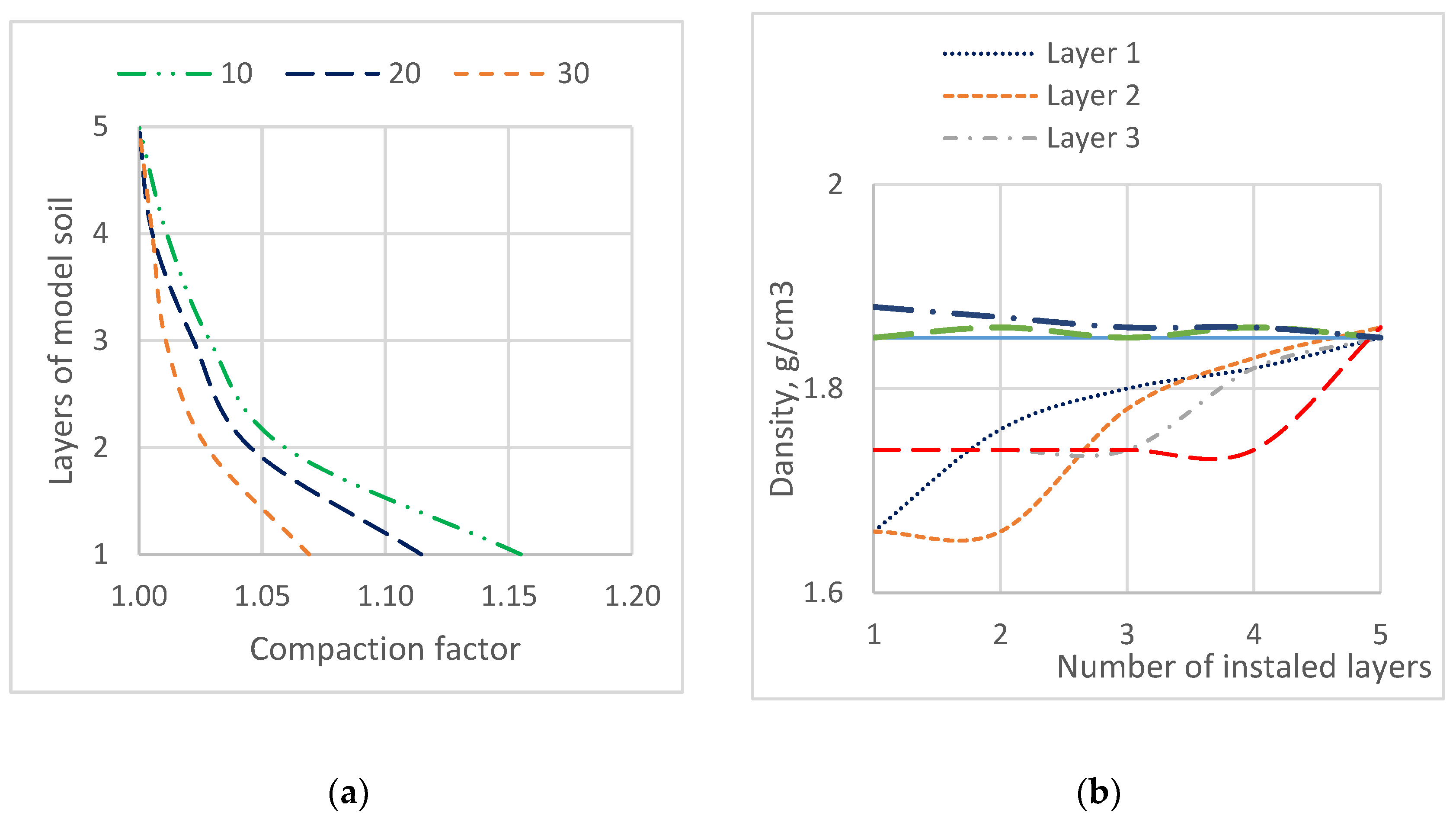
Figure 5 shows the results of adjusting the rolling technology based on compaction of the underlying layers (for variable rolling with a roller). The obtained results allow us to adjust the compaction technology taking into account the layer-by-layer formation of the model soil. Figure 5A shows the dependences of changes in the sealing coefficients for each of the layers (taking into account the compaction of the underlying layers with each subsequent compaction of the upper layer) by the number of roller rolls. The abscissa axis shows the effect of compaction of each subsequent layer on the underlying layers, from 1-the lower layer, to 5-the upper layer (therefore, all curves converge to 1 on the abscissa scale for layer 5, since there is no sixth layer, therefore, there is no effect on layer 5). Figure 5B shows the results of the calculated densities from the number of specified rollouts (determined from Diagram 5A) and the actual densities measured after rolling.
According to the results of numerous measurements of changes in the densities of the model soil during rolling, the compaction coefficient (Figure 5A) for different numbers of run-ins varies from 0.01 to 0.15. Since with a subsequent increase in the number of run-ins, the density per underlying layer exceeds the specified one (1.85 g/сm3), further rolling is not advisable. With 10 rolls, the maximum density of the first layer (after rolling all layers from 10 to 50 times) is 1.15, with 20 rolls – 1.11, and with 30-1.07. The same values for the second layer were 1.06 for 10 rolls, 1.05 for 20 rolls, and 1.03 for 40 rolls. For the third layer, the coefficients were 1.03 for 10 rolls, 1.03 for 20 rolls, and 0.2 for 30 rolls. For the fourth layer 1.01 at 10, 20 and 30 rolls (compaction after 10 rolls is not significant). According to calculations, the predicted number of rolls (Figure 5B) of Layer 1 was 20 rolls, while the achieved density was from 1.66 to 1.85 g /cm3 after rolling all 5 layers. The same indicators for 2 layers – 20 run-ins, an increase in density from 1.66 to 1.86 g /cm3. For 3 layers – 30 rolls from 1.74 to 1.85 g /cm3. For 4 layers – 30 rolls, from 1.74 to 1.86 g /cm3. For layer 5, as for the last one, to achieve a density of 1.85 g /cm3, the previously defined value is 50 rolls. According to the control measurements of the density of the model soil, the actual density of layers for the specified number of rolls was: for 1 layer – 1.88 g/cm3, 2 layers-1.87 g/cm3, 3 layers-1.85 g/cm3, 4 layers-1.86 g/cm3, 4 layers – 1.85 g/cm3.See3. Therefore, for the 1st and 2nd layers, you can take a smaller number of rolls, but this indicator does not greatly affect the reduction in compaction of the underlying layers, as a result of rolling out the overlying layers.
4. Discussion
The obtained results demonstrate the effectiveness of the proposed large-scale modeling approach for reproducing in-situ conditions of weak loamy soils subjected to injection treatment. In comparison with previous studies on soil stabilization using injection mortars, the present work emphasizes not only the mechanical improvement of soil but also the reliability of physical modeling parameters, including density, moisture content, and overburden pressure simulation.
The experimental results confirm a strong relationship between moisture content and soil preparation parameters (R = 0.99), which is consistent with previously reported findings on the sensitivity of clayey soils to water variation during compaction. The observed density range of 1.85-1.88 g/cm³ indicates that the adopted layer-by-layer compaction method is capable of closely reproducing natural soil conditions, which is essential for realistic simulation of injection processes.
The analysis of roller compaction effects revealed that 20–50 passes are sufficient to achieve target density depending on the soil layer depth. This highlights the importance of considering interlayer interaction during model soil preparation, as upper-layer compaction significantly influences the density of underlying layers. Such behavior is often neglected in simplified laboratory modeling approaches but is critical for achieving realistic boundary conditions.
From the perspective of the working hypothesis, the results support the assumption that physically based modeling without strict dynamic similarity can still provide reliable representation of field conditions when key soil parameters are preserved. This approach may be particularly useful for engineering applications where exact similarity criteria are difficult to satisfy.
Future research should focus on validating the proposed modeling methodology under different soil types (e.g., sandy clays and silty soils) and evaluating the direct penetration behavior of injection mortars under varying rheological properties. Additionally, coupling physical modeling with numerical simulation could further improve the predictive capability of the method.
5. Conclusions
- Laboratory tests of sandy and clay soils were performed in order to develop a technology for laying model soil in an experimental tray according to a given natural density and humidity (for loam). Modeling of the model soil is necessary for subsequent studies of the injection solution of deep cementation under conditions close to real ones.
- According to the results of measurements of the granulometric composition of the sandy soil, the studied soil belongs to large sands. The maximum mass fraction is observed in fractions from 0.5 to 2.0 mm and is 77.44%. According to the results of measurements of the consistency of loam, the studied loam is from a semi-solid to a solid state. Most of the loam samples are below the plastic limits, and the average values of liquid indexes are -0.22.
- According to the results of density tests, the average density of sandy soils in the natural state is 1.65 g/cm3, in the loose state-1.36 g/cm3. The density of loams in the natural state is 1.85 g/cm3, in the loose state-1.48 g/cm3. All partial values of densities for both sandy and loamy soils are closely related, in both cases the coefficient of variation does not exceed 2.8%.
- According to the results of the selection of prayer sand soil according to the control parameters of density, the technology of laying prayer soil is a layer – by – layer compaction of sand layers with rolling in the following sequence: 1 and 2 layers of 20 rolls, 3 and 4 layers-30 rolls, 5 stops-50 rolls. At the same time, the density of the model soil is achieved, as close as possible to the real one – 1.85 g/cm3.
Author Contributions
Conceptualization, M.S. and R.L.; methodology, M.S., R.L. and K.A.; software, D.Z.; validation, D.A., M.Zh. and B.Ch.; formal analysis, K.A. and D.Z.; investigation, M.S., D.A. and M.Zh.; resources, R.L.; data curation, B.Ch.; writing—original draft preparation, M.S.; writing-review and editing, R.L. and K.A.; visualization, D.Z.; supervision, R.L.; project administration, M.S.; funding acquisition, R.L. All authors have read and agreed to the published version of the manuscript.
Funding
This research received no external funding.
Institutional Review Board Statement
Not applicable.
Informed Consent Statement
Not applicable.
Data Availability Statement
Data are contained within the article.
Acknowledgments
The authors would like to thank all those who contributed to this study.
Conflicts of Interest
The authors declare no conflicts of interest.
References
- Lukpanov, R.; Zhantlessova, Z.; Dyussembinov, D.; Zhumagulova, A.; Jexembayeva, A. Modified Additive for Soil Stabilization by Deep Cementation. Buildings 2025, 15, 3607. [Google Scholar] [CrossRef]
- Begentayev, M.M.; Akhmetov, D.A.; Lukpanov, R.E.; Kuldeyev, E.I.; Zhumadilova, Z.O.; Myrzaliyev, T.; et al. Research of Physical and Mechanical Properties of Self-Compacting Concrete Based on Polyfractional Binder. Applied Sciences 2025, 15, 5283. [Google Scholar] [CrossRef]
- Azar, S.M. Deep Soil Mixing (DSM) with Binders: A State-of-the-Art Method in Ground Improvement Techniques. In Advancements in Underground Infrastructures; CRC Press, 2025; pp. 46–73. [Google Scholar] [CrossRef]
- Bekkaliev, N.; Sabitov, Y.; Lukpanov, R.; Zhumagulova, A.; Jexembayeva, A. Optimised Hydration and Durability of Non-Autoclaved Aerated Concrete via Lignin-Based Ionic Additive. Eng 2025, 6, 249. [Google Scholar] [CrossRef]
- Kargin, M.; Rauan, L.; Kargin, J.; Raman, S.N.; Imjai, T.; Garcia, R.; Laory, I. A new practical model to calculate the reduced compressive strength of pre-damaged lightweight concrete subjected to freezing–thawing cycles. Journal of Asian Architecture and Building Engineering 2025, 1–17. [Google Scholar] [CrossRef]
- Yenkebayeva, A.; Lukpanov, R.; Yenkebayev, S.; Tsygulyov, D. Comparative Analysis of Design Solutions of a Reinforced Railroad Embankment Using Various Calculation Methods. International Journal of GEOMATE 2021, 21(87), 58–63. [Google Scholar] [CrossRef]
- Mukhambetkaliyev, K.; Alibayeva, A.; Amirbayev, Y.; Zhantlessova, Z.; Lukpanov, R.; Zhumagulova, A.; Alizhanov, D.; Smagulova, M.; Chugulev, B. The influence of a modified additive based on a paraffin component on the workability and setting time of an injection grout for the deep soil cementation method. GEOMATE Journal 2025, 29(132), 191–200. [Google Scholar] [CrossRef]
- Amirbayev, Y.; Zhantlessova, Z.; Lukpanov, R.; Dyussembinov, D.; Zhumagulova, A.; Ashimova, S.; Smagulova, M.; Asanova, G.; Zhumamuratov, M. Evaluation of the impact of a modified additive in injection solution on its physical and mechanical properties. GEOMATE Journal 2026, 30(137), 12–19. [Google Scholar] [CrossRef]
- Soils. Laboratory Methods for Determining Physical Characteristics. Standard. 2015. Available online: https://new-shop.ksm.kz/catalog/GOST_5180-2015/.
Figure 1.
Tray test performance.
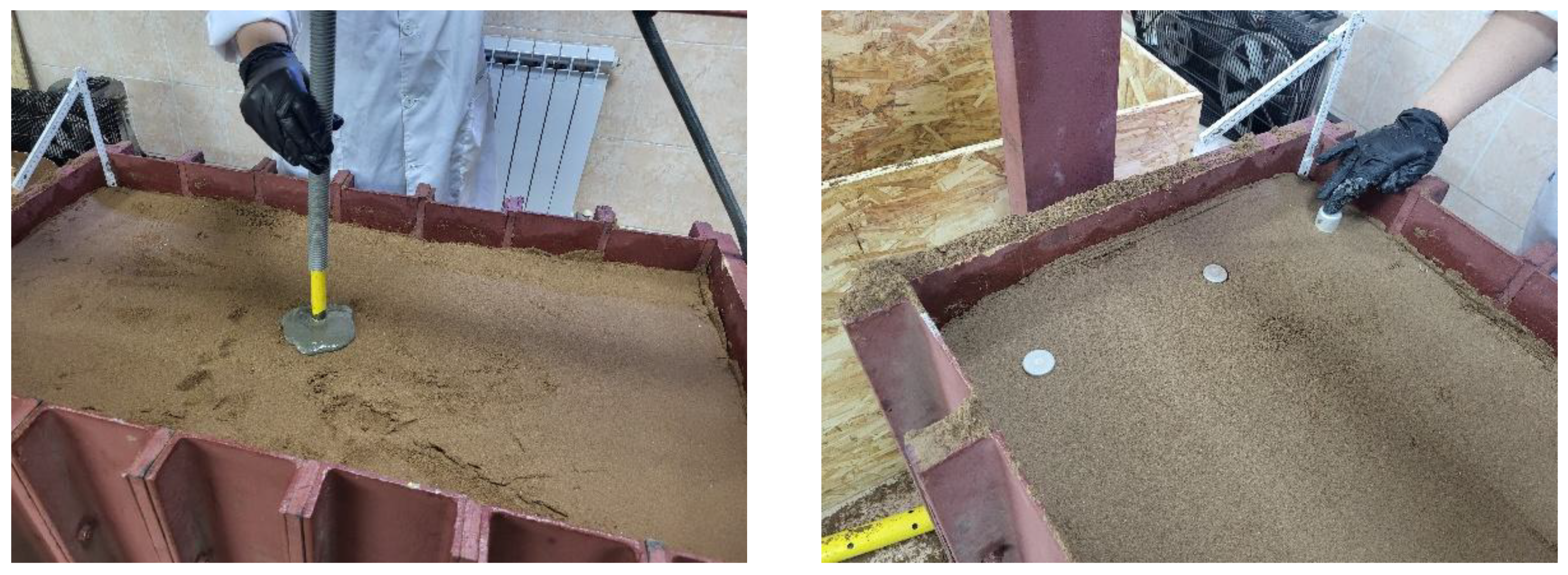
Figure 2.
(a) Natural moisture content and consistency limits of loamy soil samples; (b) Average values of plasticity index (main ordinate axis) and liquidity index (secondary ordinate axis).
Figure 2.
(a) Natural moisture content and consistency limits of loamy soil samples; (b) Average values of plasticity index (main ordinate axis) and liquidity index (secondary ordinate axis).
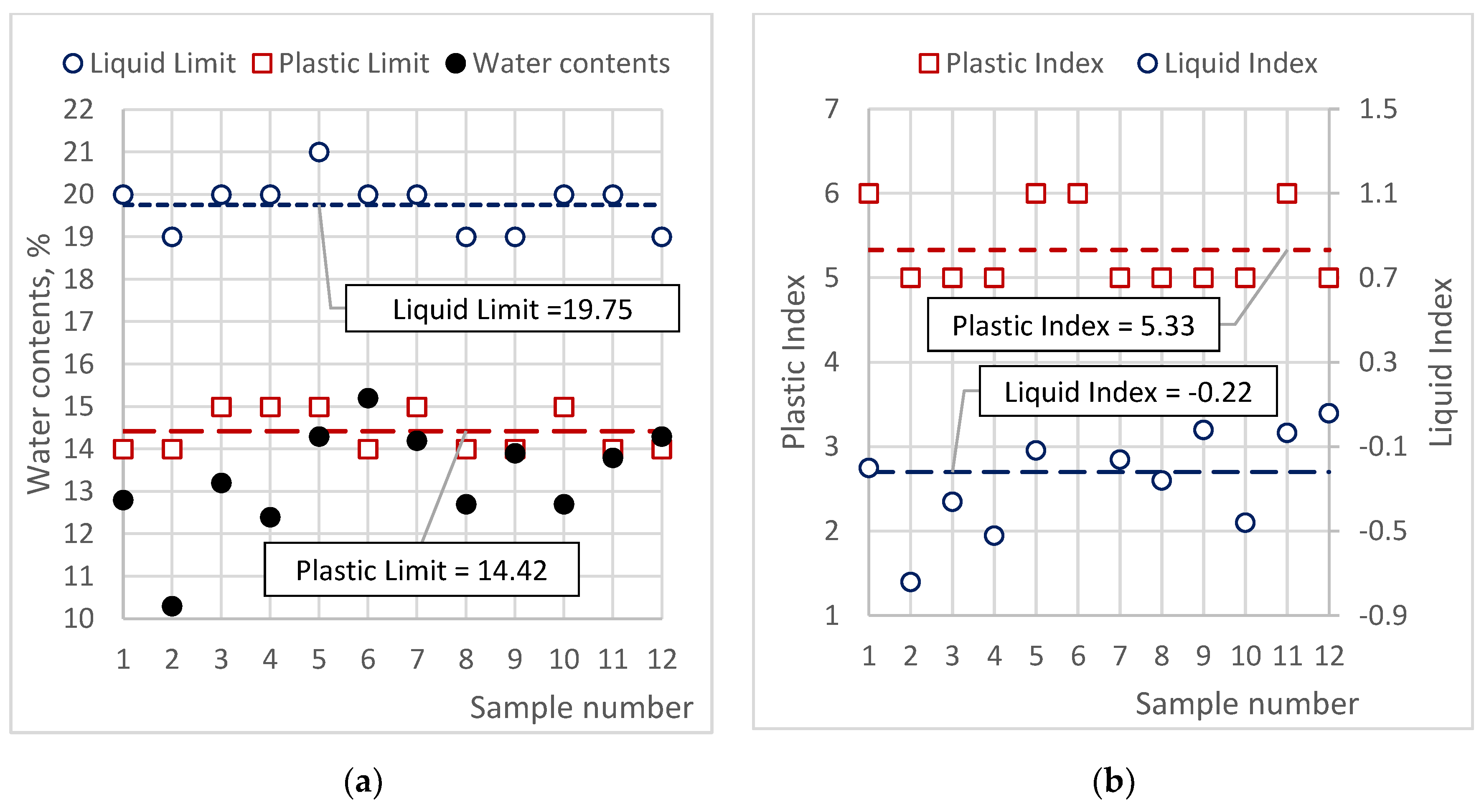
Figure 3.
(a) Partial and average densities of sandy and loamy soils in the natural state; (b) Partial and average densities of sandy and loamy soils in the loose dry state.
Figure 3.
(a) Partial and average densities of sandy and loamy soils in the natural state; (b) Partial and average densities of sandy and loamy soils in the loose dry state.
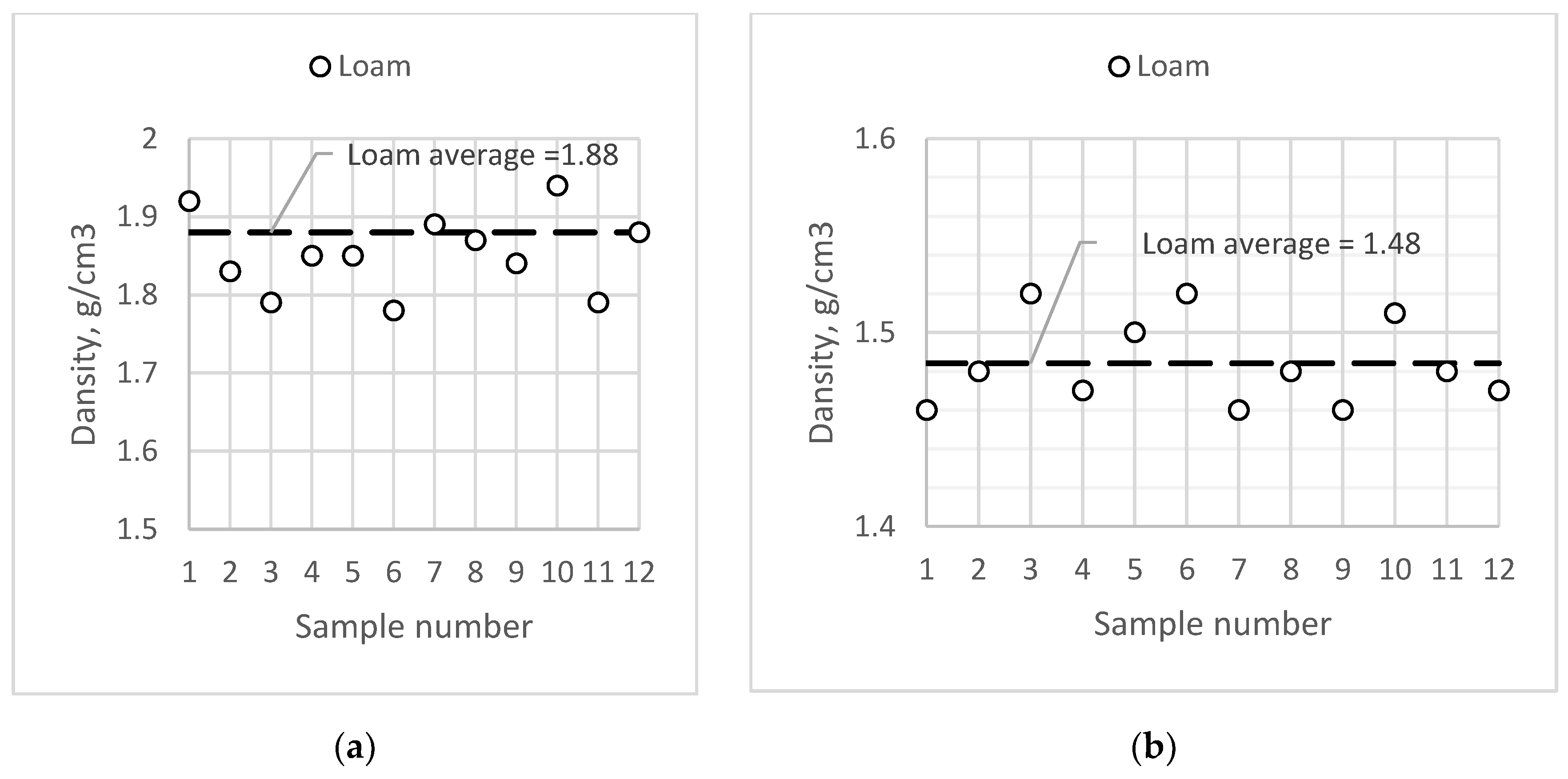
Figure 4.
(a) Variation of model soil moisture content after compaction with a 12 kg roller as a function of added water volume (L); (b) Variation of model soil density as a function of the number of roller passes under previously established moisture conditions.
Figure 4.
(a) Variation of model soil moisture content after compaction with a 12 kg roller as a function of added water volume (L); (b) Variation of model soil density as a function of the number of roller passes under previously established moisture conditions.
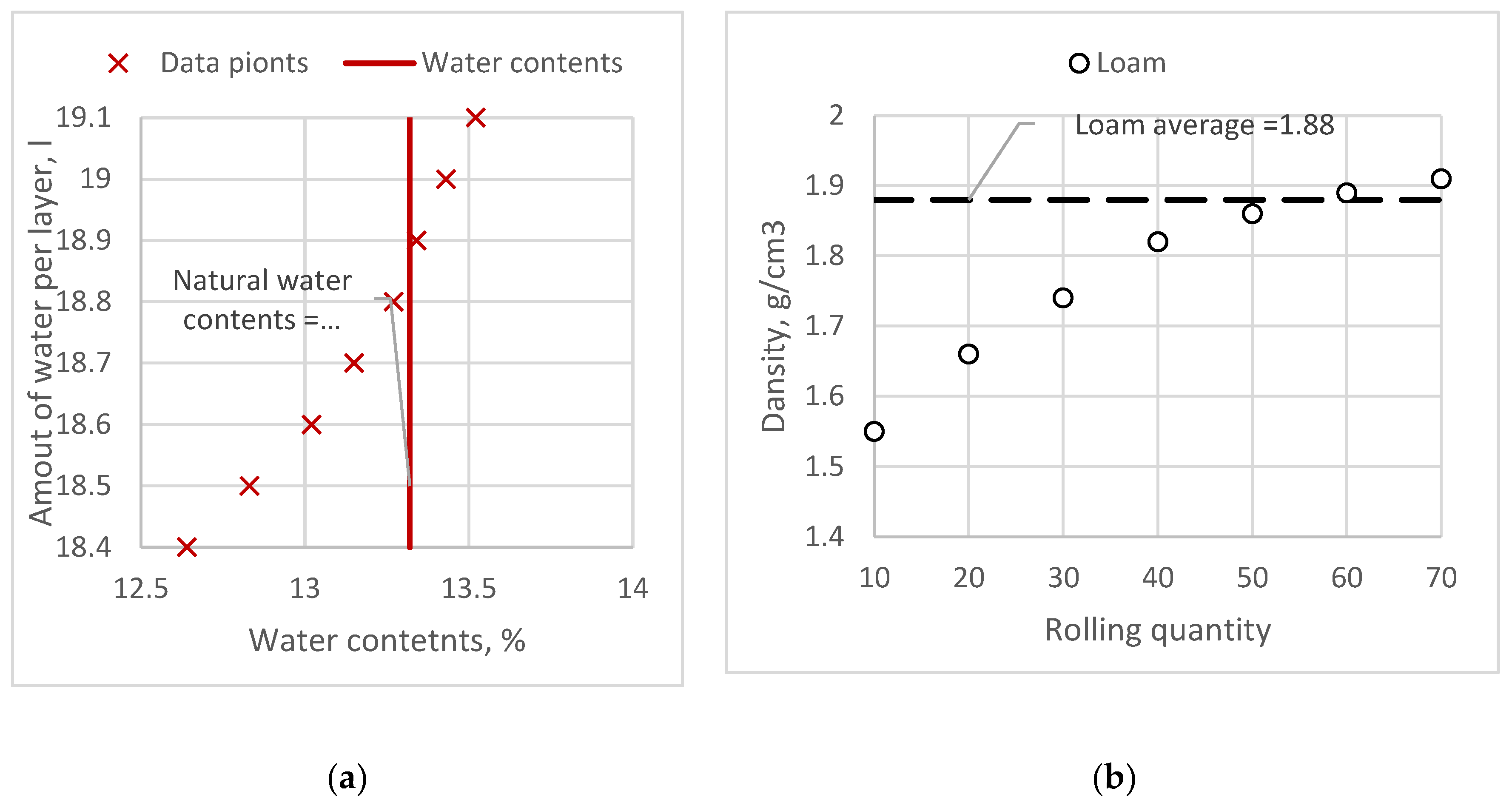
Figure 5.
(a) Variation of layer compaction coefficients versus number of roller passes considering interlayer effects (layers 1-5); (b) Comparison of calculated and measured soil densities versus number of roller passes.
Figure 5.
(a) Variation of layer compaction coefficients versus number of roller passes considering interlayer effects (layers 1-5); (b) Comparison of calculated and measured soil densities versus number of roller passes.
Disclaimer/Publisher’s Note: The statements, opinions and data contained in all publications are solely those of the individual author(s) and contributor(s) and not of MDPI and/or the editor(s). MDPI and/or the editor(s) disclaim responsibility for any injury to people or property resulting from any ideas, methods, instructions or products referred to in the content. |
© 2026 by the authors. Licensee MDPI, Basel, Switzerland. This article is an open access article distributed under the terms and conditions of the Creative Commons Attribution (CC BY) license.
Copyright: This open access article is published under a Creative Commons CC BY 4.0 license, which permit the free download, distribution, and reuse, provided that the author and preprint are cited in any reuse.


