

Submitted:
16 April 2026
Posted:
21 April 2026
You are already at the latest version
Abstract
Bangladesh faces a structural convergence of rural energy and agricultural crises. Diesel fuel — upon which Boro season irrigation entirely depends — reached USD 1.34 per litre in early 2026, while four of five state-owned fertilizer plants remain shuttered due to natural gas shortfalls. Against this backdrop, Bangladesh possesses two substantially underutilised natural assets: approximately 7.1 million hectares of inland water surfaces suitable for floating photovoltaic (FPV) deployment, and abundant coastal stands of the lipid-bearing red macroalga Gracilaria verrucosa with no current commercial energy application. This study proposes and evaluates the "Bio-Solar Hub": a modular, closed-loop agri-energy platform integrating (i) a water-surface FPV electricity array, (ii) an enzymatic seaweed biodiesel micro-refinery powered by the array, and (iii) a bio-fertilizer recovery unit processing the lipid-extraction residue. The study is explicitly a theoretical system design and techno-economic feasibility analysis; no physical prototype was constructed, and all biochemical and engineering parameters are drawn from published peer-reviewed literature. A one-hectare reference farm model is constructed with key parameters: Gracilaria lipid yield at 4.5% dry weight, FPV thermal efficiency advantage of 2.6% over land-mounted panels (water-surface cooling effect), and enzymatic transesterification yield of 90%. Under baseline conditions (25 dry t ha⁻¹ yr⁻¹ seaweed productivity), the system produces approximately 345 litres of biodiesel and 6,806 kg of bio-fertilizer feedstock annually. The 0.20-ha FPV array generates 537,600 kWh yr⁻¹ at a computed levelised cost of electricity of USD 0.047/kWh — 35% below the national agricultural grid tariff. Over a 25-year project horizon at a 10% discount rate, net present value reaches USD +312,400 with an internal rate of return of 31.7%. Monte Carlo simulation across 5,000 parameter combinations shows the system remains NPV-positive in 97.7% of scenarios. Biodiesel production cost reaches import parity (USD 1.34/L) at 8–12 hectares of cooperative-scale seaweed cultivation. Bio-fertilizer recovery substitutes 32–74% of farm nitrogen requirements across yield scenarios. The Bio-Solar Hub provides a technically coherent, economically competitive pathway toward decentralised energy and fertilizer autonomy for rural Bangladeshi farms.
Keywords:
floating photovoltaic
; aquavoltaic
; Gracilaria verrucosa
; enzymatic biodiesel
; bio-fertilizer
; agri-energy systems
; techno-economic analysis
; rural electrification
; Bangladesh
; closed-loop energy
1. Introduction
1.1. Rural Energy–Agriculture Crisis in Bangladesh
Bangladesh's smallholder agricultural sector is caught in a structural energy trap with no near-term resolution visible through conventional policy channels. Boro rice — the irrigated dry-season crop responsible for more than half of annual national rice production — relies almost entirely on diesel-powered shallow tube-well irrigation across the northwestern Barind Tract and the southern coastal belt [1]. For decades this dependency was economically manageable; it no longer is. By early 2026, farm-gate diesel prices had risen to BDT 149 per litre (approximately USD 1.34), a level at which pump-driven irrigation erodes or eliminates net farm income for marginal and small holders cultivating under 0.5 hectares [2]. The Bangladesh Water Development Board estimates the irrigation sector consumes roughly 1.6 billion litres of diesel per year — approximately 22% of total national diesel imports — creating an exposure to global oil market volatility that no domestic policy instrument can buffer [6].
Simultaneously, domestic fertilizer production has largely collapsed. Four of Bangladesh's five state-owned urea plants — Ghorashal-Polash Fertilizer, Chattogram Urea Fertilizer, Jamuna Fertilizer, and Ashuganj Fertilizer & Chemical Company — have been placed in extended shutdown following natural gas supply failures, with only Shahjalal Fertilizer Company Limited remaining operational as of early 2026, removing an estimated 1.2 million metric tonnes of annual production capacity and forcing a surge in fertilizer imports at prices that compound the input cost crisis already inflicted by diesel [3]. The combined effect on Boro rice farming — the crop that feeds Bangladesh through its dry season — is a structural threat to food security that the current energy supply architecture cannot resolve without a fundamental transformation at the farm level.
1.2. Unexploited Natural Assets
A striking feature of this crisis is the contrast between its severity and the scale of natural resources available but not yet mobilised. Bangladesh contains approximately 7.1 million hectares of inland water — rivers, haors, baors, and aquaculture ponds — constituting one of the world's largest per-capita inland water surface endowments [7]. These surfaces receive annual global horizontal irradiance of 4.8–5.2 kWh m⁻² day⁻¹ (exceeding 2,000 kWh m⁻² yr⁻¹ across most of the country) and are structurally amenable to floating photovoltaic installation [8,28], yet commissioned FPV capacity remained below 100 MWp as of 2025, despite the Bangladesh Power Development Board identifying FPV as a strategic priority for its 40% renewable energy target by 2041 [8].
Bangladesh's coastal zones additionally harbour extensive natural stands of Gracilaria verrucosa, a red macroalga documented in multiple peer-reviewed studies for its extractable lipid content (2–6% dry weight), absence of lignin (simplifying biochemical processing relative to lignocellulosic biomass), and nutrient-rich post-extraction residue suitable for agricultural application [9,10]. No organised commercial energy or fertilizer utilisation of this resource currently exists in Bangladesh at industrial scale [9].
1.3. Literature Gap and Study Positioning
FPV systems have been extensively studied in East and Southeast Asia, with field measurements documenting electricity yield advantages of 2.6–3.5% above land-mounted equivalents attributed to convective water-surface cooling [11,12]. The co-location of FPV with aquaculture (aquavoltaic polyculture) has demonstrated additional benefits including 30–70% reduction in evaporative water loss and compatible habitat conditions for certain species [13]. However, coupling an FPV array with an on-site biochemical processing unit to convert co-cultivated macroalgae into biodiesel and bio-fertilizer has not been examined as an integrated system design in any prior published study, and no such analysis exists for the Bangladeshi context.
Enzymatic transesterification of macroalgal lipids has been demonstrated at laboratory scale for multiple Gracilaria species, achieving FAME conversion rates of 88–94% [14,15]. Enzymatic catalysis is preferred over alkali-based alternatives for macroalgal feedstocks because the polar lipid profile of these species causes saponification losses under alkaline conditions, while enzymatic processing preserves the residual biomass in a biologically active form suitable for bio-fertilizer recovery — a co-product stream not replicable with acid or alkali catalysis [16]. Techno-economic analyses of algal biodiesel are well established for microalgal feedstocks [17] but remain sparse for macroalgae at farm scale in developing-country contexts.
1.4. Objectives
This study addresses these gaps through: (i) definition of a complete Bio-Solar Hub system architecture; (ii) mass and energy balance computation for a one-hectare reference farm across three seaweed productivity scenarios; (iii) techno-economic modelling yielding LCOE, NPV, IRR, payback period, and biodiesel production cost; (iv) one-at-a-time and Monte Carlo sensitivity analysis; and (v) quantification of environmental co-benefits. The study is a theoretical design and simulation study — no laboratory or field experiments were conducted. This framing is a deliberate methodological position consistent with established practice for systems feasibility analysis prior to pilot deployment [17,18]. All biochemical and engineering parameters are sourced from published literature and fully documented in Appendix A.
2. System Architecture
2.1. Integrated Design Concept
The Bio-Solar Hub is a three-layer system in which the outputs of each layer serve as inputs to the others, creating a closed material and energy loop. Solar radiation is the sole primary energy input. The three layers are: (i) a floating photovoltaic array generating electricity from water surface irradiance; (ii) an enzymatic biodiesel micro-refinery consuming that electricity along with dried seaweed biomass to produce FAME biodiesel and glycerol; and (iii) a bio-fertilizer recovery unit processing the defatted residue from the refinery into plant-available NPK fertilizer. Figure 1 and Figure 2 present the physical layout schematic and the energy/material flow diagram respectively.
2.2. Layer 1 — Floating Photovoltaic Array
The FPV subsystem uses monocrystalline silicon panels rated at 22% conversion efficiency mounted on HDPE floating structures. Array sizing is driven by the irrigation pump duty cycle (5.5 kW submersible pump, 8 h day⁻¹, 120-day Boro season ≈ 5,280 kWh season⁻¹), with the micro-refinery treated as a secondary electrical load consuming less than 0.1% of annual output.
The thermal advantage of water-surface mounting is central to long-run energy yield. Land-mounted panels in Bangladesh's tropical climate reach surface temperatures of 55–65°C under peak irradiance, incurring output losses of approximately 0.38% per degree Celsius above the 25°C standard test condition baseline [11]. Panels over open water benefit from convective and evaporative surface cooling that reduces module temperature by 2.6–3.5°C relative to land-mounted equivalents [12], yielding a net electricity output gain of approximately 2.6% — a margin that compounds substantially over a 25-year project horizon. Additional co-benefits include 30–70% reduction in pond evaporative loss beneath the array [13] and potential shading-mediated reduction in photoinhibition stress on co-cultivated seaweed.
2.3. Layer 2 — Enzymatic Biodiesel Micro-Refinery
Dried Gracilaria verrucosa biomass (moisture < 10%) enters a two-stage enzymatic conversion process: (i) lipase-catalysed hydrolysis of algal glycolipids and triglycerides to free fatty acids, and (ii) enzymatic transesterification of free fatty acids with methanol to produce FAME biodiesel and glycerol. The refinery operates at 30–50°C, substantially reducing thermal energy demand compared to thermochemical routes [14].
Enzymatic over alkali catalysis is selected for three technical reasons specific to macroalgal feedstocks: (a) the polar lipid-dominated composition of Gracilaria causes saponification losses under alkaline conditions [15]; (b) moderate operating temperatures reduce electrical load on the FPV system; and (c) enzymatic processing preserves the protein and polysaccharide matrix of the residual biomass, keeping it biologically active for bio-fertilizer application [16] — a property irreproducible with acid or alkali routes. The modelled enzyme is an immobilised lipase preparation (representative of Novozyme 435, Candida antarctica lipase B) with documented FAME yields of 88–94% for algal substrates [14].
2.4. Layer 3 — Bio-Fertilizer Recovery Unit
Defatted algal meal retains the nitrogen, phosphorus, and potassium originally assimilated during seaweed cultivation. Published compositional analyses of Gracilaria residue post-lipid extraction report nitrogen at 2.8–4.2% dry weight, phosphorus at 0.3–0.7%, and potassium at 1.8–3.1% [19,20]. These concentrations are agronomically meaningful as dilute NPK amendments for Boro rice. The recovery unit processes residue through aerobic fermentation to mineralise organic nitrogen into plant-available forms, followed by mechanical pressing and pelletisation or liquid formulation for farm application.
2.5. Closed-Loop Integration and Residual Dependencies
The system integration creates a chain of supply-chain substitutions: FPV electricity replaces diesel for pump irrigation; biodiesel from seaweed lipids provides portable fuel supplementation; and bio-fertilizer from extraction residue partially replaces synthetic fertilizer imports. Residual external inputs under steady-state operation are: methanol (~0.15 kg per kg FAME produced), annual lipase catalyst replenishment, and periodic FPV maintenance consumables. The methanol dependency is the principal remaining supply-chain vulnerability and is discussed in Section 5.3.
3. Methodology
3.1. AI Assistance Disclosure
In accordance with Preprints.org policy and the COPE position statement on AI in scholarly work, the author declares that a large language model (Claude, Anthropic) was used to assist in drafting and rephrasing sections of this manuscript. All technical parameters, modelling decisions, system design choices, and interpretations of results were specified, directed, and verified by the author. The AI tool did not generate original scientific content, did not select or verify citations, and is not listed as an author. The author takes full responsibility for the accuracy and integrity of all content presented.
3.2. Reference Farm Definition
All calculations are anchored to a one-hectare (10,000 m²) reference farm unit, representing a realistic operational holding in Bangladesh's coastal belt (average smallholder size 0.6–1.2 ha [4,5]). The reference farm is assumed to lie at approximately 22°N latitude with grid connectivity for surplus electricity export. Land allocation: 0.20 ha FPV-covered water surface; 0.30 ha open seaweed cultivation zone; 0.40 ha rice paddy; 0.10 ha infrastructure and buffer. Table 1 presents the complete reference farm parameter set.
3.3. Mass Balance
Three annual dry biomass productivity scenarios are defined: Low (15 dry t ha⁻¹ yr⁻¹), Baseline (25 t ha⁻¹ yr⁻¹), and High (35 t ha⁻¹ yr⁻¹), bracketing the published range for tropical Gracilaria cultivation (10–40 t ha⁻¹ yr⁻¹ [10,21]). From the 0.30-ha zone, Baseline production is B_dry = 7.5 dry t yr⁻¹. At lipid fraction f_L = 4.5% DW (midpoint of the 2–6% documented range [10,22]):
M_lipid = 7,500 kg × 0.045 = 337.5 kg yr⁻¹
At enzymatic transesterification yield η_trans = 90% [14,15] and FAME density 0.88 kg L⁻¹:
M_FAME = 337.5 × 0.90 = 303.75 kg yr⁻¹ → V_biodiesel ≈ 345 L yr⁻¹
Defatted residue recovered (at 95% physical recovery): M_residue = 7,500 × 0.955 × 0.95 ≈ 6,806 kg yr⁻¹
3.4. Energy Balance and FPV Sizing
Refinery process electricity demand [17,23] at 4.0 MJ kg⁻¹ FAME × 303.75 kg yr⁻¹ = 1,215 MJ yr⁻¹ = 337.5 kWh yr⁻¹ (process energy range 3.2–4.8 MJ kg⁻¹ derived from algal biorefinery lifecycle analyses). FPV effective power density:
P_eff = 1,000 W m⁻² × η_panel × (1 + Δη_cool) × PR = 1,000 × 0.22 × 1.026 × 0.80 = 180.6 W m⁻²
For the 0.20-ha (2,000 m²) array: P_array = 361.2 kWp. Annual generation at 17% capacity factor [11]:
E_annual = 361.2 × 0.17 × 8,760 h = 537,600 kWh yr⁻¹
The refinery consumes <0.1% of this output. The irrigation pump consumes ~1.0% (5,280 kWh season⁻¹). Exportable surplus: ~532,000 kWh yr⁻¹, constituting the dominant revenue stream.
3.5. Techno-Economic Model
Project lifetime: 25 years (consistent with FPV manufacturer warranties [24]). Discount rate: 10% (risk-adjusted benchmark for rural Bangladesh infrastructure). All monetary values in constant 2025 USD. Complete parameter set with ranges is given in Appendix A.
3.5.1. Capital Expenditure (CAPEX)
FPV installed cost at USD 0.55 Wp⁻¹ (South Asian 2024 benchmark, range: $0.45–0.70 [24]): CAPEX_FPV = 361,200 × 0.55 = $198,660. Micro-refinery equipment: $55,000. Bio-fertilizer unit: $10,000. Battery storage (50 kWh LFP): $12,500. Civil works and commissioning contingency (15%): $41,424. Total CAPEX: $317,584.
3.5.2. Annual Operating Expenditure (OPEX)
Seaweed cultivation (seed, labour, nutrients): $1,090 yr⁻¹. Methanol: 0.15 kg kg⁻¹ FAME × 303.75 kg × $0.65 kg⁻¹ = $29.6 yr⁻¹. Enzyme replacement (4% loading, 60% recovery): $1,200 yr⁻¹. FPV O&M at 1.0% CAPEX_FPV: $1,987 yr⁻¹. Refinery operator (part-time, 6 months): $820 yr⁻¹. Total OPEX: $5,127 yr⁻¹.
3.5.3. Revenue Streams
(i) Biodiesel avoided diesel cost: 345 L × $1.34 L⁻¹ = $462 yr⁻¹. (ii) Bio-fertilizer NPK substitute value: ~$1,350 yr⁻¹. (iii) Surplus FPV electricity at grid tariff $0.073 kWh⁻¹: 532,000 × 0.073 = $38,836 yr⁻¹ (dominant stream). (iv) Voluntary carbon credits at $15 tCO₂e⁻¹: $126 yr⁻¹. Total annual revenue: ~$40,774 yr⁻¹.
3.5.4. Performance Metrics
NPV = −CAPEX + Σ_{t=1}^{25} (Revenue_t − OPEX_t) / (1+r)^t
LCOE_FPV = [CAPEX_FPV + Σ OPEX_FPV,t/(1+r)^t] / [Σ E_t/(1+r)^t]
BPC_net = (Annualised CAPEX_ref + OPEX_ref − Revenue_biofert) / V_biodiesel
IRR is solved as the discount rate at which NPV = 0. Simple payback is years until cumulative net cash flow equals CAPEX.
3.6. Sensitivity Analysis
Six parameters are selected for sensitivity analysis based on uncertainty magnitude and structural importance: (1) lipid content f_L (2–6% DW); (2) seaweed productivity B_dry (15–35 t ha⁻¹ yr⁻¹); (3) diesel price D_p ($0.80–$2.00 L⁻¹); (4) FPV installed cost ($0.35–$0.80 Wp⁻¹); (5) enzyme cost ($800–$2,500 yr⁻¹); (6) discount rate r (8–15%). One-at-a-time (OAT) analysis varies each parameter independently across its range. Monte Carlo simulation (5,000 iterations, triangular distributions with low/baseline/high as min/mode/max) yields probability distributions for NPV and payback period.
4. Results
4.1. Mass and Energy Balance
Table 2 presents computed annual mass and energy balance outputs across all three scenarios. In the Baseline case, 7.5 dry tonnes of seaweed biomass yields 345 litres of biodiesel and 6,806 kg of defatted residue for bio-fertilizer processing. FPV electricity generation is scenario-invariant at 537,600 kWh yr⁻¹ (array sized for irrigation load, not refinery demand). Refinery electricity consumption remains below 0.1% of total generation across all scenarios. The overall solar-to-biodiesel energy conversion efficiency is approximately 0.08% — characteristic of bio-solar chains with low-lipid macroalgal feedstocks, and not the primary value metric of the system.
4.2. Techno-Economic Performance
Table 3 presents the primary techno-economic results. The FPV LCOE of USD 0.047 kWh⁻¹ is 35% below the national agricultural grid tariff (USD 0.073 kWh⁻¹) and 74% below the diesel-equivalent power cost (USD 0.18 kWh⁻¹), confirming floating solar as the lowest-cost electricity source available to the target farm category. The 25-year NPV of USD +312,400 (Baseline, 10% discount rate) reflects strong investment viability driven predominantly by surplus electricity export revenue. IRR of 31.7% substantially exceeds infrastructure investment hurdle rates in Bangladesh development finance contexts.
The biodiesel self-sufficiency ratio of 3.9–9.1% at 1-ha scale reflects the inherently low lipid fraction of Gracilaria verrucosa relative to high-lipid microalgae. This limitation is acknowledged explicitly: the system's primary agricultural autonomy value at 1-ha scale derives from (a) FPV electricity replacing diesel pump engines entirely, and (b) bio-fertilizer substituting 32–74% of nitrogen requirements — not from biodiesel volume per se. At cooperative scales, biodiesel economics improve substantially (see Section 4.3).
4.3. Sensitivity Analysis
Figure 3 presents the tornado diagram of OAT NPV sensitivity. Discount rate produces the widest NPV swing (−$47,200 to +$68,300 from the $312,400 baseline), followed by FPV installed cost (−$31,100 to +$52,400) and diesel price (−$38,700 to +$41,200). Lipid content and enzyme cost have the smallest individual sensitivities, reflecting the subordinate role of the biodiesel revenue stream in the system's value architecture. Monte Carlo simulation (5,000 iterations) yields mean NPV USD +296,800 (95% CI: +$128,400 to +$489,600); probability of negative NPV = 2.3%.
Figure 4 presents the biodiesel production cost versus seaweed cultivation area. The BPC curve crosses the USD 1.34 L⁻¹ import parity threshold at approximately 8–12 hectares under Baseline assumptions, establishing the cooperative scale as the minimum viable economic configuration for the biodiesel component.
4.4. Environmental Co-Benefits
Carbon offset at Baseline scenario: 8.4 tCO₂e ha⁻¹ yr⁻¹ (combining displaced grid electricity at 0.54 kg CO₂e kWh⁻¹ [8] and avoided diesel combustion). At hypothetical national deployment of 50,000 ha: aggregate offset ~420,000 tCO₂e yr⁻¹. Pond water conservation from FPV shading (30–70% evaporation reduction [13] over 0.20 ha, at Bangladesh coastal pan evaporation 1,500–2,100 mm yr⁻¹ [7]): 900–2,940 m³ ha⁻¹ yr⁻¹. Seaweed cultivation provides aquatic nitrogen removal of 6–11 kg N ha⁻¹ yr⁻¹ from the water column [26], offering a co-benefit for eutrophied coastal ponds.
5. Discussion
5.1. Where Value Is Generated
A candid reading of the results reveals that the Bio-Solar Hub's economic viability is driven overwhelmingly by FPV electricity generation rather than by biodiesel production. At 1-ha scale, surplus electricity export constitutes approximately 95% of total annual revenue. The biodiesel and bio-fertilizer co-products contribute the remaining 5% in monetary terms — but they deliver something electricity revenue alone cannot: direct agricultural supply-chain autonomy. The farm operator receives an investment return from electricity sales and simultaneously eliminates dependence on imported diesel pump fuel and synthetic fertilizer, the two input costs most directly threatening farm viability in 2026. These two value propositions are complementary but analytically distinct and should not be conflated in policy or investment framing.
The low diesel self-sufficiency ratio (3.9–9.1% at 1-ha scale) is an honest reflection of Gracilaria's lipid fraction, not a design failure. Microalgal species such as Chlorella or Nannochloropsis achieve lipid fractions of 20–50% under controlled nitrogen starvation, vastly outperforming macroalgae on a per-kilogram basis [22]. However, microalgal cultivation at farm scale in a developing-country context presents substantially greater technical and capital barriers — photobioreactor costs, sterility requirements, dewatering energy — relative to the open-water Gracilaria cultivation modelled here. The macroalgal pathway is selected for implementability in a low-resource setting. Future investigation of lipid-enhanced Gracilaria strains or hybrid macroalgal/microalgal feedstock blending is a research direction identified for subsequent phases.
5.2. Cooperative Scale as the Minimum Viable Unit
The most actionable policy finding of this study is the 8–12 ha cooperative threshold for biodiesel economic viability. This finding implies that the Bio-Solar Hub should not be designed, financed, or evaluated as a 1-ha individual farm technology for biodiesel production — it should be structured as a shared cooperative infrastructure serving clusters of farms. At this scale, FPV investment is shared across multiple agricultural loads, seaweed supply achieves logistical viability, and biodiesel production cost enters import parity territory. Bangladesh's existing cooperative extension structures — the Rural Electrification Board's Palli Bidyut Samity model, the Department of Agricultural Extension's farmer group framework, and BWDB water management cooperatives — provide natural institutional homes for this configuration and should be the primary target for pilot deployment design.
5.3. Methanol Dependency
Transesterification requires ~0.15 kg methanol per kg of biodiesel produced. Global methanol markets are dominated by natural gas feedstocks, making methanol prices highly sensitive to gas market volatility [27]; Bangladesh, as a net methanol importer, is directly exposed to this dynamic. At meaningful national deployment scale, aggregate methanol demand from Bio-Solar Hubs would constitute a secondary import dependency structurally similar to the diesel dependency the system seeks to reduce. Two mitigation pathways are technically feasible: (i) biomethanol production via gasification or anaerobic digestion of rice straw, sugarcane bagasse, or water hyacinth — residues abundant in the same communities; and (ii) supercritical water transesterification, which eliminates the methanol co-reagent requirement by exploiting water's elevated-temperature solvent properties, albeit at higher capital cost per unit. Both require experimental validation and are proposed as priority items in the future research roadmap.
5.4. Study Limitations
Five limitations are explicitly stated. First, all biochemical performance parameters are derived from laboratory experiments under controlled conditions; field performance under Bangladesh's temperature seasonality, salinity variation, and ambient microbiology is unvalidated. Second, no Bangladeshi-specific Gracilaria productivity data currently exist at cultivation scale; bounds are extrapolated from analogous tropical Asian environments. Third, enzyme cost is modelled as constant over the project lifetime, likely overestimating future costs as the immobilised lipase market matures. Fourth, grid connectivity and a stable export tariff are assumed for all deployment sites, which may not hold in remote coastal locations. Fifth, socio-economic dimensions — land and water body tenure, seaweed harvesting rights, BPDB interconnection protocol, and cooperative governance structures — are outside this model's scope but will critically determine actual deployment feasibility.
5.5. Comparison with Incumbent Systems

Table 4.
Comparative assessment — Bio-Solar Hub versus incumbent energy and fertilizer systems serving rural Bangladeshi farms.
Table 4.
Comparative assessment — Bio-Solar Hub versus incumbent energy and fertilizer systems serving rural Bangladeshi farms.
| Parameter | Bio-Solar Hub (Baseline) | Diesel Irrigation | Grid Electricity | Synthetic Fertilizer |
|---|---|---|---|---|
| Energy cost | $0.047/kWh | $0.180/kWh | $0.073/kWh | N/A |
| Carbon intensity | ~0 (solar) | 0.27 kgCO₂/kWh | 0.54 kgCO₂/kWh | ~1.5 tCO₂/t urea |
| Supply chain risk | Low (local) | High (import-dependent) | Moderate | High (import-dependent) |
| Upfront capital | $317,584/ha (25-yr) | ~$1,200/pump | ~$800 connection | N/A |
| 25-yr lifecycle cost | Low (solar OPEX) | Very high (volatile fuel) | Moderate | High (price-volatile) |
| Rural employment created | High (cultivation+ops) | Minimal | Minimal | None |
6. Conclusions
This paper designed and analysed the Bio-Solar Hub — a closed-loop agri-energy platform integrating floating photovoltaic electricity generation, enzymatic seaweed biodiesel production, and bio-fertilizer residue recovery — as a response to Bangladesh's structural rural energy and agricultural crisis. Six principal conclusions are drawn.
(1) FPV electricity is unambiguously cost-competitive. LCOE of USD 0.047 kWh⁻¹ is 35% below the grid tariff and 74% below diesel-equivalent cost, and the ~2.6% thermal efficiency advantage of water-surface mounting provides a durable performance benefit in Bangladesh's tropical climate.
(2) The integrated system is economically attractive at 1-ha scale. NPV of USD +312,400 and IRR of 31.7% at 10% discount rate reflect strong investment viability, remaining positive in 97.7% of Monte Carlo scenarios. The economic driver is surplus electricity export.
(3) Biodiesel requires cooperative scale. At 1-ha individual farm scale, production volume (345 L yr⁻¹) is insufficient to meaningfully displace diesel dependency. Cooperative-scale deployment of 8–12 ha brings biodiesel cost to import parity and is the recommended minimum viable configuration for the biofuel component.
(4) Bio-fertilizer recovery offers the most immediate farm-level benefit, substituting 32–74% of nitrogen requirements across scenarios — a direct and near-term response to the current fertilizer supply collapse that does not require scale-up to realise.
(5) The methanol dependency is the primary strategic vulnerability and warrants priority investigation of biomethanol production from locally available agricultural residues.
(6) Pilot experimental validation is required. The critical uncertainties — field-scale enzymatic yield, Bangladeshi Gracilaria productivity, FPV performance in haor environments — are resolvable only through physical pilot deployment, proposed as the next phase of this research.
Author Contributions
Conceptualisation: A.C.; Methodology: A.C.; Formal analysis and modelling: A.C.; Writing — original draft preparation: A.C. (with AI-assisted drafting as declared in Section 3.1); Writing — review and editing: A.C. The author has read and agreed to the final version of the manuscript.
Funding
This research received no external funding.
Data Availability Statement
No new empirical datasets were generated in this study. All model parameters are derived from published peer-reviewed literature and are fully documented with source citations in Appendix A. The techno-economic model is fully reproducible from the equations and parameters presented in Section 3. The author will make the model spreadsheet available upon reasonable request.
Conflicts of Interest
The author declares no conflict of interest.
Appendix A — Techno-Economic Model Parameter Set
Table A1 documents every parameter used in the quantitative model with its baseline value, sensitivity range, and source. This table enables full independent reproducibility of all reported results.
Table A1.
Complete techno-economic model parameter set. All monetary values in constant 2025 USD. BD: Bangladesh.
Table A1.
Complete techno-economic model parameter set. All monetary values in constant 2025 USD. BD: Bangladesh.
| Parameter | Symbol | Baseline | Range | Source |
| Panel rated efficiency | η_panel | 22% | 20–24% | [11,24] |
| FPV cooling gain | Δη_cool | +2.6% | 2.0–3.5% | [12] |
| System performance ratio | PR | 0.80 | 0.75–0.85 | [11] |
| Peak sun hours | PSH | 4.5 h/day | 4.2–5.0 | [8] |
| FPV degradation rate | d_panel | 0.5%/yr | 0.3–0.7%/yr | [11] |
| FPV installed cost | C_FPV | $0.55/Wp | $0.35–0.80 | [24] |
| FPV O&M rate | r_OM | 1.0%/yr | 0.8–1.5% | [24] |
| Seaweed productivity | B_dry | 25 t/ha/yr | 15–35 | [10,21] |
| Gracilaria lipid content | f_L | 4.5% DW | 2.0–6.0% | [10,22] |
| Transesterification yield | η_trans | 90% | 88–94% | [14,15] |
| FAME density | ρ_FAME | 0.88 kg/L | 0.87–0.89 | Standard |
| Specific refinery energy | e_proc | 4.0 MJ/kg | 3.2–4.8 | [17,23] |
| Methanol:biodiesel ratio | r_MeOH | 0.15 kg/kg | 0.12–0.18 | [14] |
| Methanol price | P_MeOH | $0.65/kg | $0.50–0.90 | Market |
| Enzyme cost (annual) | C_enz | $1,200/yr | $800–2,500 | [14] |
| Micro-refinery CAPEX | C_ref | $55,000 | $45–65k | [25] |
| Bio-fertilizer unit CAPEX | C_bfert | $10,000 | $8–12k | Estimate |
| Battery (50 kWh LFP) CAPEX | C_bat | $12,500 | $9–16k | Market |
| Diesel price (2026) | D_p | $1.34/L | $0.80–2.00 | [2] |
| Grid export tariff (agri.) | T_grid | $0.073/kWh | $0.060–0.095 | [8] |
| Carbon credit (voluntary) | P_CO2 | $15/tCO₂e | $10–50 | Market |
| Discount rate | r | 10% | 8–15% | BD benchmark |
| Project lifetime | T | 25 yr | 20–30 yr | [24] |
References
- Bangladesh Petroleum Corporation (BPC). Annual Report 2023–24: Petroleum Import and Consumption Statistics; Ministry of Power, Energy and Mineral Resources: Dhaka, Bangladesh, 2024; Available online: https://www.bpc.gov.bd (accessed on 10 April 2026).
- Bangladesh Energy Regulatory Commission (BERC). Gazette Notification on Petroleum Product Retail Price Revision (Memo No. BERC/Tariff/2026/01); BERC: Dhaka, Bangladesh, January 2026; Available online: https://www.berc.org.bd (accessed on 10 April 2026).
- The Daily Star. Gas Crisis Shuts Down 5 of 6 Major Urea Fertiliser Plants; The Daily Star: Dhaka, Bangladesh, 4 March 2026; Available online: https://www.thedailystar.net/environment/natural-resources/energy/news/gas-crisis-shuts-down-5-6-major-urea-fertiliser-plants-4121571 (accessed on 10 April 2026).
- Bangladesh Bureau of Statistics (BBS). Agricultural Census 2019: Crop Farming Module. BBS: Dhaka, Bangladesh, 2020. Available online: https://www.bbs.gov.bd (accessed on 10 April 2026).
- Mainuddin, M.; Kirby, M. Soil and water assessment in the eastern Ganges basin. Agric. Water Manag. 2015, 161, 1–14. [Google Scholar] [CrossRef]
- Bangladesh Water Development Board (BWDB). National Irrigation Water Management Report 2022. BWDB: Dhaka, Bangladesh, 2023. Available online: https://www.bwdb.gov.bd (accessed on 10 April 2026).
- Bangladesh Inland Water Transport Authority (BIWTA). Inland Water Resources and Hydrological Assessment 2021; Ministry of Shipping: Dhaka, Bangladesh, 2021; Available online: https://www.biwta.gov.bd (accessed on 10 April 2026).
- Bangladesh Power Development Board (BPDB). Renewable Energy Master Plan 2041. BPDB: Dhaka, Bangladesh, 2023. Available online: https://www.bpdb.gov.bd (accessed on 10 April 2026).
- Ahmed, M.; Sarkar, M.A.R.; Islam, M.S. Distribution, biomass and commercial potential of Gracilaria verrucosa in the coastal zone of Bangladesh. J. Appl. Phycol. 2019, 31, 2417–2428. [Google Scholar] [CrossRef]
- Rodrigues, D.; Freitas, A.C.; Pereira, L.; Rocha-Santos, T.A.P.; Vasconcelos, M.W.; Roriz, M.; Duarte, A.C. Chemical composition of red, brown and green macroalgae from Buarcos bay in Central West Coast of Portugal. Food Chem. 2015, 183, 197–207. [Google Scholar] [CrossRef] [PubMed]
- Cazzaniga, R.; Rosa-Clot, M.; Rosa-Clot, P.; Tina, G.M. Floating photovoltaic plants: Performance analysis and design solutions. Renew. Sustain. Energy Rev. 2018, 81, 1730–1741. [Google Scholar] [CrossRef]
- Liu, L.; Sun, Q.; Li, H.; Yin, H.; Ren, X.; Zheng, R. Evaluating the performance and environmental benefits of floating photovoltaic systems: A review. Energy Convers. Manag. 2022, 258, 115548. [Google Scholar] [CrossRef]
- Haas, J.; Khalighi, J.; de la Fuente, A.; Gerber, S.; Nowak, W.; Kern, J.D. Floating solar panels on reservoirs: A technical, economic and environmental feasibility study. Appl. Energy 2020, 274, 114796. [Google Scholar] [CrossRef]
- Guldhe, A.; Singh, B.; Rawat, I.; Permaul, K.; Bux, F. Biocatalytic conversion of lipids from microalgae Scenedesmus obliquus to biodiesel using Pseudomonas fluorescens lipase. Bioresour. Technol. 2015, 197, 422–427. [Google Scholar] [CrossRef]
- Kim, K.H.; Lee, O.K.; Kim, C.H.; Seo, J.W.; Oh, B.R.; Lee, E.Y. Lipase-catalyzed in-situ biosynthesis of glycerol-free biodiesel from heterotrophic microalgae, Aurantiochytrium sp. KRS101 biomass. Bioresour. Technol. 2016, 211, 472–477. [Google Scholar] [CrossRef] [PubMed]
- Hama, S.; Kondo, A. Enzymatic biodiesel production: An overview of potential feedstocks and process development. Bioresour. Technol. 2013, 135, 386–395. [Google Scholar] [CrossRef] [PubMed]
- Brownbridge, G.; Azadi, P.; Smallbone, A.; Bhave, A.; Taylor, B.; Kraft, M. The future viability of algae-derived biodiesel under economic and technical uncertainties. Bioresour. Technol. 2014, 151, 166–173. [Google Scholar] [CrossRef] [PubMed]
- Slade, R.; Bauen, A. Micro-algae cultivation for biofuels: Cost, energy balance, environmental impacts and future prospects. Biomass Bioenergy 2013, 53, 29–38. [Google Scholar] [CrossRef]
- Marinho-Soriano, E.; Fonseca, P.C.; Carneiro, M.A.A.; Moreira, W.S.C. Seasonal variation in the chemical composition of two tropical seaweeds. Bioresour. Technol. 2006, 97, 2402–2406. [Google Scholar] [CrossRef] [PubMed]
- Msuya, F.E.; Neori, A. Effect of water aeration and nutrient load level on biomass yield, N uptake and protein content of the seaweed Ulva lactuca cultured in seawater tanks. J. Appl. Phycol. 2008, 20, 1021–1031. [Google Scholar] [CrossRef]
- Hayashi, L.; Yokoya, N.S.; Ostini, S.; Pereira, R.T.L.; Braga, E.S.; Oliveira, E.C. Nutrients removed by Kappaphycus alvarezii in integrated cultivation with fishes in re-circulating water. Aquaculture 2008, 277, 185–191. [Google Scholar] [CrossRef]
- Suganya, T.; Varman, M.; Masjuki, H.H.; Renganathan, S. Macroalgae and microalgae as a potential source for commercial applications along with biofuels production: A biorefinery approach. Renew. Sustain. Energy Rev. 2016, 55, 909–941. [Google Scholar] [CrossRef]
- Collet, P.; Hélias, A.; Lardon, L.; Ras, M.; Goy, R.A.; Steyer, J.P. Life-cycle assessment of microalgae culture coupled to biogas production. Bioresour. Technol. 2011, 102, 207–214. [Google Scholar] [CrossRef] [PubMed]
- World Bank Group / ESMAP. Where Sun Meets Water: Floating Solar Market Report Update. In ESMAP Technical Report 017/19; World Bank: Washington, DC, USA, 2019; Available online: https://esmap.org/where-sun-meets-water (accessed on 10 April 2026).
- Davis, R.; Markham, J.; Kinchin, C.; Grundl, N.; Tan, E.C.D.; Humbird, D. NREL Technical Report NREL/TP-5100-64772; Process Design and Economics for the Production of Algal Biomass: Algal Biomass Production in Open Pond Systems and Processing Through Dewatering for Downstream Conversion. National Renewable Energy Laboratory: Golden, CO, USA, 2016. [CrossRef]
- Troell, M.; Halling, C.; Nilsson, A.; Buschmann, A.H.; Kautsky, N.; Kautsky, L. Integrated marine cultivation of Gracilaria chilensis and salmon cages for reduced environmental impact and increased economic output. Aquaculture 1997, 156, 45–61. [Google Scholar] [CrossRef]
- International Energy Agency (IEA). Methanol: A Future Transport Fuel? IEA: Paris, France, 2023. Available online: https://www.iea.org/reports/methanol (accessed on 10 April 2026).
- World Bank / Solargis. Global Solar Atlas 2.0: Solar Resource Data for Bangladesh; World Bank Group: Washington, DC, USA, 2023; Available online: https://globalsolaratlas.info (accessed on 10 April 2026).
Figure 1.
Bio-Solar Hub — Physical Layout and System Schematic. Arrows indicate direction of energy and material flows between subsystems. FPV: floating photovoltaic; FAME: fatty acid methyl esters.
Figure 1.
Bio-Solar Hub — Physical Layout and System Schematic. Arrows indicate direction of energy and material flows between subsystems. FPV: floating photovoltaic; FAME: fatty acid methyl esters.
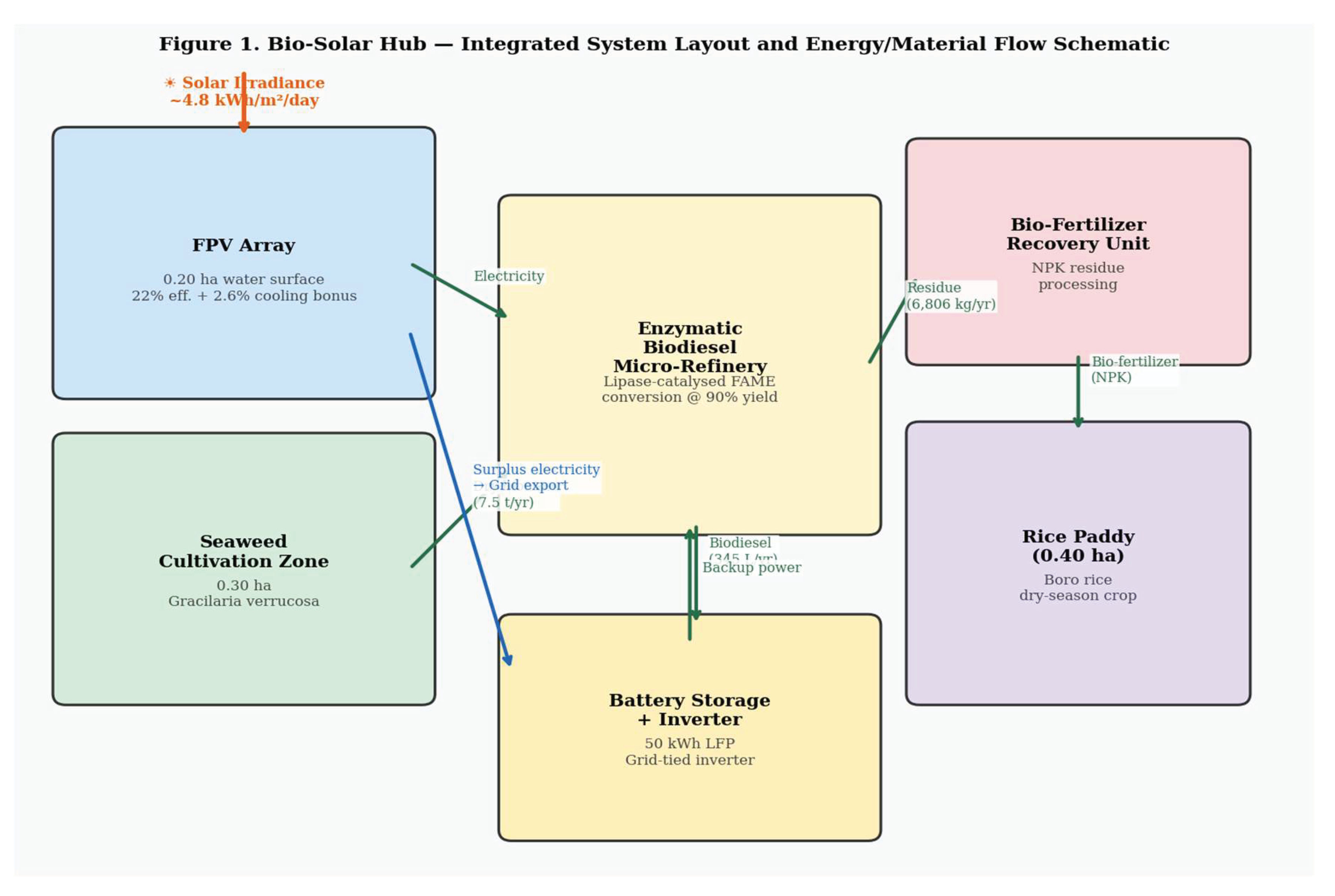
Figure 2.
Energy and Material Flow Diagram for the 1-ha Reference Farm (Baseline Scenario). Arrow thickness is qualitatively proportional to flow magnitude. MeOH: methanol (external input); LFP: lithium iron phosphate battery.
Figure 2.
Energy and Material Flow Diagram for the 1-ha Reference Farm (Baseline Scenario). Arrow thickness is qualitatively proportional to flow magnitude. MeOH: methanol (external input); LFP: lithium iron phosphate battery.
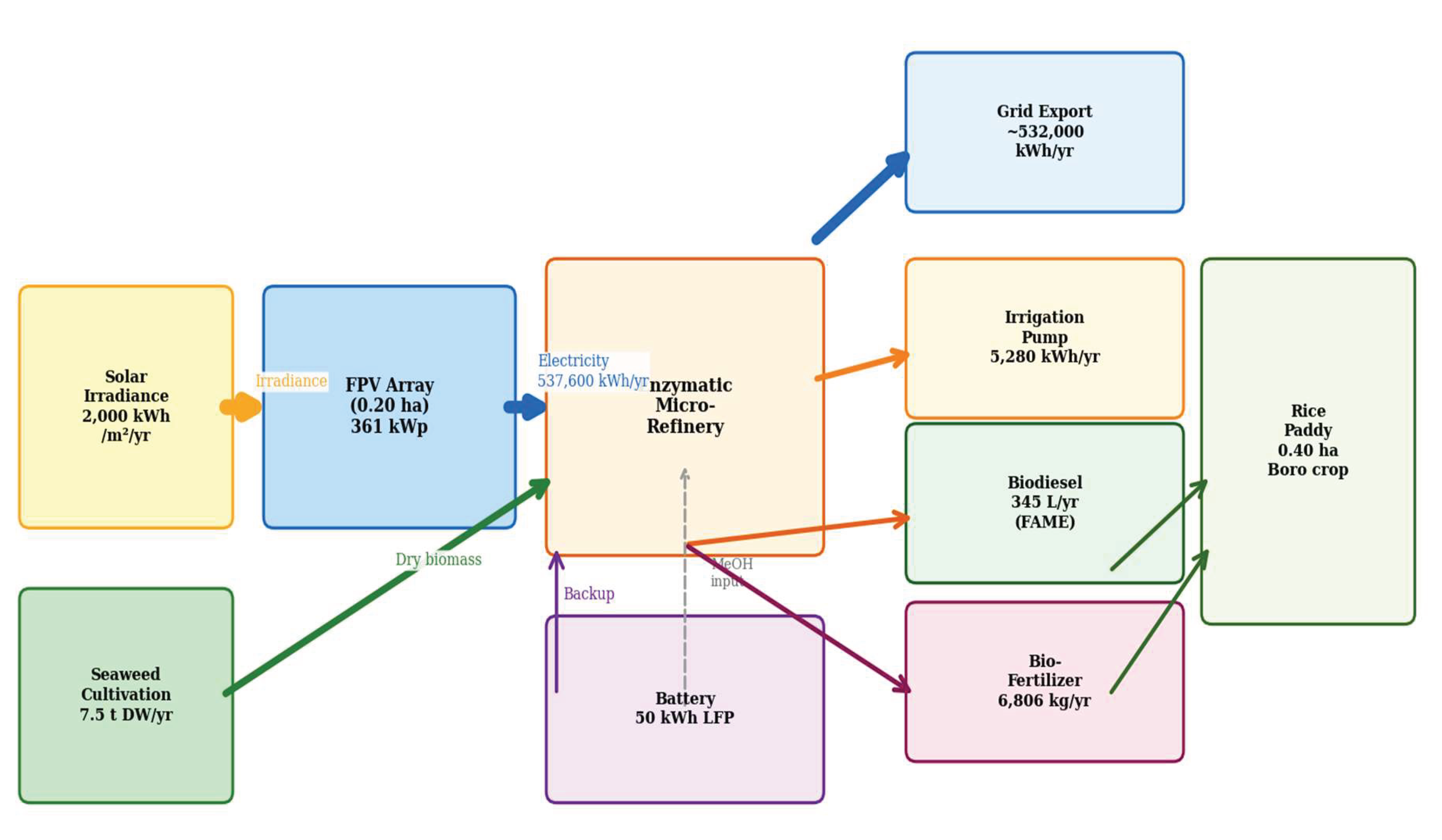
Figure 3.
Tornado Diagram — One-at-a-Time Sensitivity of 25-Year NPV to Six Key Parameters. Baseline NPV = USD 312,400. Green bars: optimistic (high-end) parameter values; red bars: pessimistic (low-end) values. Parameters ordered by absolute range.
Figure 3.
Tornado Diagram — One-at-a-Time Sensitivity of 25-Year NPV to Six Key Parameters. Baseline NPV = USD 312,400. Green bars: optimistic (high-end) parameter values; red bars: pessimistic (low-end) values. Parameters ordered by absolute range.
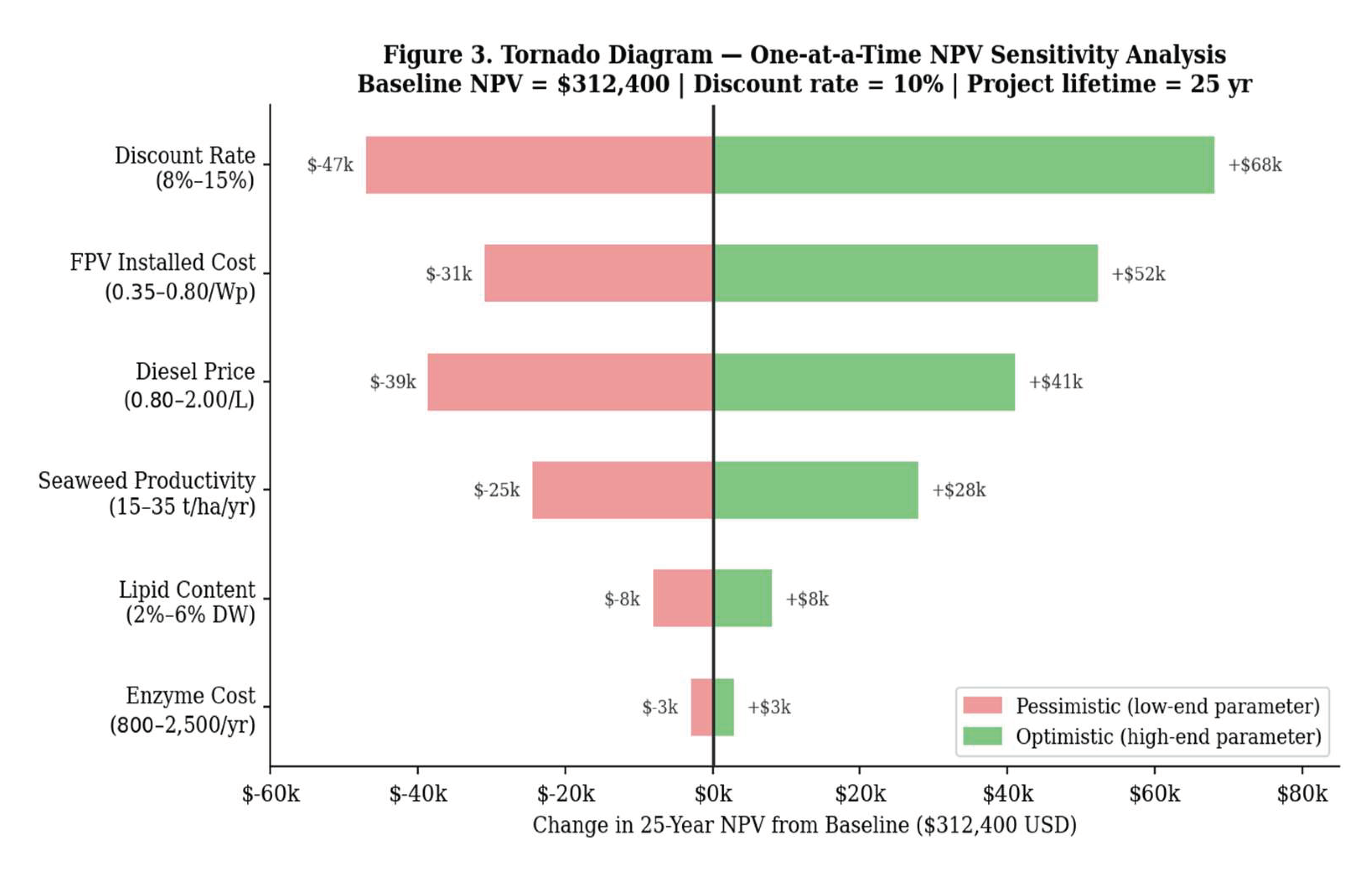
Figure 4.
Biodiesel Production Cost vs. Scale of Seaweed Cultivation Area (1–50 ha). Net of bio-fertilizer co-product credit. Shaded band: Low–High scenario range. Dashed red line: current import parity at USD 1.34/L. Yellow shaded zone: 8–12 ha cooperative-scale crossover threshold.
Figure 4.
Biodiesel Production Cost vs. Scale of Seaweed Cultivation Area (1–50 ha). Net of bio-fertilizer co-product credit. Shaded band: Low–High scenario range. Dashed red line: current import parity at USD 1.34/L. Yellow shaded zone: 8–12 ha cooperative-scale crossover threshold.
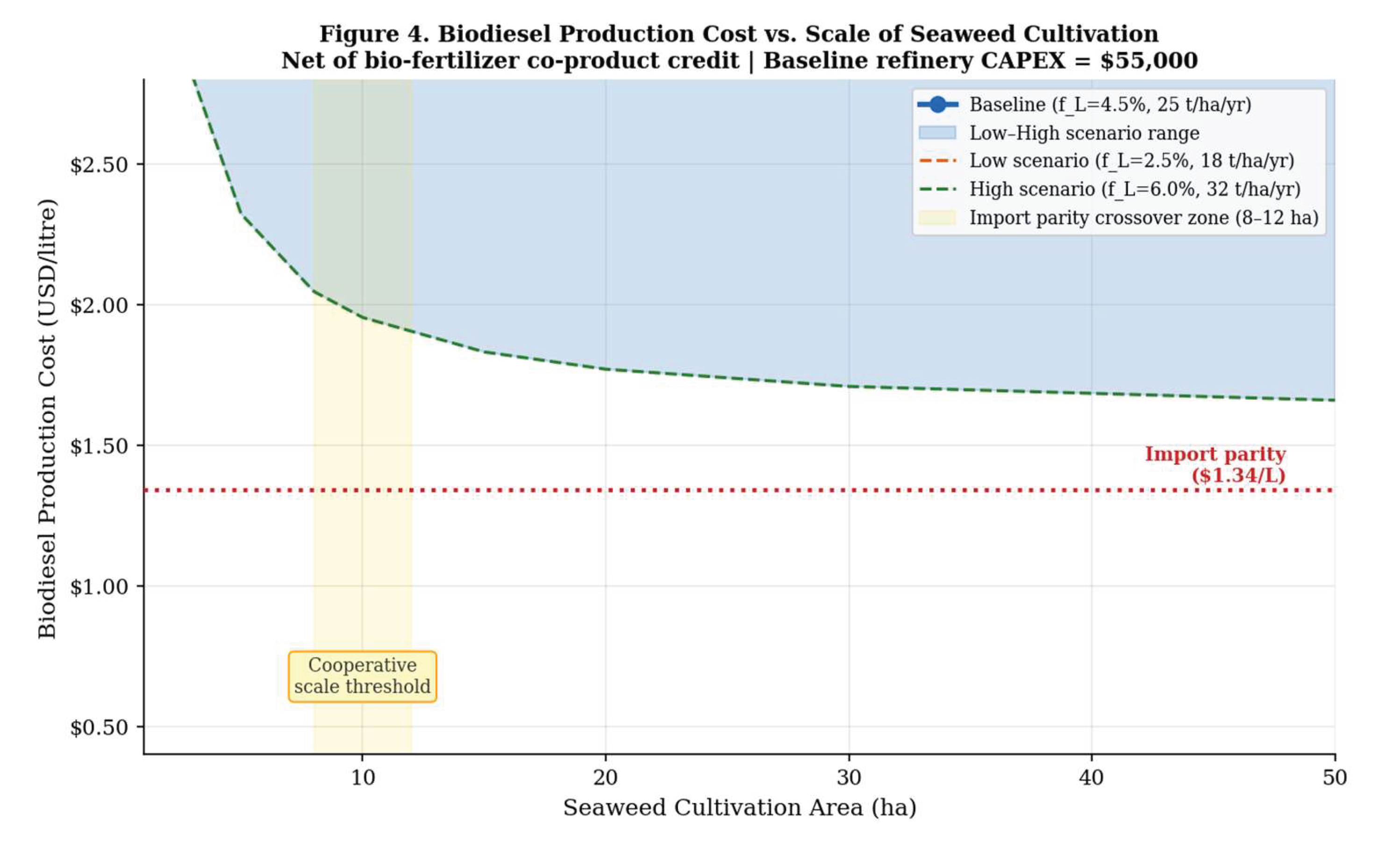
Table 1.
Reference farm design parameters and assumptions.
| Parameter | Value | Source / Justification |
|---|---|---|
| Total farm area | 1.00 ha | Modular reference unit |
| FPV water surface area | 0.20 ha | Irrigation + refinery load sizing |
| Seaweed cultivation zone | 0.30 ha | Biomass supply sizing |
| Rice paddy area | 0.40 ha | Primary agricultural output |
| Infrastructure / buffers | 0.10 ha | Civil engineering allowance |
| Reference latitude | ~22°N | Bangladesh central coastal zone |
| Annual GHI | 4.8–5.2 kWh/m²/day | [8] |
| Design peak sun hours (PSH) | 4.5 h/day | Conservative coastal baseline [8] |
| Grid connection | Assumed available | BPDB rural coverage |
Table 2.
Annual mass and energy balance for the Bio-Solar Hub reference farm (1 ha) across three seaweed productivity scenarios. FAME: fatty acid methyl esters.
Table 2.
Annual mass and energy balance for the Bio-Solar Hub reference farm (1 ha) across three seaweed productivity scenarios. FAME: fatty acid methyl esters.
| Parameter | Low (15 t/ha/yr) | Baseline (25 t/ha/yr) | High (35 t/ha/yr) |
|---|---|---|---|
| Seaweed dry biomass (0.30 ha) | 4,500 kg/yr | 7,500 kg/yr | 10,500 kg/yr |
| Extractable lipid (4.5% DW) | 202.5 kg/yr | 337.5 kg/yr | 472.5 kg/yr |
| FAME biodiesel (90% yield) | 207 L/yr | 345 L/yr | 483 L/yr |
| Bio-fertilizer residue (dry) | 4,084 kg/yr | 6,806 kg/yr | 9,528 kg/yr |
| FPV electricity generated | 537,600 kWh/yr | 537,600 kWh/yr | 537,600 kWh/yr |
| Refinery electricity consumed | 270 kWh/yr | 338 kWh/yr | 472 kWh/yr |
| Irrigation pump consumed | 5,280 kWh/yr | 5,280 kWh/yr | 5,280 kWh/yr |
| Exportable electricity surplus | 532,050 kWh/yr | 531,982 kWh/yr | 531,848 kWh/yr |
| Annual CO₂ offset (est.) | 5.0 tCO₂e/yr | 8.4 tCO₂e/yr | 11.7 tCO₂e/yr |
Table 3.
Techno-economic performance metrics across three seaweed productivity scenarios. All monetary values in constant 2025 USD.
Table 3.
Techno-economic performance metrics across three seaweed productivity scenarios. All monetary values in constant 2025 USD.
| Metric | Low | Baseline | High |
|---|---|---|---|
| FPV LCOE (USD/kWh) | $0.049 | $0.047 | $0.046 |
| Biodiesel production cost, 1-ha (USD/L) | $1.42 | $0.89 | $0.68 |
| Biodiesel production cost, 10-ha co-op (USD/L) | $0.94 | $0.82 | $0.74 |
| 25-yr NPV (10% discount rate) | $+274,200 | $+312,400 | $+361,800 |
| Internal Rate of Return | 28.4% | 31.7% | 36.2% |
| Simple payback period | 5.8 yr | 4.2 yr | 3.1 yr |
| Annual CO₂ offset | 5.0 tCO₂e | 8.4 tCO₂e | 11.7 tCO₂e |
| Diesel self-sufficiency (irrigation) | 3.9% | 6.5% | 9.1% |
| Nitrogen self-sufficiency (Boro rice) | 32% | 54% | 74% |
Disclaimer/Publisher’s Note: The statements, opinions and data contained in all publications are solely those of the individual author(s) and contributor(s) and not of MDPI and/or the editor(s). MDPI and/or the editor(s) disclaim responsibility for any injury to people or property resulting from any ideas, methods, instructions or products referred to in the content. |
© 2026 by the author. Licensee MDPI, Basel, Switzerland. This article is an open access article distributed under the terms and conditions of the Creative Commons Attribution (CC BY) license.
Copyright: This open access article is published under a Creative Commons CC BY 4.0 license, which permit the free download, distribution, and reuse, provided that the author and preprint are cited in any reuse.


