

Submitted:
19 April 2026
Posted:
21 April 2026
You are already at the latest version
Abstract
This paper starts with surveying the evolution of quantum-like models of cognition and decision making, transitioning from static kinematic representations to a robust dynamical framework based on open quantum systems. We provide a comprehensive analysis of the Gorini-Kossakowski-Sudarshan-Lindblad (GKSL) master equation's application in cognitive psychology and decision making, illustrating how it models mental state evolution as a dissipative process influenced by an informational environment. We categorize dynamical regimes into Passive and Active Hamiltonians, demonstrating how non-commutation with projections on decision basis serves as a mathematical signature of cognitive agency and Quantum Escape from classical equilibria. The utility of this framework is further explored through its ability to stabilize non-Nash outcomes in strategic games, such as the Prisoner's Dilemma. Building upon this dynamical foundation, we identify ``cognitive beats'' as a signature of the internal struggle between competing ``flows of mind'' deliberated at approximately equal frequencies. Distinct from the damped oscillations of simple interference, these beats emerge from a structural tension between Liouvillian channels that generates a secondary, slow-scale modulation of conviction. This beat envelope dictates the timing of peak readiness and hesitation, providing a mathematical map of the transition between conflicting cognitive states. By resolving these nested time scales, we provide a new spectral diagnostic for the depth of cognitive agency and the complexity of the underlying deliberation process. This paper develops a theoretical framework linking GKSL dynamics with quantum-like cognition and decision-making (QCDM), highlighting how dissipative quantum models can capture features of human thought and decision processes.
Keywords:
Quantum-like cognition and decision making
; Gorini–Kossakowski–Sudarshan–Lindblad dynamics
; decision making through decoherence
; active and passive Hamiltonians
; internal and environmental contributions to decision making
; quantum beats
; Prisoner’s Dilemma
; quantal responseequilibrium
1. Introduction
The field of Quantum-Like Modeling (QLM) has established itself as a mathematically rigorous alternative to classical Kolmogorovian probability, successfully accounting for empirical phenomena such as interference effects (violations of the law of total probability), order, conjunction, disjunction, and response replicability effects, contextuality, incompatibility of observables, e.g., questions.1 However, early iterations of these models were predominantly static, providing probability assignments for fixed moments rather than capturing the continuous, temporal nature of thought. Because human cognition is a dynamical process shaped by constant information flow, social interaction, and internal fluctuations, there is a fundamental need for a framework that accounts for mental state evolution.
While standard Schrödinger-type dynamics offer a starting point, their inherent reversibility and conservation of entropy fail to reflect the irreversible nature of real-world decision making. Consequently, researchers have turned to the theory of open quantum systems, specifically the Gorini–Kossakowski–Sudarshan–Lindblad (GKSL) master equation [25,39], to describe cognitive agents as systems interacting with a “psycho-mental” or informational environment. This approach, known as decision making through decoherence, allows for a principled transition from mental superpositions - representing competing alternatives - to stable “steady states” that signify a commitment to a decision.
This paper develops a theoretical framework connecting GKSL dynamics with quantum-like models of cognition and decision-making (QCDM), demonstrating how dissipative quantum dynamics can provide a rigorous mathematical foundation for capturing features of human thought and decision processes. The framework may be of interest not only to researchers in cognitive science, decision making, social science, and biology, but also to experts in the mathematical theory of GKSL dynamics, opening a new avenue for applications of this well-established formalism.2
A central advancement of the present work is the formal distinction between Passive and Active Hamiltonians within this dissipative evolution. While passive dynamics merely reflect the environmental pull, an active Hamiltonian signifies the internal agency of the decision-maker, where non-commutation between internal operators and environmental influences leads to a Quantum Escape from classical equilibrium. This mechanism provides a mathematical foundation for cognitive autonomy, allowing the agent to maintain stable preferences or reach non-classical outcomes that would be unreachable under purely Markovian classical relaxation.
This framework demonstrates significant utility in the realm of strategic interactions, particularly in resolving paradoxes within game theory. By modeling the Prisoner’s Dilemma through GKSL dynamics, we show that the interplay between decoherence and coherent internal updates can stabilize non-Nash cooperative outcomes. This suggests that selection of cooperative strategies is not merely a deviation from rationality, but a stable dynamical state emerging from the continuous interaction between the agent’s internal cognitive state and the social informational environment.
Finally, we explore a sophisticated dynamical regime characterized by “cognitive beats.” These beats represent an internal struggle between competing “flows of mind”—deliberative pathways that operate at nearly identical frequencies. Distinct from the simple damped oscillations of standard interference, these beats arise from a structural tension between Liouvillian channels, manifesting as a slow-scale modulation of conviction. By resolving these nested time scales, we can map the transition between peak readiness and hesitation, offering a new spectral diagnostic for the complexity and depth of the underlying deliberation process.
In connection with the cognitive beats phenomenon, we refer to the article [52], where eye-tracking measurements were used as a signature of convergence toward a steady state. In that work, fluctuating damping behavior in eye-tracking data was experimentally observed, and the data were simulated using GKSL dynamics within a decoherence-based framework of decision making. The graphs presented in [52] exhibit fluctuations; however, the sample size is not sufficient to determine whether cognitive beats are present.
2. Static Quantum-like Scheme for Decision Making
The cognitive state of an agent (decision maker) S is represented by a quantum state, mathematically described as a density operator acting on a complex Hilbert space . In the early formulations of QCDM, and more generally in QLM, only pure states were typically considered. However, the adoption of concepts from the theory of open quantum systems has motivated the systematic use of mixed states as well.
Cognitive observables—such as questions, tasks, or psychological traits—are represented by Hermitian linear operators . The spectrum of the operator corresponds to the set of possible outcomes of the associated cognitive measurement. In the finite-dimensional case, which we assume throughout this work in accordance with standard practice in QLM, the spectrum is discrete and consists of eigenvalues . These eigenvalues label the possible responses to the question represented by the observable .
These eigenstates correspond to the actions of responses themselves, which are events the agent must manifest in the natural world. From the perspective of classical probability theory, they must be mutually exclusive.
Any Hermitian operator admits a spectral decomposition,
where denotes the orthogonal projector onto the eigenspace corresponding to the eigenvalue .
For a pure cognitive state , the probability of obtaining the outcome is given by Born’s rule,
A measurement yielding the result induces a transformation (or “back-action”) of the cognitive state,
This transformation is known as the projection postulate, formulated in its general form by Lüders.
For mixed states described by density operators , the Born rule takes the form
Conditioned on obtaining the outcome , the post-measurement state is given by
The above construction follows the textbook theory of quantum measurements. While mathematically consistent, this framework remains largely formal and does not by itself clarify the internal structure of cognitive measurements. One particularly important feature is the reliance on the projection postulate. In QCDM, especially in approaches based predominantly on pure states, it is common to interpret this postulate as a “collapse of the mental wave function.” Superpositions are then viewed as superpositions of competing cognitive alternatives within the agent S.
Answering a question represented by an observable with outcome is modeled as a collapse of the pure cognitive state, corresponding to a projection onto the subspace . For observables with non-degenerate spectra, this reduces to a projection onto the corresponding eigenvector. In the QCDM literature, such decision processes are often illustrated by geometric pictures of state-vector projections in a plane (see, e.g., [15,16]). However, this interpretation introduces a degree of conceptual mystification, both in quantum cognition and in quantum physics itself. We argue that it is desirable to eliminate this ambiguous notion from QCDM and, more generally, from QLM. An alternative approach that avoids explicit appeal to collapse is known as decision making through decoherence :
Generally, the agent can be conscious all of the possible reactions. That is, the representations of these events exist simultaneously and interfere each other in its mind. This representational simultaneity is the property characterizing the agent’s cognitive state, and the intensity of interference is clearly expressed in the non-diagonal part of in the basis of the eigenvectors. On the other hand, the classical probability theory values the exclusivity of objective events and the frequencies of them, and in this sense, the representational simultaneity is completely vanished. This is expressed in . The states of and are semantically different: The cognitive measurement is a sort of semantic reduction.
3. The GKSL Equation in Quantum-like Cognition and Decision Making
3.1. Motivation and Conceptual Framework
In our foundational work [2], we proposed modeling cognitive evolution using the GKSL master equation, the most general form of a Markovian, completely positive, trace-preserving evolution for a density operator. This choice was not grounded in physical assumptions about the brain, but rather in the structural properties of the formalism, which ensure consistency of probability assignments and facilitate modeling of irreversible processes in open, context-dependent systems.
Cognitive states are represented by density operators on a Hilbert space of cognitive observables. Their evolution is governed by GKSL equation:
where H encodes internal cognitive tendencies and the jump operators describe interaction of a system S with the environment Here is understood as psycho-mental environment of an individual or generally as the information environment. With this general interpretation, this equation is used in QCDM, biology (including genetics, epigenetics, evolution theory), game theory [2,3,4,5,6,10,35] as well as in QLM in economics, finance, political and social sciences [35,37]. In modeling bridging of classical dynamics in neuronal networks of the brain with QCDM [36], a system S is a network realizing one special psychic function and its environment consists of signals coming from other networks interacting with In such models S is composed not of individual neurons, but of neuronal circuits. However, we shall not consider such bridging problem in this paper.
Denote the superoperator in right hand side of the GKSL equation (Liouvillian) by it acts in the space of linear operators where complex Hilbert space is system’s state space (in the infinite dimensional case one considers the space of bounded linear operators). Then the GKSL equation can be written as
The operator is the infinitesimal generator of the semigroup consisting of superoperators defined by
acting in and determining quantum Markov dynamics. We understood well that processing of information by brain (as well as e.g. by financial market) can be described by the quantum Markovian dynamics only approximately.
3.2. Cognitive Interpretation of Dynamical Terms
The Hamiltonian term, mapping captures internal cognitive dynamics such as oscillations between competing alternatives, conflict monitoring, and internal deliberation.3 The jump operators capture environmental influences - informational context, memory effects (especially in the case of GKSL dynamics with time dependent operators), social pressure, noise, and other external impacts - which induce decoherence and probabilistic reduction of cognitive superpositions. In bridging of classical neuronal dynamics in the brain with QCDM [36], these terms describe interaction of a neuronal network S with other Neuronal networks. We know that the internal dynamical interpretation of the Hamiltonian term is too straight forward, since some components of the Hamiltonian operator can also reflect environment’s signaling. We use this interpretation just for simplicity.
The paper’s use of the GKSL equation to model a cognitive agent as an “open system” interacting with an “informational environment” is a direct application of nonequilibrium statistical mechanics (in physics cf. [61]).
4. Decision Making Through Decoherence
A central insight of the GKSL approach is that decision making, known as decision making through decoherence, can be modeled as convergence toward a steady state – a decision state, satisfying
In this interpretation, a decision is not an instantaneous event but the outcome of a dynamical process in which the cognitive state asymptotically stabilizes to the decision state under the influence of both internal processes and environmental context. We illustrated this mechanism primarily in the context of the Prisoner’s Dilemma and other strategic games in our earlier works [3,10], see also Section 10.
Each decision state is a stationary point of the GKSL dynamics. The stationary points can be found from the equation
Solutions of these equation are all potential candidates for decision states.
We remark that any GKSL dynamics on a finite-dimensional Hilbert space admits at least one steady state:
The GKSL generator defines a completely positive trace-preserving dynamical semigroup acting on the convex compact set of density matrices. Since is continuous and preserves this set, the trajectory has accumulation points. Any accumulation point satisfies for all , which implies Thus at least one steady state exists.
We remark that generally approaching a decision state is characterized by fluctuations which amplitudes are damped in the process of stabilization, but never disappear completely. Of course, is the mathematical abstraction and a real decision maker “stops the process of decision generation” at times sharply distributed around the relaxation time of the GKSL dynamics.
In decision-making models, we introduce decision operator (Hermitian) A which is diagonal is some decision basis and decision outcomes are labeled by its eigenvalues For simplicity, we can consider a decision operator with non-degenerate spectrum. Our further analysis of decision making through decoherence is based on the following theorem (see, e.g., [24,38,57] for details).
Theorem 1
(Existence of a Diagonal Steady State). Consider a finite-dimensional Hilbert space with an orthonormal basis . Let the system evolve under the GKSL equation:
with generator’s components satisfying the following restrictions:
decoherence operator is composed of the transition and dephasing operators:
with non-negative rate coefficients, such that Sufficient Damping Condition holds:
For every pair of indices , the total decoherence rate is strictly positive:
Conclusion:For any initial density matrix , the evolution of the populations is governed by the dynamical Pauli equation (cf. with physics and chemistry [62]):
As , the system converges to a steady state that isdiagonal in the basis:
The populations satisfy the stationary Pauli equation:
We note that commutativity condition (11) is equivalent to diagonalization of Hamiltonian in basis
We remark that the diagonal operators (pure dephasing) increase the decoherence rate but do not affect the steady-state populations . We also note that the dynamics of the off-diagonal elements of the state operator satisfy the dephasing equation:
Since , .
5. Classical-like Decision Making: Passive Hamiltonian
In particular, we seek a dynamics where the steady state is diagonal in a specific decision basis , representing the complete resolution of cognitive interference into discrete probabilities. From a cognitive perspective, this construction models the transition from a state of mental superposition—where multiple mutually exclusive options are considered simultaneously—to a state of definite commitment. This is the classical-like regime of decision making represented within quantum formalism. We utilize the output of Theorem 1.
The dissipative operator is constructed of
- Dephasing Operators [54]: To eliminate off-diagonal elements without altering the population of the states, we define . This represents the resolution of cognitive dissonance through environmental or internal decoherence.
The full dissipative part of the GKSL generator, , is constructed as the sum of two distinct cognitive processes: dephasing and transition: Psychologically, these components represent distinct functions: dephasing is the process of categorization and the thinning of the mental field, where the ambiguity of holding conflicting beliefs is resolved. Transitions represent the process of active deliberation or preference shifting, where the subject weighs the relative merits of outcomes to favor the most attractive strategy.
The dephasing component, representing the environment-induced loss of cognitive coherence, is defined by:
where is the decoherence rate. These operators specifically suppress the off-diagonal elements (), ensuring the state becomes a classical mixture in the strategy basis .
The transition component is defined by:
where the coefficients are transition rates
Under the condition (11) for the decision basis vectors, the internal cognitive logic (described by Hamiltonian cannot drive population shifts. Under the Sufficient Decoherence Condition, the resulting decision state is a purely classical mixture:
5.1. Uniqueness vs. Non-Uniqueness of Decision State
Theorem 2
(Uniqueness of the Steady state). Let the condition of Theorem 1 hold and additionally let the transition rates be irreducible (the state graph is strongly connected), Then steady state isunique.
In this case the system is ergodic: for any initial state , the dynamics converge to this unique diagonal state:
We recall that he transition rates are said to be irreducible if, for every pair of indices , there exists a finite sequence of intermediate indices such that the product of the corresponding transition rates is strictly positive:
Thus, it is possible to transition from any basis state to any other basis state through a finite chain of transitions with non-zero rates.
This definition can be formulated in the graph theoretic framework as strong connectivity. The state graph is a directed graph defined as follows:
- Vertices (V): The set of orthonormal basis states .
- Edges (E): A directed edge exists from state to state if and only if the transition rate is strictly positive ().
The graph G is strongly connected if, for every pair of vertices , there exists a directed path from u to v and a directed path from v to u.
Cognitive Interpretation of Graph Connectivity. The irreducibility of transition rates and the resulting strong connectivity of the state graph G carry profound implications for the “trajectories of thought” within the mental Hilbert state space. In this framework, a thought trajectory is the time-evolution of the density matrix as it relaxes toward the steady state .
Global Reachability and Open-Mindedness. A strongly connected graph for the decision basis implies that for any two basis mental states (initial thought) and (potential decision), there exists a sequence of non-zero transition rates connecting them. This represents a regime of global reachability. During the deliberation process, the agent’s “stream of mind is not restricted to a subset of ideas. Every potential conclusion remains accessible from any starting point, characterizing a state of cognitive flexibility or open-mindedness.
The Decision State as a Universal Attractor. Mathematically, Theorem 2 guarantees that if the graph is strongly connected, the steady state is unique and globally attractive. In QCDM This implies that the final decision is independent of the initial bias. Regardless of the agent’s “hunch” or starting mental state , the dissipative pressure of the informational environment and the internal logic will eventually drive the agent to the same unique probability distribution. This models a process of “rational convergence” or stable personality traits.
Cognitive Traps and Dogmatism (Reducible Case). If the state-graph is not strongly connected (reducible), the mental state space is partitioned into isolated islands or terminal components. In QCDM these islands are interpreted ascognitive traps. If a thought trajectory enters such a component, it can never transition back to states outside of it. This provides a mathematical model for prejudice, dogmatism, or cognitive silos, where the agent becomes locked into a specific subset of beliefs. We also point to mental path dependence. The decision state is not unique; the final decision depends entirely on which island the initial thought occupied. This characterizes a decision-making process that is hypersensitive to initial framing or prior history
This is the good place to refer to the paper of Montroll and Weiss [42] on random walks on lattices; in the framework of their theory the relaxation towards a steady state (decision) can be mathematically viewed as a random walk on a graph of basis mental states, where irreducibility and connectivity determine if a unique decision is reached.
Transient Thoughts vs. Persistent Beliefs. In a graph that is not strongly connected, some states may be transient. These represent “fleeting thoughts.” The trajectory may visit these states during the early stages of deliberation, but once the agent moves past them, the transition rates ensure they can never be revisited. They are discarded in favor of the persistent beliefs found in the terminal components of the graph.
5.2. Detailed Balance Condition
In cognitive applications, it is natural to appeal to the Detailed Balance Condition as a special realization the Sufficient Decoherence Condition. We note that the Detailed Balance Condition is stronger than the Sufficient Decoherence Condition and Theorem 2 can be applied. By the Detailed Balance Condition the probability flow from state n to m equals the flow from m to n:
For a system driven by utilities and , the transition rates are typically defined as
Substituting this into the balance equation yields the ratio:
The unique normalized solution to this system is the Gibbs distribution:
where acts as the intensity of choice, which is mathematically identical to the inverse temperature in thermodynamics This demonstrates that in the commuting limit (in conjunction with the Detailed Balance Condition), the GKSL equation generates the classical Quantal Response Equilibrium - Gibbs distribution (22). Such GKSL dynamics can be treated as classical.
Dynamics constrained by conditions of Theorem 1 can be certified as classical-like. It generates a decision state that is diagonal in the decision basis (generally it is non-unique and need not coincide with Quantal Response Equilibrium.
6. Quantum Decision Making: Active Hamiltonian
If the Hamiltonian contains off-diagonal elements,
it acts as a coherent drive that rotates population between different states. Mathematically this situation is described by the following theorem:
Theorem 3
(Non-Existence of Diagonal Steady States). Let under the Sufficient Damping Condition (). If there exists a pair such that:
- 1.
- Non-zero Hamiltonian Coupling:
- 2.
- Population Gradient:
Then cannotbe diagonal in the decision basis .
Proof.
Assume, for contradiction, that the steady state is diagonal in the basis . We write , where . For to be a steady state, the matrix elements of the Lindbladian must vanish for all pairs . For :
1. Dissipative Term: Under the Sufficient Damping Condition, the action of on any matrix results in . Since we assumed is diagonal, for . Thus:
2. Hamiltonian Term: The stationarity condition now requires the commutator term to vanish independently:
Substituting the diagonal form , the sum reduces to:
3. Contradiction: By the theorem’s hypothesis, there exists a pair such that and . This implies , which contradicts the requirement that the Hamiltonian term must be zero.
Therefore, the assumption that is diagonal must be false. The steady state must satisfy for at least one pair . □
This theorem implies the Liouvillian has a nontrivial null space. However, the mere existence of a stationary state does not guarantee that exists for every initial state . It does not preclude:
- Persistent Oscillations: If the Lindbladian has purely imaginary eigenvalues, the dynamics may contain non-decaying oscillatory modes. In this case the system does not converge to a stationary state but evolves on a periodic or quasi-periodic orbit around it. This corresponds to the existence of decoherence-free oscillatory subspaces.
- Multiple Steady States: If the dynamics are not “relaxing” (non-ergodic), the final state may depend entirely on , or the system could be trapped in a specific subspace.
Cognitive Meaning: This theorem proves that internal deliberation (H) acting up to asymmetric preferences forces the agent into a non-classical state of persistent coherence. In this regime:
- The Hamiltonian constantly generates coherences () that the dephasing term attempts to destroy.
- The stationary state is not purely diagonal in the decision basis (even under Sufficient Decoherence Condition). It retains non-vanishing off-diagonal elements, representing a state of “active deliberation” or persistent quantum-like superposition. At least, it is the cognitive state where the property of representational simultaneity is not completely vanished. Its eigenstates will not correspond to the events (the responses) observed in the nature, since each of them is the superposition of , generally. However, the agent may experience these cognitive states in its mind: Such the experience certainly exists in the epistemological sense, not in the natural scientific one. We have to distinguish the epistemological reality from the natural scientific reality. (See appendix A for further foundational discussion).
- Crucially, the presence of “active Hamiltonian” H can shift the diagonal populations away from the values predicted by the transition rates alone (coherence-induced population shift, the well known result in quantum thermodynamics). The internal logic represented by H competes with the environmental pressure of the jump operators, leading to a driven-dissipative steady state that does not align with classical expectations.
- Purely imaginary eigenvalues of the generator lead to non-decaying oscillations of the cognitive state. In decision-making terms, this represents stable indecision: the agent cyclically shifts preference between alternatives without converging to a final probability distribution. The mind remains in a self-sustained deliberative loop, with competing options repeatedly reactivated. Such behavior may arise in certain pathological cognitive conditions, where thought processes become trapped in repetitive cycles, for example in obsessive rumination, manic switching of intentions, or other disorders characterized by persistent cognitive instability.
The following two propositions can also find applications in QCDM, in the framework of decision making through decoherence:
Proposition 1
(Structure of a Coherence-Induced Steady State). Under the assumptions of Theorem 3, let be any steady state. Denote its stationary populations by . Then admits the decomposition
with the off-diagonal coefficients
Proof.
Taking the off-diagonal matrix elements of the steady-state condition gives, for :
Solving for yields
This gives the decomposition stated above. □
Proposition 2
(Uniqueness of the Steady State for Active Hamiltonian). Under the conditions of Theorem 3, assume in addition that the transition rates are irreducible (the associated state graph is strongly connected). Then, the steady state is unique and globally attractive: for any initial density matrix .
In physics, quantum information theory, this area of research (the GKSL dynamics with Active Hamiltonians) is known as Dissipative State Engineering [1,23].
The Necessity of Non-Commutation: Agency and Conflict Monitoring
For a model to exhibit a Quantum Escape from a classical equilibrium, the non-commutation condition is mandatory. From a cognitive perspective, this non-zero commutator represents the mathematical signature of cognitive agency or subjective bias, where the internal cognitive drive actively resists the dissipative pressure of the informational environment.
We remark that Theorem 3 remains robust under the stronger Detailed Balance Condition. If the Hamiltonian is active (), the internal deliberative flow creates a “torque” that prevents the state from ever collapsing into the classical Gibbs diagonal. Thus, even under the Detailed Balance Condition, an Active Hamiltonian acts as a conflict monitor [11,51]. In this regime, H constantly pumps probability back into off-diagonal elements—generating quantum-like coherences —which prevents the mental state from settling into a purely classical mixture. This mechanism provides a dynamical explanation for key phenomena in QCDM:
Persistent Deliberation: The steady state remains “warm,” maintaining a state of active tension between competing alternatives rather than a cold, singular choice.
Quantum Escape in Strategic Games: The internal logic of the decision-maker can stabilize outcomes that are classically unstable. In the Prisoner’s Dilemma (see Section 10 for details), for instance, while dissipative transition operators drive the system toward the Nash equilibrium of mutual defection, a non-commuting Hamiltonian can shield the cooperative superposition. This allows the system to escape the classical utility trap and stabilize a decision state with a significant probability of mutual cooperation, reflecting the persistent logical intuitions observed in human subjects [22]. In this light, the magnitude of the commutator serves as a formal measure of the individual’s autonomy from the external reward structure.
7. Cognitive Beats: A Distinguishing Property of Decision by Coherence Model
7.1. Multifrequency Beats
Within the QCDM framework, a two-frequency beat (cognitive beat) arises from the interference of two oscillatory components of the probability trajectory with nearby frequencies. Equal amplitudes are not required for the appearance of beats, although they produce the most pronounced and symmetric modulation pattern. This phenomenon serves as a signature of the coupling between the internal Hamiltonian dynamics and the dissipative GKSL environment, and represents a spectral feature of the Liouvillian operator.
General Two–Frequency Superposition
Consider two oscillating contributions to the probability trajectory
where the amplitudes and may be different and the frequencies are assumed to be close, Introducing the average and difference frequencies
the trajectory can be rewritten as
This representation shows that the signal consists of a fast oscillation at frequency whose amplitude varies slowly on the time-scale . The slow modulation corresponds to the beat phenomenon. The beat frequency is determined by the difference of the two oscillation frequencies,
In the general unequal-amplitude case the envelope does not vanish. Instead, the oscillations occur between upper and lower bounds determined by and . The beat pattern is therefore asymmetric but still clearly present whenever the frequencies are sufficiently close.
Symmetric Beat: Equal Amplitude Case
A particularly transparent form is obtained when the amplitudes coincide, In this symmetric case the signal reduces to
In this equal-amplitude limit the envelope periodically reaches zero, producing maximal constructive and destructive interference. This corresponds to the canonical beat pattern with clearly visible nodes and antinodes, see Figure 1.
Interpretation in GKSL / QCDM Dynamics
The appearance of beats indicates the presence of at least two oscillatory modes of the Liouvillian dynamics with nearby imaginary parts of the eigenvalues. The frequencies and are determined by the Liouvillian spectrum, while the amplitudes and depend on the projection of the initial state onto the corresponding eigenmodes.
Thus the conditions for beats are: (a) close Liouvillian frequencies (necessary condition), (b) nonzero projections onto both modes (amplitudes ). We also highlight again that equal amplitudes produce maximal symmetric beats. The pulsing behaviour of therefore serves as a diagnostic of multi-mode dissipative dynamics and indicates the presence of multiple coherent oscillatory channels in the QCDM evolution.
General Multi-Frequency Formulation
In a complex dissipative cognitive system, the probability trajectory is typically composed of multiple oscillatory modes originating from the Liouvillian spectrum. The most general form can be written as
where is the stationary probability, are decay rates determined by the real parts of Liouvillian eigenvalues, are oscillation frequencies determined by the imaginary parts, are amplitudes fixed by the initial state, are phase shifts. A multifrequency beat occurs whenever the set of frequencies contains at least two values that are relatively close to each other,
In this situation the interference between these nearby modes produces slow amplitude modulation on top of faster oscillatory dynamics. If several clusters of close frequencies are present, the trajectory may exhibit nested beats, hierarchical modulation, or quasi-periodic pulsing patterns. Such behaviour is a direct signature of a structured Liouvillian spectrum and indicates the presence of multiple competing dynamical channels.
In the special case of two dominant nearby modes, the general multi-frequency expression reduces to the two-frequency beat discussed above. When more than two nearby frequencies are present, the resulting trajectory can display irregular envelopes, secondary beat frequencies, and long-time modulation patterns.
The following fields provide the mathematical basis for treating beats as a signature of complex dissipative dynamics: quantum dissipative systems [12] (analysis of GKSL dynamics and the spectral properties of Liouvillian operators), spectral theory of Liouvillians [41] (discussion how clusters of complex eigenvalues lead to metastable oscillations and beat-like structures), quantum optics - quantum beats [53] (interference of transition frequencies leading to quantum beats in fluorescence signals), high energy physics [27].
7.2. Three Mechanisms of Cognitive Beat Phenomena
Within the QCDM framework, probability trajectories generated by GKSL dynamics may exhibit oscillatory behaviour with slowly varying envelopes. Such behaviour naturally arises when the Liouvillian spectrum contains several oscillatory modes with close frequencies. In this case the probability trajectory can be written in the general form (31), where the frequencies are determined by the imaginary parts of the Liouvillian eigenvalues. Beat phenomena occur whenever at least two frequencies are close, for some
In the QCDM interpretation this means that the decision maker simultaneously supports several oscillatory cognitive dynamical modes operating on different time scales. Their interference produces slow modulation of decision probabilities. The crucial question is therefore the origin of these frequencies. In GKSL-based cognitive dynamics, three qualitatively different mechanisms may generate them.
Type I: Hamiltonian (Internal Deliberation) Beats
The first and most direct mechanism corresponds to oscillations generated purely by the internal cognitive Hamiltonian. In this case the dissipative part of the GKSL equation only damps oscillations, while the frequencies are determined by the Hamiltonian spectrum. If the Hamiltonian eigenvalues are , the oscillatory components appear at frequencies When two such frequency differences are close, the corresponding oscillatory components interfere and produce beats.
This mechanism admits a natural cognitive interpretation. The Hamiltonian represents coherent transitions between cognitive states, and therefore its eigenfrequencies describe intrinsic deliberation cycles. Beats then arise when the decision maker alternates between two nearly equivalent reasoning pathways. The system does not settle into a single evaluation mode but instead slowly shifts its emphasis between competing internal narratives. A simple example is a decision between a safe and a risky option. Consider three cognitive states: an undecided baseline state, a cognitive mode favouring the safe option, and another favouring the risky option. A minimal Hamiltonian representation is The parameters and describe transitions between the undecided state and the two competing cognitive modes, while and characterize their internal deliberation frequencies. If , the decision maker alternates between two nearly equivalent lines of reasoning. The probability of choosing the safe or risky option then exhibits slow modulation, reflecting an internal cognitive beat. This situation corresponds to a purely endogenous mechanism. The oscillations originate entirely from internal deliberation, and the environment only determines relaxation toward a stationary state.
Type II: Dissipative (Environment-Driven) Beats
A qualitatively different mechanism appears when oscillatory behaviour is generated primarily by the dissipative part of the GKSL dynamics. In this case the environment does not merely damp internal oscillations but actively induces coherent transitions between cognitive states. The resulting Liouvillian spectrum may contain complex eigenvalues even when the Hamiltonian is trivial.
Such GKSL dynamics cannot be generated solely by the jump and dephasing operators that have been considered before; active dissipative channels, such as those discussed in Appendix B, should be added. Such channels involve non-transition type operators that actively generate off-diagonal coherences. These operators prevent the Quantum Escape from being fully suppressed by decoherence, allowing the environment itself to sustain the oscillatory dynamics of cognitive beats.
Cognitively, this corresponds to a situation in which oscillations are driven by structured information flow rather than internal deliberation. The decision maker is repeatedly influenced by alternating external signals, and the probability distribution reflects this externally imposed rhythm.
As an illustration, consider a person forming an opinion under alternating exposure to opposing viewpoints. Let the three states correspond to a neutral position, a pro opinion, and an anti opinion. The Hamiltonian may be taken small or even zero, while the dissipative operators describe transitions induced by external information streams. For example, one may consider jump operators that move the system from the neutral state to either opinion, together with cross-influence operators that convert one opinion into the other. Such structured dissipation can produce oscillatory Liouvillian modes. When two of these modes have similar frequencies, the resulting probability dynamics displays beats. In this case the oscillations do not reflect internal deliberation cycles but rather the temporal structure of the informational environment. The beats correspond to interference between different channels of social or informational influence.
Type III: Hybrid Beats
The most realistic scenario combines both mechanisms. Internal deliberation produces oscillatory modes, while environmental interactions modify them and introduce additional frequencies. The resulting Liouvillian spectrum depends on both the Hamiltonian and the dissipator, and beat phenomena emerge from their interplay.
Cognitively, this corresponds to a decision maker whose internal reasoning interacts with an external information stream. Internal evaluation may favour certain options, while external signals periodically reinforce or weaken them. When the internal deliberation frequency is close to the external modulation frequency, resonance-like effects appear, producing pronounced beats.
A natural example is an investment decision. The cognitive states may correspond to buying, waiting, or remaining undecided. Internal reasoning generates oscillations between optimistic and cautious evaluations. At the same time, market news and price fluctuations introduce an external rhythm. When these two time scales are comparable, the decision probability exhibits slow modulation. The decision maker alternates between confidence and hesitation in a quasi-periodic manner.
Mathematically, this hybrid regime corresponds to Liouvillian eigenvalues of the form
where the frequencies depend jointly on the Hamiltonian and the dissipative operators. Near-degeneracy of two such frequencies produces multifrequency beats.
Interpretation for QCDM
The three mechanisms described above correspond to different cognitive origins of beat phenomena. Hamiltonian beats reflect competition between internal deliberation pathways. Dissipative beats arise from structured environmental influence. Hybrid beats emerge from the interaction between internal reasoning and external information flow.
From the QCDM perspective, the observation of beats in probability trajectories indicates the presence of multiple cognitive oscillators operating on similar time scales. The interference between these oscillators produces slow modulation of decision probabilities. This behaviour is incompatible with purely classical Markov decision models, which cannot generate oscillatory population dynamics without additional hidden structure.
Therefore, beat phenomena provide a diagnostic signature of coherent multi-mode cognitive dynamics. Their presence suggests that the decision maker simultaneously explores several competing representations and that these representations interact coherently over time. In Appendix B we present the concrete experimental framework for possible ’ing mathematical model based on the decision making through decoherence
7.3. Identifying the active Hamiltonian
The emergence of these beats serves as a critical diagnostic tool to distinguish between the Passive and Active Hamiltonian (in fact, classical and quantum) regimes across different system dimensions N. Let F be the maximum number of distinct observable frequencies .
The Passive Case (Classical Limit): In the Passive Case, the population matrix is decoupled from the coherences. The dynamics are restricted to the spectrum of an N-dimensional transition rate matrix. Because one eigenvalue must be zero (steady state), there are degrees of freedom for dynamics.
- If , : The eigenvalue is real. No oscillations are possible ().
- If or , allows for at most one pair of complex conjugate eigenvalues ().
In this regime, beats are mathematically impossible because a beat requires at least two distinct frequencies ().
The Active Case (Quantum-Like Coupling): In the Active Case, the full Liouvillian couples populations to off-diagonal coherences. Excluding the steady state, there are eigenvalues available to manifest in the diagonal elements.
- If , : Allows for one oscillatory pair ().
- If , : Allows for up to seven oscillatory pairs ().
The following table summarizes the spectral capacity of both regimes to produce oscillations and beats:

Table 1.
Comparison of spectral complexity between Passive and Active regimes.
| Dimension (N) | Regime | Max Frequencies (F) | Certification Result |
|---|---|---|---|
| (Qubit) | Passive | 0 | Pure Decay (No Oscillation) |
| Active | 1 | Pure Oscillation (No Beats) | |
| (Qutrit) | Passive | 1 | Single Frequency (No Beats) |
| Active | 4 | Beats Possible | |
| (PD) | Passive | 1 | Single Frequency (No Beats) |
| Active | 7 | Complex Beats Possible |
Theorem [Visibility of Spectral Complexity] Let be the GKSL generator in an N-dimensional Hilbert space.
- Passive Requirement: If , the trajectory is restricted to the spectrum of an matrix. For , this precludes multifrequency beats.
- Active Requirement: If , inherits the spectral complexity of the full Liouvillian. For , the presence of a beat pattern is a sufficient certificate of an Active Hamiltonian (in our GKSL framework).
8. Equivalence of GKSL Dynamics with Passive Hamiltonian and Classical Markovian Dynamics
The intuition that Passive Hamiltonian GKSL dynamics is equivalent to classical Markovian dynamics is mathematically rigorous. When the Hamiltonian H is “passive,” the quantum-specific interference terms effectively vanish from the evolution of the diagonal elements, reducing the system to a classical Master Equation.
If the Hamiltonian H is passive, then the commutator . Under this condition, the following simplifications occur:
- Decoupling: The coherences (off-diagonal elements ) decouple from the populations (diagonal elements ).
- Unitary Vanishing: The term contributes zero to the evolution of the diagonal elements .
The resulting rate of change for each probability depends exclusively on the other probabilities , yielding the Pauli master equation (cf. with physics and chemistry [62]):
where are the transition rates derived from the Lindblad operators . This is identical to the form utilized in classical Markovian dynamics.
The classical equivalence imposes strict constraints on the spectral complexity of the system:
- 1.
- Eigenvalue Constraints: For a classical transition rate matrix of dimension N, the eigenvalues are constrained by the properties of stochastic matrices. For , there are 4 eigenvalues, one of which is always 0 (representing the steady state).
- 2.
-
The Limit: The remaining 3 eigenvalues can only manifest in two configurations:
- Three real negative numbers (resulting in pure exponential decay).
- One real negative number and one pair of complex conjugates (resulting in a single frequency oscillation).
Since a classical Markov process on 4 states can support at most one pair of complex conjugate eigenvalues, it is limited to a single frequency . Because a multifrequency beat requires the interference of at least two distinct frequencies (), such patterns are mathematically impossible in the Passive/Classical regime, for N=4 (e.g.the Prisoner’s Dilemma, Section 10).
Detailed Balance: Monotonic Dynamics
To contrast classical and quantum behavior, it is useful to consider GKSL dynamics with a passive Hamiltonian H and a dissipator satisfying the detailed balance condition (Section 5.2). In this case, the population dynamics is given a classical master equation , where the generator W is similar to a symmetric matrix. Consequently, W has only real eigenvalues, and the populations evolve as sums of purely exponential terms without oscillations, leading to monotonic relaxation toward the stationary state.
In contrast, for an active Hamiltonian the populations couple to coherences and no closed classical generator for exists. The effective dynamics are then governed by the full Liouvillian, whose spectrum may contain complex-conjugate eigenvalues. As a result, the population dynamics are generally non-monotonic and may exhibit oscillations or beat patterns.
9. Contrasting the Busemeyer and Asano-Khrennikov Approaches to Cognitive Modeling
The role of multifrequency beats serves as the primary differentiator between the unitary model of the Busemeyer et al. [16,17,50] and the Open-System model (decision making through decoherence) of the Asano-Khrennikov et al. [2][6].
- 1.
- Unitary Model: Dynamics are governed by . For , the probability is a sum of frequencies derived from the 4 eigenvalues of H. While multifrequency interference is possible, the lack of natural damping often results in sustained oscillations rather than the localized pulses characteristic of cognitive beats.
- 2.
- Open-System Model: Dynamics are governed by the Liouvillian . The structure allows for up to numerous distinct frequencies. In this framework, the ’Active Hamiltonian’ acts as the engine of deliberation, pumping energy between coherences and populations. This interaction manifests as damped beats—the mathematical signature of a mind moving from uncertainty toward a decision. For a three-option state (), these cognitive beats begin to emerge; however, in more complex systems like the Prisoner’s Dilemma, the matrix structure allows for a rich spectrum of up to seven distinct frequencies
From the viewpoint of beats, the Asano-Khrennikov framework is more robust for certification. It provides a larger spectral bandwidth ( vs N), allowing for complex beat patterns that are mathematically impossible in both classical Markovian models and simple unitary models with high symmetry.
10. The Prisoner’s Dilemma
The Prisoner’s Dilemma is the classic “non-zero-sum” game where two players must choose between Cooperation (C) and Defection (D). The main output of the classical expected utility theory is that while mutual cooperation (CC) yields the best collective outcome, individual rationality leads both players to the defect strategy (DD) .
The Payoff Matrix
We consider the standard payoff structure for players Alice (rows) and Bob (columns):
Table 2.
Payoff matrix for the Prisoner’s Dilemma.
| Bob: C | Bob: D | |
|---|---|---|
| Alice: C | ||
| Alice: D |
Here the payoffs follow the hierarchy: (Temptation > Reward > Punishment > Sucker’s payoff).
The Nash Equilibrium occurs at : regardless of Bob’s choice, Alice’s payoff is higher if she defects ( and ), the same logic applies to Bob. Despite the fact that is Pareto-optimal (both players would be better off), the stable point—where no player can improve their payoff by changing their strategy alone—is mutual defection. This is the output of the classical expected utility theory. However, humans behavior frequently deviates from the Nash equilibrium in the experiments of Prisoner’s Dilemma type – we can rely on several foundational works; we briefly overview some them: Simon [56] introduced the concept of Bounded Rationality, providing the historical root for why steady-state Nash equilibria () might not be reached by finite human agents. In 1979 Kahneman and Tversky [28] wrote the seminal paper on Prospect Theory, which documents how humans deviate from expected utility maximization; this paper is essential for coming discussion on the interplay between classical and quantum-like payoff-driven dynamics (see also Tversky and Kahneman [60] and Shafir and Tversky [55]). The paper of Henrich et al. [26] provides the empirical “ground truth” across different cultures, showing that humans consistently prioritize fairness and cooperation over pure payoff maximization in games like the Prisoner’s Dilemma or Ultimatum Game. The paper of Thaler [58] explains the psychological mechanisms (like mental accounting) that cause humans to treat potential losses and gains differently, which could be modeled within our QLM as a “moral” or “cognitive” oscillation.
Representative applications of QLMs to dilemmas such as the Prisoner’s Dilemma can be found in [15,16,49], where interference effects are used to explain violations of the sure-thing principle; in works [3,5,6] the dynamics of decision making in the Prisoner’s Dilemma was modeled with the GKSL equation - decision making through decoherence.
10.1. Quantum Dynamics of the Prisoner’s Dilemma
We model the decision process using the basis . The agent assumed in this model is Alice, Bob, or a third entity who tries to predict their cognitive experiences. The dynamics are governed by the GKSL equation. To represent the cognitive tension between the Pareto-optimal outcome and the Nash equilibrium, we propose Hamiltonian:
where is the frequency of “cognitive oscillation” between cooperation and defection. This Hamiltonian doesn’t commute with dephasing operators, so we are in the framework of Section 6. The steady state isn’t determined solely by the jump operators. In the full GKSL framework, the stationary condition:
shows that is the result of a dynamical competition; the stationary state is not simply the thermal or “rational” state dictated by the payoffs. When H includes off-diagonal coupling between and , it acts as a coherent pump. Even if the transition rates favor defection,
the Hamiltonian prevents the system from relaxing into the Nash Equilibrium. In this regime, the steady state exhibits:
Coherent Population Trapping: A non-vanishing probability of cooperation that persists as .
Quantum-Classical Competition: Assume the Detailed Balance Condition. The specific value of depends on the ratio . If the cognitive frequency is high relative to the relaxation rate , the internal reasoning effectively overrides the payoff-driven environment.
Thus, the GKSL framework allows for the emergence of cooperation not just as a transient fluke, but as a stable, stationary phenomenon resulting from the non-trivial commutation relations between the agent’s internal deliberation (H) and the external incentive structure ().
10.2. The Possibility of and Jumps
While the proposed Hamiltonian H specifically couples the mutual states and , the intermediate “asymmetric” states and remain critical to the dynamics through the dissipative term .
The transition rates are governed by the full payoff hierarchy . Consequently, the system does not simply toggle between mutual cooperation and mutual defection. Instead, the environment exerts “temptation” pressures:
- The Sucker-Temptation Leak: Even if H populates the state, the jump operators and drive the system toward the asymmetric states because the temptation payoff T exceeds the reward R.
- The Rational Sink: Once the system enters or , the hierarchy ensures a final dissipative pull toward the Nash Equilibrium .
Therefore, the states and act as the “classical pathways” through which quantum coherence is lost. The Hamiltonian H acts as a “shortcut” or “quantum bridge” that allows the agent to mentally bypass these intermediate states during deliberation. The final observed probability of cooperation depends on whether the decision is reached at a transient time t where the coherent oscillation toward is at its peak, or if the dissipative “leak” through the asymmetric states has already led the system to the steady state.
11. Concluding Remarks
The integration of the GKSL master equation into the framework of QLM marks a transformative shift from descriptive snapshots of decision outcomes to the simulation of living cognitive dynamics. By treating the human mind as an open system in continuous dialogue with an informational environment, this approach provides a rigorous mathematical language for understanding how mental states irreversibly evolve, fluctuate, and eventually stabilize into concrete commitments through the process of decoherence.
A central conceptual implication of this framework concerns the interpretation of the system–environment structure itself. The dynamics depend sensitively on how this boundary is defined and on the nature of the interaction it encodes. In this respect, the Lindblad operators can be understood as formalizing the relational layer—capturing contextual pressures, informational constraints, and comparison mechanisms imposed by the environment—whereas the Hamiltonian term reflects contributions that are not reducible to such relations. These contributions correspond to internal cognitive or physiological processes that may operate independently of externally imposed logical structures.
Within this perspective, the distinction between Passive and Active Hamiltonians acquires a deeper meaning. In the passive regime, dissipation drives the system toward equilibria consistent with externally defined structures, such as the rational solutions of strategic games. For example, when the environment is identified with the structure of the Prisoner’s Dilemma, the resulting steady state aligns with the Nash equilibrium derived from classical “if–then” reasoning. However, this description remains incomplete, as it does not account for cognitive elements such as expectations, beliefs about others’ behavior, or intuitive judgments. These elements, which do not arise from purely logical inference, are naturally associated with the Hamiltonian component.
The introduction of an Active Hamiltonian makes it possible to formalize the tension between these two modes of cognition. While dissipative terms encode comparison processes and environmental pressures—including deviations from strict rationality—the Hamiltonian captures internally generated tendencies that can compete with or override them. This interplay provides a mechanism for the emergence of stable non-classical outcomes and highlights that departures from Nash-type equilibria are not merely anomalies, but can arise from structurally distinct components of the cognitive dynamics.
Furthermore, the discovery of cognitive beats introduces a new lens through which to analyze deliberation as a multi-scale dynamical process. These beats reflect the interference of competing cognitive modes operating at nearby frequencies and manifest as slow modulations of decision probabilities. As such, they provide a diagnostic signature of the coexistence and interaction of multiple dynamical channels—internal and external—within the decision process. This theoretical development opens the possibility of empirically accessing the temporal structure of cognition, for example through high-resolution eye-tracking (cf. [52]) or EEG data.
Looking forward, the impact of this research extends toward the study of collective cognitive phenomena and the “social laser” effect, where individual cognitive dynamics synchronize to produce coherent social action. Future investigations into non-Markovian memory effects within the GKSL framework will further refine our understanding of how past informational contexts shape the current Liouvillian spectrum. Ultimately, this work establishes a foundation for a functional physics of the mind, bridging the gap between abstract quantum mathematics and the observable reality of human behavior.
Acknowledgments
A.K. was partially supported by the EU-grant CA21169 (DYNALIFE) and visiting fellowship at Waseda University; he wants to thanks prof. Gunji for fruitful discussions on open quantum systems and natural vs. artificial intelligence and hospitality.
Appendix A. Foundational Discussion: Epistemological vs. Natural Reality
Epistemological reality refers to the domain of internally experienced and cognitively represented states of a subject. It encompasses mental contents such as beliefs, uncertainties, simultaneous considerations of incompatible alternatives, and other states of deliberation that exist as elements of knowledge or awareness. In this sense, a superposition of cognitive representations may be epistemologically real, because it corresponds to an actually experienced state of indecision or coexistence of competing possibilities in the mind of the agent.
Natural scientific reality, in contrast, refers to the domain of observable and empirically measurable events that can be registered and intersubjectively verified. In this domain, only definite outcomes—such as the final response or decision of the agent—are accessible to observation and recording. Superpositions in the cognitive Hilbert space do not appear directly in this level of description; instead, they manifest themselves only indirectly through probabilistic patterns of observable behavior.
Thus, epistemological reality concerns the internal structure of cognition and knowledge, whereas natural scientific reality concerns externally observable phenomena. The former may legitimately contain superposed or coherent cognitive states, while the latter is restricted to the realized outcomes that emerge when a decision or response becomes empirically manifest.
This distinction is reminiscent of the differentiation between psychic and physical domains discussed in the dialogue between Pauli and Jung [40,45]. Psychic reality refers to internally experienced mental states and symbolic representations, whereas physical reality refers to externally observable events accessible to scientific investigation. In this perspective, cognitive superposition states belong to the internal epistemological domain, while observable decisions correspond to realized events in the empirical domain.
Appendix B. Appendix B: Towards Experimental Verification of the Beats Phenomenon
For , beats are theoretically predicted within the framework of decision making through decoherence. The primary empirical study involving this framework for was reported in [52], where eye-tracking served as a signature for the convergence toward a steady state. These experiments revealed the irreducible presence of oscillations during deliberation—a characteristic naturally captured by the GKSL-based model. However, at the time of that study, the ’beat’ phenomenon had not yet been formally addressed within QCDM. Furthermore, the obtained in [52] experimental dataset lacked the temporal resolution required to resolve these beats. The theoretical analysis of the beat phenomenon presented in the present paper is intended to stimulate further experimental research, specifically aimed at gathering high-density data to validate these oscillations and simulate decision-making through decoherence
Within the framework of decision making through decoherence, it is possible to observe beat phenomena even if the internal Hamiltonian is negligible: In this scenario, the oscillatory components arise not from periodic modulation but from the interplay of multiple dissipative channels that produce complex eigenvalues in the Liouvillian spectrum. These oscillations manifest as beats in the probability of adopting particular cognitive states.
Cognitive States and Minimal Model.
We consider the minimal three-state cognitive system:
Dissipators.
The system is subject to constant dissipative influences representing environmental channels:
These describe continuous transitions from the neutral state toward pro- or contra-positions. To generate oscillatory behaviour, we introduce constant cross-dissipators that allow for coherent interactions between the opinion states:
The combined effect of can produce a Liouvillian with complex eigenvalues. These complex eigenvalues correspond to oscillatory modes in the probability trajectories of the cognitive states.
The emergence of beats is contingent upon the Liouvillian spectrum containing multiple eigenvalues with distinct imaginary parts . Specifically, when the cross-dissipation strengths and are non-zero and slightly asymmetric relative to the primary transition rates , the system supports two interference modes.
Let denote the probability of the pro-position state. The interference of two oscillatory Liouvillian modes with frequencies and can produce a beat pattern.
Cognitive Interpretation.
In this model, the beats are generated entirely by the structure of the environment. The constant dissipators represent ongoing influences, while the cross-dissipators induce coherent oscillations between competing opinions. The interference of these oscillatory modes produces slow modulation of decision probabilities. This is analogous to a decision maker continuously exposed to two competing media streams, where each channel exerts a constant influence and their interaction produces quasi-periodic fluctuations in opinion strength. The beat pattern is a signature of the environmental complexity rather than intrinsic deliberation cycles.
Example: Continuous Media Exposure.
Consider two media channels delivering information continuously, without explicit temporal modulation. The pro-position channel corresponds to , the contra-position channel to , and the interaction between the two channels is represented by and . The Liouvillian spectrum contains two close frequencies and , giving rise to a beat envelope in .
In this scenario, the fast oscillations correspond to immediate transitions induced by each environmental channel, and the slow envelope corresponds to the interference between these channels. During constructive phases, the pro- and contra-channels reinforce a particular opinion, while during destructive phases they partially cancel, and the system moves closer to neutrality.
Experimental Considerations.
This model can be tested in controlled laboratory experiments by presenting participants with two continuous streams of information that influence decision making in opposing directions. The streams themselves are constant in intensity but differ in their interaction pathways, which corresponds to the cross-dissipators in the GKSL model. The beat envelope emerges naturally as a result of these interactions, providing an experimentally observable signature of dissipative cognitive beats.
References
- Alicki, R.; Lendi, K. Quantum Dynamical Semigroups and Applications; Springer: Berlin, 1987. [Google Scholar]
- Asano, M.; Ohya, M.; Tanaka, Y.; Khrennikov, A.; Basieva, I. On application of Gorini–Kossakowski–Sudarshan–Lindblad equation in cognitive psychology. OSID 2011, 18(1), 55–69. [Google Scholar] [CrossRef]
- Asano, M.; Ohya, M.; Khrennikov, A. Quantum-like model for decision making process in two players game: A non-Kolmogorovian model. Found. Phys. 2011, 41(3), 538–548. [Google Scholar] [CrossRef]
- Asano, M.; Ohya, M.; Tanaka, Y.; Khrennikov, A.; Basieva, I. Quantum-like model of brain’s functioning: Decision making from decoherence. J. Theor. Biology 2011, 281, 56–64. [Google Scholar] [CrossRef] [PubMed]
- Asano, M.; Tanaka, Y.; Khrennikov, A. Quantum-like dynamics of decision-making in Prisoner’s Dilemma. Physica A 2012, 391(5), 2083–2099. [Google Scholar] [CrossRef]
- Asano, M.; Khrennikov, A.; Ohya, M.; Tanaka, Y.; Yamato, I. Quantum Adaptivity in Biology: from Genetics to Cognition; Springer: Heidelberg-Berlin-New York, 2015. [Google Scholar]
- Bagarello, F. Quantum Concepts in the Social, Ecological and Biological Sciences; Cambridge University Press: Cambridge, UK, 2019. [Google Scholar]
- Bagarello, F.; Gargano, F.; Oliveri, F. Quantum tools for macroscopic systems; Springer: Cham, Switzerland, 2023. [Google Scholar]
- Bagarello, F.; Gargano, F.; Gorgone, M.; Oliveri, F. Spreading of information on a network: a quantum view. Entropy 2023, 25(10), 1438. [Google Scholar] [CrossRef]
- Basieva, I.; Khrennikov, A.; Ozawa, M. Quantum-like modeling in biology with open quantum systems and instruments. Biosystems 201(2021), 104328. [CrossRef]
- Botvinick, M. M.; Braver, T. S.; Barch, D. M.; Carter, C. S.; Cohen, J. D. Conflict monitoring and cognitive control. Psychological Review 2001, 108(3), 624–652. [Google Scholar] [CrossRef]
- Breuer, H.-P.; Petruccione, F. The Theory of Open Quantum Systems; Oxford University Press: Oxford, 2002. [Google Scholar]
- Bruza, P. D.; Kitto, K.; Ramm, B. J.; Sitbon, L. A probabilistic framework for analysing the compositionality of conceptual combinations. J. Math. Psych. 2015, 67, 26–38. [Google Scholar] [CrossRef]
- Bruza, P. D.; Fell, L.; Hoyte, P.; Dehdashti, S.; Obeid, A.; Gibson, A.; Moreira, C. Contextuality and context-sensitivity in probabilistic models of cognition. Cognitive Psychology 2023, 140, 101529. [Google Scholar] [CrossRef]
- Busemeyer, J. R.; Wang, Z.; Townsend, J. T. Quantum dynamics of human decision-making. J. Math. Psych. 2006, 50, 220–241. [Google Scholar] [CrossRef]
- Busemeyer, J.R.; Bruza, P.D. Quantum Models of Cognition and Decision, 2nd Edition ed; Cambridge University Press: Cambridge, UK, 2012. [Google Scholar]
- Busemeyer, J. R.; Pothos, E. M. Theoretical and Empirical Aspects of Quantum Models of Cognition. Topics in Cognitive Science 2013, 5(4), 672–688. [Google Scholar]
- Busemeyer, J. R.; Wang, Z.; Khrennikov, A.; Basieva, I. Applying quantum principles to psychology. Physica Scripta 2014, T163, 014007. [Google Scholar] [CrossRef]
- Busemeyer, J. R. Measurement Models in Quantum Cognition. In The Quantum-Like Revolution: A Festschrift for Andrei Khrennikov; Springer International Publishing: Cham, 2023; pp. 269–279. [Google Scholar]
- Camerer, C. F. Behavioral Game Theory: Experiments in Strategic Interaction; Princeton University Press: Princeton, 2003. [Google Scholar]
- Davies, E. B. Markovian master equations. Communications in Mathematical Physics 1974, 39(2), 91–110. [Google Scholar] [CrossRef]
- W. De Neys, Bias and conflict: A case for logical intuitions. Perspectives on Psychological Science 2012, 7(1), 28–38. [CrossRef] [PubMed]
- Diehl, S. , Quantum states and phases in driven open quantum systems. Nature Physics 2008, 4(11), 878–883. [Google Scholar] [CrossRef]
- Frigerio, A. Stationary States of Quantum Dynamical Semigroups. Comm. Math. Phys. 1978, 63, 269–276. [Google Scholar] [CrossRef]
- Gorini, V.; Kossakowski, A.; Sudarshan, E. C. G. Completely positive dynamical semigroups of N-level systems. J. Math. Phys. 1976, 17(5), 821–825. [Google Scholar] [CrossRef]
- Henrich, J.; Boyd, R.; Bowles, S.; Camerer, C.; Fehr, E.; Gintis, H.; McElreath, R. In search of Homo economicus: Behavioral experiments in 15 small-scale societies. American Economic Review 2001, 91(2), 73–78. [Google Scholar] [CrossRef]
- Hiesmayr, B. C. The GKLS Master Equation in High Energy Physics. In Open Systems & Information Dynamics; 2018. [Google Scholar]
- Kahneman, D.; Tversky, A. Prospect theory: An analysis of decision under risk. Econometrica 1979, 47(2), 263–291. [Google Scholar] [CrossRef]
- Khrennikov, A. Yu. (2nd edition: 2009) Interpretations of Probability; VSP Int. Sc. Publishers: Utrecht/Tokyo; De Gruyter: Berlin, 1999. [Google Scholar]
- Khrennikov, A. Information Dynamics in Cognitive, Psychological, Social, and Anomalous Phenomena. In Series: Fundamental Theories of Physics; Kluwer, Dordrecht, 2004. [Google Scholar]
- Khrennikov, A. Ubiquitous Quantum Structure: From Psychology to Finances; Springer: Berlin/Heidelberg, Germany; New York, NY, USA, 2010. [Google Scholar]
- Khrennikov, A.; Basieva, I.; Dzhafarov, E.N.; Busemeyer, J. R. Quantum models for psychological measurements: An unsolved problem. PLOS One 2014, 9, Art. e110909. [Google Scholar] [CrossRef]
- Khrennikov, A. Quantum version of Aumann’s approach to common knowledge: sufficient conditions of impossibility to agree on disagree. Journal of Mathematical Economics 2015, 60, 89–104. [Google Scholar] [CrossRef]
- Khrennikov, A. Social Laser’: action amplification by stimulated emission of social energy. Philosophical Transactions of the Royal Society A: Mathematical, Physical and Engineering Sciences 2016, 374(2058), 20150094. [Google Scholar] [CrossRef] [PubMed]
- Khrennikov, A. Open Quantum Systems in Biology, Cognitive and Social Sciences; Springer, 2023. [Google Scholar]
- Khrennikov, A.; Iriki, A.; Basieva, I. Constructing a bridge between functioning of oscillatory neuronal networks and quantum-like cognition along with quantum-inspired computation and AI. BioSystems 2025, 257, 105573. [Google Scholar] [CrossRef] [PubMed]
- Khrennikova, P.; Haven, E. Instability of political preferences and the role of mass media: A dynamical representation in a quantum framework. Phil. Trans. Royal Soc. A 2016, 374, 20150106. [Google Scholar] [CrossRef]
- Kossakowski, A.; Frigerio, A.; Gorini, V.; Verri, M. Quantum detailed balance and KMS condition. Comm. Math. Phys. 1977, 57(2), 97–110. [Google Scholar] [CrossRef]
- Lindblad, G. On the generators of quantum dynamical semigroups. Communications in Mathematical Physics 1976, 48(2), 119–130. [Google Scholar] [CrossRef]
- Atom and Archetype: The Pauli/Jung Letters; Meier, C. A., Ed.; Princeton University Press, 2001. [Google Scholar]
- Minganti, F.; Biella, A.; Bartolo, N.; Ciuti, C. Spectral theory of Liouvillians for dissipative phase transitions. Physical Review A 2018. [Google Scholar] [CrossRef]
- Montroll, E. W.; Weiss, G. H. Random walks on lattices. II. Continuous-time random walks and the Montroll–Weiss equation. J. Math. Phys. 1965, 6, 167–181. [Google Scholar] [CrossRef]
- Ozawa, M.; Khrennikov, A. Application of theory of quantum instruments to psychology: Combination of question order effect with response replicability effect. Entropy 2020, 22(1), 37.1–9436. [Google Scholar] [CrossRef]
- Ozawa, M.; Khrennikov, A. Modeling combination of question order effect, response replicability effect, and QQ-equality with quantum instruments. Journal of Mathematical Psychology 2021, 100, 102491. [Google Scholar] [CrossRef]
- Pauli, W. The influence of archetypal ideas on the scientific theories of Kepler. In C. G. Jung & W. Pauli, The Interpretation of Nature and the Psyche; Pantheon Books, 1955. [Google Scholar]
- Plotnitsky, A. The agency of observation not to be neglected: complementarity, causality and the arrow of events in quantum and quantum-like theories. Phil. Trans. Royal Soc. A 2023, 381(2256), 20220295. [Google Scholar] [CrossRef] [PubMed]
- Plotnitsky, A. E. Haven, The Quantum-Like Revolution. A Festschrift for Andrei Khrennikov with a foreword by 2022 Nobel Laureate Anton Zeilinger; Springer Nature: Berli, 2023. [Google Scholar]
- Pothos, E. M.; Busemeyer, J. R. A quantum probability explanation for violations of ‘rational’decision theory. Proceedings of the Royal Society B: Biological Sciences 2009, 276(1665), 2171–2178. [Google Scholar] [CrossRef] [PubMed]
- Pothos, E. M.; Busemeyer, J. R. Can quantum probability provide a new direction for cognitive modeling? Behavioral and Brain Sciences 2013, 36, 255–327. [Google Scholar] [CrossRef] [PubMed]
- Pothos, E.M.; Busemeyer, J.R. Quantum Cognition. Ann. Rev. Psych. 2022, 73, 749–778. [Google Scholar] [CrossRef]
- Ridderinkhof, K. R.; van den Wildenberg, W. P.; Segalowitz, S. J.; Carter, C. S. Neurocognitive mechanisms of cognitive control: The role of the medial frontal cortex in action selection, response monitoring and self-regulation. Brain and Cognition 2004, 56(2), 129–140. [Google Scholar] [CrossRef]
- Rosner, A.; Basieva, I.; Barque-Duran, A.; Glöckner, A.; von Helversen, B.; Khrennikov, A.; Pothos, E.M. Ambivalence in decision making: An eye tracking study. Cognitive Psychology 2022, 134, 101464. [Google Scholar] [CrossRef]
- Scully, M. O.; Zubairy, M. S. Quantum Optics; Cambridge University Press, 1997. [Google Scholar]
- Schlosshauer, M. Decoherence and the Quantum-to-Classical Transition; Springer: Berlin, 2007. [Google Scholar]
- Shafir, E.; Tversky, A. Thinking through uncertainty: Nonconsequentialist reasoning and choice. Cognitive Psychology 1992, 24(4), 449–474. [Google Scholar] [CrossRef]
- Simon, H. A. A behavioral model of rational choice. Quarterly Journal of Economics 1955, 69(1), 99–118. [Google Scholar] [CrossRef]
- Spohn, H. An algebraic condition for the existence of a unique stationary state of a dissipative quantum system. Lett. Math. Phys. 1977, 2(1), 33–38. [Google Scholar] [CrossRef]
- Thaler, R. Toward a positive theory of consumer choice. Journal of Economic Behavior & Organization 1980, 1(1), 39–60. [Google Scholar] [CrossRef]
- Tsarev, D.; Trofimova, A.; Alodjants, A.; Khrennikov, A. Phase transitions, collective emotions and decision-making problem in heterogeneous social systems. Scientific reports 2019, 9(1), 18039. [Google Scholar] [CrossRef]
- Tversky, A.; Kahneman, D. Judgment under uncertainty: Heuristics and biases. Science 1974, 185(4157), 1124–1131. [Google Scholar] [CrossRef]
- Zwanzig, R. Nonequilibrium Statistical Mechanics; Oxford University Press, 2001. [Google Scholar]
- van Kampen, N. G. Stochastic Processes in Physics and Chemistry, 3rd ed.; North-Holland, 2007. [Google Scholar]
| 1 | |
| 2 | The GKSL dynamics, rigorously formulated over 50 years ago, has found numerous applications in quantum physics, supported by the development of advanced mathematical theory. Here, we propose a novel application of this theory to QCDM and generally to QLM. |
| 3 | In cognitive science, the term deliberation usually refers to the process of weighing alternatives prior to making a decision. Historically, deliberation has often been understood as an internal process, associated with internal reasoning, reflective evaluation, and conscious comparison of options. However, in modern decision science the notion of deliberation is interpreted more broadly. It may also include external information acquisition, interaction with the environment, sequential accumulation of evidence, and dialogue with media or social inputs. In this wider sense, deliberation refers to the overall dynamics of decision formation and is not restricted to purely internal cognitive activity. In the present paper, we adopt this broader interpretation and use the term deliberation to denote the dynamical process of preference formation under both internal and external influences. |
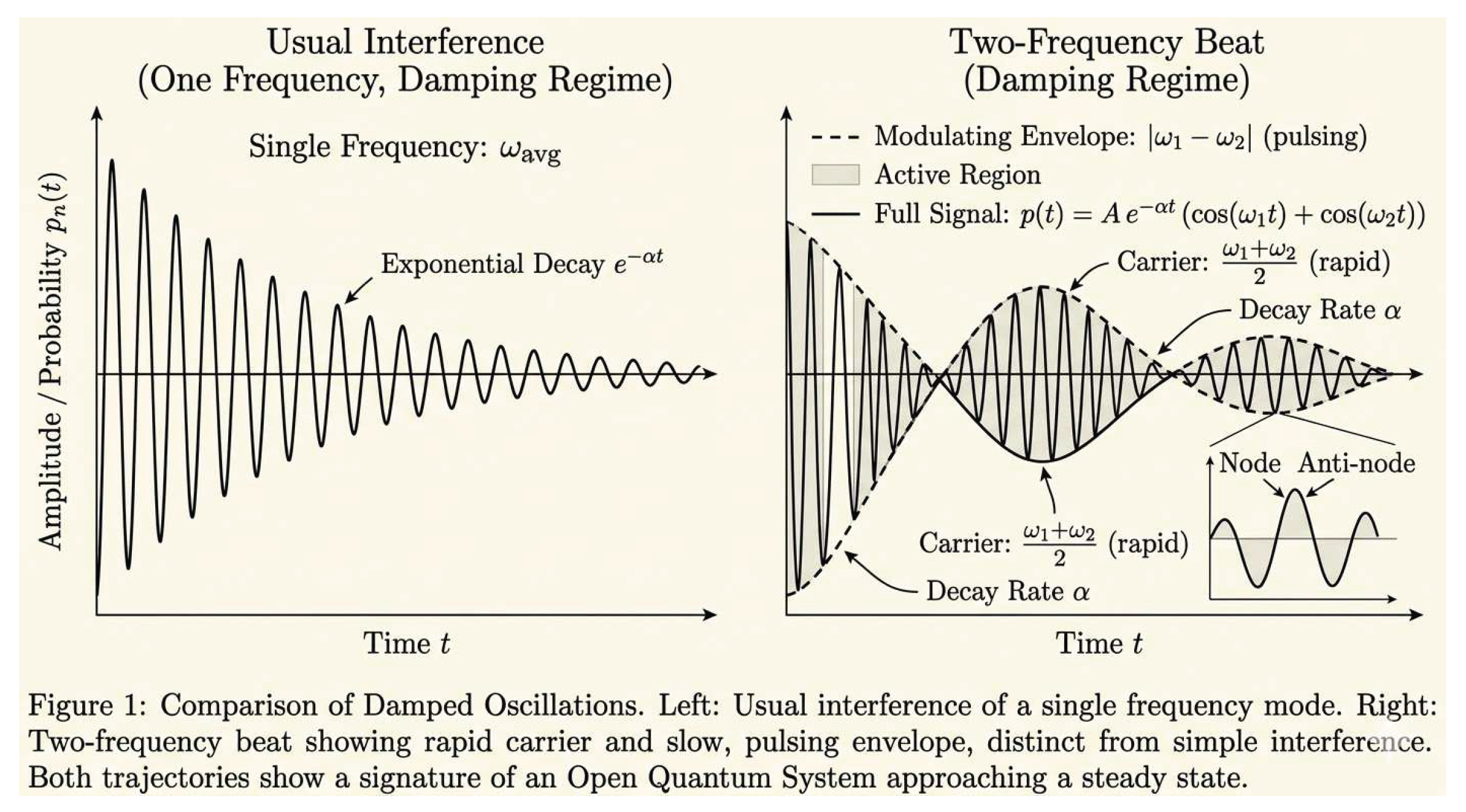
Disclaimer/Publisher’s Note: The statements, opinions and data contained in all publications are solely those of the individual author(s) and contributor(s) and not of MDPI and/or the editor(s). MDPI and/or the editor(s) disclaim responsibility for any injury to people or property resulting from any ideas, methods, instructions or products referred to in the content. |
© 2026 by the authors. Licensee MDPI, Basel, Switzerland. This article is an open access article distributed under the terms and conditions of the Creative Commons Attribution (CC BY) license (http://creativecommons.org/licenses/by/4.0/).
Copyright: This open access article is published under a Creative Commons CC BY 4.0 license, which permit the free download, distribution, and reuse, provided that the author and preprint are cited in any reuse.


