
Submitted:
20 April 2026
Posted:
21 April 2026
You are already at the latest version
Abstract
Alzheimer’s Disease (AD), the most prevalent form of dementia, is pathologically defined by extracellular beta-amyloid (Aβ) plaques and intraneuronal neurofibrillary tangles (NFTs), accompanied by chronic neuroinflammation. Recent advances in single-cell RNA sequencing (scRNA-seq/snRNA-seq) and spatial transcriptomics have provided unprecedented resolution for dissecting the cellular and molecular landscape of neuroinflammation in AD. While scRNA-seq enables high-throughput profiling of cellular heterogeneity across brain regions, spatial transcriptomics preserves tissue architecture to map cell-type-specific gene expression within anatomical contexts. This review synthesizes the neuroinflammatory mechanisms of AD, outlines the technical evolution and comparative capabilities of single-cell and spatial omics platforms, including resolution, throughput, and compatibility with multiple sample types, and critically evaluates findings from studies in both animal models and human brain tissues. These approaches have revealed state-specific transformations in microglia and astrocytes, including shifts in transcriptional programs, metabolic reprogramming, and pro-inflammatory polarization across disease stages. Notably, spatial transcriptomic analyses demonstrate pronounced regional heterogeneity: periplaque microenvironments exhibit distinct immune cell compositions and gene expression signatures. Collectively, these omics technologies are redefining the cellular basis of AD progression and hold transformative potential for the discovery of early diagnostic biomarkers and precision therapeutic targets.
Keywords:
Alzheimer’s disease
; neuroinflammation
; Single-cell RNA sequencing
; spatial transcriptomics
; microglia
; astrocyte
1. Introduction
Alzheimer’s Disease (AD) is a progressive neurodegenerative disorder characterized by a gradual decline in cognitive and memory functions [1]. It is estimated that over 55 million people worldwide are living with AD, a number projected to reach 78 million by 2030 [2]. Typical brain pathologies in AD include the deposition of Aβ plaques and neurofibrillary tangles in the cerebral cortex and hippocampus, accompanied by neuronal and synaptic loss [1,3]. Against the backdrop of global population aging, the rising prevalence of AD imposes a substantial economic and caregiving burden on society [4]. Traditionally, the pathological mechanisms of AD have been dominated by the Aβ cascade hypothesis and tauopathy, yet these theories have limitations in explaining the full spectrum of the disease and guiding effective treatments [5]. Although monoclonal antibodies targeting Aβ have shown some progress in clinical trials recently, their efficacy remains limited and is associated with specific risks. Meanwhile, therapies targeting tau have yet to achieve decisive breakthroughs, prompting the scientific community to reflect deeply and actively explore new pathological perspectives [6].
Emerging evidence indicates that neuroinflammation plays a pivotal role in AD pathogenesis. The brain’s resident immune cells, microglia and astrocytes, can recognize and clear Aβ deposits. However, upon aberrant activation, they secrete large amounts of pro-inflammatory cytokines and complement proteins, exacerbating neuronal damage [7,8]. Neuroinflammation in the central nervous system is primarily mediated by microglia and astrocytes, which amplify AD pathology through multiple mechanisms [9]. First, neuroinflammation and Aβ pathology form a vicious cycle: microglial dysfunction impairs Aβ clearance, while inflammatory signals promote amyloid precursor protein (APP) processing to generate more Aβ. Furthermore, Aβ fibrils can activate inflammasomes, further intensifying the inflammatory response [10]. Second, neuroinflammation interacts with tau pathology: inflammatory factors can activate kinases, leading to tau hyperphosphorylation and promoting microglia-mediated prion-like spreading of tau [11]. Additionally, neuroinflammation directly contributes to synaptic dysfunction and neuronal death, for instance, through complement pathway-mediated aberrant synaptic pruning and direct neurotoxicity of inflammatory factors [12]. For example, Aβ oligomers activate microglia, and through pathways involving NLRP3 inflammasome activation or TLR signaling, these cells release inflammatory mediators such as IL-1α, TNF-α, and C1q. These factors subsequently induce astrocytes to transform into a neurotoxic A1 phenotype, producing neurotoxic substances that lead to neuronal death [8,13]. Reactive A1 astrocytes contribute to AD pathogenesis through multiple mechanisms: they upregulate complement component C3, which interacts with neuronal C3a receptors to induce synaptic and dendritic damage, and they express APP, BACE-1, and γ-secretase, thereby increasing Aβ production and exacerbating neuroinflammation [8]. Genetic evidence further supports the central role of neuroinflammation. Genome-wide association studies (GWAS) have identified AD risk genes such as TREM2 and CD33 that are primarily expressed in microglia and involved in inflammatory regulation [14]. Moreover, AD-associated genetic risk variants (e.g., TREM2, CD33) are predominantly expressed in immune cells, suggesting a close link between immune pathways and AD pathology [13]. Deficiency or mutation of TREM2 impairs the ability of microglia to phagocytose Aβ and enhances inflammatory responses, thereby aggravating plaque deposition and neuronal injury [13]. Recent studies have also revealed that besides glial cells, oligodendrocytes exhibit a ‘disease-associated oligodendrocyte’ (DAO) phenotype in AD, linked to abnormalities in myelination and Erk signaling pathways [3].
In summary, positioning neuroinflammation at the center of the AD pathological network provides an integrative framework for understanding disease mechanisms and developing novel anti-inflammatory therapies [15]. The pathogenesis of AD involves a complex network of immune responses triggered by Aβ and tau accumulation, encompassing pathways such as the NLRP3 inflammasome, the complement system, and neurotoxic glial reactions [8,13]. The recent widespread adoption of single-cell RNA sequencing and spatial transcriptomics has significantly advanced our mechanistic understanding of neuroinflammation in AD, revealing cell-type-specific dynamics and spatially resolved inflammatory signatures at unprecedented resolution (Figure 1).
2. Methodology Review
2.1. Single-Cell RNA Sequencing (scRNA-seq/snRNA-seq)
Single-cell transcriptomics technology, first introduced in 2009, enables the capture of the entire transcriptome from individual intact cells [16]. While traditional bulk transcriptome sequencing requires inputs of hundreds of thousands of cells and consequently reflects only the population average, scRNA-seq overcomes these technical limitations by accurately quantifying gene expression levels at single-cell resolution [17]. A core technical advantage that has emerged from this approach is its ability to systematically resolve cellular heterogeneity, thereby avoiding the signal averaging inherent in bulk sequencing methods [17]. Compared to traditional approaches, scRNA-seq not only identifies rare cell populations but also reveals continuous trajectories of cell state transitions through high-dimensional data analysis, thus more accurately reflecting the dynamic changes in cell populations during disease progression [18]. In terms of the advantages of single-cell sequencing for large-scale data clustering, applying unsupervised clustering algorithms to thousands to millions of single-cell transcriptomes allows for the systematic categorization of cells, identifying previously undefined cell subtypes within tissues [19]. Currently, the most used modern mainstream method is the microfluidic platform from 10x Genomics, which encapsulates single cells or nuclei with barcoded beads within water-in-oil droplets. The mRNA from each cell is reverse-transcribed within the droplet and tagged with a unique barcode, enabling parallel sequencing of hundreds to tens of thousands to hundreds of thousands of cells [16]. Compared to whole-cell sequencing, single-nucleus sequencing (snRNA-seq) can utilize frozen or fixed brain tissue to extract nuclei, offering better compatibility for brain cells like neurons that are difficult to dissociate [16]. The advantages of sc/snRNA-seq technologies include near-single-cell resolution and whole-genome expression profiling capability with high detection sensitivity. However, sample preparation requires tissue dissociation into single cells, resulting in the loss of original spatial information [20]. A major limitation highlighted in large-scale single-cell studies is the prevalence of batch effects, which necessitates the use of specialized bioinformatics algorithms for quality assessment and data integration [21].
2.2. Spatial Transcriptomics Technology
Spatial omics technologies sequence mRNA while preserving the tissues in situ architecture, establishing a direct correspondence between gene expression and spatial distribution. As a crucial complement to scRNA-seq, the advantage of spatial transcriptomics lies in its ability to map gene expression data directly onto spatial coordinates within the tissue structure, retaining the positional relationships of cells within their native microenvironment [22]. Representative platforms include sequencing-based methods (Visium, Slide-seq, Stereo-seq, etc.) and imaging-based methods (MERFISH, seqFISH+, etc.). In 2016, Ståhl et al. first reported spatial transcriptomics technology based on printed chips, where oligonucleotide arrays with spatial barcodes are placed on tissue sections to generate two-dimensional maps of gene expression within the tissue [22]. The commercialized 10x Genomics Visium system builds upon this principle, utilizing arrays of capture probes with spots approximately 55 μm in diameter (containing ~1-10 cells per spot, ~5000 spots/slide), enabling genome-wide sequencing of tissue sections [23]. Slide-seq utilizes arrays of beads approximately 10 μm in diameter to capture RNA, achieving near-single-cell spatial resolution [24]. Imaging-based in situ hybridization methods employ multiple rounds of fluorescence in situ hybridization (FISH) to capture RNA. MERFISH utilizes combinatorial barcoding with error-robust encoding schemes, enabling the localization of hundreds to thousands of genes at single-cell resolution [16,25]; seqFISH+ employs 60 ‘pseudo-colors’ across multiple hybridization rounds, reportedly enabling the detection of approximately 10,000 genes [16]. The characteristics of these methods are compared in Table 1. Recent advances in integrative multi-omics approaches have further enhanced the resolution and information content of spatial transcriptomics, enabling simultaneous analysis of gene expression and spatial location at the single-cell level [26].
Therefore, sequencing-based spatial omics methods (e.g., Visium, Slide-seq, Stereo-seq) offer whole-transcriptome coverage but generally require fresh tissue and are limited by resolution constraints. In contrast, imaging-based methods (MERFISH, seqFISH+) can achieve subcellular resolution but currently rely on targeted gene panels, involve higher costs, and require longer imaging times. Each method has its own strengths and weaknesses; experimental design must balance factors such as spatial resolution, detection throughput, sample processing complexity, and budget [20]. Anyway, combined use of single-cell sequencing and spatial omics has been proved as effective complementary techniques in illustrating AD pathology (Figure 2).
3. Major Findings
3.1. Animal Model Studies
Single-cell and spatial omics analyses using AD animal models (e.g., 5xFAD, 3xTg, APP/PS1, App NL-G-F) have revealed key cell subtypes and gene pathways involved in neuroinflammation. Regarding microglia, Keren-Shaul et al. (2017) first identified a TREM2-dependent ‘disease-associated microglia’ (DAM) subpopulation in 5xFAD mice, characterized by enrichment of genes related to lipid metabolism and phagocytosis. Molecular features include upregulation of genes like Apoe, Trem2, Cst7, and downregulation of homeostatic markers such as P2ry12 and Tmem119 [27]. DAM activation is dependent on the TREM2 signaling pathway, which plays a critical regulatory role in AD pathology [28,29]. Regarding astrocytes, Habib et al. (2020) identified a novel ‘disease-associated astrocyte’ (DAA) population in the hippocampus of 5xFAD mice, which appears early and increases with disease progression [30]. In the mid-to-late stages of AD, as Aβ plaques deposit and tau pathology spreads, microglia in the brain become chronically activated, releasing large amounts of inflammatory factors (e.g., IL-1α, TNF, C1q). Although astrocytes are not professional immune cells, they can be indirectly activated by this inflammatory milieu, acquiring immune-regulatory functions and actively participating in the neuroinflammatory process [31].Park et al. (2023) further reported novel disease-associated oligodendrocyte (DAO) subtypes in App NL-G-F and 5xFAD mice, linking abnormal Erk signaling activation to impaired myelination [3]. Spatial omics studies have elucidated cellular interactions within the plaque environment: Mallach et al. (2024) used CosMx and Stereo-seq spatial transcriptomics to analyze the hippocampus and adjacent cortical regions of App^NL-G-F knock-in mice, finding that microglia heavily aggregate around plaques, disrupting astrocyte-to-microglia crosstalk and causing synaptic imbalance; they also noted that microglial responses were relatively consistent across different brain regions, whereas astrocyte responses exhibited regional heterogeneity [32]. A recent study based on Stereo-seq spatial transcriptomics further identified a reactive microglial subtype (Micro.1) in the AD hippocampus, significantly enriched around Aβ plaques and highly expressing complement components (e.g., C3, C7) and DAM genes, suggesting a key role in neuroinflammation and synaptic pruning [33]. Key findings from relevant animal studies are summarized in Table 2.
3.2. Human Studies
Significant progress has also been made in recent years using single-cell/single-nucleus and spatial omics studies on human AD brain tissue. Mathys et al. (2024) constructed a single-cell transcriptomic atlas comprising 1.3 million cells from 283 human brain samples across 6 brain regions. They identified up to 76 cell types and found that specific excitatory neuron populations were markedly reduced in AD. Their study also implicated the Reelin pathway in AD resilience and revealed specialized transcriptional programs in astrocytes associated with cognitive resistance [1]. Single-cell transcriptomic analysis of the AD brain reveals the existence of diverse neuroinflammation-related cellular subpopulations, including disease-associated microglia characterized by elevated expression of MHC-II genes and complement components, as well as reactive astrocyte subsets marked by upregulation of the AD risk gene CLU [19].
Sziraki et al. (2023) employed a novel combinatorial indexing technology (EasySci-RNA) to resolve cellular heterogeneity in mice (1.5M cells) and humans (118k cells), identifying numerous rare cell subtypes and AD-associated alterations [34]. Miyoshi et al. (2024) compared spatial and single-cell omics data from the brains of patients with sporadic AD and Down syndrome-associated AD (DSAD), revealing aberrant glial inflammatory gene programs in the superficial cortical layers, closely linked to Aβ-related processes; they validated transcriptional changes in plaque-proximal areas using 5xFAD mice [35]. Recent spatial omics studies, integrating Visium with immunohistochemistry, have directly resolved plaque-glia ‘micro-niches’ in the AD human cortex. Avey et al. (2025) analyzed tissue from the posterior cingulate cortex of 21 AD patients, categorizing spatial sequencing spots based on plaque and glial markers into classes such as low Aβ/high gliosis. Results showed that ‘low Aβ’ regions had more severe neuronal loss, while ‘high gliosis’ regions exhibited upregulated inflammatory pathways. Gene modules characteristic of DAM, DAA, and PIGs (plaque-induced genes) were enriched in plaque-proximal areas [36]. Furthermore, iPSC-derived multicellular culture experiments confirmed that upon Aβ exposure, microglia, but not astrocytes, adopted a reactive state consistent with the spatial transcriptomic data from human brains. Recent research has also identified a terminally inflammatory microglia (TIM) population that accumulates in aged brains and APOE4 genotype AD brains. TIMs co-express inflammatory factors (e.g., S100A8/A9) and cellular stress markers (e.g., Fos, Jun), exhibit metabolic dysregulation and reduced Aβ clearance capacity, resembling a T cell exhaustion-like state [37]. Studies on human AD brain tissue further corroborate the clinical relevance of microglial heterogeneity, with distinct subtypes correlating with disease stage and pathological severity [38]. Key findings from human studies are summarized in Table 3.
3.3. Comparison Across Disease Stages
Multiple studies indicate differences in cellular states across various stages of AD. AD progression is generally categorized into preclinical, mild cognitive impairment (MCI), and confirmed AD dementia stages. Mathys et al., in their single-nucleus analysis of prefrontal cortex from 48 individuals, observed that microglial and astrocyte activation, along with altered neuronal expression, accompany early AD pathology [1]. Srinivasan et al. reported a progressive activation state of microglial populations concurrent with plaque accumulation in transgenic AD mice. A study based on peripheral blood transcriptomics provides new clues for ultra-early AD diagnosis. This research found that in the subjective cognitive decline (SCD) stage—the ultra-early phase preceding clinical AD symptoms—the transcriptome of peripheral blood already exhibits significant downregulation of the type I interferon (IFN-I) signaling pathway, suggesting that dysregulation of peripheral immune IFN responses may occur prior to the accumulation of typical brain pathology [40].
Overall, the early stage of initial Aβ accumulations is characterized by microglia-mediated clearance responses and neuronal stress pathways; mid-to-late stages feature severe chronic inflammation, complement activation, and synaptic loss (Figure 3). These studies reveal the dynamic evolution of inflammatory responses with disease progression. However, due to the difficulty of obtaining longitudinal time-series data from human samples, current understanding is largely inferred from cross-sectional analyses. This highlights the need for future longitudinal studies or simulated animal experiments to clarify the cellular and molecular trajectory across different stages.
3.4. Spatial Transcriptomics Reveals Differences Between Aβ Plaque Proximal and Distal Regions
Spatial transcriptomics provides direct evidence for investigating the plaque microenvironment. Studies have identified unique cellular subtypes and molecular signatures in the vicinity of Aβ plaques (proximal region), whereas tissue further away from plaques (distal region) retains a more homeostatic state. In the complex pathological course of AD, inflammation does not occur uniformly but exhibits significant spatiotemporal heterogeneity[32]. For instance, proximal regions are enriched with pathologically active microglia which express DAM markers like Cst7, Itgax, and Apoe, and reactive astrocytes which upregulate DAA markers such as Gfap and Serpina3n; these cells express complement factors and pro-inflammatory mediators, likely participating in altered cell-cell communication and synaptic signaling disruption [32,36]. Spatial in situ analysis further confirms that DAMs aggregate significantly around Aβ plaques, with proximal areas (<50 μm) showing prominent enrichment of genes related to lysosomal degradation, complement pathways, and Aβ metabolism [41]. Conversely, distal regions are dominated by homeostatic neurons and supportive cells, exhibiting lower expression of inflammatory genes. In the study by Avey et al., ‘low Aβ/high gliosis’ regions (representing diffuse plaques) showed significant upregulation of neuronal apoptosis markers, whereas both low and high Aβ regions with high gliosis were enriched for inflammation-related pathways, with a more pronounced effect observed in low Aβ (diffuse plaque) areas [36]. Mallach et al. also reported the presence of disease-associated microglia (DAM) characterized by upregulated Apoe, Lpl, and Trem2, along with dysregulated astrocytic signaling around plaques, including downregulation of the GABA transporter Slc6a11 (Gat3) in astrocytes within microglia-dense plaque niches [32]. Spatial transcriptomic analysis further demonstrates a ‘core-shell’ cellular organization pattern around Aβ plaques in the AD hippocampus: microglia aggregate near the plaque core, while astrocytes are distributed more peripherally. Enhanced ligand-receptor interactions, such as SPP1-ITGB1 and MIF-CD44, between these two cell types drive local neuroinflammatory responses [33].
These findings support the ‘plaque-glia niche’ hypothesis in AD: the microenvironment created by Aβ plaques recruits and reprograms glial cells, forming localized inflammatory foci that concurrently contribute to neuronal degeneration in more distant regions (Table 4).
3.5. Intercellular Interaction Networks and Key Regulatory Factors
The formation and maintenance of this inflammatory microenvironment depend on a complex network of interactions among different cell types. Cell-cell communication analyses based on single-cell or spatial transcriptomic data confirm that microglia, astrocytes, and neurons are central nodes in this network [42]. In AD models, Aβ-activated microglia release signals like IL-1α, TNF, and C1q, which collectively induce astrocytes to transition towards a neurotoxic phenotype [31]. Activated astrocytes can induce neuronal and oligodendrocyte death through the release of saturated long-chain lipids, specifically free fatty acids and very long-chain phosphatidylcholines, carried within ApoE/ApoJ lipid particles. This process is mediated via lipoapoptosis pathways, which involve FOXO3a dephosphorylation and PUMA upregulation, and occurs independently of physical cell contact. Notably, the toxic activity is mediated by saturated lipids trafficked within ApoE/ApoJ lipoparticles, rather than by the protein components themselves [43]. Concurrently, stressed neurons alter their network activity by exhibiting excitotoxicity and engaging compensatory remodeling of inhibitory inputs, thereby further influencing the functional states of microglia and astrocytes. Complex feedback and feedforward interactions exist between glial cells and neurons. This multicellular ‘cellular phase’ response can transition from an initially compensatory and protective reaction to a chronic, irreversible pathological process as the disease progresses, collectively exacerbating synaptic dysfunction and neurodegeneration [44].
Furthermore, the APOE genotype exerts pleiotropic effects on AD pathological progression. Different APOE isoforms (ε2, ε3, ε4) are closely associated with variations in Aβ plaque burden, tau pathology severity, microglial and astrocyte reactivity, and blood-brain barrier integrity, highlighting the critical role of APOE in modulating intercellular communication and disease advancement [45].
Further investigation has revealed that in the presence of amyloid plaques, plaque-associated microglia can transform into neurodegenerative microglia (MGnD). These cells significantly accelerate the propagation of tau pathology across brain regions by hypersecreting extracellular vesicles carrying phosphorylated tau protein. This suggests that microglia-mediated vesicle secretion is a crucial mechanism linking Aβ pathology to the spread of tau pathology [46].
4. Technical Limitations and Improvement Needs
Although scRNA-seq and spatial transcriptomics technologies have significantly advanced AD research, several limitations persist.
Regarding sample preparation, scRNA-seq requires tissue dissociation to obtain single cells, which can cause cellular damage and bias. For instance, some fragile neurons are easily lost or underrepresented during this process, and non-neuronal cells may be over-represented in the final cell suspension. For brain tissue, snRNA-seq is often preferred to mitigate dissociation artifacts, as nuclei are more resistant to mechanical stress and can be isolated from archived frozen specimens. Spatial technologies frequently require fresh-frozen samples, which can be challenging to obtain for clinical specimens. Notably, comparative studies in mouse visual cortex demonstrate that while snRNA-seq detects fewer total transcripts per sample than scRNA-seq, the inclusion of intronic reads enables identification of closely related neuronal cell types with resolution comparable to whole cells [47]. This supports the utility of snRNA-seq for large-scale surveys of cellular diversity. Improvement strategies include developing spatial platforms compatible with FFPE tissues (e.g., 10x Visium FFPE kit) or optimizing frozen section pre-treatment, and promoting techniques like chemical fixation or cryopreservation of nuclei in single-cell sequencing to reduce bias and batch effects.
Regarding spatial resolution, most sequencing-based spatial methods (e.g., Visium, Slide-seq) have resolution limited to the multicellular/cell-population level, making it difficult to capture single-cell or subcellular differences. While imaging-based methods offer high resolution, they are often restricted by the number of probes that can be used. Improvement strategies involve combining multiple spatial technologies—for example, using MERFISH or seqFISH for deep targeted probing on regions or gene clusters of interest identified by whole-transcriptome Visium—further increasing capture spot density through technologies like Stereo-seq, or developing nanoscale spatial barcoding technologies.
In terms of throughput and coverage, high-resolution imaging methods are time-consuming and costly, limiting their application to large tissue areas or whole-brain scales [16,20]. Improvement directions include incorporating new technologies like automated super-resolution microscopy and optical synthesis to increase throughput or employing clustering/partitioning strategies to pre-select regions of interest for high-resolution analysis.
Regarding data analysis and integration, single-cell data contain high noise and dropout events characterized by zero-inflation, while spatial data face challenges like background noise and barcode bleeding. Cell type identification often relies on marker genes, which can introduce bias across different studies [48]. Direct comparison and integration of scRNA-seq and spatial data are challenging and require cross-modal alignment algorithms. Improvement directions include developing robust denoising and pseudotime inference algorithms, utilizing data fusion tools such as Seurat integration, Tangram, and LIGER to align single-cell and spatial data for inferring the spatial distribution of single-cell subtypes, and incorporating multi-omics joint analyses by leveraging proteomic or methylomic information to aid cell identification [49].
In terms of multi-omics integration, measuring only the transcriptome limits insight into regulatory mechanisms. Improvement directions include combining single-cell ATAC-seq to explore chromatin accessibility, employing CITE-seq/CyTOF to obtain protein expression data, introducing single-cell metabolomics to examine metabolic changes, developing spatial proteomics technologies such as in situ mass spectrometry imaging to pair with transcriptomics, and exploring spatial multi-omics—for example, simultaneous in situ detection of mRNA and proteins, or spatial ATAC-seq. Major limitations of technology and improvement strategies are summarized in Table 5.
5. Clinical Translation Prospects
The application of single-cell and spatial omics in the AD field holds broad promise but also faces considerable challenges.
For early diagnosis, this study demonstrates that molecular subtypes (including those with neuroinflammatory signatures) are detectable at the mild cognitive impairment (MCI) stage using brain transcriptomics, suggesting that pathological divergence occurs before advanced clinical decline. While this study was limited to postmortem tissue, it highlights the potential for future multi-omic and peripheral biomarker studies to translate these subtype-specific network drivers (e.g., LRP10, MSN) into clinical tools [50]. Advances in biomarker development provide tools for this goal: novel PET tracers such as those targeting TSPO, MAO-B, or the P2X₇ receptor allow for in vivo visualization of microglial activation [51]; The blood-based biomarker GFAP offers significant potential for non-invasive clinical application in detecting Aβ pathology across the Alzheimer disease continuum [52]. For example, specific gene expression signatures from microglial or astrocyte subtypes might correspond to detectable circulating factors. Recently, plasma biomarkers identified through spatial transcriptomics screening have shown considerable promise. For instance, levels of CCK and PMP2 proteins carried within brain-derived extracellular vesicles are significantly decreased in the plasma of AD patients. Combined detection of these two markers can effectively differentiate AD from healthy controls and non-AD dementias, offering a new avenue for non-invasive diagnosis [33]. Plasma GFAP (a marker of astrocytic activation), when combined with plasma Aβ42/Aβ40 ratios, improves the discrimination of preclinical brain amyloid-β pathology (as defined by PET imaging) in cognitively normal older adults [53]. The integration of machine learning algorithms with multi-omics data further enhances the performance of blood-based biomarkers for early AD detection [54]. However, the high cost of single-cell sequencing precludes its use for large-scale sample screening; current applications primarily rely on downstream validation using lower-cost detection methods for discovered targets.
Regarding drug target identification, key pathways revealed by scRNA-seq (e.g., TREM2-dependent DAM signatures, NLRP3 inflammasome) provide targets for novel drug development. TREM2, as a crucial regulator of microglial function, is a focus of research, with genetic evidence strongly supporting agonistic approaches over antagonism [55]. Studies indicate that TREM2 agonists can enhance microglial phagocytosis and promote their transition towards a neuroprotective state, reducing neuritic dystrophy and modifying Aβ plaque morphology toward a less toxic conformation in animal models [56]. Furthermore, modulating glial activation states, such as through deletion of Chi3l1, has been shown to alter microglial functional phenotypes (e.g., enhanced CD68 expression and Aβ phagocytosis), suggesting that regulation of glial activity may mitigate amyloid pathology. However, this study relies on genetic deletion of a secreted glycoprotein rather than direct intervention in microglial transcriptional programs or metabolic states [57]. Spatial analysis of AD mouse models reveals that complement receptor C3aR is selectively upregulated in microglia surrounding amyloid plaques, while its ligand C3 is predominantly expressed in astrocytes. This region-specific astrocyte-microglia crosstalk impairs Aβ clearance and exacerbates pathology. Pharmacological blockade of C3aR reduces plaque burden, demonstrating that targeting spatially defined glial communication can disrupt neuroinflammatory cycles [58]. Complement pathway inhibitors have shown synapse-protective effects in preclinical studies, potentially representing a novel therapeutic strategy for AD [59].
For efficacy assessment and precision medicine, single-cell omics can be used to monitor treatment efficacy at the cellular level by comparing transcriptional changes in specific cell subtypes before and after drug administration. Moreover, these technologies can help identify patient subgroups, enabling precision medicine—as patients may exhibit heterogeneity in inflammatory pathways, warranting tailored treatments. However, current limitations in sample acquisition, especially biopsies, and data volume hinder widespread clinical implementation.
Overall, scRNA-seq and spatial omics offer new avenues for AD early screening and targeted therapy, but overcoming challenges related to cost, reproducibility, and data interpretation is essential for clinical translation.
6. Challenges and Future Directions
Despite the immense promise, targeting neuroinflammation faces numerous challenges. First, the causal relationship between specific cellular subtypes and AD pathogenesis remains unclear, and discrepancies between animal models and human disease limit clinical translation [60].
Second, selecting the optimal therapeutic time window is critical, as intervention too early or too late may compromise efficacy [5]. The dual nature of neuroinflammation regulation is also a key consideration; excessive suppression could impair its normal physiological functions [61]. Future research should focus on integrating single-cell multi-omics data (e.g., epigenomics, proteomics) and rigorously validating targets in human pluripotent stem cell-derived models and human tissue samples [62].
A recent clinical study utilizing PET imaging and fluid biomarkers further underscores the priority of targeting neuroinflammation. Consistent with multi-omics findings in postmortem tissue, this study provides in vivo confirmation in humans that microglial activation modulates astrocyte reactivity. This glial crosstalk acts as a key upstream event that triggers the subsequent propagation of tau pathology and cognitive decline in the presence of pre-existing Aβ pathology [63]. This study establishes a causal link demonstrating that microglia-mediated T cell infiltration drives neurodegeneration in tauopathy. It suggests that targeting the detrimental crosstalk between activated microglia and infiltrating T cells may represent a potential therapeutic strategy for AD and primary tauopathies [64]. The establishment of human tissue banks and organoid models will facilitate the transition from basic research to clinical application [65]. International collaboration and large-scale data sharing are essential for deciphering the complex mechanisms of neuroinflammation in AD [66].
7. Conclusion and Outlook
Neuroinflammation acts as a central ‘amplifier’ and integrator in AD pathology. Single-cell transcriptomics and spatial omics technologies are providing unprecedented insights into neuroinflammation within the AD brain. From characterizing heterogeneous microglial and astrocyte states to deciphering complex cellular interactions within the plaque microenvironment, these technologies continuously generate novel biological hypotheses and mechanistic frameworks. Targeting neuroinflammation, particularly through precise, cell-type-specific, and spatiotemporally controlled modulation, represents a crucial path forward to overcome the current therapeutic impasse in AD.
Future efforts will increasingly emphasize integrative multi-omics analyses of large-scale human cohorts and longitudinal tracking of early pathological changes. Simultaneously, advancements in algorithms and experimental techniques—such as improving sensitivity, enabling parallel single-cell multi-omics measurements, and leveraging AI-driven analysis—will further accelerate discovery. Coupling these omics achievements with clinical research holds the potential to expedite the development of early diagnostic biomarkers and precise drug targets. Through multidisciplinary collaboration and technological innovation, the translation from mechanistic insights to clinical interventions can be realized, offering new hope for individuals affected by AD.
In conclusion, single-cell and spatial omics provide an unparalleled opportunity to dissect neuroinflammation in AD. The journey is fraught with challenges yet brimming with potential, poised to steer the field towards new horizons of discovery.
Author Contributions
Conceptualization, F.X.; methodology, F.X., X.W. and Z.R.; software, F.X., X.W. and Z.R.; validation, X.W., F.X. and Z.R.; formal analysis, X.W.; investigation, F.X., Z.R.; resources, F.X., X.W. and Z.R.; data curation, X.W., F.X.; writing—original draft preparation, F.X., X.W.; writing—review and editing, F.X., X.W. and Z.R.; visualization, X.W.; supervision, F.X..; project administration, F.X.; funding acquisition, F.X. All authors have read and agreed to the published version of the manuscript.
Funding
This research was funded by the funding from the Ministry of Industry and Information Technology of the People’s Republic of China (to F.X.), the National Natural Science Foundation of China (81301404, to F.X.), and the Scientific Research Fund of Zhejiang Wanli University (SC1032511980070, to F.X.).
Conflicts of Interest
The authors declare no conflicts of interest.
Abbreviations
| AD | Alzheimer’s Disease |
| Aβ | Beta-amyloid |
| NFTs | Intraneuronal neurofibrillary tangles |
| scRNA-seq/snRNA-seq | Single-cell RNA sequencing |
| APP | Amyloid precursor protein |
| GWAS | Genome-wide association studies |
| MG | Microglia |
| AS | Astrocyte |
| DAO | Disease-associated oligodendrocyte |
| FISH | Fluorescence in situ hybridization |
| DAM | Disease-associated microglia |
| DAA | Disease-associated astrocyte |
| DSAD | Down syndrome-associated AD |
| PIGs | Plaque-induced genes |
| TIM | Terminally inflammatory microglia |
| MCI | Mild cognitive impairment |
| SCD | Subjective cognitive decline |
| IFN-I | Type I interferon |
| MGnD | Neurodegenerative microglia |
| CSF | Cerebrospinal fluid |
References
- Mathys, H.; Boix, C. A.; Akay, L. A.; Xia, Z.; Davila-Velderrain, J.; Ng, A. P.; Jiang, X.; Abdelhady, G.; Galani, K.; Mantero, J.; Band, N.; James, B. T.; Babu, S.; Galiana-Melendez, F.; Louderback, K.; Prokopenko, D.; Tanzi, R. E.; Bennett, D. A.; Tsai, L.-H.; Kellis, M. Single-cell multiregion dissection of Alzheimer’s disease. Nature 2024, 632, 858–868. [Google Scholar] [CrossRef] [PubMed]
- World Health Organization. Global Status Report on the Public Health Response to Dementia, 1st ed.; World Health Organization: Geneva, 2021. [Google Scholar]
- Park, H.; Cho, B.; Kim, H.; Saito, T.; Saido, T. C.; Won, K. J.; Kim, J. Single-cell RNA-sequencing identifies disease-associated oligodendrocytes in male APP NL-G-F and 5XFAD mice. Nat Commun 2023, 14, 802. [Google Scholar] [CrossRef] [PubMed]
- Scheltens, P.; De Strooper, B.; Kivipelto, M.; Holstege, H.; Chetelat, G.; Teunissen, C. E.; Cummings, J.; van der Flier, W. M. Alzheimer’s disease. Lancet 2021, 397, 1577–1590. [Google Scholar] [CrossRef]
- Long, J. M.; Holtzman, D. M. Alzheimer Disease: An Update on Pathobiology and Treatment Strategies. Cell 2019, 179, 312–339. [Google Scholar] [CrossRef] [PubMed]
- Cummings, J.; Zhou, Y.; Lee, G.; Zhong, K.; Fonseca, J.; Cheng, F. Alzheimer’s disease drug development pipeline: 2023. Alzheimers Dement (N Y) 2023, 9, e12385. [Google Scholar] [CrossRef]
- Singh, D. Astrocytic and microglial cells as the modulators of neuroinflammation in Alzheimer’s disease. J Neuroinflammation 2022, 19, 206. [Google Scholar] [CrossRef]
- Han, J.; Zhang, Z.; Zhang, P.; Yu, Q.; Cheng, Q.; Lu, Z.; Zong, S. The roles of microglia and astrocytes in neuroinflammation of Alzheimer’s disease. Front Neurosci 2025, 19, 1575453. [Google Scholar] [CrossRef]
- Hansen, D. V.; Hanson, J. E.; Sheng, M. Microglia in Alzheimer’s disease. J Cell Biol 2018, 217, 459–472. [Google Scholar] [CrossRef]
- Ising, C.; Venegas, C.; Zhang, S.; Scheiblich, H.; Schmidt, S. V.; Vieira-Saecker, A.; Schwartz, S.; Albasset, S.; McManus, R. M.; Tejera, D.; Griep, A.; Santarelli, F.; Brosseron, F.; Opitz, S.; Stunden, J.; Merten, M.; Kayed, R.; Golenbock, D. T.; Blum, D.; Latz, E.; Buée, L.; Heneka, M. T. NLRP3 inflammasome activation drives tau pathology. Nature 2019, 575, 669–673. [Google Scholar] [CrossRef]
- Kitazawa, M.; Cheng, D.; Tsukamoto, M. R.; Koike, M. A.; Wes, P. D.; Vasilevko, V.; Cribbs, D. H.; LaFerla, F. M. Blocking IL-1 signaling rescues cognition, attenuates tau pathology, and restores neuronal beta-catenin pathway function in an Alzheimer’s disease model. J Immunol 2011, 187, 6539–49. [Google Scholar] [CrossRef]
- Dejanovic, B.; Wu, T.; Tsai, M. C.; Graykowski, D.; Gandham, V. D.; Rose, C. M.; Bakalarski, C. E.; Ngu, H.; Wang, Y.; Pandey, S.; Rezzonico, M. G.; Friedman, B. A.; Edmonds, R.; De Maziere, A.; Rakosi-Schmidt, R.; Singh, T.; Klumperman, J.; Foreman, O.; Chang, M. C.; Xie, L.; Sheng, M.; Hanson, J. E. Complement C1q-dependent excitatory and inhibitory synapse elimination by astrocytes and microglia in Alzheimer’s disease mouse models. Nat Aging 2022, 2, 837–850. [Google Scholar] [CrossRef]
- Abdulkhaliq, A. A.; Alasiri, G.; Kim, B.; Khan, J.; Ajoolabady, A.; Yousof, S. M.; Ren, J.; Tuomilehto, J.; Borai, A.; Alrfaei, B. M.; Pratico, D. TREM2 in neurodegeneration and diseases. Mol Psychiatry 2026. [Google Scholar] [CrossRef]
- Ulland, T. K.; Colonna, M. TREM2 - a key player in microglial biology and Alzheimer disease. Nat Rev Neurol 2018, 14, 667–675. [Google Scholar] [CrossRef] [PubMed]
- Zhou, Y.; Huang, Y.; Fan, Y.; Xue, F. Co-regulation of microglial subgroups in Alzheimer’s amyloid pathology: Implications for diagnosis and drug development. PLoS One 2025, 20, e0337741. [Google Scholar] [CrossRef] [PubMed]
- Williams, C. G.; Lee, H. J.; Asatsuma, T.; Vento-Tormo, R.; Haque, A. An introduction to spatial transcriptomics for biomedical research. Genome Med 2022, 14, 68. [Google Scholar] [CrossRef] [PubMed]
- Tang, F.; Barbacioru, C.; Wang, Y.; Nordman, E.; Lee, C.; Xu, N.; Wang, X.; Bodeau, J.; Tuch, B. B.; Siddiqui, A.; Lao, K.; Surani, M. A. mRNA-Seq whole-transcriptome analysis of a single cell. Nat Methods 2009, 6, 377–82. [Google Scholar] [CrossRef]
- Papalexi, E.; Satija, R. Single-cell RNA sequencing to explore immune cell heterogeneity. Nat Rev Immunol 2018, 18, 35–45. [Google Scholar] [CrossRef]
- Mathys, H.; Davila-Velderrain, J.; Peng, Z.; Gao, F.; Mohammadi, S.; Young, J. Z.; Menon, M.; He, L.; Abdurrob, F.; Jiang, X.; Martorell, A. J.; Ransohoff, R. M.; Hafler, B. P.; Bennett, D. A.; Kellis, M.; Tsai, L. H. Single-cell transcriptomic analysis of Alzheimer’s disease. Nature 2019, 570, 332–337. [Google Scholar] [CrossRef]
- Chen, J.; Wang, Y.; Ko, J. Single-cell and spatially resolved omics: Advances and limitations. Journal of Pharmaceutical Analysis 2023, 13, 833–835. [Google Scholar] [CrossRef]
- Yu, Y.; Mai, Y.; Zheng, Y.; Shi, L. Assessing and mitigating batch effects in large-scale omics studies. Genome Biol 2024, 25, 254. [Google Scholar] [CrossRef]
- Stahl, P. L.; Salmen, F.; Vickovic, S.; Lundmark, A.; Navarro, J. F.; Magnusson, J.; Giacomello, S.; Asp, M.; Westholm, J. O.; Huss, M.; Mollbrink, A.; Linnarsson, S.; Codeluppi, S.; Borg, A.; Ponten, F.; Costea, P. I.; Sahlen, P.; Mulder, J.; Bergmann, O.; Lundeberg, J.; Frisen, J. Visualization and analysis of gene expression in tissue sections by spatial transcriptomics. Science 2016, 353, 78–82. [Google Scholar] [CrossRef] [PubMed]
- Fatemi, M.; Feng, E.; Sharma, C.; Azher, Z.; Goel, T.; Ramwala, O.; Palisoul, S. M.; Barney, R. E.; Perreard, L.; Kolling, F. W.; Salas, L. A.; Christensen, B. C.; Tsongalis, G. J.; Vaickus, L. J.; Levy, J. J. Inferring spatial transcriptomics markers from whole slide images to characterize metastasis-related spatial heterogeneity of colorectal tumors: A pilot study. J Pathol Inform 2023, 14, 100308. [Google Scholar] [CrossRef]
- Rodriques, S. G.; Stickels, R. R.; Goeva, A.; Martin, C. A.; Murray, E.; Vanderburg, C. R.; Welch, J.; Chen, L. M.; Chen, F.; Macosko, E. Z. Slide-seq: A scalable technology for measuring genome-wide expression at high spatial resolution. Science 2019, 363, 1463–1467. [Google Scholar] [CrossRef]
- Wang, G.; Moffitt, J. R.; Zhuang, X. Multiplexed imaging of high-density libraries of RNAs with MERFISH and expansion microscopy. Scientific Reports 2018, 8. [Google Scholar] [CrossRef] [PubMed]
- Liu, Y.; Yang, M.; Deng, Y.; Su, G.; Enninful, A.; Guo, C. C.; Tebaldi, T.; Zhang, D.; Kim, D.; Bai, Z.; Norris, E.; Pan, A.; Li, J.; Xiao, Y.; Halene, S.; Fan, R. High-Spatial-Resolution Multi-Omics Sequencing via Deterministic Barcoding in Tissue. Cell 2020, 183, 1665–1681 e18. [Google Scholar] [CrossRef] [PubMed]
- Keren-Shaul, H.; Spinrad, A.; Weiner, A.; Matcovitch-Natan, O.; Dvir-Szternfeld, R.; Ulland, T. K.; David, E.; Baruch, K.; Lara-Astaiso, D.; Toth, B.; Itzkovitz, S.; Colonna, M.; Schwartz, M.; Amit, I. A Unique Microglia Type Associated with Restricting Development of Alzheimer’s Disease. Cell 2017, 169, 1276–1290 e17. [Google Scholar] [CrossRef]
- Wang, Y.; Cella, M.; Mallinson, K.; Ulrich, J. D.; Young, K. L.; Robinette, M. L.; Gilfillan, S.; Krishnan, G. M.; Sudhakar, S.; Zinselmeyer, B. H.; Holtzman, D. M.; Cirrito, J. R.; Colonna, M. TREM2 lipid sensing sustains the microglial response in an Alzheimer’s disease model. Cell 2015, 160, 1061–71. [Google Scholar] [CrossRef]
- Xue, F.; Du, H. TREM2 mediates microglial anti-inflammatory activations in Alzheimer’s Disease: Lessons learned from transcriptomics. Cells 2021, 10. [Google Scholar] [CrossRef]
- Habib, N.; McCabe, C.; Medina, S.; Varshavsky, M.; Kitsberg, D.; Dvir-Szternfeld, R.; Green, G.; Dionne, D.; Nguyen, L.; Marshall, J. L.; Chen, F.; Zhang, F.; Kaplan, T.; Regev, A.; Schwartz, M. Disease-associated astrocytes in Alzheimer’s disease and aging. Nat Neurosci 2020, 23, 701–706. [Google Scholar] [CrossRef]
- Liddelow, S. A.; Guttenplan, K. A.; Clarke, L. E.; Bennett, F. C.; Bohlen, C. J.; Schirmer, L.; Bennett, M. L.; Munch, A. E.; Chung, W. S.; Peterson, T. C.; Wilton, D. K.; Frouin, A.; Napier, B. A.; Panicker, N.; Kumar, M.; Buckwalter, M. S.; Rowitch, D. H.; Dawson, V. L.; Dawson, T. M.; Stevens, B.; Barres, B. A. Neurotoxic reactive astrocytes are induced by activated microglia. Nature 2017, 541, 481–487. [Google Scholar] [CrossRef]
- Mallach, A.; Zielonka, M.; van Lieshout, V.; An, Y.; Khoo, J. H.; Vanheusden, M.; Chen, W. T.; Moechars, D.; Arancibia-Carcamo, I. L.; Fiers, M.; De Strooper, B. Microglia-astrocyte crosstalk in the amyloid plaque niche of an Alzheimer’s disease mouse model, as revealed by spatial transcriptomics. Cell Rep 2024, 43, 114216. [Google Scholar] [CrossRef]
- Wang, P.; Han, L.; Wang, L.; Tao, Q.; Guo, Z.; Luo, T.; He, Y.; Xu, Z.; Yu, J.; Liu, Y.; Wu, Z.; Xu, B.; Jin, B.; Wei, Y.; Yang, Y.; Cheng, M.; Jiang, Y.; Tian, C.; Zheng, H.; Fan, Z.; Jiang, P.; Gao, Y.; Wu, J.; Wang, S.; Sun, B.; Fang, Z.; Lei, J.; Luo, B.; Wen, H.; Peng, G.; Tang, Y.; Yang, T.; Chen, J.; Zhuang, Z.; Su, X.; Pan, C.; Zhu, K.; Shen, Y.; Liu, S.; Bao, A.; Yao, J.; Wang, J.; Xu, X.; Li, X. M.; Liu, L.; Duan, S.; Zhang, J. Molecular pathways and diagnosis in spatially resolved Alzheimer’s hippocampal atlas. Neuron 2025, 113, 2123–2140 e9. [Google Scholar] [CrossRef]
- Sziraki, A.; Lu, Z.; Lee, J.; Banyai, G.; Anderson, S.; Abdulraouf, A.; Metzner, E.; Liao, A.; Banfelder, J.; Epstein, A.; Schaefer, C.; Xu, Z.; Zhang, Z.; Gan, L.; Nelson, P. T.; Zhou, W.; Cao, J. A global view of aging and Alzheimer’s pathogenesis-associated cell population dynamics and molecular signatures in human and mouse brains. Nat Genet 2023, 55, 2104–2116. [Google Scholar] [CrossRef]
- Miyoshi, E.; Morabito, S.; Henningfield, C. M.; Das, S.; Rahimzadeh, N.; Shabestari, S. K.; Michael, N.; Emerson, N.; Reese, F.; Shi, Z.; Cao, Z.; Srinivasan, S. S.; Scarfone, V. M.; Arreola, M. A.; Lu, J.; Wright, S.; Silva, J.; Leavy, K.; Lott, I. T.; Doran, E.; Yong, W. H.; Shahin, S.; Perez-Rosendahl, M.; Alzheimer’s Biomarkers Consortium-Down, S.; Head, E.; Green, K. N.; Swarup, V. Spatial and single-nucleus transcriptomic analysis of genetic and sporadic forms of Alzheimer’s disease. Nat Genet 2024, 56, 2704–2717. [Google Scholar] [CrossRef]
- Avey, D. R.; Ng, B.; Vialle, R. A.; Kearns, N. A.; de Paiva Lopes, K.; Iatrou, A.; De Tissera, S.; Vyas, H.; Saunders, D. M.; Flood, D. J.; Xu, J.; Tasaki, S.; Gaiteri, C.; Bennett, D. A.; Wang, Y. Uncovering plaque-glia niches in human Alzheimer’s disease brains using spatial transcriptomics. Mol Neurodegener Adv 2025, 1, 2. [Google Scholar] [CrossRef]
- Millet, A.; Ledo, J. H.; Tavazoie, S. F. An exhausted-like microglial population accumulates in aged and APOE4 genotype Alzheimer’s brains. Immunity 2024, 57, 153–170 e6. [Google Scholar] [CrossRef] [PubMed]
- Gerrits, E.; Brouwer, N.; Kooistra, S. M.; Woodbury, M. E.; Vermeiren, Y.; Lambourne, M.; Mulder, J.; Kummer, M.; Moller, T.; Biber, K.; Dunnen, W.; De Deyn, P. P.; Eggen, B. J. L.; Boddeke, E. Distinct amyloid-beta and tau-associated microglia profiles in Alzheimer’s disease. Acta Neuropathol 2021, 141, 681–696. [Google Scholar] [CrossRef]
- Sun, N.; Victor, M. B.; Park, Y. P.; Xiong, X.; Scannail, A. N.; Leary, N.; Prosper, S.; Viswanathan, S.; Luna, X.; Boix, C. A.; James, B. T.; Tanigawa, Y.; Galani, K.; Mathys, H.; Jiang, X.; Ng, A. P.; Bennett, D. A.; Tsai, L. H.; Kellis, M. Human microglial state dynamics in Alzheimer’s disease progression. Cell 2023, 186, 4386–4403 e29. [Google Scholar] [CrossRef]
- Song, L.; Chen, J.; Lo, C. Z.; Guo, Q.; Consortium, Z. I. B.; Feng, J.; Zhao, X. M. Impaired type I interferon signaling activity implicated in the peripheral blood transcriptome of preclinical Alzheimer’s disease. EBioMedicine 2022, 82, 104175. [Google Scholar] [CrossRef] [PubMed]
- Zeng, H.; Huang, J.; Zhou, H.; Meilandt, W. J.; Dejanovic, B.; Zhou, Y.; Bohlen, C. J.; Lee, S. H.; Ren, J.; Liu, A.; Tang, Z.; Sheng, H.; Liu, J.; Sheng, M.; Wang, X. Integrative in situ mapping of single-cell transcriptional states and tissue histopathology in a mouse model of Alzheimer’s disease. Nat Neurosci 2023, 26, 430–446. [Google Scholar] [CrossRef] [PubMed]
- Zheng, Y.; Huang, R.; Pan, J. Dynamic Intercellular Networks in the CNS: Mechanisms of Crosstalk from Homeostasis to Neurodegeneration. Int J Mol Sci 2025, 26, 17. [Google Scholar] [CrossRef] [PubMed]
- Guttenplan, K. A.; Weigel, M. K.; Prakash, P.; Wijewardhane, P. R.; Hasel, P.; Rufen-Blanchette, U.; Munch, A. E.; Blum, J. A.; Fine, J.; Neal, M. C.; Bruce, K. D.; Gitler, A. D.; Chopra, G.; Liddelow, S. A.; Barres, B. A. Neurotoxic reactive astrocytes induce cell death via saturated lipids. Nature 2021, 599, 102–107. [Google Scholar] [CrossRef] [PubMed]
- De Strooper, B.; Karran, E. The Cellular Phase of Alzheimer’s Disease. Cell 2016, 164, 603–15. [Google Scholar] [CrossRef] [PubMed]
- Serrano-Pozo, A.; Das, S.; Hyman, B. T. APOE and Alzheimer’s disease: advances in genetics, pathophysiology, and therapeutic approaches. Lancet Neurol 2021, 20, 68–80. [Google Scholar] [CrossRef] [PubMed]
- Clayton, K.; Delpech, J. C.; Herron, S.; Iwahara, N.; Ericsson, M.; Saito, T.; Saido, T. C.; Ikezu, S.; Ikezu, T. Plaque associated microglia hyper-secrete extracellular vesicles and accelerate tau propagation in a humanized APP mouse model. Mol Neurodegener 2021, 16, 18. [Google Scholar] [CrossRef]
- Bakken, T. E.; Hodge, R. D.; Miller, J. A.; Yao, Z.; Nguyen, T. N.; Aevermann, B.; Barkan, E.; Bertagnolli, D.; Casper, T.; Dee, N.; Garren, E.; Goldy, J.; Graybuck, L. T.; Kroll, M.; Lasken, R. S.; Lathia, K.; Parry, S.; Rimorin, C.; Scheuermann, R. H.; Schork, N. J.; Shehata, S. I.; Tieu, M.; Phillips, J. W.; Bernard, A.; Smith, K. A.; Zeng, H.; Lein, E. S.; Tasic, B. Single-nucleus and single-cell transcriptomes compared in matched cortical cell types. PLoS One 2018, 13, e0209648. [Google Scholar] [CrossRef]
- Li, T.; Wang, Z.; Liu, Y.; He, S.; Zou, Q.; Zhang, Y. An overview of computational methods in single-cell transcriptomic cell type annotation. Brief Bioinform 2025, 26. [Google Scholar] [CrossRef]
- Rood, J. E.; Maartens, A.; Hupalowska, A.; Teichmann, S. A.; Regev, A. Impact of the Human Cell Atlas on medicine. Nat Med 2022, 28, 2486–2496. [Google Scholar] [CrossRef] [PubMed]
- Neff, R. A.; Wang, M.; Vatansever, S.; Guo, L.; Ming, C.; Wang, Q.; Wang, E.; Horgusluoglu-Moloch, E.; Song, W. M.; Li, A.; Castranio, E. L.; Tcw, J.; Ho, L.; Goate, A.; Fossati, V.; Noggle, S.; Gandy, S.; Ehrlich, M. E.; Katsel, P.; Schadt, E.; Cai, D.; Brennand, K. J.; Haroutunian, V.; Zhang, B. Molecular subtyping of Alzheimer’s disease using RNA sequencing data reveals novel mechanisms and targets. Sci Adv 2021, 7. [Google Scholar] [CrossRef] [PubMed]
- Narayanaswami, V.; Dahl, K.; Bernard-Gauthier, V.; Josephson, L.; Cumming, P.; Vasdev, N. Emerging PET Radiotracers and Targets for Imaging of Neuroinflammation in Neurodegenerative Diseases: Outlook Beyond TSPO. Mol Imaging 2018, 17, 1536012118792317. [Google Scholar] [CrossRef]
- Benedet, A. L.; Mila-Aloma, M.; Vrillon, A.; Ashton, N. J.; Pascoal, T. A.; Lussier, F.; Karikari, T. K.; Hourregue, C.; Cognat, E.; Dumurgier, J.; Stevenson, J.; Rahmouni, N.; Pallen, V.; Poltronetti, N. M.; Salvado, G.; Shekari, M.; Operto, G.; Gispert, J. D.; Minguillon, C.; Fauria, K.; Kollmorgen, G.; Suridjan, I.; Zimmer, E. R.; Zetterberg, H.; Molinuevo, J. L.; Paquet, C.; Rosa-Neto, P.; Blennow, K.; Suarez-Calvet, M.; Translational Biomarkers in, A.; Dementia study, A. s.; Families, s.; BioCogBank Paris Lariboisiere, c. Differences Between Plasma and Cerebrospinal Fluid Glial Fibrillary Acidic Protein Levels Across the Alzheimer Disease Continuum. JAMA Neurol 2021, 78, 1471–1483. [Google Scholar] [CrossRef]
- Chatterjee, P.; Pedrini, S.; Stoops, E.; Goozee, K.; Villemagne, V. L.; Asih, P. R.; Verberk, I. M. W.; Dave, P.; Taddei, K.; Sohrabi, H. R.; Zetterberg, H.; Blennow, K.; Teunissen, C. E.; Vanderstichele, H. M.; Martins, R. N. Plasma glial fibrillary acidic protein is elevated in cognitively normal older adults at risk of Alzheimer’s disease. Transl Psychiatry 2021, 11, 27. [Google Scholar] [CrossRef]
- Qiu, S.; Joshi, P. S.; Miller, M. I.; Xue, C.; Zhou, X.; Karjadi, C.; Chang, G. H.; Joshi, A. S.; Dwyer, B.; Zhu, S.; Kaku, M.; Zhou, Y.; Alderazi, Y. J.; Swaminathan, A.; Kedar, S.; Saint-Hilaire, M. H.; Auerbach, S. H.; Yuan, J.; Sartor, E. A.; Au, R.; Kolachalama, V. B. Development and validation of an interpretable deep learning framework for Alzheimer’s disease classification. Brain 2020, 143, 1920–1933. [Google Scholar] [CrossRef]
- Lewcock, J. W.; Schlepckow, K.; Di Paolo, G.; Tahirovic, S.; Monroe, K. M.; Haass, C. Emerging Microglia Biology Defines Novel Therapeutic Approaches for Alzheimer’s Disease. Neuron 2020, 108, 801–821. [Google Scholar] [CrossRef] [PubMed]
- Wang, S.; Mustafa, M.; Yuede, C. M.; Salazar, S. V.; Kong, P.; Long, H.; Ward, M.; Siddiqui, O.; Paul, R.; Gilfillan, S.; Ibrahim, A.; Rhinn, H.; Tassi, I.; Rosenthal, A.; Schwabe, T.; Colonna, M. Anti-human TREM2 induces microglia proliferation and reduces pathology in an Alzheimer’s disease model. J Exp Med 2020, 217. [Google Scholar] [CrossRef] [PubMed]
- Lananna, B. V.; McKee, C. A.; King, M. W.; Del-Aguila, J. L.; Dimitry, J. M.; Farias, F. H. G.; Nadarajah, C. J.; Xiong, D. D.; Guo, C.; Cammack, A. J.; Elias, J. A.; Zhang, J.; Cruchaga, C.; Musiek, E. S. Chi3l1/YKL-40 is controlled by the astrocyte circadian clock and regulates neuroinflammation and Alzheimer’s disease pathogenesis. Sci Transl Med 2020, 12, 574. [Google Scholar] [CrossRef] [PubMed]
- Lian, H.; Litvinchuk, A.; Chiang, A. C.; Aithmitti, N.; Jankowsky, J. L.; Zheng, H. Astrocyte-Microglia Cross Talk through Complement Activation Modulates Amyloid Pathology in Mouse Models of Alzheimer’s Disease. J Neurosci 2016, 36, 577–89. [Google Scholar] [CrossRef]
- Dejanovic, B.; Huntley, M. A.; De Maziere, A.; Meilandt, W. J.; Wu, T.; Srinivasan, K.; Jiang, Z.; Gandham, V.; Friedman, B. A.; Ngu, H.; Foreman, O.; Carano, R. A. D.; Chih, B.; Klumperman, J.; Bakalarski, C.; Hanson, J. E.; Sheng, M. Changes in the Synaptic Proteome in Tauopathy and Rescue of Tau-Induced Synapse Loss by C1q Antibodies. Neuron 2018, 100, 1322–1336 e7. [Google Scholar] [CrossRef]
- Pascoal, T. A.; Benedet, A. L.; Ashton, N. J.; Kang, M. S.; Therriault, J.; Chamoun, M.; Savard, M.; Lussier, F. Z.; Tissot, C.; Karikari, T. K.; Ottoy, J.; Mathotaarachchi, S.; Stevenson, J.; Massarweh, G.; Scholl, M.; de Leon, M. J.; Soucy, J. P.; Edison, P.; Blennow, K.; Zetterberg, H.; Gauthier, S.; Rosa-Neto, P. Microglial activation and tau propagate jointly across Braak stages. Nat Med 2021, 27, 1592–1599. [Google Scholar] [CrossRef]
- Salter, M. W.; Stevens, B. Microglia emerge as central players in brain disease. Nat Med 2017, 23, 1018–1027. [Google Scholar] [CrossRef]
- Lau, S.-F.; Cao, H.; Fu, A. K. Y.; Ip, N. Y. Single-nucleus transcriptome analysis reveals dysregulation of angiogenic endothelial cells and neuroprotective glia in Alzheimer’s disease. Proceedings of the National Academy of Sciences 2020, 117, 25800–25809. [Google Scholar] [CrossRef] [PubMed]
- Ferrari-Souza, J. P.; Povala, G.; Rahmouni, N.; Bellaver, B.; Ferreira, P. C. L.; De Bastiani, M. A.; Leffa, D. T.; Lussier, F. Z.; Aguzzoli, C. S.; Brum, W. S.; Carello-Collar, G.; Borelli, W. V.; Therriault, J.; Macedo, A. C.; Servaes, S.; Stevenson, J.; Pola, I.; Gauthier, S.; Souza, D. O.; Schilling, L. P.; Lourenco, M. V.; Triana-Baltzer, G.; Kolb, H. C.; Benedet, A. L.; Ashton, N. J.; Tudorascu, D. L.; Zetterberg, H.; Blennow, K.; Johnson, S. C.; Pascoal, T. A.; Rosa-Neto, P.; Zimmer, E. R. Microglia modulate Abeta-dependent astrocyte reactivity in Alzheimer’s disease. Nat Neurosci 2026, 29, 81–87. [Google Scholar] [CrossRef] [PubMed]
- Chen, X.; Firulyova, M.; Manis, M.; Herz, J.; Smirnov, I.; Aladyeva, E.; Wang, C.; Bao, X.; Finn, M. B.; Hu, H.; Shchukina, I.; Kim, M. W.; Yuede, C. M.; Kipnis, J.; Artyomov, M. N.; Ulrich, J. D.; Holtzman, D. M. Microglia-mediated T cell infiltration drives neurodegeneration in tauopathy. Nature 2023, 615, 668–677. [Google Scholar] [CrossRef]
- Padmanabhan, J.; Raja, W. K.; Mungenast, A. E.; Lin, Y.-T.; Ko, T.; Abdurrob, F.; Seo, J.; Tsai, L.-H. Self-Organizing 3D Human Neural Tissue Derived from Induced Pluripotent Stem Cells Recapitulate Alzheimer’s Disease Phenotypes. Plos One 2016, 11, 9. [Google Scholar]
- Yang, A. C.; Vest, R. T.; Kern, F.; Lee, D. P.; Agam, M.; Maat, C. A.; Losada, P. M.; Chen, M. B.; Schaum, N.; Khoury, N.; Toland, A.; Calcuttawala, K.; Shin, H.; Palovics, R.; Shin, A.; Wang, E. Y.; Luo, J.; Gate, D.; Schulz-Schaeffer, W. J.; Chu, P.; Siegenthaler, J. A.; McNerney, M. W.; Keller, A.; Wyss-Coray, T. A human brain vascular atlas reveals diverse mediators of Alzheimer’s risk. Nature 2022, 603, 885–892. [Google Scholar] [CrossRef] [PubMed]
Figure 1.
Multi-cellular interactions underlying neuroinflammation in AD. Homeostatic microglia can differentiate into DAM Stage 1, DAM Stage 2, and IFN-MG states, and release cytokines such as TNFα, IFNγ, IL1β, and IL6 through signaling pathways including TREM2, NF-κB, and cGAS-STING. Astrocytes can be induced into A1 (toxic) and A2 (protective) subtypes. The abnormal activation of these immune cells promotes the formation of amyloid-β plaques and tau pathology, disrupts the blood-brain barrier, triggers infiltration of peripheral immune cells, and ultimately leads to neuronal death and synapse loss.
Figure 1.
Multi-cellular interactions underlying neuroinflammation in AD. Homeostatic microglia can differentiate into DAM Stage 1, DAM Stage 2, and IFN-MG states, and release cytokines such as TNFα, IFNγ, IL1β, and IL6 through signaling pathways including TREM2, NF-κB, and cGAS-STING. Astrocytes can be induced into A1 (toxic) and A2 (protective) subtypes. The abnormal activation of these immune cells promotes the formation of amyloid-β plaques and tau pathology, disrupts the blood-brain barrier, triggers infiltration of peripheral immune cells, and ultimately leads to neuronal death and synapse loss.
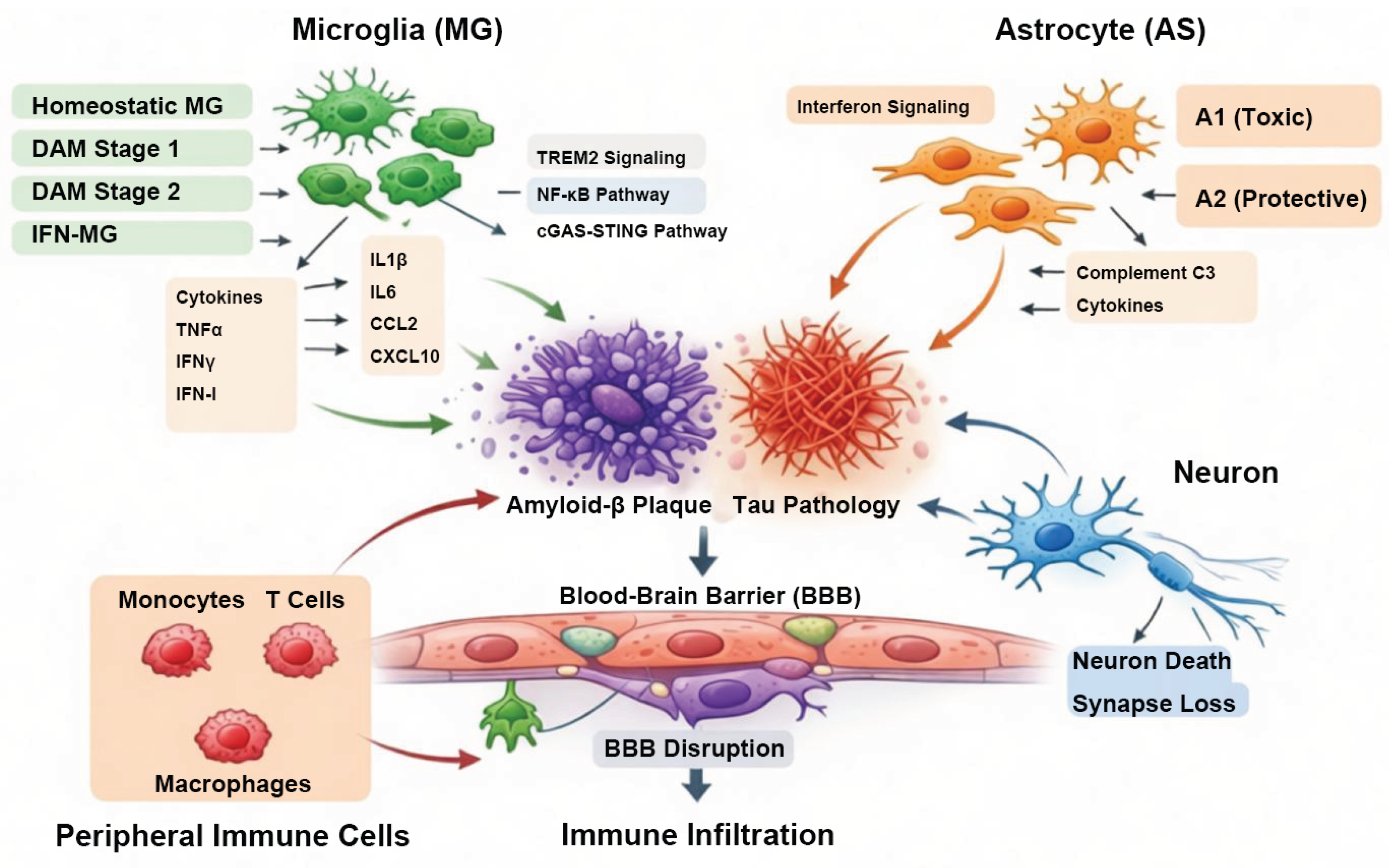
Figure 2.
Workflow and complementary features of single-cell sequencing and spatial transcriptomics. Single-cell sequencing involves tissue dissociation, single-cell isolation using droplet-based microfluidics, RNA capture, library preparation, sequencing, and downstream bioinformatic analysis to identify cellular heterogeneity and transcriptional states. In contrast, spatial transcriptomics preserves tissue architecture by placing tissue sections onto spatially barcoded slides, followed by RNA capture, reverse transcription, sequencing, and reconstruction of spatial gene expression maps. Single-cell sequencing provides high-resolution cellular profiling but lacks spatial information, whereas spatial transcriptomics retains spatial context with relatively lower cellular resolution. Integration of these approaches enables spatial localization of transcriptionally defined cell populations and improved characterization of tissue microenvironments.
Figure 2.
Workflow and complementary features of single-cell sequencing and spatial transcriptomics. Single-cell sequencing involves tissue dissociation, single-cell isolation using droplet-based microfluidics, RNA capture, library preparation, sequencing, and downstream bioinformatic analysis to identify cellular heterogeneity and transcriptional states. In contrast, spatial transcriptomics preserves tissue architecture by placing tissue sections onto spatially barcoded slides, followed by RNA capture, reverse transcription, sequencing, and reconstruction of spatial gene expression maps. Single-cell sequencing provides high-resolution cellular profiling but lacks spatial information, whereas spatial transcriptomics retains spatial context with relatively lower cellular resolution. Integration of these approaches enables spatial localization of transcriptionally defined cell populations and improved characterization of tissue microenvironments.
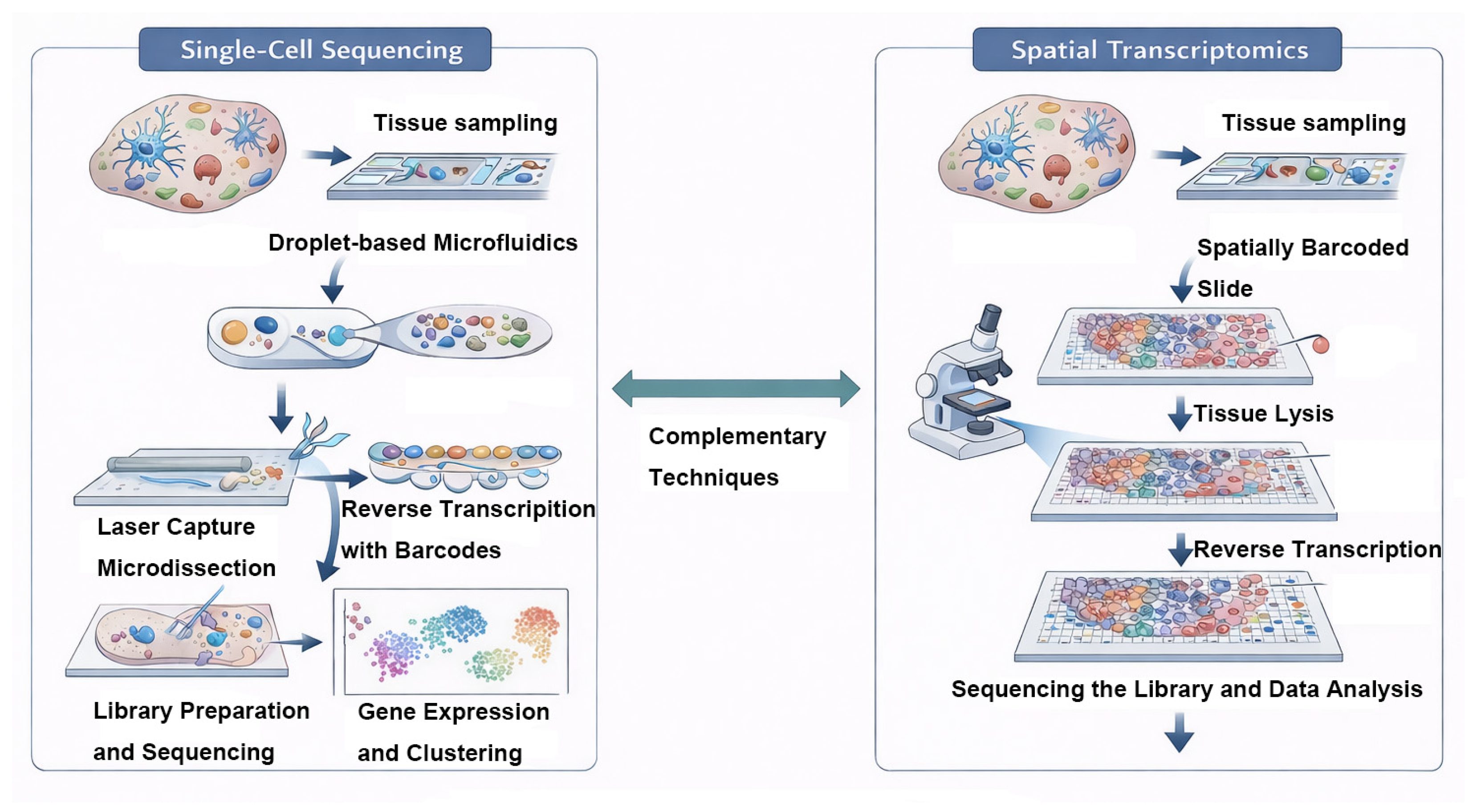
Figure 3.
Stage-dependent evolution of neuroinflammation during AD progression. In the early stage, Aβ deposition begins, accompanied by mild microglial activation with increased expression of TREM2, APOE, and TYROBP, while astrocyte activation remains limited and neuronal structures are largely preserved. During the intermediate stage, Aβ plaques expand and tau pathology increases. Disease-associated microglia accumulate around plaques, reactive astrocytes emerge, and inflammatory mediators and complement components promote synaptic dysfunction and neuronal stress. Blood–brain barrier dysfunction and limited peripheral immune cell infiltration may also occur. In the late stage, extensive Aβ and tau pathology are accompanied by chronic microglial activation, widespread neurotoxic astrocytes, complement activation, and pronounced neuronal loss. Increased immune cell infiltration and white matter degeneration further contribute to disease progression.
Figure 3.
Stage-dependent evolution of neuroinflammation during AD progression. In the early stage, Aβ deposition begins, accompanied by mild microglial activation with increased expression of TREM2, APOE, and TYROBP, while astrocyte activation remains limited and neuronal structures are largely preserved. During the intermediate stage, Aβ plaques expand and tau pathology increases. Disease-associated microglia accumulate around plaques, reactive astrocytes emerge, and inflammatory mediators and complement components promote synaptic dysfunction and neuronal stress. Blood–brain barrier dysfunction and limited peripheral immune cell infiltration may also occur. In the late stage, extensive Aβ and tau pathology are accompanied by chronic microglial activation, widespread neurotoxic astrocytes, complement activation, and pronounced neuronal loss. Increased immune cell infiltration and white matter degeneration further contribute to disease progression.
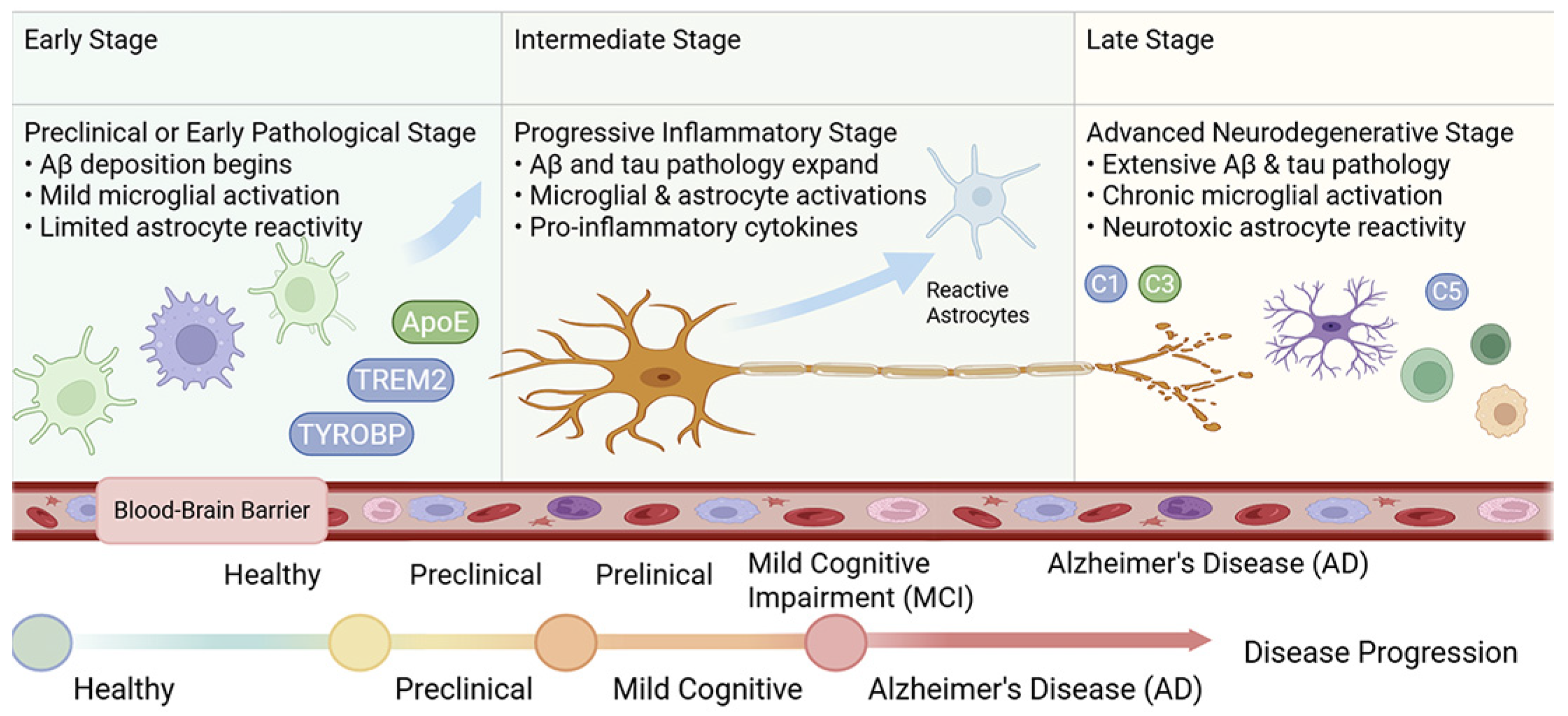

Table 1.
Comparison of common single-cell and spatial omics platforms and their key parameters.
| Plaform/ Technology |
Category | Resolution | Gene Detection Capacity | Throughput | Sample Type | Main Applications/Advantages |
| 10x Chromium (scRNA-snRNA) | Droplet-based (Sequencing) | Single-cell/single-nucleus (~10 μm) | Whole transcriptome (~10,000–20,000 genes) | High (up to 10⁴–10⁵ cells) | Live cells, frozen tissues | Single-cell heterogeneity analysis, high throughput |
| 10x Visium | Spatial capture (Sequencing) | ~55 μm per spot (1–10 cells per spot) | Whole transcriptome (~18,000–20,000 genes) | Moderate (~5,000 spots per section) | Fresh frozen (Visium v1), FFPE (Visium v2) | Whole-transcript spatial mapping, easy operation |
| Slide-seqV2 | Spatial capture (Sequencing) | ~10 μm per bead (near single-cell) | Whole transcriptome | High (millions of beads) | Frozen tissues | Higher spatial resolution, captures more cells |
| Stereo-seq | Spatial capture (Sequencing) | 0.5–3 μm per spot (single-cell and subcellular) | Whole transcriptome | Ultra-high (ultra-dense arrays) | Frozen tissues | Ultra-high resolution, enables subcellular localization |
| MERFISH (MERSCOPE) | In situ imaging (FISH) | Single-cell/subcellular | Scalable to thousands of genes (targeted probes) | Moderate | Fixed tissues | High spatial resolution, near 100% probe capture efficiency |
| seqFISH+ | In situ imaging (FISH) | Single-cell/subcellular | ~10,000 genes | Moderate | Fixed tissues | Ultra-high gene multiplexity, avoids optical crowding via multiple rounds of hybridization |
| GeoMx DSP | Region-of-interest (ROI) capture | Up to cellular level (adjustable ROI) | Targeted panels (hundreds to thousands of genes) | Low | FFPE, frozen tissues | Targeted gene panels, tissue-preserving, highly flexible ROI selection |
Table 2.
Major pathological features revealed by single-cell RNA sequencing and spatial transcriptomics in AD animal models.
Table 2.
Major pathological features revealed by single-cell RNA sequencing and spatial transcriptomics in AD animal models.
| Study (Year) | Sample/Model | Technology | Key Findings | Limitations |
| Keren-Shaul et al. (2017) [27] | 5xFAD mouse brains | scRNA-seq | Identified TREM2-dependent disease-associated microglia (DAM) subpopulation enriched in phagocytosis and inflammation-related genes | Early study, lacks spatial localization information |
| Habib et al. (2020) [30] | Hippocampus of 5xFAD mice | snRNA-seq | Identified disease-associated astrocytes (DAA), whose abundance increases with disease progression | Small sample size, mainly focused on the hippocampus |
| Mallach et al. (2024) [32] | Hippocampus of 5xFAD mice | Spatial transcriptomics (Visium) | Abundant microglial aggregation around plaques disrupts astrocytic signaling; microglial responses are consistent across brain regions, while astrocytic responses show high regional heterogeneity | Mouse model only, limited to the hippocampal region |
| Park et al. (2023) [3] | Male App NL-G-F and 5xFAD mice / human AD brains | scRNA-seq | Identified disease-associated oligodendrocyte (DAO) subpopulation; elevated Erk1/2 signaling activity in DAOs, and Erk inhibition restores myelination and ameliorates AD pathology | Focused on oligodendrocytes, limited coverage of other cell types |
Table 3.
Key information from selected human AD-related single-cell and spatial omics studies.
| Study (Year) | Sample Type | Technology | Key Findings | Limitations |
| Mathys et al. (2024) [1] | 283 AD and control brains (6 brain regions) | snRNA-seq | Constructed an atlas of over 100 cell subpopulations; identified impaired neuronal populations in AD and linked Reelin signaling to cognitive resilience | Cross-sectional samples, no integration of spatial information |
| Sziraki et al. (2023) [34] | 1.5 million mouse cells / 118,000 human cells | scRNA-seq (EasySci) | Identified over 300 cell subtypes; revealed AD-associated transcriptional changes in rare cell types | Novel technology, requires further validation |
| Miyoshi et al. (2024) [35] | Brain tissues from sporadic AD (sAD) and Down syndrome-associated AD (DSAD) patients, 5xFAD mice | Spatial transcriptomics + snRNA-seq | Upregulated glial inflammatory programs in superficial cortical layers; validated transcriptional changes near plaques in 5xFAD mice | Differences between DSAD and sAD require further investigation |
| Avey et al. (2025) [36] | Posterior cingulate cortex from 21 AD patients | Spatial transcriptomics (Visium) + IHC | Increased neuronal apoptosis in “low Aβ” plaque regions; upregulated inflammation in “high gliosis” regions; enrichment of DAM/DAA gene modules | Relatively small number of cases |
| Gerrits et al. (2021) [38] | Human AD brain tissues | snRNA-seq | Identified microglial subpopulations specifically associated with Aβ and tau pathologies | Lacks spatial context information |
| Sun et al. (2023) [39] | Human AD brain tissues | snRNA-seq | Identified terminally inflammatory microglia (TIM) subpopulation, which accumulates in aged and APOE4 AD brains and exhibits inflammatory and stress phenotypes | Mainly focused on microglia, limited analysis of other cell types |
Table 4.
Key observations regarding Aβ plaque proximal versus distal regions from selected studies.
| Study | Sample/Model | Technology | Observations in Plaque-Proximal Regions | Observations in Plaque-Distal Regions |
| Avey et al. (2025) [36] | Posterior cingulate cortex of human AD patients | Visium + IHC | “High gliosis” plaque regions: upregulated inflammation and AD-related pathways; enrichment of DAM/DAA gene modules | “Low Aβ” plaque regions: increased neuronal apoptosis markers |
| Mallach et al. (2024) [32] | Hippocampus of 5xFAD mice | High-resolution spatial transcriptomics | Around plaques: dense microglial aggregation, disrupted astrocyte-neuron signaling (synaptic imbalance); elevated CD68 expression | Distal to plaques: weak glial responses, features of normal brain tissue |
| Miyoshi (2024) [35] | Humans and 5xFAD mice | Spatial transcriptomics + snRNA-seq | Near plaques in superficial cortical layers: upregulation of specific inflammatory genes (e.g., IL-1, complement components); transcriptomic profiles correlate with AD risk | Deep cortical layers: relatively downregulated inflammatory genes |
Table 5.
Major limitations of multidimensional transcriptomics and corresponding improvement strategies.
Table 5.
Major limitations of multidimensional transcriptomics and corresponding improvement strategies.
| Limitation Category | Specific Issues | Improvement Strategies |
| Sample Compatibility | Most spatial omics require fresh-frozen samples; scRNA-seq is limited to viable cells | Develop FFPE-compatible spatial technologies; optimize nuclei extraction and tissue fixation techniques |
| Spatial Resolution | Sequencing-based methods have low resolution; imaging-based methods have low throughput and limited coverage | Increase probe density; combine multiple spatial technologies (sequencing + FISH); develop high-throughput imaging protocols |
| Throughput and Coverage | Large-volume samples are difficult to fully cover; long imaging times | Automated microscopy; pre-select plaque regions via regional screening; parallel sequencing of multiple fragments |
| Doublets and Batch Effects | scRNA-seq is prone to doublet formation; batch effects exist across different datasets | Optimize cell concentration control; apply batch integration algorithms (e.g., Harmony); implement strict quality control |
| Cell Type Annotation | A few cell types lack specific markers; ambiguous cell type identification | Utilize multi-omics data (scATAC-seq, protein markers) to provide more phenotypic clues; assist annotation with AI methods |
| Data Integration | Direct comparison and integration of single-cell and spatial data are challenging; limited software tools | Develop cross-modal alignment tools; construct comprehensive databases; share standardized analytical workflows |
| Reproducibility | High tissue heterogeneity makes validation across different samples difficult | Increase sample size; perform multi-center data validation; release open-access data and code |
Disclaimer/Publisher’s Note: The statements, opinions and data contained in all publications are solely those of the individual author(s) and contributor(s) and not of MDPI and/or the editor(s). MDPI and/or the editor(s) disclaim responsibility for any injury to people or property resulting from any ideas, methods, instructions or products referred to in the content. |
© 2026 by the authors. Licensee MDPI, Basel, Switzerland. This article is an open access article distributed under the terms and conditions of the Creative Commons Attribution (CC BY) license (http://creativecommons.org/licenses/by/4.0/).
Copyright: This open access article is published under a Creative Commons CC BY 4.0 license, which permit the free download, distribution, and reuse, provided that the author and preprint are cited in any reuse.


