

Submitted:
17 April 2026
Posted:
21 April 2026
You are already at the latest version
Abstract
The ongoing expansion of Highly The ongoing expansion of Highly Pathogenic Avian Influenza Virus (HPAIV) H5N1 is driving unprecedented wildlife mortality and raising global health concerns. To date, Oceania remains the last region free of HPAIV, offering a critical opportunity to anticipate and mitigate future emergence. Here, we assess the risk of HPAIV introduction and spread within seabird communities of New Caledonia, a key biodiversity hotspot of the South Pacific located along major transoceanic migratory routes. We compiled a comprehensive list of seabird species previously exposed to HPAIV and evaluated their likelihood of occurrence in New Caledonia using literature and global biodiversity databases. Species were classified as breeding or non-breeding, and their potential roles in virus dynamics were quantified using trait-based indices. Additionally, seabird migratory connectivity between New Caledonia and surrounding regions was estimated. Among 71 retained seabird species, several long-distance migrant species—particularly within Procellariidae and Charadriiformes—emerged as potential high-risk vectors, although often with low probability of occurrence locally. In contrast, highly colonial breeding species, including Thalasseus bergii and Fregata minor, showed the greatest potential to amplify local transmission. Network analyses revealed that the strongest ecological connections occur with nearby regions not yet affected by HPAIV, whereas links to infected areas involve distances > 2000 km, potentially constraining virus emergence in the South Pacific. Our results identify priority species and critical knowledge gaps, providing a framework to guide targeted surveillance and proactive management strategies in the South Pacific.
Keywords:
avian flu
; disease outbreak
; H5N1
; movement ecology
; emerging infectious disease
; South Pacific
Introduction
Avian influenza is a contagious viral disease which primarily infects domestic and wild birds (Alexander and Brown, 2009). In 2020, a new lineage of Highly Pathogenic Avian Influenza Virus H5N1 clade 2.3.4.4b (hereafter HPAIV), emerged in Northern Europe, causing the death of millions of farmed poultry as well as millions of wild terrestrial and marine birds (Bellido-Martín et al., 2025; Wille and Barr, 2022). The particularity of this HPAIV strain is that it infects a broader range of hosts including terrestrial and marine birds and mammals at an unprecedented geographic range (Peacock et al., 2025). It also reaches higher viral loads and thus causes larger and more intense outbreaks with massive mortalities and dramatic demographic consequences on animal populations (Couty et al., 2026). The global spread of HPAIV now represents a major threat not only to wildlife and farmed animal health but also human health, as first HPAIV transmission cases to humans have occurred in dairy cow farms of the United States (Nguyen et al., 2025).
The rapid propagation of HPAIV through Europe, America, Africa and Antarctica, has been facilitated by wild migratory birds, which can cover thousands of kilometres during their seasonal migration. Among them, seabirds, which most species are long-distance migrants, have been heavily impacted by HPAIV outbreaks and are likely responsible for the spread of the virus between continents (Couty et al., 2026; Lane et al., 2024; Wille and Barr, 2022). Beyond migration, seabirds also have specific life history traits that may accelerate the transmission of HPAIV between individuals, such as their high coloniality on land during the breeding season. Moreover, some of their feeding strategies such as scavenging or kleptoparasitism can facilitate pathogen spread within and among colonies but also within and among vertebrate species (Clessin et al., 2025; Gorta et al., 2024).
Despite the global spread of HPAIV, the last region still spared by the virus is Oceania (Clessin et al., 2025; Wille et al., 2024). It therefore represents an area of utmost importance in the surveillance of HPAIV spread dynamics. More than 50 wild bird species living in Oceania have been infected by HPAIV in other parts of the world and could therefore introduce the virus through major migratory routes (Plaza et al., 2024). New Zealand and Australia are currently actively monitoring the potential emergence of HPAIV both in farmed and wild animals with enhanced surveillance networks (Airey and Short, 2024; Stanislawek et al., 2024). However, information in other parts of the region are missing, notably in small tropical islands where the circulation of viruses in general is rarely addressed (Lebarbenchon et al., 2023).
New Caledonia, in the Coral Sea, is situated on important migratory pathways of birds migrating from East Asia to Oceania or from Antarctica/Oceania towards Western and Eastern North Pacific, regions where HPAIV have already been detected (Plaza et al., 2024). Infected migrating birds making stop-overs or extended stays in New-Caledonian waters could increase encounters with locally breeding seabirds and constitute an overlooked entry point for HPAIV in the region. Moreover, New Caledonia constitutes a globally important biodiversity hotspot. It is composed of one main island (Grande-Terre) and hundreds of smaller more or less remote coral islands where 27 tropical seabird species regularly breed (Dalloyau, 2024). Due to their geographic isolation and smallness, New Caledonian ecosystems are particularly vulnerable to perturbations such as infectious diseases (Fernández-Palacios et al., 2021). The emergence of HPAIV in this insular ecosystem could thus have dramatic effects on populations of wild birds and more particularly, seabirds.
Seabird distribution has been investigated in all marine ecosystems of the world but seabird species breeding in tropical areas have received less attention compared to species breeding in temperate or polar environments, especially in the South Pacific (Bernard et al., 2021). In New Caledonia, precise knowledge on the abundance and distribution of seabirds is still missing, due to islet remoteness and the asynchrony of breeding in some seabird species (Gaskin et al., 2025). We therefore do not currently know the degree of connectivity of seabird populations at a local and regional scale. Those big data gaps prevent robust predictions about the potential areas of HPAIV emergence in the South Pacific region, the subsequent potential spread dynamics of HPAIV among and between seabird populations and potential spill-over risks to farmed birds and humans of the region.
This study aims at conducting a risk assessment of the emergence and spread of HPAIV in seabird species of New Caledonia. To do so, we first identify the non-breeding migratory seabirds coming from other regions which may be the most susceptible to introduce HPAIV in the New-Caledonia region. Then, we identify the seabird species breeding in New Caledonia which are the most likely to spread the virus locally and regionally. By reviewing specific life history traits and distribution, we calculate an index of exposition, susceptibility and vulnerability and point out the species to study in priority to monitor the emergence and spread of HPAIV in the South Pacific region. The study also aims at determining the current state of scientific knowledge on the presence of breeding and non-breeding seabirds in New Caledonia.
Methods
Study Area
Our study primarily focuses on New Caledonia (NC) and its islets located within the French Exclusive Economic Zone (Figure 1). To account for the potential origin of migratory seabird species, we assumed that countries geographically closest to NC and Oceania were the most likely sources of HPAIV via direct migration movements of seabirds. Our study area does not extend beyond India and Eastern Russia (>10 000km). Beyond these distances, too many steps in the transmission chain would be necessary for HPAI to reach NC.
Selection of Candidate Species and Probability of Presence in NC
We first compiled a global list of wild bird species previously infected by HPAIV using scientific articles, books and governmental reports. Then, we exclusively selected seabird species present, observed in NC or whose global distribution overlapped with NC, based on nine scientific reports (Barré et al., 2009, 2006; Bismuth and Borsa, 2022; Borsa et al., 2divided021, 2021; Gurney, 2023; Rancurel, 1976; Spaggiari et al., 2007a, 2007b), the Pacific Seabird Atlas (Dalloyau, 2024), and a document from the Regional Oceanic Environmental Programme (Gaskin et al., 2025). The list was completed using observation data from three global ornithological databases: BirdLife, IUCN, et Avibase (Appendix I).
Once the list established, we defined four qualitative categories of presence probability of species in NC. Each was determined by considering both redundancy of observations for a given species, based on its range defined in the selected literature and in the UICN list (i.e, theoretical presence), and confirmed observations in the field from databases maintained by eBird, iNaturalist, GBIF, SCO and INPN (i.e confirmed presence).
For confirmed presences, only verified observations from human observations without spatial or temporal mismatches, were considered. To obtain the total amount of confirmed presence by species, we summed data from SCO, iNaturalist and took the maximum value among data from Bird, INPN and GBIF databases, to account for redundancies.
The four probabilities of presence categories were defined as follow:
- -
- Absent: no actual observation et no theoretical presence
- -
- Unlikely: species without theoretical presence and with fewer than 10 confirmed observations in total or with theoretical presence and without actual observation.
- -
- Likely: species with at least one confirmed observation in total and theoretical presence
- -
- Present: species with theoretical presence and at least one confirmed observation in each database, with a total of more than 10 confirmed observations in total.
For the subsequent analysis, species identified as absent were excluded.
Transmission Potential Score Via Migratory Seabirds and Establishment of HPAIV Within neo-Caledonian Colonies
For the selected species, we recorded the following information: Order, Family, Genus, Latin name, English name, their status in NC (breeding, migratory, observed), whether they have been affected by HPAIV in other parts of the world, their conservation status according to the UICN (LC, NT, VU, EN, CR, DD), whether they are migratory or not, their diet during the breeding season (surface feeder, diver, scavenger, predator, follow boats), and whether the species is victim of kleptoparaistism or kleptoparasitic itself.
Species were then divided in two categories: breeding species and non-breeding species. For non-breeding species, we identified life-history traits most likely enhancing HPAIV transmission by assigning a score to each trait (Appendix II) and calculated their average. This yielded a final potential transmission score for each migratory species.
For breeding species, we additionally recorded the maximum number of individuals per colony in NC (gregariousness) and population size in NC. To calculate the virus establishment score within NC colonies, we based our approach on the framework developed by (Pearce-Higgins et al., 2025). We selected a set of seabird life-history traits considered to be the most relevant for virus transmission and establishment. Each trait was assigned a numerical score according to species characteristics. Each trait was also weighted according to its relative importance in virus transmission and establishment (cf Appendix I). Traits were then grouped into three main categories: exposure (EF), sensitivity (SF), and impact (IF). For each category, a weighted mean score was calculated based on the traits composing that category. Finally, the three category scores were multiplied to obtain a single final spread potential score by species, representing the virus establishment potential:
VF = EF × SF × IF
Network of Interactions Between Neighbouring Countries and New Caledonia
In this analysis, only non-breeding species of NC were considered, as we assumed that the primary transmission pathway for HPAIV is via the migration of seabirds breeding outside NC. For each species, we recorded their global distribution within the study area using IUCN and eBird data. To simplify the geographic network, the small Pacific islands were grouped into the three regions: Melanesia (Vanuatu, Solomon Islands, Marianas, Marshall Islands, Nauru, Norfolk, Fiji), Micronesia (Micronesia, Guam, Kiribati) and Polynesia (Samoa, French Polynesia, Cook Islands, Tokelau, Tonga, Tuvalu, Wallis & Futuna, Pitcairn, Niue).
We obtained the number of occurrences of each species in countries whose migratory flow could potentially be linked to NC. For each species in each country, a score was assigned based on its status:
- -
- Breeding or resident: 3
- -
- Present during the non-breeding period: 2
- -
- Vagrant, observed, or uncertain origin/presence: 1
Thus, each country was connected to NC with the sum of occurrences for each trait determining the “thickness” of the connection. We then calculated distances between each country and NC in R using their nearest coastal line. For grouped regions such as Melanesia, Polynesia, and Micronesia, we averaged the distances of the constituent countries. Euclidian distances to NC were measured using Google Earth for Cocos Island and Christmas Island, as they were absent from the world shapefile file generated by the rnaturalearthdata R package (South et al., 2024).
Results
Of the 147 species initially selected among Anseriformes, waders, raptors, seabirds, 71 were included in our study. Forty non-breeding seabird species in NC were identified as potential vectors of HPAIV, as well as 31 breeding species.
Procellariidae, followed by Diomedeidae, were the families with the highest number of non-breeding species considered as potential candidates for the introduction of HPAIV into NC, with 21 and 6 species respectively (Figure 2a). For species breeding in NC, the most represented families were Laridae followed by Procellariidae, with 13 and 6 species respectively (Fig .2b). Sulidae breeding in NC ranked third, whereas this same family ranked last among non-breeding species.
Overall, non-breeding birds included 14 species that had already recorded cases of HPAIV, while breeding species included 7. The number of non-breeding species that had already experienced HPAIV cases was similar among affected families, ranging between two and three species per family, except for Procellariidae, which appeared to be much more affected (six species). All non-breeding species belonging to the Laridae family had already recorded cases of HPAIV. Among species breeding in New Caledonia, Laridae followed by Sulidae were the families with the highest number of species affected by HPAIV, with a maximum of three species.
The non-breeding species that had higher HPAIV potential transmission score were Thalassarche melanophris, Stercorarius parasiticus, Stercorarius maccormicki, Stercorarius antarcticus, Pterodroma gouldi, Macronectes halli, Macronectes giganteus, as well as Larus dominicanus (Figure 3a). Thus, these species are potentially the most likely to introduce the virus to NC, added to the fact that their presence is likely in this country, and all had at least one confirmed case of HPAIV in their world’s population. Nevertheless, Stercorarius antarcticus, Macronectes halli et Larus dominicanus showed a low probability of being encountered in NC.
The only two non-breeding species whose presence was confirmed in NC, Puffinus tenuiostri and Sternula albifrons, both had high potential transmission scores. But overall, the highest scores were for species with the lowest probability of occurrence in NC.
For breeding species in NC, seabirds with the highest spread potential score were Thalasseus bergii and Fregata minor, followed by Sula sula, Sula leucogaster and Sterna dougallii (Figure 3b). All of these species had at least one confirmed case of HPAIV in their world’s population. All species with the highest scores—either breeding or non-breeding in NC—had their IUCN world conservation status as Least concern (Figure 3), suggesting that demographic impacts of HPAIV may not immediately put species at risk of extinction.
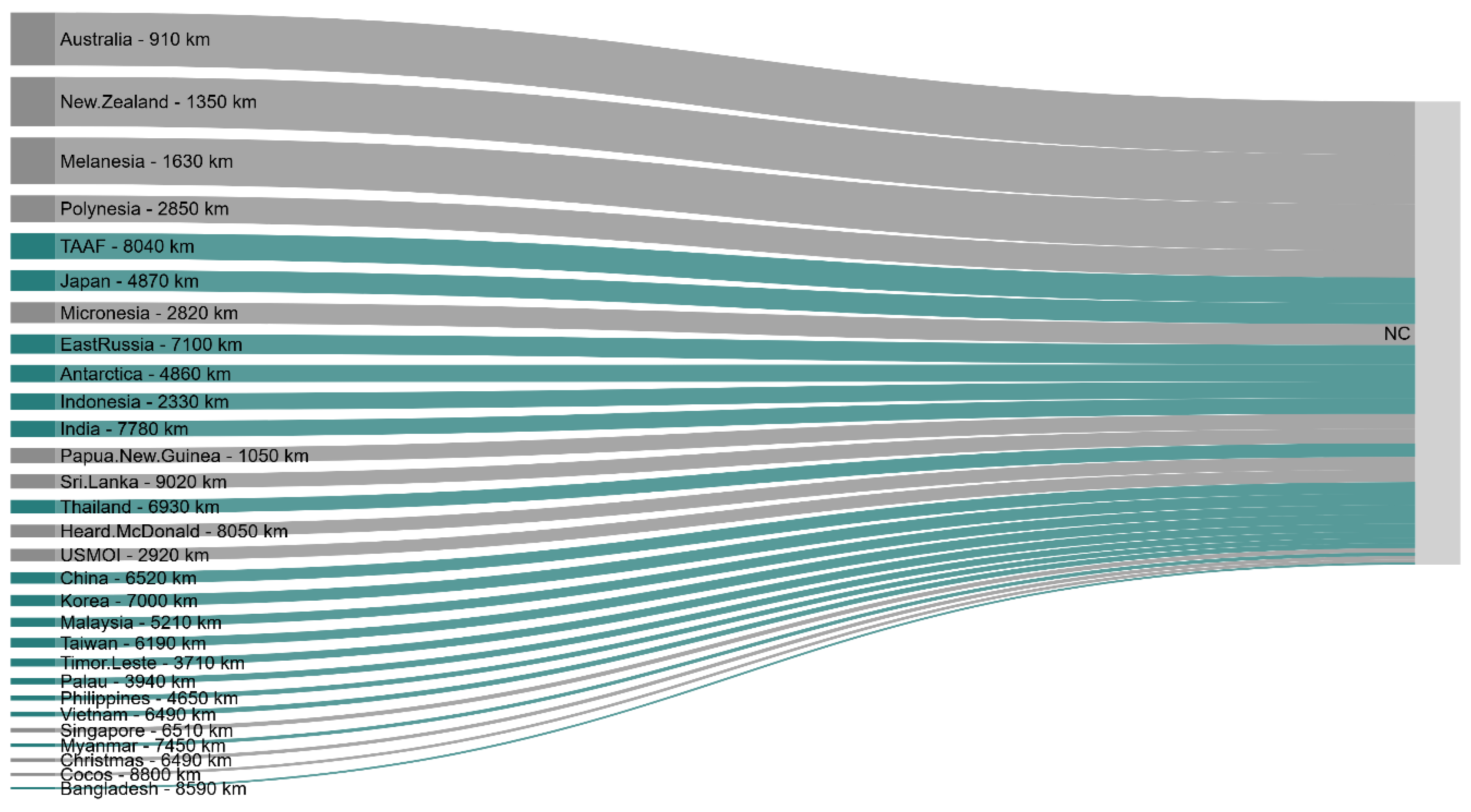
The four geographic areas and countries sharing the highest number of species with New Caledonia, and therefore exhibiting the greatest number of theoretical connections with NC, were Australia, New Zealand, Melanesia, and Polynesia (Figure 4). All are located within 3,000 km of NC and have not been affected by HPAIV yet. Among regions already affected by HPAIV, those showing the strongest potential migratory connections to NC were the French Southern and Antarctic Territories (TAAF), followed by Japan, both located more than 4,500 km from NC. The closest infected country was Indonesia (2330 km) but had intermediate connection with NC (Figure 4).
Discussion
Which Species May Be Involved in HPAIV Emergence and Spread in New Caledonia?
Procellariidae and Diomedeidae, generally robust, large-bodied, and long-distance migratory seabirds, were the non-breeding seabird families with the highest number of species candidates (Figure 2). Despite their smaller body size, Oceanitidae and Hydrobatidae are also long-distance migrants and may facilitate the spread of HPAIV over large distances (Morten et al., 2025). However, only one non-breeding Hydrobatidae species was observed in New Caledonia. The low number of observations of this family may indeed due to the fact that they do not actually migrate to NC but we cannot rule out an observation bias, as most of Hydrobatidae species are nocturnal and primarily pelagic (Schreiber and Burger, 2001). Sulidae were represented by one single non-breeding species in NC (Morus serrator) primarily remaining in the Tasman Sea (Ismar et al., 2011). In our analysis, the number of breeding seabird species actually observed in NC was, 31 species. Other sources considered 27 (Dalloyau, 2024)and 23 breeding species (Gaskin et al., 2025). Those differences highlight the strong disparity of data regarding breeding seabird species in NC, especially for Puffinus bailloni, Pterodroma heraldica, Anous ceruleus, Onychoprion lunatus, and Pterodroma nigripennis. They underpin the need for updates on which species regularly breed in the different remote areas of New Caledonia.
Our findings also show that non-breeding Charadriiformes (including Stercorariidae and Laridae) had a high number of species previously infected, in agreement with other studies which state that this seabird order is considered as a reservoir for HPAIV (Lebarbenchon et al., 2023; Stanislawek et al., 2024). Among non-breeding seabirds, all species of the family Laridae had previously shown cases of HPAIV. This family also had the highest number of species affected by the virus, followed by the family Sulidae. Predictive phylogenetic studies have shown that Laridae, like Sulidae, are among the bird families the most at risk if HPAI ever reaches Oceania (Ryding et al., 2025). Procellariidae had the highest number of non-breeding species impacted by this virus, despite not being among the most affected families. However, Macronectes halli and Macronectes giganteus two species among Procellariidae were in the first position for potential transmission score in NC (Figure 3a). These two species had previously been identified as “high-risk” species for introducing HPAIV into Oceania (Banyard et al., 2024; Clessin et al., 2025). They do circumpolar or trans-equatorial migrations and potentially cross the waters of countries already affected by the virus, as do other species with similar risk scores, such as Stercorarius maccormicki (Weimerskirch et al., 2015). Stercorarius antarcticus, which also had a high score among non-breeding species, has previously been considered responsible for the introduction of the virus into Antarctica (Lisovski et al., 2024) and for its spread in French subantarctic territories (Clessin et al., 2025). However, the probability of occurrence of these 3 species remains hypothetical in New Caledonia, in contrast to other non-breeding species whose presence has been confirmed (even though their score was lower). Indeed, Sternula albifrons is a non-breeding species that migrates from Asia to Australia (Hayakawa et al., 2022) and has previously been infected with HPAIV. Populations of Sternula albifrons have been observed on several occasions in NC, in association with other breeding species such as Anous stolidus, Thalasseus bergii, and Sternula nereis (Dalloyau, 2024). This observation is noteworthy because Thalasseus bergii had the highest spread potential score of breeding species (Figure 3). Thalasseus bergii and Fregata minor, both at the top of ranking, exhibited life-history traits promoting close contact between individuals, which could facilitate rapid virus spread. Moreover, Fregata minor is a confirmed kleptoparasite on sympatric breeding species (Gorta et al., 2024). Sula leucogaster ranks second in the vulnerability assessment and is the most abundant Sulidae species in NC. Its all-year breeding leads to prolonged, dense aggregations, which can enhance virus transmission within colonies (Dalloyau, 2024). Sula sula and Sterna dougallii also rank second; their high colony densities in NC likely explain their elevated vulnerability scores.
All species with the highest scores—either breeding or non-breeding in NC—had their IUCN world conservation status as Least Concern (Figure 3), suggesting that demographic impacts of HPAIV may not immediately put species at risk of extinction at the global scale. Nevertheless, breeding seabird conservation status in the South Pacific has not been assessed so depending on the size and trends of local seabird populations, HPAIV may have contrasting effects on local population dynamics. It hence advocates for local population surveys.
New Caledonia Still Spared from HPAIV?
We observed that no country located within 2,000 km of NC was affected by HPAIV (Figure 4). Furthermore, all affected countries that are the most connected to NC are located beyond this distance limit. This apparent “barrier” effect can be explained by the large geographic distance separating these regions from NC. If migratory seabirds excrete the virus for up to eight days, as shown in ducks and gulls (Brown et al., 2006), an infected migrating seabird could potentially travel long distances. Flying continuously at an average speed of 50 km/h for eight days, it could theoretically cover up to 9,600 km. However, it’s unlikely that seabirds would fly continuously for long periods, suggesting that by the time birds reach NC, viral excretion would have ceased. In addition, survival rates of infected birds are low, and among survivors, the virus can impair body condition and consequently reduce their flight capacity and mobility (Bennison et al., 2024; Duriez et al., 2023). Therefore, multiple transmission steps would be required for the virus to reach NC. As a result, for countries located more than 2,000 km away, the probability of HPAIV introduction remains relatively low. This “barrier effect” may be reinforced by the oligotrophic waters surrounding NC, which offers low nutrient availability (Menkès et al., 2015) and are potentially less attractive to migratory birds which prefer more productive waters.
Moreover, NC includes more than 600 islets around Grande-Terre (Dalloyau, 2024), leading to strong spatial isolation of colonies, which is considered a major barrier to virus transmission in Oceanic islands (Lebarbenchon et al., 2023). Combined with expected seabird breeding-site fidelity, connectivity among populations breeding on different islands is likely low, further limiting virus transmission.
Limitations et Perspectives
This study provides a broad overview of the species that should be targeted in future research aiming at monitoring HPAIV circulation and emergence in the last untouched region of the world. However, the species list presented here is not exhaustive, and research efforts aimed at monitoring migratory, breeding, and resident species found in NC need to be improved. Limited data availability for some species, resulting from insufficient research effort or monitoring issues, may sometimes be mistaken for a true absence of the species in NC.
While this study focused on large-scale species distributions, local distributions within NC should also be considered by examining breeding population dynamics to identify breeding sites, foraging areas and potential contact zones with non-breeding migratory seabirds. In addition, this study only addresses potential spatial overlap between breeding and non-breeding marine species in NC, whereas temporal overlap is equally critical for the transmission of HPAIV. Identifying the annual and monthly seasonality of species present in NC would help determine periods when interspecific contact can occur. For some breeding species, foraging range also varies with reproductive stage, as individuals do not travel the same distances during egg incubation and chick-rearing (Rayner et al., 2023; Soanes et al., 2021). Finally, daily temporal overlap should also be considered, as some species such as Pterodroma spp. forage primarily at night (Rayner et al., 2008, 2023). It would be interesting to also study the age of individuals, because young birds often differ in their spatial use compared to adults, being less competitive or less constrained by reproduction (e.g., Péron and Grémillet, 2013). For non-breeding species, some life-history traits are also seasonal, like species that scavenge during the breeding season and not during the non-breeding season, reducing their potential to transmit the virus (Gorta et al., 2024).
Other potential pathways for virus introduction should also be considered, such as through NC breeding seabirds that migrate to other regions. Because little is known about their migration routes and wintering areas, it is difficult to assess this risk. Additionally, some “vagrant” individuals may occasionally reach NC waters and encounter local species while foraging, although such encounters remain rare (Ramírez-Garofalo and Lockwood, 2025).
Finally, our study focuses only on seabird species. Many non-marine birds are long-distance migrants and could potentially introduce HPAIV to NC such as Anseriformes, considered as the main reservoirs of the virus (Stanislawek et al., 2024). Shorebirds are also important to consider, as some species migrate over long distances and pass through NC, like the Bar-tailed Godwit (Limosa lapponica) (Stanislawek et al., 2024). Migratory raptors could act as potential virus carriers, such as the Peregrine Falcon (Falco peregrinus), a major predator of many breeding seabird species in New Caledonia (Dalloyau, 2024), although their migration routes to and from NC remain largely unknown.
Overall, our results highlight the need to give particular attention to certain families of seabirds in monitoring the emergence and spread of HPAIV in NC. Future studies could benefit from mapping interaction networks among both breeding and non-breeding marine species, identifying where and when these species are likely to come into contact. This would reveal at-risk species and the locations to target in priority to conduct fieldwork and collect crucial tracking and/or serological data crucial for detecting and managing disease outbreaks (Talmon et al., 2025). With the right support from governmental veterinary services, the network should include interactions between wild and domestic species, in order to pinpoint areas conducive to HPAIV transmission. Such an approach aligns with the global « One Health » perspective, addressing health concerns across wildlife, domestic animals, and humans.
Data Availability Statement
The tables and R code to generate the figures are available at http://github/auponchon/HPAIV_risk_seabirds_Caledonia.
Acknowledgments
Aurore Ponchon received fundings from the IMBE-IRD Nouvelle Entrante and AOI-mission Sud 2025.
Appendix I

Table A1.
Assignment of life-history trait scores based on hypotheses for non-breeding species and framework of Pearce-Higgins et al. (2025).
Table A1.
Assignment of life-history trait scores based on hypotheses for non-breeding species and framework of Pearce-Higgins et al. (2025).
| Score | Justifications | |
|---|---|---|
|
H5N1 (Breeding and non breeding species) |
Affected: 4 Not affected: 1 |
Our hypothesis: A species that has already been affected, regardless of the population concerned, is more likely to introduce H5N1 into NC. For breeding species based on Pearce-Higgins et al.’s framework: Weight = 2 |
|
Diet (Breeding and non breeding species) |
Scavenger / predator: 4 Kleptoparasitism: 3 Ship-following / Surface feeder: 2 Diver: 1 |
These scores are based on potential interactions among individuals. Scavengers and predators feeding directly on other species are the most likely to get infected and spread H5N1, followed by kleptoparasitic species, for which there is a high risk of fluid exchange. Ship-following species are also at risk due to aggregations around fishing vessels and surface-feeding species may engage in competition for food, whereas diving species are generally less likely to come into contact with infected individuals For breeding species based on Pearce-Higgins et al.’s framework: Weight = 2 |
|
Gregariousness (maximum number of individuals per colony in NC) (just for breeding species) |
Occurs in large (1000’s individuals) breeding aggregations: 4 Occurs in moderate (100’s individuals) breeding aggregations: 3 Occurs in small (10’s individuals) breeding aggregations: 2 small (<10) family groups: 1 |
Based on Pearce-Higgins et al.’s framework Weight = 10 |
|
Population size in NC (maximum number of individuals) (just for breeding species) |
Very rare (<1,000 individuals): 4 Rare (1,000–10,000 individuals): 3 Common (10,000–100,000 individuals): 2 Abundant (>100,000 individuals): 1 |
Based on Pearce-Higgins et al.’s framework Weight = 1 |
|
Global conservation status according to the IUCN (just for breeding species) |
Threatened (vulnerable or higher): 4 Near threatened: 3 NA: 2 Least Concern: 1 |
Based on Pearce-Higgins et al.’s framework Weight = 4 |
References
- Airey, M.; Short, K.R. High pathogenicity avian influenza in Australia and beyond: could avian influenza cause the next human pandemic? Microbiol. Aust. 2024, 45, 155–158. [Google Scholar] [CrossRef]
- Alexander, D.; Brown, I. History of highly pathogenic avian influenza. Rev Sci Tech 2009, 28, 19–38. [Google Scholar] [CrossRef]
- Banyard, A.C.; Bennison, A.; Byrne, A.M.P.; Reid, S.M.; Lynton-Jenkins, J.G.; Mollett, B.; De Silva, D.; Peers-Dent, J.; Finlayson, K.; Hall, R.; Blockley, F.; Blyth, M.; Falchieri, M.; Fowler, Z.; Fitzcharles, E.M.; Brown, I.H.; James, J. Detection and spread of high pathogenicity avian influenza virus H5N1 in the Antarctic Region. Nat. Commun. 2024, 15, 7433. [Google Scholar] [CrossRef]
- Barré, N.; Hébert, O.; Aublin, R.; Spaggiari, J.; Chartendrault, V.; Baillon, N. Troisième complément à la liste des oiseaux de Nouvelle-Calédonie. Alauda Dijon 2009, 77, 287–302. [Google Scholar]
- Barré, N.; Villard, P.; Manceau, N.; Monimeau, L.; Ménard, C. Les oiseaux de l’archipel des Loyauté (Nouvelle-Calédonie): Inventaire et éléments d’écologie et de biogéographie. Rev. Décologie 2006, 61, 175–194. [Google Scholar] [CrossRef]
- Bellido-Martín, B.; Rijnink, W.F.; Iervolino, M.; Kuiken, T.; Richard, M.; Fouchier, R.A.M. Evolution, spread and impact of highly pathogenic H5 avian influenza A viruses. Nat. Rev. Microbiol. 2025. [Google Scholar] [CrossRef]
- Bennison, A.; Adlard, S.; Banyard, A.C.; Blockley, F.; Blyth, M.; Browne, E.; Day, G.; Dunn, M.J.; Falchieri, M.; Fitzcharles, E.; Forcada, J.; Forster Davidson, J.; Fox, A.; Hall, R.; Holmes, E.; Hughes, K.; James, J.; Lynton-Jenkins, J.; Marshall, S.; McKenzie, D.; Morley, S.A.; Reid, S.M.; Stubbs, I.; Ratcliffe, N.; Phillips, R.A. A case study of highly pathogenic avian influenza (HPAI) H5N1 at Bird Island, South Georgia: the first documented outbreak in the subantarctic region. Bird Study 2024, 1–12. [Google Scholar] [CrossRef]
- Bernard, A.; Rodrigues, A.S.L.; Cazalis, V.; Grémillet, D. Toward a global strategy for seabird tracking. Conserv. Lett. 2021, 14, e12804. [Google Scholar] [CrossRef]
- Bismuth, D.; Borsa, P. Bilan de l’avifaune des atolls Chesterfield-Bampton et d’Entrecasteaux (Nouvelle-Calédonie). Ornithomedia 15 2022. [Google Scholar]
- Borsa, P.; Philippe, A.; Le Bouteiller, A. Diversité et abondance des oiseaux marins des atolls d’Entrecasteaux (parc naturel de la mer de Corail) estimées à partir de missions ponctuelles effectuées ces deux dernières décennie; Institut de Recherche pour le Développement: Nouméa, Nouvelle-Calédonie, 2021. [Google Scholar]
- Brown, J.D.; Stallknecht, D.E.; Beck, J.R.; Suarez, D.L.; Swayne, D.E. Susceptibility of North American ducks and gulls to H5N1 highly pathogenic avian influenza viruses. Emerg. Infect. Dis. 2006, 12, 1663. [Google Scholar] [CrossRef] [PubMed]
- Clessin, A.; Briand, F.-X.; Tornos, J.; Lejeune, M.; De Pasquale, C.; Fischer, R.; Souchaud, F.; Hirchaud, E.; Hong, S.L.; Bralet, T.; Guinet, C.; McMahon, C.R.; Grasland, B.; Baele, G.; Boulinier, T. Circumpolar spread of avian influenza H5N1 to southern Indian Ocean islands. Nat. Commun. 2025, 16, 8463. [Google Scholar] [CrossRef]
- Couty, M.; Guinat, C.; Fornasiero, D.; Briand, F.-X.; Henry, P.-Y.; Grasland, B.; Palumbo, L.; Le Loc’h, G. The role of wild birds in the global highly pathogenic avian influenza H5 panzootic, 2020–2023. Npj Biodivers. 2026, 5, 1. [Google Scholar] [CrossRef]
- Dalloyau, S. Atlas des oiseaux marins nicheurs des territoires français d’Outre-Mer. In Biotope. ed; Parthénope, 2024. [Google Scholar]
- Duriez, O.; Sassi, Y.; Le Gall-Ladevèze, C.; Giraud, L.; Straughan, R.; Dauverné, L.; Terras, A.; Boulinier, T.; Choquet, R.; Van De Wiele, A.; Hirschinger, J.; Guérin, J.-L.; Le Loc’h, G. Highly pathogenic avian influenza affects vultures’ movements and breeding output. Curr. Biol. 2023, 33, 3766–3774.e3. [Google Scholar] [CrossRef]
- Fernández-Palacios, J.M.; Kreft, H.; Irl, S.D.H.; Norder, S.; Ah-Peng, C.; Borges, P.A.V.; Burns, K.C.; de Nascimento, L.; Meyer, J.-Y.; Montes, E.; Drake, D.R. Scientists’ warning—The outstanding biodiversity of islands is in peril. Glob. Ecol. Conserv. 2021, 31, e01847. [Google Scholar] [CrossRef] [PubMed]
- Gaskin, C.P.; Lukies, K.A.; Whitehead, E.A.; Raine, A.F. Pacific seabird survey and monitoring manual: tools to support seabird conservation across ecosystems in Oceania; Secretariat of the Pacific Regional Environment Programme (SPREP): Apia, Samoa, 2025. [Google Scholar]
- Gorta, S.B.Z.; Berryman, A.J.; Kingsford, R.T.; Klaassen, M.; Clarke, R.H. Kleptoparasitism in seabirds—A potential pathway for global avian influenza virus spread. Conserv. Lett. 2024, 17, e13052. [Google Scholar] [CrossRef]
- Gurney, F. Western Pacific Odyssey tour report 2023. Bird Quest tours. 2023. [Google Scholar]
- Hayakawa, M.; Suzuki-Matsubara, M.; Matsubara, K.; Kanazawa, S.; Fujii, T.; Kitamura, W.; Murofushi, R.A.; Moriyama, A. Population genetic structure of Little Tern (Sternula albifrons) in Japan inferred from nucleotide sequence diversities of the mitochondrial DNA control region. Ornithol. Sci. 2022, 21, 155–163. [Google Scholar] [CrossRef]
- Ismar, S.M.; Phillips, R.A.; Rayner, M.J.; Hauber, M.E. Geolocation tracking of the annual migration of adult Australasian Gannets (Morus serrator) breeding in New Zealand. Wilson J. Ornithol. 2011, 123, 121–125. [Google Scholar] [CrossRef]
- Lane, J.V.; Jeglinski, J.W.E.; Avery-Gomm, S.; Ballstaedt, E.; Banyard, A.C.; Barychka, T.; Brown, I.H.; Brugger, B.; Burt, T.V.; Careen, N.; Castenschiold, J.H.F.; Christensen-Dalsgaard, S.; Clifford, S.; Collins, S.M.; Cunningham, E.; Danielsen, J.; Daunt, F.; D’entremont, K.J.N.; Doiron, P.; Duffy, S.; English, M.D.; Falchieri, M.; Giacinti, J.; Gjerset, B.; Granstad, S.; Grémillet, D.; Guillemette, M.; Hallgrímsson, G.T.; Hamer, K.C.; Hammer, S.; Harrison, K.; Hart, J.D.; Hatsell, C.; Humpidge, R.; James, J.; Jenkinson, A.; Jessopp, M.; Jones, M.E.B.; Lair, S.; Lewis, T.; Malinowska, A.A.; McCluskie, A.; McPhail, G.; Moe, B.; Montevecchi, W.A.; Morgan, G.; Nichol, C.; Nisbet, C.; Olsen, B.; Provencher, J.; Provost, P.; Purdie, A.; Rail, J.-F.; Robertson, G.; Seyer, Y.; Sheddan, M.; Soos, C.; Stephens, N.; Strøm, H.; Svansson, V.; Tierney, T.D.; Tyler, G.; Wade, T.; Wanless, S.; Ward, C.R.E.; Wilhelm, S.I.; Wischnewski, S.; Wright, L.J.; Zonfrillo, B.; Matthiopoulos, J.; Votier, S.C. High pathogenicity avian influenza (H5N. 2024. [Google Scholar]
- Lebarbenchon, C.; Boucher, S.; Feare, C.; Dietrich, M.; Larose, C.; Humeau, L.; Le Corre, M.; Jaeger, A. Migratory patterns of two major influenza virus host species on tropical islands. R. Soc. Open Sci. 2023, 10, 230600. [Google Scholar] [CrossRef] [PubMed]
- Lisovski, S.; Günther, A.; Dewar, M.; Ainley, D.; Aldunate, F.; Arce, R.; Ballard, G.; Bauer, S.; Belliure, J.; Banyard, A.C. Unexpected delayed incursion of highly pathogenic avian influenza H5N1 (clade 2.3. 4.4 b) into the antarctic region. Influenza Other Respir. Viruses 2024, 18, e70010. [Google Scholar] [CrossRef]
- Menkès, C.E.; Allain, V.; Rodier, M.; Gallois, F.; Lebourges-Dhaussy, A.; Hunt, B.P.; Smeti, H.; Pagano, M.; Josse, E.; Daroux, A. Seasonal oceanography from physics to micronekton in the south-west Pacific. Deep Sea Res. Part II Top. Stud. Oceanogr. 2015, 113, 125–144. [Google Scholar] [CrossRef]
- Morten, J.M.; Carneiro, A.P.B.; Beal, M.; Bonnet-Lebrun, A.-S.; Dias, M.P.; Rouyer, M.-M.; Harrison, A.-L.; González-Solís, J.; Jones, V.R.; Garcia Alonso, V.A.; Antolos, M.; Arata, J.A.; Barbraud, C.; Bell, E.A.; Bell, M.; Bose, S.; Broni, S.; de L Brooke, M.; Butchart, S.H.M.; Carlile, N.; Catry, P.; Catry, T.; Charteris, M.; Cherel, Y.; Clark, B.L.; Clay, T.A.; Cole, N.C.; Conners, M.G.; Debski, I.; Delord, K.; Egevang, C.; Elliot, G.; Esefeld, J.; Facer, C.; Fayet, A.L.; Fijn, R.C.; Fischer, J.H.; Franklin, K.A.; Gilg, O.; Gill, J.A.; Granadeiro, J.P.; Guilford, T.; Handley, J.M.; Hanssen, S.A.; Hawkes, L.A.; Hedd, A.; Jaeger, A.; Jones, C.G.; Jones, C.W.; Kopp, M.; Krietsch, J.; Landers, T.J.; Lang, J.; Le Corre, M.; Mallory, M.L.; Masello, J.F.; Maxwell, S.M.; Medrano, F.; Militão, T.; Millar, C.D.; Moe, B.; Montevecchi, W.A.; Navarro-Herrero, L.; Neves, V.C.; Nicholls, D.G.; Nicoll, M.A.C.; Norris, K.; O’Dwyer, T.W.; Parker, G.C.; Peter, H.-U.; Phillips, R.
- Nguyen, T.-Q.; Hutter, C.R.; Markin, A.; Thomas, M.; Lantz, K.; Killian, M.L.; Janzen, G.M.; Vijendran, S.; Wagle, S.; Inderski, B.; Magstadt, D.R.; Li, G.; Diel, D.G.; Frye, E.A.; Dimitrov, K.M.; Swinford, A.K.; Thompson, A.C.; Snekvik, K.R.; Suarez, D.L.; Lakin, S.M.; Schwabenlander, S.; Ahola, S.C.; Johnson, K.R.; Baker, A.L.; Robbe-Austerman, S.; Torchetti, M.K.; Anderson, T.K. Emergence and interstate spread of highly pathogenic avian influenza A(H5N1) in dairy cattle in the United States. Science 2025, 388, eadq0900. [Google Scholar] [CrossRef] [PubMed]
- Peacock, T.P.; Moncla, L.; Dudas, G.; VanInsberghe, D.; Sukhova, K.; Lloyd-Smith, J.O.; Worobey, M.; Lowen, A.C.; Nelson, M.I. The global H5N1 influenza panzootic in mammals. Nature 2025, 637, 304–313. [Google Scholar] [CrossRef] [PubMed]
- Pearce-Higgins, J.W.; Clewley, G.; Bolton, M.; Banyard, A.C.; Falchieri, M.; Lindley, P.; Atkinson, P.W. Assessing the vulnerability of wild bird populations to high pathogenicity avian influenza. Bird Study 2025, 72, 5–19. [Google Scholar] [CrossRef]
- Péron, C.; Grémillet, D. Tracking through life stages: adult, immature and juvenile autumn migration in a long-lived seabird. PLOS ONE 2013, 8, e72713. [Google Scholar] [CrossRef]
- Plaza, P.; Santangeli, A.; Cancellario, T.; Lambertucci, S. Potential Arrival Pathway for Highly Pathogenic Avian Influenza H5N1 to Oceania. Influenza Other Respir. Viruses 2024, 18, e70055. [Google Scholar] [CrossRef]
- Ramírez-Garofalo, J.R.; Lockwood, J.L. Animal vagrancy and the spread of pathogens. Trends Ecol. Evol. 2025, 40, 119–121. [Google Scholar] [CrossRef] [PubMed]
- Rancurel, P. Notes ornithologiques: Liste préliminaire des oiseaux de mer iles et ilots voisins de la Nouvelle Calédonie. Cah. Off. Recherce Sci. Tech. O.-m. Ser. Oceanogr. 1976, 14, 163–168. [Google Scholar]
- Rayner, M.; Hauber, M.; Clout, M.; Seldon, D.; Van Dijken, S.; Bury, S.; Phillips, R. Foraging ecology of the Cook’s petrel Pterodroma cookii during the austral breeding season: a comparison of its two populations. Mar. Ecol. Prog. Ser. 2008, 370, 271–284. [Google Scholar] [CrossRef]
- Rayner, M.J.; Gaskin, C.P.; Taylor, G.A. Seasonal movements, foraging activity, and breeding biology of black-winged petrel (Pterodroma nigripennis) from three New Zealand colonies. Notornis 2023, 70, 111–123. [Google Scholar] [CrossRef]
- Ryding, S.; Ross, T.A.; Klaassen, M. Predicting high pathogenicity avian influenza H5N1 susceptibility in wild birds, with1 special reference to Australia. 2025. [Google Scholar]
- Schreiber, E.A.; Burger, J. Biology of Marine Birds; CRC Press, 2001. [Google Scholar] [CrossRef]
- Soanes, L.M.; Green, J.A.; Bolton, M.; Milligan, G.; Mukhida, F.; Halsey, L.G. Linking foraging and breeding strategies in tropical seabirds. J. Avian Biol. 2021, 52. [Google Scholar] [CrossRef]
- South, A.; Schramm, M.; Massicotte, P. rnaturalearthdata: World Vector Map Data from Natural Earth Used in “rnaturalearth.”. 2024. [Google Scholar]
- Spaggiari, J.; Barré, N.; Baudat-Franceschi, J.; Borsa, P.; Colin, F. New Caledonian seabirds, in: Compendium of Marine Species from New Caledonia 2007a, 415–428.
- Spaggiari, J.; Chartendrault, V.; Barré, N. Zones importantes pour la conservation des oiseaux de Nouvelle-Calédonie; Société calédonienne d’ornithologie—SCO: Nouméa, Nouvelle-Calédonie, 2007b. [Google Scholar]
- Stanislawek, W.L.; Tana, T.; Rawdon, T.G.; Cork, S.C.; Chen, K.; Fatoyinbo, H.; Cogger, N.; Webby, R.J.; Webster, R.G.; Joyce, M.; Tuboltsev, M.A.; Orr, D.; Ohneiser, S.; Watts, J.; Riegen, A.C.; McDougall, M.; Klee, D.; O’Keefe, J.S. Avian influenza viruses in New Zealand wild birds, with an emphasis on subtypes H5 and H7: Their distinctive epidemiology and genomic properties. PLOS ONE 2024, 19, e0303756. [Google Scholar] [CrossRef] [PubMed]
- Talmon, I.; Pekarsky, S.; Bartan, Y.; Thie, N.; Getz, W.M.; Kamath, P.L.; Bowie, R.C.K.; Nathan, R. Using wild-animal tracking for detecting and managing disease outbreaks. Trends Ecol. Evol. 2025, 40, 760–771. [Google Scholar] [CrossRef]
- Weimerskirch, H.; Tarroux, A.; Chastel, O.; Delord, K.; Cherel, Y.; Descamps, S. Population-specific wintering distributions of adult south polar skuas over three oceans. Mar. Ecol. Prog. Ser. 2015, 538, 229–237. [Google Scholar] [CrossRef]
- Wille, M.; Atkinson, R.; Barr, I.G.; Burgoyne, C.; Bond, A.L.; Boyle, D.; Christie, M.; Dewar, M.; Douglas, T.; Fitzwater, T.; Hassell, C.; Jessop, R.; Klaassen, H.; Lavers, J.L.; Leung, K.K.-S.; Ringma, J.; Sutherland, D.R.; Klaassen, M. Long-Distance Avian Migrants Fail to Bring 2.3.4.4b HPAI H5N1 Into Australia for a Second Year in a Row. Influenza Other Respir. Viruses 2024, 18, e13281. [Google Scholar] [CrossRef]
- Wille, M.; Barr, I.G. Resurgence of avian influenza virus. Science 2022, 376, 459–460. [Google Scholar] [CrossRef] [PubMed]
Figure 1.
Study area in New Caledonia. The dashed line represents the Exclusive Economic Zone of New Caledonia and the blue lines, territorial waters with mainland and islets holding breeding seabird colonies. These two shapefiles were retrieved from http://www.georep.nc.
Figure 1.
Study area in New Caledonia. The dashed line represents the Exclusive Economic Zone of New Caledonia and the blue lines, territorial waters with mainland and islets holding breeding seabird colonies. These two shapefiles were retrieved from http://www.georep.nc.
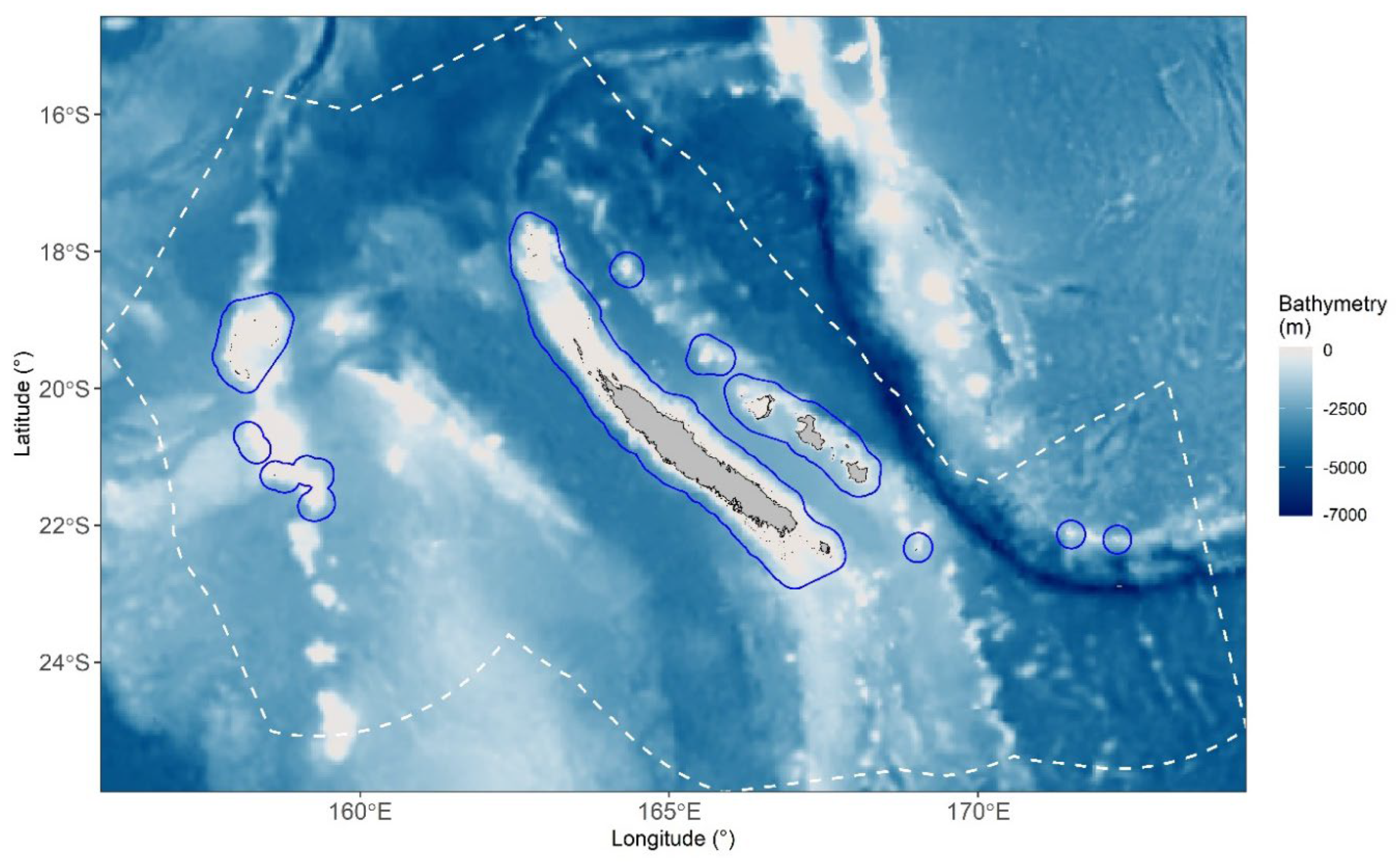
Figure 2.
Number of identified seabird species per family that have been affected (dark green) or not (light green) by HPAIV in other parts of the world, for (a) non-breeding species and (b) breeding species in New Caledonia. Procellariidae = petrels and shearwaters; Diomedeidae = albatrosses; Stercorariidae = skuas; Laridae = terns, noddies, gulls; Oceanitidae = storm-petrels; Hydrobatidae = storm-petrels; Sulidae = boobies; Phalacrocoracidae = cormorants; Fregatidae = frigatebirds; Phaethontidae = tropicbirds.
Figure 2.
Number of identified seabird species per family that have been affected (dark green) or not (light green) by HPAIV in other parts of the world, for (a) non-breeding species and (b) breeding species in New Caledonia. Procellariidae = petrels and shearwaters; Diomedeidae = albatrosses; Stercorariidae = skuas; Laridae = terns, noddies, gulls; Oceanitidae = storm-petrels; Hydrobatidae = storm-petrels; Sulidae = boobies; Phalacrocoracidae = cormorants; Fregatidae = frigatebirds; Phaethontidae = tropicbirds.
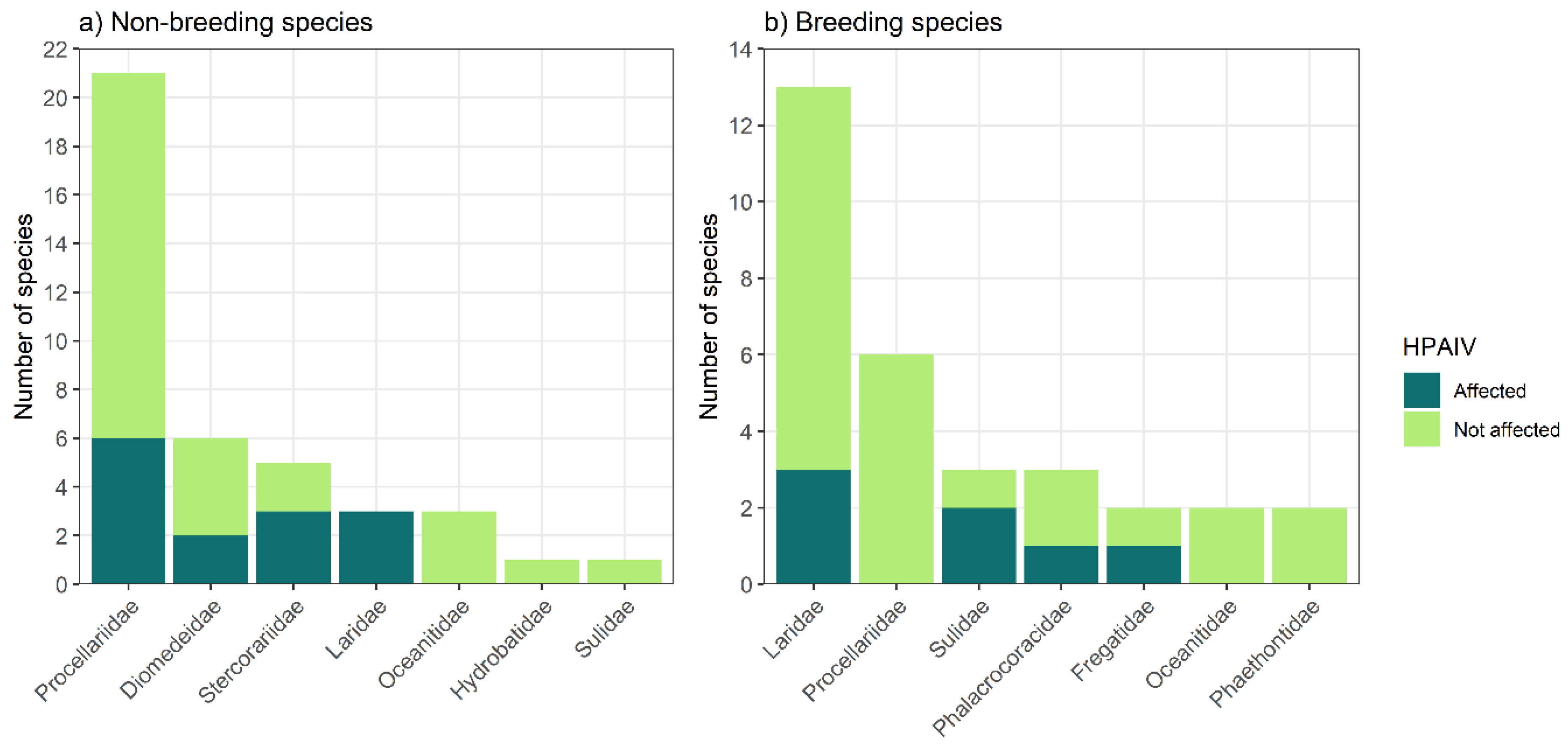
Figure 3.
(a) HPAIV potential transmission score in non-breeding species regarding their probability of presence in NC; (b) HPAIV spread potential score in breeding species of NC. Red stars indicate species previously affected by HPAIV in other parts of the world. Abbreviations in brackets indicate IUCN conservation status. LC = Least Concern; NT=Near-threatened; VU = Vulnerable; EN=Endangered; CR = Critically Endangered; DD = Data Deficient.
Figure 3.
(a) HPAIV potential transmission score in non-breeding species regarding their probability of presence in NC; (b) HPAIV spread potential score in breeding species of NC. Red stars indicate species previously affected by HPAIV in other parts of the world. Abbreviations in brackets indicate IUCN conservation status. LC = Least Concern; NT=Near-threatened; VU = Vulnerable; EN=Endangered; CR = Critically Endangered; DD = Data Deficient.
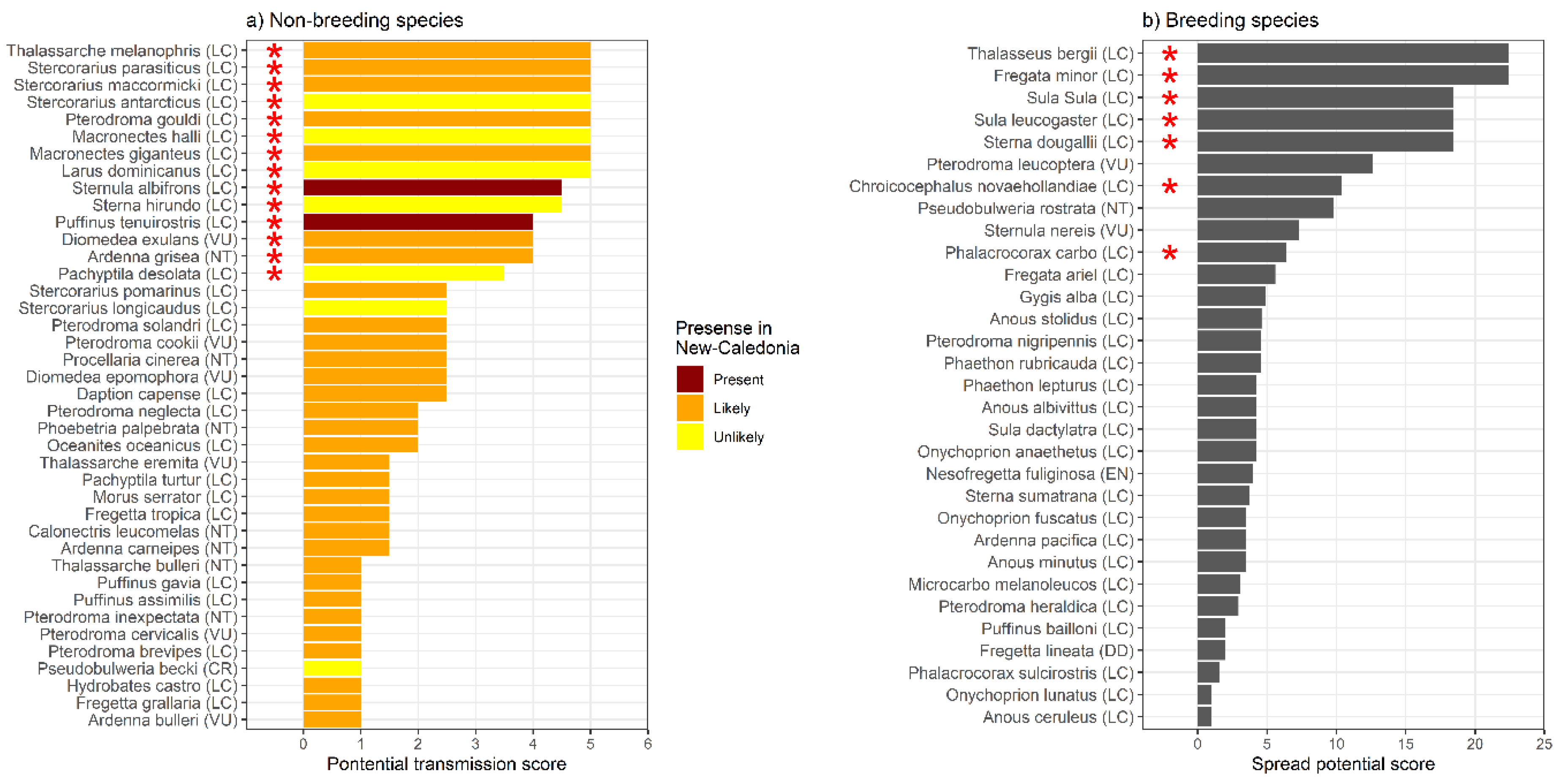
Figure 4.
Importance of potential migratory flows of non-breeding species passing by/stopping in New Caledonia, according to IUCN presence status. Countries shown in green are those affected by HPAIV, considering all host species (wild and domestic birds, and mammals). Each region was connected to New Caledonia (NC), with the sum of occurrences calculated for each seabird species, resulting in varying line thicknesses according to the total score assigned. TAAF = French Southern and Antarctic territories; East Russia = Russian Far East; USMOI = United States Minor Outlying Islands; Cocos = Cocos Islands; Papua NG = Papua New Guinea. Distances represent the closest coastline point from the centroid of New Caledonia mainland.
Figure 4.
Importance of potential migratory flows of non-breeding species passing by/stopping in New Caledonia, according to IUCN presence status. Countries shown in green are those affected by HPAIV, considering all host species (wild and domestic birds, and mammals). Each region was connected to New Caledonia (NC), with the sum of occurrences calculated for each seabird species, resulting in varying line thicknesses according to the total score assigned. TAAF = French Southern and Antarctic territories; East Russia = Russian Far East; USMOI = United States Minor Outlying Islands; Cocos = Cocos Islands; Papua NG = Papua New Guinea. Distances represent the closest coastline point from the centroid of New Caledonia mainland.
Disclaimer/Publisher’s Note: The statements, opinions and data contained in all publications are solely those of the individual author(s) and contributor(s) and not of MDPI and/or the editor(s). MDPI and/or the editor(s) disclaim responsibility for any injury to people or property resulting from any ideas, methods, instructions or products referred to in the content. |
© 2026 by the authors. Licensee MDPI, Basel, Switzerland. This article is an open access article distributed under the terms and conditions of the Creative Commons Attribution (CC BY) license (http://creativecommons.org/licenses/by/4.0/).
Copyright: This open access article is published under a Creative Commons CC BY 4.0 license, which permit the free download, distribution, and reuse, provided that the author and preprint are cited in any reuse.


