

Submitted:
17 April 2026
Posted:
20 April 2026
You are already at the latest version
Abstract
Most theories of emotion assume that emotional experiences arise from the interaction between bodily states, cognitive processes, and the surrounding environment. Despite this convergence, a central empirical problem remains insufficiently explained: similar physiological states can give rise to markedly different emotional experiences depending on context.Existing approaches provide partial accounts of this variability. Biological models characterise the role of bodily signals, predictive and constructivist frameworks emphasise inference and conceptual knowledge, and socio-cultural theories highlight the influence of norms and shared meaning. However, these perspectives often fail to distinguish between two levels of top-down organisation: conceptual knowledge, which provides the categories used to interpret affective states, and socio-cultural constraints, which regulate which interpretations become plausible and stable in a given context.In this article, we propose a tri-directional framework in which emotion emerges from the ongoing interaction between bodily signals, predictive processes, and socio-cultural constraints. Within this perspective, emotional experience is conceptualised as a process of constrained selection under uncertainty: bodily signals generate ambiguous affective input, predictive processes organise candidate interpretations, and socio-cultural constraints bias their stabilisation.A central implication of this framework concerns the role of stress. Rather than producing a uniform increase or decrease in emotional responding, stress is conceptualised as a constraint on regulatory dynamics that reduces the range of accessible interpretations and amplifies the system’s dominant mode of stabilisation. This leads to the prediction that, under stress, emotional responses will diverge rather than converge depending on contextual and socio-cultural factors.By integrating biological, inferential, and socio-cultural perspectives within a unified framework, this approach provides a more precise account of emotional variability and generates testable predictions regarding the dynamics of emotion under conditions of uncertainty.
Keywords:
emotional variability
; constrained selection
; uncertainty
; stress
; socio-cultural constraints
; predictive processing
1. Introduction
Emotion science has made substantial progress in identifying the biological, cognitive, and socio-cultural processes that contribute to emotional experience. Yet, a central empirical phenomenon remains insufficiently explained: similar physiological states or external conditions can give rise to radically different emotional experiences depending on context, expectations, and shared meaning. For instance, comparable autonomic arousal may be experienced as fear, excitement, anger, or empathic concern. Explaining this divergence remains a fundamental challenge for existing theories of emotion.
Existing approaches capture important aspects of this phenomenon, but leave a critical gap. Biological models successfully characterise the autonomic and neural substrates of emotion, yet do not explain how similar bodily states acquire different meanings across contexts (Damasio, 1996; Panksepp, 1998). Predictive and constructivist frameworks emphasise inference and conceptual knowledge, describing the brain as a system that generates and updates predictions under uncertainty (Barrett, 2017; Seth, 2013; Friston, 2010; Clark, 2013). However, these models under-specify how socially structured constraints shape the selection and stabilisation of emotional interpretations. Conversely, socio-cultural approaches demonstrate that emotions are shaped by norms, practices, and shared meaning, but remain less precise about how these constraints are implemented at the level of moment-to-moment physiological and inferential processes (Mesquita, 2022; De Leersnyder et al., 2013; Kirmayer & Ramstead, 2017).
A common limitation across these approaches is that they privilege a single dominant direction of explanation. Affect-program theories prioritise biologically basic emotions (Ekman & Cordaro, 2011; Izard, 2007), constructivist approaches focus on conceptual categorisation (Barrett, 2017; Lindquist et al., 2015), and appraisal theories emphasise evaluative processes (Scherer et al., 2001; Ellsworth & Scherer, 2003; Frijda, 2007). Models of emotion regulation describe how emotional responses are modulated over time (Gross, 1998, 2015), while phenomenological approaches characterise the structure of lived experience (Colombetti, 2014; Ratcliffe, 2008). While these frameworks differ in their assumptions, they converge on the dynamic and context-dependent nature of emotion (Keltner & Gross, 1999; Gross & Barrett, 2011). However, by treating biological, inferential, and socio-cultural processes as hierarchically or sequentially organised, they fail to account for how emotional experience emerges from their simultaneous and reciprocal interaction.
As a result, these models struggle to explain a key empirical property of emotion: the divergence of emotional outcomes under similar physiological conditions. This limitation suggests that emotional experience cannot be adequately understood within unidirectional or additive frameworks, but instead requires a model capable of capturing the coupled dynamics through which bodily signals, predictive processes, and socio-cultural constraints jointly shape emotional interpretation under conditions of uncertainty.
To overcome this limitation, we propose a tri-directional framework of emotion. Emotion is conceptualised as an emergent regulatory process arising from the continuous interaction between bodily signals, predictive processes, and socio-cultural constraints. Within this framework, emotional experience results from constrained selection among multiple possible interpretations: bodily signals generate ambiguous affective input, predictive processes organise candidate interpretations, and socio-cultural constraints bias their stabilisation.
In other words, emotion is not the product of bodily states or inference alone, but a process of constrained selection emerging from the tri-directional coupling of body, brain, and socio-cultural structure.
2. A Tri-Directional Framework of Emotion
The present framework is organised around three interdependent channels: bodily signals, predictive processes, and socio-cultural constraints.
The body provides interoceptive and autonomic signals that constitute ongoing affective information about the organism’s internal state (Craig, 2002; Critchley & Garfinkel, 2017). The brain implements predictive and conceptual processes that organise, interpret, and anticipate this evidence (Friston, 2010; Barrett, 2017; Seth, 2013). The cultural channel refers to socio-cultural structures that shape which interpretations become salient, acceptable, or stable within a given context (Mesquita, 2022; De Leersnyder et al., 2013).
These components do not operate independently. Bodily signals generate ambiguous affective input, predictive processes organise candidate interpretations, and socio-cultural constraints regulate which interpretations are stabilised.
2.1. Conceptual Knowledge and Socio-Cultural Constraints
A central contribution of the present framework is the distinction between conceptual knowledge and socio-cultural constraints, which operate at different levels of emotional inference but are often conflated in the literature.
Conceptual knowledge refers to the set of learned emotion categories and associated meanings that enable individuals to interpret affective states. Emotion concepts such as fear, anger, or shame function as top-down priors that organise interoceptive signals into coherent and recognisable categories (Barrett, 2017; Lindquist et al., 2012). In this sense, conceptual knowledge determines how affective states can be described and categorised.
Socio-cultural constraints, by contrast, refer to socially structured norms, values, and expectations that regulate which interpretations are considered plausible, appropriate, or legitimate within a given context (Mesquita, 2022; De Leersnyder et al., 2013). Rather than providing categories, these constraints operate at a higher level by shaping which interpretations are selected, maintained, or inhibited.
This distinction is critical. Conceptual knowledge defines the space of possible interpretations, whereas socio-cultural constraints regulate the selection and stabilisation of these interpretations under conditions of ambiguity. As a result, they cannot be reduced to a single top-down process.
2.2. Operationalising Socio-Cultural Constraints
Importantly, socio-cultural constraints can be operationalised at multiple levels rather than treated as a diffuse contextual factor.
At the experimental level, they can be manipulated through contextual framing (e.g., moral versus neutral interpretations of the same situation), a method widely used in social psychology to shape evaluative responses (Haidt, 2001; Van Bavel et al., 2018). At the individual level, they can be approximated using psychometric measures of normative orientation, such as social hierarchy beliefs, moral values, or identity-related constructs (Sidanius & Pratto, 1999; Graham et al., 2011; Jost, 2017). At the situational level, they can be indexed through perceived social norms and expectations, which have been shown to systematically influence behaviour and judgment (Cialdini et al., 1990; Bicchieri, 2006).
To reduce the risk of conceptual overextension, the present framework treats the cultural channel as a structured configuration of measurable components rather than a single undifferentiated variable.
These dimensions can be independently manipulated or assessed and jointly define the space of socially plausible emotional interpretations.
2.3. Implications for Emotional Variability
This distinction has direct implications for explaining emotional variability. Emotional differences cannot be attributed solely to variation in conceptual knowledge. Individuals sharing similar emotion concepts may nevertheless converge on different emotional interpretations because socio-cultural constraints bias how these concepts are deployed (Van Bavel et al., 2018; Jost, 2017).
Within this architecture, emotion is not a linear sequence but the outcome of a continuous coordination process. Emotional meaning emerges from the interaction between bodily evidence, predictive interpretation, and socio-cultural constraint. When these components are aligned, emotional states stabilise rapidly. When they are misaligned—for instance, when bodily signals conflict with contextual expectations—uncertainty increases, leading to ambiguity or instability in emotional experience (Hohwy, 2013; Peters et al., 2017).
Emotion can therefore be understood as a dynamic process through which the system converges toward a coherent interpretation under multiple interacting constraints (Pessoa, 2017).
2.4. Minimal Formalisation
This framework can be expressed in minimal formal terms. Let B(t) denote bodily signals, P(t) predictive processes, and C(t) socio-cultural constraints, each evolving over time. Emotional states E(t) correspond to the stabilisation of a constrained interpretation emerging from their interaction:
where f reflects a non-linear process of selection and stabilisation under constraint.
E(t) = f(B(t), P(t), C(t))
Within this formulation, multiple candidate interpretations may be compatible with a given bodily state, and emotional experience corresponds to the selection of one trajectory among these possibilities. Crucially, identical physiological activation B(t) can lead to different emotional outcomes depending on the configuration of P(t) and C(t).
Factors such as stress can be conceptualised as modulatory influences that reduce the range of accessible states by constraining the system’s dynamics, thereby accelerating convergence toward dominant interpretations.
At this stage, this formulation is intended as an illustrative abstraction rather than a fully specified mathematical model. It identifies the relevant variables and their functional relations, but does not yet define the precise form of the dynamics governing their evolution.
A more explicit formulation would require specifying the system as a set of coupled differential equations, for example:
where each component evolves as a function of its interaction with the others.
Ḃ(t) = F_B(B(t), P(t), C(t))
Ṗ(t) = F_P(B(t), P(t), C(t))
Ċ(t) = F_C(B(t), P(t), C(t))
Within this system, emotional states correspond to dynamically stabilised configurations emerging from the continuous coupling between bodily signals, predictive processes, and socio-cultural constraints. Emotion is defined here as a trajectory-like process selected under constraint within a multidimensional state space.
Crucially, this formulation implies that identical physiological states B(t) can give rise to different emotional outcomes depending on the configuration of P(t) and C(t). Factors such as stress can be conceptualised as constraints acting on the system’s dynamics, reducing the range of accessible trajectories and accelerating convergence toward dominant states.
A full formalisation of these dynamics remains a key objective for future work.
3. Emotion as Regulation Under Uncertainty
The tri-directional framework implies a functional redefinition of emotion. Rather than treating emotions as discrete states or outputs, we conceptualise them as processes that regulate uncertainty. Living systems operate under conditions of incomplete information: bodily signals are inherently noisy and ambiguous, environments are variable, and social contexts impose normative expectations that are not always explicit (Friston, 2010; Clark, 2013; Peters et al., 2017). Emotion provides a mechanism for organising this uncertainty into meaningful and actionable states.
Crucially, emotion is not equivalent to uncertainty reduction itself. Instead, it is the process through which uncertainty is regulated. Emotional states such as fear, anger, or attachment can be understood as context-dependent regulatory configurations that stabilise perception, action, and meaning under specific conditions (Gross, 2015; Panksepp, 1998).
Importantly, regulation of uncertainty does not imply its uniform reduction. While some emotional states (e.g., fear, anxiety, or shame) typically function to reduce uncertainty by stabilising interpretation and constraining action, others (e.g., curiosity, joy, or positive arousal) may sustain or even increase uncertainty in controlled ways. In such cases, emotional processes do not aim at immediate stabilisation, but at maintaining a balance between coherence and exploration, allowing the system to remain responsive to novel, ambiguous, or potentially rewarding situations.
From this perspective, emotional regulation operates across at least two functional regimes. In stabilisation regimes, uncertainty is reduced through rapid convergence toward a coherent interpretation, often under conditions of threat or constraint. In contrast, exploratory regimes tolerate or even maintain a degree of uncertainty, enabling flexible engagement, learning, and adaptive exploration. The balance between these regimes depends on contextual demands, perceived controllability, and regulatory capacity. Positive emotional states are more likely to emerge within this latter regime, where uncertainty is not eliminated but reframed as manageable and informative.
Example 1. Empathy as a Discriminative Test Case
Empathy provides a stringent test case for competing theories of emotion because it involves the integration of bodily resonance, inferential processing, and social meaning. Existing frameworks offer partial predictions, but differ in what they identify as the primary determinant of empathic experience.
A biological model predicts that empathy should largely track the intensity of bodily resonance elicited by another person’s distress. On this view, stronger interoceptive or autonomic responses to others’ pain should be associated with stronger empathic engagement, because empathic experience is grounded primarily in shared affective or sensorimotor processes. Such accounts successfully explain why observing another person in pain often produces physiological activation, but they have difficulty accounting for cases in which comparable bodily responses lead to different emotional outcomes, such as compassion, personal distress, defensive withdrawal, or detachment.
A predictive model instead predicts that empathy depends primarily on the observer’s inference about the meaning of the other person’s state. According to this view, empathic concern emerges when bodily and perceptual signals are interpreted as evidence of another’s suffering in a way that is integrated into a coherent predictive model. This account explains why prior expectations and contextual interpretation matter, but it remains less precise in explaining why similar inferential situations may nevertheless lead to divergent outcomes depending on normative or relational context.
A socio-cultural model predicts that empathic responses will vary as a function of norms, values, and socially learned expectations governing whether engagement with another’s suffering is appropriate, expected, or legitimate. Such approaches explain why people may respond differently to ingroup versus outgroup suffering, or why professional roles may encourage concern in some settings and detachment in others. However, when taken alone, they tend to under-specify how these social constraints are implemented at the level of moment-to-moment perception and bodily experience.
The tri-directional framework makes a stronger and more specific prediction: empathic outcomes depend on the coupled configuration of bodily signals, predictive interpretation, and socio-cultural constraints. On this account, physiological activation elicited by another person’s distress does not map onto a single emotional outcome. Instead, bodily resonance generates an ambiguous affective signal that can stabilise into different states depending on how it is interpreted and socially constrained. When predictive processes categorise the signal as shared suffering and socio-cultural constraints support engagement, the system stabilises into empathic concern. When the same activation is interpreted as self-relevant threat, or when socio-cultural constraints discourage engagement, the system stabilises instead into personal distress, avoidance, or emotional detachment.
This difference generates a clear empirical contrast between models. If empathy were determined primarily by bodily resonance, then increasing physiological activation should systematically increase empathic responding across contexts. If it were determined primarily by predictive inference, then contextual interpretation should dominate regardless of social-normative framing. If it were determined primarily by socio-cultural norms, then normative framing should be sufficient to predict empathic outcome independently of bodily state. By contrast, the tri-directional framework predicts an interaction: similar physiological activation should lead to different emotional outcomes depending on the joint configuration of predictive framing and socio-cultural constraint.
This prediction can be tested experimentally. Participants may be exposed to identical stimuli depicting others in distress while physiological responses are recorded. Contextual framing can manipulate predictive interpretation, for example by presenting the target as innocent and in need of care versus responsible for their own suffering. Normative framing can manipulate socio-cultural constraints, for example by presenting helping as expected and legitimate versus inappropriate, costly, or normatively discouraged. The tri-directional model predicts that comparable bodily activation will not produce uniform empathic responses, but will diverge into concern, distress, or withdrawal depending on the combined predictive and socio-cultural configuration. Such divergence would be difficult to explain within models that privilege only one level of analysis.
Example 2. Shame as a Discriminative Test Case
Shame constitutes a complementary test case because it involves self-evaluation under social constraint and therefore highlights the role of socio-cultural structure in emotional stabilisation.
A biological model predicts that shame should be associated with a characteristic bodily profile, including autonomic arousal, postural contraction, gaze aversion, and behavioural inhibition. These signatures are informative and well documented, but on their own they do not explain why similar bodily states do not always result in shame. Comparable physiological and behavioural patterns may also occur in embarrassment, guilt, anxiety, or even heightened self-awareness without negative self-evaluation.
A predictive model predicts that shame emerges when bodily and situational signals are interpreted through a model of negative self-relevance, such that the individual infers that the self has been exposed, devalued, or judged unfavourably. This account clarifies the role of interpretation and self-models, but it leaves open the question of why certain self-relevant interpretations become dominant and stable in some contexts but not in others.
A socio-cultural model predicts that shame depends on norms defining what counts as failure, impropriety, or loss of social value. This perspective explains why shame exhibits strong cross-cultural variability and why the same act may be shameful in one setting but not in another. However, when considered in isolation, it does not fully explain how social norms become embodied in immediate affective experience and interact with bodily and inferential processes in real time.
The tri-directional framework predicts that shame emerges only when three conditions are jointly met: bodily activation signals social salience, predictive processes organise this activation as self-relevant negative evaluation, and socio-cultural constraints stabilise this interpretation as legitimate or expected. Shame therefore does not arise from bodily response alone, nor from inference alone, nor from norms alone, but from their coupled convergence. The same bodily pattern may instead stabilise into guilt if the event is interpreted as a specific wrong action, into embarrassment if the violation is minor and socially recoverable, or into neutral self-awareness if socio-cultural constraints do not support global negative self-evaluation.
This yields a distinct empirical prediction. If shame were primarily biological, then similar bodily signatures should reliably produce shame across contexts. If it were primarily predictive, then interpretive framing should dominate independently of the normative environment. If it were primarily socio-cultural, then normative context should largely determine the emotional outcome regardless of bodily intensity or predictive self-relevance. By contrast, the tri-directional framework predicts that shame will emerge most strongly when bodily salience, self-referential prediction, and socio-cultural constraint are aligned. Divergent emotional outcomes should occur when one or more of these components is altered.
This prediction can be tested by exposing participants to comparable self-relevant situations, such as making an error in public, while manipulating both interpretive framing and normative context. A predictive manipulation may frame the event as evidence of personal inadequacy versus a normal part of learning. A socio-cultural manipulation may frame the same event as a moral violation, a competence failure, or a socially trivial incident. The tri-directional model predicts that similar bodily activation will stabilise into different emotional states depending on the combined configuration of predictive and socio-cultural constraints. Such results would support the view that shame is not the automatic product of bodily arousal or social norms alone, but the outcome of constrained emotional selection within a coupled system.
4. Stress as a Constraint on Tri-Directional Regulation
Within this framework, stress is not conceptualised as an emotion, but as a constraint on regulatory capacity. It reflects a state of heightened uncertainty combined with increased energetic demand, which limits the system’s ability to sustain flexible and context-sensitive emotional regulation (Peters et al., 2017; McEwen & Wingfield, 2010). Rather than simply amplifying emotional responses, stress alters the structure of the regulatory process itself by reducing the range of accessible interpretations and behavioural responses. In this sense, stress acts as the conditions under which emotional meaning is constructed and stabilised.
Crucially, this constraint operates through a differential modulation of the three couplings that underlie emotional regulation. Under increasing stress, the fast Body–Brain coupling becomes dominant, as amplified interoceptive signals demand rapid and efficient interpretation. At the same time, the Brain–Culture coupling is weakened, reducing the system’s capacity to integrate nuanced socio-cultural information and context-dependent norms. The slower Culture–Body coupling is similarly attenuated, as embodied norms are no longer flexibly adjusted but instead expressed in more rigid or habitual forms. The overall effect is a shift from flexible, multi-level coordination toward rapid stabilisation driven primarily by bodily salience and simplified predictive interpretations.
This shift has important functional consequences. As the system becomes more constrained, emotional responses become faster, more selective, and less differentiated, consistent with empirical findings on stress-related rigidity and reduced variability (Arnsten, 2009; Hermans et al., 2014). Importantly, this pattern does not reflect dysfunction per se, but an adaptive trade-off: under conditions of constraint, the system prioritises coherence and stability over flexibility (Sterling, 2012). The framework therefore predicts that stress systematically biases emotional regulation toward interpretations that are immediately available, bodily salient, and less dependent on fine-grained socio-cultural modulation. In doing so, it provides a principled explanation for why stress does not produce uniform emotional outcomes, but instead amplifies the dominant direction of regulation—whether toward self-protection, withdrawal, or engagement—depending on the underlying configuration of the system.
Example: Stress and the Divergence of Empathy
A critical test of the framework concerns the effect of stress on empathic responses, which remains inconsistent in the literature. Empirical findings show that stress can both increase and decrease empathy depending on the context, leading to apparently contradictory results (Cameron et al., 2019; Zaki, 2014; Tomova et al., 2014; von Dawans et al., 2012). While some studies report reduced empathic responding under stress due to increased cognitive load and diminished regulatory capacity (Tomova et al., 2014), others show increased prosocial and affiliative responses under acute stress (von Dawans et al., 2012). These inconsistencies are difficult to reconcile within unidirectional models, which typically predict either a uniform amplification or suppression of empathic processes.
The tri-directional framework provides a principled explanation for this variability by treating stress as a constraint on the coupling dynamics underlying emotional regulation. When individuals are exposed to another person’s distress, the resulting physiological activation is broadly conserved, reflecting the detection of salient social information. However, under stress, the system’s capacity to sustain multiple interpretations is reduced, leading to a convergence toward the most immediately available regulatory solution.
This convergence depends on the relative configuration of predictive and socio-cultural constraints. When predictive models categorise the observed state as socially meaningful and manageable, and when socio-cultural norms support engagement, stress amplifies empathic concern by accelerating stabilisation toward a prosocial response. Conversely, when the same physiological activation is interpreted as self-relevant threat, or when socio-cultural constraints do not support engagement, stress biases the system toward self-protection, resulting in withdrawal, avoidance, or reduced empathic responsiveness.
In this sense, stress does not determine the direction of empathic responses, but selectively amplifies the dominant mode of regulation within the system. This leads to a testable prediction: under increasing stress, variability in empathic outcomes should not decrease uniformly, but should instead polarise, with individuals converging more strongly toward either empathic engagement or self-protective disengagement depending on their predictive and socio-cultural configuration.
The framework developed here has an important methodological implication. If emotion emerges from the continuous interaction of bodily signals, predictive processes, and socio-cultural constraints, then it cannot be adequately captured by static or purely linear descriptions. Instead, it requires a formalism capable of representing processes that evolve over time, depend on prior states, and involve reciprocal feedback across levels. Formal dynamical systems modelling provides such a framework by translating theoretical assumptions into mathematical relations that specify how a system changes over time (Perski et al., 2025; Thelen & Smith, 1994; Kelso, 1995).
This shift is particularly relevant for emotion. The phenomena described throughout this article—context sensitivity, divergent outcomes from similar bodily signals, the effects of stress on regulatory flexibility, and the recursive interaction between body, prediction, and socio-cultural constraint—are inherently dynamic. They involve nonlinearity, temporal dependence, and within-person variability, which are difficult to capture using cross-sectional or additive models (Mabire-Yona et al., 2025; Hamaker, 2012). Recent work in psychological modelling has emphasised the need for formal approaches capable of representing intra-individual dynamics, feedback loops, and multiple interacting timescales, rather than relying on underspecified verbal theories (Perski et al., 2025).
Within this perspective, the present framework should be understood as an architectural proposal that identifies the relevant components and their interactions, but does not yet provide a full formal specification. A central limitation of this work is precisely the absence of an explicit mathematical model. The tri-directional framework defines the structure of the system, but does not yet specify the state variables, parameters, or equations required to simulate or estimate its dynamics.
Addressing this limitation constitutes a key direction for future research. Translating the present framework into a formal dynamical model would allow the explicit representation of nonlinear coupling, feedback processes, and temporal shifts in regulatory balance under stress and uncertainty. Such formalisation would not only refine the theory conceptually, but also enable stronger empirical tests, comparison between alternative model specifications, and a more precise understanding of how emotional, cognitive, and behavioural processes co-evolve over time (Perski et al., 2025; Mabire-Yona et al., 2025; Lewis, 2005).
More broadly, the present framework suggests that progress in the science of emotion may benefit from a closer integration with nonlinear dynamical systems modelling. Not because emotional phenomena should be reduced to physical systems, but because the mathematical tools developed to describe time-dependent and nonlinear processes provide a principled way to capture the self-organising, context-sensitive, and multi-level nature of emotional regulation (Kelso, 1995; Thelen & Smith, 1994).
5. Discussion
The tri-directional framework proposed here implies a shift in how emotion is conceptualised: from discrete states to dynamic, multi-level processes evolving under constraint. This shift is not merely descriptive, but redefines what counts as an explanation in emotion science.
First, the framework reframes variability in emotional experience as an expected property of the system rather than as noise. Differences across individuals or contexts do not reflect instability of emotion itself, but systematic variation in how bodily signals, predictive processes, and socio-cultural constraints are coupled. This perspective aligns with recent work emphasising the context-sensitive and distributed nature of emotional processes, which cannot be reduced to fixed neural signatures or invariant patterns (Lindquist et al., 2012; Satpute & Lindquist, 2019; Pessoa, 2017). It provides a principled explanation for phenomena that remain difficult to reconcile within unidirectional models, including divergent emotional interpretations of identical stimuli, cross-cultural variability, and context-dependent reversals of affect.
Second, the framework extends predictive accounts of emotion in a specific and non-trivial way. While predictive processing models emphasise the role of top-down inference in shaping emotional experience (Friston, 2010; Barrett, 2017; Seth & Friston, 2016), they often treat social and cultural influences as contextual inputs. The present framework instead conceptualises socio-cultural structures as intrinsic constraints on the inferential process itself, regulating which interpretations become stabilised under conditions of uncertainty. This view is consistent with recent approaches highlighting the embedded and socially situated nature of cognition and emotion (Kirmayer & Ramstead, 2017; Constant et al., 2019), but goes further by explicitly modelling culture as a structuring component of emotional dynamics.
Third, the framework clarifies the functional role of emotion by situating it within a broader regulatory problem. Rather than viewing emotions as outputs or categories, they are conceptualised as context-dependent solutions that organise uncertainty into coherent and actionable states. This perspective converges with emerging integrative accounts in affective science, which describe emotion as a process that coordinates perception, action, and meaning under conditions of uncertainty (Barrett & Satpute, 2019; Clark, 2013).
Beyond these theoretical contributions, the framework also highlights important limitations in current methodological approaches. A large portion of empirical research in affective neuroscience has focused on identifying correlations between neural activity and self-reported emotional states. While such approaches have yielded valuable insights, they remain inherently limited in scope. By prioritising brain-based measurements, they risk overlooking the distributed and embodied nature of emotional processes, which unfold across the entire organism and its interaction with the environment (Critchley & Garfinkel, 2017; Seth, 2013).
In this sense, studying the brain in isolation provides only a partial view of emotional dynamics. Emotional experience does not emerge from neural activity alone, but from the continuous interaction between physiological signals, neural inference, and socio-cultural context. Bodily states, including interoceptive and autonomic processes, play a central role in shaping affective experience, while social and cultural structures constrain how these states are interpreted and stabilised. Ignoring these dimensions risks reducing emotion to a purely neural phenomenon, thereby missing the mechanisms through which emotional meaning is constructed and regulated.
More fundamentally, the present framework suggests that emotion cannot be adequately understood by studying the body, the brain, or the environment in isolation. Each of these components provides necessary but insufficient information about the system as a whole. Emotional phenomena emerge from their interaction, and it is precisely this interaction that must be captured in order to explain how emotions arise, vary, and stabilise. This implies a shift from component-based analysis toward integrative, multi-level approaches capable of capturing the coupled dynamics of biological, cognitive, and socio-cultural processes.
5.1. Testable Predictions
A central strength of the present framework lies in its capacity to generate precise and refutable predictions.
Under increasing stress or uncertainty, the system should exhibit reduced behavioural variability, decreased heart rate variability, and increased response stereotypy, reflecting a shift from flexible exploration toward rapid stabilisation under constraint.
Manipulations of interoceptive precision are expected to alter emotional interpretation even when external stimuli remain constant, by reshaping the relative weighting of bodily evidence and predictive hypotheses.
Contextual and normative framing should systematically bias emotional trajectories, particularly under ambiguity. When multiple interpretations are available, socio-cultural constraints should determine which interpretation stabilises.
More generally, the framework predicts that alignment between bodily signals, predictive processes, and socio-cultural constraints should produce rapid stabilisation of emotional states, whereas misalignment should generate ambiguity, volatility, or dysregulation.
At the collective level, the framework further predicts that shared socio-cultural constraints will promote convergence toward similar emotional states across individuals, providing a potential mechanism for emotional synchronisation and polarisation.
Crucially, the model predicts that stress does not produce a uniform emotional response. Rather than simply amplifying emotional intensity, stress amplifies the direction in which a situation is interpreted.
When individuals are exposed to similar stressors and comparable levels of physiological activation, their emotional responses should diverge depending on contextual framing. In prosocial contexts, where a situation is interpreted as an opportunity to help, physiological activation is expected to be associated with increased empathic engagement and helping behaviour. In contrast, under threat-related or self-relevant framing, the same activation should instead be associated with withdrawal or self-protective responses.
This prediction can be tested by examining the interaction between physiological stress and contextual framing on emotional and behavioural outcomes. If stress were found to produce similar emotional responses regardless of context, this would challenge the core assumption that emotional experience emerges from the interaction between bodily signals, predictive processes, and socio-cultural constraints.
The present framework is also situated within a broader landscape of theories that have addressed emotional evaluation, regulation, and experience from complementary perspectives. Appraisal theories have long emphasised the role of cognitive evaluation in shaping emotional responses, highlighting how individuals interpret situations in relation to goals, values, and coping potential (Scherer, 2001; Smith & Ellsworth, 1985). Similarly, models of emotion regulation have provided detailed accounts of how individuals modulate emotional responses over time through strategies such as reappraisal or suppression (Gross, 1998, 2015). In parallel, phenomenological approaches have focused on the structure of lived emotional experience and its embodied and situated character (Colombetti, 2014; Ratcliffe, 2008).
Rather than opposing these perspectives, the present framework aims to integrate and extend them by situating evaluation, regulation, and experience within a unified system of interacting constraints. In this view, appraisal processes can be understood as components of predictive interpretation, regulation as an emergent property of constraint-based dynamics, and phenomenological experience as the lived outcome of these coupled processes. This integrative positioning allows the framework to remain compatible with existing approaches while offering a more explicit account of how these processes are jointly structured and constrained.
5.2. Theoretical Implications
Beyond its empirical predictions, the framework carries broader theoretical implications.
It challenges the implicit assumption that emotion can be reduced to a single dominant explanatory level, whether biological, cognitive, or social. Instead, it suggests that emotional phenomena are inherently multi-level and cannot be fully understood without considering the reciprocal constraints between these levels.
It also provides a more precise account of the role of culture in emotion. Rather than acting as a post hoc modifier or external influence, socio-cultural structures are conceptualised as shaping the space of possible emotional interpretations, thereby playing a constitutive role in emotional experience.
Finally, the framework offers a way to reconcile tensions within the literature. For instance, conflicting findings regarding the effects of stress on empathy or emotional regulation can be understood as reflecting different configurations of the same underlying system.
5.3. Limitations and Future Directions
Several limitations should be acknowledged in order to properly situate the scope of the present framework.
First, the model remains primarily conceptual and does not yet provide a full formal specification. While it identifies the key components and their interactions, it does not specify the mathematical structure, state variables, or equations required to simulate or estimate system dynamics. As a result, many of its mechanistic claims remain difficult to test directly. Formalising the coupling between bodily signals, predictive processes, and socio-cultural constraints therefore constitutes a central challenge for future work.
Second, the operationalisation of socio-cultural constraints remains a critical issue. The cultural channel encompasses a broad range of constructs, including norms, values, identity, and ideology. While this breadth reflects the complexity of socio-cultural influences, it also raises the risk of conceptual overextension. Future research must identify more precise and measurable proxies in order to avoid circular explanations in which culture accounts for emotional outcomes simply because it includes all relevant influences.
This suggests that capturing socio-cultural constraints cannot rely on single-variable proxies, but instead requires the development of composite indices capable of integrating multiple dimensions of social influence. In practice, such an index would need to combine factors such as normative expectations (what is perceived as appropriate within a given context), value orientations (what is considered important or desirable), identity commitments (how individuals define themselves in relation to social groups), ideological beliefs (structured systems of meaning that guide interpretation), and perceived social position or status. Taken together, these elements form a structured yet dynamic representation of the socio-cultural environment within which emotional interpretation unfolds. Conceptualising socio-cultural constraints in this way allows them to be treated as measurable configurations that can systematically bias how emotional meaning is stabilised under uncertainty.
However, this move toward measurement immediately reveals a deeper challenge. Before such composite indices can be meaningfully operationalised, the constructs they are built upon must themselves be conceptually clarified. Terms such as “norms”, “values”, or “ideology” are widely used across social and psychological sciences, yet they often lack precise, unified definitions and are studied within fragmented empirical traditions. As a result, they function more as broad interpretive categories than as well-specified variables that can be directly integrated into formal models. This creates a structural gap between the richness of socio-cultural phenomena and the current capacity of psychological science to represent them in a coherent and testable manner.
For this reason, the challenge is not only methodological, but fundamentally conceptual. Advancing the present framework will require the development of integrative approaches capable of redefining these constructs in ways that are both theoretically rigorous and empirically tractable. Rather than treating socio-cultural influences as diffuse or external factors, future work must aim to specify how they can be decomposed, measured, and recombined within a unified representational system. Such progress would make it possible to incorporate socio-cultural constraints directly into formal models of emotional regulation, thereby transforming them from explanatory placeholders into operational components of a fully testable theory.
This framework also carries an important implication regarding the organisation of scientific inquiry itself. By conceptualising emotion as an emergent process arising from the continuous interaction between bodily dynamics, predictive inference, and socio-cultural constraints, it challenges the traditional compartmentalisation of disciplines that study these components in isolation. Physiological processes are typically investigated within neuroscience and biology, predictive mechanisms within cognitive science and computational modelling, and socio-cultural influences within social psychology and sociology. However, the present model suggests that none of these domains can, on their own, provide a sufficient account of emotional phenomena, as the relevant mechanisms only become fully intelligible through their interaction.
In this sense, the difficulty of modelling emotion does not stem solely from the complexity of each component, but from the lack of integration across levels of analysis that are usually treated as separate. Capturing the dynamics described here requires conceptual and methodological tools that can accommodate both continuous biological processes and structured social constraints, as well as their nonlinear coupling over time. This places the study of emotion at the intersection of domains that have historically developed distinct languages, assumptions, and methods.
As a result, progress in this area may depend on the development of genuinely transdisciplinary approaches, in which concepts and methods from fields such as neuroscience, social psychology, and dynamical systems theory are not simply combined, but integrated within a shared framework. Such integration would allow the formulation of models capable of linking physiological variability, inferential processes, and socio-cultural structure within a unified system. Rather than viewing these domains as complementary but separate, the present framework suggests that they describe different aspects of a single underlying process, and that understanding emotion requires moving across, rather than within, disciplinary boundaries.
Third, empirical research has traditionally examined the components of emotional processes in isolation. Testing the present framework will require multi-level experimental designs capable of simultaneously manipulating bodily signals, predictive expectations, and socio-cultural context. Such designs remain methodologically challenging but are necessary to validate the proposed interactions.
Fourth, the framework risks overgeneralisation. By proposing a unified architecture across levels of analysis, it may be interpreted as applying to all emotional phenomena in the same way. However, certain rapid or reflexive affective responses may rely more heavily on specific components (e.g., physiological pathways) and involve minimal socio-cultural modulation. Future work should therefore aim to specify boundary conditions under which tri-directional coupling is more or less dominant.
Fifth, the developmental and temporal dynamics of the system remain underspecified. The model does not yet explain how socio-cultural constraints and predictive structures emerge, stabilise, or change over time. Understanding how these components are learned, internalised, and updated is essential for a complete account of emotional dynamics.
Finally, current measurement tools remain indirect. Indicators of physiological variability, behavioural flexibility, and socio-cultural influence are often used as proxies rather than direct measures of the underlying processes. Advances in multi-level measurement and computational modelling will be necessary to more precisely capture the interactions proposed in this framework.
Taken together, these limitations delineate the conditions under which it should be interpreted as a structured and testable research programme.
6. Conclusion
The science of emotion has progressed through powerful yet fragmented traditions, each capturing a partial dimension of affective life. This paper proposes a unifying framework in which emotion emerges from the continuous coupling of Body, Brain, and Culture.
Within this architecture, emotion is not merely a reaction, but a regulatory process operating under conditions of uncertainty. Bodily signals generate ambiguous affective evidence, predictive systems organise this evidence into coherent trajectories, and socio-cultural structures shape which interpretations become stable, meaningful, and actionable.
Mechanistically, emotional experience can be understood as a recursive process: uncertainty in bodily states drives predictive inference, which is progressively stabilised through socio-cultural constraints. When this process becomes rigid, the system may converge toward stable but inflexible patterns, manifesting as reduced emotional differentiation and increased behavioural stereotypy.
The tri-directional framework therefore provides a common language for integrating physiological, cognitive, and socio-cultural accounts of emotion, while generating testable predictions across both individual and collective levels. More broadly, it shifts the focus of emotion research from identifying fixed categories to understanding how emotional states emerge, stabilise, and transform under interacting constraints.
This perspective suggests a shift in emphasis: emotional processes may play a primary role in regulating uncertainty, while beliefs emerge as stabilising interpretations of these underlying affective dynamics.
Figure 1.
Tri-directional architecture of emotion as a regulatory system under uncertainty.
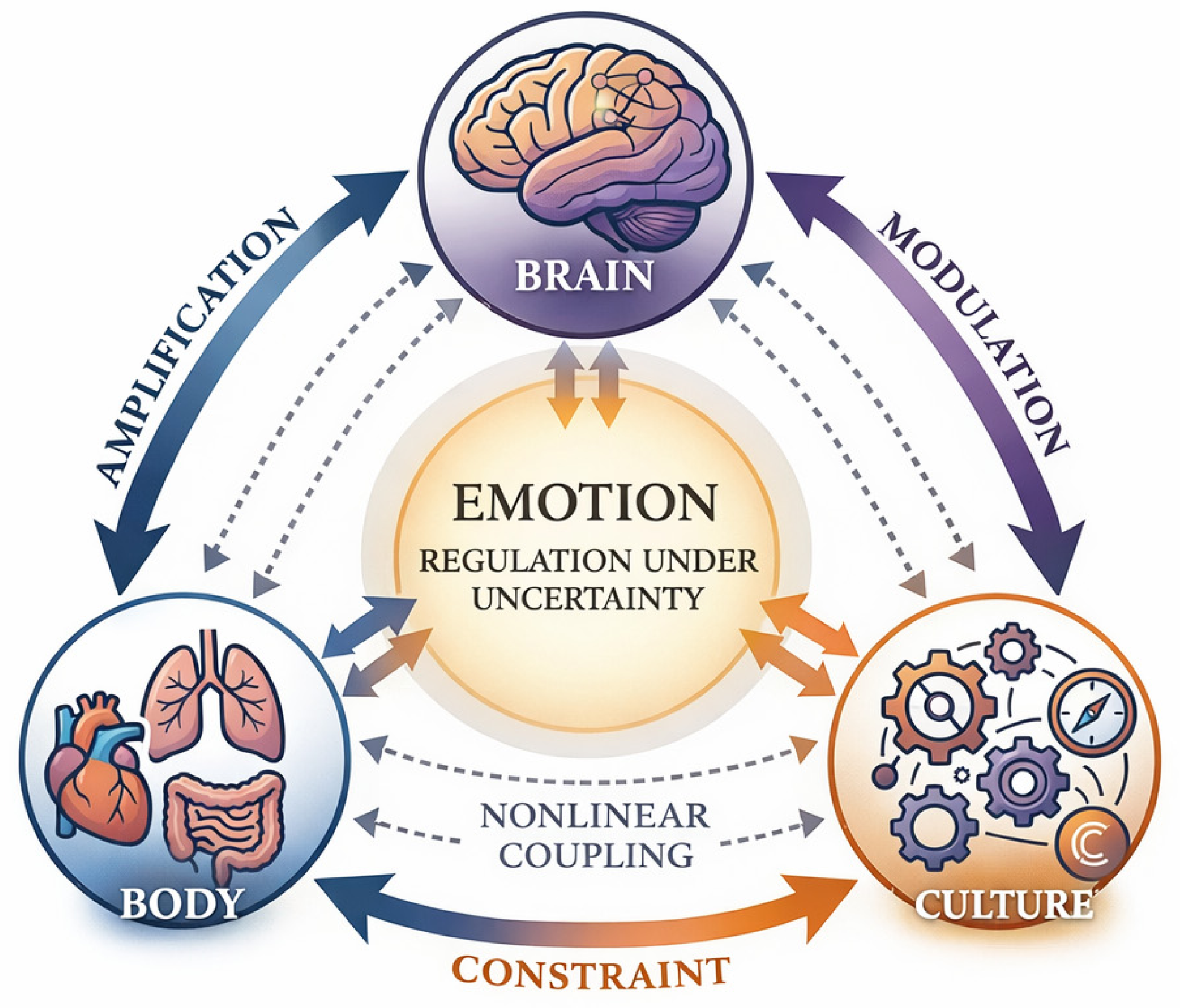
Emotion is conceptualised as an emergent process arising from the nonlinear coupling of three interdependent channels: Body, Brain, and Culture. Bodily signals provide ambiguous affective evidence through interoceptive and autonomic activity. Predictive brain processes organise and interpret this evidence via inference and model-based anticipation. Socio-cultural structures act as higher-order constraints, shaping which interpretations become stable, meaningful, and actionable.
The interactions between these channels are dynamic and reciprocal. Bodily signals can amplify or constrain predictive processes, predictive models modulate the interpretation of interoceptive input, and socio-cultural frameworks influence the weighting and stabilisation of competing interpretations. These interactions are characterised by nonlinear coupling, in which each component continuously reshapes the others.
At the centre of the system, emotion emerges as a regulatory process that organises uncertainty into coherent experiential and behavioural trajectories. Under conditions of alignment between Body, Brain, and Culture, emotional states stabilise rapidly. Under conditions of misalignment or constraint, the system may exhibit increased ambiguity, variability, or rigidification.
Arrows represent directional influences such as amplification, modulation, and constraint, while the circular structure reflects the continuous and recursive nature of the coupling process.
Figure 2.
Causal mechanism of emotion as constrained selection under uncertainty.
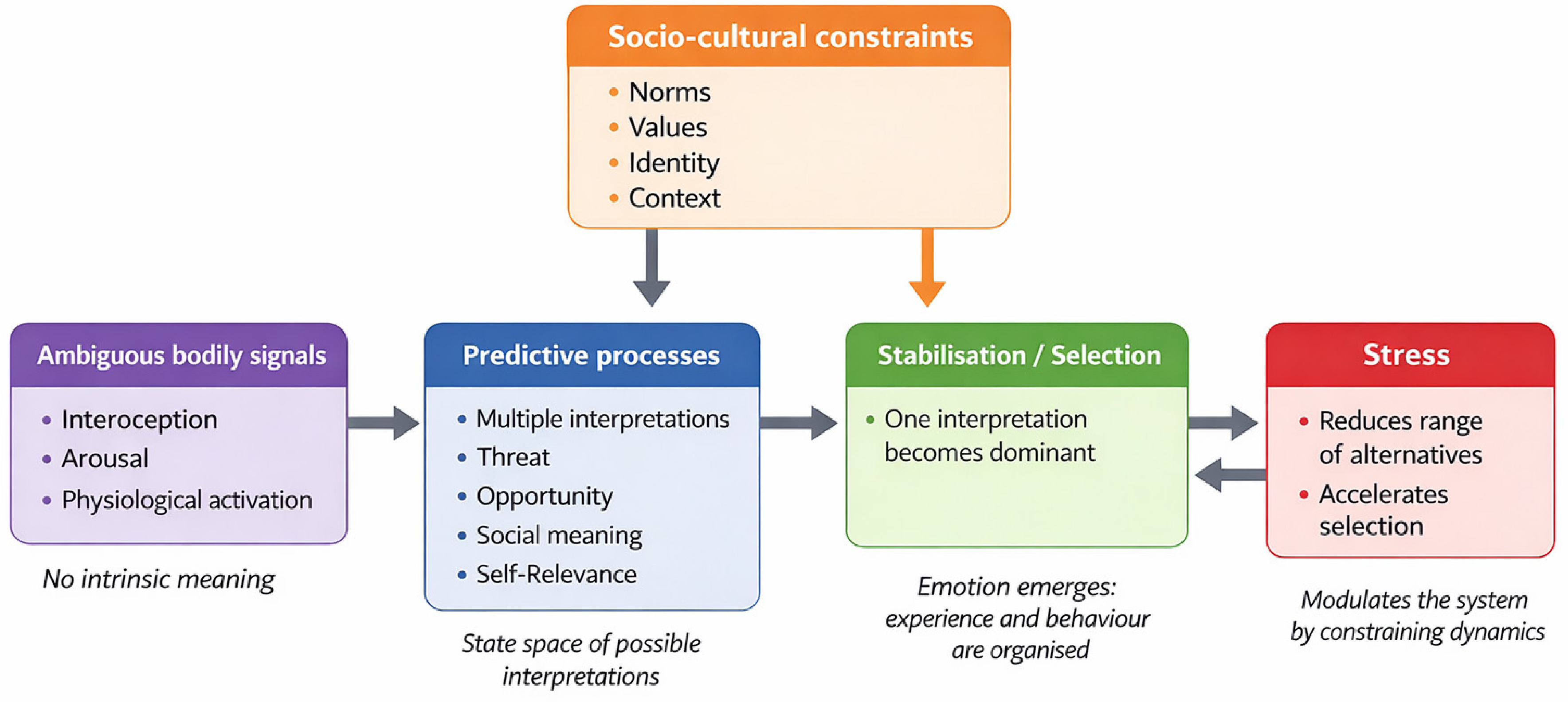
Emotional experience emerges from a multi-stage process in which ambiguous bodily signals generate a space of possible interpretations through predictive processes. These candidate interpretations are constrained by socio-cultural factors (e.g., norms, values, identity, and context), which bias the selection toward specific emotional states. Emotion corresponds to the stabilisation of one interpretation, organising both subjective experience and behaviour. Stress acts as a modulatory factor that reduces the range of possible interpretations and accelerates convergence toward a dominant state. As a result, identical physiological activation can lead to divergent emotional outcomes depending on the configuration of predictive and socio-cultural constraints.

Table 1.
Emotional regulation can operate across distinct functional regimes depending on how uncertainty is managed. In stabilisation regimes, emotional processes reduce uncertainty by rapidly converging toward a coherent interpretation, often under conditions of threat or constraint. In exploratory regimes, emotional processes tolerate or maintain uncertainty in a controlled manner, enabling flexible engagement and adaptive learning. The balance between these regimes is dynamically modulated by contextual demands, perceived controllability, and regulatory capacity.
Table 1.
Emotional regulation can operate across distinct functional regimes depending on how uncertainty is managed. In stabilisation regimes, emotional processes reduce uncertainty by rapidly converging toward a coherent interpretation, often under conditions of threat or constraint. In exploratory regimes, emotional processes tolerate or maintain uncertainty in a controlled manner, enabling flexible engagement and adaptive learning. The balance between these regimes is dynamically modulated by contextual demands, perceived controllability, and regulatory capacity.
| Regime | Primary Function | Uncertainty Profile | Typical Emotional States | Cognitive-Behavioural Characteristics | Predicted Conditions |
| Stabilisation | Rapid reduction of uncertainty | Decreasing uncertainty | Fear, anxiety, shame, anger | Fast convergence, reduced variability, action constraint, increased selectivity | Threat, time pressure, high stress, low perceived controllability |
| Exploration | Maintenance or modulation of uncertainty | Sustained or tolerated uncertainty | Curiosity, joy, interest, positive arousal | Flexible engagement, increased variability, openness to new information, adaptive learning | Safety, novelty, moderate uncertainty, high perceived controllability |
Table 2.
Socio-cultural constraints can be operationalised as a structured set of measurable dimensions rather than treated as a diffuse contextual factor. The table summarises four key components—social norms, values, ideological beliefs, and social identity—along with their definitions, illustrative examples, and possible measurement approaches.
Table 2.
Socio-cultural constraints can be operationalised as a structured set of measurable dimensions rather than treated as a diffuse contextual factor. The table summarises four key components—social norms, values, ideological beliefs, and social identity—along with their definitions, illustrative examples, and possible measurement approaches.
| Construct | Definition | Example | Measurement approach |
| Social norms | Perceived expectations about what is appropriate or acceptable in a given context | Helping a person in distress versus avoiding involvement | Experimental manipulation of normative context or questionnaires assessing perceived norms |
| Values | Priorities that guide what is considered important or desirable | Prioritising harm reduction versus group loyalty | Standardised questionnaires assessing value priorities |
| Ideological beliefs | Systems of meaning that shape how social reality is interpreted | Interpreting situations in terms of threat, hierarchy, or fairness | Questionnaires assessing beliefs about social organisation and intergroup relations |
| Social identity | The degree to which individuals define themselves in relation to social groups | Stronger emotional response to ingroup versus outgroup members | Measures of group identification and experimental manipulation of group membership |
Author Contributions
A.E.F. conceptualized the study, developed the theoretical framework, conducted the literature review, and wrote the manuscript.
Funding
This research did not receive any specific grant from funding agencies in the public, commercial or not-for-profit sectors.
Ethics Approval and Consent to Participate
This article does not contain any studies with human participants or animals performed by the author.
Consent for Publication
The author transfers all copyright ownership in the event that the work is published. The author warrants that the article is original, does not infringe any copyright or other proprietary right of any third party, is not under consideration by another journal, and has not been previously published.
Acknowledgments
The author sincerely thanks Christophe Letellier for his guidance and for opening a path toward nonlinear dynamical thinking, which deeply influenced the development of this work.
Conflicts of Interest
The author declares no known competing interests.
References
- Arnsten, A. F. T. (2009). Stress signalling pathways that impair prefrontal cortex structure and function. Nature Reviews Neuroscience, 10(6), 410–422. [CrossRef]
- Barrett, L. F. (2017). How emotions are made: The secret life of the brain. Houghton Mifflin Harcourt.
- Barrett, L. F., & Satpute, A. B. (2019). Historical pitfalls and new directions in the neuroscience of emotion. Neuroscience Letters, 693, 9–18. [CrossRef]
- Bicchieri, C. (2006). The grammar of society: The nature and dynamics of social norms. Cambridge University Press.
- Cameron, C. D., Hutcherson, C. A., Ferguson, A. M., Scheffer, J. A., Hadjiandreou, E., & Inzlicht, M. (2019). Empathy is hard work: People choose to avoid empathy because of its cognitive costs. Journal of Experimental Psychology: General, 148(6), 962–976. [CrossRef]
- Cialdini, R. B., Reno, R. R., & Kallgren, C. A. (1990). A focus theory of normative conduct. Journal of Personality and Social Psychology, 58(6), 1015–1026. [CrossRef]
- Clark, A. (2013). Whatever next? Predictive brains, situated agents, and the future of cognitive science. Behavioral and Brain Sciences, 36(3), 181–204. [CrossRef]
- Colombetti, G. (2014). The feeling body: Affective science meets the enactive mind. MIT Press. [CrossRef]
- Constant, A., Ramstead, M. J. D., Veissière, S. P. L., & Friston, K. J. (2019). Regimes of expectations: An active inference model of social conformity and human decision making. Frontiers in Psychology, 10, 679. [CrossRef]
- Craig, A. D. (2002). How do you feel? Interoception: The sense of the physiological condition of the body. Nature Reviews Neuroscience, 3(8), 655–666. [CrossRef]
- Critchley, H. D., & Garfinkel, S. N. (2017). Interoception and emotion. Current Opinion in Psychology, 17, 7–14. [CrossRef]
- Damasio, A. R. (1996). The somatic marker hypothesis and the possible functions of the prefrontal cortex. Philosophical Transactions of the Royal Society B: Biological Sciences, 351(1346), 1413–1420. [CrossRef]
- De Leersnyder, J., Boiger, M., & Mesquita, B. (2013). Cultural regulation of emotion: Individual, relational, and structural sources. Frontiers in Psychology, 4, Article 55. [CrossRef]
- Ekman, P., & Cordaro, D. (2011). What is meant by calling emotions basic. Emotion Review, 3(4), 364–370. [CrossRef]
- Ellsworth, P. C., & Scherer, K. R. (2003). Appraisal processes in emotion. In R. J. Davidson, K. R. Scherer, & H. Goldsmith (Eds.), Handbook of affective sciences (pp. 572–595). Oxford University Press.
- Frijda, N. H. (2007). The laws of emotion. Lawrence Erlbaum Associates.
- Friston, K. (2010). The free-energy principle: A unified brain theory? Nature Reviews Neuroscience, 11(2), 127–138. [CrossRef]
- Graham, J., Nosek, B. A., Haidt, J., Iyer, R., Koleva, S., & Ditto, P. H. (2011). Mapping the moral domain. Journal of Personality and Social Psychology, 101(2), 366–385. [CrossRef]
- Gross, J. J. (1998). The emerging field of emotion regulation: An integrative review. Review of General Psychology, 2(3), 271–299. [CrossRef]
- Gross, J. J. (2015). Emotion regulation: Current status and future prospects. Psychological Inquiry, 26(1), 1–26. [CrossRef]
- Gross, J. J., & Barrett, L. F. (2011). Emotion generation and emotion regulation: One or two depends on your point of view. Emotion Review, 3(1), 8–16. [CrossRef]
- Haidt, J. (2001). The emotional dog and its rational tail: A social intuitionist approach to moral judgment. Psychological Review, 108(4), 814–834. [CrossRef]
- Hamaker, E. L. (2012). Why researchers should think “within-person.” In M. R. Mehl & T. S. Conner (Eds.), Handbook of research methods for studying daily life (pp. 43–61). Guilford Press.
- Hermans, E. J., Henckens, M. J. A. G., Joëls, M., & Fernández, G. (2014). Dynamic adaptation of large-scale brain networks in response to acute stressors. Trends in Neurosciences, 37(6), 304–314. [CrossRef]
- Hohwy, J. (2013). The predictive mind. Oxford University Press. [CrossRef]
- Izard, C. E. (2007). Basic emotions, natural kinds, emotion schemas, and a new paradigm. Perspectives on Psychological Science, 2(3), 260–280. [CrossRef]
- Jost, J. T. (2017). Ideological asymmetries and the essence of political psychology. Political Psychology, 38(S1), 167–208. [CrossRef]
- Kelso, J. A. S. (1995). Dynamic patterns: The self-organization of brain and behavior. MIT Press.
- Keltner, D., & Gross, J. J. (1999). Functional accounts of emotions. Cognition and Emotion, 13(5), 467–480.
- Kirmayer, L. J., & Ramstead, M. J. D. (2017). Embodiment and enactment in cultural psychiatry. Culture, Medicine, and Psychiatry, 41, 276–298.
- Lewis, M. D. (2005). Self-organizing individual differences in brain development. Developmental Review, 25(3–4), 252–277. [CrossRef]
- Lindquist, K. A., Wager, T. D., Kober, H., Bliss-Moreau, E., & Barrett, L. F. (2012). The brain basis of emotion: A meta-analytic review. Behavioral and Brain Sciences, 35(3), 121–143. [CrossRef]
- Lindquist, K. A., MacCormack, J. K., & Shablack, H. (2015). The role of language in emotion: Predictions from psychological constructionism. Frontiers in Psychology, 6, 444. [CrossRef]
- Mabire-Yona, R., Montalescot, L., Vansimaeys, C., Préaud, M., & Morvan, Y. (2025). Tous les modèles sont faux, mais la complexité est utile. Pratiques Psychologiques. [CrossRef]
- McEwen, B. S., & Wingfield, J. C. (2010). What is in a name? Integrating homeostasis, allostasis, and stress. Hormones and Behavior, 57(2), 105–111. [CrossRef]
- Mesquita, B. (2022). Between us: How cultures create emotions. W. W. Norton & Company.
- Panksepp, J. (1998). Affective neuroscience: The foundations of human and animal emotions. Oxford University Press.
- Pessoa, L. (2017). A network model of the emotional brain. Trends in Cognitive Sciences, 21(5), 357–371. [CrossRef]
- Perski, O., Copeland, A., Allen, J., Pavel, M., Rivera, D. E., Hekler, E., Hankonen, N., & Chevance, G. (2025). The iterative development and refinement of health psychology theories through formal, dynamical systems modelling: A scoping review. Health Psychology Review, 19(1), 1–44. [CrossRef]
- Peters, A., McEwen, B. S., & Friston, K. (2017). Uncertainty and stress: Why it causes diseases and how it is mastered by the brain. Progress in Neurobiology, 156, 164–188. [CrossRef]
- Ratcliffe, M. (2008). Feelings of being: Phenomenology, psychiatry and the sense of reality. Oxford University Press.
- Satpute, A. B., & Lindquist, K. A. (2019). The default mode network’s role in discrete emotion. Trends in Cognitive Sciences, 23(10), 851–864. [CrossRef]
- Scherer, K. R., Schorr, A., & Johnstone, T. (Eds.). (2001). Appraisal processes in emotion: Theory, methods, research. Oxford University Press.
- Seth, A. K. (2013). Interoceptive inference, emotion, and the embodied self. Trends in Cognitive Sciences, 17(11), 565–573. [CrossRef]
- Seth, A. K., & Friston, K. J. (2016). Active interoceptive inference and the emotional brain. Philosophical Transactions of the Royal Society B: Biological Sciences, 371(1708), 20160007. [CrossRef]
- Sidanius, J., & Pratto, F. (1999). Social dominance: An intergroup theory of social hierarchy and oppression. Cambridge University Press.
- Smith, C. A., & Ellsworth, P. C. (1985). Patterns of cognitive appraisal in emotion. Journal of Personality and Social Psychology, 48(4), 813–838. [CrossRef]
- Sterling, P. (2012). Allostasis: A model of predictive regulation. Physiology & Behavior, 106(1), 5–15. [CrossRef]
- Thelen, E., & Smith, L. B. (1994). A dynamic systems approach to the development of cognition and action. MIT Press.
- Tomova, L., von Dawans, B., Heinrichs, M., Silani, G., & Lamm, C. (2014). Is stress affecting our ability to tune into others? Psychoneuroendocrinology, 43, 95–104. [CrossRef]
- Van Bavel, J. J., & Pereira, A. (2018). The partisan brain: An identity-based model of political belief. Trends in Cognitive Sciences, 22(3), 213–224. [CrossRef]
- von Dawans, B., Fischbacher, U., Kirschbaum, C., Fehr, E., & Heinrichs, M. (2012). The social dimension of stress reactivity: Acute stress increases prosocial behavior in humans. Psychological Science, 23(6), 651–660. [CrossRef]
- Zaki, J. (2014). Empathy: A motivated account. Psychological Bulletin, 140(6), 1608–1647. [CrossRef]
Disclaimer/Publisher’s Note: The statements, opinions and data contained in all publications are solely those of the individual author(s) and contributor(s) and not of MDPI and/or the editor(s). MDPI and/or the editor(s) disclaim responsibility for any injury to people or property resulting from any ideas, methods, instructions or products referred to in the content. |
© 2026 by the author. Licensee MDPI, Basel, Switzerland. This article is an open access article distributed under the terms and conditions of the Creative Commons Attribution (CC BY) license.
Copyright: This open access article is published under a Creative Commons CC BY 4.0 license, which permit the free download, distribution, and reuse, provided that the author and preprint are cited in any reuse.


