

Submitted:
18 April 2026
Posted:
20 April 2026
You are already at the latest version
Abstract
Background: Strength-Duration (S-D) assessment is commonly used in clinics to examine the excitability of peripheral nerves and muscles. Yet, how changes in neuromuscular excitability relates to improved athletic and muscular performance in healthy subjects remains poorly understood. Therefore, the aim of the study was to evaluate the electrophysiological changes in neuromuscular excitability in the vastus medialis (VM) muscle, using the S-D assessment, following a back squat conditioning activity (BS-CA) protocol designed to elicit a post-activation potentiation (PAP)/post-activation performance enhancement (PAPE) effect. Methods: Eleven athletic males were included in this study. All subjects performed two trials: one examining their BS one-repetition maximum (1 RM) and a main experiment. During the main experiment, baseline levels of rectangular rheobase (R-RIC), triangular rheobase (R-DIC) and chronaxie was collected from the VM muscle, following a standard warmup. Subsequently, the subjects performed three warmup BS-sets and executed a top set of five repetitions (reps) at 80% of 1RM. Afterwards, R-RIC, R-DIC and chronaxie was reassessed for pre and post analysis. Based on these S-D curve (SDC) parameters, the muscle adjustability quotient (MAQ) and threshold charge (Q) was also computed and compared. Results: The R-RIC, R-DIC and Q were all significantly higher following the BS-CA, compared to pre-intervention (p < 0.001). No significant differences were observed for the chronaxie and MAQ (p > 0.05), although an increasing trend was noted (p = 0.054). Conclusions: Based on the findings from this study, the neuromuscular excitability in the VM muscle can be acutely altered following a BS-CA-protocol. However, these changes seems to be more related to muscle fatigue than PAP/PAPE. Nevertheless, S-D assessment may broaden our understanding of the fatigue process during exercise.
Keywords:
post-activation potentiation
; electrophysiology
; electrodiagnosis
; strength-duration properties
; post-activation performance enhancement
1. Introduction
It is well established that the contractile force of skeletal muscles depends on the synaptic transmission at the neuromuscular junction (NMJ) and various membrane characteristics [1,2,3]. They regulate the initiation and propagation of action potentials, which in turn controls calcium ion (Ca+) release from the sarcoplasmic reticulum (SR), the formation of cross-bridge cycle and ultimately contractile force [1,4,5]. Alterations in the neuromuscular/membrane excitability, such as higher threshold current and a reduced availability of voltage-gated sodium channels (VGSCs), have been demonstrated to impair action potential generation and transmission along the sarcolemma and T-tubules [6,7,8]. This in turn impedes the excitation–contraction coupling process, reducing SR Ca+ release [7,8] and consequently actin-myosin cross-bridge formation, and the production of muscle force [6,7].
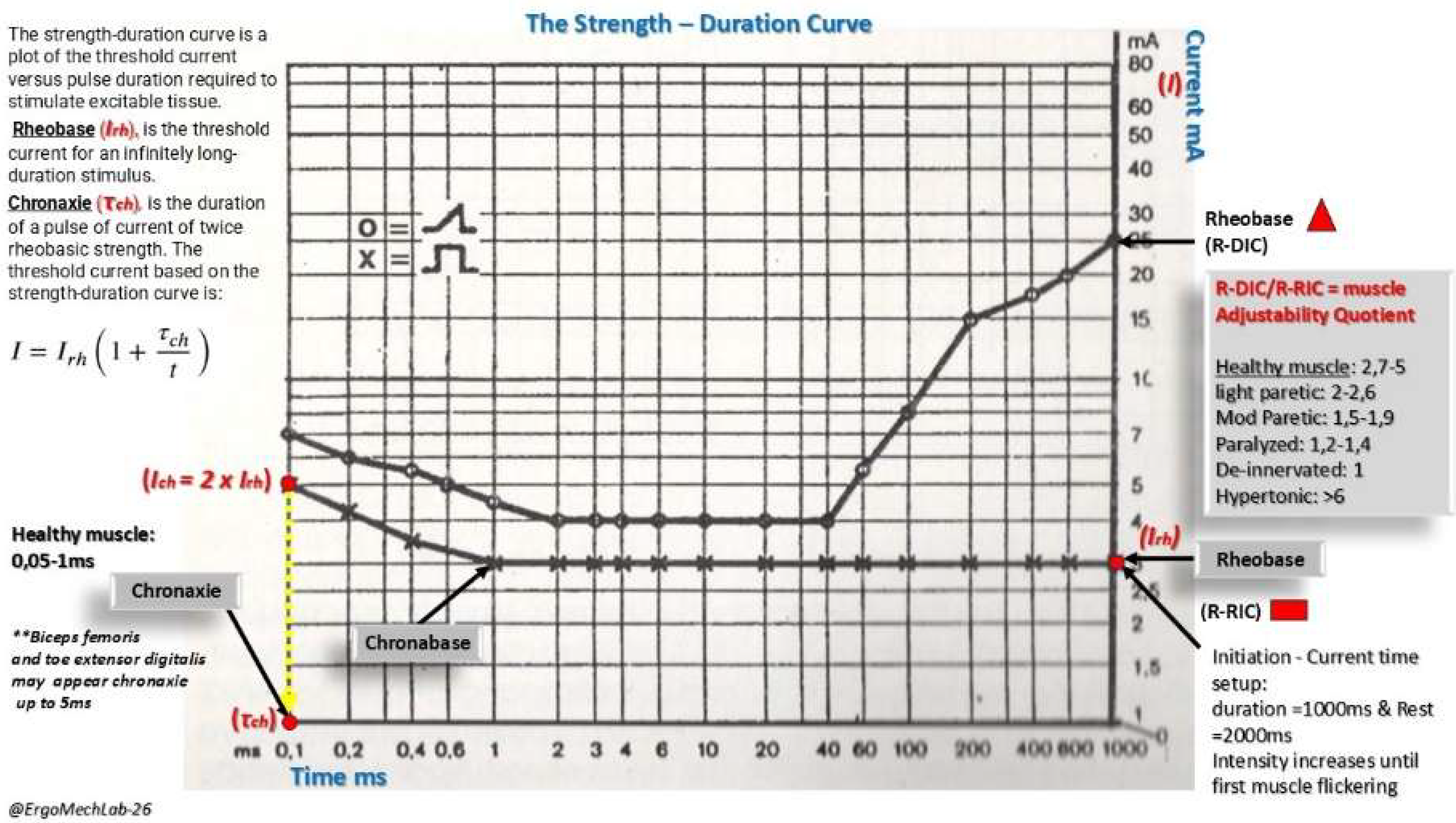
Several neuromuscular disorders are caused by NMJ dysfunction and alterations in membrane function, resulting in muscle weakness [9], disability [10] and reduced quality of life [11]. Electrodiagnostic measures, such as evaluating strength-duration (S-D) properties, has been used as a feasible, non-invasive tool to examine neuromuscular excitability and related aspects of membrane function in clinical settings [11,12,13], and as part of electrotherapy for rehabilitation [14]. Two of the most common S-D curve (SDC) parameters are the rheobase and chronaxie [12,14], often denoted by Irh and τch, respectively [15,16]. The rheobase is normally defined as the minimum current required to elicit an action potential with a stimulus of infinite (or very long) duration, sometimes referred to as rectangular rheobase (R-RIC) [17,18]. The chronaxie, in contrast, refers to the minimum duration required to excite the tissue using a current twice the R-RIC [18,19]. Depending on the evaluation procedure and objective, the triangular rheobase (R-DIC) may also be examined, defined as the minimal peak current of a linearly increasing (ramp) stimulus required to elicit a detectable response [13,17].
These SDC parameters provide us with a quick overview of the excitability of peripheral nerves and muscles, including different neuromuscular disturbances [12,13,20] that can impair a patient’s movement quality and overall muscle strength [9,10]. For a broader understanding of the electrophysiology of motor nerves and skeletal muscles, the threshold current, and accommodation quotient or muscle adjustability quotient (MAQ) can also be computed [15,18,20]. The threshold current, referring to the minimum current needed for excitation at a given duration [21], provides insights into the excitability of nerves/muscles [22,23,24] and can be used to monitor physiological states (i.e. fatigue and electrolyte imbalances) [23,24,25]. Different mathematical equations can be used to calculate the threshold current [15,21], but Weiss’ equation has been considered to be one of the best to explore longer and shorter stimuli currents [15], commonly referred to as the threshold charge (Q) [20,26,27]. Similarly, the MAQ helps clinicians/researcher’s understand the membranes accommodation capacity (i.e. how the membrane respond to currents rising slowly compared to abruptly) [13,18], which is useful for evaluating if the muscle is healthy or paretic. Furthermore, while these SDC parameters have been used in clinical [12,21] and rehabilitations settings [14,17], to the best of our knowledge, there is lack of data regarding how these parameters are influenced by physical activity in healthy subjects, especially exercise-protocols designed to optimize athletic and muscular performance.
It is for instance well known that a warmup can enhance muscular performance via increased blood flow [28], motor unit discharge rates [29], speed of nervous impulses [28], and improved contractile force via muscle potentiation [30], often referred to as post-activation potentiation (PAP) [30,31]. Historically, the PAP phenomenon was confirmed by assessing the maximum twitch force, or peak twitch torque (PTT), elicited by supramaximal electrical stimulation [31], with increased expression of myosin regulatory light chain (MRLC) phosphorylation being believed to be the primary mechanism [31,32,33]. Mechanistically, a higher expression of MRLC phosphorylation causes structural changes in the myosin heads (such as improving their mobility), allowing them to move closer to the actin binding sites [4,31]. This sequentially allows the same SR Ca+ release (during a contraction) to produce a greater number of active cross-bridges, enabling more force production for the same Ca+ concentration (i.e. increased Ca+ sensitivity) [4,30], and ultimately enhances the rate of force development [4,31]. Thus, although, research and applied professionals have employed several warmup strategies with the goal of optimizing the PAP effect [30], there has been conflicting data regarding how changes in neuromuscular excitability modulates the PAP phenomenon [34,35]. For example, an experimental study by Hodgson and colleagues [34] demonstrated that the compound muscle action potential (M-wave) amplitude (reflecting changes in sarcolemmal excitability) in the soleus was acutely increased following a warmup strategy or conditioning activity (CA), consisting of a set of plantar flexion isometric maximum voluntary contraction (MVC) combined with explosive plantar flexion. Notably, this M-wave enlargement coincided with the highest PTT enhancement observed 2-30s post-CA (i.e. a PAP response).
Although this transient rise in M-wave size has been noted by several researchers [35,36], and even been coined M-wave potentiation [35,37], it’s interpretation and physiological meaning has been largely distinct [6,35,38]. For instance, some have postulated that it may, at least partially, contribute to the PAP response [36,39], be a simple motion artifact from the electrodes [35], and others have proposed that it may be related to muscle fatigue [38]. However, it is also equally common to see a largely unaffected and relatively stable M-wave, while different muscle performance outcomes are acutely enhanced [32,40,41]. Part of these differences could be related to how the PAP response was defined, as improvements in stimulated muscle contraction can occur independent of changes in voluntary contraction [31]. The PAP response have been found to be highest immediately post an isometric MVC-CA protocol, and drops exponentially over time [31,32,35], while acute improvements in voluntary muscular performance usually peak 5-10 min post the CA [31,39]. Hence, in recent years, the term post-activation performance enhancement (PAPE) has more commonly been used to describe acute improvements in voluntary muscular performance following different CAs [33,42], especially when the PAP response is not directly confirmed with a twitch verification test [31,42].
However, a classical CA-protocol that has been postulated to elicit both a PAP and PAPE response during different ballistic movements is heavy loaded back squats (BS) [43,44,45]. For instance, Mina and colleagues [44] observed acute improvements in peak power output and rate of force development during a countermovement jump 30 seconds to 12 minutes post a BS-CA protocol, specifically when using variable resistance. Further, although, several studies have actually evaluated the M-wave in various muscles when measuring the PAP response [34,40,41], there is very limited data regarding how it relates to PAPE. Moreover, the equipment required for accurate M-wave assessment (incl. the surface electromyography system) can be expensive [46] and is less portable compared to electrodiagnostic stimulators used to examine neuromuscular excitability via S-D properties .
Having a greater understanding of how electrophysiology relates to PAP/PAPE and if electrodiagnostic stimulators can be used, may not only help us optimize performance and reduce unnecessary muscle fatigue, but also reduce musculoskeletal injuries, and thus a large economic burden. According to demographic data, it has been estimated that musculoskeletal injuries provide an economic burden of roughly $980 billion per year in the US [47]. Clinically, this may also be of great value for evaluating the rehabilitation process after injury. Thus, the aim of the study was to evaluate the electrophysiological changes in neuromuscular excitability in the vastus medialis (VM) muscle, using the S-D assessment, following a BS-CA protocol designed to elicit a PAP/PAPE effect.
2. Materials and Methods
2.1. Subjects
Eleven athletic male university students, aged 19.2 (± 1.9) with no known history of neurological or musculoskeletal impairments, volunteered for this study. All subjects had at least 2 years of resistance training experience, and were given oral and written explanation of the testing procedures. They also signed a written consent prior to volunteering. Furthermore, all subjects were instructed to avoid strenuous exercise, alcohol and stimulants for at least 72 hours prior to testing. This study was conducted as a part of a larger research project approved by the Bioethics committee, Department of Physical Education and Sports Science, University of Thessaly (protocol code 2091 and date: 8/02/2023). The present sub-study falls within the scope of the original ethical approval, with the study conducted in accordance with the Declaration of Helsinki.

Table 1.
Characteristics of the subjects (n = 11).
| Characteristics | (Mean ± SD) |
| Age (years) | 19.6 ± 1.5 |
| Height (cm) | 175.6 ± 3.5 |
| Weight (kg) | 78.3 ± 13.8 |
| Note: SD = Standard Deviation | |
2.2. Experimental Design
2.2.1. Overview
A within-subjects design was used to assess differences in neuromuscular excitability in the vastus medialis (VM) muscle before and after a PAP/PAPE inducing BS-CA protocol, using an electrodiagnostic stimulator (ELETTRONICA PAGANI, ™ Paderno Dugnano, Italy). Prior to the main experiment, anthropometrics was collected, in addition to evaluating the subjects maximum strength (one-repetition maximum (1-RM)) on the back squat (BS). This was separated by at least 72 hours from the main experiment to minimize the effect of neuromuscular fatigue [48]. During the main experiments, the participants perform three low to medium intensity warmup BS-sets and executed a top set of five repetitions (reps) at 80% of 1RM. This have been demonstrated to be heavy enough to induce a potent PAP/PAPE effect [49,50]. Additionally, R-RIC and R-DIC was measured from the VM muscle, pre and post the BS-intervention (described later).
2.2.2. One Repetition Maximum Back Squat Assessment
The 1-RM BS-protocol was adopted from Mina and colleagues [44] The subject initially performed a standard warm-up using a stationary bike (Monark 874E, Varberg, Sweden) at 65 rpm with a 1-kg load for 5 minutes, followed by 1 set of 10 BS reps using a standard 20-kg Olympic bar. The subjects then completed 5-6 reps of the squat lift exercise at 50% of their estimated 1-RM load, before the load was increased by 10-20% for 3-5 reps, and by a further 10-20% for 2-3 reps with a 2–3-minute rest interval between sets. The final load was increased by 10%. If the set felt easy and the subjected maintained strict form, 5% was added for each consecutive 1-RM attempts, until failure or a challenging set was reached, resting 3-5 mins between attempts. The heaviest successful attempt was recorded as their 1-RM squat load. To control the technique, subjects were instructed to place the bar above the posterior deltoids at lower neck region (around C7 level) and attempt to squat to a position where the knee was flexed to ~90 ° before returning to a standing position. This was visually assessed by a coach having an Olympic Weightlifting Certification to ensure safe and correct lifting technique.
2.2.3. Main Experiment - Back Squat Protocol
During the main experiments the subjects performed a task-specific warm-up consisting of 5 minutes of cycling (see subsection 2.2.2), followed by 1 set of 10 reps repetitions using a standard 20-kg Olympic bar. Subsequently, three additional warmups sets were performed at 50%, 60-65%, 70-75% of the previously determined 1-RM load for six, five and five reps respectively (see Table 2). The last and top set was performed at 80% of 1 RM for five reps.
2.2.4. Collection of Rheobase Parameters and Chronaxie
An electrodiagnostic stimulator was used to examine neuromuscular excitability in the VM muscle via S-D properties. The skin was shaved, abraded, and cleaned with alcohol, prior to placing bipolar adhesive surface electrodes (Noraxon Dual Electrodes, Ag/AgCL snap, Noraxon USA, Inc, Scottsdale, AZ) on the belly of the VM muscle. Specifically, the anode (reference electrode) was placed over the proximal region of the anterior thigh, proximal to the motor point of the VM. The cathode (active electrode) was placed directly over the distally located motor point of the VM, corresponding to the region of the VM, as previously described by Botter and colleagues [51]. For the rheobase measurement, the R-RIC was assessed before and immediately after the squat-intervention using a 1000 ms duration square-wave current pulse, while R-DIC was assessed using a 1000 ms duration triangular-wave current pulse (linearly increasing), respectively. In both rheobase conditions, the stimuli were separated by a 2 s inter-stimulus (rest). Furthermore, the current increased from 0 to 35 mA in 1 mA increments until a slight but apparent muscle contraction was visible. For the chronaxie, the pulse duration was decreased from 0.1 ms to 0.5 ms in 0.05 ms increments, until a consistent visible muscle contraction was observed.
2.3. Formulas for Threshold Charge and Muscle Adjustability Quotient
The threshold current was calculated using Weiss formula, corresponding to the threshold charge (Q) as described by Weiss’s law. The Q represents the minimal charge delivered at a given stimulus duration needed to elicit an action potential or observable muscle contraction. Weiss formula is often calculated using the following equation (Weiss, G. 1901)
Q = Irh (t + τch)
Where Irh is the R-RIC in mA, t is the stimulus duration and τch is the chronaxie are in ms, respectively. The Q is accordingly expressed in mA ⋅ ms, corresponding to microcoulomb (μC) which is a standard unit of electric charge (Kloth 2014) and commonly used in electrophysiology studies [21,52,53]. In contrast, the muscle adjustability quotient (MAQ) was determined from the R-RIC and R-DIC measurements to evaluate the accommodation properties of the neuromuscular system. This ratio reflects the ability of the membrane to respond to currents rising slowly (triangular) compared abruptly (rectangular) [13,18]. MAQ was calculated using the following equation.
Figure 1.
An overview of the Strength-Duration Curve.
2.4. Statistical Analysis
The data are presented as means ± standard deviations (SD) unless otherwise stated. The differences between pre-intervention and post- intervention were normally distributed and was checked using the Shapiro–Wilk test. A paired t-tests were carried out to compare the means of each SDC parameters, respectively. Effect sizes (Cohen’s d) were calculated to characterize the magnitude of the observed differences, and were interpreted following conventional guidelines: 0.2 = small, 0.5 = medium, 0.8 = large. All statistical analyses were executed using SPSS ver. 31.0 statistical program for MacOS (SPSS Software, IBM Inc., Chicago, IL, USA). The level of significance was set at p < 0.05.
3. Results
3.1. Rheobase Parameters and Chronaxie
There was a significant difference in all rheobase parameters post the BS-CA protocol. Specifically, the R-RIC was significantly higher following the BS-intervention (M = 8.83, SD = 2.15) compared to pre-intervention (M = 4.56, SD = 1.45), t(10) = -9.150, p < 0.001, d = 2.8. Similarly, a higher R-DIC was noted following the BS-CA protocol (M = 26.18, SD = 4.6) compared to pre-intervention (M = 14.01, SD = 4.2), t(10) = -7.037, p < 0.001, d = 2.1 (see Figure 2). Although, no significant differences were observed between the chronaxie values pre and post the intervention, a trend was observed (see Figure 3). In particular, following the BS-intervention, the mean chronaxie was trending towards a higher value (M = 0.27, SD = 0.13) compared to the pre-intervention (M = 0.20, SD = 0.13), t(10) = -2.19, p = 0.054, d = 0.66 (see Table 3).
3.2. Threshold Charge and Muscle Adjustability Quotient
No significant differences was observed for the MAQ post-intervention (M = 3.05, SD = 0.54) compared to pre-intervention (M = 3.12, SD = 0.34), t(10) = 0.53, p = 0.61, d = 0.16. Interestingly, however, there was a significant change in the Q pre and post the BS-CA protocol (see Figure 4). Specifically, the mean Q was notably higher in the post squat-intervention (M = 627.36, SD = 231.13) compared to pre-intervention (M = 293.14, SD = 192.78), t(10) = -4.48, p < 0.001, d = 1.4 (see Table 4).
4. Discussion
The purpose of this study was to evaluate the electrophysiological changes in neuromuscular excitability in the VM muscle, using the S-D assessment, following a BS-CA protocol designed to elicit a PAP/PAPE effect. The findings from our study suggest that the neuromuscular excitability of the VM can be acutely altered, following a standard PAP/PAPE inducing CA protocol. Paradoxically, however, our study revealed that rheobases parameters (i.e. R-RIC and R-DIC) and the Q in the VM muscle increased after the BS-intervention (see figures 2 and 4), indicating reduced neuromuscular excitability [54] and presumably muscle fatigue [23]. While no differences were observed for the chronaxie, there was a trend towards a higher chronaxie in the VM following the BS-intervention (see Figure 3), pointing towards slower membrane dynamics and responsiveness [19]. Interestingly, however, the MAQ remained stable throughout the intervention, implying that the membrane accommodation properties were still preserved [13].
This is in line with earlier studies suggesting that neuromuscular excitability and related aspects of membrane function are not directly involved with the PAP/PAPE phenomenon [40,41,55] but contradicts the notion that neuromuscular excitability are not altered after a CA protocol designed to induce PAP/PAPE [55,56]. Previous research have consistently shown that sarcolemma excitability (via recording M-waves) in the VM [41], but also in the vastus lateralis [40] and soleus [32], tend to remain stable after a CA-protocol, while there is an observable improvement in twitch force [40,41] or voluntary performance outcomes [32,40] (i.e. PAP and PAPE, respectively), implying that acute improvements in muscular performance can occur independent of evident changes in neuromuscular excitability.
Intriguingly, however, a transient ‘M-wave enlargement’ have also been noted by several researchers, following different CA-protocols [34,35], which has commonly been referred to as M-wave potentiation [35,37]. Although, there has been mixed interpretation about this M-wave phenomenon [6,35,36], it is clear that it can also occur following a fatigue-inducing exercise protocol [6,57]. An experimental study by Bigland-Ritchie and colleagues [57] demonstrated that a continuous MVC protocol of the adductor pollicis muscle for 1-minute, impaired force by 40-60% while the M-wave size (elicited via a single supramaximal stimulus) increased.
Furthermore, more recently it has been suggested that an increase of the M-wave size may in fact reflect excitability disruption, via a prolonged transmembrane potential [58,59]. This broadening of the intracellular potential has been demonstrated to be related to increased extracellular potassium concentrations ([K+]0) [58,60], which is elevated during intense exercise and is believed to be a major cause of muscle fatigue [6,61,62]. Thus, a reduced neuromuscular excitability, which can be presumed through a higher R-RIC, R-DIC and Q, can clearly be a sign of muscle fatigue. Furthermore, based on the work of Sale [63], it has been well recognized for decades that the PAP/PAPE effect and muscle fatigue normally coexist, and that the dissipation of fatigue needs to be greater than the decay rate of PAP/PAPE, for the involved muscles to be in a net potentiated state [63,64,65]. Hence, although it is unclear if the CA-protocol in our study resulted solely in more fatigue than muscle potentiation in the VM muscle, earlier research suggests that M-wave potentiation can coincide with both PAP/PAPE [34,36] and muscle fatigue [6,58], implying that it is still possible to observe markers of fatigue (e.g. reduced neuromuscular excitability) following a CA-protocol, independent of any evident PAP/PAPE effect.
Therefore, while evaluating S-D properties may provide minimal mechanistic insights into the PAP/PAPE phenomenon, they may broaden our understanding of the fatigue process. For instance, a recent pharmaceutical study by Rocchi and co-worker [66] demonstrated that taking sodium channel blockers, such as lacosamide, consistently raised the rheobase levels relative to a placebo or carbamazepine. The authors in this study proposed that this were due to the blocking action on VGSCs, which earlier work have noted are critical for regulating axonal excitability [67,68]. Additionally, an ex vivo experiment demonstrated that tetrodotoxin (a potent neurotoxin) directly inhibited several sodium channels, including Nav1.7, and this was linked with a higher rheobase, reduced neuronal firing rate and reduced nociceptor excitability [69]. Furthermore, during intense fatiguing muscular activity, it is also well established that [K+]0 not only increases, but there is also a reduction in intracellular K+ concentration ([K+]i), which together (via the K+ gradient) depolarizes the resting membrane potential [62]. Based on in vitro experiments, depolarization can sequentially reduce the availability of VGSCs by promoting channel inactivation [70,71]. This reduction of available VGSCs leads to a decrease in sodium current [70], which has been shown to be reflected by an increased rheobase [72], Q [73] and a reduction in overall neuromuscular/membrane excitability [6,70,72,73].Thus, although not directly evaluated, we can postulate that the BS-CA-protocol may have been adequately fatigue-inducing to acutely raise [K+]0 and reduce [K+]i, and this consequently increased the R-RIC, R-DIC and Q in the VM in our study (see Figure 2 and Figure 4).
Additionally, based on previous studies, a higher rheobase and Q, is also evident of a higher electric impedance [74] and signifies that a greater amount of electrical input is required to reach depolarization threshold [26,73], both resulting in reduced neuromuscular/membrane excitability [73,74]. While no changes was observed for the chronaxie, the trend pointed towards a higher value following the BS-CA protocol, inferring a slower membrane response [19]. Although, it is less clear how inactivation of VGSCs relates to the chronaxie, experimental data grounded from in vitro studies suggests that the chronaxie can also be altered, at least when using cultured hippocampal neurons from rats [75].
These discrepancies in our findings can in part be attributed to how the chronaxie were collected or computed (e.g., extracting it from the SDC vs equating it to the membrane time constant) and differences in cellular geometry [75,76]. Interestingly, we also found that the MAQ were unaffected by the BS-CA protocol, implying that the membrane accommodation properties were still preserved [13]. Based on previous literature [13,18], the subjects in our study were within the lower of end of the healthy range (for reference, see Figure 1) on average (see Table 4), pointing towards more excitable tissues than the general population.
As the subjects in our study were healthy, athletic and resistance trained, and most in vivo human research (using electrodiagnostic tests) has been conducted on patients with neuromuscular disorders [12,14,18], this would be expected. A key limitation of this study is that twitch force (i.e., PAP) or voluntary muscular performance outcomes (i.e., PAPE) was not directly evaluated. However, earlier data suggest that PAP is usually highest immediately post the CA protocol [34,35,36], and the M-wave potentiation phenomenon (i.e. acute changes in membrane excitability of skeletal muscles) has been shown to be very short-lived (≤ 1 min) [36], hence why the primary focus of this study was to collect the S-D data immediately following the BS-CA protocol.
Moreover, while our study suggest that neuromuscular excitability can be acutely altered in the VM muscle, following a standard CA protocol designed to induce PAP/PAPE, another limitation is that the underlying physiology cannot be fully characterized by S-D properties alone. For instance, evidence from in vitro experiments suggest a reduced neuromuscular/membrane excitability is mediated by increases in membrane capacitance and decreases in membrane resistance [77,78]. However, the relative contribution of these mechanisms cannot be clearly delineated without including more advanced procedures. Furthermore, another notable limitation with S-D assessment is that it almost exclusively reflects neuromuscular excitability at the peripheral level (i.e. muscles and peripheral nerves) [27,79], as the central nervous system (CNS) is effectively bypassed during electrical stimulation [80].
Hence, to examine the involvement of the CNS, S-D properties need to be complemented with techniques such as electroencephalogram (EEG) [81], or even more noteworthy transcranial magnetic stimulation (TMS) [66], a procedure that allows measures of excitability within the motor cortex and corticospinal pathways [66,82]. Similarly, although SDC parameters offers insight into excitability at the peripheral neuromuscular level, alterations in Ca+ sensitivity (an intramuscular mechanism contributing to the PAP phenomenon), cannot be inferred either by SDC parameters alone.
4.1. Practical Applications
The results from this paper suggest that measuring S-D properties may provide us with new insights into the fatigue process during exercise, in particular the development of fatigue following warm up strategies designed to optimize muscular performance. Due to its accessibility and non-invasive nature, it may also have some utility for examining training adaptations following different exercise protocols.
4.2. Limitations and Future Recommendations
The present study has several methodological limitations. This includes the small sample size, no control group and the S-D properties were only assessed at one time point. This may limit the generalizability of the results. Further studies should therefore include a larger sample size, include a control group and include more time intervals, to improve our understanding of how neuromuscular excitability and related membrane functions modulate the PAP/PAPE phenomenon. Additionally, to determine the contribution of the CNS, further studies should consider adding procedure such as EEG and/or TMS, and use a range of different CA-protocols. Having a greater understanding of how changes in neuromuscular excitability relates to PAP/PAPE may help us reduce muscle fatigue, and thus injury risk. According to demographic data, it has been estimated that musculoskeletal injuries provide an economic burden of roughly $980 billion per year in the US. This paper therefore highlights the potential value of understanding how electrophysiological changes in neuromuscular excitability relates to the PAP/PAPE phenomenon.
5. Conclusions
This study aimed to evaluate the electrophysiological changes in neuromuscular excitability in the VM muscle, using the S-D assessment, following a BS-CA protocol designed to elicit a PAP/PAPE effect. The findings demonstrated that a standard BS-CA protocol can acutely increase rheobase parameters (R-RIC and R-DIC, respectively) the Q, and possibly the chronaxie (based on the observed trend). This suggests reduced neuromuscular excitability and presumably muscle fatigue, implying that evaluating S-D properties may provide us with new insights into the fatigue process during exercise. However, since the S-D assessment primarily reflects neuromuscular excitability within muscles and peripheral nerves, future studies should employ different procedures that controls for excitability within the motor cortex and corticospinal pathways. Having a greater understanding of this may not only help us optimize performance and reduce unnecessary muscle fatigue, but also reduce musculoskeletal injuries, and thus a large economic burden. Clinically, this may also be of great value for evaluating the rehabilitation process after injury. This paper therefore highlights the potential value of understanding how electrophysiological changes in neuromuscular excitability relates to the PAP/PAPE effect.
Author Contributions
Conceptualization, P.V.T.; methodology, P.G. and P.V.T.; software, P.G., A.P., V.T and P.V.T.; formal analysis, P.G., A.P. and V.T; data collection, P.G., A.P. and V.T; writing—original draft preparation, P.G.; writing—review and editing, P.G. and P.V.T; visualization, P.G.; supervision, P.V.T. All authors have read and agreed to the published version of the manuscript.
Funding
This research received no external funding.
Informed Consent Statement
Informed consent was obtained from all subjects involved in the study. Written informed consent has been obtained from the subjects to publish this paper.
Data Availability Statement
The data presented in this study are available on request from the corresponding author due to ethical considerations.
Acknowledgments
We are truly grateful for all the volunteers who gave their precious time and effort to participate in this study. We are equally appreciative of our colleagues at Ergo-Mech Laboratory for the unwavering support.
Conflicts of Interest
The authors declare no conflicts of interest.
Abbreviations
The following abbreviations are used in this manuscript:
| [K+]0 | Extracellular Potassium Concentrations |
| [K+]i | Intracellular Potassium Concentrations |
| 1 RM | One-Repetition Maximum |
| BS | Back Squat |
| CA | Conditioning Activity |
| Ca+ | Calcium Ion |
| CNS | Central Nervous System |
| EEG | Electroencephalogram |
| M-wave | Compound Muscle Action Potential |
| MAQ | Muscle Adjustability Quotient |
| MRLC | Myosin Regulatory Light Chain |
| MVC | Maximum Voluntary Contraction |
| NMJ | Neuromuscular Junction |
| PAP | Post-Activation Potentiation |
| PAPE | Post-Activation Performance Enhancement |
| PTT | Peak Twitch Torque |
| Q | Threshold Charge |
| R-DIC | Triangular Rheobase |
| R-RIC | Rectangular Rheobase |
| Reps | Repetitions |
| S-D | Strength-Duration |
| SD | Standard Deviations |
| SDC | Strength-Duration Curve |
| SR | Sarcoplasmic Reticulum |
| TMS | Transcranial Magnetic Stimulation |
| VGSCs | Voltage-Gated Sodium Channels |
| VM | Vastus Medialis |
| μC | Microcoulomb |
References
- Plant, D.R.; Lynch, G.S. Excitation-contraction coupling and sarcoplasmic reticulum function in lechanically skinned fibres frog fast skeletal muscles of aged mice. The Journal of Physiology 2002, 543, 169–76. [Google Scholar] [CrossRef] [PubMed]
- Hernández-Ochoa, E.O.; Schneider, M.F. Voltage sensing mechanism in skeletal muscle excitation-contraction coupling: coming of age or midlife crisis? Skeletal Muscle 2018, 8, 22. [Google Scholar] [CrossRef] [PubMed]
- Wang, B.; Dudko, O.K. A theory of synaptic transmission. eLife 2021, 10, e73585. [Google Scholar] [CrossRef]
- Stull, J.T.; Kamm, K.E.; Vandenboom, R. Myosin light chain kinase and the role of myosin light chain phosphorylation in skeletal muscle. Arch Biochem Biophys. 2011, 510, 120–8. [Google Scholar] [CrossRef]
- Pitake, S.; Ochs, R.S. Membrane depolarization increases ryanodine sensitivity to Ca2+ release to the cytosol in L6 skeletal muscle cells: Implications for excitation–contraction coupling. Exp Biol Med (Maywood) 2016, 241, 854–62. [Google Scholar] [CrossRef]
- Allen, D.G.; Lamb, G.D.; Westerblad, H. Skeletal muscle fatigue: cellular mechanisms. Physiol Rev. 2008, 88, 287–332. [Google Scholar] [CrossRef]
- Cairns, S.P.; Taberner, A.J.; Loiselle, D.S. Changes of surface and t-tubular membrane excitability during fatigue with repeated tetani in isolated mouse fast- and slow-twitch muscle. Journal of Applied Physiology 2009, 106, 101–12. [Google Scholar] [CrossRef]
- Fauler, M.; Jurkat-Rott, K.; Lehmann-Horn, F. Membrane excitability and excitation–contraction uncoupling in muscle fatigue. Neuromuscular Disorders 2012, 22, 162–7. [Google Scholar] [CrossRef]
- Padilla, C.J.; Harrigan, M.E.; Harris, H.; Schwab, J.M.; Rutkove, S.B.; Rich, M.M.; et al. Correction to: Profiling age-related muscle weakness and wasting: neuromuscular junction transmission as a driver of age-related physical decline. GeroScience 2021, 43, 2835–6. [Google Scholar] [CrossRef] [PubMed]
- Miao, Y.; Xie, L.; Song, J.; Cai, X.; Yang, J.; Ma, X.; et al. Unraveling the causes of sarcopenia: Roles of neuromuscular junction impairment and mitochondrial dysfunction. Physiological Reports 2024, 12, e15917. [Google Scholar] [CrossRef]
- Kwai, N.C.G.; Arnold, R.; Wickremaarachchi, C.; Lin, C.S.Y.; Poynten, A.M.; Kiernan, M.C.; et al. Effects of Axonal Ion Channel Dysfunction on Quality of Life in Type 2 Diabetes. Diabetes Care 2013, 36, 1272–7. [Google Scholar] [CrossRef]
- Silva, P.E.; Maldaner, V.; Vieira, L.; De Carvalho, K.L.; Gomes, H.; Melo, P.; et al. Neuromuscular electrophysiological disorders and muscle atrophy in mechanically-ventilated traumatic brain injury patients: New insights from a prospective observational study. Journal of Critical Care 2018, 44, 87–94. [Google Scholar] [CrossRef]
- Wróbel, B.; Dolibog, P.; Penkala, A.; Kierszniok, K.; Król, P. The Determination of Normative Values for the Median Nerve Using Classic Electrodiagnostic Methods. Med Rehabil. 2022, 25, 9–14. [Google Scholar] [CrossRef]
- Lee, W.D.; Kim, J.H.; Lee, J.U.; Kim, M.Y.; Lee, L.K.; Yang, S.M.; et al. Differences in Rheobase and Chronaxie between the Paretic and Non-Paretic Sides of Hemiplegic Stroke Patients: a Pilot Study. J Phys Ther Sci. 2013, 25, 717–9. [Google Scholar] [CrossRef] [PubMed]
- Bostock, H. The strength-duration relationship for excitation of myelinated nerve: computed dependence on membrane parameters. The Journal of Physiology 1983, 341, 59–74. [Google Scholar] [CrossRef]
- Smit, J.E.; Hanekom, T.; Hanekom, J.J. Predicting action potential characteristics of human auditory nerve fibres through modification of the Hodgkin–Huxley equations. South African Journal of Science 2008, 104, 284–292. [Google Scholar]
- Arnold, D.; Thielker, J.; Klingner, C.M.; Puls, W.C.; Misikire, W.; Guntinas-Lichius, O.; et al. Selective Surface Electrostimulation of the Denervated Zygomaticus Muscle. Diagnostics 2021, 11, 188. [Google Scholar] [CrossRef] [PubMed]
- De-la-Cruz-Torres, B.; Abuín-Porras, V.; Navarro-Flores, E.; Calvo-Lobo, C.; Romero-Morales, C. Ultrasound-Guided Percutaneous Neuromodulation in Patients with Chronic Lateral Epicondylalgia: A Pilot Randomized Clinical Trial. IJERPH 2021, 18, 4877. [Google Scholar] [CrossRef]
- Geddes, L.A. Accuracy limitations of chronaxie values. IEEE Trans Biomed Eng. 2004, 51, 176–81. [Google Scholar] [CrossRef] [PubMed]
- Salian, S.; Tulsankar, G. Strength-duration curve: A measure for assessing pain in trapezius spasm. Indian J Pain. 2017, 31, 41. [Google Scholar] [CrossRef]
- Abalkhail, T.M.; MacDonald, D.B.; AlThubaiti, I.; AlOtaibi, F.A.; Stigsby, B.; Mokeem, A.A.; et al. Intraoperative direct cortical stimulation motor evoked potentials: Stimulus parameter recommendations based on rheobase and chronaxie. Clinical Neurophysiology 2017, 128, 2300–8. [Google Scholar] [CrossRef]
- Krarup, C.; Moldovan, M. Nerve conduction and excitability studies in peripheral nerve disorders. Current Opinion in Neurology 2009, 22, 460–6. [Google Scholar] [CrossRef]
- Fortune, E.; Lowery, M.M. Effect of membrane properties on skeletal muscle fiber excitability: a sensitivity analysis. Med Biol Eng Comput. 2012, 50, 617–29. [Google Scholar] [CrossRef] [PubMed]
- Boërio, D.; Bostock, H.; Spescha, R.; Z’Graggen, W.J. Potassium and the Excitability Properties of Normal Human Motor Axons In Vivo. PLoS ONE 2014, 9, e98262. [Google Scholar] [CrossRef]
- Kiernan, M.C.; Walters, R.J.L.; Andersen, K.V.; Taube, D.; Murray, N.M.F.; Bostock, H. Nerve excitability changes in chronic renal failure indicate membrane depolarization due to hyperkalaemia. Brain 2002, 125, 1366–78. [Google Scholar] [CrossRef] [PubMed]
- Weiss, G. Sur la possibilite de rendre comparables entre eux les appareils servant a l’excitation electrique. Arch Ital Biol. 1901, 35, 413. [Google Scholar]
- Mogyoros, I.; Kiernan, M.C.; Burke, D. Strength-duration properties of human peripheral nerve. Brain 1996, 119, 439–47. [Google Scholar] [CrossRef] [PubMed]
- Shellock, F.G.; Prentice, W.E. Warming-Up and Stretching for Improved Physical Performance and Prevention of Sports-Related Injuries: Sports Medicine. 1985, 2, 267–78. [Google Scholar] [CrossRef]
- Lee, J.; Park, D.; Lee, J.Y.; Park, J. Effect of Warm-Up Exercise on Functional Regulation of Motor Unit Activation during Isometric Torque Production. Journal of Human Kinetics 2024, 92, 29–41. [Google Scholar] [CrossRef]
- McGowan, C.J.; Pyne, D.B.; Thompson, K.G.; Rattray, B. Warm-Up Strategies for Sport and Exercise: Mechanisms and Applications. Sports Med. 2015, 45, 1523–46. [Google Scholar] [CrossRef]
- Blazevich, A.J.; Babault, N. Post-activation Potentiation Versus Post-activation Performance Enhancement in Humans: Historical Perspective, Underlying Mechanisms, and Current Issues. Front Physiol. 2019, 10, 1359. [Google Scholar] [CrossRef]
- Miyamoto, N.; Kanehisa, H.; Fukunaga, T.; Kawakami, Y. Effect of postactivation potentiation on the maximal voluntary isokinetic concentric torque in humans. J Strength Cond Res. 2011, 25, 186–92. [Google Scholar] [CrossRef]
- Cuenca-Fernández, F.; Smith, I.C.; Jordan, M.J.; MacIntosh, B.R.; López-Contreras, G.; Arellano, R.; et al. Nonlocalized postactivation performance enhancement (PAPE) effects in trained athletes: a pilot study. Appl Physiol Nutr Metab. 2017, 42, 1122–5. [Google Scholar] [CrossRef]
- Hodgson, M.J.; Docherty, D.; Zehr, E.P. Postactivation potentiation of force is independent of h-reflex excitability. Int J Sports Physiol Perform. 2008, 3, 219–31. [Google Scholar] [CrossRef]
- Folland, J.P.; Wakamatsu, T.; Fimland, M.S. The influence of maximal isometric activity on twitch and H-reflex potentiation, and quadriceps femoris performance. Eur J Appl Physiol. 2008, 104, 739–48. [Google Scholar] [CrossRef]
- Hamada, T.; Sale, D.G.; MacDougall, J.D.; Tarnopolsky, M.A. Postactivation potentiation, fiber type, and twitch contraction time in human knee extensor muscles. Journal of Applied Physiology 2000, 88, 2131–7. [Google Scholar] [CrossRef]
- Hicks, A.; Fenton, J.; Garner, S.; McComas, A.J. M wave potentiation during and after muscle activity. J Appl Physiol (1985) 1989, 66, 2606–10. [Google Scholar] [CrossRef] [PubMed]
- Rodriguez-Falces, J.; Place, N. Sarcolemmal Excitability, M-Wave Changes, and Conduction Velocity During a Sustained Low-Force Contraction. Front Physiol. 2021, 12, 732624. [Google Scholar] [CrossRef] [PubMed]
- Gallardo, P.; Giakas, G.; Sakkas, G.K.; Tsaklis, P.V. Are Surface Electromyography Parameters Indicative of Post-Activation Potentiation/Post-Activation Performance Enhancement, in Terms of Twitch Potentiation and Voluntary Performance? A Systematic Review. JFMK 2024, 9, 106. [Google Scholar] [CrossRef] [PubMed]
- Seitz, L.B.; Trajano, G.S.; Dal Maso, F.; Haff, G.G.; Blazevich, A.J. Postactivation potentiation during voluntary contractions after continued knee extensor task-specific practice. Appl Physiol Nutr Metab. 2015, 40, 230–7. [Google Scholar] [CrossRef]
- Johnson, M.; Baudin, P.; Ley, A.L.; Collins, D.F. A Warm-Up Routine That Incorporates a Plyometric Protocol Potentiates the Force-Generating Capacity of the Quadriceps Muscles. J Strength Cond Res. 2019, 33, 380–9. [Google Scholar] [CrossRef]
- Boullosa, D. Post-activation performance enhancement strategies in sport: a brief review for practitioners. Hum Mov. 2021, 22, 101–9. [Google Scholar] [CrossRef]
- Esformes, J.I.; Bampouras, T.M. Effect of Back Squat Depth on Lower-Body Postactivation Potentiation. Journal of Strength and Conditioning Research 2013, 27, 2997–3000. [Google Scholar] [CrossRef]
- Mina, M.A.; Blazevich, A.J.; Tsatalas, T.; Giakas, G.; Seitz, L.B.; Kay, A.D. Variable, but not free-weight, resistance back squat exercise potentiates jump performance following a comprehensive task-specific warm-up. Scand J Med Sci Sports 2019, 29, 380–92. [Google Scholar] [CrossRef] [PubMed]
- Conrado De Freitas, M.; Rossi, F.E.; Colognesi, L.A.; De Oliveira, J.V.N.S.; Zanchi, N.E.; Lira, F.S.; et al. Postactivation Potentiation Improves Acute Resistance Exercise Performance and Muscular Force in Trained Men. Journal of Strength & Conditioning Research 2021, 35, 1357–63. [Google Scholar] [CrossRef]
- Fuentes Del Toro, S.; Wei, Y.; Olmeda, E.; Ren, L.; Guowu, W.; Díaz, V. Validation of a Low-Cost Electromyography (EMG) System via a Commercial and Accurate EMG Device: Pilot Study. Sensors 2019, 19, 5214. [Google Scholar] [CrossRef]
- Nguyen, A.T.; Aris, I.M.; Snyder, B.D.; Harris, M.B.; Kang, J.D.; Murray, M.; et al. Musculoskeletal health: an ecological study a ssessing disease burden and research funding. Lancet Reg Health Am. 2024, 29, 100661. [Google Scholar] [CrossRef]
- Thomas, K.; Brownstein, C.G.; Dent, J.; Parker, P.; Goodall, S.; Howatson, G. Neuromuscular Fatigue and Recovery after Heavy Resistance, Jump, and Sprint Training. Medicine & Science in Sports & Exercise 2018, 50, 2526–35. [Google Scholar] [CrossRef]
- Tsoukos, A.; Brown, L.E.; Veligekas, P.; Terzis, G.; Bogdanis, G.C. Postactivation Potentiation of Bench Press Throw Performance Using Velocity-Based Conditioning Protocols with Low and Moderate Loads. Journal of Human Kinetics 2019, 68, 81–98. [Google Scholar] [CrossRef] [PubMed]
- Eken, Ö; Mainer-Pardos, E.; Yagin, F.H.; Eken, I.; Prieto-González, P.; Nobari, H. Motoric performance variation from morning to evening: 80% intensity post-activation potentiation protocol impacts performance and its diurnal amplitude in basketball players. Front Psychol. 2022, 13, 1066026. [Google Scholar] [CrossRef]
- Botter, A.; Oprandi, G.; Lanfranco, F.; Allasia, S.; Maffiuletti, N.A.; Minetto, M.A. Atlas of the muscle motor points for the lower limb: implications for electrical stimulation procedures and electrode positioning. Eur J Appl Physiol. 2011, 111, 2461–71. [Google Scholar] [CrossRef]
- Babb, T.L.; Soper, H.V.; Lieb, J.P.; Brown, W.J.; Ottino, C.A.; Crandall, P.H. Electrophysiological studies of long-term electrical stimulation of the cerebellum in monkeys. Journal of Neurosurgery 1977, 47, 353–65. [Google Scholar] [CrossRef]
- Kloth, L.C. Electrical Stimulation Technologies for Wound Healing. Adv Wound Care (New Rochelle) 2014, 3, 81–90. [Google Scholar] [CrossRef]
- Rodríguez-Fernández, ÁL.; Rebollo-Roldán, J.; Jiménez-Rejano, J.J.; Güeita-Rodríguez, J. Strength-Duration Curves of the Common Fibular Nerve Show Hypoexcitability in People With Functional Ankle Instability. PM&R 2016, 8, 536–44. [Google Scholar] [CrossRef]
- Zagatto, A.M.; Dutra, Y.M.; Claus, G.; Malta E de, S.; de Poli, R.A.B.; Brisola, G.M.P.; et al. Drop jumps improve repeated sprint ability performance in professional basketball players. Biol Sport. 2022, 39, 59–66. [Google Scholar] [CrossRef] [PubMed]
- Baudry, S.; Duchateau, J. Postactivation potentiation in a human muscle: effect on the rate of torque development of tetanic and voluntary isometric contractions. J Appl Physiol (1985) 2007, 102, 1394–401. [Google Scholar] [CrossRef] [PubMed]
- Bigland-Ritchie, B.; Jones, D.A.; Hosking, G.P.; Edwards, R.H. Central and peripheral fatigue in sustained maximum voluntary contractions of human quadriceps muscle. Clin Sci Mol Med. 1978, 54, 609–14. [Google Scholar] [CrossRef] [PubMed]
- Rodriguez-Falces, J.; Place, N. Sarcolemmal membrane excitability during repeated intermittent maximal voluntary contractions. Exp Physiol. 2019, 104, 136–48. [Google Scholar] [CrossRef]
- Renaud, J.M.; Ørtenblad, N.; McKenna, M.J.; Overgaard, K. Exercise and fatigue: integrating the role of K+, Na+ and Cl− in the regulation of sarcolemmal excitability of skeletal muscle. Eur J Appl Physiol. 2023, 123, 2345–78. [Google Scholar] [CrossRef]
- Juel, C. Muscle action potential propagation velocity changes during activity. Muscle and Nerve 1988, 11, 714–9. [Google Scholar] [CrossRef]
- Cairns, S.P.; Flatman, J.A.; Clausen, T. Relation between extracellular [K+], membrane potential and contraction in rat soleus muscle: modulation by the Na+-K+ pump. Pflugers Arch. 1995, 430, 909–15. [Google Scholar] [CrossRef]
- Cairns, S.P.; Leader, J.P.; Higgins, A.; Renaud, J.M. The peak force-resting membrane potential relationships of mouse fast- and slow-twitch muscle. American Journal of Physiology-Cell Physiology 2022, 322, C1151–65. [Google Scholar] [CrossRef]
- Sale, D.G. Postactivation potentiation: role in human performance. Exerc Sport Sci Rev. 2002, 30, 138–43. [Google Scholar] [CrossRef]
- Robbins, D.W. Postactivation Potentiation and Its Practical Applicability: A Brief Review. J Strength Cond Res. 2005, 19, 453. [Google Scholar] [CrossRef]
- Tillin, N.A.; Bishop, D. Factors Modulating Post-Activation Potentiation and its Effect on Performance of Subsequent Explosive Activities: Sports Medicine. 2009, 39, 147–66. [Google Scholar] [CrossRef] [PubMed]
- Rocchi, L.; Brown, K.; Di Santo, A.; Smith, H.; Peterchev, A.V.; Rothwell, J.C.; et al. Distinct impacts of sodium channel blockers on the strength–duration properties of human motor cortex neurons. Epilepsia 2025, 66, 4223–34. [Google Scholar] [CrossRef] [PubMed]
- Hodgkin, A.L.; Huxley, A.F. A quantitative description of membrane current and its application to conduction and excitation in nerve. The Journal of Physiology 1952, 117, 500–44. [Google Scholar] [CrossRef]
- Catterall, W.A. Voltage-gated sodium channels at 60: structure, function and pathophysiology. The Journal of Physiology 2012, 590, 2577–89. [Google Scholar] [CrossRef]
- Xie, Y.F.; Yang, J.; Ratté, S.; Prescott, S.A. Similar excitability through different sodium channels and implications for the analgesic efficacy of selective drugs. eLife 2024, 12, RP90960. [Google Scholar] [CrossRef] [PubMed]
- Goldfarb, M. Voltage-gated sodium channel-associated proteins and alternative mechanisms of inactivation and block. Cell Mol Life Sci. 2012, 69, 1067–76. [Google Scholar] [CrossRef]
- Vandael, D.H.F.; Ottaviani, M.M.; Legros, C.; Lefort, C.; Guérineau, N.C.; Allio, A.; et al. Reduced availability of voltage-gated sodium channels by depolarization or blockade by tetrodotoxin boosts burst firing and catecholamine release in mouse chromaffin cells. The Journal of Physiology 2015, 593, 905–27. [Google Scholar] [CrossRef] [PubMed]
- Kang, Y.J.; Clement, E.M.; Sumsky, S.L.; Xiang, Y.; Park, I.H.; Santaniello, S.; et al. The critical role of persistent sodium current in hippocampal gamma oscillations. Neuropharmacology 2020, 162, 107787. [Google Scholar] [CrossRef]
- Hennings, K.; Arendt-Nielsen, L.; Andersen, O.K. Breakdown of accommodation in nerve: a possible role for persistent sodium current. Theor Biol Med Model. 2005, 2, 16. [Google Scholar] [CrossRef]
- Mogyoros, I.; Lin, C.S.; Kuwabara, S.; Cappelen-Smith, C.; Burke, D. Strength-duration properties and their voltage dependence as measures of a threshold conductance at the node of Ranvier of single motor axons. Muscle Nerve 2000, 23, 1719–26. [Google Scholar] [CrossRef]
- Stern, S.; Agudelo-Toro, A.; Rotem, A.; Moses, E.; Neef, A. Chronaxie Measurements in Patterned Neuronal Cultures from Rat Hippocampus. PLoS ONE 2015, 10, e0132577. [Google Scholar] [CrossRef]
- Rattay, F.; Paredes, L.P.; Leao, R.N. Strength-duration relationship for intra- versus extracellular stimulation with microelectrodes. Neuroscience 2012, 214, 1–13. [Google Scholar] [CrossRef] [PubMed]
- de Oliveira, B.L.; Pfeiffer, E.R.; Sundnes, J.; Wall, S.T.; McCulloch, A.D. Increased cell membrane capacitance is the dominant mechanism of stretch-dependent conduction slowing in the rabbit heart: a computational study. Cell Mol Bioeng. 2015, 8, 237–46. [Google Scholar] [CrossRef]
- Dougherty, P.M.; Chen, J. Relationship of membrane properties, spike burst responses, laminar location, and functional class of dorsal horn neurons recorded in vitro. Journal of Neurophysiology 2016, 116, 1137–51. [Google Scholar] [CrossRef] [PubMed]
- Boinagrov, D.; Loudin, J.; Palanker, D. Strength-duration relationship for extracellular neural stimulation: numerical and analytical models. J Neurophysiol. 2010, 104, 2236–48. [Google Scholar] [CrossRef]
- Rozand, V.; Grosprêtre, S.; Stapley, P.J.; Lepers, R. Assessment of Neuromuscular Function Using Percutaneous Electrical Nerve Stimulation. J Vis Exp. 2015, 103, 52974. [Google Scholar] [CrossRef]
- Brümmer, V.; Schneider, S.; Strüder, H.K.; Askew, C.D. Primary motor cortex activity is elevated with incremental exercise intensity. Neuroscience 2011, 181, 150–62. [Google Scholar] [CrossRef]
- Collins, B.W.; Gale, L.H.; Buckle, N.C.M.; Button, D.C. Corticospinal excitability to the biceps brachii and its relationship to postactivation potentiation of the elbow flexors. Physiol Rep. 2017, 5, e13265. [Google Scholar] [CrossRef]
Figure 2.
Bar graph illustrating changes in rheobase parameters following the squat protocol. * = P <.001 compared to pre-intervention.
Figure 2.
Bar graph illustrating changes in rheobase parameters following the squat protocol. * = P <.001 compared to pre-intervention.
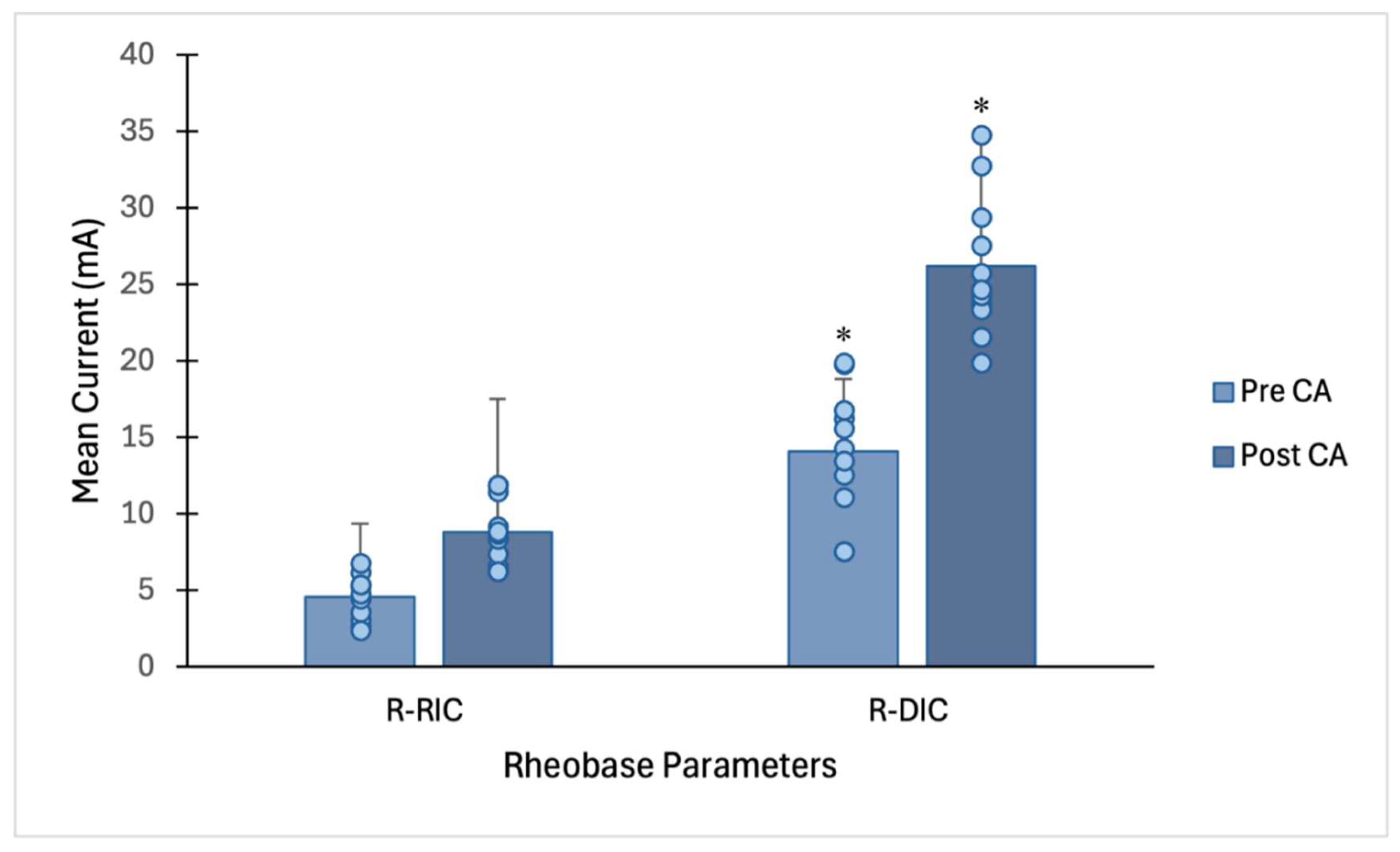
Figure 3.
Box plot demonstrating a trend towards a higher chronaxie value following the squat protocol.
Figure 3.
Box plot demonstrating a trend towards a higher chronaxie value following the squat protocol.
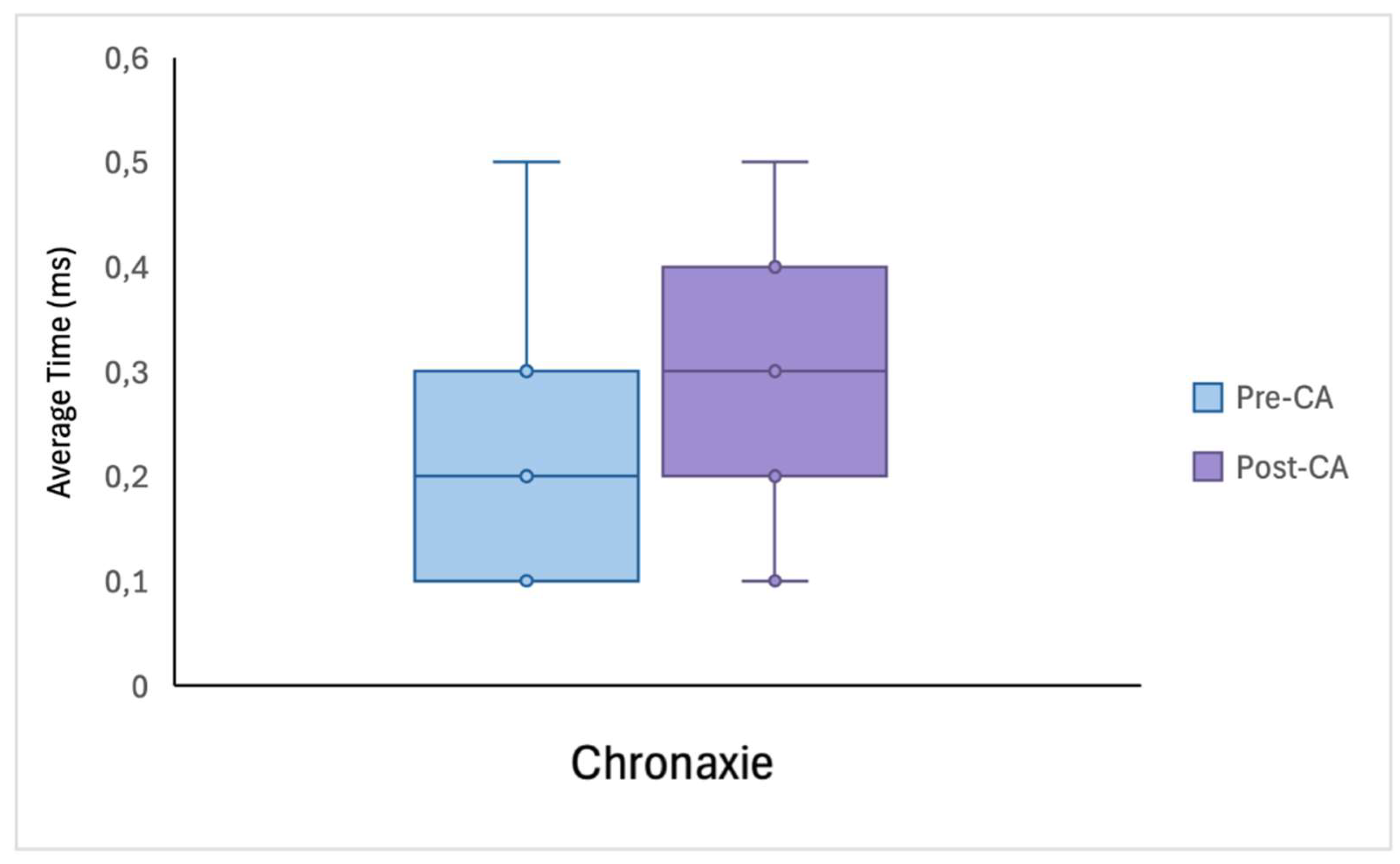
Figure 4.
The box plot reveal differences in threshold charge following the squat protocol. * = P <.001 compared to pre-intervention.
Figure 4.
The box plot reveal differences in threshold charge following the squat protocol. * = P <.001 compared to pre-intervention.
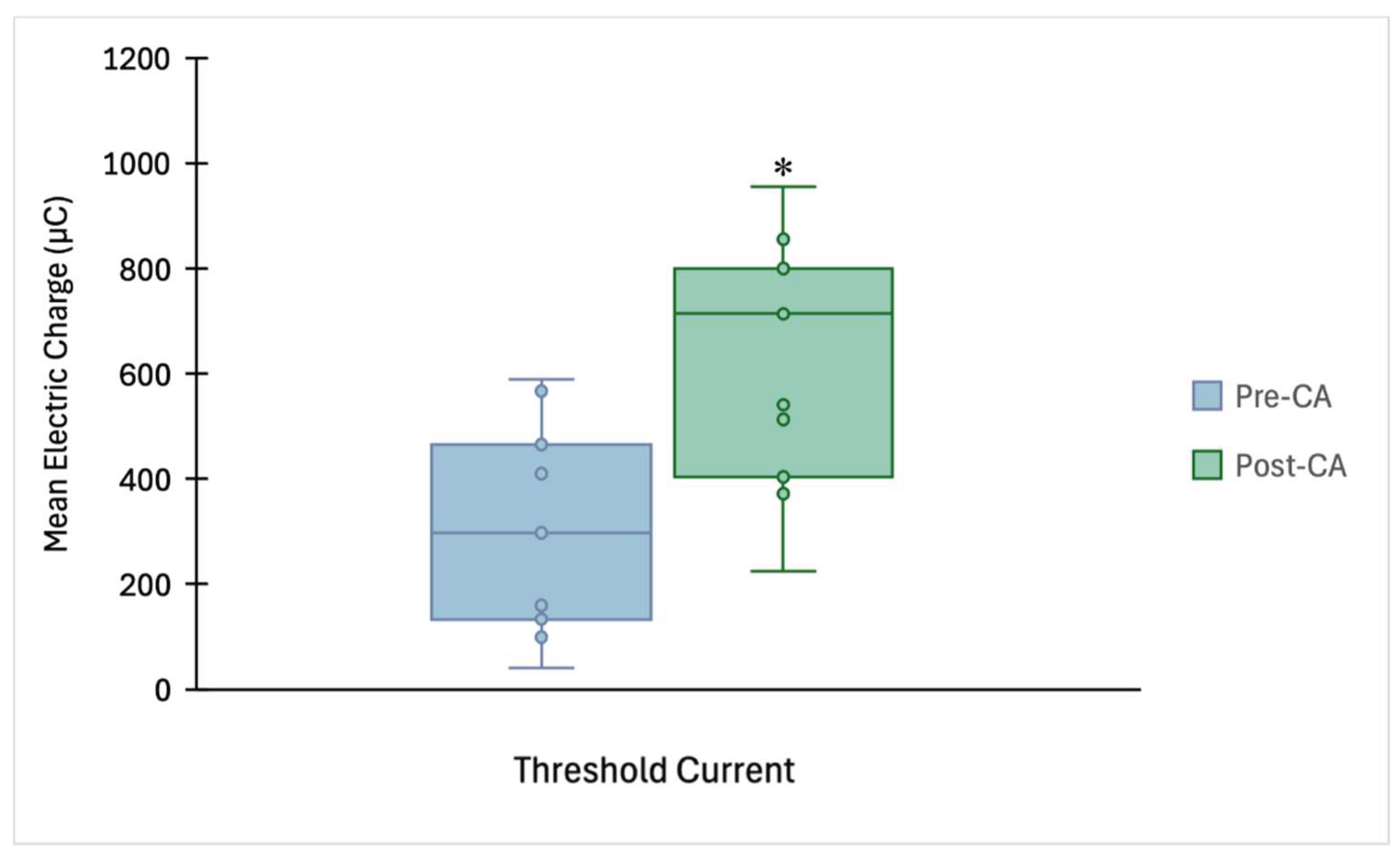
Table 2.
A warmup protocol for eliciting a PAP/PAPE effect.
| Specific Warm Up Conditioning Protocol – For Back Squats | ||
| Intensity (% of 1RM) | Reps | Rest/set |
| <50 (20 kg) | 10 | 2 |
| 50 | 6 | 2 |
| 60-65 | 5 | 3 |
| 70-75 | 5 | 3 |
| 80 (Top Set) | 5 | |
Table 3.
Characteristics of Rheobase Parameters and Chronaxie; Values are means ± SD. R-RIC = Rheobases at rectangular current (mA), R-DIC = Rheobases at triangular pulse (mA), τch = Chronaxie (ms).
Table 3.
Characteristics of Rheobase Parameters and Chronaxie; Values are means ± SD. R-RIC = Rheobases at rectangular current (mA), R-DIC = Rheobases at triangular pulse (mA), τch = Chronaxie (ms).
| Parameter | Trial | Cohen’s d | p-value | |
| Pre (n = 11) | Post (n = 11) | |||
| R-RIC (mA) | 4.56 ± 1.45 | 8.83 ± 2.15 | 2.8 | <0.001 |
| R-DIC (mA) | 14.01 ± 4.2 | 26.18 ± 4.6 | 2.1 | <0.001 |
| τch (ms) | 0.20 ± 0.13 | 0.27 ± 0.13 | 0.66 | 0.054 |
Table 4.
Characteristics of Threshold Charge and Muscle Adjustability Quotient; Values are means ± SD. Q = Threshold charge (μC), MAQ = Muscle Adjustability Quotient.
Table 4.
Characteristics of Threshold Charge and Muscle Adjustability Quotient; Values are means ± SD. Q = Threshold charge (μC), MAQ = Muscle Adjustability Quotient.
| Parameter | Trial | Cohen’s d | p-value | |
| Pre (n = 11) | Post (n = 11) | |||
| Q (μC) | 293.14 ± 192.78 | 627.36 ± 231.13 | 1.4 | <0.001 |
| MAQ | 3.12 ± 0.34 | 3.05 ± 0.54 | 0.16 | 0.61 |
Disclaimer/Publisher’s Note: The statements, opinions and data contained in all publications are solely those of the individual author(s) and contributor(s) and not of MDPI and/or the editor(s). MDPI and/or the editor(s) disclaim responsibility for any injury to people or property resulting from any ideas, methods, instructions or products referred to in the content. |
© 2026 by the authors. Licensee MDPI, Basel, Switzerland. This article is an open access article distributed under the terms and conditions of the Creative Commons Attribution (CC BY) license (http://creativecommons.org/licenses/by/4.0/).
Copyright: This open access article is published under a Creative Commons CC BY 4.0 license, which permit the free download, distribution, and reuse, provided that the author and preprint are cited in any reuse.


