
Submitted:
18 April 2026
Posted:
20 April 2026
You are already at the latest version
Abstract
Background/Objectives: Protozoan parasites of the genus Leishmania are causative agents of a group of devastating human diseases, known as leishmaniasis. These microorganisms possess very unusual mechanisms of gene expression that are poorly understood. This study was aimed at analyzing the tRNA repertoire encoded in the Leishmania infantum genome, a species responsible for the most severe form of disease, visceral leishmaniasis. tRNAs are adaptor molecules aimed at decoding mRNAs into proteins. Results: A total of 92 tRNA genes, dispersed on 38 loci were identified; often located in regions where unidirectional gene arrays converge. Putative intronic sequences were inferred for three tRNA genes, and, remarkably, 9 tRNAs were identified within the protein-coding sequences of annotated genes. According to structural predictions, the L. infantum tRNA repertoire covers 49 of the 61 possible anticodons, but because of the well-documented wobble phenomenon, these are sufficient to decode all codons in the 8532 protein-coding genes currently annotated in its genome. As illustrated in this study, codon usage is a well-conserved trait among different Leishmania species but differs substantially regarding the codon usage of its human host. Finally, we analyzed tRNA adaptation index (tAI) parameters, codon usage metrics, and relative protein expression levels. Conclusions: Apart from providing the tRNA gene repertoire and its genome distribution, we have shown the existence of a statistically significant, positive correlation between the tAI scores and protein expression levels in L. infantum promastigotes.
Keywords:
Leishmania
; transfer RNAs
; tRNAs
; proteome
; codon usage
; protein expression
1. Introduction
The molecular biology central dogma explains how genetic information (stored as DNA/RNA) is expressed as amino acids sequences (proteins) by a process known as translation that takes place in a supramolecular machine called ribosome [1]. The ribosome reads the genetic information transcribed into messenger RNAs (mRNAs) one codon (three nucleotides) at a time to insert the appropriate amino acid into a polypeptide chain using adaptor molecules (aminoacyl-tRNAs) that carry a particular amino acid and recognize a specific codon by base pairing with their anticodon. There are 64 possible codons, but three of them usually act as stop codons because there are not tRNAs able to interact with them; their function is to mark where translation should terminate. On the other hand, there are 20 different amino acids in natural proteins and, therefore, tRNAs with different anticodons can be loaded with the same amino acid; this class of tRNAs are known as isoacceptors [2]. On the contrary, in a given organism, not all of the 61 encoding codons have a dedicated tRNA, but a single tRNA anticodon may recognize several codons due to wobble base pairing; thus, tRNAs with the same anticodon (able to decode the same set of codons) are named isodecoders. Because of wobble, the minimal number of different tRNAs needed to decode all 61 codons is 32 [2]. However, usually, the number of isodecoders is higher than 32 and varies in the different organisms; moreover, each isodecoder can be present in multiple gene copies. Thus, in model eukaryotes the number of tRNA genes varies between 170 and 570 and the number of different tRNA isodecoders range from 41 to 55; usually the number of tRNA genes increases in parallel to the cellular complexity of organisms [3]. However, it is worthy to note that tRNAs having particular translational-active anticodons are absent in all kingdoms of life: bacteria, archaea, and eukaryotes [4].
Leishmania parasites belong to the group of kinetoplastids that are among the earliest-branching eukaryotes [5]. A peculiarity of these parasites is the absence of transcriptional control for individual genes, being post-transcriptional mechanisms operating on mRNA translational efficiency key for controlling gene expression [6,7]. At least, two molecular factors are particularly relevant to determine the translational efficiency of a given mRNA coding sequence, the codon usage and the tRNA repertory. After having available the first genome sequence for a Leishmania species, Padilla-Mejía and co-workers identified 83 tRNA-coding genes in the Leishmania major genome, a relative lower number of genes than found in model organisms [8]. Although the genomes for other Leishmania species have been sequenced, an inventory of tRNA genes existing in species other than L. major has not been reported to date.
Codon usage refers to the preferential or non-random use of synonymous codons. Because of the genetic code degeneracy, the same amino acid is incorporated after reading different codons (namely synonymous codons). Apart from tryptophan and methionine, each one encoded by a single codon, the remaining 18 amino acids are encoded by several synonymous codons. The usage with different frequencies of synonymous codons is termed as codon usage bias (CUP), and different species have consistent and characteristic CUPs. Moreover, codon usage bias varies not only between organisms but also between groups of genes within a particular organism [9]. Codon usage is a relevant regulator of gene expression as the translational rate of a mRNA would depends on, among other factors, the abundance of the tRNAs needed to decode its coding sequence. In general, highly expressed genes contains preferred codons whose frequencies correlate the abundances of the tRNA isoacceptors in a particular organism [10]. The relevance of this evolutionarily balanced adaptation in the codon preference of particular genes has been extensively documented in humans, where single mutations in coding regions that do not change the coded amino acids (i.e., synonymous mutations) have been linked to disease and cancer development [11].
The codon usage of three Leishmania species (L. major, Leishmania infantum and Leishmania braziliensis) was reported more than ten years ago [12], when the genome assemblies, particularly those for L. infantum and L. braziliensis, were incomplete. In fact, at that time, only 66 tRNAs could be identified in the L. infantum genome. In 2017, an improved assembly for the L. infantum genome was obtained by González-de la Fuente and co-workers [13]. Based on this improved genome, and using two complementary bioinformatics tools, we identified a total of 92 tRNAs genes. According to their anti-codon sequences, they cover a total of 49 different triplets (codons). Considering this repertory of tRNAs and the wobble rules, it was calculated the translational adaptation index (tAI) for every of the currently annotated proteins in this Leishmania species. Finally, by analyzing the relative abundance of the proteins identified in the L. infantum promastigotes, it was observed a statistically significant correlation between tAI values and protein abundance.
2. Materials and Methods
2.1. Leishmania Genomes and Protein-Coding Sequences
The genome sequences and protein-coding sequences used in this study are publicly available at the Leish-ESP repository (https://jmrequenajmr.wixsite.com/leish-esp, accessed on 11 April 2026)).
2.2. tRNA Gene Annotation
Two bioinformatics programs were used: tRNAscan-SE 2.0.12 [14] and ARAGORN 1.2.41 [15]. To ensure maximum sensitivity, several search modes (eukaryotic, mitochondrial, organellar, and COVE) were selected when the tRNAscan-SE program was run. The ARAGORN program was downloaded through the following link: https://www.trna.se/ (accessed on 11 April 2026). The results obtained through the different searches were merged to generate a non-redundant list of tRNA genes for each species. When predictions of anticodons were not coincidental in both programs, we underwent visualization of the predicted structures looking for the more accurate anticodon based on the secondary structure rules underpinned by Rich and RajBhandary [16]. Finally, genomic coordinates for tRNAs were refined according to their predicted secondary structures.
2.3. Analysis of Codon Usage in Protein-Coding Sequences
A bioinformatic tool was developed to determine the absolute and relative numbers of codons found in every coding sequence (CDS). This tool was designed to be friendly used at the following web site: https://leishmania.cbm.uam.es/tools/codon-usage (accessed on 11 April 2026). Codon usage were determined in the following species (datasets): L. infantum (https://data.mendeley.com/datasets/f9sr5bgv24/1, accessed on 11 April 2026), L. major (https://data.mendeley.com/datasets/b299x68yj7/1, accessed on 11 April 2026), L. braziliensis (https://zenodo.org/records/19205547, accessed on 11 April 2026), and Homo sapiens (https://zenodo.org/records/18787765, accessed on 11 April 2026).
2.4. Calculation of the tRNA Adaptation Index (tAI)
The tAI for every L. infantum protein-coding gene was calculated according to dos Reis and coworkers [17]. For each codon, it was estimated an adaptiveness numerical value Wik that takes in account the number of tRNA isoacceptors that recognize a given codon and the efficiency of the codon–anticodon interaction based on the Crick’s wobble rules for codon–anticodon pairing [17]. Wi values were normalized according the maximum Wi value (taken arbitrarily as 1) among those coding for the same amino acid. Finally, the tAI of a coding sequence is calculated as the geometric mean of the relative adaptiveness values of its codons. For calculations, we used the formula:
where the tAI for a given gene (g) is defined as the geometric mean of the relative adaptation weights (wᵢₖ) of the number of codons (Lg) that compose the gene. The formula is expressed in a logarithmic form to ensure numerical stability during computation. In sum, the tAI is a measure of the adaptation of a given gene to the available tRNA pool.
2.5. Parasite Culture, Protein Samples and Proteomic Data
Promastigotes of L. infantum JPCM5 strain were grown at 26 ◦C in Roswell Park Memorial Institute (RPMI) medium supplemented with 15% of heat-inactivated fetal bovine serum (FBS), hemin (10 μg/mL) and an antibiotic mix (streptomycin 10 μg/mL and penicillin 105 U/mL). Cultures (50 mL) were started at 5 × 10⁵ cells/mL and the parasites were harvested in the middle logarithmic growth phase (107 promastigotes per mL). After washing twice with phosphate buffer saline (PBS), the pellets (5 × 10⁸ cells) were processed using the Subcellular Protein Fractionation Kit for Cultured Cells (Cat. Number 78840; Thermofisher Scintific). As a result, four fractions were obtained and processed for proteomic analysis.
Each fraction was submitted to in-gel digestion using sequencing grade trypsin (Promega, Madison, WI, USA) following the procedure described elsewhere [18]. Peptide samples were analyzed by reverse phase-liquid chromatography (RP-LC)-MS/MS analysis (Dynamic Exclusion Mode) in an Easy-nLC 1200 system coupled to an ion trap LTQ-Orbitrap Velos Pro hybrid mass spectrometer (Thermo Scientific, Waltham, MA, USA). The proteome raw data are publicly available at Zenodo repository (https://zenodo.org/records/18639527, accessed on 11 April 2026). Peptide identification from raw data was carried out using the PEAKS Studio XPro search engine (Bioinformatics Solutions Inc.,Waterloo, ON, Canada) [19]. Searches were performed against the most recent L. infantum proteome dataset available at the Mendeley Data server (https://data.mendeley.com/datasets/dtmstvb2j5/2, accessed on 11 April 2026).
2.6. Calculation of Relative Protein Abundance
From the peptide mass spectra associated to the L. infantum (JPCM5 strain) proteome, we determined the relative protein abundance using the "Top3" method, which sums the intensities of the three most abundant unique peptides identified for each protein [20].
3. Results and Discussion
3.1. Annotation of tRNA Genes in the L. infantum Genome
A search for tRNA genes was conducted on the more recent genome sequence of the reference strain (JPCM5) for L. infantum [13] by using two bioinformatics programs: tRNAscan-SE 2.0.12 [14] and ARAGORN 1.2.41 [15]. The ARAGORN algorithm combines a search of tRNA consensus sequences together their ability to conform a secondary structure adapting the typical cloverleaf form. The detection sensitivity of this program was estimated to be 99% in sequences from all three life kingdoms [15]. The tRNAscan-SE algorithm is trained with large sets of clade-specific tRNAs and specialized isotypes, being able to identify typical tRNAs but also to discriminate atypical ones like initiator methionine tRNA (iMet tRNA), elongator methionine tRNA (Met tRNA) and selenocysteine tRNA [14]. Although ARAGORN and tRNAscan-SE yielded coincidental results for most identified tRNAs, a few discrepancies were also observed (see below). As expected, ARAGORN and tRNAscan-SE have demonstrated to be confident tools for tRNA identification in Leishmania, but it is recommendable to use both as they complemented each other in the characterization of atypical tRNA structures. As a result of this analysis, 92 tRNAs were predicted in the L. infantum (JPCM5) genome (see Table 1 and supplementary file). In a previous study, 83 tRNA genes were identified in L. major genome [8], which a quite similar number.
Two of the tRNAs were predicted to be iMet tRNAs (LINF_090013000 and LINF_360074700) and another two coding for internal Met tRNAs (LINF_110015000 and LINF_340017200). For structural details allowing to differentiate both types of Met tRNAs, see the article by Padilla-Mejia and co-workers [8]. Also, a specialized tRNA for introducing selenocysteine (SeC tRNA) was identified (LINF_060007300). The existence of selenoproteins, and the factors required for translation has been documented in L. major [21].
A discrepancy regarding anticodon assignation between the two prediction programs occurred for three tRNAs: LINF_340042300, LINF_360019300, and LINF_360019600 (the latter two have identical nucleotide sequences). Whereas tRNAscan-SE predicted anticodons for leucine (Leu), the structure modeled by ARAGORN supports that these tRNAs would be decoding tyrosine (Tyr) (Figure 1A-B). The reason for this discrepancy in the predicted anticodons between both programs is that ARAGORN detected putative introns in the sequences of these three genes, whereas tRNAscan-SE does not. In figure 1 (panels A and B), the secondary structures correspond to the spliced tRNAs are shown; in supplementary figure S1 it is shown the anomalous tRNA structures that are predicted when the intronic sequences are included. The presence of introns in tRNA genes is not a surprising finding as tRNA genes containing introns have been described in all three kingdoms of life (see [2] and references therein). In fact, tRNATyr was also postulated to be the only intron-containing tRNA identified in the Trypanosoma cruzi genome [22]. Furthermore, an extremely persuasive argument in favor of the plausible structure depicted for these tRNAs is that none other L. infantum tRNA was found to be Tyr-specific (Table 1).
According to the structural predictions, there are two tRNAs whose structures have some deviations from the typical tRNA structure: LINF_070006450 (Figure 1C) and LINF_130017500 (Figure 1D). These tRNAs were only detected by ARAGORN. LINF_070006450 was predicted to decode phenylalanine, but it possesses a V-loop unusually large and the A-stem has eight nucleotides instead of seven (more common in typical tRNAs). The anomaly found in tRNA structure predicted for LINF_130017500 is that the C-loop contains only seven nucleotides when more often this loop consists of eight bases. As a consequence, the search algorithm did not make an anticodon assignation; nevertheless, according to the consensus rule for the anticodon placement (YUNNNR [Y: C or U (pyrimidines); R: A or G (purines); NNN, anticodon]), this would be GUG, ie a tRNA specific for decoding histidine.
Table 1 shows the tRNAs ordered according to the decoded amino acid and its anticodon. Forty-nine out of the 61 theoretically possible decoding tRNAs were identified in the L. infantum genome. Nevertheless, as shown also in Table 1, all the 61 codons were found to exist among the annotated protein-coding sequences in this parasite. We will come back to this question in section 3.4.
3.2. Genomic Organization of the tRNA Genes
The 92 tRNA genes identified in the L. infantum species are distributed on 23 out of the 36 chromosomes comprising the genome (detailed information is provided in Supplementary file). The tRNA genes are found either alone or grouped, amounting a total of 38 different loci. The locus having a large number of tRNA genes is located at chromosome 23 and it is comprised of 10 tRNA genes and a 5S rRNA gene (Figure 2A). Remarkably, this gene locus is located at the chromosomal point in which two transcriptional units converge, suggesting that the tRNA loci might serve as stopping points for the RNA polymerase II transcriptional machinery. There are other tRNA loci located in equivalent positions (i.e., confluence of transcriptional units) at chromosomes 3, 5, 9, 15, 16, 21 (two loci), and 24. Although less frequently, some tRNA loci are found between divergent transcriptional units in chromosomes 9 (Figure 2B), and 10.
Another remarkable finding is the location of some tRNA genes within coding sequences (CDS) of protein-coding genes. An example is tRNA LINF_020010500, which is embedded in the CDS of gene LINF_020010400 but in antisense orientation regarding the CDS (Figure 2C). This gene encodes a large protein (2091 amino acids in length) without any distinctive structural domain, but highly conserved among different Leishmania species (see UniProt entry A0A6L0WHP6 for further details). Other tRNA genes embedded in protein-coding sequences are: LINF_070006450 (located in sense orientation within the CDS of gene LINF_070006400, which encodes for a TMEM115/Pdh1/Rbl19-like protein); LINF_130017500 (located in antisense within the CDS of gene LINF_130017400, which encodes a thiamin pyrophosphokinase [23]); LINF_180013900 (in the sense strand within the LINF_180013800 CDS, which encodes a protein of unknown function (869 amino acids in length) that is conserved among different Leishmania species; LINF_210019700 (in sense within the LINF_210019800 CDS and the encoded protein contains a conserved leucine-rich repeat domain); LINF_280009850 (in antisense within the LINF_280009800 CDS, which encodes a NuSAP1-like protein); and LINF_290019900 (in antisense within the LINF_290019800 CDS, which codes for an RNA binding protein). This finding is not an absolute novelty, as the presence of a tRNA within a CDS was previously described in Trypanosoma brucei, a Leishmania-related trypanosomatid, by Padilla-Mejía and co-workers [8].
3.3. Analysis of Codon Usage in L. infantum Protein-Coding Sequences
The frequency of codons was calculated using an in-house Python script (see Materials and Methods section). Currently, the number of protein-coding genes annotated in the L. infantum (JPCM5 strain) is 8532 (https://data.mendeley.com/datasets/f9sr5bgv24/1, accessed on 11 April 2026). Table 1 shows the relative frequencies (per thousand) for every of the 61 sense codons. In Supplementary file, individual codon frequencies for every protein-coding sequence are provided. Regarding the stop codons, the less-used non-sense (or termination) codon is TAA (20.5 %) followed by TAG (36.6%) and TGA (42.9%). A factor that may contribute to those differences is the high G+C content (59.74%) of the L. infantum genome. In agreement with this high G+C content, among the synonymous codons, those having a GC-richness are clearly more abundant (Table 1). For instance, the Arg-coding codon CGC is around 12-fold more frequent than codon AGA.
To determine possible codon usage variations along de genus Leishmania, we analyzed the codon frequencies in the species L. major, belonging to the Leishmania subgenus as L. infantum, and L. braziliensis, as representative of the Viannia subgenus. Despite the 20–100 million years of divergence existing between these Leishmania species [24], a strong conservation in codon usage was observed across the genus (Figure 3A-C). For comparative purposes, the codon usage in Homo sapiens was also determined (Figure 3D), showing clear differences with that found in the Leishmania coding sequences. Overall, the human codon usage shows an equilibrated proportion among the coding triplets, whereas Leishmania genomes show marked differences (see Supplementary file for numerical values determined for every of the 64 codons in the four species). For instance, in Leishmania, the most frequently used triplet is GAG (coding for Glutamic acid, E) with near 5% of all triplets, followed by GCG (Alanine, A; 4.5%), and the less used triplets are TTA (Leucine, L; 0.16%) and ATA (Ileucine, I; 0,27%). In humans, the frequencies (in %) of these codons are 4 for GAG (4%), 0.76 for GCG, 0.78 for TTA, and 0.75 for ATA.
In a previous study, a comparison in the codon usage between Leishmania genomes and other related trypanosomatids showed that codons rich in G or C were more preferred in Crithidia and Leishmania species than in species of the genus Trypanosoma [25].
3.4. Determination of the Translational Efficiency of the L. infantum Protein Coding Genes
As discussed in previous section, the relative usage of synonymous codons is conditioned by the overall G+C content of a given genome. In this regard, it would be expected that the tRNA pool found in a given organism mirrors codon frequencies of its protein-coding genes. However, this is not an absolute rule in L. infantum (Table 1), and a remarkable example is found in the Ile-coding codons: the more frequent codon, ATC (frequency, 18.91 º/ºº) does not have a specific decoding tRNA, whereas the other two codons, which possess dedicated tRNAs, ATT (with 3 decoding tRNAs) and ATA (with 1 decoding tRNA) are present at lower frequencies, 8.37 and 2.72, respectively. As mentioned above, the lack of a given anticodon-containing tRNA it not a problem because other tRNAs are able to recognize several codons due to the flexible base-pairing between the first nucleotide of the anticodon and the third position of the codon, which is known a tRNA wobble ([17] and references therein); in other words, a tRNA may bind multiple synonymous codons, and a particular codon can be decoded by multiple tRNA isoacceptors.
The values compiled in Table 1 represent a mean value from all L. infantum protein-coding genes and we wondered whether particular sets of genes have codon usages more adapted to the tRNA pool. For this purpose, the tRNA adaptation index (tAI), which is a measure of the codon adaptation to the relative tRNA abundances [17], was calculated for each L. infantum protein-coding genes (Supplementary file). Among the L. infantum protein-coding genes, the tAI values varied from 0.8935 (the highest, for gene LINF_350023700 that codes for ribosomal protein uL18) to 0.4466 (the lowest, for gene LINF_220005100, which is annotated as a putative pseudogen encoding a hypothetical protein).
With the aim of determining whether those proteins having high tAI values are indeed those proteins attaining higher steady-state levels in the parasite, we analyzed the relative protein abundance in L. infantum promastigotes. For this purpose, protein extracts were used to identify and quantify peptides by liquid chromatography coupled with mass spectrometry (LC-MS) as detailed in Materials and Methods section. To determine the relative abundance of the identified proteins, we followed an approach based on the peptide peak intensities [20]. In particular, we used the top-3 method consisting of summing the intensity of the top-three most abundant peptides for a given protein. Although the methodology is very simplistic, it is based on the experimental demonstration that there exists a robust relationship between MS signals and protein concentration [26]. Thus, for every protein identified in the L. infantum protein extracts, the intensities of the top three most abundant peptides were summed; consequently, proteins identified by less than three distinct peptides were excluded from the analysis. Finally, 2088 of the identified proteins met the criteria (see Supplementary file), and were used for further analysis. The reliability of this protein quantification method is supported by the finding, among the more abundant proteins, of proteins like tubulins, heat shock proteins HSP70 and HSP90, GP63/leishmanolysin protease, and ribosome components.
Figure 4A shows a positive correlation between tAI values and the relative abundance of the 2088 proteins quantified from the proteomic samples. In order to obtain statistical significance clues, proteins were grouped in four groups according to their relative abundance (Figure 4B), expressed in a logarithmic scale: i) proteins with relative abundance lower than 2 (n=585; tAI mean=0.686; SD=0.042); ii) proteins with relative abundance between 2-3 log units (n=1051; tAI mean=0.708; SD=0.047); iii) proteins having a relative abundance in the range of 3-4 log units (n=427; tAI mean=0.754; SD=0.057), and iv) the proteins having relative abundance values higher than 4 log units (n=34; tAI mean=0.802; SD=0.051). The differences between those groups showed a robust statistics significance according to the two-tailed unpaired Student’s t test. Thus, regarding the first group (i), the p value for the null hypothesis was 2.4×10-169 for group ii, 2.5×10-174 for group iii, and 2,77×10-88 for group iv. In conclusion, this analysis evidenced a significant codon adaptation in the gene sequences coding for those proteins having a higher abundance in L. infantum promastigotes.
4. Conclusions
A total of 92 tRNA-encoding genes has been identified in L. infantum. According to their anticodon, they are grouped into 49 different isodecoders (tRNAs with the same anticodon). As expected, there are 21 types of isoacceptors (tRNAs that load the same amino acid), one for each of the 20 standard amino acids and one for selenocysteine. There are dedicated tRNA for incorporating either the initial metionione or internal ones; there were identified two of each type. Genes coding for tRNAs are dispersed on the genome, but are frequently found in genomic regions where unidirectional gene arrays converge.
It is well-accepted that particular patterns of codon usage can control ribosome speed and, consequently, the efficiency of protein synthesis [27]. In this study, we applied the statistics method developed by dos Reis and collaborators [17], and supported by experimental data, that allows to calculate adaptiveness value Wi for each codon taking into account the tRNA gene pool. Thus, for a given gene it is possible to calculate the tRNA adaptation index (tAI) as the geometric mean of the relative adaptiveness values (Wi) of its codons. When tAI values of genes and relative expression levels of the encoded proteins were compared, it was determined a strong positive relationship between the use of codons with high adaptiveness and the protein abundance in L. infantum promastigotes.
Apart from the classical known function of tRNAs as decoders of the genetic code, in recent studies an increasing number of new functions are being attributed to them, such as regulation of transcription and translation, and protein labeling for degradation [2]. Additionally, and regulatory functions played by small RNA fragments derived from tRNA molecules has been involved in a variety of functions affecting chromatin structure, DNA replication and cell fate [4]. Nevertheless, these are research areas waiting to be explored in Leishmania, but this work is contributing a characterization of the tRNA gene compendium existing in this parasite and paving the road for future studies.
Supplementary Materials
The following supporting information can be downloaded at the website of this paper posted on Preprints.org, Supplementary file.xlsx is an Excel file containing tRNAs sequences, codon usage for every L. infantum protein-coding gene, tAI scores, relative protein abundances, and codon usage tables for the species analyzed in this study; Supplementary Figure s1.docx shows the structure of the intron-containing tRNA genes identified in this study.
Author Contributions
Conceptualization, A.N.P., A.C. and J.M.R.; methodology, A.N.P., A.C. and J.A.J.; software, A.N.P. and J.A.J.; validation, A.N.P., A.C., J.A.J and J.M.R.; formal analysis, A.N.P., A.C., J.A.J and J.M.R.; investigation, A.N.P., A.C. and J.A.J.; resources, J.M.R; data curation, A.N.P., J.A.J and J.M.R.; writing—original draft preparation, A.N.P. and J.M.R.; writing—review and editing, A.N.P., A.C., J.A.J and J.M.R.; funding acquisition, J.M.R. All authors have read and agreed to the published version of the manuscript.
Funding
This research was supported by grant PID2024-159768OB-I00 from MICIU/ AEI / 10.13039/501100011033 / FEDER, UE. Also, by Instituto de Salud Carlos III, grant CB21/13/00018 (CIBERINFEC). The CBM receives an institutional grant from the Fundación Ramón Areces. The CBM is a Severo Ochoa Center of Excellence (grant CEX2021-001154-S).
Data Availability Statement
The proteome raw data generated in this study are publicly available at Zenodo repository (https://zenodo.org/records/18639527).
Acknowledgments
The proteomic analyses (protein identification and characterization by LC–MS/MS) were carried out in the CBM protein chemistry facility, which belongs to the ProteoRed-ISCIII network. I thank all members from our laboratory who contributed to the current knowledge about Leishmania genomes.
Conflicts of Interest
The authors declare no conflicts of interest. The funders had no role in the design of the study; in the collection, analyses, or interpretation of data; in the writing of the manuscript; or in the decision to publish the results.
References
- Green, R.; Noller, H.F. Ribosomes and Translation. Annu. Rev. Biochem. 1997, 66, 679–716. [Google Scholar] [CrossRef] [PubMed]
- Berg, M.D.; Brandl, C.J. Transfer RNAs: Diversity in Form and Function. RNA Biol. 2021, 18, 316–339. [Google Scholar] [CrossRef]
- Goodenbour, J.M.; Pan, T. Diversity of TRNA Genes in Eukaryotes. Nucleic Acids Res. 2006, 34, 6137–6146. [Google Scholar] [CrossRef]
- Ehrlich, R.; Davyt, M.; López, I.; Chalar, C.; Marín, M. On the Track of the Missing TRNA Genes: A Source of Non-Canonical Functions? Front. Mol. Biosci. 2021, 8, 643701. [Google Scholar] [CrossRef]
- Moreira, D.; Lopez-Garcia, P.; Vickerman, K. An Updated View of Kinetoplastid Phylogeny Using Environmental Sequences and a Closer Outgroup: Proposal for a New Classification of the Class Kinetoplastea. Int J Syst Evol Microbiol 2004, 54, 1861–1875. [Google Scholar] [CrossRef]
- Clayton, C.; Shapira, M. Post-Transcriptional Regulation of Gene Expression in Trypanosomes and Leishmanias. Mol Biochem Parasitol 2007, 156, 93–101. [Google Scholar] [CrossRef]
- Requena, J.M. Lights and Shadows on Gene Organization and Regulation of Gene Expression in Leishmania. Front. Biosci. 2011, 16, 2069–2085. [Google Scholar] [CrossRef]
- Padilla-Mejía, N.E.; Florencio-Martínez, L.E.; Figueroa-Angulo, E.E.; Manning-Cela, R.G.; Hernández-Rivas, R.; Myler, P.J.; Martínez-Calvillo, S. Gene Organization and Sequence Analyses of Transfer RNA Genes in Trypanosomatid Parasites. BMC Genomics 2009, 10, 232. [Google Scholar] [CrossRef]
- Parvathy, S.T.; Udayasuriyan, V.; Bhadana, V. Codon Usage Bias. Mol. Biol. Rep. 2022, 49, 539–565. [Google Scholar] [CrossRef] [PubMed]
- Frumkin, I.; Lajoie, M.J.; Gregg, C.J.; Hornung, G.; Church, G.M.; Pilpel, Y. Codon Usage of Highly Expressed Genes Affects Proteome-Wide Translation Efficiency. Proc. Natl. Acad. Sci. U. S. A 2018, 115, E4940–E4949. [Google Scholar] [CrossRef] [PubMed]
- Davyt, M.; Bharti, N.; Ignatova, Z. Effect of MRNA/TRNA Mutations on Translation Speed: Implications for Human Diseases. J. Biol. Chem. 2023, 299, 105089. [Google Scholar] [CrossRef]
- Rashmi, M.; Swati, D. Comparative Genomics of Trypanosomatid Pathogens Using Codon Usage Bias. Bioinformation 2013, 9, 912–918. [Google Scholar] [CrossRef]
- Gonzalez-de la Fuente, S.; Peiro-Pastor, R.; Rastrojo, A.; Moreno, J.; Carrasco-Ramiro, F.; Requena, J.M.; Aguado, B. Resequencing of the Leishmania Infantum (Strain JPCM5) Genome and de Novo Assembly into 36 Contigs. Sci Rep 2017, 7, 18050. [Google Scholar] [CrossRef]
- Chan, P.P.; Lin, B.Y.; Mak, A.J.; Lowe, T.M. TRNAscan-SE 2.0: Improved Detection and Functional Classification of Transfer RNA Genes. Nucleic Acids Res. 2021, 49, 9077–9096. [Google Scholar] [CrossRef] [PubMed]
- Laslett, D.; Canback, B. ARAGORN, a Program to Detect TRNA Genes and TmRNA Genes in Nucleotide Sequences. Nucleic Acids Res. 2004, 32, 11–16. [Google Scholar] [CrossRef] [PubMed]
- Rich, A.; RajBhandary, U.L. Transfer RNA: Molecular Structure, Sequence, and Properties. Annu. Rev. Biochem. 1976, 45, 805–860. [Google Scholar] [CrossRef]
- dos Reis, M.; Savva, R.; Wernisch, L. Solving the Riddle of Codon Usage Preferences: A Test for Translational Selection. Nucleic Acids Res. 2004, 32, 5036–5044. [Google Scholar] [CrossRef]
- Adán-Jiménez, J.; Sánchez-Salvador, A.; Morato, E.; Solana, J.C.; Aguado, B.; Requena, J.M. A Proteogenomic Approach to Unravel New Proteins Encoded in the Leishmania Donovani (HU3) Genome. Genes (Basel) 2024, 15, 775. [Google Scholar] [CrossRef]
- Tran, N.H.; Qiao, R.; Xin, L.; Chen, X.; Liu, C.; Zhang, X.; Shan, B.; Ghodsi, A.; Li, M. Deep Learning Enables de Novo Peptide Sequencing from Data-Independent-Acquisition Mass Spectrometry. Nat. Methods 2019, 16, 63–66. [Google Scholar] [CrossRef]
- Matzke, M.M.; Brown, J.N.; Gritsenko, M.A.; Metz, T.O.; Pounds, J.G.; Rodland, K.D.; Shukla, A.K.; Smith, R.D.; Waters, K.M.; Mcdermott, J.E.; et al. A Comparative Analysis of Computational Approaches to Relative Protein Quantification Using Peptide Peak Intensities in Label-Free LC-MS Proteomics Experiments. Proteomics 2013, 13, 493–503. [Google Scholar] [CrossRef] [PubMed]
- Cassago, A.; Rodrigues, E.M.; Prieto, E.L.; Gaston, K.W.; Alfonzo, J.D.; Iribar, M.P.; Berry, M.J.; Cruz, A.K.; Thiemann, O.H. Identification of Leishmania Selenoproteins and SECIS Element. Mol Biochem Parasitol 2006, 149, 128–134. [Google Scholar] [CrossRef]
- Díaz-Viraqué, F.; Ehrlich, R.; Robello, C. Genomic Organization of Trypanosoma Cruzi TRNA Genes. Genome Biol. Evol. 2025, 17, evaf108. [Google Scholar] [CrossRef] [PubMed]
- Ranjan Kumar, R.; Jain, R.; Akhtar, S.; Parveen, N.; Ghosh, A.; Sharma, V.; Singh, S. Characterization of Thiamine Pyrophosphokinase of Vitamin B1 Biosynthetic Pathway as a Drug Target of Leishmania Donovani. J. Biomol. Struct. Dyn. 2024, 42, 5669–5685. [Google Scholar] [CrossRef] [PubMed]
- Kaufer, A.; Stark, D.; Ellis, J. Evolutionary Insight into the Trypanosomatidae Using Alignment-Free Phylogenomics of the Kinetoplast. Pathogens 2019, 8, 157. [Google Scholar] [CrossRef] [PubMed]
- Subramanian, A.; Sarkar, R.R. Comparison of Codon Usage Bias across Leishmania and Trypanosomatids to Understand MRNA Secondary Structure, Relative Protein Abundance and Pathway Functions. Genomics 2015, 106, 232–241. [Google Scholar] [CrossRef]
- Silva, J.C.; Gorenstein, M. V.; Li, G.-Z.; Vissers, J.P.C.; Geromanos, S.J. Absolute Quantification of Proteins by LCMSE. Mol. Cell. Proteomics 2006, 5, 144–156. [Google Scholar] [CrossRef]
- Fredrick, K.; Ibba, M. How the Sequence of a Gene Can Tune Its Translation. Cell 2010, 141, 227–229. [Google Scholar] [CrossRef]
Figure 1.
Cloverleaf representation of several L. infantum tRNAs. A) LINF_340042300; B) LINF_360019300, and LINF_360019600 (both tRNAs have identical nucleotide sequence); C) LINF_070006450; D) LINF_130017500. Colored in red are the nucleotides conforming the anticodon.
Figure 1.
Cloverleaf representation of several L. infantum tRNAs. A) LINF_340042300; B) LINF_360019300, and LINF_360019600 (both tRNAs have identical nucleotide sequence); C) LINF_070006450; D) LINF_130017500. Colored in red are the nucleotides conforming the anticodon.
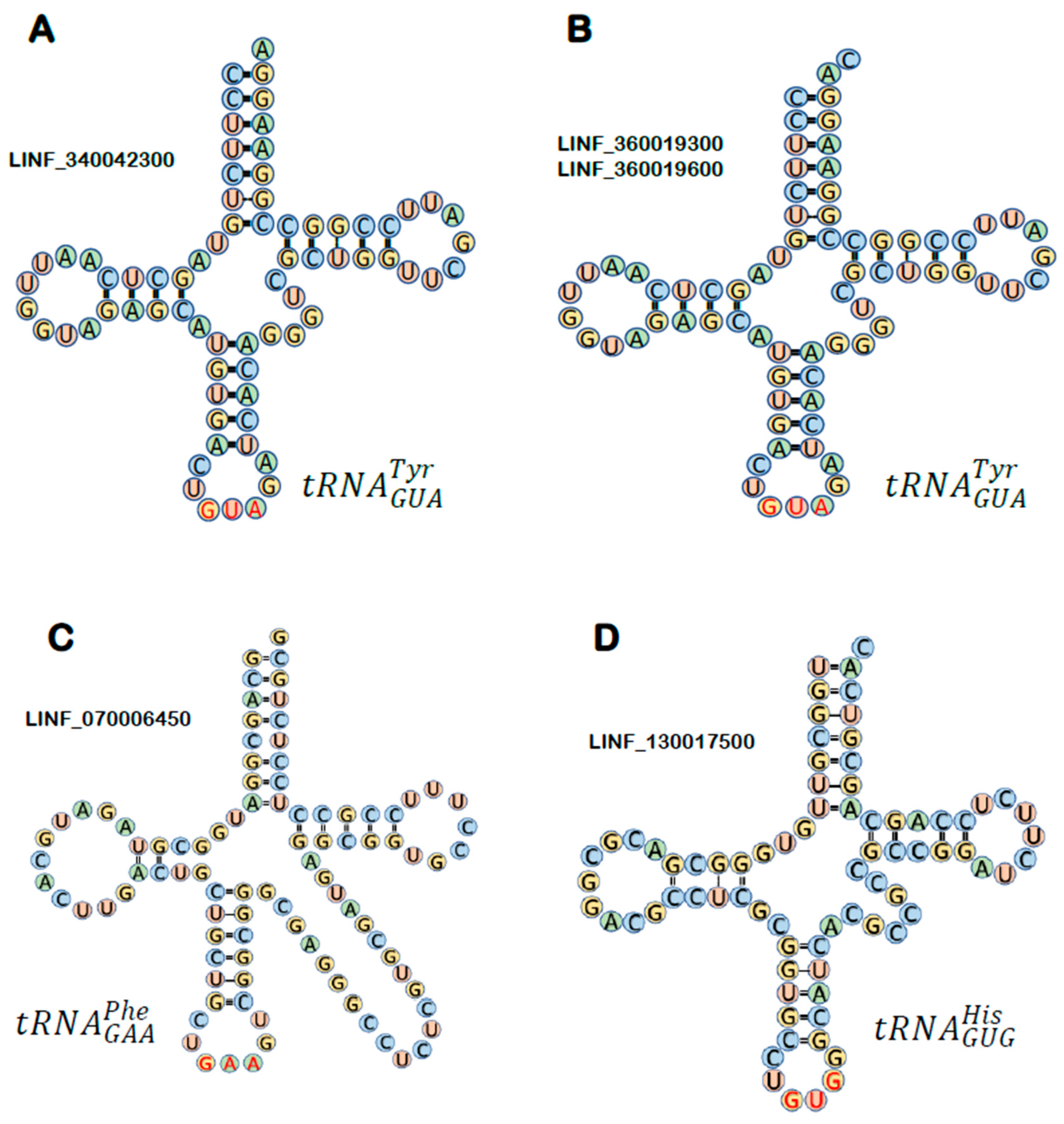
Figure 2.
Organization of tRNA genes at particular loci in the L. infantum genome. A) The locus having the larger number of tRNAs (ten) is located at chromosome 23. These genes are in a region in which two transcriptional units converge. B) A locus in chromosome 9 containing three tRNAs within a region in which two transcriptional units diverge. C) Example of a tRNA (LINF_020010500) embedded within a protein-coding sequence (LINF_020010500). Protein-coding genes and intergenic regions are drawn to scale, but not the genes coding for tRNAs and 5S rRNA (pink arrows). The positions of the tRNAs on the chromosome are shown by green triangles, and above them the corresponding tRNAs are depicted. Red or blue arrows indicate that genes are located at the plus or minus strand, respectively. The ID codes for every gene is included, and for tRNAs also the anticodon and decoded amino acid are shown.
Figure 2.
Organization of tRNA genes at particular loci in the L. infantum genome. A) The locus having the larger number of tRNAs (ten) is located at chromosome 23. These genes are in a region in which two transcriptional units converge. B) A locus in chromosome 9 containing three tRNAs within a region in which two transcriptional units diverge. C) Example of a tRNA (LINF_020010500) embedded within a protein-coding sequence (LINF_020010500). Protein-coding genes and intergenic regions are drawn to scale, but not the genes coding for tRNAs and 5S rRNA (pink arrows). The positions of the tRNAs on the chromosome are shown by green triangles, and above them the corresponding tRNAs are depicted. Red or blue arrows indicate that genes are located at the plus or minus strand, respectively. The ID codes for every gene is included, and for tRNAs also the anticodon and decoded amino acid are shown.
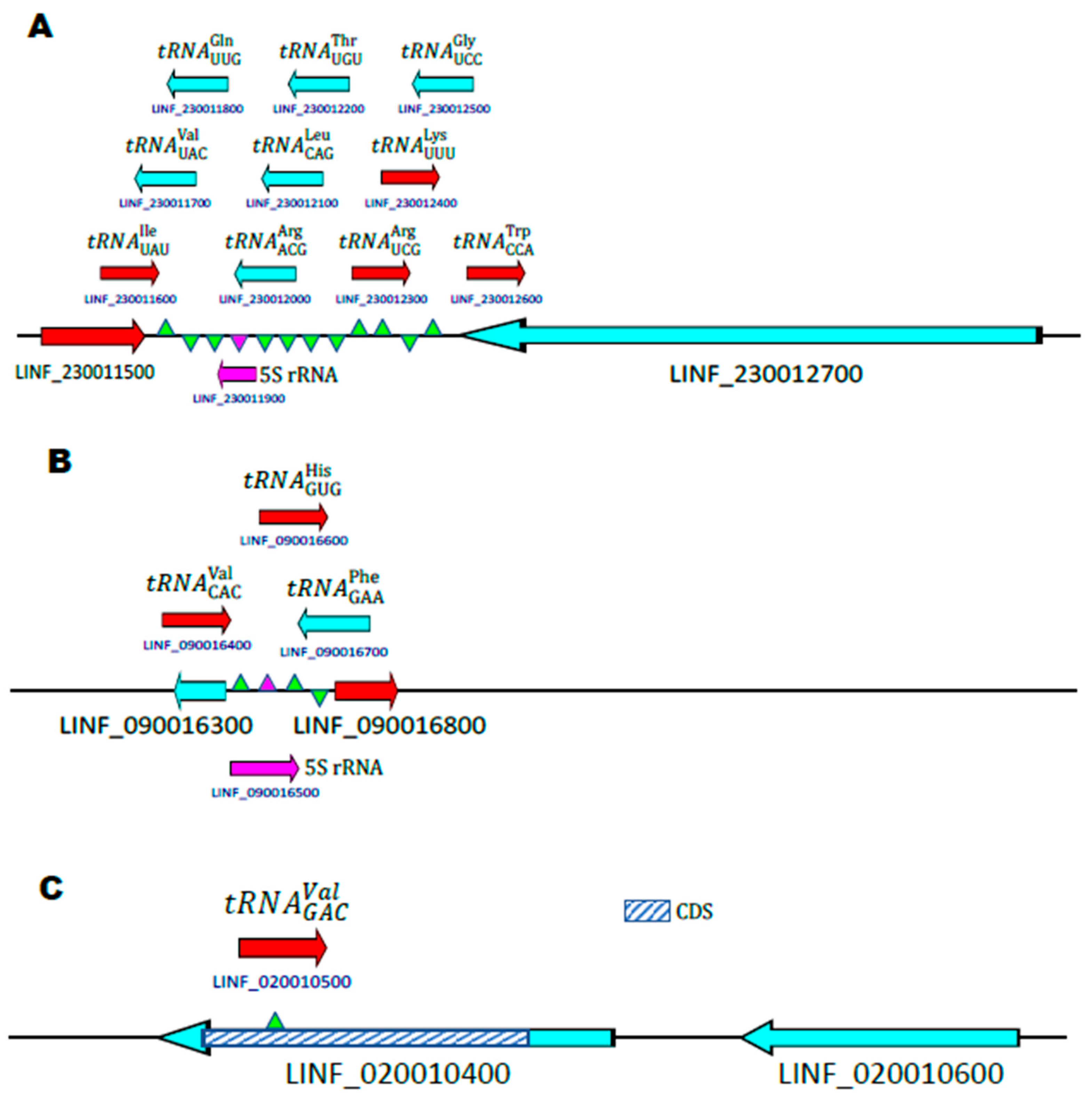
Figure 3.
Codon usage circular plots for three Leishmania species and humans. A) L. infantum; B) L. major; C) L. braziliensis; D) H. sapiens. The frequency scale (‰) is represented at the circle radius.
Figure 3.
Codon usage circular plots for three Leishmania species and humans. A) L. infantum; B) L. major; C) L. braziliensis; D) H. sapiens. The frequency scale (‰) is represented at the circle radius.
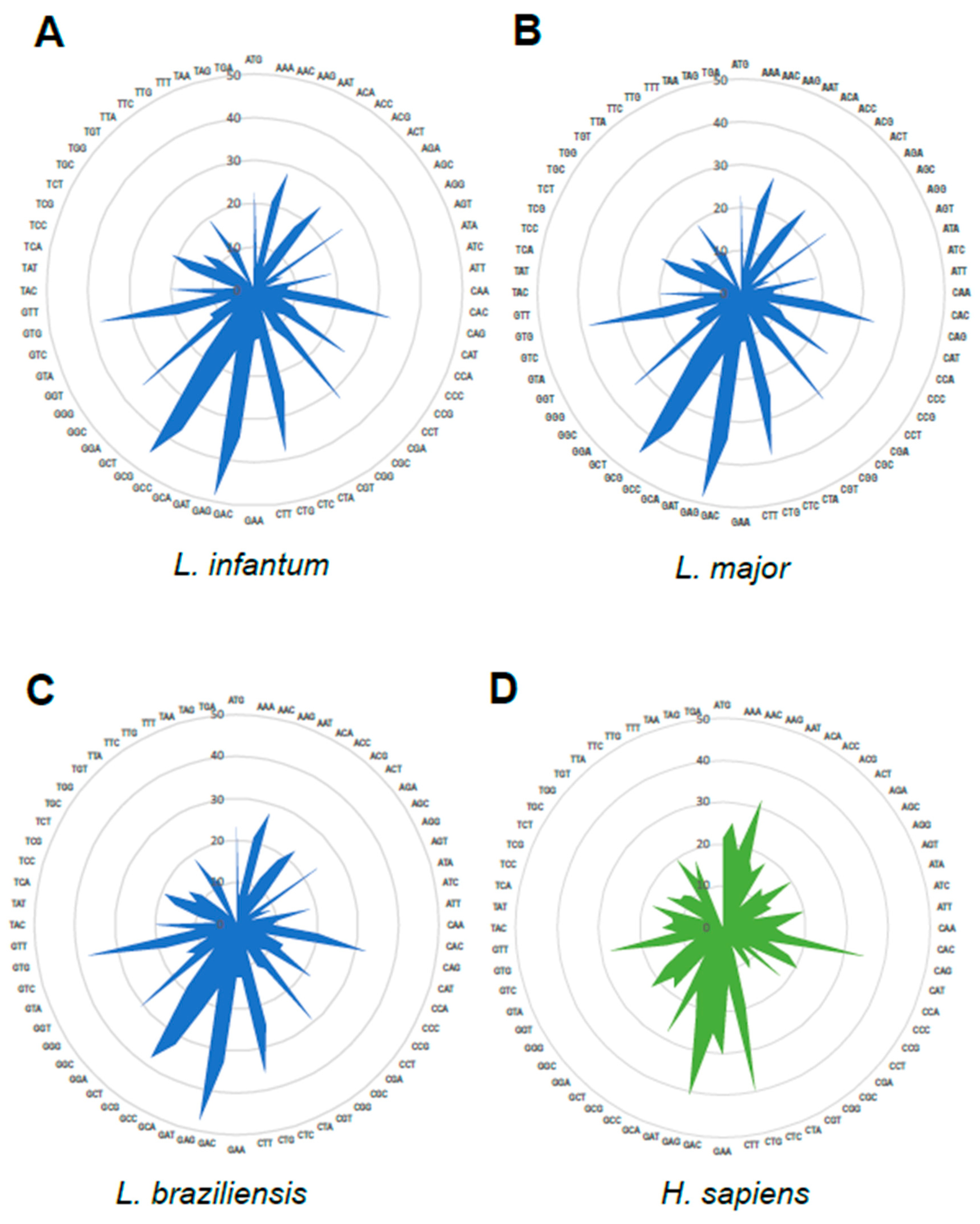
Figure 4.
Analysis of the correlation between codon usage and relative protein abundance. A) tRNA adaptation index (tAI) of the L. infantum proteins coding genes versus relative abundance (in logarithmic scale) of the encoded proteins. B) Proteins were grouped according their relative abundance values in four groups: <2, 2-3, 3-4, and 4-5. The number of proteins within each category (n) is indicated inside the bars. Error bars indicate the standard deviation between tAI values of proteins included in each group. Statistical differences among groups were calculated by the two-tailed unpaired Student’s t test (see text for p values).
Figure 4.
Analysis of the correlation between codon usage and relative protein abundance. A) tRNA adaptation index (tAI) of the L. infantum proteins coding genes versus relative abundance (in logarithmic scale) of the encoded proteins. B) Proteins were grouped according their relative abundance values in four groups: <2, 2-3, 3-4, and 4-5. The number of proteins within each category (n) is indicated inside the bars. Error bars indicate the standard deviation between tAI values of proteins included in each group. Statistical differences among groups were calculated by the two-tailed unpaired Student’s t test (see text for p values).
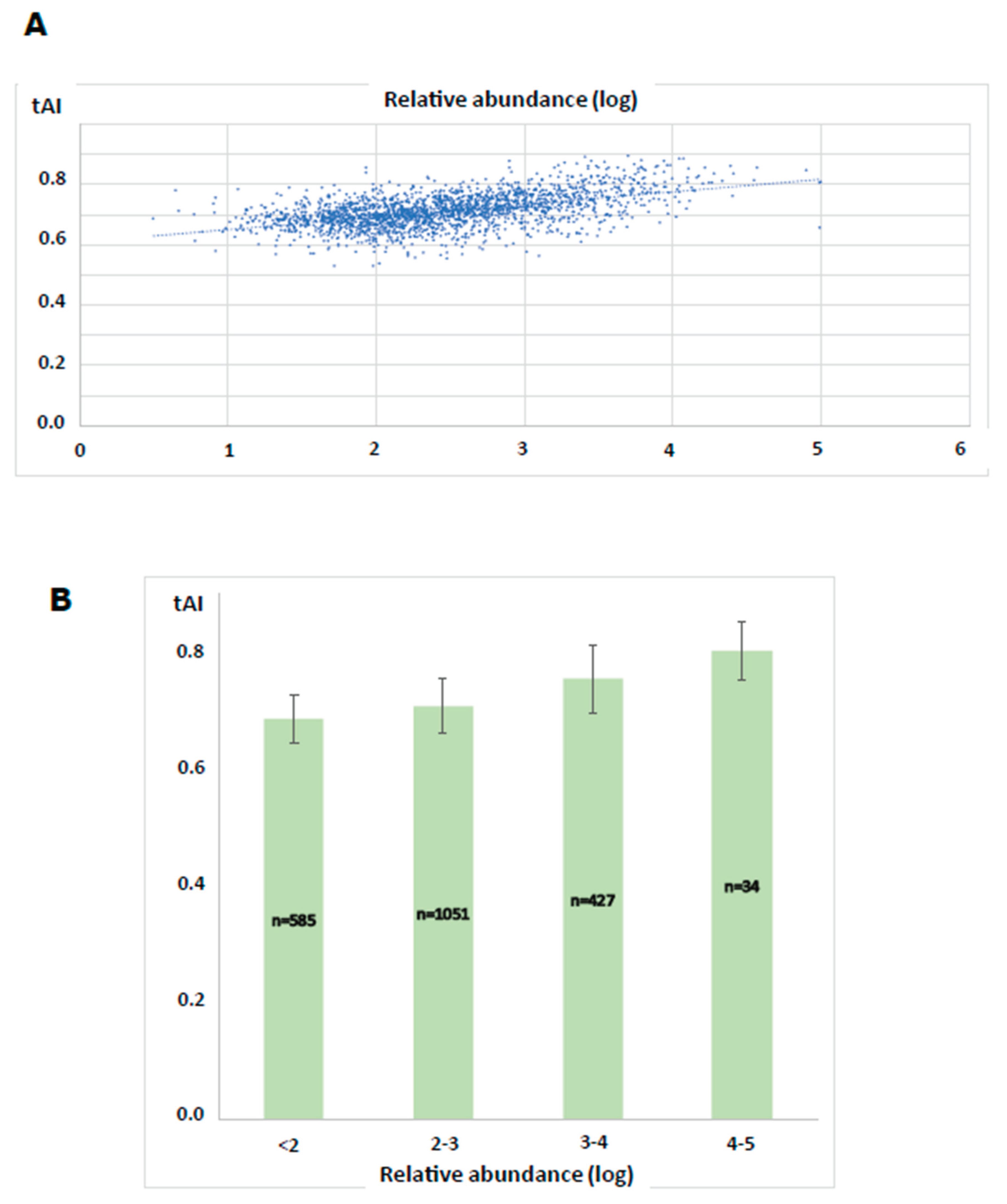

Table 1.
tRNA genes, codon Wik values, and codon usage in L. infantum.
| Amino acid | Anticodon | # tRNAs | tRNA gene ID | Wik | Codon | ‰ in CDSa |
| Phe | GAA | 3 | LINF_070006450* LINF_090016700 LINF_310035600 |
1 | TTC | 19.14 |
| AAA | 0 | 0.54 | TTT | 10.32 | ||
| Leu | CAG | 2 | LINF_090013100 LINF_230012100 |
1 | CTG | 38.12 |
| AAG | 3 | LINF_110009900 LINF_110010300 LINF_360074600 |
0.30 | CTT | 11.26 | |
| UAA | 1 | LINF_240022200 | 0.04 | TTA | 1.64 | |
| CAA | 1 | LINF_290025800 | 0.29 | TTG | 10.87 | |
| UAG | 1 | LINF_340017300 | 0.12 | CTA | 4.68 | |
| GAG | 0 | 0.65 | CTC | 24.81 | ||
| Ile | UAU | 1 | LINF_230011600 | 0.14 | ATA | 2.72 |
| AAU | 3 | LINF_240022300 LINF_240022400 LINF_340017100 |
0.44 | ATT | 8.37 | |
| GAU | 0 | 1 | ATC | 18.91 | ||
| Met (i) | CAU | 2 | LINF_090013000 LINF_360074700 |
1 | ATG | 22.65 |
| Met | CAU | 2 | LINF_110015000 LINF_340017200 |
1 | ATG | |
| Val | CAC | 2 | LINF_090016400 LINF_090017100 |
1 | GTG | 37.53 |
| AAC | 2 | LINF_210018800 LINF_340017000 |
0.23 | GTT | 8.73 | |
| UAC | 1 | LINF_230011700 | 0.15 | GTA | 5.45 | |
| GAC | 1 | LINF_020010500 | 0.51 | GTC | 19.16 | |
| Ser | GCU | 2 | LINF_170013500 LINF_210010800 |
1 | AGC | 25.48 |
| CGA | 1 | LINF_290025900 | 0.83 | TCG | 21.18 | |
| AGA | 1 | LINF_310035700 | 0.39 | TCT | 9.97 | |
| UGA | 1 | LINF_340017400 | 0.29 | TCA | 7.37 | |
| ACU | 0 | 0.28 | AGT | 7.23 | ||
| GGA | 0 | 0.64 | TCC | 16.32 | ||
| Pro | AGG | 2 | LINF_210018700 LINF_360033400 |
0.34 | CCT | 8.83 |
| CGG | 2 | LINF_240010900 LINF_340042500 |
1 | CCG | 26.13 | |
| UGG | 1 | LINF_360074800 | 0.40 | CCA | 10.48 | |
| GGG | 0 | 0.47 | CCC | 12.31 | ||
| Thr | UGU | 1 | LINF_230012200 | 0.40 | ACA | 10.02 |
| CGU | 2 | LINF_300026300 LINF_340042400 |
1 | ACG | 25.01 | |
| AGU | 3 | LINF_360019400 LINF_360019500 LINF_360033200 |
0.28 | ACT | 6.97 | |
| GGU | 0 | 0.70 | ACC | 17.47 | ||
| Ala | CGC | 2 | LINF_110010000 LINF_110010200 |
1 | GCG | 45.36 |
| AGC | 2 | LINF_170013600 LINF_310011300 |
0.41 | GCT | 18.51 | |
| UGC | 1 | LINF_330008700 | 0.45 | GCA | 20.40 | |
| GGC | 1 | LINF_290019900 | 0.81 | GCC | 36.95 | |
| Tyr | GUA | 3 | LINF_340042300 LINF_360019300 LINF_360019600 |
1 | TAC | 20.00 |
| AUA | 0 | 0.20 | TAT | 3.97 | ||
| His | GUG | 2 | LINF_090016400 LINF_090017400 LINF_130017500* |
1 | CAC | 20.15 |
| AUG | 0 | 0.33 | CAT | 6.59 | ||
| Gln | CUG | 3 | LINF_160017000 LINF_240022100 LINF_360051500 |
1 | CAG | 33.20 |
| UUG | 1 | LINF_230011800 | 0.23 | CAA | 7.64 | |
| Asn | GUU | 4 | LINF_100020000 LINF_280009850 LINF_340042200 LINF_340042600 |
1 | AAC | 20.81 |
| AUU | 1 | LINF_230016900 | 0.26 | AAT | 5.45 | |
| Lys | CUU | 4 | LINF_030011800 LINF_100019900 LINF_210018900 LINF_330021200 |
1 | AAG | 28.08 |
| UUU | 1 | LINF_230012400 | 0.20 | AAA | 5.64 | |
| Asp | GUC | 3 | LINF_130017500 LINF_170013400 LINF_240024600 |
1 | GAC | 34.26 |
| AUC | 0 | 0.43 | GAT | 14.57 | ||
| Glu | UUC | 1 | LINF_090017100 | 0.24 | GAA | 11.63 |
| CUC | 2 | LINF_150015100 LINF_310019000 |
1 | GAG | 48.53 | |
| Cys | GCA | 1 | LINF_360074500 | 1 | TGC | 14.63 |
| ACA | 0 | 0.27 | TGT | 3.93 | ||
| Trp | CCA | 1 | LINF_230012600 | 1 | TGG | 10.79 |
| Arg | ACG | 4 | LINF_050014900 LINF_070014000 LINF_110015000 LINF_230012000 |
0.32 | CGT | 10.31 |
| CCG | 1 | LINF_090017400 | 0.43 | CGG | 13.87 | |
| UCG | 1 | LINF_230012300 | 0.23 | CGA | 7.54 | |
| UCU | 2 | LINF_180013900 LINF_330008600 |
0.09 | AGA | 2.79 | |
| CCU | 1 | LINF_330008500 | 0.18 | AGG | 5.70 | |
| GCG | 0 | 1 | CGC | 32.50 | ||
| Gly | GCC | 4 | LINF_100020000 LINF_310018900 LINF_360033100 LINF_360033300 |
1 | GGC | 34.75 |
| CCC | 1 | LINF_110010100 | 0.34 | GGG | 11.87 | |
| UCC | 1 | LINF_230012500 | 0.19 | GGA | 6.68 | |
| ACC | 1 | LINF_210019700 | 0.35 | GGT | 12.11 | |
| SeC | UCA | 1 | LINF_060007300 | NA | TGA | NA |
a Determined from the coding sequences (CDS) of the 8532 L. infantum protein-coding genes annotated to date. *tRNA with atypical structure (see Figure 1).
Disclaimer/Publisher’s Note: The statements, opinions and data contained in all publications are solely those of the individual author(s) and contributor(s) and not of MDPI and/or the editor(s). MDPI and/or the editor(s) disclaim responsibility for any injury to people or property resulting from any ideas, methods, instructions or products referred to in the content. |
© 2026 by the authors. Licensee MDPI, Basel, Switzerland. This article is an open access article distributed under the terms and conditions of the Creative Commons Attribution (CC BY) license (http://creativecommons.org/licenses/by/4.0/).
Copyright: This open access article is published under a Creative Commons CC BY 4.0 license, which permit the free download, distribution, and reuse, provided that the author and preprint are cited in any reuse.