

Submitted:
20 April 2026
Posted:
21 April 2026
You are already at the latest version
Abstract
Biomass valorization plays a vital role in achieving carbon neutrality and circular economy frameworks. Owing to its carbon rich structure, biomass represents a promising feedstock to produce bio-based hydrocarbons via biological and thermochemical pathways. While biological conversion routes have been extensively studied, their deployment at commercial scale is constrained by high capital costs and low product yields. In contrast, thermochemical conversion technologies are increasingly being explored as viable largescale biomass valorization routes. This review presents a comprehensive assessment of thermochemical pathways, with particular emphasis on hydrothermal liquefaction (HTL). HTL enables the efficient conversion of wet and heterogeneous lignocellulosic biomass without energy intensive drying pretreatments. The review critically examines the formation and physicochemical properties of the two main HTL products, namely liquid biocrude and solid hydrochar. Special attention is devoted to challenges associated with biocrude quality, particularly its high oxygen content, and corresponding upgrading strategies. Additionally, the diverse applications of hydrochar for energy recovery, soil amendment, and heterogeneous catalyst synthesis are discussed. The article also compares the technology readiness levels of thermochemical conversion routes and highlights the growing role of artificial intelligence and machine learning in process modelling and optimization. Finally, future research directions are identified, emphasizing design by specification strategies and physics informed AI to enable scalable, autonomous biomass conversion technologies.
Keywords:
biomass valorization
; hydrothermal liquefication
; biocrude upgrading
; hydrochar application
; artificial intelligence
1. Introduction
Biomass serves as a versatile resource for industries in animal fooding, textiles, construction, soil improvement, chemicals, and energy sectors. In the global pursuit of sustainability, carbon neutrality, and reduced environmental impact, biomass has emerged as a key contributor to circular economic strategies. Its organic and renewable nature makes it an attractive alternative to fossil-based resources. However, using primary biomass for energy directly competes with food production, which has a higher priority [1]. This challenge highlights the importance of second-generation biofuels, derived from agro-forestry residues, and other waste streams. The biomass waste used for producing second generation biofuels share similar chemical compositions with fossil-based feedstocks. Further, biomass offers advantages such as high abundance, renewability, and biodegradability, which makes them a promising solution for sustainable energy and resource recovery [2]. Organic residues contribute 46% of cumulative global solid wastes, where agricultural, industrial and urban-area produced residues are the chief contributors [3]. Agricultural and forestry operations generate substantial quantities of lignocellulosic residues, including husks, straws, sawdust, and wood shavings. These bio-residues, primarily composed of cellulose, hemicellulose, and lignin, represent the most abundant renewable biomass resource on Earth. Owing to their chemical complexity and structural diversity, lignocellulosic biomass is increasingly recognized as a versatile feedstock for energy and chemical productions. The unique chemistry of its major components enables the development of advanced biorefinery processes, positioning lignocellulosic biomass as a cornerstone for future bio-based industries [4]. Biofuels derived from lignocellulosic biomass are widely regarded as carbon-neutral alternatives to fossil fuels for the transportation and energy sectors. Currently, fossil fuels dominate the global primary energy supply, accounting for approximately 81%, followed by renewable sources at 14% (biomass contributes 70%) and nuclear energy at 5%. The global annual biomass supply from agriculture and forestry is estimated at approximately 12 billion tons of dry matter, with agriculture providing about 61% (47% from crops and 14% from above-ground residues) and forestry contributing the remaining 39%. These figures underscore the vast availability of biomass resources and their critical role in advancing sustainable energy systems [4,5]. Figure 1 illustrates different sources of biomass along with their end-to-end distribution for different applications. The major sectors where the produced biomasses are used differ depending on the source of residue production, like crop residues are chiefly used as animal food and bioenergy synthesis. Whereas bio-based residue produced from wood industry is chiefly used in the energy sector followed by the biomaterials industry [6].
2. Thermal Conversion of Bio-Based Residues
Vegetal biomass is an abundant, and easy to acquire resources which can be converted into energy and sustainable materials. Application of organic raw material chiefly aims at reducing the consumption of fossil-based items for daily human consumption. However, the most important challenge is associated with finding and developing proper biomass conversion and valorization methods. Although several technologies are being developed for the large-scale conversion of biomass into energy, their widespread adoption remains limited due to the requirement for high capital investment. Hydrothermal treatments, torrefaction, pyrolysis, gasification and combustion are preferred routes for the treatment and valorization of biomass and other organic residues [17]. Figure 2 shows the products from different thermochemical conversion techniques and identifies the major application fields of each product.
Thermochemical conversion technologies enable the transformation of biomass into solid, liquid, and gaseous energy carriers through controlled variations in temperature, reaction conditions, and residence time. Among these pathways, pyrolysis is the most widely applied method, accounting for approximately 52 % of reported biomass-to-energy studies. Pyrolysis involves the thermal decomposition of biomass at elevated temperatures in the absence of oxygen, producing liquid bio-oil along with solid char and non-condensable gases, which are commonly utilized for energy generation and further upgrading. Hydrothermal processing, including hydrothermal liquefaction and hydrothermal carbonization, ranks as the second most reported conversion route with a share of about 11-12 %. Operating in hot, compressed water at temperatures typically between 200 and 500 °C, hydrothermal processing is particularly suited for wet biomass and organic residues. These processes yield high-energy-density liquid biocrude and solid hydrochar without the need for prior drying the feedstock. Combustion represents the third most practiced thermochemical pathway, accounting for roughly 10 % of applications, and remains a mature technology for direct heat and power generation [18,19]. Gasification and related high-temperature conversion routes are less frequently reported and involve partial oxidation of biomass under controlled oxygen conditions to produce syngas. Collectively, these thermochemical pathways show that adjusting reaction severity and operating conditions governs the distribution of solid, liquid, and gaseous products share during biomass conversion [20,21].
Thermochemical conversion technologies for biomass can be broadly categorized into conventional incineration (CI) and advanced thermal (AT) techniques. This classification is based on reaction conditions, operating severity, and desired product properties. CI techniques rely on the complete oxidation of biomass in excess oxygen to directly generate heat and electricity. In contrast, AT techniques operate under oxygen deficient or controlled environments [21,22,23]. These techniques are designed to enhance conversion efficiency while enabling the production of biofuels. These advanced approaches include pyrolysis, gasification, and related high-temperature processes distinguished by the extent of oxidation and the nature of products [24]. Pyrolysis proceeds in the absence of oxygen and favors the formation of liquid and solid products through thermal decomposition. Gasification, on the other hand, employs partial oxidation at higher temperatures to generate syngas (H2 + CO) as the dominant product [25,26]. Hydrothermal routes extend this classification by introducing water as a reactive medium, enabling biomass conversion at elevated pressures and moderate temperatures. Within this advanced thermal framework, fast/flash pyrolysis and hydrothermal liquefaction (HTL) represent two distinct but complementary pathways that bridge conventional waste-to-energy and fuel-oriented biorefinery concepts. As highlighted in waste-to-energy classifications, pyrolysis emerges as a key advanced alternative to incineration due to its ability to recover liquid fuels rather than solely heat or power. Building on this foundation, comparative thermochemical analyses of fast/flash pyrolysis and HTL demonstrate that process selection is governed not only by operating conditions but also by the biochemical composition and moisture content of the feedstock [27].
3. Hydrothermal- Liquification, Biocrude Upgradation Techniques and Factors Affecting Biocrude Upgradation
Biomass is a chemically and physically heterogeneous material composed predominantly of organic matter, accompanied by a smaller but influential fraction of inorganic (mineral) constituents. The organic fraction is mainly responsible for energy content and reactivity. Biomass chiefly consists of carbon, hydrogen, and oxygen-rich compounds, with minor amounts of nitrogen, sulfur, and phosphorus, which influence emissions during conversion. The inorganic fraction in biomass comprises minerals present as organically bound elements, simple salts, or discrete mineral phases originating from plant uptake, soil contamination, or processing [28]. The compounds typically include alkali and alkaline earth metals (K, Ca, Mg, Na), silicon, phosphorus, chlorine, and trace elements. Compared to fossil fuels, bio-based liquid hydrocarbons are characterized by high oxygen content, high viscosity, and strong compositional variability. These properties collectively govern the heating value, conversion efficiency, and ash-related challenges in energy application of biofuels [28,29]. Hydrothermal processes, particularly HTL, represent a thermochemical conversion route that is fundamentally distinct from both conventional incineration and dry advanced thermal techniques. Incineration is designed for complete oxidation and direct heat or power generation, while dry advanced thermal routes, such as pyrolysis, aim to recover energy intermediates from low-moisture feedstocks [20,30]. HTL, in contrast, operates effectively on wet and compositionally heterogeneous biomass removing the cost of drying pre-treatment. Conversion proceeds through hydrolysis, decomposition, and repolymerization reactions in hot compressed water. These mechanisms favor the formation of liquid products with higher carbon retention and lower oxygen content than typical pyrolysis oils [20,31]. Figure 3 illustrates the different mechanisms occurring during the HTL of biomass, based on the different components of biomass. The figure indicates that proteins, lipids, carbohydrates, and lignin undergo a common initial hydrolysis step, forming reactive intermediates that follow component-specific secondary pathways under HTL conditions. Lipids and proteins preferentially contribute to bio-oil through fatty acid decarboxylation/dehydration and amino-acid deamination/decarboxylation, respectively. Carbohydrates hydrolyze to sugars that further fragment and dehydrate to yield water-soluble compounds in the aqueous phase, with partial decarboxylation producing gaseous products. Lignin degrades into phenolic intermediates that undergo repolymerization and condensation, leading predominantly to solid biochar formation [32,33,34]. While hydrolysis serves as the initial step in biomass conversion during the HTL process, the final product distribution is controlled by competing secondary reactions. Stabilization pathways promote bio-crude and gas formation, whereas condensation reactions preferentially direct carbon toward solid biochar, especially in lignin-rich feedstocks [35].
The major energy producing biomass are obtained from wood processing residues, agricultural residues, food wastes, algal biomass, and municipal solid wastes [36]. However, biomass derived HTL biocrude has a limited application in commercial energy sector due to its physio-chemical limitations. These drawbacks require treatment through advanced techniques for improving the quality of the product. However, the intricacy of the process and complex chemical structure of biocrude, makes the upgradation task quite difficult for industrial application [37]. Figure 4 shows the compounds found in energy producing biomass. The quality and quantity of bio-crude produced by HTL are strongly rooted to the properties and composition of the biomass. Besides, lignocellulosic components (cellulose, hemicellulose and lignin) and extractives (proteins and lipids), presence of aldehydes, phenolic compounds, N-containing groups and esters, have significant impact on the quality of biocrude produced [38,39,40].
The major upgradation techniques adopted for enhancing biocrude quality are divided into physical and chemical upgradation methods, depending on the nature of the method used for extracting usable fuels. Physical upgradation techniques like supercritical fluid treatment, solvent addition, emulsification and distillation, target the direct extraction of valuable hydrocarbons from biocrude. However, these techniques do not have any influence in enhancing the yield of usable hydrocarbons. Contrary to physical techniques, chemical treatments enhance the physical fuel properties of the biocrude and increase the hydrocarbon yield through molecular alterations, through selective removal of unwanted heteroatoms. The most adopted chemical techniques for biocrude upgradation are hydrotreating, esterification, catalytic cracking, and steam reforming [41]. Among these approaches, catalytic hydrotreating has emerged as the most extensively investigated route due to its effectiveness in heteroatom removal and its direct compatibility with existing petroleum refining infrastructure. Catalytic hydrotreating is a thermochemical upgrading process in which biocrude is treated in the presence of hydrogen to promote hydrogenation reactions. The process targets removal of heteroatoms through mechanisms like hydro-deoxygenation, hydro-desulfurization, and hydro-denitrogenation [42]. Table 1 compiles different studies conducted on upgradation of HTL-produced biocrude from different feedstocks through hydrotreatment techniques. The table summarizes catalytic upgrading studies of HTL biocrudes spanning lignocellulosic, lipid-rich, algal, and waste-derived feedstocks. It is observed that across all systems, sulfided NiMo and CoMo-based catalysts exhibit strong hydrodeoxygenation activity, yielding substantial reductions in oxygen content under a wide range of operating conditions.
The table suggests that feedstocks dominated by lignin or lipid-derived oxygenates reach low residual oxygen levels at moderate severity. In contrast, biocrudes derived from sewage sludge, food waste, and wastewater-grown biomass show persistent nitrogen-related challenges despite severe reaction conditions. Multi-stage configurations and guard-bed deployment reported for nitrogen and metal-rich feeds reflect catalyst protection and stability attainment with very low O2 concentration. The data collectively indicate that oxygen removal is kinetically favorable over conventional hydrotreating catalysts. However, nitrogen-containing species have higher severity demands, require well designed upgrading strategies and longer catalyst lifetime. The following sections elaborate on the different hydro-processing technologies used at industrial levels for enhancing the quality of crude oil, and thus, increasing the amount of liquid fuel yield.
3.1. Hydro-Processing Methods of HTL-Biocrude
Hydrotreatment of crude oils has been practiced at commercial refineries for several decades to produce high-quality transportation fuels. It is primarily divided into three major categories: (i) hydrodeoxygenation (HDO), (ii) hydrodenitrogenation (HDN), and (iii) hydrodesulfurization (HDS). As suggested by their nomenclature, these processes selectively remove heteroatoms such as oxygen, nitrogen, and sulfur, present in both conventional petroleum crudes and renewable biocrudes, respectively. The feedstock is processed under elevated temperature and hydrogen pressure, converting heteroatoms into by-products such as water (H₂O), hydrogen sulfide (H₂S), and ammonia (NH₃), while simultaneously improving fuel quality and stability [48,49]. A common way to see and understand the hydrotreatment reaction is shown in equation (1) [50].
However, the high severity of operating conditions, required for processes like HDN and HDS, limits their application at commercial levels for biocrude upgradation. Nevertheless, HDO processes require less severe conditions, to remove elemental oxygenated compounds from bio-based crude oils. The differences in the nature of the upgradation processes favor the use of oxygen containing biomass for fuel production as compared to nitrogenous compounds. Thus, further discussions in this article would focus on the research developments in HDO processes to understand its applicability and limitations faced in the industries.
3.2. Hydrodeoxygenation
Hydrodeoxygenation is a key upgrading reaction for biomass-derived crude oils, enabling the removal of oxygenated compounds through hydrogenation and hydrogenolysis reactions. In HDO, C-O-C, C-O-H, and C-O bonds, present in phenols, aldehydes, ketones, acids, and ether groups, are cleaved with oxygen predominantly eliminated as water. However, the process ensures that the hydrocarbon framework is retained or hydrogenated depending on reaction conditions and catalyst properties [51]. Conventional HDO processes are conducted at moderate to high temperatures (typically 300-400 °C) and elevated hydrogen pressures over heterogeneous catalysts. The efficiency of HDO is governed by the balance between metal sites, responsible for hydrogen activation, and acid sites to carry out dehydration, C-O bond scission, and ring-opening reactions [52,53].
The reaction environment plays a critical role in determining HDO performance, particularly when comparing monophasic and biphasic solvent systems. In monophasic systems, solvent, and catalyst exist in a single liquid phase, where reaction rates and selectivity are strongly influenced by solvent polarity and solubility effects. Single-phase systems offer simplified reactor design and easier catalyst handling, but are prone to secondary reactions like repolymerization, coke formation, and catalyst deactivation, especially at the high temperatures [53]. In contrast, biphasic water-oil systems introduce a simultaneous reaction-separation function. These systems increase the interfacial area between phases, promote selective partitioning of reactants and products, and suppress undesired side reactions by continuously extracting products into the organic phase. Studies approve that biphasic systems improve mass transfer, stabilize transition states, and reduces catalyst deactivation, and hydrolysis rates of sensitive intermediates [53,54,55].
Recent advances emphasize the use of tailored catalysts in conjunction with biphasic systems to further enhance HDO efficiency. Amphiphilic and carbon-based catalysts can stabilize water-oil interfaces, forming Pickering emulsions to maximize interfacial contact and hydrogen availability at the reaction zones. Noble metal catalysts exhibit high hydrogenation activity under relatively mild conditions, while non-noble metal systems and bifunctional catalysts enable cost-effective large-scale deployment [48,52,56,57]. Further, studies related to model compounds demonstrate that biphasic HDO systems enhance selectivity toward deoxygenated products, improve catalyst stability, and simplify downstream separation by coupling reaction and extraction within a single process step [53,58,59,60]. Collectively, these developments position HDO as a robust and scalable strategy for upgrading oxygen-rich biocrudes into fuel-compatible intermediates in biphasic reaction environments.
Several studies have been conducted to help explore the impact of catalytic and non-catalytic HDO processes for upgradation of biocrude oils. Table 2 lists different studies conducted on HDO of bio-based crude oils produced through HTL process. The table indicated that deep deoxygenation of HTL biocrudes requires high-temperature (330-400 °C), and abundant hydrogen supply (70-150 bar) for upgradation. Across diverse feedstocks, achieving oxygen contents below 1 wt.% typically requires sulfided NiMo, CoMo, or noble metal catalysts. Further, batch hydro treatment studies rely on high catalyst loadings (10-40 wt.%) to compensate for limited residence time and mass-transfer constraints [61,62].
Contrary to the batch processes, studies on continuous trickle-bed hydrotreatment and staged upgrading strategies showed similar or superior oxygen removal at lower catalyst loading [66,67]. H2-donor solvents and partial HDO steps further mitigate coke formation and improve stability at high severity. Nevertheless, upgrading performance strongly depends on feedstock composition and strategy selection [62,65]. Protein and nitrogen-rich biocrudes required more severe hydrotreatment yet still exhibited limited nitrogen removal. This indicates that HDN remains more challenging to accomplish than HDO at lab-scale studies [62]. Lignocellulosic and lipid-rich feeds respond more favorably to both single-step HDO and staged upgrading approaches. However, partial HDO prior to co-processing of lignin rich feedstock derived biocrude reported higher miscibility and characteristics of stable refinery integration. Besides, subsequent refinery hydro-processing further reduces biocrude oxygen content to fossil-like levels (< 0.2 wt.%) [67].
Hydrothermal liquefaction (HTL) biocrude is currently being recognized as a chemically multifunctional intermediate suitable to produce biochemicals along with fuels. Chemically, HTL biocrude comprises a highly heterogeneous mixture of phenolic monomers and oligomers, carboxylic acids, ketones, aldehydes, esters, fatty acids, olefinic hydrocarbons, and N and S-containing heterocycles. The chemical compounds are majorly formed through hydrolysis, dehydration, decarboxylation, retro-aldol condensation, and recombination reactions under subcritical and near-critical water conditions [71,72]. In lignocellulosic feedstocks, lignin depolymerization via β-O-4 ether bond cleavage yields guaiacols, syringols, catechols, and alkyl phenols. This process generates phenolic-rich biocrudes that have demonstrated direct applicability as renewable substitutes for petroleum phenol in phenol-formaldehyde resins and wood adhesives [73,74,75]. Concurrently, cellulose and hemicellulose hydrolysis followed by dehydration reactions produce furfural, 5-hydroxymethylfurfural (5-HMF), levulinic acid, and short-chain organic acids. These chemicals function as platform molecules for downstream synthesis of resins, plasticizers, solvents, pharmaceutical intermediates, and agrochemicals [72,73]. Lipid-rich feedstocks undergo triglyceride hydrolysis, subsequent decarboxylation and hydrogen transfer reactions, yielding free fatty acids, fatty esters, and long-chain hydrocarbons. This enables targeted recovery of specialty chemicals, lubricants, surfactants, and oleochemical applications without the need of attaining deep hydrotreating severity [73,76,77]. Protein-derived biocrudes introduce amine, amide, pyrrolic, pyridinic, and nitrogen species formed through deamination and Maillard-type reactions. These chemical compounds are valuable precursors for pharmaceuticals, corrosion inhibitors, functional additives, and specialty reagents post separation [72,73,78]. The heavy biocrude fraction (boiling range >350 °C) contributes as a potential source of bio-asphaltenes and bio-polyol precursors, supporting applications in bitumen modification, polymer synthesis, and polyurethane production [79,80]. Importantly, HTL biocrude valorization is enhanced by integration with the aqueous phase, which contains water-soluble carboxylic acids, alcohols, sugars, and nitrogenous compounds. These compounds can be recovered for chemical use or nutrient recycling (fertilizers), improving overall carbon efficiency and process circularity [81,82,83].
Besides producing liquid products, the HTL process also produces a significant quantity of solid by-products known as hydrochar. It is carbon-rich source that has been identified as a promising resource for several applications like soil enrichment, water treatment and many more. The following section carries out a detailed discussion of the chemical composition of the solid hydrochar along with a comprehensive discussion on the promising routes of its applications.
4. Applications for Hydrochar Produced from Hydrothermal Liquification
Hydrochar is a carbon-rich solid material produced through hydrothermal conversion of biomass in subcritical or supercritical water. Thus, making hydrochar production particularly suitable for wet biomass without an energy-intensive drying step. Unlike biochar, hydrochar is generated at relatively low temperatures (typically 180-240 °C) under autogenous pressure [84,85]. Hydrothermal carbonization (HTC) is the most widely adopted method for the production hydrochar globally. HTC produces hydrochar through the compression of water in the medium at temperatures lower than the pyrolysis range. However, at temperature higher than 260 °C HTL is the major process employed for hydrochar making [84,86,87]. HTL process promotes dehydration, decarboxylation, and polymerization reactions, yielding the solid by-product, hydrochar. As a result, hydrochar typically exhibits higher H/C and O/C ratios, lower ash content, and a more acidic surface compared to pyrolysis-derived biochar [88,89]. Figure 5 illustrates different methods of hydrochar production, as found in literature. The image lists the important conditions needed during each process, for hydrochar production. Lower temperatures and pressure are both favorable to achieve high yields of hydrochar in HTC. However, with the increase in temperature and pressure, the major product of hydrotreating process shifts towards liquid or gas-based resources, with limited amount of hydrochar production [87].
Although pristine hydrochar generally possesses low surface area and porosity as compared char produced through other techniques. However, the physicochemical properties of hydrochar can be significantly tuned through processes like activation and functionalization [90,91]. These characteristics have positioned hydrochar as a promising renewable material for applications in catalyst production, adsorption applications, carbon sequestration, and environmental remediation [88]. The following section contains a brief discussion on the different applications of hydrochar upon specific physio-chemical treatments.
4.1. Bio-Coal for Energy
Hydrochar contains a high fraction of fixed carbon and a reduced oxygen content compared with raw biomass, leading to improved fuel quality and greater energy density. The elemental composition of hydrochar typically shows lower O/C atomic ratios than untreated biomass, indicating a higher degree of carbonization and enhanced calorific value [92]. As a result, hydrochar commonly exhibits higher heating values in the range of low-rank coals, with values often comparable to lignite and, while in some cases, approaching those of bituminous coal [93,94]. The increased carbon content and reduced volatile matter of hydrochar contribute to more stable and efficient combustion behavior. The product also contains fewer inorganic constituents than many raw biomasses, which results in lower ash content and improved combustion cleanliness. These chemical characteristics support smoother ignition, reduced slagging tendencies, and improved overall fuel performance [95,96]. Consequently, hydrochar can be used as a solid fuel for stationary energy generation, either as a standalone fuel or in co-firing systems with coal, without major modifications to existing infrastructure.
In addition to direct combustion, the chemical composition of hydrochar makes it a well-suited feedstock for gasification. The high fixed-carbon content and reduced volatile matter, shifts gasification of hydrochars from volatile-dominated reactions to char controlled heterogeneous reactions. Elemental analysis shows increased carbon content and decreased hydrogen and oxygen contents, resembling a coal-like structure. This carbon-dense composition promotes the formation of condensed aromatic structures that are thermally stable and reactive during char-steam and char-CO₂ gasification [97]. The enrichment of fixed carbon enhances hydrogen production through char gasification and the water-gas shift reaction. At the same time, the removal of O2-containing functional groups suppresses excessive CO₂ formation and reduces hydrogen consumption, leading to improved syngas quality and low tar production [98,99]. In addition, alkali and alkaline earth metals such as K, Ca, and Mg are relatively enriched in the solid phase and act as intrinsic catalysts for gasification and tar reforming [96]. Together, the high fixed-carbon content, increased aromaticity, reduced oxygen functionality, and favorable inorganic composition explain the coal-like energy containment for efficient syngas production in hydrothermally derived char.
Several studies have been conducted to find the potential of bio-coal production from hydrothermal processes over a long period of time. These studies majorly focused on application of HTC as a biomass conversion process. A research study carried out by Musa et al. in 2022 analyzed the effect of process variables on biocoal production through HTC of pine Kraft lignin at low temperatures. The study observed that, lignin-rich feedstocks exhibit a high degree of coalification under HTC. During HTC of pine Kraft lignin, the solid product retained a large fraction of aromatic carbon because lignin contains pre-condensed phenylpropane units. Further, hydrolysis cleaved ether and ester linkages, while dehydration and decarboxylation preferentially removed oxygen rather than carbon. Solid-state 13C-NMR confirmed loss of oxygenated functional groups and enrichment of aromatic carbon in the solid phase. As a result, carbon recovery remained high even at elevated temperatures, and fuel ratios increased substantially with residence time. Alkali metal leaching occurred concurrently due to subcritical water acting as an effective inorganic solvent, improving ash behavior without compromising carbon retention [100]. A study focused on understanding the feasibility of bio-coal production through HTC in Malaysia, found that considering the Malaysian food waste composition, HTC is a suitable process for bio-coal production. However, it was observed that due to large moisture content of the feed, the fuel produced was found to be of moderate quality with limited improvements in combustion properties. Thus, concluding that, economic feasibility, rather than chemical limitation, emerged as the primary constraint for industrial adoption of HTC to create bio-coal [101]. A recent study conducted by Alper et al. (2024) investigated the production of bio-coal in presence of two sulfonic-acid catalysts, from lignocellulosic biomass, through HTC. The study observed that acid addition increased proton availability, promoting breakdown of polysaccharides into furanic intermediates, that polymerized into fixed carbon. Higher fuel ratios resulted, alongside increased formation of organic acids in the aqueous phase. Morphological cracking observed by electron microscopy corresponded to intensified volatile matter release, rather than thermal sintering [102]. Besides these studies, a study on HTC of Miscanthus, showed that HTC corrected biomass specific limitations unrelated to carbon content. Early harvested material suffered from high alkali concentrations and poor grindability. Thus, due to uneven particle sizes, HTC selectively removed inorganic species and disrupted fibrous structures, producing friable solids with coal-like combustion behaviour [103]. However, in another study on bio-coal production from elephant dung, torrefaction of feedstock produced limited coalification. Oxygen remained structurally bound, and energy demand was dominated by moisture evaporation. These results highlighted water-mediated chemistry as the critical factor enabling deep transformation in wet biomass systems [104].
Conclusively, hydrothermal processes produce a carbon-rich, coal-like solid (hydrochar) with enhanced fuel properties. The high fixed carbon, low O/C ratio, and heating values are comparable to low-rank coals, supporting efficient combustion and syngas generation. However, the degree of coalification achieved is strongly feed-dependent and is ultimately limited by techno-economic factors rather than chemistry alone.
4.2. Soil Enrichment
Hydrochar amendment modifies soil behavior primarily through surface chemistry and carbon fraction composition rather than through surface area or porosity. Multiple studies show that hydrochars rich in oxygen, nitrogen, and phosphorus containing functional groups interact directly with soil minerals, contaminants, and microorganisms [105,106]. These surface groups determine electrostatic interactions, chemical complexation, redox reactions, and mineral bridging. Thus, indicating that soil responses depend more on chemical reactivity than on bulk physical properties such as BET surface area [107,108]. Metal immobilization by hydrochar follows metal-specific pathways rather than a single universal mechanism. In lead-contaminated soils, phosphorus-enriched hydrochars immobilize Pb predominantly through the formation of insoluble Pb-phosphate phases and inner-sphere complexation with phosphate and carboxyl containing surface groups. This process sharply reduces Pb leaching and plant uptake, even under extreme contamination levels [106,109]. Other metals like chromium show significantly different fundamental behavior, compared to Pb contaminants. In a study on algal-derived hydrochar application for Cr removal, it was observed that the hydrochar promotes electron transfer from nitrogen-doped aromatic structures. This phenomenon reduces Cr (VI) to Cr (III), by subsequent immobilization through surface complexation and precipitation. Cadmium, however, shows weaker immobilization because it lacks redox chemistry and relies mainly on electrostatic attraction and coordination with oxygen and nitrogen-containing functional groups. These results highlight that hydrochar effectiveness depends on matching hydrochar chemistry with metal speciation [110].
Hydrochar also improves soil physical structure by enhancing soil aggregation. Experimental studies demonstrate that hydrochar accelerates macroaggregate formation by acting as nuclei for particulate organic matter while stimulating microbial production of binding agents [107,111]. Labile dissolved organic carbon initiates microbial activity, whereas aromatic carbon fractions become physically protected within aggregates. As a result, mean weight diameter increases by up to 100%, and soil organic carbon (SOC) increases by more than 140%, exceeding responses observed with straw or biochar amendments [107]. Nutrient retention and availability are similarly governed by surface chemistry. Hydrochars with high densities of acidic functional groups exhibit increased cation exchange capacity, improving ammonium and potassium retention and reducing nutrient leaching [112]. Nutrient release shifts from rapid dissolution to diffusion and sorption-controlled behavior. In fertilizer systems, hydrochar prolongs nitrogen residence time in soil while sustaining plant uptake and minimizing nutrient loss [108]. In alkaline soils, hydrochar enhances phosphorus availability by lowering pH and promoting microbial transformation of stable calcium-phosphate pools into labile forms [113]. Hydrochar amendments enhance soil aggregation, soil organic carbon protection, and nutrient retention when carbon remains accessible to microbial processing. Several studies indicate that carbon stability alone does not guarantee improved biological function, also, nutrient availability and microbial responses depend strongly on hydrochar chemistry and soil context. Thus, improving soil aggregation, SOC protection, and nutrient turnover [114,115,116].
Hydrochar performance varies with its physicochemical characteristics and the properties of the receiving soil. Under appropriate conditions, hydrochar immobilizes metals through chemical precipitation, redox transformation, and surface complexation. Subsequently, it also contributes to soil aggregation, soil organic carbon stabilization, and nutrient retention via interactions with soil minerals and microbes. However, the relative contribution of these processes differs across hydrochar types and soil systems. Thus, reflecting differences in surface functionality, carbon composition, and nutrient chemistry. This variability indicates that hydrochar behavior is context dependent and should be evaluated with consideration of both material properties and site-specific soil constraints.
4.3. Catalysts from Hydrochar
In recent years, biomass-derived carbon materials have been widely investigated as heterogeneous catalysts for energy and environmental applications. Among these, hydrochar has attracted growing attention due to the ease with which its surface chemistry can be deliberately modified to introduce catalytic functionality [88,117]. Several studies demonstrate that hydrochar can be transformed into effective solid catalysts or catalysts support, used for biofuel production, advanced oxidation processes, and biocatalysis, through post-synthetic chemical treatments [118,119,120]. Catalytic performance found across studies is closely linked to the physical and chemical characteristics of functionalized hydrochar. Surface roughness and accessible pore structures facilitate effective mass transfer and exposure of reactants to active sites [121,122]. Although hydrochar exhibits moderate surface areas compared to activated carbon, catalytic activity is primarily governed by the surface functional groups, along with the adsorption capacity [121]. Surface oxygen-containing functionalities on hydrochar enable post-synthetic functionalization, supporting the formation of basic catalytic sites through alkaline activation [121], stable Brønsted acid sites via sulfonation [123], and in covalent anchoring of enzymes following crosslinking [122].
Beyond acid-base catalysis, hydrochar has been applied in redox-driven water treatment systems. Yu et al. [124] in their study related to development of Fe-hydrochar composites to catalyze estrogen through Fenton-like mechanisms, demonstrated that Iron-loaded hydrochar effectively promoted Fenton-like oxidation. The modified hydrochar facilitated electron transfer and stabilized iron species during hydrogen peroxide activation [124]. Further, Li et al. (2022), extended this approach by developing hydrochar-based photocatalytic composites, achieving efficient pharmaceutical degradation under visible light [125]. These studies confirm that hydrochar contributes directly to catalytic mechanisms by mediating redox reactions rather than functioning solely as an adsorbent. Hydrochar has also been explored as a catalyst support for metal-based and biocatalytic systems. Pereira et al. (2022) synthesized a triazole-functionalized hydrochar to anchor palladium nanoparticles for ullmann coupling. They observed that triazole groups introduced onto hydrochar via CuAAC click chemistry, enabled uniform anchoring of palladium nanoparticles. This phenomenon resulted in a monodispersed, recyclable nanocatalyst that delivered high conversion and selectivity in Ullmann homocoupling reactions. The catalyst had high performance under mild, environmentally benign conditions, with minimal loss of activity over multiple reuse cycles [126].
The use of hydrochar as catalysts for biodiesel production has also been a burning topic of discussion in the bio-fuel engineering field. In a study conducted by Khan et al. in 2024 rice husk derived hydrochar was modified via cobalt impregnation to create a metal-anchored catalyst with high accessibility of active sites. The resulting RHAC-Co catalyst achieved biodiesel conversion efficiencies above 96% under relatively mild conditions (75 °C, low catalyst loading). This observation confirmed that the oxygen-rich hydrochar surface effectively stabilizes metal species and promotes transesterification activities [127]. Furthermore, in a dual-function system, mustard husk hydrochar coated with polyaspartic acid and incorporated with Fe-Mn species was designed to address both heavy-metal remediation and hydrogen evolution. The modified hydrochar showed exceptional Pb (II) removal (approx. 99%) and significantly enhanced H2 generation rates. This observation was attributed to increased surface area, improved electron transfer, and negatively charged oxygen-containing functional groups that favored metal binding and redox reactions [128].
Hydrochar has also shown strong catalytic performance in oxidation-based water treatment processes. Glucose-derived hydrochar combined with bimetallic metal-organic frameworks (MOFs) enabled efficient activation of peroxymonosulfate. Thus, resulting in rapid dye degradation and high mineralization efficiency over a wide pH range. It was observed that the hydrochar improved the structural stability of the MOF and suppressed metal leaching, extending catalyst lifetime [129]. Similarly, Fe-activated hydrochar produced from olive mill waste was evaluated in photo-Fenton systems, where it promoted hydroxyl radical generation and achieved rapid decolorization of both synthetic dyes and real textile wastewater while maintaining activity over repeated cycles [130]. In another photocatalytic study, hydrochar derived from ice-cream wastewater was used as a conductive support for TiO₂ nanoparticles. The composite exhibited nearly complete dye degradation due to inhibited nanoparticle agglomeration and reduced charge-carrier recombination, with hydrochar acting as an electron reservoir [131].
Although hydrochar’s catalytic performance is widely attributed to surface functional groups, porosity, and metal-support interactions, its intrinsic electronic behavior remains inadequately addressed. In several redox-driven applications, including photocatalysis, Fenton like oxidation, and hydrogen evolution, hydrochar is frequently reported to promote electron transfer or function as an electron reservoir. However, these roles are largely inferred from enhanced catalytic activity rather than supported by direct evaluation of charge-transport properties. Electronic conductivity and internal charge transfer within the hydrochar matrix therefore emerge as critical yet insufficiently characterized factors governing catalytic performance.
Biomass has been used for synthesis of several value-added products, especially in the material science and energy industry. Thus, there are numerous techniques that are adopted in the industry or lab scale studies, to broaden the scope of biomass valorization. A few methods like pyrolysis, gasification, hydrothermal liquefication, Fischer-Tropsch reaction, anaerobic digestion etc., have been studied widely in the biomass valorization industry, and adopted at commercial levels. Figure 6 illustrates a technology readiness level (TRL) scale of important biomass to energy conversion techniques, widely studied in recent years [132]. The image enlists TRL rankings of these techniques in 2024, for energy production applications only.
The image shows that processes at early-to-mid development include micro-algae transesterification to fatty acid methyl esters (TRL-4). Techniques like biomass hydrothermal liquefaction for transportation fuels, biomass gasification integrated with carbon capture and storage (CCUS), and Fischer–Tropsch synthesis coupled with gasification and CCUS are listed in TRL 5 scores, signifying their validation at relevant systems. Further, CO₂-to-liquid fuels production via Fischer–Tropsch synthesis and reverse water-gas shift (RWGS) is shown at TRL-6, reflecting demonstration under relevant conditions.
Notably, advanced technologies include biomass waste pyrolysis for transportation fuels (TRL 7) and anaerobic digestion to biomethane with CO₂ capture (TRL 8). Fully mature, commercially deployed routes (TRL 9) comprise anaerobic digestion to biogas, small-scale biomass gasification to produce bio-syngas, torrefaction, combustion, and transesterification of oils and fats to FAME, highlighting their established operational readiness relative to emerging pathways. The TRL analysis reveals that conventional biomass conversion pathways are commercially mature. Yet advanced fuel synthesis and CCUS-integrated processes remain at intermediate readiness due to scale-up and integration challenges. Consequently, near-term deployment will be driven by established technologies (AD for biomethane, biomass pyrolysis, etc.), whereas mid-TRL pathways (CCUS integrated techniques) require focused development to improve system integration, cost competitiveness, and long-term operability.
The development in adopting these techniques can be enhanced through the integration of artificial intelligence and machine learning techniques for characterization of feeds, operating conditions and products. The following section carries out a detailed literature review of different studies implementing AI/ML techniques in biomass valorization.
5. Application of Artificial Intelligence and Machine Learning in Biomass Valorization
The valorization of biomass into fuels, chemicals, and energy carriers involves inherently complex and nonlinear processes operating across multiple spatial and temporal scales. These systems are strongly influenced by feedstock heterogeneity, reaction pathways, and tight coupling between operating parameters. Conventional mechanistic and empirical models often struggle to represent such complexity with sufficient accuracy, particularly under realistic conditions. Additionally, experimental datasets are limited, and feedstock properties vary significantly between sources. As a result, the predictive capability and applicability of conventional models to process optimization and scale-up strategies remain constrained [133,134]. In recent years, artificial intelligence (AI) and machine learning (ML) techniques have emerged as effective tools to address these limitations. Unlike traditional modeling approaches, AI/ML methods can directly learn nonlinear relationships from experimental and operational data without requiring explicit assumptions about reaction mechanisms [135]. This capability makes them well suited for handling multivariable interactions, complex nonlinear behavior, and high-dimensional datasets commonly encountered in biomass conversion systems [136]. Consequently, AI-based models have been increasingly employed for prediction, optimization, and decision support in biomass valorization pathways. Broadly, AI/ML applications in biomass valorization span four interconnected domains: (i) prediction of biomass availability and properties, (ii) modeling and optimization of biochemical and thermochemical conversion processes, (iii) yield, and quality prediction for biofuels, and (iv) system-level integration encompassing supply chains, life cycle assessment (LCA), and techno-economic analysis (TEA) [133,137]. Several studies have been carried out in recent years to analyze the scope of implementing AI/ML applications in biomass valorization methods, especially for predicting the yield of targeted products, or product qualities. A few of these studies are listed below in Table 3 that provides an overview of AI/ML applications across major biomass valorization pathways, revealing consistent performance trends and shared limitations.
Across a wide range of biomass conversion applications, including product synthesis, process kinetics, and feedstock property estimation, machine-learning models consistently outperform simple regression approaches in capturing strongly nonlinear process behavior. Advanced architectures such as ANNs and ensemble methods have shown markedly higher predictive accuracy. This is demonstrated by XGBoost models achieving near-unity coefficients of determination for HHV prediction and by optimization-assisted neural networks substantially reducing kinetic parameter errors. These improvements translate directly into practical benefits, enabling identifying near-optimal operating conditions and reducing experimental runs significantly, while maintaining close agreement with laboratory data. Decision-support frameworks that embed ML within optimization routines demonstrated high ability to guide process exploration efficiently through reporting high prediction accuracy while eliminating a large fraction of trial-and-error experimentation. Despite these advances, important challenges persist in applying AI/ML at commercial levels. Most models are trained on relatively small, laboratory-scale datasets that are often assembled from heterogeneous literature sources, limiting robustness under and reducing transferability of the model to continuous or industrial systems. Moreover, the aggregation of diverse experimental data improves dataset size but also introduces unaccounted variability and uncertainty. Furthermore, uncertainty quantification and confidence interval reporting are largely absent in the present studies, undermining confidence in model predictions for scale-up and investment decisions. Optimization objectives also remain narrowly focused on yield or product distribution, with limited consideration of economic, energy, or environmental performance. Although feedstock screening studies increasingly emphasize interpretable models through feature attribution techniques, many process-level neural network frameworks remain effectively black-box. Overall, the literature reflects a transition from standalone predictive tools toward integrated, decision-oriented artificial intelligence systems, with future progress dependent on improved data quality, uncertainty handling, interpretability, and system-level integration to enable reliable industrial deployment.
The integration of AI and ML into biomass valorization represents a paradigm shift from traditional kinetic theory toward robust, data-driven optimization strategies. Modern applications focus on predictive modeling and advanced characterization. The algorithms of these models bypass classical thermodynamic limitations to accurately forecast product yield, and feed properties based on ultimate and proximate analysis [143,144]. Emerging trends highlight a shift toward sophisticated architecture such as Graph Neural Networks (GNN) for mapping thermal conductivity and Deep Reinforcement Learning (DRL) for autonomous energy management [145]. Furthermore, the adoption of hybrid ML models and spatio-temporal forecasting allows for simultaneous resource assessment and emission reduction. This enables the prediction of biomass availability under fluctuating environmental conditions while correlating feedstock variations directly with combustion outputs [133,135,146]. Despite these advancements, significant opportunities for improvement remain, particularly in bridging the gap between laboratory-scale success and industrial implementation [137,147]. Future advancements must prioritize model interpretability through Explainable AI (XAI) to align data-driven insights with underlying physical laws. However, it must be ensured that the standardized, high-frequency experimental databases are fed to the AI models, to improve global model generalizability and reliability across the bioenergy value chain [137].
6. Future Research Opportunities
The production of biofuels has been deeply investigated in this article. However, the limitations of biomass valorization technologies, restrict the use of biomass for energy generation at commercial levels. Besides tackling the elemental issues like high oxygen, nitrogen or sulphur content, there are several other issues, which need to be investigated scientifically, to commercialize biomass conversion techniques. A few of these issues have been identified below, with the intent of providing a research direction for future studies. The aspects are as follows:
- Design-by-Specification: Setting explicit electronic targets for hydrochar catalysts (like, minimum conductivity, carrier mobility, interfacial electron-transfer rate constants) and use physics-informed models together with operando measurements to backtrack the catalyst synthesis parameters, for achieving the set targets.
- b. Metal-Support Electronic Coupling for Hydro-denitrogenation: Engineering bimetallic catalyst systems on electronically tailored hydrochars to promote C-N bond scission in refractory N- species. Further, use operando FTIR and transient methods to resolve rate-limiting steps and inhibition, extending the catalysts lifetime.
- c. Interface Engineering in Biphasic Media: Using hydrochar to stabilize Pickering emulsions responsible for co-localizing H₂ activation, acid sites, and electron transfer at water-oil boundaries. Furthermore, application of microfluidics or interfacial spectroscopy could help quantify the coupled mass and charge-transport, suppressing coking or polymerization.
- d. Data & AI Integration for Scale-Up: Combining explainable AI with physics-informed neural networks (PNN), and uncertainty quantification can guide experimental selection, while ensuring model reliability beyond lab scale.
7. Conclusions
In summary, biomass valorisation stands as a cornerstone of the global pursuit of carbon neutrality and circular economy strategies. Lignocellulosic residues from agriculture and forestry offer a vast, renewable resource for producing second-generation biofuels and value-added chemicals. While various thermochemical pathways exist, hydrothermal liquefaction (HTL) has emerged as a particularly effective route for processing wet, heterogeneous biomass without the need for pre-treatment of feedstock. The resulting biocrude possesses complex chemical structures that necessitate advanced upgrading techniques, specifically catalytic hydrodeoxygenation. HDO targets the removal of oxygenated compounds from biocrude produced through different thermochemical routes, in presence of hydrogen gas, improving the product quality. Parallel to liquid fuel production, the solid byproduct (hydrochar) demonstrates significant potential as a sustainable energy source (bio-coal), a soil amendment agent for nutrient retention and metal immobilisation, and a versatile support for heterogeneous catalysts. Its physicochemical properties can be further tuned through activation and functionalization to meet specific industrial requirements. Thus, hydrothermal valorization methods help in deriving more than one product from a given feed stock, under specific temperature and pressure conditions. This makes the hydrothermal processes more industry friendly, as compared to other biomass valorization methods. Nevertheless, the TRL scale illustrates that short-term decarbonization will mainly rely on well-established biomass technologies (like pyrolysis, gasification for syngas, torrefication etc.). However, expanding low-carbon fuels in the long term will require further development of less mature technologies, like HTL, and Fischer-Tropsch driven techniques, to make them fully integrated and cost-effective.
Furthermore, the integration of AI and ML represents a vital paradigm shift, enabling the prediction of complex nonlinear relationships in conversion processes. These tools significantly reduce experimental efforts and offer robust decision-support frameworks for process optimization. However, despite these advancements, moving from laboratory-scale success to industrial implementation requires addressing challenges such as catalyst deactivation, nitrogen removal from protein-rich feeds, and model generalizability. Thus, future research must priorities ‘design-by-specification’ concept for catalyst preparations. Additionally, the use of physics-informed AI could help ensure model reliability during scaling up of these newer technologies. Ultimately, the holistic integration of advanced thermochemical processing with data-driven optimization will be essential for establishing biomass as a reliable and competitive energy carrier in the global energy mix.
Author Contributions
Conceptualization, A.K.D. and G.K.R.; Methodology, A.K.D. and G.K.R.; Software, G.K.R. and J.D.G.P.; Validation, A.K.D.; Formal analysis, A.K.D. and G.K.R.; Investigation, G.K.R., J.D.G.P, and A.K.D.; Resources, G.K.R. and J.D.G.P.; Data curation, A.K.D.; Writing—original draft preparation, G.K.R. and J.D.G.P.; Writing—review and editing, A.K.D. and G.K.R.; Visualization, A.K.D. and G.K.R.; Supervision, A.K.D. All authors have read and agreed to the published version of the manuscript.
Funding
This research received no external funding.
Data Availability Statement
No new data was created for the research described in the article.
Acknowledgments
The authors have reviewed and edited the output and take full responsibility for the content of this publication.
Conflicts of Interest
The authors declare no conflicts of interest.
Abbreviations
The following abbreviations are used in this manuscript:
| HTL | Hydrothermal Liquification |
| HTC | Hydrothermal Carbonization |
| HDO | Hydrodeoxygenation |
| HDS | Hydro-desulfurization |
| HDN | Hydro-denitrogenation |
| AI | Artificial Intelligence |
| ML | Machine Learning |
| TRL | Technology Readiness Level |
References
- Arodudu, O.; Holmatov, B.; Voinov, A. Ecological Impacts and Limits of Biomass Use: A Critical Review. Clean Technol. Environ. Policy 2020, 22, 1591–1611. [Google Scholar] [CrossRef]
- Igwebuike, C.M.; Awad, S.; Andrès, Y. Renewable Energy Potential: Second-Generation Biomass as Feedstock for Bioethanol Production. Molecules 2024, 29, 1619. [Google Scholar] [CrossRef]
- Chavan, S.; Yadav, B.; Atmakuri, A.; Tyagi, R.D.; Wong, J.W.C.; Drogui, P. Bioconversion of Organic Wastes into Value-Added Products: A Review. Bioresour. Technol. 2022, 344, 126398. [Google Scholar] [CrossRef]
- Okolie, J.A.; Nanda, S.; Dalai, A.K.; Kozinski, J.A. Chemistry and Specialty Industrial Applications of Lignocellulosic Biomass. Waste and Biomass Valorization 2021, 12, 2145–2169. [Google Scholar] [CrossRef]
- Popp, J.; Kovács, S.; Oláh, J.; Divéki, Z.; Balázs, E. Bioeconomy: Biomass and Biomass-Based Energy Supply and Demand. N. Biotechnol. 2021, 60, 76–84. [Google Scholar] [CrossRef] [PubMed]
- Diop, C.A.B.; Lo, M.; Snoussi, Y.; Gam-Derouich, S.; El Garah, M.; Jouini, M.; Gningue-Sall, D.; Chehimi, M.M. Functional Hydrochar/Biochar through Thermochemical Conversion of Millet Bran from Senegal: Physicochemical, Morphological and Electrochemical Properties. Emergent Mater. 2025, 8, 2663–2678. [Google Scholar] [CrossRef]
- Huber, G.W.; Iborra, S.; Corma, A. Synthesis of Transportation Fuels from Biomass: Chemistry, Catalysts, and Engineering. Chem. Rev. 2006, 106, 4044–4098. [Google Scholar] [CrossRef] [PubMed]
- McKendry, P. Energy Production from Biomass (Part 2): Conversion Technologies. Bioresour. Technol. 2002, 83, 47–54. [Google Scholar] [CrossRef]
- Sarker, M.I.; Liu, L.; Yadav, M.P.; Yosief, H.O.; Hussain, S.A. Conversion of Renewable Biomass into Bioproducts; 2021; pp. 1–5. [Google Scholar]
- Vuppaladadiyam, A.K.; Jena, M.K.; Hakeem, I.G.; Patel, S.; Veluswamy, G.; Thulasiraman, A.V.; Surapaneni, A.; Shah, K. A Critical Review of Biochar versus Hydrochar and Their Application for H2S Removal from Biogas. Rev. Environ. Sci. Bio/Technology 2024, 23, 699–737. [Google Scholar] [CrossRef]
- Vuppaladadiyam, A.K.; Varsha Vuppaladadiyam, S.S.; Sikarwar, V.S.; Ahmad, E.; Pant, K.K.; S, M.; Pandey, A.; Bhattacharya, S.; Sarmah, A.; Leu, S.-Y. A Critical Review on Biomass Pyrolysis: Reaction Mechanisms, Process Modeling and Potential Challenges. J. Energy Inst. 2023, 108, 101236. [Google Scholar] [CrossRef]
- Nanda, S.; Pattnaik, F.; Borugadda, V.B.; Dalai, A.K.; Kozinski, J.A.; Naik, S. Catalytic and Noncatalytic Upgrading of Bio-Oil to Synthetic Fuels: An Introductory Review 2021, 1–28.
- Verdier, S.; Mante, O.D.; Hansen, A.B.; Poulsen, K.G.; Christensen, J.H.; Ammtizboll, N.; Gabrielsen, J.; Dayton, D.C. Pilot-Scale Hydrotreating of Catalytic Fast Pyrolysis Biocrudes: Process Performance and Product Analysis. Sustain. Energy Fuels 2021, 5, 4668–4679. [Google Scholar] [CrossRef]
- Zacher, A.H.; Olarte, M. V.; Santosa, D.M.; Elliott, D.C.; Jones, S.B. A Review and Perspective of Recent Bio-Oil Hydrotreating Research. Green Chem. 2014, 16, 491–515. [Google Scholar] [CrossRef]
- Tang, Z.; Lu, Q.; Zhang, Y.; Zhu, X.; Guo, Q. One Step Bio-Oil Upgrading through Hydrotreatment, Esterification, and Cracking. Ind. Eng. Chem. Res. 2009, 48, 6923–6929. [Google Scholar] [CrossRef]
- Pulungan, A.N.; Goei, R.; Kembaren, A.; Nurfajriani, N.; Sihombing, J.L.; Gea, S.; Wong, H.R.; Hasibuan, M.I.; Rahayu, R.; Tok, A.I.Y. Two Stages Upgrading of Bio-Oil through Esterification and Hydrodeoxygenation Reactions Using Fe2O3-CoO Supported Catalyst. Biomass Convers. Biorefinery 2024, 14, 20655–20664. [Google Scholar] [CrossRef]
- Brebu, M.; Ioniță, D.; Stoleru, E. Thermal Behavior and Conversion of Agriculture Biomass Residues by Torrefaction and Pyrolysis. Sci. Rep. 2025, 15, 11505. [Google Scholar] [CrossRef] [PubMed]
- Ramos, A. Integrating Waste Thermal Conversion and Lifecycle Analysis for Sustainable Energy Production: Reflecting upon Environmental and Economic Impacts. Sustain. Energy Technol. Assessments 2025, 78, 104342. [Google Scholar] [CrossRef]
- Kamran, M. Bioenergy; INC, 2021; ISBN 9780128235386. [Google Scholar]
- Biller, P.; Ross, A.B. 17 - Production of Biofuels via Hydrothermal Conversion; Elsevier Ltd, 2016; ISBN 9780081004555. [Google Scholar]
- Ramos, A. Integrating Waste Thermal Conversion and Lifecycle Analysis for Sustainable Energy Production: Reflecting upon Environmental and Economic Impacts. Sustain. Energy Technol. Assessments 2025, 78, 104342. [Google Scholar] [CrossRef]
- Makarichi, L.; Jutidamrongphan, W.; Techato, K. The Evolution of Waste-to-Energy Incineration: A Review. Renew. Sustain. Energy Rev. 2018, 91, 812–821. [Google Scholar] [CrossRef]
- Dong, J.; Tang, Y.; Nzihou, A.; Chi, Y.; Weiss-Hortala, E.; Ni, M. Life Cycle Assessment of Pyrolysis, Gasification and Incineration Waste-to-Energy Technologies: Theoretical Analysis and Case Study of Commercial Plants. Sci. Total Environ. 2018, 626, 744–753. [Google Scholar] [CrossRef]
- Khalil, M.; Berawi, M.A.; Heryanto, R.; Rizalie, A. Waste to Energy Technology: The Potential of Sustainable Biogas Production from Animal Waste in Indonesia. Renew. Sustain. Energy Rev. 2019, 105, 323–331. [Google Scholar] [CrossRef]
- Roy, P.; Dias, G. Prospects for Pyrolysis Technologies in the Bioenergy Sector: A Review. Renew. Sustain. Energy Rev. 2017, 77, 59–69. [Google Scholar] [CrossRef]
- Morris, M.; Waldheim, L. Energy Recovery from Solid Waste Fuels Using Advanced Gasification Technology. Waste Manag. 1998, 18, 557–564. [Google Scholar] [CrossRef]
- Alizad Oghyanous, F.; Eskicioglu, C. Hydrothermal Liquefaction vs. Fast/Flash Pyrolysis for Biomass-to-Biofuel Conversion: New Insights and Comparative Review of Liquid Biofuel Yield, Composition, and Properties. Green Chem. 2025, 27, 7009–7041. [Google Scholar] [CrossRef]
- de Caprariis, B.; De Filippis, P.; Petrullo, A.; Scarsella, M. Hydrothermal Liquefaction of Biomass: Influence of Temperature and Biomass Composition on the Bio-Oil Production. Fuel 2017, 208, 618–625. [Google Scholar] [CrossRef]
- Moreira-Mendoza, C.A.; Essounani-Mérida, S.; Molina-Ramírez, S.; Cortés-Reyes, M.; Herrera, C.; Larrubia, M.Á; Alemany, L.J. Biocrude Upgrading with Tandem Catalysts Hydrothermal Liquefaction of Biomass Feedstocks. Catal. Today 2026, 461, 115496. [Google Scholar] [CrossRef]
- Adams, P.; Bridgwater, T.; Lea-Langton, A.; Ross, A.; Watson, I. Biomass Conversion Technologies. In Greenhouse Gases Balances of Bioenergy Systems; Elsevier, 2018; pp. 107–139. [Google Scholar]
- Adams, P.; Bridgwater, T.; Lea-Langton, A.; Ross, A.; Watson, I. Biomass Conversion Technologies. In Greenhouse Gases Balances of Bioenergy Systems; Elsevier, 2018; pp. 107–139. [Google Scholar]
- Gai, C.; Zhang, Y.; Chen, W.-T.; Zhang, P.; Dong, Y. An Investigation of Reaction Pathways of Hydrothermal Liquefaction Using Chlorella Pyrenoidosa and Spirulina Platensis. Energy Convers. Manag. 2015, 96, 330–339. [Google Scholar] [CrossRef]
- Scarsella, M.; de Caprariis, B.; Damizia, M.; De Filippis, P. Heterogeneous Catalysts for Hydrothermal Liquefaction of Lignocellulosic Biomass: A Review. Biomass and Bioenergy 2020, 140, 105662. [Google Scholar] [CrossRef]
- Liu, W.-J.; Yu, H.-Q. Thermochemical Conversion of Lignocellulosic Biomass into Mass-Producible Fuels: Emerging Technology Progress and Environmental Sustainability Evaluation. ACS Environ. Au 2022, 2, 98–114. [Google Scholar] [CrossRef] [PubMed]
- Bao, R.; Wang, S.; Feng, J.; Duan, Y.; Liu, K.; Zhao, J.; Liu, H.; Yang, J. A Review of Hydrothermal Biomass Liquefaction: Operating Parameters, Reaction Mechanism, and Bio-Oil Yields and Compositions. Energy & Fuels 2024, 38, 8437–8459. [Google Scholar] [CrossRef]
- U.S. Energy Information Administration Biomass Explained Available online: https://www.eia.gov/energyexplained/biomass/#:~:text=Wood and wood processing waste,producing biogas (renewable natural gas).
- Ghadge, R.; Nagwani, N.; Saxena, N.; Dasgupta, S.; Sapre, A. Design and Scale-up Challenges in Hydrothermal Liquefaction Process for Biocrude Production and Its Upgradation. Energy Convers. Manag. X 2022, 14, 100223. [Google Scholar] [CrossRef]
- Biller, P.; Ross, A.B. Potential Yields and Properties of Oil from the Hydrothermal Liquefaction of Microalgae with Different Biochemical Content. Bioresour. Technol. 2011, 102, 215–225. [Google Scholar] [CrossRef]
- Li, H.; Liu, Z.; Zhang, Y.; Li, B.; Lu, H.; Duan, N.; Liu, M.; Zhu, Z.; Si, B. Conversion Efficiency and Oil Quality of Low-Lipid High-Protein and High-Lipid Low-Protein Microalgae via Hydrothermal Liquefaction. Bioresour. Technol. 2014, 154, 322–329. [Google Scholar] [CrossRef]
- Usman, M.; Cheng, S.; Boonyubol, S.; Cross, J.S. From Biomass to Biocrude: Innovations in Hydrothermal Liquefaction and Upgrading. Energy Convers. Manag. 2024, 302, 118093. [Google Scholar] [CrossRef]
- Rath, G.K.; Borugadda, V.B.; Dalai, A.K. Advancements in Co-Refining Biocrude with Conventional Crude Oil: A Comparative Review of Upgradation Techniques. In Next-Generation Biofuels; Elsevier, 2026; pp. 261–286. [Google Scholar]
- Guo, Y.; Xu, D.; Wang, S. Bio-Oil Production in Hydrothermal Liquefaction of Biomass and Upgrading of Biocrude. In Hydrothermal Processing of Biomass for Hydrogen and Bio-oil Production; Springer Nature Singapore: Singapore, 2025; pp. 89–150. [Google Scholar]
- Badoga, S.; Alvarez-Majmutov, A.; Rodriguez, J.K.; Chen, J. Upgrading of Hydrothermal Liquefaction Biocrude from Forest Residues Using Solvents and Mild Hydrotreating for Use as Co-Processing Feed in a Refinery. Energy & Fuels 2023, 37, 13104–13114. [Google Scholar] [CrossRef]
- Nath, S.; Boahene, P.; Dalai, A. Conversion of Co-Hydrothermal Liquefaction Biocrude into High-Quality Biofuels via Hydrodeoxygenation: Process Optimization and Analysis. J. Anal. Appl. Pyrolysis 2025, 192. [Google Scholar] [CrossRef]
- Marangon, B.B.; Castro, J. de S.; Ballotin, F.C.; Silva, L.S.; Assemany, P.; do Couto, E.A.; Silva, T.A.; Jesus Junior, M.M.; Ribeiro, V.J.; Ribeiro Júnior, J.I.; et al. One-Step Hydrothermal Liquefaction and Catalytic Upgrading of Wastewater-Grown Microalgae for Potential Sustainable Aviation Fuel Precursors. ACS Omega 2026, 11, 6073–6083. [Google Scholar] [CrossRef] [PubMed]
- Browning, B.; Batalha, N.; Costa Gomes, M.; Laurenti, D.; Lebaz, N.; Geantet, C.; Tayakout-Fayolle, M. Hydrotreatment of Sewage Sludge-Derived Hydrothermal Liquefaction Biocrude. Part I: Experimental. Energy & Fuels 2024, 38, 11793–11804. [Google Scholar] [CrossRef]
- Subramaniam, S.; Santosa, D.M.; Brady, C.; Swita, M.; Ramasamy, K.K.; Thorson, M.R. Extended Catalyst Lifetime Testing for HTL Biocrude Hydrotreating to Produce Fuel Blendstocks from Wet Wastes. ACS Sustain. Chem. Eng. 2021, 9, 12825–12832. [Google Scholar] [CrossRef]
- Yan, P.; Kennedy, E.M.; Rabiee, H.; Weng, Y.; Peng, H.; Ma, B.; Zhu, Z.; Stockenhuber, M. Recent Advances in Heterogeneous Catalysts for Biocrude Hydrodeoxygenation. Green Chem. 2025, 27, 3375–3397. [Google Scholar] [CrossRef]
- Wang, J.; Wang, R. Recent Advances in Simultaneous Desulfurization and Denitrogenation of Fuel Oil. Molecules 2026, 31, 279. [Google Scholar] [CrossRef] [PubMed]
- Chand, R.; Borugadda, V.B.; Dalai, A.K. Catalytic Hydrodeoxygenation of Bio-Crude and Heavy Gas Oil Blends Using Carbon-Supported Molybdenum Catalysts. Energy & Fuels 2025, 39, 10435–10451. [Google Scholar] [CrossRef]
- Morais, A.R.C.; da Costa Lopes, A.M.; Costa, P.; Fonseca, I.; Nogueira, I.N.; Oliveira, A.C.; Bogel-Lukasik, R. Cattle Fat Valorisation through Biofuel Production by Hydrogenation in Supercritical Carbon Dioxide. RSC Adv. 2014, 4, 32081. [Google Scholar] [CrossRef]
- Barroso-Martín, I.; Ballesteros-Plata, D.; Infantes-Molina, A.; Guerrero-Pérez, M.O.; Santamaría-González, J.; Rodríguez-Castellón, E. An Overview of Catalysts for the Hydrodeoxygenation Reaction of Model Compounds from Lignocellulosic Biomass. IET Renew. Power Gener. 2022, 16, 3009–3022. [Google Scholar] [CrossRef]
- Wei, H.; Wang, Z.; Li, H. Sustainable Biomass Hydrodeoxygenation in Biphasic Systems. Green Chem. 2022, 24, 1930–1950. [Google Scholar] [CrossRef]
- Vankelecom, I.F.J. Polymeric Membranes in Catalytic Reactors. Chem. Rev. 2002, 102, 3779–3810. [Google Scholar] [CrossRef]
- Qing, W.; Li, X.; Shao, S.; Shi, X.; Wang, J.; Feng, Y.; Zhang, W.; Zhang, W. Polymeric Catalytically Active Membranes for Reaction-Separation Coupling: A Review. J. Memb. Sci. 2019, 583, 118–138. [Google Scholar] [CrossRef]
- Mortensen, P.M.; Grunwaldt, J.-D.; Jensen, P.A.; Jensen, A.D. Screening of Catalysts for Hydrodeoxygenation of Phenol as a Model Compound for Bio-Oil. ACS Catal. 2013, 3, 1774–1785. [Google Scholar] [CrossRef]
- Yohe, S.L.; Choudhari, H.J.; Mehta, D.D.; Dietrich, P.J.; Detwiler, M.D.; Akatay, C.M.; Stach, E.A.; Miller, J.T.; Delgass, W.N.; Agrawal, R.; et al. High-Pressure Vapor-Phase Hydrodeoxygenation of Lignin-Derived Oxygenates to Hydrocarbons by a PtMo Bimetallic Catalyst: Product Selectivity, Reaction Pathway, and Structural Characterization. J. Catal. 2016, 344, 535–552. [Google Scholar] [CrossRef]
- Utikar, R.P.; Ranade, V. V. Intensifying Multiphase Reactions and Reactors: Strategies and Examples. ACS Sustain. Chem. Eng. 2017, 5, 3607–3622. [Google Scholar] [CrossRef]
- Wang, X.; Arai, M.; Wu, Q.; Zhang, C.; Zhao, F. Hydrodeoxygenation of Lignin-Derived Phenolics – a Review on the Active Sites of Supported Metal Catalysts. Green Chem. 2020, 22, 8140–8168. [Google Scholar] [CrossRef]
- Kim, H.; Yang, S.; Lim, Y.H.; Ha, J.-M.; Kim, D.H. Upgrading Bio-Oil Model Compound over Bifunctional Ru/HZSM-5 Catalysts in Biphasic System: Complete Hydrodeoxygenation of Vanillin. J. Hazard. Mater. 2022, 423, 126525. [Google Scholar] [CrossRef]
- Wang, Z.C.; Chen, D.; Shan, Y.Q.; Lin, L.X.; Duan, P.G. Catalytic Hydrotreatment of the High-Boiling-Point Fraction of Soybean Straw Biocrude in a Mixed Hydrogen Donor. Fuel 2022, 310, 122126. [Google Scholar] [CrossRef]
- Yang, C.; Wang, S.; Jiang, Z.; Li, J.; He, C.; Xu, T.; Xu, D. Catalytic Hydrotreatment Upgrading of Biocrude Oil Derived from Hydrothermal Liquefaction of Animal Carcass. Fuel 2022, 317, 123528. [Google Scholar] [CrossRef]
- Ebrahim, S.A.; Jankovic, M.; Jiang, X.; Kodra, O.; Toll, F.; Baranova, E.A.; Singh, D. Catalytic Hydrotreating of Food Waste-Derived Hydrothermal Liquefaction Bio-Crude: A Comparative Study of Pd/C, in-Situ Sulfided NiMo/Al2O3 and CoMo/Al2O3 Catalysts. Fuel 2026, 407, 137571. [Google Scholar] [CrossRef]
- Masoumi, S.; Dalai, A.K. NiMo Carbide Supported on Algal Derived Activated Carbon for Hydrodeoxygenation of Algal Biocrude Oil. Energy Convers. Manag. 2021, 231, 113834. [Google Scholar] [CrossRef]
- Jahromi, H.; Rahman, T.; Roy, P.; Adhikari, S. Hydrotreatment of Solvent-Extracted Biocrude from Hydrothermal Liquefaction of Municipal Sewage Sludge. Energy Convers. Manag. 2022, 263, 115719. [Google Scholar] [CrossRef]
- Achour, A.; Castello, D.; Haider, M.S.; Rosendahl, L.A. Lab-Scale Catalytic Hydrotreating of Hydrothermal Biocrude: Effects of Temperature and Space Velocity on Fuel Upgrading and Catalyst Performance. Chem. Eng. J. 2025, 520, 166233. [Google Scholar] [CrossRef]
- Badoga, S.; Alvarez-Majmutov, A.; Rodriguez, J.K.; Gieleciak, R.; Chen, J. Coprocessing Partially Hydrodeoxygenated Hydrothermal Liquefaction Biocrude from Forest Residue in the Vacuum Gas Oil Hydrocracking Process. Energy & Fuels 2023, 37, 13126–13136. [Google Scholar] [CrossRef]
- Dimitriadis, A.; Bezergianni, S. Towards Bio-Crude Refinery Integration: Hydrodeoxygenation and Co-Hydroprocessing with Light Cycle Oil. Energies 2024, 17, 6032. [Google Scholar] [CrossRef]
- Rautiainen, S.; Viertiö, T.; Vuorio, N.; Hyppönen, F.; Meca, L.; Kukula, P.; Lehtonen, J. Hydrodeoxygenation of Black Liquor HTL Oil Model Compounds in Supercritical Water. Reactions 2026, 7, 7. [Google Scholar] [CrossRef]
- Nath, S.; Boahene, P.; Dalai, A. Conversion of Co-Hydrothermal Liquefaction Biocrude into High-Quality Biofuels via Hydrodeoxygenation: Process Optimization and Analysis. J. Anal. Appl. Pyrolysis 2025, 192, 107275. [Google Scholar] [CrossRef]
- Kryeziu, A.; Slovák, V.; Parchaňská, A. Liquefaction of Cellulose for Production of Advanced Porous Carbon Materials. Polymers (Basel). 2022, 14, 1621. [Google Scholar] [CrossRef]
- Sarker, T.R.; Sarker, B.; Saha, B.; Khatun, M.L.; Dalai, A.K. Hydrothermal Liquefaction: Transforming Waste into Renewable Fuels and High-Value Bio-Chemicals. Renew. Sustain. Energy Rev. 2025, 222, 115974. [Google Scholar] [CrossRef]
- Summers, S.; Jing, Q.; Kawale, H.; Wang, Z.; Mirzaei, D.; Zhang, Y. Waste Biorefinery Concept for Production of Value-Added Products Through Hydrothermal Liquefaction Pathway: A Critical Review and Outlook. ACS ES&T Eng. 2025, 5, 2417–2449. [Google Scholar] [CrossRef]
- Feng, S.; Yuan, Z.; Leitch, M.; Shui, H.; Xu, C.C. Effects of Bark Extraction before Liquefaction and Liquid Oil Fractionation after Liquefaction on Bark-Based Phenol Formaldehyde Resoles. Ind. Crops Prod. 2016, 84, 330–336. [Google Scholar] [CrossRef]
- Feng, S.; Yuan, Z.; Leitch, M.; Xu, C.C. Adhesives Formulated from Bark Bio-Crude and Phenol Formaldehyde Resole. Ind. Crops Prod. 2015, 76, 258–268. [Google Scholar] [CrossRef]
- Ren, R.; Han, X.; Zhang, H.; Lin, H.; Zhao, J.; Zheng, Y.; Wang, H. High Yield Bio-Oil Production by Hydrothermal Liquefaction of a Hydrocarbon-Rich Microalgae and Biocrude Upgrading. Carbon Resour. Convers. 2018, 1, 153–159. [Google Scholar] [CrossRef]
- Ahmad, F.; Doddapaneni, T.R.K.C.; Toor, S.S.; Kikas, T. Reaction Mechanism and Kinetics of Hydrothermal Liquefaction at Sub- and Supercritical Conditions: A Review. Biomass 2025, 5, 9. [Google Scholar] [CrossRef]
- LeClerc, H.O.; Atwi, R.; Niles, S.F.; McKenna, A.M.; Timko, M.T.; West, R.H.; Teixeira, A.R. Elucidating the Role of Reactive Nitrogen Intermediates in Hetero-Cyclization during Hydrothermal Liquefaction of Food Waste. Green Chem. 2022, 24, 5125–5141. [Google Scholar] [CrossRef]
- Robertson, G.; Adiningtyas, K.V.; Ebrahim, S.A.; Scoles, L.; Baranova, E.A.; Singh, D. Understanding the Nature of Bio-Asphaltenes Produced during Hydrothermal Liquefaction. Renew. Energy 2021, 173, 128–140. [Google Scholar] [CrossRef]
- Hu, S.; Luo, X.; Li, Y. Polyols and Polyurethanes from the Liquefaction of Lignocellulosic Biomass. ChemSusChem 2014, 7, 66–72. [Google Scholar] [CrossRef] [PubMed]
- Zhu, Y.; Schmidt, A.; Valdez, P.; Snowden-Swan, L.; Edmundson, S. Hydrothermal Liquefaction and Upgrading of Wastewater-Grown Microalgae: 2021 State of Technology; Richland, WA (United States), 2022. [Google Scholar]
- Halleraker, H. V.; Barth, T. Quantitative NMR Analysis of the Aqueous Phase from Hydrothermal Liquefaction of Lignin. J. Anal. Appl. Pyrolysis 2020, 151, 104919. [Google Scholar] [CrossRef]
- Chen, P.H.; Venegas Jimenez, J.L.; Rowland, S.M.; Quinn, J.C.; Laurens, L.M.L. Nutrient Recycle from Algae Hydrothermal Liquefaction Aqueous Phase through a Novel Selective Remediation Approach. Algal Res. 2020, 46, 101776. [Google Scholar] [CrossRef]
- Shen, Y. A Review on Hydrothermal Carbonization of Biomass and Plastic Wastes to Energy Products. Biomass and Bioenergy 2020, 134, 105479. [Google Scholar] [CrossRef]
- Mumme, J.; Eckervogt, L.; Pielert, J.; Diakité, M.; Rupp, F.; Kern, J. Hydrothermal Carbonization of Anaerobically Digested Maize Silage. Bioresour. Technol. 2011, 102, 9255–9260. [Google Scholar] [CrossRef]
- Reza, M.T.; Andert, J.; Wirth, B.; Busch, D.; Pielert, J.; Lynam, J.G.; Mumme, J. Hydrothermal Carbonization of Biomass for Energy and Crop Production. Appl. Bioenergy 2014, 1. [Google Scholar] [CrossRef]
- Ighalo, J.O.; Akaeme, F.C.; Georgin, J.; de Oliveira, J.S.; Franco, D.S.P. Biomass Hydrochar: A Critical Review of Process Chemistry, Synthesis Methodology, and Applications. Sustainability 2025, 17, 1660. [Google Scholar] [CrossRef]
- Masoumi, S.; Borugadda, V.B.; Nanda, S.; Dalai, A.K. Hydrochar: A Review on Its Production Technologies and Applications. Catalysts 2021, 11, 939. [Google Scholar] [CrossRef]
- Liu, H.; Chen, Y.; Yang, H.; Gentili, F.G.; Söderlind, U.; Wang, X.; Zhang, W.; Chen, H. Hydrothermal Carbonization of Natural Microalgae Containing a High Ash Content. Fuel 2019, 249, 441–448. [Google Scholar] [CrossRef]
- Onyango, C.; Nyairo, W.; Shikuku, V. A Review on the Recent Advances in the Use of Hydrochar for Adsorption of Methylene Blue Dye from Aqueous Systems. Discov. Chem. 2026, 3, 20. [Google Scholar] [CrossRef]
- Chhabra, T.; Dwivedi, P.; Krishnan, V. Acid Functionalized Hydrochar as Heterogeneous Catalysts for Solventless Synthesis of Biofuel Precursors. Green Chem. 2022, 24, 898–910. [Google Scholar] [CrossRef]
- Demirbaş, A. Estimating of Structural Composition of Wood and Non-Wood Biomass Samples. Energy Sources 2005, 27, 761–767. [Google Scholar] [CrossRef]
- Mäkelä, M.; Benavente, V.; Fullana, A. Hydrothermal Carbonization of Lignocellulosic Biomass: Effect of Process Conditions on Hydrochar Properties. Appl. Energy 2015, 155, 576–584. [Google Scholar] [CrossRef]
- Liu, Z.; Quek, A.; Kent Hoekman, S.; Balasubramanian, R. Production of Solid Biochar Fuel from Waste Biomass by Hydrothermal Carbonization. Fuel 2013, 103, 943–949. [Google Scholar] [CrossRef]
- Baxter, L.L.; Miles, T.R.; Miles, T.R.; Jenkins, B.M.; Milne, T.; Dayton, D.; Bryers, R.W.; Oden, L.L. The Behavior of Inorganic Material in Biomass-Fired Power Boilers: Field and Laboratory Experiences. Fuel Process. Technol. 1998, 54, 47–78. [Google Scholar] [CrossRef]
- Afolabi, O.O.D.; Sohail, M. Comparative Evaluation of Conventional and Microwave Hydrothermal Carbonization of Human Biowaste for Value Recovery. Water Sci. Technol. 2017, 75, 2852–2863. [Google Scholar] [CrossRef]
- Zhuang, X.; Song, Y.; Zhan, H.; Yin, X.; Wu, C. Gasification Performance of Biowaste-Derived Hydrochar: The Properties of Products and the Conversion Processes. Fuel 2020, 260, 116320. [Google Scholar] [CrossRef]
- Feng, Y.; Yu, T.; Ma, K.; Xu, G.; Hu, Y.; Chen, D. Effect of Hydrothermal Temperature on the Steam Gasification Performance of Sewage Sludge: Syngas Quality and Tar Formation. Energy & Fuels 2018, 32, 6834–6838. [Google Scholar] [CrossRef]
- Álvarez-Murillo, A.; Ledesma, B.; Román, S.; Sabio, E.; Gañán, J. Biomass Pyrolysis toward Hydrocarbonization. Influence on Subsequent Steam Gasification Processes. J. Anal. Appl. Pyrolysis 2015, 113, 380–389. [Google Scholar] [CrossRef]
- Musa, U.; Castro-Díaz, M.; Uguna, C.N.; Snape, C.E. Effect of Process Variables on Producing Biocoals by Hydrothermal Carbonisation of Pine Kraft Lignin at Low Temperatures. Fuel 2022, 325, 124784. [Google Scholar] [CrossRef]
- Singh, A.; Gill, A.; Lim, D.L.K.; Kasmaruddin, A.; Miri, T.; Chakrabarty, A.; Chai, H.H.; Selvarajoo, A.; Massawe, F.; Abakr, Y.A.; et al. Feasibility of Bio-Coal Production from Hydrothermal Carbonization (HTC) Technology Using Food Waste in Malaysia. Sustainability 2022, 14, 4534. [Google Scholar] [CrossRef]
- Alper, K.; Auersvald, M.; Kejla, L.; Ercan, B.; Ucar, S.; Tekin, K.; Šimáček, P.; Karagoz, S. Sulfonic Acid-Catalyzed Biocoal Production from Lignocellulosic Biomass. Energy & Fuels 2024, 38, 8817–8828. [Google Scholar] [CrossRef]
- Smith, A.M.; Whittaker, C.; Shield, I.; Ross, A.B. The Potential for Production of High Quality Bio-Coal from Early Harvested Miscanthus by Hydrothermal Carbonisation. Fuel 2018, 220, 546–557. [Google Scholar] [CrossRef]
- Stępień, P.; Świechowski, K.; Hnat, M.; Kugler, S.; Stegenta-Dąbrowska, S.; Koziel, J.A.; Manczarski, P.; Białowiec, A. Waste to Carbon: Biocoal from Elephant Dung as New Cooking Fuel. Energies 2019, 12, 4344. [Google Scholar] [CrossRef]
- Islam, M.A.; Limon, M.S.H.; Romić, M.; Islam, M.A. Hydrochar-Based Soil Amendments for Agriculture: A Review of Recent Progress. Arab. J. Geosci. 2021, 14, 102. [Google Scholar] [CrossRef]
- Li, F.; Zimmerman, A.R.; Zheng, Y.; Yang, Y.; Huang, J.; Zhang, Y.; Hu, X.; Yu, Z.; Huang, J.; Gao, B. P-Enriched Hydrochar for Soil Remediation: Synthesis, Characterization, and Lead Stabilization. Sci. Total Environ. 2021, 783, 146983. [Google Scholar] [CrossRef]
- Sun, L.; Wang, J.J.; Wei, S.; Ye, P.; Deng, Y.; Meng, X.; Li, R.; Zhang, Z.; Su, X.; Xiao, R. Hydrochar as an Effective Amendment for Enhancing Soil Aggregation and Carbon Sequestration: Evidence from Comparative Microcosm Experiments. Biochar 2026, 8, 69. [Google Scholar] [CrossRef]
- Xu, S.; Chu, Q.; Lin, J.; Qin, F.; Li, D.; Liu, X.; Xu, X.; Yin, S.; Chen, C.; He, P.; et al. Hydrochar from Rice Straw as a Bio-Based Slow-Release Fertilizer: Tuning Temperature and Oxidation for Agronomic Performance. Ind. Crops Prod. 2026, 240, 122662. [Google Scholar] [CrossRef]
- Kravchenko, E.; Minkina, T.; Privizentseva, D.; Kazeev, K.; Chernikova, N.; Popov, V.; Cruz, T. Dela; Yuan, Z.; Baek, K. Effective Lead Immobilization in Contaminated Soil with Hydrochar Application. Water, Air, Soil Pollut. 2026, 237, 409. [Google Scholar] [CrossRef]
- Hu, C.; Wang, Y.; Cao, B.; Chen, L.; Qiu, X. Contrasting Cr(VI) and Cd(II) Immobilization in Contaminated Soils by Microalgae Derived Hydrochar 2026.
- Sun, K.; Han, L.; Yang, Y.; Xia, X.; Yang, Z.; Wu, F.; Li, F.; Feng, Y.; Xing, B. Application of Hydrochar Altered Soil Microbial Community Composition and the Molecular Structure of Native Soil Organic Carbon in a Paddy Soil. Environ. Sci. Technol. 2020, 54, 2715–2725. [Google Scholar] [CrossRef] [PubMed]
- Sudibyo, H.; Pangestu, R.A.; Athalia, A.T.; Salsabila, R.; Mahannada, A.; Suparmin, A. Catalyst- and Temperature-Driven Variations in Chemistry, Carbon Permanence, and Agronomic Performance of Hydrochar from Hydrothermal Processing of Biomass Waste. Environ. Res. 2026, 296, 124002. [Google Scholar] [CrossRef]
- Chen, X.; Galliane, T.F.J.; Zhao, C.; Li, M.; Huang, L. Phosphorus-Enriched Hydrochar Enhances Soybean Yield through Phosphorus Transformation and Microbial Community Modulation: A Novel Strategy for Reducing Phosphate Fertilizer Application in Calcareous Saline-Sodic Soil. Soil Tillage Res. 2026, 257, 106960. [Google Scholar] [CrossRef]
- Pantelopoulos, A.; Aronsson, H. Organic Waste and Their Respective Hydrochars: Characteristics, Carbon Stability and Nutrient Release Dynamics in Soil. J. Environ. Manage. 2026, 400, 128674. [Google Scholar] [CrossRef]
- Sun, K.; Han, L.; Yang, Y.; Xia, X.; Yang, Z.; Wu, F.; Li, F.; Feng, Y.; Xing, B. Application of Hydrochar Altered Soil Microbial Community Composition and the Molecular Structure of Native Soil Organic Carbon in a Paddy Soil. Environ. Sci. Technol. 2020, 54, 2715–2725. [Google Scholar] [CrossRef] [PubMed]
- Sudibyo, H.; Pangestu, R.A.; Athalia, A.T.; Salsabila, R.; Mahannada, A.; Suparmin, A. Catalyst- and Temperature-Driven Variations in Chemistry, Carbon Permanence, and Agronomic Performance of Hydrochar from Hydrothermal Processing of Biomass Waste. Environ. Res. 2026, 296, 124002. [Google Scholar] [CrossRef] [PubMed]
- Alfredo Quevedo-Amador, R.; Elizabeth Reynel-Avila, H.; Ileana Mendoza-Castillo, D.; Badawi, M.; Bonilla-Petriciolet, A. Functionalized Hydrochar-Based Catalysts for Biodiesel Production via Oil Transesterification: Optimum Preparation Conditions and Performance Assessment. Fuel 2022, 312, 122731. [Google Scholar] [CrossRef]
- Ghosh, N.; Halder, G. Transforming Discarded Cigarette Butts into Novel Hydrochar Catalyst towards Biodiesel Synthesis from Waste Cooking Oil: A Trash-to-Treasure Approach. Energy Convers. Manag. 2026, 352, 121138. [Google Scholar] [CrossRef]
- Eskikaya, O.; Isik, Z.; Arslantas, C.; Yabalak, E.; Balakrishnan, D.; Dizge, N.; Rao, K.S. Preparation of Hydrochar Bio-Based Catalyst for Fenton Process in Dye-Containing Wastewater Treatment. Environ. Res. 2023, 216, 114357. [Google Scholar] [CrossRef]
- Sá, H.; Michelin, M.; Tavares, T.; Sanroman, M.A.; Rosales, E.; Neves, I.C.; Silva, B. Immobilization of Laccase on Grape Seed-Derived Hydrochar and Biochar as Sustainable Biocatalysts for Efficient Pharmaceutical Degradation in Real Wastewater. J. Environ. Chem. Eng. 2025, 13, 118237. [Google Scholar] [CrossRef]
- Alfredo Quevedo-Amador, R.; Elizabeth Reynel-Avila, H.; Ileana Mendoza-Castillo, D.; Badawi, M.; Bonilla-Petriciolet, A. Functionalized Hydrochar-Based Catalysts for Biodiesel Production via Oil Transesterification: Optimum Preparation Conditions and Performance Assessment. Fuel 2022, 312, 122731. [Google Scholar] [CrossRef]
- Sá, H.; Michelin, M.; Tavares, T.; Sanroman, M.A.; Rosales, E.; Neves, I.C.; Silva, B. Immobilization of Laccase on Grape Seed-Derived Hydrochar and Biochar as Sustainable Biocatalysts for Efficient Pharmaceutical Degradation in Real Wastewater. J. Environ. Chem. Eng. 2025, 13, 118237. [Google Scholar] [CrossRef]
- Ghosh, N.; Halder, G. Transforming Discarded Cigarette Butts into Novel Hydrochar Catalyst towards Biodiesel Synthesis from Waste Cooking Oil: A Trash-to-Treasure Approach. Energy Convers. Manag. 2026, 352, 121138. [Google Scholar] [CrossRef]
- Yu, J.; Zhu, Z.; Zhang, H.; Chen, T.; Qiu, Y.; Xu, Z.; Yin, D. Efficient Removal of Several Estrogens in Water by Fe-Hydrochar Composite and Related Interactive Effect Mechanism of H2O2 and Iron with Persistent Free Radicals from Hydrochar of Pinewood. Sci. Total Environ. 2019, 658, 1013–1022. [Google Scholar] [CrossRef]
- Li, S.; Ma, Q.; Chen, L.; Yang, Z.; Aqeel Kamran, M.; Chen, B. Hydrochar-Mediated Photocatalyst Fe3O4/BiOBr@HC for Highly Efficient Carbamazepine Degradation under Visible LED Light Irradiation. Chem. Eng. J. 2022, 433, 134492. [Google Scholar] [CrossRef]
- Pereira, G.R.; Lopes, R.P.; Wang, W.; Guimarães, T.; Teixeira, R.R.; Astruc, D. Triazole-Functionalized Hydrochar-Stabilized Pd Nanocatalyst for Ullmann Coupling. Chemosphere 2022, 308, 136250. [Google Scholar] [CrossRef]
- Khan, L.A.; Liaquat, R.; Aman, M.; Kanan, M.; Saleem, M.; Khoja, A.H.; Bahadar, A.; Khan, W.U.H. Investigation of Novel Transition Metal Loaded Hydrochar Catalyst Synthesized from Waste Biomass (Rice Husk) and Its Application in Biodiesel Production Using Waste Cooking Oil (WCO). Sustainability 2024, 16, 7275. [Google Scholar] [CrossRef]
- Islam, I.U.; Hu, X.; Abdulghaffar, A.T.; Zhao, X.; Long, J.; Wang, X.; XU, Y.; Yabalak, E. PASP-Coated Bimetallic Mustard Husk Hydrochar for Dual Environmental Remediation and Green Energy: Pb(II) Removal, Enhanced Hydrogen Evolution, and DFT Insights Aligned with UN SDGs. Fuel 2026, 410, 137930. [Google Scholar] [CrossRef]
- Liu, R.-P.; Sha, R.; Cheng, A.-L.; Xue, Q.-S.; Gao, E.-Q. Enhanced Degradation of Organic Dyes with Hydrochar Supported Bimetallic NH2-MIL-101(Fe/Co) via Peroxymonosulfate Activation. Polyhedron 2026, 292, 118085. [Google Scholar] [CrossRef]
- Izghri, Z.; Rabichi, I.; Yaacoubi, F.E.; Beddach, Y.; Hanyny, J.; Ounas, A.; Sekkouri, C.; El Gaini, L.; Ennaciri, K.; Chahid, L.; et al. Activated FeCl3-Hydrochar/DWTS as a High-Performance Catalyst in the Photo-Fenton Process for Wastewater Treatment. Biomass Convers. Biorefinery 2026, 16, 54. [Google Scholar] [CrossRef]
- Naribi, Z.; Esserrar, S.; Salhi, A.; El Krati, M.; Tahiri, S. TiO2 Supported on Hydrochar Derived from Industrial Ice Cream Wastewater as a Photocatalytic Composite for Efficient Degradation of AR97 in Aqueous Media. Environ. Sci. Pollut. Res. 2026, 33, 3172–3188. [Google Scholar] [CrossRef] [PubMed]
- IEA ETP Clean Energy Technology Guide. 2026.
- Sajal Suhane; Rushali Rajaram Katkar; Smita Suhane; S. Sugumaran; Santosh Bhauso Takale; Surekha Dehu Khetree; Shyamsing Thakur; Shital Yashwant Waware; Anant Sidhappa Kurhade AI-Driven Optimization of Bio-Energy Systems: Models for Resource Assessment and Emission Reduction. Appl. Chem. Eng. 2025, 9. [CrossRef]
- Ezhumalai, M.; Govindasamy, M.; Dhairiyasamy, R.; Varshney, D.; Singh, S. Catalytic Performance and AI-Predicted Optimization of Hydrogen-Rich Syngas from Biomass-Derived Feedstocks. Int. J. Energy Water Resour. 2026, 10, 5. [Google Scholar] [CrossRef]
- Pallavi Vishnu Kharat; Beena Nawghare; N. Alangudi Balaji; Vishvas V. Kalunge; Charu P. Kumbhare; Tejasvini Rahul Katkar; Sagar Arjun Dalvi; Shital Yashwant Waware; Anant Sidhappa Kurhade Data- Driven Prediction of Biofuel Yield and Combustion Emissions Using AI Techniques Appl. Chem. Eng. 2025. [CrossRef]
- Owusu, W.A.; Marfo, S.A. Artificial Intelligence Application in Bioethanol Production. Int. J. Energy Res. 2023, 2023, 1–8. [Google Scholar] [CrossRef]
- Hosseini, M.; Amirfakhri, S.J.; Ghiaasiaan, R. Artificial Intelligence in Biofuels: Progress, Trends, and Directions. Chem. Biodivers. 2026, 23. [Google Scholar] [CrossRef]
- Deepankumar, S.; Senthil Kumar, K. L. Hydrothermal Liquefaction and Gasification of Industrial Waste Algae: Experimental and AI-Assisted Optimization for Biofuel and Hydrogen Production. Biomass Convers. Biorefinery 2026, 16, 125. [Google Scholar] [CrossRef]
- Alruqi, M.; Sharma, P.; Algburi, S.; Khan, M.A.; Alsubih, M.; Islam, S. Biomass Energy Transformation: Harnessing the Power of Explainable Ai to Unlock the Potential of Ultimate Analysis Data. Environ. Technol. Innov. 2024, 35, 103652. [Google Scholar] [CrossRef]
- Xiao, K.; Zhu, X. Machine Learning Approach for the Prediction of Biomass Waste Pyrolysis Kinetics from Preliminary Analysis. ACS Omega 2024, 9, 48125–48136. [Google Scholar] [CrossRef]
- Esfahanian, M.; Nikzad, M.; Najafpour, G.; Ghoreyshi, A. Modeling and Optimization of Ethanol Fermentation Using Saccharomyces Cerevisiae: Response Surface Methodology and Artificial Neural Network. Chem. Ind. Chem. Eng. Q. 2013, 19, 241–252. [Google Scholar] [CrossRef]
- Khandelwal, K.; Nanda, S.; Dalai, A.K. Machine Learning Modeling of Supercritical Water Gasification for Predictive Hydrogen Production from Waste Biomass. Biomass and Bioenergy 2025, 197, 107816. [Google Scholar] [CrossRef]
- khan, M.; Raza Naqvi, S.; Ullah, Z.; Ali Ammar Taqvi, S.; Nouman Aslam Khan, M.; Farooq, W.; Taqi Mehran, M.; Juchelková, D.; Štěpanec, L. Applications of Machine Learning in Thermochemical Conversion of Biomass-A Review. Fuel 2023, 332, 126055. [Google Scholar] [CrossRef]
- Wang, Z.; Peng, X.; Xia, A.; Shah, A.A.; Huang, Y.; Zhu, X.; Zhu, X.; Liao, Q. The Role of Machine Learning to Boost the Bioenergy and Biofuels Conversion. Bioresour. Technol. 2022, 343, 126099. [Google Scholar] [CrossRef]
- Mira, K.; Bugiotti, F.; Morosuk, T. Artificial Intelligence and Machine Learning in Energy Conversion and Management. Energies 2023, 16, 7773. [Google Scholar] [CrossRef]
- Sonali Shrikant Patil; P. Ramani; Snehal Mayur Banarase; Prafulla O. Bagde; Pushparaj Sunil Warke; N. Alangudi Balaji; Muralidhar Ingale; Shital Yashwant Waware; Anant Sidhappa Kurhade AI-Supported Forecasting of Biomass Availability under Changing Environmental and Resource Conditions. Appl. Chem. Eng. 2026. [CrossRef]
- Wang, R.; He, Z.; Chen, H.; Guo, S.; Zhang, S.; Wang, K.; Wang, M.; Ho, S.-H. Enhancing Biomass Conversion to Bioenergy with Machine Learning: Gains and Problems. Sci. Total Environ. 2024, 927, 172310. [Google Scholar] [CrossRef]
Figure 1.
Lignocellulosic biomass sources and end-use distribution.
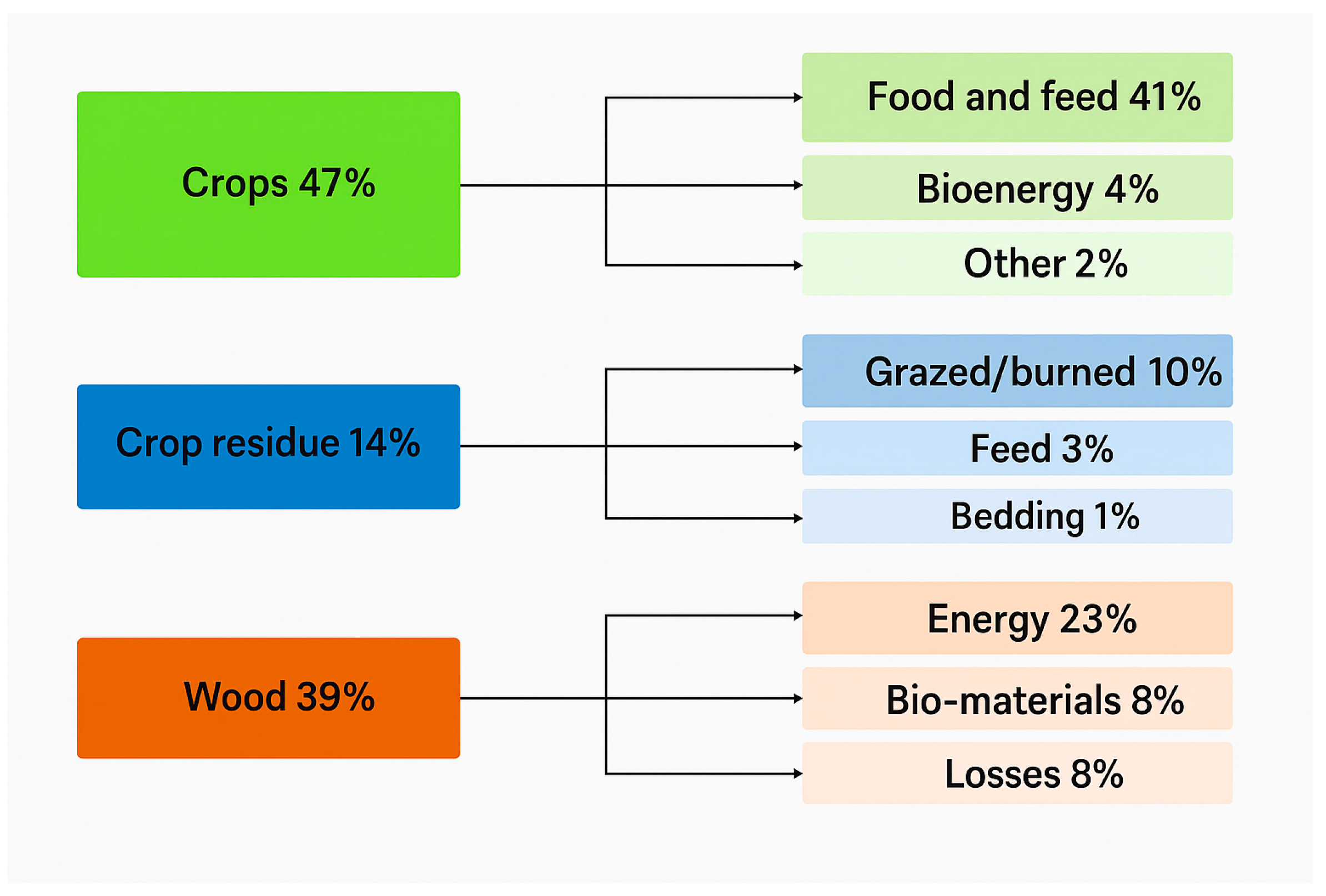
Figure 2.
Thermochemical methods of biomass conversion into high-value hydrocarbons, for different applications.
Figure 2.
Thermochemical methods of biomass conversion into high-value hydrocarbons, for different applications.
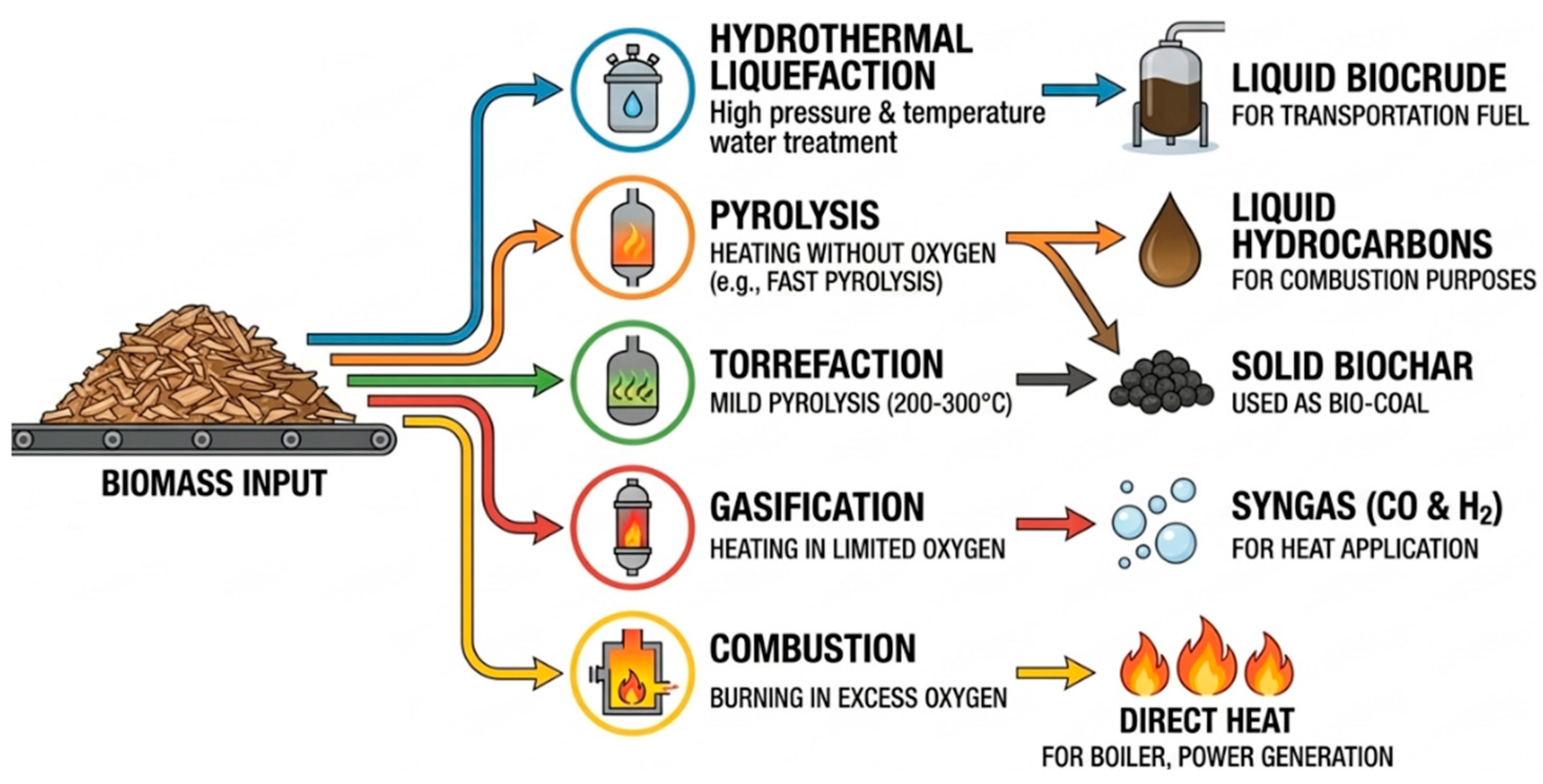
Figure 3.
Schematic diagram of major HTL reaction pathways for specific components of lignocellulosic biomass feedstock.
Figure 3.
Schematic diagram of major HTL reaction pathways for specific components of lignocellulosic biomass feedstock.
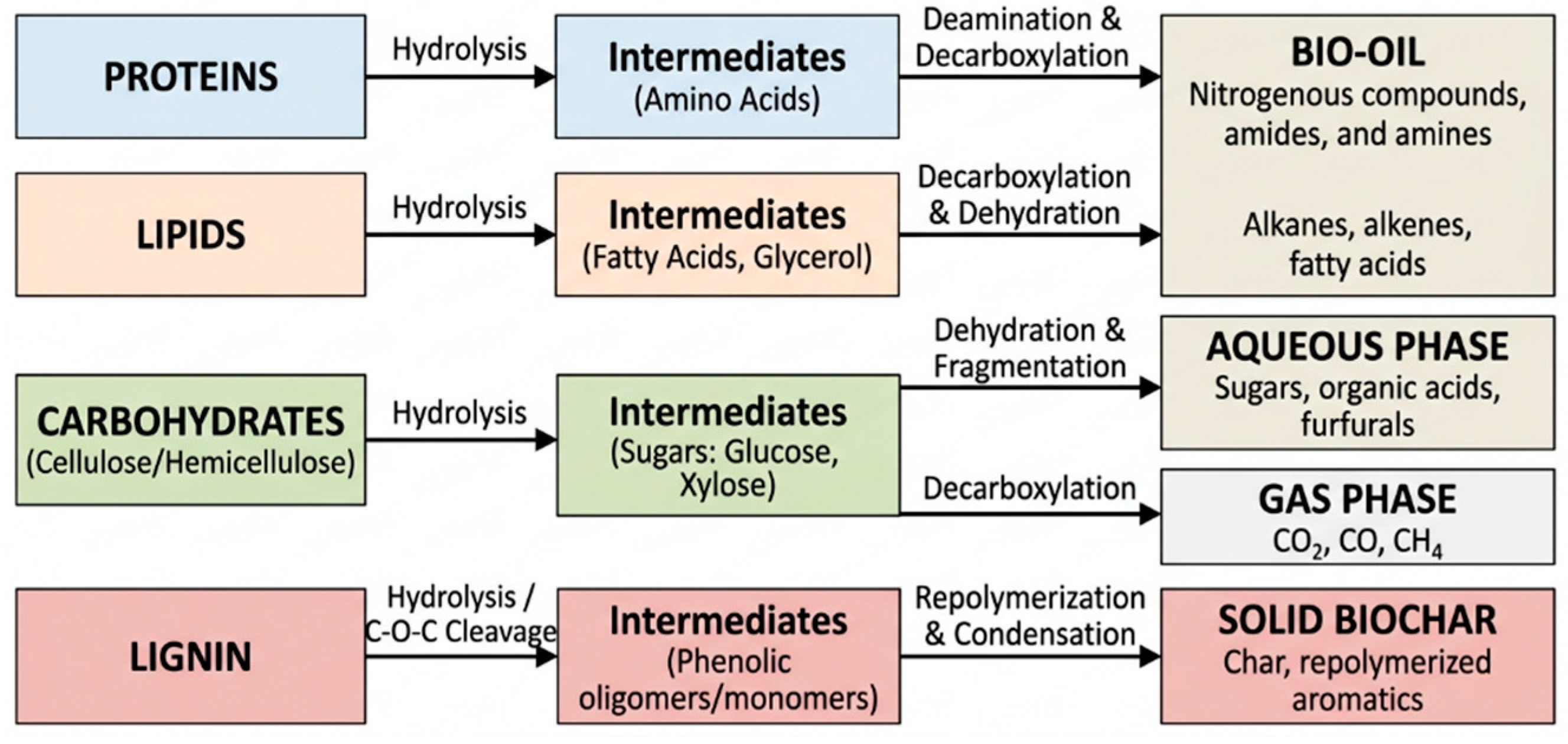
Figure 4.
Major chemical compounds present in the HTL bio-crude.
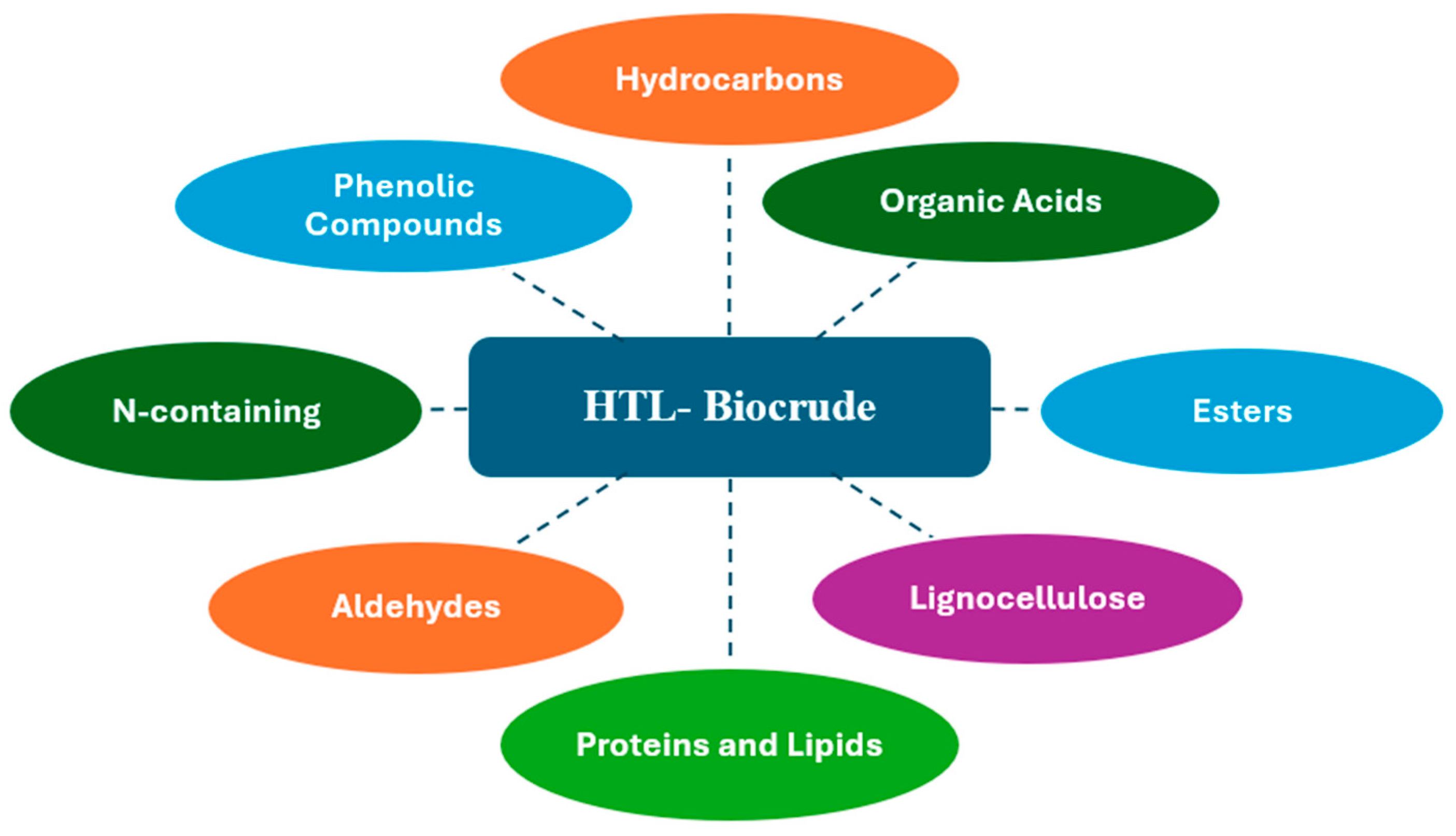
Figure 5.
Methods and parameters of hydrochar production (Adopted and modified from [87]).
Figure 5.
Methods and parameters of hydrochar production (Adopted and modified from [87]).
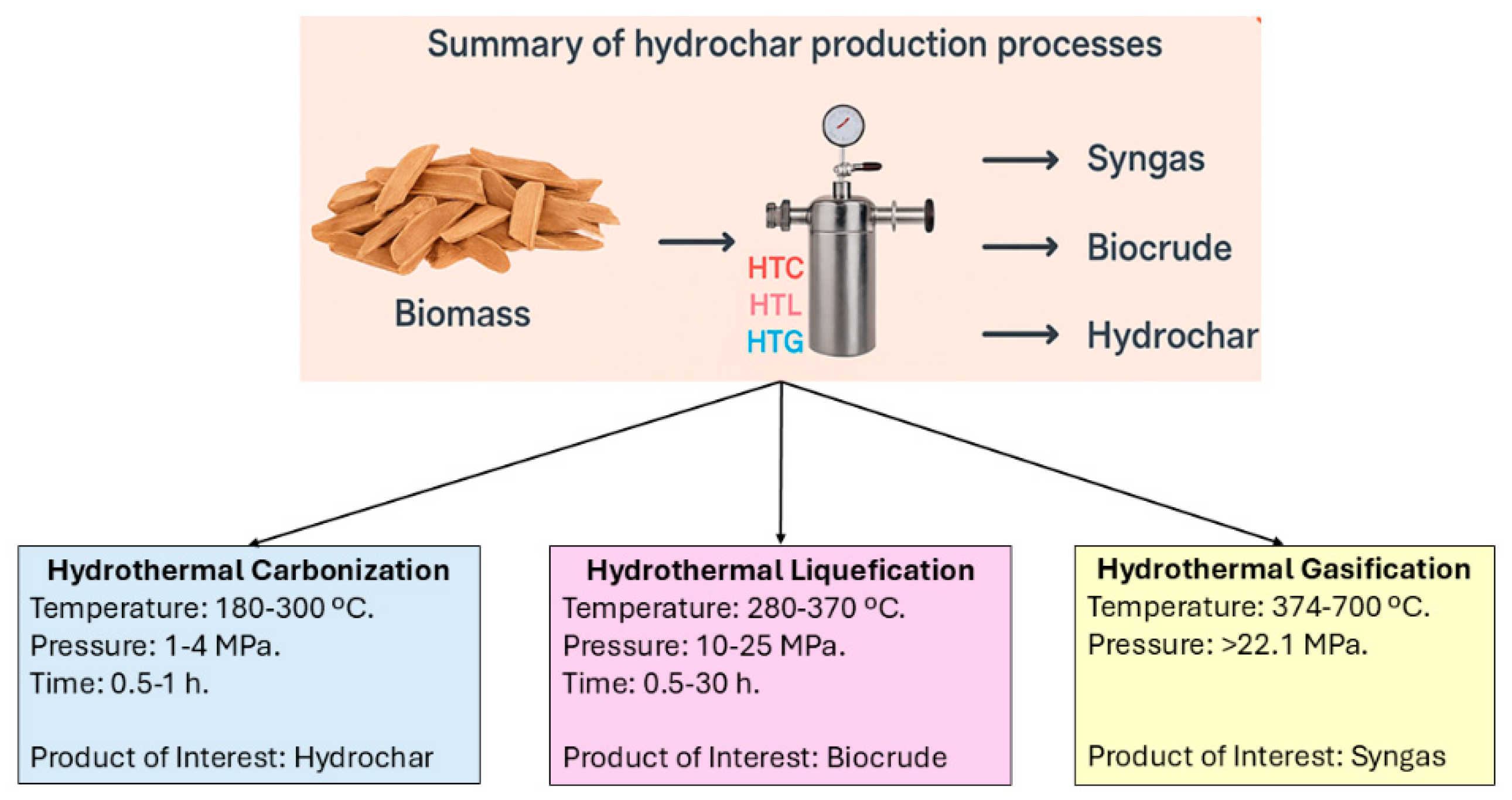
Figure 6.
TRL scores of thermochemical routes for biomass valorization in 2024.
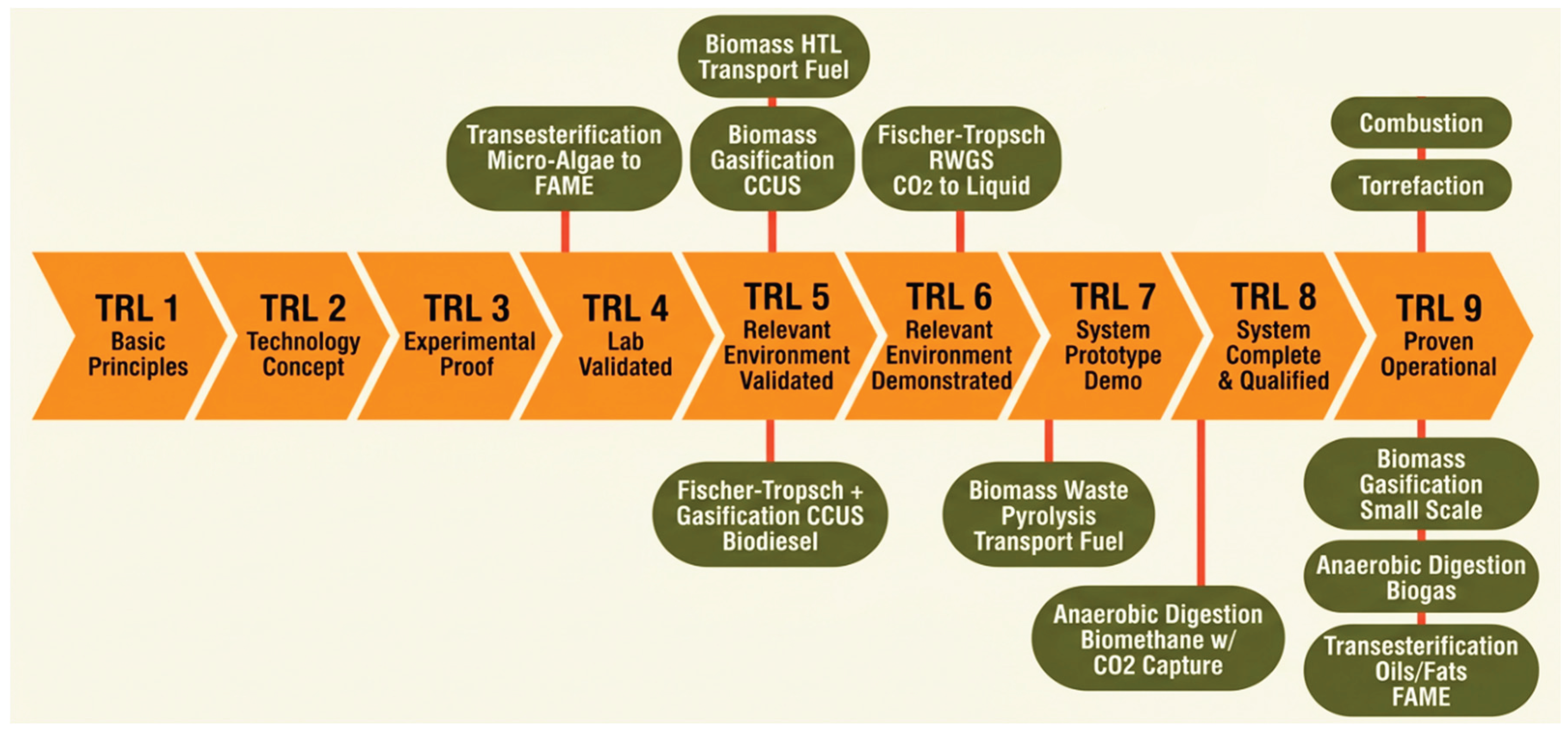

Table 1.
Comparison of catalytic upgradation of HTL biocrudes from feedstocks of different origin.
| Feedstock | Dominant Issues | Upgrading Strategy | Catalyst Type | Operating Conditions (T, P) | Products | References |
| Forest residues (50/50 spruce-pine wood) | High O2 (11 wt. %), phenolic compounds, higsh TAN (68 mgKOH g⁻¹) | Solvent de-asphalting (n-pentane, toluene, DCM, EtOAc); Mild hydrotreating | Sulfided NiMo/Al₂O₃ | 290-320 °C, 9 h, 1400 psi H₂ | Distillate-range hydrocarbons; O2 final 2.9 wt. % | [43] |
| Co-HTL of wheat straw + waste cooking oil | High oxygen (10 wt. %), high acidity. | Batch hydrodeoxygenation | Sulfided NiMo/γ Al₂O₃ | 350 °C, 8 h, 1500 psi H₂ | Diesel-range paraffins (C17–C19); O2 final 0.56 wt. %. | [44] |
| Wastewater-grown microalgae | High heteroatoms (O, N, S), aromatic-rich oil. | One-step HTL + in-situ catalytic upgrading | NiMo/Al₂O₃ | 320-370 °C, 30-120 min, 18-22 MPa | Aromatics + alkanes; SAF precursor; O2 final 5-10 wt% O2. | [45] |
| Sewage-sludge HTL biocrude | Extremely high N (6-7 wt.%), refractory carbazoles/indoles | Severe batch hydrotreatment | NiMoS/Al₂O3 | 350-390 °C, 0-5 h, 100 bar H₂ | Fuel-range liquids (73 wt% <350 °C); N2 residual of 1.4 wt%, high degree of O2 removal | [46] |
| Food waste and sewage-sludge | High N (4-5 wt.%), high metals, catalyst stability concerns | Continuous two-stage hydrotreating (guard+ main bed) | CoMo/Al₂O₃ (guard) + NiMo/Al₂O₃ (main) | 350-400 °C, 1500 psi, WHSV 2 h⁻¹ | Diesel-rich blend stock (70% diesel cut); 0.15-0.25 wt.% O | [47] |
Table 2.
Studies on hydrodeoxygenation of HTL produced biocrude from different sources.
| Feedstock | Upgrading strategy | Catalyst used (loading in wt.%) | Operating conditions | Observation | Ref. |
|---|---|---|---|---|---|
| High boiling fraction of Soyabean straw HTL biocrude | Catalytic hydrotreatment in H2-donor solvent (tetralin + decalin) | Pt/C (40 wt.%) |
T = 400 ºC, Pr. = 100 bar t = 4h |
98.6% S, 96.2% N, 87.1% O2 removed |
[61] |
| HTL biocrude of Animal carcass (streaky pork) | Catalytic hydrotreatment of biocrude in a water-free system | CoMo/γAl2O3 (20 wt.%) |
T = 400 ºC, Pr. = 150 bar t = 4h |
64.4% N, 84.6% O2 removed |
[62] |
| HTL biocrude of Food waste (mixed vegetables + ground meat) | Single-step catalytic HDO, HDN, and mild hydrocracking | Pd/C (20 wt.%) |
T = 350 ºC, Pr. = 30 bar t = 3h |
58% O2 removed, low H2 consumption | [63] |
| HTL biocrude derived from Microalgae (Nannochlopsis) | Catalytic hydrodeoxygenation (HDO) following non-catalytic HTL | NiMoC/AC (10 wt.%) |
T = 400 ºC, Pr. = 30 bar t = 2.75h |
94% O2 reduction, 72.5% oil yield, 43 MJ/kg HHV | [64] |
| HTL biocrude of municipal sweage sludge | Single-step HDO of solvent-extracted biocrudes (DCM, hexane, toluene, acetone) | Ni/SiO2- Al2O3 (5 wt.%) |
T = 350 ºC, Pr. = 70 bar t = 1h |
Hexane extract: 5 wt. % O2; Toluene extract 12 wt. % O2 | [65] |
| HTL biocrude of bio-pulp derived from food wastes. | 2-stage continuous catalytic HDO using trickle-bed reactors with guard-bed stabilization followed by deep hydrotreating | Mo/Al₂O₃ (guard bed- 60 g) + NiMo/Al₂O₃ (main catalyst 47 g) | Continuous process; 1st stage: 260 °C, 2nd stage: 400 °C; 10 MPa H₂, WHSV 0.2 h⁻¹ | Upgraded oil yield of 92 wt.%, 64% diesel production, 96% O2 removed. | [66] |
| Partially hydrotreated HTL biocrude from a 50/50 spruce-pine wood mixture | Partial HDO to render biocrude fully miscible in VGO, followed by 2-stage co-processing | Hydrotreating: 15 mL NiMo catalyst with 28 mL SiC; Hydrocracking: 10 mL Zeolite-based catalyst with 18.5 mL SiC | Hydrotreating: T = 330 ºC, Pr. = 100 bar WHSV = 0.5 h-1; Hydrocracking: T = 405 ºC, Pr. = 100 bar LHSV = 1.5 h-1 |
Partially HDO biocrude: 3.6 wt. % O2. co-processed blend: 0.16 wt. % O2 |
[67] |
| HTL biocrude derived from spent coffee grounds | Mild hydrotreatment (HDO stabilization) followed by refinery-relevant coprocessing | Sulfided NiMo/γAl₂O₃ (7.1 v/v blend with demetallization catalyst) |
T = 330 ºC, Pr. = 70 bar LHSV = 1 h-1 |
0.39 wt. % O2 in stabilized biocrude | [68] |
| Model compounds of HTL biocrude, derived from black liquor | Catalytic HDO in subcritical/supercritical water | Activated Carbon supported NiMoSx (6.5 wt.%) |
T = 380 ºC, Pr. = 15 bar t = 2 h |
Highest selectivity to phenols. 40% degree of deoxygenation for both conditions | [69] |
| HTL biocrude mixture of wheat straw and waste cooking oil | Single-step HDO | Sulfided NiMo/γAl2O3 (13 wt.%) |
T = 350 ºC, Pr. = 103 bar t = 8 h |
Final O2 content 0.6 wt.%, HHV of 46 MJ/kg, and low acidity | [70] |
Table 3.
Comparative study for different AI/ML implemented studies in biomass valorization.
| Category of Study | Primary Objective | AI/ML model | Key Observations | Limitations Observed | Reference |
|---|---|---|---|---|---|
| Syngas Production | Optimize hydrogen-rich syngas from aqueous phase reforming (APR). | Artificial Neural Networks (ANN) | Catalyst type and temperature are the dominant variables for H2 selectivity. 90% of predictions lay within ±5% error of experimental values. | ANN performance fluctuates with extreme pressure variations. | [134] |
| Algal Biofuels production | Optimize HTL and HTG for bio-oil and hydrogen production. | Combined machine learning based Tunable Decision Support System and Tunable Recommendation System | AI-optimized parameters deviated by < 3% from experimental optima. Required experimental runs reduced by 65% compared to manual trial-and-error optimization | Nonlinearity in supercritical water gasification. Prediction confidence intervals and robustness under noisy data were not formally assessed | [138] |
| Feedstock Characterization | Predict HHV of biomass fuels through ML models | Linear regression, Random Forest, Extreme gradient boosting (XGBoost), adaptive boosting (AdaBoost | ML outperforms linear regression, XGBoost gives best performance across training datasets. | The model functions as a screening tool rather than offering dynamic optimization. Variability due to experimental protocols is not normalized. | [139] |
| Pyrolysis Kinetics | Develop ML-models to predict biomass pyrolysis kinetic parameters | ANN models and a hybrid Particle Swarm Optimization (PSO-ANN) approach | PSO significantly improved ANN training stability. Maximum relative deviation decreased from 12.85% (ANN-3) to 6.72% (PSO-ANN) | Model accuracy drops for Continuous pyrolysis systems, limiting its application at industrial scales. | [140] |
| Bioethanol production | Establish a data-driven ANN model capable of predicting bioethanol yield in a system | Multilayer Perceptron (MLP) through back propagation. | ANN model demonstrated high predictive accuracy, with reported R² values. The model effectively captured strong nonlinear coupling between reaction parameters | Prediction confidence intervals were not reported, limiting industrial applicability. Optimization was conducted solely on yield, without integration of cost, energy efficiency, or emissions | [141] |
| Hydrogen production | Compared different ML models to predict the yield of hydrogen | Hyper-parameter through Genetic algorithm and PSO | PSO-optimized Gradient Boosting Regression (Test R² = 0.96; cross-validation R² = 0.92). SCWG had more influence on predictions (61%) than feed properties | A mixed and limited dataset, with varying experimental conditions, led to underperformance of the ANN model | [142] |
Disclaimer/Publisher’s Note: The statements, opinions and data contained in all publications are solely those of the individual author(s) and contributor(s) and not of MDPI and/or the editor(s). MDPI and/or the editor(s) disclaim responsibility for any injury to people or property resulting from any ideas, methods, instructions or products referred to in the content. |
© 2026 by the authors. Licensee MDPI, Basel, Switzerland. This article is an open access article distributed under the terms and conditions of the Creative Commons Attribution (CC BY) license (http://creativecommons.org/licenses/by/4.0/).
Copyright: This open access article is published under a Creative Commons CC BY 4.0 license, which permit the free download, distribution, and reuse, provided that the author and preprint are cited in any reuse.


