
Submitted:
15 April 2026
Posted:
17 April 2026
You are already at the latest version
Abstract
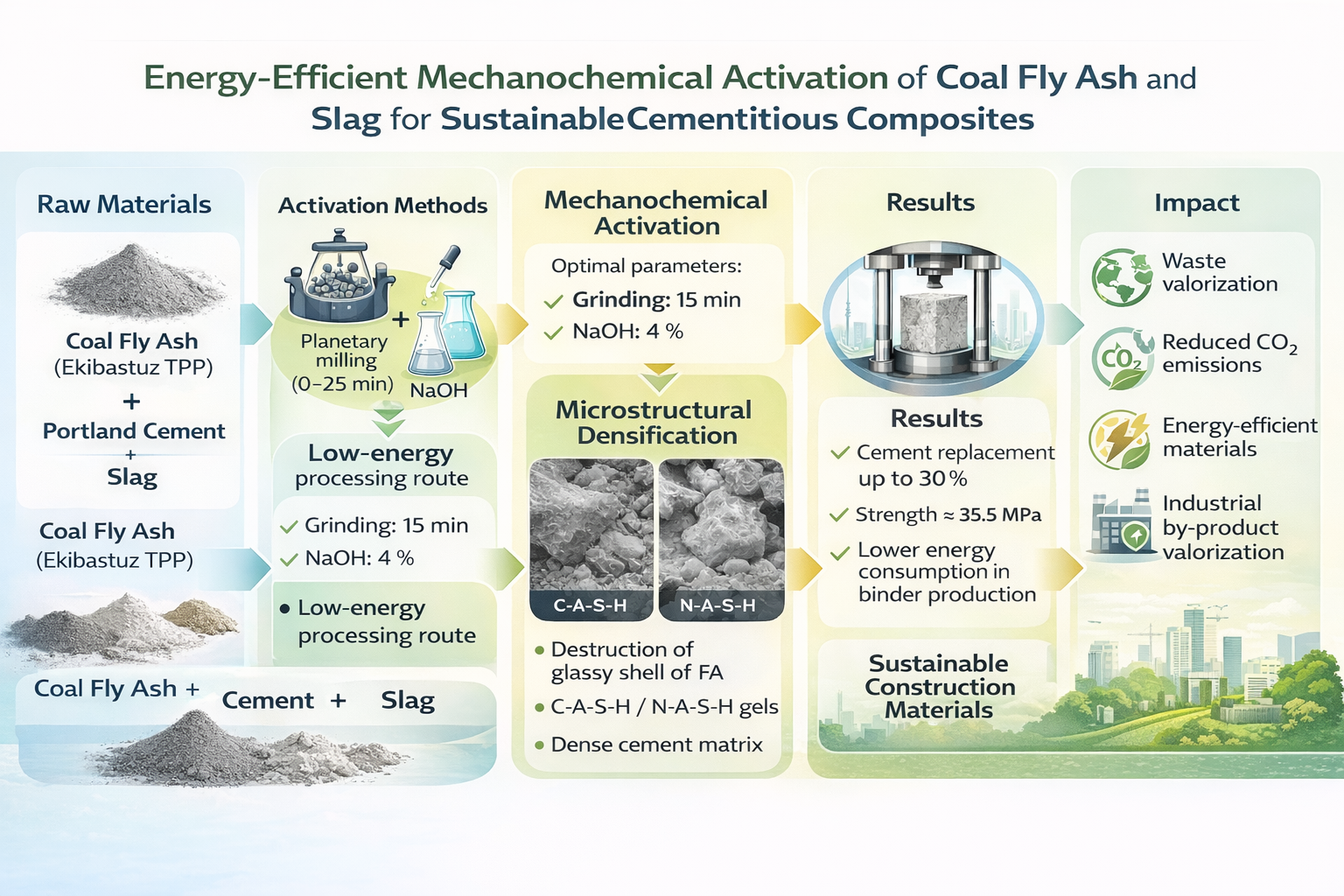
This study investigates the energy-efficient mechanochemical activation of fly ash derived from Kazakh coals for the development of sustainable cementitious composites. The ap-proach aims to enhance the reactivity of aluminosilicate materials while reducing the en-ergy demand and carbon footprint associated with conventional clinker-based cement production.
Mechanochemical activation was performed to increase the specific surface area and in-duce structural defects in the glassy phase of fly ash, thereby improving its reactivity. Chemical activation using sodium hydroxide (NaOH) was applied to promote intensive pozzolanic reactions and accelerate dissolution kinetics.
The optimal activation conditions were identified as 15 min of mechanical treatment com-bined with 4% NaOH. Under these conditions, the compressive strength reached 35.5 MPa at 28 days, exceeding that of the reference cement (35.0 MPa). At fly ash contents of 15–20%, the composites maintained or improved strength, whereas an increase to 30% resulted in a reduction to 31.5 MPa.
Mechanical activation increased the specific surface area to approximately 4800–5000 cm²/g; however, prolonged grinding (up to 30 min) led to particle agglomeration and a de-crease in strength to about 28 MPa. Chemical activation enhanced reaction kinetics without significantly affecting particle fineness.
Microstructural analysis revealed the formation of a dense and homogeneous matrix dom-inated by C–S–H, C–A–S–H, and N–A–S–H gel phases with reduced porosity. The com-bined activation approach demonstrated a clear synergistic effect, enabling up to 20% ce-ment replacement without loss of performance.
Importantly, the proposed method provides a low-energy pathway for the utilization of industrial waste, contributing to reduced clinker consumption and lower CO₂ emissions. The results highlight the significant potential of Kazakhstan’s industrial by-products for the production of energy-efficient, environmentally friendly, and cost-effective construction materials.
Keywords:
energy-efficient materials
; mechanochemical activation
; coal fly ash
; slag
; cementitious composites
; pozzolanic activity
; mechanical properties
; CO₂ reduction
; sustainability
Copyright: This open access article is published under a Creative Commons CC BY 4.0 license, which permit the free download, distribution, and reuse, provided that the author and preprint are cited in any reuse.


