

Submitted:
15 April 2026
Posted:
16 April 2026
You are already at the latest version
Abstract
Within the conceptual framework of the Unified Flexibility & Mindfulness (UFM) model, the current study applied a process-oriented, contextual behavioral science lens to understanding the challenges and dynamics of classroom teaching in the United States. In particular, the study sought to highlight the specific flexibility processes linked to lower teacher burnout and to greater use of adaptive instructional and behavior management strategies. Toward that end, a sample of 308 teachers (79% female, 85% white, Mage = 42 years old) teaching an average of 2.9 grade levels (50% K-5th, 28% 6th-9th, 42% 10th-12th), with an average of 13 years of teaching experience completed a relational task (RT) indirectly assessing relational thinking about students along with teacher-report measures of: (1) their own use of 14 forms of mindful flexibility (and distracted, reactive inflexibility) in the classroom (a modified UFM scale based on the MPFI), (2) their conscious perceptions student engagement and disaffection with learning (EvD scale), (3) their use of adaptive instructional and behavior management strategies (CSS-T), and (4) a measure of teaching- and student-related burnout (CBI). Exploratory network analyses largely supported the Unified Flexibility and Mindfulness model shaping teachers’ functioning in the classroom. The results further highlighted unique links from dichotomous thinking on the RT (i.e., viewing all positive or negative adjectives as essentially the same in students) to greater burn out and unique links from more nuanced thinking on the RT (i.e., the ability to see negative and positive traits coexisting in students) to greater perceptions of both student engagement and disaffection. Teachers’ engagement of committed action and self-as-context in the classroom (along with perceptions of greater student engagement) emerged as some of the most robust predictors of using adaptive classroom strategies. In contrast, teachers’ engagement in fusion and inaction (along with perceptions of greater student disaffection and lower student engagement) emerged as the most robust predictors of teacher burnout. Implications are discussed.
Keywords:
psychological flexibility
; mindfulness
; unified flexibility and mindfulness model
; teaching strategies
; behavior management strategies
; classroom dynamics
; teacher burnout
; relational frame theory
; relational density theory
; relational task
1. Introduction
Teaching children and adolescents is critical, but it can also be extremely challenging and difficult. Even motivated and hard-working students have off days, and so, in addition to providing engaging and dynamic instruction, teachers are bombarded with difficult and challenging behavior from their students on a daily basis. Given this, it is less surprising that teachers are struggling with unhealthy levels of stress, burnout, and attrition (Clunies-Ross et al., 2008; Harmsen et al. 2018; Mrstik et al., 2019; Schlichte et al., 2005; von der Embse et al., 2020). That constant barrage of demands and the corresponding levels of compassion fatigue and burnout that teachers experience can represent a significant drain on the teachers’ own internal resources, potentially tainting their perceptions of students and even making it more challenging to engage effective instructional and behavioral management strategies. Building on a handful of recent studies (e.g., Parker et al., 2024; Rogge et al., 2024; Rogge et al., 2026) developing the Unified Flexibility and Mindfulness model (UFM; Rogge & Daks, 2021), the current study sought to apply a Contextual Behavioral Science (CBS) lens to understanding these classroom dynamics. To further scaffold this work within a CBS framework, the current study also used a relational task based on the relational density literature (e.g., Belisle & Dixon, 2020) to indirectly assess teachers’ relational thinking about students. Thus, within the context of the UFM conceptual framework, the study examined how teachers maintaining more nuanced relational thinking about students might promote resilience in the classroom by helping teachers (1) engage in more in psychologically flexible and mindful behavioral repertoires in response to classroom disruptions, (2) potentially linking to greater perceptions of student engagement, (3) supporting greater value-driven behavior management and teaching even in the face of challenging and obstructive behavior, and (4) promoting to lower levels of burnout. In contrast, greater entrenchment in binary (black-and-white) relational thinking about students might be linked to (1) greater engagement of defensive-reactive-inflexible behavioral repertoires in response to classroom disruptions, (2) greater perceptions of student disaffection, (3) linking to more reactive behavior management and teaching strategies, and (4) greater burnout.
1.1. Understanding the Teacher Burnout Crisis
The profession of teaching is facing higher than healthy levels of stress, burnout, and teacher attrition (Clunies-Ross et al., 2008; Harmsen et al. 2018; Mrstik et al., 2019; Schlichte et al., 2005; von der Embse et al., 2020). For example, in a 2012 study of 236 teachers and staff, 75% of the sample met clinical levels of anxiety, depression, or stress (Jeffcoat & Hayes, 2012). Given the importance of our teachers for a fully functioning educational system, these data indicate a crisis which is also reflected in the current attrition rate and teacher shortages across the United States, with estimates of over 411,000 teaching positions in the US currently unfilled or filled by uncertified teachers (Tan et al., 2025). Underlying this crisis, research has found that student misbehavior affects teacher stress, well-being, confidence, and has a negative impact on student learning and academic achievements (Friedman, I.A., 1995; Hastings & Bham, 2003; Herman et al., 2018; Kyriacou, C., 2001; Tobin & Sugai, 1999; Skaalvik & Skaalvik, 2010; Tsouloupas et al., 2010; Sutherland et al., 2008). For example, Clunies-Ross et al. (2008) found that even minor student misbehavior such as talking out of turn affects teacher levels of stress (increasing the stress response) as well as their well-being and confidence (decreasing these values). This was also correlated with negative effects on student outcomes (Clunies-Ross et al., 2008). Tsoupulos et al. (2010) found that the act of disciplining students increased emotional exhaustion, “causing distress, negative attitudes, and feelings of helplessness, hopelessness and embarrassment” (Friedman, 2006 cited in Tsoupulos et al., 2010 p.174). Additional research supports relationships between teacher stress, teacher attrition, and those teachers’ negative perceptions of students (Clunies-Ross et al., 2008; Harmsen et al. 2018; Mrstik et al., 2019; Schlichte et al., 2005; von der Embse et al., 2019). From a CBS perspective, disruptive student behavior represents difficult and challenging experiences for teachers to navigate and their engagement of mindfully flexible (or distracted, reactive, inflexible) behavioral repertoires in response could serve to buffer (or exacerbate) the impact of challenging student behavior on the classroom dynamics. Thus, to build on this growing body of work, the current study sought to use the UFM conceptual framework to help identify key skills (i.e., behavioral repertoires) that might offer teachers notable relief and even resilience in the context of the current teacher-burnout crisis.
1.2. Assessing Teachers’ Attitudes toward Students
Perceptions of Student Engagement / Disaffection. A large body of previous work has indicated that student engagement is reciprocally linked to classroom dynamics including teachers’ behavior management and teaching strategies as well as their own experiences of burnout (see Fredricks et al., 2004 for a review). For example, lower student engagement and greater student disaffection have been linked to teachers using more controlling or reactive responses to disruptive behavior (Reeve, 2012; Skinner & Belmont, 1993; Skinner et al, 2009). Teachers’ perceptions of student engagement/disaffection have also been linked to their instructional practices, suggesting that teachers tend to adapt their teaching strategies in response to students’ levels of engagement (Fredricks et al., 2004; Pianta et al., 2012). Notably, teachers’ perceptions of low student engagement and high student disaffection (along with perceptions of disruptive behavior) have been robustly linked to greater stress and burnout (Jennings & Greenberg, 2009; Skaalvik & Skaalvik, 2010). Taken together, these findings highlight that teachers’ perceptions of student engagement and disaffection might serve as critical lenses through which classroom dynamics, instructional practices, and teacher well-being are shaped.
Moving Beyond Self-Report. Well-developed and validated teacher-report scales like the student-focused Engagement Versus Disaffection with Learning scale (EvsD; Ritoša et al.,2020) have been linked to teaching and behavior management strategies (e.g., Van den Berghe et al., 2016) but can be limited by factors like social desirability and lack of personal insight. Indirect measures hold the potential of addressing such concerns and augmenting self-reported data by assessing underlying or implicit attitudes toward students. Toward that end, in 2020, Belisle & Dixon proposed Relational Density Theory (RDT) as a metaphorical conceptualization of the resistance to change within derived relational networks.
Relational Density Theory (RDT). RDT proposes that the higher the mass (or density and volume) of a given network of associated words/meaning, the more resistant to change those related meanings are (Belisle & Clayton, 2021; Belisle & Dixon, 2020). For instance, a teacher associating loud, boisterous, distracted students tightly with unsuccessful or defiant students would be suggestive of categorical relational thinking (i.e., thinking of students as more globally bad, or not). If that network of related ideas contains large numbers of stimuli (high volume) and those stimuli are strongly related in meaning to one another for that teacher (density), then that network of relations (perception) would be expected to be more resistant to change. Thus, a high density of relations among student negative traits (and a separate high density of relations among student positive traits) could guide teachers to view students in a more dichotomous manner – seeing them as broadly good or bad rather than viewing them in a more nuanced manner that could allow the perception of unique combinations of strengths and weaknesses in each student.
Relational Tasks. To assess the density and volume of a network of relations, researchers have used relational tasks in which respondents were asked to rate the level of similarity of all possible pairs within sets of positive and negative adjectives (or images) concerning some target group (e.g., Hutchison et al., 2023). Average ratings of each pair could then be used to create a proximity/distance matrix across the various adjectives and the density of that matrix (at a group level) could be visualized with multidimensional scaling procedures. Thus, these studies have largely been conducted: (1) within controlled, laboratory-based paradigms, (2) typically relying on relatively small samples, and (3) have focused on evaluating the density and volume of network relations exclusively at a group level, often contrasting results in treatment versus control groups or pre-treatment versus post-treatment network relations (e.g., see Belisle & Dixon, 2020; Hutchison et al., 2023). Using this approach, previous studies have demonstrated that the average density of a relational network of perceptions within a sample can be weakened (i.e., becoming less rigid / inflexible) if that sample is treated with ACT or multiple exemplar training (e.g., Paliliunas et al., 2024). Although this innovative work has laid a solid foundation for the use of relational tasks to evaluate relational density, its focus on group-level results have precluded its application to understanding individual differences in relational framing and how those differences may relate to meaningful psychological and behavioral outcomes (effectively precluding all correlational analyses).
An Individualized Approach to Assessing Relational Density. The current study extended this emerging literature by recruiting a notably large online sample that could support the application of exploratory factor analytic techniques to teachers’ similarity ratings from a relational task. This allowed us to develop individual-level indices of network density among those student-focused adjectives. Thus, this approach enabled, for the first time, the assessment of teachers’ relational thinking about students at an individual level (rather than a global group level) and the examination of how those relational frames might demonstrate correlational links to their engagement in psychologically flexible versus inflexible behavioral repertoires, as well as to their instructional practices, perceptions of students, and experiences of burnout. Data from a pilot study of teachers testing this approach (Palmer, 2025) uncovered correlational links between the indirectly assessed relational thinking about students and teachers’ psychological flexibility.
1.3. The Unified Flexibility & Mindfulness Conceptual Framework
Key Processes from Two Treatment Literatures. To focus the current work on a set of key behavioral processes that can both (1) be readily assessed and (2) for which interventions have already been developed, we turned to the Acceptance and Commitment Therapy (ACT; Hayes et al., 1999, 2011) and mindfulness-based treatment literatures (e.g., Mindfulness-Based Stress Reduction; MBSR; see Grossman et al., 2004). As those two fields have developed and matured over the last 25 years, they have converged to identify a set of at least 14 distinct behavioral repertoires that represent fundamental forms of mindfulness / psychological flexibility. This is exemplified by the development of scales like the Multidimensional Psychological Flexibility Inventory (MPFI; Rolffs et al., 2018) and the and the Five Facet Mindfulness Questionnaire (FFMQ; Baer et al., 2006). The 14 distinct behavioral repertoires assessed by the MPFI and FFMQ (see Rogge & Daks, 2021) have been shown to play critical roles in helping individuals navigate difficult and challenging thoughts, feelings, and experiences in their daily lives across a series of experimental studies (Levin et al., 2012), across hundreds of correlational studies (Daks & Rogge, 2020), and have emerged as potential treatment mechanisms across dozens of treatment studies (e.g., Macri & Rogge, 2024).
An Integrated and Process-Oriented Model. Recent work has integrated those mindful flexibility processes into a process-oriented, stepwise model, the Unified Flexibility and Mindfulness (UFM) model and corresponding scale (Rogge & Daks, 2021). The model has been supported by quantitative findings in: (1) a cross-sectional sample of 2742 online respondents from the US (Rogge & Daks, 2021), (2) a cross-cultural sample of 2091online respondents from the US, China, Japan, and Taiwan (Rogge et al, 2024), (3) a university sample of 276 college students, and (4) a two-wave longitudinal study of 1242 online respondents from the US (Rogge et al., 2006). Across these studies, the results have remained robust across a range of demographic and cultural groups, have been tested using both confirmatory (i.e., SEM) and exploratory (i.e., psychological network analysis) statistical approaches, and have been linked to key tenets of Buddhism (Rogge et al., 2024).
An Adaptive Cascade. As shown in Figure 1, the core UFM model posits that present moment awareness, being observant of sensations, and the ability to clearly describe thoughts and feelings function together as mindful lenses that allow teachers to detect potentially difficult and challenging experiences (e.g., disruptive student behavior) as they arise. Thus, engaging those repertoires would promote (i.e., show strong proximal links to) greater mindful decentering from those experiences (rather than defensively reacting to them), allowing teachers to engage in greater acceptance, self-as-context (i.e., maintaining a broader perspective), and defusion (i.e., gently experiencing the experience without clinging to it) in the midst of those disruptions. The model then posits that greater decentering from difficult and challenging experiences would, in turn, promote greater value-driven behavior even in the midst of such challenging behaviors. Thus, individuals would be able to maintain contact with their deeper values and take committed action toward their deeper goals even in the face of setbacks and disruptions. Finally, the model posits that greater levels of value-driven behavior would promote more effective individual functioning (i.e., engaging in more effective teaching and behavior management strategies and reducing burnout).
A Disruptive Cascade. In addition to this cascade of adaptive behavioral repertoires, the UFM model also posits a disruptive cascade in which: (1) high engagement in distracted inattention to the present moment is linked to greater defensively reacting to difficult situations in the form of experiential avoidance, self-as-content (i.e., judging and shaming oneself for Figure 1. Conceptual Model Integrating Relational Frames and Perceptions of Students into the Unified Flexibility and Mindfulness Model difficult thoughts, feelings, and experiences), and fusion (i.e., getting trapped in difficult thoughts and feelings like a broken record), (2) which are, in turn, robustly linked to aimless and haphazard behavior in the form of routinely losing contact with deeper values in the stress and strain of everyday life and getting stuck in inaction in the face of setbacks and other difficult experiences, (3) which are, in turn, linked to poorer individual functioning.
The Transactional Nature of These Links. The arrows presented in Figure 1 are all double-headed as the UFM model posits that these associations are likely to be bidirectional. The model also acknowledges that while the behavioral repertoires in one stage of the model will show some of their strongest links to one another and to their adjacent stages, they are likely to show links to subsequent stages as well, given the interconnected nature of these repertoires. Consistent with these points, despite the stepwise nature of the UFM model, the model does not assert that the path to developing mindful flexibility in one’s life (or even responding to a specific difficult event) is a perfectly linear path, recognizing that individuals likely shift back and forth between various stages as needed.
1.4. The Salience of Mindful Flexibility in Classrooms
Given the recency of the development of the UFM model, the current study will be the first to apply the UFM conceptual framework to modeling classroom dynamics. However, this approach builds directly on the work of Jennings & Greenberg (2009), in which they highlighted the critical importance of teachers' social and emotional competence (SEC) to not only promote their own well-being but to also create prosocial classrooms in which students could thrive. To promote the SEC among educators, a number of previous studies have provided ACT-based interventions to teachers (e.g., Biglan et al., 2013; Gillard et al, 2021; Paliliunas et al, 2023). These studies demonstrated declines in stress and burnout as well as improvements in self-efficacy, self-compassion, well-being, and specific dimensions of psychological flexibility (e.g., drops in experiential avoidance, increases in mindful awareness and valued living; Biglan et al., 2013). Toward the same end, previous studies have delivered mindfulness-based interventions to teachers (e.g., Flook et al., 2013; Jennings et al., 2017; Roeser et al., 2013; see Emerson et al., 2017 for a review), demonstrating improvements on classroom organization, adaptive emotion regulation, self-compassion, psychological distress, burnout, and mindfulness. These ACT and mindfulness treatment studies also uncovered correlational links between a handful of more specific mindful flexibility dimensions and the various outcomes examined. Thus, these approaches highlight the importance of cultivating awareness, acceptance, and value-guided behavior among teachers, core processes that are explicitly integrated within the Unified Flexibility and Mindfulness (UFM) model. However, despite this promising intervention literature, relatively little work has examined the full compliment of behavioral processes within the UFM model at the level of individual differences in teachers’ day-to-day functioning in the classroom.
1.5. The Current Study
To build on previous work, the current study sought to examine a range of classroom dynamics students within the broader conceptual frameworks of the UFM and RDT models. Toward that end, an online sample of 308 teachers completed measures of their (1) levels of burnout, (2) teaching and behavior management strategies, (3) self-reported perceptions of students’ engagement and disaffection, (4) relational thinking about students (indirectly assessed with a relational task), and (5) a comprehensive measure of the degree to which they engage (in their classrooms) the 14 behavioral processes within the UFM model (i.e., a classroom-focused UFM scale). Exploratory psychological network analyses were used to uncover the unique links between the components of the UFM model and the classroom dynamics examined.
1.6. Applying the UFM to the Classroom Setting
As shown in Figure 1, when adapting the UFM model to the classroom, we posited first (Hypothesis 1) that teachers’ relational thinking about students (assessed indirectly with a relational task) would show robust links to teachers’ self-reported perceptions of student engagement and disaffection as well as to their self-reported engagement of the behavioral repertoires in the. More specifically, we posited (Hypothesis 1A) that indirect assessment of relational frames representing more nuanced thinking would be linked to greater perceptions of student engagement and to their own engagement of more mindfully flexible behavioral repertoires in the classroom whereas (Hypothesis 1B) relational frames representing more categorical (black and white) thinking would be linked to greater perceptions of student disaffection and to their own engagement of more defensive, reactive, and inflexible behavioral repertoires. We further posited (Hypothesis 2A) that teachers engaging (within their classrooms) the mindful flexibility repertoires of the UFM would be linked to greater perceptions of student engagement whereas (Hypothesis 2B) teachers engaging the defensive, reactive, and inflexible behavioral repertoires of the UFM would be linked to greater perceptions of student disaffection. Finally, we posited (Hypothesis 3) that teachers perceiving greater student engagement would be linked to (Hypothesis 3A) their greater engagement of value-driven behavior in the classroom, to (Hypothesis 3B) their greater use of adaptive behavior management and teaching strategies, and to (Hypothesis 3C) lower levels of burnout. On the other side of the coin, we posited (Hypothesis 4) that teachers perceiving greater student disaffection would be linked to (Hypothesis 4A) their greater engagement of aimless and haphazard behavioral repertoires in the classroom, to (Hypothesis 4B) less frequent use of adaptive behavior management and teaching strategies, and to (Hypothesis 4C) higher levels of burnout.
2. Method
2.1. Participants
A total of 308 K through 12 teachers completed the survey. Respondents were an average of 42 years old (SD = 11.2) and identified primarily as female (79%), with 19% male, and 2% nonbinary, fluid, or agender and white (85%), with 6% black, 5% Hispanic/Latinx, 1% biracial, 1% Asian, and 1% other. A majority (88%) reported having bachelor’s or masters degrees and 59% of the sample reported annual household incomes of below $100,000.
2.2. Procedure
The study involved a 25-30min online survey. The first webpage of the survey provided an information sheet to obtain informed consent. The second webpage then collected eligibility information, sending ineligible respondents to an end-of-survey thank you page so as to avoid collecting substantive data from those ineligible respondents. Respondents were eligible to participate if they were currently teaching kindergarten through 12th grade students, were fluent in English, and were between the ages of 18 and 70. Individualized feedback was provided at the end of the survey as the primary recruitment incentive.
Recruitment. The recruitment materials provided the study title, “The Understanding Teachers’ Perspectives Survey”, along with some basic information about the study (e.g., entirely voluntary, completed online, involving a 25-30min survey) and a link to the online survey. Participants were recruited from a range of sources including: the Prolific crowdsourcing platform (70%), the ResearchMatch participant registry (25%), local school districts (4%), and other sources with lower yields (1%). Individualized feedback based on survey responses was provided at the end of the survey as the primary recruitment incentive. Participants recruited through Prolific were also given a $2.60 recruitment incentive.
Relational Task. Using an approach developed to assess the density of relational networks (i.e., perceptions; Belisle & Clayton, 2021, Paliliunas et al., 2024), teachers rated 66 unique pairwise combinations of 12 adjectives (angry, defiant, disrespectful, distracted, loud, unsuccessful, thoughtful, cooperative, respectful, focused, quiet, successful) on a 10-point response scale (not at all similar, a tiny bit similar, a little similar, somewhat similar, moderately similar, fairly similar, quite similar, very similar, extremely similar, completely the same) using the stem, “STUDENT TRAITS: In your experience, how closely related are these two student characteristics?” Responses on a set of 34 internally consistent pairs linking positive adjectives with other positive adjectives and negative adjectives with other negative adjectives were averaged (α = .970) such that higher scores reflect greater dichotomous thinking (i.e., seeing all negative adjectives as essentially the same and all positive adjectives as essentially the same – a pattern of responding suggestive of black and white, categorical thinking). Consistent with the high internal consistency obtained for this subscale, an Exploratory Factor Analysis (EFA; using principle axis factoring extraction with direct Oblimin rotation) on those 34 item-pairs suggested a dominant first factor accounting for 51.6% of the variance. Specifically, the EFA yielded a first eigenvalue (ev1 = 17.557) over eight times greater than the second eigenvalue (ev2 = 2.105) which was part of the remaining linear skew (ev3-6: 1.247, 1.072, 0.848, 0.842). Similarly, responses on a set of 29 internally consistent pairs in which positive adjectives were paired with negative adjectives were averaged (α = .949) such that higher scores reflect greater nuanced thinking (i.e., seeing negative student traits as being able to coexist and share similarity with positive student traits). A subsequent EFA on the items of this subscale also suggested a dominant first factor (ev1-6: 12.199, 2.723, 1.443, 1.065, 0.883, 0.824). This novel method of scoring responses on an RT at an individual level was recently successfully piloted as a method of representing relational frames from RT data in a manner enabling correlational analyses (Palmer, 2025).
2.3. Measures
Unless otherwise indicated, the self-report scales instructed teachers to focus on the last 2 weeks and were presented with common 6-point response sets (e.g., not at all, a little, somewhat, quite a bit, very much, extremely). Scales and subscales were scored by averaging responses across items (thereby yielding scores ranging from 1 to 6) such that higher scores reflect higher levels of the construct assessed by each scale. All Cronbach alpha coefficients presented were estimated within the current sample.
Mindful Flexibility in the Classroom. To assess teachers’ engagement of flexible and inflexible behavioral repertoires as they instruct and interact with students in their classrooms, teachers completed the Unified Flexibility and Mindfulness (UFM) measure (Rogge & Daks, 2021). This scale contains the 12 (5-item) subscales of the Multidimensional Psychological Flexibility Inventory (MPFI; Rolffs et al., 2018) along with 2 additional IRT optimized subscales conceptually drawn from the mindfulness literature. To focus the measure on their engagement of mindful flexibility (and rigid, mindless inflexibility) behavioral repertoires in the classroom, the UFM items were presented with the stem, “IN THE LAST 2 WEEKS, when I was in my classroom with students…” As shown in Figure 2, the UFM subscales demonstrated robust internal consistency in the current sample with Cronbach alpha coefficients ranging from .854 to .959 (Mα = .933). The positive subscales were then averaged to create a global index of mindful flexibility (α = .872) and the negative subscales were averaged to create a global index of inflexibility (α = .844).
Teaching Strategies. Participants completed 41 items of the Classroom Strategies Scale – Teacher form (CSS-T; Reddy et al., 2015) which assesses 3 instructional strategies (performance feedback α = .859, promoting thinking α = .841, instructional delivery/student focus α = .834) and 4 behavioral management strategies (praise α = .879, corrective feedback α = .807, prevention management α = .749, directives/transitions α = .855). Given the robust Figure 2. Bivariate Correlations and Network Analysis Edge Weights correlations among the CSS-T subscales, we created an overall teaching strategies composite by averaging across all subscales (α = .870).
Burnout. Teachers completed 12 items from 2 subscales of the abbreviated Copenhagen Burnout Inventory (CBI; Barton et al., 2022). The items of the CBI patients subscale were slightly modified to focus on students rather than patients (e.g., In the last 2 weeks, did you find it hard to work with students). Thus, the CBI assessed work burnout (α = .919) and burnout toward students (.935). As those two subscales demonstrated marked collinearity (r = .80), we created a composite score assessing global classroom burnout by averaging across all of the items (α = .953). Averages on that composite were converted to the common 0 to 100 range used for CBI scores (with higher scores reflecting greater burnout). Although clinical bands of severity for the CBI have yet to be empirically established (see Hansen & Virden, 2022), the field has accepted and widely adopted the convention that scores from 50-74 represent moderate burnout, scores from 75-99 represent high burnout, and maximum scores of 100 represent severe burnout (e.g., Creedy et al., 2017; Hansen & Virden, 2022). The current study made use of those severity bands to help describe levels of burnout in the sample, but treated burnout as a continuous variable in all other analyses including the main network analyses.
2.4. Analytic Strategy
SPSS 29.0 was used to prepare the raw data from the Qualtrics survey platform for use in R and to generate bivariate correlations and sample descriptive statistics.
Data Exclusion. Ineligible subjects were screened at the start of the baseline survey immediately after informed consent and were actively prevented from completing any more of the study. Between March 14, 2025 and June 5, 2025, a total of 471 respondents started the online survey of this project. Of those respondents, a total of 315 completed at least 70% of the survey (i.e., completing at least 238 of the roughly 340 items) for a survey completion rate of 67%. Among the 315 completers, 2 respondents completed the survey at an excessively fast rate (26+ questions per minute – more than three times the average rate) and were therefore excluded from the final data for rushing. Of the remaining 313 respondents, 5 made mistakes on 6 or more of the 10 directed questions that were distributed throughout the survey (i.e., “To show you are paying attention, please leave this question unanswered”) and were therefore excluded for lack of sufficient attention. This data exclusion process therefore resulted in the final sample of 308 respondents whose data will be used in the analyses.
Missing Data. The final sample of 308 respondents had only nominal levels of missing data (0.9%) on the variables used in the network analyses. In addition, Little’s MCAR test suggested that the pattern of missing data did not significantly differ from the pattern expected from Missing Completely At Random (MCAR; χ2(1777) = 1297, p = .999). Taken together, these findings markedly attenuate the risk of that missingness influencing the results.
Multivariate Normality. As the findings of network analyses can be influenced by a lack of multivariate normality (see Epskamp & Fried, 2018), we evaluated the multivariate normality of our data with the MVN package in R (Korkmaz et al., 2014) prior to conducting our network analyses. Those analyses identified significant multivariate skew and kurtosis (a common issue with self-reported survey data). Following current best practices (Epskamp & Fried, 2018) we used the huge package in R (Zhao et al., 2012) to conduct a nonparanormal transformation (Liu et al., 2009).
Network Analyses. The network analyses were conducted within R (version 4.0.3) using the estimateNetwork function in the bootnet package (Epskamp & Fried, 2021; version 1.9) to extract the model and the predict function in the MGM package (Haslbeck & Waldorp, 2015) to generate multiple R2 estimates for each node. Following current best practices (Epskamp & Fried, 2018), we estimated a gaussian graphic model on Spearman’s rank-correlations to adjust for the ordinal nature of Likert-response data. To minimize the risk of interpreting spurious or unstable edge-weights (Brunner & Austin, 2009; Babyak, 2004, we used regularization with the least absolute shrinkage and selection operator (LASSO; Tibshirani, 1996) to help simplify and focus the network analyses on more stable and parsimonious solutions. This form of regularization applies increasing penalties (i.e., shrinking edge weights) to models with larger numbers of parameters and sets notably small edge weights to zero, thereby helping to minimize the interpretation of spurious effects. Thus, LASSO regularization was utilized with the Extended Bayesian Information Criterion (EBIC; Chen & Chen, 2008) selection method (Epskamp & Fried, 2018). We also set the tuning parameter at a conservative 0.5 to favor more parsimonious (i.e., sparse) models. The qgraph package (Epskamp et al., 2021; version 1.9) was used to create graphs of the network results.
Accuracy and Stability of Edge-Estimates. Using the netSimulator function within the bootnet package for R (Epskamp & Fried, 2021), we compared the results obtained within our data to results from 1000 simulations across a number of sample sizes. This allowed us to determine the relative power and stability of the network results. We also used the bootnet function of the bootnet package to generate 1000 nonparametric bootstrapped samples to obtain 95% confidence intervals for the edge-weights estimated in our models. Finally, we used the bootnet function to generate 1000 case-dropping bootstrapped samples, thereby allowing us to investigate the stability of the centrality estimates from our network models.
2.5. Transparency and Openness
All study materials and procedures were evaluated and approved as a minimal risk study by the (removed name of IRB for blind review) and are available on the osf.io listing for this project (citation and link removed) along with (a) a preregistration for this article, (b) our R network analysis code, (c) our SPSS syntax, and (d) our final R and SPSS data sets (available upon reasonable request). In the preregistration we report how we determined our sample size, all data exclusions, all manipulations, and all measures in the study.
3. Results
3.1. Sample Descriptives
The 308 teachers surveyed ranged from 1 to 36 years of teaching experience (M = 13.6 years, SD = 8.8) and primarily taught fulltime (91%) at public schools (81%), with 8% at secular private schools, 8% at non-secular private schools, and 3% at other types of schools. Roughly 41% of teachers reported teaching a single grade level as a majority (59%) taught multiple grade levels (M = 2.9 grade levels, SD = 2.3 grade levels). Approximately 50% of teachers reported teaching at least one elementary school grade level (i.e., kindergarten to 5th grade), 28% teaching at least one junior high grade level (i.e., 6th to 8th grade), 42% teaching at least one high school grade level (i.e, 9th to 12th grade), and 26% reported currently teaching special education (those percentages total to more than 100% as those are overlapping groups). As shown in Figure 1, the teachers in the sample reported notable levels of burnout toward work and students with 93 teachers (31%) reporting moderate burnout (i.e., CBI scores from 50-74 out of 100), 38 teachers (13%) reporting high burnout (i.e., CBI scores from 75-99), and 2 teachers (0.7%) reporting severe burnout (i.e., maximum CBI scores of 100). Taken as a set, these findings suggest that our recruitment efforts were effective in curating a diverse sample of teachers representing a wide range of teaching settings and experiences.
3.2. Network Findings
A two-model approach. Given the marked novelty of examining teachers’ use of mindful/flexible and distracted/rigid/inflexible behavioral repertoires in their classrooms as critical processes that could shape classroom dynamics (i.e., their relational thinking about students, their perceptions of students’ engagement and disaffection, their behavioral management and teaching strategies, and their own levels of burnout), we chose to take a stepwise approach to examining those links. In our first model (Model 1), we explored teachers’ global mindful-flexibility and their global distracted-inflexibility in the classroom using composite scores. This focused the model on examining the unique links to the shared variance among the 8 dimensions of mindful-flexibility as well as the shared variance among 6 dimensions of distracted-inflexibility. Thus, Model 1 highlighted how mindfully-flexible behavioral repertoires, as a set, and distracted-inflexible behavioral repertoires were broadly linked to the classroom dynamics examined. From this perspective, Model 1 functioned as an initial omnibus test of whether teachers’ engagement of mindful-flexible and distracted-reactive-inflexibility behavioral repertoires in the classroom (in response to the normative chaos of classroom teaching) might shape classroom dynamics. We then built a second model to compliment the findings of the first model by including all 14 distinct dimensions of mindful-flexibility within the UFM framework. This effectively shifted the shared variance of mindful-flexibility and distracted-inflexibility processes (examined in the first model) into the unique edge weights emerging among the 14 UFM processes (forming the UFM framework). Thus, Model 2 served to not only replicate and extend finding supporting the UFM framework, but also to uncover the unique links from the 14 UFM processes to the classroom dynamics variables examined.
Accuracy and stability checks. As shown in Supplemental Online Figures S1A and S1B, the results obtained from simulated datasets demonstrated reasonable levels of sensitivity and specificity for detecting meaningful edge weights and discriminating them from spurious edge weights (both above .75 on average for samples of 308 subjects). In addition, the results from those simulated datasets demonstrated robust correlations with the edge weight estimates from the actual data (correlations above .85 on average for samples of 308 subjects), suggesting reasonably high levels of stability for the current findings. Extending this, the centrality estimates for closeness, expected influence, and strength (see Supplemental Online Figures S1C and S1D) also demonstrated robust correlations with the corresponding centrality estimates from the actual data (correlations above .80 for samples of 308 subjects), suggesting similar stability for those centrality findings for each model. As shown in Supplemental Online Figures S2A and S2B, confidence intervals estimated from non-parametric bootstrapping in the current sample helped to clarify the relative precision of the edge weight estimates. As shown in Supplemental Online Figures S2C and S2D, for all of the centrality estimates except betweenness (a centrality estimate known to be more problematic; Bringmann et al., 2019; Hallquist et al., 2021), case-dropping bootstrapping results further suggested that even dropping the bootstrapped sample size down to 70% of the current sample continued to yield centrality estimates that correlated above .75 with those from the full sample in over 95% of the bootstrapped samples. Taken as a set, these analyses suggested that the current sample size afforded reasonable accuracy and stability within the network findings.
Unique, proximal links that emerged. Network analysis using Gaussian graphical models is designed to uncover the most robust unique links amongst a set of correlated constructs. It does this by calculating the partial correlations between each pair of variables after controlling for every other variable in the analysis. The resulting partialized correlations are called edge-weights in network analysis. While this causes a majority of the pairwise associations to shrink to exceedingly small estimates near zero (which are then set to zero via LASSO regularization), this process allows the most proximal and unique links between pairs of variables to emerge, uncovering a deeper pattern of findings formerly obscured in a sea of moderate correlations. The results of this process are demonstrated in Figure 2 which shows the original zero-order correlation matrices for each model (below the diagonals) and the resulting simplified matrices of edge-weights resulting from the network analyses (above the diagonals).
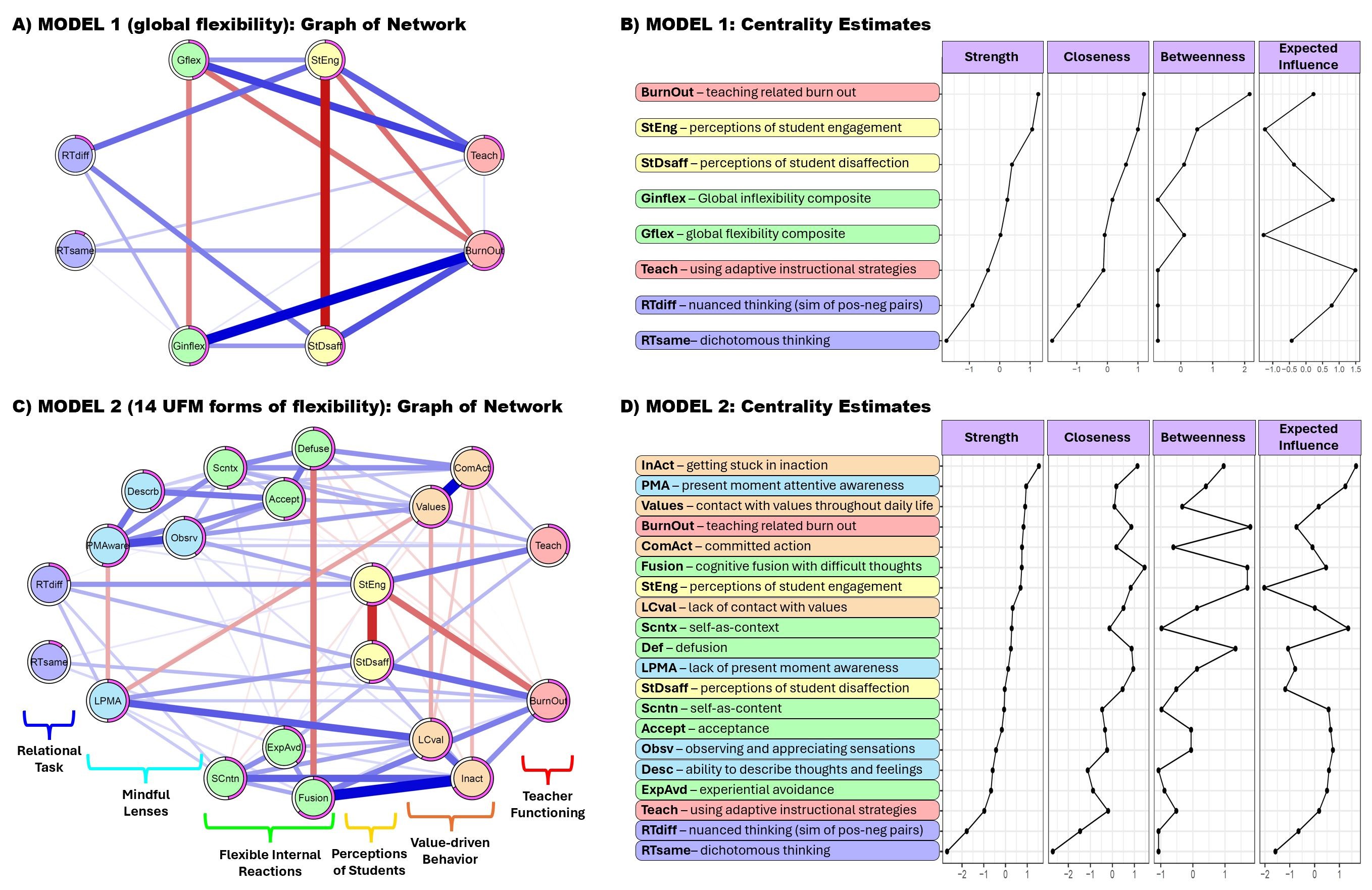
Interpreting network graphs. To visualize these results, Figure 3A and 3C present network graphs for the two models. In these graphs, the variables (termed nodes in network analysis) are represented by circles and the proportion of variance accounted for in each variable is represented by the proportion of pink filling the ring around each node. The unique associations that emerged (i.e., the edge-weights) are represented as lines linking pairs of variables/nodes. The thicker and more deeply saturated lines represent stronger links, with blue lines indicating positive associations and red lines representing negative associations. The authors specified the spacing of the nodes in these graphs to facilitate interpretation by aligning their positions with the broader UFM conceptual framework (Figure 1).
Model 1. Focusing primarily on the strongest unique associations to emerge (i.e., the darker and thicker lines in Figure 3A – representing the largest amounts of unique shared variance), greater evidence of a nuanced relational frame toward students (i.e., seeing positive and negative students traits as more similar – labeled RTdiff in the graph) demonstrated robust unique links to higher teacher perceptions of both student engagement and disaffection in their classrooms, suggestive of potentially greater sensitivity and nuance in those conscious student evaluations. In contrast, greater evidence of a categorical (black and white) relational frame toward students (i.e., seeing all positive students traits as strongly similar and all negative traits as strongly similar) was linked to higher levels of teacher burnout. Consistent with expectations, greater perceptions of student engagement were uniquely linked to greater use of adaptive behavior management and teaching strategies and to lower levels of teacher burnout. In contrast, greater teacher perceptions of student disaffection were linked to greater teacher burnout.
Turning to the global assessments of mindful-flexibility and distracted-inflexibility, higher levels of teachers generally engaging the mindful-flexibility repertoires in their classrooms was uniquely linked to: (1) teachers using more adaptive behavior management and teaching strategies in those classrooms, (2) lower levels of teacher burnout, and (3) greater teacher perceptions of student engagement. In contrast, greater teacher engagement of distracted-inflexible behavioral repertoires in their classrooms was uniquely linked to: (1) greater teacher burnout, and (2) greater perceptions of student disaffection. Taken as a set, these results suggest that teachers’ general engagement of the mindful-flexibility and distracted-inflexibility behavioral repertoires of the UFM model were uniquely linked to classroom dynamics.
Model 2. Once again focusing on the more robust unique links (as those account for larger amounts of the shared variance), the results presented in Figure 3C were broadly supportive of the UFM model when applied to a classroom setting. Thus, a positive cascade emerged represented by a density of robust edges arcing across the sets of mindful flexibility skills in the top half of the graph. Consistent with UFM model predictions, skills within each stage were robustly linked to one another and to skills in the one or two subsequent stages, highlighting the interconnected nature of mindful flexibility behavioral repertoires. More specifically, greater engagement of mindful lenses (the light blue nodes of describing thoughts & feelings, observing sensations, & present moment attentive awareness) showed robust positive links to one another and to correspondingly higher levels of the light green nodes of self as context, acceptance, and defusion representing effective decentering from difficult experiences. Engagement of decentering skills were linked to one another and, in turn, linked to higher levels of the light orange nodes of committed action and maintaining contact with values representing right-mindful and value-driven behavior. Consistent with expectations, higher engagement of value-driven behavioral repertoires in the classroom was linked to more adaptive behavior management and teaching strategies. Higher levels of observing the physical sensations and beauty in each moment within the classroom was the only dimension of psychological flexibility to show a fairly robust direct link to higher perceptions of student engagement.
A corresponding negative cascade also emerged represented by a density of robust edges arcing across the sets of distracted/rigid/inflexible skills in the bottom half of the graph. Specifically, teachers’ greater engagement of a distracted and inattentive lens within the classroom was linked to greater defensive reactivity (light green nodes of self-as-context, experiential avoidance, and fusion) and strongly to a greater difficulty in maintaining day-to-day contact with deeper values. Greater engagement of defensive reactivity in response to difficult classroom experiences was linked to greater aimless and haphazard behavior (light orange nodes of losing contact with values and getting stuck in inaction), which, in turn, was linked to greater feelings of burnout. Turning to the most robust links from dimensions of distracted-inflexibility to classroom dynamics, engagement in cognitive fusion (getting stuck in difficult thoughts, feelings, and experiences in the classroom) and inaction demonstrated the most robust links to teachers’ feelings of burnout, Thus, this suggested that mentally and behaviorally shutting down in response to the ongoing chaos of teaching a large and diverse class of students was particularly tied to experiencing burnout toward students and teaching in general. The dimension of lack of present moment awareness (i.e., engaging a generally distracted and inattentive lens to the present moment) was linked to greater perceptions of student disaffection.
Turning to the indices of centrality estimated for Model 2 (Figure 3D), the four dimensions of the UFM model representing value-driven behavior (contact with values and committed action) and aimless haphazard behavior (lack of contact with values and inaction) emerged as markedly central, both in terms of the overall strength of their unique links to other nodes/processes in the model and in terms of the high level of integration and possible influence existing within the nodes to which they are directly linked (i.e., their expected influence). This serves to highlight the fundamentally behavioral nature of the UFM and its links to classroom dynamics.
4. Discussion
Through the use of Relational Frame Theory, Relational Density Theory, and the Unified Flexibility and Mindfulness conceptual frameworks, this study applied a Contextual Behavioral Science lens to characterizing the potential mechanics underlying classroom dynamics. Building on the promising findings of ACT and mindfulness-based interventions with teachers (e.g., Biglan et al., 2013; Emerson et al., 2017; Jennings et al., 2017; Paliliunas et al, 2023; Roeser et al., 2013), the study conducted a broader (Model 1) and a more fine-grained, process-focused (Model 2), exploratory analysis of how teachers’ relational thinking about students and their engagement of various mindfully flexible behavioral repertoires (and distracted-reactive-inflexible repertoires) might be linked in mechanistic chains to a range of classroom dynamics (i.e., teachers’ perceptions of student engagement and disaffection, their use of adaptive behavior management and teaching strategies, and their symptoms of burnout).
4.1. Interpretation of Results
At a broader level, the results offered support for the UFM model when applied to classroom dynamics. This extends previous work on the UFM (e.g., Rogge & Daks, 2021; Rogge et al., 2024; Parker et al., 2024) into educational settings, providing rich and detailed scaffolding (directly linked to the various therapeutic metaphors, visualizations, and exercises developed for ACT) to understand how teachers’ SEC could be enhanced and maintained. The results also offered partial support for the more specific hypotheses driving this study.
H1: Relational Thinking to Perceptions of Student Engagement. The results offered partial support for Hypotheses 1A and 1B, uncovering unique links from teachers’ relational thinking patterns (assessed indirectly) to their perceptions of student engagement and disaffection (assessed with self-report). Unexpectedly, stronger nuanced relational thinking about students were uniquely linked not only to higher perceptions of student engagement (as anticipated) but also to higher perceptions of student disaffection, suggesting that such a nuanced frame could help teachers more clearly see a mixture of engagement and disaffection in the same students. Taken as a set, these findings highlight the potential for patterns of relational thinking to shape how teachers view their students.
H2: UFM Processes to Perceptions of Student EvD. The Model 1 results offered support for Hypothesis 2, as teachers’ global engagement of the mindful-flexibility skills was moderately linked to greater perceptions of student engagement (Hypothesis 2A) and teachers’ global engagement of the defensive-reactive-inflexible behavioral repertoires was moderately linked to greater perceptions of student disaffection (Hypothesis 2B). The Model 2 results clarified these findings, offering more tentative support for Hypothesis 2, as the only mindful-flexibility process showing notable unique links to greater perceptions of student engagement (after controlling for all other variables in the model) was observing sensations in the classroom (Hypothesis 2A). Similarly, the only distracted-reactive-inflexible processes showing notable links to greater perceptions of student disaffection were lack of present moment awareness and getting stuck in inaction in the classroom setting (Hypothesis 2B). These results begin to suggest that although teachers’ engagement of mindful-flexibility behavioral repertoires in the classroom might impact their own teaching strategies and well-being (e.g., burnout), engaging specific repertoires was more moderately linked to teachers’ perceptions of students.
H3: Perceptions of Student Engagement to Value Driven Behavior, Teaching Strategies, & Burnout. The results offered partial support for Hypothesis 3 as teachers’ perceptions of student engagement were notably linked to their greater use of adaptive behavior management and teaching strategies (Hypothesis 3B) and to lower levels of burnout (Hypothesis 3C) in both Models 1 and 2, but failed to show strong unique links to their greater engagement of value-driven behavior in the classroom (Hypothesis 3A, only tested in Model 2). These results align with previous findings linking student engagement to teaching strategies (e.g., Fredricks et al., 2004; Pianta et al., 2012) and burnout (e.g., Jennings & Greenberg, 2009; Skaalvik & Skaalvik, 2010), highlighting that those links are quite specific and potentially somewhat independent of teachers’ more general engagement of value-driven behavior in the classroom.
H4: Perceptions of Student Disaffection to Value Driven Behavior, Teaching Strategies, & Burnout. The results also offered partial support for Hypothesis 4, as perceptions of student disaffection were uniquely linked to greater inaction (in Model 2, Hypothesis 4A) and to higher levels of burnout (in Models 1 and 2, Hypothesis 4C), but failed to show a notable link to behavior management and teaching strategies (in Models 1 and 2, Hypothesis 4B). Thus, by controlling for a more comprehensive set of classroom dynamics, a more nuanced picture emerged suggesting that perceptions of student disaffection were most proximally linked to teachers engaging in aimless, haphazard, and reactive behavior as well as to higher burnout.
4.2. Implications
Novel Conceptual Integration. The present study offers a novel integration of Relational Density Theory (RDT; Belisle & Dixon, 2020) and the Unified Flexibility and Mindfulness model (UFM; Rogge & Daks, 2021) by examining how the organization of teachers’ relational networks may scaffold adaptive versus maladaptive patterns of classroom functioning. Whereas RDT has almost exclusively been applied at a group-level (characterizing the density and nature of relational networks of groups in laboratory settings), the UFM model has been applied at an individual level (exploring possible mechanistic chains linking various mindful-flexibility processes that are triggered in response to difficult thoughts, feelings, and experiences in the classroom). Although both are grounded within the broader CBS conceptual framework, these traditions have developed in parallel with little integration. The current work bridges this gap by conceptualizing relational density as a structural substrate that could shape classroom dynamics. Specifically, densely clustered networks of student descriptors may reflect or promote categorical, rigid modes of thinking, which in turn may amplify the use of defensive-reactive-inflexible processes and shape teachers’ perceptions of students, use of behavior management and teaching strategies, and increasing frustrations in the classroom. By situating teachers’ relational representations of students within a broader process model of flexibility and mindfulness, this study extends both frameworks and provides a more comprehensive and contextualized account of the cognitive, behavioral, and affective mechanisms underlying teacher burnout, instructional practices, and classroom climate.
Relational Thinking Was Robustly Linked to Perceptions of Student EvD. Across both models, more nuanced patterns of teachers’ relational thinking toward students demonstrated robust unique links to perceptions of student engagement and disaffection. As this is one of the first studies to have both (1) examined patterns of relational thinking at an individual level (assessed with an RDT-based relational task) and (2) applied RDT to a classroom environment, this offers novel evidence supporting the validity of relational tasks for assessing the relational thinking patterns linked to relational frames. Specifically, it highlights that, as predicted by RFT and RDT, those underlying patterns of relational thinking hold the potential to shape teachers’ conscious perceptions of the classroom environment.
Relational Thinking Was Linked to Teaching Strategies and Burnout Primarily through Perceptions of Student EvD. Unexpectedly, both Model 1 and 2 uncovered a moderate link from higher binary (black and white) relational thinking to higher levels of burnout, highlighting unique risks associated with such thinking. With the exception of that unique link, patterns of relational thinking were primarily linked to the outcomes of teaching strategies and burnout indirectly via their robust links to perceptions of student engagement and disengagement. These findings help to contextualize the robust finding in the literature linking perceptions of student engagement and disengagement to teaching strategies and burnout (see Fredricks et al., 2004 for a review) by highlighting perceptions of students as an intermediate mechanism by which relational thinking toward students might shape the classroom environment. This begins to suggest that the ability to detect and perceive student engagement, even in students with challenging behavior, could serve as a major source of resilience for teachers, encouraging them to use more adaptive approaches to behavior management and teaching and possibly even protecting them from burnout. The current study is cross-sectional and therefore unable to clarify directions of causality within the unique links that emerged. Future research could make use of multi-wave studies to support cross-lagged predictive analyses to address that question and bolster these implications.
Mindful-Flexibility Was Robustly Linked to Teaching Strategies and Burnout. Another notably unique contribution of the current study was establishing robust links from global mindful-flexibility (and distracted-reactive-inflexibility) to classroom strategies and teacher burnout in Model 1. This builds on the work demonstrating that ACT-based and mindfulness-based interventions can be effective at improving teachers’ well-being and teaching styles (e.g., Biglan et al., 2013; Emerson et al., 2017) by highlighting the positive and negative cascades of behavioral repertoires within the UFM model as possible mechanisms.
The findings of Model 2 then extend that work further by highlighting specific UFM processes demonstrating links to classroom strategies and burnout. Notably, one process from each of the stages of the positive cascade within the UFM model emerged with unique links to the use of adaptive behavior management and teaching strategies: present moment awareness (i.e., living fully in each moment) from the mindful lenses stage, self-as-context (i.e., maintaining a broader perspective even in the face of disruptions and challenging student behavior) from the decentering stage, and committed action (i.e., continuing to take meaningful steps toward your deeper goals despite the stresses, strains, setbacks, and distractions of day-to-day life in a classroom) from the value-driven behavior stage. The current findings therefore begin to suggest that those skills might represent particular sources of resilience for teachers.
Distracted-Reactive-Inflexibility Robustly Was Linked to Burnout. Two distracted-reactive-inflexible processes emerged with unique links to burnout: (1) fusion (i.e., having negative thoughts and experiences continually run through one’s mind like a broken record) from the defensively reacting stage of the UFM negative cascade and (2) getting stuck in inaction (i.e., negative thoughts and experiences effectively stalling out teachers’ progress toward deeper goals for themselves and their students) from the aimless and haphazard stage. These findings begin to suggest that those processes might represent key risk areas and potential targets for intervention to prevent and treat school-related burnout.
4.3. Limitations
Despite the notable conceptual and substantive contributions of the current study, a number of factors limit the generalizability of its findings. First, the study was entirely cross-sectional and so, directions of causality could not be determined. Although the UFM model posits reciprocal directions of influence between the variables examined, future work should make use of multi-wave designs that can support cross-lagged predictive analyses to more directly assess potential directions of influence within the links that emerged in these analyses. Second, the sample was 79% female and 85% white with an average age of 42. Although this reasonably mirrors the demographics of teachers in the US (77% female, 80% white, with an average age of 43; see Schaeffer, 2024), the lower representation of male and minority teachers in the current sample raises concerns about the generalizability of these findings. Future work should seek larger samples, potentially oversampling male and minority teachers, to allow the generalizability of the current findings to be directly tested in those smaller demographic groups. Third, the sample collected data entirely online which might have served to limit diversity in the final sample. Counterbalancing this concern, recent national data suggests notable declines the technology gap due in large part to the rapid permeation of smart phones into the lives of individuals in the US (Pew Research, 2021), thereby making internet access increasingly available to individuals from all walks of life. To more directly address this concern, future studies of the UFM model in classrooms should seek samples with greater diversity to ensure these findings continue to hold across all demographic groups. Finally, although the UFM model incorporates 14 distinct behavioral repertoires into a larger 3-stage process framework, future work on the UFM model could be enhanced by considering the inclusion of additional flexibility and mindfulness processes (e.g., non-attachment, self- compassion, emotion regulation skills).
4.4. Conclusion
Despite its limitations, the current study offers a critical first-look into how Contextual Behavioral Science can inform our understanding of classroom dynamics and teacher well-being. By integrating a novel individual-focused approach to Relational Density Theory within the broader scaffolding of the Unified Flexibility and Mindfulness model, the study contextualizes our understanding of classroom dynamics, offering key insights into the specific mechanisms that might serve as optimal points of risk, resilience, and targets for interventions to bolster teachers and their efforts to shape the minds of the next generation.
Supplementary Materials
The following supporting information can be downloaded at the website of this paper posted on Preprints.org. Figure S1. Simulations for detecting observed networks at different sample sizes. Figure S2. Bootstrapping results to evaluate stability / precision of network findings.
Author Contributions
Conceptualization, KP and RDR; Methodology, KP and RDR; Software, RDR and KP; Formal Analysis, RDR and KP; Investigation, KP and RDR; Resources, RDR; Data Curation, KP and RDR; Writing – Original Draft Preparation, KP and RDR; Writing – Review & Editing, KP and RDR; Visualization, RDR and KP; Supervision, RDR; Project Administration, KP and RDR; Funding Acquisition, n/a.
Funding
There was no formal funding for this project.
Data Availability Statement
All study materials have been made available on the second author’s osf.io profile under the “The Understanding Teachers’ Perspectives Survey” project (https://osf.io/73z6d/). The preregistration for the project and this manuscript is also available in that project, as are the SPSS syntax and R syntax and relevant output. Finally, the data is available upon reasonable request within that same osf.io project.
Acknowledgments
We would like to thank the teachers who took time out of their busy lives to participate in our study. We have deep gratitude and respect for their dedication to educating youth.
Conflicts of Interest
No financial conflicts of interest to report.
References
- Babyak, M. A. (2004). What you see may not be what you get: A brief, nontechnical introduction to overfitting in regression-type models. Psychosomatic Medicine, 66(3), 411–421. [CrossRef]
- Barton, M. A., Lall, M. D., Johnston, M. M., Lu, D. W., Nelson, L. S., Bilimoria, K. Y., & Reisdorff, E. J. (2022). Reliability and validity support for an abbreviated Copenhagen burnout inventory using exploratory and confirmatory factor analysis. JACEP Open, 3(4), e12797. [CrossRef]
- Belisle, J., & Clayton, M. (2021). Coherence and the merging of relational classes in self-organizing networks: Extending relational density theory. Journal of Contextual Behavioral Science, 20, 118-128. [CrossRef]
- Belisle, J., & Dixon, M. R. (2020). Relational density theory: Nonlinearity of equivalence relating examined through higher-order volumetric-mass-density. Perspectives on Behavior Science, 43(2), 259-283. [CrossRef]
- Biglan, A., Layton, G. L., Jones, L. B., Hankins, M., & Rusby, J. C. (2013). The value of workshops on psychological flexibility for early childhood special education staff. Topics in Early Childhood Special Education, 32(4), 196-210. [CrossRef]
- Bringmann, L. F., Elmer, T., Epskamp, S., Krause, R. W., Schoch, S. F., Wichers, M., … & Snippe, E. (2019). What do centrality measures measure in psychological networks? Journal of Abnormal Psychology, 128(8), 892–903. [CrossRef]
- Brunner, J., & Austin, P. C. (2009). Inflation of Type I error rate in multiple regression when independent variables are measured with error. Canadian Journal of Statistics, 37(1), 33–46. [CrossRef]
- Chang, M.-L. (2009). An appraisal perspective of teacher burnout: Examining the emotional work of teachers. Educational Psychology Review, 21(3), 193–218. [CrossRef]
- Creedy, D. K., Sidebotham, M., Gamble, J., Pallant, J., & Fenwick, J. (2017). Prevalence of burnout, depression, anxiety and stress in Australian midwives: a cross-sectional survey. BMC pregnancy and childbirth, 17(13). [CrossRef]
- Epskamp, S., & Fried, E. I. (2018). A tutorial on regularized partial correlation networks. Psychological Methods, 23(4), 617-634. [CrossRef]
- Epskamp, S., & Fried, E. I. (2021). Package ‘bootnet’. R package version, 1.5 https://github.com/SachaEpskamp/bootnet.
- Flook, L., Goldberg, S. B., Pinger, L., Bonus, K., & Davidson, R. J. (2013). Mindfulness for teachers: A pilot study to assess effects on stress, burnout, and teaching efficacy. Mind, Brain, and Education, 7(3), 182–195. [CrossRef]
- Fredricks, J. A., Blumenfeld, P. C., & Paris, A. H. (2004). School engagement: Potential of the concept, state of the evidence. Review of Educational Research, 74(1), 59–109. [CrossRef]
- Gillard, D., Wright, D., McNally, A., Flaxman, P. E., McIntosh, R., & Honey, K. (2021). Acceptance & commitment therapy for school leaders’ well-being: An initial feasibility study. Educational Psychology in Practice, 37(1), 34–51.
- Grossman, P., Niemann, L., Schmidt, S., & Walach, H. (2004). Mindfulness-based stress reduction and health benefits: A meta-analysis. Journal of Psychosomatic Research, 57(1), 35-43. [CrossRef]
- Hallquist, M. N., Wright, A. G. C., & Molenaar, P. C. M. (2021). Problems with centrality measures in psychopathology symptom networks: Why network psychometrics cannot escape psychometric theory. Multivariate Behavioral Research, 56(2), 199–223. [CrossRef]
- Hansen, S. B., & Virden, T. (2022). An assessment of burnout among graduate students in health professional programs. International Journal for the Scholarship of Teaching and Learning, 16(2), 1-5. [CrossRef]
- Haslbeck, J., & Waldorp, L. J. (2015). mgm: Estimating time-varying mixed graphical models in high-dimensional data. arXiv preprint. arXiv:1510.06871.
- Hutchison, L., Belisle, J., Matthews, M., & Sickman, E. (2023). Applying concepts of relational density theory to climate related consumer behavior: A contextual extension study. Journal of Contextual Behavioral Science, 30, 8-19. [CrossRef]
- Jennings, P. A., & Greenberg, M. T. (2009). The prosocial classroom: Teacher social and emotional competence in relation to student and classroom outcomes. Review of Educational Research, 79(1), 491–525. [CrossRef]
- Jennings, P. A., Brown, J. L., Frank, J. L., Doyle, S., Oh, Y., Davis, R., Rasheed, D., DeWeese, A., DeMauro, A. A., Cham, H., & Greenberg, M. T. (2017). Impacts of the CARE for Teachers program on teachers’ social and emotional competence and classroom interactions. Journal of Educational Psychology, 109(7), 1010–1028. [CrossRef]
- Korkmaz, S., Göksülük, D., & Zararsiz, G. (2014). MVN: An R package for assessing multivariate normality. R JOURNAL, 6(2).
- Levin, M. E., Hildebrandt, M. J., Lillis, J., & Hayes, S. C. (2012). The impact of treatment components suggested by the psychological flexibility model: A meta-analysis of laboratory-based component studies. Behavior Therapy, 43(4), 741–756. [CrossRef]
- Liu, H., Lafferty, J., & Wasserman, L. (2009). The nonparanormal: Semiparametric estimation of high dimensional undirected graphs. Journal of Machine Learning Research, 10(10). [CrossRef]
- Paliliunas, D., Burke, R. V., Taylor, S. L., Frizell, C. B., Durbin, K. K., & Hutchings, D. L. (2023). Evaluating an ACT-based brief intervention for educators treatment package on reported well-being and ACT-consistent language in the classroom. Behavior Analysis in Practice, 16(1), 156–171. [CrossRef]
- Palmer, K. (2025). The Relationship Between Teachers' Psychological Flexibility and Their Perceptions of Student Behavior (Doctoral dissertation, Boise State University; Order No. 31842058). Available from ProQuest Dissertations & Theses Global. (3237598732). Retrieved from https://ezp.lib.rochester.edu/login?url=https://www.proquest.com/dissertations-theses/relationship-between-teachers-psychological/docview/3237598732/se-2.
- Parker, S. F., Rogge, R. D., Drake, C. E., & Fogle, C. (2024). A fresh lens on psychological flexibility: Using network analysis and the unified flexibility and mindfulness model to uncover paths to wellbeing and distress. Journal of Contextual Behavioral Science, 32, 100753. [CrossRef]
- Pianta, R. C., Hamre, B. K., & Allen, J. P. (2012). Teacher-student relationships and engagement: Conceptualizing, measuring, and improving the capacity of classroom interactions. In S. L. Christenson et al. (Eds.), Handbook of Research on Student Engagement (pp. 365–386). Springer. [CrossRef]
- Reddy, L. A., Dudek, C. M., Fabiano, G. A., & Peters, S. (2015). Measuring teacher self-report on classroom practices: Construct validity and reliability of the Classroom Strategies Scale–Teacher Form. School Psychology Quarterly, 30(4), 513-533. [CrossRef]
- Reeve, J. (2012). A self-determination theory perspective on student engagement. In: Christenson, S., Reschly, A., Wylie, C. (Eds) Handbook of Research on Student Engagement, 149–172. Springer, Boston, MA. [CrossRef]
- Ritoša, A., Danielsson, H., Sjöman, M., Almqvist, L., & Granlund, M. (2020, November). Assessing school engagement–adaptation and validation of the “Engagement Versus Disaffection with Learning: Teacher report” in the Swedish educational context. Frontiers in Education, 5, 521972. [CrossRef]
- Roeser, R. W., Schonert-Reichl, K. A., Jha, A., Cullen, M., Wallace, L., Wilensky, R., Oberle, E., Thomson, K., Taylor, C., & Harrison, J. (2013). Mindfulness training and reductions in teacher stress and burnout: Results from two randomized, waitlist-control field trials. Journal of Educational Psychology, 105(3), 787–804. [CrossRef]
- Rogge, R. D., & Daks, J. S. (2021). Embracing the intricacies of the path toward mindfulness: Broadening our conceptualization of the process of cultivating mindfulness in day-to-day life by developing the unified flexibility and mindfulness model. Mindfulness, 12, 701-721. [CrossRef]
- Rogge, R. D., Garlock, A., & Rasmussen, B. D. (2026). Charting Behavioral Cascades from Difficult Experiences to Well-Being or Distress: Testing the Unified Flexibility & Mindfulness Model with Network Analyses of Longitudinal Change. Journal of Contextual Behavioral Science, 39, 100976. [CrossRef]
- Rogge, R. D., Lin, Y. Y., Swanson, D. P., & Amaro, A. (2024). Tracing the path toward mindfulness back to its origins: Linking tenets of Buddhism to mindfulness within the Buddhism-informed unified flexibility and mindfulness (BI-UFM) model. Mindfulness, 15(4), 775-794. [CrossRef]
- Rolffs, J. L., Rogge, R. D., & Wilson, K. G. (2018). Disentangling components of flexibility via the hexaflex model: Development and validation of the Multidimensional Psychological Flexibility Inventory (MPFI). Assessment, 25(4), 458-482. [CrossRef]
- Schaeffer, K. (2024, September 24). Key facts about public school teachers in the U.S. Pew Research Center. https://www.pewresearch.org/short-reads/2024/09/24/key-facts-about-public-school-teachers-in-the-u-s/.
- Skaalvik, E. M., & Skaalvik, S. (2010). Teacher self-efficacy and teacher burnout: A study of relations. Teaching and Teacher Education, 26(4), 1059–1069. [CrossRef]
- Skinner, E. A., & Belmont, M. J. (1993). Motivation in the classroom: Reciprocal effects of teacher behavior and student engagement across the school year. Journal of educational psychology, 85(4), 571–581. [CrossRef]
- Skinner, E. A., Kindermann, T. A., & Furrer, C. J. (2009). A motivational perspective on engagement and disaffection: Conceptualization and assessment of children’s behavioral and emotional participation in academic activities. Educational and Psychological Measurement, 69(3), 493–525. [CrossRef]
- Tan, T. S., Comai, S., & Patrick, S. K. (2025). State teacher shortages 2025 update: Teaching positions left vacant or filled by teachers without full certification. Learning Policy Institute. https://learningpolicyinstitute.org/product/state-teacher-shortages-vacancy-resource-tool-2025.
- Van den Berghe, L., Cardon, G., Tallir, I., Kirk, D., & Haerens, L. (2016). Dynamics of need-supportive and need-thwarting teaching behavior: the bidirectional relationship with student engagement and disengagement in the beginning of a lesson. Physical Education and Sport Pedagogy, 21(6), 653–670. [CrossRef]
- Zhao, T., Liu, H., Roeder, K., Lafferty, J., & Wasserman, L. (2012). The huge package for high-dimensional undirected graph estimation in R. Journal of Machine Learning Research, 13(1), 1059–1062. https://www.jmlr.org/papers/volume13/zhao12a/zhao12a.pdf.
Figure 1.
Conceptual Model Integrating Relational Frames and Perceptions of Students into the Unified Flexibility and Mindfulness Model.
Figure 1.
Conceptual Model Integrating Relational Frames and Perceptions of Students into the Unified Flexibility and Mindfulness Model.
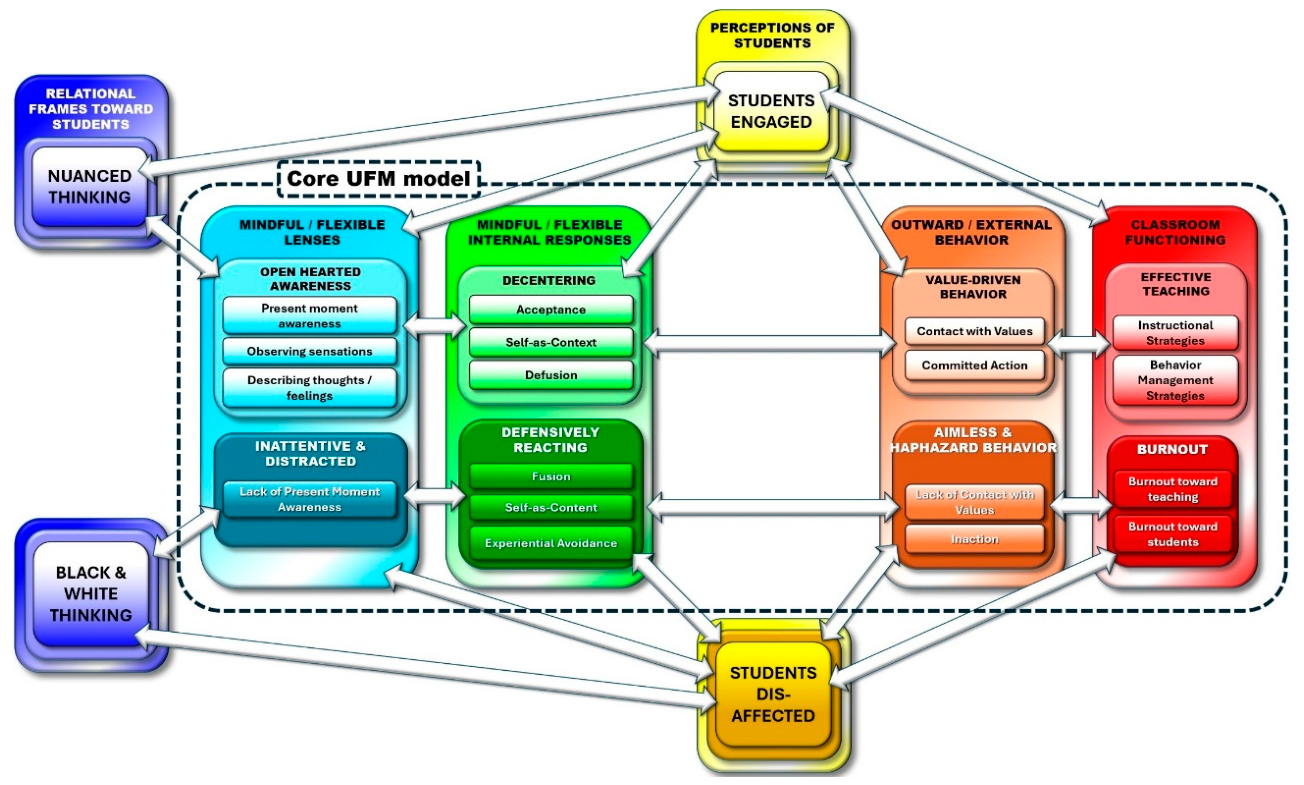
Figure 2.
Bivariate Correlations and Network Analysis Edge Weights.
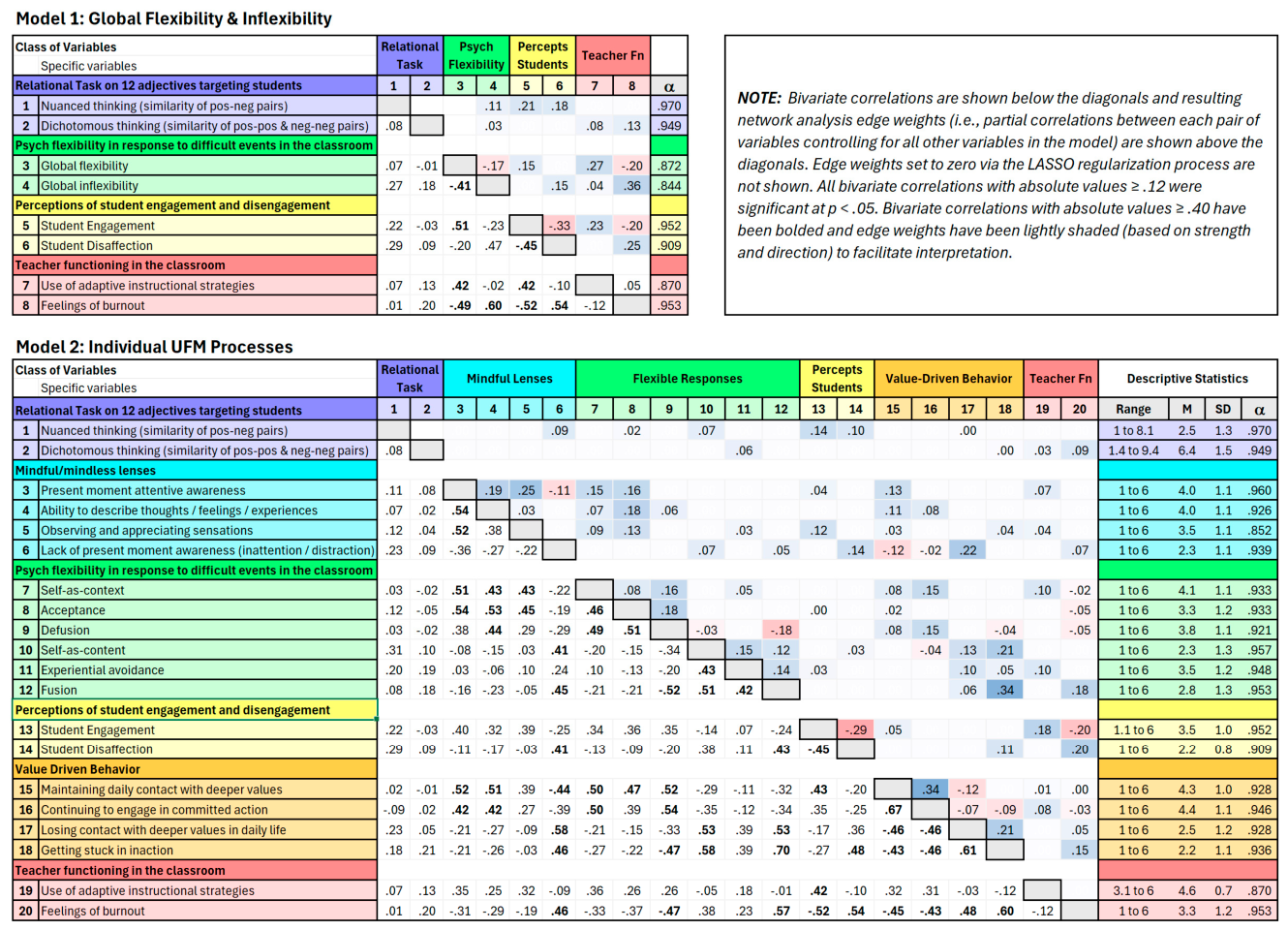
Figure 3.
Network Graphs and Centrality Estimates. NOTE: The variables included in the models are represented as circles (i.e., nodes) in panels A and C. The lines in those panels represent the unique links (i.e., the edge weights) that emerged between pairs of variables (i.e., the partial correlation between each pair of variables after controlling for all of the other variables in the model). Blue edges represent positive associations, red edges represent negative associations, and the thickness and color saturation of each edge indicates its relative strength. The pink filling in the ring around each node graphically presents the proportion of variance accounted for in each variable by the model. Strength estimates centrality by summing the absolute strengths of the edges linking each node to the rest of the model, whereas closeness estimates the proximity of each node to other nodes, betweenness estimates the number of times a node represents the shortest link between two other nodes, and expected influence estimates how much a change in each node might result in an overall positive or negative shift in the rest of the model. as a set, these findings suggest that relational frames assessed and scored at an individual level from a student-focused relational task demonstrated meaningful links to conscious perceptions of students and to teacher burnout.
Figure 3.
Network Graphs and Centrality Estimates. NOTE: The variables included in the models are represented as circles (i.e., nodes) in panels A and C. The lines in those panels represent the unique links (i.e., the edge weights) that emerged between pairs of variables (i.e., the partial correlation between each pair of variables after controlling for all of the other variables in the model). Blue edges represent positive associations, red edges represent negative associations, and the thickness and color saturation of each edge indicates its relative strength. The pink filling in the ring around each node graphically presents the proportion of variance accounted for in each variable by the model. Strength estimates centrality by summing the absolute strengths of the edges linking each node to the rest of the model, whereas closeness estimates the proximity of each node to other nodes, betweenness estimates the number of times a node represents the shortest link between two other nodes, and expected influence estimates how much a change in each node might result in an overall positive or negative shift in the rest of the model. as a set, these findings suggest that relational frames assessed and scored at an individual level from a student-focused relational task demonstrated meaningful links to conscious perceptions of students and to teacher burnout.
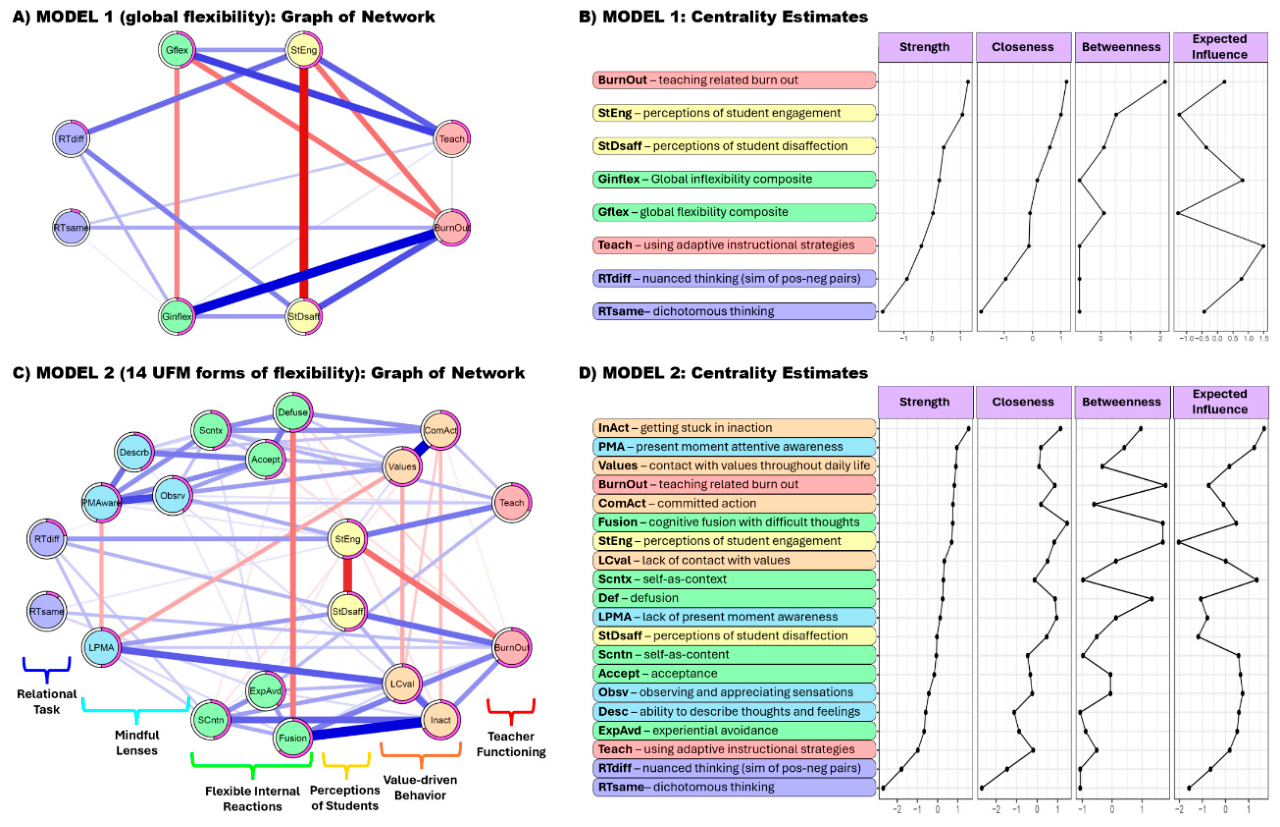
Disclaimer/Publisher’s Note: The statements, opinions and data contained in all publications are solely those of the individual author(s) and contributor(s) and not of MDPI and/or the editor(s). MDPI and/or the editor(s) disclaim responsibility for any injury to people or property resulting from any ideas, methods, instructions or products referred to in the content. |
© 2026 by the authors. Licensee MDPI, Basel, Switzerland. This article is an open access article distributed under the terms and conditions of the Creative Commons Attribution (CC BY) license (http://creativecommons.org/licenses/by/4.0/).
Copyright: This open access article is published under a Creative Commons CC BY 4.0 license, which permit the free download, distribution, and reuse, provided that the author and preprint are cited in any reuse.


