
Submitted:
14 April 2026
Posted:
16 April 2026
You are already at the latest version
Abstract
Phytohormones act as key endogenous factors and signalling molecules that mediate abiotic stress responses in plants, and are the integration centres of plant responses to environmental stimuli, playing an important role in plant resistance to drought, salt, cold and other stresses. Stress responses are finely regulated through a complex network of different classes of phytohormone signalling pathways. Many transcription factors are able to regulate the content of endogenous plant hormones by influencing hormone synthesis, metabolic gene and stress-related genes expression, which in turn affects plant growth and development and improves plant tolerance to abiotic stresses. Signaling molecules in plant stress responses, such as abscisic acid (ABA) ethylene (ETH), gibberellin (GA), jasmonic acid (JA) and salicylic acid (SA). Their roles in orchestrating plant responses to abiotic stresses. With global climate change, abiotic disasters have become increasingly frequent in recent years, severely hindering crop growth and development. Nanomaterials have attracted widespread attention from researchers because they can significantly alleviate abiotic stress in crops caused by factors such as salinity, drought, flooding, and heavy metals. This paper reviews recent research progress on the use of plant hormones and nanomaterials to alleviate abiotic stress in plants and elaborates on their underlying mechanisms of action. In the future, we will focus on investigating the roles of plant hormones and nanomaterials in modulating plant responses to abiotic stress, thereby enhancing plant tolerance to such stresses and increasing crop yields to address food security challenges.
Keywords:
abiotic stress
; phytohormones
; stress-related genes
; nanomaterials
1. Introduction
Phytohormones are organic signalling molecules produced by plants through their own metabolism that can produce significant physiological effects at very low concentrations. Phytohormones can either function at the site of synthesis or be transported via the vascular system to act in tissues relatively distant from the site of synthesis. Phytohormones signaling molecules have been studied in plant abiotic and biotic stress responses, such as abscisic acid (ABA), auxin (IAA), brassinosteroids (BR), ethylene (ETH), gibberellin (GA), cytokinins (CK), jasmonic acid (JA), strigolactone (SL), and salicylic acid (SA) [1,2,3,4,5,6]. These phytohormones not only help plants to resist abiotic and biotic stresses but also regulate plant growth and development. They are independent of each other, but also synergistically regulate the developmental processes such as seed germination, nutrient growth, reproductive growth, embryonic development, seed maturation and dormancy, as well as the adaptation to biotic and abiotic environmental stresses during the growth cycle of plants [7,8,9,10,11]. Studies have shown that many families of transcription factors are able to hormonally regulate the ability of plants to cope under abiotic stresses [12,13,14,15]. Because of the complex interactions of different phytohormones and their ability to control a wide range of physiological processes, they can serve as key endogenous factors that mediate plant stress responses. Moreover, since plant hormones are involved in defence responses, their complex intertwined signalling pathways make the generation of fine and efficient stress responses easier [4,5,6]. Studies have shown that ABA, ETH, GA, JA, and SA play a important roles in orchestrating plant responses to abiotic stresses [16,17,18] (Figure 1). ABA is the main phytohormone that regulates the response of plants to abiotic stresses, such as drought, salt, cold, heat and other abiotic stresses that can alter ABA levels [1,2]. Ethylene is a key plant hormone that plays a complex role in plant responses to abiotic stress, both enhancing plant resistance and, under certain conditions, leading to aging and death. It plays a vital role in defending against adversities such as drought, high salinity, and low temperatures [19]. Under abiotic stress, GA helps plants adapt to environmental pressures such as drought tolerance, salt tolerance, and heat tolerance by regulating its own biosynthesis and signal transduction. Its specific functions include controlling leaf elongation, promoting seed germination and flowering, and influencing plant responses to gravity sensing [20]. The role of JA in abiotic stress primarily involves regulating plant growth and development while acting as a signaling molecule to activate defense responses. When plants encounter drought, salinity, high temperatures, or low temperatures, the JA signaling pathway is activated, thereby influencing plant growth and simultaneously inducing the plant to produce a series of defense mechanisms [21]. SA plays a crucial role in plant defense against abiotic stresses by regulating metabolic processes, such as enhancing resistance and inducing defense responses [22]. Therefore, hormones play a crucial role in plant responses to abiotic stress.
Plant nanobiology is a cutting-edge interdisciplinary subject that has emerged in recent years. Nanomaterials have a unique small size effect and can enter the interior of plants as nutrient carriers or regulators and participate in plant metabolism, which can promote plant growth and development. Nanozymes are nanomaterials that have catalytic activity similar to natural enzymes [23,24,25]. Nanomaterials (NMs) are materials that have at least one dimension in the range of 1-100 nm in three dimensions and have special physicochemical properties in contrast to the corresponding non-nanomaterials [26,27]. Since the early 1990s, nanotechnology has been rapidly developing in the fields of medicine, energy, and food processing, and is widely used in biosensors, water purification, photocatalysis, and antimicrobial agents. In the field of agriculture, NMs can enter into crop plants through their organs such as seeds, roots and leaves to regulate their physiological and biochemical metabolisms in order to improve their tolerance to biotic and abiotic stresses, and they can also be applied in agricultural production in the form of pesticides, fertilisers, nanocomposites, and nano-sensors, which can significantly improve the yield and quality of crops. And the different structures, shapes, sizes and concentrations of NMs present different effects on crops at different growth periods [28,29,30]. Gao et al. reported that nano Fe3O4 has the enzymatic properties of horseradish peroxidase (HRP), which can rapidly catalyse the decomposition of H2O2, and the reaction follows enzymatic kinetics [31]. Compared with traditional enzyme catalysts, nanoenzymes have the advantages of high catalytic activity, low cost, and easy to scale up production. At the same time, nanoenzymes are mostly composed of inorganic materials, which can ensure that their chemical structure and properties do not change under extreme conditions, their have higher stability than natural enzymes [32,33]. Some studies have shown that nanoenzymes can effectively regulate plant metabolism and significantly improve plant resistance to abiotic stresses, and can also promote plant growth [31,34]. Scientists have shown that nanoenzymes can effectively regulate plant metabolism and significantly improve plant resistance to abiotic stresses, and can also promote plant growth [34,35,36,37,38]. Nanoenzymes can function as antioxidant-like enzymes, which play a role in scavenging reactive oxygen species (ROS) by catalytically converting excess oxygen radicals or hydrogen peroxide produced in plants due to abiotic stresses into oxygen and water [39,40]. Nanoenzymes also have the functions of up-regulating protein expression levels in crops, complexing heavy metal ions, and providing trace elements for plant growth, all of which play an important role in improving the abiotic stress resistance of crops [41,42,43].
Plants surviving in nature are subjected to a variety of abiotic stresses, taking osmotic stress as an example, among which drought stress is one of the serious unfavourable factors affecting plant growth and productivity [44]. Under drought conditions, plant cells shrink and water deficit leads to metabolic disorders in the plant and photosynthesis, respiration, leaf transpiration, and root growth receive inhibition or even stop, leading to plant death [45]. At the same time, drought stress is the most critical factor limiting the normal growth and development of plants, which causes a much higher reduction in agricultural yields than other abiotic stresses [46]. The some main mechanisms by which drought stress reduces crop yields. First point, reduced canopy uptake of photosynthetically active radiation. Second point, reduced radiation utilisation efficiency. Third point, reduced harvest index. Repeatable drought stress treatments are cumbersome and seriously hinder research on drought tolerance in plants and prevent the application of traditional breeding efforts and modern genetic methods in improving drought tolerance in crops [47]. Salt stress is one of the main stress factors faced by plants in the natural environment, which can cause imbalance of ion content in plants leading to ion toxicity, resulting in osmotic stress, water deficiency, mineral nutrient deficits, hindering plant absorption of soil nutrients and water, leading to water loss, stomatal closure, affecting the plant to carry out photosynthesis, growth inhibition, metabolic disorders, accelerated senescence, seriously affecting plant growth, metabolic disorders, accelerated senescence, seriously affecting the growth of plants, and even lead to plant death [48]. At the same time, due to plant transpiration, Na+ and Cl- accumulate in the plant body, causing damage to the osmotic pressure balance in the plant body, imbalance of intracellular redox reactions, increase in reactive oxygen species, deepen the degree of plasma membrane peroxidation, and damage to the cellular structure, thus inhibiting seed germination and seedling growth [4,5,6]. Nowadays, more and more scientists are focusing on abiotic stresses, and many studies have shown that some transcription factor family genes are involved in plant resistance to abiotic stresses. For example, transcription factors such as AP2, WRKY, MYB, NAC, C2H2 and so on. They are involved in the response of plants to abiotic stresses such as drought, cold, salinity and heat [49,50,51,52,53]. In order to achieve sustainable agricultural development, meet the growing global demand for food, achieve stable and increased food production, and promote food security and sustainable development, it is urgent to mitigate the negative impacts of abiotic stress on crops, and the rapid development of nanotechnology in the field of agriculture has brought new ideas to this end.
In summary, the impact of abiotic stress on plant growth and development is very serious. So the study of abiotic stress is very important, and more and more researchers are beginning to focus on this direction. With the expectation that by improving the ability of plants to withstand abiotic stresses, we can ensure that the food security crisis caused by rapid population growth will be effectively alleviated worldwide and the yields of major food crops will be increased, with the development of molecular biology, it has been gradually recognised that the expression of plant genes can influence the tolerance of plants under abiotic stresses. This article reviews the role of major plant hormones such as ABA, ETH, GA, JA, and SA in regulating abiotic stress responses. It also summarizes the research progress in nanomaterials action mechanisms and regulation for abiotic stress, and proposes suggestions for the development prospects of this field, in order to provide a reference for the development of new nanomaterials and their application in resisting abiotic stress. It aims to deepen the understanding of the molecular mechanism of plant hormone regulation of stress responses and provide new ideas for the genetic improvement of crop stress tolerance.
2. Mechanisms of Phytohormones Resistance to Abiotic Stress in Plants
Since plants are immobile, they cannot escape abiotic and biotic stresses. Exposure to these stresses throughout their life cycle leads to stunted growth and, in severe cases, death. Consequently, plants have evolved defense responses against multiple stress factors, with responses to specific stresses primarily regulated by relevant plant hormones [10,41]. In this process, beyond the pivotal role of individual hormone levels, interactions and influences among different plant hormones facilitate the coordinated remedial actions of numerous genes and their regulatory factors during stress responses. Therefore, to gain a deeper understanding of defense response mechanisms, it is particularly urgent to elucidate the intricate connections of cross-talk between various plant hormones [54,55].
2.1. The Role of ABA in Plant Responses to Abiotic Stress
ABA is an important plant hormone known as the “stress hormone.” It accumulates rapidly when plants are exposed to stress conditions such as drought, high salinity, and low temperatures. By promoting stomatal closure to reduce water loss, inhibiting growth, and maintaining bud and seed dormancy, it regulates plant development and enhances stress tolerance [56,57]. Salt stress and drought stress among abiotic stresses exert profound effects on plants. These stresses impede water uptake by plant roots, leading to “physiological drought” while salt directly damages plants, manifesting as stunted growth, leaf damage, and reduced photosynthesis. The combined effects of salt and drought intensify these adverse impacts. Under osmotic conditions caused by high salinity or drought, ABA stimulates stomatal closure, maintains water balance, and regulates the expression of stress response genes [58,59,60]. Lim et al. found that OsWRKY5 negatively regulates drought tolerance in rice. Its expression is downregulated by drought stress as well as by NaCl, mannitol, and ABA treatments. Loss of Oswrky5 activity increases rice sensitivity to ABA, thereby promoting ABA-dependent stomatal closure. OsWRKY5 downregulates the expression of downstream genes of OsMYB2 in the ABA signaling pathway. As OsWRKY5 acts as a negative regulator of ABA-induced drought tolerance, this strongly suggests that OsWRKY5 may enhance drought tolerance in rice varieties by regulating ABA [61]. Wei et al. found that rice circadian clock-associated protein 1 OsCCA1 is essential for rice tolerance to salt, osmotic, and drought stress. They identified 692 direct transcriptional targets of OsCCA1, many of which are involved in the ABA signaling pathway. Furthermore, OsCCA1 can directly bind to the promoters of OsPP108 and OsbZIP46, thereby activating their expression. An Oscca1 knockout mutant generated exhibited increased sensitivity to ABA signaling. In summary, OsCCA1 may confer tolerance to various abiotic stresses in rice by regulating ABA signaling, thereby linking the circadian clock to ABA signaling [62].
2.2. The Role of ETH in Plant Responses to Abiotic Stress
ETH is a gaseous hormone that is widely present in various tissues and organs of plants and plays a role in plant growth and development. It also contributes to plants’ responses to abiotic stress [63]. Changes in ethylene levels within plants are regulated by internal signaling molecules and external environmental factors. When plants are exposed to biotic or abiotic stressors such as mechanical injury, hypoxia, cold stress, and frost damage, ethylene levels in the plant change. Various stress conditions often lead to an increase in ethylene levels within the plant [64]. Djemal et al. found that overexpression of the ethylene-responsive transcription factor TdSHN1 in durum wheat led to cutin formation and reduced stomatal density. The TdSHN1-overexpressing lines exhibited enhanced salt tolerance due to reduced water loss from the leaves [65]. Cheng et al. found that ERF1 may be involved in the salt stress response via the ethylene signaling pathway. In Arabidopsis thaliana, ERF1 expression is significantly induced under both high-salinity and drought stress. Salt stress induction requires both the JA and ETH signaling pathways. ERF1-overexpressing lines exhibited enhanced drought and salt tolerance, along with reduced stomatal aperture, resulting in decreased water loss due to transpiration [66]. An et al. found that under salt stress, the ethylene-responsive transcription factor MdERF4 in apple is induced and reduces the salt tolerance by binding to and inhibiting the expression of MdERF3. They hypothesized that the MdERF4-MdERF3 interaction may serve as a feedback regulatory mechanism for maintaining ethylene homeostasis in plants under salt stress [67].
2.3. The Role of GA in Plant Responses to Abiotic Stress
As a classic plant hormone, GA regulates various processes of plant growth and development, such as promoting stem elongation, leaf expansion, seed germination, flowering, and fruit development [68]. GA interacts with other hormonal signals within the plant, integrating to form a complex regulatory network that synergistically regulates plant growth and development and helps the plant respond to abiotic stress [69]. Lu et al. found that two homologous genes of AtMFT (a phosphatidylethanolamine-binding protein), OsMFT1 and OsMFT2, are present in Oryza sativa. Under salt stress, seeds from the Osmft1 loss-of-function mutant germinate faster than those from WT. Overexpression of OsMFT1 or OsMFT2 increases sensitivity to salt stress during seed germination. A transcriptomic comparison of Osmft1 mutants with WT under salt-stressed and unstressed conditions revealed multiple differentially expressed genes associated with salt stress, plant hormone metabolism, and signaling pathways. Furthermore, under salt stress, OsMFT1-overexpressing seeds exhibited increased sensitivity to GA [70]. Li et al. identified three WRKY transcription factors—OsWRKY24, OsWRKY53, and OsWRKY70—that play roles in abiotic stress and plant hormone responses. They contain two conserved domains, and their promoters harbor multiple cis-regulatory elements that respond to abiotic stress and hormone signals. Under various stress conditions—including darkness, low temperature, salt stress, and drought—as well as following treatment with hormones such as ABA, SA, MeJA, and GA, the transcriptional levels of these genes in wild-type seedlings underwent significant changes. The expression level of OsWRKY24 was downregulated under salt stress, drought, and following treatment with ABA and GA. OsWRKY53 transcripts were induced under darkness, low temperature, salt stress, and drought treatments, while SA and GA treatments suppressed their expression. Furthermore, the expression level of OsWRKY70 was upregulated under darkness and low-temperature conditions but was suppressed under salt stress, drought, ABA and GA treatments [71].
2.4. The Role of JA in Plant Responses to Abiotic Stress
JA hormones are a class of very important lipid-based growth regulators in plants; they play a role in regulating certain key growth and development processes as well as responses to environmental factors, such as the initiation of trichomes on leaf surfaces, anthocyanin accumulation, and responses to freezing stress [72,73]. Kong et al. identified and characterized the osmotic stress-induced ethylene response factor 15 (PtoERF15), which is involved in regulating the size, density, and cell wall thickness of xylem vessels in Populus tomentosa in response to drought stress. Overexpression of PtoERF15 helps maintain water potential in the stem, thereby enhancing its drought tolerance. PtoERF15 directly regulates PtoMYC2b, a key regulator of the JA signaling pathway. PtoMYC2b is also involved in the regulation of Populus tomentosa vessel morphology. In summary, PtoERF15-PtoMYC2b transcriptional cascade maintains stem water potential by regulating xylem vessel development, ultimately enhancing the drought tolerance of Populus tomentosa [74]. Wang et al. cloned the PlWRKY13 gene from peony leaves. Four types of abiotic stress—low temperature, high temperature, waterlogging, and salt stress—all induced the expression of PlWRKY13, which was upregulated. Measurements of endogenous hormone levels (JA and SA) revealed that JA levels gradually increased following infection with A. tenuissima. The overall decrease in the levels of both hormones suggests that they are associated with PlWRKY13 transcription, and that PlWRKY13 may be involved in JA- and SA-mediated disease resistance pathways [75].
2.5. The Role of SA in Plant Responses to Abiotic Stress
SA is a phenolic hormone. It regulates plant growth and development and also influences photosynthesis, transpiration, and the uptake and transport of ions in plants. Additionally, SA plays an active role in how plants respond to various abiotic stresses, including cold, drought, salinity, and heavy metals [22,76]. Fan et al. identified 175 differentially expressed genes (DEGs) between the AP2 transcription factor erf3 mutant and wild type; the upregulated DEGs were primarily enriched in defense-related pathways, including the SA pathway marker genes PR2 and PR5. Conversely, downregulated DEGs were primarily enriched in pathways responding to wounding/JA and ABA/water stress, indicating that ERF3 positively regulates JA-mediated wound responses and ABA-mediated abiotic stress responses. Following pathogen infection, ERF3 is induced, thereby suppressing the expression of SA pathway genes and promoting JA-mediated wound responses and ABA-mediated abiotic stress responses [77]. He et al. identified a NAC transcription factor, GhATAF1, in cotton. This gene is significantly induced by JA, SA, and infection by the bacterial pathogen Ralstonia solanacearum. Overexpression of GhATAF1 enhances the expression of the ABA-responsive gene GhABI4, thereby improving the salt tolerance of cotton plants. It also regulates multiple stress response genes, such as GhAVP1, GhRD22, GhDREB2A, GhLEA3 and GhLEA6 [78]. Wu et al. Identified some WRKY transcription factor genes in Ipomoea pes-caprae and 17 highly expressed WRKY genes in the transcriptome under salt stress conditions. The gene IpWRKY16 was significantly upregulated under salt stress, drought, SA and ABA treatments. Under salt stress, sweet potato roots overexpressing IpWRKY16 exhibited higher superoxide dismutase (SOD), peroxidase (POD), and catalase (CAT) activities, as well as lower malondialdehyde (MDA) content. Using non-invasive microtitration (NMT) technology, significant Na⁺efflux was observed in the elongation zone of IpWRKY16-overexpressing sweet potato adventitious roots. Several ion transporter genes responded to the expression of IpWRKY16, with IbSOS3, IbAHA4-1, and IbAHA4-2 showing the highest expression levels. Therefore, IpWRKY16 responds to salt stress by regulating these key genes [79].
3. Mechanisms of Nanomaterials Resistance to Abiotic Stress in Plants
Nowadays, due to global climate change and human activities, abiotic stresses such as high temperatures, salinity, drought, flooding, and heavy metals pose increasingly severe challenges to plants [80,81]. Abiotic stress has become the primary factor limiting agricultural production. To achieve sustainable agricultural development, meet the growing global demand for food, ensure stable and increased crop yields, and promote food security and sustainable development, it is imperative to mitigate the negative impacts of non-biotic stress on crops. The rapid advancement of nanotechnology in the agricultural sector has opened up new avenues for addressing these challenges [82].
The ways in which plants absorb nanomaterials can be categorized into the following types. The first is seed-mediated absorption. The second is root absorption. The third is leaf absorption (Figure 2) [83]. Nanomaterials can enhance plant photosynthesis, mitigate metal pollution, and play a positive role in improving plant growth conditions and soil quality.
3.1. Plants Absorb Nanomaterials Through Their Root Systems
There are two ways in which plant roots absorb nanomaterials, one is applied to the soil, and the other is added to the nutrient solution. Once nanomaterials reach the root epidermis, they are primarily absorbed via two pathways—the extracellular pathway and the symplastic pathway—and then transported to various tissues of the crop. In the extracellular pathway, nanomaterials in water pass through pores in the cell wall by osmosis and then diffuse into the space between the cell membrane and the cell wall [84,85,86]. In the endosymbiotic pathway, nanomaterials can cross the cell membrane to enter the cytoplasm, be transported between cells via plasmodesmata, or enter the intercellular spaces from damaged areas of the root system [87,88]. The characterization properties of nanomaterials, such as particle size and charge, influence the efficiency with which crop root systems absorb them. Studies have shown that the roots of Nicotiana xanth L. can absorb 3.5-nm gold nanoparticles (AuNPs), whereas 18-nm gold nanoparticles only accumulate on the root surface [89]. Roots can absorb gold nanoparticles smaller than 5 nm in Arabidopsis, but they cannot absorb particles in the 7–108 nm. Negatively charged nanoparticles can readily migrate into the plasmodesmata of plant roots, whereas positively charged nanoparticles adsorb onto root cap mucilage and further induce mucilage production, thereby preventing the nanoparticles from migrating into the internal tissues of the root. There are many factors that influence the uptake of nanoparticles; for example, different plant species and different growth stages produce different root exudates [90,91].
In the soil environment, soil particles naturally contain charged nanoparticles that can form electrostatic bonds with ions in the soil (such as K+ or Ca2+), thereby enhancing the soil’s cation exchange capacity [92]. The application of nanomaterials in hydroponic systems can promote the uptake of essential nutrients by plants under abiotic stress, increase chlorophyll content in plant leaves, and enhance defense mechanisms [93]. The exogenous addition of nanomaterials can alter the structure of soil microbial communities by affecting the physicochemical properties of the soil, thereby providing nutrients and a favorable growth environment for plant root systems. Kulikova et al. indicates that the partial dissolution of AgNPs leads to the release of Ag+, which promotes the oxidation of soil organic matter and the partial breakdown of soil aggregates, resulting in a significant increase in the concentration of metal elements in the soil solution. Furthermore, following AgNPs treatment, wheat exhibited a significant decrease in water uptake rate, as well as in above-ground and root biomass [94]. Liu et al. showed that 20 µg/L of AgNPs reduced the abundance of soil microorganisms, inhibited the growth of Eisenia foetida and plants, and disrupted the colonization of beneficial microorganisms around plant roots, thereby reducing the plants’ ability to absorb nutrients and water [95].
3.2. Plants Absorb Nanomaterials Through Their Leaves
There are two methods for applying nanomaterials to leaves. The first is foliar injection, in which the epidermis on the underside of the leaf is punctured with a needle, and a solution of nanomaterials are gently injected into the mesophyll cells using a needle-free syringe. The second method is foliar spraying, in which nanomaterials are directly sprayed onto the surface of crop leaves. To increase the retention and diffusion of the nanomaterial solution on the leaves, surfactants can be added to the solution [96,97]. Since nanomaterials can penetrate directly into mesophyll cells, foliar application is a simple method and a more practical option for field trial conditions. After being applied via foliar spraying, nanomaterials are absorbed and transported into the internal tissues of the leaf either through the waxy cuticle—via the lipophilic pathway for nonpolar solutes and the hydrophilic pathway for polar solutes—or through the stomata. They are then transported over long distances through the phloem, along with other substances, to young shoots and roots via the exoplasmic pathway [98,99,100].
3.3. Mechanisms of Which Nanomaterials Enhance Plant Tolerance to Abiotic Stress
Nanomaterials (NPs) interact with the environment and crops to regulate plant physiological and biochemical processes, enhance plant stress tolerance under abiotic stress, and improve plant growth and reproductive capacity, thereby significantly increasing yield and quality. This allows crops to regulate their ability to adapt to various abiotic stresses (Figure 3).
3.3.1. The Role of Nanomaterials Under Drought Stress
When plants are subjected to drought stress, their root systems undergo a process of self-thinning, in which a large number of fine roots and lateral roots are shed. This leads to a decline in the root system’s absorption capacity, causing the plant to wilt and, in severe cases, die from dehydration [101]. When crops are subjected to drought stress, nanomaterials can mitigate the adverse effects of drought stress by regulating photosynthesis and antioxidant enzyme activity within the plants, as well as by enhancing the expression of drought-resistant genes [102,103]. Under drought conditions, crops produce excessive amounts of reactive oxygen species (ROS), which damage lipids, proteins, and nucleic acids, thereby triggering oxidative stress responses in plants. Nanomaterials can regulate the physiological state of seeds, optimizing plant hormone levels and promoting better seed germination under drought conditions [104]. Rezayian et al. treated rapeseed plants with different concentrations of polyethylene glycol and simulated drought stress by adding or omitting iron nanoparticles (1.5 and 3 mg/L). Under drought stress, iron nanoparticles significantly promoted the growth of stressed plants and enhanced their defense mechanisms. This is because the nanoparticles activated enzymatic defense systems (catalase and polyphenol oxidase) and promoted the synthesis of non-enzymatic antioxidants (phenolics, flavonols, and flavonoids), thereby enhancing membrane stability and drought tolerance in plants [105]. Shirvani et al. investigated whether foliar application of zinc oxide nanoparticles (ZnO-NPs) or conventional zinc fertilizer (ZnSO4) could alleviate drought-induced water stress and increase soybean yield. Under drought conditions, treatment with ZnO-NPs at a concentration of 200 mg Zn/L increased the activities of catalase, peroxidase, and superoxide dismutase, respectively, and significantly reduced proline content. Under both drought and non-drought conditions, the ZnO-NPs treatment at a concentration of 200 mg Zn/L yielded the highest seed yield [106]. As a nanoscale soil water-retaining agent, the application of 100 µg/mL of graphene oxide (GO) to soil increases the levels of defense enzymes and hormones in Glycine max, as well as the expression of drought-related genes such as GmP5CS, GmGOLS, GmDREB1, and GmNCED1, thereby enhancing the drought tolerance of soybeans [107]. In summary, the results indicate that nanoparticles can enhance plant survival under drought stress by increasing antioxidant activity, raising relative water content, reducing stress-related proline content, and increasing photosynthetic pigment content.
3.3.2. The Role of Nanomaterials Under Temperature Stress
Temperature stress on crops can be broadly categorized into heat stress and cold stress. Temperature directly affects enzyme activity. At optimal temperatures, plant metabolism is active and growth rates accelerate. Low temperatures can cause stunted growth (cold damage) or death (freeze damage), while high temperatures can accelerate transpiration, inhibit growth, and reduce crop yields [108,109,110]. Under temperature stress, nanomaterials can help maintain crop growth balance by regulating the rhizosphere environment, ROS levels, and stress-responsive genes, thereby reducing the damage caused by stress. Yadav et al. conducted experiments using rice in a Free-Air Temperature Elevation (FATE) system, applying synthetic green ZnO NPs (30 nm) and ZnSO4 as fertilizers, respectively. Compared with the control group, the application of ZnO NPs to the soil increased the photosynthetic rate and stomatal conductance of the rice. Under FATE treatment, the control group exhibited lower protein content, stomatal conductance, and chlorophyll and carotenoid levels compared to the environmental control group. Furthermore, under FATE treatment, the ZnO NPs treatment resulted in higher levels of soil protein, proline, catalase (CAT), and superoxide dismutase (SOD) activity compared to the ZnSO4 treatment. Under CK treatment, compared with the control group, ZnO NPs treatment significantly increased the number of effective tillers, the number of full-sized grains, and total grain yield [111]. Guy et al. Applied mature plum fruits (Prunus domestica L.) treated with a coating of glycine betaine-coated chitosan nanoparticles (CTS-GB-NPs, 5 and 10 g/L, 150 nm). This treatment reduced weight loss and tissue softening during storage, significantly increased antioxidant enzyme activity during refrigeration, balanced ROS levels, and improve cold tolerance, thereby extending their shelf life; even after 40 days of storage at 1 °C, the fruit retained higher quality and nutritional value. Based on these results, CTS-GB-NPs can effectively mitigate cold damage, preserve the nutritional quality of plums, and extend their storage and shelf life [112]. In summary, the results indicate that nanoparticles can enhance plant survival under temperature stress.
3.3.3. The Role of Nanomaterials Under Salt Stress
Salt stress is a type of abiotic stress that is extremely harmful to plants. Under salt stress, plants primarily exhibit symptoms such as water deficiency, ion toxicity, and nutrient imbalance. Specifically, high-salinity soils can cause physiological drought (water deficiency) in plants, impair photosynthesis, lead to stunted root development, cause leaf scorch, and even result in the death of the entire plant [113,114,115]. Ghassemi et al. evaluated the potential effects of solid biochar (25g biochar kg-1 soil), biochar-based magnesium oxide nanocomposites (25g BNC-MgO kg-1 soil), manganese oxide nanocomposites (25g BNC-MnO kg-1 soil), and combinations of these nanocomposites on the salt tolerance of Carthamus tinctorius L. The application of biochar and bio-nanocomposites (BNCs) increased the content of potassium, manganese, and magnesium in plant tissues, as well as photosynthetic pigments, Fv/Fm, and RETR, and elevated leaf water content. It also reduced sodium accumulation, ROS production, and oxidative stress under salt stress, thereby increasing plant biomass. The BNC-MgO + BNC-MnO treatment was most effective in mitigating salt damage [116]. Sheikhalipour et al. investigated the potential role of selenium-doped carbon nanoparticles (Se-CS NPs) in reversing or mitigating the effects of salt stress on the growth of Momordica charantia. The results indicated that Se-CS NPs improved growth parameters, photosynthetic parameters (SPAD and Fv/Fm), antioxidant enzyme activities (POD, SOD, CAT), and nutrient homeostasis (Na+, K+, Ca2+, and Cl-) in bitter melon under salt stress, and induced the expression of related genes. Therefore, the application of Se-CS NPs may serve as a simple and effective method for managing salt stress [117]. In summary, the results indicate that nanoparticles can enhance plant survival under salt stress. The reason is that nanomaterials can promote the production of osmolytes to alleviate osmotic stress, regulate ion transport to maintain ion balance, and enhance oxidase activity to scavenge excess ROS, thereby ensuring that plants can continue to survive under salt stress.
3.3.4. The Role of Nanomaterials Under Heavy Metals Stress
Heavy metals can enter plants through contaminated soil and water, inhibiting the growth of roots, stems, and leaves, resulting in stunted growth, chlorosis, and even death. Heavy metals destroy chlorophyll in plants, inhibit photosynthesis, and disrupt the cell membrane system, leading to metabolic disorders; in severe cases, they can cause plant cell apoptosis [118,119,120]. In hydroponic experiments, Wang et al. added cadmium nanoparticles, copper nanoparticles, and copper oxide nanoparticles to the nutrient solution, respectively. The results indicated that copper-based nanoparticles could enhance the photosynthetic rate of plants and increase the biomass of plants. Treatment with copper nanoparticles increased the activities of superoxide dismutase, peroxidase, and catalase in Brassica plants. Cd+Cu nanoparticles exhibited an antagonistic effect on cadmium accumulation, inhibiting cadmium accumulation in both leaves and roots. In contrast, Cd+CuO nanoparticles increased cadmium uptake in the leaves and roots of Brassica plants, respectively. Copper content in the aboveground parts showed a significant negative correlation with cadmium uptake [121]. Yan et al. found that both Si and Si nanoparticles promoted tomato growth under cadmium stress; Principal Component Analysis (PCA) results indicated that Si nanoparticles were more effective than Si. Si nanoparticles alleviated oxidative damage in both the shoot parts and roots, whereas Si primarily alleviated oxidative damage in the roots. Furthermore, both Si and Si nanoparticles reduced cadmium concentrations in the sap of tomato shoot parts, roots, and xylem. Both Si and Si nanoparticles reduced cadmium influx rates and extracellular cadmium uptake, with Si nanoparticles exhibiting a more significant reduction. Furthermore, Si regulated the expression of genes responsible for cadmium uptake (NRAMP2 and LCT1) and cellular compartmentalization (HMA3), whereas Si nanoparticles reduced the expression of NRAMP2 [122]. In summary, nanoparticles exacerbate oxidative damage in plants under cadmium stress and reduce their nutritional value.
4. Conclusions and Prospects
Plants utilize complex signaling pathways to respond to abiotic stress. In addition to other small molecules, such as Ca2+and ROS, plant hormones can initiate specific signaling cascades upon the perception of abiotic stress [123,124]. Fluctuations in ABA, ETH, GA, JA, and SA levels, as early responses to stress, influence metabolic processes and lead to changes in plant growth patterns. The intricate signaling networks and subtle interactions within hormonal signaling pathways help integrate various abiotic stress signals, enabling plants to enhance their survival capacity under abiotic stress conditions.
Traditional plant genetic engineering methods have played a significant role in crop improvement by enhancing plant tolerance to abiotic stress; however, these methods are often limited by technical complexity, lengthy timeframes, and reliance on tissue culture. Consequently, nanotechnology has emerged as a solution. Due to their small size, nanomaterials can easily penetrate crop tissues; simultaneously, their unique physicochemical properties enable them to exert diverse effects on crop morphology, physiology, and biochemical processes under various abiotic stresses. This technology represents a precise, efficient, and more species-universal crop improvement strategy, offering a convenient solution for enhancing plant resistance to abiotic stress (Table 1).
In my view, the following prospects emerge: 1. Given that some nanomaterials may cause environmental pollution, future research should prioritize the rational design of biodegradable nanomaterials capable of targeted delivery to specific organelles. 2. more attention can be paid to the direct impact of the interaction between nanomaterials and hormones on plant tolerance to abiotic stress. 3. Combining nanotechnology with emerging tools such as CRISPR genome editing and AI-guided materials optimization will further expand the precision and scalability of plant engineering strategies. In the future, we will not be limited to traditional agriculture. Enhancing plants resilience to abiotic stress requires interdisciplinary collaboration among plant biologists, materials scientists, and others. Ultimately, this will enable nanotechnology to make a meaningful contribution to sustainable agriculture and lay a solid foundation for high and stable yields.
Author Contributions
All the authors contributed to the present form of the manuscript. Z.M collected the data, drafted the manuscript; Z.M., L.H. edited; Z.M., Q.W. created figures and tables; L.H. supervised; Z.M., Q.W., L.H. finalized and approved the final version of manuscript. All authors have read and agreed to the published version of the manuscript.
Funding
This research was funded by the Jilin Scientific and Technological Development Program (Grant No. [20250102274JC]).
Informed Consent Statement
Not applicable.
Data Availability Statement
Not applicable.
Acknowledgments
Not applicable.
Conflicts of Interest
The authors declare no competing interests.
References
- Bari, R.; Jones, J.D. Role of plant hormones in plant defence responses. Plant Mol Biol. 2009, 69, 473–88. [Google Scholar] [CrossRef]
- Nakashima, K.; Yamaguchi-Shinozaki, K. ABA signaling in stress-response and seed development. Plant Cell Rep. 2013, 32, 959–70. [Google Scholar] [CrossRef]
- Lata, C.; Prasad, M. Role of DREBs in regulation of abiotic stress responses in plants. J Exp Bot. 2011, 62, 4731–48. [Google Scholar] [CrossRef]
- Navarro, L.; Bari, R.; Achard, P.; Lisón, P.; Nemri, A.; Harberd, N.P.; Jones, J.D. DELLAs control plant immune responses by modulating the balance of jasmonic acid and salicylic acid signaling. Curr Biol. 2008, 18, 650–5. [Google Scholar] [CrossRef]
- Nishiyama, R.; Watanabe, Y.; Leyva-Gonzalez, M.A.; Ha, C.V.; Fujita, Y.; Tanaka, M.; Seki, M.; Yamaguchi-Shinozaki, K.; Shinozaki, K.; Herrera-Estrella, L.; Tran, L.S. Arabidopsis AHP2, AHP3, and AHP5 histidine phosphotransfer proteins function as redundant negative regulators of drought stress response. Proc Natl Acad Sci U S A 2013, 110, 4840–5. [Google Scholar] [CrossRef]
- Verma, V.; Ravindran, P.; Kumar, P.P. Plant hormone-mediated regulation of stress responses. BMC Plant Biol. 2016, 16, 86. [Google Scholar] [CrossRef] [PubMed]
- Ma, Z.; Hu, L.; Zhong, Y. Structure, evolution, and roles of MYB transcription factors proteins in secondary metabolite biosynthetic pathways and abiotic stresses responses in plants: a comprehensive review. Front Plant Sci. 2025, 16, 1626844. [Google Scholar] [CrossRef] [PubMed]
- Ma, Z.; Wu, T.; Huang, K.; Jin, Y.M.; Li, Z.; Chen, M.; Yun, S.; Zhang, H.; Yang, X.; Chen, H.; Bai, H.; Du, L.; Ju, S.; Guo, L.; Bian, M.; Hu, L.; Du, X.; Jiang, W. A Novel AP2/ERF Transcription Factor, OsRPH1, Negatively Regulates Plant Height in Rice. Front Plant Sci. 2020, 11, 709. [Google Scholar] [CrossRef] [PubMed]
- Ma, Z.; Jin, Y.M.; Wu, T.; Hu, L.; Zhang, Y.; Jiang, W.; Du, X. OsDREB2B, an AP2/ERF transcription factor, negatively regulates plant height by conferring GA metabolism in rice. Front Plant Sci. 2022, 13, 1007811. [Google Scholar] [CrossRef]
- Waadt, R.; Seller, C.A.; Hsu, P.K.; Takahashi, Y.; Munemasa, S.; Schroeder, J.I. Plant hormone regulation of abiotic stress responses. Nat Rev Mol Cell Biol. 2022, 23, 680–694. [Google Scholar] [CrossRef]
- Chakraborty, R.; Rehman, R.U.; Siddiqui, M.W.; Liu, H.; Seth, C.S. Phytohormones: Heart of plants' signaling network under biotic, abiotic, and climate change stresses. Plant Physiol Biochem. 2025, 223, 109839. [Google Scholar] [CrossRef] [PubMed]
- Huang, S.; Ma, Z.; Hu, L.; Huang, K.; Zhang, M.; Zhang, S.; Jiang, W.; Wu, T.; Du, X. Involvement of rice transcription factor OsERF19 in response to ABA and salt stress responses. Plant Physiol Biochem. 2021, 167, 22–30. [Google Scholar] [CrossRef]
- Ma, Z.; Hu, L. MicroRNA: A Dynamic Player from Signalling to Abiotic Tolerance in Plants. Int J Mol Sci. 2023, 24, 11364. [Google Scholar] [CrossRef]
- Ma, Z.; Hu, L.; Jiang, W. Understanding AP2/ERF Transcription Factor Responses and Tolerance to Various Abiotic Stresses in Plants: A Comprehensive Review. Int J Mol Sci. 2024, 25, 893. [Google Scholar] [CrossRef]
- Ma, Z.; Hu, L. WRKY Transcription Factor Responses and Tolerance to Abiotic Stresses in Plants. Int J Mol Sci. 2024, 25, 6845. [Google Scholar] [CrossRef]
- Pérez-Llorca, M.; Pollmann, S.; Müller, M. Ethylene and Jasmonates Signaling Network Mediating Secondary Metabolites under Abiotic Stress. Int J Mol Sci. 2023, 24, 5990. [Google Scholar] [CrossRef]
- Xie, Z.; Nolan, T.M.; Jiang, H.; Yin, Y. AP2/ERF Transcription Factor Regulatory Networks in Hormone and Abiotic Stress Responses in Arabidopsis. Front Plant Sci. 2019, 10, 228. [Google Scholar] [CrossRef]
- Yang, X.; Jia, Z.; Pu, Q.; Tian, Y.; Zhu, F.; Liu, Y. ABA Mediates Plant Development and Abiotic Stress via Alternative Splicing. Int J Mol Sci. 2022, 23, 3796. [Google Scholar] [CrossRef]
- Bianchetti, R.; Ali, A.; Gururani, M. Abscisic acid and ethylene coordinating fruit ripening under abiotic stress. Plant Sci. 2024, 349, 112243. [Google Scholar] [CrossRef] [PubMed]
- Khan, N.A.; Asaf, S.; Ahmad, W.; Jan, R.; Bilal, S.; Khan, I.; Khan, A.L.; Kim, K.M.; Al-Harrasi, A. Diversity, Lifestyle, Genomics, and Their Functional Role of Cochliobolus, Bipolaris, and Curvularia Species in Environmental Remediation and Plant Growth Promotion under Biotic and Abiotic Stressors. J Fungi (Basel) 2023, 9, 254. [Google Scholar] [CrossRef] [PubMed]
- Wang, J.; Song, L.; Gong, X.; Xu, J.; Li, M. Functions of Jasmonic Acid in Plant Regulation and Response to Abiotic Stress. Int J Mol Sci. 2020, 21, 1446. [Google Scholar] [CrossRef] [PubMed]
- Nadarajah, K.; Abdul, H.N.W.; Abdul, R.N.S.N. SA-Mediated Regulation and Control of Abiotic Stress Tolerance in Rice. Int J Mol Sci. 2021, 22, 5591. [Google Scholar] [CrossRef] [PubMed]
- Zhao, L.; Lu, L.; Wang, A.; Zhang, H.; Huang, M.; Wu, H.; Xing, B.; Wang, Z.; Ji, R. Nano-Biotechnology in Agriculture: Use of Nanomaterials to Promote Plant Growth and Stress Tolerance. J Agric Food Chem. 2020, 68, 1935–1947. [Google Scholar] [CrossRef] [PubMed]
- Zhao, L.; Bai, T.; Wei, H.; Gardea-Torresdey, J.L.; Keller, A.; White, J.C. Nanobiotechnology-based strategies for enhanced crop stress resilience. Nat Food 2022, 3, 829–836. [Google Scholar] [CrossRef]
- Zhou, H.; Wu, H.; Zhang, F.; Su, Y.; Guan, W.; Xie, Y.; Shen, W. Molecular basis of cerium oxide nanoparticle enhancement of rice salt tolerance and yield. Environmental Science: Nano 2021, 8, 3294–3311. [Google Scholar] [CrossRef]
- Arora, S.; Murmu, G.; Mukherjee, K.; Saha, S.; Maity, D. A comprehensive overview of nanotechnology in sustainable agriculture. J Biotechnol. 2022, 355, 21–41. [Google Scholar] [CrossRef]
- Auffan, M.; Rose, J.; Bottero, J.Y.; Lowry, G.V.; Jolivet, J.P.; Wiesner, M.R. Towards a definition of inorganic nanoparticles from an environmental, health and safety perspective. Nat Nanotechnol. 2009, 4, 634–41. [Google Scholar] [CrossRef]
- Pramanik, B.; Sar, P.; Bharti, R.; Gupta, R.K.; Purkayastha, S.; Sinha, S.; Chattaraj, S.; Mitra, D. Multifactorial role of nanoparticles in alleviating environmental stresses for sustainable crop production and protection. Plant Physiol Biochem. 2023, 201, 107831. [Google Scholar] [CrossRef]
- Paulami, D.A.M.; Paret, M.L.; Mondal, R.; Mandal, A.K. Advancement of noble metallic nanoparticles in agriculture: a promising future. Pedosphere 2023, 33, 116–128. [Google Scholar]
- Shaw, D.S.; Honeychurch, K.C. Nanosensor Applications in Plant Science. Biosensors (Basel) 2022, 12, 675. [Google Scholar] [CrossRef]
- Gao, L.; Zhuang, J.; Nie, L.; Zhang, J.; Zhang, Y.; Gu, N.; Wang, T.; Feng, J.; Yang, D.; Perrett, S.; Yan, X. Intrinsic peroxidase-like activity of ferromagnetic nanoparticles. Nat Nanotechnol. 2007, 2, 577–83. [Google Scholar] [CrossRef]
- Huang, Y.; Ren, J.; Qu, X. Nanozymes: Classification, Catalytic Mechanisms, Activity Regulation, and Applications. Chem Rev. 2019, 119, 4357–4412. [Google Scholar] [CrossRef]
- Zhang, R.; Yan, X.; Fan, K. Nanozymes inspired by natural enzymes. Accounts of Materials Research 2021, 2, 534–547. [Google Scholar] [CrossRef]
- Xu, Z.; Zhang, T.; Xu, Z.; Ma, Y.; Niu, Z.; Chen, J.; Zhang, M.; Shi, F. Research Progress and Prospects of Nanozymes in Alleviating Abiotic Stress of Crops. J Agric Food Chem. 2025, 73, 8694–8714. [Google Scholar] [CrossRef] [PubMed]
- Imtiaz, H.; Shiraz, M.; Mir, A.R.; Siddiqui, H.; Hayat, S. Nano-priming techniques for plant physio-biochemistry and stress tolerance. Journal of Plant Growth Regulation 2023, 42, 6870–6890. [Google Scholar] [CrossRef]
- Imran, O.I. Nano biotechnology: exploring the potential of nano materials in enhancing crop health and combating abiotic stress. Communications in Soil Science and Plant Analysis 2024, 55, 2509–2528. [Google Scholar] [CrossRef]
- Adeleke, B.S.; Akinola, S.A.; Adedayo, A.A.; Glick, B.R.; Babalola, O.O. Synergistic relationship of endophyte-nanomaterials to alleviate abiotic stress in plants. Frontiers in Environmental Science 2022, 10, 1015897. [Google Scholar] [CrossRef]
- Khalid, F.; Asif, K.; Rasheed, Y.; Ashraf, H.; Maqsood, M. F.; Rana, S. Nano priming for boosting growth and resilience in crops under abiotic stresses. Biocatal Agric Biotechnol. 2023, 53, 102892. [Google Scholar] [CrossRef]
- Wu, H.; Tito, N.; Giraldo, J.P. Anionic Cerium Oxide Nanoparticles Protect Plant Photosynthesis from Abiotic Stress by Scavenging Reactive Oxygen Species. ACS Nano 2017, 11, 11283–11297. [Google Scholar] [CrossRef]
- Khan, M.N.; Li, Y.; Fu, C.; Hu, J.; Chen, L.; Yan, J.; Khan, Z.; Wu, H.; Li, Z. CeO2 Nanoparticles Seed Priming Increases Salicylic Acid Level and ROS Scavenging Ability to Improve Rapeseed Salt Tolerance. Glob Chall. 2022, 6, 2200025. [Google Scholar] [CrossRef]
- Mittler, R.; Zandalinas, S.I.; Fichman, Y.; Van, B.F. Reactive oxygen species signalling in plant stress responses. Nat Rev Mol Cell Biol. 2022, 23, 663–679. [Google Scholar] [CrossRef]
- Banerjee, A.; Roychoudhury, A. Maghemite nano-fertilization promotes fluoride tolerance in rice by restoring grain yield and modulating the ionome and physiome. Ecotoxicol Environ Saf. 2021, 215, 112055. [Google Scholar] [CrossRef]
- Xu, L.; Zhu, Z.; Sun, D.W. Bioinspired Nanomodification Strategies: Moving from Chemical-Based Agrosystems to Sustainable Agriculture. ACS Nano 2021, 15, 12655–12686. [Google Scholar] [CrossRef] [PubMed]
- Zhang, Y.; Xu, J.; Li, R.; Ge, Y.; Li, Y.; Li, R. Plants' Response to Abiotic Stress: Mechanisms and Strategies. Int J Mol Sci. 2023, 24, 10915. [Google Scholar] [CrossRef] [PubMed]
- Handayani, T.; Watanabe, K. The combination of drought and heat stress has a greater effect on potato plants than single stresses. Plant, Soil & Environment 2020, 66. [Google Scholar]
- Gupta, B.; Shrestha, J. Editorial: Abiotic stress adaptation and tolerance mechanisms in crop plants. Front Plant Sci. 2023, 14, 1278895. [Google Scholar] [CrossRef]
- Ndikuryayo, C.; Ndayiragije, A.; Kilasi, N.; et al. Breeding for rice aroma and drought tolerance: a review. Agronomy 2022, 12, 1726. [Google Scholar] [CrossRef]
- Wan, Q.; Hongbo, S.; Zhaolong, X.; Jia, L.; Dayong, Z.; Yihong, H. Salinity Tolerance Mechanism of Osmotin and Osmotin-like Proteins: A Promising Candidate for Enhancing Plant Salt Tolerance. Curr Genomics 2017, 18, 553–556. [Google Scholar] [CrossRef]
- Almeida, D.M.; Oliveira, M.M.; Saibo, N.J.M. Regulation of Na+ and K+ homeostasis in plants: towards improved salt stress tolerance in crop plants. Genet Mol Biol. 2017, 40, 326–345. [Google Scholar] [CrossRef]
- Ali, A.; Maggio, A.; Bressan, R.A.; Yun, D.J. Role and Functional Differences of HKT1-Type Transporters in Plants under Salt Stress. Int J Mol Sci. 2019, 20, 1059. [Google Scholar] [CrossRef]
- Napieraj, N.; Reda, M.G.; Janicka, M.G. The role of NO in plant response to salt stress: interactions with polyamines. Funct Plant Biol. 2020, 47, 865–879. [Google Scholar] [CrossRef]
- Jin, X.; Long, Y.; Xiong, S.; Yang, Z.; Chen, W.; Hawar, A.; Sun, B. SbNAC2 enhances abiotic stress tolerance by upregulating ROS scavenging activities and inducing stress-response genes in sorghum. Environmental and Experimental Botany 2021, 192, 104664. [Google Scholar] [CrossRef]
- Luo, P.; Chen, L.; Chen, Y.; Shen, Y.; Cui, Y. RmZAT10, a novel Cys2/His2 zinc finger transcription factor of Rosa multiflora, functions in cold tolerance through modulation of proline biosynthesis and ROS homeostasis. Environmental and Experimental Botany 2022, 198, 104845. [Google Scholar] [CrossRef]
- Kurosawa, E. Experimental studies on the nature of the substance secreted by the “bakanae”fungus. Nat Hist Soc Formosa 1926, 16, 213–227. [Google Scholar]
- Rankenberg, T.; Geldhof, B.; van, V.H.; Holsteens, K.; Van de, P.B.; Sasidharan, R. Age-Dependent Abiotic Stress Resilience in Plants. Trends Plant Sci. 2021, 26, 692–705. [Google Scholar] [CrossRef]
- Mukherjee, A.; Dwivedi, S.; Bhagavatula, L.; Datta, S. Integration of light and ABA signaling pathways to combat drought stress in plants. Plant Cell Rep. 2023, 42, 829–841. [Google Scholar] [CrossRef]
- Zha, D.; He, Y.; Song, J. Regulatory role of ABA-responsive element binding factors in plant abiotic stress response. Physiol Plant. 2025, 177, e70233. [Google Scholar] [CrossRef]
- Li, Q.; Zhu, P.; Yu, X.; Xu, J.; Liu, G. Physiological and Molecular Mechanisms of Rice Tolerance to Salt and Drought Stress: Advances and Future Directions. Int J Mol Sci. 2024, 25, 9404. [Google Scholar] [CrossRef] [PubMed]
- Perin, E.C.; da Silva, M.R.; Borowski, J.M.; Crizel, R.L.; Schott, I.B.; Carvalho, I.R.; Rombaldi, C.V.; Galli, V. ABA-dependent salt and drought stress improve strawberry fruit quality. Food Chem. 2019, 271, 516–526. [Google Scholar] [CrossRef]
- Zhu, J.K. Salt and drought stress signal transduction in plants. Annu Rev Plant Biol. 2002, 53, 247–73. [Google Scholar] [CrossRef]
- Lim, C.; Kang, K.; Shim, Y.; Yoo, S.C.; Paek, N.C. Inactivating transcription factor OsWRKY5 enhances drought tolerance through abscisic acid signaling pathways. Plant Physiol. 2022, 188, 1900–1916. [Google Scholar] [CrossRef] [PubMed]
- Wei, H.; Xu, H.; Su, C.; Wang, X.; Wang, L. Rice CIRCADIAN CLOCK ASSOCIATED 1 transcriptionally regulates ABA signaling to confer multiple abiotic stress tolerance. Plant Physiol. 2022, 190, 1057–1073. [Google Scholar] [CrossRef]
- Van, de.P.B.; de, V.J. Evolution of ethylene as an abiotic stress hormone in streptophytes. Environ Exp Bot. 2023, 214, 105456. [Google Scholar]
- Chen, H.; Bullock, D.A., Jr.; Alonso, J.M.; Stepanova, A.N. To Fight or to Grow: The Balancing Role of Ethylene in Plant Abiotic Stress Responses. Plants (Basel) 2021, 11, 33. [Google Scholar] [CrossRef]
- Djemal, R.; Khoudi, H. TdSHN1, a WIN1/SHN1-type transcription factor, imparts multiple abiotic stress tolerance in transgenic tobacco. Environ. Exp. Bot. 2016, 131, 89–100. [Google Scholar] [CrossRef]
- Cheng, M.C.; Liao, P.M.; Kuo, W.W.; Lin, T.P. The Arabidopsis ETHYLENE RESPONSE FACTOR1 regulates abiotic stress-responsive gene expression by binding to different cis-acting elements in response to different stress signals. Plant Physiol. 2013, 162, 1566–82. [Google Scholar] [CrossRef]
- An, J.P.; Zhang, X.W.; Xu, R.R.; You, C.X.; Wang, X.F.; Hao, Y.J. Apple MdERF4 negatively regulates salinity tolerance by inhibiting MdERF3 transcription. Plant Sci. 2018, 276, 181–188. [Google Scholar] [CrossRef]
- Sandhu, N.; Aggarwal, H.; Kumar, A.; Augustine, G.; Vishnoi, R.; Pandey, A.K.; Chauhan, H.; Chhuneja, P. Regulating Plant Architecture to Enhance the Future of Cereal Crop Production. Physiol Plant. 2025, 177, e70367. [Google Scholar] [CrossRef] [PubMed]
- Liu, J.; Wu, Y.; Dong, G.; Zhu, G.; Zhou, G. Progress of Research on the Physiology and Molecular Regulation of Sorghum Growth under Salt Stress by Gibberellin. Int J Mol Sci. 2023, 24, 6777. [Google Scholar] [CrossRef] [PubMed]
- Lu, K.; Guo, Z.; Di, S.; Lu, Y.; Muhammad, I.A.R.; Rong, C.; Ding, Y.; Li, W.; Ding, C. OsMFT1 Inhibits Seed Germination by Modulating Abscisic Acid Signaling and Gibberellin Biosynthesis under Salt Stress in Rice. Plant Cell Physiol. 2023, 64, 674–685. [Google Scholar] [CrossRef]
- Li, J.; Chen, Y.; Zhang, R.; Wu, B.; Xiao, G. Expression identification of three OsWRKY genes in response to abiotic stress and hormone treatments in rice. Plant Signal Behav. 2023, 18, 2292844. [Google Scholar] [CrossRef]
- Ruan, J.; Zhou, Y.; Zhou, M.; Yan, J.; Khurshid, M.; Weng, W.; Cheng, J.; Zhang, K. Jasmonic Acid Signaling Pathway in Plants. Int J Mol Sci. 2019, 20, 2479. [Google Scholar] [CrossRef]
- Wang, Y.; Mostafa, S.; Zeng, W.; Jin, B. Function and Mechanism of Jasmonic Acid in Plant Responses to Abiotic and Biotic Stresses. Int J Mol Sci. 2021, 22, 8568. [Google Scholar] [CrossRef]
- Kong, L.; Song, Q.; Wei, H.; Wang, Y.; Lin, M.; Sun, K.; Zhang, Y.; Yang, J.; Li, C.; Luo, K. The AP2/ERF transcription factor PtoERF15 confers drought tolerance via JA-mediated signaling in Populus. New Phytol. 2023, 240, 1848–1867. [Google Scholar] [CrossRef]
- Wang, X.; Li, J.; Guo, X.; Ma, Y.; Qiao, Q.; Guo, J. PlWRKY13: A Transcription Factor Involved in Abiotic and Biotic Stress Responses in Paeonia lactiflora. Int J Mol Sci. 2019, 20, 5953. [Google Scholar] [CrossRef] [PubMed]
- Prakash, V.; Singh, V.P.; Tripathi, D.K.; Sharma, S.; Corpas, F.J. Nitric oxide (NO) and salicylic acid (SA): A framework for their relationship in plant development under abiotic stress. Plant Biol (Stuttg) 2021, 1, 39–49. [Google Scholar] [CrossRef] [PubMed]
- Fan, Y.; Jin, Y.; Yang, W. ERF3 represses SA pathway defense to modulate tradeoffs between biotic and abiotic stress responses in Arabidopsis. Plant Cell Rep. 2025, 45, 7. [Google Scholar] [CrossRef] [PubMed]
- He, X.; Zhu, L.; Xu, L.; Guo, W.; Zhang, X. GhATAF1, a NAC transcription factor, confers abiotic and biotic stress responses by regulating phytohormonal signaling networks. Plant Cell Rep. 2016, 35, 2167–79. [Google Scholar] [CrossRef]
- Wu, J.; Su, Y.; Pan, Z.; Wang, Y.; Zhang, Y.; Li, L.; Jiang, J.; Cao, X. Identification of WRKY transcription factors in Ipomoea pes-caprae and functional role of IpWRKY16 in sweet potato salt stress response. BMC Plant Biol. 2024, 24, 1190. [Google Scholar] [CrossRef]
- Šola, I.; Poljuha, D.; Pavičić, I.; Jurinjak, T.A.; Šamec, D. Climate Change and Plant Foods: The Influence of Environmental Stressors on Plant Metabolites and Future Food Sources. Foods 2025, 14, 416. [Google Scholar] [CrossRef]
- Eckardt, N.A.; Ainsworth, E.A.; Bahuguna, R.N.; Broadley, M.R.; Busch, W.; Carpita, N.C.; Castrillo, G.; Chory, J.; DeHaan, L.R.; Duarte, C.M.; Henry, A.; Jagadish, S.V.K.; Langdale, J.A.; Leakey, A.D.B.; Liao, J.C.; Lu, K.J.; McCann, M.C.; McKay, J.K.; Odeny, D.A.; Jorge de, O.E.; Platten, J.D.; Rabbi, I.; Rim, E.Y.; Ronald, P.C.; Salt, D.E.; Shigenaga, A.M.; Wang, E.; Wolfe, M.; Zhang, X. Climate change challenges, plant science solutions. Plant Cell. 2023, 35, 24–66. [Google Scholar] [CrossRef]
- Imran, Q.M.; Falak, N.; Hussain, A.; et al. Abiotic stress in plants; Stress perception to molecular response and role of biotechnological tools in stress resistance. Agronomy 2021, 11, 1579. [Google Scholar] [CrossRef]
- Jiang, S.; Li, H.; Zhang, L.; Mu, W.; Zhang, Y.; Chen, T.; Wu, J.; Tang, H.; Zheng, S.; Liu, Y.; Wu, Y.; Luo, X.; Xie, Y.; Ren, J. Generic Diagramming Platform (GDP): a comprehensive database of high-quality biomedical graphics. Nucleic acids research 2025, 53, D1670–D1676. [Google Scholar] [CrossRef] [PubMed]
- Avellan, A.; Schwab, F.; Masion, A.; Chaurand, P.; Borschneck, D.; Vidal, V.; Rose, J.; Santaella, C.; Levard, C. Nanoparticle Uptake in Plants: Gold Nanomaterial Localized in Roots of Arabidopsis thaliana by X-ray Computed Nanotomography and Hyperspectral Imaging. Environ Sci Technol. 2017, 51, 8682–8691. [Google Scholar] [CrossRef]
- Dutta, P.; Kumari, A.; Mahanta, M.; Upamanya, G.K.; Heisnam, P.; Borua, S.; Kaman, P.K.; Mishra, A.K.; Mallik, M.; Muthukrishnan, G.; Sabarinathan, K.G.; Puzari, K.R.; Vijayreddy, D. Nanotechnological approaches for management of soil-borne plant pathogens. Front Plant Sci. 2023, 14, 1136233. [Google Scholar] [CrossRef]
- Vishwakarma, V.; Ogunkunle, C.O.; Rufai, A.B.; Okunlola, G.O.; Olatunji, O.A.; Jimoh, M.A. Nanoengineered particles for sustainable crop production: potentials and challenges. 3 Biotech. 2023, 13, 163. [Google Scholar] [CrossRef] [PubMed]
- Khan, I.; Awan, S.A.; Rizwan, M.; Hassan, Z.U.; Akram, M.A.; Tariq, R.; Brestic, M.; Xie, W. Nanoparticle's uptake and translocation mechanisms in plants via seed priming, foliar treatment, and root exposure: a review. Environ Sci Pollut Res Int. 2022, 29, 89823–89833. [Google Scholar] [CrossRef] [PubMed]
- Butova, V.V.; Bauer, T.V.; Polyakov, V.A.; Minkina, T.M. Advances in nanoparticle and organic formulations for prolonged controlled release of auxins. Plant Physiol Biochem. 2023, 201, 107808. [Google Scholar] [CrossRef]
- Sabo-Attwood, T.; Unrine, J.M.; Stone, J.W.; Murphy, C.J.; Ghoshroy, S.; Blom, D.; Bertsch, P.M.; Newman, L.A. Uptake, distribution and toxicity of gold nanoparticles in tobacco (Nicotiana xanthi) seedlings. Nanotoxicology 2012, 6(4), 353–60. [Google Scholar] [CrossRef]
- Stolte Bezerra Lisboa Oliveira, L.; Ristroph, K.D. Critical Review: Uptake and Translocation of Organic Nanodelivery Vehicles in Plants. Environ Sci Technol. 2024, 58, 5646–5669. [Google Scholar] [CrossRef]
- Taylor, A.F.; Rylott, E.L.; Anderson, C.W.; Bruce, N.C. Investigating the toxicity, uptake, nanoparticle formation and genetic response of plants to gold. PLoS One 2014, 9, e93793. [Google Scholar] [CrossRef]
- Guleria, G.; Thakur, S.; Shandilya, M.; Sharma, S.; Thakur, S.; Kalia, S. Nanotechnology for sustainable agro-food systems: The need and role of nanoparticles in protecting plants and improving crop productivity. Plant Physiol Biochem. 2023, 194, 533–549. [Google Scholar] [CrossRef]
- Wang, Y.; Wang, L.; Ma, C.; Wang, K.; Hao, Y.; Chen, Q.; Mo, Y.; Rui, Y. Effects of cerium oxide on rice seedlings as affected by co-exposure of cadmium and salt. Environ Pollut. 2019, 252, 1087–1096. [Google Scholar] [CrossRef]
- Kulikova, N.A.; Volkov, D.S.; Volikov, A.B.; et al. Silver nanoparticles stabilized by humic substances adversely affect wheat plants and soil. Journal of Nanoparticle Research 2020, 22, 100. [Google Scholar] [CrossRef]
- Liu, J.; Williams, P.C.; Goodson, B.M.; Geisler-Lee, J.; Fakharifar, M.; Gemeinhardt, M.E. TiO2 nanoparticles in irrigation water mitigate impacts of aged Ag nanoparticles on soil microorganisms, Arabidopsis thaliana plants, and Eisenia fetida earthworms. Environ Res. 2019, 172, 202–215. [Google Scholar] [CrossRef] [PubMed]
- Wu, H.; Tito, N.; Giraldo, J.P. Anionic Cerium Oxide Nanoparticles Protect Plant Photosynthesis from Abiotic Stress by Scavenging Reactive Oxygen Species. ACS Nano 2017, 11, 11283–11297. [Google Scholar] [CrossRef]
- Hu, P.; An, J.; Faulkner, M.M.; Wu, H.; Li, Z.; Tian, X.; Giraldo, J.P. Nanoparticle Charge and Size Control Foliar Delivery Efficiency to Plant Cells and Organelles. ACS Nano 2020, 14, 7970–7986. [Google Scholar] [CrossRef]
- Ali, S.; Mehmood, A.; Khan, N. Uptake, translocation, and consequences of nanomaterials on plant growth and stress adaptation. Journal of Nanomaterials 2021, 2021, 6677616. [Google Scholar] [CrossRef]
- Sembada, A.A.; Lenggoro, I.W. Transport of Nanoparticles into Plants and Their Detection Methods. Nanomaterials (Basel) 2024, 14, 131. [Google Scholar] [CrossRef] [PubMed]
- Avellan, A.; Yun, J.; Zhang, Y.; Spielman-Sun, E.; Unrine, J.M.; Thieme, J.; Li, J.; Lombi, E.; Bland, G.; Lowry, G.V. Nanoparticle Size and Coating Chemistry Control Foliar Uptake Pathways, Translocation, and Leaf-to-Rhizosphere Transport in Wheat. ACS Nano 2019, 13, 5291–5305. [Google Scholar] [CrossRef]
- Zhu, J.K. Abiotic Stress Signaling and Responses in Plants. Cell. 2016, 167, 313–324. [Google Scholar] [CrossRef] [PubMed]
- Muhammad, A.M.; Waseem, M.; Jakada, B.H.; Okal, E.J.; Lei, Z.; Saqib, H.S.A.; Yuan, W.; Xu, W.; Zhang, Q. Mechanisms of Abscisic Acid-Mediated Drought Stress Responses in Plants. Int J Mol Sci. 2022, 23, 1084. [Google Scholar] [CrossRef] [PubMed]
- Cao, Y.; Yang, W.; Ma, J.; Cheng, Z.; Zhang, X.; Liu, X.; Wu, X.; Zhang, J. An Integrated Framework for Drought Stress in Plants. Int J Mol Sci. 2024, 25, 9347. [Google Scholar] [CrossRef] [PubMed]
- Wang, J.; Wu, H.; Wang, Y.; Ye, W.; Kong, X.; Yin, Z. Small particles, big effects: How nanoparticles can enhance plant growth in favorable and harsh conditions. J Integr Plant Biol. 2024, 66, 1274–1294. [Google Scholar] [CrossRef]
- Rezayian, M.; Niknam, V.; Arabloo, M. Iron nanoparticle regulate succinate dehydrogenase activity in canola plants under drought stress. Sci Rep. 2023, 13, 9628. [Google Scholar] [CrossRef]
- Shirvani-Naghani, S.; Fallah, S.; Pokhrel, L.R.; Rostamnejadi, A. Drought stress mitigation and improved yield in Glycine max through foliar application of zinc oxide nanoparticles. Sci Rep. 2024, 14, 27898. [Google Scholar] [CrossRef]
- Zhao, L.; Wang, W.; Fu, X.; Liu, A.; Cao, J.; Liu, J. Graphene Oxide, a Novel Nanomaterial as Soil Water Retention Agent, Dramatically Enhances Drought Stress Tolerance in Soybean Plants. Front Plant Sci. 2022, 13, 810905. [Google Scholar] [CrossRef]
- Ding, Y.; Yang, S. Surviving and thriving: How plants perceive and respond to temperature stress. Dev Cell. 2022, 57, 947–958. [Google Scholar] [CrossRef]
- Cvetkovska, M.; Vakulenko, G.; Smith, D.R.; Zhang, X.; Hüner, N.P.A. Temperature stress in psychrophilic green microalgae: Minireview. Physiol Plant. 2022, 174, e13811. [Google Scholar] [CrossRef]
- Guy, C.; Kaplan, F.; Kopka, J.; Selbig, J.; Hincha, D.K. Metabolomics of temperature stress. Physiol Plant. 2008, 132, 220–35. [Google Scholar] [CrossRef]
- Yadav, A.; Bhatia, A.; Bana, R.S.; Ranjan, R.; Dhakar, R.; Shivay, Y.S.; Meena, S.L.; Yadav, S.; Singh, T.; Raj, R.; Kumar, M.; Kumar, V.; Sharan, S.P.; Kumar, A. Green zinc oxide nanoparticles improve zinc bioavailability and mitigate high temperature stress in rice. Sci Rep. 2026, 16, 6573. [Google Scholar] [CrossRef]
- Mahmoudi, R.; Razavi, F.; Rabiei, V.; Gohari, G.; Palou, L. Application of Glycine betaine coated chitosan nanoparticles alleviate chilling injury and maintain quality of plum (Prunus domestica L.) fruit. Int J Biol Macromol. 2022, 207, 965–977. [Google Scholar] [CrossRef]
- Zhao, S.; Zhang, Q.; Liu, M.; Zhou, H.; Ma, C.; Wang, P. Regulation of Plant Responses to Salt Stress. Int J Mol Sci. 2021, 22, 4609. [Google Scholar] [CrossRef]
- Zhou, H.; Shi, H.; Yang, Y.; Feng, X.; Chen, X.; Xiao, F.; Lin, H.; Guo, Y. Insights into plant salt stress signaling and tolerance. J Genet Genomics 2024, 51, 16–34. [Google Scholar] [CrossRef] [PubMed]
- Yang, Y.; Guo, Y. Unraveling salt stress signaling in plants. J Integr Plant Biol. 2018, 60, 796–804. [Google Scholar] [CrossRef] [PubMed]
- Ghassemi-Golezani, K.; Farhangi-Abriz, S.; Abdoli, S. How can biochar-based metal oxide nanocomposites counter salt toxicity in plants? Environ Geochem Health 2021, 43, 2007–2023. [Google Scholar] [CrossRef] [PubMed]
- Sheikhalipour, M.; Mohammadi, S.A.; Esmaielpour, B.; Spanos, A.; Mahmoudi, R.; Mahdavinia, G.R.; Milani, M.H.; Kahnamoei, A.; Nouraein, M.; Antoniou, C.; Kulak, M.; Gohari, G.; Fotopoulos, V. Seedling nanopriming with selenium-chitosan nanoparticles mitigates the adverse effects of salt stress by inducing multiple defence pathways in bitter melon plants. Int J Biol Macromol. 2023, 242, 124923. [Google Scholar] [CrossRef]
- Guo, Z.; Gao, Y.; Yuan, X.; Yuan, M.; Huang, L.; Wang, S.; Liu, C.; Duan, C. Effects of Heavy Metals on Stomata in Plants: A Review. Int J Mol Sci. 2023, 24, 9302. [Google Scholar] [CrossRef]
- Asgher, M.; Rehaman, A.; Nazar, Ul; Islam, S.; Khan, N.A. Multifaceted roles of silicon nano particles in heavy metals-stressed plants. Environ Pollut. 2024, 341, 122886. [Google Scholar] [CrossRef]
- Panda, A.; Fatnani, D.; Parida, A.K. Uptake, impact, adaptive mechanisms, and phytoremediation of heavy metals by plants: Role of transporters in heavy metal sequestration. Plant Physiol Biochem. 2025, 221, 109578. [Google Scholar] [CrossRef]
- Wang, S.; Fu, Y.; Zheng, S.; Xu, Y.; Sun, Y. Phytotoxicity and Accumulation of Copper-Based Nanoparticles in Brassica under Cadmium Stress. Nanomaterials (Basel) 2022, 12, 1497. [Google Scholar] [CrossRef]
- Yan, G.; Jin, H.; Yin, C.; Hua, Y.; Huang, Q.; Zhou, G.; Xu, Y.; He, Y.; Liang, Y.; Zhu, Z. Comparative effects of silicon and silicon nanoparticles on the antioxidant system and cadmium uptake in tomato under cadmium stress. Sci Total Environ. 2023, 904, 166819. [Google Scholar] [CrossRef]
- Khan, T.A.; Kappachery, S.; Karumannil, S.; AlHosani, M.; Almansoori, N.; Almansoori, H.; Yusuf, M.; Tran, L.P.; Gururani, M.A. Brassinosteroid Signaling Pathways: Insights into Plant Responses under Abiotic Stress. Int J Mol Sci. 2023, 24, 17246. [Google Scholar] [CrossRef]
- Wang, C.; Qu, K.; Wang, J.; Qin, R.; Li, B.; Qiu, J.; Wang, G. Biomechanical regulation of planar cell polarity in endothelial cells. Biochim Biophys Acta Mol Basis Dis. 2022, 1868, 166495. [Google Scholar] [CrossRef]
- Mahakham, W.; Sarmah, A.K.; Maensiri, S.; Theerakulpisut, P. Nanopriming technology for enhancing germination and starch metabolism of aged rice seeds using phytosynthesized silver nanoparticles. Sci Rep. 2017, 7, 8263. [Google Scholar] [CrossRef]
- Mazhar, M.W.; Ishtiaq, M.; Maqbool, M. Seed priming with calcium oxide nanoparticles improves germination, biomass, antioxidant defence and yield traits of canola plants under drought stress. South African Journal of Botany 2022, 151, 889–899. [Google Scholar] [CrossRef]
- Omar, A.A.; Heikal, Y.M.; Zayed, E.M.; Shamseldin, S.A.M.; Salama, Y.E.; Amer, K.E.; Basuoni, M.M.; Abd, E.S.; Mohamed, A.H. Conferring of Drought and Heat Stress Tolerance in Wheat (Triticum aestivum L.) Genotypes and Their Response to Selenium Nanoparticles Application. Nanomaterials (Basel) 2023, 13, 998. [Google Scholar] [CrossRef] [PubMed]
- Zahedi, S.M.; Hosseini, M.S.; Daneshvar, H.M.N.; Peijnenburg, W. Mitigation of the effect of drought on growth and yield of pomegranates by foliar spraying of different sizes of selenium nanoparticles. J Sci Food Agric. 2021, 101, 5202–5213. [Google Scholar] [CrossRef] [PubMed]
- Sun, L.Y.; Song, F.B.; Li, X.N.; et al. Nano-ZnO alleviates drought stress via modulating plant water use and carbohydrate metabolism in maize. Archives of Agronomy and Soil Science 2021, 67, 245–259. [Google Scholar] [CrossRef]
- Iqbal, M.; Raja, N.I.; Mashwani, Z.; et al. Effect of silver nanoparticles on growth of wheat under heat stress. Iranian Journal of Science and Technology. Transactions A: Science 2019, 43, 387–395. [Google Scholar] [CrossRef]
- Mahmoud, N.E.; Abdelhameed, R.M. Use of titanium dioxide doped multi-wall carbon nanotubes as promoter for the growth, biochemical indices of Sesamum indicum L. under heat stress conditions. Plant Physiol Biochem. 2023, 201, 107844. [Google Scholar] [CrossRef]
- Hasanpour, H.; Maali-Amir, R.; Zeinali, H. Effect of TiO2 nanoparticles on metabolic limitations to photosynthesis under cold in chickpea. Russian Journal of Plant Physiology 2015, 62, 779–787. [Google Scholar] [CrossRef]
- Mogazy, A.M.; Hanafy, R.S. Foliar spray of biosynthesized zinc oxide nanoparticles alleviate salinity stress effect on Vicia faba plants. Journal of Soil Science and Plant Nutrition 2022, 22, 2647–2662. [Google Scholar] [CrossRef]
- Lalarukh, I.; Zahra, N.; Al, H.A.A.; et al. Exogenously applied ZnO nanoparticles induced salt tolerance in potentially high yielding modern wheat (Triticum aestivum L.) cultivars. Environmental Technology & Innovation 2022, 27, 102799. [Google Scholar] [CrossRef]
- Liu, J.; Li, G.; Chen, L.; Gu, J.; Wu, H.; Li, Z. Cerium oxide nanoparticles improve cotton salt tolerance by enabling better ability to maintain cytosolic K+/Na+ ratio. J Nanobiotechnology 2021, 19, 153. [Google Scholar] [CrossRef] [PubMed]
- Rossi, L.; Zhang, W.; Ma, X. Cerium oxide nanoparticles alter the salt stress tolerance of Brassica napus L. by modifying the formation of root apoplastic barriers. Environ Pollut. 2017, 229, 132–138. [Google Scholar] [CrossRef]
- Torabian, S.; Farhangi-Abriz, S.; Zahedi, M. Efficacy of FeSO4 nano formulations on osmolytes and antioxidative enzymes of sunflower under salt stress. Indian Journal of Plant Physiology 2018, 23, 305–315. [Google Scholar] [CrossRef]
- Wang, K.; Wang, Y.; Wan, Y.; Mi, Z.; Wang, Q.; Wang, Q.; Li, H. The fate of arsenic in rice plants (Oryza sativa L.): Influence of different forms of selenium. Chemosphere 2021, 264, 128417. [Google Scholar] [CrossRef] [PubMed]
- Ali, S.; Rizwan, M.; Noureen, S.; Anwar, S.; Ali, B.; Naveed, M.; Abd, A.E.F.; Alqarawi, A.A.; Ahmad, P. Combined use of biochar and zinc oxide nanoparticle foliar spray improved the plant growth and decreased the cadmium accumulation in rice (Oryza sativa L.) plant. Environ Sci Pollut Res Int. 2019, 26, 11288–11299. [Google Scholar] [CrossRef]
- Sebastian, A.; Nangia, A.; Prasad, M.N.V. Cadmium and sodium adsorption properties of magnetite nanoparticles synthesized from Hevea brasiliensis Muell. Arg. bark: Relevance in amelioration of metal stress in rice. J Hazard Mater. 2019, 371, 261–272. [Google Scholar] [CrossRef]
- Ma, J.; Cai, H.; He, C.; Zhang, W.; Wang, L. A hemicellulose-bound form of silicon inhibits cadmium ion uptake in rice (Oryza sativa) cells. New Phytol. 2015, 206, 1063–1074. [Google Scholar] [CrossRef]
- Koleva, L.; Umar, A.; Yasin, N.A.; Shah, A.A.; Siddiqui, M.H.; Alamri, S.; Riaz, L.; Raza, A.; Javed, T.; Shabbir, Z. Iron Oxide and Silicon Nanoparticles Modulate Mineral Nutrient Homeostasis and Metabolism in Cadmium-Stressed Phaseolus vulgaris. Front Plant Sci. 2022, 13, 806781. [Google Scholar] [CrossRef]
- Sun, H.Y.; He, S.J.; Liu, T.L.; et al. Alleviation of cadmium toxicity by nano-silicon dioxide in Momordica charantia L. seedlings. Journal of Soil Science and Plant Nutrition 2023, 23, 1060–1069. [Google Scholar] [CrossRef]
- Noman, M.; Shahid, M.; Ahmed, T.; Tahir, M.; Naqqash, T.; Muhammad, S.; Song, F.; Abid, H.M.A.; Aslam, Z. Green copper nanoparticles from a native Klebsiella pneumoniae strain alleviated oxidative stress impairment of wheat plants by reducing the chromium bioavailability and increasing the growth. Ecotoxicol Environ Saf. 2020, 192, 110303. [Google Scholar] [CrossRef] [PubMed]
- Hashimoto, T.; Mustafa, G.; Nishiuchi, T.; Komatsu, S. Comparative Analysis of the Effect of Inorganic and Organic Chemicals with Silver Nanoparticles on Soybean under Flooding Stress. Int J Mol Sci. 2020, 21, 1300. [Google Scholar] [CrossRef] [PubMed]
- Chen, Z.; Niu, J.; Guo, Z.; Sui, X.; Xu, N.; Kareem, H.A.; et al. Graphene enhances photosynthesis and the antioxidative defense system and alleviates salinity and alkalinity stresses in alfalfa (Medicago sativa L.) by regulating gene expression. Environmental Science: Nano 2021, 8, 2731–2748. [Google Scholar] [CrossRef]
Figure 1.
Mechanisms of Action of Plant Hormones in Response to Abiotic Stress.
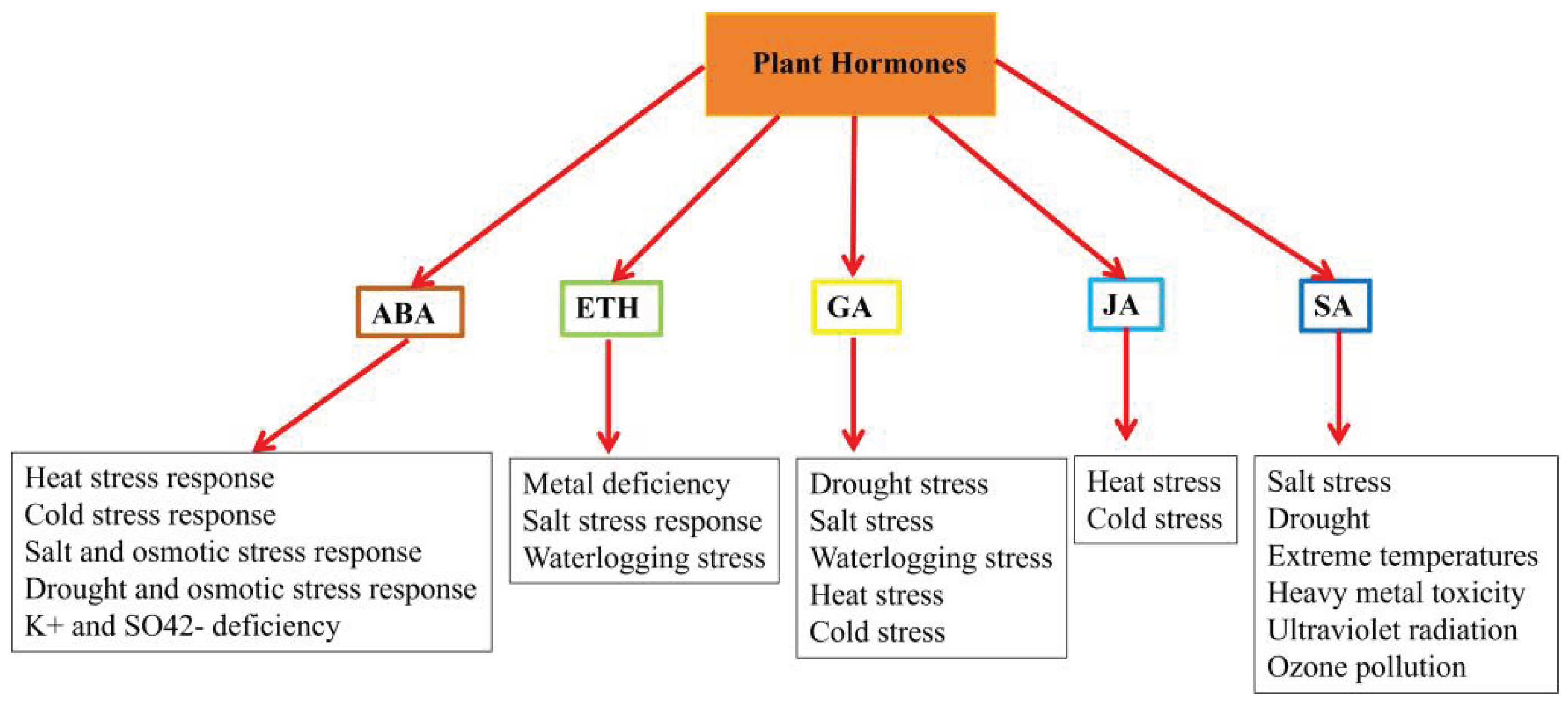
Figure 2.
Different pathways of nanomaterial absorption in plants. A: Seed-induced; B: Root absorption; C: Leaf absorption. Yellow dots represent nanomaterials. Image materials are generated from biogdp.com.
Figure 2.
Different pathways of nanomaterial absorption in plants. A: Seed-induced; B: Root absorption; C: Leaf absorption. Yellow dots represent nanomaterials. Image materials are generated from biogdp.com.
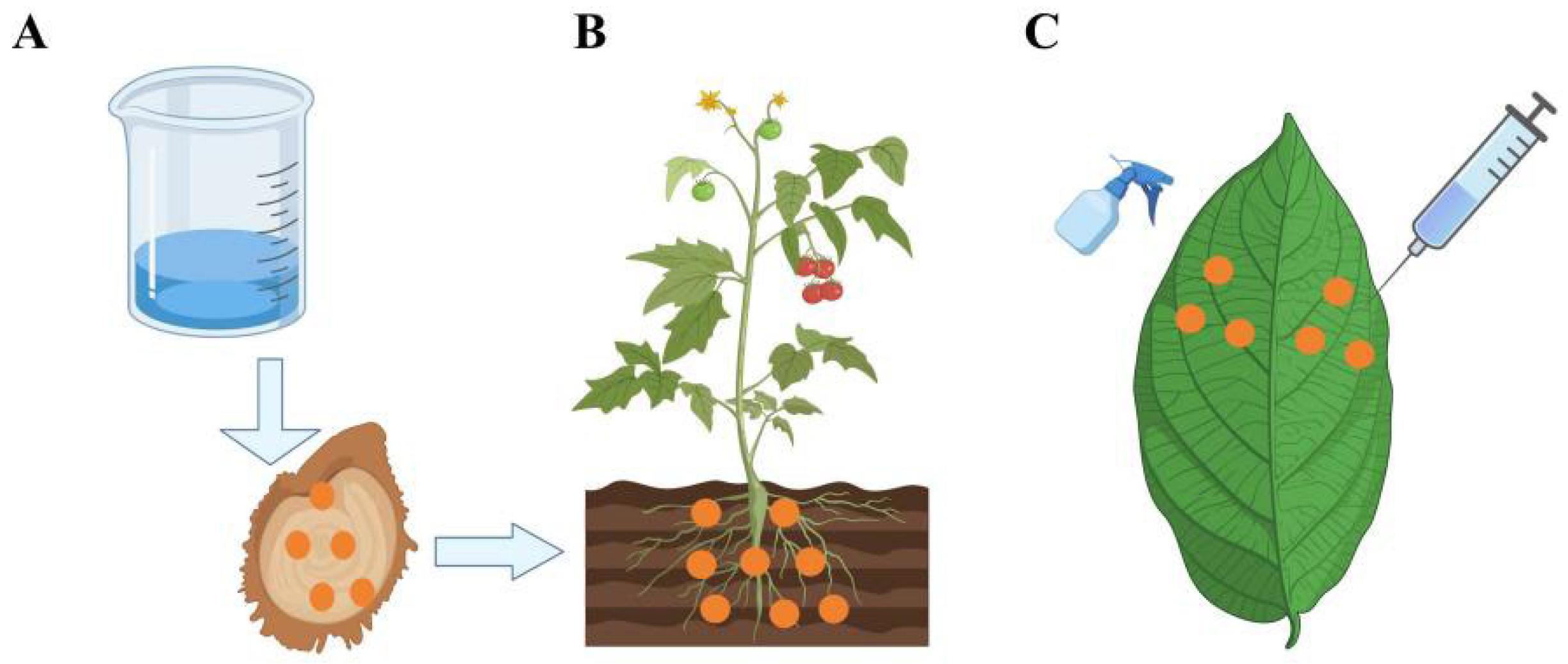
Figure 3.
Mechanisms by Which Nanomaterials Enhance Crop Resistance to Abiotic Stress. A red up arrow indicates an increase, and a red down arrow indicates a decrease.
Figure 3.
Mechanisms by Which Nanomaterials Enhance Crop Resistance to Abiotic Stress. A red up arrow indicates an increase, and a red down arrow indicates a decrease.
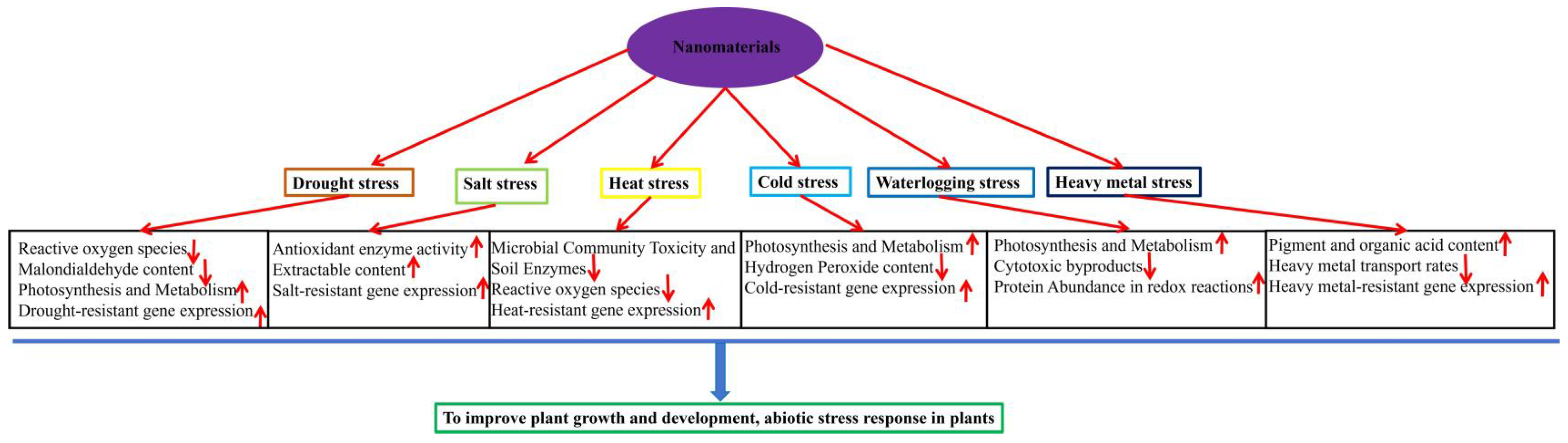

Table 1.
Mechanisms by Which Nanoparticles Enhance plants Stress Tolerance Under Non-biotic Stress Conditions.
Table 1.
Mechanisms by Which Nanoparticles Enhance plants Stress Tolerance Under Non-biotic Stress Conditions.
| Nanoparticles | Abiotic stresses | Usage | Crop species | Impact | Reference |
| AgNPs | Drought stress | Seed-induced | Oryza sativa | To enhance water absorption and promote the germination of aged seeds | [125] |
| CaO-NPs | Drought stress | Seed-induced | Brassica napus | To increase seedling fresh weight, number of leaves, chlorophyll content, and yield, as well as antioxidant enzyme levels, while reducing MDA content | [126] |
| SeNPs | Drought stress | Leaf application | Triticum aestivum | To increases CAT, SOD, and APX activity; improves photosynthetic rate, gas exchange, and transpiration rate; regulates the expression of certain stress-related genes; and enhances heat tolerance | [127] |
| SeNPs | Drought stress | Leaf application | Punica granatum | To increase antioxidant enzyme activity and the biosynthesis of photosynthetic pigments, and reduce levels of H₂O₂ and malondialdehyde | [128] |
| ZnO-NPs | Drought stress | Seed-induced | Zea mays | To increase net photosynthetic rate, water use efficiency, and the activity of key enzymes involved in carbon metabolism; enhance sucrose and starch synthesis in leaves, as well as glycolytic metabolism | [129] |
| GO | Drought stress | Soil-root uptake | Glycine max | To increase the levels of defense enzymes and hormones, as well as the expression of certain drought-stress genes, thereby enhancing the plant's drought tolerance | [130] |
| AgNPs | High temperature stress | Soil-root uptake | Triticum aestivum | To increase the root-to-shoot ratio, fresh and dry plant weight, and leaf area, and promote a decrease in ROS levels | [107] |
| TiO2-NPs | High temperature stress | Leaf application | Sesamum indicum | To increase peroxidase activity and the proportion of unsaturated fatty acids, and reduce the concentrations of malondialdehyde and H₂O₂ | [131] |
| SeNPs | High temperature stress | Leaf application | Triticum aestivum | To increases CAT, SOD, and APX activity; improves photosynthetic rate, gas exchange, and transpiration rate; regulates the expression of certain stress-related genes; and enhances heat tolerance | [132] |
| CTS-GB-NPs | Cold temperature stress | Fruit spread | Prunus salicina | To increase antioxidant enzyme activity while reducing weight loss and tissue softening during storage | [128] |
| TiO2-NPs | Cold temperature stress | Seed-induced | Cicer arietinum | To increase the expression of genes encoding chlorophyll-binding proteins and the activity of phosphoenolpyruvate carboxylase to promote photosynthesis | [112] |
| CeO2-NPs | Salt stress | Root uptake | Oryza sativa | Regulate the enzymatic activity of the antioxidant system and reduce 8-OHdG levels | [93] |
| ZnO-NPs | Salt stress | Leaf application | Vicia faba | To increase the content of proline and total soluble sugars | [133] |
| ZnO-NPs | Salt stress | Leaf application | Triticum aestivum | To promote the formation of plant sap and nutrient absorption | [134] |
| CeO2-NPs | Salt stress | Leaf injection | Gossypium hirsutum Linn | To regulate the expression of KOR, SOS, and other ion transport genes to minimize Na+ absorption | [135] |
| CeO2-NPs | Salt stress | Soil-root uptake | Brassica napus | To reduce the barrier in the plant's plastids, promoting the transport of more Na+ from the roots to the stems | [136] |
| FeSO4-NPs | Salt stress | Leaf application | Helianthus annuus | To increase CAT, POX, and PPO activity and reduces hydroxyl radical production | [137] |
| SeNPs | Heavy Metals Stress | Root uptake | Oryza sativa | To form complexes with As, reducing the transport of heavy metals from roots to stems | [138] |
| CeO2-NPs | Heavy Metals Stress | Root uptake | Oryza sativa | To increase chlorophyll content in seedlings and reduce proline content | [93] |
| ZnO-NPs | Heavy Metals Stress | Leaf application | Oryza sativa | To reduce Cd concentrations in plant roots and stems, increased soil pH, and significantly reduced soil-available Cd | [139] |
| Fe3O4-NPs | Heavy Metals Stress | Root uptake | Oryza sativa | To reduce the accumulation of Cd in plants and its mobility in soil | [140] |
| SiNPs | Heavy Metals Stress | Root uptake | Oryza sativa | To form complexes with Cd, reduces the translocation of heavy metals from roots to stems, stimulates the expression of the Si-absorption gene OsLsi1, and enhances resistance to Cd stress | [141] |
| Fe3O4-NP | Heavy Metals Stress | Seed-induced | Phaseolus vulgaris | To increase K+ levels, promote polyamine biosynthesis, and reduce MDA levels and electrolyte leakage | [142] |
| SiNPs | Heavy Metals Stress | Root uptake | Momordica charantia | To increase chlorophyll content, photosynthetic rate, transpiration rate, and stomatal conductance; enhance antioxidant enzyme activity; reduce Cd concentrations in plant stems and roots; and decrease flavonoid and soluble sugar levels to enhance Cd tolerance | [143] |
| CuNPs | Heavy Metals Stress | Root uptake | Triticum aestivum | To increase root length and raised levels of antioxidants in the cells | [144] |
| AgNPs | Waterlogging stress | Root uptake | Glycine max | To increase levels of soybean calmodulin, calreticulin, and glycoproteins to regulate misfolded proteins or severely damaged proteins | [145] |
| Graphene-NPs | Salt stress | Root fertilization | Medicago sativa | Biomass increased significantly under stress | [146] |
| Graphene-NPs | Alkali stress | Root fertilization | Medicago sativa | Biomass increased significantly under stress | [146] |
Disclaimer/Publisher’s Note: The statements, opinions and data contained in all publications are solely those of the individual author(s) and contributor(s) and not of MDPI and/or the editor(s). MDPI and/or the editor(s) disclaim responsibility for any injury to people or property resulting from any ideas, methods, instructions or products referred to in the content. |
© 2026 by the authors. Licensee MDPI, Basel, Switzerland. This article is an open access article distributed under the terms and conditions of the Creative Commons Attribution (CC BY) license (http://creativecommons.org/licenses/by/4.0/).
Copyright: This open access article is published under a Creative Commons CC BY 4.0 license, which permit the free download, distribution, and reuse, provided that the author and preprint are cited in any reuse.


