
Submitted:
14 April 2026
Posted:
15 April 2026
You are already at the latest version
Abstract
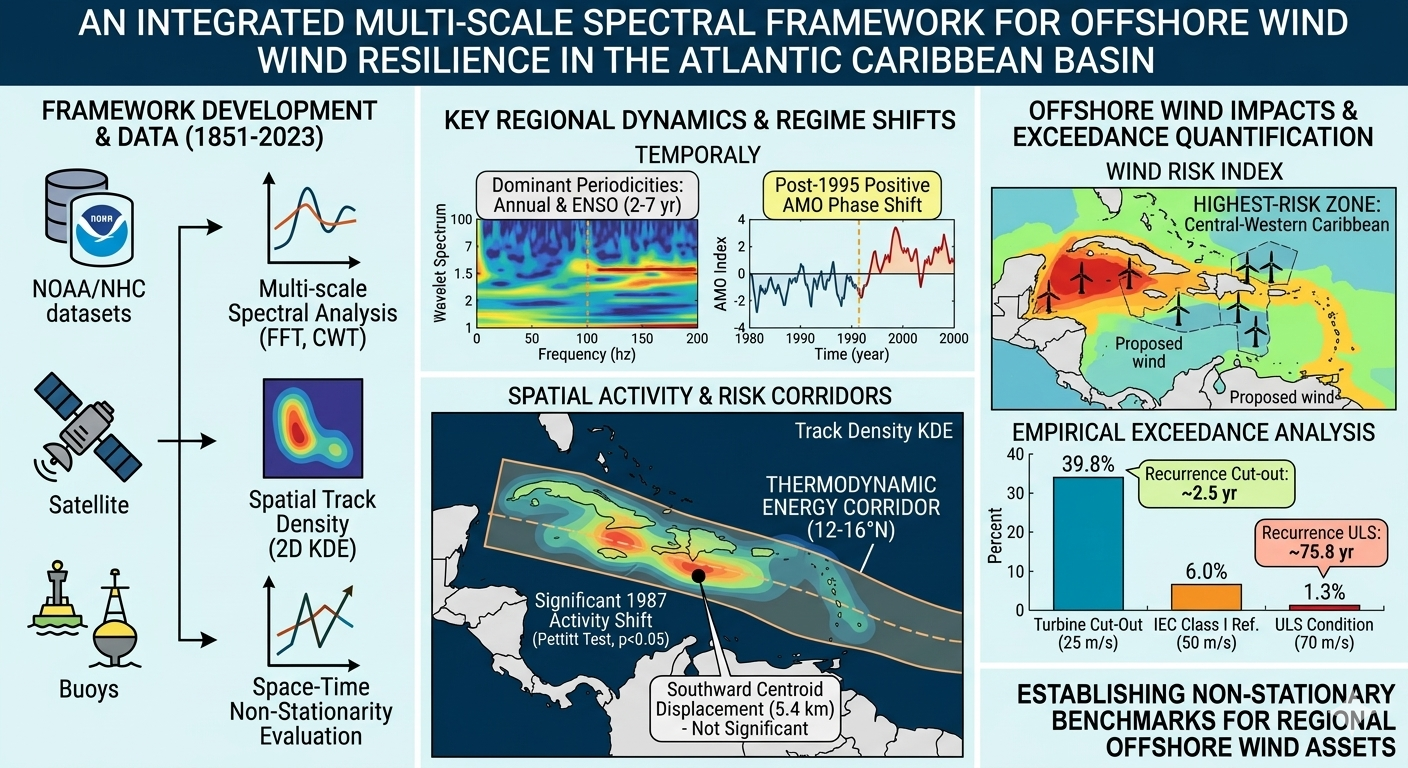
The development of offshore wind energy in tropical cyclone-prone regions requires analytical frameworks that capture non-stationary climate dynamics. This study presents a multi-scale spectral approach to characterize Atlantic tropical cyclone variability and assess implications for offshore wind resilience in the Caribbean Basin. The methodology integrates Fast Fourier Transform (FFT) and Continuous Wavelet Transform (CWT) to resolve temporal variability in sea surface temperature, cyclone frequency, and intensity, complemented by two-dimensional kernel density estimation (KDE) and non-stationarity analysis. Using NOAA and National Hurricane Center datasets, results identify dominant periodicities at annual and ENSO (2–7 year) scales, a post-1995 spectral energy shift associated with the positive AMO phase, and a thermodynamically consistent energy corridor along 12-16°N. A statistically significant change point in 1987 (Pettitt test, p < 0.05) is detected, although spatial displacement is not significant. An integrated Wind Risk Index highlights the central-western Caribbean as a high-exposure zone overlapping offshore wind development areas. Exceedance analysis shows that 39.8% of observations surpass 25 m/s, 6.0% exceed 50 m/s, and 1.3% approach 70 m/s, indicating relevant design considerations. These findings support the need for non-stationary, multi-scale approaches in offshore wind risk assessment under tropical cyclone influence.
Keywords:
wind energy
; tropical cyclones
; continuous wavelet transform
; sea surface temperature
; track density analysis
; offshore wind resilience
; Atlantic Caribbean
Copyright: This open access article is published under a Creative Commons CC BY 4.0 license, which permit the free download, distribution, and reuse, provided that the author and preprint are cited in any reuse.


