
Submitted:
14 April 2026
Posted:
16 April 2026
You are already at the latest version
Abstract
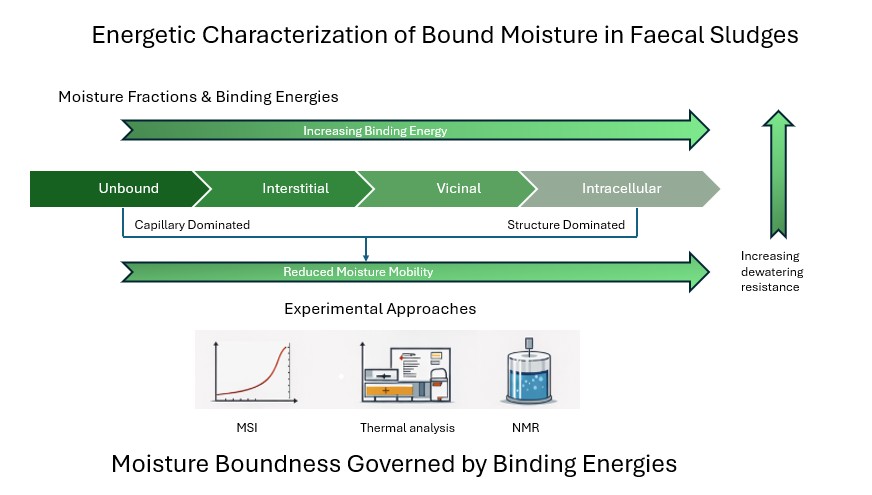
In faecal sludges (FS) from non-sewered sanitation systems, bound moisture consti-tuted 46-67% of total moisture across all sanitation types investigated, yet the energet-ic basis for its resistance to removal has not previously been characterized. Existing classifications of moisture fractions lack quantitative binding energy data, leaving the thermodynamic limits of solid–liquid separation undefined for FS. This study investi-gates the distribution and binding energies of bound moisture fractions in FS obtained from ventilated pit latrines, urine-diverting dehydrating toilets, and septic tank sys-tems. Bound moisture fractions were determined using moisture sorption isotherms, low-temperature convective drying, nuclear magnetic resonance, and thermogravi-metric–differential scanning calorimetry analyses. Results show that interstitial mois-ture constituted 37–50% of total moisture, followed by vicinal (6–14%) and intracellu-lar (3–9%) fractions, with net isosteric heat rising sharply below 20–30% moisture content (w.b.). Evaporation enthalpy exceeded that of bulk water at moisture contents below ~30% (w.b.), consistent with EPS-mediated adsorption and capillary confine-ment contributing to increased energy requirements for moisture removal and indi-cating a transition from capillary-controlled to structure-influenced retention. These findings provide a thermodynamic basis for interpreting why conventional mechani-cal dewatering stalls at a residual moisture content that differs systematically between VIP, UDDT, and septic tank sludges. These insights are relevant for improving FS treatment strategies, particularly in selecting appropriate combinations of dewatering, drying, and pre-treatment processes.
Keywords:
faecal sludge
; moisture boundness
; binding energy
; net isosteric heat
; sludge dewaterability
Copyright: This open access article is published under a Creative Commons CC BY 4.0 license, which permit the free download, distribution, and reuse, provided that the author and preprint are cited in any reuse.


