
Submitted:
14 April 2026
Posted:
15 April 2026
You are already at the latest version
Abstract
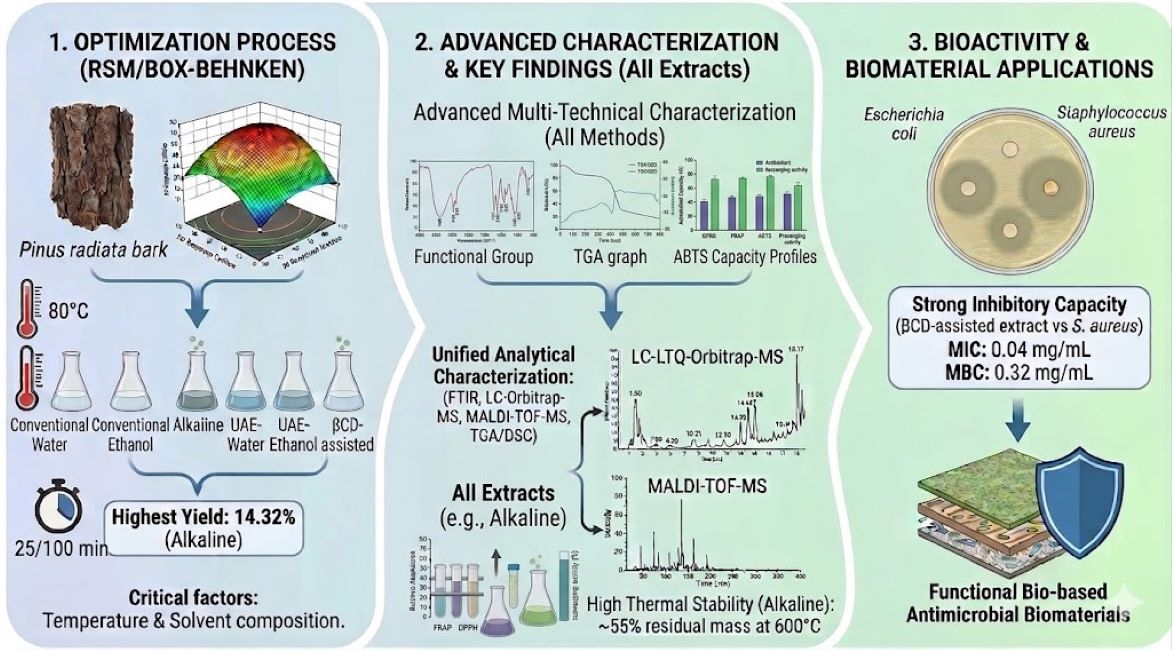
Conventional and emerging extraction methods for recovering phenolic compounds (PCs) from Pinus radiata bark were investigated for their potential use in bio-composites and bio-based biomaterial applications. To optimize the recovery process, a Response Surface Methodology (RSM) based on a Box-Behnken design was used to evaluate the effects of extraction time (20–100min), temperature (20–80°C), and water or ethanol-water solvent concentrations with β-cyclodextrin (βCD) or NaOH (0.5–1.5% w/v CD/db). Polyphenolic profiles of the extracts were characterized using Fourier transform infrared spectroscopy (FTIR), LC-LTQ-Orbitrap-MS, and matrix-assisted laser desorption/ionization time-of-flight mass spectrometry (MALDI-TOF-MS). Thermogravimetric analysis (TGA) and differential scanning calorimetry (DSC) were used to evaluate the thermal stability and degradation behavior of the powdered extracts. Antioxidant capacity (DPPH, FRAP, ABTS) and antibacterial activity against Escherichia coli and Staphylococcus aureus were assessed by spectrophotometric assays and the agar diffusion method, respectively. Highest extraction yields were obtained using alkaline extraction (14.32%) and ultrasound-assisted extraction (UAE) (13.86%), followed by ethanol extraction (12.74%). Minimum inhibitory concentration (MIC) for P-βCD was 0.04 mg/mL and the minimum bactericidal concentration (MBC) was 0.32 mg/mL against S. aureus. These results suggest a strong inhibitory capacity at low concentrations and the potential incorporation of these extracts into bio-based antimicrobial biomaterials.
Keywords:
plant bark
; polyphenols
; tannins
; green extraction
; antioxidant capacity
; antimicrobial activity
; mass spectrometry
; thermal stability
; biomaterials
; circular bioeconomy
Copyright: This open access article is published under a Creative Commons CC BY 4.0 license, which permit the free download, distribution, and reuse, provided that the author and preprint are cited in any reuse.


