

Submitted:
14 April 2026
Posted:
15 April 2026
You are already at the latest version
Abstract
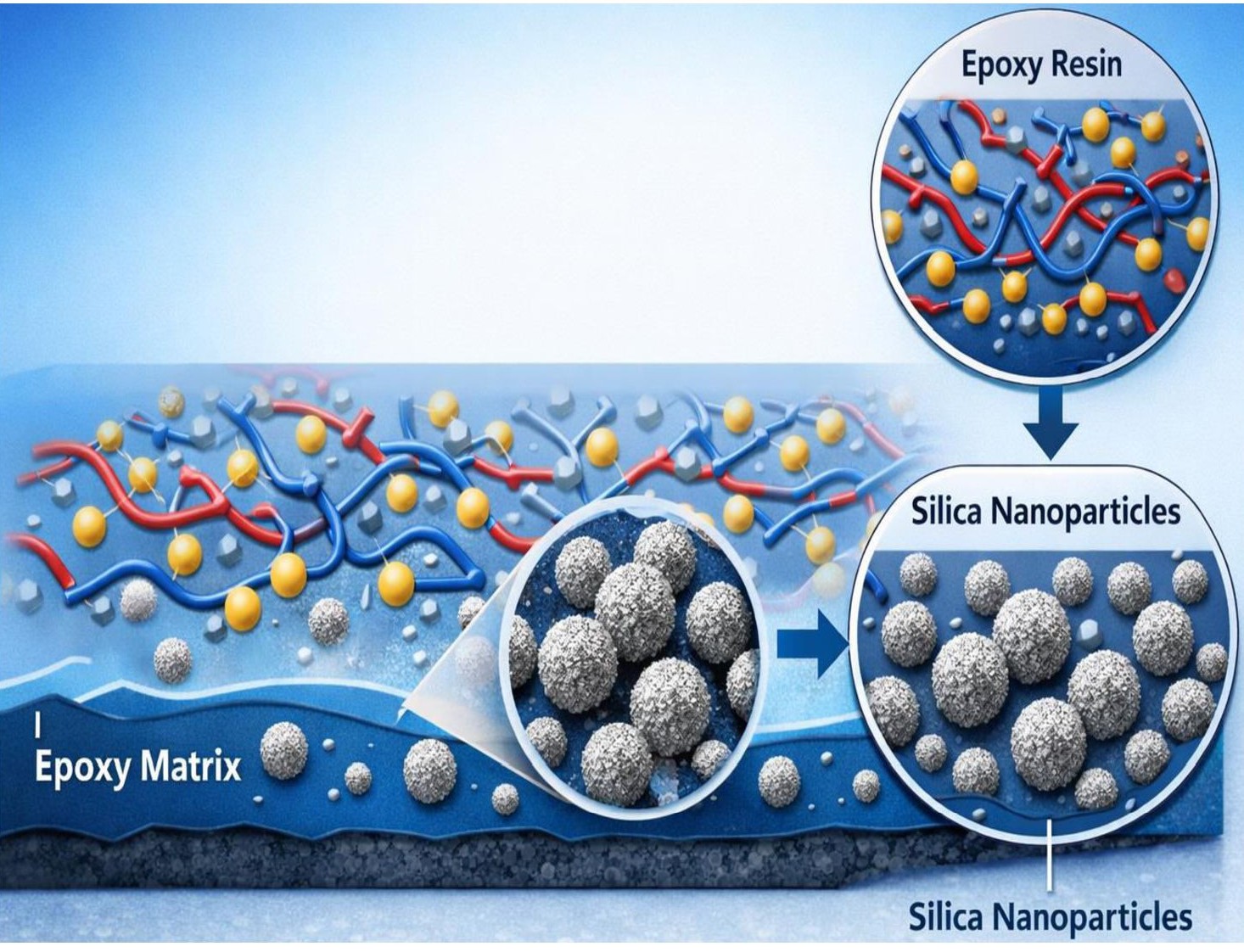
Nano-composite coatings offer significant potential to improve the mechanical, thermal, and chemical properties of traditional materials. This review focuses on epoxy polymers reinforced with silica nanoparticles, which are promising for creating films that enhance structural strength. The incorporation of silica nanoparticles into epoxy matrices results in nano-composite films with adhesion, hardness, and toughness, due to strong interfacial bonding and uniform dispersion. The review explores various synthesis and fabrication methods, including sol-gel processes, in-situ polymerization, and surface modification, and their effects on the composite’s appearance and performance. It also examines how silica nanoparticles contribute to strengthening the epoxy matrix via energy dissipation, crack deflection, and stress transfer mechanisms. Furthermore, the influence of surface functionalization, dispersion quality, and nanoparticle loading on mechanical properties is analyzed. The potential applications in protective coatings, structural adhesives, and fiber-reinforced composites highlight the importance of silica-epoxy nano-composites, while addressing environmental concerns, scalability, and nanoparticle aggregation challenges.
Keywords:
epoxy polymer
; silica nanoparticle
; film preparation
; structural strength
; epoxy polymer supported silica nanoparticle
1. Introduction
Epoxy polymers are a type of thermosetting resin that is well-known for its superior adhesion [1,2], mechanical qualities [3], electrical insulation [4], and chemical resistance [5]. Because of these qualities, epoxy-based materials are ideal for a wide range of industrial uses, such as adhesives, coatings, composites, and structural elements. However, despite their benefits, pure epoxy resins frequently have drawbacks that limit their performance in demanding situations, such as brittleness and insufficient mechanical strength under specific circumstances [6,7].
The use of nanoparticles has become a viable tactic to get around these restrictions and improve the structural stability and longevity of epoxy systems. Silica nanoparticles (SiO2 NPs) have attracted a lot of interest among different Nano fillers because of their large surface area, chemical stability, and compatibility with epoxy matrices. Silica nanoparticles, when evenly distributed in an epoxy matrix, can enhance interfacial bonding, boost load transfer effectiveness, and help create a more durable and toughened composite [8,9].
The incorporation of silica nanoparticles into epoxy polymers produces nanocomposite films that outperform pure epoxy in terms of mechanical performance. The range of applications for these Nano composite films in protective and structural coatings is increased by their improved tensile strength, fracture toughness, and resistance to crack propagation. The structural integrity of the epoxy coatings supported by nanoparticles is further enhanced by their enhanced environmental resistance and thermal stability [10].
The goal of this review is to thoroughly examine the basic characteristics of silica-epoxy nanocomposites, such as their synthesis, characteristics, difficulties, and potential applications. Researchers and engineers can better utilize their potential for a variety of applications by comprehending the mechanisms behind their reinforcement capabilities and the creative fabrication techniques used, ultimately aiding in the creation of structural materials that are safer, more resilient, and perform better. The review’s analysis shows that epoxy coatings backed by silica nanoparticles hold great potential as an eco-friendly and very successful method of boosting structural strength in a variety of engineering applications.
The review’s main goal is to present a thorough examination of the most recent developments in the creation and use of epoxy polymers backed by silica nanoparticles for film-based structural reinforcement. Investigating how silica nanoparticle integration improves epoxy resins’ mechanical, thermal, and chemical characteristics may help them be more useful in a range of structural applications [11,12]. The review aims to illustrate the possible advantages and drawbacks of these nanocomposite systems in enhancing the functionality and longevity of structural materials by looking at recent studies.
Evaluating the various manufacturing processes and strategies used to create epoxy films enhanced with silica nanoparticles is another important goal. This entails evaluating the surface modification, film generation, and nanoparticle dispersion techniques that affect the overall characteristics of the nanocomposites. In order to achieve the intended reinforcement effects, the review also seeks to determine the best practices and circumstances that result in uniform dispersion and robust interfacial bonding between the silica nanoparticles and the epoxy matrix [13,14].
This review presents a significant breakthrough in the development of epoxy polymers reinforced with silica nanoparticles for film-based structural applications. Incorporating silica nanoparticles into epoxy matrices has substantially improved their mechanical strength, toughness, and durability, overcoming some of the traditional limitations of epoxy resins. Achieving uniform dispersion and strong interfacial bonding has resulted in nanocomposite films with enhanced load-bearing capacity, better thermal stability, and increased resistance to environmental degradation. These advancements open up new possibilities for creating more reliable, lightweight, and high-performance structural reinforcement materials across industries such as aerospace, construction, and automotive. The review also aims to identify current challenges and explore future research directions in silica nanoparticle-supported epoxy films for structural reinforcement. It emphasizes the importance of understanding long-term stability, environmental impact, and scalability of these nanocomposites. Ultimately, the review seeks to guide researchers and industry professionals in developing more dependable, sustainable, and efficient film-based reinforcement systems for various structural applications.
2. Epoxy and Silica Nano Composite Film Preparation Techniques
The best dispersion of silica nanoparticles and robust interfacial bonding within the epoxy matrix are ensured by a variety of preparation techniques for Epoxy and silica nanocomposite films. Solution casting, in-situ sol-gel synthesis, and layer-by-layer are common methods [15,16,17].
The choice of preparation process is crucial for customizing the properties of Epoxy and silica nanocomposite films because each method has pros and cons related to scalability, homogeneity, and compatibility with different application requirements. Preparation techniques for epoxy and silica nanocomposite films primarily include in-situ sol-gel processing, solution casting, and layer-by-layer (LbL) assembly, each offering distinct advantages and considerations presented in Table 1. The in-situ sol-gel method involves incorporating silica precursors directly into the epoxy resin, followed by hydrolysis and polycondensation reactions that produce uniformly dispersed silica nanoparticles with strong interfacial bonding, resulting in enhanced mechanical, thermal, and barrier properties. Solution casting entails dispersing silica nanoparticles in a solvent, mixing with epoxy resin, and then evaporating the solvent to produce high-quality, uniform films; this technique is simple, cost-effective, and scalable but requires careful control to prevent agglomeration and defects. The layer-by-layer assembly method involves sequentially depositing silica and epoxy layers through electrostatic or covalent interactions, allowing for precise control over film nanostructure, composition, and thickness, which is ideal for advanced multilayered applications; however, this approach is labor-intensive and time-consuming. Each technique offers unique benefits suited to different application requirements, balancing factors such as uniformity, scalability, control, and complexity.
2.1. In-Situ Sol-Gel Process
The in-situ sol-gel procedure is a popular technique for creating Epoxy and silica nano-composite films because it provides exact control over how the silica nanoparticles are integrated and dispersed within the polymer matrix [23]. This process involves the direct incorporation of silica precursors, such as tetraethyl orthosilicate (TEOS), into the epoxy resin system, where they are subjected to hydrolysis and polycondensation processes with the aid of catalysts, such as bases or acids [24,25]. This procedure, which takes place alongside with the epoxy’s drying, makes it possible for silica nanoparticles to develop along the polymer chains, guaranteeing a uniform distribution at the nanoscale level. Strong interfacial interaction between the silica particles and the epoxy matrix is made possible by the in-situ nature of this approach, which is beneficial for improving the mechanical, thermal, and barrier qualities of the composite [26]. The in-situ sol-gel process involves forming a gel within a medium, converting precursors into a solid network, enabling uniform coating or material synthesis at ambient conditions further presented in Figure 1.
In order to prepare the silica precursor solution, TEOS or comparable chemicals are first hydrolyzed under carefully monitored circumstances, which frequently include certain pH, temperature, and stirring parameters [27]. The epoxy resin and this hydrolyzed sol are then fully combined, occasionally with the addition of curing agents and catalysts to promote the production of nanoparticles and polymerization at the same time [28]. Silica nanoparticles are created and grown in situ while the sol goes through polycondensation within the epoxy matrix, producing a uniform dispersion without the need for surfactants or outside mixing. The final step in creating the Epoxy and silica nano-composite film is curing the mixture at a regulated temperature, which creates a material that combines the beneficial qualities of both components [29].
There are a number of advantages to using the in-situ sol-gel process when creating Epoxy and silica nanocomposites. It offers superior control over the silica nanoparticles’ size, distribution, and connectivity all of which have a direct impact on the performance of the composite [29]. Because of the covalent bonds and chemical compatibility created during synthesis, this technique usually produces strong interfacial bonding, which improves durability and load transmission. Moreover, by modifying variables like silica content, hydrolysis conditions, and curing temperature, the method enables customization of the composite’s properties [30]. It is a flexible and successful strategy for making it for creating sophisticated nanostructured coatings, adhesives, and structural materials with enhanced functional qualities.
2.2. Solution Casting Technique
Epoxy and silica nanocomposite films can be prepared easily and adaptably using the solution casting approach. Using ultrasonication or vigorous stirring, silica nanoparticles are first dispersed in an appropriate solvent, like ethanol or acetone, in order to obtain a uniform dispersion and avoid agglomeration [29]. A homogenous solution is synthesized by dissolving the epoxy resin separately in the same solvent. In order to ensure complete mixing and even dispersion of silica nanoparticles inside the epoxy matrix, the silica dispersion is then added gradually to the epoxy solution while being continuously stirred [26]. After achieving a uniform mixture, the solvent is evaporated under controlled circumstances, such as at room temperature or at a higher temperature, to create a solid film. The mixture is then placed onto a clean, flat substrate or mold [32]. With this technique, the final nanocomposite film’s composition and thickness may be precisely controlled.
Solution casting is used because technique is easy to use, economical, and produces high-quality nanocomposite films with consistent dispersion of nanoparticles. Successful fabrication depends on producing stable and evenly distributed silica nanoparticles in the epoxy solution, which can be improved by adding dispersion agents or employing surface modification techniques. For the final film to remain intact, the evaporation process needs to be carefully controlled to avoid flaws like bubbles or cracks [33]. Improved mechanical strength, thermal stability, and barrier qualities characterize the resultant Epoxy and silica nanocomposite films, which make them appropriate for a range of industrial uses like coatings, electronics, and packaging. In general, solution casting is still a widely used technique because of its ease of use, scalability, and capacity to create materials for nanocomposite applications that are customizable [8].
Figure 2 presented as solution casting technique involves pouring a liquid polymer solution into molds, then drying to form thin, uniform films used in coatings, membranes, and electronic devices.
2.3. Layer-by-Layer Assembly
Epoxy and silica nanocomposite films with controlled nanostructures can be precisely and adaptably created using the layer-by-layer (LbL) assembly technique, which entails the sequential deposition of alternating layers of epoxy resin and silica nanoparticles, usually enabled by electrostatic attraction, hydrogen bonding, or covalent bonding [34]. The substrate surface is frequently pre-treated to introduce adhesion-promoting functional groups in order to start the process. The substrate is coated with an initial layer of silica nanoparticles, which can be functionalized with charged groups to improve electrostatic interactions [35].
Washing is then done to get rid of any loosely bound particles. To create the required number of layers, a layer of epoxy resin is then added, allowing it to interact with the silica layer. This process is repeated several times. A multilayered nanocomposite film with specific qualities is the end result of meticulously regulating each deposition cycle to guarantee homogeneity and robust interlayer adhesion [36].
The perfect control of film thickness, content, and nanostructure is one of the major benefits of the LbL assembly approach [37]. The distribution and orientation of silica nanoparticles within the epoxy matrix can be precisely tuned by researchers by varying parameters including the number of layers, deposition duration, pH, and ionic strength of the solutions [14]. By using this method, functional molecules or nanoparticles can be added to particular layers to provide extra capabilities like enhanced electrical conductivity, mechanical strength, or barrier qualities [38]. The procedure is also appropriate for delicate or complex geometries because it works with a variety of substrates and may be carried out in moderate environments. Improved performance qualities make the Epoxy and silica nanocomposite films created by LbL assembly perfect for electrical, sensor, and advanced coating applications [39]. Despite its benefits, the numerous deposition cycles needed to reach the appropriate film thickness might make the layer-by-layer construction process laborious. Careful control of process parameters is also necessary to guarantee homogeneity and robust interlayer interactions across numerous layers [40]. Nevertheless, this approach is a desirable option for high-performance applications and research due to its capacity to create highly ordered, multilayered nanocomposite films with adaptable architecture. All things considered, the LbL assembly method offers a sophisticated way to create Epoxy and silica nanocomposite films with distinctive nanostructures and improved functions, increasing their potential in a variety of technical domains [41].
3. Surface Modification of Silica Nanoparticles
Enhancing silica nanoparticles’ compatibility and interfacial bonding with epoxy matrices requires surface modification as presented in Figure 3. In the polymer matrix, hydroxyl groups on the surface of raw silica nanoparticles can cause agglomeration and poor interfacial adhesion. In order to solve this, organosilane coupling agents are grafted onto the silica surface via functionalization processes such salinization. Through the overview of organic functional groups, epoxy resins can interact or form chemical bonds more successfully, improving dispersion and interfacial adhesion [42,43]. In addition to preventing nanoparticle agglomeration, improved surface modification enables surface chemistry to be tailored to achieve particular properties, like increased hydrophobicity or enhanced thermal stability [44]. This greatly improves the overall performance of Epoxy and silica nanocomposite films.
3.1. Functionalization to Improve Dispersion
Functionalization is a key technique for improving silica nanoparticles’ dispersion in epoxy matrices and other polymer systems because silica particles have a tendency to aggregate naturally due to strong van der Waals forces and hydrogen bonds, which can result in poor dispersion and compromised composite properties [45]. By adding certain functional groups, such as amino, alkyl, or methacryloxy groups, to the surface of silica particles, their surface chemistry can be changed to improve compatibility with the epoxy resin [46]. In order to decrease the propensity of particles to aggregate and guarantee a more even distribution over the composite, these functional groups can establish covalent connections or potent intermolecular interactions with the polymer matrix [47]. To achieve higher mechanical strength, thermal stability, and barrier properties in the finished nanocomposite films, this improved dispersion is essential [48].
Functionalization usually entails salinization, in which the silica surface is grafted with desired functional groups using organosilane coupling agents [48,49]. Amino-silanes, for instance, add amino groups that can react with epoxy groups to promote interfacial adhesion and chemical bonding [50]. In a similar vein, alkyl-silanes offer hydrophobic properties that can decrease moisture absorption and increase water resistance [51]. The final composite’s intended qualities and compatibility with epoxy resin determine which functional groups are used. In addition to increasing dispersion, proper surface modification strengthens the interfacial bond between silica nanoparticles and the polymer matrix, which is crucial for stress transfer and enhancing the composite’s endurance [52].
All things considered, silica nanoparticle surface functionalization is a flexible and successful method to maximize their performance in epoxy nanocomposites [14,53]. It is feasible to regulate interactions between nanoparticles and the matrix, stop aggregation, and promote even dispersion inside the resin by adjusting the surface chemistry [54,55]. This results in composites that have better mechanical, thermal, and chemical qualities, which makes them appropriate for cutting-edge uses including electronic materials, adhesives, and coatings [3]. Furthermore, the range of possible uses for epoxy-based nanocomposites can be expanded by further customizing functionalized silica nanoparticles to impart particular characteristics like conductivity [29].
3.2. Coupling Agents and Surface Treatments
A common strategy to improve silica nanoparticle compatibility and dispersion in polymer matrices like epoxy resins is surface modification of the particles using coupling agents and surface treatments [14]. To chemically attach organic functional groups onto the silica surface, silane coupling agents like glycidoxypropyltriethoxysilane or aminopropyltriethoxysilane (APTES) are frequently employed [56,57]. While their organic functional groups can interact with or make a covalent bond with the epoxy resin, these agents react with the hydroxyl groups on silica to form durable siloxane bonds [28]. Depending on the desired compatibility, this alteration not only makes the silica surface more hydrophobic or hydrophilic, but it also improves interfacial adhesion, which is essential for load transmission and overall composite performance [58].
The surface energy and compatibility of silica nanoparticles can be further modified by covering them with organic polymers, surfactants, or functional compounds in addition to silane coupling agents [56,59]. Functional groups can also be directly introduced onto the silica surface by grafting or plasma modification methods. These techniques seek to foster covalent or potent secondary contacts with the polymer chains, lessen nanoparticle aggregation, and enhance uniform dispersion within the epoxy matrix [43,60]. By enhancing nanoparticle-matrix interactions, surface modification via coupling agents is crucial for customizing silica nanoparticles to particular composite applications, guaranteeing enhanced mechanical, thermal, and chemical capabilities [8,61].
3.3. Impact of Surface Modification on Interfacial Bonding
Interfacial bonding in composite materials is greatly impacted by surface modification of silica nanoparticles, especially in epoxy-based systems [62]. Stronger covalent or secondary bonds can be formed between silica surfaces and the epoxy matrix when they are functionalized with the right chemical groups [63]. For example, covalent connections can be formed during curing by employing silane coupling agents with epoxy-reactive groups, which creates a smooth interface between the nanoparticle and the polymer [64].
By enhancing the efficiency of load transfer from the matrix to the reinforcing nanoparticles, this increased interfacial bonding raises the composite material’s mechanical strength, toughness, and endurance. Incompatible surface chemistries cause silica nanoparticles to have poor interfacial adhesion without such modification, which compromises under stress [65].
Surface modification has an effect on interfacial bonding that goes beyond mechanical characteristics; it also has an effect on the nanocomposite’s chemical resistance and thermal stability [66]. Strong interfacial contacts decrease the creation of microvoids or defects at the interface, which can serve as starting locations for failure under mechanical or thermal stress, and stop nanoparticle pull-out [38]. Additionally, customized surface alterations can produce chemically resistant interfaces that withstand deterioration in challenging conditions, extending the composite’s life [67]. Optimizing the performance of silica-reinforced epoxy composites in cutting-edge applications including coatings, electronics, and structural components requires the ability to design these interfacial connections through surface chemistry [52,67].
In the end, the effectiveness of interfacial bonding is directly impacted by the surface modification approach chosen, which determines the nanocomposite’s overall performance [68]. Better stress distribution and mechanical integrity result from silica nanoparticles being evenly distributed and firmly bonded inside the epoxy matrix thanks to proper functionalization [14,53,69]. Better stress transmission and energy dissipation during loading are also made possible by this improved interface, which is crucial for high-performance materials [70]. Therefore, to optimize the synergistic advantages of silica nanoparticles and epoxy resins and create composites with excellent mechanical, thermal, and chemical properties, surface modification is essential.
4. Microstructure and Morphology of Epoxy with Silica Films
The overall functionality and performance of Epoxy and silica films are significantly influenced by their microstructure and shape [71]. Typically, these nanocomposite films are heterogeneous, with silica nanoparticles dispersed throughout the epoxy matrix to form an intricate network at the nanoscale [72]. The degree of agglomeration, particle size, and uniformity of nanoparticle dispersion all have a significant impact on the film’s mechanical, thermal, and barrier properties [73,74]. The ideal result of properly dispersing and firmly adhering silica nanoparticles to the epoxy matrix is a homogeneous microstructure that enhances toughness and facilitates efficient stress transmission [52,53]. However, insufficient agglomeration or dispersion may lead to defects and areas of stress concentration, potentially endangering mechanical integrity [75]. Advanced imaging methods such as scanning electron microscopy (SEM), transmission electron microscopy (TEM), and atomic force microscopy (AFM) are commonly used to characterize the morphology and reveal the degree of nanoparticle dispersion, interfacial adhesion, and overall microstructural homogeneity—all essential for optimizing nanocomposite performance.
4.1. Dispersion and Distribution of Silica Nanoparticles
The microstructure and morphology of Epoxy and silica films are significantly influenced by the distribution and dispersion of silica nanoparticles inside the polymer matrix. Achieving a consistent dispersion is crucial because it directly affects the mechanical properties, optical clarity, and overall performance of the composite [14,76]. Evenly distributed silica nanoparticles can effectively reinforce the epoxy matrix as stress transfer points, boosting its hardness and strength. Proper dispersion also lessens the production of agglomerates, which can lead to weak spots and act as sites for the beginning or propagation of cracks [77]. To promote a homogeneous dispersion of nanoparticles during processing, techniques like high-shear mixing, ultrasonication, and surface modifiers are commonly employed [78].
The morphology of silica in the epoxy matrix can range from uniformly distributed individual particles to clustered aggregates, depending on the surface chemistry of the nanoparticles and the conditions of processing [13]. Well-dispersed silica particles can form a nanostructured network with near-uniform dispersion, which improves interfacial adhesion and load transfer [79]. Inadequate dispersion, however, might result in large agglomerates that reduce the transparency and mechanical integrity of the film [80]. The size, shape, and surface properties of silica nanoparticles also influence how uniformly they scatter; smaller, surface-modified particles often scatter more evenly than larger, unmodified ones [81]. TEM and SEM are two common characterization techniques used to look at and observe the dispersion state inside the films.
The microstructure and morphology of Epoxy and silica films ultimately dictate many of their mechanical and physical properties. A uniform dispersion of silica nanoparticles creates a nanocomposite with enhanced stiffness, thermal stability, and chemical resistance while maintaining the required optical properties if transparency is required [82]. However, large agglomerates and uneven distribution can lead to heterogeneity, which reduces the material’s reliability and durability. Controlling the dispersion and distribution of silica nanoparticles through surface modification and processing processes is essential for tailoring the microstructure of Epoxy and silica films to meet specific application requirements [83]. Optimizing these properties guarantees the production of high-performance nanocomposite coatings and films with remarkable multifunctional properties.
4.2. Interfacial Interactions Between Epoxy Matrix and Silica
The microstructure and general functionality of Epoxy and silica films are largely determined by the interfacial interactions between the epoxy matrix and silica nanoparticles. Strong interfacial bonding promotes mechanical qualities like strength, toughness, and durability by permitting effective load transfer from the epoxy matrix to the silica particles. The key factors of these interactions are the surface chemistry of the silica nanoparticles and their compatibility with the epoxy resin [84,85]. A cohesive interface can be created by adding functional groups to the silica surface through surface modification, such as the use of silane coupling agents, which can create chemical bonds or secondary interactions with the epoxy matrix. A more cohesive and mechanically robust film is produced by strong interfacial connections that limit nanoparticle pull-out under stress, lessen the creation of micro voids, and encourage a uniform distribution of stress throughout the composite [56,86,87].
At the microstructural level, silica nanoparticles exhibit a more uniform shape and are well-integrated within the epoxy matrix due to strong interfacial interactions [88]. This integration produces a more uniform distribution of stress and fewer flaws to maximize the performance of the composite [89]. However, the integrity of the film may be jeopardized by microvoids and stress concentrations brought on by debonding and nanoparticle aggregation brought on by insufficient interfacial bonding [90]. The kind of these interfacial connections also affects other characteristics, such as thermal stability and chemical resistance, by keeping the interface stable against environmental deterioration [91]. Therefore, to regulate the microstructure and achieve the necessary functional features in Epoxy and silica nanocomposite films, it is essential to modify the interfacial chemistry between epoxy and silica.
4.3. Effect of Nanoparticle Loading on Film Uniformity
The microstructure and morphology of Epoxy and silica films are significantly influenced by the loading of silica nanoparticles. At low nanoparticle loadings, the silica particles have a propensity to agglomerate and form film defects, which leads to an uneven dispersion of the nanoparticles and reduced film homogeneity [14]. As the nanoparticle loading increases, the agglomerates break apart and the silica particles begin to disperse more uniformly throughout the epoxy matrix. This leads to a more consistent film shape with improved mechanical properties and reduced porosity [92].
However, overfilling a phenomenon in which the silica particles begin to form a separate phase within the epoxy matrix can result from heavy nanoparticle loading. Because the nanoparticles produce a heterogeneous structure that may be prone to delamination and cracking, this may lead to a loss of film homogeneity [93]. Furthermore, excessive nanoparticle loadings may result in increased viscosities and processing problems that make consistent film production difficult. Therefore, figuring out the optimal nanoparticle loading that balances mechanical properties and film uniformity is essential to the production of high-performance Epoxy and silica films [8].
The size and location of the silica nanoparticles influence how loading them impacts the film’s homogeneity. Smaller particles frequently disperse more evenly and cause fewer defects, but bigger particles might cause more significant agglomeration and inhomogeneity [94]. The distribution of particle sizes can also influence the mechanical properties of the film; a more narrow distribution leads to greater toughness and strength [95]. By carefully controlling the nanoparticle loading and size distribution, Epoxy and silica composites can have uniform film shape and optimal mechanical properties.
5. Mechanical Properties and Structural Reinforcement
Silica nanoparticles significantly enhance the mechanical properties of epoxy polymers, making them more appropriate for applications needing structural reinforcement [85,96]. The improved tensile strength, modulus, and toughness of these nanocomposites are primarily due to effective load transmission made possible by strong interfacial interaction between silica particles and the epoxy matrix [97]. By serving as nanoscale reinforcements, the nanoparticles can reduce the likelihood of brittle failure by preventing cracks from propagating and more evenly distributing applied loads throughout the material [98,99].
The addition of silica can also increase the composite’s hardness and resistance to impact, resulting in films that are more resilient to both static and dynamic loading. Together, these improvements aid in the creation of high-performance, lightweight films that can reinforce structural elements in electrical, automotive, civil engineering, and aerospace applications [100].
5.1. Tensile Strength and Modulus Enhancement
When silica nanoparticles are included into epoxy matrices, they function as reinforcing agents by spreading stress more uniformly throughout the composite and bearing some of the applied load [10,53,84]. The stiffness and tensile strength of the material are effectively increased when silica particles are evenly distributed and attached to the epoxy matrix, creating a network that resists deformation [101,102]. This reinforcing mechanism depends on the quality of interfacial adhesion, which ensures effective stress transfer from the polymer matrix to the stiff silica particles and increases the film’s overall load-bearing capabilities [103].
The Epoxy and silica films become more resistant to deformation under applied stresses as a result of this toughening effect, which also raises the tensile strength and elastic modulus. Nanoparticle loading, size, and surface changes, which affect the degree of interfacial bonding and dispersion within the matrix, are frequently linked to the degree of enhancement [104,105]. Additionally, the inclusion of silica nanoparticles may cause microscopic structural strengthening, improving resistance to the onset and propagation of cracks.
To get the greatest increases in modulus and tensile strength, however, careful balancing is required. Inadequate dispersion or excessive nanoparticle loading may cause agglomerates and stress concentration sites, which may eventually weaken the composite material and reduce its mechanical performance [8,106]. Stronger interfacial bonding and uniform dispersion can result from suitably surface functionalizing silica particles to increase their compatibility with epoxy resin. All things considered, by carefully controlled nanoparticle integration, Epoxy and silica films can be created to have much better tensile and structural properties, making them suitable for demanding engineering applications requiring high strength and stiffness [107].
5.2. Fracture Toughness and Impact Resistance
Epoxy films’ impact resistance and fracture toughness can be greatly increased by silica nanoparticles, improving the material’s longevity and capacity to absorb energy under unforeseen pressures. When dispersed uniformly, silica nanoparticles act as physical barriers within the polymer matrix, stopping the start and spread of cracks [108]. These particles can improve the material’s resistance to fracture by causing crack deflection, pinning, or even bridging by wasting the energy required for crack propagation [109]. Additionally, the nanoparticles contribute to the formation of a microstructure that absorbs more energy, increasing the epoxy layer’s resistance to greater impact forces without catastrophically breaking.
Impact resistance is further aided by the improved microstructure brought about by nanoparticle reinforcement. The silica particles help distributes impact energy more evenly throughout the matrix by reducing localized stress concentrations that typically lead to brittle fracture [96,110]. Changes in the surface of silica nanoparticles can also improve interfacial bonding, increasing the composite’s ability to absorb impact energy and bend plastically. To get the best fracture toughness and impact resistance, similar to tensile improvements, a uniform dispersion of nanoparticles is required; agglomerates or weakly bound particles might operate as stress concentrators, reducing the toughness and impact performance of the Epoxy and silica films [8]. Therefore, careful control of the nanoparticle concentration and surface chemistry is necessary to maximize these structural reinforcing benefits.
5.3. Crack Propagation Resistance
Silica nanoparticles are crucial for boosting the films’ resistance to fracture propagation, which enhances the durability and structural integrity of Epoxy and silica films. When dispersed uniformly throughout the epoxy matrix, these nanoparticles serve as effective crack arresters, creating physical barriers that can deflect or stop cracks from developing under mechanical stress [52]. Because of their vast surface area, silica particles can more easily establish a strong interfacial contact with the polymer matrix, allowing them to absorb and release energy as cracks propagate. This energy absorption technique significantly reduces the likelihood of crack coalescence and extension, increasing the material’s resistance to fracture [111].
The ability of silica nanoparticles to stop cracks from spreading depends on their size, distribution, and surface chemistry. Smaller nanoparticles with a restricted size distribution, which tend to spread more uniformly, consistently provide a homogenous network of toughening sites throughout the epoxy matrix [112]. Surface modifications like silane coupling agents can increase the interfacial adhesion between silica and epoxy, strengthening the binding and enhancing the particles’ capacity to transfer stress and absorb fracture energy. As a result, these components combine to form a more complicated fracture path, which increases the energy needed for cracks to propagate [113]. This increases the composite film’s lifetime and fracture toughness.
However, precise control over nanoparticle loading and dispersion is necessary for optimal crack resistance. Excessive loading can produce nanoparticle agglomeration, which can lead to stress concentration zones that may aggravate rather than avoid cracks [54,75]. Conversely, insufficient loading may not provide enough reinforcing to significantly improve crack resistance. Appropriate surface actions and dispersion techniques are essential for silica nanoparticles to have the strongest toughening effects. A practical way to greatly improve epoxy films’ resistance to crack propagation and extend their lifespan in demanding structural applications is to incorporate uniformly distributed silica nanoparticles [8].
5.4. Correlation Between Microstructure and Mechanical Performance
The link between microstructure and mechanical performance in Epoxy and silica films must be understood in order to comprehend how microscopic features impact macroscopic properties. An evenly distributed and well-dispersed microstructure, characterized by uniformly distributed silica nanoparticles embedded into the epoxy matrix, typically results in improved mechanical performance [52,114,115]. Effective stress transfer between the matrix and the reinforcing particles in these microstructures leads to increased modulus and tensile strength. Conversely, microstructures with voids or agglomerates serve as stress concentrators, which can degrade the material’s durability by causing cracks to propagate when it is subjected to mechanical stress [116].
The microstructural features, such as particle size, distribution, and interfacial bonding, greatly influence the overall mechanical behavior [117]. For instance, a microstructure including evenly distributed, small nanoparticles reduces the composite’s weak points and enhances load transfer [98]. Strong interfacial adhesion allows the particles to effectively reinforce the epoxy matrix without debonding during deformation [98]. On the other hand, localized stress concentrations brought on by insufficient interfacial contacts or poor dispersion reduce the material’s resistance to tensile stresses and increase the likelihood of failure [118,119]. Therefore, surface modification and controlled synthesis are necessary to modify the microstructure and improve mechanical performance.
Ultimately, the connection between microstructure and function highlights, how important processing techniques and nanoparticle characteristics are for producing Epoxy and silica coatings with remarkable mechanical capabilities [14]. When nanoparticle loading, size, and dispersion are balanced in a microstructure, tensile strength, stiffness, and toughness can be significantly enhanced. Understanding this link allows scientists and engineers to predict and enhance these composites’ performance, ensuring their suitability for advanced engineering applications where mechanical dependability and longevity are essential [120].
6. Thermal and Environmental Stability
Thermal and environmental stability are important considerations for Epoxy and silica nanocomposite films, especially for applications requiring extended exposure or harsh environments [52]. Silica nanoparticles significantly increase the thermal durability of the epoxy matrix and expand the material’s service temperature range by acting as a heat barrier and preventing thermal deterioration [121]. Additionally, silica’s chemical inertness provides protection against chemical attack, moisture, and UV rays—all of which over time could compromise the integrity of epoxy-based coatings and films [122,123]. By strengthening interfacial interactions and reducing the likelihood of nanoparticle aggregation or leaching under stress, silica surface functionalization improves environmental stability [124]. Epoxy and silica nanocomposite films are increasingly being employed in demanding applications such protective coatings, automotive, and aerospace because it is essential to maintain structural integrity under high temperatures and exposure to external environments [52].
6.1. Thermal Degradation Behavior
The thermal degradation behavior of Epoxy and silica films is a crucial factor to take into account when assessing their suitability for high-temperature applications [125]. Silica nanoparticles contribute to increased thermal stability by acting as physical barriers that reduce the flow of volatile breakdown products during heating [126]. By postponing the onset of deterioration and slowing down the rate at which the polymer matrix degrades, this barrier effect increases the thermal lifespan of the composite [127].
Additionally, silica’s exceptional thermal durability provides a reinforcing effect that helps maintain the film’s structural integrity at higher temperatures and prevents an early collapse caused by thermal stress [127]. By serving as barriers, postponing degradation, preserving structural integrity, and extending lifespan in high-temperature applications, silica nanoparticles improve the thermal resilience of epoxy coatings.
Heat degradation of epoxy and silica films often occurs in multiple stages [128]. Thermogravimetric analysis (TGA) may detect the weight loss caused by the epoxy matrix’s initial loss of volatile components and chain scission at high temperatures. When silica nanoparticles are present, the degradation initiation temperature may rise, indicating enhanced heat resistance [129]. The silica produces a more thermally stable composite by inhibiting mass transfer and slowing down the breakdown process. This tendency prolongs service life and maintains mechanical qualities under heat stress, which is especially advantageous in environments where materials are exposed to high temperatures on a regular or cyclical basis [130].
Additionally, the overall thermal stability of Epoxy and silica films can be modified by altering the dispersion quality, surface modifications, and nanoparticle loading [14]. Properly dispersed silica nanoparticles not only increase the initial degradation temperature but also reduce the formation of char and char residues, which can act as protective layers during burning [131]. As a result, flame retardancy is enhanced and thermal breakdown-related environmental hazards are reduced. Understanding and optimizing these composites’ thermal degradation behavior is essential to developing advanced materials that can withstand harsh temperatures and environmental conditions, making them suitable for use in electronics, aerospace, and protective coating applications [132].
6.2. Resistance to Moisture and Chemicals
Silica nanoparticles greatly improve the thermal and environmental stability of epoxy coatings, particularly with regard to their ability to resist moisture and chemical deterioration [10]. Silica can act as a barrier to reduce the permeability of water and other corrosive chemicals into the polymer matrix because it is hydrophilic and inert by nature [133]. The film’s resistance to environmental deterioration is increased when silica nanoparticles are uniformly dispersed throughout the epoxy, creating a complex route that stops moisture and chemicals from diffusing [10]. This barrier effect is crucial for applications in harsh settings where exposure to moisture, humidity, acids, or alkalis could expose the mechanical integrity and longevity of the coating.
Furthermore, silica nanoparticles support the thermal stability of epoxy coatings by acting as heat sinks and fortifying the structural network [134]. Silica can increase the breakdown temperature of the composite by restricting the mobility of polymer chains and stabilizing the matrix at high temperatures. This increased thermal resistance is crucial for maintaining the film’s protective properties and preventing early softening or breakdown in high-temperature environments [135]. Additionally, because silica is resistant to corrosive chemicals, its chemical inertness ensures that the composite will not erode and retain the film’s protective role over time.
To achieve the highest level of environmental resistance, however, surface modification quality and nanoparticle dispersion are crucial. Poor dispersion can weaken the benefits of adding silica by creating pathways for moisture infiltration and isolated locations for chemical attack [136]. Surface functionalization of silica nanoparticles can improve their compatibility with epoxy resin, enhancing their barrier and chemical resistance properties [14]. All things considered, silica-reinforced epoxy films are suitable for protective coatings in demanding outdoor and industrial environments where stability and durability are essential due to their remarkable resistance to chemicals and moisture.
6.3. Effects on Durability and Lifespan of Films
Thermal stability has a major impact on the longevity and endurance of Epoxy and silica films, especially in applications that are subjected to high temperatures [137]. The addition of silica nanoparticles enhances the composite’s resistance to heat stress by increasing the glass transition temperature and reducing the rate of thermal deterioration [138]. The silica particles effectively slow down the rate at which the epoxy matrix degrades at high temperatures by functioning as heat insulators and barriers to thermal diffusion. This improved thermal resistance ensures that the films will maintain their mechanical properties and structural integrity across a greater temperature range because thermal fluctuations are common in the electronics, coatings, and aerospace industries [135]. For Epoxy and silica films to function well over time, environmental stability—including resistance to moisture, chemicals, and UV radiation—is equally crucial. By forming a denser and less permeable barrier inside the polymer matrix, silica nanoparticles can greatly increase environmental resistance [139,140]. This lessens the amount of water and corrosive substances that can corrode underlying substrates or induce hydrolytic deterioration. Furthermore, the epoxy matrix is shielded from photodegradation—which over time can result in discoloration, embrittlement, and loss of mechanical properties—by silica’s natural UV resistance [141]. As a result, silica-loaded films have a longer lifespan and are more durable in challenging environments.
However, the quality of the nanoparticle dispersion and the degree of interfacial bonding have a major impact on how well silica increases stability. The protective benefits of silica could be undermined by weak bonding or poor dispersion, which could allow moisture and contaminants to enter [142]. Surface modifications to silica particles can further enhance their compatibility with the epoxy matrix, leading to more uniform dispersion and stronger interactions. All things considered; by improving nanoparticle loading and surface chemistry, Epoxy and silica films can achieve remarkable thermal and environmental stability, significantly extend their service life and maintain performance under challenging conditions [10,52].
7. Applications in Structural Reinforcement
Epoxy and silica nanocomposite films have garnered significant attention in the field of structural reinforcement due to their exceptional strength, durability, and lightweight characteristics [52]. In many different industries, including infrastructure, automotive, civil engineering, and aerospace, these materials are frequently used to extend the life and mechanical performance of structural elements [143]. Epoxy and silica films are applied as coatings and laminates in automotive and aerospace applications to improve load-bearing capacity, impact resistance, and resistance to crack propagation and all of which extend the life of critical components [3]. They are utilized in civil engineering as protective overlays or consolidates for steel and concrete structures because they offer improved resistance to environmental deterioration, such as corrosion, moisture penetration, and thermal stresses [144]. Silica-enhanced epoxy films are ideal for creating reinforced composites that can withstand challenging operating conditions and provide safety and structural integrity in a range of challenging environments due to their remarkable properties and versatility [107].
7.1. Coatings for Concrete, Metals, and Composites
The exceptional mechanical strength, chemical resistance, and adhesion of Epoxy and silica composite coatings have sparked a lot of interest in structural reinforcement applications presented in Figure 4. By providing protection against environmental factors like moisture, chemical assaults, and chloride intrusion, these coatings increase the durability of concrete surfaces [145]. By adding silica nanoparticles, the coating’s microstructure is improved, resulting in a denser, less permeable layer that effectively seals surface porosities and halts deterioration [144]. Epoxy and silica coatings are an excellent choice for strengthening and rebuilding outdated infrastructure since they increase the load-bearing capacity and lifetime of concrete structures [146,147].
In addition to concrete, epoxy and silica coatings are frequently applied to metal surfaces, particularly in corrosion-prone areas [148]. Silica nanoparticles assist prevent metal from deteriorating by forming a barrier against corrosive materials including water, salts, and acids [149]. These composites protect the metal substrates underneath from deterioration, damage, and scratches by forming a hard, sticky coating that also serves as mechanical reinforcement [122]. These coatings are especially helpful in industrial, infrastructure, and marine settings where long-term corrosion protection and structural integrity are crucial [150]. Customization of nanoparticle loading and surface modifications enables optimal performance suitable for specific environmental conditions.
Additionally, epoxy and silica are rapidly being applied to composite materials utilized in the automotive, civil engineering, and aerospace sectors. These coatings enhance the mechanical properties and environmental stability of composite structures, which are often susceptible to degradation due to mechanical stress and exposure to the environment [143]. The silica nanoparticles improve tensile strength, impact resistance, and dimensional stability by strengthening the surface. This structural strengthening extends the service life and safety margins of composite components [151]. All things considered, Epoxy and silica coatings’ improved performance characteristics and versatility make them essential for structural reinforcement in a range of industries, producing safer and more durable infrastructure and equipment.
7.2. Protective and Insulating Films
Epoxy and silica films with enhanced mechanical and microstructural properties have found important applications in structural reinforcement, particularly as protective and insulating coatings [144]. Because of their high modulus and tensile strength, they are ideal for reinforcing surfaces that are subjected to mechanical forces, such as concrete structures, bridges, and industrial equipment. Using these films as a long-lasting protective layer that defends against wear, corrosion, and physical damage can extend the lifespan of underlying substrates. Their excellent stickiness and chemical resistance, which make them effective under difficult circumstances, further strengthen their robust barrier against environmental deterioration [152]. Epoxy and silica films are suitable for thermal and electrical insulation applications because they have potential insulating properties in addition to structural reinforcing [153]. The silica nanoparticles contribute to a low dielectric constant by reducing electrical conductivity and shielding sensitive electronic components. Furthermore, because of their thermal stability and resistance to heat transmission, the films can be employed as insulating coatings for electrical insulators, transformers, and other electronic equipment [154]. Because of their combination of mechanical strength and insulating properties, epoxy and silica films are useful materials in the electronics industry, where resistance to mechanical and thermal stresses is essential.
The versatility of Epoxy and silica films in specific applications is further enhanced by their capacity to alter their characteristics through surface functionalization, nanoparticle loading, and production techniques. While modifying the film’s dielectric and thermal characteristics is essential for insulation, optimizing the nanoparticle content for structural reinforcement ensures optimal strength and adhesion [107]. By designing these films to be flexible, UV-stable, and environmentally robust, their range of applications in electronics, transportation, and construction can be increased. All things considered, Epoxy and silica films are helpful materials in modern engineering and technology because they offer a versatile solution that combines protective and insulating properties with structural reinforcement [155].
7.3. Integration into Structural Components
A practical method for enhancing the durability and usefulness of many engineering systems is to apply Epoxy and silica nanocomposite coatings to structural components. Because of their improved mechanical properties, such as increased stiffness and tensile strength, these films can be used as protective coatings or overlays over steel, concrete, and other load-bearing materials [156]. By serving as effective barriers against environmental deterioration, such as moisture incursion, chemical attack, and mechanical wear, they extend the life of structural components. They can also be utilized to reinforce complex or irregular structural elements, offering comprehensive coverage and protection, due to their ability to adapt to challenging geometries [157].
Epoxy and silica films are widely used in structural reinforcement applications to improve existing buildings, bridges, and failing infrastructure. By attaching these films onto aging or damaged surfaces, engineers can successfully increase the load-carrying capacity and seismic resistance of the structures without requiring significant demolition or reconstruction [144]. The films are a popular option for on-site reinforcement because of their mobility and ease of usage, which provide both immediate strength gains and long-term durability. Additionally, their unique microstructure allows for customization to meet specific reinforcement requirements, such strong impact resistance or enhanced adhesion in corrosive situations [158].
For Epoxy and silica films to be successfully integrated into structural components, surface preparation, adhesion quality, and film thickness management are essential. Appropriate surface treatment guarantees a strong bond between the film and the substrate, which is crucial for load transfer and overall performance [159]. Advances in nanocomposite technology have made it possible to create multipurpose films that offer additional benefits including self-healing, corrosion resistance, and thermal stability in addition to reinforcement [160]. As research progresses, these nanocomposite films may become crucial parts of modern structural reinforcing methods, leading to safer, more robust, and resilient infrastructure systems.
8. Challenges and Future Directions
Some of the main challenges in producing Epoxy and silica nanocomposite films are ensuring strong interfacial bonding for effective stress transfer, preventing agglomeration, and achieving homogenous dispersion of silica nanoparticles inside the epoxy matrix. To solve these issues, creative surface modification strategies, advanced mixing methods, and scalable processing techniques are required [161]. Future research will probably focus on multifunctional composites that combine better thermal, electrical, or environmental resistance with mechanical reinforcement using hybrid nanomaterials like graphene or carbon nanotubes. Furthermore, modern manufacturing methods including in-situ synthesis, 3D printing, and layer-by-layer assembly allow for fine control over nanostructure and property customization [162]. Automation and real-time monitoring are expected to accelerate the commercialization and scalability of these innovative materials, paving the way for highly durable, lightweight, and multipurpose structural coatings and components.
8.1. Achieving Uniform Nanoparticle Dispersion
Automation and real-time monitoring are expected to accelerate the commercialization and scalability of these innovative materials, paving the way for highly durable, lightweight, and multipurpose structural coatings and components. High-shear mixing, ultrasonication, and the addition of surfactants or surface functionalization have all been employed to improve dispersion. However, these methods could occasionally result in defects or impair the interfacial bond, which would decrease their effectiveness. Finding a compromise between processing settings to prevent re-agglomeration and process scalability is another significant problem in turning laboratory accomplishments into industrial applications.
Future research will focus on developing innovative techniques to improve nanoparticle dispersion and interfacial bonding. The use of novel dispersing agents or surface modification of silica nanoparticles with functional groups intended for covalent attachment to epoxy are promising strategies. A more consistent and regulated dispersion of nanoparticles may also be achieved by employing nanostructured templates and adding in-situ polymerization procedures. Ultimately, producing Epoxy and silica films on a large scale with consistent nanoparticle dispersion will require interdisciplinary approaches combining chemistry, materials science, and process engineering. These advancements will be crucial to realizing the full promise of nanocomposite materials for high-performance coating, electrical, and structural applications.
8.2. Scale-Up and Cost Considerations
One of the primary problems in the creation of Epoxy and silica films with improved characteristics is scaling up the production process while maintaining consistent quality and homogeneous nanoparticle dispersion [54]. Precise control over nanoparticle size, surface functionalization, and mixing conditions are frequently advantageous in laboratory-scale synthesis; however, applying these techniques to industrial-scale manufacturing introduces complications like increased viscosity, the possibility of nanoparticle agglomeration, and challenges in achieving homogeneous distribution [8]. Large-scale production also necessitates equipment that can handle high-viscosity mixtures and strong process control, both of which can greatly raise operating expenses. In order to achieve consistency, reproducibility, and cost-effectiveness, it is imperative to optimize processing processes like mixing, coating, and curing methods [163].
Cost considerations are also essential for the development and application of Epoxy and silica nanocomposites in the future. The price of premium silica nanoparticles can increase the material’s overall cost, especially if they have specific surface alterations. Furthermore, the additional steps needed for dispersion and surface functionalization processes increase production costs [164]. To boost the commercial appeal of these new materials, future research must focus on reducing the cost of nanoparticles through scalable synthesis methods, employing less expensive raw materials, or developing alternative filler solutions. Finding a balance between performance improvements and economic viability continues to be a significant challenge. Advances in processing technologies, like roll-to-roll coating or solvent-free techniques, may help reduce costs and promote broader use in sectors like structural composites, electronics, and coatings.
8.3. Environmental and Health Considerations
One of the biggest challenges in the creation and application of Epoxy and silica films is addressing health and environmental concerns related to the use of nanoparticles. The production, handling, and disposal of silica nanoparticles are risky because they can irritate the skin or cause lung problems when inhaled. Furthermore, because of their small size and high reactivity, nanoparticles may be dangerous to the environment if discharged into ecosystems. This could have an impact on aquatic life and soil health [165,166]. Safe manufacturing practices, suitable disposal methods, and the creation of eco-friendly alternatives are crucial to lowering these risks and promoting sustainable growth in this sector.
Future research will likely focus on creating safer and more environmentally friendly nanocomposite materials. Examples of this include researching naturally occurring or biodegradable nanoparticles, functionalizing silica surfaces to lower toxicity, and developing more efficient methods for distributing nanoparticles that lessen waste and environmental impact [167]. New advancements in green synthesis techniques, along with stricter regulations and safety requirements, will be necessary for the ethical commercialization of Epoxy and silica films. Incorporating environmental and health issues into the design and production process will ultimately determine the safe and sustainable usage of these innovative materials in a variety of industrial applications.
8.4. Emerging Trends and Innovative Fabrication Approaches
Achieving consistent dispersion of silica nanoparticles within the epoxy matrix is one of the main obstacles in the development of Epoxy and silica films. Agglomeration of nanoparticles may lead to inhomogeneous coatings with reduced mechanical and barrier properties. To overcome this obstacle and improve the compatibility and bonding of silica and epoxy, novel surface modification techniques are required, such as functionalization with silane coupling agents. Moreover, controlling the size, shape, and distribution of nanoparticles is still a difficult process that requires complex mixing methods and processing parameters to ensure consistency and repeatability in large-scale manufacturing [84].
Emerging developments in this field center on the development of multipurpose Epoxy and silica composites that combine mechanical reinforcement with other desirable properties, such as enhanced thermal stability, electrical conductivity, or UV resistance [168]. A practical method to create synergistic effects and tailor features for specific applications is to combine silica with hybrid nanomaterials like graphene or carbon nanotubes. Furthermore, the use of environmentally friendly and sustainable fabrication methods, like solvent-free processes or bio-based epoxy resins, is becoming more and more common [169]. This is consistent with global efforts to reduce adverse environmental effects and improve the security of nanocomposite manufacturing.
To achieve precise control over the location of nanoparticles and the structure of films, innovative manufacturing techniques are also exploring state-of-the-art techniques such layer-by-layer assembly, 3D printing, and in-situ sol-gel synthesis. These methods can be used to create intricate, highly tailored nanostructures with improved uniformity and functional performance [170]. Future research should focus on integrating these techniques with automation and real-time monitoring to enhance scalability, optimize processing parameters, and encourage the commercial application of high-performance Epoxy and silica nanocomposite films for a variety of applications, such as coatings, electronics, and structural elements.
9. Conclusions
This review work emphasizes the significant role of silica nanoparticles in enhancing epoxy composites. Due to their high surface area and excellent mechanical properties, silica nanoparticles effectively improve load-bearing capacity, toughness, and durability of the composites. To maximize these benefits, it is crucial to achieve a uniform dispersion of silica within the epoxy matrix. This is typically accomplished through various surface modification techniques that enhance compatibility and adhesion between the nanoparticles and the epoxy resin. When used as a support phase, silica nanoparticles facilitate the formation of strong interfacial bonds, which substantially boost mechanical properties such as tensile strength, impact resistance, and fracture toughness. In addition to improving structural integrity, silica incorporation imparts other valuable features, including enhanced chemical resistance and thermal stability. However, challenges remain in preventing nanoparticle agglomeration and achieving optimal dispersion.
Poor distribution can negatively impact the composite’s performance, undermining the potential improvements offered by silica. Overall, silica nanoparticle-reinforced epoxy composites represent a promising approach for developing high-performance coatings and structural materials. To fully unlock their potential, future research should focus on refining surface functionalization methods, advancing dispersion techniques, and developing scalable manufacturing processes. These efforts will help optimize the properties of silica-enhanced epoxy films and expand their applications in advanced engineering fields. Continued innovation in these areas is essential to realize the full capabilities of silica-supported epoxy composites for next-generation structural and protective solutions.
Author Contributions
Belete Tessema: Performed the experiments; Conceived and designed the experiments; Wrote the paper. Getahun Tefera: Analyzed and interpreted the data; materials, analysis tools or data; Wrote the paper. Glen Bright: Analyzed and interpreted the data, Wrote the paper.
Funding
This research received no external funding.
Data Availability Statement
All data are available in this research work.
Acknowledgments
Acknowledging financial support is an important element of academic writing, highlighting the collaborative spirit of research. The University of KwaZu-lu-Natal in South Africa has shown its dedication to promoting knowledge by offering financial assistance for scholarly endeavors. This support not only enables the research process but also fosters stronger academic partnerships between institutions and researchers.
Conflicts of Interest
The authors state that they have no conflicts of interest, financial or personal, that could have influenced the research presented in this paper.
References
- Farzanehfar, N.; Taheri, A.; Rafiemanzelat, F.; Jazani, O.M. High-performance epoxy nanocomposite adhesives with enhanced mechanical, thermal and adhesion properties based on new nanoscale ionic materials. Chemical Engineering Journal 2023, 471, 144428. [Google Scholar] [CrossRef]
- Wu, Y.; He, G.; Liu, M.; Huang, L.; Xiang, Y. Epoxy-functionalized coatings via free radical polymerization: Spray-drying enabled interfacial engineering for high-performance SBR/Kaolin composites. Progress in Organic Coatings 2025, 208, 109529. [Google Scholar] [CrossRef]
- Fekiač, J.J.; Krbata, M.; Kohutiar, M.; Janík, R.; Kakošová, L.; Breznická, A. Comprehensive Review: Optimization of Epoxy Composites, Mechanical Properties, & Technological Trends. Polymers 2025, 17, 271. [Google Scholar]
- Dallaev, R.; Pisarenko, T.; Papež, N.; Sadovský, P.; Holcman, V. A brief overview on epoxies in electronics: Properties, applications, and modifications. Polymers 2023, 15, 3964. [Google Scholar] [CrossRef] [PubMed]
- Albadrani, M.A.; Almutairi, A.D. Impact of Eco-Friendly Plaster Using Epoxy Resin and Epoxy Hardener on Mechanical Properties under Compression and Tension. Polymers 2024, 16, 548. [Google Scholar] [CrossRef] [PubMed]
- Edah, G.O.; Atiba, J.O.; Fayomi, O.S. Advancements in fibre-reinforced polymers: Properties, applications (A mini review). Next Materials 2025, 8, 100743. [Google Scholar] [CrossRef]
- Rehim, M.A.; Turky, G. Epoxy resin reinforced with graphene derivatives: Physical and dielectric properties. Journal of Polymer Research 2022, 29, 120. [Google Scholar] [CrossRef]
- Ali, H.; Ali, S.; Ali, K.; Ullah, S.; Ismail, P.M.; Humayun, M. Impact of the nanoparticle incorporation in enhancing mechanical properties of polymers. Results in Engineering 2025, 27, 106151. [Google Scholar] [CrossRef]
- Jin, R.; Xu, B.; Guo, D.; Shi, B.; Chen, Y.; Jia, X. Advanced chemical modification technology of inorganic oxide nanoparticles in epoxy resin and mechanical properties of epoxy resin nanocomposites: A review. Nano Materials Science 2024, 17, 643–664. [Google Scholar] [CrossRef]
- Fuseini, M.; Zaghloul, M.M.Y.; Abakar, D.; Zaghloul, M.M.Y. Review of epoxy nano-filled hybrid nanocomposite coatings for tribological applications. FlatChem 2025, 49, 100768. [Google Scholar] [CrossRef]
- Klepka, T.; Podkościelna, B.; Czerwiński, D.; Samujło, B. The influence of silica nanoparticles on the thermal and mechanical properties of crosslinked hybrid composites. Materials 2021, 14, 7431. [Google Scholar] [CrossRef] [PubMed]
- Tessema, B.; Tefera, G.; Bright, G. Synthesis of Silver Nanoparticles Using Reducing Agents of Ocimum lamiifolium Leaves for the Application of Anti-Bacterial Activity. Nanomaterials 2026, 16, 283. [Google Scholar] [CrossRef]
- Sprenger, S. Epoxy resin composites with surface-modified silicon dioxide nanoparticles: A review. Journal of Applied Polymer Science 2013, 130, 1421–1428. [Google Scholar] [CrossRef]
- Kim, T.; Kwon, S.H.; Kim, H.J.; Lim, C.S.; Chung, I.; Lee, W.K. Effect of the surface modification of silica nanoparticles on the viscosity and mechanical properties of silica/epoxy nanocomposites. Composite Interfaces 2022, 29, 1573–1590. [Google Scholar] [CrossRef]
- Li, H.; Cheng, B.; Gao, W.; Feng, C.; Huang, C.; Liu, Y. Recent research progress and advanced applications of silica/polymer nanocomposites. Nanotechnology Reviews 2022, 11, 2928–2964. [Google Scholar] [CrossRef]
- Frison, T.; Irlweg, A.; Ergül, Ö.; Totev, D.I.; Tuinier, R.; Esteves, A.C.C. Electron beam-induced cationic polymerization drives structure and properties of epoxy coatings. Progress in Organic Coatings 2025, 200, 109017. [Google Scholar] [CrossRef]
- Tessema, B.; Tefera, G.; Bright, G. Synthesis of Biomass-Based Silica Gel-Supported Metallic Nanoparticles for Disinfection of Drinking Water. Journal of Composites Science 2026, 10, 129. [Google Scholar] [CrossRef]
- Liu, X.; Liu, L.; Yang, L.; Bai, H.; Sun, Z.; Yin, L. Injectable double-crosslinked oxidized dextran/gelatin-tyramine hydrogel loaded with in-situ synthesized HA on COOH-MWCNTs to enhance osteogenesis and angiogenesis. Carbohydrate Polymers 2026, 381, 125052. [Google Scholar] [CrossRef]
- Zamini, N.; Mirzadeh, H.; Solouk, A.; Shafipour, R. Injectable in situ forming hydrogel based on carboxymethyl chitosan for sustained release of hyaluronic acid: A viscosupplement for biomedical applications. Carbohydrate Polymers 2025, 352, 123227. [Google Scholar] [CrossRef] [PubMed]
- Yaseen, M.; Khattak, M.A.K.; Khan, A.; Bibi, S.; Bououdina, M.; Usman, M. State-of-the-art electrochromic thin films devices, fabrication techniques and applications: A review. Nanocomposites 2024, 10, 1–40. [Google Scholar] [CrossRef]
- Gwag, J.S.; Do, H.H.; Mishra, R.K.; Nguyen, M.K.; Tran, N.T. Hierarchical chitin and chitosan-derived heterostructural nanocomposites: From interdisciplinary applications to a sustainable vision. Carbohydrate Polymers 2025, 362, 123702. [Google Scholar] [CrossRef] [PubMed]
- Zhang, X.; Shi, X.; Gautrot, J.E.; Peijs, T. Nanoengineered electrospun fibers and their biomedical applications: A review. Nanocomposites 2021, 7, 1–34. [Google Scholar] [CrossRef]
- Jathar, A.; Fatema, S.; Farooqui, M.; Jirekar, D.; Ghumare, P. Nanocomposites: A comprehensive review for sustainable innovations. Sigma: Journal of Engineering & Natural Sciences/Mühendislik ve Fen Bilimleri Dergisi 2025, 43, 1400–1416. [Google Scholar]
- Ciriminna, R.; Fidalgo, A.; Pandarus, V.; Beland, F.; Ilharco, L.M.; Pagliaro, M. The sol–gel route to advanced silica-based materials and recent applications. Chemical Reviews 2013, 113, 6592–6620. [Google Scholar] [CrossRef]
- Imparato, C.; Bifulco, A.; Malucelli, G.; Aronne, A. Solids containing Si-OP bonds: Is the hydrolytic sol-gel route a suitable synthesis strategy? Journal of Sol-Gel Science and Technology 2023, 116, 2573–2598. [Google Scholar] [CrossRef]
- Bifulco, A.; Avolio, R.; Lehner, S.; Errico, M.E.; Clayden, N.J.; Pauer, R. In situ P-modified hybrid silica–epoxy nanocomposites via a green hydrolytic sol–gel route for flame-retardant applications. ACS Applied Nano Materials 2023, 6, 7422–7435. [Google Scholar] [CrossRef]
- Liu, Y.; Zhao, M.; Zhang, M.; Yang, B.; Qi, Y.K.; Fu, Q. Mesoporous silica nanoparticle-based nanomedicine: Preparation, functional modification, and theranostic applications. Materials Today Bio 2025, 34, 102223. [Google Scholar] [CrossRef]
- Aziz, T.; Haq, F.; Farid, A.; Cheng, L.; Chuah, L.F.; Bokhari, A. The epoxy resin system: Function and role of curing agents. Carbon Letters 2024, 34, 477–494. [Google Scholar] [CrossRef]
- Branda, F.; Grappa, R.; Costantini, A.; Luciani, G. Sol–gel approach for fabricating silica/epoxy nanocomposites. Polymers 2023, 15, 2987. [Google Scholar] [CrossRef]
- Ghadei, S.K.; Sankaran, K.J.; Sakthivel, R. Hybrid Nano-Interfacial Engineering of Special-Wettable Surfaces for Advanced Oil/Water Separation: Multifunctional Strategies and Future Directions. Results in Surfaces and Interfaces 2025, 19, 100526. [Google Scholar] [CrossRef]
- Tessema, B.; Gonfa, G.; Hailegiorgis, S.M. Synthesis of modified silica gel supported silver nanoparticles for the application of drinking water disinfection: A review. Results in Engineering 2024, 22, 102261. [Google Scholar] [CrossRef]
- Zhou, Y.; Yang, M.; Wu, W.; Vasiliev, A.L.; Zhu, K.; Padture, N.P. Room-temperature crystallization of hybrid-perovskite thin films via solvent–solvent extraction for high-performance solar cells. Journal of Materials Chemistry A 2015, 3, 8178–8184. [Google Scholar] [CrossRef]
- Zizhe, L.; Rauf, S.; Xu, Z.; Sagar, R.U.R.; Faisal, F.; Tayyab, Z. Advanced fabrication techniques for polymer-metal nanocomposite films: State-of-the-art innovations in energy and electronic applications. Chemical Science 2025, 16, 3362–3407. [Google Scholar]
- Carosio, F.; Laufer, G.; Alongi, J.; Camino, G.; Grunlan, J.C. Layer-by-layer assembly of silica-based flame retardant thin film on PET fabric. Polymer Degradation and Stability 2011, 96, 745–750. [Google Scholar] [CrossRef]
- Friedrich, J.F. Plasma-Deposited Polymer Layers as Adhesion Promoters. Progress in Adhesion and Adhesives 2024, 8, 37–118. [Google Scholar]
- Haddadi, S.; Ramazani S.A., A.; Mahdavian, M.; Taheri, P.; Mol, J.; Gonzalez-Garcia, Y. Self-healing epoxy nanocomposite coatings based on dual-encapsulation of nano-carbon hollow spheres with film-forming resin and curing agent. Composites Part B: Engineering 2019, 175, 107087. [Google Scholar] [CrossRef]
- Xiao, F.X.; Pagliaro, M.; Xu, Y.J.; Liu, B. Layer-by-layer assembly of versatile nanoarchitectures with diverse dimensionality: A new perspective for rational construction of multilayer assemblies. Chemical Society Reviews 2016, 45, 3088–3121. [Google Scholar] [CrossRef]
- Kashfipour, M.A.; Mehra, N.; Zhu, J. A review on the role of interface in mechanical, thermal, and electrical properties of polymer composites. Advanced Composites and Hybrid Materials 2018, 1, 415–439. [Google Scholar] [CrossRef]
- Hossain, A.; Shuvo, M.R.H.; Khan, S.; Sayem, A.S.M.; Islam, S.; Hossain, N. Functional nanoparticle developments for 3D-printed biodegradable implants-A comprehensive review. Results in Surfaces and Interfaces 2025, 19, 100541. [Google Scholar] [CrossRef]
- Shim, D.S.; Baek, G.Y.; Seo, J.S.; Shin, G.Y.; Kim, K.P.; Lee, K.Y. Effect of layer thickness setting on deposition characteristics in direct energy deposition (DED) process. Optics & Laser Technology 2016, 86, 69–78. [Google Scholar] [CrossRef]
- Wang, C.; Park, M.J.; Yu, H.; Matsuyama, H.; Drioli, E.; Shon, H.K. Recent advances of nanocomposite membranes using layer-by-layer assembly. Journal of Membrane Science 2022, 661, 120926. [Google Scholar] [CrossRef]
- Zhao, X.W.; Song, L.Y.; Zhu, X.D.; Liu, K.G.; Zang, C.G.; Wen, Y.Q. One-step enrichment of silica nanoparticles on milled carbon fibers and their effects on thermal, electrical, and mechanical properties of polymethyl-vinyl siloxane rubber composites. Composites Part A: Applied Science and Manufacturing 2018, 113, 287–297. [Google Scholar] [CrossRef]
- Hao, T.; Wang, Y.; Liu, Z.; Li, J.; Shan, L.; Wang, W. Emerging applications of silica nanoparticles as multifunctional modifiers for high performance polyester composites. Nanomaterials 2021, 11, 2810. [Google Scholar] [CrossRef]
- Zhu, N.; Ji, H.; Yu, P.; Niu, J.; Farooq, M.; Akram, M.W. Surface modification of magnetic iron oxide nanoparticles. Nanomaterials 2018, 8, 810. [Google Scholar] [CrossRef] [PubMed]
- Nair, A.; Day, C.M.; Garg, S.; Nayak, Y.; Shenoy, P.A.; Nayak, U.Y. Polymeric functionalization of mesoporous silica nanoparticles: Biomedical insights. International Journal of Pharmaceutics 2024, 660, 124314. [Google Scholar] [CrossRef]
- Aspinall, S.R.; Khutoryanskiy, V.V. Surface modification of silica particles with adhesive functional groups or their coating with chitosan to improve the retention of toothpastes in the mouth. Langmuir 2023, 39, 1677–1685. [Google Scholar] [CrossRef]
- Singh, R.; Rawat, H.; Kumar, A.; Gandhi, Y.; Kumar, V.; Mishra, S.K. Graphene and its hybrid nanocomposite: A Metamorphoses elevation in the field of tissue engineering. Heliyon 2024, 10, e33542. [Google Scholar] [CrossRef]
- Aguirre-Loredo, R.Y.; Fonseca-García, A.; Calambas, H.L.; Salazar-Arango, A.; Caicedo, C. Improvements of thermal and mechanical properties of achira starch/chitosan/clay nanocomposite films. Heliyon 2023, 9, e16782. [Google Scholar] [CrossRef]
- Zhou, Y.; Jiang, Y.; Lin, J.; Aidarova, S.; Gabdullin, M.; Issakhov, M. A Review on Surface Functionalization and Characterization of Silicon Oxide Nanoparticle: Implications for Enhanced Hydrocarbon Recovery. Energies 2024, 17, 3429. [Google Scholar] [CrossRef]
- Andre, J.S.; Grant, J.; Greyson, E.; Chen, X.; Tucker, C.; Drumright, R. Molecular interactions between amino silane adhesion promoter and acrylic polymer adhesive at buried silica interfaces. Langmuir 2022, 38, 6180–6190. [Google Scholar] [CrossRef]
- Yan, M.; Luo, K.H.; Chou, E.W.; Chang, E.M.; Lee, C.L.; Yu, P.J. Super-absorbent polymer with low rewet rate prepared by using internal hydrophobic/hydrophilic crosslinker and external silicon-containing surface modifier. Reactive and Functional Polymers 2025, 215, 106340. [Google Scholar] [CrossRef]
- Uniyal, P.; Gaur, P.; Yadav, J.; Bhalla, N.A.; Khan, T.; Junaedi, H. A Comprehensive Review on the Role of Nanosilica as a Toughening Agent for Enhanced Epoxy Composites for Aerospace Applications. ACS Omega 2025, 10, 15810–15839. [Google Scholar] [CrossRef]
- Karnati, S.R.; Agbo, P.; Zhang, L. Applications of silica nanoparticles in glass/carbon fiber-reinforced epoxy nanocomposite. Composites Communications 2020, 17, 32–41. [Google Scholar] [CrossRef]
- Rahman, M.M.; Khan, K.H.; Parvez, M.M.H.; Irizarry, N.; Uddin, M.N. Polymer nanocomposites with optimized nanoparticle dispersion and enhanced functionalities for industrial applications. Processes 2025, 13, 994. [Google Scholar] [CrossRef]
- Díez-Pascual, A.M. Nanoparticle Reinforced Polymers. Polymers 2019, 11, 625. [Google Scholar] [CrossRef]
- Aziz, T.; Ullah, A.; Fan, H.; Jamil, M.I.; Khan, F.U.; Ullah, R. Recent progress in silane coupling agent with its emerging applications. Journal of Polymers and the Environment 2021, 29, 3427–3443. [Google Scholar] [CrossRef]
- Mousavi, M.; Fini, E. Silanization mechanism of silica nanoparticles in bitumen using 3-aminopropyl triethoxysilane (APTES) and 3-glycidyloxypropyl trimethoxysilane (GPTMS). ACS Sustainable Chemistry & Engineering 2020, 8, 3231–3240. [Google Scholar] [CrossRef]
- Zhang, C.; Tang, Z.; Guo, B.; Zhang, L. Concurrently improved dispersion and interfacial interaction in rubber/nanosilica composites via efficient hydrosilane functionalization. Composites Science and Technology 2019, 169, 217–223. [Google Scholar] [CrossRef]
- Mallakpour, S.; Madani, M. A review of current coupling agents for modification of metal oxide nanoparticles. Progress in Organic Coatings 2015, 86, 194–207. [Google Scholar] [CrossRef]
- Bagwe, R.P.; Hilliard, L.R.; Tan, W. Surface modification of silica nanoparticles to reduce aggregation and nonspecific binding. Langmuir 2006, 22, 4357–4362. [Google Scholar] [CrossRef] [PubMed]
- Yu, K.; Liang, Y.; Ma, G.; Yang, L.; Wang, T.J. Coupling of synthesis and modification to produce hydrophobic or functionalized nano-silica particles. Colloids and Surfaces A: Physicochemical and Engineering Aspects 2019, 574, 122–130. [Google Scholar] [CrossRef]
- Guo, Q.; Li, G.; Zhu, P.; Xu, Z.; Zhao, T.; Sun, R. Interfacial engineering of epoxy/silica nanocomposites by amino-rich polyethyleneimine towards simultaneously enhanced rheological and thermal-mechanical performance for electronic packaging application. Composites Part B: Engineering 2022, 245, 110214. [Google Scholar] [CrossRef]
- Jouyandeh, M.; Jazani, O.M.; Navarchian, A.H.; Shabanian, M.; Vahabi, H.; Saeb, M.R. Surface engineering of nanoparticles with macromolecules for epoxy curing: Development of super-reactive nitrogen-rich nanosilica through surface chemistry manipulation. Applied Surface Science 2018, 447, 152–164. [Google Scholar] [CrossRef]
- Palola, S.; Vuorinen, J.; Noordermeer, J.W.; Sarlin, E. Development in additive methods in aramid fiber surface modification to increase fiber-matrix adhesion: A review. Coatings 2020, 10, 556. [Google Scholar] [CrossRef]
- Mohammed, M.M.; Rasidi, M.; Mohammed, A.M.; Rahman, R.B.; Osman, A.F.; Adam, T. Interfacial bonding mechanisms of natural fibre-matrix composites: An overview. BioResources 2022, 17, 7031–7090. [Google Scholar] [CrossRef]
- Maurya, A.; Sinha, S.; Kumar, P.; Singh, V. A review: Impact of surface treatment of nanofillers for improvement in thermo mechanical properties of the epoxy based nanocomposites. Materials Today: Proceedings 2023, 78, 164–172. [Google Scholar] [CrossRef]
- Simões, S. High-performance advanced composites in multifunctional material design: State of the art, challenges, and future directions. Materials 2024, 17, 5997. [Google Scholar] [CrossRef]
- Nemani, S.K.; Annavarapu, R.K.; Mohammadian, B.; Raiyan, A.; Heil, J.; Haque, M.A. Surface modification of polymers: Methods and applications. Advanced Materials Interfaces 2018, 5, 1801247. [Google Scholar] [CrossRef]
- Gao, J.; Patterson, B.; Kashcooli, Y.; O’brien, D.; Palmese, G. Synergistic fracture toughness enhancement of epoxy-amine matrices via combination of network topology modification and silica nanoparticle reinforcement. Composites Part B: Engineering 2022, 238, 109857. [Google Scholar] [CrossRef]
- Zeng, C.; Zeng, X.; Cheng, X.; Pang, Y.; Xu, J.; Sun, R. Design of thermal interface materials with excellent interfacial heat/force transfer ability via hierarchical energy dissipation. Advanced Functional Materials 2024, 34, 2406075. [Google Scholar] [CrossRef]
- Hwang, J.J.; Chen, P.Y.; Luo, K.H.; Wang, Y.C.; Lai, T.Y.; Balitaan, J.N.I. Leaf on a Film: Mesoporous Silica-Based Epoxy Composites with Superhydrophobic Biomimetic Surface Structure as Anti-Corrosion and Anti-Biofilm Coatings. Polymers 2024, 16, 1673. [Google Scholar] [CrossRef] [PubMed]
- Ribeiro, T.; Baleizão, C.; Farinha, J.P.S. Functional films from silica/polymer nanoparticles. Materials 2014, 7, 3881–3900. [Google Scholar] [CrossRef]
- Hakke, V.S.; Landge, V.K.; Sonawane, S.H.; Babu, G.U.B.; Ashokkumar, M.; Flores, E.M. The physical, mechanical, thermal and barrier properties of starch nanoparticle (SNP)/polyurethane (PU) nanocomposite films synthesised by an ultrasound-assisted process. Ultrasonics Sonochemistry 2022, 88, 106069. [Google Scholar] [CrossRef]
- Jafarzadeh, S.; Jafari, S.M. Impact of metal nanoparticles on the mechanical, barrier, optical and thermal properties of biodegradable food packaging materials. Critical Reviews in Food Science and Nutrition 2021, 61, 2640–2658. [Google Scholar] [CrossRef]
- Zeinedini, A.; Shokrieh, M.M. Agglomeration phenomenon in graphene/polymer nanocomposites: Reasons, roles, and remedies. Applied Physics Reviews 2024, 11, 041301. [Google Scholar] [CrossRef]
- Meer, S.; Kausar, A.; Iqbal, T. Attributes of polymer and silica nanoparticle composites: A review. Polymer-Plastics Technology and Engineering 2016, 55, 826–861. [Google Scholar] [CrossRef]
- Afzal, A.; Siddiqi, H.M.; Saeed, S.; Ahmad, Z. The influence of epoxy functionalized silica nanoparticles on stress dispersion and crack resistance in epoxy–based hybrids. Materials Express 2011, 1, 299–306. [Google Scholar] [CrossRef]
- Nagaraj, K.; Badgujar, N.P.; Kulkarni, R.D. Advancements in pigment dispersion technologies: High-speed dispersers, bead mills, and ultrasonic cavitation for enhanced coating performance. Journal of Coatings Technology and Research 2025, 23, 273–295. [Google Scholar] [CrossRef]
- Karabanova, L.V.; Whitby, R.L.; Korobeinyk, A.; Bondaruk, O.; Salvage, J.P.; Lloyd, A.W. Microstructure changes of polyurethane by inclusion of chemically modified carbon nanotubes at low filler contents. Composites Science and Technology 2012, 72, 865–872. [Google Scholar] [CrossRef]
- De Paola, M.G.; Paletta, R.; Lopresto, C.G.; Lio, G.E.; De Luca, A.; Chakraborty, S. Stability of film-forming dispersions: Affects the morphology and optical properties of polymeric films. Polymers 2021, 13, 1464. [Google Scholar] [CrossRef]
- Rahman, I.A.; Padavettan, V. Synthesis of silica nanoparticles by sol-gel: Size-dependent properties, surface modification, and applications in silica-polymer nanocomposites—A review. Journal of Nanomaterials 2012, 2012, 132424. [Google Scholar] [CrossRef]
- Ilangovan, S.; Kumaran, S.S.; Vasudevan, A.; Naresh, K. Effect of silica nanoparticles on mechanical and thermal properties of neat epoxy and filament wounded E-glass/epoxy and basalt/epoxy composite tubes. Materials Research Express 2019, 6, 085002. [Google Scholar] [CrossRef]
- Gong, C.; Weiblen, D.; Rende, D.; Akcora, P.; Ozisik, R. Stability of particle dispersion and heterogeneous interfacial layers in polymer nanocomposites. Polymer 2021, 226, 123813. [Google Scholar] [CrossRef]
- Tsai, J.L.; Hsiao, H.; Cheng, Y.L. Investigating mechanical behaviors of silica nanoparticle reinforced composites. Journal of Composite Materials 2010, 44, 505–524. [Google Scholar] [CrossRef]
- Sprenger, S. Improving mechanical properties of fiber-reinforced composites based on epoxy resins containing industrial surface-modified silica nanoparticles: Review and outlook. Journal of Composite Materials 2015, 49, 53–63. [Google Scholar] [CrossRef]
- Deng, J.; Song, Y.; Lan, Z.; Xu, Z.; Chen, Y.; Yang, B. The surface modification effect on the interfacial properties of glass fiber-reinforced epoxy: A molecular dynamics study. Nanotechnology Reviews 2022, 11, 1143–1157. [Google Scholar] [CrossRef]
- Ghamarpoor, R.; Jamshidi, M.; Mohammadpour, M. Achieving outstanding mechanical/bonding performances by epoxy nanocomposite as concrete–steel rebar adhesive using silane modification of nano SiO2. Scientific Reports 2023, 13, 9157. [Google Scholar] [CrossRef] [PubMed]
- Adhikesavan, M.; Dhairiyasamy, R.; Mottaiyan, P.; Singh, S. Synergistic Reinforcement Strategies: Nanosilica with Graphene Versus MoS2 in High-Performance Glass/Epoxy Composites. Journal of Materials Engineering and Performance 2025, 35, 10243–10266. [Google Scholar] [CrossRef]
- Raja, T. Innovative lightweight materials using sugarcane ash and neem fiber epoxy matrix composite for sustainable applications. Results in Engineering 2025, 25, 103720. [Google Scholar] [CrossRef]
- Oh, S.J.; Lee, J.H.; Kim, S.M.; Han, S.; Park, A.Y.; Moon, H. Overview of Testing Methods for Mechanical and Adhesion Properties of Materials in Semiconductor Packages. IEEE Transactions on Materials for Electron Devices 2025, 2, 49–63. [Google Scholar] [CrossRef]
- Siddiqui, M.S.; Hossain, M.M.; Ferdous, R.; Rabbi, M.; Abid, S.S.Y. An extensive review on bibliometric analysis of carbon nanostructure reinforced composites. Results in Materials 2024, 25, 100655. [Google Scholar] [CrossRef]
- Uddin, M.; Sun, C. Improved dispersion and mechanical properties of hybrid nanocomposites. Composites Science and Technology 2010, 70, 223–230. [Google Scholar] [CrossRef]
- Wu, L.; Baghdachi, J. Functional Polymer Coatings: Principles, Methods, and Applications; John Wiley & Sons: Hoboken, NJ, USA, 2015. [Google Scholar]
- Farooq, S.; Habib, M.; Cardozo, O.; Ullah, K.; Pandey, A.; Said, Z. Exploring the impact of particle stability, size, and morphology on nanofluid thermal conductivity: A comprehensive review for energy applications. Advances in Colloid and Interface Science 2025, 341, 103495. [Google Scholar] [CrossRef] [PubMed]
- Barth, N.; Schilde, C.; Kwade, A. Influence of particle size distribution on micromechanical properties of thin nanoparticulate coatings. Physics Procedia 2013, 40, 9–18. [Google Scholar] [CrossRef]
- Mani, M. Silica nanoparticle-enhanced mechanical properties and energy absorption behavior of hybrid fiber-reinforced polymer composites for structural applications. Next Materials 2025, 9, 101213. [Google Scholar] [CrossRef]
- Rashid, A.B.; Haque, M.; Islam, S.M.; Labib, K.R.U. Nanotechnology-enhanced fiber-reinforced polymer composites: Recent advancements on processing techniques and applications. Heliyon 2024, 12, e44361. [Google Scholar] [CrossRef]
- De Cicco, D.; Asaee, Z.; Taheri, F. Use of nanoparticles for enhancing the interlaminar properties of fiber-reinforced composites and adhesively bonded joints—A review. Nanomaterials 2017, 7, 360. [Google Scholar] [CrossRef]
- Kumar, K.; Das, S.; Garg, R.; Goyat, M.S. A comprehensive review on enhancing the strength of CFRPs through nano-reinforcements: Applications, characterization, and challenges. Journal of Failure Analysis and Prevention 2024, 24, 1588–1627. [Google Scholar] [CrossRef]
- Rao, M.N.; Kumar, K.V. Influence of Silica Filler Loading on Static and Dynamic Mechanical and Water Absorption Properties of PLA/ABS/Kenaf Hybrid Composites. Chemistry Africa 2025, 8, 4807–4817. [Google Scholar] [CrossRef]
- Mehmood, S.; Ali, N.; Ali, F.; Haq, F.; Haroon, M.; Fahad, S. The influence of surface modified silica nanoparticles: Properties of epoxy nanocomposites. Zeitschrift Für Physikalische Chemie 2021, 235, 649–661. [Google Scholar] [CrossRef]
- Guo, Q.; Zhu, P.; Li, G.; Wen, J.; Wang, T.; Lu, D.D. Study on the effects of interfacial interaction on the rheological and thermal performance of silica nanoparticles reinforced epoxy nanocomposites. Composites Part B: Engineering 2017, 116, 388–397. [Google Scholar] [CrossRef]
- Demiral, M. Strength in Adhesion: A Multi-Mechanics Review Covering Tensile, Shear, Fracture, Fatigue, Creep, and Impact Behavior of Polymer Bonding in Composites. Polymers 2025, 17, 2600. [Google Scholar] [CrossRef]
- Liang, Y.; Pearson, R. The toughening mechanism in hybrid epoxy-silica-rubber nanocomposites (HESRNs). Polymer 2010, 51, 4880–4890. [Google Scholar] [CrossRef]
- Marouf, B.T.; Mai, Y.W.; Bagheri, R.; Pearson, R.A. Toughening of epoxy nanocomposites: Nano and hybrid effects. Polymer Reviews 2016, 56, 70–112. [Google Scholar] [CrossRef]
- Chandra, P.; Venkatarayappa, R.; Chandrashekar, S.D.; Raveendra, K.; Bhaskararao, A.P.; Bheemappa, S. Enhancing the Interfacial Adhesion and Mechanical Strength of Pultruded ECR–Glass Fiber Composites with Nanofiller-Infused Epoxy Resin. Journal of Composites Science 2025, 9, 321. [Google Scholar] [CrossRef]
- Parvizi, P.; Jalilian, M.; Dearn, K.D. Epoxy Composites Reinforced with Nanomaterials and Fibres: Manufacturing, Properties, and Applications. Polymer Testing 2025, 146, 108761. [Google Scholar] [CrossRef]
- Jumahat, A.; Soutis, C.; Jones, F.; Hodzic, A. Effect of silica nanoparticles on compressive properties of an epoxy polymer. Journal of Materials Science 2010, 45, 5973–5983. [Google Scholar] [CrossRef]
- Shu, R.; Mao, Y.; Martinez-Pechero, A.; Coenen, J.W.; Terra, A.; Schönen, S. Study on the fracture behavior and toughening mechanisms of continuous fiber reinforced Wf/Y2O3/W composites fabricated via powder metallurgy. Composites Part B: Engineering 2024, 287, 111845. [Google Scholar] [CrossRef]
- Siddiqui, M.S.; Rabbi, M.; Rahman, M.T. An experimental review on enhancing the low and high-velocity impact resistance of NFCs through nanoparticle reinforcement. Journal of Reinforced Plastics and Composites 2025, 44, 1270–1298. [Google Scholar] [CrossRef]
- Sasaki, Y.; Nishizawa, Y.; Watanabe, T.; Kureha, T.; Uenishi, K.; Nakazono, K. Nanoparticle-based tough polymers with crack-propagation resistance. Langmuir 2023, 39, 9262–9272. [Google Scholar] [CrossRef]
- Sipaut, C.S.; Mansa, R.F.; Padavettan, V.; Rahman, I.A.; Dayou, J.; Jafarzadeh, M. The effect of surface modification of silica nanoparticles on the morphological and mechanical properties of bismaleimide/diamine matrices. Advances in Polymer Technology 2015, 34, 21492. [Google Scholar] [CrossRef]
- Jie, Q.; Li, Y.; Lv, G.; Jiang, X.; Yuan, S. Effect of silica modified by silane coupling agent on properties of epoxy resin composites. Journal of Physics: Conference Series 2022, 2256, 012017. [Google Scholar] [CrossRef]
- Zou, H.; Wu, S.; Shen, J. Polymer/silica nanocomposites: Preparation, characterization, properties, and applications. Chemical Reviews 2008, 108, 3893–3957. [Google Scholar] [CrossRef]
- Houssat, M. Nanocomposite Electrical Insulation: Multiscale Characterization and Local Phenomena Comprehension; Université Paul Sabatier-Toulouse III: Toulouse, France, 2020. [Google Scholar]
- Fu, S.Y.; Feng, X.Q.; Lauke, B.; Mai, Y.W. Effects of particle size, particle/matrix interface adhesion and particle loading on mechanical properties of particulate–polymer composites. Composites Part B: Engineering 2008, 39, 933–961. [Google Scholar] [CrossRef]
- Yan, Y.F.; Kou, S.Q.; Yang, H.Y.; Shu, S.L.; Shi, F.J.; Qiu, F. Microstructure-based simulation on the mechanical behavior of particle reinforced metal matrix composites with varying particle characteristics. Journal of Materials Research and Technology 2023, 26, 3629–3645. [Google Scholar] [CrossRef]
- Baig, Z.; Mamat, O.; Mustapha, M. Recent progress on the dispersion and the strengthening effect of carbon nanotubes and graphene-reinforced metal nanocomposites: A review. Critical Reviews in Solid State and Materials Sciences 2018, 43, 1–46. [Google Scholar] [CrossRef]
- Balokhonov, R.; Romanova, V.; Zinovieva, O.; Zemlianov, A. Microstructure-based analysis of residual stress concentration and plastic strain localization followed by fracture in metal-matrix composites. Engineering Fracture Mechanics 2022, 259, 108138. [Google Scholar] [CrossRef]
- Ahmed, M.R.; Maio, L.; Potluri, P. Graphene-enhanced epoxy composites: A comprehensive review of dispersion mechanisms, processing strategies, property optimization, characterization and sustainable innovations. Progress in Aerospace Sciences 2025, 158, 101142. [Google Scholar] [CrossRef]
- Dittanet, P.; Pearson, R.A.; Kongkachuichay, P. Thermo-mechanical behaviors and moisture absorption of silica nanoparticle reinforcement in epoxy resins. International Journal of Adhesion and Adhesives 2017, 78, 74–82. [Google Scholar] [CrossRef]
- Liu, X. Review of protective coatings for corrosion mitigation in chemical machinery: Performance and mechanical aspects. Journal of Adhesion Science and Technology 2025. [Google Scholar] [CrossRef]
- Mohanty, D.; Mohanty, S.; Kanny, K. Role of Additives in Waterborne Epoxy Coatings. In Recent Advances on Waterborne Epoxy Coatings: Synthesis, Properties and Applications; Springer: Singapore, 2025; pp. 37–62. [Google Scholar]
- Kankala, R.K.; Han, Y.H.; Na, J.; Lee, C.H.; Sun, Z.; Wang, S.B. Nanoarchitectured structure and surface biofunctionality of mesoporous silica nanoparticles. Advanced Materials 2020, 32, 1907035. [Google Scholar] [CrossRef] [PubMed]
- Barra, G.; Guadagno, L.; Raimondo, M.; Santonicola, M.G.; Toto, E.; Ciprioti, S.V. A comprehensive review on the thermal stability assessment of polymers and composites for aeronautics and space applications. Polymers 2023, 15, 3786. [Google Scholar] [CrossRef]
- Mitran, R.A.; Ioniţǎ, S.; Lincu, D.; Berger, D.; Matei, C. A review of composite phase change materials based on porous silica nanomaterials for latent heat storage applications. Molecules 2021, 26, 241. [Google Scholar] [CrossRef] [PubMed]
- Barreira-Pinto, R.; Carneiro, R.; Miranda, M.; Guedes, R.M. Polymer-matrix composites: Characterising the impact of environmental factors on their lifetime. Materials 2023, 16, 3913. [Google Scholar] [CrossRef] [PubMed]
- Abenojar, J.; Tutor, J.; Ballesteros, Y.; Del Real, J.; Martínez, M. Erosion-wear, mechanical and thermal properties of silica filled epoxy nanocomposites. Composites Part B: Engineering 2017, 120, 42–53. [Google Scholar] [CrossRef]
- Venezia, V.; Matta, S.; Lehner, S.; Vitiello, G.; Costantini, A.; Gaan, S. Detailed thermal, fire, and mechanical study of silicon-modified epoxy resin containing humic acid and other additives. ACS Applied Polymer Materials 2021, 3, 5969–5981. [Google Scholar] [CrossRef]
- Shang, L.; Lyu, Y.; Han, W. Microstructure and thermal insulation property of silica composite aerogel. Materials 2019, 12, 993. [Google Scholar] [CrossRef]
- Almeida, S.R.; Elicker, C.; Vieira, B.M.; Cabral, T.H.; Silva, A.F.; Sanches Filho, P.J. Black SiO2 nanoparticles obtained by pyrolysis of rice husk. Dyes and Pigments 2019, 164, 272–278. [Google Scholar] [CrossRef]
- Ghosh, S.K.; Misra, M.; Kiziltas, A.; Prevoir, S.; Mohanty, A.K. Recent Progress in Flame Retardancy of Graphene and Bio-based Sustainable Flame Retardants for Polymer Composite Applications. Composites Part C: Open Access 2025, 18, 100637. [Google Scholar] [CrossRef]
- Askes, S.H.; Leeuwenburgh, V.C.; Pomp, W.; Arjmandi-Tash, H.; Tanase, S.; Schmidt, T. Water-dispersible silica-coated upconverting liposomes: Can a thin silica layer protect TTA-UC against oxygen quenching? ACS Biomaterials Science & Engineering 2017, 3, 322–334. [Google Scholar]
- Arabli, V.; Aghili, A. The effect of silica nanoparticles, thermal stability, and modeling of the curing kinetics of epoxy/silica nanocomposite. Advanced Composite Materials 2015, 24, 561–577. [Google Scholar] [CrossRef]
- Kim, K.M.; Kim, H.; Kim, H.J. Enhancing thermo-mechanical properties of epoxy composites using fumed silica with different surface treatment. Polymers 2021, 13, 2691. [Google Scholar] [CrossRef]
- Jang, H.; Lee, W.; Lee, J. Nanoparticle dispersion with surface-modified silica nanoparticles and its effect on the wettability alteration of carbonate rocks. Colloids and Surfaces A: Physicochemical and Engineering Aspects 2018, 554, 261–271. [Google Scholar] [CrossRef]
- Liu, Y.L.; Wei, W.L.; Hsu, K.Y.; Ho, W.H. Thermal stability of epoxy-silica hybrid materials by thermogravimetric analysis. Thermochimica Acta 2004, 412, 139–147. [Google Scholar] [CrossRef]
- Kwon, D.J.; Shin, P.S.; Kim, J.H.; Baek, Y.M.; Park, H.S.; DeVries, K.L. Interfacial properties and thermal aging of glass fiber/epoxy composites reinforced with SiC and SiO2 nanoparticles. Composites Part B: Engineering 2017, 130, 46–53. [Google Scholar] [CrossRef]
- Akinlabi, S.; Ogbonna, O.; Mashinini, P.; Adediran, A.; Fatoba, O.; Akinlabi, E.T. Titanium and epoxy for automobile application: A review. In Proceedings of the 8th International Conference On Advances in Civil, Structural and Mechanical Engineering ACSM 2018, Birmingham, UK, 24 June 2018. [Google Scholar]
- Kamde, D.K.; Pillai, R.G. Effect of sunlight/ultraviolet exposure on the corrosion of fusion-bonded epoxy (FBE) coated steel rebars in concrete. Corrosion 2020, 76, 843–860. [Google Scholar] [CrossRef] [PubMed]
- Tang, Z.; Liu, X.; Feng, X. Research Progress on Epoxy Resins in Cultural Heritage Conservation. Polymers 2025, 17, 1747. [Google Scholar] [CrossRef]
- Paygozar, B. Improving Bonding Capability of Epoxy by Silica Nanoparticles: Steel/Aluminum Single-Lap Joint, 2025.
- Phiri, R.; Rangappa, S.M.; Siengchin, S.; Oladijo, O.P.; Ozbakkaloglu, T. Advances in lightweight composite structures and manufacturing technologies: A comprehensive review. Heliyon 2024, 10, e39661. [Google Scholar] [CrossRef] [PubMed]
- Uvida, M.C.; Almeida, A.d.A.; Pulcinelli, S.H.; Santilli, C.V.; Hammer, P. Structural properties of epoxy–silica barrier coatings for corrosion protection of reinforcing steel. Polymers 2022, 14, 3474. [Google Scholar] [CrossRef] [PubMed]
- Pramanik, S.K.; Bhuiyan, M.; Robert, D.; Roychand, R.; Gao, L.; Pramanik, B.K. MIL-101 (Cr)/epoxy composite coating for enhanced corrosion resistance in concrete sewer infrastructure. Process Safety and Environmental Protection 2025, 199, 107360. [Google Scholar] [CrossRef]
- Vafaeenezhad, H.; Eslami-Farsani, R. Self-healing and self-lubricating nano-hybrid smart coatings. In Nano-Hybrid Smart Coatings: Advancements in Industrial Efficiency and Corrosion Resistance; ACS Publications: Washington, DC, USA, 2024; pp. 303–352. [Google Scholar]
- Zhang, S.; Liang, Z.; Zhou, J.; He, E.; Yang, Z.; Wang, Y. Nanocomposites based on epoxy vitrimer. Nano Research 2026, 19, 94908455. [Google Scholar] [CrossRef]
- Anwar, S.; Li, X. A review of high-quality epoxy resins for corrosion-resistant applications. Journal of Coatings Technology and Research 2024, 21, 461–480. [Google Scholar] [CrossRef]
- Govardhane, S.; Shende, P. Integration of green nanotechnology with silica for corrosion inhibition. Corrosion Reviews 2021, 39, 211–218. [Google Scholar] [CrossRef]
- Saikia, M.; Dutta, T.; Jadhav, N.; Kalita, D.J. Insights into the Development of Corrosion Protection Coatings. Polymers 2025, 17, 1548. [Google Scholar] [CrossRef]
- Cui, X.; Liu, J.; Liu, H.; Wu, G. Enhanced interfacial strength and mechanical properties of carbon fiber composites by introducing functionalized silica nanoparticles into the interface. Journal of Adhesion Science and Technology 2019, 33, 479–492. [Google Scholar] [CrossRef]
- Gaikwad, N.S.; Deshmukh, D.D.; Kakade, S.P. Fiber-reinforced polymer matrix composites for improved defence armor-A comprehensive review. Smart Materials in Manufacturing 2025, 3, 100084. [Google Scholar] [CrossRef]
- Ogbonna, V.; Popoola, A.; Popoola, O.; Adeosun, S. A review on polyimide reinforced nanocomposites for mechanical, thermal, and electrical insulation application: Challenges and recommendations for future improvement. Polymer Bulletin 2022, 79, 663–695. [Google Scholar] [CrossRef]
- Bell, M.; Krentz, T.; Nelson, J.K.; Schadler, L.; Wu, K.; Breneman, C. Investigation of dielectric breakdown in silica-epoxy nanocomposites using designed interfaces. Journal of Colloid and Interface Science 2017, 495, 130–139. [Google Scholar] [CrossRef]
- Azani, M.R.; Hassanpour, A. UV-curable polymer nanocomposites: Material selection, formulations, and recent advances. Journal of Composites Science 2024, 8, 441. [Google Scholar] [CrossRef]
- Sadowski, Ł.; Kampa, Ł.; Chowaniec, A.; Królicka, A.; Żak, A.; Abdoulpour, H. Enhanced adhesive performance of epoxy resin coating by a novel bonding agent. Construction and Building Materials 2021, 301, 124078. [Google Scholar] [CrossRef]
- Shanaghi, A.; Farrokhi, A. Investigation of atmospheric corrosion risk mitigation processes for urban structures: Effective strategies for sustainable development. International Journal of Human Capital in Urban Management 2025, 10. [Google Scholar]
- Du, H.; Liu, K.; Xu, T.; Xu, C.; Lin, M.; Fang, Z. Lignocellulosic Films: Preparation, Properties, and Applications. Chemical Reviews 2025, 125, 11666–11814. [Google Scholar] [CrossRef] [PubMed]
- Marques, A.C.; Mocanu, A.; Tomić, N.Z.; Balos, S.; Stammen, E.; Lundevall, A. Review on adhesives and surface treatments for structural applications: Recent developments on sustainability and implementation for metal and composite substrates. Materials 2020, 13, 5590. [Google Scholar] [CrossRef] [PubMed]
- Tayyab, M.; Zizhe, L.; Rauf, S.; Xu, Z.; Sagar, R.U.R.; Faiz, F. Advanced fabrication techniques for polymer–metal nanocomposite films: State-of-the-art innovations in energy and electronic applications. Chemical Science 2025, 16, 3362–3407. [Google Scholar] [CrossRef] [PubMed]
- Girish, S.; Vinay, M.; Bavan, D.S.; Ahmed, R.; Asdaque, P.B.; Revanasiddappa, M. Evaluation of thermal properties of epoxy composites filled by nanofiller materials. Discover Applied Sciences 2025, 7, 1269. [Google Scholar] [CrossRef]
- Vignesh, J.; Ramesh, B.; Xavier, J.R. Recent advances in multifunctional nanocomposites for high-performance and durable concrete in harsh environments. Results in Engineering 2025, 29, 108840. [Google Scholar] [CrossRef]
- Chakraborty, D.; Yurdusen, A.; Mouchaham, G.; Nouar, F.; Serre, C. Large-scale production of metal–organic frameworks. Advanced Functional Materials 2024, 34, 2309089. [Google Scholar] [CrossRef]
- Naeimi, E.F.; Selvi, K.Ç; Ungureanu, N. Exploring the role of advanced composites and biocomposites in agricultural machinery and equipment: Insights into design, performance, and sustainability. Polymers 2025, 17, 1691. [Google Scholar] [CrossRef]
- Ale, A.; Gutierrez, M.F.; Rossi, A.S.; Bacchetta, C.; Desimone, M.F.; Cazenave, J. Ecotoxicity of silica nanoparticles in aquatic organisms: An updated review. Environmental Toxicology and Pharmacology 2021, 87, 103689. [Google Scholar] [CrossRef]
- Ding, R.; Li, Y.; Yu, Y.; Sun, Z.; Duan, J. Prospects and hazards of silica nanoparticles: Biological impacts and implicated mechanisms. Biotechnology Advances 2023, 69, 108277. [Google Scholar] [CrossRef]
- Kirubakaran, D.; Wahid, J.B.A.; Karmegam, N.; Jeevika, R.; Sellapillai, L.; Rajkumar, M. A comprehensive review on the green synthesis of nanoparticles: Advancements in biomedical and environmental applications. Biomedical Materials & Devices 2026, 4, 388–413. [Google Scholar]
- Remya, V.; Joy, J.; Mrudula, M.; Kareem, F.A.; Thomas, S. Epoxy thermosetting polymer systems—Fundamentals challenges and opportunities. In Micro-And Nanostructured Epoxy Thermosetting Polymer Blends and Their Nanocomposites; Elsevier: Amsterdam, The Netherlands, 2026; pp. 3–38. [Google Scholar]
- Ghadei, S.K.; Sankaran, K.J.; Sakthivel, R. Hybrid nano-interfacial engineering of special-wettable surfaces for advanced oil/water separation: Multifunctional strategies and future directions. Results in Surfaces and Interfaces 2025, 19, 100526. [Google Scholar] [CrossRef]
- Hamzat, Y.; Aljabali, A.A.; El-Tanani, M.; Tambuwala, M.M. From nanomaterials to well-defined structures: Exploring layer-by-layer assembly techniques. Current Nanoscience 2025, 21, 404–422. [Google Scholar] [CrossRef]
Figure 1.
In-situ sol-gel process, illustrating sol formation, transformation from sol to gel, and gel formation steps [31].
Figure 1.
In-situ sol-gel process, illustrating sol formation, transformation from sol to gel, and gel formation steps [31].
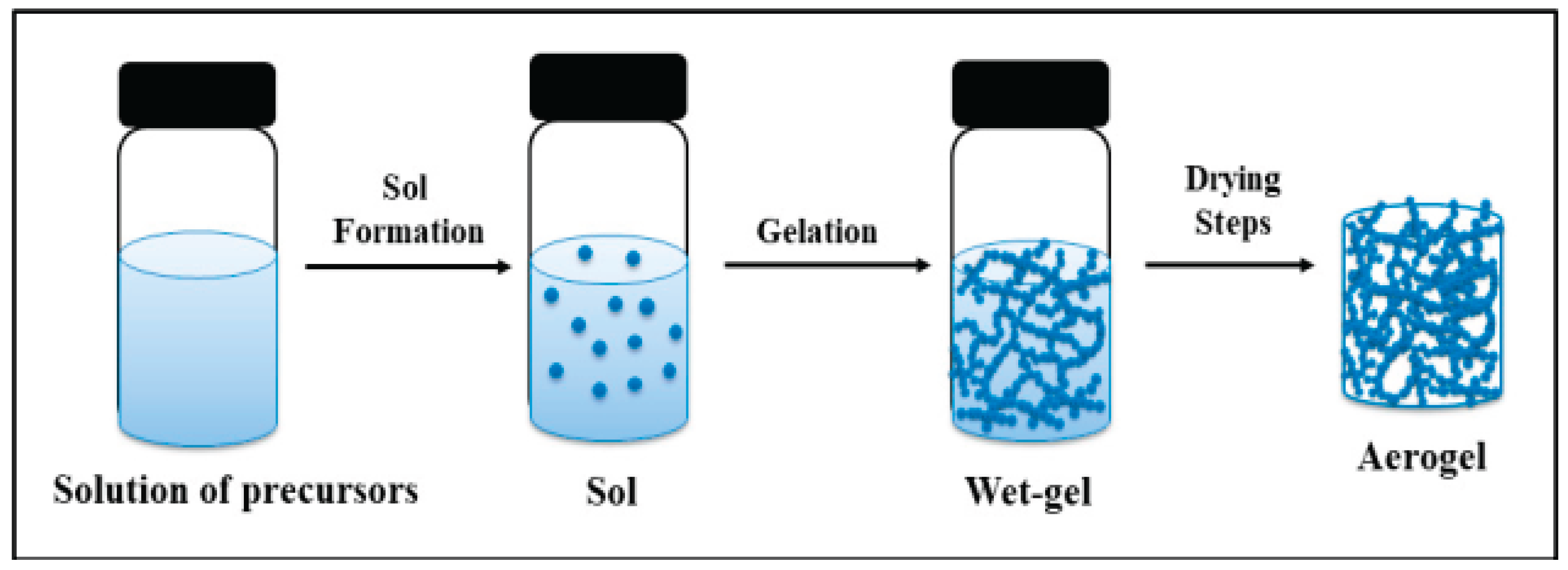
Figure 2.
Solution casting technique of mold preparation.
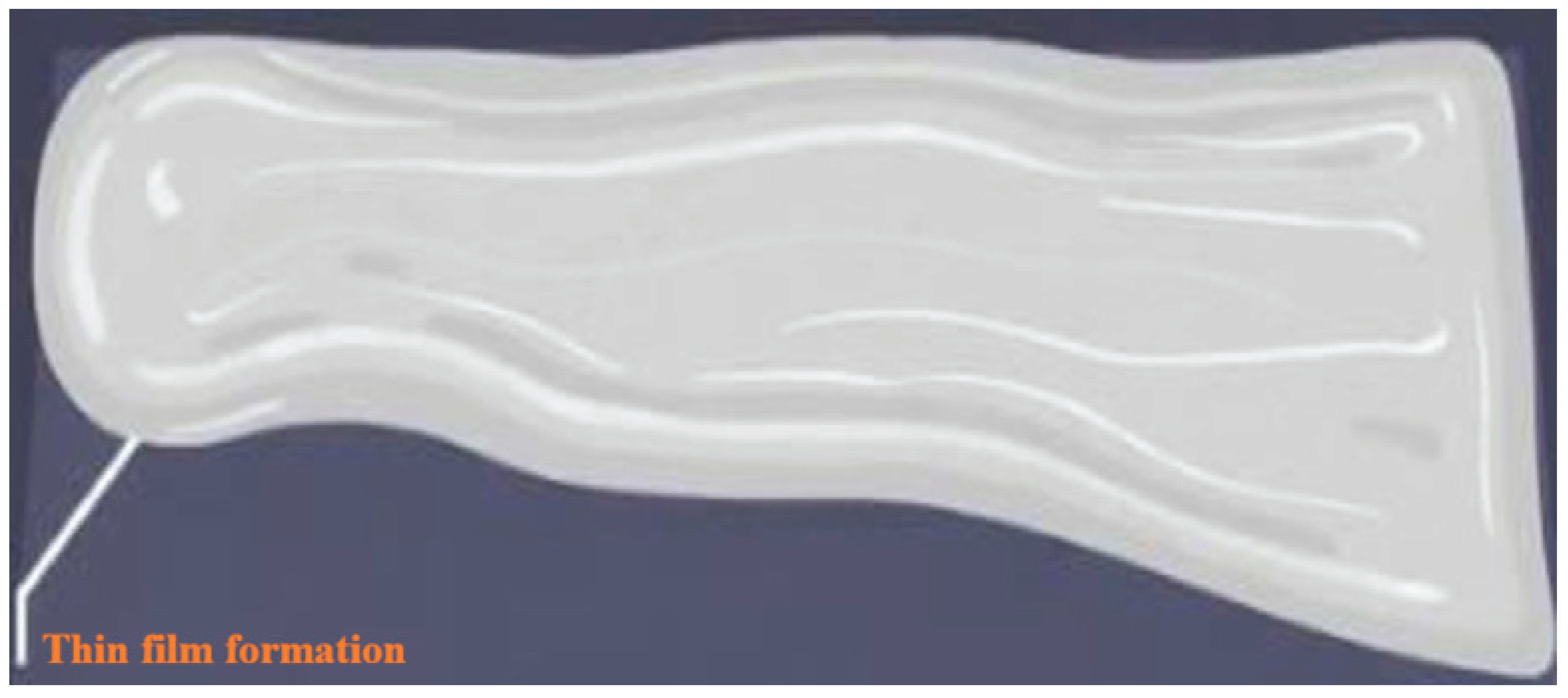
Figure 3.
Surface modification of silica nanoparticles.
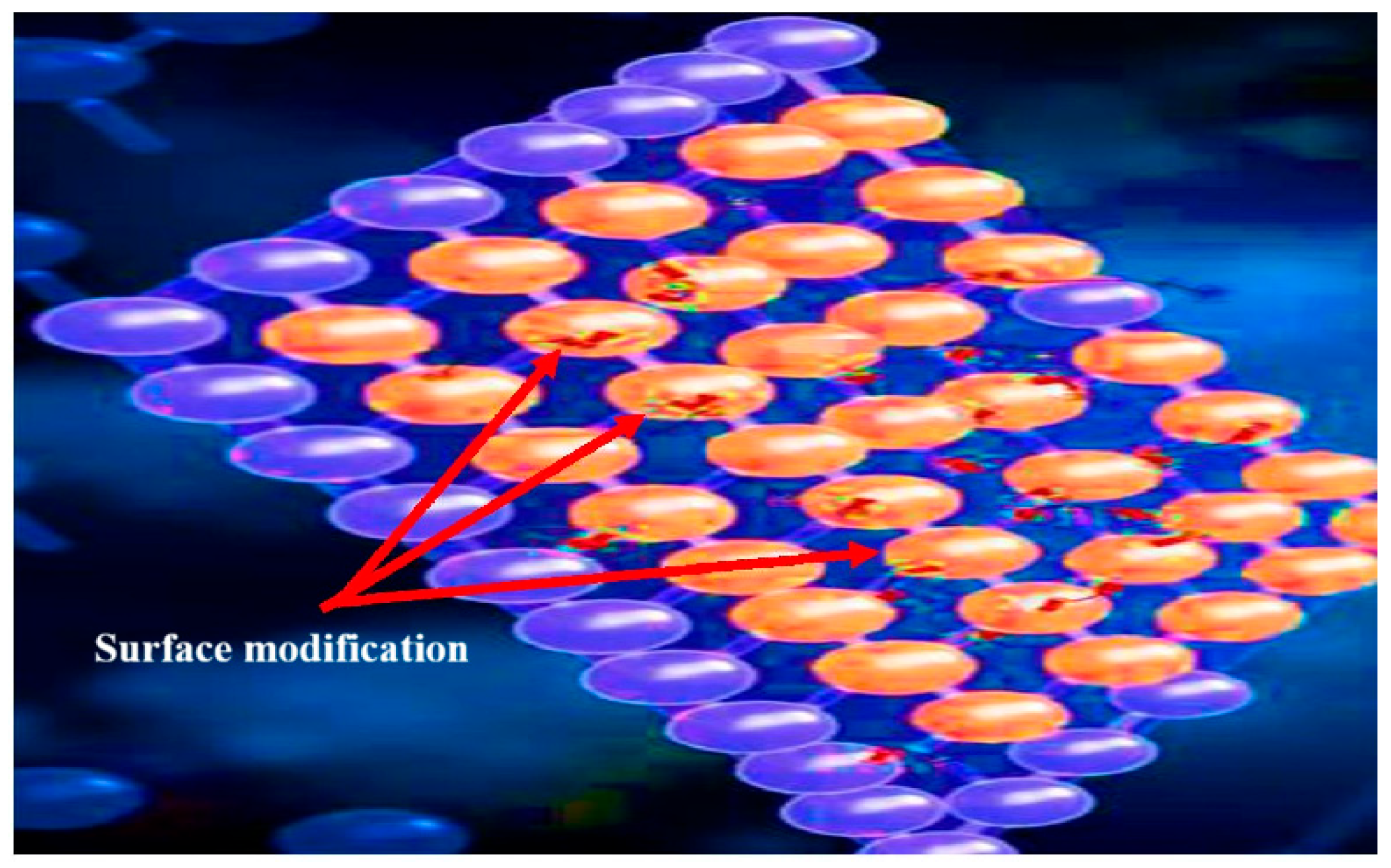
Figure 4.
Epoxy and silica coatings for concrete, metals, and composites.
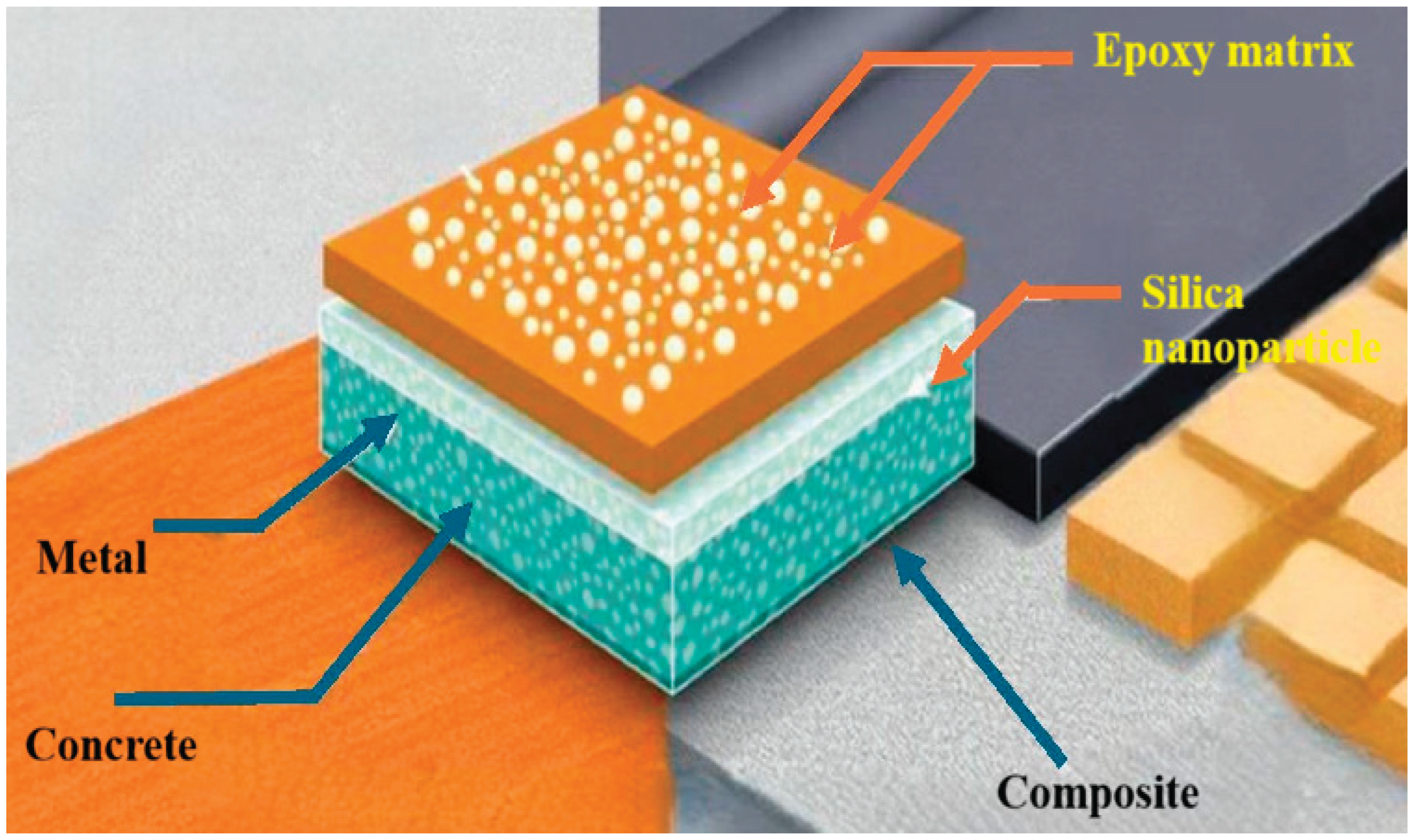

Table 1.
The preparation techniques for Epoxy and silica nanocomposite films, including their key features, advantages, and limitations.
Table 1.
The preparation techniques for Epoxy and silica nanocomposite films, including their key features, advantages, and limitations.
| Technique | Description | Key Features | Advantages | Limitations | Reference |
|---|---|---|---|---|---|
| In-situ Sol-Gel Process |
|
|
|
|
[18,19] |
| Solution Casting Technique |
|
|
|
|
[8,20] |
| Layer-by-Layer (LbL) Assembly |
|
|
|
|
[21,22] |
Disclaimer/Publisher’s Note: The statements, opinions and data contained in all publications are solely those of the individual author(s) and contributor(s) and not of MDPI and/or the editor(s). MDPI and/or the editor(s) disclaim responsibility for any injury to people or property resulting from any ideas, methods, instructions or products referred to in the content. |
© 2026 by the authors. Licensee MDPI, Basel, Switzerland. This article is an open access article distributed under the terms and conditions of the Creative Commons Attribution (CC BY) license (http://creativecommons.org/licenses/by/4.0/).
Copyright: This open access article is published under a Creative Commons CC BY 4.0 license, which permit the free download, distribution, and reuse, provided that the author and preprint are cited in any reuse.


