
Submitted:
14 April 2026
Posted:
15 April 2026
You are already at the latest version
Abstract
Autism spectrum disorder (ASD) is highly heterogeneous in symptom onset and severity, comorbidities, and treatment responsiveness, challenging a single “brain-centered” pathogenic model. Increasing evidence indicates that a subset of individuals with ASD exhibits prominent peripheral physiological alterations, including gastrointestinal (GI) dysfunction, gut microbial dysbiosis, immune imbalance, oxidative stress, and mito-chondrial/energy metabolic vulnerability. In this context, gut-derived metabo-lites—particularly short-chain fatty acids (SCFAs)—have emerged as plausible modula-tors of the neurodevelopmental milieu through the expanded gut–immune–metabolic–brain axis. This review synthesizes: (i) SCFA biogenesis and core physiological functions (GPCR-mediated signaling and epigenetic regulation), (ii) context- and developmental stage–dependent bidirectional effects shaped by dose, exposure duration, and tissue spec-ificity, (iii) the clinical heterogeneity of reported microbiome and SCFA alterations in ASD, and (iv) propionate as a frequently discussed candidate signal and the interpretive boundaries of preclinical evidence. Human studies show inconsistent directions and magnitudes of SCFA changes (increases, decreases, or no differences), driven by major sources of variability such as sample type (stool vs. blood, reflecting distinct physiological layers), GI symptom stratification, diet and medication/antibiotic exposure, and non-standardized analytical pipelines and reporting units. Accordingly, SCFAs should not be treated as universal ASD biomarkers; rather, they are better interpreted as con-text-dependent signals that may become salient under specific clinical-biological condi-tions. Building on this premise, we propose the conceptual framework of “metabolic ASD,” defined as a subtype in which peripheral metabolic–immune perturbations plausibly contribute to neurodevelopmental vulnerability. To avoid premature causal claims, we outline design requirements for future research, including developmentally informed lon-gitudinal cohorts, rigorous phenotypic stratification, standardized metabolomics, and multi-layer endpoints integrating barrier integrity, systemic inflammation, and metabolic stress. Ultimately, metabolic ASD should be positioned as a testable precision-medicine research frame rather than a universal etiological model.
Keywords:
autism spectrum disorder
; gut–brain axis
; microbiome
; short-chain fatty acids
; propionate
1. Introduction
1.1. Heterogeneity of Autism Spectrum Disorder and the Rationale for a Metabolic Subtype
Autism spectrum disorder (ASD) is a prototypical neurodevelopmental condition characterized by deficits in social interaction and communication, accompanied by restricted and repetitive patterns of behavior [1,2,3]. Despite its unified diagnostic framework, ASD exhibits marked interindividual variability across multiple dimensions, including age of symptom onset, clinical severity, cognitive and language profiles, comorbid conditions, and responsiveness to intervention. This heterogeneity is widely recognized as one of the defining features of ASD.
Observational studies of infants and toddlers aged 18–24 months have demonstrated substantial variability in early communicative behaviors, with gesture–vocalization combinations and word use frequencies differing by more than an order of magnitude across individuals. Similarly, responses to early intensive behavioral interventions show pronounced variability, with up to half of affected children failing to demonstrate significant improvement despite structured intervention [3,4,5,6]. Collectively, these findings underscore the limitations of conceptualizing ASD as a disorder driven by a single pathophysiological pathway and instead support the view of ASD as a spectrum composed of partially overlapping biological subgroups.
Historically, research into ASD etiology has focused predominantly on genetic risk factors and disruptions in neurodevelopmental pathways. Variants affecting synaptic structure and function (e.g., SHANK3, NLGN3), chromatin remodeling (CHD8, ARID1B), transcriptional regulation (MECP2), and cell growth and signaling pathways (PTEN, TSC2), as well as alterations in mTOR and Wnt signaling, have been repeatedly implicated [7,8,9,10]. However, most individual risk genes account for less than 1% of ASD cases, and large-scale exome sequencing and meta-analytic studies have emphasized that many identified variants are rare. Consequently, genetic findings alone are insufficient to comprehensively explain the broad clinical and phenotypic heterogeneity observed across the ASD population.
These limitations have prompted increasing recognition that, while genetic susceptibility provides an important foundation for ASD risk, additional biological layers—such as epigenetic regulation, environmental influences, and gene–environment interactions—likely play critical roles in shaping phenotypic expression. In parallel with this conceptual expansion, recent ASD research has increasingly examined the contribution of peripheral physiological systems beyond the central nervous system. In particular, subgroups of individuals with ASD have been repeatedly reported to exhibit gastrointestinal (GI) dysfunction and gut microbiota dysbiosis [11,12], immune dysregulation [13,14], and alterations in energy metabolism and mitochondrial function [15,16].
Clinical studies further support this perspective, documenting a high prevalence of chronic GI symptoms and altered gut microbial composition [17,18], elevated systemic inflammatory markers [19], increased oxidative stress [20,21], and mitochondrial abnormalities [22,23] in subsets of individuals with ASD. These converging observations challenge strictly brain-centric models of ASD pathophysiology and suggest that peripheral biological environments may meaningfully interact with neurodevelopmental vulnerability.
In light of the consistent presence of peripheral metabolic and immunophysiological abnormalities in a subset of individuals with ASD, this review argues for the necessity of moving beyond a unitary neurodevelopmental framework. Instead, we propose consideration of biologically defined subgroups in which alterations in gut-derived metabolites, metabolic regulation, immune balance, and mitochondrial function may amplify neurodevelopmental susceptibility. Within this context, we introduce the concept of “metabolic ASD” as a conceptual framework to delineate a subgroup characterized by prominent peripheral physiological involvement. This review integrates evidence linking gut microbiota alterations, impaired intestinal barrier integrity, systemic inflammation, and central neuroinflammatory processes to explore how the peripheral metabolic environment may influence neurodevelopmental trajectories.
Importantly, the concept of metabolic ASD is not intended as a universal explanatory model for all ASD cases. Rather, it is proposed as a stratification framework to identify a biologically and clinically distinct subgroup within the broader ASD spectrum, in which peripheral metabolic dysregulation represents a major contributing pathophysiological factor.
1.2. The Expanded Concept of the Gut–Brain Axis and the Pathophysiological Significance of Gut-Derived Metabolites
The gut–brain axis is a conceptual framework describing bidirectional communication between the GI tract and the central nervous system (CNS), encompassing an integrated physiological network that links neural, immune, endocrine, and metabolic pathways [24]. Early models of the gut–brain axis primarily emphasized neural regulation mediated by the autonomic nervous system and the enteric nervous system. More recent evidence, however, has substantially broadened this concept by identifying gut microbiota and their metabolites as central modulators of gut–brain communication [24,25].
Within this host–microbe symbiosis, gut microorganisms generate a wide range of bioactive metabolites, some of which extend their influence beyond the local intestinal environment and reach distant organs via systemic circulation [26]. These microbiota-derived metabolites engage neural, immune, and metabolic pathways, thereby forming a multilayered signaling network that links peripheral physiological states to central nervous system function [27,28]. At the intestinal level, short-chain fatty acids (SCFAs) activate free fatty acid receptors FFAR2/GPR43 and FFAR3/GPR41 expressed on intestinal epithelial cells, modulating intracellular calcium signaling and MAPK pathways and contributing to epithelial homeostasis [29,30]. In particular, butyrate has been reported to enhance intestinal barrier integrity not only through histone deacetylase (HDAC) inhibition but also via p300 auto-acylation–mediated histone acetylation, leading to increased expression of tight junction–related proteins such as claudins [31,32].
Beyond epithelial regulation, SCFAs influence enteric neural signaling by modulating neurotransmitter release through FFAR3 expressed on enteric nerve terminals [33] and exert immunomodulatory effects within the gut mucosal environment. Intestinal dendritic cells and macrophages respond to SCFAs via GPR109A signaling, promoting the production of the anti-inflammatory cytokine IL-10 and facilitating immune tolerance through modulation of TLR4 signaling and induction of Foxp3⁺ regulatory T cells (Tregs) [34,35]. In parallel, tryptophan-derived metabolites such as indole-3-propionate (IPA) have been shown to activate aryl hydrocarbon receptor (AhR) pathways, promoting Treg differentiation while suppressing Th17 polarization, thereby contributing to the attenuation of intestinal inflammatory responses [36,37].
A subset of gut-derived metabolites can also access the central nervous system via the circulation and influence blood–brain barrier (BBB) integrity. For example, propionate has been reported to activate FFAR3 signaling in brain endothelial cells, thereby promoting NRF2-dependent antioxidant pathways while suppressing TLR4/CD14-mediated inflammatory signaling. Through these mechanisms, propionate has been associated with the restoration of tight junction protein expression, including claudin-5, occludin, and ZO-1, and with reduced BBB permeability [38,39]. From this perspective, the gut–brain axis extends beyond a purely neural conduit and is more appropriately viewed as an integrated regulatory system linking the gut, immune system, metabolic environment, and brain.
Taken together, disruption of the intestinal barrier may permit microbial-derived molecules and metabolites to enter the systemic circulation, where they can trigger immune activation and metabolic stress responses that alter the microenvironment of the central nervous system. Such processes involve bottom-up, periphery-to-brain signaling pathways and may, under certain conditions, be associated with neuroinflammatory responses, altered glial activity, and dysregulation of neuronal energy metabolism.
This expanded view of the gut–brain axis provides a relevant theoretical framework for understanding neurodevelopmental disorders such as ASD. The developing nervous system is particularly sensitive to metabolic and immune signals, raising the possibility that subtle alterations in the gut environment during critical developmental windows may exert lasting effects on neurodevelopmental trajectories. Accordingly, gut microbiota and their metabolites have emerged as key candidate mediators linking environmental influences and host physiological states to ASD pathophysiology.
1.3. Research Trends on Short-Chain Fatty Acids and the Scope of This Review
SCFAs represent a major class of microbiota-derived metabolites mediating gut–brain communication and have been highlighted as key regulatory factors linked to the gut microbial dysbiosis repeatedly reported in ASD [40]. SCFAs are primarily produced through the microbial fermentation of dietary fibers, with acetate, propionate, and butyrate constituting the principal components [41,42]. These metabolites are known to participate in the maintenance of intestinal homeostasis, modulation of immune responses, regulation of energy metabolism, and aspects of nervous system function [43,44,45,46]. Under physiological conditions, SCFAs generally act as homeostatic regulators that support host metabolic and immunological balance.
However, these established physiological roles alone do not sufficiently account for the pronounced clinical heterogeneity observed in ASD. Clinical studies in individuals with ASD have repeatedly documented alterations in gut microbial composition accompanied by changes in SCFA concentrations and profiles; notably, the direction of these changes has been inconsistent, with reports of increased, decreased, or unchanged levels across studies [47,48]. This lack of concordance suggests that SCFA alterations are unlikely to represent a universal pathophysiological signature of ASD. Rather, they appear to reflect context-dependent phenomena shaped by multiple factors, including sample type, analytical methodology, age, dietary patterns, the presence of GI symptoms, exposure to medications or antibiotics, and overall systemic metabolic status.
Despite this heterogeneity, specific SCFAs have recurrently occupied a central position in ASD-related hypotheses, with propionic acid serving as a prominent example. In preclinical models, propionate has been associated with behavioral alterations, neuroimmune activation, mitochondrial dysfunction, and metabolic stress responses, leading to its frequent discussion in ASD-related metabolic research [1,49]. In contrast, findings from human clinical studies have not consistently replicated these associations. Consequently, it is more appropriate to interpret propionate not as a singular causal agent of ASD, but as a context-dependent risk modifier that may influence or amplify neurobiological changes within specific subgroups characterized by underlying metabolic vulnerability.
Building on this perspective, the present review aims to reframe gut microbiota–associated metabolite imbalance, including SCFAs, within a subgroup-based conceptual framework referred to here as “metabolic ASD.” To this end, we first provide a systematic overview of SCFA biosynthesis, physiological functions, receptor-mediated signaling pathways, and their condition-dependent effects across developmental stages. On this theoretical foundation, subsequent sections focus on propionate as a representative case, critically examining both its relevance and its limitations in interpreting clinical heterogeneity and pathophysiological mechanisms in ASD.
2. Physiological Roles of Gut Microbiota and Short-Chain Fatty Acids
2.1. Composition of the Gut Microbiota and Mechanisms of Short-Chain Fatty Acid Production
The human gut microbiota is a complex microbial ecosystem composed predominantly of bacteria and plays a central role not only in digestion and nutrient absorption but also in immune regulation, metabolic homeostasis, and modulation of nervous system function. In healthy adults, the gut microbiota is typically dominated by the phyla Firmicutes, Bacteroidetes, Actinobacteria, and Proteobacteria, although their relative abundance and functional characteristics vary dynamically in response to diet, age, environmental factors, and medication exposure [50,51].
Gut microorganisms ferment dietary fibers and resistant carbohydrates that are otherwise indigestible by the host, generating a range of metabolites, among which SCFAs represent the most prominent end products. SCFAs are generally defined as fatty acids containing two to four carbon atoms, with acetate, propionate, and butyrate constituting the principal components. In the human colon, these SCFAs are typically present at an approximate molar ratio of 60:20:20. Under physiological conditions, total SCFA concentrations range from approximately 70–140 mM in the proximal colon and 20–70 mM in the distal colon. Both absolute concentrations and relative proportions of SCFAs are influenced by dietary composition, microbial metabolic activity, and host absorptive capacity, and are therefore often used as functional indicators of gut microbial activity [52,53].
SCFA production occurs through distinct metabolic pathways that depend on microbial species composition and community structure. Members of the phylum Bacteroidetes, particularly species within the genus Bacteroides, predominantly produce acetate and propionate. Propionate synthesis in these organisms commonly proceeds via the succinate pathway, mediated by enzymes such as methylmalonyl-CoA transcarboxylase [54]. In contrast, several taxa within the phylum Firmicutes, especially those belonging to the Clostridiales cluster (e.g., Faecalibacterium prausnitzii, Roseburia intestinalis, Eubacterium hallii, and members of the genus Anaerostipes), are major butyrate producers. These bacteria primarily generate butyrate through the acetyl-CoA pathway during carbohydrate fermentation. Notably, increased relative abundance of Firmicutes has been reported to correlate positively with colonic butyrate concentrations (r = 0.68 ± 0.21) [55].
Within the phylum Actinobacteria, species of the genus Bifidobacterium (including B. longum subsp. infantis, B. bifidum, and B. breve) predominantly produce acetate and lactate via the bifid shunt pathway, converting glucose into acetate and lactate at an approximate molar ratio of 3:2 [56]. These intermediate metabolites—particularly lactate, acetate, and succinate—can subsequently serve as substrates for other microbial taxa through cross-feeding mechanisms. For example, lactate and acetate are further metabolized into butyrate by specialized butyrate-producing bacteria such as Anaerostipes caccae, Eubacterium hallii, and Anaerobutyricum soehngenii, contributing to approximately 20% of total colonic butyrate production [57]. Such functional interactions among microbial taxa are key determinants of both the composition and diversity of the SCFA pool in the gut.
SCFAs produced within the intestinal lumen are largely absorbed and utilized locally by the colonic epithelium. More than 95% of colonic butyrate is consumed locally as a primary energy source for colonocytes, whereas approximately 64% of acetate and 91% of propionate are transported via the portal circulation to the liver. Upon hepatic uptake, propionate and butyrate are preferentially extracted, with an estimated 70–90% metabolized before reaching the systemic circulation. In contrast, more than 90% of acetate escapes hepatic extraction and enters the peripheral circulation, where it can be utilized by extrahepatic tissues. Accordingly, the ultimate physiological impact of SCFAs reflects not only their intestinal production but also epithelial absorption, hepatic metabolism, and the host’s systemic metabolic state. These characteristics underscore the role of SCFAs as functional mediators linking gut microbial activity to host physiology, rather than as simple byproducts of microbial fermentation [58,59].
2.2. Physiological Functions of Major Short-Chain Fatty Acids and Gut–Immune–Neural Homeostasis
Microbiota-derived SCFAs function not merely as energy substrates but as key physiological signaling molecules that broadly regulate the intestinal mucosal environment, immune responses, and neural function. Under normal physiological conditions, appropriate SCFA production—estimated at approximately 500–600 mmol/day with a molar ratio of 60:20:20 (acetate:propionate:butyrate)—provides an essential foundation for maintaining functional integration across the gut–immune–neural axis [61]. In particular, butyrate at physiological concentrations (~0.5 mM) induces interleukin-22 (IL-22) production in intestinal CD4⁺ T cells and innate lymphoid cells (ILCs) via GPR41 signaling, while simultaneously enhancing the expression of tight junction–associated proteins, including claudins, occludin, and zonula occludens-1 (ZO-1), in intestinal epithelial cells. In parallel, maintenance of physiological cerebrospinal fluid concentrations of acetate (0–171 μM), propionate (0–6 μM), and butyrate (0–2.8 μM) has been associated with increased claudin and occludin expression at the BBB, thereby supporting BBB integrity. Collectively, these observations indicate that SCFAs under physiological conditions act as essential regulators of gut–immune–neural homeostasis [60,61].
Despite belonging to the same metabolite class, individual SCFAs exert distinct biological effects within the gut–immune–neural axis due to differences in their sites of production, tissue distribution, metabolic fate, and receptor affinities. Accordingly, this section delineates the representative physiological roles of acetate, butyrate, and propionate under normal conditions.
Acetate is the most abundant SCFA produced in the gut and exhibits relatively efficient transfer into the systemic circulation [58,61]. Under physiological conditions, approximately 64% of acetate in the portal circulation is extracted by the liver, while the remaining fraction reaches peripheral tissues. In the liver, acetate serves as a precursor for acetyl-CoA, contributing to fatty acid and cholesterol synthesis and modulating lipogenesis via AMP-activated protein kinase (AMPK) activation. In skeletal muscle, acetate functions as an energy substrate and has been reported to increase myoglobin and GLUT4 expression, thereby enhancing oxygen utilization and insulin sensitivity. In adipose tissue, acetate promotes the expression of genes associated with lipolysis and increases oxygen consumption, contributing to systemic energy homeostasis [58,62]. Extending these metabolic observations to central nervous system function, Frost et al. (2014) demonstrated using PET-CT and ^13C high-resolution magic-angle spinning (HR-MAS) spectroscopy that acetate derived from dietary fiber fermentation crosses the BBB, reaches the hypothalamus, and modulates neuropeptide expression and AMPK/ACC signaling, resulting in appetite-suppressive effects [63]. More recently, Forte et al. (2024) identified a mechanism by which acetate directly suppresses the excitability of hypothalamic orexin/hypocretin (OX/Hcrt) neurons via GPR43 signaling, further supporting the role of acetate in gut–brain metabolic communication [64].
Butyrate serves as the primary energy source for colonic epithelial cells, promoting ATP production through β-oxidation and the tricarboxylic acid (TCA) cycle. Donohoe et al. (2011) quantitatively demonstrated that butyrate deprivation in colonocytes from germ-free mice resulted in a ~56% reduction in ATP levels, a 16-fold decrease in the NADH/NAD⁺ ratio, and an approximately 70% reduction in oxidative phosphorylation, indicating severe impairment of cellular energy metabolism [65]. Physiological butyrate supplementation effectively reverses these metabolic deficits and suppresses energy deprivation–induced autophagy, thereby preserving the structural and functional integrity of the colonic epithelium. In addition, butyrate activates AMPK to promote rapid (within 1–2 h) redistribution of ZO-1 and occludin to the cell periphery, stabilizing tight junction architecture. Through HDAC inhibition, butyrate also induces p21 expression and suppresses cyclin D1, promoting G1 cell cycle arrest and epithelial differentiation. Concurrently, increased alkaline phosphatase and dipeptidyl peptidase IV (DPP IV) activity facilitates epithelial maturation and regeneration, collectively reinforcing intestinal barrier function [43,66].
Beyond epithelial effects, butyrate and propionate exhibit anti-inflammatory properties through GPR43-mediated signaling and HDAC inhibition, promoting differentiation of naïve CD4⁺ T cells into FoxP3⁺ regulatory T cells (Tregs). This process is accompanied by increased expression of CD39 and PD-L1 and enhanced IL-10 production, alongside suppression of pro-inflammatory cytokines such as TNF-α and IL-6. These effects favor tolerogenic differentiation of dendritic cells and contribute to immune homeostasis [67,68].
Propionate generated through intestinal fermentation is transported to the liver, where portal concentrations increase by approximately 35- to 100-fold and hepatic propionyl-CoA levels rise by 8- to 18-fold. Within hepatocytes, propionate exerts dual metabolic actions: first, propionyl-CoA activates pyruvate carboxylase to generate succinyl-CoA, thereby supplying substrates to the TCA cycle and gluconeogenesis; second, propionate activates AMPK via GPR43 signaling, leading to suppression of phosphoenolpyruvate carboxykinase (PEPCK) and glucose-6-phosphatase (G6Pase) expression and modulation of hepatic gluconeogenesis [69,70]. Heimann et al. (2014) further demonstrated that propionate and butyrate suppress hormone-stimulated lipolysis, reduce de novo lipogenesis, and enhance insulin-stimulated glucose uptake in primary rat adipocytes, supporting a role for SCFAs in lipid metabolism and insulin sensitivity [71]. In line with these findings, Weitkunat et al. (2016) reported that propionate supplementation in a high-fat diet model reduced hepatic triglyceride content by approximately 40%, suppressed expression of sterol regulatory element-binding factor 1 (Srebf1) and related lipogenic enzymes, and increased odd-chain fatty acid (OCFA) production, resulting in improved insulin sensitivity [72].
Within the immune system, propionate exhibits high affinity for GPR43 (FFAR2) and directly acts on FoxP3⁺ Tregs in the colonic lamina propria, increasing histone acetylation through inhibition of HDAC6 and HDAC9 and enhancing the expansion and function of IL-10–producing Tregs. Propionate also upregulates expression of the homing receptor GPR15, facilitating colonic localization of Tregs and supporting immune tolerance [73]. In addition, propionate displays relatively high activity at FFAR3 and has been proposed to directly influence brain endothelial cells, suggesting comparatively greater accessibility to the central nervous system. This feature contrasts with acetate, which does not exhibit comparable protective effects on BBB integrity [38]. Notably, portal venous SCFA concentrations are approximately fivefold higher than those in peripheral circulation (375 μmol/L vs. 79 μmol/L), and despite relatively high hepatic clearance, propionate appears capable of achieving physiologically relevant BBB exposure, positioning it as a distinctive mediator within the gut–brain axis [63,74].
Collectively, major SCFAs exhibit distinct yet complementary metabolic and immunological properties and act in a tissue-specific manner from intestinal fermentation through systemic circulation to the central nervous system. A clear understanding of SCFA function under physiological conditions therefore provides an essential reference framework for interpreting the significance of SCFA imbalance observed under pathological states.
2.3. SCFA Signaling Mechanisms: Receptor-Mediated Pathways and Epigenetic Regulation
The physiological effects of SCFAs extend beyond their roles as energy sources or metabolic substrates and are mediated through both extracellular receptor-dependent signaling and intracellular epigenetic regulation. At the cellular level, SCFAs signal primarily via G protein–coupled receptors (GPCRs), including GPR41/FFAR3, GPR43/FFAR2, and GPR109A, as well as through receptor-independent inhibition of HDACs [45,75]. These complementary mechanisms enable SCFAs to exert both rapid signaling effects and longer-term modulation of gene expression.
FFAR2 (GPR43) and FFAR3 (GPR41) function as canonical SCFA-sensing receptors and are expressed across a broad range of cell types within the intestinal epithelium, lamina propria, and peripheral immune compartments, including macrophages, monocytes, dendritic cells, and neutrophils [76,77]. Activation of these receptors has been implicated in the regulation of immune cell differentiation, modulation of cytokine production, maintenance of epithelial barrier integrity, and control of cellular energy metabolism. Through these pathways, SCFA signaling contributes to coordinated regulation of metabolic and inflammatory responses both locally within the gut and systemically.
In parallel with receptor-mediated signaling, SCFAs directly influence gene expression through inhibition of HDAC activity [31,32]. HDAC inhibition leads to increased histone acetylation, thereby altering chromatin accessibility and enabling sustained transcriptional reprogramming. This epigenetic mode of action allows SCFAs to function not only as transient metabolic signals but also as modulators of longer-term cellular phenotype and function [78]. Experimental evidence supports this temporal distinction: Folkerts et al. (2020) demonstrated that butyrate induces detectable histone acetylation within approximately 3 hours, followed by widespread changes in gene expression over 18–24 hours, resulting in persistent alterations in cellular phenotype [79].
In immune cells, SCFA-induced epigenetic regulation has been shown to influence the balance between regulatory and effector T cell differentiation through combined effects on HDAC activity and modulation of the mTOR–S6K signaling axis [80]. In intestinal epithelial cells, similar mechanisms contribute to the fine-tuning of inflammatory responsiveness by reshaping transcriptional programs that govern barrier function and cytokine signaling [81]. These findings highlight that SCFA-mediated epigenetic effects are highly context dependent and vary according to cell type, developmental state, and local microenvironment.
Together, receptor-dependent and receptor-independent signaling mechanisms provide a mechanistic basis for the capacity of SCFAs to influence physiological regulation beyond the intestinal lumen. At the same time, these pathways underscore that SCFA actions are not linear or uniform but are shaped by concentration, duration of exposure, tissue-specific receptor expression, and cell-type–specific epigenetic sensitivity. Such complexity offers a framework for understanding how identical metabolites may exert divergent biological effects across different physiological and pathological contexts.
2.4. Developmental Stage– and Context-Dependent Actions of SCFAs
The biological effects of SCFAs are maintained within specific concentration ranges—typically within physiological contexts at low millimolar levels (approximately 1–5 mM). Outside these ranges, particularly under high-concentration exposure (≥20 mM), the same metabolites can elicit qualitatively distinct or even opposing biological responses, reflecting a bidirectional dose–response relationship [82,83].
Indeed, SCFAs exhibit strong concentration dependence: within physiological ranges observed in the proximal colon (70–140 mM) and distal colon (20–70 mM), they generally support homeostatic regulation, whereas excessive or imbalanced exposure can induce context-specific dual effects depending on cell type and inflammatory milieu. Under such conditions, activation of FFAR2- and GPR109A-mediated pathways has been associated with NLRP3 inflammasome activation, increased IL-18 production, and enhanced secretion of pro-inflammatory cytokines such as TNF-α, IL-6, and IL-1β, potentially promoting neuroinflammatory responses [84,85].
In addition to concentration dependence, the physiological impact of SCFAs is strongly influenced by developmental stage. During fetal and early postnatal periods, when the nervous system undergoes rapid formation and remodeling, sensitivity to metabolic and immune signals is markedly heightened. This increased vulnerability reflects the presence of critical developmental windows characterized by elevated neural plasticity compared with adulthood [86]. During pregnancy, maternal gut microbiota and their derived metabolites, including SCFAs, directly influence fetal neurodevelopment [87]. Similarly, early infancy (approximately 0–3 months of age) represents a period of rapid microbial colonization and increasing SCFA production, during which alterations in SCFA profiles may exert lasting effects on subsequent neurodevelopmental trajectories [88,89,90].
Key neurodevelopmental processes occurring from late gestation through early postnatal life—including myelination, synaptogenesis, and microglial maturation—have been shown to be particularly sensitive to neuroinflammatory signaling and metabolic perturbations mediated by maternal inflammation and gut microbiota–derived SCFAs [91,92]. These findings suggest that SCFA exposure during early developmental periods may exert disproportionate influence on neural circuit formation relative to later life stages.
Clinical evidence further supports this developmental sensitivity. Alterations in maternal circulating SCFA concentrations during pregnancy have been associated with neurodevelopmental outcomes in early infancy. In a cohort study of 357 mother–infant pairs, lower maternal serum concentrations of acetate, butyrate, and isobutyrate during the first trimester were associated with significantly higher Bayley-III language and psychomotor development scores at 40 days of age compared with higher-exposure groups. In contrast, propionate exhibited a non-linear association, with optimal developmental, mood, and temperament scores observed within an intermediate concentration range [93]. These findings indicate that the developmental effects of SCFAs are not linear and support the existence of an optimal exposure window.
Accumulating evidence suggests that SCFA exposure patterns during these sensitive periods may exert long-term, and potentially irreversible, effects on gut–brain axis function, mitochondrial energy metabolism, neuroimmune interactions, and glial activation states [25,92]. This contrasts with the role of SCFAs in mature individuals, where they primarily function as metabolic substrates or physiological signaling molecules. During development, SCFAs may instead act as critical modulators of the neurodevelopmental milieu. Consequently, imbalances in SCFA exposure—either excess or deficiency—during fetal and neonatal stages have been proposed as potential contributors to the neurobiological substrates underlying neurodevelopmental disorders, including ASD [40,94,95].
Moreover, SCFA actions are tissue specific. Identical SCFA signals can elicit divergent responses across intestinal epithelium, peripheral immune compartments, the blood–brain barrier, and the central nervous system microenvironment [39,44,46,96]. Such tissue-specific responsiveness provides a physiological basis for how alterations in the gut metabolic environment may extend beyond local intestinal effects to influence central nervous system function.
In summary, while SCFAs serve as essential mediators of gut–immune–neural homeostasis under physiological conditions, their biological effects are highly dependent on concentration, developmental timing, and tissue context. These condition-dependent properties provide a critical conceptual framework for interpreting gut microbiota and SCFA imbalances observed in individuals with ASD and help explain the lack of consistency across clinical findings.
3. Gut Microbiota and Short-Chain Fatty Acid Imbalance in Autism Spectrum Disorder
3.1. Alterations in Gut Microbiota Composition in Individuals with ASD and Their Functional Implications
Reported alterations in SCFA levels in individuals with ASD have been inconsistent across human studies, with both increases and decreases described for acetate, propionate, and butyrate depending on study design and cohort characteristics (Table 1). Differences across studies reflect variation in biological and methodological context, including sample source, GI symptom stratification, developmental stage, and analytical methodology, and no uniform direction of change is observed across individual SCFAs in ASD.
As discussed in the preceding sections, the gut microbiota and its derived metabolites play central roles in maintaining functional integration across the gut–immune–neural axis under physiological conditions. Against this reference framework, the compositional alterations in gut microbial communities repeatedly reported in individuals with ASD warrant attention not merely as differences in microbial diversity, but as potential modulators of host metabolic and immune regulatory environments.
Across multiple case–control studies and systematic reviews, individuals with ASD have been reported to exhibit reduced alpha diversity alongside significant separation in beta diversity–based community structure compared with typically developing controls [97,98,99]. In a meta-analysis by Iglesias-Vázquez et al. (2020), children with ASD (n = 493) showed significantly higher relative abundances of Bacteroidetes (14.33% vs. 10.97%, p = 0.002), Firmicutes (13.42% vs. 10.77%, p < 0.001), and Proteobacteria (0.09% vs. 0.02%, p < 0.001) compared with controls (n = 404). The Bacteroidetes/Firmicutes ratio was modestly higher in ASD (0.69) than in controls (0.44), although the direction of this ratio varied substantially across studies [100]. In contrast, a large cohort study by Li et al. (2024) involving 957 individuals with ASD and 161 controls reported a reduced Bacteroidetes/Firmicutes ratio in the ASD group (0.54 vs. 0.89, p < 0.05), together with significant group separation in beta diversity analyses, with the first principal coordinate (PCO1) explaining 12.56% of total variance [101].
At the genus level, selective increases and decreases in specific taxa have been reported (Table 2). Reductions in fermentative genera such as Prevotella (adjusted p = 0.04), unclassified Veillonellaceae (adjusted p = 0.04), and Coprococcus (adjusted p = 0.06) have been relatively consistently observed across studies [102]. Conversely, meta-analytic data indicate significant enrichment of Bacteroides (ASD 9.04% vs. control 4.69%, p < 0.001) and Clostridium (ASD 0.74% vs. control 0.16%, p < 0.001) in individuals with ASD [100].
Alterations in taxa associated with short-chain fatty acid (SCFA) production have also been reported, although with substantial inter-study variability. For example, Faecalibacterium prausnitzii was reported as increased in ASD in a meta-analysis (6.84% vs. 5.00%, p = 0.040), whereas individual studies have documented both increases and decreases, reflecting limited consistency across cohorts. Such discrepancies are likely attributable to differences in age ranges, taxonomic resolution (genus vs. species), and analytical methodologies [100,103,104]. Similarly, Bifidobacterium abundance was reduced in meta-analytic comparisons (ASD 0.46% vs. control 0.89%, p < 0.001), yet individual studies again reported conflicting results, underscoring methodological and population-level heterogeneity [99,100,104,105].
Collectively, these alterations in SCFA-associated taxa have been interpreted as indirect evidence of a perturbed intestinal metabolic environment in ASD. However, most studies have relied on functional prediction approaches such as PICRUSt2, limiting the ability to directly link compositional changes to measured metabolite profiles [106]. As a result, causal or quantitative relationships between microbial shifts and SCFA alterations remain insufficiently established.
Importantly, the overall pattern of gut microbiota alterations reported in ASD lacks consistency across studies, making it difficult to define a universal microbial signature characteristic of ASD. This variability likely reflects the influence of multiple confounding factors, including age, dietary habits, the presence or absence of GI symptoms, antibiotic exposure, and differences in 16S rRNA sequencing platforms and bioinformatic pipelines [98,102,107,108,109]. Notably, some studies have reported more pronounced microbial alterations in ASD subgroups with co-occurring GI symptoms. For instance, individuals with ASD and GI symptoms exhibited selective increases in Sutterella, Roseburia, and Fusobacterium, accompanied by markers of increased intestinal permeability (elevated zonulin: 20.28 ± 5.21 μg/g; reduced lysozyme: 799.86 ± 672.91 μg/g). In contrast, ASD individuals without GI symptoms (n = 11) showed increases in Klebsiella and Lactobacillus without corresponding changes in zonulin or lysozyme levels relative to controls [110]. However, Kang et al. (2013) reported that reduced microbial diversity correlated with ASD symptom severity but not with GI symptom severity, suggesting that dysbiosis may occur independently of overt GI manifestations [102].
In summary, while alterations in gut microbiota composition are a recurrent finding in ASD, their directionality and magnitude are highly heterogeneous. These changes may reflect functional reorganization of microbial communities rather than a uniform taxonomic shift. Given the reliance on predictive functional analyses and the absence of consistent metabolite-level validation in many studies, gut microbiota alterations are more appropriately interpreted as contextual background factors that may modulate metabolic and immune environments under specific clinical or biological conditions, rather than as a singular etiological driver of ASD. This framework provides an essential premise for interpreting clinical studies examining SCFA concentration changes in individuals with ASD, which are addressed in the following section.
3.2. Clinical Heterogeneity of Reported Short-Chain Fatty Acid Alterations in Individuals with ASD
In parallel with reports of altered gut microbiota composition in individuals with ASD, numerous clinical studies have sought to directly quantify changes in the intestinal metabolic environment by measuring short-chain fatty acid (SCFA) concentrations in fecal samples or blood [59,111,112]. To date, however, these studies have not yielded a consistent pattern of increase or decrease for specific SCFAs. Instead, substantial inter-study variability and marked clinical heterogeneity have been repeatedly observed [47,111,112], reflecting the combined influence of biological and methodological factors summarized in Table 3.
Reported SCFA alterations differ by metabolite. Several studies have documented increased fecal concentrations of specific SCFAs—most notably propionic acid—in subsets of individuals with ASD. For example, elevated fecal propionate levels have been reported in children with ASD accompanied by constipation compared with typically developing controls [111]. In contrast, Wang et al. (2019) found no significant differences between ASD and control groups in the relative proportions of ten measured SCFAs, including propionate (22.2% vs. 21.4%, p > 0.05) [47]. Other cohorts have reported opposing patterns, with reduced acetate and butyrate concentrations alongside increased valerate levels in ASD (acetate: 732.4 vs. 899.9 μmol/g; butyrate: 413.2 vs. 563.3 μmol/g; ASD < control) [48]. Similar inconsistencies have been reported for acetate and butyrate across studies, with findings ranging from increases to decreases or no detectable differences [47,112]. Taken together, these discordant results indicate that alterations in SCFA composition cannot currently be defined as a universal biological feature of ASD [40].
One major contributor to this heterogeneity is the type of biological specimen used for SCFA measurement. Fecal SCFAs primarily reflect local concentrations within the colonic lumen, where microbial fermentation and utilization of dietary fibers and carbohydrates occur. In contrast, circulating SCFAs represent the integrated outcome of intestinal absorption, first-pass metabolism in the portal–hepatic system, and subsequent utilization or clearance by peripheral tissues [94,112]. Consistent with this distinction, metabolomic studies that simultaneously analyzed fecal and plasma samples from the same ASD cohorts have shown that metabolite panels and signal intensities distinguishing ASD from controls differ substantially between compartments, indicating that luminal and systemic measures capture distinct aspects of host–microbiome metabolism [114,115]. These findings underscore the importance of considering sample-specific physiological context when interpreting SCFA data.
Clinical heterogeneity within ASD populations further amplifies variability in reported SCFA profiles. Subgroups of individuals with ASD who present with GI (GI) symptoms, particularly constipation, have more frequently exhibited elevated fecal propionate and valerate concentrations compared with controls [111,112]. However, such patterns have not been consistently reproduced across cohorts differing in age range, definitions and assessments of GI symptoms, dietary composition, and exposure to medications or antibiotics [40,94]. This lack of reproducibility suggests that reported SCFA alterations are more likely to characterize specific clinical subgroups rather than the ASD population as a whole.
Methodological differences also pose significant challenges for cross-study comparison. SCFA quantification has been performed using diverse analytical platforms, including gas chromatography–flame ionization detection (GC–FID), gas chromatography–mass spectrometry (GC–MS), and liquid chromatography–tandem mass spectrometry (LC–MS/MS) [116,117,118]. Variations in sample storage conditions, extraction protocols, internal standards, and reporting units (e.g., μmol/g feces, μmol/mL plasma, or relative proportions) can yield substantially different quantitative outcomes even from comparable biological samples [113,116,119]. Moreover, many studies are limited by small sample sizes and cross-sectional designs, constraining statistical power and reproducibility [47,48,111].
In summary, although a substantial body of quantitative data on SCFA concentrations in ASD has accumulated, the direction and magnitude of reported alterations vary widely across studies, reflecting pronounced clinical heterogeneity. These findings suggest that changes in individual SCFAs are unlikely to serve as universal pathophysiological markers of ASD. Instead, they are more plausibly interpreted as context-dependent metabolic readouts shaped by clinical characteristics, gut microbiota composition, dietary and pharmacological exposures, and methodological factors. Accordingly, future research should move beyond treating SCFAs as a homogeneous group and instead examine acetate, propionate, butyrate, and other SCFAs individually, with careful consideration of their distinct physiological, immunological, and neurobiological effects in relation to ASD.
3.3. Selective Associations Between Propionate Alterations and ASD Phenotypes
As discussed in the preceding sections, alterations in SCFAs observed in individuals with ASD are characterized by substantial clinical heterogeneity, limiting the ability to generalize ASD-related biological features based on changes in any single metabolite. Nevertheless, when individual SCFAs are examined separately, propionic acid (propionate) has repeatedly emerged as a focal point of investigation.
The recurrent emphasis on propionate can be attributed to two main considerations. First, several clinical studies have reported alterations in fecal or circulating propionate levels in individuals with ASD, with such changes appearing more pronounced in subgroups presenting with co-occurring GI symptoms [111,112,120]. Second, preclinical studies have demonstrated that exogenous propionate exposure or experimental manipulation of propionate-related metabolic conditions can be associated with behavioral alterations, dysregulated neuroimmune responses, and disturbances in energy metabolism [1,121,122]. Collectively, these findings suggest that propionate possesses biological properties that enable interaction with neural and metabolic systems.
Importantly, however, these observations do not imply that propionate functions as a direct causal agent in ASD. In clinical contexts, associations between propionate levels and ASD-related phenotypes have not been consistently replicated across all cohorts and vary according to study design, biological specimen analyzed, and characteristics of the study population [40,47,48,111]. This variability indicates that the biological effects of propionate are unlikely to be universally operative across the ASD population. Rather, they may manifest selectively under conditions in which specific biological vulnerabilities or metabolic and immune environments are present.
From this perspective, propionate is more appropriately conceptualized not as a definitive etiological marker of ASD, but as a candidate signaling molecule whose neurobiological impact may be modulated by broader metabolic and immunological contexts. Increases in propionate should therefore be interpreted not as an independent pathogenic factor, but as a context-dependent component interacting with gut microbial composition, intestinal barrier integrity, and systemic metabolic and immune states.
In summary, among the SCFA alterations reported in ASD, propionate has consistently attracted attention despite pronounced clinical heterogeneity. Its selective consideration serves not to generalize SCFA imbalance as a universal feature of ASD, but to provide a starting point for exploring mechanistic possibilities within biologically defined subgroups. In this regard, propionate offers a logical bridge toward subsequent discussions of neurobiological mechanisms within the conceptual framework of a “metabolic ASD” subtype.
4. Neuro-pathophysiological Implications of Short-Chain Fatty Acids with a Focus on Propionate
4.1. Absorption, Systemic Distribution, and Central Nervous System Accessibility of Propionate
To evaluate whether propionate may contribute to neuro-pathophysiological processes relevant to ASD, it is first necessary to examine whether biologically plausible routes exist by which this metabolite, once generated in the gut, can reach the central nervous system. Propionate produced by gut microbiota is primarily absorbed across the colonic epithelium, a process mediated by both passive diffusion and monocarboxylate transporters (MCTs).
Following absorption, propionate enters the portal circulation and is delivered to the liver, where a substantial fraction undergoes first-pass metabolism. Hepatic processing includes conversion to propionyl-CoA and subsequent utilization in energy production, gluconeogenesis, or lipid-related metabolic pathways, thereby limiting the proportion of propionate that ultimately reaches the systemic circulation. Consequently, circulating propionate concentrations reflect not only microbial production within the gut, but also colonic epithelial absorption efficiency, intestinal transit time, hepatic metabolic capacity for propionyl-CoA processing, and host metabolic status, including dietary fiber and carbohydrate intake patterns, insulin resistance, and adiposity [94,113]. These considerations indicate that blood propionate levels should be interpreted as an integrated outcome of the gut–liver–systemic metabolic axis rather than as a direct surrogate marker of gut microbial activity alone.
A critical issue in considering potential central nervous system effects of propionate is its capacity to cross the BBB. Certain SCFAs have been reported to traverse the BBB to a limited extent via specific transport mechanisms, and propionate has been proposed as one such candidate. However, BBB accessibility is likely to be strongly context dependent, influenced by circulating concentration, duration of exposure, transporter expression in brain endothelial cells, and developmental stage [38,39]. In particular, during early developmental periods, the structural and functional properties of the BBB differ from those observed in adulthood [123,124,125,126], raising the possibility that identical systemic exposures may result in distinct central distributions and biological effects across the lifespan.
Accordingly, the potential impact of propionate on the central nervous system should not be inferred solely from its theoretical ability to cross the BBB. Rather, it should be considered within a conditional framework that incorporates timing and duration of exposure, developmental stage, and the local metabolic and cellular environment. Collectively, these considerations suggest that the neurobiological relevance of propionate is strongly shaped by developmental timing and biological context, with key developmental windows linking gut-derived short-chain fatty acid–related signals to neurodevelopmental processes summarized in Table 4.
4.2 Potential Disruption of the Neurodevelopmental Milieu: Neuronal Differentiation, Synaptogenesis, and Neuroinflammation
When considering the potential impact of propionate on neurodevelopmental processes, the currently available evidence remains insufficient to establish a definitive causal relationship demonstrating that this metabolite directly disrupts human neurodevelopment. Much of the existing literature relies on animal models or in vitro systems, in which exposure paradigms and mechanistic interpretations are subject to inherent limitations. Accordingly, this section does not assume that propionate exerts immediate or direct effects on neuronal differentiation or synapse formation. Instead, the discussion focuses on the possibility that propionate may contribute to conditions that alter the neurodevelopmental milieu during sensitive developmental periods.
During brain development, neuronal differentiation and maturation are tightly regulated by metabolic state, immune signaling, and the extracellular microenvironment [127,128]. These regulatory processes are, in turn, influenced by systemic metabolic conditions, including signals derived from gut microbiota metabolism [61,129]. For instance, Yang et al. (2020) reported that physiological, micromolar concentrations of SCFAs (acetate, propionate, and butyrate) significantly increased proliferation rates and the proportion of mitotic cells in human neural progenitor cultures [130]. Complementing these findings, Erny et al. (2015) demonstrated that germ-free mice exhibit immature microglial phenotypes characterized by increased dendritic length, branching points, and terminal processes, suggesting that gut microbiota–derived signals contribute to shaping the immune environment of the developing brain [131].
Beyond postnatal development, evidence has also emerged for a maternal gut–embryonic brain axis through which microbiota-derived metabolites, including SCFAs, influence embryonic neuronal differentiation and subsequent offspring behavior [132]. In line with this concept, offspring of dams exposed to high-fat diets displayed impairments in cognitive and social behaviors, reduced expression of synaptic proteins such as PSD-95, and delayed microglial maturation. Notably, these alterations were partially reversed by high-fiber dietary interventions or SCFA supplementation during gestation or early postnatal life [133]. Collectively, these findings provide quantitative support for the notion that gut microbiota–derived SCFAs can modulate metabolic, immune, and synaptic regulatory axes within the developing brain, thereby establishing a framework for examining the potential role of individual SCFAs, including propionate.
Within this context, the possible influence of propionate on the neurodevelopmental milieu may be traced through alterations in relevant biochemical signaling pathways. Several preclinical studies have reported changes in markers associated with neuronal differentiation, synaptic proteins, or activation states of microglia and astrocytes following propionate exposure. However, these observations are largely confined to experimental paradigms involving high concentrations or non-physiological routes of administration in specific animal models or in vitro systems [1,121,130]. As such, these findings are more appropriately interpreted as model-dependent indications that metabolic–immune regulatory axes can be perturbed under restricted conditions, rather than as conclusive evidence that propionate directly reprograms neurodevelopmental trajectories.
Synapse formation and remodeling warrant similar caution in interpretation. Under normal developmental conditions, synaptic pruning and refinement are tightly coordinated through interactions between neurons and glial cells, particularly microglia. These processes are sensitive to neuronal activity–dependent complement signaling and to local inflammatory and metabolic states [134,135]. While several preclinical studies have reported alterations in synaptic protein expression or synaptic density following propionate exposure [136,137], such findings should be regarded as contextual observations rather than definitive demonstrations of direct synaptic disruption.
Neuroinflammatory signaling represents another potential interface linking propionate exposure to changes in the neurodevelopmental environment. Under certain conditions, propionate has been associated with modulation of immune responses and altered activation states of glial cells. Given that microglial activation during development plays a central role in synaptic pruning and circuit maturation, such changes could indirectly influence neurodevelopmental outcomes [121,134,138]. Importantly, however, these associations should be interpreted as contributory rather than causal, reflecting one of multiple regulatory inputs shaping the developing brain.
Crucially, the effects described above are highly dependent on exposure timing, concentration, duration, and host developmental stage. Perturbations in metabolic and immune environments during early sensitive periods may leave enduring imprints on neural circuit organization that are not readily reversible later in life. From this perspective, the influence of propionate is more plausibly conceptualized not as an acute neurotoxic insult, but as an environmental bias that subtly modulates regulatory processes during neurodevelopment.
4.3. Mitochondrial Dysfunction and Energy Metabolic Stress
One of the more consistently reported biological features across ASD-related research is vulnerability in mitochondrial function and regulation of energy metabolism. These metabolic characteristics are rarely interpreted as the direct consequence of a single molecular insult; rather, they are more often understood as the integrated outcome of altered gut environments, immune activation, and developmental stressors acting in combination. Alterations in SCFAs, with particular emphasis on propionate, should therefore be considered within this broader metabolic–energetic framework.
Mitochondria play a central role in neuronal energy supply and maintenance of synaptic function, with particularly high energetic demands during neurodevelopment. Several preclinical studies have reported changes in mitochondrial indices following propionate exposure, including altered electron transport chain efficiency, dysregulation of mitochondrial membrane potential, and shifts in cellular redox balance. For example, rodent models receiving intracerebroventricular propionate administration exhibited reduced activity across multiple respiratory chain complexes, decreased ATP production, and increased reactive oxygen species (ROS) generation, consistent with mitochondrial dysfunction. Similarly, experiments using cell lines derived from individuals with ASD and from controls have shown that propionate treatment can alter oxygen consumption rates, mitochondrial membrane potential, ROS production, and ATP synthesis, suggesting that mitochondrial electron transport and redox homeostasis may be modulated under certain conditions. In addition, tissues from patients with propionic aciduria—a metabolic disorder characterized by chronic propionate accumulation—have demonstrated secondary mitochondrial abnormalities, including reduced respiratory chain complex activity, decreased mitochondrial DNA content, and structural mitochondrial alterations [139,140,141]. Importantly, these findings are largely derived from specific disease models or experimental paradigms and do not establish a direct causal relationship between propionate and mitochondrial dysfunction in individuals with ASD.
From an energy metabolism perspective, multiple studies have reported abnormalities in TCA cycle intermediates and pyruvate-related metabolites in urine, blood, and brain tissue from individuals with ASD [142,143]. Elevated lactate concentrations and increased lactate-to-pyruvate ratios in peripheral blood have been observed across several cohorts [144,145], findings that are commonly interpreted as indirect indicators of impaired mitochondrial respiratory efficiency or altered cytosolic–mitochondrial redox balance. In some cohorts, reduced activity of electron transport chain complex I and concomitant decreases in ATP-generating capacity have been detected in peripheral blood cells from children with ASD [146]. Consistent patterns have also been reported in stem cell–based models derived from individuals with ASD, which demonstrated slowed glycolytic flux, ATP deficiency, and reduced cellular respiration [147]. Together, these observations support the presence of an energy metabolic stress state that may impose additional constraints on neuronal function.
Propionate is metabolized within host cells through conversion to propionyl-CoA and methylmalonyl-CoA, ultimately yielding succinyl-CoA and allowing entry into the TCA cycle. Experimental studies in animal models and hepatocyte systems have shown that propionate exposure can increase TCA cycle intermediate pools and enhance pyruvate cycling, indicative of elevated anaplerotic flux. Under certain conditions, such metabolic loading may place additional strain on energy homeostasis [69,148]. The lactate-to-pyruvate ratio, which reflects cytosolic NADH/NAD⁺ redox status via the lactate dehydrogenase reaction, has repeatedly been reported to increase in contexts of mitochondrial dysfunction and metabolic stress, including ASD [144,149].
Although several preclinical studies have observed alterations in electron transport efficiency, mitochondrial membrane potential, and redox balance following propionate exposure, these findings do not support a uniform model in which propionate directly and consistently induces mitochondrial dysfunction. Rather, they suggest that propionate may function as a modulatory factor that amplifies existing energy metabolic imbalance under conditions of pre-existing metabolic vulnerability or oxidative stress [139,140]. This interpretation aligns with a framework in which propionate is viewed not as a singular etiological agent, but as a context-dependent stress amplifier acting upon an already susceptible metabolic background.
Oxidative stress represents an additional dimension closely linked to mitochondrial dysfunction. Disruption of metabolic balance may increase oxidative burden, thereby impairing neuronal energy supply and survival signaling pathways [145,146]. While direct causal evidence linking propionate exposure to oxidative stress remains limited, the potential for secondary oxidative load in the setting of heightened metabolic stress has been conceptually proposed.
4.4. Distinguishing Direct Effects from Axis-Mediated Indirect Effects
The potential neuro-pathophysiological implications of propionate discussed thus far can be conceptually categorized into two distinct yet complementary pathways. One involves direct effects, in which propionate reaches the central nervous system via systemic circulation and acts locally on the metabolic milieu or on neuronal and glial cellular functions. The other involves axis-mediated indirect effects, whereby alterations in the intestinal environment influence the central nervous system indirectly through compromised intestinal barrier integrity, systemic immune activation, and metabolic stress responses
Importantly, these two pathways should not be regarded as mutually exclusive mechanisms. Rather, they may operate concurrently under the same biological conditions. In particular, when intestinal barrier function is impaired and accompanied by systemic inflammation or metabolic stress, the central nervous system impact of gut-derived metabolites—including propionate—may be relatively amplified. Within this context, the neuro-pathophysiological relevance of propionate is more appropriately interpreted not as an isolated toxic effect of a single molecule, but as a context-dependent signal reflecting the functional state of the broader gut–immune–metabolic–brain axis.
This conceptual distinction provides an essential framework for interpreting subsequent discussions of gut–brain axis–mediated bottom-up signaling. Accordingly, the following section (Section 5) will examine in greater detail how gut-derived metabolites, including propionate, may influence the central nervous system through retrograde signaling pathways involving intestinal barrier dysfunction, systemic inflammatory responses, and neuro–immune–metabolic interactions.
5. Retrograde Signaling via the Gut–Brain Axis
5.1. Conceptual Framework of Gut Metabolite–Based Bottom-Up Signaling
The gut–brain axis has traditionally been understood as a bidirectional communication system linking the GI tract and the central nervous system. More recently, increasing attention has been directed toward bottom-up (periphery-to-brain) signaling, often referred to as retrograde signaling, whereby alterations in the intestinal environment influence central nervous system function [150,151]. From this perspective, gut microbiota and their derived metabolites are not merely metabolic byproducts but function as informational signals through which local intestinal changes can be translated into neural regulatory effects.
Gut metabolite–based retrograde signaling is best conceptualized not as a single linear pathway but as a multiaxial system integrating neural, immune, and metabolic routes. Changes originating in the intestinal lumen can be rapidly conveyed via neural pathways. Notably, vagal afferent fibers—which constitute approximately 80% of the vagus nerve—sense luminal metabolites such as SCFAs, bile acids, and tryptophan-derived compounds through receptors including FFAR2, TGR5, and TRPA1. These signals are transmitted to the nucleus tractus solitarius and subsequently relayed to central autonomic regulatory networks. In parallel, under conditions of impaired intestinal barrier integrity, reduced expression of tight junction proteins (e.g., occludin and ZO-1) may permit translocation of microbial components such as lipopolysaccharide (LPS) into the systemic circulation. This process engages a comparatively slower but more sustained immune-mediated signaling route, through which peripheral inflammatory cues can influence central nervous system function. Such immune signals have been associated with activation of TLR4/MyD88 pathways in the brain, increased expression of microglial activation markers (e.g., Iba-1 and CD68), and elevated levels of pro-inflammatory cytokines including TNF-α and IL-6 [152,153,154].
Together, these convergent pathways indicate that the gut–brain axis functions not simply as a conduit for signal transmission but as an integrated regulatory system that translates peripheral physiological states into central neural responses. Within this framework, gut-derived metabolites such as propionate are more appropriately interpreted not as isolated pathogenic agents acting directly on the brain, but as signalized outputs of broader intestinal state changes. Retrograde signaling thus reflects a process by which combined alterations in microbial ecology, epithelial barrier function, systemic immune activation, and metabolic status are conveyed to the central nervous system.
Consistent with emerging evidence, the biological effects of identical microbial metabolites may vary substantially depending on context. These context-dependent and state-dependent effects are shaped by integrated physiological conditions, including local metabolite concentrations, host immune status, receptor expression profiles, and the integrity of the intestinal barrier. Accordingly, the functional significance of gut-derived metabolites within retrograde signaling pathways should be understood as contingent upon the broader physiological landscape in which they operate.
5.2. Signal Amplification Mediated by Intestinal Barrier Dysfunction and Systemic Inflammation
Within the framework of gut–brain axis–mediated retrograde signaling, the functional integrity of the intestinal epithelial barrier serves as a critical gateway determining whether alterations in the gut environment can propagate to systemic and central nervous system levels. Under physiological conditions, the intestinal epithelium strictly limits the translocation of microbes and their metabolites through tight junction structures composed of transmembrane proteins such as occludin and claudins, together with cytoplasmic plaque proteins including ZO-1. However, cumulative influences such as gut microbial dysbiosis, exposure to pro-inflammatory cytokines, high-fat or high-sugar diets, oxidative stress, and endoplasmic reticulum stress can disrupt tight junction organization through reduced expression or altered localization of these proteins, resulting in compromised barrier function [155,156,157]. In support of this mechanism, Crawford et al. (2022) demonstrated in intestinal organoid models that exposure to TNF-α or IFN-γ induces structural distortion of tight junctions, characterized by increased tortuosity (p < 0.0001), along with enhanced epithelial permeability and dysregulated epithelial cell cycle control, providing direct evidence that inflammatory cytokines can impair barrier integrity [158].
When epithelial barrier function is compromised, microbial-derived molecules and gut metabolites may translocate beyond the intestinal lumen into the systemic circulation. Ghosh et al. (2020) reported that increased paracellular transport under barrier-disrupted conditions facilitates the movement of LPS into the bloodstream, where circulating LPS binds to LPS-binding protein or lipoproteins and activates Toll-like receptor 4 (TLR4) on immune cells, thereby triggering systemic inflammatory responses [159]. This process has been corroborated in animal models: Thaiss et al. (2018) demonstrated that hyperglycemia-induced barrier dysfunction was accompanied by the detection of microbial DNA in mesenteric lymph nodes, spleen, and liver, whereas oral antibiotic treatment abolished these findings, establishing the gut microbiota as a direct source of systemically translocated microbial components [160].
Importantly, such systemic translocation can occur in the absence of overt infection and may give rise to a state of chronic low-grade inflammation characterized by elevated circulating inflammatory mediators. Cani et al. (2012) conceptualized this phenomenon as metabolic endotoxemia, showing that high-fat diet–fed animal models exhibit a 2–3-fold increase in circulating LPS levels without pathogenic infection, accompanied by increased secretion of pro-inflammatory cytokines such as TNF-α, IL-6, and IL-1β, as well as macrophage activation [161]. Furthermore, Mohammad and Thiemermann (2021) demonstrated that LPS activation of the TLR4/MyD88 signaling pathway can further increase intestinal tight junction permeability, thereby establishing a positive feedback loop that amplifies inflammatory signaling [162].Within this inflammatory milieu, gut-derived metabolites do not act in isolation but function as components of a composite signaling environment shaped by microbial products and host immune responses.
Systemic inflammation has particular relevance for central nervous system involvement. Huo et al. (2021) reported that LPS translocation secondary to intestinal barrier disruption activates TLR4/MyD88 signaling in brain tissue, leading to increased expression of microglial activation markers (Iba-1 and CD68) and elevated levels of pro-inflammatory cytokines including TNF-α and IL-6 [154]. Notably, these changes were attributed not to direct neurotoxicity of gut-derived metabolites, but to the combined effects of epithelial barrier dysfunction and systemic inflammatory activation.
SCFAs including propionate, may likewise assume distinct physiological roles depending on the state of the intestinal barrier. Studies by Peng et al. (2009) and Singh et al. (2014) demonstrated that under conditions of preserved barrier integrity, butyrate enhances tight junction protein expression via AMPK activation and suppresses intestinal inflammation through GPR109A signaling, thereby supporting immune regulation and metabolic homeostasis [34,43]. In contrast, when barrier function is compromised, the systemic exposure profile of SCFAs and host responses to these metabolites may be altered. This context dependence underscores that the functional impact of identical metabolites is not fixed, but rather critically shaped by epithelial barrier status, which serves as a key determinant of the magnitude and directionality of retrograde signaling.
5.3. Integration of Neuro–Immune–Metabolic Pathways and Central Nervous System Responses
The downstream consequences of retrograde signaling are unlikely to converge on a single, uniform central response. Instead, they are more plausibly expressed as an integrated reconfiguration of neuro–immune–metabolic pathways. According to the concept of the metabolic–inflammatory axis proposed by Yin et al. (2016), systemic inflammation and metabolic stress originating from peripheral environmental changes can influence the central nervous system microenvironment by modulating glial activation states, energy metabolism, and neural responsiveness. These effects are coordinated through dynamic interactions among neural, immune, and metabolic pathways rather than through isolated signaling routes [162,163].
Microglia occupy a central position in this integrative framework, serving as key regulators of immune surveillance and synaptic remodeling within the central nervous system. Schafer et al. (2012) demonstrated that microglia sculpt neural circuits in an activity-dependent manner through complement signaling pathways involving C1q, C3, and CR3 [134]. Importantly, microglia are highly responsive to peripheral inflammatory cues. Qin et al. (2007) reported that a single systemic LPS injection induced prolonged elevation of brain TNF-α levels—persisting for up to ten months—accompanied by sustained microglial activation and progressive loss of dopaminergic neurons. These findings support the concept of self-propagating neuroinflammation initiated by peripheral immune activation [164]. Similarly, Cunningham and Riazi et al. (2008) showed that experimentally induced peripheral intestinal inflammation (TNBS colitis) resulted in microglial activation and increased TNF-α expression in the hippocampus, along with heightened seizure susceptibility and behavioral alterations [165]. Nonetheless, these observations were obtained under specific experimental conditions, and caution is warranted when extrapolating such findings to human neurodevelopmental disorders.
From a metabolic perspective, retrograde signaling may also influence central energy homeostasis. De Felice and Lourenco (2015) reported that elevated levels of systemic inflammatory cytokines such as TNF-α and IL-1β can impair neuronal insulin signaling, reduce glucose utilization, and ultimately diminish ATP production. These metabolic disruptions may compromise synaptic efficacy and destabilize neuronal survival signaling pathways [166]. Supporting this view, Camandola and Mattson (2017) estimated that synaptic transmission accounts for approximately 50–80% of total cerebral ATP consumption, indicating that even modest reductions in brain energy availability resulting from systemic metabolic stress could place substantial strain on synaptic maintenance and neuronal function [167] .
Crucially, neuro–immune–metabolic responses do not operate in isolation but tend to form self-amplifying interaction networks. Immune activation can drive a metabolic shift in microglia toward glycolysis-dominant states, and this metabolic reprogramming, in turn, enhances cytokine production and release, further amplifying immune signaling. Such positive feedback loops suggest that retrograde signaling is fundamentally state-dependent, with coordinated regulatory changes persisting even after the initial peripheral stimulus has subsided. This interactional architecture provides a mechanistic basis for sustained neuro–immune–metabolic coupling following transient peripheral perturbations [168,169].
5.4. Limitations of Preclinical Evidence and Clinical Implications
Although the concept of gut–brain axis–mediated retrograde signaling has been repeatedly supported by preclinical studies, substantial limitations remain with respect to reproducibility and interpretability. Many experimental investigations have been conducted under acute or non-physiological conditions, and observed outcomes vary considerably depending on exposure intensity, duration, and the developmental stage of the experimental animals [124,132,136]. As a result, similar interventions may yield divergent neurobiological or metabolic responses across studies, complicating efforts to derive unified mechanistic conclusions.
Comparable inconsistencies are also evident in clinical research. For instance, in studies involving Chinese children with ASD, Liu et al. (2019) reported significant associations between fecal SCFA levels and ASD-related measures, whereas Wang et al. (2019), analyzing a similar population, failed to identify meaningful associations between circulating SCFA concentrations and ASD diagnosis [47,48]. Such discrepancies highlight how relatively subtle differences in study design—including the biological matrix analyzed (fecal vs. blood samples), timing of sample collection, statistical modeling approaches, and covariate adjustment strategies—can substantially influence data interpretation.
More fundamentally, it is important to recognize the structural limitations inherent to preclinical approaches that rely on microbiota transplantation, experimental disruption of intestinal barrier integrity, or artificial induction of specific metabolic states. While these strategies are valuable for exploring conceptual plausibility, they often simultaneously alter gut ecology, immune responses, and metabolic conditions, making it difficult to isolate the independent effects of a single metabolite [46,115]. Consequently, observations derived from such models cannot be readily reduced to direct causal effects of individual metabolites. Instead, preclinical evidence supporting retrograde signaling should be interpreted as exploratory indications of potential mechanistic pathways rather than as direct proof of their operation in human ASD pathophysiology.
This recognition necessitates a cautious reassessment of the clinical significance of retrograde signaling frameworks. In aggregate, gut metabolite–based bottom-up signaling is best understood as a conceptual model in which alterations in intestinal barrier integrity, systemic inflammatory tone, and neuro–immune–metabolic interactions converge to influence central nervous system function. Within this model, SCFAs —including propionate—are not independent etiological agents but components of a broader signaling environment through which changes in the gut milieu are conveyed to the brain.
Importantly, such mechanisms are unlikely to operate uniformly across all individuals with ASD. As illustrated by the divergent findings reported by Liu and Wang, the relevance of gut-derived metabolites and retrograde signaling pathways is likely contingent upon individual biological characteristics and clinical context. This critical perspective provides an essential foundation for the interpretation of clinical data, evaluation of therapeutic strategies, and rigorous assessment of the proposed “metabolic ASD” concept in the subsequent sections.
6. Gut-Derived Metabolites and ASD: Integration of Clinical Evidence, Boundaries of Interpretation, and a Research Roadmap for Precision Interventions
6.1. Integrative Interpretation of Clinical Evidence: Signals Are Present, but Not Universal Markers
As summarized in Section 3, quantitative analyses of gut microbiota–related metabolites, particularly SCFAs, have been repeatedly conducted in cohorts of individuals with ASD [40,47]. However, the accumulated clinical evidence does not support the conclusion that alterations in specific SCFAs (e.g., propionate or butyrate) are consistently reproduced in the same direction across the ASD population as a whole. Rather, reported findings vary substantially depending on study conditions and patient characteristics [47,48,111,112]. Accordingly, the central implication of the clinical literature lies not in simply confirming the presence or absence of SCFA alterations, but in identifying the clinical and biological contexts in which gut-derived metabolic signals become particularly salient.
This context dependence is clearly reflected in physiological differences related to sampling location. Fecal SCFAs are strongly influenced by local fermentation dynamics and intestinal transit time, whereas circulating SCFAs represent downstream outcomes following epithelial absorption, hepatic first-pass metabolism, and utilization by peripheral tissues, thereby more closely reflecting systemic exposure [113,114]. Thus, measurements of the same metabolite may index distinct physiological layers—luminal fermentation versus systemic metabolic availability—depending on the biological matrix analyzed. From this perspective, discrepancies across clinical studies are better interpreted not as methodological inconsistencies or errors, but as manifestations of differences in the physiological strata being interrogated.
Importantly, several studies have reported that gut metabolite alterations are more pronounced in ASD subgroups with co-occurring GI symptoms, suggesting that metabolic imbalance is unlikely to represent a universal feature of ASD but may instead carry selective relevance within specific clinical subtypes [110,111,112]. Taken together, the current body of clinical evidence does not warrant dismissal of gut-derived metabolic alterations as irrelevant to ASD. Rather, it supports an interpretation in which conditions exist within the broader clinical heterogeneity of ASD under which metabolic perturbations can be meaningfully detected. This framework emphasizes the need to move beyond binary judgments of presence versus absence and toward an integrative, context-aware approach to patient stratification; core biomarker domains proposed to support identification of metabolically vulnerable subgroups within ASD are summarized in Table 5.
6.2. Guarding Against Premature Causal Inference: Reframing “Limitations” as Design Requirements
The recurrent inconsistencies observed in studies of gut-derived metabolites should not be reduced to a generalized conclusion that the evidence base is merely “insufficient.” Rather, these discrepancies should be interpreted as informative indicators of the research designs required to enable clinically meaningful interpretation. In this sense, many of the structural limitations identified to date should be reframed not as shortcomings, but as design requirements that future studies must explicitly address.
First, evaluation of causality and temporal precedence necessitates a shift beyond cross-sectional analyses toward developmentally informed longitudinal designs. ASD is fundamentally characterized by altered developmental trajectories, and both gut microbiota composition and metabolic environments change dynamically with age, diet, and living conditions [150]. Accordingly, longitudinal tracking of the same individuals is essential to determine whether changes in metabolic markers precede, follow, or co-evolve with alterations in clinical phenotypes.
Second, study designs must incorporate stratification that reflects the clinical heterogeneity of ASD. At a minimum, subgrouping based on the presence of GI symptoms, age range, dietary restrictions or selective eating patterns, comorbid metabolic states (e.g., obesity or insulin resistance), and histories of medication or antibiotic exposure should be considered prerequisites rather than optional adjustments. Without such stratification, comparisons based on group-level averages risk conflating biologically distinct conditions and obscuring meaningful signal patterns [98,107,108,109].
Third, ensuring reproducibility in gut metabolite research requires standardized pipelines for sample processing, analysis, and reporting. Variability in storage conditions, extraction methods, internal standards, analytical platforms (e.g., GC–FID, GC–MS, LC–MS/MS), and reporting formats (absolute concentrations versus relative proportions) can result in divergent quantitative outcomes even when similar biological phenomena are examined [116,119]. At a minimum, consensus on core SCFA panels and reporting units is needed to facilitate cross-study comparability.
Fourth, interpretation of SCFA-related findings should move beyond isolated metabolite measurements toward multilayered biomarker frameworks that capture intestinal barrier integrity, systemic inflammation, and metabolic state. As discussed in Section 5, gut–brain axis–mediated effects are rarely reducible to the direct action of a single metabolite; rather, they are more appropriately understood as state changes arising from the convergence of epithelial barrier dysfunction, inflammatory activation, and metabolic stress [150,159,162]. Concurrent assessment of barrier-related markers (e.g., zonulin), LPS-associated indices, inflammatory cytokines, and indicators of mitochondrial function or oxidative stress would allow metabolic signals to be interpreted within their physiological context.
Ultimately, the central objective of this section is not to reiterate that current clinical evidence is limited, but to delineate the minimum design criteria required to transform the concept of “metabolic ASD” into a scientifically testable and clinically interpretable framework. The extent to which future studies satisfy these design requirements will be a decisive factor in determining both the interpretability and translational potential of gut-derived metabolite research in ASD.
6.3. Therapeutic Implications of the Metabolic ASD Concept: Defining the Target and the Endpoints, Not the Magnitude of Effect
As the potential contribution of gut-derived metabolic imbalance to ASD pathophysiology has gained attention, the limitations of treating ASD as a single, homogeneous clinical entity have become increasingly apparent. Approaches that apply identical interventions across the entire ASD population are unlikely to yield consistent or interpretable outcomes. Consequently, therapeutic discussions must be reframed from the broad question of “Does this intervention work in ASD?” toward a precision-oriented inquiry: In which biologically defined subgroup does a given intervention modify which specific biological or clinical endpoints? This shift captures the therapeutic implication of the proposed “metabolic ASD” concept, which is not intended to promote a universal treatment strategy, but rather a framework for selective, subgroup-targeted interventions.
To date, proposed therapeutic strategies have largely fallen into three categories:
(ii) dietary interventions such as fiber enrichment or targeted carbohydrate modulation [170], and
(iii) microbiota reconstitution approaches, including fecal microbiota transplantation (FMT) [150].
Although some studies have reported changes in gut microbiota composition or metabolic indices following these interventions, effects on core ASD symptoms have not been consistently replicated at the population level. When clinical improvements have been observed, they have typically appeared in selected subgroups rather than across the entire cohort [47,48,171,172]. These observations underscore that the central challenge is not to overstate the promise of specific interventions, but to refine the criteria for identifying responders and to define biologically meaningful endpoints.
At least three methodological steps are required to advance this approach.
First, biomarker-informed stratification must precede therapeutic application. Multivariate panels integrating SCFA profiles (absolute concentrations and relative proportions), markers of intestinal barrier integrity, inflammatory indices, and indicators of metabolic stress represent plausible candidates for operationally defining a “metabolic ASD” subgroup.
Second, assessment of treatment efficacy should not be confined to behavioral outcomes alone. Instead, mechanism-linked endpoints are required to determine whether gut metabolites and associated barrier, inflammatory, and metabolic axes are actually modified in response to intervention.
Third, longitudinal designs and translational studies bridging preclinical and clinical data are essential to establish the temporal relationships between metabolic changes and shifts in clinical phenotypes, thereby distinguishing simple co-occurrence from potential pathophysiological contribution.
In summary, therapeutic approaches grounded in the metabolic ASD framework should not be positioned as broadly applicable prescriptions for ASD as a whole. Rather, they should be viewed as precision interventions to be selectively evaluated in subgroups where metabolic vulnerability constitutes a central pathophysiological axis. At this stage, the priority is not to assert therapeutic efficacy, but to construct robust patient stratification schemes and study designs that acknowledge clinical heterogeneity. Such an approach will enable gut-derived metabolic imbalance to be integrated into a coherent pathophysiological cascade and, ultimately, to serve as the basis for testable and clinically meaningful therapeutic hypotheses (Figure 1).
5. Conclusions
ASD is a highly heterogeneous neurodevelopmental condition that cannot be adequately explained by a single pathophysiological mechanism. This heterogeneity challenges brain-centered models that have traditionally dominated ASD research and highlights the need for broader conceptual frameworks. In this review, we revisited ASD pathophysiology through the lens of gut microbiota–derived metabolic imbalance, with a particular focus on SCFAs, and critically examined the concept of “metabolic ASD” as a biologically meaningful subtype in which peripheral metabolic and immune environments may contribute to neurodevelopmental vulnerability.
Across clinical studies, reported alterations in SCFA concentrations exhibit substantial heterogeneity and strong context dependence. Rather than representing a universal biological feature of ASD, SCFA imbalance appears to reflect signals shaped by measurement site, analytical methodology, developmental stage, dietary factors, gastrointestinal symptoms, and systemic metabolic status. These findings underscore the limitations of approaches that seek to generalize ASD pathophysiology based on single metabolites or isolated pathways.
Within this heterogeneous landscape, propionate has repeatedly attracted attention in both clinical and preclinical research, with suggested associations involving behavioral modulation, neuroimmune responses, mitochondrial function, and energy metabolic stress. However, the available evidence does not support propionate as a direct etiological agent in ASD. Instead, it is more appropriately interpreted as a context-dependent candidate signal whose neurobiological impact may be modulated or amplified under specific conditions of metabolic and immune vulnerability.
The integrative perspective advanced in this review conceptually links alterations in the gut microbiota–metabolite axis to central nervous system function through periphery-to-brain pathways involving intestinal barrier integrity, systemic inflammation, and neuro–immune–metabolic interactions. Importantly, this framework does not propose that gut-derived metabolic imbalance underlies all cases of ASD. Rather, it provides a hypothesis-driven structure for identifying subgroups in which peripheral metabolic environments may hold pathophysiological relevance within the broader heterogeneity of ASD.
In summary, ASD represents a spectrum of disorders that cannot be reduced to a single biological axis. In a subset of individuals, however, a metabolic pathophysiological axis centered on gut-derived metabolites may contribute to neurodevelopmental susceptibility. The concept of metabolic ASD should therefore be viewed as a theoretical starting point for refining study design, enabling biologically informed stratification, and guiding precision-oriented interventions. Its clinical and pathophysiological significance will ultimately require rigorous validation through developmentally informed longitudinal studies and subgroup-focused research approaches.
Author Contributions
Conceptualization, J.C. and J.Y.S.; writing—original draft preparation, J.C. and J.Y.S.; writing—review and editing, J.Y.S., Y.D. and J.S.; visualization, Y.D. and J.S.; supervision, J.C. All authors have read and agreed to the published version of the manuscript.
Funding
This research was supported by a grant from the Daegu Haany University Ky-lin Foundation in 2025.
Institutional Review Board Statement
Not applicable.
Informed Consent Statement
Not applicable.
Data Availability Statement
Not applicable.
Conflicts of Interest
The authors declare no conflicts of interest.
References
- Choi, J.; Lee, S.; Won, J.; Jin, Y.; Hong, Y.; Hur, T.Y.; Kim, J.H.; Lee, S.R.; Hong, Y. Pathophysiological and neurobehavioral characteristics of a propionic acid-mediated autism-like rat model. PLoS One 2018, 13(2), e0192925. [Google Scholar] [CrossRef]
- Tsai, C.H.; Chen, K.L.; Li, H.J.; Chen, K.H.; Hsu, C.W.; Lu, C.H.; Hsieh, K.Y.; Huang, C.Y. The symptoms of autism including social communication deficits and repetitive and restricted behaviors are associated with different emotional and behavioral problems. Sci Rep. 2020, 10(1), 20509. [Google Scholar] [CrossRef] [PubMed]
- Delehanty, A.; Wetherby, A.M. Coordinated social communication in toddlers with and without autism spectrum disorder during a home observation. Autism Dev Lang Impair 2022, 7, 23969415221121089. [Google Scholar] [CrossRef] [PubMed]
- Lombardo, M.V.; Lai, M.C.; Baron-Cohen, S. Big data approaches to decomposing heterogeneity across the autism spectrum. Mol Psychiatry 2019, 24(10), 1435–1450. [Google Scholar] [CrossRef]
- Reichow, B.; Hume, K.; Barton, E.E.; Boyd, B.A. Early intensive behavioral intervention (EIBI) for young children with autism spectrum disorders (ASD). Cochrane Database Syst Rev 2018, 5(5), CD009260. [Google Scholar] [CrossRef]
- Jobin, A. Varied treatment response in young children with autism: A relative comparison of structured and naturalistic behavioral approaches. Autism 2020, 24(2), 338–351. [Google Scholar] [CrossRef]
- Al-Beltagi, M.; Saeed, N.K.; Bediwy, A.S.; Bediwy, E.A.; Elbeltagi, R. Decoding the genetic landscape of autism: A comprehensive review. World J Clin Pediatr 2024, 13(3), 98468. [Google Scholar] [CrossRef]
- Satterstrom FK, Kosmicki JA, Wang J, Breen MS, De Rubeis S, An JY, Peng M, Collins R, Grove J, Klei L, Stevens C, Reichert J, Mulhern MS, Artomov M, Gerges S, Sheppard B, Xu X, Bhaduri A, Norman U, Brand H, Schwartz G, Nguyen R, Guerrero EE, Dias C; Autism Sequencing Consortium; iPSYCH-Broad Consortium; Betancur C, Cook EH, Gallagher L, Gill M, Sutcliffe JS, Thurm A, Zwick ME, Børglum AD, State MW, Cicek AE, Talkowski ME, Cutler DJ, Devlin B, Sanders SJ, Roeder K, Daly MJ, Buxbaum JD. Large-Scale Exome Sequencing Study Implicates Both Developmental and Functional Changes in the Neurobiology of Autism. Cell. 2020 Feb 6;180(3):568-584.e23. [CrossRef]
- Fu, J.M.; Satterstrom, F.K.; Peng, M.; Brand, H.; Collins, R.L.; Dong, S.; Wamsley, B.; Klei, L.; Wang, L.; Hao, S.P.; Stevens, C.R.; Cusick, C.; Babadi, M.; Banks, E.; Collins, B.; Dodge, S.; Gabriel, S.B.; Gauthier, L.; Lee, S.K.; Liang, L.; Ljungdahl, A.; Mahjani, B.; Sloofman, L.; Smirnov, A.N.; Barbosa, M.; Betancur, C.; Brusco, A.; Chung, B.H.Y.; Cook, E.H.; Cuccaro, M.L.; Domenici, E.; Ferrero, G.B.; Gargus, J.J.; Herman, G.E.; Hertz-Picciotto, I.; Maciel, P.; Manoach, D.S.; Passos-Bueno, M.R.; Persico, A.M.; Renieri, A.; Sutcliffe, J.S.; Tassone, F.; Trabetti, E.; Campos, G.; Cardaropoli, S.; Carli, D.; Chan, M.C.Y.; Fallerini, C.; Giorgio, E.; Girardi, A.C.; Hansen-Kiss, E.; Lee, S.L.; Lintas, C.; Ludena, Y.; Nguyen, R.; Pavinato, L.; Pericak-Vance, M.; Pessah, I.N.; Schmidt, R.J.; Smith, M.; Costa, C.I.S.; Trajkova, S.; Wang, J.Y.T.; Yu, M.H.C.; Cutler, D.J.; De Rubeis, S.; Buxbaum, J.D.; Daly, M.J.; Devlin, B.; Roeder, K.; Sanders, S.J.; Talkowski, M.E.; Autism Sequencing Consortium (ASC); Broad Institute Center for Common Disease Genomics (Broad-CCDG); iPSYCH-BROAD Consortium. Rare coding variation provides insight into the genetic architecture and phenotypic context of autism. Nat Genet. 2022, 54(9), 1320–1331. [Google Scholar] [CrossRef]
- De Rubeis S, He X, Goldberg AP, Poultney CS, Samocha K, Cicek AE, Kou Y, Liu L, Fromer M, Walker S, Singh T, Klei L, Kosmicki J, Shih-Chen F, Aleksic B, Biscaldi M, Bolton PF, Brownfeld JM, Cai J, Campbell NG, Carracedo A, Chahrour MH, Chiocchetti AG, Coon H, Crawford EL, Curran SR, Dawson G, Duketis E, Fernandez BA, Gallagher L, Geller E, Guter SJ, Hill RS, Ionita-Laza J, Jimenz Gonzalez P, Kilpinen H, Klauck SM, Kolevzon A, Lee I, Lei I, Lei J, Lehtimäki T, Lin CF, Ma'ayan A, Marshall CR, McInnes AL, Neale B, Owen MJ, Ozaki N, Parellada M, Parr JR, Purcell S, Puura K, Rajagopalan D, Rehnström K, Reichenberg A, Sabo A, Sachse M, Sanders SJ, Schafer C, Schulte-Rüther M, Skuse D, Stevens C, Szatmari P, Tammimies K, Valladares O, Voran A, Li-San W, Weiss LA, Willsey AJ, Yu TW, Yuen RK; DDD Study; Homozygosity Mapping Collaborative for Autism; UK10K Consortium; Cook EH, Freitag CM, Gill M, Hultman CM, Lehner T, Palotie A, Schellenberg GD, Sklar P, State MW, Sutcliffe JS, Walsh CA, Scherer SW, Zwick ME, Barett JC, Cutler DJ, Roeder K, Devlin B, Daly MJ, Buxbaum JD. Synaptic, transcriptional and chromatin genes disrupted in autism. Nature. 2014 Nov 13;515(7526):209-15. [CrossRef]
- Liu, S.; Xi, H.; Xue, X.; Sun, X.; Huang, H.; Fu, D.; Mi, Y.; He, Y.; Yang, P.; Tang, Y.; Zheng, P. Clostridium butyricum regulates intestinal barrier function via trek1 to improve behavioral abnormalities in mice with autism spectrum disorder. Cell Biosci. 2024, 14(1), 95. [Google Scholar] [CrossRef]
- Nithianantharajah, J.; Balasuriya, G.K.; Franks, A.E.; Hill-Yardin, E.L. Using Animal Models to Study the Role of the Gut-Brain Axis in Autism. Curr Dev Disord Rep. Epub 2017 May 12. 2017, 4(2), 28–36. [Google Scholar] [CrossRef]
- Hsiao, E.Y.; McBride, S.W.; Chow, J.; Mazmanian, S.K.; Patterson, P.H. Modeling an autism risk factor in mice leads to permanent immune dysregulation. Proc Natl Acad Sci U S A 2012, 109(31), 12776–81. [Google Scholar] [CrossRef] [PubMed]
- Choi, G.B.; Yim, Y.S.; Wong, H.; Kim, S.; Kim, H.; Kim, S.V.; Hoeffer, C.A.; Littman, D.R.; Huh, J.R. The maternal interleukin-17a pathway in mice promotes autism-like phenotypes in offspring. Science 2016, 351(6276), 933–9. [Google Scholar] [CrossRef] [PubMed]
- Yardeni, T.; Cristancho, A.G.; McCoy, A.J.; Schaefer, P.M.; McManus, M.J.; Marsh, E.D.; Wallace, D.C. An mtDNA mutant mouse demonstrates that mitochondrial deficiency can result in autism endophenotypes. Proc Natl Acad Sci U S A 2021, 118(6), e2021429118. [Google Scholar] [CrossRef]
- Ahn, Y.; Sabouny, R.; Villa, B.R.; Yee, N.C.; Mychasiuk, R.; Uddin, G.M.; Rho, J.M.; Shutt, T.E. Aberrant Mitochondrial Morphology and Function in the BTBR Mouse Model of Autism Is Improved by Two Weeks of Ketogenic Diet. Int J Mol Sci 2020, 21(9), 3266. [Google Scholar] [CrossRef] [PubMed]
- Leader, G.; Abberton, C.; Cunningham, S.; Gilmartin, K.; Grudzien, M.; Higgins, E.; Joshi, L.; Whelan, S.; Mannion, A. Gastrointestinal Symptoms in Autism Spectrum Disorder: A Systematic Review. Nutrients 2022, 14(7), 1471. [Google Scholar] [CrossRef]
- Cao, X.; Liu, K.; Liu, J.; Liu, Y.W.; Xu, L.; Wang, H.; Zhu, Y.; Wang, P.; Li, Z.; Wen, J.; Shen, C.; Li, M.; Nie, Z.; Kong, X.J. Dysbiotic Gut Microbiota and Dysregulation of Cytokine Profile in Children and Teens With Autism Spectrum Disorder. Front Neurosci 2021, 15, 635925. [Google Scholar] [CrossRef]
- Arteaga-Henríquez, G.; Gisbert, L.; Ramos-Quiroga, J.A. Immunoregulatory and/or Anti-inflammatory Agents for the Management of Core and Associated Symptoms in Individuals with Autism Spectrum Disorder: A Narrative Review of Randomized, Placebo-Controlled Trials. CNS Drugs 2023, 37(3), 215–229. [Google Scholar] [CrossRef]
- Chen, L.; Shi, X.J.; Liu, H.; Mao, X.; Gui, L.N.; Wang, H.; Cheng, Y. Oxidative stress marker aberrations in children with autism spectrum disorder: a systematic review and meta-analysis of 87 studies (N = 9109). Transl Psychiatry 2021, 11(1), 15. [Google Scholar] [CrossRef]
- Main, P.A.; Angley, M.T.; O'Doherty, C.E.; Thomas, P.; Fenech, M. The potential role of the antioxidant and detoxification properties of glutathione in autism spectrum disorders: a systematic review and meta-analysis. Nutr Metab (Lond) 2012, 9, 35. [Google Scholar] [CrossRef]
- Weissman, J.R.; Kelley, R.I.; Bauman, M.L.; Cohen, B.H.; Murray, K.F.; Mitchell, R.L.; Kern, R.L.; Natowicz, M.R. Mitochondrial disease in autism spectrum disorder patients: a cohort analysis. PLoS One 2008, 3(11), e3815. [Google Scholar] [CrossRef]
- Rose, S.; Niyazov, D.M.; Rossignol, D.A.; Goldenthal, M.; Kahler, S.G.; Frye, R.E. Clinical and Molecular Characteristics of Mitochondrial Dysfunction in Autism Spectrum Disorder. Mol Diagn Ther 2018, 22(5), 571–593. [Google Scholar] [CrossRef]
- Carabotti, M.; Scirocco, A.; Maselli, M.A.; Severi, C. The gut-brain axis: interactions between enteric microbiota, central and enteric nervous systems. Ann Gastroenterol 2015, 28(2), 203–209. [Google Scholar]
- Guo, C.; Huo, Y.J.; Li, Y.; Han, Y.; Zhou, D. Gut-brain axis: Focus on gut metabolites short-chain fatty acids. World J Clin Cases 2022, 10(6), 1754–1763. [Google Scholar] [CrossRef]
- Li, C.; Liang, Y.; Qiao, Y. Messengers From the Gut: Gut Microbiota-Derived Metabolites on Host Regulation. Front Microbiol 2022, 13, 863407. [Google Scholar] [CrossRef] [PubMed]
- Deng, W.; Yi, P.; Xiong, Y.; Ying, J.; Lin, Y.; Dong, Y.; Wei, G.; Wang, X.; Hua, F. Gut Metabolites Acting on the Gut-Brain Axis: Regulating the Functional State of Microglia. Aging Dis. 2024, 15(2), 480–502. [Google Scholar] [CrossRef] [PubMed]
- Ahmed, H.; Leyrolle, Q.; Koistinen, V.; Kärkkäinen, O.; Layé, S.; Delzenne, N.; Hanhineva, K. Microbiota-derived metabolites as drivers of gut-brain communication. Gut Microbes 2022, 14(1), 2102878. [Google Scholar] [CrossRef] [PubMed]
- Ang, Z.; Xiong, D.; Wu, M.; Ding, J.L. FFAR2-FFAR3 receptor heteromerization modulates short-chain fatty acid sensing. FASEB J 2018, 32(1), 289–303. [Google Scholar] [CrossRef]
- Tolhurst, G.; Heffron, H.; Lam, Y.S.; Parker, H.E.; Habib, A.M.; Diakogiannaki, E.; Cameron, J.; Grosse, J.; Reimann, F.; Gribble, F.M. Short-chain fatty acids stimulate glucagon-like peptide-1 secretion via the G-protein-coupled receptor FFAR2. Diabetes 2012, 61(2), 364–71. [Google Scholar] [CrossRef]
- Thomas, S.P.; Denu, J.M. Short-chain fatty acids activate acetyltransferase p300. Elife 2021, 10, e72171. [Google Scholar] [CrossRef]
- Yan, H.; Ajuwon, K.M. Butyrate modifies intestinal barrier function in IPEC-J2 cells through a selective upregulation of tight junction proteins and activation of the Akt signaling pathway. PLoS One 2017, 12(6), e0179586. [Google Scholar] [CrossRef]
- Pang, S.; Ren, Z.; Ding, H.; Chan, P. Short-chain fatty acids mediate enteric and central nervous system homeostasis in Parkinson's disease: Innovative therapies and their translation. Neural Regen Res. 2026, 21(3), 938–956. [Google Scholar] [CrossRef]
- Singh, N.; Gurav, A.; Sivaprakasam, S.; Brady, E.; Padia, R.; Shi, H.; Thangaraju, M.; Prasad, P.D.; Manicassamy, S.; Munn, D.H.; Lee, J.R.; Offermanns, S.; Ganapathy, V. Activation of Gpr109a, receptor for niacin and the commensal metabolite butyrate, suppresses colonic inflammation and carcinogenesis. Immunity Epub 2014 Jan 9. 2014, 40(1), 128–39. [Google Scholar] [CrossRef]
- Kaisar, M.M.M.; Pelgrom, L.R.; van der Ham, A.J.; Yazdanbakhsh, M.; Everts, B. Butyrate Conditions Human Dendritic Cells to Prime Type 1 Regulatory T Cells via both Histone Deacetylase Inhibition and G Protein-Coupled Receptor 109A Signaling. Front Immunol 2017, 8, 1429. [Google Scholar] [CrossRef]
- Ren, T.; Li, D.; Sun, F.; Pan, L.; Wang, A.; Li, X.; Bao, Y.; Zhang, M.; Zheng, F.; Yue, H. Indole Propionic Acid Regulates Gut Immunity: Mechanisms of Metabolite-Driven Immunomodulation and Barrier Integrity. J Microbiol Biotechnol. 2025, 35, e2503045. [Google Scholar] [CrossRef]
- Baranwal, G.; Goodlett, B.L.; Arenaz, C.M.; Creed, H.A.; Navaneethabalakrishnan, S.; Rutkowski, J.M.; Alaniz, R.C.; Mitchell, B.M. Indole Propionic Acid Increases T Regulatory Cells and Decreases T Helper 17 Cells and Blood Pressure in Mice with Salt-Sensitive Hypertension. Int J Mol Sci. 2023, 24(11), 9192. [Google Scholar] [CrossRef]
- Hoyles, L.; Snelling, T.; Umlai, U.K.; Nicholson, J.K.; Carding, S.R.; Glen, R.C.; McArthur, S. Microbiome-host systems interactions: protective effects of propionate upon the blood-brain barrier. Microbiome 2018, 6(1), 55. [Google Scholar] [CrossRef] [PubMed]
- Fock, E.; Parnova, R. Mechanisms of Blood-Brain Barrier Protection by Microbiota-Derived Short-Chain Fatty Acids. Cells 2023, 12(4), 657. [Google Scholar] [CrossRef] [PubMed]
- Lagod, P.P.; Naser, S.A. The Role of Short-Chain Fatty Acids and Altered Microbiota Composition in Autism Spectrum Disorder: A Comprehensive Literature Review. Int J Mol Sci. 2023, 24(24), 17432. [Google Scholar] [CrossRef] [PubMed]
- Boets, E.; Deroover, L.; Houben, E.; Vermeulen, K.; Gomand, S.V.; Delcour, J.A.; Verbeke, K. Quantification of in Vivo Colonic Short Chain Fatty Acid Production from Inulin. Nutrients 2015, 7(11), 8916–29. [Google Scholar] [CrossRef]
- Morrison, D.J.; Preston, T. Formation of short chain fatty acids by the gut microbiota and their impact on human metabolism. Gut Microbes 2016, 7(3), 189–200. [Google Scholar] [CrossRef]
- Peng, L.; Li, Z.R.; Green, R.S.; Holzman, I.R.; Lin, J. Butyrate enhances the intestinal barrier by facilitating tight junction assembly via activation of AMP-activated protein kinase in Caco-2 cell monolayers. J Nutr. 2009, 139(9), 1619–25. [Google Scholar] [CrossRef] [PubMed]
- Kim, C.H.; Park, J.; Kim, M. Gut microbiota-derived short-chain Fatty acids, T cells, and inflammation. Immune Netw 2014, 14(6), 277–88. [Google Scholar] [CrossRef] [PubMed]
- Kimura, I.; Inoue, D.; Hirano, K.; Tsujimoto, G. The SCFA Receptor GPR43 and Energy Metabolism. Front Endocrinol (Lausanne) 2014, 5, 85. [Google Scholar] [CrossRef] [PubMed]
- Colombo, A.V.; Sadler, R.K.; Llovera, G.; Singh, V.; Roth, S.; Heindl, S.; Sebastian Monasor, L.; Verhoeven, A.; Peters, F.; Parhizkar, S.; Kamp, F.; Gomez de Aguero, M.; MacPherson, A.J.; Winkler, E.; Herms, J.; Benakis, C.; Dichgans, M.; Steiner, H.; Giera, M.; Haass, C.; Tahirovic, S.; Liesz, A. Microbiota-derived short chain fatty acids modulate microglia and promote Aβ plaque deposition. Elife 2021, 10, e59826. [Google Scholar] [CrossRef]
- Wang, J.; Pan, J.; Chen, H.; Li, Y.; Amakye, W.K.; Liang, J.; Ma, B.; Chu, X.; Mao, L.; Zhang, Z. Fecal Short-Chain Fatty Acids Levels Were Not Associated With Autism Spectrum Disorders in Chinese Children: A Case-Control Study. Front Neurosci 2019, 13, 1216. [Google Scholar] [CrossRef]
- Liu, S.; Li, E.; Sun, Z.; Fu, D.; Duan, G.; Jiang, M.; Yu, Y.; Mei, L.; Yang, P.; Tang, Y.; Zheng, P. Altered gut microbiota and short chain fatty acids in Chinese children with autism spectrum disorder. Sci Rep. 2019, 9(1), 287. [Google Scholar] [CrossRef]
- MacFabe, D.F. Short-chain fatty acid fermentation products of the gut microbiome: implications in autism spectrum disorders. Microb Ecol Health Dis 2012, 23. [Google Scholar] [CrossRef]
- Claesson, M.J.; Cusack, S.; O'Sullivan, O.; Greene-Diniz, R.; de Weerd, H.; Flannery, E.; Marchesi, J.R.; Falush, D.; Dinan, T.; Fitzgerald, G.; Stanton, C.; van Sinderen, D.; O'Connor, M.; Harnedy, N.; O'Connor, K.; Henry, C.; O'Mahony, D.; Fitzgerald, A.P.; Shanahan, F.; Twomey, C.; Hill, C.; Ross, R.P.; O'Toole, P.W. Composition, variability, and temporal stability of the intestinal microbiota of the elderly. Proc Natl Acad Sci U S A 2011, 108 Suppl 1(Suppl 1), 4586–91. [Google Scholar] [CrossRef]
- Rinninella, E.; Raoul, P.; Cintoni, M.; Franceschi, F.; Miggiano, G.A.D.; Gasbarrini, A.; Mele, M.C. What is the Healthy Gut Microbiota Composition? A Changing Ecosystem across Age, Environment, Diet, and Diseases. Microorganisms 2019, 7(1), 14. [Google Scholar] [CrossRef]
- den Besten, G.; van Eunen, K.; Groen, A.K.; Venema, K.; Reijngoud, D.J.; Bakker, B.M. The role of short-chain fatty acids in the interplay between diet, gut microbiota, and host energy metabolism. J Lipid Res. 2013, 54(9), 2325–40. [Google Scholar] [CrossRef]
- Kasubuchi, M.; Hasegawa, S.; Hiramatsu, T.; Ichimura, A.; Kimura, I. Dietary gut microbial metabolites, short-chain fatty acids, and host metabolic regulation. Nutrients 2015, 7(4), 2839–49. [Google Scholar] [CrossRef] [PubMed]
- Price, C.E.; Valls, R.A.; Ramsey, A.R.; Loeven, N.A.; Jones, J.T.; Barrack, K.E.; Schwartzman, J.D.; Royce, D.B.; Cramer, R.A.; Madan, J.C.; Ross, B.D.; Bliska, J.; O'Toole, G.A. Intestinal Bacteroides modulates inflammation, systemic cytokines, and microbial ecology via propionate in a mouse model of cystic fibrosis. mBio 2024, 15(2), e0314423. [Google Scholar] [CrossRef] [PubMed]
- Singh, V.; Lee, G.; Son, H.; Koh, H.; Kim, E.S.; Unno, T.; Shin, J.H. Butyrate producers, "The Sentinel of Gut": Their intestinal significance with and beyond butyrate, and prospective use as microbial therapeutics. Front Microbiol. 2023, 13, 1103836. [Google Scholar] [CrossRef] [PubMed]
- Tsukuda, N.; Yahagi, K.; Hara, T.; Watanabe, Y.; Matsumoto, H.; Mori, H.; Higashi, K.; Tsuji, H.; Matsumoto, S.; Kurokawa, K.; Matsuki, T. Key bacterial taxa and metabolic pathways affecting gut short-chain fatty acid profiles in early life. ISME J 2021, 15(9), 2574–2590. [Google Scholar] [CrossRef]
- Culp, E.J.; Goodman, A.L. Cross-feeding in the gut microbiome: Ecology and mechanisms. Cell Host Microbe 2023, 31(4), 485–499. [Google Scholar] [CrossRef]
- Boets, E.; Gomand, S.V.; Deroover, L.; Preston, T.; Vermeulen, K.; De Preter, V.; Hamer, H.M.; Van den Mooter, G.; De Vuyst, L.; Courtin, C.M.; Annaert, P.; Delcour, J.A.; Verbeke, K.A. Systemic availability and metabolism of colonic-derived short-chain fatty acids in healthy subjects: a stable isotope study. J Physiol. 2017, 595(2), 541–555. [Google Scholar] [CrossRef]
- Cummings, J.H.; Pomare, E.W.; Branch, W.J.; Naylor, C.P.; Macfarlane, G.T. Short chain fatty acids in human large intestine, portal, hepatic and venous blood. Gut 1987, 28(10), 1221–7. [Google Scholar] [CrossRef]
- Yang, W.; Yu, T.; Huang, X.; Bilotta, A.J.; Xu, L.; Lu, Y.; Sun, J.; Pan, F.; Zhou, J.; Zhang, W.; Yao, S.; Maynard, C.L.; Singh, N.; Dann, S.M.; Liu, Z.; Cong, Y. Intestinal microbiota-derived short-chain fatty acids regulation of immune cell IL-22 production and gut immunity. Nat Commun. 2020, 11(1), 4457. [Google Scholar] [CrossRef]
- Silva, Y.P.; Bernardi, A.; Frozza, R.L. The Role of Short-Chain Fatty Acids From Gut Microbiota in Gut-Brain Communication. Front Endocrinol (Lausanne) 2020, 11, 25. [Google Scholar] [CrossRef]
- Yamashita, H.; Maruta, H.; Jozuka, M.; Kimura, R.; Iwabuchi, H.; Yamato, M.; Saito, T.; Fujisawa, K.; Takahashi, Y.; Kimoto, M.; Hiemori, M.; Tsuji, H. Effects of acetate on lipid metabolism in muscles and adipose tissues of type 2 diabetic Otsuka Long-Evans Tokushima Fatty (OLETF) rats. Biosci Biotechnol Biochem. 2009, 73(3), 570–6. [Google Scholar] [CrossRef]
- Frost, G.; Sleeth, M.L.; Sahuri-Arisoylu, M.; Lizarbe, B.; Cerdan, S.; Brody, L.; Anastasovska, J.; Ghourab, S.; Hankir, M.; Zhang, S.; Carling, D.; Swann, J.R.; Gibson, G.; Viardot, A.; Morrison, D.; Louise Thomas, E.; Bell, J.D. The short-chain fatty acid acetate reduces appetite via a central homeostatic mechanism. Nat Commun. 2014, 5, 3611. [Google Scholar] [CrossRef] [PubMed]
- Forte, N.; Marfella, B.; Nicois, A.; Palomba, L.; Paris, D.; Motta, A.; Pina Mollica, M.; Di Marzo, V.; Cristino, L. The short-chain fatty acid acetate modulates orexin/hypocretin neurons: A novel mechanism in gut-brain axis regulation of energy homeostasis and feeding. Biochem Pharmacol Epub 2024 Jun 20. 2024, 226, 116383. [Google Scholar] [CrossRef] [PubMed]
- Donohoe, D.R.; Garge, N.; Zhang, X.; Sun, W.; O'Connell, T.M.; Bunger, M.K.; Bultman, S.J. The microbiome and butyrate regulate energy metabolism and autophagy in the mammalian colon. Cell Metab. 2011, 13(5), 517–26. [Google Scholar] [CrossRef] [PubMed]
- Siavoshian, S.; Segain, J.P.; Kornprobst, M.; Bonnet, C.; Cherbut, C.; Galmiche, J.P.; Blottière, H.M. Butyrate and trichostatin A effects on the proliferation/differentiation of human intestinal epithelial cells: induction of cyclin D3 and p21 expression. Gut 2000, 46(4), 507–14. [Google Scholar] [CrossRef]
- Hu, M.; Alashkar Alhamwe, B.; Santner-Nanan, B.; Miethe, S.; Harb, H.; Renz, H.; Potaczek, D.P.; Nanan, R.K. Short-Chain Fatty Acids Augment Differentiation and Function of Human Induced Regulatory T Cells. Int J Mol Sci 2022, 23(10), 5740. [Google Scholar] [CrossRef]
- Henao-Mejia, J.; Elinav, E.; Jin, C.; Hao, L.; Mehal, W.Z.; Strowig, T.; Thaiss, C.A.; Kau, A.L.; Eisenbarth, S.C.; Jurczak, M.J.; Camporez, J.P.; Shulman, G.I.; Gordon, J.I.; Hoffman, H.M.; Flavell, R.A. Inflammasome-mediated dysbiosis regulates progression of NAFLD and obesity. Nature 2012, 482(7384), 179–85. [Google Scholar] [CrossRef]
- Perry, R.J.; Borders, C.B.; Cline, G.W.; Zhang, X.M.; Alves, T.C.; Petersen, K.F.; Rothman, D.L.; Kibbey, R.G.; Shulman, G.I. Propionate Increases Hepatic Pyruvate Cycling and Anaplerosis and Alters Mitochondrial Metabolism. J Biol Chem. 2016, 291(23), 12161–70. [Google Scholar] [CrossRef]
- Yoshida, H.; Ishii, M.; Akagawa, M. Propionate suppresses hepatic gluconeogenesis via GPR43/AMPK signaling pathway. Arch Biochem Biophys 2019, 672, 108057. [Google Scholar] [CrossRef]
- Heimann, E.; Nyman, M.; Degerman, E. Propionic acid and butyric acid inhibit lipolysis and de novo lipogenesis and increase insulin-stimulated glucose uptake in primary rat adipocytes. Adipocyte 2014, 4(2), 81–8. [Google Scholar] [CrossRef]
- Weitkunat, K.; Schumann, S.; Nickel, D.; Kappo, K.A.; Petzke, K.J.; Kipp, A.P.; Blaut, M.; Klaus, S. Importance of propionate for the repression of hepatic lipogenesis and improvement of insulin sensitivity in high-fat diet-induced obesity. Mol Nutr Food Res. 2016, 60(12), 2611–2621. [Google Scholar] [CrossRef]
- Smith, P.M.; Howitt, M.R.; Panikov, N.; Michaud, M.; Gallini, C.A.; Bohlooly-Y, M.; Glickman, J.N.; Garrett, W.S. The microbial metabolites, short-chain fatty acids, regulate colonic Treg cell homeostasis. Science 2013, 341(6145), 569–73. [Google Scholar] [CrossRef] [PubMed]
- Haghikia, A.; Zimmermann, F.; Schumann, P.; Jasina, A.; Roessler, J.; Schmidt, D.; Heinze, P.; Kaisler, J.; Nageswaran, V.; Aigner, A.; Ceglarek, U.; Cineus, R.; Hegazy, A.N.; van der Vorst, E.P.C.; Döring, Y.; Strauch, C.M.; Nemet, I.; Tremaroli, V.; Dwibedi, C.; Kränkel, N.; Leistner, D.M.; Heimesaat, M.M.; Bereswill, S.; Rauch, G.; Seeland, U.; Soehnlein, O.; Müller, D.N.; Gold, R.; Bäckhed, F.; Hazen, S.L.; Haghikia, A.; Landmesser, U. Propionate attenuates atherosclerosis by immune-dependent regulation of intestinal cholesterol metabolism. Eur Heart J 2022, 43(6), 518–533. [Google Scholar] [CrossRef] [PubMed]
- Kimura, I.; Inoue, D.; Maeda, T.; Hara, T.; Ichimura, A.; Miyauchi, S.; Kobayashi, M.; Hirasawa, A.; Tsujimoto, G. Short-chain fatty acids and ketones directly regulate sympathetic nervous system via G protein-coupled receptor 41 (GPR41). Proc Natl Acad Sci U S A 2011, 108(19), 8030–5. [Google Scholar] [CrossRef] [PubMed]
- Ang, Z.; Er, J.Z.; Tan, N.S.; Lu, J.; Liou, Y.C.; Grosse, J.; Ding, J.L. Human and mouse monocytes display distinct signalling and cytokine profiles upon stimulation with FFAR2/FFAR3 short-chain fatty acid receptor agonists. Sci Rep. 2016, 6, 34145. [Google Scholar] [CrossRef]
- Lavoie, S.; Chun, E.; Bae, S.; Brennan, C.A.; Gallini Comeau, C.A.; Lang, J.K.; Michaud, M.; Hoveyda, H.R.; Fraser, G.L.; Fuller, M.H.; Layden, B.T.; Glickman, J.N.; Garrett, W.S. Expression of Free Fatty Acid Receptor 2 by Dendritic Cells Prevents Their Expression of Interleukin 27 and Is Required for Maintenance of Mucosal Barrier and Immune Response Against Colorectal Tumors in Mice. Gastroenterology 2020, 158(5), 1359–1372.e9. [Google Scholar] [CrossRef]
- Licciardi, P.V.; Ververis, K.; Karagiannis, T.C. Histone deacetylase inhibition and dietary short-chain Fatty acids. ISRN Allergy 2011, 2011, 869647. [Google Scholar] [CrossRef]
- Folkerts, J.; Redegeld, F.; Folkerts, G.; Blokhuis, B.; van den Berg, M.P.M.; de Bruijn, M.J.W.; van IJcken, W.F.J.; Junt, T.; Tam, S.Y.; Galli, S.J.; Hendriks, R.W.; Stadhouders, R.; Maurer, M. Butyrate inhibits human mast cell activation via epigenetic regulation of FcεRI-mediated signaling. Allergy 2020, 75(8), 1966–1978. [Google Scholar] [CrossRef]
- Park, J.; Kim, M.; Kang, S.G.; Jannasch, A.H.; Cooper, B.; Patterson, J.; Kim, C.H. Short-chain fatty acids induce both effector and regulatory T cells by suppression of histone deacetylases and regulation of the mTOR-S6K pathway. Mucosal Immunol 2015, 8(1), 80–93. [Google Scholar] [CrossRef]
- Lin, M.Y.; de Zoete, M.R.; van Putten, J.P.; Strijbis, K. Redirection of Epithelial Immune Responses by Short-Chain Fatty Acids through Inhibition of Histone Deacetylases. Front Immunol 2015, 6, 554. [Google Scholar] [CrossRef]
- Otten, B.M.J.; Sthijns, M.M.J.P.E.; Troost, F.J. A Combination of Acetate, Propionate, and Butyrate Increases Glucose Uptake in C2C12 Myotubes. Nutrients 2023, 15(4), 946. [Google Scholar] [CrossRef]
- Saleri, R.; Borghetti, P.; Ravanetti, F.; Cavalli, V.; Ferrari, L.; De Angelis, E.; Andrani, M.; Martelli, P. Effects of different short-chain fatty acids (SCFA) on gene expression of proteins involved in barrier function in IPEC-J2. Porcine Health Manag 2022, 8(1), 21. [Google Scholar] [CrossRef] [PubMed]
- Park J, Wang Q, Wu Q, Mao-Draayer Y, Kim CH. Bidirectional regulatory potentials of short-chain fatty acids and their G-protein-coupled receptors in autoimmune neuroinflammation. Sci Rep. 2019 Jun 20;9(1):8837. https://doi.org/10.1038/s41598-019-45311-y. Erratum in: Sci Rep. 2019 Nov 20;9(1):17511. [CrossRef]
- Corrêa-Oliveira, R.; Fachi, J.L.; Vieira, A.; Sato, F.T.; Vinolo, M.A. Regulation of immune cell function by short-chain fatty acids. Clin Transl Immunology 2016, 5(4), e73. [Google Scholar] [CrossRef] [PubMed]
- Cusick, S.E.; Georgieff, M.K. The Role of Nutrition in Brain Development: The Golden Opportunity of the "First 1000 Days. J Pediatr. 2016, 175, 16–21. [Google Scholar] [CrossRef] [PubMed]
- Sun, Z.; Lee-Sarwar, K.; Kelly, R.S.; Lasky-Su, J.A.; Litonjua, A.A.; Weiss, S.T.; Liu, Y.Y. Identifying the critical time window for the association of the early-life gut microbiome and metabolome with childhood neurodevelopment. medRxiv 2022. [Google Scholar] [CrossRef]
- Kasani, P.H.; Yun, C.H.; Cho, K.H.; Jeong, S.J. Neonatal gut microbiota stratification and identification of SCFA-associated microbial subgroups using unsupervised clustering and machine learning classification. Front Microbiol 2025, 16, 1668451. [Google Scholar] [CrossRef]
- Ruohtula, T.; de Goffau, M.C.; Nieminen, J.K.; Honkanen, J.; Siljander, H.; Hämäläinen, A.M.; Peet, A.; Tillmann, V.; Ilonen, J.; Niemelä, O.; Welling, G.W.; Knip, M.; Harmsen, H.J.; Vaarala, O. Maturation of Gut Microbiota and Circulating Regulatory T Cells and Development of IgE Sensitization in Early Life. Front Immunol 2019, 10, 2494. [Google Scholar] [CrossRef]
- Beghetti, I.; Barone, M.; Brigidi, P.; Sansavini, A.; Corvaglia, L.; Aceti, A.; Turroni, S. Early-life gut microbiota and neurodevelopment in preterm infants: a narrative review. Front Nutr. 2023, 10, 1241303. [Google Scholar] [CrossRef]
- Kwon, H.K.; Choi, G.B.; Huh, J.R. Maternal inflammation and its ramifications on fetal neurodevelopment. Trends Immunol. 2022, 43(3), 230–244. [Google Scholar] [CrossRef]
- Hsu, C.Y.; Khachatryan, L.G.; Younis, N.K.; Mustafa, M.A.; Ahmad, N.; Athab, Z.H.; Polyanskaya, A.V.; Kasanave, E.V.; Mirzaei, R.; Karampoor, S. Microbiota-derived short chain fatty acids in pediatric health and diseases: from gut development to neuroprotection. Front Microbiol 2024, 15, 1456793. [Google Scholar] [CrossRef]
- Hernández-Martínez, C.; Canals, J.; Voltas, N.; Martín-Luján, F.; Arija, V. Circulating Levels of Short-Chain Fatty Acids during Pregnancy and Infant Neurodevelopment. Nutrients 2022, 14(19), 3946. [Google Scholar] [CrossRef]
- MacFabe, D.F. Enteric short-chain fatty acids: microbial messengers of metabolism, mitochondria, and mind: implications in autism spectrum disorders. Microb Ecol Health Dis. 2015, 26, 28177. [Google Scholar] [CrossRef]
- Zhang, D.; Zhou, M.; Qiu, Y.; Xu, H.; Liu, H.; Liu, Y.; Xie, L. Cross-generational mechanisms of maternal gut microbiota in modulating offspring autism spectrum disorder risk: from the gut-brain axis to translational challenges in precision interventions. Front Aging Neurosci 2025, 17, 1642240. [Google Scholar] [CrossRef] [PubMed]
- Cao, Q.; Shen, M.; Li, R.; Liu, Y.; Zeng, Z.; Zhou, J.; Niu, D.; Zhang, Q.; Wang, R.; Yao, J.; Zhang, G. Elucidating the specific mechanisms of the gut-brain axis: the short-chain fatty acids-microglia pathway. J Neuroinflammation 2025, 22(1), 133. [Google Scholar] [CrossRef] [PubMed]
- Li, H.; Guo, W.; Li, S.; Sun, B.; Li, N.; Xie, D.; Dong, Z.; Luo, D.; Chen, W.; Fu, W.; Zheng, J.; Zhu, J. Alteration of the gut microbiota profile in children with autism spectrum disorder in China. Front Microbiol 2024, 14, 1326870. [Google Scholar] [CrossRef] [PubMed]
- Lou, M.; Cao, A.; Jin, C.; Mi, K.; Xiong, X.; Zeng, Z.; Pan, X.; Qie, J.; Qiu, S.; Niu, Y.; Liang, H.; Liu, Y.; Chen, L.; Liu, Z.; Zhao, Q.; Qiu, X.; Jin, Y.; Sheng, X.; Hu, Z.; Jin, G.; Liu, J.; Liu, X.; Wang, Y. Deviated and early unsustainable stunted development of gut microbiota in children with autism spectrum disorder. Gut 2022, 71(8), 1588–1599. [Google Scholar] [CrossRef]
- Chen, Q.; Xu, J.; Yang, J.; Qin, X.; Fan, J.; Ke, H.; Yang, Z.; Zheng, W.; Li, X.; Huang, L.; Ning, W. Gut microbiota analysis in children with autism spectrum disorder and their family members. Sci Rep. 2025, 15(1), 44282. [Google Scholar] [CrossRef]
- Iglesias-Vázquez, L.; Van Ginkel Riba, G.; Arija, V.; Canals, J. Composition of Gut Microbiota in Children with Autism Spectrum Disorder: A Systematic Review and Meta-Analysis. Nutrients 2020, 12(3), 792. [Google Scholar] [CrossRef]
- Li, H.; Guo, W.; Li, S.; Sun, B.; Li, N.; Xie, D.; Dong, Z.; Luo, D.; Chen, W.; Fu, W.; Zheng, J.; Zhu, J. Alteration of the gut microbiota profile in children with autism spectrum disorder in China. Front Microbiol 2024, 14, 1326870. [Google Scholar] [CrossRef]
- Kang, D.W.; Park, J.G.; Ilhan, Z.E.; Wallstrom, G.; Labaer, J.; Adams, J.B.; Krajmalnik-Brown, R. Reduced incidence of Prevotella and other fermenters in intestinal microflora of autistic children. PLoS One 2013, 8(7), e68322. [Google Scholar] [CrossRef]
- Retuerto, M.; Al-Shakhshir, H.; Herrada, J.; McCormick, T.S.; Ghannoum, M.A. Analysis of Gut Bacterial and Fungal Microbiota in Children with Autism Spectrum Disorder and Their Non-Autistic Siblings. Nutrients 2024, 16(17), 3004. [Google Scholar] [CrossRef]
- Coretti L, Paparo L, Riccio MP, Amato F, Cuomo M, Natale A, Borrelli L, Corrado G, Comegna M, Buommino E, Castaldo G, Bravaccio C, Chiariotti L, Berni Canani R, Lembo F. Gut Microbiota Features in Young Children With Autism Spectrum Disorders. Front Microbiol. 2018 Dec 19;9:3146. https://doi.org/10.3389/fmicb.2018.03146. Erratum in: Front Microbiol. 2019 May 03;10:920. [CrossRef]
- Darwesh, M.K.; Bakr, W.; Omar, T.E.I.; El-Kholy, M.A.; Azzam, N.F. Unraveling the relative abundance of psychobiotic bacteria in children with Autism Spectrum Disorder. Sci Rep. 2024, 14(1), 24321. [Google Scholar] [CrossRef]
- Xiang, F.; Zhang, M.; Wei, X.; Chang, J. Gut microbiota composition and phylogenetic analysis in autism spectrum disorder: a comparative study. Front Psychiatry 2025, 16, 1609638. [Google Scholar] [CrossRef]
- Yap CX, Henders AK, Alvares GA, Wood DLA, Krause L, Tyson GW, Restuadi R, Wallace L, McLaren T, Hansell NK, Cleary D, Grove R, Hafekost C, Harun A, Holdsworth H, Jellett R, Khan F, Lawson LP, Leslie J, Frenk ML, Masi A, Mathew NE, Muniandy M, Nothard M, Miller JL, Nunn L, Holtmann G, Strike LT, de Zubicaray GI, Thompson PM, McMahon KL, Wright MJ, Visscher PM, Dawson PA, Dissanayake C, Eapen V, Heussler HS, McRae AF, Whitehouse AJO, Wray NR, Gratten J. Autism-related dietary preferences mediate autism-gut microbiome associations. Cell. 2021 Nov 24;184(24):5916-5931.e17. https://doi.org/10.1016/j.cell.2021.10.015. Epub 2021 Nov 11. Erratum in: Cell. 2024 Jan 18;187(2):495-510. Cell. [CrossRef]
- Li, H.; Liu, C.; Huang, S.; Wang, X.; Cao, M.; Gu, T.; Ou, X.; Pan, S.; Lin, Z.; Wang, X.; Zhu, Y.; Jing, J. Multi-omics analyses demonstrate the modulating role of gut microbiota on the associations of unbalanced dietary intake with gastrointestinal symptoms in children with autism spectrum disorder. Gut Microbes 2023, 15(2), 2281350. [Google Scholar] [CrossRef] [PubMed]
- Chavira, A.; Wang, E.H.J.; Mills, R.H. Meta-analysis of the autism gut microbiome identifies factors influencing study discrepancies and machine learning classification. bioRxiv. 2022.
- Vernocchi, P.; Ristori, M.V.; Guerrera, S.; Guarrasi, V.; Conte, F.; Russo, A.; Lupi, E.; Albitar-Nehme, S.; Gardini, S.; Paci, P.; Ianiro, G.; Vicari, S.; Gasbarrini, A.; Putignani, L. Gut Microbiota Ecology and Inferred Functions in Children With ASD Compared to Neurotypical Subjects. Front Microbiol 2022, 13, 871086. [Google Scholar] [CrossRef] [PubMed]
- He, J.; Gong, X.; Hu, B.; Lin, L.; Lin, X.; Gong, W.; Zhang, B.; Cao, M.; Xu, Y.; Xia, R.; Zheng, G.; Wu, S.; Zhang, Y. Altered Gut Microbiota and Short-chain Fatty Acids in Chinese Children with Constipated Autism Spectrum Disorder. Sci Rep. 2023, 13(1), 19103. [Google Scholar] [CrossRef] [PubMed]
- Deng, W.; Wang, S.; Li, F.; Wang, F.; Xing, Y.P.; Li, Y.; Lv, Y.; Ke, H.; Li, Z.; Lv, P.J.; Hao, H.; Chen, Y.; Xiao, X. Gastrointestinal symptoms have a minor impact on autism spectrum disorder and associations with gut microbiota and short-chain fatty acids. Front Microbiol 2022, 13, 1000419. [Google Scholar] [CrossRef]
- Manokasemsan, W.; Jariyasopit, N.; Poungsombat, P.; Kaewnarin, K.; Wanichthanarak, K.; Kurilung, A.; Duangkumpha, K.; Limjiasahapong, S.; Pomyen, Y.; Chaiteerakij, R.; Tansawat, R.; Srisawat, C.; Sirivatanauksorn, Y.; Sirivatanauksorn, V.; Khoomrung, S. Quantifying fecal and plasma short-chain fatty acids in healthy Thai individuals. Comput Struct Biotechnol J 2024, 23, 2163–2172. [Google Scholar] [CrossRef]
- Needham, B.D.; Adame, M.D.; Serena, G.; Rose, D.R.; Preston, G.M.; Conrad, M.C.; Campbell, A.S.; Donabedian, D.H.; Fasano, A.; Ashwood, P.; Mazmanian, S.K. Plasma and Fecal Metabolite Profiles in Autism Spectrum Disorder. Biol Psychiatry 2021, 89(5), 451–462. [Google Scholar] [CrossRef]
- Kang, D.W.; Adams, J.B.; Vargason, T.; Santiago, M.; Hahn, J.; Krajmalnik-Brown, R. Distinct Fecal and Plasma Metabolites in Children with Autism Spectrum Disorders and Their Modulation after Microbiota Transfer Therapy. mSphere 2020, 5(5), e00314-20. [Google Scholar] [CrossRef]
- Trivedi, N.; Erickson, H.E.; Bala, V.; Chhonker, Y.S.; Murry, D.J. A Concise Review of Liquid Chromatography-Mass Spectrometry-Based Quantification Methods for Short Chain Fatty Acids as Endogenous Biomarkers. Int J Mol Sci. 2022, 23(21), 13486. [Google Scholar] [CrossRef]
- Rohde, J.K.; Fuh, M.M.; Evangelakos, I.; Pauly, M.J.; Schaltenberg, N.; Siracusa, F.; Gagliani, N.; Tödter, K.; Heeren, J.; Worthmann, A. A Gas Chromatography Mass Spectrometry-Based Method for the Quantification of Short Chain Fatty Acids. Metabolites 2022, 12(2), 170. [Google Scholar] [CrossRef] [PubMed]
- Scortichini, S.; Boarelli, M.C.; Silvi, S.; Fiorini, D. Development and validation of a GC-FID method for the analysis of short chain fatty acids in rat and human faeces and in fermentation fluids. J Chromatogr B Analyt Technol Biomed Life Sci. 2020, 1143, 121972. [Google Scholar] [CrossRef] [PubMed]
- Liebisch, G.; Ecker, J.; Roth, S.; Schweizer, S.; Öttl, V.; Schött, H.F.; Yoon, H.; Haller, D.; Holler, E.; Burkhardt, R.; Matysik, S. Quantification of Fecal Short Chain Fatty Acids by Liquid Chromatography Tandem Mass Spectrometry-Investigation of Pre-Analytic Stability. Biomolecules 2019, 9(4), 121. [Google Scholar] [CrossRef]
- Levkova, M.; Chervenkov, T.; Pancheva, R. Genus-Level Analysis of Gut Microbiota in Children with Autism Spectrum Disorder: A Mini Review. Children (Basel) 2023, 10(7), 1103. [Google Scholar] [CrossRef] [PubMed]
- Abdelli, L.S.; Samsam, A.; Naser, S.A. Propionic Acid Induces Gliosis and Neuro-inflammation through Modulation of PTEN/AKT Pathway in Autism Spectrum Disorder. Sci Rep. 2019, 9(1), 8824. [Google Scholar] [CrossRef]
- Thomas, R.H.; Meeking, M.M.; Mepham, J.R.; Tichenoff, L.; Possmayer, F.; Liu, S.; MacFabe, D.F. The enteric bacterial metabolite propionic acid alters brain and plasma phospholipid molecular species: further development of a rodent model of autism spectrum disorders. J Neuroinflammation 2012, 9, 153. [Google Scholar] [CrossRef]
- Saunders, N.R.; Liddelow, S.A.; Dziegielewska, K.M. Barrier mechanisms in the developing brain. Front Pharmacol 2012, 3, 46. [Google Scholar] [CrossRef]
- Saunders, N.R.; Dziegielewska, K.M.; Møllgård, K.; Habgood, M.D. Physiology and molecular biology of barrier mechanisms in the fetal and neonatal brain. J Physiol. 2018, 596(23), 5723–5756. [Google Scholar] [CrossRef]
- Fleming, A.; Diekmann, H.; Goldsmith, P. Functional characterisation of the maturation of the blood-brain barrier in larval zebrafish. PLoS One 2013, 8(10), e77548. [Google Scholar] [CrossRef]
- Verscheijden, L.F.M.; van Hattem, A.C.; Pertijs, J.C.L.M.; de Jongh, C.A.; Verdijk, R.M.; Smeets, B.; Koenderink, J.B.; Russel, F.G.M.; de Wildt, S.N. Developmental patterns in human blood-brain barrier and blood-cerebrospinal fluid barrier ABC drug transporter expression. Histochem Cell Biol. 2020, 154(3), 265–273. [Google Scholar] [CrossRef]
- Wang, C.; He, T.; Qin, J.; Jiao, J.; Ji, F. The roles of immune factors in neurodevelopment. Front Cell Neurosci 2025, 19, 1451889. [Google Scholar] [CrossRef]
- Maffezzini, C.; Calvo-Garrido, J.; Wredenberg, A.; Freyer, C. Metabolic regulation of neurodifferentiation in the adult brain. Cell Mol Life Sci 2020, 77(13), 2483–2496. [Google Scholar] [CrossRef]
- Wang, Q.; Yang, Q.; Liu, X. The microbiota-gut-brain axis and neurodevelopmental disorders. Protein Cell 2023, 14(10), 762–775. [Google Scholar] [CrossRef] [PubMed]
- Yang, L.L.; Millischer, V.; Rodin, S.; MacFabe, D.F.; Villaescusa, J.C.; Lavebratt, C. Enteric short-chain fatty acids promote proliferation of human neural progenitor cells. J Neurochem. 2020, 154(6), 635–646. [Google Scholar] [CrossRef] [PubMed]
- Erny, D.; Hrabě de Angelis, A.L.; Jaitin, D.; Wieghofer, P.; Staszewski, O.; David, E.; Keren-Shaul, H.; Mahlakoiv, T.; Jakobshagen, K.; Buch, T.; Schwierzeck, V.; Utermöhlen, O.; Chun, E.; Garrett, W.S.; McCoy, K.D.; Diefenbach, A.; Staeheli, P.; Stecher, B.; Amit, I.; Prinz, M. Host microbiota constantly control maturation and function of microglia in the CNS. Nat Neurosci 2015, 18(7), 965–77. [Google Scholar] [CrossRef] [PubMed]
- Kimura, I.; Miyamoto, J.; Ohue-Kitano, R.; Watanabe, K.; Yamada, T.; Onuki, M.; Aoki, R.; Isobe, Y.; Kashihara, D.; Inoue, D.; Inaba, A.; Takamura, Y.; Taira, S.; Kumaki, S.; Watanabe, M.; Ito, M.; Nakagawa, F.; Irie, J.; Kakuta, H.; Shinohara, M.; Iwatsuki, K.; Tsujimoto, G.; Ohno, H.; Arita, M.; Itoh, H.; Hase, K. Maternal gut microbiota in pregnancy influences offspring metabolic phenotype in mice. Science 2020, 367(6481), eaaw8429. [Google Scholar] [CrossRef]
- Liu, X.; Li, X.; Xia, B.; Jin, X.; Zeng, Z.; Yan, S.; Li, L.; Yuan, S.; Zhao, S.; Dai, X.; Yin, F.; Cadenas, E.; Liu, R.H.; Zhao, B.; Hou, M.; Liu, Z.; Liu, X. Gut microbiota mediates high-diet alleviation of maternal obesity-induced cognitive and social deficits in offspring. bioRxiv 2020. [Google Scholar]
- Schafer, D.P.; Lehrman, E.K.; Kautzman, A.G.; Koyama, R.; Mardinly, A.R.; Yamasaki, R.; Ransohoff, R.M.; Greenberg, M.E.; Barres, B.A.; Stevens, B. Microglia sculpt postnatal neural circuits in an activity and complement-dependent manner. Neuron 2012, 74(4), 691–705. [Google Scholar] [CrossRef]
- Schafer, D.P.; Lehrman, E.K.; Stevens, B. The "quad-partite" synapse: microglia-synapse interactions in the developing and mature CNS. Glia 2013, 61(1), 24–36. [Google Scholar] [CrossRef]
- Lobzhanidze, G.; Japaridze, N.; Lordkipanidze, T.; Rzayev, F.; MacFabe, D.; Zhvania, M. Behavioural and brain ultrastructural changes following the systemic administration of propionic acid in adolescent male rats. Further development of a rodent model of autism. Int J Dev Neurosci 2020, 80(2), 139–156. [Google Scholar] [CrossRef]
- Zhvania, M.G.; Lobzhanidze, G.; Pochkhidze, N.; Japaridze, N.; Tchelidze, P.; Rzayev, F.; Gasimov, E. Propionic acid affects the synaptic architecture of rat hippocampus and prefrontal cortex. Micron 2024, 181, 103624. [Google Scholar] [CrossRef] [PubMed]
- Lagod, P.P.; Abdelli, L.S.; Naser, S.A. An In Vivo Model of Propionic Acid-Rich Diet-Induced Gliosis and Neuro-Inflammation in Mice (FVB/N-Tg(GFAPGFP)14Mes/J): A Potential Link to Autism Spectrum Disorder. Int J Mol Sci. 2024, 25(15), 8093. [Google Scholar] [CrossRef] [PubMed]
- Mehan, S.; Rahi, S.; Tiwari, A.; Kapoor, T.; Rajdev, K.; Sharma, R.; Khera, H.; Kosey, S.; Kukkar, U.; Dudi, R. Adenylate cyclase activator forskolin alleviates intracerebroventricular propionic acid-induced mitochondrial dysfunction of autistic rats. Neural Regen Res. 2020, 15(6), 1140–1149. [Google Scholar] [CrossRef] [PubMed]
- Frye, R.E.; Rose, S.; Chacko, J.; Wynne, R.; Bennuri, S.C.; Slattery, J.C.; Tippett, M.; Delhey, L.; Melnyk, S.; Kahler, S.G.; MacFabe, D.F. Modulation of mitochondrial function by the microbiome metabolite propionic acid in autism and control cell lines. Transl Psychiatry 2016, 6(10), e927. [Google Scholar] [CrossRef]
- Schwab, M.A.; Sauer, S.W.; Okun, J.G.; Nijtmans, L.G.; Rodenburg, R.J.; van den Heuvel, L.P.; Dröse, S.; Brandt, U.; Hoffmann, G.F.; Ter Laak, H.; Kölker, S.; Smeitink, J.A. Secondary mitochondrial dysfunction in propionic aciduria: a pathogenic role for endogenous mitochondrial toxins. Biochem J 2006, 398(1), 107–12. [Google Scholar] [CrossRef]
- Chen Q, Qiao Y, Xu XJ, You X, Tao Y. Urine Organic Acids as Potential Biomarkers for Autism-Spectrum Disorder in Chinese Children. Front Cell Neurosci. 2019 Apr 30;13:150. https://doi.org/10.3389/fncel.2019.00150. Erratum in: Front Cell Neurosci. 2019 Aug 22;13:388. [CrossRef]
- Kurochkin, I.; Khrameeva, E.; Tkachev, A.; Stepanova, V.; Vanyushkina, A.; Stekolshchikova, E.; Li, Q.; Zubkov, D.; Shichkova, P.; Halene, T.; Willmitzer, L.; Giavalisco, P.; Akbarian, S.; Khaitovich, P. Metabolome signature of autism in the human prefrontal cortex. Commun Biol. 2019, 2, 234. [Google Scholar] [CrossRef]
- Oh, M.; Kim, S.A.; Yoo, H.J. Higher Lactate Level and Lactate-to-Pyruvate Ratio in Autism Spectrum Disorder. Exp Neurobiol 2020, 29(4), 314–322. [Google Scholar] [CrossRef]
- Rossignol, D.A.; Frye, R.E. Mitochondrial dysfunction in autism spectrum disorders: a systematic review and meta-analysis. Mol Psychiatry Epub 2011 Jan 25. 2012, 17(3), 290–314. [Google Scholar] [CrossRef]
- Giulivi, C.; Zhang, Y.F.; Omanska-Klusek, A.; Ross-Inta, C.; Wong, S.; Hertz-Picciotto, I.; Tassone, F.; Pessah, I.N. Mitochondrial dysfunction in autism. JAMA 2010, 304(21), 2389–96. [Google Scholar] [CrossRef]
- Féron, F.; Caillol, D.; Fourel, L.; Leimkuhler, S.; Iranzo, O.; Gepner, B.; Guiraudie-Capraz, G. An impaired glycolysis induces ATP deficiency and reduced cell respiration in stem cells of patients with autism spectrum disorders. Sci Rep. 2025, 15(1), 38353. [Google Scholar] [CrossRef]
- Longo, N.; Price, L.B.; Gappmaier, E.; Cantor, N.L.; Ernst, S.L.; Bailey, C.; Pasquali, M. Anaplerotic therapy in propionic acidemia. Mol Genet Metab 2017, 122(1-2), 51–59. [Google Scholar] [CrossRef]
- Go S, Kramer TT, Verhoeven AJ, Oude Elferink RPJ, Chang JC. The extracellular lactate-to-pyruvate ratio modulates the sensitivity to oxidative stress-induced apoptosis via the cytosolic NADH/NAD+ redox state. Apoptosis. 2021 Feb;26(1-2):38-51. https://doi.org/10.1007/s10495-020-01648-8. Epub 2020 Nov 23. Erratum in: Apoptosis. 2024 Dec;29(11-12):1858-1859. [CrossRef]
- Loh, J.S.; Mak, W.Q.; Tan, L.K.S.; Ng, C.X.; Chan, H.H.; Yeow, S.H.; Foo, J.B.; Ong, Y.S.; How, C.W.; Khaw, K.Y. Microbiota-gut-brain axis and its therapeutic applications in neurodegenerative diseases. Signal Transduct Target Ther 2024, 9(1), 37. [Google Scholar] [CrossRef] [PubMed]
- Munir, M.U.; Ali, S.A.; Chung, K.H.K.; Kakinen, A.; Javed, I.; Davis, T.P. Reverse engineering the Gut-Brain Axis and microbiome-metabolomics for symbiotic/pathogenic balance in neurodegenerative diseases. Gut Microbes 2024, 16(1), 2422468. [Google Scholar] [CrossRef] [PubMed]
- Bonaz, B.; Bazin, T.; Pellissier, S. The Vagus Nerve at the Interface of the Microbiota-Gut-Brain Axis. Front Neurosci 2018, 12, 49. [Google Scholar] [CrossRef]
- Jameson KG, Kazmi SA, Son C, Mazdeyasnan D, Leshan E, Vuong HE, Paramo J, Lopez-Romero A, Yang L, Schweizer FE, Hsiao EY. Vagal interoception of microbial metabolites from the small intestinal lumen. bioRxiv [Preprint]. 2023 Dec 19:2023.12.18.572257. doi: 10.1101/2023.12.18.572257. Update in: iScience. 2024 Dec 27;28(2):111699. [CrossRef]
- Huo, J.Y.; Jiang, W.Y.; Yin, T.; Xu, H.; Lyu, Y.T.; Chen, Y.Y.; Chen, M.; Geng, J.; Jiang, Z.X.; Shan, Q.J. Intestinal Barrier Dysfunction Exacerbates Neuroinflammation via the TLR4 Pathway in Mice With Heart Failure. Front Physiol. 2021, 12, 712338. [Google Scholar] [CrossRef]
- Barbara G, Barbaro MR, Fuschi D, Palombo M, Falangone F, Cremon C, Marasco G, Stanghellini V. Inflammatory and Microbiota-Related Regulation of the Intestinal Epithelial Barrier. Front Nutr. 2021 Sep 13;8:718356. https://doi.org/10.3389/fnut.2021.718356. Erratum in: Front Nutr. 2021 Nov 01;8:790387. [CrossRef]
- Yu, L.C.; Wang, J.T.; Wei, S.C.; Ni, Y.H. Host-microbial interactions and regulation of intestinal epithelial barrier function: From physiology to pathology. World J Gastrointest Pathophysiol 2012, 3(1), 27–43. [Google Scholar] [CrossRef]
- Kang, G.G.; Trevaskis, N.L.; Murphy, A.J.; Febbraio, M.A. Diet-induced gut dysbiosis and inflammation: Key drivers of obesity-driven NASH. iScience 2022, 26(1), 105905. [Google Scholar] [CrossRef]
- Crawford, C.K.; Lopez Cervantes, V.; Quilici, M.L.; Armién, A.G.; Questa, M.; Matloob, M.S.; Huynh, L.D.; Beltran, A.; Karchemskiy, S.J.; Crakes, K.R.; Kol, A. Inflammatory cytokines directly disrupt the bovine intestinal epithelial barrier. Sci Rep. 2022, 12(1), 14578. [Google Scholar] [CrossRef]
- Ghosh, S.S.; Wang, J.; Yannie, P.J.; Ghosh, S. Intestinal Barrier Dysfunction, LPS Translocation, and Disease Development. J Endocr Soc. 2020, 4(2), bvz039. [Google Scholar] [CrossRef]
- Thaiss, C.A.; Levy, M.; Grosheva, I.; Zheng, D.; Soffer, E.; Blacher, E.; Braverman, S.; Tengeler, A.C.; Barak, O.; Elazar, M.; Ben-Zeev, R.; Lehavi-Regev, D.; Katz, M.N.; Pevsner-Fischer, M.; Gertler, A.; Halpern, Z.; Harmelin, A.; Aamar, S.; Serradas, P.; Grosfeld, A.; Shapiro, H.; Geiger, B.; Elinav, E. Hyperglycemia drives intestinal barrier dysfunction and risk for enteric infection. Science 2018, 359(6382), 1376–1383. [Google Scholar] [CrossRef] [PubMed]
- Cani, P.D.; Osto, M.; Geurts, L.; Everard, A. Involvement of gut microbiota in the development of low-grade inflammation and type 2 diabetes associated with obesity. Gut Microbes 2012, 3(4), 279–88. [Google Scholar] [CrossRef] [PubMed]
- Mohammad, S.; Thiemermann, C. Role of Metabolic Endotoxemia in Systemic Inflammation and Potential Interventions. Front Immunol 2021, 11, 594150. [Google Scholar] [CrossRef] [PubMed]
- Yin, F.; Sancheti, H.; Patil, I.; Cadenas, E. Energy metabolism and inflammation in brain aging and Alzheimer's disease. Free Radic Biol Med 2016, 100, 108–122. [Google Scholar] [CrossRef]
- Qin, L.; Wu, X.; Block, M.L.; Liu, Y.; Breese, G.R.; Hong, J.S.; Knapp, D.J.; Crews, F.T. Systemic LPS causes chronic neuroinflammation and progressive neurodegeneration. Glia 2007, 55(5), 453–62. [Google Scholar] [CrossRef]
- Riazi, K.; Galic, M.A.; Kuzmiski, J.B.; Ho, W.; Sharkey, K.A.; Pittman, Q.J. Microglial activation and TNFalpha production mediate altered CNS excitability following peripheral inflammation. Proc Natl Acad Sci U S A 2008, 105(44), 17151–6. [Google Scholar] [CrossRef]
- De Felice, F.G.; Lourenco, M.V. Brain metabolic stress and neuroinflammation at the basis of cognitive impairment in Alzheimer's disease. Front Aging Neurosci 2015, 7, 94. [Google Scholar] [CrossRef]
- Camandola, S.; Mattson, M.P. Brain metabolism in health, aging, and neurodegeneration. EMBO J 2017, 36(11), 1474–1492. [Google Scholar] [CrossRef]
- Lauro, C.; Limatola, C. Metabolic Reprograming of Microglia in the Regulation of the Innate Inflammatory Response. Front Immunol 2020, 11, 493. [Google Scholar] [CrossRef]
- Sangineto, M.; Ciarnelli, M.; Cassano, T.; Radesco, A.; Moola, A.; Bukke, V.N.; Romano, A.; Villani, R.; Kanwal, H.; Capitanio, N.; Duda, L.; Avolio, C.; Serviddio, G. Metabolic reprogramming in inflammatory microglia indicates a potential way of targeting inflammation in Alzheimer's disease. Redox Biol. Epub 2023 Aug 9. 2023, 66, 102846. [Google Scholar] [CrossRef]
- Adams, J.B.; Audhya, T.; Geis, E.; Gehn, E.; Fimbres, V.; Pollard, E.L.; Mitchell, J.; Ingram, J.; Hellmers, R.; Laake, D.; Matthews, J.S.; Li, K.; Naviaux, J.C.; Naviaux, R.K.; Adams, R.L.; Coleman, D.M.; Quig, D.W. Comprehensive Nutritional and Dietary Intervention for Autism Spectrum Disorder-A Randomized, Controlled 12-Month Trial. Nutrients 2018, 10(3), 369. [Google Scholar] [CrossRef] [PubMed]
- Grimaldi, R.; Gibson, G.R.; Vulevic, J.; Giallourou, N.; Castro-Mejía, J.L.; Hansen, L.H.; Leigh Gibson, E.; Nielsen, D.S.; Costabile, A. A prebiotic intervention study in children with autism spectrum disorders (ASDs). Microbiome 2018, 6(1), 133. [Google Scholar] [CrossRef]
- Kang, D.W.; Adams, J.B.; Gregory, A.C.; Borody, T.; Chittick, L.; Fasano, A.; Khoruts, A.; Geis, E.; Maldonado, J.; McDonough-Means, S.; Pollard, E.L.; Roux, S.; Sadowsky, M.J.; Lipson, K.S.; Sullivan, M.B.; Caporaso, J.G.; Krajmalnik-Brown, R. Microbiota Transfer Therapy alters gut ecosystem and improves gastrointestinal and autism symptoms: an open-label study. Microbiome 2017, 5(1), 10. [Google Scholar] [CrossRef]
Figure 1.
Conceptual framework of a metabolic subtype of autism spectrum disorder driven by gut-derived metabolite imbalance. This figure presents a conceptual model proposing the existence of a metabolically defined subtype of ASD, in which gut-derived metabolite imbalance acts as a context-dependent pathophysiological contributor rather than a universal etiological factor. (A) Alterations in gut microbiota composition lead to quantitative and qualitative imbalances in short-chain fatty acids (SCFAs), including acetate, propionate, and butyrate. (B) Under biologically susceptible conditions, dysbiosis-associated metabolic disturbances may impair intestinal epithelial barrier integrity, facilitating the systemic dissemination of microbial metabolites and inflammatory mediators such as lipopolysaccharide (LPS). (C) These peripheral signals can be conveyed to the central nervous system through ascending gut–brain axis pathways, encompassing immune, metabolic, and neurogenic routes. (D) During critical neurodevelopmental periods, such signals may modulate microglial activity, neuroinflammatory tone, mitochondrial function, and neuronal energy metabolism, potentially influencing synaptic maturation and neural circuit stability. (E) This model highlights ASD heterogeneity by delineating a “metabolic ASD” subpopulation characterized by heightened vulnerability to metabolite-driven neurobiological perturbations, thereby supporting biomarker-based stratification and precision medicine approaches.
Figure 1.
Conceptual framework of a metabolic subtype of autism spectrum disorder driven by gut-derived metabolite imbalance. This figure presents a conceptual model proposing the existence of a metabolically defined subtype of ASD, in which gut-derived metabolite imbalance acts as a context-dependent pathophysiological contributor rather than a universal etiological factor. (A) Alterations in gut microbiota composition lead to quantitative and qualitative imbalances in short-chain fatty acids (SCFAs), including acetate, propionate, and butyrate. (B) Under biologically susceptible conditions, dysbiosis-associated metabolic disturbances may impair intestinal epithelial barrier integrity, facilitating the systemic dissemination of microbial metabolites and inflammatory mediators such as lipopolysaccharide (LPS). (C) These peripheral signals can be conveyed to the central nervous system through ascending gut–brain axis pathways, encompassing immune, metabolic, and neurogenic routes. (D) During critical neurodevelopmental periods, such signals may modulate microglial activity, neuroinflammatory tone, mitochondrial function, and neuronal energy metabolism, potentially influencing synaptic maturation and neural circuit stability. (E) This model highlights ASD heterogeneity by delineating a “metabolic ASD” subpopulation characterized by heightened vulnerability to metabolite-driven neurobiological perturbations, thereby supporting biomarker-based stratification and precision medicine approaches.
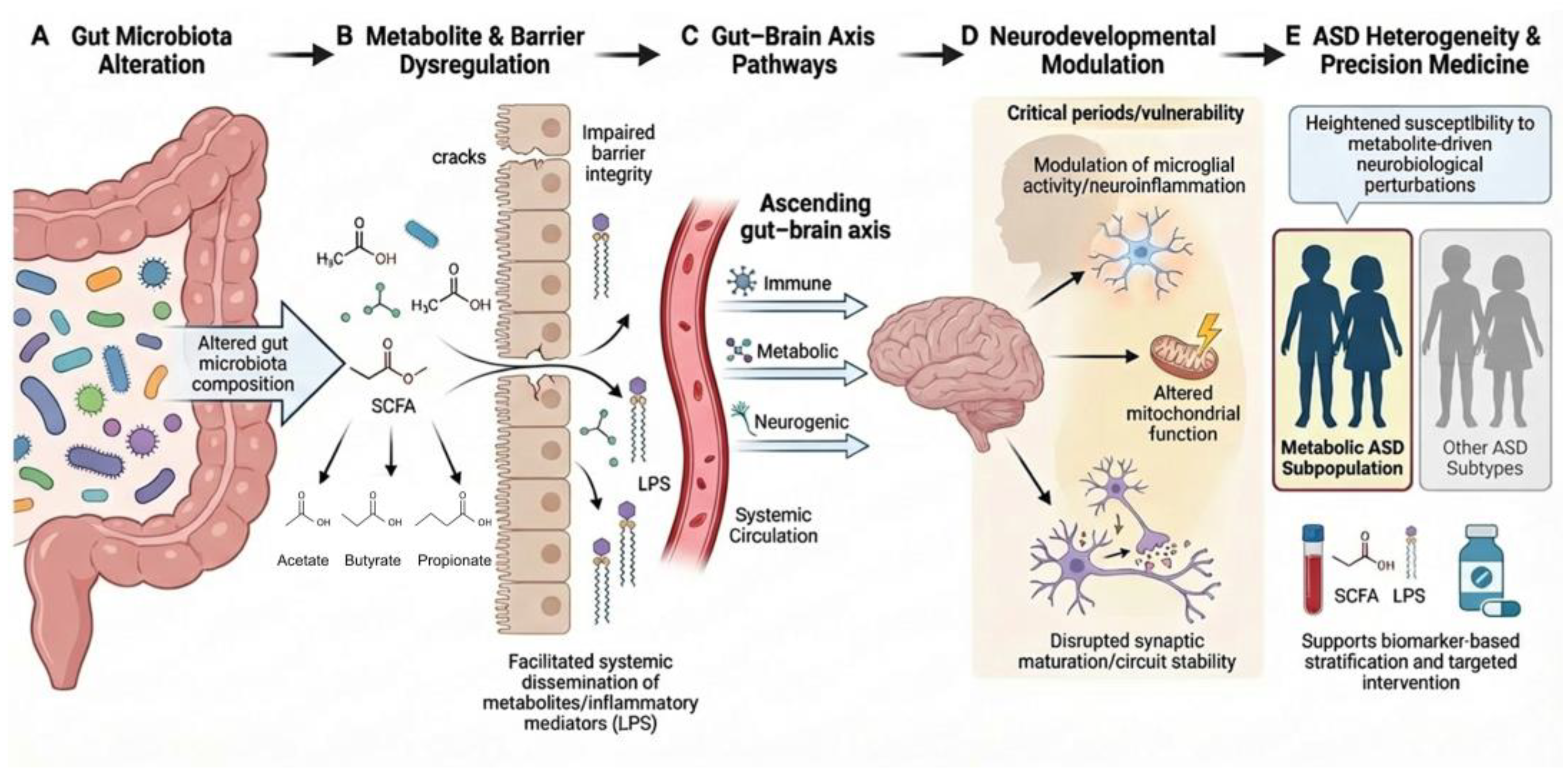

Table 1.
Reported alterations in short-chain fatty acid levels in autism spectrum disorder across human studies
Table 1.
Reported alterations in short-chain fatty acid levels in autism spectrum disorder across human studies
| Study | Model | Sample Type | Age/Stage | ASD Characteristics | ASD patients | ||
|---|---|---|---|---|---|---|---|
| Acetate | Propionate | Butyrate | |||||
| Wang et al., 2019 [47] | Human | Feces | Children | ASD vs TD controls | ↔ | ↔ | ↔ |
| Liu et al., 2019 [48] | ↓ | NS | ↓ | ||||
* Table legend. Summary of reported alterations in SCFA levels in ASD based on hu-man case–control studies that performed direct quantitative comparisons with control groups. Arrows indicate the direction of statistically significant changes relative to con-trols (↑ increased, ↓ decreased, ↔ no significant change). Differences across studies re-flect variation in biological and methodological context, including sample source, gastro-intestinal symptom stratification, developmental stage, and analytical methodology. SCFA, short-chain fatty acid; ASD, autism spectrum disorder; GI, gastrointestinal; TD, typically developing.
Table 2.
Dominant gut microbial taxa reported as altered in autism spectrum disorder across hu-man cohort studies.
Table 2.
Dominant gut microbial taxa reported as altered in autism spectrum disorder across hu-man cohort studies.
| Study | Model | Sample type | Increased taxa | Decreased taxa | Functional implication |
|---|---|---|---|---|---|
| Liu et al., 2019 [48] | Human (ASD) | Feces | Propionate- and acetate-producing taxa; Desulfovibrio (G) | Butyrate-associated taxa; Ruminococcaceae (F), Eubacterium (G), Lachnospiraceae (F), Erysipelotrichaceae (F) | Altered SCFA-related microbial balance |
| Li et al., 2024 [97] | Human (ASD) | Fusobacteria (P), Firmicutes (P), Verrucomicrobia (P), | Lentisphaerae (P), Bacteroidetes (P), Euryarchaeota (P), Patescibacteria (P) | Altered microbial community structure | |
| Lou et al., 2022 [98] | Human (ASD) |
Bifidobacterium (G), Veillonella (G), Enterobacteriaceae (F), Lachnospiraceae (F) |
Clostridium (G), Veillonella ratti (S) |
Early-life cohort-specific microbial deviation | |
| Iglesias-Vázquez et al., 2020 [100] | Human (ASD) | Bacteroides (G), Parabacteroides (G), Clostridium (G), Faecalibacterium (G), Phascolarctobacterium (G) | Coprococcus (G), Bifidobacterium (G) | Context-dependent lack of a consistent ASD microbial signature | |
| Kang et al., 2013 [102] | Human (ASD) | NR | Prevotella (G), Coprococcus (G), unclassified Veillonellaceae (F) | Disrupted microbial interactions | |
| Coretti et al., 2018 [104] | Human (ASD) | Bacteroidetes (P), Proteobacteria (P) | Actinobacteria (P) | Pro-inflammatory microbial shift |
* Table legend. Summary of dominant gut microbial taxa reported to be altered in in-dividuals with ASD across representative human cohort studies. Taxa are listed at the genus or higher taxonomic level when consistently reported, as taxonomic resolution var-ies across study designs and analytical pipelines. This comparison highlights both con-vergent and divergent microbial patterns across ASD cohorts, underscoring the con-text-dependent and non-universal nature of gut microbiota alterations. The table also il-lustrates the limitations of direct taxonomic translation across studies, emphasizing that reported microbial shifts should be interpreted within their specific clinical, developmen-tal, and methodological contexts. ASD, autism spectrum disorder; SCFA, short-chain fatty acid.
Table 3.
Major sources of biological and methodological heterogeneity influencing reported SCFA alterations in autism spectrum disorder studies.
Table 3.
Major sources of biological and methodological heterogeneity influencing reported SCFA alterations in autism spectrum disorder studies.
| Source of heterogeneity | Categories / examples | Impact on SCFA readouts | Implications for interpretation |
|---|---|---|---|
| Sample source | Feces vs plasma/serum | Captures luminal fermentation output vs absorbed/systemically available SCFAs, influenced by host metabolism (e.g., hepatic clearance) | Fecal and circulating SCFAs are not interchangeable |
| GI symptom stratification | Constipation, diarrhea, abdominal pain | Alters intestinal transit time, fermentation kinetics, absorption efficiency, and stool water content | Null findings may reflect signal dilution in unstratified cohorts |
| Developmental stage | Infancy, childhood, adolescence | Age-dependent microbiota maturation and diet transitions shift baseline SCFA profiles | Age mismatch limits cross-study comparability |
| Diet and fiber intake | High vs low fermentable fiber; dietary patterns | Directly modulates microbial substrate availability and SCFA production | Dietary control is critical for stronger causal inference |
| Medication exposure | Antibiotics, probiotics/prebiotics, laxatives, psychotropics, PPIs | Reshapes microbial composition and metabolic output; may interact with GI status | Medication history should be systematically captured and adjusted for |
| Analytical workflow / platform | GC-FID, GC–MS, LC–MS/MS (with derivatization and internal standards) | Differences in sensitivity, specificity, and quantification range across platforms | Methodological heterogeneity contributes substantially to variability |
| Reporting units / normalization | Absolute concentration vs relative proportion; wet vs dry weight; different unit scales | Limits quantitative comparability and may invert apparent group differences | Directional interpretation is frequently more appropriate than magnitude alone |
| Experimental design / model | Human cohorts vs rodent models; exposure-based vs endogenous metabolism | Exposure paradigms may not recapitulate endogenous SCFA dynamics in humans | Animal findings should not be directly generalized to human ASD |
* Table legend. Major sources of biological and methodological heterogeneity contrib-uting to variability in reported short-chain fatty acid (SCFA) findings in autism spectrum disorder (ASD) studies. This table summarizes key contextual factors spanning sample source, developmental timing, gastrointestinal comorbidity, diet and medication expo-sures, analytical workflows, reporting units, and experimental design. Collectively, these sources of variability support interpreting SCFAs as context-dependent metabolic signals rather than universal biomarkers of ASD. SCFA, short-chain fatty acid; ASD, autism spec-trum disorder.
Table 4.
Developmental window–dependent contexts linking gut-derived short-chain fatty acids to neurodevelopment.
Table 4.
Developmental window–dependent contexts linking gut-derived short-chain fatty acids to neurodevelopment.
| Developmental stage | SCFA-related context | Biological processes potentially affected | Observed or reported outcomes | Representative references |
|---|---|---|---|---|
| Pregnancy (maternal) | Circulating maternal SCFAs reflecting gut fermentation | Maternal metabolic–immune milieu influencing fetal neurodevelopmental susceptibility | Associations with offspring neurodevelopmental measures in cohort studies | [93] |
| Prenatal period (maternal immune activation) | SCFA–immune crosstalk potentially intersecting with maternal inflammation | Immune signaling at the maternal–fetal interface | Increased vulnerability to neurodevelopmental alterations in offspring | [14,95] |
| Early postnatal (infancy) | Infant gut fermentation–derived SCFAs with limited systemic availability | Microglial maturation and synaptic pruning (preclinical support) | Atypical early developmental trajectories in early-life microbiome studies | [90,92] |
| Childhood | Diet-modulated gut and plasma metabolomic profiles | Systemic metabolic shifts linked to microbiota modulation | Context-dependent associations with autism-related traits | [107,115] |
| Juvenile (experimental animal models) | Experimental SCFA exposure (e.g., propionate/PPA) | Neuroinflammation and mitochondrial stress pathways | ASD-like behavioral phenotypes in specific paradigms | [1,94] |
* Table legend. Developmental window–dependent contexts in which gut-derived SCFAs have been reported to associate with neurodevelopmental processes. Representative ref-erences are provided to anchor key developmental contexts rather than to exhaustively catalogue all relevant studies. Descriptions are intentionally framed as context-dependent and non-deterministic, reflecting differences in developmental timing, biological suscep-tibility, and experimental paradigms. SCFA, short-chain fatty acid; ASD, autism spectrum disorder; PPA, propionic acid.
Table 5.
Core biomarker domains for stratifying a metabolically vulnerable subgroup within autism spectrum disorder
Table 5.
Core biomarker domains for stratifying a metabolically vulnerable subgroup within autism spectrum disorder
| Biomarker domain | Candidate markers | Measurement source | Biological rationale |
|---|---|---|---|
| Gut-derived metabolites | Relative SCFA patterns (acetate, propionate, butyrate) | Feces / plasma | Reflects microbial fermentation patterns and systemic availability |
| Gastrointestinal integrity | Lipopolysaccharide-binding protein (LBP) | Serum | Indicates barrier-related metabolite translocation |
| Immune activation | Representative inflammatory cytokines (e.g., IL-6, IL-17A) | Serum | Captures inflammatory tone linked to metabolic signaling |
| Oxidative stress / redox imbalance | Redox-related markers | Blood | Reflects oxidative imbalance relevant to neuronal vulnerability |
| Mitochondrial / energy metabolism | Energy metabolism–related indicators | Blood | Reflects altered cellular energy metabolism |
| Microbiota structure | Relative depletion of fermentative taxa | Fecal sequencing | Reflects reduced SCFA-producing capacity |
| Developmental timing | Perinatal/early-life exposures | Clinical history | Identifies sensitive developmental windows |
* Table legend. Core biomarker domains proposed to support biological stratification of a metabolically vulnerable subgroup within autism spectrum disorder (ASD). The listed domains are research-oriented and non-diagnostic, intended to guide hypothesis-driven study design and context-aware interpretation of metabolic–immune alterations rather than clinical classification. Candidate markers and measurement sources are provided as representative examples reflecting convergent evidence across human and experimental studies. These domains should be interpreted as integrative dimensions rather than standalone biomarkers, emphasizing heterogeneity and context dependence across ASD populations. ASD, autism spectrum disorder; SCFA, short-chain fatty acid.
Disclaimer/Publisher’s Note: The statements, opinions and data contained in all publications are solely those of the individual author(s) and contributor(s) and not of MDPI and/or the editor(s). MDPI and/or the editor(s) disclaim responsibility for any injury to people or property resulting from any ideas, methods, instructions or products referred to in the content. |
© 2026 by the authors. Licensee MDPI, Basel, Switzerland. This article is an open access article distributed under the terms and conditions of the Creative Commons Attribution (CC BY) license (http://creativecommons.org/licenses/by/4.0/).
Copyright: This open access article is published under a Creative Commons CC BY 4.0 license, which permit the free download, distribution, and reuse, provided that the author and preprint are cited in any reuse.


