

Submitted:
13 April 2026
Posted:
15 April 2026
You are already at the latest version
Abstract
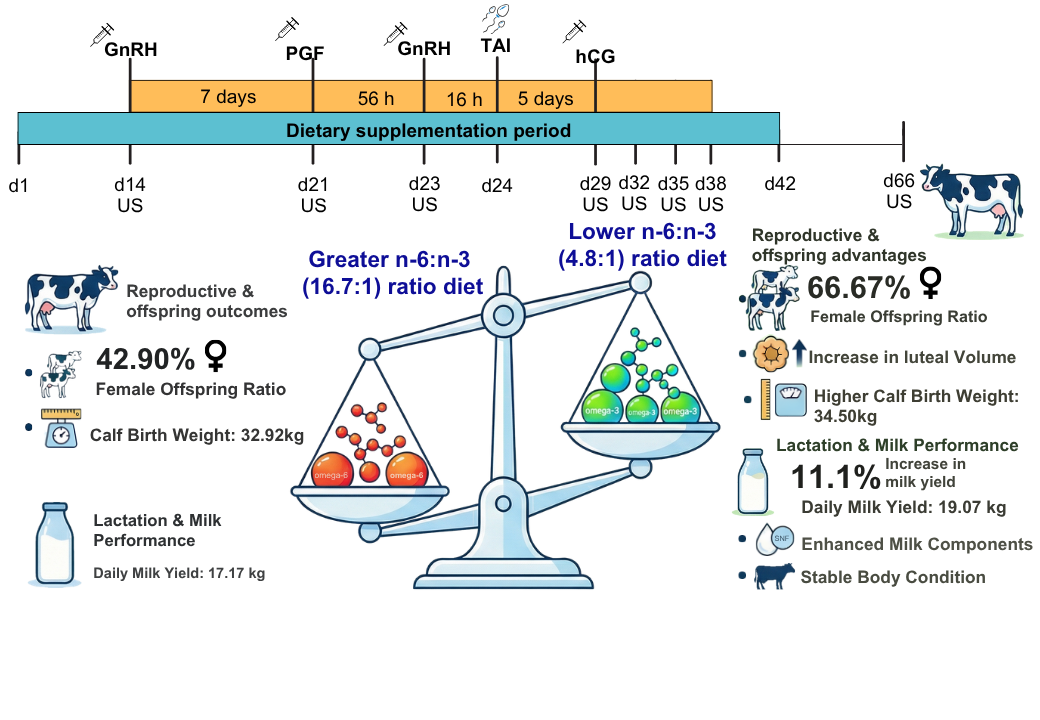
The objectives were to evaluate the effects of different dietary omega-6 to omega-3 (n-6:n-3) fatty acid ratios during timed AI on fertility and offspring sex ratio in lactating dairy cows. Holstein cows (n=60) averaging 109 ± 10 days in milk (DIM) were randomly assigned to be fed either a greater n-6:n-3 diet or a lower n-6:n-3 diet for 42 days. All cows were synchronized using a modified Ovsynch protocol. Although synchronized ovulation rates and pregnancy outcomes were not significantly affected by treatment, cows fed the lower n-6:n-3 ratio exhibited significantly greater corpus luteum (CL) volume and cross-sectional area on days 11 and 14 post-TAI, indicating enhanced luteal development. Pregnancy rates following the first AI and cumulative AI, as well as the number of services per conception, did not differ between treatments. However, maternal dietary fatty acid composition influenced offspring characteristics. Cows fed the lower n-6:n-3 ratio tended to produce a greater proportion of female offspring (66.67% vs. 42.90%; p = 0.09). In addition, calves born to cows receiving the lower n-6:n-3 ratio had greater birth weight than those from cows fed the greater n-6:n-3 ratio diet. Additionally, the lower n-6:n-3 diet tended to increase milk yield and significantly increased lactose and solids-not-fat yields. In conclusion, a lower dietary n-6:n-3 ratio during a TAI program improves fertility potential by enhancing luteal development and may favor female offspring production while supporting lactation performance.
Keywords:
polyunsaturated fatty acids
; omega-3
; omega-6
; fertility
; dairy cows
; sex ratio
Copyright: This open access article is published under a Creative Commons CC BY 4.0 license, which permit the free download, distribution, and reuse, provided that the author and preprint are cited in any reuse.


