

Submitted:
14 April 2026
Posted:
15 April 2026
You are already at the latest version
Abstract
Background: Reaction time (RT) is a fundamental measure of information processing speed in cognitive neuroscience and is influenced by both structural and functional brain properties. While prior studies have independently linked white matter microstructure and EEG alpha oscillations to cognitive performance, their joint contribution to distinct aspects of RT remains unclear. This study aims to investigate whether multimodal data can dissociate neural systems underlying cognitive and motor components of processing speed.
Methods: We analyzed diffusion tensor imaging, resting-state EEG alpha peak frequency, demographic variables, and behavioral RT measures from a Go/No-Go paradigm in 24 healthy adults from the Cuban Human Brain Mapping Project. Behavioral metrics included the mean, standard deviation and skewness of reaction times for simple and complex tasks. Sparse multiple canonical correlation analysis was applied to identify multi-variate associations across modalities.
Results: Two significant latent dimensions were identified (p< 0.05). The first dimension linked bilateral association tracts (SLF, IFOF, UNC) with complex RT performance, reflecting higher-order cognitive processing. The second dimension associated motor and interhemispheric tracts (CGC, CST, ILF, forceps major and minor) with intra-individual asymmetric variability (skewness) across tasks, indicating a motor-execution consistency system. EEG alpha peak frequency did not significantly contribute to either dimension. Sex showed strong associations with both components.
Conclusions: Distinct white matter networks support separable cognitive and motor aspects of processing speed, while resting-state alpha frequency does not independently explain behavioral variability. These findings highlight the importance of multimodal and multivariate approaches for understanding and potentially disentangling complex brain–behavior relationships.
Keywords:
fractional anisotropy
; reaction time
; intra-individual variability
; EEG alpha peak
; white matter
; canonical correlation analysis
; multimodal neuroimaging
1. Introduction
Neural basis underlying performance in human reaction time tasks remains a central topic in cognitive neuroscience, with roots extending to the foundations of psychometry and differential psychology established by Sir Francis Galton in the 19th century. Since then, numerous factors affecting reaction time performance have been evaluated, with methodologies evolving to use reaction time in perceptual and motor tasks to infer the content, duration, and temporal sequencing of cognitive operations. The reaction time increases with the amount of information conveyed in the stimulus and the options to respond, and is the final expression of complex cognitive processes integrating several additive factors, including the training [1], which can be eliminated by using experimental tasks designed with two level of difficulties, where the first level corresponds to the training.
The speed of neural signal transmission in white matter pathway connecting other structures of cortical gray matter is a key factor which constrained the reaction time performance. The Diffusion Weighted Imaging (DWI) modality boosts the research in mapping white matter pathways (tractography) and measuring white matter tracts’ integrity using fractional anisotropy (FA), which reflects their efficiency in neural signal transmission. The relationship between speed of processing and white matter microstructure has been studied for many years using different methodologies to answer diverse experimental questions related to the neural basis underlying cognitive processes and the distinct factors influencing them, especially age, sex, or education, among others. For example, Stufflebeam et al., [2] investigated the relation between timing of neural activity (latency of peak visual responses in occipital cortex measured by MEG) and white matter microstructural integrity using fractional anisotropy in the entire brain in eight healthy young adults. Penke et al., [3] studying elder people, used a measure of integrity of eight major white matter tracts to predict a general factor of information processing speed. This analysis was effective for testing the overall combined effect of both tracts’ integrity measures and diverse types of reaction time measures. With a similar approach, Kuznetsova et al., [4] studied white matter structure integrity and information processing in healthy elder, using multiple linear regression to test the relationship between a ‘general factor of speed’ calculated from several measures of information processing, and fractional anisotropy across the white matter in the whole brain.
In this study, the main result showed association of general speed factors with white matter skeleton integrity rather than specific regions. Individual reaction time response was revealed to be associated with neuroanatomy connectivity and white matter maturation and integrity [5]. For instance, for tasks that require interhemispheric information transfer and selection of bimanual response, it was found that the reaction time is negatively correlated with white matter FA of genus and body of corpus callosum, whereas tasks that require complex cognitive processing such as working memory, are positively correlated with FA of frontal white matter [4].
On the other hand, electrophysiology can provide information about the association of electrical activity of the brain with behavior, for example, the hypothesis that certain types of brain waves (EEG rhythms) reflect mental efficiency (performance in reaction time). In an important seminal study, Klimesch et al., [6] demonstrated the strong relation of the alpha rhythm and the speed of processing information. The alpha rhythm is thought to reflect thalamocortical and corticocortical connectivity, with peak alpha frequency potentially indexing the speed of neural communication [7,8] Valdés-Hernández et al., [9] provided evidence that white matter architecture, particularly in thalamocortical radiations, correlates with EEG alpha rhythm characteristics, supporting the hypothesis that structural connectivity constrains the frequency of oscillatory activity.
However, the extent to which these oscillatory properties directly predict behavioral performance in complex tasks, beyond their structural determinants, remains unclear. Indeed, the relationship between resting-state alpha peak frequency and task-specific cognitive performance may be indirect, mediated by structural pathways rather than reflecting direct functional contributions to information processing speed [9]. Challenges and problems for identification of anatomical and functional brain connectivity effect on inter-individual performance in reaction time task response, could be only solved by multimodality experimental techniques and multivariate analysis methodologies able to handle effectively many variables associated with reaction tasks which involved mental processing speed.
For that reason, in this work we use more than one modality (structural and functional variables) in the same analysis to look for concurrent relationship between EEG alpha peak and white matter architecture (as reflected in FA data) with the speed of processing (reaction time) in healthy subjects. The present study addresses three specific questions: (1) Do distinct white matter systems differentially support simple versus complex information processing demands? (2) Does resting-state EEG alpha peak frequency contribute independently to explaining reaction time variance beyond structural connectivity? (3) Can multivariate multimodal analysis disentangle separable brain-behavior relationships that would be obscured by traditional univariate approaches? We hypothesized that different tracts would be associated with performance on simple and more complex tasks requiring decision-making and rule maintenance; reflected in the intra-individual variability of motor execution speed as measured by the reaction times. At the same time, we hypothesize that the EEG alpha peak frequency would show limited direct association with behavioral performance in these complex cognitive tasks, potentially because individual alpha frequency is primarily constrained by structural connectivity in thalamocortical networks rather than directly determining task-specific processing speed.
By applying sparse multiple canonical correlation analysis to DTI-based white matter integrity, EEG alpha peak frequency, demographic variables, and detailed reaction time measures (including mean, variability, and distributional parameters), we aim to demonstrate the utility of advanced multivariate methods for revealing distinct neural systems underlying information processing speed.
2. Materials and Methods
Sample
Twenty-four healthy subjects including 14 females and 10 males. All are right-handers, age ranged from 20 to 43 years old with mean age of 29.54 and SD 8.5. This a subsample of the more than 400 subjects who were recruited at the Cuban Human Brain Mapping Project (CHBMP) (see description of the CHBMP [10]. In this project, subjects were randomly selected in the population of the municipality of La Lisa, Havana. This population is considered representative in terms of ethnic and gender distribution of the Cuban population [11]. The curated dataset of this project has been published in Human brain mapping [12].
Participants were included in the study after an informed signed consent, in accordance with the ethical standards of the Declaration of Helsinki (Experimentation, 1964), and the experimental protocols were approved by the Ethics Committee of the Cuban Neuroscience Center. Each subject underwent an interview and medical examination with Neurology and Psychiatry specialists, to rule out any pathology of the nervous system which could invalidate their participation in the study. Neurological examination was performed following the procedure described in guidelines published by the Department of Health and Human Services U.S. in 2003. Mini-International Psychiatric Interview was used for psychiatric evaluation [13].
To check the cognitive status and discard mental disorders or other handicaps as exclusion criteria, the intelligence quotient (IQ) was obtained for each subject. The IQ was calculated using the Spanish language version of the Wechsler Adult Intelligence III Scale (WAIS III) [14].
Stimuli and Paradigm
A visual GO, NO-GO task to record the reaction time was implemented using the software Mindtracer for stimulation paradigms in psychophysiology, developed at the Cuban Neuroscience Center [15]. The subject sat in front of a computer display and was instructed to press the ‘space’ key with the index finger of the right hand if the condition is correct. The duration of the stimuli is 500 ms, and the screen cleared for 500 ms after a response was made as shown in Figure 1.
The experimental paradigm consisted of two tasks, where a set of letters (P, B, X, E, A, S) were presented sequentially. Each task consisted of 500 trials and were applied with the following specific instructions as follows:
Simple Reaction Time (SRT): “Press the space bar when the letter “A” appears on the screen”.
Complex Reaction time (CRT): “Press the space bar only when the letter “A” appears preceded by the letter “S”.
The two tasks were presented to the subjects in the same consecutive order. Although this procedure might introduce a bias due to the order of the tasks, we were not interested in measuring the difference in reaction times, but the correlation between their values and the other biological or demographic variables. Instead, we believe that for this purpose it is adequate to have the same effect of training (if present) for all subjects, Schematic illustration of the stimulus sequences used in the experiment are shown in Figure 1. In both tasks, participants fixate on a central stimulus showing a sequential presentation of black squares with a yellow uppercase letter in the center, and one of the letters is designated as the target. In the simple task (left), participants respond (press/GO) whenever the target appears, following a fixed delay (~500 ms). In the complex task (right), participants must additionally evaluate the stimulus context and selectively respond (go) if the previous stimulus showed a specific letter or withhold response (no-go) if it did not, with 25% of the stimuli in GO condition and 75% in NO-GO condition. This design dissociates basic sensorimotor processing from higher-order cognitive control and decision-making processes [16].
For both simple and complex tasks, six behavioral variables were calculated for each subject: the mean of the response time for the trials with correct responses (reaction times); the standard deviation, and the skewness of the intra-subject distribution of reaction times, to study the influence of the asymmetry/variability of reaction times along subjects. In addition, the mean and standard deviation of the errors (commission and omission errors for SRT and CRT) were also calculated for assessing that subjects have followed the instructions properly.
Acquisition and Preprocessing of Neuroimaging Data
Using a scanner Siemens Symphony 1.5 T (Erlangen, Germany), a 3D high-resolution T1 anatomical image and a standard low-resolution scheme of diffusion gradients were acquired for each subject. The T1 anatomical image was recorded with the following characteristics: 160 contiguous sagittal slices 1 mm thick, field of view (FOV) = 256 × 256 mm2, corresponding to a resolution in sagittal plane of 1 × 1 mm2, echo time (ET) = 3.93 ms, repetition time (RT) = 3000 ms. Using a single echo planar imaging (EPI) sequence, twelve diffusion-weighted images were obtained (b = 1200 s/mm2) and a reference T2 weighted image (b0 image) with no diffusion weighting (b = 0 s/mm2). The acquisition parameters were FOV= 256 × 256 mm2, acquired matrix = 128 × 128, corresponding to a resolution in the axial plane of 2 × 2 mm2, ET/RT= 160/7000 ms. The slice number was adapted to cover the whole brain with a slice thickness of 3 mm. The acquisition scheme was repeated 5 times to average the corresponding images and thus improving the signal-to-noise ratio. To correct the distortions caused by magnetic field inhomogeneities in the series of diffusion-weighted images, phase and magnitude maps were obtained. The parameters used were voxel size of 3.5 mm; ET1 = 7.71 ms, ET2 = 12.47 ms and RT = 672 ms.
All images were visually inspected, and those which presented either technical and/or pathological defects were discarded. Regarding the DWI images, a Hanning filter to b0 images was applied to correct the b0 diffusion images which presented a mild Gibbs ringing artifact around the ventricles. Other processing of this data were the correction of Eddy currents and motion effects by performing a linear registration of the weighted images to the b0; as well as the correction of distortions effects due to main field inhomogeneities by using the Unwarping SPM2 toolbox [17] on both phase and magnitude images. Diffusion tensors were fitted at every voxel using a linear regression method [18,19], and Fractional Anisotropy (FA) images were computed for all the subjects. To achieve anatomical correspondence, all individual FA images were normalized to the online template provided by the ICBM (ICBM-DTI-81) using SPM5 [20]. Since several factors, such as axonal density, myelination and axonal orientation homogeneity, influence the anisotropy value, a 3D anisotropic filter was applied to the warped FA images to reduce noise [21].
Estimation of the Diffusion Tensor and Fiber Tracking
Diffusion tensor and fiber tracking were estimated using the toolbox DTI & Fiber Tools v.3.0 [22] described in [11]. Deterministic tractography FACT was used to trace fiber orientation by starting on voxels corresponding to previously defined ROIs to estimate the tracts: anterior thalamic radiation (ATR), cingulate gyrus associated cingulum (CGC), hippocampal gyrus associated cingulum (CGH), cortico-spinal tract (CST), inferior fronto- occipital fasciculus (IFOF), inferior longitudinal fasciculus (ILF), superior longitudinal fasciculus (SLF), uncinate fasciculus (UNC), forceps major (Fmj) and forceps minor (Fmn). The resulting paths of these tracts were visually inspected and corrected in cases where necessary, by the exclusion of fibers that do not belong anatomically to tracts or presented changes of directions larger than 120 degrees. The mean, maximum, minimum, and standard deviation of FA values in voxels belonging to each tract are presented in Table 1.
EEG Data Recording and Preprocessing
EEG resting state was acquired using a 64 channels neurometric Cuban system (MEDICID-3) in an extended 10-20 montage, during 3 minutes of eyes closed condition. Detailed technical parameters can be found in prior methodological reports [9,23]. We used the frequency of the alpha peak for each subject in our subsample as a variable related to functional connectivity efficiency. The EEG signal was band-pass filtered (0.5–45 Hz), down sampled to 100 Hz, and artifacts were removed using Independent Component Analysis (ICA). Power spectral density was computed using Fast Fourier Transform (FFT), and the alpha peak frequency was identified as the frequency with maximum amplitude between 7–13 Hz [6,24].
Research Design and Statistical Analysis
The final data to be analyzed consisted of three groups of variables: Group 1 consisted of 19 biological 19 variables, namely the mean FA of eight tracts in each hemisphere and two interhemispheric tracts, and the EEG alpha peak; Group 2 contained 3 demographic variables, namely age, sex and educational level; Group 3 comprised the 6 behavioral variables, i.e. the mean, standard deviation and skewness of simple (SRT) and complex reaction times (CRT).
To study the relationship between the FA in white matter tracts, the EEG alpha peak frequency and the speed of processing, we look for a unique model to explain these relations using canonical correlation (CCA) analysis, which has been traditionally used to identify and measure the associations among two sets of variables [25].This approach is appropriate in the same situations where multiple regression would be, but when there are multiple intercorrelated outcome variables. Canonical correlation analysis determines a set of canonical variates, which are orthogonal linear combinations of the variables within each set that best explain the variability both within and between sets.
On the other hand, the sample size was smaller (n=24) than the number of variables (nv=28), thus it was necessary to apply regularization methods. For this purpose, we selected the sparse multiple canonical correlation analysis (mCCA), which is a multivariate statistical analysis to test the strength of linear association between multiple sets of variables by maximizing the correlation between linear combinations of variables in each set [26].
We have used the penalized matrix decomposition (PMA) implemented in an “R” package [27,28], where MultiCCA.permute function was applied to our three groups of datasets. The dataset in each group was composed of subjects (rows) and features (columns), assuming that in all sets the columns are unordered and variables are standardized to zero mean and unit std. The lasso penalty is used to obtain the corresponding canonical vectors and impose sparsity such that many coefficients were estimated exactly to zero, which implies that the effect of corresponding variable to explain correlations among groups is null. For testing the significance of these weights, a permutation test was performed for the z- scores, correcting for multiple comparisons by using the maximum value of the z- statistic [29]. Here, only the weighting parameters for the first and second sparse multiple CCA factors (dimensions) are given, and the corresponding p-values for canonical variates were computed [27].
For our analysis, we set p-value<0.05 as the significance level for canonical correlation. The analysis of the data and its interpretation was then oriented to address the following three questions: Which white matter tracts are significantly associated with behavioral measures? How strong and with which direction are the contributing variables in those associations? Which demographic variables have significant effects on FA and behavioral task performance? Is there any significant association between FA (white matter integrity), task performance, and brain functional efficiency measured by the frequency of the alpha peak?
3. Results
Behavioral Performance Characteristics
Table 2 summarizes behavioral performance across the SRT and CRT tasks, including mean reaction times, standard deviation, skewness, and number of errors. Overall, there were no significant differences between SRT and CRT responses, although the latter were slightly faster than the former in average. However, the standard deviation was higher for the CRT than for SRT and the intra-subject distributions were positively skewed in both tasks, but stronger in the CRT. As expected, the CRT was also more error-prone than SRT, reflecting the greater task complexity. The total commission errors in the SRT tasks were 44 and omissions were 50. For the CRT task, total commission errors were 65 and omissions were 104. However, a chi-square test between them showed no statistical differences (F=1.12; p=0.28).
Sparse Multiple CCA Identifies Two Significant Dimensions
The input to the MultiCCA.permute function were the three group datasets totaling 28 variables with 24 observations (subjects). The first two sparse multiple CCA factors or dimensions were statistically significant with p-values equal 0.015 and 0.013, respectively. The tuning parameters that determine how sparse the solution weight vectors are in each data set, were automatically selected by the MultiCCA.permute function. The corresponding optimal penalty values for biological, demographic and behavioral data sets were p1=3.15, p2=1.25, p3=1.77, respectively, and were identical in both dimensions. Sparse canonical variate weights, ranging from -1 to 1, are given for the two dimensions in Table 3. Higher weights imply higher contribution to the latent construct which has maximal correlation among the three groups of variables. Weights that are zero can be interpreted as those variables that do not contribute to the correlation among the groups, i.e. do not show significant correlation with other variables.
Figure 2 illustrates the global results for the two latent significant dimensions derived from the multimodal analysis. Dimension 1 (Language–Association) is primarily associated with fronto-temporal white matter tracts, including the inferior fronto-occipital fasciculus (IFOF), superior longitudinal fasciculus (SLF), and uncinate fasciculus (UNC). These variables are positively related to the mean complex reaction time (CRT = 0.745) but also negatively with the asymmetry of this reaction time’s distribution (SKWCRT = −0.584).Dimension 2 (Motor–Execution) is characterized by motor and interhemispheric pathways, including the cingulum (CGC), corticospinal tract (CST), forceps major (Fmj), forceps minor (Fmn), and inferior longitudinal fasciculus (ILF). This dimension is not significantly related to any of the reaction times, but it is negatively linked to skewness in both simple and complex reaction time measures (SKWSRT = −0.738; SKWCRT = −0.589). Both dimensions show a strong negative contribution from sex, while the individual alpha frequency (IAF) does not show a significant contribution in any of them.
Dimension 1: Language-Association Tracts and Complex Task Performance
The first dimension of sparse multiple CCA revealed significant weights for the white-matter mean FA of three bilateral tracts, namely, the SLF, UNC and IFOF in both right and left hemispheres, as shown in Figure 3. The mean FA values for these tracts showed a significant association with the complex reaction time task, positively with the mean (CRT) and negatively with the skewness of CRT (SKWCRT). This suggests that a higher FA of these tracts might be related to sustained language processing during the task that leads to higher reaction times. Interestingly, this appears only for the reaction times in the complex but not the simple task, suggesting that the latter can be performed without involving language-associated networks. At the same time, this process seems to lead to more symmetric distribution of the complex reaction times, given the negative correlation with the skewness, which is high in this sample (see Table 2).
On the other hand, we found a strong negative relationship of the variable sex, which was coded as 1 for males and 2 for females. This then means that gender is associated with differences in the mean FA of significant tracts and/or in the performance of the complex task. In our dataset, we found that indeed females showed slower reaction times than males in both tasks, which explains the negative association. Since complex tasks demand more concentration and decision making before performing a response on the subject, we can also identify this dimension as reflecting the “Complexity of the task”.
Dimension 2: Motor-Interhemispheric Tracts and Intra-Individual Variability
The second dimension of the canonical correlation shows association between three bilateral and two forceps white matter tracts with intra-subject asymmetry of reaction times in both simple and complex tasks, as reflected by the skewness (SKWSRT and SKWCRT). The tracts are the CGC, CST and ILF in both hemispheres, plus the Fmj and Fmn, as shown in Figure 4. This dimension reflects a common process to both behavioral tasks, but it is not significantly related to the mean SRT or CRT, suggesting that differences in reaction times are more influenced by other networks and not by motor-related ones. The negative association with the skewness of both tasks’ reaction times suggests that higher mean FA in the motor network might decrease the asymmetric variability of reaction times, i.e. make them to be less biased to high values (even if they do not change in average). Thus, the intra-subject distribution of speed of responses becomes more symmetric, and we can identify this dimension as reflecting the “Intra-subject asymmetric variability”. Like Dimension 1, the sex variable has also a strong negative contribution to the correlation among datasets, indicating that females are also showing lower mean FA values in the tracts that are significant in this canonical dimension.
Absence of Significant Associations for EEG Alpha Peak and Visual Pathways
Notably, the EEG alpha peak frequency did not show significant loadings on either canonical dimension (Table 3 and Figure 2). Despite being included as a biological variable alongside white matter FA measures, alpha peak frequency was effectively excluded from both solutions by the sparsity constraints, indicating no substantial covariance with either the behavioral performance measures or the demographic variables in this sample.
Similarly, several white matter tracts associated with visual processing showed negligible contributions to both dimensions. The anterior thalamic radiations (ATR-L, ATR-R) and hippocampal cingulum (CGH-L, CGH-R) did not achieve non-zero weights in either dimension, suggesting that the visual pathways and medial temporal connections were not primary determinants of individual differences in the reaction time tasks employed here. The absence of these visual and thalamocortical tracts from the significant weights, combined with the null finding for EEG alpha peak frequency, suggests that the observed brain-behavior relationships are specific to association and motor pathways rather than reflecting general visual processing speed or thalamocortical oscillatory properties.
4. Discussion
Our results demonstrate that sparse multiple canonical correlation analysis of multimodal neuroimaging and behavioral data can dissociate distinct white matter systems supporting different aspects of information processing speed. We identified two significant latent dimensions: one linking language-associated tracts to complex task performance, and another linking motor-interhemispheric tracts to intra-individual asymmetric variability. Notably, resting-state EEG alpha peak frequency did not contribute significantly to either dimension, suggesting that structural connectivity may be the primary determinant of individual differences in reaction time performance in this sample. These findings validate our three hypotheses while highlighting the importance of multivariate approaches for disentangling complex brain-behavior relationships.
Distinct White Matter Systems for Cognitive Complexity and Motor Consistency
The first canonical dimension revealed a specific association between bilateral language-associated white matter tracts -superior longitudinal fasciculus (SLF), inferior fronto-occipital fasciculus (IFOF), and uncinate fasciculus (UNC)- and performance on the complex reaction time task. This finding aligns with the established role of these association tracts in language and executive function. The SLF provides the anatomical substrate for transferring language information from posterior temporal regions to anterior frontal speech areas [30] while the IFOF has been implicated in semantic processing networks [31]. The UNC connects limbic structures (hippocampus, amygdala) with orbitofrontal cortex and has been linked to language lateralization [32].
Our interpretation is that the CRT task, despite its apparent simplicity, imposes substantial cognitive demands through its verbal instructions and working memory requirements. Participants must maintain the conditional rule (“S only if preceded by A”) while monitoring the stimulus stream, processes that engage in language comprehension and executive control systems supported by these tracts. The negative loading of skewness (SKWCRT) on this dimension suggests that individuals with higher FA in these tracts also show more consistent (less skewed) response distributions, indicating stable cognitive processing. This interpretation agrees with the “neural noise” hypothesis, wherein better structural connectivity reduces variability in neural signal transmission [5,33].
The second dimension revealed a distinct anatomical system comprising the cingulate gyrus cingulum (CGC), corticospinal tract (CST), inferior longitudinal fasciculus (ILF), and both forceps tracts (Fmj, Fmn) associated with skewness measures across both simple and complex tasks. This pattern suggests a domain-general system supporting motor execution consistency and interhemispheric coordination. The CST provides the primary motor output pathway from cortex to spinal cord [34], while the CGC is implicated in motor control, conflict monitoring, and response inhibition [35]. The forceps tracts connecting occipital lobes via the splenium support interhemispheric visual-motor integration [5] and the ILF conveys information between occipital and temporal lobes relevant for visual stimulus evaluation [36].
Importantly, this second dimension was associated with intra-individual asymmetric variability (skewness) across both task types, rather than mean response times. This finding converges with recent evidence that white matter microstructure in motor pathways specifically relates to response consistency rather than average speed. Hennessee et al., [37] demonstrated that neurite density in the superior CST correlated with non-decision time parameters in simple RT tasks, but not with mean RT itself, suggesting that motor pathway integrity primarily affects the efficiency of action initiation rather than decision processes. Our results extend this framework by showing that a broader network including cingulum and interhemispheric connections supports consistent motor execution across varying cognitive demands.
The dissociation between these two dimensions of language/association tracts for complex task performance versus motor/interhemispheric tracts for consistency supports a dual-systems model of information processing speed. This model posits that distinct neural circuits support (1) the cognitive operations required for decision-making under complexity and (2) the efficient and consistent execution of motor responses. Our multivariate approach was essential for revealing this dissociation, as univariate analyses would be confounded by the substantial correlations between mean RT and variability measures, as well as between different white matter tracts.
The Absence of EEG Alpha Peak Contributions: Structural Constraints on Oscillatory Activity
Our third hypothesis predicted limited direct association between EEG alpha peak frequency and behavioral performance, and this was confirmed: alpha peak showed negligible loadings on both canonical dimensions. This null finding requires careful interpretation considering the extensive literature linking alpha oscillations to cognitive processing speed.
Klimesch et al., [6] established that higher alpha peak frequency correlates with better memory performance and faster processing speed, leading to the hypothesis that individual alpha frequency reflects the “speed of information processing.” However, subsequent work has clarified that alpha oscillations are constrained by structural connectivity, particularly thalamocortical white matter architecture. Valdés-Hernández et al., [9] demonstrated that white matter integrity in posterior thalamic radiations and superior corona radiata correlates with alpha peak frequency, supporting the interpretation that structural properties determine oscillatory dynamics.
Our findings are consistent with this structural-determinism view. The absence of alpha peak frequency contributions to the canonical dimensions suggests that, in our sample, individual differences in alpha frequency were either (1) insufficiently variable to contribute to behavioral predictions, or (2) redundant with the white matter measures already capturing individual differences in structural connectivity. The latter interpretation aligns with Valdés-Hernández et al., [9] finding that white matter architecture accounts for variance in alpha rhythms. In either case, our results indicate that for complex reaction time tasks involving language processing and motor execution, structural connectivity measures provide more direct and powerful prediction of individual differences than resting-state oscillatory markers.
This finding has methodological implications for studies seeking biomarkers of cognitive performance. While EEG offers practical advantages for large-scale screening, our results suggest that DTI-based structural measures may be more informative for understanding individual differences in task-specific processing speed. Nevertheless, future work should also study other measures related to EEG amplitude and employ simultaneous EEG-fMRI or combined EEG-DTI acquisition during task performance to determine whether task-related (rather than resting-state) oscillatory dynamics show stronger behavioral associations.
Sex Differences in Brain-Behavior Relationships
Sex showed the strongest canonical weights (-0.995) across both dimensions, with females demonstrating poorer performance and different directional patterns than males. This finding is consistent with well-documented sex differences in reaction time performance, where males typically show faster responses, particularly for choice reaction time tasks [38].
Recent large-scale studies have provided more nuanced perspectives on sex differences in white matter microstructure. Ingalhalikar et al., [39] analyzed 1,062 young adults from the Human Connectome Project and found widespread higher fractional anisotropy in females across 40 out of 77 white matter tracts, with large effect sizes in the fornix and middle cortico-cerebellar tract. Similarly, Del Mauro et al., [40] found that women showed higher fiber density and fractional anisotropy in most tracts, particularly in the corpus callosum, fornix, and superior longitudinal fasciculus, even after adjusting for total brain volume. These microstructural advantages in females might be expected to confer processing speed benefits, yet our results and the broader literature show male advantages in RT performance.
This apparent paradox may reflect several factors. First, sex differences in RT may be primarily driven by non-structural factors such as motor execution efficiency, neuromodulatory tone, or strategy differences rather than white matter integrity per se. Second, the relationship between FA and processing speed is complex and tract-specific: higher FA in association tracts may support language processing (potentially advantageous in our verbal CRT task), while faster RT may depend more on CST microstructure where males may show advantages. Third, our sample size (n=24) may have insufficient power to detect sex-by-tract interactions that would clarify these relationships. The ENIGMA consortium meta-analysis concluded that sex effects on white matter are modest (approximately 2% variance explained) and require large samples for robust detection [39,41].
Comparison with Existing Literature and Methodological Considerations
Our findings both converge with and extend previous research on white matter and reaction time. Tuch et al., [42] found that complex choice reaction time correlated with FA in visuospatial attention pathways (optic radiation, posterior thalamus, precuneus) but not motor pathways or corpus callosum, using voxel-based analysis. Our tract-specific approach revealed different associations -language tracts for CRT and motor/commissural tracts for variability- likely because our task employed verbal (letter) stimuli rather than visuospatial cues. This discrepancy highlights the importance of task-specific white matter associations: the neural substrates of processing speed are not universal but depend on the specific cognitive operations required.
The use of sparse multiple CCA represents a methodological advance over standard multiple regression approaches employed in previous studies [3,4]. While these studies demonstrate that white matter integrity predicts processing speed, they could not dissociate distinct systems for different aspects of performance. Our multivariate approach revealed that the mean and skewness of the CRT load on different dimensions with different anatomical substrates, a finding that would be obscured in univariate analyses. This aligns with recent calls for multivariate methods in neuroimaging to capture the distributed nature of brain-behavior relationships [43].
The sparse CCA approach also addresses the “curse of dimensionality” inherent in multimodal studies. With 28 variables and 24 subjects, standard CCA would be inadmissible. The L₁ penalization employed by the PMA package [29] yields interpretable solutions by zeroing non-contributing variables, effectively performing simultaneous variable selection and dimensionality reduction. This property was essential for revealing the specific tract-behavior associations without overfitting.
Implications, Limitations, and Future Direction
Our findings suggest that interventions targeting processing speed deficits should consider specific cognitive operations impaired. For deficits in complex decision-making, enhancing integrity of language-associated tracts (SLF, IFOF, UNC) may be relevant, potentially through language-based cognitive training or neuromodulation approaches. For deficits in response consistency, targeting motor and interhemispheric pathways (CST, CGC, forceps) through motor skill training or physical exercise may be more appropriate.
Limitations of the present study should be acknowledged. First, the sample size (n=24) is modest relative to the number of variables analyzed (nv=28), and results require replication in larger cohorts. While sparse CCA incorporates regularization to handle high-dimensional data, the generalizability of canonical weights and the stability of dimension solutions would benefit from cross-validation in independent samples. The fixed task order (SRT always preceding CRT) introduces potential practice effects that may have influenced the unexpected finding of faster CRT than SRT means, although it did not interfere with the scientific questions pursued here. The relatively low-resolution of DWI and the use of a deterministic tractography (FACT algorithm) may have introduced measurement error in tract FA estimates, as this method is robust for major fiber bundles, but less accurate than probabilistic methods in regions of crossing fibers. The use of resting-state EEG alpha peak frequency may not capture task-relevant oscillatory dynamics; concurrent EEG recording during task performance would better assess the relationship between alpha oscillations and behavioral responses. Additionally, the sparse CCA approach, while powerful for variable selection, assumes linear relationships and may miss non-linear brain-behavior associations. Sex effects, though pronounced, should be interpreted cautiously given the unequal distribution (14 females, 10 males) and lack of explicit testing for sex-by-tract interactions due to limited power.
Future work should address these limitations through several lines of research. Larger samples with balanced sex distributions and counterbalanced task designs are needed to confirm the observed dissociations and clarify sex-specific brain-behavior relationships. Advanced diffusion models (NODDI, multi-compartment approaches) and ultra-high field MRI (7T) provide more specific microstructural characterization of the identified tracts. Simultaneous EEG-fMRI or combined EEG-DTI during task performance would help determining whether task-related oscillatory dynamics show stronger behavioral associations than resting-state measures. Longitudinal designs tracking white matter development and reaction time performance across the lifespan will clarify how these systems mature and age. Finally, application of similar multimodal multivariate approaches to clinical populations, particularly those with selective white matter pathology such as multiple sclerosis, small vessel disease, or traumatic brain injury, will establish the generalizability and clinical utility of these brain-behavior relationships.
5. Conclusions
This study demonstrates that distinct white matter systems support separable aspects of information processing speed, as revealed by sparse multiple canonical correlation analysis of multimodal neuroimaging and behavioral data. Language-associated tracts (SLF, IFOF, UNC) primarily predicted complex reaction time performance and decision consistency, while motor and interhemispheric pathways (CGC, CST, ILF, forceps) determined intra-individual asymmetric variability of reaction times for both simple and complex tasks. Notably, resting-state EEG alpha peak frequency did not contribute independently to these brain-behavior relationships, suggesting that structural connectivity is the primary determinant of individual differences in reaction time performance. Sex showed strong associations with both dimensions, consistent with documented performance differences.
These findings validate the utility of multivariate multimodal approaches for disentangling complex brain-behavior relationships that would be obscured by traditional univariate analyses. The dissociation between cognitive-complexity and motor-consistency systems has implications for understanding individual differences in healthy aging and neurological disease. In clinical populations, selective impairment of processing speed components, e.g. average slowing versus increased variability may reflect differential vulnerability of these distinct white matter networks. Cognitive training paradigms emphasizing language and executive functions may preferentially engage the SLF/IFOF/UNC network, while motor training or physical exercise may enhance CST and cingulum integrity to improve response consistency. The absence of EEG alpha frequency contributions suggests that structural neuroimaging may be more informative than electrophysiological screening for predicting task-specific processing speed, though concurrent functional and structural assessment remain essential for comprehensive characterization. By establishing that information processing speed emerges from distinct structural networks rather than representing a unitary construct, this work provides a foundation for more nuanced understanding of neural efficiency and its selective breakdown in disease.
Author Contributions
SY conceptualized the study, developed the methodology, performed formal analyses, and prepared the original draft of the manuscript. NF contributed to the methodology and assisted in data analysis. EM conducted the investigation, verified the experimental procedures, and validated the results, while contributing to manuscript review and editing. LG curated and preprocessed the data. CL contributed to the funding and manuscript’s revision. ML contributed to formal analysis, supported methodological development, and critically revised the manuscript. PV supervised the study, coordinated the project, and finalized the manuscript. .
Funding
This work was supported in part by the Belt and Road grant; STI 2030– Major Projects (2022ZD0208500).
Institutional Review Board Statement
The study was conducted in accordance with the Declaration of Helsinki and approved by the Ethics Committee of the Cuban Neuroscience Center.
Informed Consent Statement
Informed consent was obtained from all subjects involved in the study.
Data Availability Statement
The dataset included BIDS files, the in-house programs, the psychological (WAIS-III, MMSE and reaction time), and the demographic and handedness data (∗.csv) available at Synapse.org. See reference 3. You can visualize the data at https://doi.org/10.7303/syn22324937. To download them you need to be registered at the synapse.org website. All the datasets have also been stored in the McGill Centre for Integrative Neuroscience (MCIN) network. The dataset will be available by request at https://chbmp-open.loris.ca.
Conflicts of Interest
The authors declare no conflicts of interest.
Abbreviations
The following abbreviations are used in this manuscript:
ATR – Anterior Thalamic Radiation
CGC – Cingulate Gyrus Cingulum
CGH – Hippocampal Gyrus Cingulum
CST – Corticospinal Tract
DTI – Diffusion Tensor Imaging
DWI – Diffusion Weighted Imaging
EEG – Electroencephalography
FA – Fractional Anisotropy
Fmj – Forceps Major
Fmn – Forceps Minor
FFT – Fast Fourier Transform
FOV – Field of View
GO/NO-GO – Go/No-Go Task Paradigm
IAF – Individual Alpha Frequency
ICA – Independent Component Analysis
IFOF – Inferior Fronto-Occipital Fasciculus
ILF – Inferior Longitudinal Fasciculus
mCCA – Multiple Canonical Correlation Analysis
PMA – Penalized Matrix Decomposition
RT – Reaction Time
SRT – Simple Reaction Time
CRT – Complex Reaction Time
SDSTR – Standard Deviation of Simple Reaction Time
SDCRT – Standard Deviation of Complex Reaction Time
SKWSRT – Skewness of Simple Reaction Time
SKWCRT – Skewness of Complex Reaction Time
SLF – Superior Longitudinal Fasciculus
UNC – Uncinate Fasciculus
References
- Donders, F.C. On the Speed of Mental Processes. Acta Psychologica 1969, 30, 412–431. [Google Scholar] [CrossRef]
- Stufflebeam, S.M.; Witzel, T.; Mikulski, S.; Hämäläinen, M.S.; Temereanca, S.; Barton, J.J.S.; Tuch, D.S.; Manoach, D.S. A Non-Invasive Method to Relate the Timing of Neural Activity to White Matter Microstructural Integrity. Neuroimage 2008, 42, 710–716. [Google Scholar] [CrossRef]
- Penke, L.; Maniega, S.M.; Murray, C.; Gow, A.J.; Valdés Hernández, M.C.; Clayden, J.D.; Starr, J.M.; Wardlaw, J.M.; Bastin, M.E.; Deary, I.J. A General Factor of Brain White Matter Integrity Predicts Information Processing Speed in Healthy Older People. J Neurosci 2010, 30, 7569–7574. [Google Scholar] [CrossRef]
- Kuznetsova, K.A.; Maniega, S.M.; Ritchie, S.J.; Cox, S.R.; Storkey, A.J.; Starr, J.M.; Wardlaw, J.M.; Deary, I.J.; Bastin, M.E. Brain White Matter Structure and Information Processing Speed in Healthy Older Age. Brain Struct Funct 2016, 221, 3223–3235. [Google Scholar] [CrossRef]
- Tamnes, C.K.; Fjell, A.M.; Westlye, L.T.; Østby, Y.; Walhovd, K.B. Becoming Consistent: Developmental Reductions in Intraindividual Variability in Reaction Time Are Related to White Matter Integrity. J. Neurosci. 2012, 32, 972–982. [Google Scholar] [CrossRef] [PubMed]
- Klimesch, W. Alpha-Band Oscillations, Attention, and Controlled Access to Stored Information. Trends in Cognitive Sciences 2012, 16, 606–617. [Google Scholar] [CrossRef]
- Nunez, P. EEG Coherency II: Experimental Comparisons of Multiple Measures. Clinical Neurophysiology 1999, 110, 469–486. [Google Scholar] [CrossRef]
- Srinivasan, R.; Nunez, P.L.; Silberstein, R.B. Spatial Filtering and Neocortical Dynamics : Estimates of EEG Coherence. 1998, 45, 814–826. [Google Scholar] [CrossRef]
- Valdés-Hernández, P.A.; Ojeda-González, A.; Martínez-Montes, E.; Lage-Castellanos, A.; Virués-Alba, T.; Valdés-Urrutia, L.; Valdes-Sosa, P.A. White Matter Architecture Rather than Cortical Surface Area Correlates with the EEG Alpha Rhythm. NeuroImage 2010, 49, 2328–2339. [Google Scholar] [CrossRef] [PubMed]
- Hernandez-Gonzalez, G.; Bringas-Vega, M.L.; Galán-Garcia, L.; Bosch-Bayard, J.; Lorenzo-Ceballos, Y.; Melie-Garcia, L.; Valdes-Urrutia, L.; Cobas-Ruiz, M.; Valdes-Sosa, P.A.; Galan-Garcia, L.; et al. Multimodal Quantitative Neuroimaging Databases and Methods: The Cuban Human Brain Mapping Project. Clinical EEG and neuroscience : official journal of the EEG and Clinical Neuroscience Society (ENCS) 2011, 42, 149–159. [Google Scholar] [CrossRef] [PubMed]
- Góngora, D.; Domínguez, M.; Bobes, M.A. Characterization of Ten White Matter Tracts in a Representative Sample of Cuban Population. BMC Med Imaging 2016, 16, 59. [Google Scholar] [CrossRef] [PubMed]
- Valdes-Sosa, P.A.P.A.; Galan-Garcia, L.; Bosch-Bayard, J.; Bringas-Vega, M.L.M.L.; Aubert-Vazquez, E.; Rodriguez-Gil, I.; Das, S.; Madjar, C.; Virues-Alba, T.; Mohades, Z.; et al. The Cuban Human Brain Mapping Project, a Young and Middle Age Population-Based EEG, MRI, and Cognition Dataset. Scientific Data 2021, 8, 45. [Google Scholar] [CrossRef] [PubMed]
- Gongora, D.; Vega-Hernandez, M.; Valdes-Sosa, P.; Jahanshahi, M.; Bringas-Vega, M. Tract-Based Fractional Anisotropy Predicts WAIS Intelligence Quotient Indices and Subtest Performance. IBRO Reports 2019, 6, S443--S444. [Google Scholar] [CrossRef]
- EIWA-III - Escala de Inteligencia de Wechsler Para Adultos | Tercera Edicion | Pearson Assessments US. Available online: https://www.pearsonassessments.com/en-us/Store/Professional-Assessments/Cognition-%26-Neuro/Escala-de-Inteligencia-de-Wechsler-para-Adultos-%7C-Tercera-Edicion/p/100000192?srsltid=AfmBOorXuVeWbka6mzmHAouga5_zr8oFemdlOhfgtD5dec93nrpZJnrD (accessed on 10 April 2026).
- Borrego, M.; Trujillo-Barreto, N.; Rodr\’\iguez-Puentes, Y.; Bosch-Bayard, J.; Mart\’\inez-Montes, E.; Melie-Garc\’\ia, L.; Aubert, E.; Valdés-Sosa, P. “Neuronic Localizador de Fuentes”: Sistema Para El Cálculo de La Tomograf{\’\i}a Eléctrica/Magnética Cerebral.; 2013; pp. 1110–1113.
- Petersen, S.E.; Posner, M.I. The Attention System of the Human Brain: 20 Years After. Annual Review of Neuroscience 2012, 35, 73–89. [Google Scholar] [CrossRef]
- SPM2 Software - Statistical Parametric Mapping. Available online: https://www.fil.ion.ucl.ac.uk/spm/software/spm2/ (accessed on 10 April 2026).
- Le Bihan, D.; Mangin, J.-F.; Poupon, C.; Clark, C.A.; Pappata, S.; Molko, N.; Chabriat, H. Diffusion Tensor Imaging: Concepts and Applications. Journal of Magnetic Resonance Imaging 2001, 13, 534–546. [Google Scholar] [CrossRef]
- Le Bihan, D.; van Zijl, P. From the Diffusion Coefficient to the Diffusion Tensor. NMR in Biomedicine 2002, 15, 431–434. [Google Scholar] [CrossRef]
- SPM5 Software - Statistical Parametric Mapping. Available online: https://www.fil.ion.ucl.ac.uk/spm/software/spm5/ (accessed on 10 April 2026).
- Kim, H.Y. AN ANISOTROPIC DIFFUSION WITH MEANINGFUL SCALE PARAMETER.
- Kreher, B.W.; Hennig, J.; Il’yasov, K.A. DTI&FiberTools: A Complete Toolbox for DTI Calculation, Fiber Tracking, and Combined Evaluation.
- Hernández-González, G. de los Á.; Álvarez-Sánchez, M.; Jordán-González, J.; Valdés-Urrutia, L.; Melie-García, L.; Valdés-Sosa, P.A. Prevalencia de Hallazgos Incidentales En Las Im{á}genes de Resonancia Magn{é}tica: Proyecto Cubano de Mapeo Cerebral Humano. Revista CENIC Ciencias Biol{ó}gicas 2012, 43. [Google Scholar]
- Klimesch, W. The Frequency Architecture of Brain and Brain Body Oscillations: An Analysis. European Journal of Neuroscience 2018, 48, 2431–2453. [Google Scholar] [CrossRef]
- HOTELLING, H. RELATIONS BETWEEN TWO SETS OF VARIATES*. Biometrika 1936, 28, 321–377. [Google Scholar] [CrossRef]
- Wilms, I.; Croux, C. Robust Sparse Canonical Correlation Analysis. BMC Syst Biol 2016, 10, 72. [Google Scholar] [CrossRef]
- Witten, D.M.; Tibshirani, R.; Hastie, T. A Penalized Matrix Decomposition, with Applications to Sparse Principal Components and Canonical Correlation Analysis. Biostatistics 2009, 10, 515–534. [Google Scholar] [CrossRef] [PubMed]
- Witten, D.; Tibshirani, R.; Gross, S.; Narasimhan, B. PMA: Penalized Multivariate Analysis 2024.
- Witten, D.M.; Tibshirani, R.J. Extensions of Sparse Canonical Correlation Analysis with Applications to Genomic Data. Stat Appl Genet Mol Biol 2009, 8, 28. [Google Scholar] [CrossRef]
- Kamali, A.; Sair, H.I.; Radmanesh, A.; Hasan, K.M. Decoding the Superior Parietal Lobule Connections of the Superior Longitudinal Fasciculus/Arcuate Fasciculus in the Human Brain. Neuroscience 2014, 277, 577–583. [Google Scholar] [CrossRef]
- Caverzasi, E.; Papinutto, N.; Amirbekian, B.; Berger, M.S.; Henry, R.G. Q-Ball of Inferior Fronto-Occipital Fasciculus and Beyond. PLOS ONE 2014, 9, e100274. [Google Scholar] [CrossRef]
- Casto, C.; Poliak, M.; Tuckute, G.; Small, H.; Sherlock, P.; Wolna, A.; Lipkin, B.; D’Mello, A.M.; Fedorenko, E. The Cerebellar Components of the Human Language Network. Neuron 2026, S0896627325009869. [Google Scholar] [CrossRef]
- Walhovd, K.B.; Fjell, A.M. White Matter Volume Predicts Reaction Time Instability. Neuropsychologia 2007, 45, 2277–2284. [Google Scholar] [CrossRef]
- Glasser, M.F.; Coalson, T.S.; Robinson, E.C.; Hacker, C.D.; Harwell, J.; Yacoub, E.; Ugurbil, K.; Andersson, J.; Beckmann, C.F.; Jenkinson, M.; et al. A Multi-Modal Parcellation of Human Cerebral Cortex. Nature 2016, 536, 171–178. [Google Scholar] [CrossRef]
- Rushworth, M.F.S.; Behrens, T.E.J. Choice, Uncertainty and Value in Prefrontal and Cingulate Cortex. Nat Neurosci 2008, 11, 389–397. [Google Scholar] [CrossRef]
- Bastos, A.M.; Vezoli, J.; Bosman, C.A.; Schoffelen, J.-M.; Oostenveld, R.; Dowdall, J.R.; De Weerd, P.; Kennedy, H.; Fries, P. Visual Areas Exert Feedforward and Feedback Influences through Distinct Frequency Channels. Neuron 2015, 85, 390–401. [Google Scholar] [CrossRef] [PubMed]
- Hennessee, J.P.; Reggente, N.; Cohen, M.S.; Rissman, J.; Castel, A.D.; Knowlton, B.J. White Matter Integrity in Brain Structures Supporting Semantic Processing Is Associated with Value-Directed Remembering in Older Adults. Neuropsychologia 2019, 129, 246–254. [Google Scholar] [CrossRef] [PubMed]
- Der, G.; Deary, I.J. Age and Sex Differences in Reaction Time in Adulthood: Results from the United Kingdom Health and Lifestyle Survey. Psychology and Aging 2006, 21, 62–73. [Google Scholar] [CrossRef] [PubMed]
- Ingalhalikar, M.; Smith, A.; Parker, D.; Satterthwaite, T.D.; Elliott, M.A.; Ruparel, K.; Hakonarson, H.; Gur, R.E.; Gur, R.C.; Verma, R. Sex Differences in the Structural Connectome of the Human Brain. Proceedings of the National Academy of Sciences 2014, 111, 823–828. [Google Scholar] [CrossRef] [PubMed]
- Del Mauro, G.; Zeng, X.; Wang, Z. Normative Brain Entropy Across the Lifespan. bioRxiv 2025, 2025.05.08.652915. [Google Scholar] [CrossRef]
- Kochunov, P.; Thompson, P.M.; Winkler, A.; Morrissey, M.; Fu, M.; Coyle, T.R.; Du, X.; Muellerklein, F.; Savransky, A.; Gaudiot, C.; et al. The Common Genetic Influence over Processing Speed and White Matter Microstructure: Evidence from the Old Order Amish and Human Connectome Projects. NeuroImage 2016, 125, 189–197. [Google Scholar] [CrossRef]
- Tuch, D.S.; Salat, D.H.; Wisco, J.J.; Zaleta, A.K.; Hevelone, N.D.; Rosas, H.D. Choice Reaction Time Performance Correlates with Diffusion Anisotropy in White Matter Pathways Supporting Visuospatial Attention. Proc Natl Acad Sci U S A 2005, 102, 12212–12217. [Google Scholar] [CrossRef]
- Durham, E.L.; Ghanem, K.; Stier, A.J.; Cardenas-Iniguez, C.; Reimann, G.E.; Jeong, H.J.; Dupont, R.M.; Dong, X.; Moore, T.M.; Berman, M.G.; et al. Multivariate Analytical Approaches for Investigating Brain-Behavior Relationships. Front Neurosci 2023, 17, 1175690. [Google Scholar] [CrossRef] [PubMed]
Figure 1.
Experimental paradigm for simple and complex reaction time tasks. In the simple condition, participants execute a motor response to target onset, whereas in the complex condition, responses are contingent on stimulus evaluation, requiring go/no-go decisions based on task rules.
Figure 1.
Experimental paradigm for simple and complex reaction time tasks. In the simple condition, participants execute a motor response to target onset, whereas in the complex condition, responses are contingent on stimulus evaluation, requiring go/no-go decisions based on task rules.
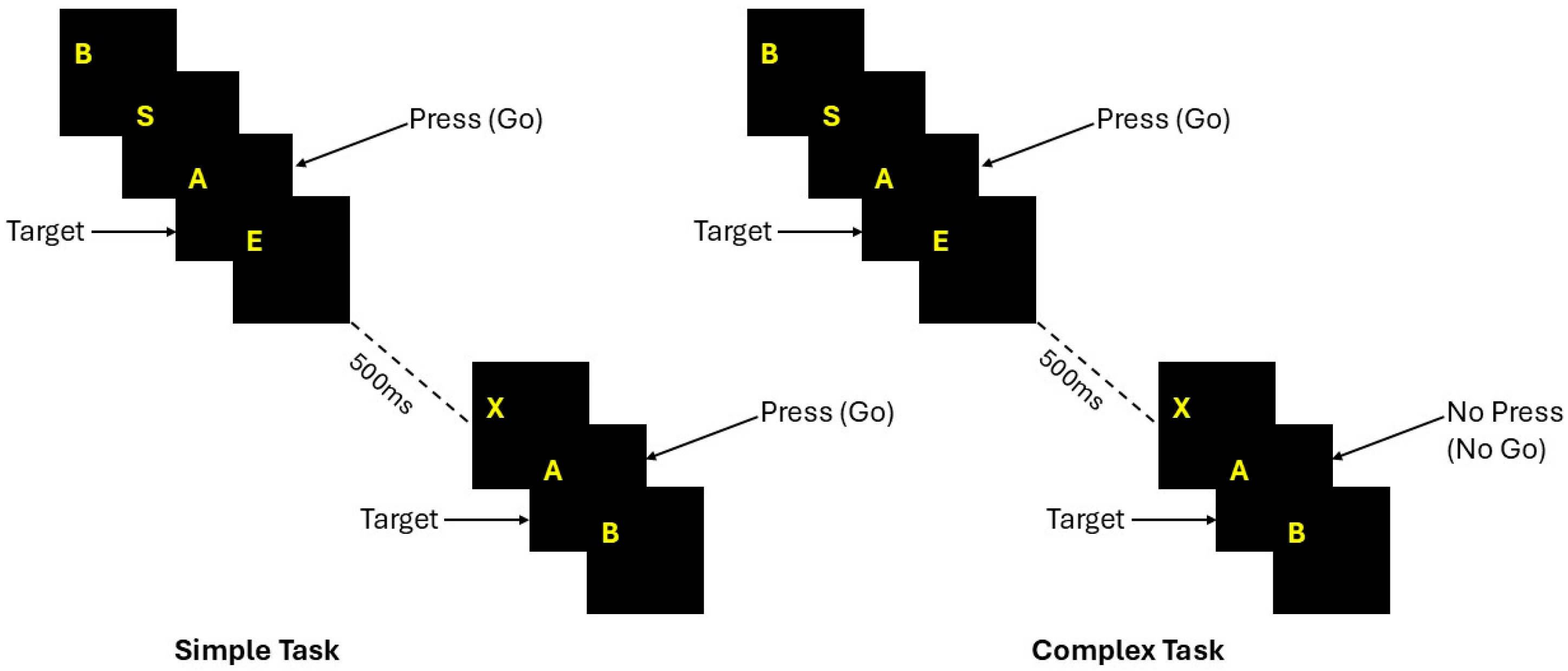
Figure 2.
Schematic representation of two latent dimensions linking white matter structure with behavior. Dimension 1 (orange) reflects a language–association network (IFOF, SLF, UNC) related to complex RT, and Dimension 2 (green) reflects a motor–execution network (CGC, CST, Fmj, Fmn, ILF) showing negative relation to simple RT skewness. In both dimensions, sex and skewness of CRT showed negative contribution to correlations, while IAF showed no significant relationship with the other variables.
Figure 2.
Schematic representation of two latent dimensions linking white matter structure with behavior. Dimension 1 (orange) reflects a language–association network (IFOF, SLF, UNC) related to complex RT, and Dimension 2 (green) reflects a motor–execution network (CGC, CST, Fmj, Fmn, ILF) showing negative relation to simple RT skewness. In both dimensions, sex and skewness of CRT showed negative contribution to correlations, while IAF showed no significant relationship with the other variables.
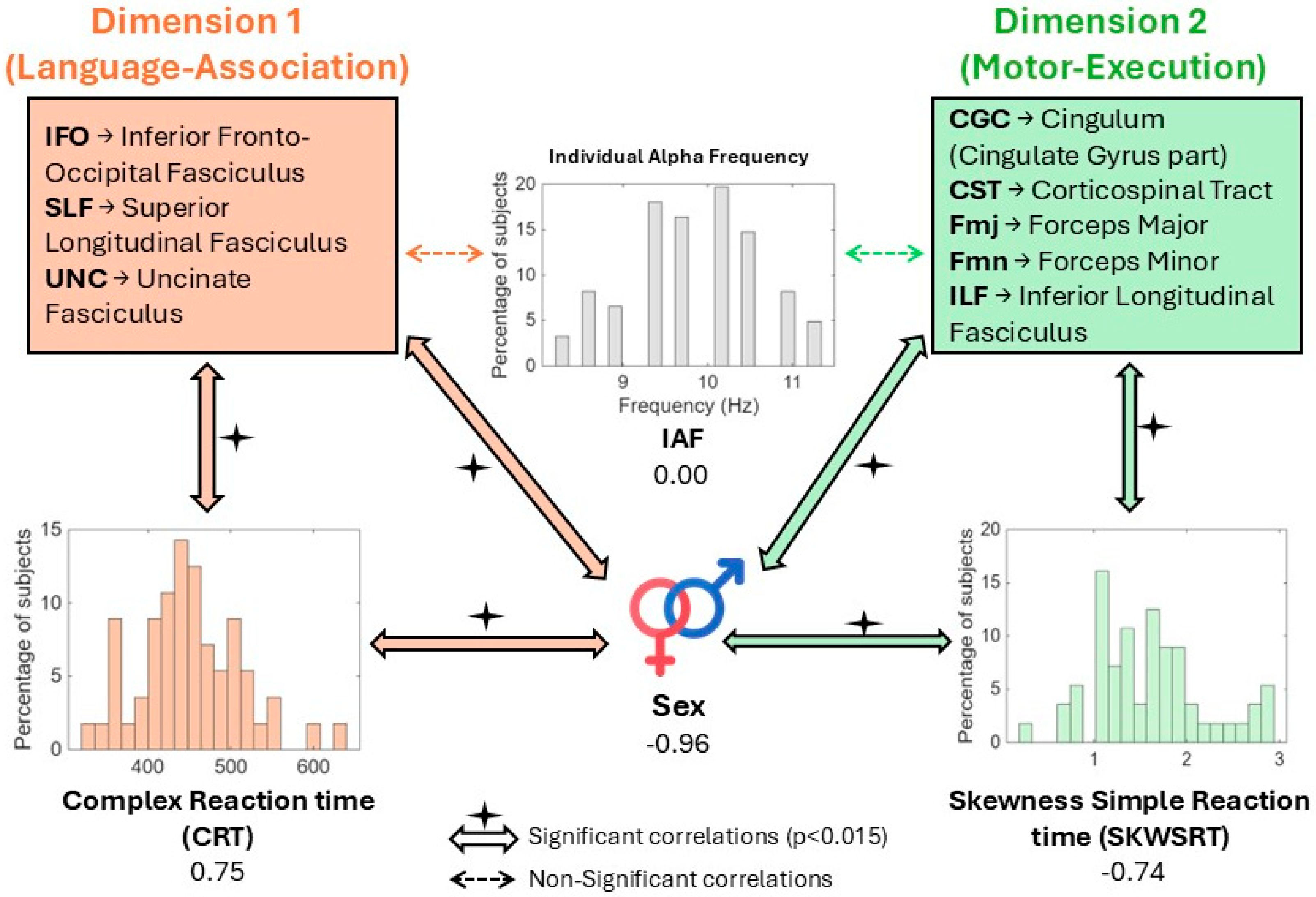
Figure 3.
Glass brain visualization of the bilateral structural connectivity patterns (tracts) underlying the language–association dimension 1. Top row: inferior fronto-occipital fasciculus (IFOF). Middle row: superior longitudinal fasciculus (SLF). Bottom row: uncinate fasciculus (UNC).
Figure 3.
Glass brain visualization of the bilateral structural connectivity patterns (tracts) underlying the language–association dimension 1. Top row: inferior fronto-occipital fasciculus (IFOF). Middle row: superior longitudinal fasciculus (SLF). Bottom row: uncinate fasciculus (UNC).
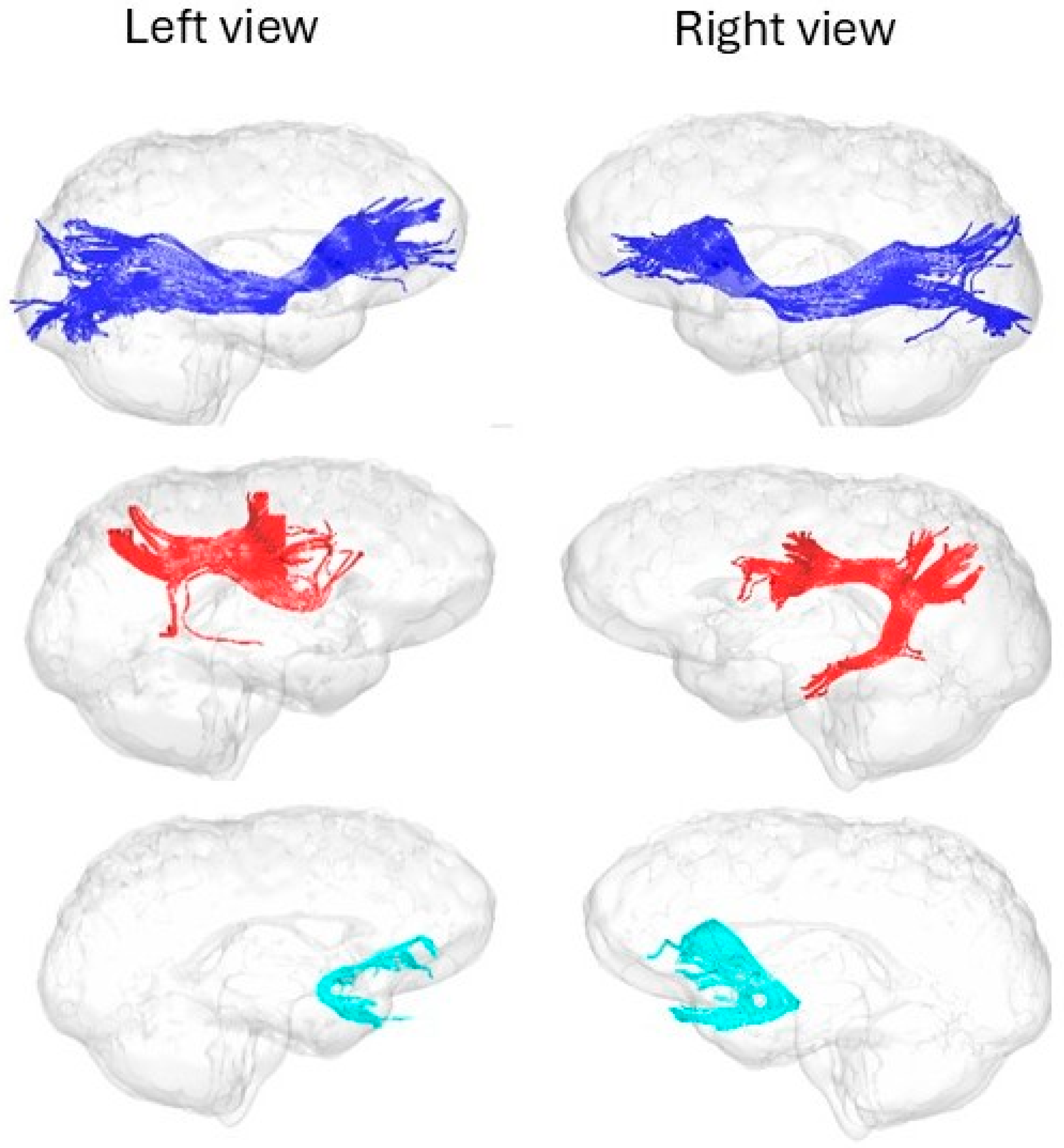
Figure 4.
Glass brain visualization of the structural connectivity patterns (tracts) underlying the motor execution dimension 2. Left panel: cingulum bundle (CGC) in the top row, bilateral corticospinal tracts (CST) in the middle row, and inferior longitudinal fasciculus (ILF) in the bottom row. Right panel: callosal fibers, forceps major and minor (Fmj, Fmn).
Figure 4.
Glass brain visualization of the structural connectivity patterns (tracts) underlying the motor execution dimension 2. Left panel: cingulum bundle (CGC) in the top row, bilateral corticospinal tracts (CST) in the middle row, and inferior longitudinal fasciculus (ILF) in the bottom row. Right panel: callosal fibers, forceps major and minor (Fmj, Fmn).
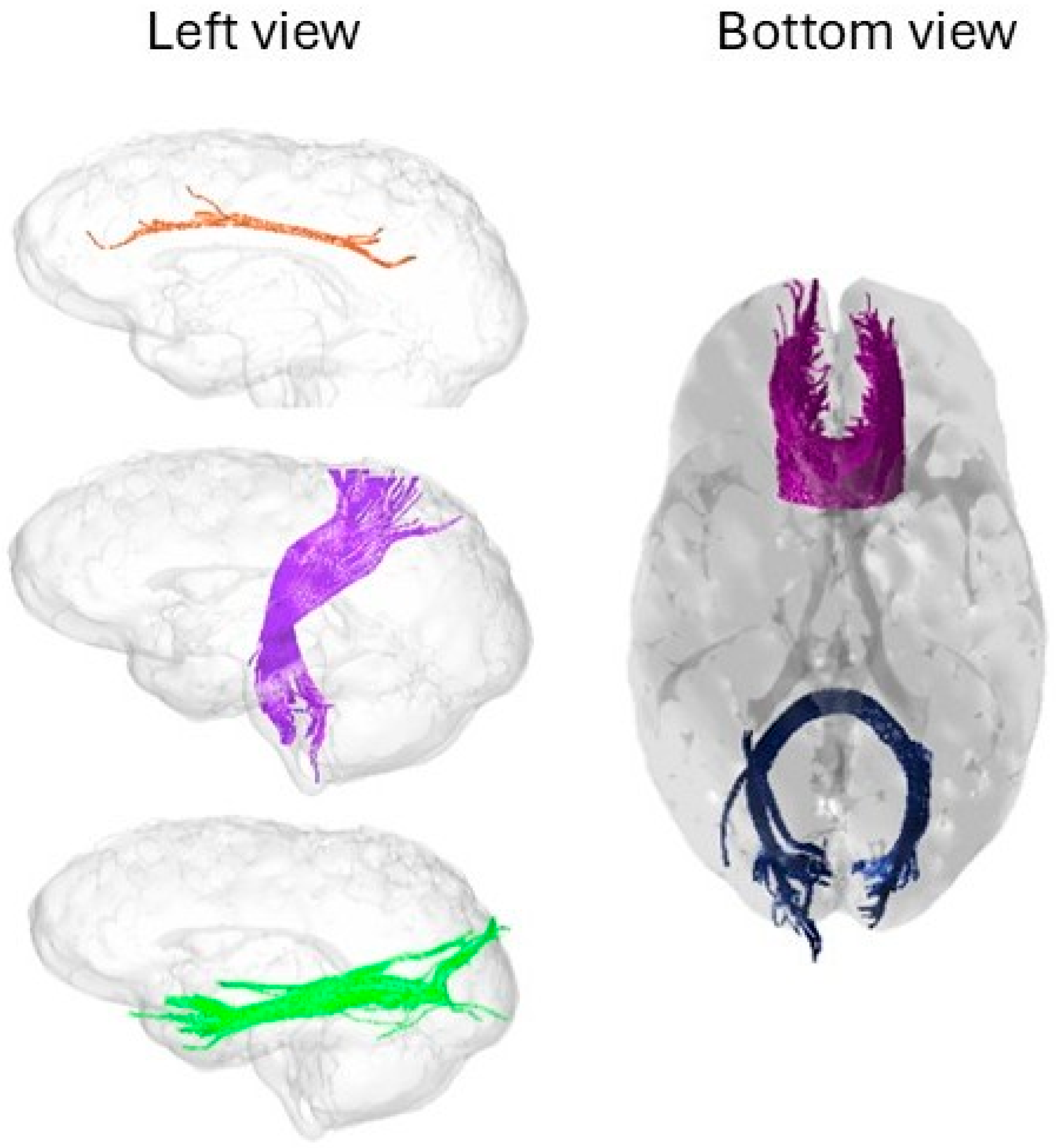

Table 1.
Summary of mean, range and standard deviation of FA values for the major white matter tracts and of the individual frequency of the alpha peak in the sample.
Table 1.
Summary of mean, range and standard deviation of FA values for the major white matter tracts and of the individual frequency of the alpha peak in the sample.
| Neuroimaging measures | Mean | Minimum | Maximum | Std. Dev. |
|---|---|---|---|---|
| ATR-L mean FA | 0.445 | 0.331 | 0.601 | 0.087 |
| ATR-R mean FA | 0.480 | 0.365 | 0.654 | 0.087 |
| CGC-L mean FA | 0.417 | 0.305 | 0.517 | 0.067 |
| CGC-R mean FA | 0.404 | 0.319 | 0.530 | 0.060 |
| CGH- L mean FA | 0.355 | 0.228 | 0.456 | 0.082 |
| CGH-R mean FA | 0.335 | 0.219 | 0.491 | 0.081 |
| CST-L mean FA | 0.553 | 0.431 | 0.674 | 0.081 |
| CST-R mean FA | 0.586 | 0.386 | 0.747 | 0.107 |
| Fmj mean FA | 0.522 | 0.422 | 0.621 | 0.067 |
| Fmn mean FA | 0.457 | 0.367 | 0.575 | 0.074 |
| IFOF-L mean FA | 0.479 | 0.360 | 0.593 | 0.091 |
| IFOF-R mean FA | 0.447 | 0.352 | 0.531 | 0.069 |
| ILF-L mean FA | 0.467 | 0.346 | 0.607 | 0.090 |
| ILF-R mean FA | 0.464 | 0.351 | 0.792 | 0.105 |
| SLF-L mean FA | 0.465 | 0.336 | 0.596 | 0.091 |
| SLF-R mean FA | 0.463 | 0.338 | 0.621 | 0.089 |
| UNC- L mean FA | 0.379 | 0.257 | 0.487 | 0.080 |
| UNC-R mean FA | 0.369 | 0.275 | 0.481 | 0.073 |
| Alpha Peak Frequency | 10.303 | 8.594 | 11.328 | 0.718 |
Table 2.
Summary of the simple and complex task performance variables (mean, std, and skewness of reaction times, and errors) for the GO, NO-GO experiment.
Table 2.
Summary of the simple and complex task performance variables (mean, std, and skewness of reaction times, and errors) for the GO, NO-GO experiment.
| Variable | Mean | Minimum | Maximum | Std. Dev |
| SRT | 463.54 | 408.00 | 518.00 | 35.49 |
| CRT | 433.37 | 357.00 | 555.00 | 47.14 |
| SDSTR | 78.58 | 44.04 | 114.78 | 17.59 |
| SDCRT | 85.81 | 45.24 | 138.71 | 22.75 |
| SKWSRT | 1.08 | -0.36 | 2.10 | 0.59 |
| Variable | Mean | Minimum | Maximum | Std. Dev |
| SKWCRT | 1.41 | -0.41 | 2.41 | 0.55 |
| Commission errors SRT | 1.8 | 0 | 9 | 2.10 |
| Omission errors SRT | 2.08 | 0 | 15 | 1.92 |
| Commission errors CRT | 2.71 | 0 | 12 | 2.56 |
| Omission errors CRT | 4.33 | 0 | 18 | 4.21 |
Table 3.
Sparse canonical variate weights for the two significant dimensions.
| Variables | Dimension 1 Canonical variate weights (p=0.015) |
Dimension 2 Canonical variate weights (p=0.013) |
|---|---|---|
| ATR-L mean FA | 0 | 0 |
| ATR-R mean FA | 0 | 0 |
| CGC-L mean FA | 0 | 0.363 |
| CGC-R mean FA | 0 | 0.303 |
| CGH-L mean FA | 0 | 0 |
| CGH- R mean FA | 0 | 0 |
| CST-L mean FA | 0 | 0.357 |
| CST-R mean FA | 0 | 0.346 |
| Fmj mean FA | 0 | 0.373 |
| Fmn mean FA | 0 | 0.307 |
| IFOF- L mean FA | 0.333 | 0 |
| IFOF-L mean FA | 0.337 | 0 |
| ILF- L mean FA | 0 | 0.301 |
| ILF-R mean FA | 0 | 0.409 |
| SLF-L mean FA | 0.423 | 0 |
| SLF-R mean FA | 0.439 | 0 |
| UNC-L mean FA | 0.379 | 0 |
| UNC-R mean FA | 0.345 | 0 |
Disclaimer/Publisher’s Note: The statements, opinions and data contained in all publications are solely those of the individual author(s) and contributor(s) and not of MDPI and/or the editor(s). MDPI and/or the editor(s) disclaim responsibility for any injury to people or property resulting from any ideas, methods, instructions or products referred to in the content. |
© 2026 by the authors. Licensee MDPI, Basel, Switzerland. This article is an open access article distributed under the terms and conditions of the Creative Commons Attribution (CC BY) license (http://creativecommons.org/licenses/by/4.0/).
Copyright: This open access article is published under a Creative Commons CC BY 4.0 license, which permit the free download, distribution, and reuse, provided that the author and preprint are cited in any reuse.


