

Submitted:
13 April 2026
Posted:
21 April 2026
You are already at the latest version
Abstract
General Relativity predicts the formation of cosmological and gravitational singularities and, being fundamentally time-reversal invariant, lacks an intrinsic mechanism for the emergence of an arrow of time. In this work, we construct a covariant effective field theory (EFT) extension of gravity based on curvature invariants that implements a dual regularization mechanism.
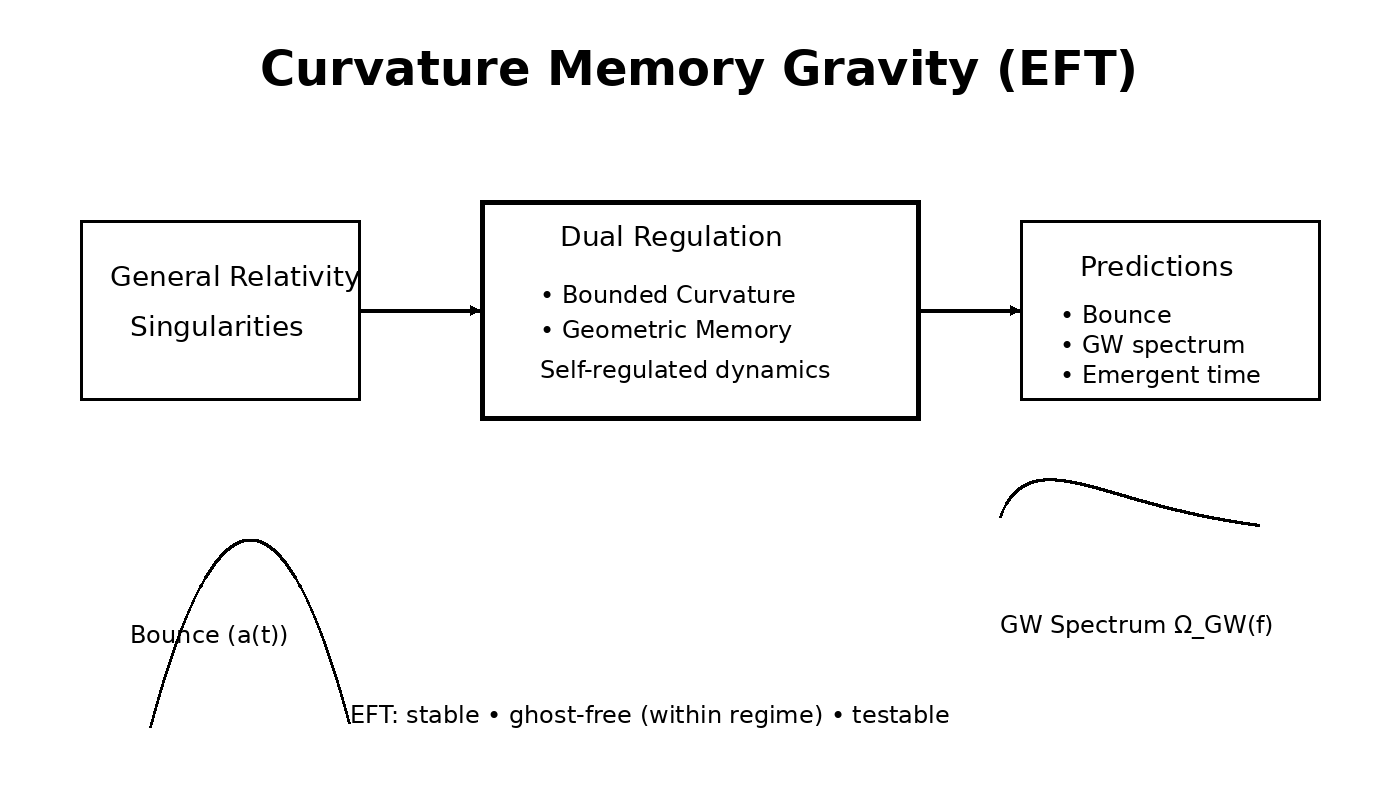
The framework combines (i) a bounded-curvature kernel (sinR-type operator) that dynamically saturates high-curvature growth, and (ii) a geometric memory contribution (“slip”) that correlates the expansion rate with its temporal variation, thereby regulating curvature flow.
Within a controlled regime below an explicit curvature cutoff, the resulting field equations remain second order and admit a nonempty, algebraically characterized perturbatively stable parameter domain. A canonical Hamiltonian (ADM) analysis fixes the degree-of-freedom counting and supports the absence of additional pathological propagating modes within the EFT regime.
In homogeneous cosmology, the dual mechanism yields nonsingular bouncing solutions with finite curvature invariants and ultraviolet damping driven by geometric memory. The bounce can be interpreted as a transition between contracting and expanding phases governed by curvature regulation rather than singular dynamics. Perturbative analysis indicates stability of both tensor and scalar sectors throughout the EFT-consistent domain.
Geometric memory introduces an effective temporal ordering of cosmological solutions: a relational time variable can be defined that evolves monotonically along dynamical trajectories, while the underlying action remains local, covariant, and CPT invariant. This suggests a dynamical origin for the arrow of time without explicit symmetry breaking.
The framework predicts characteristic observational signatures, particularly in gravitational-wave physics. These include curvature-dependent damping of tensor modes, potential deviations in the primordial stochastic gravitational-wave spectrum, and imprints associated with nonsingular bounce dynamics, providing concrete avenues for observational tests.
Rather than an ultraviolet completion, the theory is a structurally consistent curvature-based EFT with explicit stability control and a well-defined domain of validity, offering a controlled setting to explore singularity resolution, emergent temporal structure, and testable deviations from standard cosmology.
Keywords:
curvature memory
; modified gravity
; effective field theory
; cosmological bounce
; emergent time
; nonsingular cosmology
; gravitational rynamics
; early universe
Copyright: This open access article is published under a Creative Commons CC BY 4.0 license, which permit the free download, distribution, and reuse, provided that the author and preprint are cited in any reuse.


