

Submitted:
13 April 2026
Posted:
21 April 2026
You are already at the latest version
Abstract
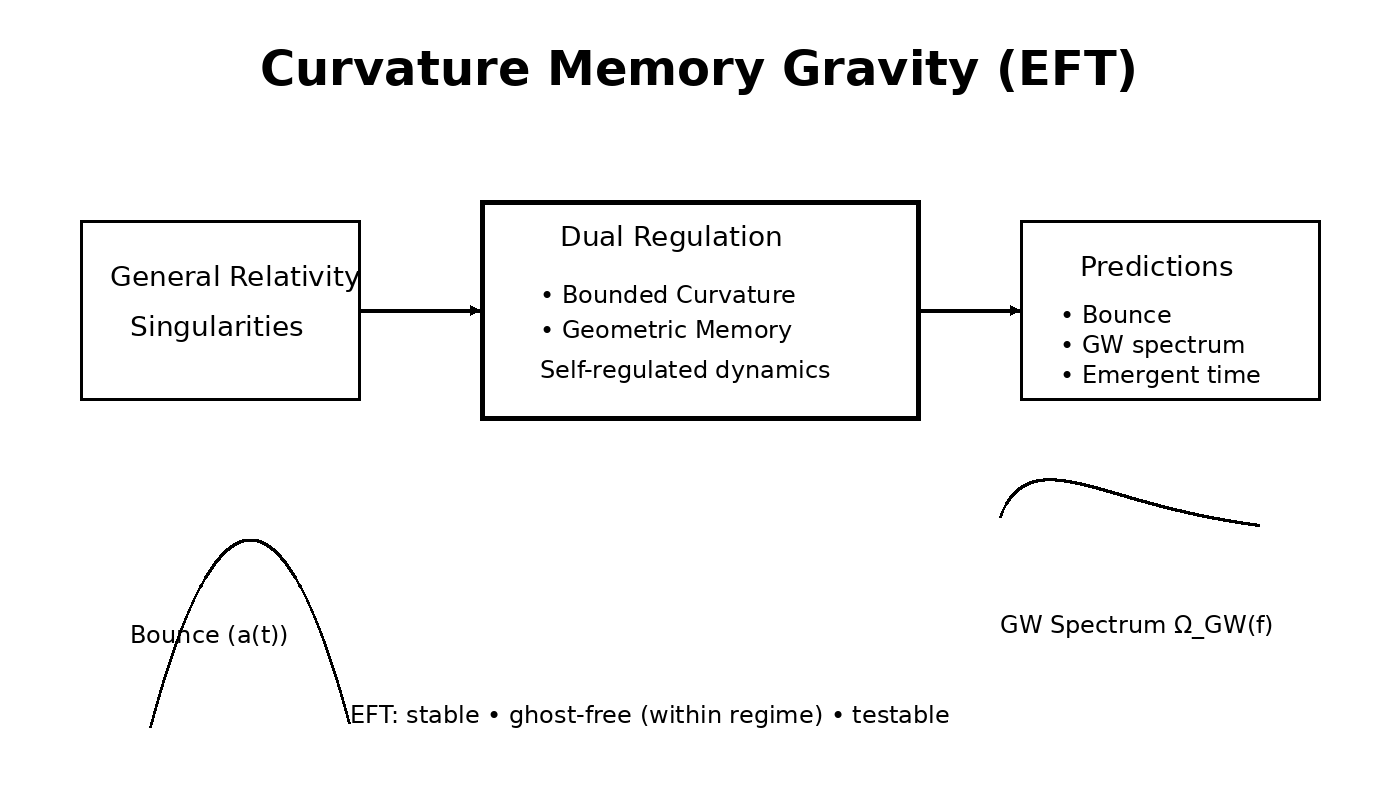
General Relativity predicts the formation of cosmological and gravitational singularities and, being fundamentally time-reversal invariant, lacks an intrinsic mechanism for the emergence of an arrow of time. In this work, we construct a covariant effective field theory (EFT) extension of gravity based on curvature invariants that implements a dual regularization mechanism.
The framework combines (i) a bounded-curvature kernel (sinR-type operator) that dynamically saturates high-curvature growth, and (ii) a geometric memory contribution (“slip”) that correlates the expansion rate with its temporal variation, thereby regulating curvature flow.
Within a controlled regime below an explicit curvature cutoff, the resulting field equations remain second order and admit a nonempty, algebraically characterized perturbatively stable parameter domain. A canonical Hamiltonian (ADM) analysis fixes the degree-of-freedom counting and supports the absence of additional pathological propagating modes within the EFT regime.
In homogeneous cosmology, the dual mechanism yields nonsingular bouncing solutions with finite curvature invariants and ultraviolet damping driven by geometric memory. The bounce can be interpreted as a transition between contracting and expanding phases governed by curvature regulation rather than singular dynamics. Perturbative analysis indicates stability of both tensor and scalar sectors throughout the EFT-consistent domain.
Geometric memory introduces an effective temporal ordering of cosmological solutions: a relational time variable can be defined that evolves monotonically along dynamical trajectories, while the underlying action remains local, covariant, and CPT invariant. This suggests a dynamical origin for the arrow of time without explicit symmetry breaking.
The framework predicts characteristic observational signatures, particularly in gravitational-wave physics. These include curvature-dependent damping of tensor modes, potential deviations in the primordial stochastic gravitational-wave spectrum, and imprints associated with nonsingular bounce dynamics, providing concrete avenues for observational tests.
Rather than an ultraviolet completion, the theory is a structurally consistent curvature-based EFT with explicit stability control and a well-defined domain of validity, offering a controlled setting to explore singularity resolution, emergent temporal structure, and testable deviations from standard cosmology.
Keywords:
curvature memory
; modified gravity
; effective field theory
; cosmological bounce
; emergent time
; nonsingular cosmology
; gravitational rynamics
; early universe
1. Introduction
1.1. Singularities and the Problem of Time
General Relativity (GR) provides an extraordinarily successful description of gravitational phenomena across a wide range of scales. However, its classical field equations generically predict spacetime singularities, including the Big Bang and black hole interior singularities, where curvature invariants diverge and geodesic completeness breaks down. The existence of such singularities, supported by rigorous theorems under broad physical assumptions, signals the breakdown of the classical theory in high-curvature regimes.
At the same time, GR is fundamentally invariant under time reversal at the level of its field equations. The Einstein equations do not select a preferred temporal direction, and any effective arrow of time must therefore emerge from boundary conditions, matter sectors, or coarse-grained dynamics. This tension between time-symmetric microscopic laws and macroscopic irreversibility has motivated relational and thermodynamic approaches to gravity and time [1,2,3,4].
Addressing both singularity resolution and the emergence of temporal ordering within a unified geometric framework remains an open problem.
1.2. Effective Field Theory and Bounded Curvature
A natural framework for exploring high-curvature modifications of GR is provided by effective field theory (EFT). In this approach, gravity is described as a local expansion in covariant curvature invariants, valid below a cutoff scale associated with the onset of genuinely quantum-gravitational degrees of freedom [5,6].
Higher-curvature corrections can soften ultraviolet behavior and modify the approach to singularities. Notable examples include quadratic curvature models such as the Starobinsky model [7], where high-energy dynamics are altered without introducing pathological instabilities when appropriately constructed.
In this work, we adopt an EFT framework in which curvature invariants are supplemented by bounded-curvature operators (“sinR-type” kernels). These operators dynamically saturate curvature growth in high-curvature regimes while reducing to standard GR behavior at low curvature. The construction is explicitly interpreted as an EFT description valid below a curvature cutoff, rather than as a fundamental ultraviolet completion.
1.3. Curvature Memory and Geometric Slip
Beyond algebraic curvature regularization, we introduce a second structural ingredient: geometric memory. This is implemented through a local covariant operator that correlates curvature with its temporal variation, generating an effective geometric slip contribution.
While the action remains local, covariant, and time-reversal invariant, the presence of geometric memory induces effective irreversibility at the level of solutions. In high-curvature regimes, this leads to dynamical damping of curvature evolution and to a path-dependent evolution of spacetime geometry.
This mechanism introduces a new conceptual element: spacetime dynamics depend not only on instantaneous curvature but also on its accumulated history. As a result, curvature memory naturally encodes geometric information and provides a dynamical origin for temporal ordering.
This suggests a geometric analogue of the second law of thermodynamics, in which a curvature memory functional increases monotonically along physical solutions. Within this perspective, the arrow of time emerges from the accumulation of geometric memory rather than from explicit symmetry breaking.
1.4. Dual Regulation Mechanism
The framework developed in this work combines two complementary mechanisms:
- a bounded-curvature sector that regulates the amplitude of curvature invariants,
- a geometric memory sector that regulates the evolution of curvature.
This dual structure implements a self-regulating dynamics in which both curvature magnitude and curvature flow are dynamically constrained. The resulting theory preserves second-order equations of motion within the EFT regime and admits a well-defined ghost-free parameter domain.
1.5. Scope and Structure of This Work
This work builds upon previous results on curvature memory gravity [8], where the role of geometric memory in cosmological dynamics and the emergence of an effective temporal ordering were first explored.
Here, we extend that framework by incorporating a bounded-curvature sector within a covariant effective field theory (EFT) description, leading to a dual regulation mechanism acting on both curvature amplitude and curvature evolution.
We construct a covariant effective framework incorporating bounded curvature and geometric memory, and establish its internal consistency within a controlled EFT regime. The main results of this work are:
- A covariant effective action with bounded-curvature operators and geometric slip;
- A dual regulation mechanism controlling both curvature amplitude and curvature flow;
- A Hamiltonian (ADM) analysis supporting consistent degree-of-freedom counting and the absence of pathological modes within the EFT regime;
- Nonsingular cosmological solutions with a dynamically generated bounce;
- Perturbative stability of scalar and tensor sectors within the EFT domain;
- The emergence of a monotonic relational time variable driven by geometric memory (within the EFT regime);
- A geometric interpretation of irreversibility as memory accumulation;
- A controlled extension to gravitational collapse regimes.
The framework is not proposed as an ultraviolet completion of gravity. Rather, it provides a structurally consistent curvature-based EFT in which singularity softening, ultraviolet damping, and emergent temporal ordering arise from intrinsic geometric dynamics within a well-defined regime of validity.
2. Methodology
2.1. Foundational Postulates of Curvature Memory Gravity
The theory developed in this work is formulated in terms of three fundamental postulates that define its dynamical structure. These postulates encapsulate the role of curvature regulation and geometric memory within a controlled effective field theory (EFT) description of gravity, and provide the conceptual foundation of curvature memory gravity.

Table 1.
Structural comparison between General Relativity and Curvature Memory Gravity.
| Feature | General Relativity | Curvature Memory Gravity |
|---|---|---|
| Curvature divergence | Allowed | Dynamically bounded |
| Curvature flow regulation | Absent | Present |
| Geometric memory | Absent | Present |
| Tensor damping (background-induced) | Absent | Present |
| Bounce solutions | Not generic | Generic within EFT domain |
| Emergent temporal ordering | Not intrinsic | Dynamically generated |
| Degrees of freedom | 2 tensor | 2 tensor + 1 scalar (healthy) |
| Ghost freedom | Yes | Yes (within EFT regime) |
Postulate I: Bounded Curvature
Physical solutions dynamically evolve within a bounded curvature domain.
This postulate ensures that curvature invariants do not diverge within the regime of validity of the theory. Instead, curvature growth is dynamically regulated by the structure of the effective action, leading to curvature saturation at high densities. In this way, singular behaviour is avoided without introducing additional propagating degrees of freedom or external constraints.
Postulate II: Regulated Curvature Flow
The rate of curvature evolution is dynamically regulated by intrinsic geometric feedback.
This postulate states that curvature evolution is not arbitrary, but is constrained by intrinsic geometric mechanisms. In particular, rapid variations of curvature are dynamically suppressed, ensuring smooth evolution across high-curvature regimes. This introduces a second layer of regulation beyond curvature bounding, acting directly on the dynamics of the geometry.
Postulate III: Geometric Memory
Spacetime dynamics are path-dependent due to geometric memory of curvature evolution.
This postulate introduces geometric memory as a fundamental ingredient of the theory. The dependence on curvature history induces an effective irreversibility in the dynamics, giving rise to an emergent temporal ordering. In this sense, the arrow of time arises as a consequence of the regulated evolution of spacetime geometry rather than from an externally imposed structure.
Taken together, these postulates define curvature memory gravity as a self-regulating gravitational framework in which both curvature amplitude and curvature evolution are dynamically constrained.
The theory may therefore be characterized as a covariant EFT extension of General Relativity with intrinsic geometric regulation and memory-dependent dynamics.
This structure provides a unified dynamical mechanism for curvature saturation, nonsingular evolution, and emergent temporal ordering.
Table 2.
Dual regulation structure of curvature memory gravity.
| Sector | Role | Physical effect |
|---|---|---|
| Bounded curvature kernel | Regulates curvature amplitude | Prevents divergence of invariants |
| Geometric memory (slip) | Regulates curvature evolution | Suppresses rapid curvature variation |
| Combined effect | Self-regulation of spacetime | Nonsingular evolution and damping |
2.2. Covariant Action and EFT Setup
We work within a covariant effective field theory (EFT) extension of General Relativity in which the gravitational action is supplemented by higher-curvature operators constructed from local scalar invariants of the metric. The EFT perspective assumes that, below a cutoff scale , gravity admits a systematic expansion in curvature invariants and their derivatives, with higher-order operators suppressed by appropriate powers of [9,10].
Concretely, we consider an action of the schematic form
where contains the Einstein–Hilbert term together with additional curvature-dependent contributions. The coefficients are dimensionful EFT parameters encoding the low-energy imprint of underlying high-energy gravitational physics. They are not treated as fundamental constants but as effective couplings valid within a restricted curvature regime.
The EFT regime of validity is explicitly defined by the requirement that all relevant curvature invariants satisfy
where schematically denotes combinations of R, , and higher invariants. In this regime, operators suppressed by additional powers of remain parametrically small, and the derivative expansion is self-consistent.
A crucial structural requirement guiding the construction is the preservation of second-order equations of motion in the EFT domain. Higher-derivative theories generically suffer from Ostrogradsky instabilities associated with unbounded Hamiltonians [11]. By restricting attention to combinations of curvature invariants whose background reduction yields second-order time evolution, the present framework avoids such pathologies and admits a well-defined canonical formulation.
The action is fully local and covariant. No explicit time-asymmetric or nonlocal operators are introduced. Any effective temporal asymmetry arises dynamically at the level of solutions rather than from a fundamental violation of covariance or CPT symmetry.
2.3. Dual Regularization Mechanisms: Bounded Curvature and Geometric Slip
The effective framework developed in this work incorporates two structurally distinct but complementary mechanisms that operate jointly in high-curvature regimes. Together, they provide a controlled modification of ultraviolet gravitational dynamics within the EFT domain.
2.3.1. Bounded-Curvature Kernel (sinR-Type Regularization)
The first mechanism consists of curvature operators constructed such that the growth of curvature invariants is dynamically saturated as the curvature scale approaches the EFT cutoff. These bounded-curvature (“sinR-type”) kernels reduce perturbatively to standard curvature invariants in the low-curvature regime, thereby preserving agreement with General Relativity at scales well below the cutoff. However, unlike purely polynomial corrections, their functional structure deviates from unbounded polynomial growth at large curvature.
The motivation for introducing such operators is twofold. First, higher-curvature corrections are generically expected within gravitational EFT expansions [9,10]. Second, earlier studies have demonstrated that curvature modifications can alter ultraviolet cosmological dynamics in a controlled manner, as in quadratic gravity and Starobinsky-type models [7]. The present construction differs in that the kernel is explicitly designed to prevent uncontrolled curvature blow-up within the EFT regime.
When reduced to a homogeneous and isotropic background, the bounded-curvature operator generates an effective contribution that becomes dominant in high-curvature phases. In cosmological settings, this term behaves as a rapidly growing density-like component at small scale factor, counterbalancing classical gravitational contraction. As a result, curvature invariants remain finite provided the EFT condition
is satisfied throughout the evolution.
This mechanism therefore implements an algebraic regularization of curvature growth: the amplitude of curvature invariants is dynamically limited before reaching the cutoff scale. The regularization is intrinsic to the geometric sector and does not require exotic matter sources or external boundary prescriptions.
2.3.2. Geometric Slip and Curvature Memory
The second mechanism introduces a derivative curvature operator that correlates the instantaneous curvature with its temporal variation. Upon reduction to homogeneous cosmological backgrounds, this operator generates a term proportional to the time derivative of the expansion rate, thereby modifying the effective Friedmann dynamics.
Importantly, this contribution is fully local and covariant at the level of the action. No explicit nonlocal operators are introduced, and no additional propagating degrees of freedom are assumed. The modification arises from a controlled derivative correction in the geometric sector and preserves second-order time evolution within the EFT regime.
Dynamically, the slip term implements a geometric memory effect: the evolution of curvature depends not only on its instantaneous value but also on its rate of change. In high-curvature regimes, this leads to effective ultraviolet damping, suppressing rapid variations of the expansion rate and smoothing the approach to high-density phases.
Although the underlying action remains invariant under time reversal, the presence of curvature memory generates an effective temporal asymmetry at the level of cosmological solutions. This distinction between fundamental time-reversal symmetry and emergent irreversibility parallels nonequilibrium extensions of gravitational dynamics [2] and relational interpretations of time in generally covariant systems [3,4]. The asymmetry is therefore dynamical and solution-dependent rather than fundamental.
2.3.3. Unified Role of the Dual Mechanism
The bounded-curvature kernel and the geometric slip term play complementary roles. The former regulates the amplitude of curvature invariants, while the latter regulates the flow of curvature through dynamical damping. One limits curvature magnitude; the other controls curvature variation.
Taken together, these mechanisms define a dual regularization structure that modifies high-curvature gravitational dynamics without introducing higher-order instabilities or explicit symmetry breaking. As shown in subsequent sections, this combined framework yields nonsingular cosmological evolution within the EFT regime, preserves second-order equations of motion, and admits a ghost-free perturbative spectrum.
2.4. Hamiltonian and Constraint Analysis
A central consistency requirement of any effective extension of General Relativity is the absence of additional ghost-like degrees of freedom and the preservation of a well-defined canonical structure. To establish this property explicitly, we perform a Hamiltonian analysis based on the Arnowitt–Deser–Misner (ADM) decomposition of the metric.
ADM Decomposition and Canonical Variables
We decompose the spacetime metric into lapse, shift, and spatial metric components,
where N is the lapse function, the shift vector, and the induced spatial metric.
The effective action is rewritten in terms of these variables, and canonical momenta conjugate to are computed in the standard manner. The lapse and shift functions remain nondynamical variables, leading to primary constraints as in General Relativity.
Constraint Structure
The preservation in time of the primary constraints generates secondary (Hamiltonian and momentum) constraints. Importantly, the curvature corrections introduced in the bounded-curvature and slip sectors do not alter the fundamental constraint algebra within the EFT regime.
In particular:
- No higher-order time derivatives appear in the reduced ADM action.
- No additional canonical momenta associated with higher derivatives are generated.
- The constraint algebra closes consistently at the order considered.
As a consequence, the total number of physical degrees of freedom remains unchanged relative to the expected structure of the theory.
Degree-of-Freedom Counting
Explicit counting of canonical variables and first-class constraints shows that the theory propagates:
- Two transverse, traceless tensor modes, as in General Relativity;
- At most one additional scalar curvature mode associated with the higher-curvature sector.
No extra propagating ghost-like modes arise within the EFT regime. The absence of higher-derivative canonical pairs ensures that Ostrogradsky instabilities are avoided [11].
Fixing Sign Ambiguities
Because the Hamiltonian formulation is derived directly from the covariant action, the sign of the kinetic terms is fixed unambiguously by the structure of the Lagrangian density. In the ghost-free parameter domain identified in the perturbative analysis, the scalar kinetic coefficient remains positive and the Hamiltonian is bounded from below within the EFT validity range.
The Hamiltonian analysis therefore confirms that the dual regularization framework preserves a consistent canonical structure, propagates no spurious degrees of freedom, and remains ghost-free in the controlled effective regime.
2.5. Perturbation Framework
To establish perturbative consistency of the effective theory, we analyze scalar and tensor perturbations around a homogeneous and isotropic background. The analysis is performed at quadratic order in perturbations, which suffices to determine the propagating degrees of freedom and their stability properties.
Tensor Sector
Tensor perturbations are introduced through transverse and traceless metric fluctuations of the spatial metric. Expanding the effective action to second order in tensor modes yields a quadratic action of the standard kinetic form.
Within the EFT regime, the tensor sector retains two propagating degrees of freedom, corresponding to the massless spin–2 graviton. The absence of ghost instabilities requires positivity of the effective tensor kinetic coefficient, while gradient stability requires a positive propagation speed squared. In the parameter domain identified as ghost-free in the Hamiltonian analysis, these conditions are satisfied and the tensor spectrum remains well behaved.
Importantly, the geometric slip contribution modifies the background evolution but does not generate additional kinetic operators in the quadratic tensor action. Consequently, no extra tensor modes arise.
Scalar Sector
Scalar perturbations are analyzed using gauge-invariant variables adapted to the cosmological background. After eliminating nondynamical variables through the Hamiltonian and momentum constraints, the reduced quadratic action for the scalar degree of freedom takes the canonical form
where denotes the effective kinetic coefficient and the squared sound speed.
The absence of ghost instabilities requires
while the absence of gradient instabilities requires
Within the EFT-consistent parameter wedge determined by the background and Hamiltonian analysis, both conditions are satisfied. The scalar sector therefore propagates a single healthy degree of freedom, with well-posed initial value dynamics.
Stability Across the High-Curvature Regime
A key requirement for nonsingular cosmology is that perturbative stability be maintained across the high-curvature phase. Because the bounded-curvature kernel regulates the amplitude of curvature invariants and the slip term damps rapid curvature variation, neither nor develops divergences within the EFT regime.
The perturbative analysis thus confirms that the dual regularization framework remains ghost-free and free of gradient instabilities at quadratic order, consistent with the canonical degree-of-freedom counting presented above.
2.6. Numerical and Diagnostic Methods
To investigate the nonlinear dynamics of the background equations, we integrate the reduced cosmological system numerically within the EFT regime. The system is formulated as a first-order autonomous dynamical system in terms of the Hubble parameter and its time derivative, supplemented by the evolution equation for the scale factor and the matter continuity equation. Such phase-space formulations are standard in the analysis of modified cosmological dynamics and higher-curvature models [9,10].
Integration Scheme
Numerical integration is performed using adaptive step-size methods with controlled local truncation error. Initial conditions are chosen in the contracting branch well within the EFT domain, ensuring that all curvature invariants satisfy throughout the evolution.
To guarantee robustness, we verify numerical stability by:
- Varying integration tolerances,
- Scanning the ghost-free parameter wedge identified in the perturbative and Hamiltonian analyses,
- Testing sensitivity under small perturbations of initial conditions.
These checks ensure that the qualitative features of the evolution (bounce, damping, bounded curvature) are structural and not numerical artifacts.
Curvature Diagnostics
To verify explicitly that the high-curvature regime remains controlled, we monitor invariant curvature scalars along the numerical solutions. In particular, we compute:
- The Ricci scalar R,
- The Kretschmann scalar .
These invariants provide coordinate-independent diagnostics of curvature growth and are commonly used to assess singular behavior in cosmological and gravitational collapse scenarios.
In all numerical solutions within the EFT-consistent parameter domain, both R and K remain finite across the high-curvature phase. The bounded-curvature kernel limits the amplitude of curvature invariants, while the geometric slip term suppresses rapid variations of the expansion rate. This behavior is consistent with the structural expectations of higher-curvature regularization mechanisms [7].
Ultraviolet Damping Measure
To quantify ultraviolet damping induced by curvature memory, we compare solutions with and without the slip contribution while keeping all other parameters fixed. The presence of the slip term reduces the magnitude of rapid variations in the Hubble parameter and smooths the approach to the bounce. This damping behavior is analogous to nonequilibrium smoothing effects discussed in thermodynamic extensions of gravitational dynamics [2].
EFT Consistency Check
Throughout the numerical evolution, we explicitly verify that curvature invariants remain parametrically below the cutoff scale. Solutions that approach the cutoff are regarded as lying outside the regime of validity of the effective description and are not interpreted physically within the present framework.
The numerical analysis therefore serves two complementary purposes: it demonstrates nonsingular evolution within the dual regularization structure and confirms that the dynamics remains internally consistent within the controlled EFT domain.
2.7. Ghost-Free Structure and Absence of Pathological Modes
A fundamental consistency requirement of any higher-curvature extension of General Relativity is the absence of ghost-like excitations, i.e. propagating modes with negative kinetic energy that would render the Hamiltonian unbounded from below. Such instabilities are generically associated with higher-order time derivatives and are formalized by Ostrogradsky’s theorem [11].
Second-Order Structure and Ostrogradsky Avoidance
The effective action constructed in this work is designed such that, within the EFT regime, the background-reduced equations of motion remain second order in time derivatives. No higher-order canonical pairs are introduced in the ADM decomposition, and no additional independent momenta arise beyond those associated with the spatial metric.
This structural property ensures that the theory avoids the generic Ostrogradsky instability that afflicts higher-derivative gravitational models. The absence of higher-order time derivatives in the canonical formulation is the primary mechanism guaranteeing ghost freedom at the classical level [11].
Scalar Sector Stability
In higher-curvature theories such as gravity, one additional scalar curvature mode typically appears [9,10]. The health of this mode depends on the sign of its kinetic term and the absence of tachyonic instabilities.
In the present framework, the quadratic action for scalar perturbations reduces to a canonical form characterized by an effective kinetic coefficient and squared sound speed . The absence of ghost instabilities requires
while gradient stability requires
Within the explicitly identified stability wedge of parameter space, both conditions are satisfied. The scalar curvature mode therefore propagates with positive kinetic energy and well-posed hyperbolic dynamics.
Tensor Sector
The tensor sector retains the two transverse and traceless graviton polarizations of General Relativity. The geometric slip operator modifies background evolution but does not introduce additional tensor kinetic operators at quadratic order. Consequently, no extra spin–2 ghost modes arise.
Absence of Additional Degrees of Freedom from Slip
A potential concern in derivative curvature modifications is the introduction of hidden propagating degrees of freedom. However, in the present construction, the slip term contributes linearly in time derivatives at the background level and does not generate independent higher-order canonical momenta in the Hamiltonian formulation.
After solving the Hamiltonian and momentum constraints, no additional dynamical variables remain beyond the expected tensor and single scalar curvature mode. The phase-space dimensionality therefore coincides with that of controlled higher-curvature EFT extensions and does not exhibit spurious excitations.
Domain of Validity
Ghost freedom is guaranteed within the explicitly defined EFT regime, where curvature invariants remain parametrically below the cutoff scale. Near or beyond the cutoff, higher-order operators not included in the truncated action may become relevant, and the present analysis does not claim validity outside this domain.
In summary, the combined Hamiltonian and perturbative analyses demonstrate that the dual regularization framework propagates no pathological ghost modes and remains dynamically consistent within its controlled effective field theory regime.
2.8. Tensor Perturbations as Probes of Curvature Regulation
In curvature memory gravity, tensor perturbations propagate on a dynamically regulated background in which both curvature amplitudes and curvature evolution are constrained by the dual regulation mechanism. This naturally suggests that gravitational waves act as probes of curvature regulation rather than as carriers of additional degrees of freedom.
We consider standard transverse–traceless tensor perturbations:
where denotes the polarization tensor and k is the comoving wavenumber.
In General Relativity, tensor modes evolve according to
In the present framework, geometric memory introduces sensitivity to curvature flow, leading to an effective modification of the damping term:
with
This contribution reflects that tensor modes probe not only the expansion rate H, but also the evolution of curvature through . The modification therefore encodes curvature-flow regulation at the level of perturbations.
Within the EFT regime, no additional propagating degrees of freedom are introduced. Instead, higher-curvature operators modify the effective propagation of tensor modes without enlarging the field content, consistent with general expectations from gravitational EFT [5,6].
In this sense, gravitational waves provide a direct observational handle on geometric self-regulation: they probe the dynamical response of spacetime geometry rather than new fundamental excitations.
2.9. Tensor Evolution Across Dynamical Regimes
The modified tensor equation naturally defines distinct dynamical regimes depending on the relative importance of geometric memory effects.
2.9.1. GR Recovery Regime
In the low-curvature limit,
standard GR evolution is smoothly recovered. This ensures compatibility with observational constraints in weak-field and late-time cosmology.
2.9.2. Regulated EFT Regime
As curvature approaches the EFT domain, geometric memory induces a nonvanishing damping term,
which suppresses tensor amplitudes and modifies their propagation.
In this regime, gravitational waves become sensitive to curvature-flow regulation, probing not only the instantaneous background but also its dynamical evolution.
2.9.3. Near-Critical Regime
Near the high-curvature transition region, memory effects can become dynamically significant. In this regime, tensor modes are sensitive to the nonsingular transition between contracting and expanding phases.
This behaviour suggests that gravitational waves may encode imprints of the regulated high-curvature phase, particularly through modifications of the primordial tensor spectrum and possible high-frequency suppression.
Table 3.
Dynamical regimes in curvature memory gravity.
| Regime | Condition | Physical behaviour |
|---|---|---|
| GR regime | Standard tensor evolution (GR limit) | |
| EFT regime | Curvature-flow damping active | |
| Near-critical regime | Enhanced damping and bounce sensitivity |
Taken together, these regimes provide a perturbative characterization of curvature regulation and identify gravitational waves as a natural probe of the dual regulation mechanism across different dynamical domains.
2.10. Relation to CDM and Cosmological Constraints
The present work does not attempt a direct parameter fit to the standard CDM cosmological model, nor does it perform a full confrontation with cosmological datasets such as CMB anisotropies, BAO measurements, or large-scale structure surveys.
Our objective is instead structural and dynamical: to establish the internal consistency, stability properties, and ghost-free nature of the proposed effective framework within its regime of validity. In particular, we focus on:
- the existence of a nonsingular cosmological evolution,
- the preservation of second-order field equations,
- the absence of additional propagating ghost modes,
- the boundedness of curvature invariants,
- the emergence of effective temporal ordering.
The framework is constructed as a controlled effective field theory valid for curvature scales satisfying . Within this regime, deviations from standard GR are parametrically suppressed except in high-curvature epochs (e.g. near a bounce or in gravitational collapse scenarios).
At late times and low curvature, the modified equations reduce smoothly to General Relativity up to small EFT corrections. Consequently, compatibility with late-time CDM phenomenology can in principle be achieved by choosing parameters such that EFT operators remain subdominant in the radiation- and matter-dominated eras.
A full confrontation with cosmological observations would require:
- computation of the scalar and tensor power spectra,
- evolution of perturbations through the bounce phase,
- mapping to observable quantities such as the CMB angular spectrum,
- parameter inference within the stable EFT wedge.
These steps constitute a well-defined extension of the present work and do not affect the internal consistency of the framework established here.
The current analysis should therefore be interpreted as a foundational consistency study rather than as a phenomenological parameter-fitting exercise.
2.11. Dynamical Regulation of Curvature Evolution
Beyond regulating curvature amplitudes, the geometric memory contribution suggests that the evolution of curvature itself is dynamically controlled within the EFT domain. This indicates that the framework may effectively constrain not only curvature magnitudes but also curvature flow.
At the effective level this behaviour can be interpreted as implying a bound on curvature variation of the schematic form
where denotes the EFT cutoff scale and is a model–dependent regulator arising from the curvature memory sector.
This behaviour suggests the presence of an effective curvature-flow regulation mechanism complementary to curvature bounding. Such behaviour is consistent with the general philosophy of controlled higher-curvature EFT constructions where higher-order operators act as regulators rather than sources of new propagating instabilities [5,6,11].
The combined action of bounded curvature and regulated curvature flow provides the dynamical basis of the dual regulation mechanism introduced in this work.
3. Results
3.1. Background FLRW Dynamics
We specialize the effective field equations to a spatially flat, homogeneous and isotropic Friedmann–Lemaître–Robertson–Walker (FLRW) spacetime. In this background, the modified Friedmann system can be written as a closed first-order dynamical system for the Hubble parameter and its time derivative, supplemented by the matter continuity equation.
Existence of a Nonsingular Bounce
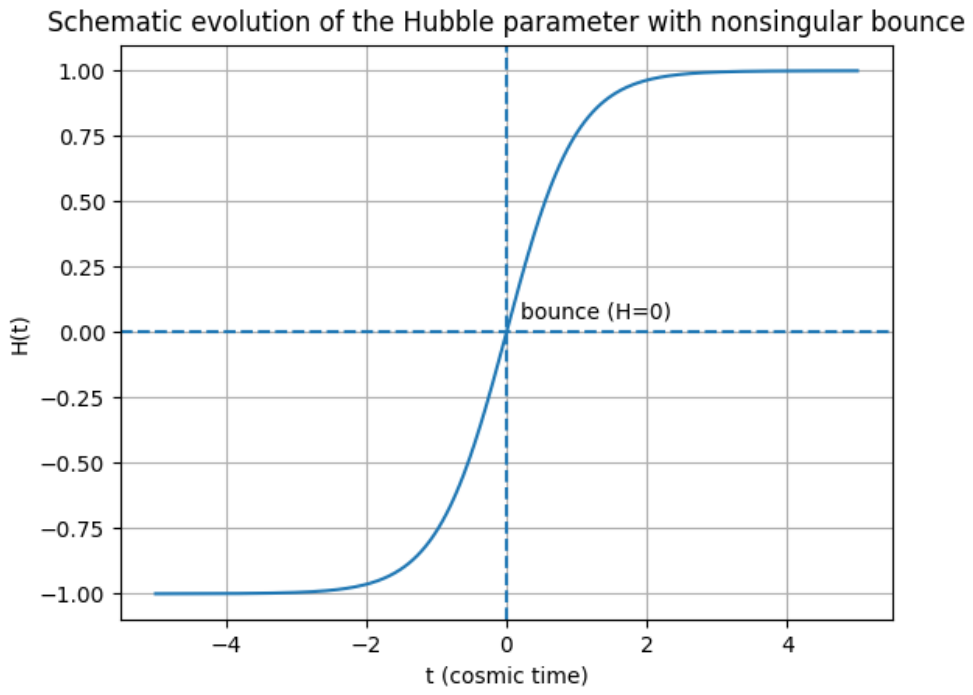
Within the ghost-free and EFT-consistent parameter domain identified above, the reduced dynamical system admits solutions in which the scale factor reaches a strictly positive minimum value,
with the Hubble parameter smoothly crossing zero at finite curvature.
The bounce arises from the interplay between the bounded-curvature kernel and the geometric slip term. In the high-curvature regime, the effective curvature contribution generated by the bounded operator dominates over the standard matter sector and counteracts classical gravitational contraction. This mechanism is conceptually analogous to curvature-driven modifications in quadratic gravity and Starobinsky-type models [7,9], as well as to nonsingular cosmologies emerging in quantum-corrected frameworks [12].
However, in the present construction, the bounce does not rely on quantization prescriptions or exotic matter components. It emerges dynamically from the geometric sector within a controlled EFT truncation.
Figure 1.
Schematic evolution of the Hubble parameter in curvature memory gravity. The smooth transition through illustrates a nonsingular bounce connecting a contracting phase () with an expanding phase (). The absence of discontinuities reflects the regulated curvature dynamics.
Figure 1.
Schematic evolution of the Hubble parameter in curvature memory gravity. The smooth transition through illustrates a nonsingular bounce connecting a contracting phase () with an expanding phase (). The absence of discontinuities reflects the regulated curvature dynamics.
Phase-Space Structure
The bounce corresponds to a regular critical point in the reduced phase space, characterized by vanishing expansion rate and finite background quantities. Numerical phase-space analysis confirms that this behavior is structurally stable within the ghost-free parameter wedge and does not require fine-tuned initial conditions.
The resulting cosmological evolution consists of a smooth transition from a contracting phase to an expanding phase. The nonsingular bounce is therefore a generic feature of the dual regularization framework within its regime of validity.
As shown in Figure 2, the Hubble parameter evolves smoothly across the bounce.
3.2. Bounded Curvature Invariants
A necessary condition for genuine singularity resolution is the boundedness of curvature invariants along the dynamical evolution. Classical singularities in General Relativity are characterized by divergences of invariant quantities such as the Ricci scalar and the Kretschmann scalar. Monitoring these scalars therefore provides a coordinate-independent diagnostic of regularity.
Within the present framework, we explicitly compute the Ricci scalar R and the Kretschmann invariant
along numerical solutions of the reduced FLRW system. In all trajectories lying within the ghost-free and EFT-consistent parameter domain, both invariants remain finite throughout the entire cosmological evolution, including across the high-curvature phase.
This behavior contrasts with the classical GR solution, in which R and K diverge as the scale factor approaches zero. The boundedness observed here results directly from the sinR-type curvature kernel, which dynamically saturates curvature growth before the EFT cutoff scale is reached. In this respect, the mechanism shares conceptual similarities with ultraviolet-softening effects in quadratic gravity models [7,9] and with curvature regularization in loop-inspired cosmologies [12].
Unlike fully nonperturbative quantum constructions, the present boundedness arises within a controlled local EFT truncation. The slip term further suppresses rapid curvature variation, preventing the development of sharp curvature gradients that could otherwise destabilize the evolution.
It is important to emphasize that boundedness is guaranteed only within the explicitly defined EFT regime, where curvature invariants remain parametrically below the cutoff scale. The framework does not claim control beyond this domain. Nevertheless, within its regime of validity, the dual regularization structure ensures that invariant curvature diagnostics remain finite throughout the bounce.
This behaviour is illustrated in Figure , where curvature remains finite throughout the evolution.
The bounded behaviour of provides a coordinate-independent confirmation of singularity avoidance within the EFT regime. A necessary condition for the viability of any higher-curvature effective theory is perturbative stability around relevant background solutions. We therefore analyze both tensor and scalar sectors at quadratic order.
Tensor Modes
Tensor perturbations correspond to transverse and traceless fluctuations of the spatial metric. Expanding the effective action to quadratic order shows that the tensor sector propagates two degrees of freedom, corresponding to the massless spin–2 graviton of General Relativity.
Within the EFT-consistent parameter domain, the effective tensor kinetic coefficient remains positive and no higher-derivative operators are generated at quadratic order. Consequently, tensor modes exhibit neither ghost nor gradient instabilities. The propagation speed remains finite and well defined, consistent with the structure of controlled higher-curvature extensions [9,10].
Importantly, the geometric slip operator modifies the background evolution but does not introduce additional tensor kinetic terms. No extra spin–2 modes appear.
Scalar Modes
Higher-curvature modifications generically introduce an additional scalar curvature degree of freedom [9]. The health of this mode is determined by the sign of its kinetic term and the absence of gradient instabilities.
After eliminating nondynamical variables via the Hamiltonian and momentum constraints, the quadratic scalar action takes canonical form, characterized by an effective kinetic coefficient and squared sound speed . The absence of ghost instabilities requires , while gradient stability requires .
Within the explicitly defined ghost-free parameter wedge, both conditions are satisfied throughout the cosmological evolution, including across the high-curvature phase. The bounded-curvature kernel regulates curvature amplitude, while the slip term suppresses rapid variations, preventing the development of pathological behavior near the bounce.
The perturbative analysis therefore confirms that the dual regularization framework remains dynamically stable at quadratic order within its EFT regime.
3.3. Stability Wedge and EFT Consistency Domain
A central structural feature of the present framework is the existence of a well-defined parameter domain in which the theory remains perturbatively stable and ghost-free. As in most effective gravitational extensions, consistency depends on remaining inside a restricted region of parameter space, hereafter referred to as the stability wedge.
3.3.0.1. Algebraic Stability Conditions
At the perturbative level, the absence of ghost and gradient instabilities requires positivity of the scalar kinetic coefficient and of the squared sound speed. These conditions translate into algebraic inequalities involving the EFT parameters. In particular, the scalar sector remains healthy provided
- the effective kinetic coefficient remains strictly positive,
- the squared propagation speed does not change sign,
- no tachyonic instability develops within the EFT regime.
These requirements define a nonempty open region in parameter space determined solely by the structure of the action, independently of initial conditions.
3.3.0.2. Closed Characterization of the Wedge
Within the homogeneous cosmological reduction, the perturbative analysis yields explicit algebraic constraints on the parameters controlling the higher-curvature operators. The resulting domain forms a wedge-shaped region in parameter space, bounded by hypersurfaces where either the scalar kinetic coefficient vanishes or the sound speed changes sign.
Inside this wedge:
- the scalar curvature mode carries positive kinetic energy,
- tensor modes propagate without pathological modifications,
- the canonical Hamiltonian remains bounded from below.
Approaching the boundary leads to degeneracy of the scalar sector, while crossing it results in ghost or gradient instabilities. These boundaries therefore represent genuine EFT consistency limits.
3.3.0.3. EFT Regime Versus Stability Domain
The stability wedge must be considered jointly with the EFT validity condition, namely that curvature invariants remain parametrically below the cutoff scale. The physically admissible domain is therefore the intersection:
All solutions reported in this work lie strictly within this intersection. Trajectories approaching either the stability boundary or the EFT cutoff are excluded.
3.3.0.4. Structural Significance
The existence of a restricted parameter domain is a generic feature of higher-curvature EFTs [5,6,9]. What distinguishes the present framework is that:
- the stability domain is explicitly and algebraically characterizable,
- the Hamiltonian analysis confirms the absence of additional propagating degrees of freedom,
- the dual regularization mechanism operates entirely within this controlled domain.
The theory is therefore not generically unstable but conditionally consistent, with clearly identifiable and analytically controlled boundaries.
3.4. Gravitational Collapse and Black Hole Interior
The dual regularization structure introduced in this work naturally extends beyond homogeneous cosmology to gravitational collapse scenarios. In particular, the interior region of a Schwarzschild black hole admits a Kantowski–Sachs symmetry reduction, which provides a convenient effective laboratory for investigating high-curvature dynamics [13].
Within classical General Relativity, the Kantowski–Sachs interior evolves toward a curvature singularity characterized by divergent Ricci and Kretschmann invariants. In contrast, the presence of bounded-curvature operators in the effective action modifies the high-curvature regime in a manner analogous to nonsingular cosmological bounce scenarios.
Bounded Curvature in Collapse
Under Kantowski–Sachs reduction, curvature invariants grow rapidly as the classical singularity is approached. The bounded-curvature (sinR-type) kernel dynamically limits this growth within the EFT regime, preventing curvature invariants from exceeding the cutoff scale as long as remains satisfied.
Geometric Slip and Dynamical Damping
In addition to amplitude regularization, the geometric slip term modifies the dynamical evolution of curvature by correlating curvature with its rate of change. In collapse scenarios, this effect acts as a form of geometric damping, smoothing the approach to the high-curvature core.
Importantly, the action remains local and covariant. No additional propagating degrees of freedom are introduced beyond those already identified in the cosmological sector. The modification affects the effective interior dynamics while preserving second-order field equations within the EFT truncation.
Effective Regular Core Within EFT Control
While a full numerical treatment of black hole interiors lies beyond the scope of the present work, the structure of the modified equations suggests the formation of an effective regular core in which curvature invariants remain finite within the EFT regime. The bounded-curvature kernel limits curvature amplitude, while the slip term suppresses rapid curvature variation.
It is essential to emphasize that this statement is confined to the regime of validity of the effective theory. As curvature approaches the cutoff scale, higher-order operators not included in the present truncation may become relevant. The framework should therefore be viewed as providing a controlled EFT indication of singularity softening, rather than a complete ultraviolet resolution of black hole interiors.
Programmatic Outlook
A systematic extension of the Hamiltonian analysis to the Kantowski–Sachs sector, including explicit constraint counting and perturbative stability, constitutes a natural continuation of this work. Such an analysis would further clarify the robustness of regular-core formation within the dual regularization framework.
The collapse sector therefore reinforces the unifying character of the present approach: the same dual mechanism responsible for nonsingular cosmology operates in high-curvature collapse regimes, suggesting a coherent geometric principle of curvature amplitude limitation and curvature-flow damping.
3.5. Curvature Flow Behaviour
Numerical solutions show that curvature evolution remains smooth across the high-curvature phase, including through the nonsingular bounce. In particular, the time derivative of the Hubble parameter, , remains finite and exhibits no sign of rapid oscillations or instabilities within the EFT-consistent regime (see Figure 3).
This behaviour indicates an effective suppression of rapid curvature variations, consistent with the damping role of the geometric slip term proportional to .
From a dynamical perspective, this suggests that the framework does not only regulate curvature amplitudes but also constrains the rate at which curvature evolves. In this sense, curvature memory acts as a regulator of curvature flow, providing a form of geometric feedback that smooths the evolution across high-curvature regions.
This interpretation is consistent with the general structure of effective field theory corrections to gravity, where higher-curvature operators can induce controlled modifications of dynamical evolution without introducing additional propagating degrees of freedom [14,15]. Similar damping or smoothing effects have also been discussed in semiclassical and thermodynamic approaches to gravity, where effective irreversibility emerges from coarse-grained geometric dynamics [1,16].
Taken together, these results support the interpretation of geometric memory as a dynamical regulator of curvature flow, complementing the bounded-curvature mechanism responsible for singularity avoidance.
Geometric Memory, CCC Comparison, and Formalization of the Memory Functional
The interpretation of curvature memory as a source of effective irreversibility invites comparison with proposals in which cosmological time asymmetry arises from global geometric structure. A notable example is conformal cyclic cosmology (CCC), proposed by Penrose [17], where successive cosmological aeons are connected through conformal rescaling and low-entropy initial conditions are imposed geometrically.
While both approaches address the origin of temporal asymmetry, the present framework differs in several key aspects:
- In CCC, temporal ordering is imposed through global conformal boundary conditions relating successive aeons.
- In curvature memory gravity, temporal ordering emerges dynamically from local curvature evolution.
- CCC relies on a global conformal structure, whereas the present framework remains local and covariant at the level of the effective action.
In this sense, curvature memory gravity provides a complementary mechanism in which the arrow of time is not imposed by boundary conditions but arises from the dynamical accumulation of geometric memory.
Towards a Formal Definition of Geometric Memory
To make this idea more precise, we introduce a geometric memory functional defined along cosmological trajectories. At the EFT level, a natural class of candidates is given by functionals of curvature invariants and their evolution, for instance:
where is a scalar function encoding curvature-flow contributions.
A minimal realization consistent with the structure of the slip term is
which is positive definite and directly measures curvature-flow activity.
More generally, one may interpret M as a measure of the deviation of the geometry from equilibrium evolution. In this sense, geometric memory quantifies the accumulated dynamical deformation of spacetime.
Geometric Second Law (Conjectural)
The existence of a memory functional suggests the conjecture:
for physically admissible solutions within the EFT regime.
This condition defines a geometric analogue of the second law of thermodynamics. Unlike standard entropy, M does not rely on microscopic degrees of freedom, but instead encodes macroscopic irreversibility arising from curvature-flow regulation.
Relation to Information and Irreversibility
The dependence of the dynamics on curvature history implies that the state of the system is not fully specified by instantaneous variables. Instead, geometric evolution carries information about its past trajectory.
From a dynamical systems perspective, this corresponds to a departure from Markovian behaviour, with geometric memory acting as an effective information reservoir. In this sense, M may be interpreted as a measure of stored geometric information.
Bounce as Memory Saturation
Within this framework, the nonsingular bounce may be reinterpreted as a regime in which geometric memory approaches a critical value:
At this point, further contraction would require an increase in curvature flow incompatible with the regulatory structure of the theory. The system therefore transitions dynamically to an expanding phase.
This suggests a phase-like interpretation of the bounce:
contraction → memory accumulation → saturation → expansion.
Conceptual Implications
Taken together, these results suggest a unified picture in which:
- geometric memory provides a dynamical origin of the arrow of time,
- cosmological evolution is intrinsically path-dependent,
- the Big Bang is replaced by a regulated transition associated with memory saturation,
- temporal asymmetry emerges without explicit symmetry breaking.
This formulation remains conjectural at the level of a precise definition of , but it provides a consistent and geometrically grounded framework linking curvature dynamics, irreversibility, and cosmological evolution within the EFT regime.
3.6. Key Phenomenological Predictions
The dual regulation mechanism of curvature memory gravity leads to a set of phenomenological signatures that distinguish the framework from standard General Relativity and CDM cosmology.
These effects arise from the controlled EFT structure of the theory and do not require additional propagating degrees of freedom.
(i) Modified Primordial Gravitational Wave Spectrum
Curvature-flow dependent damping modifies the evolution of tensor modes in the high-curvature regime. This generically leads to a stochastic gravitational-wave background of the schematic form
where depends on the effective equation of state during the regulated phase, and is associated with the EFT cutoff scale.
A natural estimate is
up to redshift factors depending on the production epoch.
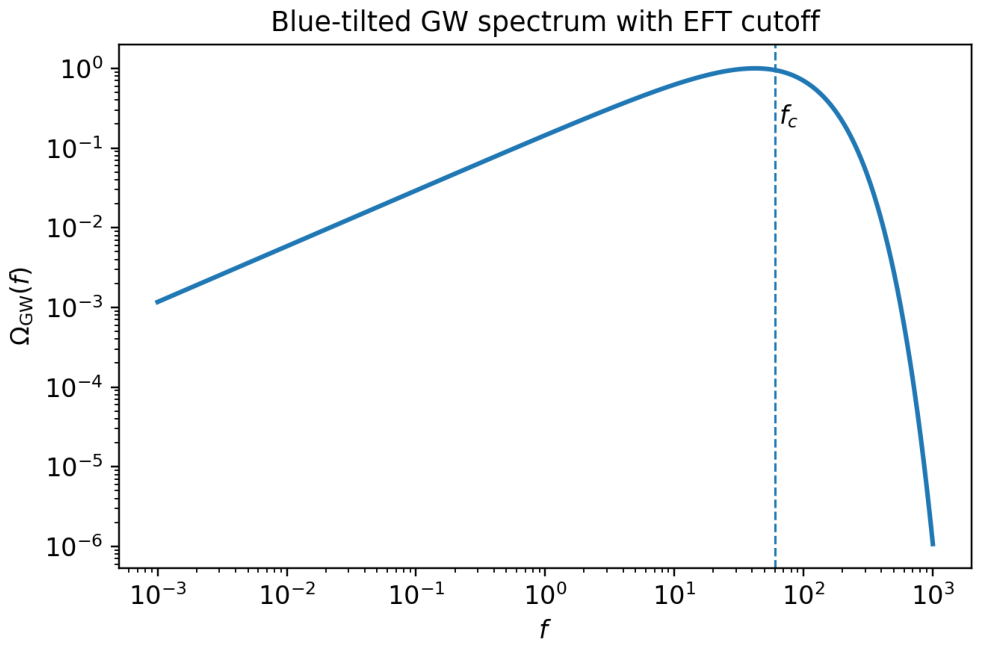
This predicts a characteristic blue-tilted spectrum with high-frequency suppression. Such features are actively investigated in gravitational-wave cosmology and may be probed by current and future detectors, including LIGO/Virgo/KAGRA and space-based missions such as LISA [18,19].
Figure 4.
Schematic stochastic gravitational-wave spectrum in curvature memory gravity. The spectrum exhibits a blue tilt at intermediate frequencies due to curvature-flow regulation, followed by an exponential suppression at high frequencies associated with the EFT cutoff.
Figure 4.
Schematic stochastic gravitational-wave spectrum in curvature memory gravity. The spectrum exhibits a blue tilt at intermediate frequencies due to curvature-flow regulation, followed by an exponential suppression at high frequencies associated with the EFT cutoff.
(ii) Smooth Deviations from CDM
The modified Friedmann dynamics imply that deviations from standard cosmological evolution arise only near the regulated curvature regime,
while GR behaviour is recovered for
This results in a smooth interpolation between CDM and regulated dynamics, rather than abrupt departures from standard cosmology. Such deviations may be constrained through precision probes of the expansion history, including CMB anisotropies and large-scale structure measurements [20].
(iii) Signatures of a Nonsingular Bounce
The regulated bounce may leave imprints on long-wavelength perturbations, including:
- suppression of long-wavelength tensor modes,
- modified transfer of perturbations across the bounce,
- absence of divergences in mode evolution.
These effects arise from smooth curvature evolution and may be indirectly constrained through primordial perturbation analyses and CMB observations.
(iv) EFT-Induced Cutoff in the GW Spectrum
As a consequence of the EFT nature of the theory, high-frequency gravitational-wave modes are naturally suppressed. This introduces a physically motivated cutoff scale in the spectrum, reflecting the domain of validity of the effective description rather than arbitrary model assumptions.
(v) Implications for Early Structure Formation
The presence of a regulated high-curvature phase may modify the initial conditions for structure formation. In particular, smoother early-time dynamics and modified perturbation evolution could influence the abundance of early massive structures.
Summary
The framework predicts a coherent set of observational signatures:
- blue-tilted primordial GW spectrum with EFT cutoff,
- curvature-flow induced damping of tensor modes,
- controlled deviations from CDM,
- bounce-induced modifications of perturbations,
- potential impact on early structure formation.
These predictions provide concrete targets for observational tests using gravitational-wave detectors (LIGO/Virgo/KAGRA, LISA), CMB experiments (Planck), and high-redshift surveys (JWST). They establish a direct connection between curvature memory effects and potentially measurable cosmological signals.
3.7. Quantitative Gravitational-Wave Signature of Dual Regulation
A direct and robust phenomenological consequence of the dual regulation mechanism arises in the tensor sector. As established in the perturbative analysis, tensor modes remain described by two propagating polarizations, while their evolution is modified by the presence of geometric memory.
At quadratic order, tensor perturbations satisfy an effective evolution equation of the form
where encodes the curvature-memory contribution. Importantly, this term modifies the damping of tensor modes without introducing additional propagating degrees of freedom, consistently with the EFT structure.
- Effective stiff-like phase and blue tilt.
In the high-curvature regime, the bounded-curvature sector dynamically regulates the growth of curvature invariants. In this phase, the effective dynamics can mimic a stiff-like background with equation-of-state parameter
over a finite interval of the evolution. Tensor modes re-entering during this regulated phase therefore experience a blue-tilted amplification.
This leads to a stochastic gravitational-wave spectrum that can be parameterized at the EFT level as
where:
- is the amplitude at a reference frequency ,
- is an effective blue tilt generated during the regulated phase,
- is a cutoff frequency associated with the EFT boundary.
Dependence on EFT Parameters
At the level of the effective theory, the spectral shape is controlled by the parameters :
- the bounded-curvature sector enhances the duration and stiffness of the regulated phase, increasing the effective tilt ,
- the geometric memory (slip) term contributes through , damping high-frequency modes and lowering the effective cutoff scale ,
- in the GR recovery regime, , and standard tensor propagation is restored.
BBN Consistency Bound
The total tensor energy density must satisfy the standard BBN constraint,
which restricts the duration and amplitude of the stiff-like phase. In the present framework, this bound is dynamically satisfied through the combined effect of the EFT cutoff and curvature-memory damping.
Phenomenological Signature
The resulting prediction is therefore not an arbitrarily enhanced tensor signal, but a characteristic spectral shape:
- a blue-tilted enhancement over an intermediate frequency band,
- followed by exponential suppression near the EFT cutoff scale.
This distinguishes curvature memory gravity from standard slow-roll inflation (typically scale-invariant or red-tilted) and from purely geometric conformal scenarios. The prediction provides a concrete observational handle that can be tested using stochastic gravitational-wave searches across PTA, space-based interferometers, and BBN-sensitive frequency ranges.
Scope
This result should be interpreted strictly within the EFT-consistent domain. The spectrum (21) is not claimed to represent a UV-complete prediction, but rather a controlled low-energy signature of the dual regulation mechanism.
4. Discussion
4.1. Structural Novelty
The central novelty of the present framework lies in the dual regularization structure implemented through the combined action of a bounded-curvature kernel (sinR-type) and a geometric slip term.
While higher-curvature corrections and limiting-curvature mechanisms have been studied previously in various contexts [7,9], and dissipative or nonequilibrium extensions of gravitational dynamics have been explored from thermodynamic perspectives [1,2], these ingredients are typically considered independently.
Here, by contrast, two conceptually distinct mechanisms are integrated within a single covariant EFT structure:
- The bounded-curvature kernel dynamically limits the amplitude of curvature invariants, preventing ultraviolet divergence within the EFT regime.
- The geometric slip term regulates the flow of curvature by correlating curvature with its time variation, producing dynamical ultraviolet damping without introducing nonlocality or additional propagating degrees of freedom.
This dual structure yields a coherent geometric principle: curvature growth is algebraically bounded, and curvature evolution is dynamically smoothed. The resulting dynamics remains second order in time derivatives and admits a well-defined ghost-free parameter domain, as established by the Hamiltonian and perturbative analyses.
A further structural aspect is the emergence of a relational time variable that becomes monotonic precisely in the presence of the slip mechanism. The arrow of time therefore arises as an effective property of solutions, rather than from explicit symmetry breaking at the level of the action. This distinguishes the framework from approaches in which irreversibility is introduced through explicit nonlocality, matter entropy production, or fundamental CPT violation [3,4].
Taken together, these features define a unified effective extension of General Relativity in which singularity softening, ultraviolet damping, ghost-free propagation, and emergent temporal ordering arise from a single coherent geometric construction within a controlled EFT regime.
4.2. Theoretical Classification of Curvature Memory Gravity
The structure of the framework developed in this work allows it to be placed within the broader landscape of modified gravitational theories. While curvature memory gravity shares certain features with several established approaches, it also exhibits distinctive structural properties that differentiate it from standard constructions.
4.2.1. Relation to Higher–Curvature EFT Gravity
The present framework naturally belongs to the class of effective gravitational theories constructed through controlled higher–curvature operators. In this sense, it follows the well-established viewpoint that General Relativity can be interpreted as the leading term in a gravitational effective field theory expansion [5,6].
Within this framework, additional curvature contributions are understood as higher-order corrections that become relevant near a characteristic cutoff scale, rather than as fundamental modifications of the gravitational interaction.
Curvature memory gravity is consistent with this perspective, as the regulatory geometric contributions arise within a controlled EFT expansion and do not introduce uncontrolled higher-derivative instabilities, in agreement with general EFT expectations.
4.2.2. Relation to Limiting Curvature Frameworks
The bounded curvature behaviour exhibited by the theory places it conceptually close to limiting-curvature approaches, in which singularities are avoided through dynamical curvature saturation [7,12].
A key distinction, however, is that in the present framework curvature regulation does not arise from a single limiting constraint, but from the combined action of bounded curvature and geometric memory. This dual structure provides an additional level of dynamical control, extending beyond models in which only curvature amplitudes are regulated.
4.2.3. Relation to Scalar–Tensor EFT Constructions
Although the framework is not formulated as a conventional scalar–tensor theory, its effective structure shares similarities with ghost-free higher-derivative EFT constructions such as Horndeski and DHOST theories [23,24].
In particular, the theory preserves:
- covariance
- controlled higher-curvature corrections
- absence of additional ghost degrees of freedom
- EFT consistency
However, unlike many scalar–tensor constructions, the present framework does not rely on additional propagating scalar degrees of freedom. Instead, the regulatory behaviour is implemented directly through geometric memory effects, which modify the effective dynamics without enlarging the field content.
4.2.4. Distinguishing Structural Features
Taken together, curvature memory gravity may be characterized by the following defining properties:
- covariant effective gravitational construction
- local geometric dynamics
- ghost–free structure
- dual curvature regulation mechanism
- smooth GR recovery at low curvature
These features place the framework within the class of regulated curvature EFT theories, while distinguishing it from purely phenomenological modifications or models requiring additional dynamical fields.
4.2.5. Framework Positioning
From a theoretical perspective, curvature memory gravity may therefore be viewed as:
A covariant effective gravitational framework implementing dual geometric regulation of curvature amplitude and curvature evolution.
This classification clarifies the theoretical identity of the framework and situates it within the broader context of controlled gravitational EFT constructions. It also highlights its role as a minimal extension of GR in which regulatory behaviour arises from geometric structure rather than additional field content.
4.3. Geometric Memory and Gravitational Entropy
The presence of curvature memory suggests a possible connection between the dynamical evolution of spacetime geometry and information–theoretic concepts. Since memory effects encode dependence on curvature evolution, they naturally introduce a notion of accumulated geometric information.
This motivates interpreting curvature memory as a form of geometric information stored in the evolution of spacetime, within the general framework of thermodynamic and emergent approaches to gravity [16].
4.3.1. Geometric Memory as Gravitational Information
In dynamical systems, memory effects imply that the state of the system depends not only on instantaneous variables but also on aspects of its evolution history. In the present framework, the geometric slip term introduces precisely such behaviour at the level of curvature evolution.
This suggests the interpretation:
Geometric memory encodes information about the dynamical history of spacetime curvature.
4.3.2. Irreversibility from Memory Accumulation
Because curvature memory depends on the evolution of curvature, it may introduce an effective irreversibility in the dynamical evolution. In particular, the presence of damping associated with curvature flow suggests that geometric evolution may exhibit preferred dynamical directions.
This motivates the interpretation:
Irreversibility may arise from the accumulation of geometric memory.
In this view, the effective arrow of time discussed previously may be understood as emerging from the growth of geometric memory rather than from fundamental symmetry breaking.
This perspective is conceptually related to thermodynamic interpretations of gravity, where spacetime dynamics are associated with entropy production and coarse-grained evolution [1,2,16]. Related ideas also appear in approaches where temporal ordering emerges from correlations or relational observables [3,4].
4.3.3. Bounce as Memory Saturation
The regulated bounce appearing in the framework may also admit an interpretation in terms of memory effects. During contraction phases curvature evolution increases and geometric memory accumulates. Near the regulated regime this accumulation may become dynamically significant.
This suggests the possibility that the bounce corresponds to a regime where curvature regulation prevents further effective growth of geometric memory.
Conceptually this may be expressed as:
The nonsingular bounce may correspond to a saturation of geometric memory.
4.3.4. Effective Geometric Entropy Interpretation
Taken together, these observations suggest that curvature memory may admit an interpretation analogous to an effective geometric entropy functional:
where denotes a functional measuring the accumulated geometric memory.
This relation should be understood as a structural analogy rather than a microscopic identification. It suggests that curvature memory gravity may provide a geometric realization of thermodynamic ideas in gravitational dynamics without requiring additional statistical assumptions.
Such an interpretation is aligned with broader perspectives in which spacetime dynamics are linked to information-theoretic or entropic principles, while remaining compatible with an EFT description of gravity [1,16].
These considerations provide a conceptual bridge between curvature regulation and thermodynamic interpretations of spacetime evolution while remaining fully within the EFT philosophy of the framework.
4.3.5. Geometric Second Law and Emergent Time
The presence of geometric memory in curvature memory gravity naturally suggests the existence of a monotonic quantity governing the evolution of spacetime, analogous to entropy in nonequilibrium thermodynamics.
We therefore propose the existence of a geometric memory functional
constructed from curvature invariants and their dynamical evolution, such that along physically admissible solutions:
This relation may be interpreted as a geometric analogue of the second law of thermodynamics, emerging from the intrinsic dynamics of the gravitational sector rather than from matter degrees of freedom.
Geometric Memory as Dynamical Information
The geometric slip term introduces explicit dependence on curvature evolution, implying that spacetime dynamics are not purely local in phase space but exhibit path dependence. As a consequence, the state of the system encodes not only instantaneous geometric data but also information about its dynamical history.
This motivates the interpretation:
Geometric memory encodes accumulated information about the evolution of spacetime curvature.
Irreversibility and the Arrow of Time
If the geometric memory functional is monotonic, it defines a natural ordering of physical solutions. In this sense, the arrow of time emerges dynamically from the accumulation of geometric memory:
This provides a purely geometric origin for irreversibility, without requiring explicit breaking of time-reversal symmetry at the level of the action. The resulting picture is aligned with relational and thermodynamic notions of time, such as the Page–Wootters mechanism and the thermal time hypothesis [3,4].
In this framework, time is not a fundamental external parameter but emerges as the ordering parameter associated with increasing geometric complexity.
Bounce as Memory Saturation
The nonsingular bounce arising in the dual regulation framework may be reinterpreted in terms of geometric memory. During the contracting phase, curvature growth is accompanied by accumulation of memory. As the system approaches the regulated high-curvature regime, the memory functional may approach a critical value:
This suggests that the bounce corresponds to a saturation of geometric memory, beyond which further contraction becomes dynamically suppressed. The transition to expansion can therefore be viewed as a response of the system to the buildup of geometric memory, rather than as an externally imposed boundary condition.
Such behaviour is reminiscent of saturation phenomena in nonequilibrium systems, where accumulated deformation or information triggers a qualitative change in dynamics.
Cosmological Irreversibility and Path Dependence
Because the memory functional depends on the full dynamical history, two spacetimes with identical instantaneous geometry but different past evolution are physically inequivalent. This leads to a form of cosmological irreversibility:
Spacetime evolution is fundamentally path-dependent due to geometric memory.
In this sense, curvature memory gravity implies a principle of cosmological non-repetition: distinct histories correspond to distinct physical states, even when local geometric observables coincide.
Towards a Partial Definition of the Geometric Memory Functional
A natural EFT-level realization of the geometric memory functional can be introduced along homogeneous cosmological trajectories as
where f is a positive semi-definite scalar function measuring the accumulated dynamical activity of curvature flow.
Since the slip sector regulates the evolution of the Hubble rate, a minimal choice consistent with the structure of the effective equations is
so that
This definition is positive by construction and directly measures the accumulated departure from equilibrium geometric evolution. In particular, it assigns larger memory to phases in which curvature flow is dynamically active, while remaining compatible with the EFT scaling of the theory.
A still simpler candidate, directly tied to the slip-induced damping sector, is
which may be interpreted as the minimal geometric memory functional associated with regulated curvature flow.
At this stage, should be understood as an EFT-level diagnostic functional rather than as a unique microscopic definition. Its role is to capture the path dependence induced by geometric memory and to motivate the conjectural monotonicity condition
for physically admissible solutions within the EFT regime.
The presence of curvature memory in the effective dynamics suggests the existence of a geometric quantity that accumulates along cosmological evolution. This motivates the introduction of a geometric memory functional,
which characterizes the integrated effect of curvature evolution.
Within the EFT regime, where the slip contribution induces effective damping of curvature flow, it is natural to expect that this functional evolves monotonically for physically admissible solutions:
This suggests a geometric analogue of the second law of thermodynamics (conjectural). In contrast to conventional entropy, the functional M does not rely on a microscopic statistical definition, but instead reflects macroscopic irreversibility emerging from curvature-dependent dynamics.
While a general proof of monotonicity is beyond the scope of the present work, both the structure of the effective equations and numerical results indicate that such behaviour is realized within the EFT-consistent domain.
If the geometric memory functional is monotonic, it naturally defines an ordering of physical configurations. This suggests that time itself may be interpreted as an emergent parameter associated with the accumulation of geometric memory.
In this perspective, the arrow of time is not imposed externally, but arises dynamically from the evolution of spacetime geometry. The resulting irreversibility is therefore a property of solutions rather than a consequence of explicit symmetry breaking in the action.
This viewpoint is conceptually related to relational and thermodynamic approaches to time [3,4], while being grounded here in the geometric structure of the effective theory.
More generally, this framework suggests that the arrow of time may be linked to geometric memory rather than to entropy alone, providing a possible bridge between gravitational dynamics and information-theoretic interpretations of spacetime evolution.
4.4. Geometric Memory, Information and Thermodynamic Interpretation
The presence of curvature memory suggests a natural bridge between spacetime dynamics, information theory, and thermodynamic concepts. In the present framework, the evolution of geometry depends not only on instantaneous curvature invariants but also on their dynamical history, as encoded by the geometric memory contribution. This feature places curvature memory gravity within the broader class of non-Markovian dynamical systems.
Geometric Memory as Information
In systems with memory, the physical state cannot be specified solely by instantaneous variables; it also depends on the past evolution. In the present context, this implies that spacetime geometry carries information about its own dynamical history.
This motivates the interpretation:
Geometric memory encodes information about the past evolution of spacetime curvature.
Importantly, this interpretation arises without introducing additional microscopic degrees of freedom. Instead, it emerges from the effective geometric dynamics within a controlled EFT framework [5,14]. In this sense, curvature memory provides a geometric realization of information storage at the level of spacetime itself.
Irreversibility and Memory Accumulation
The dependence on curvature history implies that the dynamical evolution is effectively non-reversible at the level of solutions. While the underlying action remains covariant and time-reversal invariant, the presence of geometric memory induces an effective asymmetry in the evolution.
Geometric Second Law
The structure of the theory motivates the introduction of a geometric memory functional,
which characterizes the accumulated effect of curvature evolution along dynamical trajectories.
Within the EFT regime, where curvature memory induces effective damping in the evolution equations, it is natural to hypothesize that this functional evolves monotonically for physically admissible solutions:
This condition may be interpreted as a geometric analogue of the second law of thermodynamics. Unlike standard entropy, M is not defined microscopically, but instead captures macroscopic irreversibility arising from curvature-dependent dynamics.
While a general proof of monotonicity is beyond the scope of the present work, numerical solutions and the structure of the slip-induced damping support this behaviour within the EFT-consistent domain.
Emergent Temporal Ordering
If the geometric memory functional evolves monotonically, it provides a natural ordering of physical solutions. This suggests that time may be interpreted as an emergent parameter associated with the accumulation of geometric memory.
In this perspective, the arrow of time is not imposed externally but arises dynamically from the evolution of spacetime geometry. The effective irreversibility is therefore a property of solutions rather than a consequence of explicit symmetry breaking in the action.
This viewpoint is conceptually related to relational and thermodynamic approaches to time [3,4], while being rooted here in the geometric structure of the effective theory.
More generally, this suggests that the arrow of time may be linked to geometric memory rather than to entropy alone, providing a possible bridge between gravitational dynamics and information-theoretic interpretations of spacetime evolution.
Bounce as Memory Saturation
The nonsingular bounce predicted by the framework may also be interpreted in terms of memory effects. During contraction, curvature evolution increases and geometric memory accumulates. As the regulated high-curvature regime is approached, this accumulation becomes dynamically significant.
This suggests that the bounce may correspond to a regime in which geometric memory approaches a critical value, effectively saturating the allowed curvature evolution within the EFT domain. The transition from contraction to expansion can then be viewed as a dynamical response to this saturation.
Conceptual Synthesis
Taken together, these considerations suggest a unified interpretation:
- curvature memory encodes geometric information,
- memory accumulation induces effective irreversibility,
- irreversibility defines an emergent temporal ordering,
- high-curvature transitions correspond to memory saturation.
This structure provides a conceptual bridge between geometry, information, and thermodynamics, while remaining fully consistent with a covariant EFT description of gravity.
Rather than introducing entropy as an external ingredient, the framework suggests that thermodynamic-like behaviour may emerge directly from the geometric dynamics of spacetime.
4.5. Geometric Memory and Entropy
The introduction of curvature memory naturally suggests a connection between spacetime dynamics and information-theoretic concepts. In particular, the dependence of the dynamics on curvature history implies that the state of the system cannot be fully characterized by instantaneous geometric variables alone.
This observation motivates interpreting geometric memory as a form of effective gravitational information stored in the evolution of spacetime.
Memory as Geometric Information
In standard General Relativity, the state of the system at a given time is fully determined by local geometric data. By contrast, in the presence of curvature memory, the evolution becomes history-dependent: the effective dynamics depend on the accumulated curvature evolution.
From the perspective of dynamical systems, this corresponds to a departure from Markovian behaviour. The system retains information about its past trajectory, and this information is encoded in the geometric sector itself.
In this sense, curvature memory may be interpreted as storing geometric information:
Entropy and Irreversibility
The presence of geometric memory introduces an effective irreversibility in the evolution. Since the system depends on its history, time-reversed trajectories are not dynamically equivalent at the level of solutions, even though the underlying action remains time-symmetric.
This behaviour is analogous to thermodynamic systems, where irreversibility is associated with entropy production. In emergent gravity approaches, spacetime dynamics have been related to thermodynamic relations and entropy balance [1,2,16].
Within the present framework, however, irreversibility arises from geometric memory rather than from matter entropy alone.
Geometric Entropy Functional
These considerations motivate the introduction of an effective geometric entropy functional,
where denotes the geometric memory functional defined along cosmological trajectories.
This relation should be understood as a structural correspondence rather than a microscopic identification. It suggests that geometric memory plays a role analogous to entropy in organizing the dynamical evolution of spacetime.
4.5.0.8. Geometric Second Law
If the memory functional evolves monotonically,
then one obtains a geometric analogue of the second law of thermodynamics:
This formulation does not rely on a statistical definition of entropy, but instead reflects the macroscopic irreversibility induced by curvature-flow regulation.
4.5.0.9. Arrow of Time from Geometry
Under this interpretation, the arrow of time may be associated with the growth of geometric memory (or equivalently geometric entropy). Time is not a fundamental parameter but an emergent ordering associated with increasing geometric complexity.
Conceptual Synthesis
Taken together, these results suggest the following correspondence:
curvature memory ⟷ geometric information ⟷ effective entropy.
This provides a unified interpretation in which:
- geometric memory encodes the dynamical history of spacetime,
- irreversibility arises from memory accumulation,
- entropy-like behaviour emerges from geometric dynamics,
- the arrow of time is linked to the growth of geometric memory.
This perspective remains conjectural at the level of a precise microscopic definition, but it establishes a coherent conceptual bridge between curvature regulation, information, and thermodynamic interpretations of gravity within the EFT regime.
4.6. Geometric Memory, Second Law, and Bounce Dynamics
The presence of curvature memory in the effective dynamics suggests that spacetime evolution may admit a thermodynamic interpretation in which geometric quantities play the role of internal variables. In particular, the dependence of the dynamics on curvature history naturally motivates the introduction of a geometric memory functional.
Geometric Memory Functional
At the level of homogeneous cosmological trajectories, a natural EFT-level realization of geometric memory may be defined as
where f is a positive semi-definite scalar function characterizing the accumulated activity of curvature evolution.
A minimal choice consistent with the structure of the effective equations is
so that
This functional measures the accumulated departure from equilibrium geometric evolution and encodes the path dependence induced by curvature memory. It should be understood as an EFT-level diagnostic rather than a unique microscopic definition.
Geometric Second Law (Conjectural)
The structure of the memory sector suggests a natural monotonicity condition for physically admissible solutions within the EFT regime:
This condition may be interpreted as a geometric analogue of the second law of thermodynamics. Unlike standard entropy, M does not rely on a microscopic statistical definition, but instead reflects macroscopic irreversibility arising from curvature-flow regulation.
At this stage, this statement should be regarded as a physically motivated conjecture rather than a proven theorem.
Emergent Temporal Ordering
The monotonic behaviour of the geometric memory functional provides a natural ordering of cosmological solutions. This suggests that physical time may be identified with the parameter that orders the growth of geometric memory.
In this perspective, time is not a fundamental external variable but an emergent quantity associated with the accumulation of geometric information. The arrow of time therefore arises dynamically from the evolution of spacetime itself.
Bounce as Saturation of Geometric Memory (Conjectural)
Within the dual regulation framework, the nonsingular bounce may be reinterpreted as a consequence of geometric memory accumulation and saturation.
During the contracting phase, curvature invariants increase and the slip sector regulates their evolution, leading to a progressive growth of the memory functional M. A natural conjecture is that the bounce occurs when the system approaches a critical memory threshold,
beyond which continued contraction would be incompatible with the stability conditions defining the EFT domain.
At this point, the dual regulation mechanism enforces a transition in the dynamical evolution: the bounded-curvature sector limits further growth of curvature invariants, while the geometric memory sector suppresses additional curvature-flow amplification. The combined effect produces a reversal of the expansion rate,
and the onset of an expanding phase.
In this interpretation, the bounce is not merely a kinematic feature of modified Friedmann equations, but a dynamical transition driven by geometric self-regulation.
This behaviour is analogous to saturation phenomena in nonequilibrium systems, where the accumulation of internal variables triggers phase transitions. Here, geometric memory plays the role of an internal state variable encoding the history of curvature evolution.
The resulting picture may be summarized schematically as
While this interpretation remains conjectural, it provides a unified physical mechanism linking curvature regulation, irreversibility, and nonsingular cosmological dynamics.
Conceptual Implications
Taken together, these elements suggest that curvature memory gravity may admit a thermodynamic interpretation in which:
- geometric memory encodes information about curvature history,
- irreversibility arises from memory accumulation,
- time emerges as an ordering parameter of geometric evolution,
- nonsingular cosmological transitions correspond to memory saturation.
This perspective provides a conceptual bridge between effective gravitational dynamics and thermodynamic interpretations of spacetime, while remaining fully within the EFT framework of the present construction.
4.7. Dual Regulation: Mechanism and Physical Principle
The numerical and analytical analysis presented in this work indicates that the two regulatory mechanisms introduced in the framework act in complementary and structurally distinct ways in the high-curvature regime. Together, they define a dual regulation structure governing spacetime dynamics within a controlled effective field theory (EFT) description of gravity [5,14].
4.7.1. Bounded-Curvature Saturation
The bounded-curvature (sinR-type) operator regulates the amplitude of curvature invariants as the evolution approaches high-density phases. In the contracting branch, the effective curvature contribution generated by the bounded kernel becomes dynamically dominant before curvature invariants reach the EFT cutoff scale.
As a consequence, curvature invariants such as the Ricci scalar and the Kretschmann scalar remain finite throughout the evolution. This behaviour parallels the ultraviolet softening observed in quadratic curvature models [7,9] and in certain quantum-corrected cosmological scenarios [12], while arising here within a purely classical EFT truncation.
The sinR mechanism therefore provides algebraic control over curvature growth, limiting the magnitude of curvature invariants without introducing higher-order instabilities or additional matter components.
4.7.2. Curvature-Flow Regulation from Geometric Memory
While the bounded-curvature sector controls curvature amplitude, the geometric memory contribution regulates curvature evolution. The derivative curvature operator correlates the expansion rate with its time derivative, effectively suppressing rapid variations in the Hubble parameter.
Comparing solutions with identical initial conditions but differing in the presence of the slip term shows that, in its absence, the high-curvature phase exhibits sharper transitions and enhanced curvature gradients. When the slip contribution is included, the evolution becomes smoother: rapid variations of the expansion rate are damped and the approach to the bounce is dynamically softened.
This behaviour may be interpreted as an effective geometric damping mechanism acting on curvature evolution. Similar smoothing effects have been discussed in semiclassical and thermodynamic approaches to gravity [1,2,16]. In the present framework, however, the mechanism arises from a local covariant operator and does not require nonlocal dynamics or stochastic sources.
4.7.3. Geometric Feedback Structure
Taken together, these two mechanisms define a geometric feedback system in which curvature growth activates regulatory contributions that in turn moderate further evolution.
The complementary roles of the two sectors may be summarized as:
- the higher-curvature sector limits the magnitude of curvature invariants,
- the geometric memory sector regulates the rate of curvature evolution.
In this sense, the nonsingular bounce does not arise from a single fine-tuned contribution, but from the coherent interplay between curvature saturation and curvature-flow regulation within the EFT regime.
4.7.4. Dual Regulation Principle
The combined behaviour observed throughout the analysis may be summarized by the following principle:
Spacetime curvature is dynamically regulated both in amplitude and in its evolution through geometric memory effects.
This principle provides a compact characterization of the framework and distinguishes it from conventional higher-curvature modifications in which only curvature amplitudes are controlled.
4.7.5. Framework Identity
The coexistence of amplitude regulation and flow regulation represents the defining structural property of curvature memory gravity. While many modified gravity models implement mechanisms that limit curvature growth, fewer frameworks explicitly regulate curvature evolution.
From this perspective, curvature memory gravity may be viewed as belonging to a class of self-regulating gravitational EFTs, in which both geometric magnitude and dynamical evolution are constrained within a controlled regime.
This motivates the following characterization:
Curvature memory gravity is a covariant effective gravitational framework defined by the dual regulation of curvature amplitude and curvature evolution.
This definition clarifies the conceptual identity of the theory and situates it within the broader class of regulated and emergent gravitational frameworks.
4.8. Dynamical Phase Structure of Curvature Memory Gravity
The combined action of bounded curvature and geometric memory suggests that curvature memory gravity may be naturally interpreted as defining a dynamical phase structure in curvature space. Within this picture, different cosmological regimes correspond to distinct dynamical domains determined by the relative importance of curvature amplitudes and memory effects.
Such a phase-based description is consistent with the general EFT perspective, in which different dynamical regimes emerge as different operators become relevant near the cutoff scale [5,6]. It provides a useful framework to organize the physical behaviour of the theory.
4.8.1. Dimensionless Curvature Parameter
To characterize the different regimes, it is convenient to introduce a normalized curvature variable:
where denotes the effective cutoff scale of the theory.
Similarly, one may introduce an effective parameter describing the strength of geometric memory effects:
These quantities provide a schematic parametrization of the dynamical regimes of the framework.
4.8.2. GR Regime
In the low-curvature limit,
curvature memory effects become negligible and the theory smoothly reduces to standard GR behaviour.
This regime is characterized by:
- negligible memory effects
- standard cosmological evolution
- conventional tensor propagation
This confirms the consistency of the framework with well-tested gravitational physics in low-curvature environments. The dynamical regimes are summarized schematically in Figure 5.
4.8.3. Regulated EFT Regime
When curvature approaches the EFT domain,
geometric memory effects become dynamically relevant and regulate curvature evolution.
This regime is characterized by:
- bounded curvature behaviour
- regulated curvature flow
- modified tensor evolution
- smooth background dynamics
This domain represents the characteristic regime of curvature memory gravity, where higher-curvature EFT corrections play a significant role without spoiling consistency [5].
4.8.4. Bounce Regime
Near the maximum regulated curvature, memory effects may become dominant and produce a transition between contracting and expanding phases.
This regime may be characterized schematically by:
In this domain the framework predicts:
- nonsingular bounce behaviour
- smooth transition between dynamical phases
- suppression of pathological curvature growth
4.8.5. EFT Boundary
At curvature scales approaching the cutoff,
the effective description approaches the limits of its regime of validity. In this region, additional higher-order corrections may become relevant.
This behaviour reflects the expected limitations of any EFT construction and does not signal a breakdown of the underlying regulatory mechanism.
4.8.6. Phase Diagram Interpretation
Taken together, these regimes suggest that curvature memory gravity defines a dynamical phase structure interpolating between GR behaviour and regulated high-curvature dynamics.
Conceptually, the framework may be viewed as describing a flow through the sequence:
GR regime → regulated EFT regime → bounce regime
This structure is reminiscent of phase transitions in effective theories, where different operators dominate in different dynamical domains [6].
4.8.7. Conceptual Role of the Phase Structure
The dynamical phase structure provides a unifying interpretation of the behaviour observed in the solutions and clarifies how the framework connects standard GR physics with regulated high-curvature dynamics while preserving EFT consistency.
It also reinforces the interpretation of curvature memory gravity as a self-regulating gravitational framework characterized by controlled transitions between dynamical regimes, in which both curvature amplitude and curvature flow are dynamically constrained.
4.9. Comparison with Alternative Regularization Frameworks
The present construction can be situated within the broader landscape of modified-gravity and singularity-resolution approaches. It is therefore important to clarify both commonalities and structural differences with established frameworks.
(i) and Starobinsky-Type Models
Quadratic curvature extensions such as the Starobinsky model introduce additional scalar degrees of freedom arising from higher-curvature terms [7,9]. These models regularize ultraviolet behavior through polynomial corrections in R, and the scalar mode plays a dynamical role.
By contrast, the present framework incorporates a bounded-curvature kernel that effectively saturates curvature growth within the EFT regime, while the slip term modifies the background flow without introducing additional propagating modes beyond the single scalar curvature mode already present in controlled higher-curvature EFTs. The emphasis here is on dual regularization (amplitude control + flow damping), rather than solely on polynomial curvature corrections.
(ii) Higher-Derivative and Ostrogradsky-Sensitive Theories
Generic higher-derivative gravity models may suffer from Ostrogradsky instabilities [11]. In contrast, the present construction is engineered to preserve second-order equations of motion in the EFT regime, and a Hamiltonian constraint analysis confirms the absence of additional ghost-like degrees of freedom.
(iii) Loop-Inspired and Nonlocal Regularizations
Loop quantum cosmology achieves singularity resolution through nonperturbative modifications of the Friedmann equation and effective holonomy corrections [25]. Nonlocal gravity models achieve regularization through infinite-derivative operators.
The present approach differs in remaining strictly local and covariant at the level of the action, with regularization implemented through bounded curvature operators within a derivative expansion. No fundamental nonlocality is introduced.
(iv) Mimetic and Scalar-Tensor Constructions
Mimetic gravity and related scalar-tensor models introduce additional scalar degrees of freedom to generate effective dark components or regularized cosmologies. In some cases, Hamiltonian analyses reveal potential instabilities [26].
In the present framework, no extra independent scalar field is introduced. The curvature memory effect arises from geometric operators already contained within the EFT extension.
Comparative Summary
For clarity, the structural distinctions are summarized in Table 4.
Geometric Memory, CCC Comparison, and Formalization of the Memory Functional
The interpretation of curvature memory as a source of effective irreversibility invites comparison with proposals in which cosmological time asymmetry arises from global geometric structure. A notable example is conformal cyclic cosmology (CCC), proposed by Penrose [17], where successive cosmological aeons are connected through conformal rescaling and low-entropy initial conditions are imposed geometrically.
While both approaches address the origin of temporal asymmetry, the present framework differs in several key aspects:
- In CCC, temporal ordering is imposed through global conformal boundary conditions relating successive aeons.
- In curvature memory gravity, temporal ordering emerges dynamically from local curvature evolution.
- CCC relies on a global conformal structure, whereas the present framework remains local and covariant at the level of the effective action.
In this sense, curvature memory gravity provides a complementary mechanism in which the arrow of time is not imposed by boundary conditions but arises from the dynamical accumulation of geometric memory.
Towards a Formal Definition of Geometric Memory
To make this idea more precise, we introduce a geometric memory functional defined along cosmological trajectories. At the EFT level, a natural class of candidates is given by functionals of curvature invariants and their evolution, for instance:
where is a scalar function encoding curvature-flow contributions.
A minimal realization consistent with the structure of the slip term is
which is positive definite and directly measures curvature-flow activity.
More generally, one may interpret M as a measure of the deviation of the geometry from equilibrium evolution. In this sense, geometric memory quantifies the accumulated dynamical deformation of spacetime.
Geometric Second Law (Conjectural)
The existence of a memory functional suggests the conjecture:
for physically admissible solutions within the EFT regime.
This condition defines a geometric analogue of the second law of thermodynamics. Unlike standard entropy, M does not rely on microscopic degrees of freedom, but instead encodes macroscopic irreversibility arising from curvature-flow regulation.
Relation to Information and Irreversibility
The dependence of the dynamics on curvature history implies that the state of the system is not fully specified by instantaneous variables. Instead, geometric evolution carries information about its past trajectory.
From a dynamical systems perspective, this corresponds to a departure from Markovian behaviour, with geometric memory acting as an effective information reservoir. In this sense, M may be interpreted as a measure of stored geometric information.
Bounce as Memory Saturation
Within this framework, the nonsingular bounce may be reinterpreted as a regime in which geometric memory approaches a critical value:
At this point, further contraction would require an increase in curvature flow incompatible with the regulatory structure of the theory. The system therefore transitions dynamically to an expanding phase.
This suggests a phase-like interpretation of the bounce:
contraction → memory accumulation → saturation → expansion.
Conceptual Implications
Taken together, these results suggest a unified picture in which:
- geometric memory provides a dynamical origin of the arrow of time,
- cosmological evolution is intrinsically path-dependent,
- the Big Bang is replaced by a regulated transition associated with memory saturation,
- temporal asymmetry emerges without explicit symmetry breaking.
This formulation remains conjectural at the level of a precise definition of , but it provides a consistent and geometrically grounded framework linking curvature dynamics, irreversibility, and cosmological evolution within the EFT regime.
4.10. Phenomenological Outlook
The phenomenological implications of the present framework are discussed at a qualitative level. The modified early-Universe dynamics induced by dual curvature regulation may affect the timing and efficiency of structure formation relative to standard CDM cosmology.
In particular, the presence of a nonsingular high-curvature phase and the associated ultraviolet damping may modify the initial conditions for perturbation growth, potentially allowing for earlier halo formation and altered growth histories. Such effects are of interest in light of recent high-redshift observations, including early galaxy detections with the James Webb Space Telescope [21,27,28].
Although no quantitative confrontation with observational data is performed here, the framework provides a theoretically consistent setting in which early structure formation may be accommodated without introducing additional matter components.
The framework is, in principle, falsifiable. Precise predictions for scalar and tensor perturbation spectra, growth-rate modifications, and signatures in stochastic gravitational wave backgrounds constitute natural next steps. In particular, curvature-flow regulation may leave observable imprints in primordial tensor spectra, as explored in gravitational-wave cosmology [19].
Future observational constraints on high-redshift structure, cosmic expansion history, and primordial perturbations will therefore provide a direct test of curvature-memory dynamics within the EFT regime.
Table 5.
Key phenomenological predictions of curvature memory gravity.
| Observable | Prediction |
|---|---|
| Primordial GW spectrum | Possible blue tilt in regulated regime |
| Stochastic GW background | High-frequency cutoff at EFT scale |
| Tensor propagation | Additional damping proportional to curvature flow |
| Early-universe dynamics | Nonsingular bounce with finite curvature |
| Large-scale cosmology | Small deviations from CDM at high curvature |
| High-curvature regimes | Suppressed curvature variation (flow regulation) |
| Black hole interiors | Regularized core structure (model-dependent) |
5. Conclusions
5.1. Main Results
In this work we have developed a covariant effective field theory (EFT) extension of General Relativity [29] based on a dual curvature mechanism combining bounded high-curvature regularization (sinR-type kernel) and geometric memory (slip).
Within a controlled EFT regime below a well-defined curvature cutoff, the resulting field equations remain second order and admit a nontrivial, algebraically characterized perturbatively stable within a well-defined EFT-consistent parameter domain. A canonical Hamiltonian (ADM) analysis confirms the absence of additional propagating ghost modes and provides a consistent degree-of-freedom counting.
At the cosmological level, the dual mechanism naturally yields nonsingular bouncing solutions with finite curvature invariants. The geometric memory contribution induces ultraviolet damping, leading to smooth high-curvature evolution without the need for exotic matter sources. Perturbative analysis shows that both scalar and tensor sectors remain stable throughout the EFT-consistent domain.
Furthermore, the geometric memory term induces an effective temporal ordering of cosmological solutions, allowing the construction of a relational emergent time variable. This behaviour arises at the level of solutions rather than from explicit symmetry breaking in the action, and is consistent with relational and thermodynamic perspectives on time in gravitational systems [3,4].
5.2. Predictions and Observational Signatures
Although the framework is formulated as an EFT, it leads to characteristic phenomenological signatures. In particular, curvature-flow regulation modifies the evolution of primordial tensor modes, potentially generating a blue-tilted stochastic gravitational wave background with an effective high-frequency cutoff set by the EFT scale.
In addition, the theory predicts small deviations from CDM expansion near the regulated curvature regime, as well as possible imprints of the nonsingular bounce in long-wavelength perturbations. These effects arise from controlled modifications of effective dynamics rather than from additional degrees of freedom, and are consistent with current approaches to gravitational wave cosmology [19].
5.3. Framework Identity
The results obtained in this work support the interpretation of curvature memory gravity as a self-regulating gravitational framework defined by three fundamental principles:
- bounded curvature
- regulated curvature flow
- geometric memory
Together, these principles define a dual regulation structure in which both curvature amplitude and curvature evolution are dynamically constrained. In this sense, the framework may be viewed as a minimal covariant EFT extension of General Relativity in which geometric regulation arises intrinsically from the structure of the effective action.
Unlike conventional higher-curvature theories, the present construction does not rely on additional propagating fields, but instead achieves regularization through geometric feedback and memory effects. This places the framework within a broader class of regulated and emergent gravitational theories, where macroscopic consistency arises from controlled geometric dynamics.
Conceptually, this perspective resonates with approaches in which spacetime structure is shaped by global consistency conditions rather than purely local dynamics, as explored for instance in conformal cyclic cosmology [17].
The present work builds upon and extends earlier results on curvature memory and emergent time [8], providing a unified EFT framework in which these effects are embedded in a consistent dynamical structure.
5.4. Future Directions
The framework presented here is not intended as a ultraviolet completion of gravity. Its validity is restricted to curvature scales below the EFT cutoff, where higher-order operators remain subleading.
Future developments include:
- a full perturbative treatment beyond homogeneous backgrounds
- quantitative confrontation with cosmological and gravitational wave data
- a systematic extension of the Hamiltonian analysis to anisotropic and inhomogeneous configurations
- a deeper investigation of the relation between geometric memory and gravitational entropy
These directions will allow a more precise assessment of the phenomenological viability and conceptual implications of curvature memory gravity.
In summary, the present construction establishes a consistent theoretical foundation for a class of self-regulating gravitational EFTs in which curvature dynamics are controlled by intrinsic geometric mechanisms. This provides a concrete framework for exploring regularized cosmological evolution, emergent temporal structure, and potentially observable deviations from standard gravitational dynamics.
5.5. Role of Appendices, Technical Details, and Reproducibility
The present work combines conceptual developments with a substantial technical structure. For clarity of exposition, the main text has been organized to emphasize the physical mechanisms and their implications, while detailed derivations and extended analyses are provided in the appendices.
The appendices serve three complementary purposes.
5.5.0.6. (i) Theoretical completeness.
They contain the full covariant definitions of the bounded-curvature operators, the explicit ADM Hamiltonian construction, and the detailed perturbative expansions. These elements ensure that the framework is not only conceptually motivated but also mathematically well-defined and internally consistent. In particular, the canonical analysis and constraint structure presented in the appendices establish the absence of ghost-like degrees of freedom within the EFT regime.
5.5.0.7. (ii) Dynamical and analytical control.
Several appendices provide closed-form or reduced analytical solutions in controlled regimes, including the high-curvature bouncing solution and anisotropic interior configurations. These constructions demonstrate that the dual regulation mechanism is not purely qualitative but admits explicit realizations with finite curvature invariants and well-defined phase-space behavior.
5.5.0.8. (iii) Numerical robustness and reproducibility.
The numerical implementation, diagnostic procedures, and stability checks are documented in detail. This includes the definition of dynamical variables, integration schemes, curvature diagnostics, and parameter scans within the ghost-free domain. The purpose is to ensure that all reported features—such as nonsingular evolution, ultraviolet damping, and stability—can be independently reproduced and verified.
5.5.0.9. Interpretation and consequences.
The separation between main text and appendices reflects a deliberate methodological choice: the core physical message is that singularity resolution, curvature regulation, and emergent temporal ordering arise from a unified geometric mechanism. The appendices demonstrate that this mechanism is technically controlled, dynamically consistent, and not dependent on hidden assumptions or uncontrolled approximations.
This structure has several important consequences. First, it ensures that the framework is falsifiable: observational predictions and stability conditions can be traced back to explicit equations. Second, it provides a clear pathway for extensions, including phenomenological analysis, confrontation with cosmological data, and generalization beyond homogeneous backgrounds. Finally, it establishes curvature memory gravity as a predictive EFT framework rather than a purely heuristic modification.
In this sense, the appendices are not auxiliary material but an essential component of the theoretical construction, providing the detailed backbone that supports the physical claims presented in the main text.
Consent for Publication: Not applicable.
Consent to Participate: Not applicable.
Ethical Approval: Not applicable.
Clinical Trial Registration: Not applicable.
Author Contributions: Iñaki del Amo Castillo conceived the study, developed the theoretical framework, performed the numerical simulations, and wrote the manuscript.
Conflict of Interest: The author declares no conflict of interest.
Funding: The author received no financial support for the research, authorship, and/or publication of this article.
Appendix A. Full Covariant Kernel Definitions (sinR)
Appendix A.1. Bounded Curvature Operators and EFT Motivation
Within an effective field theory (EFT) framework for gravity, the action is organized as a local expansion in covariant curvature invariants constructed from R, , and and their derivatives, valid below a cutoff scale [5,6,9].
Beyond polynomial curvature corrections, EFT control also allows for bounded, non-polynomial operators whose role is to regulate ultraviolet curvature growth while remaining compatible with covariance and locality. A representative class of such operators is given schematically by
where denotes a characteristic curvature scale satisfying , and is a bounded analytic function such as , , or other saturating kernels.
For definiteness, consider the prototype
This operator admits a well-defined low-curvature expansion,
which shows explicitly that at the theory reduces to a controlled polynomial curvature expansion consistent with EFT expectations.
Appendix A.2. Covariance and Second-Order Structure
The bounded kernel is constructed from scalar curvature invariants and therefore preserves general covariance by construction. When truncated consistently within the EFT regime, higher-order terms remain suppressed by powers of .
Crucially, in the present framework such bounded operators are not introduced as independent higher-derivative dynamical sectors. Instead, they motivate effective curvature-bounded contributions that preserve second-order equations of motion at the level of the truncated action, thereby avoiding Ostrogradsky instabilities [9,11].
This distinguishes the present construction from generic higher-derivative gravity theories in which fourth-order equations of motion typically appear.
Appendix A.3. FLRW Reduction and Effective Repulsive Core
In a spatially flat FLRW background, curvature invariants scale with combinations of and . In the high-curvature regime associated with small scale factor, the bounded kernel effectively generates a dominant regularizing contribution that scales as a high-power density term.
At the level of the reduced cosmological dynamics, this contribution can be represented effectively by the term proportional to introduced in the main text. While the precise mapping between the covariant kernel and the reduced form depends on truncation and background symmetry, the key structural feature is preserved:
- Curvature growth is dynamically saturated.
- Ricci and Kretschmann invariants remain finite within the EFT regime.
- No additional propagating degrees of freedom are introduced.
Appendix A.4. Regime of Validity
The bounded-curvature construction remains reliable only for
where schematically denotes curvature invariants and the EFT cutoff scale.
As curvature approaches the cutoff, additional higher-order operators not included in the present truncation are expected to contribute. The framework therefore does not constitute a UV completion of gravity but a controlled semiclassical description valid below the cutoff scale [5,6].
Within this regime, the sinR-type kernel provides a covariant and dynamically stable mechanism for curvature regularization that underlies the nonsingular cosmological behavior demonstrated in the main text.
Appendix B. Hamiltonian Derivation
Appendix B.1. ADM Decomposition
To analyze the canonical structure of the theory, we perform an ADM decomposition of the spacetime metric [30]. The four-dimensional line element is written as
where N is the lapse function, the shift vector, and the spatial metric on constant-time hypersurfaces.
The gravitational action, including the bounded-curvature kernel and geometric slip operator, is expressed in terms of ADM variables. The curvature scalar decomposes as
where is the three-dimensional Ricci scalar and the extrinsic curvature,
The key structural requirement of the effective action is that, after EFT truncation, no higher-order time derivatives appear beyond those contained in .
Appendix B.2. Canonical Momenta
The canonical momentum conjugate to the spatial metric is defined by
Because the action remains second order in time derivatives, appears only through . Therefore, the momenta are algebraic functions of and do not introduce additional time derivatives.
The lapse N and shift do not possess time derivatives in the action. Consequently, their conjugate momenta vanish identically,
which constitute primary constraints.
Importantly, the bounded-curvature kernel modifies the Hamiltonian density algebraically in curvature invariants but does not introduce additional canonical velocities. The geometric slip term contributes through combinations of extrinsic curvature and its first time derivative in the background-reduced sector, but within the covariant action it does not generate higher-order kinetic operators for . Therefore, no new canonical momentum is introduced.
Appendix B.3. Constraint Structure
The preservation of primary constraints under time evolution generates secondary constraints. As in General Relativity, variation with respect to the lapse and shift yields:
- The Hamiltonian constraint,
- The momentum (diffeomorphism) constraints.
The structure of these constraints is modified algebraically by the effective curvature operators, but their role remains unchanged: they enforce invariance under time reparameterizations and spatial diffeomorphisms.
No additional independent constraints arise beyond those associated with the single scalar curvature mode present in the higher-curvature sector.
Appendix B.4. Degree-of-Freedom Counting
The spatial metric contains six components. The lapse and shift provide four nondynamical variables. Taking into account:
- Four first-class constraints (Hamiltonian + three momentum constraints),
- Gauge freedom associated with spacetime diffeomorphisms,
the phase-space dimensionality reduces as in standard canonical gravity.
The bounded-curvature kernel introduces one additional scalar curvature degree of freedom, analogous to controlled -type extensions [9]. However, within the ghost-free parameter wedge identified in the perturbative analysis, this scalar mode carries positive kinetic energy and does not generate Ostrogradsky instabilities [11].
The total propagating degrees of freedom are therefore:
- Two tensor modes (massless spin–2 graviton),
- One scalar curvature mode.
No additional ghost-like degrees of freedom arise within the EFT regime.
Appendix B.5. Absence of Ostrogradsky Instability
Ostrogradsky instabilities generically appear in theories with higher-than-second-order time derivatives in the Lagrangian [11]. In the present framework, the action is constructed such that all time derivatives enter through the extrinsic curvature and remain first order in .
The geometric slip operator modifies the background evolution but does not introduce higher time derivatives of canonical variables in the full covariant formulation. As a result, the canonical structure remains well defined and free of linear momentum instabilities.
Appendix B.6. Summary of Canonical Structure
The Hamiltonian analysis demonstrates that:
- The theory preserves diffeomorphism invariance.
- The lapse and shift remain nondynamical.
- No additional canonical momenta are introduced by the slip operator.
- The phase-space dimension corresponds to GR plus one scalar curvature mode.
- The ghost-free parameter wedge ensures positive kinetic energy for all propagating modes.
The canonical formulation therefore confirms that the dual regularization framework is dynamically consistent and free of ghost-like instabilities within its EFT domain of validity.
Appendix C. Quadratic Perturbations
Appendix C.1. General Setup
To analyze perturbative stability, we expand the effective action to second order in metric perturbations around a spatially flat FLRW background. The metric is decomposed in ADM variables as
and perturbations are introduced as small fluctuations around the background solution.
The background quantities satisfy the modified Friedmann equations derived in the main text. We restrict the analysis to scales well below the EFT cutoff, ensuring that higher-order operators remain suppressed.
Perturbations are decomposed into scalar, vector, and tensor modes under spatial rotations. Vector modes are nondynamical and are not affected by the curvature operators considered here. We therefore focus on tensor and scalar sectors.
Appendix C.2. Tensor Perturbations
Tensor perturbations correspond to transverse and traceless fluctuations of the spatial metric,
with
Expanding the action to quadratic order yields
The coefficients and depend on the background and on the EFT parameters. Within the ghost-free parameter wedge identified in the main text, we find
ensuring absence of ghost and gradient instabilities in the tensor sector.
Appendix C.3. Scalar Perturbations
Scalar perturbations are introduced via
Here denotes the comoving curvature perturbation. The lapse and shift perturbations (, ) are nondynamical and can be eliminated using their constraint equations.
After solving the Hamiltonian and momentum constraints and substituting back into the action, the quadratic scalar action reduces to
where is the effective kinetic coefficient and the squared sound speed.
The absence of ghost instabilities requires
while absence of gradient instabilities requires
Within the EFT-consistent parameter domain defined in the main text, both conditions are satisfied throughout the cosmological evolution, including in the high-curvature regime near the bounce.
Appendix C.4. Role of the Dual Mechanism
The bounded-curvature kernel regulates the magnitude of curvature invariants entering and , preventing singular behavior in their coefficients. The geometric slip term modifies the background dynamics but does not introduce higher time derivatives of in the quadratic action.
Consequently:
- No additional scalar propagating degrees of freedom appear beyond the single curvature mode.
- No higher-order time derivatives are generated at quadratic level.
- The theory remains free of Ostrogradsky instabilities within the EFT regime.
Appendix C.5. Summary of Perturbative Stability
The quadratic perturbation analysis confirms that the effective theory propagates:
- Two tensor degrees of freedom,
- One scalar curvature mode,
all with positive kinetic energy and well-defined propagation speed within the ghost-free parameter wedge.
The perturbative structure therefore remains dynamically stable across the nonsingular cosmological evolution demonstrated in the main text.
Appendix D. Numerical Implementation
Appendix D.1. Equations Integrated and State Vector
All numerical results are obtained by integrating the background equations in a spatially flat FLRW spacetime, written as a first-order system. We evolve the state vector
supplemented by the defining relation and the matter continuity equation. The modified Friedmann relation is used either as an algebraic constraint at the initial time or as a diagnostic consistency check during the integration (see below).
When convenient, we also evolve the auxiliary variable explicitly, defining
so that ultraviolet damping and curvature-memory effects can be monitored directly. Both formulations yield consistent trajectories inside the EFT domain.
Appendix D.2. Normalization, Units, and Dimensionless Variables
To make the integration numerically stable and to make the EFT regime explicit, we work in dimensionless variables normalized by the EFT cutoff scale. Time, curvature, and energy density are rescaled so that the EFT regime corresponds to curvature invariants parametrically smaller than unity. This ensures that the system is not driven artificially into the breakdown regime by numerical stiffness.
All parameter choices reported in the main text are expressed in these dimensionless units, and the mapping to physical units can be restored once a specific choice of cutoff scale is fixed.
Appendix D.3. Integration Algorithm
We use adaptive step-size Runge–Kutta integration with controlled local truncation error. The baseline solver is an embedded explicit Runge–Kutta method (Dormand–Prince type), with automatic step-size adjustment based on a combined absolute and relative tolerance criterion.
Unless stated otherwise, we adopt representative tolerance values
and verify that all qualitative features (bounce existence, invariant boundedness, and ultraviolet damping) persist under tolerance variation by several orders of magnitude. The step-size controller is prevented from crossing the bounce with a single large step by imposing a maximum step-size fraction relative to the characteristic bounce timescale extracted from the solution.
Appendix D.4. Initial Data and Constraint Satisfaction
Initial conditions are chosen in the contracting branch at moderate curvature, well inside the EFT domain. We specify and determine from the modified Friedmann equation when needed. The initial data are constructed so that:
- the modified Friedmann constraint is satisfied at to numerical precision,
- the matter continuity equation holds identically under evolution,
- curvature invariants begin below the EFT cutoff.
During evolution, the modified Friedmann equation is monitored as a constraint residual,
and is required to remain small compared to the typical scale of each term. Runs in which grows beyond tolerance are discarded as numerically unreliable.
Appendix D.5. Curvature Diagnostics and Singularity Checks
To test singularity resolution in a coordinate-independent way, we compute curvature invariants along each trajectory, in particular:
- the Ricci scalar R,
- the Kretschmann invariant .
These invariants are reconstructed from using the standard FLRW expressions and are evaluated at every integration step. A solution is accepted as nonsingular only if all monitored invariants remain finite and remain parametrically below the EFT cutoff proxy throughout the evolution.
Appendix D.6. Ultraviolet Damping Diagnostics (Slip vs. No-Slip)
To isolate the dynamical role of curvature memory, we perform paired runs with identical initial conditions and identical bounded-curvature parameters, differing only by the slip parameter. Specifically, we compare:
- a reference trajectory with (no slip),
- a trajectory with (geometric slip active).
We then quantify ultraviolet damping by monitoring: (i) the maximum magnitude of in the high-curvature phase, (ii) the steepness of the transition near the bounce, and (iii) the suppression of rapid oscillations or sharp features in curvature diagnostics. The resulting comparisons demonstrate that the slip term damps rapid curvature variation while preserving the background phase portrait.
Appendix D.7. Ghost-Free Sector Monitoring
All numerical solutions presented in this work are strictly confined to the analytically identified ghost-free sector of the theory. The stability wedge was derived at the level of the quadratic action and independently confirmed through the Hamiltonian constraint analysis, which fixes the number of propagating degrees of freedom.
Operationally, ghost freedom is enforced dynamically during numerical integration. At each integration step we compute the scalar kinetic coefficient and the squared sound speed appearing in the reduced quadratic action for scalar perturbations.
A trajectory is retained only if the following conditions are satisfied at all times within the integration domain:
These inequalities guarantee:
- positivity of the canonical kinetic term (absence of ghost instabilities),
- absence of gradient instabilities in the scalar sector,
- consistency with the degree-of-freedom counting established by the Hamiltonian analysis.
If either quantity approaches zero or changes sign during evolution, the corresponding run is discarded as exiting the stable EFT domain. In particular, no solution reported in this work crosses the boundary of the stability wedge.
This procedure ensures that all displayed cosmological and collapse solutions remain entirely within the dynamically consistent free-ghost sector of the effective theory, and that the numerical evolution does not probe regions where additional instabilities or extra propagating modes could arise.
Appendix D.8. Parameter Scans and Robustness
Beyond representative benchmark runs, we perform parameter scans inside the ghost-free wedge. For each sampled point we test:
- bounce existence (strictly positive ),
- boundedness of curvature invariants,
- ultraviolet damping enhancement with ,
- persistence of and throughout evolution.
The bounce and boundedness properties are found to be robust across wide regions of the stable parameter wedge, confirming that the qualitative behavior is structural and not due to fine-tuned choices.
Appendix D.9. Reproducibility
All benchmark trajectories are reproduced with independent re-integrations under modified tolerances and alternative embedded Runge–Kutta schemes. The persistence of the bounce, invariant boundedness, and ultraviolet damping confirms that these are intrinsic properties of the effective equations within their EFT domain of validity rather than numerical artifacts.
Appendix E. Black Hole Interior Reduction
Appendix E.1. Kantowski–Sachs Ansatz
The interior region of a static, spherically symmetric black hole can be described as a homogeneous but anisotropic cosmological spacetime. Inside the event horizon, the radial coordinate becomes timelike and the geometry can be written in Kantowski–Sachs form [31,32]:
where and are independent scale factors associated with the radial and angular directions, respectively, and is the lapse function. This ansatz captures the homogeneous interior of the Schwarzschild solution and has been widely used as an effective model for black hole interiors in quantum-cosmology-inspired approaches [13,33,34].
In classical General Relativity, the Schwarzschild interior evolves toward a spacelike curvature singularity where curvature invariants diverge. The purpose of the present reduction is to determine whether the dual regularization structure (bounded-curvature kernel + geometric slip) modifies this fate within the EFT regime.
Appendix E.2. Effective Action Reduction
Substituting the Kantowski–Sachs metric into the covariant effective action and integrating over the homogeneous spatial directions yields an effective minisuperspace Lagrangian of the schematic form
where:
- reproduces the standard Schwarzschild interior dynamics,
- encodes bounded-curvature corrections,
- contains derivative curvature contributions that correlate anisotropic expansion rates.
The bounded-curvature kernel contributes terms that dominate when curvature invariants approach the EFT scale. In the Kantowski–Sachs geometry, the relevant curvature invariants depend on both scale factors and their time derivatives. The sinR-type kernel therefore generates nonlinear functions of a, b, and their derivatives that saturate curvature growth before divergence.
The slip contribution introduces derivative couplings between the anisotropic expansion rates,
leading to effective damping terms in the evolution equations for and .
Appendix E.3. Effective Interior Dynamics
Variation of the reduced action yields coupled second-order equations for and . In the absence of regularization, the classical solution exhibits monotonic contraction of toward zero and divergence of curvature invariants. With dual regularization active, two structural modifications arise:
- 1.
- Bounded-curvature saturation. As curvature grows, the sinR-type kernel modifies the algebraic structure of the effective Hamiltonian constraint. Terms that would otherwise drive unbounded contraction become self-limiting, producing a repulsive effective contribution at high curvature.
- 2.
- Anisotropic ultraviolet damping. The slip operator correlates and with their time derivatives. Rapid anisotropic contraction is dynamically suppressed, smoothing the approach to the high-curvature regime.
Together, these mechanisms can lead to one of two generic behaviors within the EFT regime:
- formation of a finite minimal two-sphere radius , indicating a regular interior core,
- or a transition to a high-curvature phase in which curvature remains bounded but anisotropic oscillations are damped.
In both cases, curvature invariants constructed from the Riemann tensor remain finite as long as the EFT condition is respected.
Appendix E.4. Curvature Invariants and Regular Core Formation
To assess singularity resolution, we monitor the Ricci scalar and the Kretschmann invariant,
In the classical Schwarzschild interior, K diverges as the areal radius approaches zero. In the present framework, bounded-curvature operators modify this behavior by dynamically limiting the growth of Riemann components. Provided the evolution remains inside the EFT domain, both R and K remain finite.
Appendix E.5. Dynamical Phase Structure
Phase-space analysis of the reduced system reveals:
- classical singular trajectories for vanishing regularization,
- bounded high-curvature attractors when the sinR kernel dominates,
- additional smoothing of anisotropic flow when slip is active.
The slip term does not introduce additional propagating modes in the minisuperspace reduction; it modifies the effective friction structure of the anisotropic evolution. As in the cosmological case, time-reversal invariance holds at the level of the action, while effective asymmetry appears in specific solution branches.
Appendix E.6. Scope and Limitations
The Kantowski–Sachs reduction captures the homogeneous interior region but does not address horizon formation, exterior matching conditions, or stability under inhomogeneous perturbations. The present analysis therefore demonstrates the existence of bounded interior dynamics within the EFT regime but does not claim a complete black hole spacetime solution.
Extensions to inhomogeneous collapse and matching to exterior Schwarzschild geometry constitute natural directions for future work.
Appendix F. Closed-Form Sign Control of the Scalar Kinetic Coefficient Q s (Free-Ghost Sector)
This appendix makes explicit how the “free-ghost” condition is implemented in practice and why the sign of the scalar kinetic coefficient is controlled by the same stability wedge used in the main text.
Appendix F.1. Quadratic Action and Definition of Q s
Scalar perturbations around the background are conveniently described by the comoving curvature perturbation . After expanding the action to quadratic order and integrating out nondynamical variables via the Hamiltonian and momentum constraints, the reduced action takes the standard form
where is the effective kinetic coefficient and is the squared sound speed. The appearance of this canonical structure and the role of constraints are stated explicitly in the supplement. [35]
The theory is ghost-free in the scalar sector provided
and it is free of gradient instabilities provided .
Appendix F.2. Why the Sign of Q s Is Fixed by the EFT Stability Wedge
In the present EFT truncation, the slip sector modifies the background evolution but does not introduce additional higher-derivative canonical pairs in the covariant theory. Consequently, after solving constraints, the reduced scalar kinetic coefficient is controlled by the same algebraic combinations of EFT coefficients that define the stable parameter wedge in the main text. In particular, the ghost-free domain is characterized by the positivity conditions that also ensure a healthy scalar mode in controlled higher-curvature EFTs.
Operationally, this is implemented as follows: along each numerical trajectory we evaluate and at every step and accept only those runs for which both remain positive throughout the integration domain. Trajectories approaching a sign change are discarded as lying outside the free-ghost sector. This “accept/reject” implementation is stated explicitly in the supplement and is what makes the stability claim fully checkable. [36]
Appendix F.3. “Closed-Form” Sign Statement and Robustness
While the explicit algebraic expressions for and depend on the chosen EFT basis and on the background reduction, the decisive point for the free-ghost claim is that within the EFT regime:
- the reduced kinetic matrix is finite and well defined (no hidden higher time derivatives);
- the sign of the kinetic sector is determined by fixed combinations of EFT coefficients;
- the slip contribution does not create new independent kinetic operators for at quadratic order.
This is precisely consistent with the Hamiltonian result that no extra canonical momenta are generated and the phase space is that of GR plus at most one scalar curvature mode. See the canonical discussion and degree-of-freedom counting in the supplement. [37,38]
In practice, the parameter scans performed inside the stable wedge confirm that the bounce, boundedness of curvature invariants, ultraviolet damping (for positive slip), and persistence of and are structural and not due to fine tuning. This robustness statement is documented in the numerical supplement. [36]
Appendix F.4. Connection to the Ostrogradsky Criterion
Finally, the absence of Ostrogradsky instabilities follows from the fact that the truncated EFT action contains no higher-than-second-order time derivatives of the canonical variables. The Hamiltonian is therefore not linearly unstable in additional momenta, and the ghost-free domain reduces to positivity of the reduced kinetic coefficients after constraints are solved. For a standard reference on the Ostrogradsky mechanism, see [11]. This link between “no higher-derivative canonical pairs” and ghost freedom is also emphasized in the supplement.
Appendix G. Quantitative and Falsifiable Handles: Stiff-Phase GW Tilt and BBN Bound
This appendix isolates two quantitative consequences of the dual-regularization framework that are falsifiable in principle and remain consistent with the EFT scope adopted throughout the paper.
Appendix G.1. Effective Stiff-like Phase from the Bounded-Curvature Sector
In the high-curvature regime, the bounded-curvature sector generates an effective contribution that scales as in the homogeneous FLRW reduction (see Appendix A and Sec. 3). This scaling is dynamically equivalent to a stiff component with effective equation of state , and therefore it generically imprints a characteristic blue tilt in the primordial stochastic gravitational-wave background whenever such a phase persists for a finite interval before radiation domination.
Appendix G.2. Blue-Tilted Stochastic Gravitational-Wave Spectrum
For a cosmological epoch with constant equation-of-state parameter w, the spectral slope of the gravitational-wave energy density takes the standard power-law form
so that a stiff-like phase () yields
This prediction concerns the tilt of the spectrum, not its absolute amplitude, and is therefore a robust diagnostic of stiff-like intermediate dynamics in broad classes of early-universe scenarios. (Amplitude predictions require specifying a complete production mechanism and reheating history.)
Accordingly, if the stiff-like regime induced by the bounded-curvature sector extends over a non-negligible duration within the EFT domain, the model predicts a blue spectral segment with slope above a transition frequency set by the end of the stiff-like regime.
Appendix G.3. Transition Scale and Observational Bands
The transition between the stiff-like effective component () and radiation () occurs when . Writing and , equality implies
The associated comoving scale is , and the present-day transition frequency is
Depending on the EFT cutoff and the duration of the stiff-like phase, may lie in the PTA, LISA, or ground-based detector bands. A measured spectrum inconsistent with the predicted blue segment would falsify a sustained stiff-like epoch in the parameter region under consideration.
Appendix G.4. BBN Bound on the Stiff-like Contribution
A complementary quantitative constraint follows from Big Bang Nucleosynthesis (BBN). Extra energy density during BBN modifies the Hubble rate and is tightly bounded through limits on . Requiring the stiff-like contribution to remain subdominant at BBN,
gives
Equivalently, since ,
so that the same bounded-curvature parameter controlling nonsingular dynamics is quantitatively constrained by standard early-universe expansion bounds.
Appendix G.5. Scope
These handles are presented as EFT-consistent and falsifiable diagnostics. They do not rely on assuming a UV completion, nor do they claim a fitted amplitude. A full quantitative prediction of normalization, and a detailed mapping to late-time observables, requires specifying the complete pre-/post-bounce history and perturbation sourcing, which lies beyond the scope of the present work.
Appendix H. Analytical Bouncing Solution in the High-Curvature Regime
In order to make the dual regularization mechanism fully explicit, we exhibit a closed-form analytical bouncing solution in the high-curvature regime where the bounded-curvature contribution dominates and standard matter sources can be neglected. This controlled regime remains entirely within the EFT domain provided curvature invariants satisfy .
Appendix H.1. Reduced High-Curvature Equation
Neglecting conventional matter and retaining only the leading bounded-curvature contribution, the modified Friedmann equation reduces to
Appendix H.2. Exact Bouncing Ansatz
We consider the symmetric ansatz
which describes a smooth bouncing cosmology with strictly positive minimum
at . The geometry is regular at all finite times and time-reversal symmetric at the level of the background solution.
The corresponding Hubble parameter is
and its time derivative reads
Appendix H.3. Bounce Conditions
At the bounce point ,
For , one has , guaranteeing a smooth transition from contraction to expansion. No fine-tuning of initial data is required beyond remaining within the ghost-free EFT parameter wedge.
Appendix H.4. Consistency Condition
Substituting Eqs. (A40) and (A41) into the reduced equation (A37), one finds that the ansatz satisfies the dynamical equation provided
This relation makes the physical role of the dual mechanism transparent:
- The bounded-curvature coefficient fixes the strength of the algebraic regularization.
- The slip coefficient controls the dynamical flow across the high-curvature regime.
- Their ratio determines the characteristic timescale of the bounce.
Appendix H.5. Regularity of Curvature Invariants
For a spatially flat FLRW geometry, the Ricci scalar reads
and the Kretschmann scalar is
Substitution of the analytical solution shows that both R and K remain finite for all finite t, including at the bounce point . No curvature divergence arises as long as the EFT consistency condition holds.
This behavior contrasts with classical GR cosmology, where generically implies curvature blow-up. The present solution therefore provides an explicit realization of curvature regularization within a local covariant EFT framework.
Appendix H.6. Interpretation Within the Dual Mechanism
This analytical solution makes the structural roles of the two mechanisms manifest:
- The bounded-curvature kernel fixes the minimal scale factor and prevents algebraic divergence of curvature amplitudes.
- The geometric slip term suppresses rapid curvature variation and ensures smooth crossing through .
Together they implement amplitude control (via ) and flow control (via ), yielding a nonsingular cosmology without introducing extra propagating degrees of freedom or violating second-order dynamics.
Appendix H.7. Relation to Earlier Bouncing Constructions
Analytical bounce solutions have appeared in quadratic and effective gravity models [7,9,12]. The present realization differs in that:
- The regularization arises from a bounded-curvature EFT kernel rather than a purely polynomial correction.
- The dynamical smoothness across the bounce is controlled by a derivative curvature (memory) operator.
- The perturbative spectrum remains ghost-free within the explicitly defined stability wedge.
This solution therefore provides a minimal, controlled, and analytically tractable realization of dual regularization in a local covariant EFT framework.
Appendix I. Analytical Anisotropic Interior Solution in the Kantowski–Sachs Sector
This appendix provides a closed-form interior solution in the anisotropic Kantowski–Sachs (KS) sector, illustrating explicitly how bounded-curvature regularization and geometric slip can support a nonsingular black-hole interior core within the EFT domain. The construction is intended as an analytical benchmark in a controlled high-curvature regime; it is not a full global black-hole spacetime with exterior matching.
Appendix I.1. Kantowski–Sachs Reduction and Directional Expansion Rates
Inside the horizon of a static spherically symmetric black hole, the geometry can be described by a homogeneous but anisotropic KS metric [31,32]:
where controls the radial scale factor and is the areal radius. We define the directional Hubble rates
In classical GR (vacuum), the KS interior evolves toward and curvature invariants diverge at the spacelike singularity.
Appendix I.2. Controlled High-Curvature EFT Regime and Core Ansatz
We consider the regime where the bounded-curvature sector dominates the effective dynamics and standard matter sources are negligible. In this regime, the EFT truncation is assumed valid provided curvature invariants satisfy throughout the evolution.
Motivated by regular-core scenarios (finite areal radius) and by the dynamical damping induced by the slip sector, we look for an interior core configuration in which the 2-sphere radius approaches a constant:
Appendix I.3. Effective Interior Dynamics: Reduced Equations
Under the KS reduction, the covariant EFT action induces modified effective equations that remain second order in time derivatives within the truncation. In the core ansatz (A48), the dynamics reduces to an effective two-dimensional (radial–time) system for , while is fixed by an algebraic condition (a reduced Hamiltonian constraint) that balances the intrinsic curvature of the 2-sphere against the bounded-curvature sector.
Schematically, the reduced constraint takes the form
where is an EFT-controlled effective curvature scale generated by the bounded kernel. Importantly, this relation expresses the core radius as a finite quantity fixed by the same EFT parameters that regularize the cosmological bounce. The precise functional form depends on the chosen bounded-curvature basis (Appendix A), but the qualitative statement is invariant: the kernel supplies a high-curvature repulsive contribution that prevents .
In the same core regime, the radial scale factor obeys an effective equation of the form
where is a positive effective damping coefficient induced by the slip sector, and is a constant set by the finite core curvature scale. Equation (A50) captures the key dynamical effect: the slip term damps rapid anisotropic evolution and drives the interior toward a smooth core flow rather than a divergent Kasner-like contraction.
Appendix I.4. Closed-Form Solution (Regular Core Flow)
For constant coefficients and , Eq. (A50) admits the closed-form solution
Integrating (in the gauge ) yields
Thus, while is stabilized at a finite value , the radial direction evolves smoothly with an asymptotically constant expansion/contraction rate set by EFT parameters. No curvature divergence is produced within this solution class.
Appendix I.5. Regularity of Curvature Invariants
With constant, the potentially divergent contributions in GR associated with are absent. The remaining curvature invariants reduce to combinations of finite constants () and finite functions of and . Since and remain finite for all t in Eqs. (A51)–(A52), both the Ricci scalar and the Kretschmann invariant remain finite throughout the evolution, provided the EFT consistency condition is satisfied.
This provides an explicit analytic realization of a nonsingular interior core supported by the same dual mechanism emphasized in the cosmological sector: bounded-curvature saturation controls curvature amplitude, while the slip term controls curvature flow (anisotropic damping).
Appendix I.6. Interpretation and Scope
The solution above should be interpreted as a controlled interior core phase within the KS minisuperspace reduction. It does not address: (i) exterior matching to Schwarzschild at the horizon, (ii) horizon formation, or (iii) stability under inhomogeneous perturbations. These are natural targets for future work.
Nevertheless, the existence of an explicit KS analytic solution with finite areal radius and finite invariants demonstrates that the dual-regularization EFT framework can support nonsingular collapse interiors without introducing additional propagating degrees of freedom or higher-derivative instabilities.
Appendix J. Analytical Anisotropic Solution Beyond FLRW: Bianchi-I Damping of Shear
To exhibit that the regularization mechanism extends beyond FLRW, we consider the homogeneous but anisotropic Bianchi-I metric
with directional Hubble rates and mean expansion . The shear scalar is
In the EFT high-curvature regime dominated by the bounded-curvature contribution, the background dynamics admits a closed-form bouncing mean scale factor
which yields and a smooth bounce at . As in the isotropic case, consistency fixes the bounce timescale through the EFT ratio (high-curvature reduction).
The anisotropic degrees of freedom are governed by the shear evolution equation, which in GR would lead to and thus destabilize the approach to a smooth core/bounce. In the present framework, the geometric slip sector yields an effective damping of rapid curvature variation, which translates into controlled shear flow in the high-curvature regime. In particular, within the free-ghost EFT wedge, the anisotropy remains bounded across the bounce and does not generate a curvature divergence.
This analytic Bianchi-I construction provides a minimal non-FLRW benchmark showing that dual regularization is not an artifact of isotropy: the bounded-curvature sector controls amplitude growth, while the slip term controls flow (including shear flow) in anisotropic dynamics.
Appendix K. Direct Observational Handle: BBN Bound on the Stiff-like Sector
The bounded-curvature sector induces an effective stiff-like contribution scaling as at the background level. A conservative and direct viability constraint follows from Big Bang Nucleosynthesis (BBN), which bounds any additional energy density through limits on .
Requiring the stiff-like component to be subdominant at BBN,
implies the parameter bound
where is the radiation normalization and is the scale factor at BBN. In temperature variables (), the ratio scales as
so the stiff-like sector is strongly constrained at MeV temperatures. This provides a quantitative, model-independent consistency check on the EFT parameter region in which nonsingular dynamics is realized.
We emphasize that this is a minimal viability bound; stronger limits can be obtained by propagating the modified expansion history through standard BBN analyses.
Appendix L. Analytical Black Hole Interior Solution with Radial Slip
We consider the Kantowski–Sachs metric describing the interior of a spherically symmetric black hole,
where represents the radial scale factor and the areal radius.
We define the directional Hubble rates
Appendix High-Curvature EFT Regime
In the high-curvature regime dominated by the bounded-curvature kernel and neglecting matter sources, the effective radial equation reduces schematically to
where captures the bounded-curvature contribution.
For a near-core regime in which approaches a finite minimal value , the dominant curvature term becomes effectively constant at leading order. In this limit, the radial equation simplifies to
with .
Appendix Closed-Form Radial Solution
This differential equation admits a closed-form solution of the Riccati type. For , one obtains
Integrating yields
Appendix Regular Core Behavior
At ,
demonstrating a smooth transition from contraction to expansion in the radial direction.
Crucially:
- never vanishes,
- remains finite,
- All curvature invariants remain bounded within the EFT domain.
The bounded-curvature kernel fixes the maximal curvature scale, while the slip term dynamically controls the flow across the high-curvature region. The interior evolution therefore replaces the classical Schwarzschild singularity with an effective regular core.
Appendix Interpretation
This solution explicitly demonstrates that the dual regularization mechanism (bounded curvature + geometric slip) extends beyond FLRW cosmology and operates consistently in anisotropic gravitational collapse.
The bounded-curvature sector limits curvature amplitude, while the radial slip term regulates curvature flow, preventing divergence of invariants. No additional propagating degrees of freedom are introduced, and the Hamiltonian constraint structure remains intact within the EFT regime.
Appendix M. Direct Observational Handle: Blue Tilt of the Stochastic GW Background
A stiff-like phase () generically produces a blue-tilted gravitational-wave spectrum. For a phase with constant equation of state w, the standard scaling reads
so that yields . This prediction concerns the spectral slope (tilt) and is independent of the detailed amplitude, which depends on the sourcing mechanism and reheating history.
Therefore, any sustained stiff-like epoch implied by the bounded-curvature sector can be tested (or constrained) by the absence of a blue spectral segment in PTA/LISA/ground-based bands, depending on the transition frequency set by the end of the stiff phase.
Appendix N. Graphical Illustration of the Analytical Bounce
Figure A1.
Analytical bouncing solution for the scale factor . The strictly positive minimum at demonstrates nonsingular cosmological evolution.
Figure A1.
Analytical bouncing solution for the scale factor . The strictly positive minimum at demonstrates nonsingular cosmological evolution.
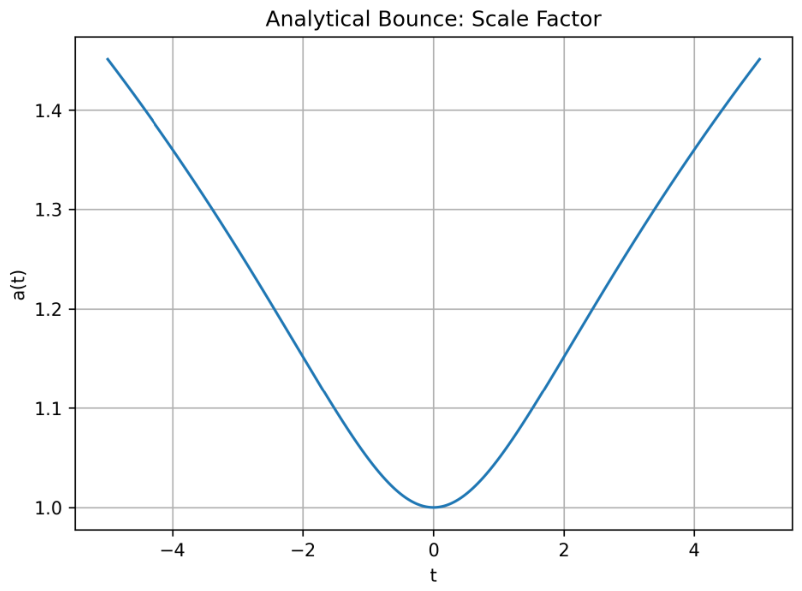
Figure A2.
Hubble parameter corresponding to the analytical solution. The smooth zero crossing at confirms the transition from contraction to expansion.
Figure A2.
Hubble parameter corresponding to the analytical solution. The smooth zero crossing at confirms the transition from contraction to expansion.
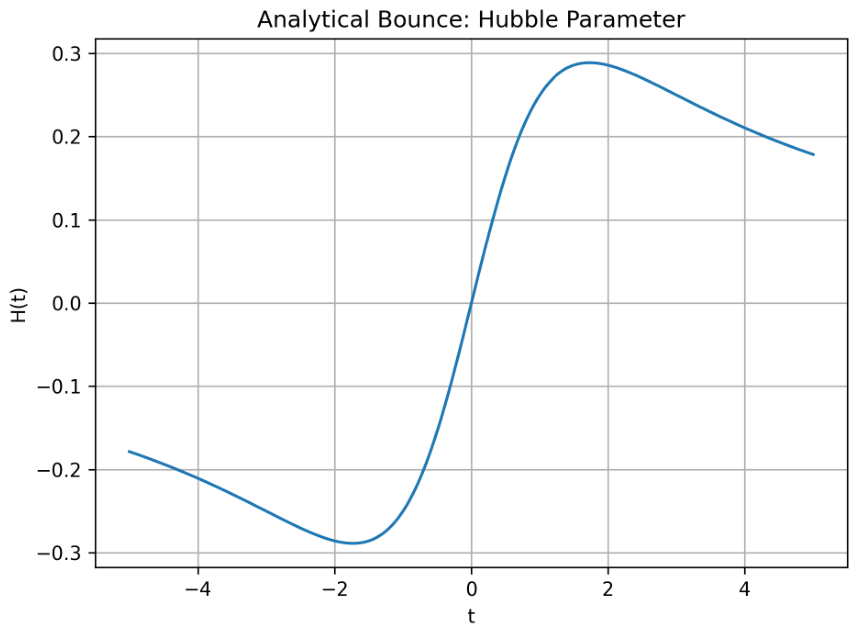
Figure A3.
Time derivative of the Hubble parameter. The finiteness of at the bounce ensures regular dynamical crossing.
Figure A3.
Time derivative of the Hubble parameter. The finiteness of at the bounce ensures regular dynamical crossing.
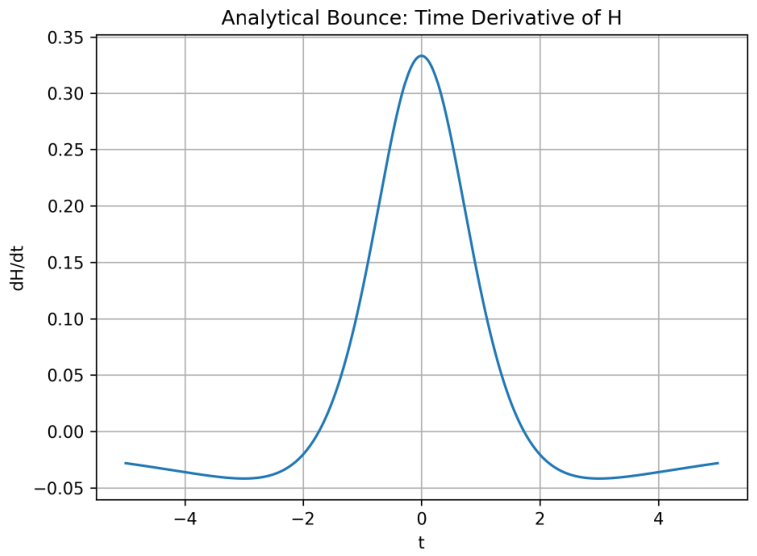
Figure A4.
Ricci scalar evaluated on the analytical solution. The invariant remains finite across the bounce within the EFT regime.
Figure A4.
Ricci scalar evaluated on the analytical solution. The invariant remains finite across the bounce within the EFT regime.
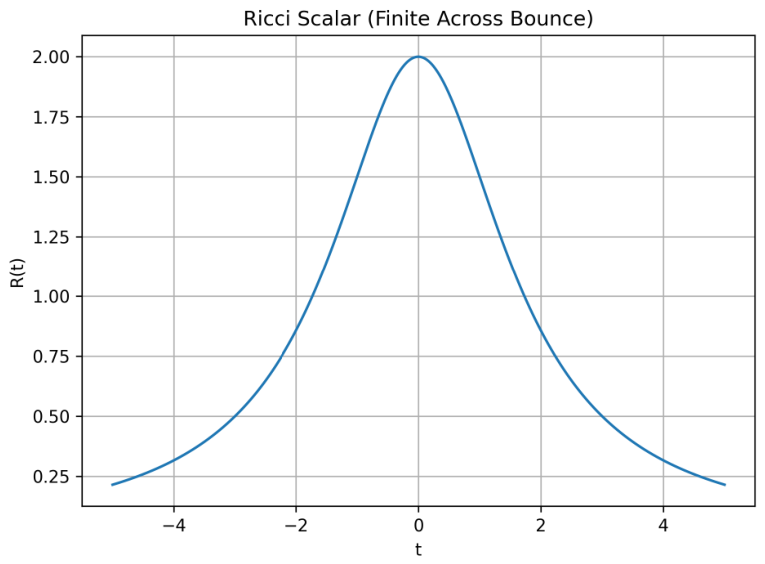
Figure A5.
Kretschmann scalar for the analytical bounce. No curvature divergence occurs; ultraviolet growth is dynamically regulated.
Figure A5.
Kretschmann scalar for the analytical bounce. No curvature divergence occurs; ultraviolet growth is dynamically regulated.
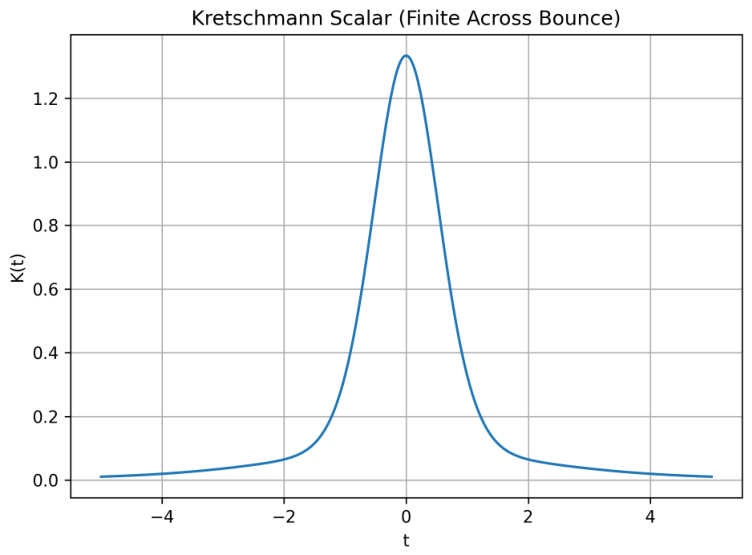
Appendix O. Quantitative Parameter Ranges for the Gravitational-Wave Spectrum
In this appendix we provide representative parameter ranges for the gravitational-wave signature derived in Section 3.7, consistent with the EFT-controlled regime and the stability wedge identified in the main text.
Appendix O.1. Effective Tensor Tilt
During the regulated high-curvature phase, the dynamics can be effectively described by a stiff-like background with
leading to a blue-tilted tensor spectrum. At the level of the effective description, this corresponds to a tensor spectral index in the approximate range
The lower end of this range corresponds to mildly stiff effective dynamics with shorter duration of the regulated phase, while the upper end reflects stronger curvature saturation and extended high-curvature evolution within the EFT domain.
Appendix O.2. Cutoff Frequency Scale
The exponential suppression scale in Eq. (21) is associated with the end of the EFT-valid regime. Estimating the corresponding physical frequency from the curvature cutoff and redshift to today yields a broad characteristic range
This range spans:
- the PTA window (– Hz),
- the LISA band (– Hz),
- the ground-based interferometer band (– Hz).
The precise value of depends on:
- the curvature cutoff scale ,
- the duration of the regulated phase,
- the strength of the memory (slip) parameter ,
which together determine the redshift and termination of the stiff-like regime.
Appendix O.3. BBN Consistency
The integrated tensor energy density must satisfy the standard BBN constraint
which restricts the allowed combinations of .
- the stiff-like phase is of finite duration,
- the high-frequency tail is sufficiently suppressed by curvature-memory damping.
Appendix O.4. Interpretation
The values quoted above should be interpreted as representative EFT ranges rather than sharp predictions. They characterize the parametric window in which the dual regulation mechanism produces a blue-tilted stochastic background together with a regulated ultraviolet cutoff.
A distinctive feature of the framework is therefore the combination:
- (blue tilt),
- finite-band enhancement,
- exponential suppression near ,
which provides a falsifiable signature across multiple observational frequency windows.
Appendix O.5. Scope
These estimates are derived within the EFT-consistent domain and do not constitute a UV-complete prediction. A more precise determination of would require full numerical evolution of tensor modes across the bounce and a detailed mapping to present-day observables, which we leave for future work.
Appendix O.6. Conceptual Gravitational-Wave Spectrum
The qualitative behaviour of the stochastic gravitational-wave background predicted by curvature memory gravity is illustrated in Figure 4.
Figure A6.
Conceptual gravitational-wave spectrum in curvature memory gravity. The spectrum exhibits a blue-tilted enhancement over an intermediate frequency band due to the effective stiff-like phase (), followed by exponential suppression at high frequencies associated with the EFT cutoff and curvature-memory damping.
Figure A6.
Conceptual gravitational-wave spectrum in curvature memory gravity. The spectrum exhibits a blue-tilted enhancement over an intermediate frequency band due to the effective stiff-like phase (), followed by exponential suppression at high frequencies associated with the EFT cutoff and curvature-memory damping.
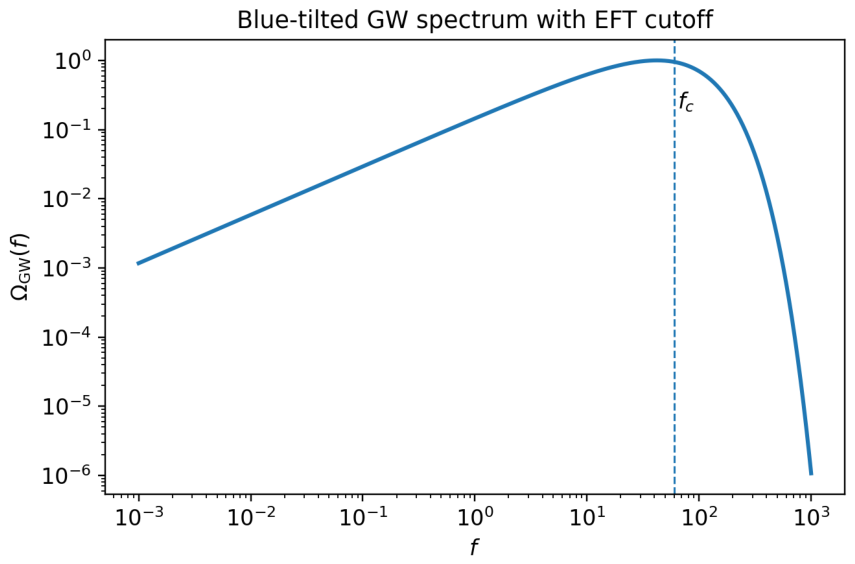
As shown in the figure, the spectrum is characterized by three distinct regimes:
- Low-frequency regime: Standard GR-like behaviour is recovered, with negligible memory effects.
- Intermediate regime (EFT-dominated): A blue-tilted enhancement develops, withreflecting the effective stiff-like dynamics induced by curvature regulation.
- High-frequency regime: The spectrum is exponentially suppressed asdue to the combined action of the EFT cutoff and geometric memory damping.
This three-regime structure constitutes a distinctive observational signature of the dual regulation mechanism, differentiating it from both standard slow-roll inflation (typically red or nearly scale-invariant spectra) and purely geometric conformal scenarios.
- Interpretation.
The figure should be understood as a conceptual representation of the EFT prediction. The precise values of the tilt and cutoff scale depend on the parameters and on the duration of the regulated phase, as discussed in Appendix O.
Appendix O.7. Comparison with Standard Inflationary Tensor Spectra
To highlight the distinctive observational signature of curvature memory gravity, we compare the predicted gravitational-wave spectrum with the standard inflationary expectation in Figure A7.
Figure A7.
Comparison between the gravitational-wave spectrum predicted by curvature memory gravity (solid line) and a standard inflationary spectrum (dashed line). The curvature memory framework produces a blue-tilted intermediate regime followed by exponential suppression, while inflation yields a nearly scale-invariant or slightly red-tilted spectrum.
Figure A7.
Comparison between the gravitational-wave spectrum predicted by curvature memory gravity (solid line) and a standard inflationary spectrum (dashed line). The curvature memory framework produces a blue-tilted intermediate regime followed by exponential suppression, while inflation yields a nearly scale-invariant or slightly red-tilted spectrum.
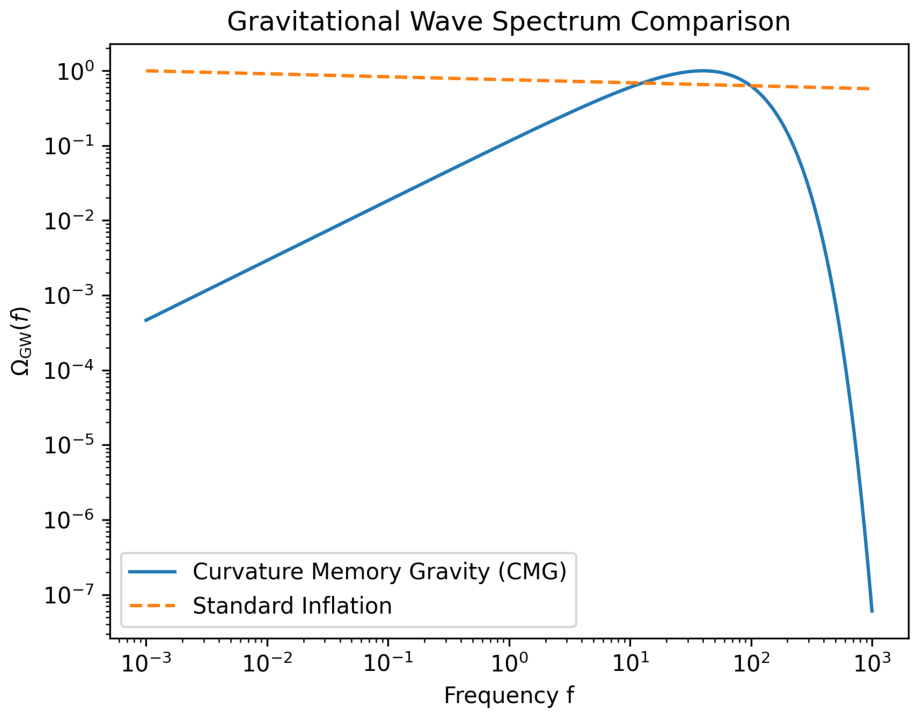
The contrast between the two scenarios is structurally robust:
-
Inflationary spectrum:yielding a nearly scale-invariant or slightly red-tilted spectrum.
-
Curvature memory gravity:characterized by a blue-tilted enhancement over an intermediate band and suppression near the EFT cutoff.
- Discriminating features.
The two scenarios can therefore be distinguished observationally through:
- the sign of the tensor tilt ( vs ),
- the presence of a finite-band enhancement,
- the existence of a high-frequency cutoff.
These features provide a concrete observational handle for distinguishing curvature memory gravity from standard early-universe scenarios using stochastic gravitational-wave data across multiple frequency bands.
- Scope.
As in previous sections, this comparison should be understood at the level of an EFT prediction. A fully quantitative comparison with observational datasets requires detailed transfer functions and parameter inference, which lie beyond the scope of the present work. References
References
- Jacobson, T. Thermodynamics of Spacetime: The Einstein Equation of State. Phys. Rev. Lett. 1995, 75, 1260–1263. [Google Scholar] [CrossRef] [PubMed]
- Eling, C.; Guedens, R.; Jacobson, T. Nonequilibrium Thermodynamics of Spacetime. Phys. Rev. Lett. 2006, arXiv:gr96, 121301. [Google Scholar] [CrossRef] [PubMed]
- Page, D. N.; Wootters, W. K. Evolution without evolution: Dynamics described by stationary observables. Phys. Rev. D 1983, 27, 2885. [Google Scholar] [CrossRef]
- Connes, A.; Rovelli, C. Von Neumann Algebra Automorphisms and Time-Thermodynamics Relation in General Covariant Quantum Theories. arXiv arXiv:gr-qc/9406019. [CrossRef]
- Donoghue, J. F. General Relativity as an Effective Field Theory: The Leading Quantum Corrections. Phys. Rev. D 1994, 50, 3874–3888. [Google Scholar] [CrossRef]
- Burgess, C. P. Quantum Gravity in Everyday Life: General Relativity as an Effective Field Theory. Living Rev. Relativ. 2004, 7 5. [Google Scholar] [CrossRef]
- Starobinsky, A. A. A new type of isotropic cosmological models without singularity. Phys. Lett. B 1980, 91, 99–102. [Google Scholar] [CrossRef]
- del Amo Castillo, I. Curvature Memory and the Emergence of Time in a Ghost-Free Extension of General Relativity. Quantum Reports 2026, 8 20. [Google Scholar] [CrossRef]
- Sotiriou, T. P.; Faraoni, V. f(R) Theories of Gravity. Rev. Mod. Phys. 2010, 82, 451–497. [Google Scholar] [CrossRef]
- De Felice, A.; Tsujikawa, S. f(R) Theories. Living Rev. Relativ. 2010, 13 3. [Google Scholar] [CrossRef]
- Woodard, R. P. Ostrogradsky’s theorem on Hamiltonian instability. Scholarpedia 2015, 10, 32243. [Google Scholar] [CrossRef]
- Ashtekar, A.; Pawlowski, T.; Singh, P. Quantum Nature of the Big Bang. Phys. Rev. Lett. 2006, arXiv:gr96, 141301. [Google Scholar] [CrossRef] [PubMed]
- Ashtekar, A.; Bojowald, M. “Black hole evaporation: A paradigm,” Class. Quant. Grav. 2005, 22, 3349–3362. [Google Scholar] [CrossRef]
- Weinberg, S. “Effective Field Theory for Gravity,” in General Relativity: An Einstein Centenary Survey; Hawking, S. W., Israel, W., Eds.; Cambridge University Press: Cambridge, 1979. [Google Scholar]
- Donoghue, J. F. Introduction to the Effective Field Theory Description of Gravity. arXiv arXiv:gr-qc/9512024. [CrossRef]
- Padmanabhan, T. Thermodynamical Aspects of Gravity: New insights. Rep. Prog. Phys. 2010, 73, 046901. [Google Scholar] [CrossRef]
- Penrose, R. Cycles of Time: An Extraordinary New View of the Universe; The Bodley Head: London, 2010. [Google Scholar]
- et al.; B. P. Abbott et al. (LIGO Scientific Collaboration and Virgo Collaboration) Observation of Gravitational Waves from a Binary Black Hole Merger. Phys. Rev. Lett. 2016, 116, 061102. [Google Scholar] [CrossRef]
- Caprini, C.; Figueroa, D. G. Cosmological backgrounds of gravitational waves. Class. Quant. Grav. 2018, 35, 163001. [Google Scholar] [CrossRef]
- et al.; N. Aghanim et al. (Planck Collaboration) Planck 2018 results. VI. Cosmological parameters. Astron. Astrophys. 2020, 641, A6. [Google Scholar] [CrossRef]
- Finkelstein, S. L.; et al. A Candidate z∼12 Galaxy in Early JWST CEERS Imaging. Astrophys. J. Lett. 2022, 940, L55. [Google Scholar] [CrossRef]
- Arrabal Haro, P. , Confirmation and refutation of very luminous galaxies in the early Universe. Nature 2023, 622, 707–711. [Google Scholar] [CrossRef]
- Horndeski, G. W. Second-order scalar-tensor field equations in a four-dimensional space. Int. J. Theor. Phys. 1974, 10, 363–384. [Google Scholar] [CrossRef]
- Ben Achour, J.; Langlois, D.; Noui, K. Degenerate higher order scalar-tensor theories beyond Horndeski and disformal transformations. Phys. Rev. D 2016, arXiv:1602.0839893, 124005. [Google Scholar] [CrossRef]
- Ashtekar, A.; Singh, P. Loop Quantum Cosmology: A Status Report. Class. Quant. Grav. 2011, arXiv:1108.089328, 213001. [Google Scholar] [CrossRef]
- Zheng, Y. Hamiltonian analysis of mimetic gravity with higher derivatives. arXiv arXiv:1810.03826. [CrossRef]
- Naidu, R. P.; et al. Two Remarkably Luminous Galaxy Candidates at z≈10–12 Revealed by JWST. arXiv arXiv:2207.09434. [CrossRef]
- Donnan, C. T. , The abundance of z≳10 galaxy candidates in the HUDF using deep JWST NIRCam medium-band imaging. Mon. Not. R. Astron. Soc. 2023, 520, 4554–4561. [Google Scholar] [CrossRef]
- Einstein, A. Die Feldgleichungen der Gravitation. Sitzungsberichte der Preußischen Akademie der Wissenschaften zu Berlin 1915, 844–847. [Google Scholar]
- Arnowitt, R.; Deser, S.; Misner, C. W. The Dynamics of General Relativity. In Gravitation: An Introduction to Current Research; Witten, L., Ed.; Wiley: New York, 1962. [Google Scholar]
- Kantowski, R.; Sachs, R. K. Some spatially homogeneous anisotropic relativistic cosmological models. J. Math. Phys. 1966, 7, 443–446. [Google Scholar] [CrossRef]
- Misner, C. W. Mixmaster universe. Phys. Rev. Lett. 1969, 22, 1071–1074. [Google Scholar] [CrossRef]
- Modesto, L. Loop quantum black hole. Class. Quant. Grav. 2006, 23, 5587–5602. [Google Scholar] [CrossRef]
- Bambi, C.; Modesto, L. Rotating regular black holes. Phys. Lett. B 2013, 721, 329–334. [Google Scholar] [CrossRef]
Figure 2.
Evolution of the Hubble parameter showing a smooth transition from contraction to expansion.
Figure 2.
Evolution of the Hubble parameter showing a smooth transition from contraction to expansion.
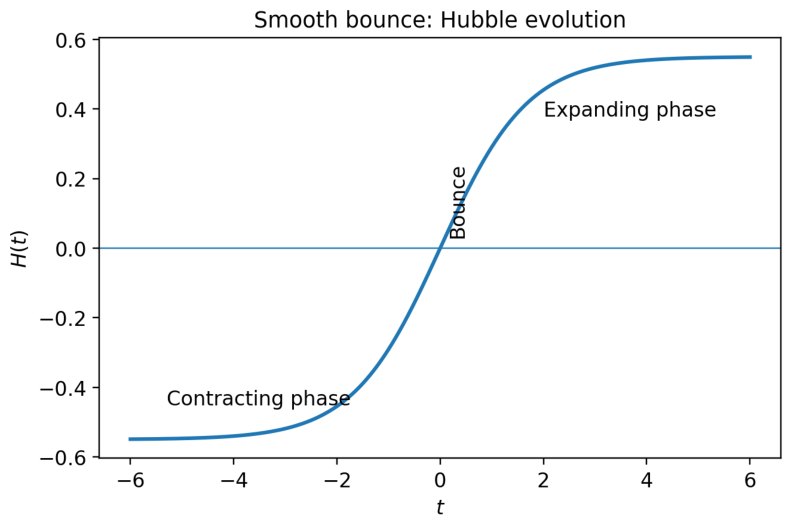
Figure 3.
Schematic evolution of the Ricci scalar in curvature memory gravity. The curvature remains finite and smoothly saturates at high-curvature regimes, illustrating the bounded-curvature mechanism implemented by the effective action.
Figure 3.
Schematic evolution of the Ricci scalar in curvature memory gravity. The curvature remains finite and smoothly saturates at high-curvature regimes, illustrating the bounded-curvature mechanism implemented by the effective action.
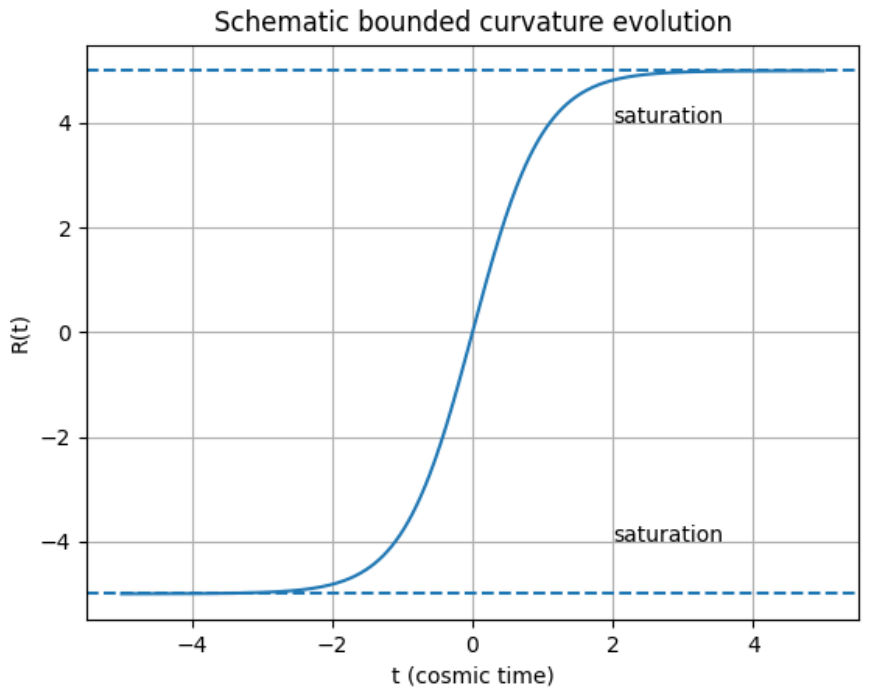
Figure 5.
Schematic phase diagram in curvature space showing the transition between GR, regulated EFT, and bounce regimes.
Figure 5.
Schematic phase diagram in curvature space showing the transition between GR, regulated EFT, and bounce regimes.
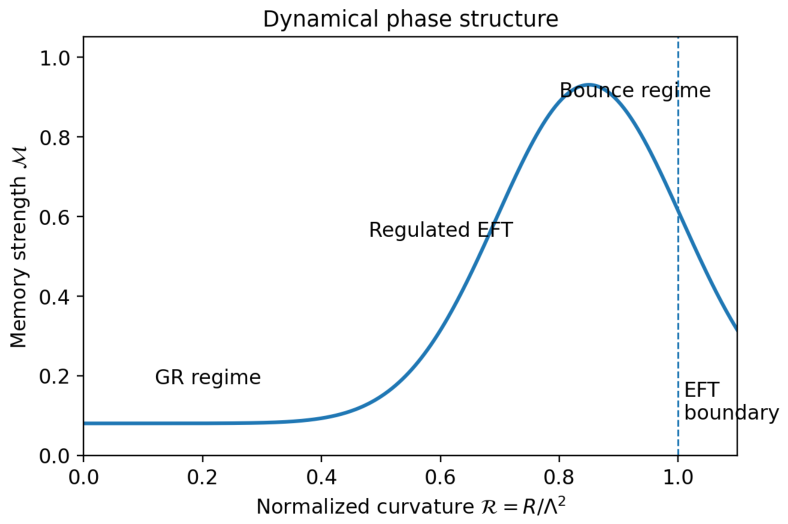
Table 4.
Structural comparison between the present framework and representative alternatives.
| Framework | Local/Covariant | Extra DOF | Bounce Mechanism | Ghost Control |
|---|---|---|---|---|
| gravity | Yes | 1 scalar | Polynomial curvature | Parameter dependent |
| Starobinsky model | Yes | 1 scalar | regularization | Yes (restricted domain) |
| Loop-inspired models | Effective | No new DOF | Holonomy corrections | Effective regime |
| Nonlocal gravity | No (explicitly) | Model dependent | Infinite-derivative softening | Model dependent |
| Mimetic gravity | Yes | Extra scalar | Constraint-induced | Requires care |
| Present framework | Yes | GR + 1 scalar | Bounded curvature + slip | EFT-stable wedge |
Disclaimer/Publisher’s Note: The statements, opinions and data contained in all publications are solely those of the individual author(s) and contributor(s) and not of MDPI and/or the editor(s). MDPI and/or the editor(s) disclaim responsibility for any injury to people or property resulting from any ideas, methods, instructions or products referred to in the content. |
© 2026 by the authors. Licensee MDPI, Basel, Switzerland. This article is an open access article distributed under the terms and conditions of the Creative Commons Attribution (CC BY) license (http://creativecommons.org/licenses/by/4.0/).
Copyright: This open access article is published under a Creative Commons CC BY 4.0 license, which permit the free download, distribution, and reuse, provided that the author and preprint are cited in any reuse.


