

Submitted:
10 April 2026
Posted:
13 April 2026
You are already at the latest version
Abstract
Background/Objectives: Celiac disease (CD) is a T-cell mediated autoimmune condition, triggered by gluten ingestion. Duodenal biopsy is the gold-standard diagnosis for CD, which is often limited by interobserver variability between pathologists. Immunohistochemistry (IHC) is a powerful technique for detecting biomarkers with potential diagnostic significance. This study aims to investigate five candidate biomarkers BTNL8, NKp46, TdT, THEMIS, and TCRδ that might improve the reproducibility of the diagnosis of CD. Methods: Formalin fixed paraffin-embedded material, surplus to diagnostic requirements was obtained from 46 subjects (untreated CD: n=21, CD treated with gluten-free diet: n=5; controls: n=20) and immunostained for BTNL8, NKp46, TdT, THEMIS and TCRδ. BTNL8 staining was scored on a 0-3 semi-quantitative scale. NKp46, TdT, THEMIS, and TCR delta-positive intra-epithelial lymphocytes (IELs) were quantified as mean counts per 100 epithelial cells (ECs). Results: TCRδ-positive IELs were markedly elevated in CD biopsies (median 9.4 IELs/100 ECs) compared to healthy controls (median 0.5 IELs/100 ECs; p<0.001), with a threshold of >2.1 TCRδ-positive IELs per 100 ECs yielding an AUC of 94% and interobserver agreement of 0.82. NKp46 expression was also increased in CD (median 13.8 IELs/100 ECs) versus controls (median 9.6; p<0.001), with >12.8 NKp46-positive IELs per 100 ECs achieving an AUC of 86% and interobserver agreement of 0.82. Immunostaining for the other biomarkers demonstrated less clear differences between CD and healthy controls. Conclusions: Corroborating several recent publications, TCRδ immunostaining provides high diagnostic accuracy and good interobserver agreement in the diagnosis of CD on duodenal biopsy, even for patients on a gluten-free diet.
Keywords:
celiac disease
; diagnostics
; immunohistochemistry
; biomarker
; intra-epithelial lymphocyte
; BTNL8
; NKp46
; TdT
; THEMIS
; TCRδ
1. Introduction
1.1. Overview of Celiac Disease
Celiac disease (CD) is a T-cell-mediated autoimmune condition triggered by gluten ingestion in genetically susceptible individuals [1]. CD is distinctive among autoimmune conditions as key triggering antigens, dietary gluten, and the autoantigen, tissue transglutaminase (tTG), have long been known. Previously considered to be a rare disorder only affecting European children, CD is now recognized to be the most common autoimmune disorders worldwide, affecting individuals of all ages [2,3]. The estimated prevalence of CD is 1% of the general population, steadily rising in Western countries [4]. Although the number of CD diagnoses has increased over the last 3 decades, CD underdiagnosis persists globally, and is attributed to its variable clinical presentation and to insufficient awareness of its diverse clinical manifestations [5].
The clinical presentations of CD include gastrointestinal (GI) and non-specific symptoms that vary with age and between individuals [6,7]. ‘Classical’ symptoms include malabsorptive symptoms such as diarrhea, weight loss, and failure to thrive, most commonly seen in children [8]. In adult populations, ‘non-classical’ CD can present as iron deficiency anemia, constipation, and bloating [9]. These manifestations can be reversed with a gluten-free diet (GFD), although fatigue and other minor GI symptoms may persist [10]. Longer term complications of undiagnosed CD include cancer, lymphoma, vitamin deficiency, anemia, osteoporosis and infertility [11,12]. A US study on young adults working in the Air Force showed that, individuals with undiagnosed CD had a nearly 4-fold increased risk of death during a 45-year follow-up period, compared with those without evidence of CD [13]. Further underlining the importance of making a diagnosis of CD and commencing the patient on a GFD, is the result of a study in Edinburgh showing that those diagnosed with CD in childhood, and treated with a GFD thereafter, had a similar mortality rate to that of the general population [14].
1.2. Current Diagnostic Pathway and Its Limitations
The clinical diagnosis of CD is made by correlating clinical presentation, with the results of serological testing and duodenal biopsy. The current gold-standard practice involves duodenal biopsy following six weeks of gluten consumption [11]. In most histopathology departments worldwide, pathologists examine the duodenal biopsies histologically, stained simply with hematoxylin and eosin (HE). Hallmark histological features include villous atrophy, crypt hyperplasia, and increased numbers of intraepithelial lymphocytes (IEL) [15]. However, the assessment of these changes, which are part of a continuum, is relatively subjective, leading to diagnostic disagreement between pathologists at least 20-25% of the time [16,17,18,19,20,21,22] , contrasting with a 3–6% disagreement rate for biopsies from other body sites [23,24,25] Furthermore, insufficient gluten consumption prior to biopsy limits the extent to which the classical features of CD are apparent [11]. Conversely, these hallmark histological features are not completely exclusive to CD, as they can be seen in Helicobacter or Giardia infection, in viral gastroenteritis and in patients taking certain medications [26]. Consequently, definitive diagnosis relies on the combined interpretation of clinical, serological, and histological findings. There is an unmet need for a more objective and reproducible diagnostic approach for CD.
1.3. Immunohistochemistry and In-Situ Hybridization
Immunohistochemistry (IHC) is a powerful diagnostic technique for the rapid detection of biomarkers with predictive, diagnostic, and prognostic significance [27]. Automated immunostaining platforms are present in most diagnostic histopathology departments worldwide. As a key component in diagnosing CD is the enumeration of IEL, with a diagnostic criterion of >30 IELs per 100 enterocytes, IHC approaches that identify IELs have been reported to improve histological sensitivity for CD compared with HE staining alone [28,29].
1.4. Candidate Diagnostic Biomarkers can Be DERIVED from an understanding of CD Pathogenesis
Recent studies have demonstrated an increase in the numbers of duodenal gamma-delta (γδ) T cells among the IEL in CD, which persists even on a gluten-free diet (GFD) [30]. These T cells are important for maintaining mucosal integrity and mediating protective immune responses, but they may also be pathogenic, participating in autoimmune responses in CD [31,32]. Alongside these alterations in γδ IEL populations, several associated proteins, including BTNL8, NKp46, TdT, and THEMIS, have been reported to show altered expression in CD, reflecting changes in IEL activation or development, and in epithelial immune signaling.
Butyrophilin-like (BTNL) molecules are increasingly recognized regulators of T-cell immunity and have been identified as activators of γδ T cells in a major histocompatibility complex (MHC)-independent manner [33]. In the intestinal epithelium, BTNL3-BTNL8 complexes interact with local γδ T cell subsets [34]. In CD, reduced BTNL8 expression is accompanied by a loss of BTNL8-responsive Vγ4/Vδ1 T cells. These are replaced by Vδ1 intraepithelial lymphocytes that are unresponsive to BTNL8, a shift that persists on a gluten-free diet [35].
Natural cytotoxicity receptors (NCRs), including NKp46, are immunoglobulin-like receptors classically expressed by natural killer cells [36]. However, previous studies have also identified NCR expression on subsets of γδ T cells, where they contribute to rapid immune responses independent of MHC-restricted antigen presentation [37]. NKp46 has been implicated as a key activating receptor in CD [38,39]. In CD, depletion of NKp46-expressing-Vδ1+ γδ T cells, alongside expansion of NKp46-negative IELs, indicates disease-associated remodeling of the IEL compartment [35]. A permanent loss of NKp46 expression was confined to the duodenum, because colonic IELs regained their NKp46 expression following GFD, indicating a site-specific phenomenon [35].
T-cell receptor (TCR) diversity is generated through V(D)J recombination mediated by recombination-activating genes (RAG) 1/2 and terminal deoxynucleotidyl transferase (TdT) [40]. There is some evidence for limited extrathymic T-cell differentiation in the duodenum [41]. Reduced RAG1 and preT alpha-chain mRNA expression have been reported in untreated celiac disease in IELs from children, suggesting an impaired capacity for extrathymic TCR gene rearrangement [42]. This led us to consider TdT as a potential CD biomarker.
Thymocyte-expressed molecule involved in selection (THEMIS) is a lymphoid-specific gene encoding a T-cell protein that plays a critical role in thymocyte development. It is involved in the regulation of positive selection of thymocytes, enabling appropriate recognition of self-antigens [43]. Genome-wide association studies have linked THEMIS with celiac disease. Additionally, increased duodenal biopsy THEMIS mRNA expression has been reported in patients with active CD compared with healthy controls and those on a gluten-free diet [44].
Because these molecules are involved in immunological processes associated with CD pathogenesis, we tested them as candidate biomarkers for improving histological diagnosis.
1.5. Aim of the Study
This study aimed to evaluate the diagnostic performance of five candidate biomarkers, detected by immunohistochemistry (BTNL8, NKp46, TdT, THEMIS, TCRδ), in distinguishing duodenal biopsies from CD patients, either on a gluten-containing diet or GFD, from healthy controls.
2. Materials and Methods
2.1. Biopsy Selection
Histological material from 46 anonymized duodenal biopsies was obtained from the Human Tissue Research Biobank at Cambridge University Hospitals NHS Foundation Trust, with full ethical approval (IRAS 162057; PI: Professor E. Soilleux). These included 21 cases of confirmed CD on a gluten-containing diet, 5 cases of confirmed CD on a strict gluten-free diet for at least 6 months, and biopsies from 20 healthy controls. Healthy control biopsies had normal histology, according to the reporting pathologist. The following exclusion criteria were used: CD diagnosis in inpatient or outpatient hospital records, history of malabsorption or diarrhea, anemia, lymphocytosis on biopsy and the patient being on GFD.
2.2. Immunohistochemistry
All 46 FFPE biopsies underwent single immunostaining on a Leica BOND-III automated staining platform (Leica Biosystems, Newcastle-upon-Tyne, UK) using the Polymer Refine Detection System (DS9800, Leica Biosystems). Sections underwent heat-induced epitope retrieval for 20 minutes at 100 °C in either sodium citrate buffer (BTNL8) or Tris-EDTA buffer (NKp46, TdT, THEMIS) or epitope retrieval for 40 minutes in Tris-EDTA buffer (TCRδ). Monoclonal rabbit IgG Clone 2187B anti-BTNL8 antibody (R&D Systems, Minneapolis, MN, USA) was applied at 2.5 µg/ml for 15 minutes. Mouse monoclonal anti-NKp46/ NCR1 antibody (195314, Novus Biologicals, Centennial, CO, USA) was applied at 25 µg/ml with 60 minutes. Mouse monoclonal anti-TdT antibody (NCL-L-TdT-339, Novocastra, Newcastle-upon-Tyne, UK) was applied at 0.3 µg/ml for 15 minutes. Rabbit polyclonal anti-THEMIS antibody (NBP3-23438, Novus Biologicals, Centennial, CO, USA) was applied at 0.5 µg/ml for 15 minutes, and the post-primary mouse linker step was omitted. Mouse monoclonal anti-TCRδ antibody (clone H-41, Santa Cruz Biotechnology, Dallas, TX, USA) was applied at 1:50 dilution for 15 minutes. Signals were visualized with the Refine detection system with DAB enhancer (AR9432, Leica Biosystems), and slides were counterstained with hematoxylin and mounted in CV Ultra Mounting Medium (14070937891, Leica Biosystems).
2.3. Image Scanning and Evaluation
The stained slides were scanned using a Leica Aperio AT2 digital slide scanner (Leica Microsystems Ltd, Milton Keynes, UK). Whole-slide images were visualized using PathXL (Philips, Belfast, UK) and independently evaluated by three observers blinded to diagnosis.
2.4. Staining Analysis
Each duodenal biopsy was visually assessed for BTNL8 staining of the surface epithelium and crypt epithelium in each patient sample separately. Each biopsy was scored with a numerical score, reflecting the intensity of the staining as defined in Table 1.
IELs positively immunostained for NKp46, THEMIS, TdT, and TCRδ were quantified, counting bilaterally from the villous tips. In cases with severe villous atrophy, IELs were counted from the flat mucosal epithelium. Five regions of each biopsy with the highest number of stained epithelial cells were selected for scoring. A total of 500 enterocytes were counted per patient for NKp46, and the number of positively stained IELs associated with these 500 enterocytes was given as the mean number per 100 enterocytes. THEMIS, TdT, and TCRδ were expressed at a lower frequency, so a total of 1000 enterocytes were counted per patient. Numbers of positively stained IELs were calculated per 100 enterocytes for each biomarker.
2.5. Statistical Analysis and Data Visualization
The intraclass correlation coefficient (ICC) (2,1) was used to determine interobserver agreement and reproducibility [45]. This approach was taken to calculate reliability from a single score, with raters considered representative of a larger population of similar raters. Each biopsy was scored by all 3 observers, and reliability was calculated from a single quantification.
Descriptive analyses (median and interquartile range (IQR)), group comparisons using Mann-Whitney U tests, interobserver ICC, sensitivity analyses with receiver-operator (ROC) curves, and data visualization were all performed using Python Software Foundation (Python Language Reference, version 4.3.1. Available at http://www.python.org).
3. Results
3.1. Analysis of Biomarker Immunostaining
Representative images of BTNL8 immunostaining are shown in Figure 1 and NKp46, THEMIS, TdT, and TCRδ immunostaining in Figure 2. All biopsies were scored by 3 independent observers, blinded to diagnosis, as described in section 2.3, giving the results shown in Table 2 and box-and-whisker plots in Figure 3.
3.2. Statistical Evaluation of Immunostained Markers
To determine the potential diagnostic utility of the five biomarkers, including for identifying CD patients on a GFD, results for three disease subgroups were compared with healthy controls. These subgroups were: (1) combined CD, representing both untreated and GFD-treated CD; (2) untreated CD represented patients on a gluten-containing diet; (3) GFD-treated CD.
3.2.1. Statistical Evaluation of BTNL8 Immunostaining Results
Surface and crypt epithelial (SE) BTNL8 staining intensity is summarized in Table 2. Surface BTNL8 intensities were higher in control specimens than in combined CD (p = 0.0039) or untreated CD (p = 0.0012), whereas treated CD intensities did not differ significantly from controls. Interobserver agreement for SE BTNL8 scoring was moderate (ICC = 0.64).
Crypt epithelial (CE) BTNL8 expression intensities were low across all groups. Significant differences were observed only between treated CD and controls (p = 0.011), with higher intensities in treated CD. Interobserver agreement for CE BTNL8 scoring was lower (ICC = 0.52), indicating modest reproducibility.
3.2.2. Statistical Evaluation of NKp46 Immunostaining Results
Median NKp46-positive IEL counts are summarized in Table 2. All CD subgroups demonstrated higher median counts compared with controls. Pairwise comparisons confirmed significantly elevated NKp46-positive IELs in combined CD (p = 2.05 × 10⁻¹²), untreated CD (p = 1.07 × 10⁻¹¹), and treated CD (p = 1.38 × 10⁻⁴) relative to controls. Interobserver agreement was strong (ICC = 0.82), indicating good reproducibility.
3.2.3. Statistical Evaluation of TdT Immunostaining Results
Median TdT-positive IEL counts were low across all groups (Table 2), with slightly more TdT+ IEL being observed in CD. Significant differences compared with controls were observed in combined CD (p = 1.87 × 10⁻⁴) and untreated CD (p = 9.58 × 10⁻⁵), but not in treated CD. Interobserver agreement was poor (ICC = 0.22), indicating limited reproducibility of TdT scoring.
3.2.4. Statistical Evaluation of THEMIS Immunostaining Results
Median THEMIS-positive IEL counts are summarized in Table 2. All CD subgroups demonstrated higher counts compared with controls. Pairwise comparisons showed significantly increased THEMIS-positive IELs in combined CD (p = 5.09 × 10⁻⁴), untreated CD (p = 0.015), and treated CD (p = 7.03 × 10⁻⁵) relative to controls. Interobserver agreement was moderate (ICC = 0.64).
3.2.5. Statistical Evaluation of TCRδ Immunostaining Results
Median TCRδ-positive intraepithelial lymphocyte (IEL) counts were markedly elevated in celiac disease compared with controls (Table 2). All CD subgroups demonstrated substantially higher median counts than controls (combined CD (p = 3.80 × 10⁻¹⁹), untreated CD (p = 3.77 × 10⁻¹⁸), treated CD (p = 1.27 × 10⁻⁶). Interobserver agreement for TCRδ enumeration was strong (ICC = 0.82), indicating good reproducibility.
3.3. Sensitivity Analysis and Diagnostic Performance
Receiver operating characteristic (ROC) analysis was performed to assess the ability of each biomarker to differentiate CD cases from controls. TCRδ demonstrated highest diagnostic accuracy, with an area under the ROC curve (AUC) of 0.94, representing the highest discriminatory performance among all markers examined. NKp46 also showed good performance (AUC = 0.86). THEMIS (AUC = 0.68) and TdT (AUC = 0.61) demonstrated limited discriminatory ability. BTNL8 showed limited diagnostic utility, with crypt epithelial staining yielding an AUC of 0.56 and surface epithelial staining an AUC of 0.37. The diagnostic thresholds for each biomarker are shown in Figure 3, and ROC curves for the CD markers are shown in Figure 4.
Diagnostic performance aligned with reproducibility across the three observers. TCRδ and NKp46, which demonstrated the highest AUC values, also showed strong interobserver agreement (ICC = 0.82). In contrast, BTNL8, THEMIS and TdT demonstrated lower discriminatory ability with modest to poor reproducibility despite statistical significance, indicating reduced robustness as markers for CD. Interobserver agreement and diagnostic performance are summarized in Table 3.
4. Discussion
4.1. Overall Biomarker Utility
This study explored the potential utility in discriminating between celiac and non-celiac biopsies of five different immunohistochemically detected biomarkers (BTNL8, NKp46, TdT, THEMIS, and TCRδ). They were selected given their potential associations with CD pathogenesis. We compared their expression in active CD and GFD-treated CD with that in non-celiac controls. Some CD patients are re-biopsied after 6 months of a GFD. These GFD-treated CD biopsies are an excellent correlate of the initial CD diagnostic biopsies received from patients who have consumed insufficient gluten prior to biopsy, because of the unpleasant symptoms that eating gluten causes them. This particular patient group is the most likely group to have mild or minimal changes of CD in their biopsies, with an attendant risk of the diagnosis of CD being missed. New biomarkers to improve diagnostic accuracy would be of greatest value in this group.
4.2. Utility of TCRδ Immunostaining
Numbers of TCRδ+ IEL were significantly higher in GFD-treated and active CD biopsies compared with healthy controls, consistent with the known expansion of γδ T cells in CD, that persist even after a GFD [30]. The ICC score of 0.82 indicated good interobserver agreement and TCRδ was the biomarker achieving the highest AUC (0.94). The robust performance of TCRδ in this study suggests its utility as a reproducible biomarker for identifying CD, even in biopsies from patients who have consumed insufficient gluten prior to biopsy. Indeed, its ability to distinguish GFD-treated CD biopsies from healthy controls means that TCRδ immunostaining might eliminate the need for gluten consumption pre-biopsy, if additional larger studies GFD-treated CD biopsies corroborate our findings. At the very least, IHC for this biomarker could substantially improve agreement between pathologists, by providing a quantitative threshold for IEL assessment, thereby complementing the existing gold-standard diagnostic test. A larger multi-center study will be needed to confirm the figure of >2.1 TCRδ+ IEL per 100 enterocytes, not least because factors such as section thickness and staining intensity might confound the assessment of numbers of IEL per 100 enterocytes.
4.3. Utility of NKp46 Immunostaining
NKp46 expression was increased in CD biopsies, contradicting a previous report of NKp46 depletion at sites of mucosal damage in CD [35]. This discrepancy may reflect methodological differences, as Mayassi et al. [35] used flow cytometry whereas this study used IHC analysis of tissue sections. Given that NKp46 is expressed by a subset of γδ T cells, the expansion of γδ T cells in CD, which our TCRδ immunostaining in this study confirms, could result in increased NKp46 expression, even if the proportion of NKp46-positive T cells is actually reduced. Interpretation of NKp46 was challenging, due to high levels of background staining, and scoring was therefore restricted to strongly stained IELs to minimize subjectivity. Further work is required to determine whether the observed increase in NKp46 expression in CD reflects a true biological change or a methodological limitation.
4.4. Utility of BTNL8 Immunostaining
BTNL8 staining in both surface and crypt epithelium showed limited diagnostic utility, with poor to moderate interobserver agreement and modest AUC values. There were significantly lower levels of expression by duodenal surface epithelium in untreated CD than GFD-treated CD and controls, consistent with previous work by Mayassi and colleagues [35], although somewhat less clearcut than suggested by this study. BTNL8 expression on crypt epithelium showed little difference between active CD and controls, although levels in crypts of treated CD patient biopsies were slightly higher than those of controls (p = 0.011).
4.5. Utility of THEMIS Immunostaining
Although THEMIS showed statistically significant differences between CD and control biopsies, independent of dietary gluten intake, the changes in expression changes were relatively subtle, with moderate discriminatory performance (AUC = 0.68) and limited inter-observer agreement (ICC = 0.64), likely indicating limited reproducibility. One previous RT-PCR-based study using RNA from whole duodenal biopsies reported increased THEMIS expression in CD compared with controls [44], in agreement with our data. However, the relatively subtle differences seen in IHC and limited inter-observer agreement are likely to preclude THEMIS being a useful diagnostic marker for CD.
4.6. Utility of TdT Immunostaining
TdT quantification was difficult due to the extremely small numbers of positive cells resulting in very limited inter-observer agreement (ICC = 0.22) and poor discriminatory performance between CD and controls (AUC = 0.61). Increased expression of TdT-positive IELs was observed in untreated coeliac disease, in contrast to previous reports demonstrating reduced RAG1 mRNA expression in patients with coeliac disease compared to controls [42]. However, this may have been confounded by the expansion of lymphocytes present in CD compared to controls, which could influence overall cell counts.
The two previous studies considering extrathymic T-cell differentiation in the duodenum focused on the expression of mRNA encoding RAG1, RAG2 and the preT alpha-chain [41,42]. When considering the machinery of T-cell differentiation, we elected to detect TdT because of the very robust antibody available against this target. To our knowledge, there are no publications describing TdT mRNA expression in the duodenum, precluding corroboration of our findings. Notably, all the biopsies in our study were from adults, while the prior RT-PCR study reporting decreased RAG1 and preT alpha-chain expression in untreated CD were performed using IELs from children [42] and there may be age-related changes in the levels of extrathymic T-cell differentiation, with the process being more prominent in children. It may therefore be helpful to evaluate TdT expression in a pediatric CD and control biopsy cohort, expressed as a percentage of total lymphocytes, to account for both age-related differences and the expansion of intraepithelial lymphocytes observed in CD.
4.7. Study Limitations and Future Work
Our study suffers from several limitations. The total numbers of biopsies were relatively small, but the GFD-treated group contained biopsies from only five patients. Furthermore, all the biopsies we used were from adults. Future work should prioritize validation of TCRδ IHC in larger, multicenter cohorts across all patient ages, including children, particularly in GFD-treated patients and in individuals with gastrointestinal conditions that may mimic celiac disease. To maximize diagnostic reproducibility and make best use of pathologists’ time and expertise, artificial intelligence (AI) could be applied to histopathological whole-slide images immunostained for TCRδ, alongside a serial HE image, using an enumeration approach, similar to that in our recent work and that of others [46,47].
5. Conclusions
This study evaluated the potential diagnostic utility of five candidate biomarkers in celiac disease to address the challenges associated with classical histological diagnosis, particularly in biopsies with relatively equivocal histological changes due to insufficient gluten intake or co-existing GI conditions. Overall, TCRδ emerged as the most promising marker in this study, making it a potential adjunct to the current histological gold-standard biopsy assessment, particularly in cases with borderline changes where diagnostic confidence is low. This would help determine its utility in cases with insufficient gluten exposure and histologically ambiguous biopsies, potentially reducing interobserver variability and improving diagnostic accuracy. Validation in larger, multi-center cohorts will be required to establish the robustness of these findings, particularly in biopsies from GFD-treated patients and children. By introducing more objective, biomarker-supported thresholds for intraepithelial lymphocyte assessment, this approach has the potential to reduce inter-pathologist variability, minimize diagnostic ambiguity, and ultimately improve the clinical pathway for patients with histologically subtle celiac disease.
Author Contributions
Conceptualization, E.J.S.; methodology, E.J.S.; formal analysis, H.L., S.P. and P.G..; investigation, V.S. and A.K.; resources, E.J.S. and V.S.; data curation, S.P. and H.L..; writing—original draft preparation, H.L. and E.J.S.; writing—review and editing, E.J.S., A.K. and H.L.; supervision, E.J.S.; project administration, E.J.S.; funding acquisition, E.J.S., V.S. and H.L. All authors have read and agreed to the published version of the manuscript.
Funding
This research was funded by Coeliac UK.
Institutional Review Board Statement
The study was conducted in accordance with the Declaration of Helsinki and received full ethical approval by the Oxfordshire Research Ethics Committee (REC) A (IRAS: 162057; PI: Professor E. Soilleux), as well as Research and Development Office Approval from the Joint Research Office of the University of Cambridge and Cambridge University Hospitals NHS Foundation Trust.
Informed Consent Statement
Generic informed consent was obtained from all subjects involved in the study at the time of biopsy, in accordance with the study’s ethical approval.
Data Availability Statement
All relevant datasets associated with this study are contained either in the main article or the supplementary material.
Acknowledgments
We are grateful to the Cambridge University Hospitals NHS Foundation Trust Human Tissue Research Biobank and to the Histopathology Core Facility, Cancer Research UK Cambridge Institute, University of Cambridge.
Conflicts of Interest
EJS is a shareholder in Lyzeum Ltd, a digital image analysis company developing software for the diagnosis of duodenal biopsies.
Abbreviations
The following abbreviations are used in this manuscript:
| AI | Artificial intelligence |
| AUC | Area under the ROC curve |
| BTNL | Butyrophilin-like |
| CD | Celiac disease |
| CE | Crypt epithelium |
| GFD | Gluten-free diet |
| HE | Hematoxylin and eosin |
| ICC | Intraclass coefficient |
| IEL | Intraepithelial lymphocytes |
| IHC | Immunohistochemistry |
| IQR | Interquartile range |
| NCR | Natural cytotoxicity receptors |
| RAG | Recombination-activating genes |
| ROC | Receiver operating characteristic |
| SE | Surface epithelium |
| TCR | T cell receptor |
| TdT | Terminal deoxynucleotidyl transferase |
| THEMIS | Thymocyte-expressed molecule involved in selection |
| tTG | Tissue transglutaminase |
| γδ | Gamma-delta |
Appendix A

Table A1.
BTNL8 surface epithelium scoring data for all 46 patients. Observers 1–3 independently assessed each biopsy, blinded to diagnosis.
Table A1.
BTNL8 surface epithelium scoring data for all 46 patients. Observers 1–3 independently assessed each biopsy, blinded to diagnosis.
| Patient | CD group | Observer 1 | Observer 2 | Observer 3 2 |
|---|---|---|---|---|
| 1 | CD untreated | 2 | 2 | 1 |
| 2 | CD untreated | 2 | 2 | 2 |
| 3 | CD untreated | 1 | 2 | 1 |
| 4 | CD untreated | 2 | 3 | 2 |
| 5 | CD untreated | 1 | 1 | 1 |
| 6 | CD untreated | 2 | 3 | 2 |
| 7 | CD untreated | 3 | 2 | 2 |
| 8 | CD untreated | 2 | 2 | 2 |
| 9 | CD untreated | 3 | 3 | 3 |
| 10 | CD untreated | 2 | 2 | 2 |
| 11 | CD untreated | 0 | 0 | 0 |
| 12 | CD untreated | 3 | 3 | 2 |
| 13 | CD untreated | 2 | 3 | 2 |
| 14 | CD untreated | 2 | 3 | 1 |
| 15 | CD untreated | 2 | 3 | 1 |
| 16 | CD untreated | 1 | 2 | 1 |
| 17 | CD untreated | 1 | 2 | 1 |
| 18 | CD untreated | 2 | 2 | 2 |
| 19 | CD untreated | 3 | 3 | 2 |
| 20 | CD untreated | 3 | 3 | 2 |
| 21 | CD untreated | 0 | 0 | 0 |
| 22 | CD GFD treated | 3 | 3 | 2 |
| 23 | CD GFD treated | 3 | 3 | 2 |
| 24 | CD GFD treated | 0 | 1 | 1 |
| 25 | CD GFD treated | 2 | 3 | 2 |
| 26 | CD GFD treated | 3 | 3 | 2 |
| 27 | Controls | 3 | 3 | 3 |
| 28 | Controls | 3 | 3 | 2 |
| 29 | Controls | 2 | 2 | 1 |
| 30 | Controls | 2 | 3 | 3 |
| 31 | Controls | 2 | 2 | 1 |
| 32 | Controls | 3 | 3 | 3 |
| 33 | Controls | 3 | 3 | 2 |
| 34 | Controls | 3 | 3 | 3 |
| 35 | Controls | 2 | 2 | 1 |
| 36 | Controls | 2 | 2 | 1 |
| 37 | Controls | 2 | 2 | 2 |
| 38 | Controls | 2 | 3 | 2 |
| 39 | Controls | 2 | 2 | 1 |
| 40 | Controls | 3 | 3 | 2 |
| 41 | Controls | 3 | 3 | 3 |
| 42 | Controls | 3 | 3 | 2 |
| 43 | Controls | 3 | 3 | 2 |
| 44 | Controls | 2 | 3 | 1 |
| 45 | Controls | 3 | 3 | 3 |
| 46 | Controls | 2 | 2 | 1 |
Table A2.
BTNL8 crypt epithelium scoring data for all 46 patients. Observers 1–3 independently assessed each biopsy, blinded to diagnosis.
Table A2.
BTNL8 crypt epithelium scoring data for all 46 patients. Observers 1–3 independently assessed each biopsy, blinded to diagnosis.
| Patient | CD group | Observer 1 | Observer 2 | Observer 3 2 |
|---|---|---|---|---|
| 1 | CD untreated | 1 | 1 | 0 |
| 2 | CD untreated | 0 | 0 | 0 |
| 3 | CD untreated | 0 | 0 | 0 |
| 4 | CD untreated | 1 | 1 | 1 |
| 5 | CD untreated | 1 | 1 | 1 |
| 6 | CD untreated | 2 | 2 | 1 |
| 7 | CD untreated | 0 | 1 | 1 |
| 8 | CD untreated | 0 | 0 | 1 |
| 9 | CD untreated | 1 | 1 | 1 |
| 10 | CD untreated | 0 | 1 | 1 |
| 11 | CD untreated | 0 | 1 | 0 |
| 12 | CD untreated | 1 | 1 | 1 |
| 13 | CD untreated | 0 | 1 | 0 |
| 14 | CD untreated | 0 | 1 | 0 |
| 15 | CD untreated | 1 | 1 | 1 |
| 16 | CD untreated | 0 | 1 | 0 |
| 17 | CD untreated | 1 | 2 | 1 |
| 18 | CD untreated | 1 | 1 | 1 |
| 19 | CD untreated | 0 | 0 | 1 |
| 20 | CD untreated | 1 | 2 | 1 |
| 21 | CD untreated | 0 | 0 | 0 |
| 22 | CD GFD treated | 1 | 0 | 1 |
| 23 | CD GFD treated | 1 | 0 | 1 |
| 24 | CD GFD treated | 1 | 1 | 1 |
| 25 | CD GFD treated | 0 | 1 | 1 |
| 26 | CD GFD treated | 1 | 1 | 1 |
| 27 | Controls | 1 | 1 | 1 |
| 28 | Controls | 1 | 1 | 1 |
| 29 | Controls | 0 | 1 | 0 |
| 30 | Controls | 2 | 2 | 1 |
| 31 | Controls | 0 | 0 | 0 |
| 32 | Controls | 1 | 1 | 0 |
| 33 | Controls | 0 | 1 | 0 |
| 34 | Controls | 2 | 2 | 2 |
| 35 | Controls | 0 | 0 | 0 |
| 36 | Controls | 1 | 0 | 1 |
| 37 | Controls | 0 | 0 | 0 |
| 38 | Controls | 0 | 0 | 0 |
| 39 | Controls | 1 | 1 | 1 |
| 40 | Controls | 0 | 0 | 1 |
| 41 | Controls | 0 | 1 | 0 |
| 42 | Controls | 0 | 1 | 1 |
| 43 | Controls | 1 | 1 | 0 |
| 44 | Controls | 0 | 0 | 0 |
| 45 | Controls | 1 | 1 | 1 |
| 46 | Controls | 0 | 0 | 0 |
Table A3.
NKp46 scoring data for all 46 patients. Observers 1–3 independently assessed each biopsy, blinded to diagnosis.
Table A3.
NKp46 scoring data for all 46 patients. Observers 1–3 independently assessed each biopsy, blinded to diagnosis.
| Patient | CD group | Observer 1 | Observer 2 | Observer 3 2 |
|---|---|---|---|---|
| 1 | CD untreated | 21.8 | 16.4 | 19.6 |
| 2 | CD untreated | 11.6 | 11 | 11.2 |
| 3 | CD untreated | 12 | 12.4 | 9.8 |
| 4 | CD untreated | 13.6 | 13.2 | 12 |
| 5 | CD untreated | 16.8 | 15.4 | 15 |
| 6 | CD untreated | 15.6 | 13 | 21.2 |
| 7 | CD untreated | 15.2 | 12.8 | 17.2 |
| 8 | CD untreated | 14.8 | 15.4 | 15 |
| 9 | CD untreated | 23.6 | 15.8 | 18.8 |
| 10 | CD untreated | 16.2 | 13.4 | 13.2 |
| 11 | CD untreated | 15 | 10.6 | 13.4 |
| 12 | CD untreated | 13.4 | 10.6 | 14 |
| 13 | CD untreated | 18.6 | 13.8 | 11 |
| 14 | CD untreated | 22.4 | 9.8 | 13.8 |
| 15 | CD untreated | 36.6 | 35.6 | 16.8 |
| 16 | CD untreated | 16.4 | 12 | 8.4 |
| 17 | CD untreated | 18.6 | 16.2 | 14.8 |
| 18 | CD untreated | 16.6 | 10.6 | 7.2 |
| 19 | CD untreated | 10.6 | 8.6 | 11.2 |
| 20 | CD untreated | 13.6 | 10.2 | 11.2 |
| 21 | CD untreated | 21.4 | 16 | 13 |
| 22 | CD GFD treated | 35.6 | 9.4 | 15.4 |
| 23 | CD GFD treated | 21.4 | 9.4 | 12.4 |
| 24 | CD GFD treated | 12.6 | 9 | 13.4 |
| 25 | CD GFD treated | 25.8 | 17.8 | 13.4 |
| 26 | CD GFD treated | 15.4 | 10.2 | 17.2 |
| 27 | Controls | 6.8 | 5.8 | 13 |
| 28 | Controls | 9.4 | 6.6 | 11.6 |
| 29 | Controls | 14.2 | 12.2 | 12.2 |
| 30 | Controls | 6.2 | 9.2 | 10.6 |
| 31 | Controls | 9.2 | 12.4 | 15 |
| 32 | Controls | 10.8 | 10.8 | 12.4 |
| 33 | Controls | 9.6 | 11.4 | 11.4 |
| 34 | Controls | 7.4 | 13.4 | 11.2 |
| 35 | Controls | 7 | 11.2 | 6.6 |
| 36 | Controls | 12.4 | 8 | 10.4 |
| 37 | Controls | 7 | 7.6 | 13 |
| 38 | Controls | 5.6 | 8.4 | 9.8 |
| 39 | Controls | 7 | 12.6 | 8.6 |
| 40 | Controls | 7.8 | 11.6 | 11.6 |
| 41 | Controls | 8.2 | 9.6 | 7.6 |
| 42 | Controls | 12.4 | 7.6 | 5.6 |
| 43 | Controls | 11.8 | 10 | 11.8 |
| 44 | Controls | 5.6 | 9.8 | 7.4 |
| 45 | Controls | 6.4 | 11.6 | 7 |
| 46 | Controls | 7.6 | 9.4 | 6.6 |
Table A4.
TdT scoring data for all 46 patients. Observers 1–3 independently assessed each biopsy, blinded to diagnosis.
Table A4.
TdT scoring data for all 46 patients. Observers 1–3 independently assessed each biopsy, blinded to diagnosis.
| Patient | CD group | Observer 1 | Observer 2 | Observer 3 2 |
|---|---|---|---|---|
| 1 | CD untreated | 0 | 0 | 0 |
| 2 | CD untreated | 1 | 1 | 0.5 |
| 3 | CD untreated | 0 | 0 | 0.5 |
| 4 | CD untreated | 0 | 0 | 0.5 |
| 5 | CD untreated | 0 | 0 | 1.5 |
| 6 | CD untreated | 1.5 | 1.5 | 1 |
| 7 | CD untreated | 0 | 0 | 0.5 |
| 8 | CD untreated | 0 | 0 | 0 |
| 9 | CD untreated | 0 | 0 | 2.5 |
| 10 | CD untreated | 0 | 0 | 1.5 |
| 11 | CD untreated | 0 | 0 | 0 |
| 12 | CD untreated | 0 | 0 | 0 |
| 13 | CD untreated | 1 | 1 | 1.5 |
| 14 | CD untreated | 0 | 0 | 0.5 |
| 15 | CD untreated | 0 | 0 | 0 |
| 16 | CD untreated | 0 | 0 | 0 |
| 17 | CD untreated | 0 | 0 | 0.5 |
| 18 | CD untreated | 0 | 0 | 1 |
| 19 | CD untreated | 0 | 0 | 0.5 |
| 20 | CD untreated | 0 | 0 | 1.5 |
| 21 | CD untreated | 0 | 0 | 0.5 |
| 22 | CD GFD treated | 0 | 0 | 0 |
| 23 | CD GFD treated | 0 | 0 | 0.5 |
| 24 | CD GFD treated | 0 | 0 | 2.5 |
| 25 | CD GFD treated | 0 | 0 | 0 |
| 26 | CD GFD treated | 0 | 0 | 0.5 |
| 27 | Controls | 0 | 0 | 0 |
| 28 | Controls | 0 | 0 | 0 |
| 29 | Controls | 0 | 0 | 0 |
| 30 | Controls | 0 | 0 | 0 |
| 31 | Controls | 0 | 0 | 0 |
| 32 | Controls | 0 | 0 | 0.5 |
| 33 | Controls | 0 | 0 | 0 |
| 34 | Controls | 0 | 0 | 0 |
| 35 | Controls | 0 | 0 | 0 |
| 36 | Controls | 0 | 0 | 0 |
| 37 | Controls | 0 | 0 | 0 |
| 38 | Controls | 0 | 0 | 0 |
| 39 | Controls | 0 | 0 | 1.5 |
| 40 | Controls | 0.5 | 0.5 | 0 |
| 41 | Controls | 0 | 0 | 0 |
| 42 | Controls | 0 | 0 | 0 |
| 43 | Controls | 0 | 0 | 0 |
| 44 | Controls | 0 | 0 | 1 |
| 45 | Controls | 0 | 0 | 0 |
| 46 | Controls | 0 | 0 | 0.5 |
Table A5.
THEMIS scoring data for all 46 patients. Observers 1–3 independently assessed each biopsy, blinded to diagnosis.
Table A5.
THEMIS scoring data for all 46 patients. Observers 1–3 independently assessed each biopsy, blinded to diagnosis.
| Patient | CD group | Observer 1 | Observer 2 | Observer 3 2 |
|---|---|---|---|---|
| 1 | CD untreated | 2.7 | 3.1 | 1.2 |
| 2 | CD untreated | 0.7 | 1.4 | 0.2 |
| 3 | CD untreated | 2.3 | 4.3 | 0.2 |
| 4 | CD untreated | 3.4 | 6.1 | 0.9 |
| 5 | CD untreated | 7 | 13.5 | 4.9 |
| 6 | CD untreated | 20 | 26.5 | 10.7 |
| 7 | CD untreated | 1.5 | 2.7 | 2.5 |
| 8 | CD untreated | 14.7 | 15.3 | 7.8 |
| 9 | CD untreated | 7.8 | 10.2 | 3.6 |
| 10 | CD untreated | 9.3 | 6.9 | 2 |
| 11 | CD untreated | 5.1 | 4.4 | 2.8 |
| 12 | CD untreated | 5.4 | 7.6 | 0.8 |
| 13 | CD untreated | 5.9 | 5.1 | 2.6 |
| 14 | CD untreated | 7.7 | 5.9 | 3.2 |
| 15 | CD untreated | 8.4 | 5.4 | 2.2 |
| 16 | CD untreated | 8.9 | 9.1 | 1.6 |
| 17 | CD untreated | 4.6 | 3.5 | 5.8 |
| 18 | CD untreated | 0.5 | 4.1 | 0.5 |
| 19 | CD untreated | 5.2 | 3.7 | 2.2 |
| 20 | CD untreated | 7.2 | 13.2 | 2.7 |
| 21 | CD untreated | 6.9 | 7.5 | 7.2 |
| 22 | CD GFD treated | 6.8 | 9.2 | 4.2 |
| 23 | CD GFD treated | 5.9 | 5.5 | 5.1 |
| 24 | CD GFD treated | 9.3 | 6.2 | 7.9 |
| 25 | CD GFD treated | 7.2 | 8.9 | 5.4 |
| 26 | CD GFD treated | 11.2 | 13 | 10.4 |
| 27 | Controls | 10.2 | 9.7 | 3 |
| 28 | Controls | 8.6 | 8.6 | 2.8 |
| 29 | Controls | 4.2 | 5.3 | 0.7 |
| 30 | Controls | 2.3 | 1.1 | 0.3 |
| 31 | Controls | 6.7 | 6.7 | 2.9 |
| 32 | Controls | 5.4 | 3.9 | 1.9 |
| 33 | Controls | 6.2 | 6.1 | 3.9 |
| 34 | Controls | 9.9 | 10.2 | 3.1 |
| 35 | Controls | 4.5 | 4.5 | 1.7 |
| 36 | Controls | 4 | 2.9 | 5.6 |
| 37 | Controls | 6.7 | 6.5 | 8.3 |
| 38 | Controls | 0.5 | 0.6 | 1.1 |
| 39 | Controls | 8.1 | 7.1 | 10.9 |
| 40 | Controls | 1.6 | 1.8 | 3.3 |
| 41 | Controls | 0 | 0 | 0 |
| 42 | Controls | 1.1 | 0.8 | 0.9 |
| 43 | Controls | 0.6 | 0.5 | 1.7 |
| 44 | Controls | 0.2 | 0 | 0.1 |
| 45 | Controls | 0 | 0 | 0.2 |
| 46 | Controls | 2.4 | 2.1 | 1.1 |
Table A6.
TCRδ scoring data for all 46 patients. Observers 1–3 independently assessed each biopsy, blinded to diagnosis.
Table A6.
TCRδ scoring data for all 46 patients. Observers 1–3 independently assessed each biopsy, blinded to diagnosis.
| Patient | CD group | Observer 1 | Observer 2 | Observer 3 2 |
|---|---|---|---|---|
| 1 | CD untreated | 18.2 | 11 | 17.8 |
| 2 | CD untreated | 6.7 | 5.2 | 3.4 |
| 3 | CD untreated | 12 | 9.2 | 6.1 |
| 4 | CD untreated | 13.8 | 10.1 | 7.7 |
| 5 | CD untreated | 3.7 | 4 | 3.5 |
| 6 | CD untreated | 9.4 | 5.9 | 6.5 |
| 7 | CD untreated | 11.6 | 8.4 | 8.1 |
| 8 | CD untreated | 22.7 | 21.5 | 12.1 |
| 9 | CD untreated | 18.1 | 12.1 | 18.9 |
| 10 | CD untreated | 7.7 | 3.4 | 3.6 |
| 11 | CD untreated | 22.4 | 21.3 | 17.4 |
| 12 | CD untreated | 7.3 | 5.4 | 4 |
| 13 | CD untreated | 18.8 | 8.2 | 9.6 |
| 14 | CD untreated | 0 | 0 | 0.1 |
| 15 | CD untreated | 15 | 8.4 | 10.4 |
| 16 | CD untreated | 16 | 11.6 | 9.6 |
| 17 | CD untreated | 13.9 | 12.4 | 8.2 |
| 18 | CD untreated | 16.7 | 8.5 | 8.9 |
| 19 | CD untreated | 16.6 | 10.4 | 6.9 |
| 20 | CD untreated | 3.8 | 3 | 2.1 |
| 21 | CD untreated | 16.9 | 8.3 | 8.8 |
| 22 | CD GFD treated | 26.1 | 10 | 14 |
| 23 | CD GFD treated | 12.2 | 9.5 | 7.4 |
| 24 | CD GFD treated | 21.8 | 14 | 11.5 |
| 25 | CD GFD treated | 12.1 | 6 | 9.3 |
| 26 | CD GFD treated | 0.7 | 0.5 | 0.8 |
| 27 | Controls | 0 | 0 | 0 |
| 28 | Controls | 1.1 | 1.6 | 1.3 |
| 29 | Controls | 0 | 0 | 0.2 |
| 30 | Controls | 0.3 | 0 | 0.1 |
| 31 | Controls | 0 | 0.1 | 0.2 |
| 32 | Controls | 0.2 | 0 | 0.1 |
| 33 | Controls | 1.1 | 1.1 | 1.8 |
| 34 | Controls | 7.7 | 5.3 | 9.8 |
| 35 | Controls | 0.8 | 0.9 | 0.5 |
| 36 | Controls | 0.7 | 0.7 | 0.7 |
| 37 | Controls | 1.9 | 0.7 | 0.8 |
| 38 | Controls | 1.2 | 0.8 | 1 |
| 39 | Controls | 0.6 | 0 | 0.1 |
| 40 | Controls | 1.7 | 1.3 | 1.4 |
| 41 | Controls | 0.5 | 0.3 | 0.3 |
| 42 | Controls | 0.9 | 0.4 | 0.6 |
| 43 | Controls | 0.7 | 0.7 | 1 |
| 44 | Controls | 0 | 0 | 0.1 |
| 45 | Controls | 0 | 0.1 | 0.2 |
| 46 | Controls | 0.3 | 0.2 | 0.3 |
References
- Ahmadzadeh, A.; Rezaei-Tavirani, M. Pathogenesis and Genetics of Celiac Disease; a Systematic Review. Egyptian Journal of Medical Human Genetics 2025, 26(1). [Google Scholar] [CrossRef]
- Durazzo, M.; Ferro, A.; Brascugli, I.; Mattivi, S.; Fagoonee, S.; Pellicano, R. Extra-Intestinal Manifestations of Celiac Disease: What Should We Know in 2022? Journal of Clinical Medicine 2022, 11(1), 258. [Google Scholar] [CrossRef]
- Lindfors, K.; Ciacci, C.; Kurppa, K.; Lundin, K. E. A.; Makharia, G. K.; Mearin, M. L.; Murray, J. A.; Verdu, E. F.; Kaukinen, K. Coeliac Disease. Nature Reviews Disease Primers 2019, 5(1). [Google Scholar] [CrossRef]
- Kang, J. Y.; Kang, A. H. Y.; Green, A.; Gwee, K. A.; Ho, K. Y. Systematic Review: Worldwide Variation in the Frequency of Coeliac Disease and Changes over Time. Alimentary Pharmacology & Therapeutics 2013, 38(3), 226–245. [Google Scholar] [CrossRef] [PubMed]
- Leonard, M. M.; Sapone, A.; Catassi, C.; Fasano, A. Celiac Disease and Nonceliac Gluten Sensitivity. JAMA 2017, 318(7), 647. [Google Scholar] [CrossRef] [PubMed]
- Leffler, D. A.; Green, P. H. R.; Fasano, A. Extraintestinal Manifestations of Coeliac Disease. Nature Reviews Gastroenterology & Hepatology 2015, 12(10), 561–571. [Google Scholar] [CrossRef] [PubMed]
- Castillo, N. E.; Theethira, T. G.; Leffler, D. A. The Present and the Future in the Diagnosis and Management of Celiac Disease. Gastroenterology Report 2014, 3(1), 3–11. [Google Scholar] [CrossRef]
- Ludvigsson, J. F.; Leffler, D. A.; Bai, J. C.; Biagi, F.; Fasano, A.; Green, P. H. R.; Hadjivassiliou, M.; Kaukinen, K.; Kelly, C. P.; Leonard, J. N.; Lundin, K. E. A.; Murray, J. A.; Sanders, D. S.; Walker, M. M.; Zingone, F.; Ciacci, C. The Oslo Definitions for Coeliac Disease and Related Terms. Gut 2012, 62(1), 43–52. [Google Scholar] [CrossRef]
- Spijkerman, M.; Tan, I. L.; Kolkman, J. J.; Withoff, Sebo; Wijmenga, Cisca; Visschedijk, M. C.; Weersma, R. K. A Large Variety of Clinical Features and Concomitant Disorders in Celiac Disease – a Cohort Study in the Netherlands. Digestive and Liver Disease 2016, 48(5), 499–505. [Google Scholar] [CrossRef]
- Caio, G.; Volta, U.; Sapone, A.; Leffler, D. A.; De Giorgio, R.; Catassi, C.; Fasano, A. Celiac Disease: A Comprehensive Current Review. BMC Medicine 2019, 17(1). [Google Scholar] [CrossRef]
- National Institute for Health and Care Excellence (NICE). Internal Clinical Guidelines Team Final Version Coeliac Disease Recognition, Assessment and Management Clinical Guideline NG20 Methods, Evidence and Recommendations. 2015. Available online: https://www.nice.org.uk/guidance/ng20/evidence/full-guideline-pdf-438530077.
- Walker, M. M.; Murray, J. A. An Update in the Diagnosis of Coeliac Disease. Histopathology 2010, no–no. [Google Scholar] [CrossRef] [PubMed]
- Rubio-Tapia, A.; Kyle, R. A.; Kaplan, E. L.; Johnson, D. R.; Page, W.; Erdtmann, F.; Brantner, T. L.; Kim, W. R.; Phelps, T. K.; Lahr, B. D.; Zinsmeister, A. R.; Melton, L. J.; Murray, J. A. Increased Prevalence and Mortality in Undiagnosed Celiac Disease. Gastroenterology 2009, 137(1), 88–93. [Google Scholar] [CrossRef] [PubMed]
- Logan, R. F.; Rifkind, E. A.; Turner, I. D.; Ferguson, A. Mortality in Celiac Disease. Gastroenterology 1989, 97(2), 265–271. [Google Scholar] [CrossRef] [PubMed]
- Marsh, M. N. Grains of Truth: Evolutionary Changes in Small Intestinal Mucosa in Response to Environmental Antigen Challenge. Gut 1990, 31(1), 111–114. [Google Scholar] [CrossRef]
- Arguelles-Grande, C.; Tennyson, C. A.; Lewis, S. K.; Green, P. H. R.; Bhagat, G. Variability in Small Bowel Histopathology Reporting between Different Pathology Practice Settings: Impact on the Diagnosis of Coeliac Disease. Journal of Clinical Pathology 2011, 65(3), 242–247. [Google Scholar] [CrossRef]
- Picarelli, A.; Borghini, R.; Donato, G.; Di Tola, M.; Boccabella, C.; Isonne, C.; Giordano, M.; Di Cristofano, C.; Romeo, F.; Di Cioccio, G.; Marcheggiano, A.; Villanacci, V.; Tiberti, A. Weaknesses of Histological Analysis in Celiac Disease Diagnosis: New Possible Scenarios. Scandinavian Journal of Gastroenterology 2014, 49(11), 1318–1324. [Google Scholar] [CrossRef]
- Villanacci, V.; Lorenzi, L.; Donato, F.; Auricchio; Dziechciarz, R.; Piotr; Gyimesi, Judit; Koletzko, Sibylle; Mišak, Zrinjka; Laguna, V. M.; Polanco, I.; Ramos, D.; Shamir, R.; Troncone, R.; Vriezinga, S. L.; Mearin, M. Luisa. Histopathological Evaluation of Duodenal Biopsy in the PreventCD Project. An Observational Interobserver Agreement Study. Apmis 2018, 126(3), 208–214. [Google Scholar] [CrossRef]
- Alessio, M. G.; Tonutti, E.; Brusca, I.; Radice, A.; Licini, L.; Sonzogni, A.; Florena, A.; Schiaffino, E.; Marus, W.; Sulfaro, S.; Villalta, D. Correlation between IgA Tissue Transglutaminase Antibody Ratio and Histological Finding in Celiac Disease. Journal of Pediatric Gastroenterology and Nutrition 2012, 55(1), 44–49. [Google Scholar] [CrossRef]
- Montén, C.; Bjelkenkrantz, K.; Gudjonsdottir, A. H.; Browaldh, L.; Arnell, H.; Naluai, Å. T.; Agardh, D. Validity of Histology for the Diagnosis of Paediatric Coeliac Disease: A Swedish Multicentre Study. Scandinavian Journal of Gastroenterology 2015, 51(4), 427–433. [Google Scholar] [CrossRef]
- Corazza, G. R.; Villanacci, V.; Zambelli, C.; Milione, M.; Luinetti, O.; Vindigni, C.; Chioda, C.; Albarello, L.; Bartolini, D.; Donato, F. Comparison of the Interobserver Reproducibility with Different Histologic Criteria Used in Celiac Disease. Clinical Gastroenterology and Hepatology 2007, 5(7), 838–843. [Google Scholar] [CrossRef] [PubMed]
- Denholm, J.; Schreiber, B. A.; Jaeckle, F.; Wicks, M. N.; Benbow, E. W.; Bracey, T. S.; Chan, J. Y. H.; Farkas, L.; Fryer, E.; Gopalakrishnan, K.; Hughes, C. A.; Kirkwood, K. J.; Langman, G.; Mahler-Araujo, B.; McMahon, R. F. T.; Myint, K. L. W.; Natu, S.; Robinson, A.; Sanduka, A.; Sheppard, K. A. CD, or Not CD, That Is the Question: A Digital Interobserver Agreement Study in Coeliac Disease. BMJ Open Gastroenterology 2024, 11(1), e001252. [Google Scholar] [CrossRef] [PubMed]
- Tsung, J. S. H. Institutional Pathology Consultation. The American Journal of Surgical Pathology 2004, 28(3), 399–402. [Google Scholar] [CrossRef] [PubMed]
- Frable, W. J. Surgical Pathology—Second Reviews, Institutional Reviews, Audits, and Correlations: What’s out There? Error or Diagnostic Variation? Archives of Pathology & Laboratory Medicine 2006, 130(5), 620–625. [Google Scholar] [CrossRef]
- Ordi, J.; Castillo, P.; Saco, A.; del Pino, M.; Ordi, O.; Rodríguez-Carunchio, L.; Ramírez, J. Validation of Whole Slide Imaging in the Primary Diagnosis of Gynaecological Pathology in a University Hospital. Journal of Clinical Pathology 2014, 68(1), 33–39. [Google Scholar] [CrossRef]
- Villanacci, V. Celiac Disease: Histology-Differential Diagnosis-Complications. A Practical Approach. Pathologica 2020, 112(3), 186–196. [Google Scholar] [CrossRef]
- Chae, Y. K.; Arya, A.; Chiec, L.; Shah, H.; Rosenberg, A.; Patel, S.; Raparia, K.; Choi, J.; Wainwright, D. A.; Villaflor, V.; Cristofanilli, M.; Giles, F. Challenges and Future of Biomarker Tests in the Era of Precision Oncology: Can We Rely on Immunohistochemistry (IHC) or Fluorescence in Situ Hybridization (FISH) to Select the Optimal Patients for Matched Therapy? Oncotarget 2017, 8(59), 100863–100898. [Google Scholar] [CrossRef]
- Dickson, B. C.; Streutker, C. J.; Chetty, R. Coeliac Disease: An Update for Pathologists. Journal of Clinical Pathology 2006, 59(10), 1008–1016. [Google Scholar] [CrossRef]
- Popp, A.; Taavela, J.; Graziano, P.; Parente, P.; Covelli, C.; Lamacchia, C.; Andriulli, A.; Mäki, M.; Isola, J. A New Intraepithelial γδ T-Lymphocyte Marker for Celiac Disease Classification in Formalin-Fixed Paraffin-Embedded (FFPE) Duodenal Biopsies. Digestive Diseases and Sciences 2020, 66(10), 3352–3358. [Google Scholar] [CrossRef]
- Camarero, C.; De Andrés, A.; García-Hoz, C.; Roldán, B.; Muriel, A.; León, F.; Roy, G. Assessment of Duodenal Intraepithelial Lymphocyte Composition (Lymphogram) for Accurate and Prompt Diagnosis of Celiac Disease in Pediatric Patients. Clinical and translational gastroenterology 2021, 12(11), e00426. [Google Scholar] [CrossRef] [PubMed]
- Dalton, J. E.; Cruickshank, S. M.; Egan, C. E.; Mears, R.; Newton, D. J.; Andrew, E. M.; Lawrence, B.; Howell, G. R.; Else, K. J.; Gubbels, M.-J.; Striepen, B.; Smith, J. A.; White, S.; Carding, S. R. Intraepithelial γδ+ Lymphocytes Maintain the Integrity of Intestinal Epithelial Tight Junctions in Response to Infection. Gastroenterology AGA 2006, 131(3), 818–829. [Google Scholar] [CrossRef]
- Hu, Y.; Hu, Q.; Li, Y.; Lu, L.; Xiang, Z.; Yin, Z.; Kabelitz, D.; Wu, Y. γδ T Cells: Origin and Fate, Subsets, Diseases and Immunotherapy. Signal Transduction and Targeted Therapy 2023, 8(1), 1–38. [Google Scholar] [CrossRef]
- Santillo, D.; Bellos, E.; Sancho-Shimizu, V. Unravelling γδ T-Cell Dysregulation in the Gut and Its Implications for Immune-Mediated Diseases. Disease Models & Mechanisms 2025, 18(9). [Google Scholar] [CrossRef]
- Jandke, A.; Melandri, D.; Monin, L.; Ushakov, D. S.; Laing, A. G.; Vantourout, P.; East, P.; Nitta, T.; Narita, T.; Takayanagi, H.; Feederle, R.; Hayday, A. Butyrophilin-like Proteins Display Combinatorial Diversity in Selecting and Maintaining Signature Intraepithelial γδ T Cell Compartments. Nature Communications 2020, 11(1). [Google Scholar] [CrossRef]
- Mayassi, T.; Ladell, K.; Gudjonson, H.; McLaren, J. E.; Shaw, D. G.; Tran, M. T.; Rokicka, J. J.; Lawrence, I.; Grenier, J.-C.; van Unen, V.; Ciszewski, C.; Dimaano, M.; Sayegh, H. E.; Kumar, V.; Wijmenga, C.; Green, P. H. R.; Gokhale, R.; Jericho, H.; Semrad, C. E.; Guandalini, S. Chronic Inflammation Permanently Reshapes Tissue-Resident Immunity in Celiac Disease. Cell 2019, 176(5), 967–981.e19. [Google Scholar] [CrossRef]
- Coënon, L.; Geindreau, M.; Ghiringhelli, F.; Villalba, M.; Bruchard, Mélanie. Natural Killer Cells at the Frontline in the Fight against Cancer. Cell Death and Disease 2024, 15(8). [Google Scholar] [CrossRef]
- Mikulak, J.; Oriolo, F.; Bruni, E.; Roberto, A.; Colombo, F.; Villa, A.; Bosticardo, M.; Bortolomai; Lo Presti, I.; Elena; Meraviglia, S.; Dieli, F.; Vetrano, S.; Danese; Della Bella, S.; Silvia; Carvello, M.; Sacchi, M.; Cugini, G.; Colombo, G.; Klinger, M.; Scocco, P. NKp46-Expressing Human Gut-Resident Intraepithelial Vδ1 T Cell Subpopulation Exhibits High Antitumor Activity against Colorectal Cancer. JCI insight 2019, 4(24). [Google Scholar] [CrossRef]
- Pazina, T.; Shemesh, A.; Brusilovsky, M.; Porgador, A.; Campbell, K. S. Regulation of the Functions of Natural Cytotoxicity Receptors by Interactions with Diverse Ligands and Alterations in Splice Variant Expression. Frontiers in Immunology 2017, 8. [Google Scholar] [CrossRef]
- Barrow, A. D.; Martin, C. J.; Colonna, M. The Natural Cytotoxicity Receptors in Health and Disease. Frontiers in Immunology 2019, 10. [Google Scholar] [CrossRef]
- Fugmann, S. D. RAG1 and RAG2 in V(D)J Recombination and Transposition. Immunologic Research 2001, 23(1), 23–40. [Google Scholar] [CrossRef]
- Lynch, S.; Kelleher, D.; McManus, R.; O’Farrelly, C. RAG1 and RAG2 Expression in Human Intestinal Epithelium: Evidence of Extrathymic T Cell Differentiation. European Journal of Immunology 1995, 25(5), 1143–1147. [Google Scholar] [CrossRef] [PubMed]
- Bas, A.; Forsberg, G.; Sjoberg, V.; Hammarstrom, S.; Hernell, O.; Hammarstrom, M-L. Aberrant Extrathymic T Cell Receptor Gene Rearrangement in the Small Intestinal Mucosa: A Risk Factor for Coeliac Disease? Gut 2008, 58(2), 189–195. [Google Scholar] [CrossRef] [PubMed]
- Lesourne, R.; Uehara, S.; Lee, J.; Song, K.-D.; Li, L.; Pinkhasov, J.; Zhang, Y.; Weng, N.-P.; Wildt, K. F.; Wang, L.; Bosselut, Remy; Love, P. E. Themis, a T Cell–Specific Protein Important for Late Thymocyte Development. Nature Immunology 2009, 10(8), 840–847. [Google Scholar] [CrossRef] [PubMed]
- Bondar, C.; Plaza-Izurieta, L.; Fernandez-Jimenez, N.; Irastorza, I.; Withoff, S.; Wijmenga, C.; Chirdo, F.; Bilbao, J. R. THEMIS and PTPRK in Celiac Intestinal Mucosa: Coexpression in Disease and after in Vitro Gliadin Challenge. European Journal of Human Genetics 2013, 22(3), 358–362. [Google Scholar] [CrossRef] [PubMed]
- Shrout, P. E.; Fleiss, J. L. Intraclass Correlations: Uses in Assessing Rater Reliability. Psychological Bulletin 1979, 86(2), 420–428. [Google Scholar] [CrossRef]
- Sali, R.; Ehsan, L.; Kowsari, Kamran; Khan, Marium Mateen; Moskaluk, C. A.; Syed, S.; Brown, D. E. CeliacNet: Celiac Disease Severity Diagnosis on Duodenal Histopathological Images Using Deep Residual Networks. 2019 IEEE International Conference on Bioinformatics and Biomedicine (BIBM) 2019. [Google Scholar] [CrossRef]
- Jaeckle, F.; Denholm, J.; Schreiber, B.; Evans, S. C.; Wicks, M. N.; Chan, J. Y. H.; Bateman, A. C.; Natu, S.; Arends, M. J.; Soilleux, E. Machine Learning Achieves Pathologist-Level Celiac Disease Diagnosis. NEJM AI 2025, 2(4). [Google Scholar] [CrossRef]
Figure 1.
Representative images of BTNL8 staining in duodenal biopsies. (a) No staining (0); (b) mild staining (1); (c) moderate staining (2); (d) strong staining (3).
Figure 1.
Representative images of BTNL8 staining in duodenal biopsies. (a) No staining (0); (b) mild staining (1); (c) moderate staining (2); (d) strong staining (3).
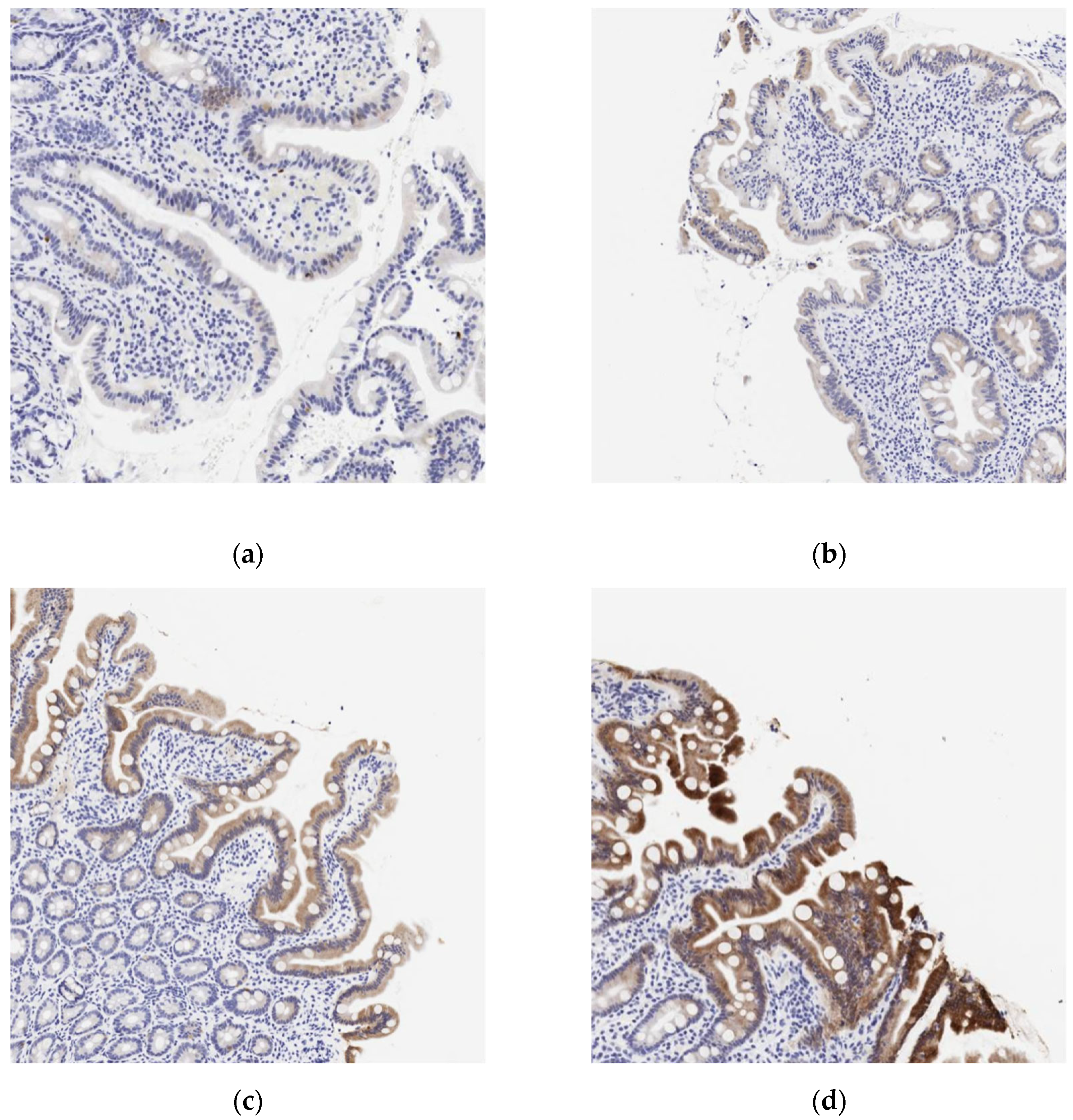
Figure 2.
Representative IHC images. (a) NKp46; (b) TdT; (c) THEMIS; (d) TCRδ in the duodenum. The red arrows indicate positively stained IELs.
Figure 2.
Representative IHC images. (a) NKp46; (b) TdT; (c) THEMIS; (d) TCRδ in the duodenum. The red arrows indicate positively stained IELs.
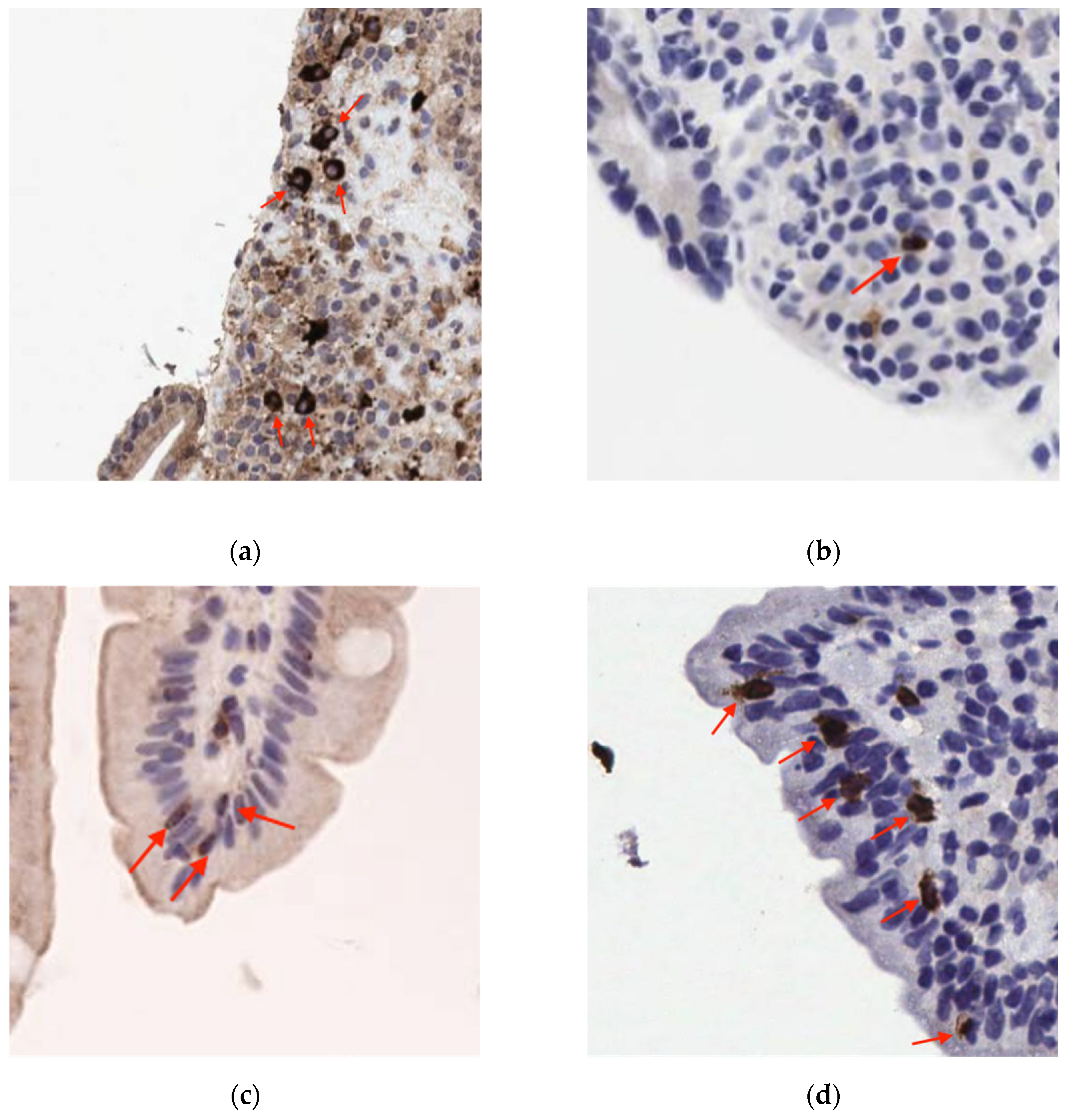
Figure 3.
Expression of five immunohistochemical biomarkers across CD subgroups and healthy controls. Boxplots and scatter plots show individual patient values and group distributions, with pairwise comparisons between disease subgroups and controls. Each dot represents the score for a single patient assessed by an individual observer. Grey dotted lines indicate the optimized diagnostic cut-off for each biomarker (summarized in Table 3). (a) Surface epithelium BTNL8; (b) Crypt epithelium BTNL8; (c) NKp46; (d) TdT; (e) THEMIS; (f) TCRδ expression. Abbreviations: SE, surface epithelium; CE, crypt epithelium; ns, not significant (at the 0.05 level).
Figure 3.
Expression of five immunohistochemical biomarkers across CD subgroups and healthy controls. Boxplots and scatter plots show individual patient values and group distributions, with pairwise comparisons between disease subgroups and controls. Each dot represents the score for a single patient assessed by an individual observer. Grey dotted lines indicate the optimized diagnostic cut-off for each biomarker (summarized in Table 3). (a) Surface epithelium BTNL8; (b) Crypt epithelium BTNL8; (c) NKp46; (d) TdT; (e) THEMIS; (f) TCRδ expression. Abbreviations: SE, surface epithelium; CE, crypt epithelium; ns, not significant (at the 0.05 level).
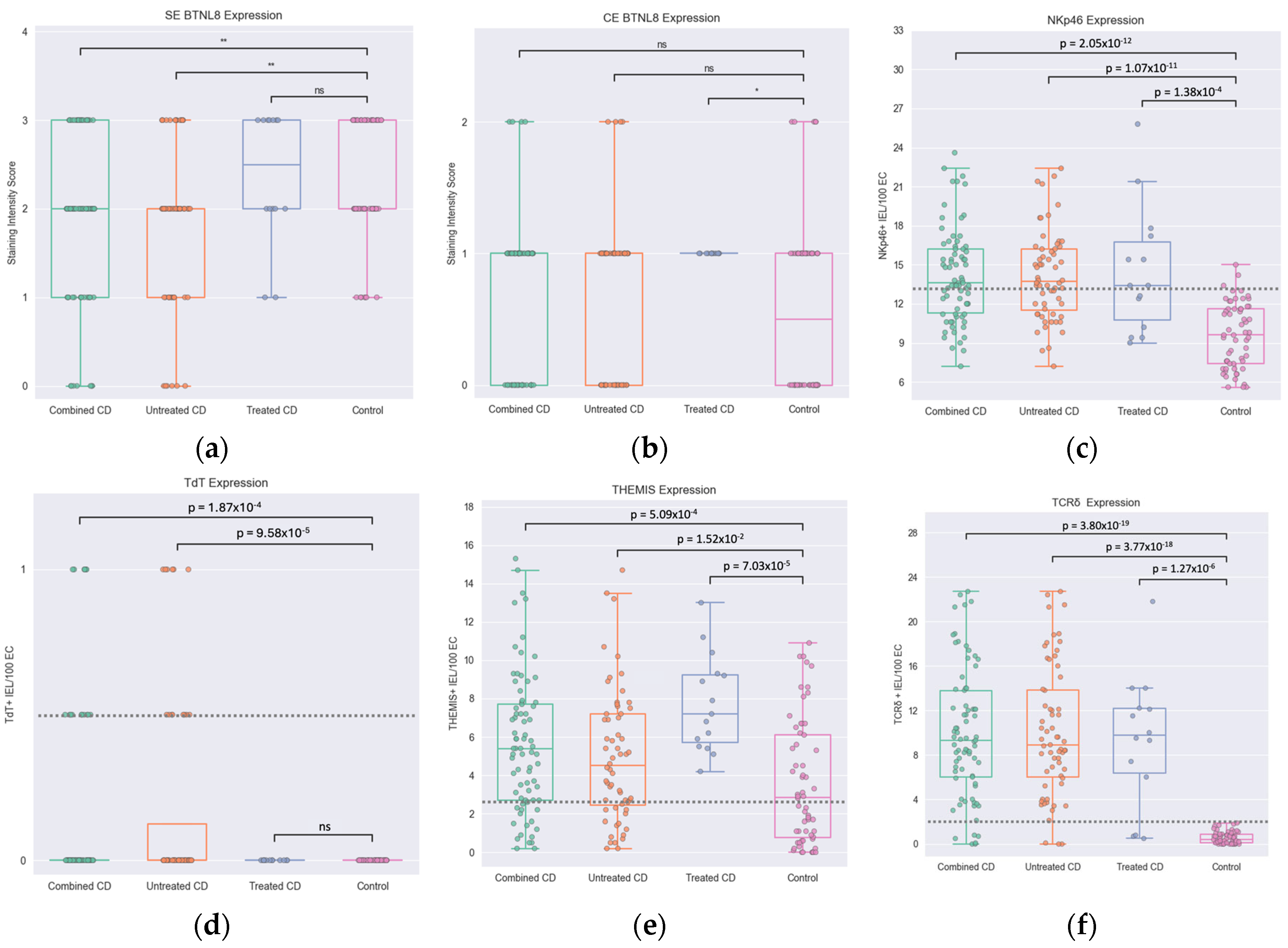
Figure 4.
Pooled ROC curves for all six immunohistochemical analyses described in Table 2.
Figure 4.
Pooled ROC curves for all six immunohistochemical analyses described in Table 2.
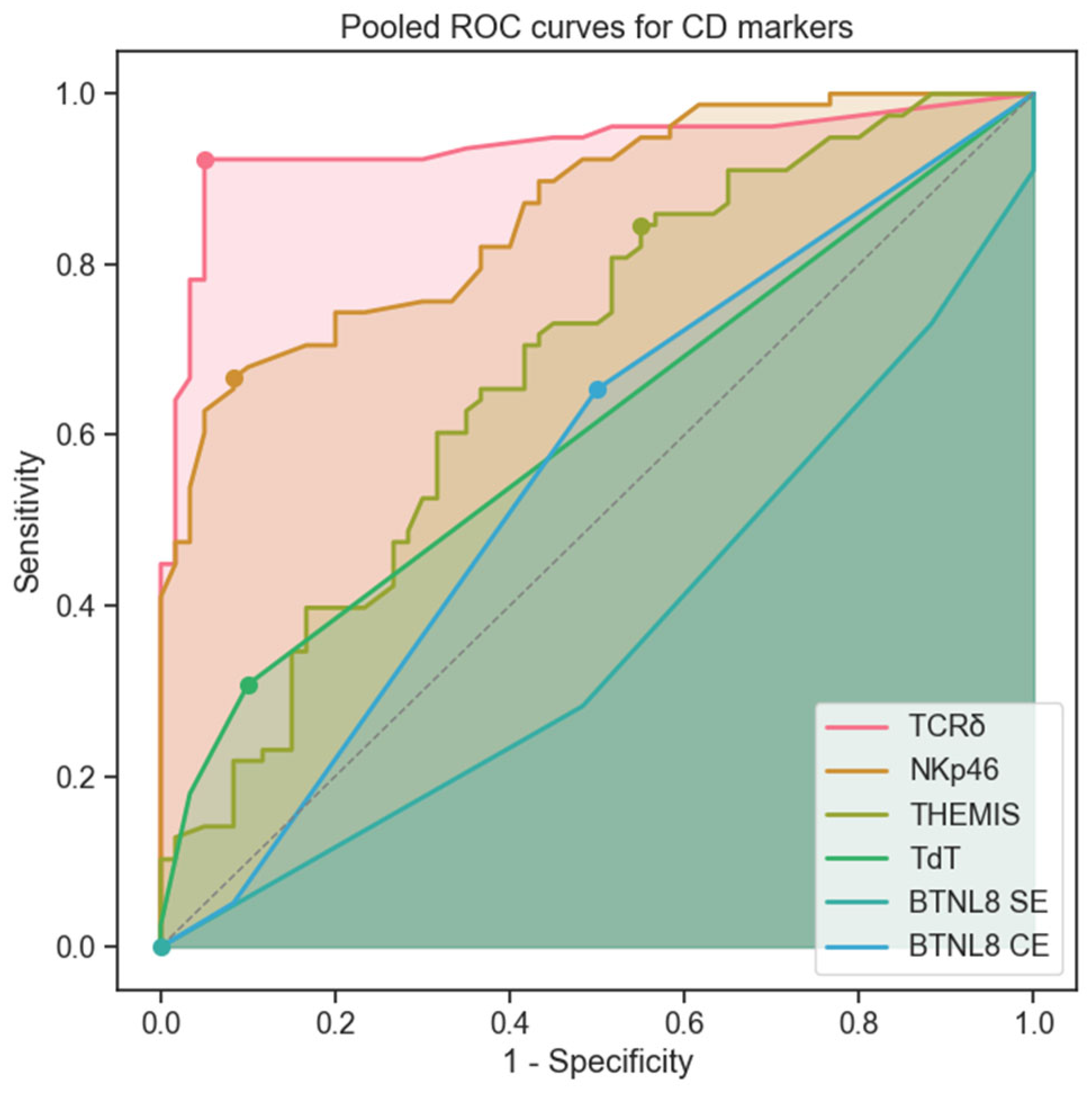
Table 1.
Scoring system for BTNL8 staining intensity.
| Score | Definition |
|---|---|
| 0 | No staining |
| 1 | Mild staining |
| 2 | Moderate staining |
| 3 | Strong staining |
Table 2.
Immunostaining results for all 5 biomarkers across the three disease subgroups and controls. BTNL8 staining intensity was enumerated separately on the surface and in crypts on a scaled of 0-3 corresponding to no, mild, moderate and strong staining. IELs positively immunostained for NKp46, THEMIS, TdT, and TCRδ were quantified, counting bilaterally from the villous tips in five regions of each biopsy with the highest number of stained epithelial cells, or in flat mucosal epithelium, if there was severe villous atrophy. IELs associated with 500 enterocytes were counted per patient for NKp46, or with 1000 enterocytes for THEMIS, TdT, and TCRδ. Mean numbers of positively stained IELs are given per 100 enterocytes for each marker. Further information on methods is included in section 2.3. Raw data corresponding to original cell counts is included in Appendix A: Table A1, Table A2, Table A3, Table A4, Table A5 and Table A6. IQR – interquartile range; ns – no significance (at the 0.05 level).
Table 2.
Immunostaining results for all 5 biomarkers across the three disease subgroups and controls. BTNL8 staining intensity was enumerated separately on the surface and in crypts on a scaled of 0-3 corresponding to no, mild, moderate and strong staining. IELs positively immunostained for NKp46, THEMIS, TdT, and TCRδ were quantified, counting bilaterally from the villous tips in five regions of each biopsy with the highest number of stained epithelial cells, or in flat mucosal epithelium, if there was severe villous atrophy. IELs associated with 500 enterocytes were counted per patient for NKp46, or with 1000 enterocytes for THEMIS, TdT, and TCRδ. Mean numbers of positively stained IELs are given per 100 enterocytes for each marker. Further information on methods is included in section 2.3. Raw data corresponding to original cell counts is included in Appendix A: Table A1, Table A2, Table A3, Table A4, Table A5 and Table A6. IQR – interquartile range; ns – no significance (at the 0.05 level).
| Diagnostic group/ Observer | Observer 1 median (IQR) | Observer 2 median (IQR) | Observer 3 median (IQR) | Median (IQR) for all 3 observers combined | p-value compared with control |
|---|---|---|---|---|---|
| Median surface BTNL8 staining intensity | - | ||||
| Combined CD | 2 (1.25-3) | 2.5 (2-3) | 2 (1-2) | 2 (1-3) | 0.0039 |
| Untreated CD | 2 (1-2) | 2 (2-3) | 2 (1-2) | 2 (1-2) | 0.0012 |
| Treated CD | 3 (2-3) | 3 (3) | 2 (2) | 2 (2-3) | 1 (ns) |
| Control | 2.5 (2-3) | 3 (2-3) | 2 (1-3) | 2 (2-3) | 1 |
| Median crypt BTNL8 staining intensity | |||||
| Combined CD | 1 | 1 (0.25-1) | 1 (0-1) | 1 (0-1) | 0.16 (ns) |
| Untreated CD | 0 | 1 (1) | 1 (0-1) | 1 (0-1) | 0.29 (ns) |
| Treated CD | 1 | 1 (0-1) | 1 (1) | 1 (1) | 0.011 |
| Control | 0 | 1 (0-1) | 0 (0-1) | 0.5 (0-1) | 1 |
| Median TCRδ+ IEL count per 100 enterocytes | |||||
| Combined CD | 13.9(8.1-17.8) | 8.5(5.5-10.85) | 8.2(4.5-10.2) | 9.4(6.0-13.9) | 3.80 × 10⁻¹⁹ |
| Untreated CD | 13.9(7.7-16.9) | 8.4(5.4-11) | 8.1(4-9.6) | 8.9(6.0-13.9) | 3.77 × 10⁻¹⁸ |
| Treated CD | 12.2(12.1-21.8) | 9.5(6-10) | 9.3(7.4-11.5) | 10.0(6.7-13.1) | 1.27 × 10⁻⁶ |
| Control | 0.7(0.15-1.1) | 0.4(0-0.8) | 0.4(0.2-1) | 0.5(0.1-1.0) | 1 |
| Median NKp46+ IEL count per 100 enterocytes | |||||
| Combined CD | 16.3 (13.9-21.4) | 12.6 (10.3-15.4) | 13.4 (11.4-15.3) | 13.8 (11.7-16.6) | 2.05 × 10⁻¹² |
| Untreated CD | 16.2 (13.6-18.6) | 13 (10.6-15.4) | 13.4 (11.2-15) | 13.8 (11.8-16.4) | 1.07 × 10⁻¹¹ |
| Treated CD | 21.4 (15.4-25.8) | 9.4 (9.4-10.2) | 13.4 (13.4-15.4) | 13.4 (11.3-17.5) | 1.38 × 10⁻⁴ |
| Control | 7.7 (6.95-9.9) | 9.9 (8.3-11.6) | 10.9 (7.55-11.9) | 9.6 (7.4-11.6) | 1 |
| Median THEMIS+ IEL count per 100 enterocytes | |||||
| Combined CD | 6.9(4.6-8.3) | 6.2(4.3-9.2) | 2.75(1.7-5.3) | 5.4(2.7-7.8) | 5.09 × 10⁻⁴ |
| Untreated CD | 5.9(3.4-7.8) | 5.9(4.1-9.1) | 2.5(1.2-3.6) | 4.9(2.6-7.6) | 0.015 |
| Treated CD | 7.2(6.8-9.3) | 8.9(6.2-9.2) | 5.4(5.1-7.9) | 7.2(5.7-9.3) | 7.03 × 10⁻⁵ |
| Control | 4.1(1.0-6.7) | 3.4(0.8-6.6) | 1.8(0.9-3.2) | 2.9(0.8-6.1) | 1 |
| Median TdT+ IEL count per 100 enterocytes | |||||
| Combined CD | 0.0(0.0) | 0.0(0.0) | 0.5(0.0-1.0) | 0.0(0.0-0.5) | 1.87 × 10⁻⁴ |
| Untreated CD | 0.0(0.0) | 0.0(0.0) | 0.5(0.0-1.0) | 0.0(0.0-0.5) | 9.58 × 10⁻⁵ |
| Treated CD | 0.0(0.0) | 0.0(0.0) | 0.5(0.0-0.5) | 0.0(0.0) | 1 (ns) |
| Control | 0.0(0.0) | 0.0(0.0) | 0.0(0.0) | 0.0(0.0) | 1 |
Table 3.
Diagnostic performance, thresholds (also shown in Figure 3), and interobserver agreement of five candidate biomarkers ranked by diagnostic performance, calculated as described in section 2.4.
Table 3.
Diagnostic performance, thresholds (also shown in Figure 3), and interobserver agreement of five candidate biomarkers ranked by diagnostic performance, calculated as described in section 2.4.
| Marker | ICC(2,1) | Threshold | AUC |
|---|---|---|---|
| TCRδ | 0.82 | >2.1 TCRδ+/100EC | 0.94 |
| NKp46 | 0.82 | >12.8 NKp46+ IEL/100 EC | 0.86 |
| THEMIS | 0.64 | >2.2 THEMIS+ IEL/100EC | 0.68 |
| TdT | 0.22 | >0.5 TdT+ IEL/100EC | 0.61 |
| BTNL8 CE | 0.52 | N/A | 0.56 |
| BTNL8 SE | 0.64 | N/A | 0.37 |
Disclaimer/Publisher’s Note: The statements, opinions and data contained in all publications are solely those of the individual author(s) and contributor(s) and not of MDPI and/or the editor(s). MDPI and/or the editor(s) disclaim responsibility for any injury to people or property resulting from any ideas, methods, instructions or products referred to in the content. |
© 2026 by the authors. Licensee MDPI, Basel, Switzerland. This article is an open access article distributed under the terms and conditions of the Creative Commons Attribution (CC BY) license (http://creativecommons.org/licenses/by/4.0/).
Copyright: This open access article is published under a Creative Commons CC BY 4.0 license, which permit the free download, distribution, and reuse, provided that the author and preprint are cited in any reuse.


