
Submitted:
09 April 2026
Posted:
13 April 2026
You are already at the latest version
Abstract
Nitrogen (N) availability is a major determinant of crop productivity; however, nitrogen use efficiency (NUE) remains relatively low in most agricultural systems. After uptake from the soil, inorganic N is assimilated into organic forms, primarily amino acids, which represent the principal long-distance transport form in most plants. The distribution of amino acids from source tissues to developing sink organs therefore plays a central role in plant growth, yield formation, and the nutritional quality of harvested organs. Amino acid transporters (AATs), also known as permeases, regulate the cellular and long-distance movement of amino acids and play a central role in nitrogen partitioning within the plant. These membrane proteins belong to the AAAP, APC, and UMAMIT transporter families and participate in multiple physiological processes, including amino acid uptake in roots, xylem and phloem transport, intracellular compartmentalization, and partitioning to reproductive tissues. Recent functional studies in both model plants and crop species demonstrate that manipulation of amino acid transporters can significantly influence biomass production, seed yield, grain protein content, and nitrogen use efficiency. In this review, we synthesize current knowledge on the structure, transport mechanisms, and physiological roles of plant amino acid transporters, with particular emphasis on their contribution to nitrogen partitioning and crop productivity. We also discuss emerging opportunities for exploiting amino acid transporters in crop breeding and biotechnology to enhance nitrogen utilization and improve the sustainability of agricultural systems.
Keywords:
amino acid transporters
; crop quality
; crop yield
; nitrogen partitioning
; nitrogen use efficiency
1. Introduction
Nitrogen (N) is the most quantitatively important essential nutrient for plants and frequently represents a major limiting factor for crop growth and yield (Lawlor et al., 2001). Nitrogen is a key component of biomolecules essential for cellular structure and function, including amino acids, proteins, nucleic acids, hormones, chlorophylls, and specialized metabolites (Rengel et al., 2023). In addition to its structural role, N availability strongly modulates plant growth and development by regulating physiological processes such as root architecture, seed dormancy, or leaf development (Liu and von Wirén, 2017; Vega et al., 2019).
In modern agricultural systems, large amounts of nitrogen fertilizers are applied to maximize crop yields. However, plants typically utilize only a fraction of the applied nitrogen, resulting in low nitrogen use efficiency (NUE) and significant environmental consequences, including nitrate leaching, greenhouse gas emissions, and eutrophication of aquatic ecosystems (Tilman et al., 2002; Masclaux-Daubresse et al., 2010; Xu et al., 2012). Improving NUE has therefore become a major objective in crop research and breeding programs aimed at increasing productivity while reducing the environmental footprint of agriculture (Good et al., 2004; Xu et al., 2012).
Plants acquire nitrogen mainly as nitrate (NO3−) or ammonium (NH4+) from the soil through specialized transport systems located in root cell membranes (Crawford and Glass, 1998; Wang et al., 2012). Following uptake, inorganic nitrogen is assimilated into organic compounds, primarily amino acids, through the coordinated activity of the nitrate reduction and ammonium assimilation pathways (Campbell, 1999; Lea and Miflin, 2011). Amino acids constitute the principal transportable forms of reduced nitrogen in plants and are distributed from source tissues, where nitrogen assimilation occurs, to sink tissues that require nitrogen for growth and storage, including developing leaves, roots, flowers, and seeds (Tegeder and Rentsch, 2010; Tegeder and Masclaux-Daubresse, 2018).
The cellular and long-distance distribution of amino acids depends on a diverse group of membrane transport proteins known as amino acid transporters (AATs) (Rentsch et al., 2007; Tegeder, 2012). These transporters regulate nitrogen partitioning by mediating amino acid uptake, export, and intracellular compartmentalization, thereby influencing plant growth, reproductive development, and crop productivity. Increasing evidence indicates that amino acid transporters play important roles in determining agronomic traits such as biomass production, seed yield, grain protein content, and NUE (Tegeder, 2014; Tegeder and Masclaux-Daubresse, 2018). Manipulation of specific permeases can alter nitrogen partitioning among tissues and organs, highlighting their potential as targets for crop improvement strategies. Despite increasing knowledge, how amino acid transport is coordinated with whole-plant nitrogen allocation and crop productivity remains poorly understood.
This review summarizes the roles of amino acid permeases in plant physiology, focusing on their impact on crop yield, nutritional quality, and NUE, and highlights their potential for improving sustainable agriculture through breeding and biotechnology.
2. Nitrogen Uptake and Assimilation
Plants primarily acquire N from the soil as nitrate, although in certain soils, conditions, or management practices, ammonium, urea, or amino acids may constitute alternative sources (Loqué and von Wirén, 2004; Maathuis, 2009; Masclaux-Daubresse et al., 2010; Witte, 2011).
N assimilation can occur in roots or shoots depending on the species and plant conditions (Andrews, 1986). In herbaceous species, absorbed nitrate is usually assimilated in leaves (Foyer et al., 2003; Hachiya et al., 2016). There, nitrate is transported into the cytosol of mesophyll cells and reduced to nitrite, a reaction catalyzed by nitrate reductase (Meyer and Stitt, 2001). Nitrite is subsequently translocated to the chloroplast, where it is reduced by the second enzyme in the pathway, nitrite reductase (NiR), to ammonium. The ammonium derived from nitrate reduction, as well as from photorespiration or amino acid metabolism, is primarily assimilated by the glutamine synthetase (GS)/glutamate synthase (GOGAT) cycle in the chloroplast (Lea and Miflin, 1974). Chloroplastic glutamine synthetase (GS2) fixes ammonium to a glutamate (Glu) molecule to generate glutamine (Gln). Gln then reacts with 2-oxoglutarate to produce two Glu molecules, in a reaction catalyzed by GOGAT (Suzuki and Knaff, 2005). In leaves and other organs, various cytosolic glutamine synthetase forms (GS1) may be involved in ammonium recycling under specific conditions, such as senescence, or in glutamine synthesis for phloem partitioning (Bernard and Habash, 2009). In addition to the GS/GOGAT cycle, asparagine synthetase (AS), carbamoyl phosphate synthetase (CPSase), and mitochondrial glutamate dehydrogenase (GDH) also contribute to ammonium assimilation (Masclaux-Daubresse et al., 2010). Moreover, in leguminous species, amino acids assimilated in the root nodules are also partitioned in the plant (Garneau et al., 2018).
Ammonium taken up from the soil is preferentially assimilated in roots via cytosolic GS1 forms, especially under high nitrate availability conditions (Hachiya and Sakakibara, 2017). At concentrations exceeding GS capacity, part of the ammonium may be transported to the shoot for assimilation (Schjoerring et al., 2002).
Nitrogen assimilation into amino acids requires energy in the form of ATP and reducing power, as well as carbon (C) skeletons for ammonium condensation. These products derive from photosynthesis, respiration, and photorespiration, underscoring the close relationship and regulation of C/N metabolism (Foyer et al., 2003). Synthetized amino acids in the leaves are used for metabolism, transiently stored or transported in the phloem to developing vegetative or reproductive sink tissues. Besides, amino acids assimilated in the root cells or taken directly from the soil were translocated to the shoot via xylem (Tegeder, 2014; Tegeder and Masclaux-Daubresse, 2018). In addition, N remobilization from storage pools or protein hydrolysis also contributes to the available amino acid pool in the plant (Tegeder and Hammes, 2018).
3. Amino Acid Transport in the Plant
Long-distance transport of amino acids involves multiple interconnected steps of inward and outward transport across the plasma membranes, including uptake from the soil, as well as xylem and phloem loading and unloading, and delivery to developing edible organs such as tubers and fruits (Pratelli and Pilot, 2014) (Figure 1). Furthermore, since amino acid metabolism and storage are compartmentalized within the cell (Galili et al., 2016), the movement between organelles, including chloroplasts, vacuoles, mitochondria and peroxisomes, and the cytosol is controlled by amino acid permeases (Snowden et al., 2015; The et al., 2024; Kuhnert et al., 2025).
In roots, amino acid uptake from the soil is mediated by plasma membrane transporters in epidermal and cortical cells (Figure 1A). Members of the AAP, LHT, and ProT families contribute to this process, with partially overlapping substrate specificities but distinct expression patterns that enable flexible responses to environmental conditions (Lee et al., 2007; Svennerstam et al., 2008; Hirner et al., 2006; Grallath et al., 2005).
Following uptake or local synthesis, amino acids are exported to the apoplast and subsequently loaded into the xylem for root-to-shoot transport, a process in which UMAMIT transporters play key roles (Figure 1A). In the shoot, amino acids are taken up by leaf cells and, together with those assimilated in the leaves, are redirected into the phloem for distribution to sink organs. Phloem loading typically involves an apoplastic pathway, with UMAMIT proteins mediating amino acid export from mesophyll cells and AAAP transporters (Figure 1), including AAPs, facilitating uptake into the sieve element–companion cell complex (Müller et al., 2015; Tegeder and Masclaux-Daubresse, 2018). Also permeases of these families regulate apoplastic unloading at the sinks, mainly fruits and seeds during the reproductive stage of the plant.
Together, these transport steps constitute a coordinated system that links nitrogen assimilation with whole-plant distribution, ultimately shaping growth, development, and reproductive success.
4. Plant Amino Acid Transporters
Amino Acid Transporter Families
Plants display a multiplicity of amino acid transporters or permeases that differ in tissue or subcellular distribution, substrate specificity, affinity or regulation (Williams and Miller, 2001; Tegeder et al., 2011; Pratelli and Pilot, 2014). Based on sequence homology and transport properties, plant amino acid transporters fall into three major families: Amino Acid/Auxin Permeases (AAAP), Amino acid/Polyamine/Choline transporters (APC), both included in the APC superfamily (Zhao et al., 2021), and Usually Multiple Acids Move In and Out Transporters (UMAMIT), as summarized in Table 1.
The AAAP family represents the largest group and includes several subfamilies such as Amino Acid Permeases (AAP), Lysine and Histidine Transporters (LHT), Proline Transporters (ProT), γ-Aminobutyric Acid Transporters (GAT), Aromatic and Neutral Amino Acid Transporters (ANT), Auxin Transporters (AUX), Amino Acid Transporter-like (ATL) and Vesicular Aminergic-Associated Transporters (VAAT). The APC family consists of three subfamilies: Cationic Amino Acid Transporters (CAT), Amino Acid/Choline Transporters (ACT), and Polyamine H+ Symporters (PHS). Genome-wide surveys reported that the AAP, LHT, ATL and VAAT subfamilies comprise the largest number of genes in the AAAP family, and the CAT were the most represented in the APC family (Zhao et al., 2012; Wu et al., 2015; Cheng et al., 2016; Ma et al., 2016; Tian et al., 2020; Omari Alzahrani, 2021). UMAMIT belongs to the nodulin-like family and might be divided into four subfamilies (Cao et al., 2025).
Some further amino acid transporter genes have been reported (Okumoto and Pilot, 2011; Haferkamp and Schmitz-Esser, 2012; Pratelli and Pilot, 2014), but most attention has been focused on AAAP and UMAMIT families.
Structure and Transport Characteristics of Amino Acid Permeases
Amino acid transporters of the AAAP and APC families share common structural and functional features as members of the APC superfamily. These proteins are integral membrane transporters typically containing 10-14 transmembrane α-helices with both C- and N-termini oriented toward the cytosol (Frommer et al., 1993; Bush et al., 1996; Vangelatos et al., 2009; Fan et al., 2023) (Figure 2A,B).
In general, it is considered that AAAP and APC transporters operate as proton-coupled symporters (Figure 2D). This secondary active transport mechanism underlies their role in amino acid import into the cell or the organelle (Bush, 1993; Frommer et al., 1993; Boorer et al., 1996; Boorer and Fischer, 1997; Meyer et al., 2006; Meier et al., 2024). Most of the AAAPs and APCs are suggested to be in the plasma membrane and therefore involved in amino acid import into the cell, playing central roles in processes such as root uptake, phloem loading and seed filling (Tegeder, 2012; Tegeder and Masclaux-Daubresse, 2018). Nevertheless, specific members of the superfamily, like CAT permeases, are predicted to be targeted to chloroplasts, mitochondria or vacuoles (Su et al., 2004; Snowden et al., 2015).
AAAP and APC transporters display broad but variable substrate specificity, mediating the transport of a broad spectrum of amino acids (Frommer et al., 1993; Boorer and Fischer, 1997; Fischer et al., 2002; Yang et al., 2020). Nevertheless, differences in the specificity and affinity for amino acids have been observed among subfamilies and between members of the same family (Fischer et al., 2002; Grallath et al., 2005; Svennerstam et al., 2008). By contrast, the permeases of other families show stronger specificity for amino acids. Among them, the ProT family mainly transports preferably proline and glycine betaine whereas GAT permeases show preference for GABA (Meyer et al., 2006). In addition, some members of the AAAP family transport other related metabolites, such as non-proteinogenic-amino acids 1-aminocyclopropane-1-carboxylic acid (ACC) and theanine or auxins (Shin et al., 2015; Choi et al., 2019; Dong et al., 2020; Hammes and Pedersen, 2024), highlighting their integration into broader metabolic and signaling networks.
In contrast, UMAMIT transporters represent a distinct, plant-specific family with unique structural and functional properties. These proteins typically contain 10 transmembrane helices arranged in two inverted repeats (Müller et al., 2015; Cao et al., 2025) (Figure 2C). Unlike AAAP and APC permeases, UMAMITs act primarily as facilitators, enabling bidirectional amino acid transport driven by concentration gradients rather than proton coupling (Müller et al., 2015). Those UMAMITs characterized to date promote the transport of a broad range of amino acids, although with specific features among genes (Müller et al., 2015; Besnard et al., 2018).
Regarding subcellular localization, UMAMITs were predominantly localized in the plasma membrane, tonoplast and chloroplasts, although some might be located at the endoplasmic reticulum, nucleus or mitochondria (Figure 2D). Notably, UMAMIT members located at the plasma membrane display mainly amino acid export activity, and are hypothesized to play, together with the H+/amino acid symporters (Figure 1C), analogous role in the amino acid transport as the SUC-SUT/SWEET pair to transport sucrose (Kim et al., 2021). Interestingly, some UMAMIT proteins have been proposed to also facilitate the efflux of glucosinolates to the apoplast (Xu et al., 2023). The UMAMIT proteins located in the chloroplast and tonoplast membranes mediate subcellular transport of amino acids associated to amino acid metabolism or storage between organelles (Kuhnert et al., 2025).
5. Physiological Functions of Amino Acid Permeases
Amino acid permeases function across multiple organizational levels, from cellular uptake and intracellular compartmentalization to long-distance transport, thereby coordinating nitrogen allocation and partitioning throughout the plant. They are expressed in diverse organs and tissues, reflecting their wide range of physiological functions (Fischer et al., 1995; Zhao et al., 2012; Ma et al., 2016; Tian et al., 2020; Zhao et al., 2021; Chen et al., 2025; Ling et al., 2026). Expression analyses frequently reveal the presence of multiple transporters within the same tissue, indicating both functional redundancy and specialization among family members.
Amino Acid Transport in the Roots
Amino acid uptake from the soil solution requires specific transporters located in the plasma membrane of epidermal or cortical root cells (Tegeder, 2014). Once inside the cytosol, amino acids move symplastically through plasmodesmata toward the vascular cylinder. This flux might also include amino acids assimilated or stored in root cells. There, they are mostly loaded into the xylem, a process that requires another plasma membrane transporter to enter the apoplast, for long-distance distribution to the aerial parts of the plant following the transpiration stream (Figure 1A).
Members of the AAP, LHT and ProT families control amino acid uptake in the roots (Table 1). For example, AAP1, AAP5, LHT1, LHT6 and ProT2 mediate the inward transport of amino acids to root cells in Arabidopsis (Chen and Busch, 1997; Grallath et al., 2005; Hirner et al., 2006; Lee et al., 2007; Svennerstam et al., 2008, 2011; Lehmann et al., 2011; Perchlik et al., 2014), with similar functions reported for homologs in crop species such as cucumber and rice (Guo et al., 2020; Yao et al., 2023).
Although the mechanisms of xylem loading remain incompletely understood, UMAMIT transporters have been implicated in amino acid export to the apoplast (Figure 1A). For instance, SIAR1/UMAMIT18 facilitates amino acid efflux from pericycle cells, contributing to xylem loading, while BAT1 has also been proposed to participate in amino acid export into the xylem sap (Ladwig et al., 2012; Dündar and Bush, 2009). Similarly, cucumber CsAAP2 is highly expressed in the root pericycle, and aap2 loss-of-function mutants showed increased free amino acid contents in roots, suggesting a role in xylem loading (Yao et al., 2023).
Xylem Transport to the Shoot
Following transport to the shoot, amino acids are imported into the mesophyll cells for metabolism or storage (Tegeder and Masclaux-Daubresse, 2018). It has been hypothesized that vegetative organs like stems could act as transitory storage organs for N in tree species, but also in herbaceous (Millard, 1988; Kotowska et al., 2020). Transporters like AtLHT1 mediate amino acid uptake into mesophyll cells from the xylem (Hirner et al., 2006).
Amino acids can also be directly transferred from the xylem to the phloem along the long-distance pathway from roots to leaves, allowing direct transport to developing sinks with low transpiration rates such as fruits and flowers (Lalonde et al., 2003; Tegeder and Rentsch, 2010) (Figure 1B). This process involves several steps of membrane transport and the coordinated activity of diverse permeases (Tegeder, 2014). For example, AtAAP2 and AtAAP6 function in xylem-to-phloem transport (Table 1) at distinct sites in Arabidopsis (Hirner et al. 1998; Okumoto et al., 2002; Zhang et al., 2010) and have a marked impact on plant growth and seed yield (Perchlik and Tegeder, 2018). Similar functions have been proposed for OsAAP3, OsAAP5 and OsAAP5 in rice (Peng et al., 2014; Lu et al., 2018; Wang et al., 2019) and GmAAP6a in cucumber (Liu et al., 2020).
Phloem Partitioning to Sinks
The growth and development of the major sinks in the plant, like seeds, fruits and tubers, mainly relies on the photoassimilates transported in the phloem primarily from the leaves. Most species are apoplastic loaders and therefore, one transporter is required to export amino acids from the mesophyll cell to the cell wall and another to enter the phloem sap (Figure 1C). Bidirectional UMAMIT permeases are considered to mediate the first step. UAMAMIT11, UMAMIT14 and UMAMIT18 (SAR1) were localized in the leaf vascular bundle and proposed to be involved in phloem loading (Müller et al., 2015; Zhao et al., 2021). In coordination with the UMAMIT exporters (Table 1), the import of amino acids in the sieve elements is regulated by AAAP and APC permeases. Among them, functional evidence points to relevant roles to members of the AAP, CAT and ProT families (Zhang et al., 2010; Lehmann et al., 2011; Tegeder and Ward, 2012; Tegeder and Masclaux-Daubresse, 2018). As example, AAP8 regulates the import into the phloem of the amino acids exported by UMAMIT18 in Arabidopsis (Santiago and Tegeder, 2017). Interestingly, phloem loading not only determines sink growth and development, but also the physiology and primary metabolism of the sources (Pratelli and Pilot, 2014; The et al., 2021).
In many species, photoassimilates are unloaded via the symplastic pathway during the early stages of fruit development, which later shifts to an apoplastic pathway (Werner et al., 2011). This change is related to the closure of cell-to-cell connections and the new expression of plasma membrane transporters (Figure 1D). There is limited information about the unloading process in the tissues that will give rise to the fruit, whereas most studies have focused on the control of amino acid import into seeds. In the developing seeds, endosperm and embryo are symplastically isolated from the maternal seed coat (Patrick and Offler, 2001). In Arabidopsis, UMAMIT11, UMAMIT14, UMAMIT18, UMAMIT28 and UMAMIT29 facilitate amino acid unloading to the apoplast at the funiculus vasculature to fuel seed N demand (Müller et al., 2015). Once in the seed apoplast, AAP and CAT permeases, like AAP1, AAP8 and CAT6, facilitate amino acid loading into the embryo (Hirner et al., 1998; Hammes et al., 2006; Schmidt et al., 2007; Sanders et al., 2009; Tegeder and Masclaux-Daubresse, 2017 and references therein) (Figure 1E).
Subcellular Transport
In addition to their roles in long-distance transport between organs, amino acid transporters also regulate the distribution of amino acids among intracellular compartments (Figure 1D; Table 1). This intracellular trafficking is essential for maintaining amino acid homeostasis, supporting metabolic processes in different organelles, and coordinating nitrogen metabolism with cellular energy and carbon status (Tegeder and Rentsch, 2010; Pratelli and Pilot, 2014). Amino acid biosynthetic pathways involve cytosol, mitochondria, peroxisomes and chloroplasts, and transport across organelle membranes is required to link amino acid biosynthesis and catabolism (Heinig et al., 2013; Galili et al., 2016; Pan et al., 2020; Medeiros et al., 2021; Moller et al., 2021).
The outer envelope membrane of plastids allows non-specific movement of amino acids through the OEP16 channel (Pohlmeyer et al., 1997), but the inner membrane acts as the barrier for controlled exchange of amino acids. The DIT2.1 gene was reported to encode for a plastidic malate/glutamate translocator essential for the photorespiratory pathways (Renné et al., 2003). Furthermore, the UMAMIT44 permease of A. thaliana also regulates glutamate export and glutamate homeostasis within and outside the chloroplast (The et al., 2024). In addition, Arabidopsis RETICULATA1 (RE1) and PhpCAT from Petunia hybrida regulate the flux of basic and cationic amino acids, respectively (Widhalm et al., 2015; Kuhnert et al., 2025).
In the mitochondria, low selectivity VDAC porins facilitate the exchange of amino acids across the outer membrane (Pudelski et al., 2010). Among the mitochondrial MCF genes, two basic amino acid carriers, BAC1 and BAC2 are involved in the transport of amino acids across the inner membrane (Hoyos et al., 2003).
Vacuoles can store a large content of amino acid pool in plant cells (Winter et al., 1993; Tan et al., 2019). In Arabidopsis, AtCAT2 and AtCAT4 were primarily localized in the tonoplast membrane and might have a relevant role in the regulation of tissue amino acid contents (Yang et al., 2014). In tomato, the GABA/Glu/Asp exchanger SlCAT9 of the tonoplast is involved in the accumulation of all three amino acids in the vacuole of mature fruits (Snowden et al., 2015).
6. Role of Amino Acid Permeases in the Determination of Yield, Nutrient Use Efficiency and Quality of Crops
Efforts on improving crop yield and NUE have been traditionally focused on processes controlling the uptake of inorganic N from the soil, the assimilation of nitrate and ammonium, and the recycling of organic nitrogen (Yanagisawa et al., 2004; Masclaux-Daubresse et al., 2010; The et al., 2021; Melino et al., 2022). In several crop species, a positive correlation of the expression of key genes involved in N uptake, assimilation and remobilization with plant biomass, yield production and NUE have been reported (Martin et al., 2006; Egami et al., 2012; Fan et al., 2016; Fang et al., 2017; Gao et al., 2019; Yu et al., 2019). However, these approaches have often produced variable results due to metabolic and post-transcriptional regulation, as well as differences in nitrogen availability, since the factors limiting NUE differ under low and high nitrogen supply.
Beyond nitrogen acquisition and assimilation, the internal distribution of assimilated nitrogen within the plant is a key determinant of crop productivity. In particular, the transport of amino acids regulates nitrogen partitioning from source to growing organs and reproductive structures, thereby influencing biomass accumulation, yield formation, and the nitrogen content of harvested organs (Perchlik and Tegeder, 2017).
Role of Amino Acid Permeases in the Determination of Crop Yield
The adequate supply of sugars and amino acids to the developing sinks determines plant growth and yield (Lawlor, 2001). Amino acids are constituents of proteins and precursors of many components of the primary and specialized metabolites of the cells. The permeases regulate the long-distance transport of amino acids from organ sources to the sinks and therefore control the amount of imported amino acids by the harvested organs in crops (e.g., fruits, tubers, inflorescences, …). Besides growth and development of sinks, storage compounds like proteins, lipids and carbohydrates were also accumulated, being crucial for yield and nutritional value (Yadav et al., 2015; ElShamey et al., 2025; Winichayakul and Roberts, 2025).
Most functional analyses on the role of amino acid permeases in the determination of crop production have been addressed in legumes and cereals, where grain/seed are the harvested organs (Table 2). In rice, permeases OsAAP1, OsAAP4, OsAAP8, OsAAP15, OsAAP18, OsANT1 and OsLHT1 were reported to regulate growth and grain yield (Ji et al., 2020; Fang et al., 2021; Yang et al., 2023; He et al., 2025; Nie et al., 2025; He et al., 2026; Li et al., 2026). Overexpression of these genes enhances tillering and promotes amino acid transport to the developing grains, whereas loss-of-function mutants display the opposite effects. These effects have been linked, at least in part, to cytokinin-mediated regulation.
In contrast, other permeases such as OsAAP3, OsAAP5, OsAAP7 and OsAAP12 act as negative regulators of tillering and grain yield (Lu et al., 2018; Wang et al., 2019; Jin et al., 2024). Accordingly, a survey among 521 cultivated rice varieties showed a negative correlation in the expression of OsAAP7 with grain yield (Jin et al., 2024). Similarly, variation in OsAAP5 expression has been associated with differences in tillering between indica and japonica varieties (Wang et al., 2019). Reduced expression of OsAAP5 leads to the accumulation of specific neutral and basic amino acids (Lys, Arg, Val and Ala), which was proposed to promote tiller growth (Zhang et al., 2010; Wang et al., 2019).
Manipulation of amino acid transporters has also been shown to influence sink strength in other crops. In wheat, the endosperm-specific overexpression of TaAAP13 increased grain size, N content and weight by enhancing amino acid import, although the total number of grains was reduced due to source limitations (Wan et al., 2021). Similarly, enhanced amino acid transport to developing seeds has been reported in maize and millet through overexpression of AtAAP1 and SiAAP9, respectively (Chen et al., 2021; Meng et al., 2024).
In legumes, several AAP transporters have been implicated in the regulation of amino acid transport to seeds (Rolletschek et al., 2005; Zhang et al., 2015; Liu et al., 2020; Lu et al., 2020; Zhang et al., 2025a). Overexpression of the PsAAP1 gene in pea source and sink tissues increased photosynthesis, vegetative biomass and amino acid content in the phloem, resulting in higher total N content in seeds and seed yield (Zhang et al., 2015). The enhanced yield was associated with an increased number of seeds but not seed size. Notably, also higher amino acid contents were reported in the xylem, as well as N uptake and assimilation.
A related ‘push-and-pull’ strategy combining carbon and nitrogen transport was demonstrated by overexpressing the sucrose transporter SUT1 in pea source and sink tissues (Lu et al., 2020). Besides the expected increase in sucrose levels in leaves, phloem and seeds, enhanced amino acid assimilation and transport to developing seeds was observed. Expression of several amino acid transporters, including PsAAP2, PsAAPP3 and PsCAT9, was up-regulated in developing cotyledons, leading to increased yield and protein and starch accumulation in mature seeds. These findings highlight the close and complex coordination between C and N metabolism, allocation and partitioning in the plant. Consistently, simultaneous overexpression of PsSUT1 and PsAAP1(3a) increased seed number and protein content in pea, without affecting seed weight (Grant et al., 2021).
A positive impact of AAP genes in amino acid transport to sinks was also found in soybean (Liu et al., 2020; Zhang et al., 2025a). For example, the overexpression of the GmAAP6-like gene increased seed weight when expressed in Arabidopsis (Zhang et al., 2025a). Likewise, overexpressing the broad bean VfAAP1 gene enhanced seed weight and yield in both pea and Vicia narbonensis (Rolletschek et al., 2005), supporting the general role of AAP transporters in regulating amino acid partitioning to the seed within the Fabaceae family.
Furthermore, amino acid permeases are also involved in the export of fixed amino acids in the nodules of legumes (Garneau et al., 2018). In pea, down-regulation of PsAAP6 through miRNA interference reduced N supply to shoots and roots and resulted in amino acid accumulation in the nodules, suggesting a regulatory role of this transporter in the coordination of nodule activity with plant N demand (Garneau et al., 2018).
Compared with grain crops, relatively few studies have examined the role of amino acid permeases in edible fruit- and tuber-producing species. Nevertheless, evidence from cucumber, potato, and tomato suggests that these transporters also influence yield-related traits. In cucumber, disruption of CsAAP2 reduced leaf size and fruit weight, indicating a role in source–sink amino acid transport (Yao et al., 2023). In potato, altered expression of StAAP1 influenced tuber morphology but did not significantly affect overall yield (Koch et al., 2003; Zhang et al., 2025b). In tomato, combinatorial manipulation of genes involved in carbon and nitrogen transport, including amino acid permeases, has demonstrated potential for improving fruit yield (Vallarino et al., 2020).
Taken together, these results demonstrate that amino acid permeases are key regulators of N partitioning from sources to sinks. By controlling amino acid fluxes at multiple stages of transport, these transporters influence biomass accumulation and crop yield (Table 2). Their effects are context-dependent, varying with developmental stage, nitrogen availability, and source–sink balance, but overall, they represent powerful targets for improving crop productivity through breeding and biotechnological approaches.
Impact of Amino Acid Transporters on Nutritional Value and Crop Quality
Amino acids are key components of the nutritional and organoleptic traits of cereal and leguminous crops, as free amino acid content or as components of storage proteins of seeds (Bright et al., 1983). Consequently, amino acid transporters may play important roles in regulating the flux of assimilated nitrogen to harvested organs and thus influence crop quality.
In cereals, grain protein content (GPC) is a key quality trait affecting both nutritional value and processing characteristics. Several amino acid transporters have been linked to the regulation of amino acid import into developing grains. The permeases TaAAP2 and TaAAP13 are highly expressed in grain transfer cells of wheat and are associated with protein accumulation in the endosperm (Wan et al., 2021). Manipulation of TaAAP13 expression alters amino acid distribution within the grain and influences gluten protein accumulation.
In rice, the qPC1 QTL, encoding OsAAP6, controls grain protein content by regulating the synthesis and accumulation of several storage proteins like glutelins, globulins and prolamine (Peng et al., 2014). Additional AAPs, including OsAAP4, OsAAP5, OsAAP6, OsAAP10 and OsAAP11, have been also implicated in determining free amino acid content and grain protein levels (Wang et al., 2019; Guo et al., 2020; Wang et al., 2020; Yang et al., 2023; Li et al., 2026). Interestingly, several studies also reported trade-offs between nitrogen and carbon accumulation in grains when the expression of permeases like OsLHT1 and OsAAP8, reflected in inverse relationships between protein and starch or amylose content in grains (Guo et al., 2020; Wang et al., 2020; Peng et al., 2024).
Similar regulatory roles have been reported in maize and legumes. For instance, ZmAAP6 influences protein accumulation during maize seed development (Wang et al., 2022), while overexpression of VfAAP1 or PsAAP1 in legumes increases seed nitrogen, amino acid content, and storage protein accumulation (Rolletschek et al., 2005). When sugars and amino acid partitioning was boosted by concurrent overexpressing the SUT1 and AAP1(3a) genes in pea (Lu et al., 2020), an increase in sucrose and protein contents was induced in the developing seed (Grant et al., 2021).
In fruit and tuber organ crops, amino acid permeases also influence the nutritional composition of the edible organ. In cucumber, loss-of-function mutants of CsAAP2 displayed reduced amino acid levels shoot and fruits (Yao et al., 2023). Similarly, the antisense suppression of StAAP1 in potato reduced levels of free amino acids in the tubers, although starch contents were not affected (Koch et al., 2003). Similarly, potato StAAP8 overexpression lines exhibit increased levels of amino acid and proteins (Zhang et al., 2025b). In tomato, overexpression of the tonoplast transporter SlCAT9 altered fruit amino acid composition by increasing glutamate, aspartate, and γ-aminobutyric acid levels (Snowden et al., 2015). Genome-wide association studies in pepper have also identified amino acid transporter genes associated with fruit nutritional traits (von Steimker et al., 2025).
Summarizing, these findings demonstrate that AAAP permeases influence the accumulation of key metabolites affecting the nutritional and organoleptic quality of crop products (Table 2). Notably, alterations in assimilated N flux also impact C compound partitioning, thereby influencing carbohydrate content.
Members of the UMAMIT family also contribute to crop nutritional quality through their roles in the distribution of nitrogen-containing specialized metabolites. In Brassicaceae crops, glucosinolates are key compounds influencing flavour, anti-nutritional properties, and agronomic quality (Cartea and Velasco, 2008). Their long-distance transport involves both glucosinolate transporters (GTRs) and UMAMIT permeases, which mediate export from biosynthetic cells into the apoplast (Agyenim-Botaeng et al., 2025). In Arabidopsis, umamit29 umamit30 umamit31 triple mutant lines resulted in marked reductions in glucosinolates in the seeds (Xu et al., 2023). Manipulating these transport processes may offer strategies to optimize glucosinolate distribution, reducing anti-nutritional compounds in edible tissues while maintaining their protective functions in source organs.
Role of Amino Acid Permeases in the Determination of Nitrogen Use Efficiency (NUE) in Crops
NUE is defined as the seed (or harvested organ) yield per unit of N available in the soil and fertilizer (Moll et al., 1982). Improving NUE is a major objective of sustainable agriculture, as it allows high crop productivity while reducing fertilizer inputs, and therefore costs and contamination to the environment (van Bueren and Struik, 2017). NUE is a complex parameter including several physiological processes involving N, like uptake, assimilation, remobilization, metabolism, storage and transport (Xu et al., 2012). Among these processes, permeases represent key determinants for NUE since they control the partitioning of assimilated nitrogen to the harvested organs (The et al., 2021).
Evidences from several crop species supports this view. In pea, overexpression of the PsAAP1 transporter enhanced both nitrogen uptake efficiency and nitrogen utilization efficiency, resulting in increased yield under different nitrogen supply levels (Perchlik and Tegeder, 2017). Similarly, overexpression of GmAAP6a in soybean promoted amino acid transport to seeds and improved seed nitrogen content and NUE (Liu et al., 2020).
Additional studies in rice have further revealed complex regulatory roles for amino acid permeases in NUE. For example, OsAAP3 enhances amino acid partitioning to the grain (Lu et al., 2018), whereas OsAAP7 negatively regulates NUE in rice through its effect on N uptake efficiency (Jin et al., 2024). Other transporters such as OsAAP15 and OsLHT1 also influence NUE by regulating panicle development and amino acid transport between roots and shoots (Guo et al., 2020; Yang et al., 2023). More recently, OsLHT5 has been shown to enhance NUE through improved amino acid utilization, with natural variation in this gene affecting transport capacity (Wang et al., 2026).
Although functional evidence in non-grain crops remains limited, transcriptomic and association studies in Brassicaceae and tomato have identified amino acid permeases as candidate genes associated with NUE-related traits (Awasthi et al., 2025; Gil-Villar et al., 2025).
These results highlight the central role of amino acid permeases in controlling nitrogen partitioning within plants and emphasize their potential as targets for improving nitrogen use efficiency in crop production systems (Table 2).
7. Conclusions and Future Perspectives
Amino acid permeases play central roles in plant nitrogen economy by regulating the distribution of assimilated nitrogen among tissues and cellular compartments. Increasing evidence from both model species and crops demonstrates that the activity of these transporters influences key agronomic traits, including biomass accumulation, seed yield, nitrogen use efficiency, and the nutritional quality of harvested organs. Members of the AAAP and UMAMIT transporter families have emerged as major regulators of source–sink nitrogen partitioning and long-distance nitrogen transport.
Despite significant progress in the identification and characterization of amino acid transporters, many aspects of their physiological regulation remain poorly understood. A major challenge is the extensive functional redundancy observed among transporter family members, which complicates the interpretation of mutant phenotypes and often masks subtle transport functions. Future studies combining multiplex genome editing approaches (e.g., CRISPR/Cas-based multi-gene knockouts), advanced phenotyping platforms, and cell-type-specific expression systems will be essential to disentangle the contributions of individual permeases to plant nitrogen distribution.
Another important research direction concerns the coordination between amino acid transport and carbon metabolism and transport. Nitrogen and carbon fluxes are tightly interconnected, and several studies have shown that perturbations in amino acid transport can influence photosynthetic performance, carbohydrate partitioning, and overall metabolic homeostasis. A systems-level understanding of how amino acid permeases integrate into the regulatory networks governing carbon–nitrogen balance will therefore be critical for predicting the metabolic consequences of transporter manipulation.
In addition, the regulatory mechanisms controlling transporter activity remain largely unexplored. Beyond transcriptional regulation, post-translational mechanisms such as phosphorylation, ubiquitination, and membrane trafficking are likely to play key roles in modulating transporter localization and activity in response to developmental and environmental signals. Small RNA- and peptide-mediated regulation as well as epigenetic mechanisms may also contribute to the fine-tuning of transporter expression under fluctuating nutrient conditions. Elucidating these regulatory layers will provide new insights into how plants dynamically adjust nitrogen allocation and partitioning.
A major technological frontier for the field is the development of approaches capable of monitoring amino acid dynamics in vivo and at single-cell resolution. Conventional metabolomic analyses rely on bulk tissue extraction and provide only static snapshots of metabolite pools, masking cell-specific transport processes. Emerging tools such as genetically encoded fluorescent amino acid biosensors, including FRET-based metabolite reporters, together with stable isotope tracing and high-resolution mass spectrometry, offer promising opportunities to visualize and quantify amino acid fluxes directly in living tissues. In particular, real-time imaging of amino acid concentrations at the cellular and subcellular levels could provide unprecedented insight into transporter activity, source–sink gradients, and intercellular nitrogen movement. Integrating these approaches with cell-type-resolved transcriptomics and metabolic flux analyses will enable a more comprehensive understanding of amino acid transport networks.
From an applied perspective, amino acid transporters represent promising targets for crop improvement. Engineering strategies that enhance the partitioning of assimilated nitrogen to the harvested organs have already demonstrated potential to increase seed yield and protein content in several species. However, achieving optimal improvements will likely require coordinated manipulation of multiple transporters together with metabolic and regulatory components to maintain the balance between nitrogen uptake, assimilation, and partitioning.
Future research should therefore focus on integrating molecular genetics, in vivo metabolite imaging, and systems biology approaches to build a predictive framework for amino acid transport in plants. Such knowledge will facilitate the development of crop varieties with improved nitrogen use efficiency, reduced fertilizer requirements, and enhanced nutritional quality, contributing to more sustainable agricultural systems.
Funding
This work was supported by grant PID2022-136541OB-I00 to SGN and RVM, and grant PID2020-114165RR-C21 to JM, funded by MICIU/AEI/10.13039/501100011033 and, as appropriate, by “ESF Investing in your future”, by “ESF+” or by “European Union NextGenerationEU/PRTR”. The study was also supported by grant CIAICO/2023/167, to SGN, funded by Conselleria de Educación, Cultura, Universidades y Empleo of the Generalitat Valenciana, and grant NCN2024_047 to JM by the Agencia Nacional de Investigación y Desarrollo (ANID)-Millennium Science Initiative, the ANID-Millennium Nucleus in Data Science for Plant Resilience—Phytolearning. We also want to acknowledge the “Severo Ochoa Program for Centres of Excellence in R&D” (CEX2020-000999-S) supported by MCIN/AEI/https://doi.org/10.13039/501100011033 for supporting the scientific services used in this study.
Conflicts of Interest
The authors declare no conflict of interest.
References
- Agyenim-Boateng, KG; Halkier, BA; Xu, D. Transport engineering of glucosinolates for future brassica crops. Trends in Plant Science 2025. [Google Scholar] [CrossRef] [PubMed]
- Andrews, M. The partitioning of nitrate assimilation between root and shoot of higher plants. Plant, Cell and Environment 1986, 9, 511–519. [Google Scholar] [CrossRef]
- Awasthi, A; Rialch, I; Kaur, H; Sharma, S; Harper, AL; Havlickova, L; Bancroft, I; Banga, SS. Underpinning regions associated with nitrogen use efficiency in Brassica juncea L. Czern: Using associative transcriptomics approach. BMC Plant Biology 2025, 25, 1253. [Google Scholar] [CrossRef] [PubMed]
- Bernard, SM; Habash, DZ. The importance of cytosolic glutamine synthetase in nitrogen assimilation and recycling. New Phytologist 2009, 182, 608–620. [Google Scholar] [CrossRef]
- Besnard, J; Zhao, C; Avice, JC; Vitha, S; Hyodo, A; Pilot, G; Okumoto, S. Arabidopsis UMAMIT24 and 25 are amino acid exporters involved in seed loading. Journal of Experimental Botany 2018, 69, 5221–5232. [Google Scholar] [CrossRef]
- Boorer, KJ; Fischer, WN. Specificity and Stoichiometry of the ArabidopsisH+/Amino Acid Transporter AAP5. Journal of Biological Chemistry 1997, 272, 13040–13046. [Google Scholar] [CrossRef]
- Boorer, KJ; Frommer, WB; Bush, DR; Kreman, M; Loo, DD; Wright, EM. Kinetics and specificity of a H+/amino acid transporter from Arabidopsis thaliana. Journal of Biological Chemistry 1996, 271, 2213–2220. [Google Scholar] [CrossRef]
- Bright, SW; Shewry, PR; Kasarda, DD. Improvement of protein quality in cereals. Critical Reviews in Plant Sciences 1983, 1, 49–93. [Google Scholar] [CrossRef]
- Bush, DR. Proton-coupled sugar and amino acid transporters in plants. Annual Review of Plant Biology 1993, 44, 513–542. [Google Scholar] [CrossRef]
- Bush, DR; Chiou, TJ; Chen, L. Molecular analysis of plant sugar and amino acid transporters. Journal of Experimental Botany 1996, 47, 1205–1210. [Google Scholar] [CrossRef]
- Campbell, WH. NITRATE REDUCTASE STRUCTURE, FUNCTION AND REGULATION: Bridging the Gap between Biochemistry and Physiology. Annual Reviews of Plant Biology 1999, 50, 277–303. [Google Scholar] [CrossRef] [PubMed]
- Cao, C; Qiu, X; Yang, Z; Jin, Y. New insights into the evolution and function of the UMAMIT (USUALLY MULTIPLE ACIDS MOVE IN AND OUT TRANSPORTER) gene family. Journal of Plant Research 2025, 138, 3–17. [Google Scholar] [CrossRef] [PubMed]
- Cartea, ME; Velasco, P. Glucosinolates in Brassica foods: Bioavailability in food and significance for human health. Phytochemistry Reviews 2008, 7, 213–229. [Google Scholar] [CrossRef]
- Chen, L; Bush, DR. LHT1, a lysine-and histidine-specific amino acid transporter in Arabidopsis. Plant Physiology 1997, 115, 1127–1134. [Google Scholar] [CrossRef]
- Chen, N; Wang, S; Yin, Y; Ren, G; Zhang, Y; Qu, L; Ling, L. Genome-wide identification of the AAAP gene family and expression analysis under tissue-specific expression in five legumes. BMC Genomics 2025, 26, 173. [Google Scholar] [CrossRef]
- Chen, Z; Zhang, Y; Zhang, J; Fan, B; Zhou, Y; Cui, X. Expression of AtAAP gene family and endosperm-specific expression of AtAAP1 gene promotes amino acid absorption in Arabidopsis thaliana and maize. Agronomy 2021, 11, 1668. [Google Scholar] [CrossRef]
- Cheng, L; Yuan, HY; Ren, R; Zhao, SQ; Han, YP; Zhou, QY; Ke, DX; Wang, YX; Wang, L. Genome-wide identification, classification, and expression analysis of amino acid transporter gene family in Glycine max. Frontiers in Plant Science 2016, 7, 515. [Google Scholar] [CrossRef]
- Choi, J; Eom, S; Shin, K; Lee, RA; Choi, S; Lee, JH; Lee, S; Soh, MS. Identification of Lysine Histidine Transporter 2 as an 1-Aminocyclopropane Carboxylic Acid Transporter in Arabidopsis thaliana by Transgenic Complementation Approach. Frontiers in Plant Science 2019, 10, 1092. [Google Scholar] [CrossRef]
- Crawford, NM; Glass, AD. Molecular and physiological aspects of nitrate uptake in plants. Trends in Plant Science 1998, 3, 389–395. [Google Scholar] [CrossRef]
- Dong, C; Li, F; Yang, T; Feng, L; Zhang, S; Li, F; Li, W; Xu, G; Bao, S; Wan, X; et al. Theanine transporters identified in tea plants (Camellia sinensis L.). The Plant Journal 2020, 101, 57–70. [Google Scholar] [CrossRef]
- Dündar, E; Bush, DR. BAT1, a bidirectional amino acid transporter in Arabidopsis. Planta 2009, 229, 1047–1056. [Google Scholar] [CrossRef]
- Egami, T; Wakayama, M; Aoki, N; Sasaki, H; Kisaka, H; Miwa, T; Ohsugi, R. The effects of introduction of a fungal glutamate dehydrogenase gene (gdhA) on the photosynthetic rates, biomass, carbon and nitrogen contents in transgenic potato. Plant Biotechnology 2012, 29, 57–64. [Google Scholar] [CrossRef]
- ElShamey, E; Yang, X; Yang, J; Xia, L; Zeng, Y. A systems review of grain proteins in rice and barley: Biosynthesis, regulation, and impact on end-use quality. Frontiers in Plant Science 2025, 16, 1658144. [Google Scholar] [CrossRef]
- Fan, X; Tang, Z; Tan, Y; Zhang, Y; Luo, B; Yang, M; Lian, X; Shen, Q; Miller, AJ; Xu, G. Overexpression of a pH-sensitive nitrate transporter in rice increases crop yields. Proceedings of the National Academy of Sciences 2016, 113, 7118–7123. [Google Scholar] [CrossRef] [PubMed]
- Fan, T; Wu, C; Yang, W; Lv, T; Zhou, Y; Tian, C. The LHT Gene Family in Rice: Molecular Characterization, Transport Functions and Expression Analysis. Plants 2023, 12, 817. [Google Scholar] [CrossRef]
- Fang, Z; Bai, G; Huang, W; Wang, Z; Wang, X; Zhang, M. The rice peptide transporter OsNPF7.3 is induced by organic nitrogen, and contributes to nitrogen allocation and grain yield. Frontiers in Plant Science 2017, 8, 1338. [Google Scholar] [CrossRef] [PubMed]
- Fang, Z; Wu, B; Ji, Y. The amino acid transporter OsAAP4 contributes to rice tillering and grain yield by regulating neutral amino acid allocation through two splicing variants. Rice 2021, 14, 2. [Google Scholar] [CrossRef] [PubMed]
- Fischer, WN; Kwart, M; Hummel, S; Frommer, WB. Substrate specificity and expression profile of amino acid transporters (AAPs) in Arabidopsis. Journal of Biological Chemistry 1995, 270, 16315–16320. [Google Scholar] [CrossRef]
- Fischer, WN; Loo, DD; Koch, W; Ludewig, U; Boorer, KJ; Tegeder, M; Rentsch, D; Wright, EM; Frommer, WB. Low and high affinity amino acid H+-cotransporters for cellular import of neutral and charged amino acids. The Plant Journal 2002, 29, 717–731. [Google Scholar] [CrossRef]
- Foyer, CH; Parry, M; Noctor, G. Markers and signals associated with nitrogen assimilation in higher plants. Journal of Experimental Botany 2003, 54, 585–593. [Google Scholar] [CrossRef]
- Frommer, WB; Hummel, S; Riesmeier, JW. Expression cloning in yeast of a cDNA encoding a broad specificity amino acid permease from Arabidopsis thaliana. Proceedings of the National Academy of Sciences 1993, 90, 5944–5948. [Google Scholar] [CrossRef] [PubMed]
- Galili, G; Amir, R; Fernie, AR. The regulation of essential amino acid synthesis and accumulation in plants. Annual Review of Plant Biology 2016, 67, 153–178. [Google Scholar] [CrossRef] [PubMed]
- Gao, Z; Wang, Y; Chen, G; Zhang, A; Yang, S; Shang, L; Wang, D; Ruan, B; Liu, C; Jiang, H; et al. The indica nitrate reductase gene OsNR2 allele enhances rice yield potential and nitrogen use efficiency. Nature Communications 2019, 10, 5207. [Google Scholar] [CrossRef] [PubMed]
- Garneau, MG; Tan, Q; Tegeder, M. Function of pea amino acid permease AAP6 in nodule nitrogen metabolism and export, and plant nutrition. Journal of Experimental Botany 2018, 69, 5205–5219. [Google Scholar] [CrossRef]
- Gil-Villar, D; Arrones, A; Gramazio, P; Vilanova, S; Jiménez-Benavente, E; Plazas, M; Arbona, V; Granell, A; Medina, J; Molina, RV; et al. Variation in responses to N limitation in Solanum lycopersicum var. cerasiforme and S. pimpinellifolium accessions and hybrids reveals genetic potential for improving nitrogen use efficiency (NUE) in tomato breeding. Plant Physiology and Biochemistry 2025, 229, 110428. [Google Scholar] [CrossRef]
- Good, AG; Shrawat, AK; Muench, DG. Can less yield more? Is reducing nutrient input into the environment compatible with maintaining crop production? Trends Plant Science 2004, 9, 597–605. [Google Scholar] [CrossRef]
- Grallath, S; Weimar, T; Meyer, A; Gumy, C; Suter-Grotemeyer, M; Neuhaus, JM; Rentsch, D. The AtProT family. Compatible solute transporters with similar substrate specificity but differential expression patterns. Plant Physiology 2005, 137, 117–126. [Google Scholar] [CrossRef]
- Grant, JE; Ninan, A; Cripps-Guazzone, N; Shaw, M; Song, J; Petřík, I; Novák, O; Tegeder, M; Jameson, PE. Concurrent overexpression of amino acid permease AAP1 (3a) and SUT1 sucrose transporter in pea resulted in increased seed number and changed cytokinin and protein levels. Functional Plant Biology 2021, 48, 889–904. [Google Scholar] [CrossRef]
- Guo, N; Hu, J; Yan, M; Qu, H; Luo, L; Tegeder, M; Xu, G. Oryza sativa Lysine-Histidine-type Transporter 1 functions in root uptake and root-to-shoot allocation of amino acids in rice. The Plant Journal 2020, 103, 395–411. [Google Scholar] [CrossRef]
- Hachiya, T; Ueda, N; Kitagawa, M; Hanke, G; Suzuki, A; Hase, T; Sakakibara, H. Arabidopsis root-type ferredoxin:NADP(H) oxidoreductase 2 is involved in detoxification of nitrite in roots. Plant and Cell Physiology 2016, 57, 2440–2450. [Google Scholar] [CrossRef]
- Hachiya, T; Sakakibara, H. Interactions between nitrate and ammonium in their uptake, allocation, assimilation, and signaling in plants. Journal of Experimental Botany 2017, 68, 2501–2512. [Google Scholar] [CrossRef] [PubMed]
- Haferkamp, I; Schmitz-Esser, S. The plant mitochondrial carrier family: Functional and evolutionary aspects. Frontiers in Plant Science 2012, 3, 2. [Google Scholar] [CrossRef] [PubMed]
- Hammes, UZ; Nielsen, E; Honaas, LA; Taylor, CG; Schachtman, DP. AtCAT6, a sink-tissue-localized transporter for essential amino acids in Arabidopsis. The Plant Journal 2006, 48, 414–426. [Google Scholar] [CrossRef] [PubMed]
- Hammes, UZ; Pedersen, BP. Structure and Function of Auxin Transporters. Annual Review of Plant Biology 2024, 75, 185–209. [Google Scholar] [CrossRef]
- He, C; Amin, B; Liu, X; Wu, B; Yang, X; Kandegama, W; Fang, Z. Amino acid transporter OsAAP8 mediates rice tillering and height by regulating the transport of neutral amino acids. Plant Physiology and Biochemistry 2025, 229, 110452. [Google Scholar] [CrossRef]
- He, C; Yang, X; Zhang, J; Wu, W; Wang, C; Chen, W; Wu, B; Huang, W; Fang, Z. Amino acid transporter OsAAP18 modulates nitrogen allocation to boost yield and grain quality in rice. Rice Science 2026, 1. [Google Scholar] [CrossRef]
- Heinig, U; Gutensohn, M; Dudareva, N; Aharoni, A. The challenges of cellular compartmentalization in plant metabolic engineering. Current Opinion in Biotechnology 2013, 24, 239–246. [Google Scholar] [CrossRef]
- Hirner, B; Fischer, WN; Rentsch, D; Kwart, M; Frommer, WB. Developmental control of H+/amino acid permease gene expression during seed development of Arabidopsis. The Plant Journal 1998, 14, 535–544. [Google Scholar] [CrossRef]
- Hirner, A; Ladwig, F; Stransky, H; Okumoto, S; Keinath, M; Harms, A; Frommer, WB; Koch, W. Arabidopsis LHT1 Is a High-Affinity Transporter for Cellular Amino Acid Uptake in Both Root Epidermis and Leaf Mesophyll. The Plant Cell 2006, 18, 1931–1946. [Google Scholar] [CrossRef]
- Hoyos, ME; Palmieri, L; Wertin, T; Arrigoni, R; Polacco, JC; Palmieri, F. Identification of a mitochondrial transporter for basic amino acids in Arabidopsis thaliana by functional reconstitution into liposomes and complementation in yeast. The Plant Journal 2003, 33, 1027–1035. [Google Scholar] [CrossRef]
- Ji, Y; Huang, W; Wu, B; Fang, Z; Wang, X. The amino acid transporter AAP1 mediates growth and grain yield by regulating neutral amino acid uptake and reallocation in Oryza sativa. Journal of Experimental Botany 2020, 71, 4763–4777. [Google Scholar] [CrossRef]
- Jin, F; Xie, P; Li, Z; Wu, B; Huang, W; Fang, Z. Blocking of amino acid transporter OsAAP7 promoted tillering and yield by determining basic and neutral amino acids accumulation in rice. BMC Plant Biology 2024, 24, 447. [Google Scholar] [CrossRef]
- Kim, JY; Loo, EP; Pang, TY; Lercher, M; Frommer, WB; Wudick, MM. Cellular export of sugars and amino acids: Role in feeding other cells and organisms. Plant Physiology 2021, 187, 1893–1914. [Google Scholar] [CrossRef] [PubMed]
- Koch, W; Kwart, M; Laubner, M; Heineke, D; Stransky, H; Frommer, WB; Tegeder, M. Reduced amino acid content in transgenic potato tubers due to antisense inhibition of the leaf H+/amino acid symporter StAAP1. The Plant Journal 2003, 33, 211–220. [Google Scholar] [CrossRef] [PubMed]
- Kotowska, MM; Wright, IJ; Westoby, M. Parenchyma Abundance in Wood of Evergreen Trees Varies Independently of Nutrients. Frontiers in Plant Science 2020, 11, 86. [Google Scholar] [CrossRef] [PubMed]
- Kuhnert, F; Westhoff, P; Valencia, V; Krüger, S; Vogel, K; Lundquist, PK; Rosar, C; Goss, T; Weber, APM. RETICULATA1 is a plastid-localized basic amino acid transporter. Nat Plants 2025, 11, 1890–1902. [Google Scholar] [CrossRef]
- Ladwig, F; Stahl, M; Ludewig, U; Hirner, AA; Hammes, UZ; Stadler, R; Harter, K; Koch, W. Siliques are Red1 from Arabidopsis acts as a bidirectional amino acid transporter that is crucial for the amino acid homeostasis of siliques. Plant Physiology 2012, 158, 1643–1655. [Google Scholar] [CrossRef]
- Lalonde, S; Tegeder, M; Throne-Holst, M; Frommer, WB; Patrick, JW. Phloem loading and unloading of sugars and amino acids. Plant, Cell and Environment 2003, 26, 37–56. [Google Scholar] [CrossRef]
- Lawlor, DW; Lemaire, G; Gastal, F. Nitrogen, plant growth and crop yield. In Plant nitrogen; Lea, PJ, Morot-Gaudry, JF, Eds.; Springer Berlin Heidelberg, 2001; pp. 343–367. [Google Scholar]
- Lea, PJ; Miflin, BJ. Alternative route for nitrogen assimilation in higher plants. Nature 1974, 251, 614–616. [Google Scholar] [CrossRef]
- Lea, PJ; Miflin, BJ. Nitrogen assimilation and its relevance to crop improvement. Annual Plant Reviews 2011, 42, 1–40. [Google Scholar]
- Lee, YH; Foster, J; Chen, J; Voll, LM; Weber, AP; Tegeder, M. AAP1 transports uncharged amino acids into roots of Arabidopsis. The Plant Journal 2007, 50, 305–319. [Google Scholar] [CrossRef] [PubMed]
- Lehmann, S; Gumy, C; Blatter, E; Boeffel, S; Fricke, W.; Rentsch, D. In planta function of compatible solute transporters of the AtProT family. Journal of Experimental Botany 2011, 62, 787–796. [Google Scholar] [CrossRef] [PubMed]
- Li, MX; Huang, FL; Lin, JH; Qu, JY; Wan, GF; Song, GC; Zhao, J; Peng, Y; Teng, ZN; Liu, L; et al. Regulation of grain protein content by the amino acid permease gene OsAAP4 in rice. Theoretical and Applied Genetics 2026, 139, 50. [Google Scholar] [CrossRef] [PubMed]
- Ling, L; Wang, S; Zhang, H; Yang, F; Qu, L. Genome-wide identification of AAAP gene family and expression analysis under abiotic stresses in Avena sativa. BMC Genomics 2026, 27, 5. [Google Scholar] [CrossRef]
- Liu, Y; von Wirén, N. Ammonium as a signal for physiological and morphological responses in plants. Journal of Experimental Botany 2017, 68, 2581–2592. [Google Scholar] [CrossRef]
- Liu, S; Wang, D; Mei, Y; Xia, T; Xu, W; Zhang, Y; You, X; Zhang, X; Li, L; Wang, NN. Overexpression of GmAAP6a enhances tolerance to low nitrogen and improves seed nitrogen status by optimizing amino acid partitioning in soybean. Plant Biotechnology Journal 2020, 18, 1749–1762. [Google Scholar] [CrossRef]
- Loqué, D; von Wirén, N. Regulatory levels for the transport of ammonium in plant roots. Journal of Experimental Botany 2004, 55, 1293–1305. [Google Scholar] [CrossRef]
- Lu, MZ; Snyder, R; Grant, J; Tegeder, M. Manipulation of sucrose phloem and embryo loading affects pea leaf metabolism, carbon and nitrogen partitioning to sinks as well as seed storage pools. The Plant Journal 2020, 101, 217–236. [Google Scholar] [CrossRef]
- Lu, K; Wu, B; Wang, J; Zhu, W; Nie, H; Qian, J; Huang, W; Fang, Z. Blocking amino acid transporter OsAAP3 improves grain yield by promoting outgrowth buds and increasing tiller number in rice. Plant Biotechnology Journal 2018, 16, 1710–1722. [Google Scholar] [CrossRef]
- Ma, H; Cao, X; Shi, S; Li, S; Gao, J; Ma, Y; Zhao, Q; Chen, Q. Genome-wide survey and expression analysis of the amino acid transporter superfamily in potato (Solanum tuberosum L.). Plant Physiology and Biochemistry 2016, 107, 164–177. [Google Scholar] [CrossRef]
- Maathuis, FJ. Physiological functions of mineral macronutrients. Current Opinion in Plant Biology 2009, 12, 250–258. [Google Scholar] [CrossRef] [PubMed]
- Martin, A; Belastegui-Macadam, X; Quilleré, I; Floriot, M; Valadier, MH; Pommel, B; Andrieu, B; Donnison, I; Hirel, B. Nitrogen management and senescence in two maize hybrids differing in the persistence of leaf greenness: Agronomic, physiological and molecular aspects. New phytologist 2005, 167, 483–492. [Google Scholar] [CrossRef] [PubMed]
- Masclaux-Daubresse, C; Daniel-Vedele, F; Dechorgnat, J; Chardon, F; Gaufichon, L; Suzuki, A. Nitrogen uptake, assimilation and remobilization in plants: Challenges for sustainable and productive agriculture. Annals of botany 2010, 105, 1141–1157. [Google Scholar] [CrossRef] [PubMed]
- Medeiros, DB; Aarabi, F; Rivas, FJM; Fernie, AR. The knowns and unknowns of intracellular partitioning of carbon and nitrogen, with focus on the organic acid-mediated interplay between mitochondrion and chloroplast. Journal of Plant Physiology 2021, 266, 153521. [Google Scholar] [CrossRef]
- Meier, S; Bautzmann, R; Komarova, NY; Ernst, V; Suter-Grotemeyer, M; Schröder, K; Haindrich, AC; Fernández, AV; Robert, CAM; Ward, JM; et al. Stress-regulated Arabidopsis GAT2 is a low affinity γ-aminobutyric acid transporter. Journal of Experimental Botany 2024, 75, 6295–6311. [Google Scholar] [CrossRef]
- Melino, VJ; Tester, MA; Okamoto, M. Strategies for engineering improved nitrogen use efficiency in crop plants via redistribution and recycling of organic nitrogen. Current Opinion in Biotechnology 2022, 73, 263–269. [Google Scholar] [CrossRef]
- Meng, R; Li, Z; Kang, X; Zhang, Y; Wang, Y; Ma, Y; Wu, Y; Dong, S; Li, X; Gao, L; et al. High overexpression of SiAAP9 leads to growth inhibition and protein ectopic localization in transgenic Arabidopsis. International Journal of Molecular Sciences 2024, 25, 5840. [Google Scholar] [CrossRef]
- Meyer, A; Eskandari, S; Grallath, S; Rentsch, D. AtGAT1, a high affinity transporter for γ-aminobutyric acid in Arabidopsis thaliana. Journal of Biological Chemistry 2006, 281, 7197–7204. [Google Scholar] [CrossRef]
- Meyer, C; Stitt, M. Nitrate reductase and signalling. In Plant nitrogen; Lea, PJ, Morot-Gaudry, J-F, Eds.; Springer New York, 2001; pp. 37–59. [Google Scholar]
- Millard, P. The accumulation and storage of nitrogen by herbaceous plants. Plant Cell and Environment 1988, 11, 1–8. [Google Scholar] [CrossRef]
- Moll, RH; Kamprath, EJ; Jackson, WA. Jackson Analysis and interpretation of factors which contribute to efficiency of nitrogen utilization. Agronomy Journal 1982, 74, 562564. [Google Scholar] [CrossRef]
- Moller, IA; Rasmusson, AG; Van Aken, O. Plant mitochondria-past, present and future. Plant J 2021, 108, 912–959. [Google Scholar] [CrossRef]
- Müller, B; Fastner, A; Karmann, J; Mansch, V; Hoffmann, T; Schwab, W; Suter-Grotemeyer, M; Rentsch, D; Truernit, E; Ladwig, F; et al. Amino acid export in developing Arabidopsis seeds depends on UmamiT facilitators. Current Biology 2015, 25, 3126–3131. [Google Scholar] [CrossRef] [PubMed]
- Nie, S; Huang, W; He, C; Wu, B; Duan, H; Ruan, J; Zhao, Q; Fang, Z. Transcription factor OsMYB2 triggers amino acid transporter OsANT1 expression to regulate rice growth and salt tolerance. Plant Physiology 2025, 197, kiae559. [Google Scholar] [CrossRef] [PubMed]
- Okumoto, S; Pilot, G. Amino Acid Export in Plants: A Missing Link in Nitrogen Cycling. Molecular Plant 2011, 4, 453–463. [Google Scholar] [CrossRef] [PubMed]
- Okumoto, S; Schmidt, R; Tegeder, M; Fischer, WN; Rentsch, D; Frommer, WB; Koch, W. High affinity amino acid transporters specifically expressed in xylem parenchyma and developing seeds of Arabidopsis. Journal of Biological Chemistry 2002, 277, 45338–45346. [Google Scholar] [CrossRef]
- Omari Alzahrani, F. Genome wide analysis of amino acid transporter superfamily in Solanum lycopersicum. Plants 2021, 10, 289. [Google Scholar] [CrossRef]
- Pan, R; Liu, J; Wang, S; Hu, J. Peroxisomes: Versatile organelles with diverse roles in plants. New Phytologist 2020, 225, 1410–1427. [Google Scholar] [CrossRef]
- Patrick, JW; Offler, CE. Compartmentation of transport and transfer events in developing seeds. Journal of Experimental Botany 2001, 52, 551–564. [Google Scholar] [CrossRef]
- Peng, B; Kong, H; Li, Y; Wang, L; Zhong, M; Su, L; Gao, G; Zhang, Q; Luo, L; Wang, G; et al. OsAAP6 functions as an important regulator of grain protein content and nutritional quality in rice. Nature Communications 2014, 5, 4847. [Google Scholar] [CrossRef]
- Peng, B; Zhang, Q; Liu, Y; Zhao, Q; Zhao, J; Zhang, Z; Sun, X; Peng, J; Sun, Y; Song, X; et al. OsAAP8 mutation leads to significant improvement in the nutritional quality and appearance of rice grains. Molecular Breeding 2024, 44, 34. [Google Scholar] [CrossRef]
- Perchlik, M; Foster, J; Tegeder, M. Different and overlapping functions of Arabidopsis LHT6 and AAP1 transporters in root amino acid uptake. Journal of Experimental Botany 2014, 65, 5193–5204. [Google Scholar] [CrossRef]
- Perchlik, M; Tegeder, M. Improving Plant Nitrogen Use Efficiency through Alteration of Amino Acid Transport Processes. Plant Physiology 2017, 175, 235–247. [Google Scholar] [CrossRef] [PubMed]
- Perchlik, M; Tegeder, M. Leaf amino acid supply affects photosynthetic and plant nitrogen use efficiency under nitrogen stress. Plant Physiology 2018, 178, 174–188. [Google Scholar] [CrossRef] [PubMed]
- Pohlmeyer, K; Soll, J; Steinkamp, T; Hinnah, S; Wagner, R. Isolation and characterization of an amino acid-selective channel protein present in the chloroplastic outer envelope membrane. Proceedings of the National Academy of Sciences 1997, 94, 9504–9509. [Google Scholar] [CrossRef] [PubMed]
- Pratelli, R; Pilot, G. Regulation of amino acid metabolic enzymes and transporters in plants. Journal of Experimental Botany 2014, 65, 5535–5556. [Google Scholar] [CrossRef]
- Pudelski, B; Kraus, S; Soll, J; Philippar, K. The plant PRAT proteins–preprotein and amino acid transport in mitochondria and chloroplasts. Plant Biology 2010, 12, 42–55. [Google Scholar] [CrossRef]
- Rengel, Z; Cakmak, I; White, PJ. Marschner’s Mineral Nutrition of Plants; Academic Press, 2023. [Google Scholar]
- Renné, P; Dreßen, U; Hebbeker, U; Hille, D; Flügge, UI; Westhoff, P; Weber, AP. The Arabidopsis mutant dct is deficient in the plastidic glutamate/malate translocator DiT2. The Plant Journal 2003, 35, 316–331. [Google Scholar] [CrossRef]
- Rentsch, D; Schmidt, S; Tegeder, M. Transporters for uptake and allocation of organic nitrogen compounds in plants. FEBS letters 2007, 581, 2281–2289. [Google Scholar] [CrossRef]
- Rolletschek, H; Hosein, F; Miranda, M; Heim, U; Götz, KP; Schlereth, A; Borisjuk, L; Saalbach, I; Wobus, U; Weber, H. Ectopic expression of an amino acid transporter (VfAAP1) in seeds of Vicia narbonensis and pea increases storage proteins. Plant Physiology 2005, 137, 1236–1249. [Google Scholar] [CrossRef]
- Sanders, A; Collier, R; Trethewy, A; Gould, G; Sieker, R; Tegeder, M. AAP1 regulates import of amino acids into developing Arabidopsis embryos. The Plant Journal 2009, 59, 540–552. [Google Scholar] [CrossRef]
- Santiago, JP; Tegeder, M. Implications of nitrogen phloem loading for carbon metabolism and transport during Arabidopsis development. Journal of Integrative Plant Biology 2017, 59, 409–421. [Google Scholar] [CrossRef] [PubMed]
- Schjoerring, JK; Husted, S; Mäck, G; Mattsson, M. The regulation of ammonium translocation in plants. Journal of Experimental Botany 2002, 53, 883–890. [Google Scholar] [CrossRef] [PubMed]
- Schmidt, R; Stransky, H; Koch, W. The amino acid permease AAP8 is important for early seed development in Arabidopsis thaliana. Planta 2007, 226, 805–813. [Google Scholar] [CrossRef] [PubMed]
- Shin, K; Lee, S; Song, WY; Lee, RA; Lee, I; Ha, K; Koo, JC; Park, SK; Nam, HG; Lee, Y; et al. Genetic identification of ACC-RESISTANT2 reveals involvement of LYSINE HISTIDINE TRANSPORTER1 in the uptake of 1-aminocyclopropane-1-carboxylic acid in Arabidopsis thaliana. Plant and Cell Physiology 2015, 56, 572–582. [Google Scholar] [CrossRef]
- Snowden, CJ; Thomas, B; Baxter, CJ; Smith, JAC; Sweetlove, LJ. A tonoplast Glu/Asp/GABA exchanger that affects tomato fruit amino acid composition. The Plant Journal 2015, 81, 651–660. [Google Scholar] [CrossRef]
- Su, YH; Frommer, WB; Ludewig, U. Molecular and functional characterization of a family of amino acid transporters from Arabidopsis. Plant Physiology 2004, 136, 3104–3113. [Google Scholar] [CrossRef]
- Suzuki, A; Knaff, DB. Glutamate synthase: Structural, mechanistic and regulatory properties, and role in the amino acid metabolism. Photosynthesis Research 2005, 83, 191–217. [Google Scholar] [CrossRef]
- Svennerstam, H; Ganeteg, U; Näsholm, T. Root uptake of cationic amino acids by Arabidopsis depends on functional expression of amino acid permease 5. New Phytologist 2008, 180, 620–630. [Google Scholar] [CrossRef]
- Svennerstam, H; Jämtgård, S; Ahmad, I; Huss-Danell, K; Näsholm, T; Ganeteg, U. Transporters in Arabidopsis roots mediating uptake of amino acids at naturally occurring concentrations. New Phytologist 2011, 191, 459–467. [Google Scholar] [CrossRef]
- Tan, X; Li, K; Wang, Z; Zhu, K; Tan, X; Cao, J. A review of plant vacuoles: Formation, located proteins, and functions. Plants 2019, 8, 327. [Google Scholar] [CrossRef]
- Tegeder, M. Transporters for amino acids in plant cells: Some functions and many unknowns. Current Opinion in Plant Biology 2012, 15, 315–321. [Google Scholar] [CrossRef] [PubMed]
- Tegeder, M. Transporters involved in source to sink partitioning of amino acids and ureides: Opportunities for crop improvement. Journal of Experimental Botany 2014, 65, 1865–1878. [Google Scholar] [CrossRef] [PubMed]
- Tegeder, M; Hammes, UZ. The way out and in: Phloem loading and unloading of amino acids. Current Opinion in Plant Biology 2018, 43, 16–21. [Google Scholar] [CrossRef] [PubMed]
- Tegeder, M; Masclaux-Daubresse, C. Source and sink mechanisms of nitrogen transport and use. New phytologist 2018, 217, 35–53. [Google Scholar] [CrossRef]
- Tegeder, M; Rentsch, D. Uptake and partitioning of amino acids and peptides. Molecular plant 2010, 3, 997–1011. [Google Scholar] [CrossRef]
- Tegeder, M; Rentsch, D; Patrick, JW. Organic carbon and nitrogen transporters. In The plasma membrane; Murphy, AS, Peer, W, Schulz, B, Eds.; Springer Berlin, 2011; pp. 331–352. [Google Scholar]
- Tegeder, M; Ward, JM. Molecular evolution of plant AAP and LHT amino acid transporters. Frontiers in Plant Science 2012, 3, 21. [Google Scholar] [CrossRef]
- Santiago, JP; Pappenberger, C; Hammes, UZ; Tegeder, M.; The SV. UMAMIT44 is a key player in glutamate export from Arabidopsis chloroplasts. The Plant Cell 2024, 36, 1119–1139. [Google Scholar]
- Snyder, R; Tegeder, M.; The SV. Targeting nitrogen metabolism and transport processes to improve plant nitrogen use efficiency. Frontiers in Plant Science 2021, 11, 628366. [Google Scholar] [CrossRef]
- Tian, R; Yang, Y; Chen, M. Genome-wide survey of the amino acid transporter gene family in wheat (Triticum aestivum L.): Identification, expression analysis and response to abiotic stress. International Journal of Biological Macromolecules 2020, 162, 1372–1387. [Google Scholar] [CrossRef]
- Tilman, D; Cassman, KG; Matson, PA; Naylor, R; Polasky, S. Agricultural sustainability and intensive production practices. Nature 2002, 418, 671–677. [Google Scholar] [CrossRef]
- Vallarino, JG; Kubiszewski-Jakubiak, S; Ruf, S; Rößner, M; Timm, S; Bauwe, H; Carrari, F; Rentsch, D; Bock, R; Sweetlove, LJ; et al. Multi-gene metabolic engineering of tomato plants results in increased fruit yield up to 23%. Scientific Reports 2020, 10, 17219. [Google Scholar] [CrossRef]
- van Bueren, ETL; Struik, PC. Diverse concepts of breeding for nitrogen use efficiency. A review. Agronomy for Sustainable Development 2017, 37, 50. [Google Scholar] [CrossRef]
- Vangelatos, I; Vlachakis, D; Sphianopoulou, V; Diallinas, G. Modelling and mutational evidence identify the substrate binding site and functional elements in APC amino acid transporters. Molecular Membrane Biology 2009, 26, 356–370. [Google Scholar] [CrossRef] [PubMed]
- Vega, A; O’Brien, JA; Gutiérrez, RA. Nitrate and hormonal signaling crosstalk for plant growth and development. Current Opinion in Plant Biology 2019, 52, 155–163. [Google Scholar] [CrossRef] [PubMed]
- von Steimker, J; Wendenburg, R; Klemmer, A; Rosaria, M; Fernie, AR; Alseekh, S; Tripodi, P. Genome-wide association analysis and linkage mapping decipher the genetic control of primary metabolites and quality traits in Capsicum. The Plant Journal 2025, 122, e70300. [Google Scholar] [CrossRef] [PubMed]
- Wan, Y; Wang, Y; Shi, Z; Rentsch, D; Ward, JL; Hassall, K; Sparks, CA; Huttly, AK; Buchner, P; Powers, S; et al. Wheat amino acid transporters highly expressed in grain cells regulate amino acid accumulation in grain. PLoS ONE 2021, 16, e0246763. [Google Scholar] [CrossRef]
- Wang, YY; Hsu, PK; Tsay, YF. Uptake, allocation and signaling of nitrate. Trends in Plant Science 2012, 17, 458–467. [Google Scholar] [CrossRef]
- Wang, S; Jiang, X; Chen, G; Wu, W; Xu, C; Du, M; Xiang, S; Cheng, X; Tian, Y; Tan, J; et al. An Elite Haplotype of Nitrogen-Use-Efficiency Gene LHT5 Enhances Salt Tolerance in Rice. Plant Biotechnology Journal 2026, 0, 1–14. [Google Scholar] [CrossRef]
- Wang, T; Li, Y; Huang, Y; Zhao, X; Dong, Z; Jin, W; Huang, W. Amino acid permease 6 regulates grain protein content in maize. The Crop Journal 2022, 10, 1536–1544. [Google Scholar] [CrossRef]
- Wang, J; Wu, B; Lu, K; Wei, Q; Qian, J; Chen, Y; Fang, Z. The amino acid permease 5 (OsAAP5) regulates tiller number and grain yield in rice. Plant Physiology 2019, 180, 1031–1045. [Google Scholar] [CrossRef]
- Wang, S; Yang, Y; Guo, M; Zhong, C; Yan, C; Sun, S. Targeted mutagenesis of amino acid transporter genes for rice quality improvement using the CRISPR/Cas9 system. The Crop Journal 2020, 8, 457–464. [Google Scholar] [CrossRef]
- Werner, D; Gerlitz, N; Stadler, R. A dual switch in phloem unloading during ovule development in Arabidopsis. Protoplasma 2011, 248, 225–235. [Google Scholar] [CrossRef] [PubMed]
- Widhalm, J; Gutensohn, M; Yoo, H; Adebesin, F; Qian, Y; Guo, L; Jaini, R; Lynch, JH; McCoy, RM; Shreve, JT; et al. Identification of a plastidial phenylalanine exporter that influences flux distribution through the phenylalanine biosynthetic network. Nature communications 2015, 6, 8142. [Google Scholar] [CrossRef] [PubMed]
- Williams, LE; Miller, AJ. Transporters responsible for the uptake and partitioning of nitrogenous solutes. Annual Review of Plant Biology 2001, 52, 659–688. [Google Scholar] [CrossRef]
- Winichayakul, S; Roberts, N. Toward sustainable crops: Integrating vegetative (non-seed) lipid storage, carbon-nitrogen dynamics, and redox regulation. Frontiers in Plant Science 2025, 16, 1589127. [Google Scholar] [CrossRef]
- Winter, H; Robinson, DG; Heldt, HW. Subcellular volumes and metabolite concentrations in barley leaves. Planta 1993, 191, 180–190. [Google Scholar] [CrossRef]
- Witte, CP. Urea metabolism in plants. Plant Science 2011, 180, 431–438. [Google Scholar] [CrossRef]
- Wu, M; Wu, S; Chen, Z; Dong, Q; Yan, H; Xiang, Y. Genome-wide survey and expression analysis of the amino acid transporter gene family in poplar. Tree Genetics & Genomes 2015, 11, 83. [Google Scholar] [CrossRef]
- Xu, G; Fan, X; Miller, AJ. Plant Nitrogen Assimilation and Use Efficiency. Annual Review of Plant Biology 2012, 63, 153–182. [Google Scholar] [CrossRef]
- Xu, D; Sanden, NCH; Hansen, LL; Belew, ZM; Madsen, SR; Meyer, L; Jørgensen, ME; Hunziker, P; Veres, D; Crocoll, C; et al. Export of defensive glucosinolates is key for their accumulation in seeds. Nature 2023, 617, 132–138. [Google Scholar] [CrossRef]
- Yadav, UP; Ayre, BG; Bush, DR. Transgenic approaches to altering carbon and nitrogen partitioning in whole plants: Assessing the potential to improve crop yields and nutritional quality. Frontiers in Plant Science 2015, 6, 275. [Google Scholar] [CrossRef] [PubMed]
- Yanagisawa, S; Akiyama, A; Kisaka, H; Uchimiya, H; Miwa, T. Metabolic engineering with Dof1 transcription factor in plants: Improved nitrogen assimilation and growth under low-nitrogen conditions. Proceedings of the National Academy of Sciences 2004, 101, 7833–7838. [Google Scholar] [CrossRef] [PubMed]
- Yang, H; Krebs, M; Stierhof, YD; Ludewig, U. Characterization of the putative amino acid transporter genes AtCAT2, 3 & 4: The tonoplast localized AtCAT2 regulates soluble leaf amino acids. Journal of Plant Physiology 2014, 171, 594–601. [Google Scholar] [PubMed]
- Yang, G; Wei, Q; Huang, H; Xia, J. Amino acid transporters in plant cells: A brief review. Plants 2020, 9, 967. [Google Scholar] [CrossRef]
- Yang, Y; Zhang, Y; Sun, Z; Shen, Z; Li, Y; Guo, Y; Feng, Y; Sun, S; Guo, M; Hu, Z; et al. Knocking out OsAAP11 to improve rice grain quality using CRISPR/Cas9 system. International Journal of Molecular Sciences 2023, 24, 14360. [Google Scholar] [CrossRef]
- Yao, X; Li, H; Nie, J; Liu, H; Guo, Y; Lv, L; Yang, Z; Sui, X. Disruption of the amino acid transporter CsAAP2 inhibits auxin-mediated root development in cucumber. New Phytologist 2023, 239, 639–659. [Google Scholar] [CrossRef]
- Yu, J; Zhen, X; Li, X; Li, N; Xu, F. Increased autophagy of rice can increase yield and nitrogen use efficiency (NUE). Frontiers in Plant Science 2019, 10, 584. [Google Scholar] [CrossRef]
- Zhang, L; Garneau, MG; Majumdar, R; Grant, J; Tegeder, M. Improvement of pea biomass and seed productivity by simultaneous increase of phloem and embryo loading with amino acids. The Plant Journal 2015, 81, 134–146. [Google Scholar] [CrossRef]
- Zhang, Y; Liu, Y; Wang, D; Li, M; Wang, Y; Li, J; Zhu, Y; Wang, Q; Yan, F. Amino acid transporter GmAAP6-like contributes to seed quality and responds to jasmonic acid pathway under MSX toxicity stress. Plant Physiology and Biochemistry 2025a, 219, 109444. [Google Scholar] [CrossRef]
- Zhang, C; Shi, M; Lin, Y; Chen, Q; Shi, X. Effects of two amino acid transporter-like genes on potato growth. Journal of Plant Physiology 2025b, 304, 154408. [Google Scholar] [CrossRef]
- Zhang, L; Tan, Q; Lee, R; Trethewy, A; Lee, YH; Tegeder, M. Altered xylem-phloem transfer of amino acids affects metabolism and leads to increased seed yield and oil content in Arabidopsis. The Plant Cell 2010, 22, 3603–3620. [Google Scholar] [CrossRef]
- Zhao, H; Ma, H; Yu, L; Wang, X; Zhao, J. Genome-wide survey and expression analysis of amino acid transporter gene family in rice (Oryza sativa L.). PloS one 2012, 7, e49210. [Google Scholar] [CrossRef]
- Zhao, C; Pratelli, R; Yu, S; Shelley, B; Collakova, E; Pilot, G. Detailed characterization of the UMAMIT proteins provides insight into their evolution, amino acid transport properties, and role in the plant. Journal Experimental Botany 2021, 72, 6400–6417. [Google Scholar] [CrossRef]
Figure 1.
Schematic model of amino acid transporter function in long-distance nitrogen transport between source and sink organs in plants. A) Amino acid uptake in roots and loading into the xylem for transport to the shoot. B) Xylem-to-phloem transfer of amino acids during the root-to-shoot transport. C) Phloem apoplastic loading of amino acids in source leaves. D) Apoplastic unloading of amino acids at the reproductive sinks. E) Apoplastic unloading of amino acids in the developing seeds. Sugar (sucrose) loading and unloading processes were included in the model highlighting C/N interplay and co-regulation. AAAP and UMAMIT: amino acid permeases; SWEET and SUT/SUC: sucrose transporters; HT: hexose transporters; INV: invertase.
Figure 1.
Schematic model of amino acid transporter function in long-distance nitrogen transport between source and sink organs in plants. A) Amino acid uptake in roots and loading into the xylem for transport to the shoot. B) Xylem-to-phloem transfer of amino acids during the root-to-shoot transport. C) Phloem apoplastic loading of amino acids in source leaves. D) Apoplastic unloading of amino acids at the reproductive sinks. E) Apoplastic unloading of amino acids in the developing seeds. Sugar (sucrose) loading and unloading processes were included in the model highlighting C/N interplay and co-regulation. AAAP and UMAMIT: amino acid permeases; SWEET and SUT/SUC: sucrose transporters; HT: hexose transporters; INV: invertase.
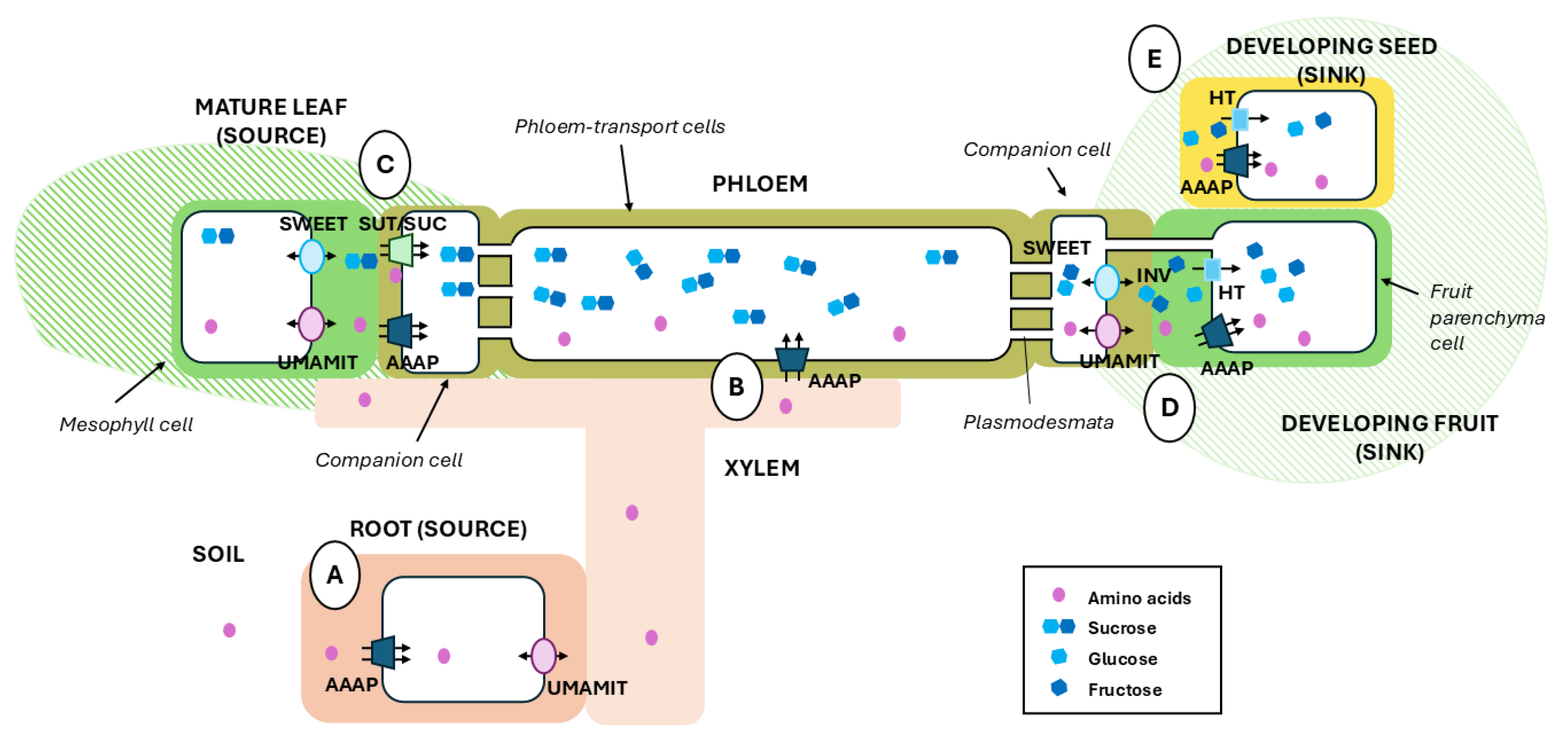
Figure 2.
Structural and functional features of amino acid transporters. (A-C) Predicted structures of representative amino acid transporters from the AAAP, APC and UMAMIT families generated using AlphaFold. A) AtAAP1 (Amino acid permease 1; 11 transmembrane domains). B) AtCAT9 (Cationic amino acid transporter 9; 14 transmembrane domains). C) AtUMAMIT14 (WAT-related protein; 10 transmembrane domains). D) Schematic model of transporter localization and transport mechanisms in plant cells. AAAP and APC transporters function as proton-coupled symporters mediating amino acid uptake, whereas UMAMIT transporters act primarily as facilitators enabling bidirectional amino acid transport. Some AAAP/APC members are localized to intracellular membranes and may function in amino acid exchange between organelles. AAP: Amino acid permease; APC: Amino acid/Polyamine/Choline transporters; UMAMIT: Usually Multiple Acids Move In and Out Transporters.
Figure 2.
Structural and functional features of amino acid transporters. (A-C) Predicted structures of representative amino acid transporters from the AAAP, APC and UMAMIT families generated using AlphaFold. A) AtAAP1 (Amino acid permease 1; 11 transmembrane domains). B) AtCAT9 (Cationic amino acid transporter 9; 14 transmembrane domains). C) AtUMAMIT14 (WAT-related protein; 10 transmembrane domains). D) Schematic model of transporter localization and transport mechanisms in plant cells. AAAP and APC transporters function as proton-coupled symporters mediating amino acid uptake, whereas UMAMIT transporters act primarily as facilitators enabling bidirectional amino acid transport. Some AAAP/APC members are localized to intracellular membranes and may function in amino acid exchange between organelles. AAP: Amino acid permease; APC: Amino acid/Polyamine/Choline transporters; UMAMIT: Usually Multiple Acids Move In and Out Transporters.
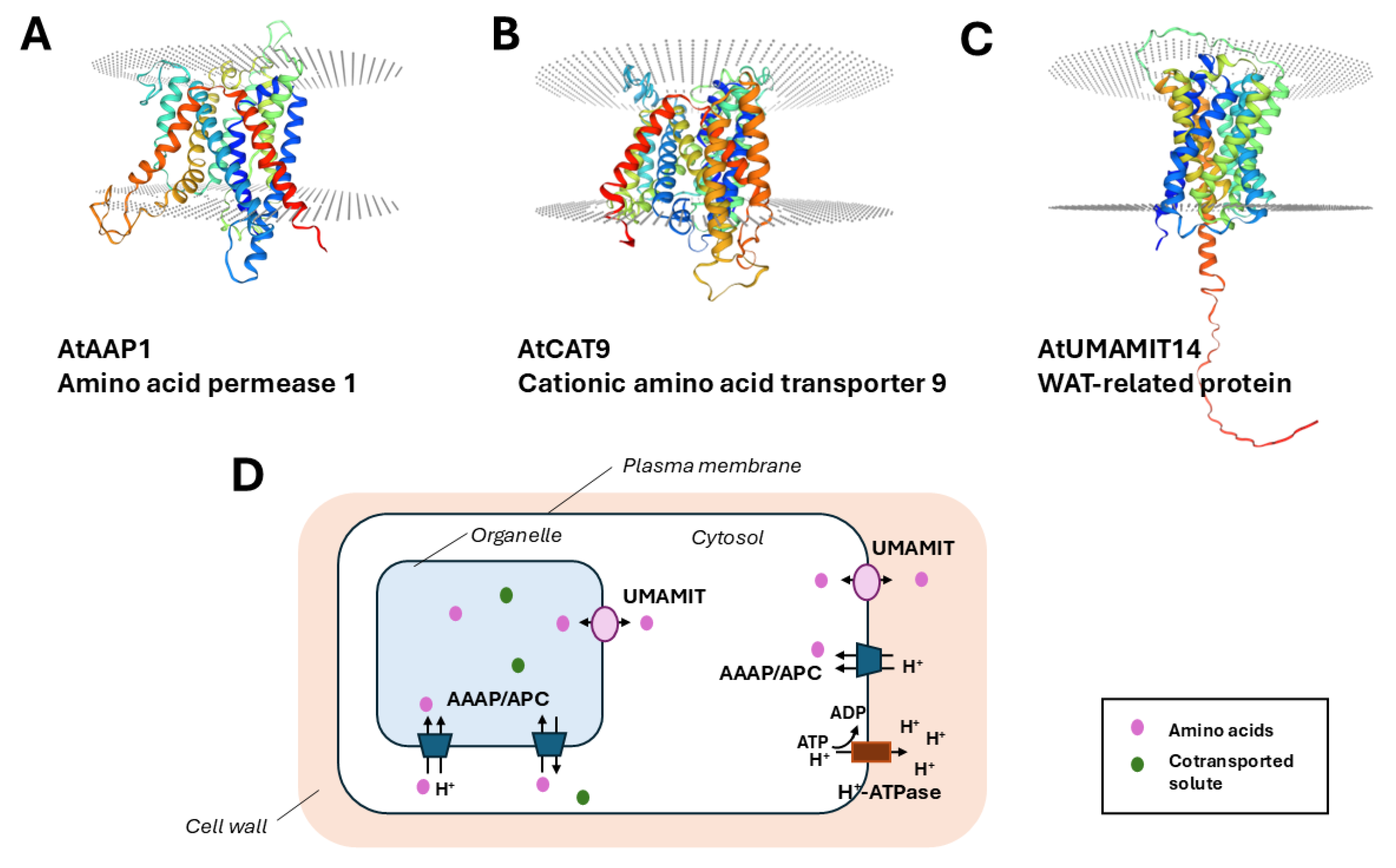

Table 1.
Major amino acid transporter families in plants.
| Family | Subfamilies | Transport | Functions | Examples |
|---|---|---|---|---|
| AAAP | AAP LHT ProT GAT ANT ATL VAAT |
Import (H+/amino acid symporters) |
Root uptake Xylem loading Xylem unloading Xylem-to-phloem transport Phloem loading Seed loading |
AtAAP1, AtLHT1, AtProT2 CsAAP2 AtLHT1 AtAAP2, AtAAP6, OsAAP3 AtAAP8, PsAAP1 AtAAP1, AtAAP8, AtCAT6 |
| APC | CAT ACT |
Import (H+/amino acid symporters) |
Organelle transport | AtCAT2, AtCAT4, SlCAT9 |
| UMAMIT | Multiple clades | Import/export (Bidirectional facilitators) |
Xylem loading Phloem loading Phloem unloading Organelle transport Seed loading |
AtUMAMIT18 AtUMAMIT11, AtUMAMIT14, AtUMAMIT18 AtUMAMIT11, AtUMAMIT14 AtUMAMIT24, AtUMAMIT44 AtUMAMIT28, AtUMAMIT29 |
References of the genes are indicated in the text.
Table 2.
Representative examples of amino acid permeases influencing crop yield, nitrogen use efficiency (NUE) and nutritional quality.
Table 2.
Representative examples of amino acid permeases influencing crop yield, nitrogen use efficiency (NUE) and nutritional quality.
| Species | Gene | Function/mechanism | Phenotype | Reference | |
|---|---|---|---|---|---|
| Crop yield | Rice Rice Wheat Pea |
OsAAP1 OsAAP5 TaAAP13 PsAAP1 |
Amino acid transport to grain Amino acid transport to grain Grain sink strength Amino acid partitioning |
Tillering. Grain number and yield Tillering. Grain number and yield Grain size Seed number and yield |
Ji et al. 2020 Wang et al. 2019 Wan et al. 2021 Zhang et al. 2015 |
| NUE | Pea Soybean Rice Rice |
PsAAP1 GmAAP6a OsAAP15 OsLHT1 |
N uptake, assimilation and transport Source to sink N transport Panicle development Amino acid uptake and transport |
NUpE and NUtE NUtE NUpE NUpE and NUtE |
Perchlik and Tegeder 2017 Liu et al. 2020 Yang et al. 2023 Guo et al. 2020 |
| Nutritional quality | Rice Wheat Maize Tomato |
OsAAP6 TaAAP13 ZmAAP6 SlCAT9 |
Amino acid unloading in grain Amino acid unloading in endosperm Amino acid unloading in grain Amino acid storage in vacuole |
Grain protein content Grain amino acid content Grain protein content Fruit amino acid content |
Peng et al. 2014 Wan et al. 2021 Wang et al. 2022 Snowden et al. 2015 |
| NUE: Nitrogen Use Efficiency; NUpE: Nitrogen Uptake Efficiency; NUtE: Nitrogen utilization Efficiency | |||||
Disclaimer/Publisher’s Note: The statements, opinions and data contained in all publications are solely those of the individual author(s) and contributor(s) and not of MDPI and/or the editor(s). MDPI and/or the editor(s) disclaim responsibility for any injury to people or property resulting from any ideas, methods, instructions or products referred to in the content. |
© 2026 by the authors. Licensee MDPI, Basel, Switzerland. This article is an open access article distributed under the terms and conditions of the Creative Commons Attribution (CC BY) license.
Copyright: This open access article is published under a Creative Commons CC BY 4.0 license, which permit the free download, distribution, and reuse, provided that the author and preprint are cited in any reuse.


