
Submitted:
09 April 2026
Posted:
13 April 2026
You are already at the latest version
Abstract
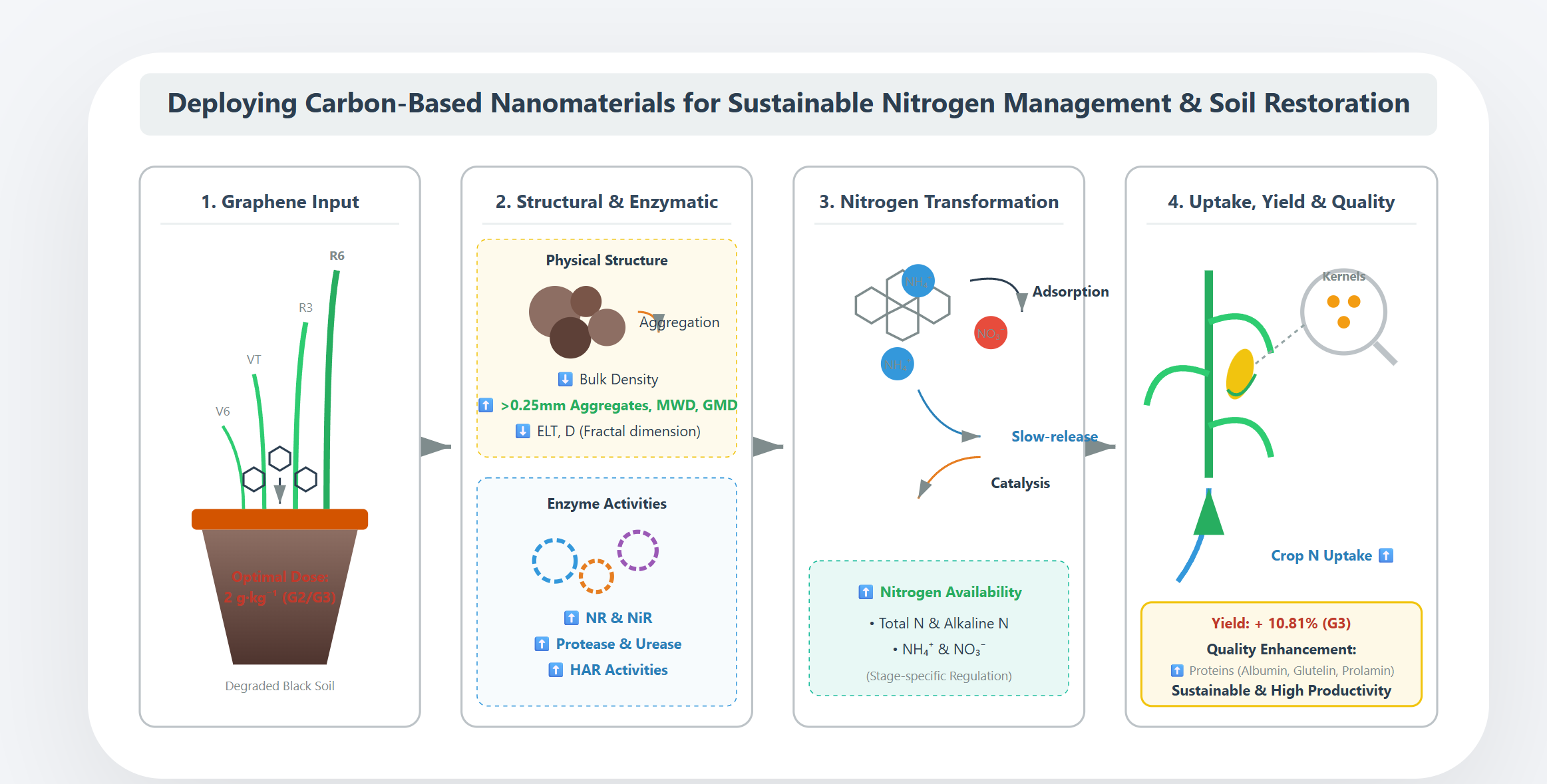
To investigate the effects of graphene soil conditioner on nitrogen forms, nitrogen cycling enzyme activities of rhizosphere soil, and maize (Zea mays L.) yield and quality, a pot experiment with five treatments was conducted. Soil samples were collected at the jointing (V6), tasseling (VT), milking (R3), and maturing (R6) stages to determine soil physical properties, nitrogen forms, and nitrogen cycling enzyme activities, while maize yield and kernel protein components were also measured. The results showed that graphene application significantly reduced soil bulk density and increased the content of soil aggregates >0.25 mm. Medium-rate treatments (G2, G3) notably improved the geometric mean diameter (GMD), mean weight diameter (MWD), and water-stable aggregate (WSA) content, while decreasing the unstable aggregate index (ELT) and fractal dimension (D), confirming improved soil structure. Graphene regulated soil nitrogen pools (total N, alkaline-hydrolyzable N, ammonium N, and nitrate N) in a dose-dependent and stage-specific manner through adsorption, slow release, and catalytic mechanisms. Low-to-moderate concentrations consistently enhanced nitrogen availability during most growth stages, whereas excessive application showed diminished or inhibitory effects at later stages. Moderate graphene application (G2, G3) also effectively enhanced the activities of key nitrogen-metabolizing enzymes—including nitrate reductase (NR), nitrite reductase (NiR), protease, urease, and hydroxylamine reductase (HAR)—during critical growth periods, thereby promoting soil nitrogen transformation and maize nitrogen utilization. The G3 treatment achieved the highest yield, increasing by 10.81% compared with the CF treatment. Kernel protein components (albumin, glutelin, and prolamin) exhibited an initial increase followed by a decrease with rising graphene rates, indicating an optimal response at moderate application levels. Considering the comprehensive improvements in soil structure, nitrogen regulation, enzyme activities, and crop performance, a graphene application rate of 2 g·kg⁻¹ is recommended as the most effective for achieving sustainable soil quality improvement and high maize productivity.
Keywords:
graphene
; nitrogen form
; enzyme activities
; soil conditioner
; maize
Copyright: This open access article is published under a Creative Commons CC BY 4.0 license, which permit the free download, distribution, and reuse, provided that the author and preprint are cited in any reuse.


