

Submitted:
08 April 2026
Posted:
14 April 2026
You are already at the latest version
Abstract
The ongoing energy crisis triggered by disruptions around the Strait of Hormuz is reshaping the economics of the global construction sector. Rising energy costs and supply chain disruptions are increasing production costs for conventional building materials such as cement, steel, and plastics, all of which are highly energy-intensive. This context intensifies the strategic relevance of materials capable of sequestering carbon over their life cycle, which offer the dual benefit of reduced energy consumption in manufacture and long-term climate benefit. Against this backdrop, this paper provides an updated overview of the accelerating global warming crisis, incorporating the most recent scientific evidence, and presents a comprehensive account of distinct classes of cementitious construction materials with CO₂ sequestration capacity. This paper also addresses the principal barriers to large-scale deployment and explores the landmark EU Energy Performance of Buildings Directive underscores the persistent lack of robust global regulations requiring real estate investors to disclose embodied carbon emissions.
Keywords:
energy crisis
; CO2
; embodied carbon
; EPBD
1.1. The 2026 Energy Crisis and the Case for Carbon-Sequestering Construction Materials
The ongoing energy crisis triggered by disruptions around the Strait of Hormuz has already driven global energy prices sharply higher and affected the cost and availability of key construction inputs such as oil-derived products, aluminium, and petrochemicals. Following the effective closure of the strait to commercial shipping from early March 2026 — the result of military conflict in the region — Brent crude oil prices surpassed $100 per barrel for the first time in four years, rising to a peak of $126 per barrel. The International Energy Agency (IEA) described the closure as the “greatest global energy security challenge in history,” characterising it as the largest supply disruption to the global oil market ever recorded (WEF, 2026). Some 20 million barrels of oil per day — approximately 20% of global seaborne oil trade — normally transit the strait, along with around 20% of global liquefied natural gas (LNG) trade, primarily from Qatar. With supply chains and freight routes disrupted, energy costs have surged across industries including building materials production. Reported price increases in aluminium, plastics, methanol, and petrochemicals — all significant construction inputs — are raising production costs for conventional materials like cement, steel, and synthetic products, which are highly energy-intensive and sensitive to fuel prices (WEF, 2026). The European construction and chemical sectors have already reported cost surcharges of up to 30% to offset surging electricity and feedstock costs.
At the same time, there is increasing awareness in engineering and sustainability research of the environmental impact of traditional construction materials, which account for a significant share of embodied energy and carbon emissions, and of the potential for alternative materials to reduce both energy use and carbon footprints in buildings. In this combined context of elevated energy costs and intensified focus on decarbonisation, the construction sector is gradually shifting toward solutions that are not only competitive in a high-energy-price environment but also aligned with broader sustainability goals. Materials capable of sequestering carbon over their service life — including bio-based products such as sustainably sourced timber and hemp composites, as well as the cementitious materials that are the focus of this book — are gaining strategic relevance because they offer both reduced energy consumption in manufacture and long-term climate benefits. The present paper focuses specifically on cementitious materials with CO₂ sequestration capacity, a class of solutions that combines the ubiquity and structural performance of concrete with the potential to act as a durable carbon sink at global scale.
This economic imperative reinforces a scientific urgency that is itself increasingly acute. During the early 18th century, coinciding with the onset of the Industrial Revolution, the atmospheric CO₂ level stood at 280 ppm. The year 2016 marked a symbolic milestone as the first in which atmospheric CO₂ levels remained consistently above 400 ppm throughout the entire year (Betts et al., 2016). By 2024, the situation had become dramatically more acute. The World Meteorological Organization (WMO) reported that the globally averaged CO₂ concentration reached 423.9 ppm in 2024 — an increase of 3.5 ppm over 2023, the largest single-year rise since modern measurements began in 1957 (WMO, 2025).
The planetary boundary of 350 ppm identified by Rockström et al. (2009) was breached long ago. Even if all greenhouse gas emissions ceased immediately, the thermal inertia of climate systems means rising seas, ocean acidification and extreme weather would continue for at least a century (Clayton, 2001). This makes negative emissions — the extraction of CO₂ from the atmosphere — an engineering imperative rather than an option (Hansen et al., 2017), and constitutes one of the Grand Challenges of Engineering (Mote et al., 2016).
There are currently two principal market-based instruments for reducing CO₂ emissions: emissions trading systems (ETSs) and carbon taxes. Academic analysis has generally favoured carbon taxes as more economically efficient (Wesseh et al., 2017; Zhang et al., 2017), yet real-world implementation has remained politically contested. Paradoxically, the ongoing energy crisis may create a new opening for carbon pricing instruments: when the full economic costs of fossil fuel dependence become visible through price shocks, the relative competitiveness of low-carbon alternatives improves without any policy intervention.
Nevertheless, global progress on carbon pricing has been substantial. Revenues exceeded $100 billion for the first time in 2024. Some 80 carbon pricing instruments — 43 carbon taxes and 37 ETSs — now cover approximately 28% of global greenhouse gas emissions (World Bank, 2025). China expanded its national ETS to the cement, steel, and aluminium sectors in March 2025 (OECD, 2025). The EU’s Carbon Border Adjustment Mechanism (CBAM) will impose fees on the CO₂ content of imported cement and steel, creating new incentives for low-carbon construction materials at precisely the moment when energy costs make them economically competitive.
Direct air capture (DAC) has attracted enormous interest, but the scale gap remains staggering. In May 2024, Climeworks inaugurated “Mammoth” in Iceland, designed to capture up to 36,000 tonnes of CO₂ per year — nine times the capacity of its predecessor, Orca (Climeworks, 2024). Yet actual capture in 2024 totalled only approximately 105 tonnes, exposing the vast chasm between design ambitions and operational reality (Barnard, 2025). Geological CO₂ storage in saline aquifers carries large risks and very high costs (Zhang and Huisingh, 2017), while carbon capture and storage from industrial point sources remains technologically immature at global scale (Langie et al., 2022). Annual removal of between 3,500 and 9,800 million tonnes of carbon will nonetheless be required over the next 30 years (TE, 2023a). This imperative, combined with the economic disruptions of the current energy crisis, elevates cementitious construction materials with inherent or engineered CO₂ sequestration capacity to the status of a globally strategic priority. Pacheco-Torgal et al. (2024) have provided a comprehensive overview of carbon dioxide storage-based cementitious construction materials, presenting a promising avenue for substantial eco-efficiency and economic advantages within the construction sector. The first part of that volume examines different methods and mechanisms for carbon dioxide sequestration in cementitious materials, including in steel slag, in magnesium-based binders, and in autoclaved cement mixtures. Part two explores carbon capture in industrial waste and recycled materials, considering cost, energy, and aqueous carbonation kinetics. The final part is entirely new and investigates biological approaches to carbon dioxide sequestration in construction materials, involving bacteria, bamboo biochar, wood bio-concretes, and bio-inspired materials. This paper reviews recent literature on five classes of cementitious construction materials with carbon sequestration capacity.
1.2. CO₂ Sequestration Through Cementitious Construction Materials
Concrete and cement-based materials constitute a globally significant and largely underappreciated CO₂ sink. Xi et al. (2016) demonstrated that a cumulative 4.5 GtC was sequestered in carbonating cement materials between 1930 and 2013, offsetting 43% of cement production CO₂ emissions over the same period. A subsequent update by Huang et al. (2023) estimated accumulated global CO₂ uptake from 1930 to 2021 at 22.9 Gt CO₂. Most recently, Niu et al. (2025) — in the most comprehensive national-level analysis ever conducted, covering 163 countries and regions with 58,517 activity data points and 6,186 carbonation parameters — extended this accounting to 2024, projecting global CO₂ uptake by cement carbonation at approximately 0.86 Gt CO₂/year: concrete absorbs 0.40 Gt/year, mortar 0.38 Gt/year, cement kiln dust 0.06 Gt/year, and construction losses 0.027 Gt/year. This represents more than half of cement production process emissions of approximately 1.6 Gt CO₂/year in 2023. This body of evidence confirms that the carbonation of cement-based materials is a substantial and growing carbon sink whose significance is systematically underestimated in national greenhouse gas inventories.
Luo et al. (2024) modelled a concrete cycle centred on construction and demolition (C&D) waste recycling with integrated CO₂ sequestration. Their analysis shows that per tonne of recycled cement produced, CO₂ emissions are reduced by 47–94% relative to ordinary Portland cement. If recycled cement were to replace OPC at the global scale, the potential annual CO₂ sink could reach 1.4–3.08 Gt. In the current energy crisis context, recycled cement also offers the additional advantage of significantly lower energy consumption in production, making it doubly attractive.
The carbonation process is, however, double-edged: late-stage natural carbonation reduces the pH of concrete, promoting reinforcement corrosion. The pre-curing approach using sodium bicarbonate disclosed by Stefaniuk et al. (2023) offers a promising pathway to overcome this limitation, enabling CO₂ to be permanently mineralised into calcium-silicate-hydrate (CSH) without compromising reinforcement protection.
Accelerated carbonation curing (ACC) — in which cement products are exposed to elevated CO₂ concentrations before or during curing — has become one of the most active frontiers in sustainable construction research. Wang and Fan (2025) map the full landscape of ACC strategies. Xie et al. (2025) provide a complementary mechanistic review demonstrating that ACC simultaneously sequesters CO₂ and improves mechanical properties and durability. Liu et al. (2025) further systematise the mechanisms, techniques, and precursor materials in enforced carbonation for low-carbon concrete.
A particularly innovative contribution comes from Fu et al. (2024), who developed a novel approach in which CO₂ is injected into a cement suspension subsequently used to manufacture concrete. By converting the carbonation reaction from a diffusion-controlled process into an aqueous ionic reaction, this method achieves a CO₂ sequestration efficiency of up to 45% while maintaining uncompromised concrete strength. The approach is technologically simple and thus amenable to rapid industrial adoption. In the context of the current energy crisis — which is raising the cost of energy-intensive conventional concrete production — the potential to sequester CO₂ during an otherwise standard manufacturing step, without additional structural penalty, constitutes a compelling economic argument as well as an environmental one.
Machine learning is now being applied to optimise ACC systematically. Sun et al. (2025) demonstrate that data-driven models can accurately predict CO₂ sequestration in cementitious materials as a function of mix composition and curing conditions, enabling the computational design of mixtures that maximise carbon uptake. A comprehensive bibliometric analysis by Liang et al. (2025) confirms that mineral carbonation of civil engineering materials is one of the most rapidly growing research topics in sustainable construction.
Geopolymers and alkali-activated materials (AAMs) represent an entirely distinct class of construction binder with significant CO₂ sequestration potential and substantially lower embodied energy than Portland cement. Kriven et al. (2024) make the case that geopolymers and AAMs are “key components of a sustainable world,” proposing a comprehensive strategy for regulatory integration and market scale-up. The lower energy intensity of geopolymer production — which does not require the high-temperature calcination of limestone — is particularly relevant in a high-energy-cost environment: LCA studies consistently report CO₂ emission reductions of 40–80% relative to OPC, primarily by eliminating the calcination step and leveraging industrial by-product precursors such as fly ash and ground granulated blast furnace slag. Tushar et al. (2025), in the first fully probabilistic LCA of geopolymer concrete production using Monte Carlo simulation across 580 mix designs, quantified a mean reduction of 43% in carbon emissions relative to conventional concrete, while critically revealing that even modest increases in chemical admixture content can significantly offset these environmental gains — a finding with direct implications for mix design optimisation.
The deliberate integration of CO₂ into geopolymer systems is now recognised as a distinct sequestration pathway. Sahoo et al. (2024) demonstrated that accelerated carbon curing (ACC) in alkali-activated mortars incorporating lateritic clay increases 1-day compressive strength by 13% and reduces total shrinkage by 25%, though long-term natural carbonation over 365 days caused decalcification in low Ca/Si ratio materials — an important durability caveat that constrains precursor selection. Ghazouani et al. (2025) introduced the conceptually innovative approach of aerating CO₂ directly into the NaOH activator solution before geopolymer synthesis, achieving 47.86 MPa at 28 days alongside improved pore structure. At the system level, Sun et al. (2025a) identified a critical structural threshold — 55% of pores below 10 nm — that governs the transition between complete and incomplete carbonation in ternary solid waste geopolymers, achieving a maximum CO₂ uptake of 12.7% and establishing a mechanistic framework for optimising carbonation initiation timing within standard 28-day construction schedules.
A further step change is represented by the application of supercritical CO₂ curing to lignite-based fly ash geopolymer mortars, which achieved a carbonation rate of 67% — far exceeding those attained under conventional atmospheric or pressurised gas conditions — alongside simultaneous improvements in compressive and flexural strength (Podnat et al., 2025).
Biochar — a carbon-rich material produced from biomass in an oxygen-limited environment — has emerged as a promising additive for construction materials owing to its intrinsic carbon sequestration capacity and its ability to promote CO₂ uptake via accelerated carbonation. Zhou et al. (2025) identify conditions under which biochar-modified materials achieve net-negative carbon footprints: specifically, approximately 30 wt% aggregate substitution under CO₂ curing, delivering a net-negative footprint at an economic value of approximately $41 per cubic metre. At 5% biochar blending, a carbon-negative effect of 541–980 kg CO₂eq/tonne is achievable. The use of agricultural and forestry residues as biochar feedstocks is also relevant to the energy crisis context, as biomass-derived materials are insulated from fossil fuel price shocks.
Reactive magnesia (MgO) cements undergo carbonation curing to form hydrated magnesium carbonates as their primary binding phases, with each kilogram of carbonated reactive MgO cement capable of sequestering up to 0.78 kg of CO₂. Tan et al. (2024), through a comprehensive life cycle assessment, demonstrate that using MgO derived from salt lake magnesium residues reduces CO₂ emissions by over 60% relative to conventional MgO, and that CRMC achieves compressive strengths up to three times higher than OPC. The calcination temperature for reactive MgO production (700–1000 °C) is substantially lower than for Portland cement clinker (up to 1450 °C), offering significant energy savings that are especially valuable in the current high-energy-cost environment.

Table 1.
Comparative overview of five cementitious material classes with CO₂ sequestration capacity: indicative uptake values, CO₂ reduction relative to OPC, energy intensity, and technology readiness level.
Table 1.
Comparative overview of five cementitious material classes with CO₂ sequestration capacity: indicative uptake values, CO₂ reduction relative to OPC, energy intensity, and technology readiness level.
| Material Class | CO₂ Uptake (indicative) | CO₂ Reduction vs OPC (%) | Energy Intensity vs OPC | Technology Readiness Level | Key Reference |
|---|---|---|---|---|---|
| Accelerated Carbonation Curing (ACC) | Up to 45% sequestration efficiency (Fu et al., 2024) | 20–40% | Similar to OPC; no additional calcination | TRL 6–8 (pilot/pre-commercial) | Wang & Fan (2025); Fu et al. (2024) |
| Geopolymers / Alkali-Activated Materials (AAMs) | Up to 12.7% CO₂ uptake by mass (Sun et al., 2025a) | 40–80% | Significantly lower (no limestone calcination) | TRL 5–7 (varies by precursor) | Kriven et al. (2024); Tushar et al. (2025) |
| Recycled Cement (C&D Waste) | Potential sink of 1.4–3.08 Gt CO₂/year at global scale (Luo et al., 2024) | 47–94% | Substantially lower (avoids virgin clinker production) | TRL 4–6 (lab/demonstration) | Luo et al. (2024) |
| Biochar-Modified Cementitious Materials | 541–980 kg CO₂eq/t at 5% blending (Zhou et al., 2025) | Net-negative at ~30 wt% under CO₂ curing | Lower (biomass-derived; fossil-fuel insulated) | TRL 4–6 (emerging; lab-scale) | Zhou et al. (2025) |
| Reactive MgO Cement (CRMC) | Up to 0.78 kg CO₂/kg MgO (Tan et al., 2024) | >60% (salt lake MgO source) | Lower calcination temp (700–1000 °C vs 1450 °C for OPC) | TRL 5–7 (pilot scale) | Tan et al. (2024) |
1.3. Barriers to Large-Scale Deployment, Embodied Carbon Regulation and the EPBD 2024
1.3.1. Barriers to Large-Scale Deployment
Despite the compelling scientific evidence reviewed in section 1.2, the penetration of these materials into the construction market remains limited. Jouamai et al. (2025) conducted a systematic scoping review identifying seven barrier domains that obstruct large-scale deployment: technical, economic, implementation, policy and regulatory, environmental, infrastructural, and cross-cutting social factors. Table 2 makes this connection by comparing leading sequestration pathways across six domains: technical, economic, implementation, infrastructure, policy and regulation, and environment. while also adding indicative CO uptake values. In this way, the table highlights not only the types of barriers that recur across technologies, such as high capital costs or limited CO transport, but also the very different scales of sequestration they can achieve. Technical barriers are the most varied across the five material classes. For ACC, the principal constraints are the limited industrial availability of concentrated CO₂ streams, the sensitivity of carbonation kinetics to moisture content and mix design, and the durability concerns associated with late-stage natural carbonation reducing concrete pH and promoting reinforcement corrosion. For geopolymers and AAMs, the main technical obstacles are the variability in precursor composition (fly ash and GGBS quality fluctuates significantly by source and geography), the lack of standardised mix design protocols, and the limited long-term durability data under field conditions. For biochar-modified materials, the heterogeneity of biochar feedstocks and the absence of harmonised characterisation methods limit reproducibility across studies. For reactive MgO cements, the sensitivity of carbonation efficiency to curing humidity and CO₂ concentration, combined with limited preclinical performance data at structural scale, remains a constraint. Recycled cement faces technical barriers around quality control of demolition waste streams and the mechanical performance penalty associated with residual paste porosity.
Economic barriers are compounded by the current energy crisis in contradictory ways. On one hand, the higher energy cost environment reduces the relative price premium of lower-energy-intensity alternatives such as geopolymers and MgO cements, making the business case more favourable. On the other hand, the capital costs of retrofitting ACC infrastructure into existing precast facilities remain substantial, and the limited industrial CO₂ supply networks required for ACC at scale represent a significant infrastructure investment. Jouamai et al. (2025) note that the absence of mandatory embodied carbon standards for investors — discussed further in section 1.3.2 — suppresses the market signal that would otherwise drive capital toward lower-carbon alternatives.
Implementation barriers include the fragmentation of certification and testing standards across jurisdictions. No harmonised international standard currently governs the characterisation of CO₂ sequestration in cementitious materials, creating market uncertainty for specifiers and clients. The limited availability of experienced contractors and supply chain actors capable of handling geopolymer or ACC systems at scale further constrains deployment beyond pilot projects.
Policy and regulatory barriers are closely intertwined with the embodied carbon disclosure gap addressed in section 1.3.2. The absence of binding quantitative limits on embodied carbon intensity in the majority of EU Member States — and virtually all other jurisdictions globally — means that the competitive advantage of sequestering materials is not systematically captured in procurement specifications or investment criteria.
Infrastructural barriers centre on the limited availability of industrial-grade CO₂ supply networks for ACC, which requires concentrated CO₂ typically at 10–100% concentration. The current industrial CO₂ market is fragmented, with supply dominated by food-grade applications and geographically concentrated near large point sources. Environmental barriers include residual uncertainties around the long-term permanence of mineralised CO₂ under thermomechanical cycling and freeze-thaw conditions, and the potential for leaching of activator compounds in AAM systems. Social barriers — including specifier inertia, client risk aversion, and limited awareness among built environment professionals — are cross-cutting and particularly difficult to address through regulatory intervention alone.
The energy crisis may nonetheless act as a catalyst for accelerating deployment: when the economic advantage of low-energy-intensity materials becomes self-evident through market price signals, institutional and regulatory barriers may be overcome more readily. China’s expansion of its national ETS to the cement sector and the EU’s CBAM both create emerging market incentives that, combined with the current fossil fuel price environment, may accelerate this transition.
1.3.2. Embodied Carbon Regulation and the EPBD 2024
The revised Energy Performance of Buildings Directive, published as EU 2024/1275 and entering into force on 28 May 2024 (EPBD, 2024), constitutes the most far-reaching regulatory intervention on building-sector carbon to date. It mandates whole-life carbon (WLC) assessments for all new buildings, using harmonised methodologies aligned with EN 15978 and the Level(s) indicator framework. Life-cycle global warming potential (GWP) must be calculated and disclosed for all new buildings exceeding 1,000 m² from 2028, and for all new buildings from 2030. In December 2025, the European Commission reinforced this framework through Delegated Regulation C(2025) 8723, establishing a common EU methodology for calculating life-cycle GWP (European Commission, 2025).
The technical backbone of this mandate is EN 15978:2011 (and its forthcoming revision under CEN/TC 350), which defines the system boundary for whole-life carbon assessment across four life-cycle stages: product and construction (modules A1–A5), use and maintenance (B1–B7), end of life (C1–C4), and beyond the system boundary (module D, covering reuse and recycling credits). The Level(s) indicator 1.2 operationalises this standard for buildings policy, requiring that GWP be expressed in kg CO₂ equivalent per square metre of net floor area per year. A critical methodological implication for the materials covered in this paper is that modules A1–A3 — encompassing raw material extraction, transport, and manufacturing — are precisely where embodied carbon reductions from carbon-sequestering cementitious materials are realised. Furthermore, module D allows for the attribution of carbonation-based CO₂ uptake during the use phase and after end-of-life crushing, a credit that is systematically excluded from current national greenhouse gas inventories but is explicitly recognised under EN 15978. The Delegated Regulation C(2025) 8723 clarifies that Member States must require this full system boundary from 2028 onwards, removing the current flexibility that has allowed practitioners to report only modules A1–A5, thereby understating embodied carbon and obscuring the comparative advantage of sequestering materials.
Embodied carbon is estimated to account for 10–25% of the total carbon footprint of current buildings, rising to approximately 400% of operational emissions in near-zero energy buildings (Pacheco-Torgal et al., 2013). Gauch et al. (2023) confirm substantial trade-offs between embodied carbon and construction cost, while BUILD UP (2025) estimates that a 40% reduction in embodied carbon can lower construction costs by nearly 10%. Chen et al. (2023) found that low-carbon cementitious binders offer embodied carbon reduction potentials 64.9% higher than supplementary cementitious materials, and the OECD (2019) projects that demand for all construction materials will double by 2060. Achieving a carbon-neutral or carbon-negative construction sector by mid-century therefore depends critically on the large-scale substitution of conventional Portland cement with the five material classes described in this paper.
A critical weakness of the EPBD 2024 framework, however, is that it imposes disclosure without binding quantitative limits on embodied carbon intensity. The experience of early-mover Member States reveals both the potential and the limits of a purely voluntary approach to limit-setting. Denmark introduced mandatory embodied carbon limits in its Building Regulation 2023 (BR23), capping life-cycle GWP at 12 kg CO₂eq/m²/year for new buildings — a threshold that already incentivises the substitution of conventional cement with lower-carbon alternatives. The Netherlands adopted a similar mandatory GWP limit of 1.0 tonne CO₂eq/m² over 50 years under the Milieu Prestatie Gebouwen (MPG) instrument. Finland has embedded embodied carbon targets within its national building code since 2025. By contrast, the majority of Member States remain at the disclosure-only stage, with no quantitative limit values adopted or proposed. Table 3 summarises the current state of implementation across selected Member States.
The fragmentation evident in Table 3 carries important market consequences. Where mandatory limits are in force, procurement specifications and green finance criteria are already beginning to differentiate materials on the basis of embodied carbon intensity. Where disclosure-only regimes prevail, the competitive signal to specifiers and investors remains absent. This regulatory unevenness creates a risk of carbon leakage within the single market: construction projects in disclosure-only jurisdictions may continue to rely on conventional high-carbon cement, while neighbouring markets with binding limits absorb the available supply of lower-carbon alternatives. The European Commission’s forthcoming review of the Delegated Regulation, scheduled for 2027, is expected to include proposals for EU-wide mandatory GWP limits — a development that would fundamentally reshape demand for all five material classes described in this paper.
The disclosure gap in the real estate investment sector compounds this regulatory shortcoming. Weinfeld et al. (2023) demonstrated that embodied carbon disclosures by German institutional real estate investors remain scarce and of limited quality — a finding consistent with the broader evidence from GRESB’s annual benchmarking surveys, which show that embodied carbon is reported by around 31% of participating real estate funds globally (GRESB, 2024). TCFD-aligned climate risk disclosures by institutional real estate investors similarly focus overwhelmingly on operational carbon and physical climate risk, with embodied carbon systematically absent from Scope 3 supply chain accounting (TCFD, 2023). This invisibility in investment reporting perpetuates the mispricing of embodied carbon risk and suppresses the flow of capital toward low-carbon construction materials. The integration of mandatory embodied carbon disclosure into EU Sustainable Finance Disclosure Regulation (SFDR) principal adverse impact indicators — currently under review by the European Supervisory Authorities — would represent the most direct regulatory pathway to closing this gap.
A further dimension of regulatory complexity arises from the interaction between the EPBD 2024 embodied carbon mandate and the EU Taxonomy Regulation (EU 2020/852). The Taxonomy’s Technical Screening Criteria for the “construction of new buildings” activity already require a life-cycle GWP disclosure as a condition of substantial contribution to climate change mitigation. However, the Taxonomy does not yet impose a mandatory GWP limit for new construction to qualify as “green” — it currently requires only that buildings meet national Nearly Zero Energy Building (NZEB) standards and disclose their life-cycle GWP. This misalignment between the EPBD 2024 (which mandates disclosure and moves toward limits) and the Taxonomy (which links green finance eligibility to energy performance rather than embodied carbon intensity) creates a significant policy incoherence. Buildings financed as EU Taxonomy-aligned green assets may nonetheless have high embodied carbon footprints if constructed with conventional cement — an outcome that undermines the integrity of the sustainable finance framework. The five classes of carbon-sequestering cementitious materials described in this paper could be instrumental in enabling new construction to simultaneously satisfy NZEB energy standards and achieve low or negative embodied carbon, thereby bridging this gap. Ensuring that the forthcoming revision of the Taxonomy Technical Screening Criteria introduces a meaningful GWP intensity threshold — set at a level that incentivises the substitution of conventional cement — is therefore a regulatory priority of the first order.
1.4. Conclusions
The convergence of the 2026 Strait of Hormuz energy crisis and the accelerating trajectory of global warming has created an unprecedented strategic imperative for the construction sector. This paper reviews recent literature on five classes of cementitious construction materials with carbon sequestration capacity: accelerated carbonation curing systems, geopolymers and alkali-activated materials, recycled cement from C&D waste, biochar-modified materials, and reactive MgO cements. Their strategic relevance has been substantially amplified by the current energy crisis, as their lower energy intensity in production makes them simultaneously more competitive on cost grounds and more attractive from a decarbonisation perspective.
The principal systemic barriers to deployment — technical heterogeneity, fragmented certification standards, limited industrial CO₂ supply networks, and the absence of binding embodied carbon standards for investors — remain largely unresolved, though the energy crisis creates new economic incentives that may accelerate market uptake independently of regulatory intervention.
On the regulatory side, EPBD 2024 (EU 2024/1275) and the December 2025 Delegated Regulation C(2025) 8723 represent the most significant institutional step forward to date in mandating whole-life carbon assessment of buildings. However, as evidenced by Weinfeld et al. (2023), voluntary disclosure frameworks have demonstrably failed to produce meaningful transparency in embodied carbon reporting. The critical policy gap that remains is the absence of mandatory embodied carbon disclosure requirements for real estate investors across the EU and globally. Without binding quantitative limits on embodied carbon intensity — analogous to operational energy performance certificates — the market signal necessary to drive large-scale adoption of the five material classes described in this paper will remain insufficient.
The EU’s Carbon Border Adjustment Mechanism, together with China’s expansion of its national ETS to the cement sector, create emerging market incentives that may accelerate this transition, particularly when combined with the competitive cost advantage conferred by the current fossil fuel price environment. In sum, this paper establishes that carbon-sequestering cementitious construction materials are no longer a niche academic proposition but a portfolio of solutions whose time has come.
References
- Barnard, M. (2025). The Mammoth failure of direct air capture. The Future is Electric, Medium, September 2025.
- Betts, R.; Jones, C.; Knight, J.; Keeling, R.; Kennedy, J. El Niño and a record CO₂ rise. Nature Climate Change 2016, 6, 806–810. [Google Scholar] [CrossRef]
- BUILD, UP. (2025). Building for the future: Driving EPBD whole-life carbon ambition across the EU. European Commission.
- Chen, S.; Teng, Y.; Zhang, Y.; Leung, C. K.; Pan, W. Reducing embodied carbon in concrete materials: A state-of-the-art review. Resources, Conservation and Recycling 2023, 188, 106653. [Google Scholar] [CrossRef]
- Clayton, R. Editorial: Is sustainable development an oxymoron? Trans I Chem E 2001, 79 (Part B), 327–328. [Google Scholar]
- Climeworks (2024). Climeworks switches on world’s largest direct air capture plant, Mammoth. Press release, 8 May 2024. https://climeworks.com.
- EPBD. Directive (EU) 2024/1275 of the European Parliament and of the Council on the energy performance of buildings. Official Journal of the European Union, 8 May 2024.
- European Commission. (2025). Delegated Regulation C(2025) 8723: Framework for calculating the life-cycle global warming potential of new buildings. Brussels, 16 December 2025.
- Fu, X.; Guerini, A.; Zampini, D.; Rotta Loria, A. F. Storing CO₂ while strengthening concrete by carbonating its cement in suspension. Communications Materials 2024, 5, 109. [Google Scholar] [CrossRef]
- Gauch, H. L.; Dunant, C. F.; Hawkins, W.; Serrenho, A. C. What really matters in multi-storey building design? Applied Energy 2023, 333, 120585. [Google Scholar] [CrossRef]
- Ghazouani, N.; et al. Optimizing CO₂-activated alkali solutions for enhanced strength and carbon sequestration in GGBS-metakaolin geopolymer composites. Construction and Building Materials 2025. [Google Scholar]
- Hansen, J.; Sato, M.; Kharecha, P.; et al. Young people’s burden: Requirement of negative CO₂ emissions. In Earth System Dynamics; 2017. [Google Scholar]
- Huang, Z.; et al. Global carbon uptake of cement carbonation accounts 1930–2021. Earth System Science Data Discussions 2023, 2023, 1–28. [Google Scholar] [CrossRef]
- GRESB. (2024). 2024 Real Estate Assessment Results. GRESB. https://www.gresb.com/2024-real-estate-assessment-results/.
- IEA. Global Energy Review 2025: CO₂ Emissions; International Energy Agency: Paris, 2025. [Google Scholar]
- Jouamai, B.; Elminor, H.; Belabid, A. Challenges of carbon sequestration in construction materials — A scoping review. Journal of Building Engineering 2025, Article 114349. [Google Scholar] [CrossRef]
- Kriven, W. M.; Shi, C.; Provis, J. L.; et al. Why geopolymers and alkali-activated materials are key components of a sustainable world. Journal of the American Ceramic Society 2024, 107, 5159–5177. [Google Scholar] [CrossRef]
- Langie, K. M. G.; Tak, K.; Kim, C.; et al. Toward economical application of carbon capture and utilization technology with near-zero carbon emission. Nature Communications 2022, 13, 7482. [Google Scholar] [CrossRef]
- Liang, et al. A comprehensive review of mineral carbonation of civil engineering materials: A bibliometric analysis. In Environmental Science & Technology; 2025. [Google Scholar]
- Liu, J.; Liu, Y.; Zeng, J.; Zhuge, Y. A comprehensive review of mechanisms, techniques and precursors in enforced carbonation for low-carbon concrete. Journal of Building Engineering 2025. [Google Scholar] [CrossRef]
- Luo, J.; Huang, R.; Wang, J.; Zhang, Y. Carbon sequestration by preparing recycled cement, recycled aggregates, and recycled concrete from C&D wastes. Materials 2024, 17(20), 5020. [Google Scholar]
- Mote, C.; Dowling, J.; Zhou, J. The power of an idea: The international impacts of the Grand Challenges for Engineering. Engineering 2016, 2, 4–7. [Google Scholar] [CrossRef]
- Niu, L.; Wu, S.; Andrew, R. M.; Shao, Z.; Wang, J.; Xi, F. Global and national CO₂ uptake by cement carbonation from 1928 to 2024. Earth System Science Data 2025, 17, 2231–2247. [Google Scholar] [CrossRef]
- OECD. (2019). Global material resources outlook to 2060. OECD Publishing, Paris.
- OECD. (2025). Effective carbon rates 2025. OECD Publishing, Paris.
- Pacheco-Torgal, F.; Faria, J.; Jalali, S. Embodied energy versus operational energy. Materials Science Forum 2013, 730, 587–591. [Google Scholar]
- Podnar, T. M.; Knez, Ž.; Kravanja, G. Enhancing strength and CO₂ uptake in lignite-based fly ash geopolymer mortar through supercritical carbonation. The Journal of Supercritical Fluids 2025, 225, 106695. [Google Scholar] [CrossRef]
- Rockström, J.; et al. Planetary boundaries: Exploring the safe operating space for humanity. Ecology and Society 2009, 14(2), 32. [Google Scholar] [CrossRef]
- Sahoo, P.; Rao, N.; Gupta, S.; et al. Carbon sequestration in earth-based alkali-activated mortar: Phase changes and performance after natural exposure. npj Materials Sustainability 2024, 2, 34. [Google Scholar] [CrossRef]
- Stefaniuk, D.; Hajduczek, M.; Weaver, J. C.; Ulm, F. J.; Masic, A. Cementing CO₂ into CSH: A step toward concrete carbon neutrality. PNAS Nexus 2023, 2(3), pgad052. [Google Scholar] [CrossRef]
- Sun, Y.; Zhang, C.; Wei, Y. H.; et al. Machine learning for efficient CO₂ sequestration in cementitious materials: A data-driven method. npj Materials Sustainability 2025, 3, 9. [Google Scholar] [CrossRef]
- Sun, T.; Peng, R.; Alrefaei, Y.; Xian, X.; Wang, Y. Influence of carbonation initiation timing on CO₂ uptake and mechanical performance of geopolymer made from ternary solid wastes. Construction and Building Materials 2025a, 498, 144033. [Google Scholar] [CrossRef]
- Tan, Y.; Liu, S.; Achintha, M.; Mi, R. Is it possible to make magnesia-based cement environmentally friendly? ACS Sustainable Chemistry & Engineering 2024, 12(46), 16869–16883. [Google Scholar] [CrossRef] [PubMed]
- TCFD. (2023). 2023 Status Report: Task Force on Climate-related Financial Disclosures. Financial Stability Board, October 2023. https://www.fsb.org/2023/10/2023-tcfd-status-report-task-force-on-climate-related-financial-disclosures.
- TE (2023a). The coming years will be the hottest ever. The Economist, 17 May 2023.
- Tushar, Q.; Bhuiyan, M. A.; Abunada, Z.; Lemckert, C.; Giustozzi, F. Carbon footprint and uncertainties of geopolymer concrete production: A comprehensive life cycle assessment (LCA). Carbon 2025, 11(3), 55. [Google Scholar] [CrossRef]
- Wang, L.; Fan, Y. Carbon sequestration technology in concrete: A review of mechanism, application and optimization strategy. Journal of Building Engineering 2025, 102, 111862. [Google Scholar] [CrossRef]
- WEF (2026). Beyond oil: 9 commodities impacted by the Strait of Hormuz crisis. World Economic Forum.
- Weinfeld, S.; Wiejak-Roy, G.; Booth, C. A. Embodied carbon reporting by German real estate institutional investors. Journal of Sustainability Research 2023, 5(1). [Google Scholar] [CrossRef]
- Wesseh, P.; et al. Carbon taxes, industrial production, welfare and the environment. Energy 2017, 123, 305–313. [Google Scholar] [CrossRef]
- (2025). WMO Greenhouse Gas Bulletin No. 21. World Meteorological Organization, Geneva.
- World Bank (2025). State and Trends of Carbon Pricing 2025. World Bank, Washington DC.
- Xi, F.; et al. Substantial global carbon uptake by cement carbonation. Nature Geoscience 2016, 9, 880–883. [Google Scholar] [CrossRef]
- Xie, F.; Zhou, D.; Zhang, M. Research progress on CO₂ curing of cementitious materials: A review. Canadian Journal of Civil Engineering 2025, 52(6), 1045–1059. [Google Scholar] [CrossRef]
- Zhang, Z.; et al. How to improve the performance of carbon tax in China? Journal of Cleaner Production 2017, 142(4), 2060–2072. [Google Scholar] [CrossRef]
- Zhang, Z.; Huisingh, D. Carbon dioxide storage schemes. Journal of Cleaner Production 2017, 142, 1055–1064. [Google Scholar] [CrossRef]
- Zhou, Q.; Wu, D.; Ye, C.; Du, J.; Qiu, L.; Jin, M.; Wu, W. Carbon sequestration potential of biochar-modified building materials: A critical review. Journal of Building Engineering 2025. [Google Scholar] [CrossRef]
Table 2.
- Comparative matrix of leading carbon-sequestration technologies in construction, their key barriers, mitigation strategies, and indicative CO sequestration potential (Jouamai et al., 2025).
Table 2.
- Comparative matrix of leading carbon-sequestration technologies in construction, their key barriers, mitigation strategies, and indicative CO sequestration potential (Jouamai et al., 2025).
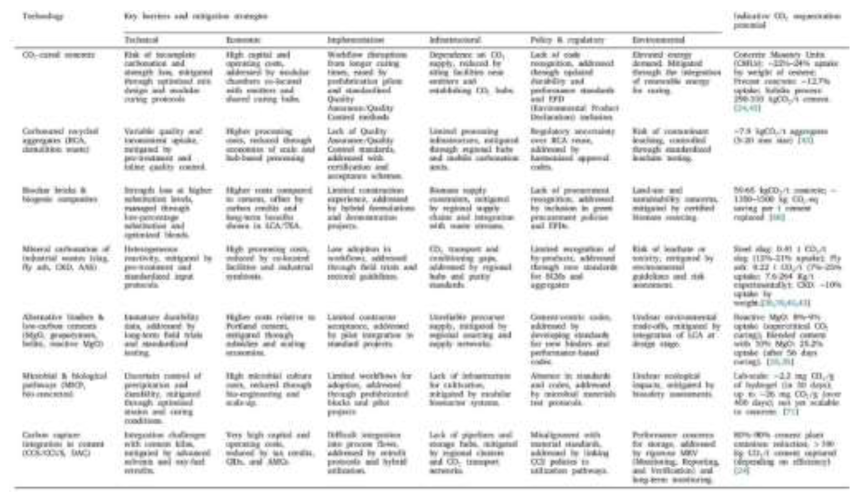 |
Table 3.
Embodied carbon regulatory status in selected EU Member States BUILD UP (2025); European Commission (2025).
Table 3.
Embodied carbon regulatory status in selected EU Member States BUILD UP (2025); European Commission (2025).
| Member State | Instrument | Quantitative Limit | Status (2026) |
|---|---|---|---|
| Denmark | BR23 Building Regulation | 12 kg CO₂eq/m²/year | Mandatory limit in force |
| Netherlands | Milieu Prestatie Gebouwen (MPG) | 1.0 t CO₂eq/m² over 50 years | Mandatory limit in force |
| Finland | National Building Code 2025 | Phased limits from 2025; full limit by 2030 | Mandatory limits being phased in |
| France | RE2020 regulation | Iconstruction limit (tightening in steps to 2031) | Mandatory limit in force; tightening schedule set |
| Germany | QNG (Sustainable Building certificate) | Voluntary GWP threshold for subsidy eligibility | Voluntary; disclosure only otherwise |
| Portugal | EPBD 2024 transposition (draft) | No quantitative limit proposed | Disclosure-only; transposition in progress |
| Spain / Italy / Poland | EPBD 2024 transposition (early stage) | No quantitative limit proposed | Disclosure-only trajectory |
Disclaimer/Publisher’s Note: The statements, opinions and data contained in all publications are solely those of the individual author(s) and contributor(s) and not of MDPI and/or the editor(s). MDPI and/or the editor(s) disclaim responsibility for any injury to people or property resulting from any ideas, methods, instructions or products referred to in the content. |
© 2026 by the authors. Licensee MDPI, Basel, Switzerland. This article is an open access article distributed under the terms and conditions of the Creative Commons Attribution (CC BY) license (http://creativecommons.org/licenses/by/4.0/).
Copyright: This open access article is published under a Creative Commons CC BY 4.0 license, which permit the free download, distribution, and reuse, provided that the author and preprint are cited in any reuse.


