

Submitted:
09 April 2026
Posted:
10 April 2026
You are already at the latest version
Abstract
(1) Pholidoptera griseoaptera (De Geer, 1773) (Orthoptera, Tettigoniidae) is known as a common and widespread inhabitant of forest edges in Europe, so it may be a suitable model to understand a dealing of forest wildlife in the past and the future. (2) We registered the presence or absence of the species in 189 edge/forest plots in the Kaluga Region using acoustic observations and pitfall traps, and performed a logit regression. (3) Across the region, the main factor that positively affected the presence of the species was the presence of nemoral herbs as dominants of the herb layer. The main negative factors were the isolation of habitat patches by physical barriers and belonging to the moraine plains of the last stage of the Moscow glaciation. The presence of coniferous species in the tree layer and spatial autocovariation were significant factors with small contributions. Abundance of Ph. griseoaptera was higher in the forest located in the river valleys. Across Kaluga City, the long existence of tree vegetation in place of plots and the isolation were the main significant factors affecting the presence of the species. The smallest urban site where the species lives is about 13 ha, and the summary square of unmowed patches in this habitat is about 0.2 ha. (4) Ph. griseoaptera can be used as a marker of the persistence of the broadleaved deciduous (nemoral) forests in the past. In a high level of urbanization, it can become a threatened species.
Keywords:
Orthoptera
; Tettigoniidae
; East European Plain
; broadleaved forests
; nemoral herbs
; isolation
; urban area
; patch
; glaciation
; historical factors
1. Introduction
One core goal of ecology is to understand the distribution and abundance of living organisms in the environment [1,2]. To conserve species, their communities, and ecosystems, we need to know what factors affect the survival of a certain species. As we can’t investigate all species, we used any surrogate or target species as representatives of any ecological groups. We know that species distribution may be influenced by habitat quality, landscape matrix quality, and historical factors [3,4,5,6]. However, there is little data on patterns of distribution for many species and their assemblages.
One of the priority species groups to investigate factors affecting their distribution and to conserve their habitats is the nemoral species, e.g., species associated with the broadleaved deciduous forest biome. In Europe, nemoral or broadleaved deciduous forests are distributed in the Continental biogeographical region. It extends in a central east-west band over most of Europe. It has some of the continent’s most productive ecosystems. Forests in this region are strongly fragmented and transformed due to very long and intensive human use. A high degree of habitat fragmentation due to transportation and urban infrastructure is one of the major pressures on biodiversity [7]. Research and conservation of nemoral species and ecosystems is a very important aim [8].
Orthopteran insects (Orthoptera) are a suitable model group for ecological and conservation research [9,10]. Relatively large body size, moderate dispersal capacity, and dependence on both vegetation structure and abiotic factors shape a good background for investigations of how any factors affect the distribution of these insects. There are numerous papers revealing both environmental and historical determinants in single orthopteran species and multispecies assemblages e.g., [11,12,13,14,15]. However, most of the European orthopterans are grassland inhabitants. Apparently, the only single forest (edge) species that is common and widespread throughout Europe is the dark bush cricket Pholidoptera griseoaptera (De Geer, 1773) [16,17].
Pholidoptera griseoaptera (Orthoptera, Tettigoniidae) is known as an inhabitant of forest edges in most areas of Europe [18,19]. In many regions, it is also found in tall grasses and among herbs outside forests [20,21,22,23], but such sites may serve as additional feeding habitats [24]. Ph. griseoaptera is a uniformly brachypterous species. Thereby, some authors researched its movement, dispersion, and distribution in fragmented landscapes [24,25,26,27,28]. It was found that this bush cricket inhabits a large percentage of suitable habitat elements and exhibits successful inter-patch dispersal in an agricultural landscape [27]. Simultaneously, movement characteristics may be landscape-dependent, and rapid fragmentation in formerly well-connected landscapes or habitat loss below a certain threshold may threaten this ground-walking species [26]. The matrix of extensive forest poses barriers for the dispersal of this species [24]. The cited papers describe the distribution of this species in some regions of Central and West Europe, which seem to lie in the optimal zone of its range. Any insect species can change its habitat preference, occupancy of habitat patches, and other features through its range [29,30]. Thereby, we should investigate how this species uses the landscapes of Eastern Europe. Pholidoptera griseoaptera was noted for all of European Russia [31]. Recently, it was found as a widespread species across zones of nemoral forests and forest-steppe [32], but we have no papers with detailed data on its habitats and other features of ecology. Some papers [23,33] give the basis to propose that this species is less typical for hemiboreal mixed coniferous-broadleaved forests. This species is not considered endangered in Russia, but it is included into Red Book of Moscow City [34]. Since Moscow City is a neighbour of the Kaluga Region, Ph. griseoaptera may not occur everywhere in this region either. Looking at our observations belonging to many localities of the Kaluga Region and Moscow City, we found thar Ph. griseoaptera is present not in all observed forest edges. Thereby, the scope of our research became to find what factors affect the distribution of Ph. griseoaptera in the Kaluga Region as sector of the eastern part of its range. We tested the following hypotheses: (1) Pholidoptera griseoaptera has a continuous distribution across the region, but occupies nemoral forests. (2) The presence of Pholidoptera griseoaptera is affected by some parameters of habitats and historical factors, such as the presence of old forests. (3) The isolation of habitats negatively influences the presence of this species, so it would be local in the urban areas. Checking these propositions, we may know: (1) What chances does this species have to be conserved in the further fragmentation of landscapes (or would it become a threatened species)? (2) Can we use Ph. griseoaptera as an indicator of habitats with some properties or as a marker of any states of habitats in the past?
2. Materials and Methods
2.1. Study Species
Pholidoptera griseoaptera (De Geer, 1773) (Figure 1) is a medium-sized (13–18 mm in length) grey-brown short-winged bush cricket (Orthoptera, Tettigoniidae) inhabiting mainly forest edges [24,25]. Adults can jump a horizontal distance that often exceeds 1 m [24]. Bush crickets can move up to 70 m in a day [25]. This species is polyphagous, feeding on both plants (e.g., Rubus sp., Taraxacum officinale, and Urtica dioica) and arthropods (e.g., caterpillars, flies, and spiders) [25]. It has a biennial life cycle; its eggs hatch in the spring of the second year. Eggs are laid into leaf axils, pithy stems, or rotten wood. There are seven nymphal stages. Adults usually appear in July. This species is day and night active, and males typically stridulate in low vegetation until the first signs of frost [24].
2.2. Study Area
The Kaluga Region is located in the centre of the East European Plain, south of Moscow, primarily within the upper basin of the Oka River – the largest right tributary of the Volga. The area of this region is 29.9 thousand sq km. Altitude varies from 108 to 279 m a.s.l through the region. The southeast part of the region is the northern margin of the Central Russian Upland. The northwest margin of the region is a part of the Smolensk-Moscow Upland, and in the central part of the region, the Baryatino-Sukhinichi Plain is located. The most geomorphological features were formed before the Quaternary period. The climate is moderate continental. Mean annual temperatures vary from 4.5 to 4.9 °C. Annual precipitation is 650-700 mm [35].
Despite plain landforms and small areas, the territory of the Kaluga Region is differentiated (Figure 2). Its northern and western parts belong to the zone of mixed coniferous-broadleaved forests [36,37], or hemiboreal biome [38], which is classified as the Boreal biogeoregion [7]. The primary vegetation in the watersheds is mixed forests, dominated by European spruce (Picea abies (L.)), small-leaved linden (Tilia cordata Mill.), and pedunculate oak (Quercus robur L.). Landforms are a result of the Moscow (relates to the central European early Würm) glaciation – about 62 kyr BP [35]. Northwestern territories are located in the area of the late stage of the Moscow glaciation. They are mainly represented by flat moraine plains, with numerous wetlands. South-western parts of the region are represented by fluvioglacial plains, with sandy ground and vast pine forests (dominated by Pinus sylvestris L.). The southeastern parts of the hemiboreal biome are landforms of the early stage of the Moscow glaciation (or margin of this glaciation). These lands are more distinctly dissected by a network of rivers, have fewer swamps, and are dominated by deciduous trees. The southern and eastern parts of the Kaluga region belong to the zone of broadleaved forests, or nemoral biome, considering as part of the Continental biogeoregion. This area was free from the Moscow glaciation. Its landforms have been influenced by an old glaciation considering as the Dnieper (Riss) glaciation (190 Myr) [35] or as the Don (the Günz) glaciation [39,40]. Typical landforms are erosional plains. The primary vegetation in the watersheds is broadleaved forests, dominated by oak, linden, and European ash (Fraxinus excelsior L.). In current forests in both biomes, dominant trees are usually Betula pendula Roth or Populus tremula L.
2.3. Data Sampling
The material for this paper was collected as samples and observations of 2003-2025, made by the authors and some researchers of the Parks Directorate of the Kaluga Region. We identified the presence or absence of Ph. griseoaptera in any plot using two main sampling methods – acoustic observation and pitfall traps. These methods are not identical, but regarded some model plots, we found that if this bush cricket is collected in pitfall traps, it would register by acoustic observation, and controversially. Acoustic observations were made at warm afternoons and evenings during July – September. Using acoustic observation, we registered the absence of the bush cricket if it was identified by this method in other sample plots at the same days and weather. We did not count singing specimens but accepted a sample plot as a place of the presence if we had more than one bush cricket. Soil pitfall traps were 0.5 l transparent plastic cups with a mouth of 85 mm in diameter filled to about a third (150 ml) with 4% formalin solution, with covers made of transparent polyethylene film. The number of traps per test area ranged from 10 to 30, depending on the size and complexity of the biotope, as well as the level of detail required for the sample plots. Pitfall traps were exposed during May – September. Using pitfall traps, we sampled 617 specimens.
As additional methods to find the bush cricket, we used window traps and sweepnet. Window traps were exposed in wooded habitats at a height to 1.5 meters above the ground. Our material includes 19 specimens sampled by window traps in nine sample plots of different types of forests. So, this method confirmed the presence of the species, but it was not used to register its absence. Sweepnets were usually made in grasslands, so the bush crickets living in the edges near the ground cannot be collected. Thereby, this method was also used to register only the presence of species. Nine plots or observations were found on GBIF from iNaturalist [41]. In 17 sample plots, we made a perennial observation of the species. It has been registered (or not registered) every year (Supplementary file). So, we can compare observations of different years.
As individual sample plots, we regarded habitat patches with different combinations of environmental predictors (see below) or having distances of 500 m or more from each other, or separated by habitat patches with unlike characteristics (fields, grasslands, large roads, buildings). Each sample plot was characterized by a unique combination of geographical coordinates – decimal latitude and longitude. Geographical coordinates were measured based on the WGS 84 datum using GPS or Yandex satellite images.
Based on literature data, we considered as potential habitats of Ph. griseoaptera some types of sample plots (Table 1): 1) forests (mesic or dry) and their edges; 2) wetlands, particularly swampy woodlands and forests; 3) gardens (plots with ploughed soil and mosaic of trees and herbs); 4) grasslands (with tall grasses and herbs). Firstly, we saw that this species was registered in no swampy woodland or any wetland. So, this type of plot was removed from the dataset. Secondly, we regarded the grasslands. The bush cricket was found in many grassland sample plots, but all of them were near tree-dominated habitats (10-20 m), mainly, there were some elements of tree vegetation, such as sparse shrubs or young trees, on these sample plots. So, we could not regard Ph. griseoaptera as a grassland inhabitant. Thereby, such places of finding were interpreted as the edges of neighbour forests. When we registered our species both in a grassland and a neighbouring forest, a grassland was not be included in the analysis of the presence of the species. Finally, among the gardens, Ph. griseoaptera was present only in plots located close to forests (distances are tens or first hundreds of meters, and there are no barriers for walking movements, such as roads with high traffic and urban buildings). Additionally, we did not register the presence of nymphs in any garden. Thereby, now we can’t count the gardens as a residential habitat of Ph. griseoaptera (though we don’t exclude this possibility), and we analyse only the forest and edges as habitats of this species. As forest or edges we regarded all tree-dominated uncultivated habitats regardless of their size, from large forests to linear willow or alder tree stands along rivers. Some forest plots were excluded due to the absence of accurate geographical coordinates or other variables. Nine plots from Moscow city were used to control perennial dynamics of presence (Supplementary file), but they were excluded from the analysis due to unequal landscape types of Moscow City and the Kaluga Region, and due to scattered distribution of these plots within Moscow City. In total, we have 189 sample plots to analyse.
Our set of sample plots occupied most of the Kaluga region, between N55.2087 E35.9894 in the north, N53.3766 E35.0679 in the south, N54.2749 E33.9226 in the west, and N54.7198 E37.2012 in the east (Figure 2). For each plot, we registered 12 independent variables (predictors) (Table 2).
Nemoral and nitrophilous species were distinguished based on the concept of ecocoenotic groups in East European forests [8] using a database [42]. We registered dominant species only in the high sublayer of the herbage. In our plots, dominant nemoral herbs were: Aegopodium podagraria L., Allium ursinum L., Carex pilosa Scop., Galeobdolon luteum Huds., and Mercurialis perennis L. Dominant nitrophilous (or plants of alder forests) species were: Chelidonium majus L., Filipendula ulmaria (L.) Maxim., Geum rivale L., and Urtica dioica L.
The presence of the old forests we identified was based on the oldest accurate map of the region, printed in 1860, and named as the Schubert map [43]. We see if there are any forests on the place of our sample plots or nearest vicinities (500 m) or within a radius of 5 km. To control the discontinuity of the presence of the forest, we have also seen maps printed in 1919 [44] and 1942 [45].
To determine the type of landscapes (landforms) for each sample plot, we used an anonymous digital map corresponding to the scheme by Vitaly Esipov [35]. A digital map was given by the bioindication Alexey Streltsov laboratory in Kaluga State University. To minimize the number of levels, we combined the moraine-fluvioglacial and fluvioglacial plains of both glaciations. We used QGIS 3 for mapping.
2.4. Data Analysis
Data analysis was obtained using R version 4.5.2 [46].
Preliminary we check the correlation of our predictors. Herbage height and Herbage coverage were strongly correlated (Pearson r=0.69, p<0.0001) and were significantly correlated with the presence of nemoral herbs (0.24 and 0.39) and nitrophilous herbs (0.53 and 0.53). Also, these variables were characterized by a large number of levels compared to other variables. Thereby, they were excluded from the analysis.
As our dependent variable is binary, we obtained a logit regression.
At the first step, we performed a logit regression using the glm function (family = binomial) in the base stats package. We combined some predictors with and without interaction. To access model quality, we used AIC, percentage of correct prediction, and McFadden pR2 in the pscl package [47]. For each predictor, we calculated p of the coefficient and partial r2 using the Anova function in the car package [48]. Non-significant predictors were removed. Some results are presented in the Supplementary file. Using some combinations, we found that significant predictors were the presence of coniferous trees, nemoral herbs, old forests, and isolation.
As our set of sample plots is a spatial object, we calculated distance-weighted autocovariate using the autocov_dist function (type="inverse") in the spdep package [49]. Optimal results were given by neighbourhood radius 5 km: 55 points with 0 autocovariation, maximum autocovariation was 0.031, and the mean was 0.003.
Definitive model was made using the Anova function in the car package [48]. We used the presence of coniferous trees, nemoral herbs, old forests, isolation, the type of landscapes, and autocovariation as predictors.
The following step was to identify factors affecting the presence of Ph. griseoaptera in urban areas and surroundings. The large urban area of the region is Kaluga City. We analysed 51 sample plots located on the urban area, in the suburbs, and surrounding rural habitats of the Kaluga Gorsovet and Ferzikovsky District, within the plain of the early stage (marginal zone) of the Moscow glaciation, river valleys, and small fluvioglacial plains having a transitional position between two former landscapes. As the previous analysis found that the bush cricket avoids only moraine plains of the last stage of the Moscow glaciation, we did not differentiate our plots by landscapes and analyse such predictors as the presence of coniferous trees, nemoral herbs, old forests, the isolation, and the autocovariation.
To compare the abundance of the bush cricket between different types of habitats (including grasslands and gardens not used to evaluate factors driving the presence of the species), we used only the data of pitfall traps. We calculated the activity-density measured in specimens per 100 trap days. The period of exposition of traps was accepted as 90 days because adults have been trapped from July to September. We distinguished four types of habitats: forests located in large river valleys (9 plots), other forests (18 plots), gardens (9 plots), and grasslands (6 plots).
3. Results
3.1. Distribution of Pholidoptera griseoaptera Across the Kaluga Region
We found three of the most important factors determining the presence or absence of Pholidoptera griseoaptera in forests or edges (Table 3). Pholidoptera griseoaptera preferred habitats with nemoral herbs and avoided habitats belonging to moraine plains of the last stage of the Moscow glaciation. Isolation of habitats by any physical barriers strongly decreased the probability of the presence of the bush cricket. The presence of coniferous species in the tree stand was also a significant negative factor, but its contribution was small. Autocovariation was significant but its contribution was small. The plot's belonging to old forests was not significant.
Regarding the distribution of the species in the map (Figure 3), we see that Pholidoptera griseoaptera is widespread in the east and southern parts of the Kaluga Region, where it occupies both river valleys and watersheds. In the western part of the Kaluga region, it is found only in river valleys. The boundary of the continuous distribution of the species coincides neither with the boundary of the Moscow glaciation nor with the boundary of the Continental biogeoregion (or nemoral biome). In terms of physical geography, it inhabits the Central Russian Upland with neighbouring low plains and does not occupy the Baryatino-Sukhinichi Plain and the Smolensk-Moscow Upland. However, the landscape map based on the quaternary sediments looks to be a good predictor of the species distribution.
3.2. Distribution of Pholidoptera griseoaptera in Urban Areas
In Kaluga City and its surroundings, the presence of Pholidoptera griseoaptera was mainly affected by the presence of old tree vegetation and the isolation (Table 4). Nemoral herbs had a low contribution because they were present in almost all sample plots of this district. The contribution of the autocovariation was very low. These results suggest that in urban areas, populations of the bush cricket are strongly fragmented. The bush cricket inhabits almost all suburban forests, and in urban areas, it is distributed mainly along the rivers. We found two habitats of the species surrounded by dense buildings (Figure 4). The first is the Grove Komsomolskaya, an array of nemoral pine forests about 30.4 ha. In the Grove Komsomolskaya, Ph. griseoaptera was found on the edges and not found in patches with a dense tree layer.
The second is the territory of Khlustin City Hospital, about 13 ha, a land with buildings, lawns, ruderal weeds, bushes, tree lines, and solitary trees. Regarding the map of 1860, we see this territory surrounded by unforested areas, with the nearest forest 1 km along the Kievka River. In 1919 and 1942, the territory was surrounded by buildings, but there were large wastelands between buildings and the river. By 1942, all areas between the hospital and the river were built, and the traffic on the roads surrounding this area became quite intensive to prevent walking migrations of insects. So, the population of Ph. griseoaptera should be isolated at least during the last half of the century.
In the territory of Khlustin City Hospital, Pholidoptera griseoaptera was found only in patches with unmowed ruderal weeds and adult trees or their undergrowth and not found with mowing of the herb layer (Figure 5). Thereby, we propose that the mowing of the herb layer may influence on the occurrence of the bush cricket. It is not statistically proved now because other sites with Ph. griseoaptera have an unmowed herb layer. The current summary square of unmowed patches in this habitat is about 0.2 ha.
3.3. Abundance of Pholidoptera griseoaptera
In forests located in large river valleys, abundance of Pholidoptera griseoaptera was significantly higher than in sample plots of other types (Figure 6). The plot with a highest abundance of the species was small oak forest on the slope of the Oka River valley (N 54.4506 E 36.5162), and the second plot was alder forest in floodplain of the Oka River (N 54.2373 E 36.2588).
4. Discussion
As in Central Europe [27,50], in the Kaluga Region, within the nemoral biome, Pholidoptera griseoaptera is a common species inhabiting the majority of forests and their edges. Outside the nemoral biome (or the Continental biogeoregion), its distribution is scattered, as well as in Central and Western Europe on the margins of this biome [18,51,52]. These results confirm that Ph. griseoaptera is associated with broadleaved deciduous forests.
Pholidoptera griseoaptera is regarded as an inhabitant of dense (and tall) herb layer [15,51], particularly of coarse herbage [20] or bushes [22] such as Rubus [21,31]. Our results suggest that in the Kaluga Region, as in other areas located on the north margin of the Continental biogeoregion [22], it is the forest species occupying only near tree vegetation. Thereby, tree vegetation (adult or young trees) is a key factor to surviving of Ph. griseoaptera. It is probable that tree vegetation moderates daily changes of temperature and other environmental parameters [22]. Bush crickets may get warm when they climb on the trunks [22]. Once, we watched this exploitation of the deadwood by this species in the Kaluga Region. Anyway, as broadleaved forests originally have multi-layered and multispecies vegetation [8], they provide the highest structural heterogeneity of the environment, which may favour the insects [53]. Also, Ph, griseoaptera can consume insect carcasses [54], and broadleaved forests are rich in insect biomass [55].
However, based on our results, the most important habitat feature that determines the presence of the bush cricket is the presence of nemoral herbs as dominants of the herb layer. This result can have both ecological and historical explanations. Nemoral herbs, especially Aegopodium podagraria, Mercurialis perennis, and Allium ursinum, form quite a stable environment in the bottom layer of biocoenosis with more humid air, less daily temperature changes, and other microclimatic specificity [8]. This dense herbage can hide the bush crickets from such predators as birds. At the same time, shoots of nemoral plants are not too dense in low part to hinder mowing of the bush cricket (compare to grasses). Leaves of nemoral herbs can serve as a good seat surface for nymphs. The authors often see the nymphs of Ph. griseoaptera sitting on the leaves of A. podagraria, rarer in other species. Sometimes we watched adult bush cricket sitting on the leaves of different plants, even Carex pilosa. The hairy surface of nemoral plants can facilitate the movement of Ph. griseoaptera. Additionally, the bush cricket can feed on small insects living on nemoral herbs. Historically, nemoral herbs may reflect the being of broadleaved forests in the past, even if now the area is occupied by small-leaved or coniferous forests [8].
We did not find a significant effect of the shrubs and undergrowth on our species. The shrubs may protect the bush cricket from occasional eating or trampling by the livestock [22], but in observed plots, there is no livestock now, and favourable microclimatic conditions may be formed by the herb layer.
We did not find the influence of the deadwood on the presence of Ph. griseoaptera. It may be assessed as indirect evidence of the ability of this species to develop on the egg stage not only in rotten wood and dead bark [56] but also into leaf axils and pithy stems [25] and into the soil [24].
A long existence of the forests in places of sample plots was found not to be an important factor driving the presence of Ph, griseoaptera in the scale of the Kaluga Region. It shows a good dispersal ability of the bush cricket in fragmented landscapes if habitat patches are not isolated by any strong physical barriers. It corresponds to the results of research in Central Europe, which found that Ph. griseoaptera exhibits successful inter-patch dispersal in a fragmented landscape and thereby succeeds in maintaining viable populations in almost all suitable habitat patches [27]. A good dispersal ability of this species is confirmed by regular catchment of jumping specimens by window traps in our research, as well as in Central Europe [57]. Another exploration of this fact may be the long existence of a small fragment of tree vegetation, which was not shown in any maps. However, there was a strong pressure of livestock on the landscapes of the region in XIX and the first half of XX century due to the fact that we do not see tree vegetation along rivers on the old photos [58], so the first exploration looks to be more probable.
The isolation of habitats by roads, buildings, or wetlands affects the presence of Ph. griseoaptera significantly. The influence of such barriers on orthopterans is known [59]. Our results confirm the importance of inter-patch movements to support the metapopulation structure of the species [24,25,26,27]. Thereby, in urban areas, a long existence of tree vegetation with an unmoved herb layer is critically factor affecting the survival of the species. It seems these patches may be small, and very small isolated populations of Ph. griseoaptera may survive for a long time. However, the traffic around two urban habitats of this species in Kaluga City became heavy only during the last several decades (based on observations of the first authors, personal communications of citizens, and data on the dynamics of motorization in Russia [60]). So, we do not exclude the gene flow into these patches 50 years ago. Thereby, we can’t guarantee sustainable living for such small populations for a long time. In light of this, we should consider Ph. griseoaptera as threated species in highly urbanized region as it has been realised in Moscow City [34].
The most surprising result of our research is the absence of Ph. griseoaptera in the moraine plains of the last stage of the Moscow glaciation. Undoubtedly, this area became for the forest insects later than other parts of the Kaluga Region. Based on the traditional concept of surface ice glacier in this area [35] or on any models of catastrophes in the Pleistocene [8] which changed directions of the large rivers of the region [61], we should accept the unsuitability of this area to our species and the presence of compelling geomorphological barriers about 70-60 kyr BP. The same pattern is right for most species of Orthoptera throughout most of Central Europe [62]. As even narrow (10-50 m) geomorphological barriers may prevent dispersion of orthopterans [59], lowlands with the postglacial waters could prevent colonization of the uplands in the northwest part of the region. As current landforms mainly precede pre-quaternary ones in the Kaluga Region [63], now the lowlands marginate a continuous range of Ph, griseoaptera in the Kaluga Region. If it is true, we may regard it as an example of historical boundaries that were described for orthopterans [59]. A similar effect was found among Carabus ground beetles, whose species richness is affected by the distance of the site from the last glaciation border [64]. It reflects the re-colonisation of Eastern Europe and from the southern Carpathians or Balkans and from the Caucasus refugia [65]. There is an opinion that the Middle Russian biota could have largely survived glaciations in individual forest patches situated along some rivers in the south of the East European Plain [66]. So, the colonisation (or re-colonisation) of the Kaluga Region by Ph. griseoaptera from the southeast looks to be reliable. However, a realistic reconstruction of this process looks to be problematic. Duration after the last glaciation (about 60 thousand years BP) should be more than quite to colonization all suitable habitats regarding a good capability of this species to disperse by walking. The reconstruction of species dispersion is complicated by diverse changes in vegetation during the Holocene. In the Kaluga Region, broadleaved deciduous forests have been growing since the Pleistocene, but spruce forests dominated during the Valdai (late Würm) glaciation, and in the middle Holocene broadleaved forests covered most of the territory [67]. However, later changes of dominant tree species are described. Pinus, Betula, Quercus, and Tilia were abundant during the period of 4200–3700 years BP [68]. A phase of significant disturbance of plant cover was detected between 3700 and 3200 years BP and was characterized by a reduction in tree vegetation and high fire activity, and Picea became more abundant. After 2600 years BP, spruce did not replace broadleaved trees in the vegetation of moraine plains, but rather penetrated into the forest communities in fluvio-glacial plains and valleys. Thereby, Ph. griseoaptera can disappear in named landforms at this time. Fluvio-glacial plains and valleys are usually dry and mineral-poor due to sandy grounds and growth by pine forests [8], which are considered by some botanists [37] as the primary type of vegetation for these landforms. In historical time, fluvio-glacial plains were transformed by ploughing and fire [8]. These changes could reduce the dispersion of the bush cricket. Now the moraine plains of the last stage of the Moscow glaciation are swampy [67], so the colonization of suitable broadleaved and mixed habitats is prevented by an unfavourable landscape matrix. We did not consider such habitats as isolated by linear barriers, but really, they can be isolated by the matrix of low quality.
Our results show that Ph. griseoaptera disperses into the Boreal biogeoregion (or hemiboreal mixed forest biome) along large rivers. In the Continental biogeoregion, the forests in river valleys look to be optimal habitats of this species regarding its activity-density. It is possible that the rivers can facilitate the dispersion of this species by transport of eggs in wood during high water [52]. However, we found activity-abundance to be high in non-flooded as well as flooded forests along the river. Thereby, we propose that the river valleys favour this species mainly due to the edge effect. Forest ecotones provide more suitable feeding and breeding (microclimate) conditions for this species [24]. In general, river valleys are warmer than watersheds [69]. So, species of the broadleaved forest disperse into the north along rivers [70]. The microclimate of the river valley can directly affect orthopterans [71]. Historically, landscapes of river valleys have been more fragmented due to man using than watershed landscapes [72]. Local disturbances due to flow or denudation, which shape patches with unvegetated soil, may facilitate the dispersion and reproduction of the bush crickets. It was a surprise that the medium-sized rivers, such as the Luzha and the Shanya Rivers, did not provide suitable habitats for the bush cricket. Probably, broadleaved patches along these rivers are too small and isolated. As Figure 3 shows, Ph. griseoaptera colonize mainly the ancient (pre-quaternary) valleys of rivers.
5. Conclusions
Our hypotheses were partially confirmed. Pholidoptera griseoaptera inhabits the edges of nemoral forests, and its distribution outside the nemoral biome is scattered. The presence of old forests affects the distribution of this species only in urban areas where walking movements are suppressed. Across the Kaluga Region as a whole, the main historical cause of the absence of the bush cricket is glaciation, which formed landscapes with an unsuitable matrix. Despite Ph. griseoaptera liking fragmented landscapes, a high level of urbanization may threaten this species. So, all observations of this species in the cities are scientifically sound. Ph. griseoaptera can live in a wide range of environmental conditions, but it probably marks historical areas of the broadleaved deciduous forests.
Supplementary Materials
The following supporting information can be downloaded at: Preprints.org, Table S1: data table of sample plots; Table S2: a list of perennial sample plots; Table S3: Results of some models of the logit regressions performed before we choose the optimal ones
Author Contributions
Conceptualization, V.A. and C.G.; methodology, V.A.; software, V.A.; validation, V.A.; formal analysis, V.A.; investigation, V.A.; resources, V.A. and C.G.; data curation, V.A. and C.G.; writing—original draft preparation, V.A.; writing—review and editing, V.A.; visualization, V.A.; supervision, V.A.; project administration, V.A..; funding acquisition, V.A. All authors have read and agreed to the published version of the manuscript.
Funding
This research received no external funding.
Institutional Review Board Statement
Not applicable.
Informed Consent Statement
Not applicable.
Data Availability Statement
Data are available in supplementary files.
Acknowledgments
We thank Sergey Alekseev, Sergey Carpukhin, Maxim Garkunov, Dmitry Khvaletsky and Vladimir Perov (Parks Directorate of the Kaluga Region) for providing materials from pitfall and window traps and for our transport to some places of investigations. We thank Michael Pershikov (Korenevo Secondary School, Zhizdrinsky District) and all observers on iNaturalist for sharing their observations. We are grateful to Aleksey Streltsov (Kaluga State University) for giving digital maps of landscapes and Victoria Teleganova (Parks Directorate of the Kaluga Region) for giving some botanical papers.
Conflicts of Interest
The authors declare no conflicts of interest.
Abbreviations
The following abbreviations are used in this manuscript:
| BP | before present |
| kyr | Thousand years |
References
- MacFadyen, A. Animal ecology. Aims and Methods, 2nd ed. Sir Isaac Pitman and Sons, Ltd.: London, 1963; XXIV+344 p.
- Molles, M.C.J. Ecology: concepts and applications. McGraw Hill: New York, USA, 2005; pp.
- Kindlmann, P.; Tsiftsis, S.; Buchbauerová, L.; Traxmandlová, I.; Štípková, Z. How Will Environmental Conditions Affect Species Distribution and Survival in the Coming Decades—A Review. Diversity, 2025, 17, 793. [CrossRef]
- Peterken, G.F.; Game, M. Historical factors affecting the number and distribution of vascular plant species in the woodlands of central Lincolnshire. The Journal of Ecology, 1984, 72, 155-182. [CrossRef]
- Ricketts, T.H. The matrix matters: effective isolation in fragmented landscapes. The American Naturalist, 2001, 158(1), 87-99. [CrossRef]
- Prevedello, J.A.; Vieira, M.V. Does the type of matrix matter? A quantitative review of the evidence. Biodiversity and Conservation, 2010, 19(5), 1205-1223. [CrossRef]
- European Environment Agency. EEA Report No 1/2002. Europe’s biodiversity – biogeographical regions and seas Biogeographical regions in Europe Published 31 May 2002. Available online: https://www.eea.europa.eu/publications/report_2002_0524_154909 (accessed on 12 November 2024).
- Smirnova, O.V.; Bobrovsky, M.V.; Khanina, L.G. (eds.). European Russian Forests. Their Current State and Features of Their History. Dordrecht: Springer Nature, 2017; 566 pp.
- Fartmann, T.; Krämer, B.; Stelzner, F.; Poniatowski, D. Orthoptera as ecological indicators for succession in steppe grassland. Ecological Indicators, 2012, 2, 337–344. [CrossRef]
- Samways, M.J.; Lockwood, J.A. Orthoptera conservation: pests and paradoxes. Journal of Insect Conservation, 1998, 2, 143–149. [CrossRef]
- Guido, M.; Gianelle, D. Distribution patterns of four Orthoptera species in relation to microhabitat heterogeneity in an ecotonal area. Acta Oecologica, 2001, 22(3), 175-185. [CrossRef]
- Kenyeres, Z.; Rácz, I.A.; Varga, Z. Endemism hot spots, core areas and disjunctions in European Orthoptera. Acta Zoologica Cracoviensia-Series B: Invertebrata, 2009, 52(1-2), 189-211. [CrossRef]
- Sergeev, M.G. Distribution patterns of grasshoppers and their kin over the Eurasian Steppes. Insects, 2021, 12(1), 77, 1–23. [CrossRef]
- Poniatowski, D.; Fartmann, T. What determines the distribution of a flightless bush-cricket (Metrioptera brachyptera) in a fragmented landscape? Journal of Insect Conservation, 2010, 14(6), 637-645. [CrossRef]
- Dvořák, T.; Hadrava, J.; Knapp, M. The ecological niche and conservation value of Central European grassland orthopterans: A quantitative approach. Biological Conservation, 2022, 265, 109406. [CrossRef]
- Bey-Bienko, G.Y. Orthoptera and Dermaptera. In Animal word of the USSR. Vol. IV. Forest belt; USSR Academy of Sciences Publ.: Moscow-Leningrad, Russia, 1953; pp. 527–552.
- Harz, K. Die Orthopteren Europas — The Orthoptera of Europe. Vol. I; Dr. W. Junk B.V.: The Hague, 1969, pp. i-xx, 1-749.
- Harz, K. Die Geradflügler Mitteleuropas; Jena: G. Fischer, 1957; 494 ss.
- Heller, K.G.; Korsunovskaya, O.; Ragge, D.R.; Vedenina, V.; Willemse, F.; Zhantiev, R.D.; Frantsevich, L. Check-list of European orthoptera. Articulata, 1998, 7, 1–61.
- Lucas, W.J. A Monograph of the British Orthoptera; The Ray Society: London, 1919; 264 pp.
- Chopard, L. Faune de France. 56, Orthoptéroïdes; Paul Lechevalier: Paris, 1951, 358 pp.
- Oschmann, M. Faunistisch-ökologische Untersuchungen an Orthopteren im Raum von Gotha. Hercynia-Ökologie und Umwelt in Mitteleuropa, 1969, 6(2), 115–168.
- Chernyakhovsky, M.E. Fauna of orthopteroid insects of the Moscow region. In Nauchnye osnovy okhrany zhivoy prirody Podmoscowia; Nauka: Moscow, Russia, 1988, pp. 72–78.
- Kaňuch, P.; Jarčuška, B.; Schlosserová, D.; Sliacka, A.; Paule, L.; Krištín, A. Landscape configuration determines gene flow and phenotype in a flightless forest-edge ground-dwelling bush-cricket, Pholidoptera griseoaptera. Evolutionary Ecology, 2012, 26(6), 1331-1343. [CrossRef]
- Diekötter, T.; Csencsics, D.; Rothenbühler, C.; Billeter, R.; & Edwards, P.J. Movement and dispersal patterns in the bush cricket Pholidoptera griseoaptera: the role of developmental stage and sex. Ecological Entomology, 2005, 30(4), 419-427. [CrossRef]
- Diekötter, T.; Speelmans, M.; Dusoulier, F.; Van Wingerden, W.K.; Malfait, J. P.; Crist, T. O.; .Edwards, P.J.; Dietz, H. Effects of landscape structure on movement patterns of the flightless bush cricket Pholidoptera griseoaptera. Environmental Entomology, 2007, 36(1), 90-98.
- Diekötter, T.; Baveco, H.; Arens, P.; Rothenbühler, C.; Billeter, R.; Csencsics, D.; De Philippi R.; Hendrickx F.; Speelmans, V.; Opdam, P.; Smulders, M. J. Patterns of habitat occupancy, genetic variation and predicted movement of a flightless bush cricket, Pholidoptera griseoaptera, in an agricultural mosaic landscape. Landscape Ecology, 2010, 25(3), 449-461. [CrossRef]
- Kaňuch, P.; Jarčuška, B.; Kovács, L.; Krištín, A. Environmentally driven variability in size-selective females’ mating frequency of bush-cricket Pholidoptera griseoaptera. Evolutionary Ecology, 2015, 29(5), 787-797. [CrossRef]
- Bey-Bienko G.Y. Changes of Habitats by Terrestrial Organisms as a Biological Principle. Zhurnal Obshchei Biologii, 1966, 20(1), 5–21.
- Sergeev, M.G. Patterns of Orthoptera distribution in North Asia; Nauka: Novosibirsk, Russia, 1986; 236 pp.
- Jacobson, G.G.; Bianki, V.L. Orthoptera and Pseudoneuroptera of the Russian Empire and bordering countries; Izdanie AF Devriena, St. Petersburg, Russia, 1905; 952 pp.
- Aleksanov, V.; Karmazina, I.; Shulaev, N.; Ruchin, A.; Lukiyanov, S.; Lobachev, E.; Nikolaeva, A.; Volodchenko, A.; Anikin, V.; Esin, M. Orthoptera and Mantodea in the Continental biogeographical region and adjacent areas of European Russia. Version 1.15. Joint Directorate of the Mordovia State Nature Reserve and National Park "Smolny". Occurrence dataset. (accessed on 09 July 2024). [CrossRef]
- Adakhovsky, D.A. Materials on the fauna, distribution and ecology of straight-winged insects (Orthoptera) Udmurtia. Bulletin of Udmurtia University Biology, 2006, 10: 120–121.
- Chernykhovsky, M.E.; Mironov, M.Yu.; Sobolev, N.A. Pholidoptera griseopatera. In Red Book of the City of Moscow, 3d edition; Department of Nature Conservation of the City of Moscow, Moscow, Russia, 2022; 311-312.
- Atlas of the Kaluga Region; Izd-vo N.Bochkarevoy: Kaluga, Russia, 2005; 48 pp.
- Lavrenko, E.M. The principles and units of geobotanical regionalization. In Geobot. Raionirovaniye SSSR. Nauka: Moscow-Leningrad, Russia, 1947; 9–13.
- Soloviyova M.P., Khomutova M.S. A tentative division of the Kaluga Region into geobotanical districts. Botanical Journal, 1969, 54, 721-728.
- Ogureeva G.N. (ed.). 2020. The Biodiversity of Russian Biomes. The Biomes of Plains; Institute of Global Climate and Ecology: Moscow, Russia, 623 pp.
- Barashkova Z.K., Lavrovich O.N., Shuleshkina E.N. The geological maps of the quaternary sediments in Kaluga region. Scale 1:500 000; Central geological center: Moscow, Russia, 1998, 1 p.
- Sheremet’eva E.V. Map of quaternary sediments. Sheet 1. State geological map of Russian Federation 1: 200 000; 2nd ed. Moscow series. Chart sheet N-37-XIII (Kaluga); Moscow, 2021, 1 p. Available from https://webftp.vsegei.ru/GGK200/N-37-XIII/N-37-XIII_KQO_1.pdf.
- GBIF.org .GBIF Occurrence Download (accessed on 04 April 2026). [CrossRef]
- Khanina L., Zaugolnova L., Smirnova O., Shovkun M., Glukhova E. Flora of vascular plants in the Central European Russia. Available from https://www.impb.ru/eco/ (accessed on 04 January 2026).
- "Shubert map". Fragment of topographic map of Kaluga Governorate years. Printed in 1860-1860. 3 versta in inch (1260 m in 1 cm). Available from http://www.etomesto.ru/shubert-map/13-14/ (accessed on 04 January 2026).
- Kaluga and its suburbs. Map of the Military Topographic Administration. Printed in 1919. http://www.etomesto.com/map-kaluga_1919/ (accessed on 01 March 2026).
- German map of the center of the Kaluga region and the environs of Vyazma, 1942. http://www.etomesto.com/map-kaluga_kozelsk-vyazma-medyn-1942/.
- R Core Team. R: A Language and Environment for Statistical Computing. R Foundation for Statistical Computing; Vienna, Austria. https://www.R-project.org/ (accessed on 01 March 2026).
- Jackman, S. pscl: Classes and Methods for R Developed in the Political Science Computational Laboratory. R package version 1.5.9; Sydney, Australia, 2024. URL https://github.com/atahk/pscl/ (accessed on 01 March 2026).
- Fox J, Weisberg S. An R Companion to Applied Regression, Third edition; Sage, Thousand Oaks CA, 2019. https://www.john-fox.ca/Companion/ (accessed on 01 March 2026).
- Bivand, R.; Wong, D. Comparing implementations of global and local indicators of spatial association. TEST, 2018, 27(3), 716-748. [CrossRef]
- Sliacka, A.; Krištìn, A.; Naďo, L. Response of Orthoptera to clear-cuts in beech forests. European Journal of Entomology, 2013, 110(2), 319-326. [CrossRef]
- Roesti, C.; Rutschmann, F. Orthoptera.ch. Der Heuschrecken-plattform für die Schweiz und Europa. Available from https://www.orthoptera.ch/. (accessed on 31.03.2026).
- Kleukers, R. M. J. C., van Nieukerken, E. J., Odé, B., Willemse, L. P. M., van Wingerden, W. K. R. E. De sprinkhanen en krekels van Nederland (Orthoptera). (Nederlandse fauna; No. 1); Nationaal Natuurhistorisch Museum: Leiden, 1997; pp. 1-413.
- Knuff, A.K.; Staab, M.; Frey, J.; Dormann, C.F.; Asbeck, T.; Klein, A.M. Insect abundance in managed forests benefits from multi-layered vegetation. Basic and Applied Ecology, 2020, 48, 124-135. [CrossRef]
- Hahn, S.; Kunert, G. Short-term consequences of nutritional depression on foraging behaviour of dark bush-crickets Pholidoptera griseoaptera (Orthoptera: Ensifera). European Journal of Entomology, 2006, 103(1), 249-253. [CrossRef]
- Chernov, Y.I. The zonation of nature and the terrestrial animals. Mysl: Moscow, Russia, 1975; pp. 1-222.
- Hartley, J.C.; Warne, A.C. The distribution of Pholidoptera griseoaptera (DeGeer) (Orthoptera: Tettigoniidae) in England and Wales related to accumulated temperatures. The Journal of Animal Ecology, 1973, 531-537. [CrossRef]
- Köhler, G.; Gossner, M.M.; Gruppe, A.; Gerstmeier, R. Orthopterans from flight-interception trap samples in spruce and larch crowns of two commercial forests in Upper Bavaria, Germany. Entomologische Zeitschrift mit Insekten-Börse, 2009, 119(6), 243-248.
- Mashkovtsev, V.P. The one and unique: Kaluga on old postcards. Faubourg: Vladimir, Russia, 2006; 287 pp.
- Sergeev, M.G. Ecogeographical distribution of Orthoptera. In: The Bionomics of Grasshoppers, Katydids and Their Kin. CAB International: Wallingford (UK) and New York, 1997, pp. 129–146.
- Milyakin, S.R. Motorization: History, Factors and Patterns. Studies on Russian Economic Development, 2023, 34(2), 254-262. [CrossRef]
- Novikov, V.P. (ed.). Oka Canyon Valley is a treasure of the Middle Russia; Biodiversity Conservation Center Publ.: Moscow – Kaluga, Russia, 2016, 96 pp.
- Varga, Z. Post-glacial dispersal strategies of Orthoptera and Lepidoptera in Europe and in the Carpathian basin. In Proceedings 13th international colloquium European Invertebrate Survey, Leiden, 2-5 September 2001. European Invertebrate Survey - the Netherlands, Leiden, 2001, pp. 93-105.
- Petrov, V.G. Geological structure and mineral resources of the Kaluga Region; Publishing house «Eydos», Kaluga, Russia, 2003; pp. 1-440.
- Penev, L.D. Large-scale variation in carabid assemblages, with special reference to the local fauna concept. Ann. Zool. Fennici, 1996, 33, 49-64.
- Hewitt, G.M. Post-glacial re-colonization of European biota. Biological Journal of the Linnean Society, 1999, 68(1-2), 87–112. [CrossRef]
- Lavrenko, E.M. History of the flora and the vegetation of the USSR according to data on the recent distribution of plants. In Vegetation of the USSR; Izd-vo AN SSSR, Moscow – Leningrad, Russian, 1938, pp. 235–396.
- Soloviyova, M.P.; Khomutova, M.S. Main results of the studying of the vegetation of the Kaluga Region. In Second conference of the regional studies of the Kaluga Region; Kaluga – Obninsk, Russia, 1970, pp. 52–56.
- Novenko, E.Y.; Tsyganov, A.N.; Mazei, N.G.; Kupriyanov, D.A.; Rudenko, O.V.; Bobrovsky, M.V., … Nizovtsev, V.A. Palaeoecological evidence for climatic and human impacts on vegetation in the temperate deciduous forest zone of European Russia during the last 4200 years: A case study from the Kaluzhskiye Zaseki Nature Reserve. Quaternary International, 2019, 516, 58-69. [CrossRef]
- Romanova, E.N.; Gobarova, E.O.; Zhil'cova, E.L. Methods for meso- and micro-climatic zoning for the purpose of optimizing the placement of crops with the use of technology for automated calculation; Gidrometeoizdat: St-Petersburg, Russia, 2003; 104 pp.
- Estevo, C.A.; Stralberg, D.; Nielsen, S.E.; Bayne, E. Topographic and vegetation drivers of thermal heterogeneity along the boreal–grassland transition zone in western Canada: Implications for climate change refugia. Ecology and Evolution, 2022, 12, e9008. [CrossRef]
- Nagy, A.; Sólymos, P. Relationship between microclimate and Orthoptera assemblages in different exposures of a dolina. Articulata, 2002, 17(1), 73-84.
- Decamps, H., Fortune, M., Gazelle, F., & Pautou, G. Historical influence of man on the riparian dynamics of a fluvial landscape. Landscape ecology, 1988, 1(3), 163-173. [CrossRef]
Figure 1.
Pholidoptera griseoaptera, male, Ferzikovsky district. Photo by Victor Aleksanov.
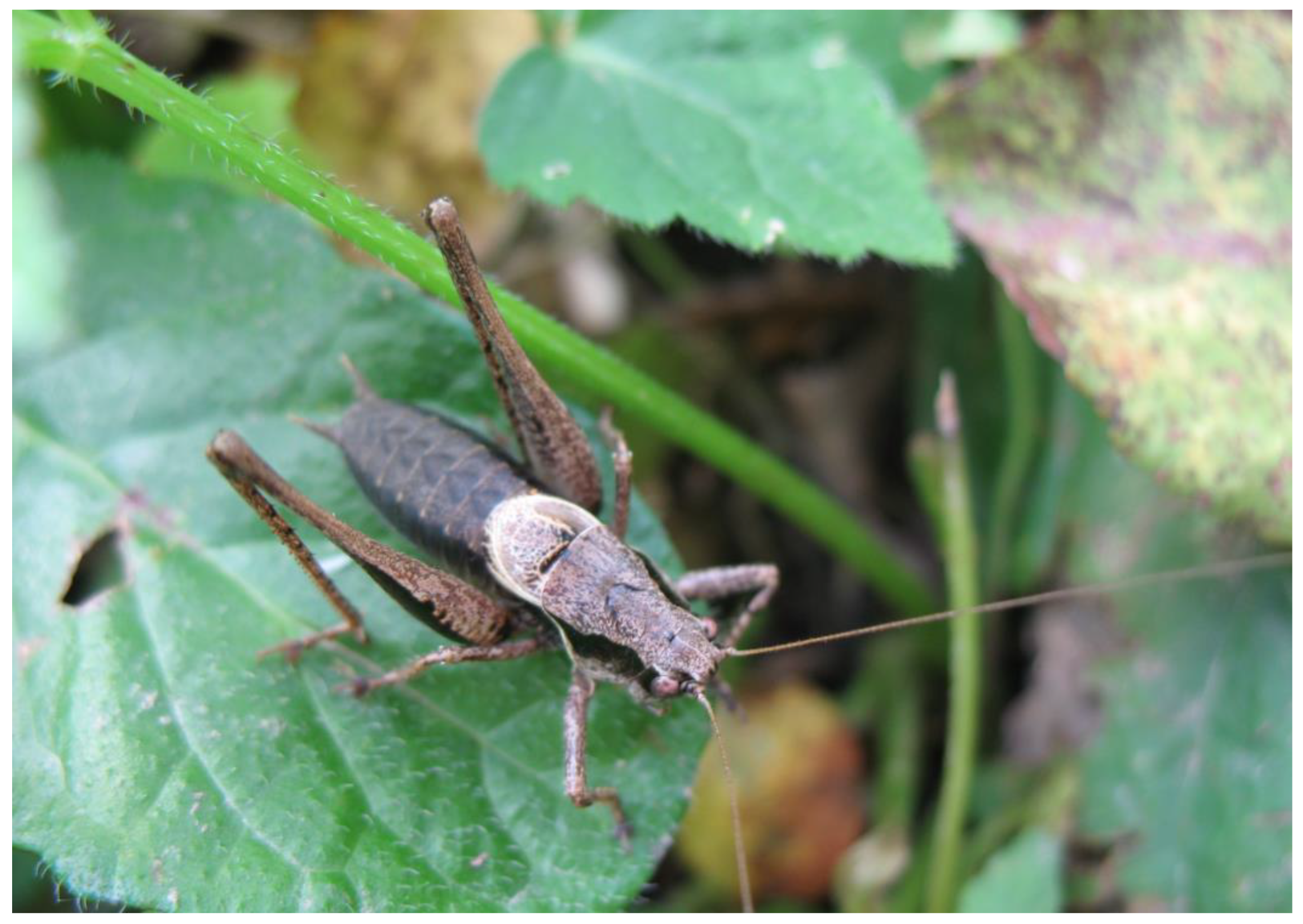
Figure 2.
The map of sample plots with elevations based on SRTM and boundaries of the Continental biogeoregion within the boundaries of the Kaluga Region, Russia.
Figure 2.
The map of sample plots with elevations based on SRTM and boundaries of the Continental biogeoregion within the boundaries of the Kaluga Region, Russia.
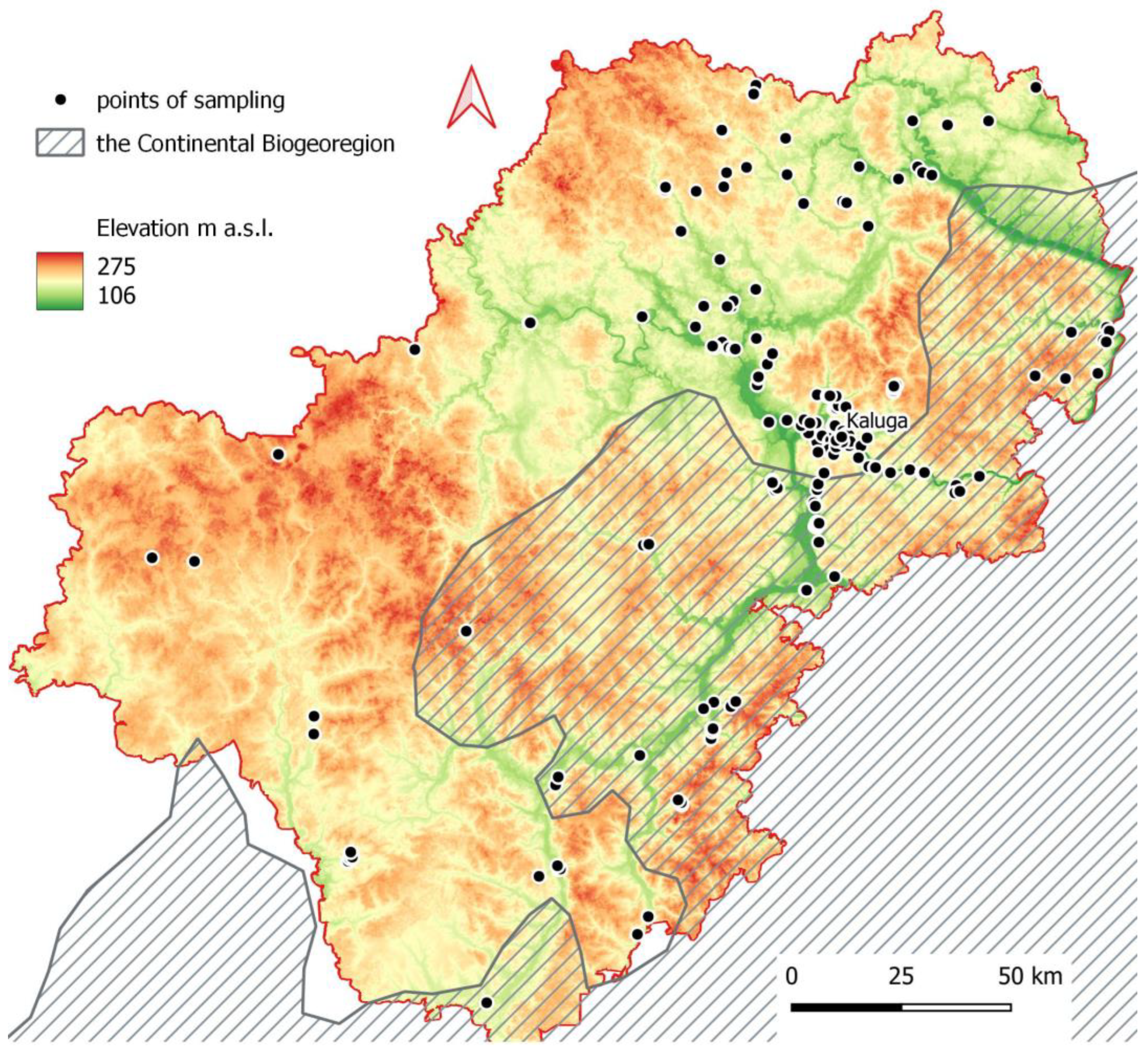
Figure 3.
Points of the presence or absence of Pholidoptera griseoaptera on the map of the Kaluga Region.
Figure 3.
Points of the presence or absence of Pholidoptera griseoaptera on the map of the Kaluga Region.
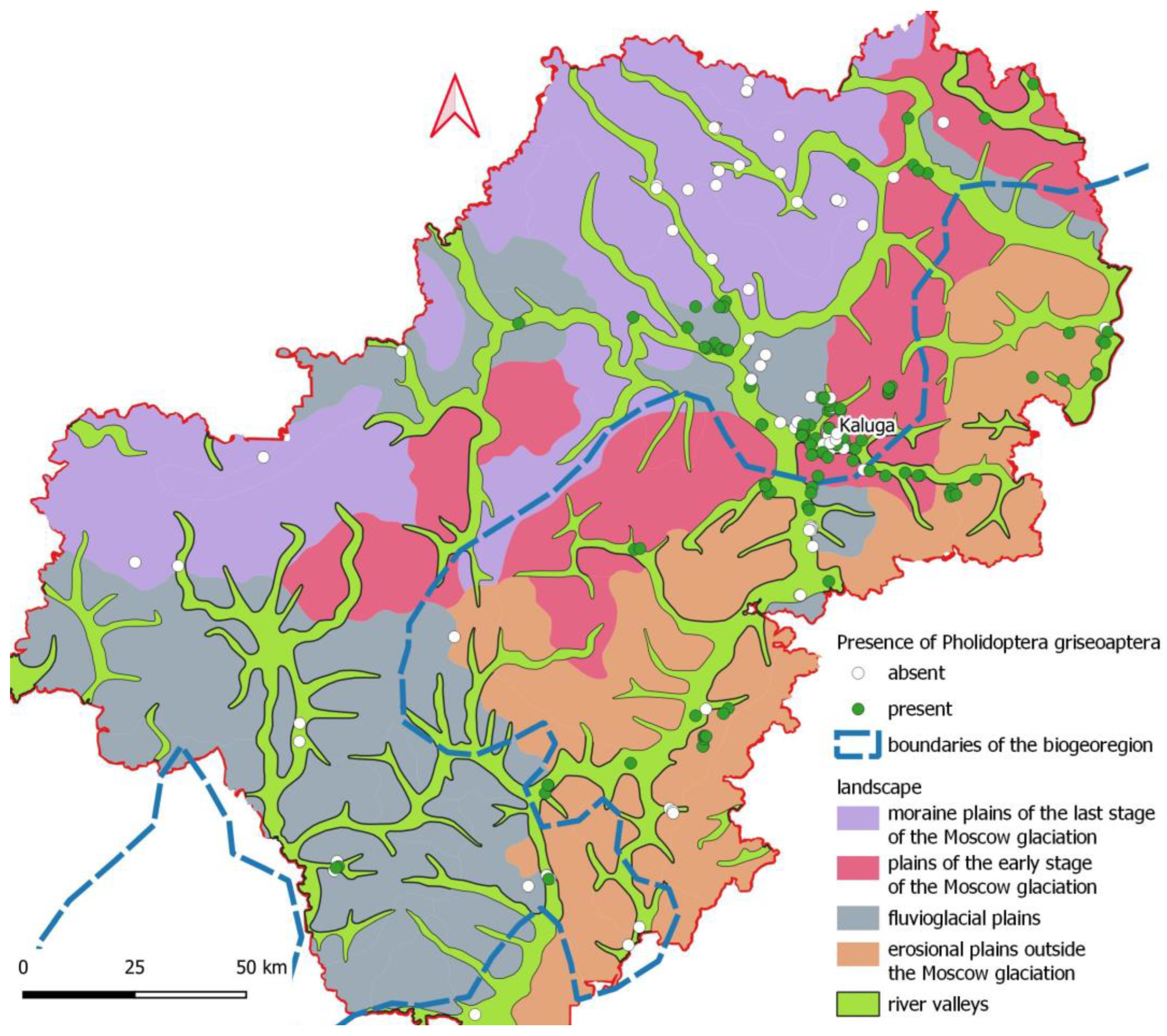
Figure 4.
Points of the presence or absence of Pholidoptera griseoaptera in the Kaluga City and its surroundings.
Figure 4.
Points of the presence or absence of Pholidoptera griseoaptera in the Kaluga City and its surroundings.
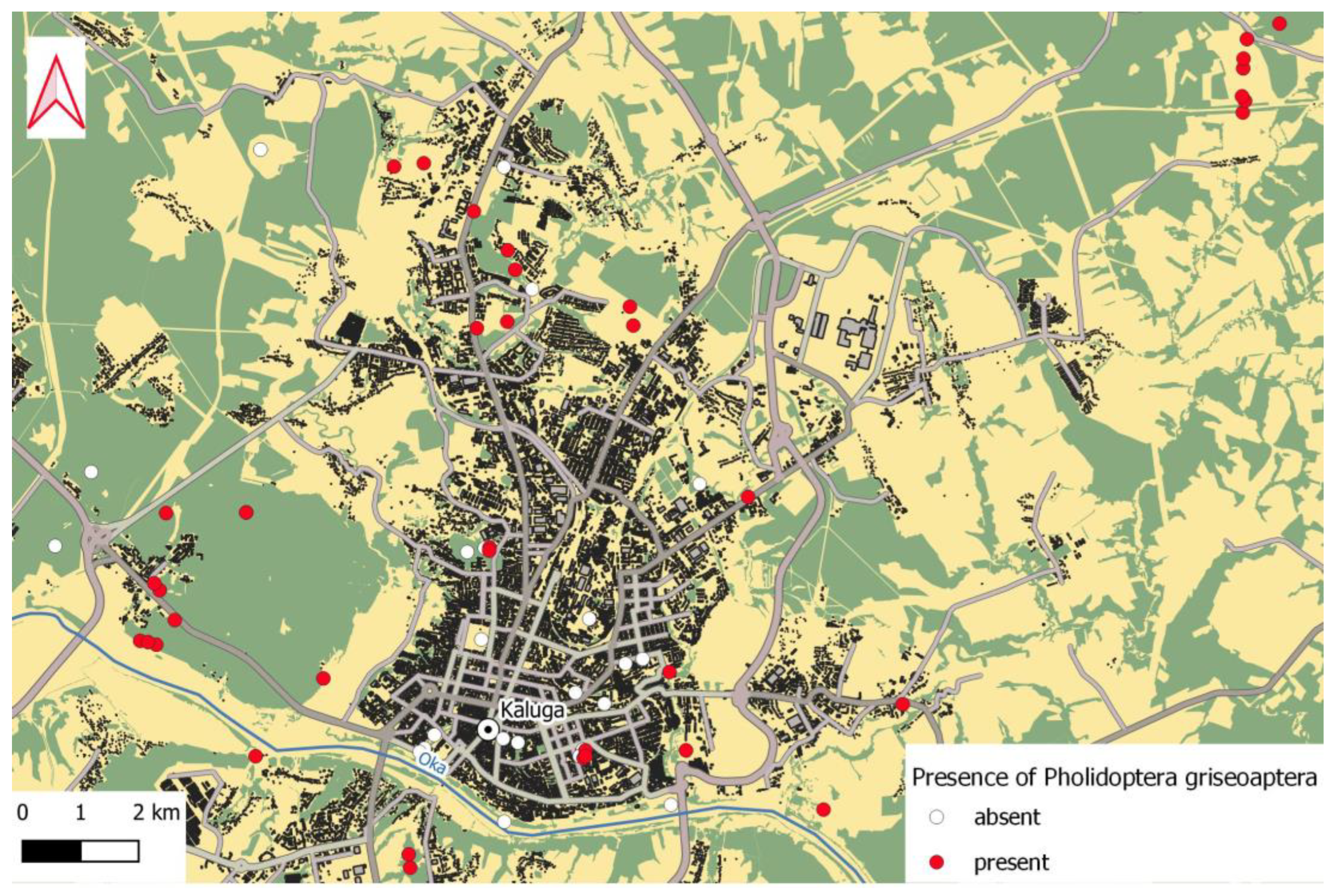
Figure 5.
Points of the presence or absence of Pholidoptera griseoaptera in the most urban habitat – lands of Khlustin City Hospital, Kaluga, Russia. Google satellite image.
Figure 5.
Points of the presence or absence of Pholidoptera griseoaptera in the most urban habitat – lands of Khlustin City Hospital, Kaluga, Russia. Google satellite image.
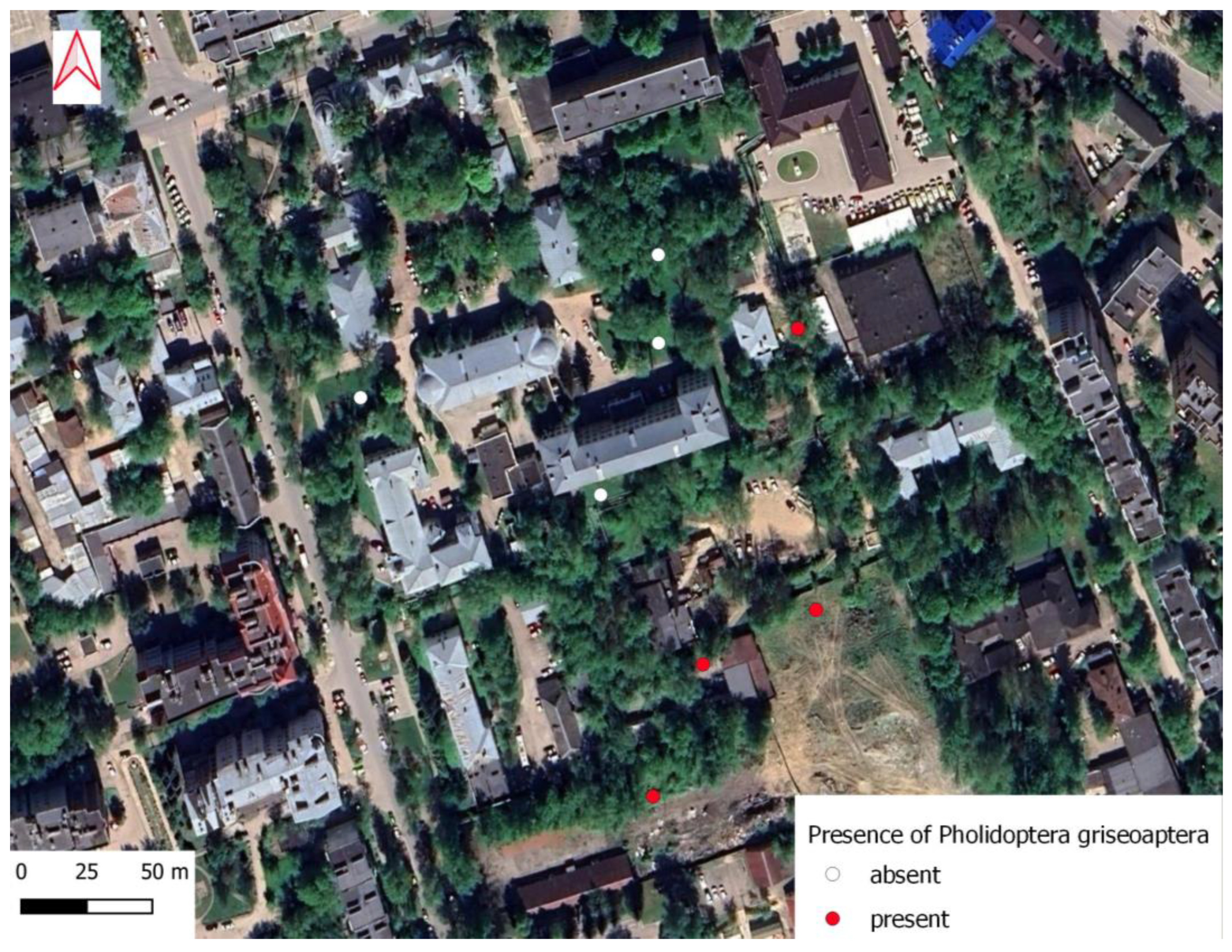
Figure 6.
Activity-density of Pholidoptera griseoaptera in different habitats of the Kaluga Region estimated using pitfall traps. Kruskal-Wallis chi-squared = 18.912, df = 3, p-value = 0.0003
Figure 6.
Activity-density of Pholidoptera griseoaptera in different habitats of the Kaluga Region estimated using pitfall traps. Kruskal-Wallis chi-squared = 18.912, df = 3, p-value = 0.0003
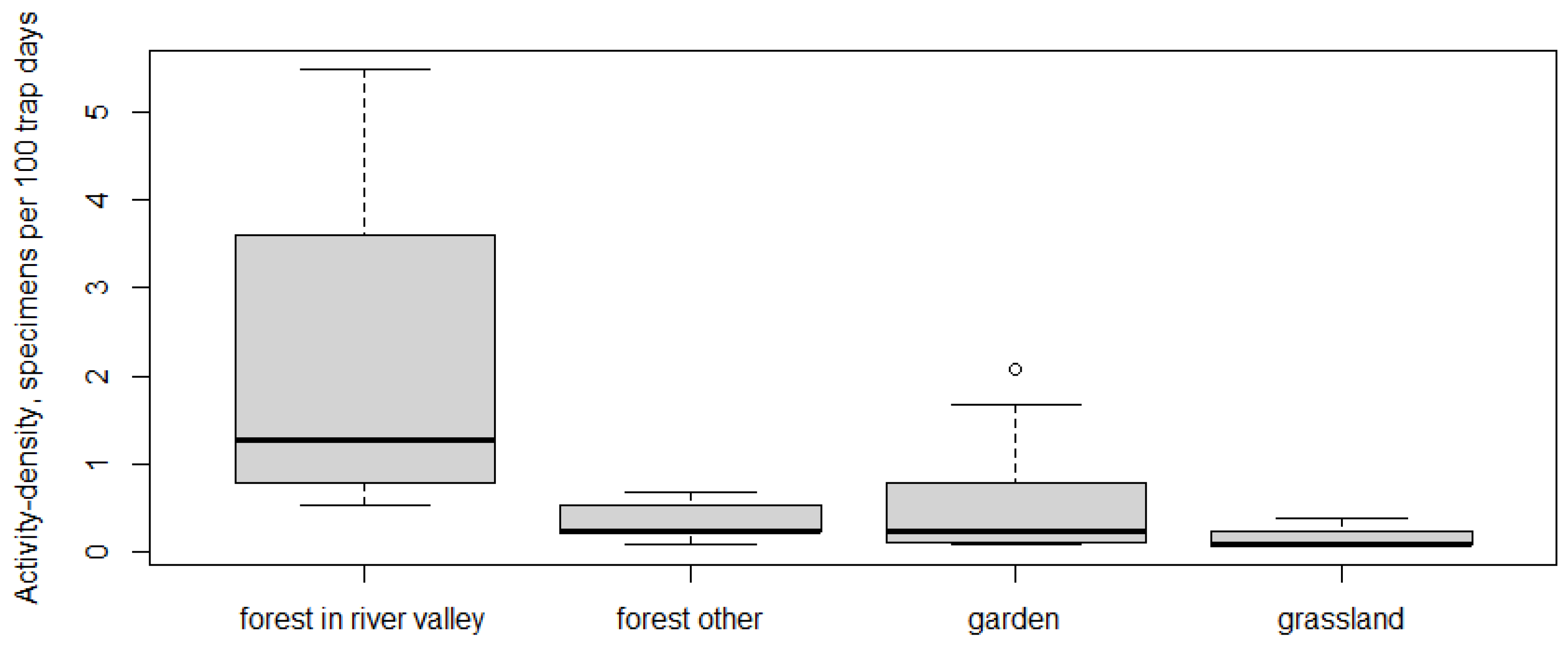

Table 1.
Numbers of plots of different habitat types where we registered the presence or absence of Pholidoptera griseoaptera in the Kaluga Region, Russia. There are significance differences between subtypes of forests (X-squared = 19.117, df = 3, p-value = 0.0003).
Table 1.
Numbers of plots of different habitat types where we registered the presence or absence of Pholidoptera griseoaptera in the Kaluga Region, Russia. There are significance differences between subtypes of forests (X-squared = 19.117, df = 3, p-value = 0.0003).
| Type of sample plots | Total | Presence | Absence |
|---|---|---|---|
| Gardens | 15 | 11 | 4 |
| Grasslands | 23 | 11 | 12 |
| Wetlands | 9 | 0 | 9 |
| Forests and edges (mesic), incl. | 189 | 117 | 75 |
| deciduous (non-riparian) | 101 | 72 | 29 |
| pine | 47 | 18 | 29 |
| spruce | 11 | 3 | 8 |
| riparian (willow or alder) | 30 | 17 | 13 |
Table 2.
Description of variables used to predict the presence of Pholidopteta griseoptera in the forests and their edges in the Kaluga Region, Russia.
Table 2.
Description of variables used to predict the presence of Pholidopteta griseoptera in the forests and their edges in the Kaluga Region, Russia.
| Label | Name | Levels | Description |
|---|---|---|---|
| Dec_Tree | Deciduous trees in tree layer | 0-1-2 | 0 – adult deciduous trees are absent 1 – sparse deciduous trees 2 – dense tree layer dominated by deciduous species |
| Dec_shrubs_un | Deciduous shrubs or undergrowth | 0-1 | 0 – deciduous shrubs (such as Corylus avellana L., Euonymus verrucosus Scop., Lonicera xylosteum L.) or undergrowth are not seen 1 – deciduous shrubs or undergrowth are conspicuous |
| Nem_herbs | Nemoral herbs | 0-1 | 0 – there are no nemoral species among dominants of the herb layer 1 – there are any nemoral species among the dominants of the herb layer |
| Nitr_herb | Nitrophilous herbs | 0-1 | 0 – there are no nitrophilous species among dominants of the herb layer 1 – there are any nitrophilous species among the dominants of the herb layer |
| Con_Tree | Coniferous trees | 0-1 | 0 – there are no coniferous trees in the tree stand. 1 – there are any coniferous trees (Pinus sylvestris or Picea abies) in the tree stand. |
| Con_un | Coniferous undergrowth | 0-1 | 0 – there is no coniferous undergrowth. 1 – there is coniferous undergrowth. |
| Hight_herb | Herbage height | 0-3 | 0 – there is no closed herb layer 1 – low herb layer (to 20 cm) 2 – moderate herb layer (20-60 cm) 3 – tall herb layer (above 60 cm) |
| Cover_herb | Herbage coverage | 0-2 | 0 – no closed herb layer 1 – sparse herb layer (coverage 10-70%) 2 – dense herb layer (70-100%) |
| Deadwood | Deadwood | 0-2 | 0 – deadwood was not seen when we sampled the insects 1 – moderate stock of deadwood (single stumps or trunks) 2 – large stock of deadwood |
| Isolation | Isolation | 0-1 | 0 – plot is not isolated by roads, buildings, bogs or other physical barriers from neighbouring forests 1 – plot is isolated by roads, buildings, bogs or other physical barriers from neighbouring forests |
| Old_forest | Presence of old forest | 0-2 | 0 – no forests within 5 km radius based on 1860 map 1 – forests within 500 m to 5 km distance 2 – forests on the same place or to 500 m |
| Landscape | Lanscapes | 5 levels | Mos_mor – moraine plains of the last stage of the Moscow glaciation Edg_mos – plains of the early stage (marginal zone) of the Moscow glaciation Ers – erosional plains outside the boundaries of the Moscow glaciation Flvg – fluvioglacial plains of both Moscow and Don glaciations Rip – landscapes of river valleys |
Table 3.
Factors affecting the presence of Pholidoptera griseopatera in the forests of the Kaluga Region, Russia: results of a general linear model. McFadden R2 is 0.367, AIC=183.46, accuracy is 81.9%
Table 3.
Factors affecting the presence of Pholidoptera griseopatera in the forests of the Kaluga Region, Russia: results of a general linear model. McFadden R2 is 0.367, AIC=183.46, accuracy is 81.9%
| Factor | Coeff. | Std. Error | z value | Pr(>|z|) | LR_Chisq | Partial_R2 |
|---|---|---|---|---|---|---|
| (Intercept) | -0.4570 | 1.3352 | -0.3422 | 0.7322 | ||
| Landscape: | 25.0711 | 0.134 | ||||
| Flvg | -0.7789 | 1.2306 | -0.6330 | 0.5268 | ||
| Edg_mos | 0.2994 | 1.2858 | 0.2329 | 0.8159 | ||
| Mos_mor | -3.2771 | 1.3855 | -2.3653 | 0.0180 | ||
| Rip | -0.2310 | 1.1601 | -0.1991 | 0.8422 | ||
| Ers | 15.7300 | 1446.1421 | 0.0109 | 0.9913 | ||
| Con_Tree | -1.3725 | 0.4366 | -3.1434 | 0.0017 | 10.5609 | 0.061 |
| Old_forest | 0.2022 | 0.2999 | 0.6742 | 0.5002 | 0.4556 | 0.003 |
| Nem_herbs | 2.1991 | 0.4553 | 4.8296 | <0.0001 | 27.2026 | 0.144 |
| Isolation | -3.4308 | 0.7535 | -4.5533 | <0.0001 | 26.5071 | 0.141 |
| Autocovariation | 121.1268 | 49.6305 | 2.4406 | 0.0147 | 6.5204 | 0.039 |
Table 4.
Factors affecting the presence of Pholidoptera griseoaptera in the forests and other tree-dominated habitats in Kaluga City and its surroundings. McFadden R2 is 0.789, AIC=25.75, accuracy is 96.1 %
Table 4.
Factors affecting the presence of Pholidoptera griseoaptera in the forests and other tree-dominated habitats in Kaluga City and its surroundings. McFadden R2 is 0.789, AIC=25.75, accuracy is 96.1 %
| Factor | Estimate | Std. Error | z value | Pr(>|z|) | LR_Chisq | Partial_R2 | Pr(>Chisq) |
|---|---|---|---|---|---|---|---|
| (Intercept) | -3.020 | 2.541 | -1.189 | 0.2346 | |||
| Con_Tree | -9.151 | 6.112 | -1.497 | 0.1343 | 6.106 | 0.308 | 0.0135 |
| Old_forest | 6.479 | 3.430 | 1.889 | 0.0589 | 22.408 | 0.620 | <0.0001 |
| Nem_herbs | 8.968 | 6.506 | 1.378 | 0.1681 | 6.716 | 0.329 | 0.0096 |
| Isolation | -7.504 | 3.792 | -1.979 | 0.0478 | 12.296 | 0.473 | 0.0005 |
| Autocovariation | -446.485 | 336.271 | -1.328 | 0.1843 | 4.344 | 0.241 | 0.0372 |
Disclaimer/Publisher’s Note: The statements, opinions and data contained in all publications are solely those of the individual author(s) and contributor(s) and not of MDPI and/or the editor(s). MDPI and/or the editor(s) disclaim responsibility for any injury to people or property resulting from any ideas, methods, instructions or products referred to in the content. |
© 2026 by the authors. Licensee MDPI, Basel, Switzerland. This article is an open access article distributed under the terms and conditions of the Creative Commons Attribution (CC BY) license (http://creativecommons.org/licenses/by/4.0/).
Copyright: This open access article is published under a Creative Commons CC BY 4.0 license, which permit the free download, distribution, and reuse, provided that the author and preprint are cited in any reuse.


