

Submitted:
08 April 2026
Posted:
10 April 2026
You are already at the latest version
Abstract
This study aimed to assess the availability and environmental impact of some widespread agro-industrial by-products in Europe, and their potential to reduce the environmental impact of small ruminant diets by replacing conventional feed ingredients. Grape, olive, and tomato pomaces, and spent grains of beer were considered. A Carbon footprint of products (CFP) approach was used to quantify the environmental impact of agro-industrial by-products, according to the ISO 14067:2018 standard. The system boundary was defined as gate to gate, while 1 kg of dried by-product was chosen as functional unit (FU). The system included the relevant stages of agro-industrial by-products production, from the drying process of agro-industrial by-products to the treatments carried out in the feed industry (e.g., milling, mixing, pelleting). The CFP of grape, olives, and tomatoes pomaces and spent grains of beer was 0.26, 0.22, 0.31 and 0.21 kg CO2equivalents (CO2e)/FU, respectively. Reusing grape, olive, tomato and brewery industry by-products available in Europe, in replacement of conventional ingredients in sheep and goats’ diets, reduced the CFP by 2% to 90% and allowed to save 5.15 Megatons of CO2e. These results suggest that the recovery of some agro-industrial by-products can effectively represent a sustainable strategy to reduce the environmental impact of conventional ingredients commonly used in animal feeding. Defining an optimal level of inclusion of these by-products can help to improve the implementation of this strategy.
Keywords:
agro-industrial by-product
; carbon footprint
; environmental impact
; sheep
; goat
1. Introduction
The agro-food system generates large amounts of secondary biomass in the form of agro-industrial by-products, which originate from the processing of both plant and animal products. These include by-products from sugar production, winemaking, and olive oil processing, as well as residues from the processing of tomatoes, potatoes, carrots, citrus fruits, and apples [1]. Many of these by-products, particularly those derived from wine, olive oil, tomato sauce, and beer processing, are rich in valuable nutrients and therefore represent potential feed resources for animal nutrition [2].
However, to the best of our knowledge, no studies have quantified the European availability of nutrients that could be obtained through the valorisation of agro-industrial by-products. At the same time, the management of these materials has become increasingly important because of their potential environmental impact, as current food waste management strategies such as incineration, landfill disposal, and even composting are often environmentally unsustainable [3]. Among the available recovery strategies, the use of agro-industrial by-products in animal feeding has received considerable scientific attention, particularly because of the presence of bioactive compounds that may improve the quality of ani-mal-derived products [4,5].The interest in these agro-industrial by-products is also driven by their chemical composition, offering substantial amounts of protein and fiber. Numerous studies have explored their potential inclusion in small ruminant diets, focusing on their effects on milk yield, milk composition, and animal performance [6,7,8,9]. Additional research has examined the impact of grape, olive oil, and brewery by-products on ruminal metabolism in sheep [10,11]. For instance, brewery by-products have been evaluated as alternative protein sources in lamb feeding [12,13,14]. However, challenges remain regarding the utilization of some by-products, including their high moisture content, which complicates storage and affects microbiological stability. To address these limitations, effective preservation methods, such as drying and ensiling, have been proposed to ensure year-round availability and resolve issues related to the seasonality of production [15,16,17].
The incorporation of food chain by-products into animal diets appears to reduce the environmental impact associated with off-farm feeds, which in dairy sheep and dairy goat farms account for 20% and 23% of total emissions, respectively [18,19]. Moreover, they can directly reduce the greenhouse gas (GHG) emissions through their richness in methane-suppressive phenolic compounds [20,21,22], or through reduced disposal, thus supporting circular economy strategies [23]. However, little research has quantified their environmental impact in terms of reducing the environmental footprint imported into livestock farms with feed. From a life cycle analysis (LCA) perspective, by-products are often considered to have negligible GHG emissions, as the environmental burden is typically attributed entirely to the primary product [24]. However, it is necessary to consider post-harvest emissions from the gate of agri-food industries, related to transport, drying and passages applied in feed chains.
The first objective of this work was to estimate the European availability of nutrients resulting from the valorisation of grape, olive and tomato pomaces, and brewers’ spent grains. Another objective was to assess the CFP of dried agro-industrial by-products and to evaluate the mitigation potential of including them in the diet of small ruminants.
2. Materials and Methods
2.1. Chemical Composition of Agro-Industrial by-Products
A literature review was carried out to assess the chemical composition of selected agro-industrial by-products (grape, olive and tomato pomaces, and brewers’ spent grains), focusing on the initial content of moisture, protein, fat, ash and fibre, expressed as neutral detergent fibre (NDF) and acid detergent fibre (ADF).
2.2. Quantity of Agro-Industrial by-Products
The amount of available agro-industrial by-products was estimated considering the total production of the primary product in Europe, and the relative percentage of by-products from industrial processing obtained from the literature. For winery by-products, the quantity of grapes processed into wine was considered. Similarly, the quantity of olive by-products was estimated based on the amount of olives processed for olive production, and tomato by-products were quantified from the amount of tomatoes processed. Brewer’s spent grains were instead estimated based on total beer production from barley.
Data on the total production of primary products were retrieved from the EUROSTAT [25] and FAOSTAT [26] databases, referring to the production of grapes for wine, olives for oil, and tomatoes in 2023, and malted beer in Europe (EU 27) in 2021. For each primary product, the relative percentage of agro-industrial by-products resulting from industrial processing was estimated as the average percentage reported in the literature. Based on the crude protein and fibre contents, the total amounts of protein and fibre available in Europe were estimated.
2.3. Estimation of the Carbon Footprint of Considered by-Products
The environmental impact of the considered agro-industrial by-products was estimated using the carbon footprint of products (CFP) approach, according to the ISO 14067:2018 standard [27]. The system boundary was defined as gate to gate, while 1 kg of dried by-product was chosen as functional unit (FU).
The agro-industrial by-products production processes were included in the system boundary, but their impacts have been cut off, assuming that at this stage the impacts of these processes are 100% attributed to the primary products. This means that each agro-industrial by-product leaves the primary industry without any environmental impact [28,29]. The system included the relevant stages of agro-industrial by-products production, from the drying process of grape, olive, tomato pomace and brewer’s spent grains to the treatments carried out in the feed industry (e.g., milling, mixing, pelleting). The transportation was excluded from the study.
The impact associated with the drying process was estimated considering the energy required for the drying process, as a function of its initial moisture content. For agro-industrial by-products for which the energy requirement for the drying process was not available in the literature, data were estimated considering the moisture content and the energy in the form of heat required for the other by-products. The initial and final moisture contents and the energy required for the drying process used to estimate the environmental impact of the drying process for each agro-industrial by-product are summarized in Table 1. A detailed description of all inputs obtained from the literature and used to estimate the electricity requirement is given in the Supplementary Material (Table S1). The emission factor for electricity consumption was 0.23 kg CO2equivalents (CO2e)/kWh [30]. For the processes related to agro-industrial by-product incorporation into animal feed, an emission factor of 0.04 kg CO2e/kg by-product (on a fresh matter basis, FM) was considered for all agro-industrial by-products [31].
2.4. Estimation of the Carbon Footprint Reduction for the Replaced Feeds in the Diet
A literature search was carried out to identify studies that included the agro-industrial by-products under investigation in replacement of ingredients in sheep and goat diets, to determine the potential level of inclusion for each by-product. From these studies, only those reporting no negative effects associated with the use of by-products on dry matter intake and milk production were selected. A list of the selected studies is given in Table S2, together with a detailed description of the level of inclusion of each by-product in the diet, and the replaced ingredient.
The reduction in CFP of each replaced ingredient in each study was estimated, considering the CFP of the replaced ingredient and its level of inclusion in each diet, and the estimated CFP of the tested by-product and its level of inclusion.
2.5. Estimation of the Carbon Footprint Reduction for the Replaced Feeds in the Diet
The reduction of CFP due to the substitution was estimated by comparing the control ration and the experimental treatment ration and was based on the level of by-product inclusion in the studies: for each study, the reduction (%) of CFP for each individual substituted ingredient was calculated. Then, four studies, reporting the typical proportions of components used in sheep and goat diets, were selected to precisely estimate the reduction in CFP associated with the use of each by-product, calculated as the difference between the CFP of the treatment diet (which includes the by-product) and the corresponding control diet (without by-product inclusion). These estimates were made considering diets including olive oil and tomato by-products in sheep [9], spent brewer’s yeast in sheep [11] and grape pomaces in goats [35]; olive, tomato and grape pomace were used in place of sugar beet pulp, whereas spent brewer’s yeast in place of soybean meal. The diets considered to estimate the potential reduction in CFP of the diet including by-products for each species are given in the supplementary material (Table S3 for olive by-products, Table S4 for tomato by-products, Table S5 for grape by-products and Table S6 for brewers’ spent yeast in the supplementary material).
2.6. Estimation of the Saved Emissions from the Reuse of by-Products in Small Ruminants Diet
Based on the estimation of the CFP associated to the control diet (without by-product inclusion), and that associated to the treatment diet (with includes the by-product), the avoided impact, expressed as kg CO2e/kg of diet was estimated.
The avoided emissions per unit of by-product included in the diet were then calculated, by considering grape, olive, tomato, and brewery by-products levels of inclusion reported in the four diets considered above for sheep and goats.
Finally, the total emissions avoided by using the by-products under study were quantified from the amount of available by-product (tons of DM) estimated in Europe.
3. Results
3.1. Chemical Composition of Agro-Industrial by-Products
A detailed overview of the chemical composition of by-products derived from the wine, olive oil, tomato processing, and beer industries is shown in Table 3. The data highlights the heterogeneity in the nutrient profiles of these by-products.
By-products generally exhibit a high moisture content (greater than 70%), apart from olive oil by-products, which show the lowest moisture level at 50%.
Considering the nutrients contents, among the by-products, brewers’ spent grains have the highest average protein content (22.8% dry matter, DM), making them a valuable protein source. Winery and tomato by-products contain moderate levels of protein (11.6% and 16.0% DM, respectively), while olive oil by-products exhibit the lowest average protein content (8.0% DM). Olive oil and tomato by-products contain relatively higher fat levels (10.4% and 10.8% DM, respectively) compared to winery by-products (6.8% DM) and brewers’ spent grains (8.6% DM). This is consistent with the lipid-rich nature of olive and tomato processing residues. Olive oil and tomato by-products are notably fibre-rich, with average NDF values of 61.65% and 58.4% DM, respectively. Winery by-products also have a substantial fibre fraction (44.0% DM). In contrast, brewers’ spent grains have a moderate NDF content (49.9% DM) but the lowest ADF content (20.6% DM).
3.2. Quantity of Agro-Industrial by-Products
The annual production of by-products from key agro-industrial sectors in Europe is reported in Table 4, along with the estimated availability of crude protein and fibre, providing insights into their nutritional contribution to feed systems. On a FM basis, the beer industry generates the largest volume of by-products (9.56 million tons FM), followed by winery (4.48 million tons FM), olive oil (3.98 million tons FM), and tomato processing (0.77 million tons FM).
However, when analysed on a DM basis, the ranking shifts due to variations in moisture content among the by-products. The beer industry and the olive oil sector both produce comparable quantities of by-products, with approximately 2 million tons DM each. This similarity highlights the high DM content of olive oil by-products relative to their lower FM production. In contrast, winery by-products account for 1.29 million tons DM, while tomato processing by-products contribute the least, at just 94,809 tons DM.
3.3. Carbon Footprint of Dried by-Products
The estimated CFP of the considered by-products is reported in Figure 1; on average the by-products had a value of 0.25 ± 0.04 (mean ± SD) kg CO2e/kg of dried by-product (on DM basis), with the lowest values exhibited by the brewers’ spent grains and olive pomace (0.21 and 0.22 kg CO2e/kg, respectively) and the highest value by tomato pomace (0.31 kg CO2e/kg); grape pomace showed an intermediate value of 0.26 kg CO2e/kg.
3.4. Reducing the Carbon Footprint of Feed Replacements in Diets
The inclusion of grape pomace at a level of 15% and 10% of the dietary DM in sheep and goats, respectively, allowed a reduction of the 43% of the CFP relate to the use of beet pulp (Table 5).
A reduction of 53% and 55% of the CFP of the concentrate was observed in sheep and goats, respectively, with the inclusion of grape marc, while the highest reduction (90%) was achieved when grape by-products were used to replace soybean hulls, whose environmental impact is quite high (1.10 kg CO2e/kg feed).
Only one study tested the use of olive cake as a replacement for cottonseed meal [9], showing a 65% reduction in its CFP.
The lowest reductions in CFP of the replaced diets (-2% replacing cottonseed meal and -19% replacing sugar beet pulp) were observed with the inclusion of tomato pomace at a level of 29.8% in the sheep diet.
3.5. Reduction of the Carbon Footprint of the Diets Including by-Products
In the present work, the potential reduction of the CFP of the small ruminant diets including by-products was estimated considering the substitution of sugar beet pulp or soybean meal with different by-products, as shown in Table 6.
The highest CFP reduction (-34.73%) was observed when tomato pomace was used to replace sugar beet pulp in the diet, while the lowest CFP reduction (-4.52%) was observed when grape pomace replaced sugar beet pulp. The use of olive pomace in replacement of sugar beet pulp allowed a reduction in the CFP of the diet of -24.01%. Finally, the reduction in CFP observed in the treatment diet containing brewer’s spent yeast was -28.0%.
3.6. Reduction of the Carbon Footprint of Diets Including by-Products
Table 7 reports the results of the estimation of total avoiding CO2 emissions, considering the European availability of the four considered by-products, their calculated CFP, and their positive environmental impact when included in the diets. The greatest amount of by-products produced in Europe was that deriving from the beer industry, with more than 2 million tons produced in 2021. This estimate, combined with the highest avoided impact, resulting in 2.0 kg CO2e avoided per kg of by-product included, and associated to the replacement of soybean meal in small ruminants’ diet, resulted in the highest contribution to total avoided emissions among the investigated by-products. The total amount of avoided CO2 emissions accounted for 5.15 Mt CO2e, mostly represented (81%) by the Brewers’ spent grains.
4. Discussion
4.1. Chemical Composition and Amount of Agro-Industrial by-Products
The high moisture content represents one of the main problems related to the use of agro-industrial by-products at industry level [100]. High water content makes by-products quite unstable; then to prevent fermentation and oxidation processes a biomass stabilization by rapid drying is needed.
The variability observed in chemical composition reflects the diverse raw materials and processing methods used in different agro-industries. These characteristics underline the potential of these by-products as feed ingredients, albeit with some constraints due to high fibre or moisture contents in certain cases.
Analysing the chemical composition of agro-industrial by-products on a DM-based perspective emerges the importance of considering moisture content when the potential contribution of agro-industrial by-products to feed systems is evaluated. Importantly, the availability of these by-products is more than sufficient to meet the demands of the feed market, not only for small ruminants but also for other livestock species where they can find valuable applications. Their significant production volumes and nutrient profiles underscore their role in supporting sustainable livestock systems, while also contributing to the circular economy by reducing waste and valorising agro-industrial residues.
4.2. Carbon Footprint of Dried by-Products
To date, little information is present in literature concerning the quantification of the environmental impact of agro-industrial by-products. This makes the comparison of our results with other studies difficult. For some by-products, widely used in the feed industry, the impact values were quantified by the Global Feed LCA Institute. This is the case of sugar beet pulp, pea and bean hulls, soybean hulls, and oat husk. No or less information are available regarding the CFP of the by-products considered in this study, even if there are widespread and arise from industry process of very common products (wine, beer, tomato, and olive oil). Results of our estimation can be useful to future considerations regarding the use of agro-industrial by-products in the feed industry, from an environmental perspective. The environmental impact of the four by-products was not high compared to the values of typical feed ingredients, except for the tomato pomace (0.31 CO2e/kg DM). The relative high environmental impact associated with tomato pomace can be explained by the high moisture content of this by-product, which ranges from 74.8% to 97.0% [74,96].
The dehydration process of the by-products is essential to allow their further applications, due to the high-water content of the raw material, which also leads to insufficient biological stability [101,102]. The estimation performed in this work was based on a common drying method for all by-products, although different drying methods may affect the biochemical composition and retention of bioactive compounds, as observed especially in grape pomace [101]. Moreover, the drying process seems to be important in solving the problem related to the seasonality of some productions that results in a high availability of some by-products in a short harvest period [103].
The estimates of CFP of by-products observed in this study are in line with environmental impacts associated with by-products such as bean hulls and oat husks, which showed CFP of 0.27 and 0.29 kg CO2e/kg by-product, respectively [34]. Moreover, according to the GFLI database, wet sugar beet pulp was associated with no environmental impact, while the dried beet pulp showed a CFP equal to 0.46 kg CO2e/kg, suggesting that the great part of the impact is related to the drying process of the by-product obtained [34]. Lower CFP values were observed for other by-products deriving from the milling industry. Rice husk, which is a lignocellulosic agricultural waste [104], showed a CFP of 0.09 kg CO2e/kg by-product [34].
It should be noticed that the impact related to the ensiling techniques of these by-products (often used as stabilization technique) and other factors (as the transport) should be also considered, providing more accurate results in this estimation.
4.3. Reducing the Carbon Footprint of Feed Replacements in Diets
The wide range (from -2 to -90%) observed in the achieved reduction of the CFP of replaced feeds in the diets can be related to the CFP of used by-product, to the CFP of replaced ingredient, to the level of inclusion of each by-product, and, finally, to the replacement level of substituted feed. The highest value of reduction observed when brewers’ spent yeast replaced soybean meal (-90%) was expected, mainly due to the highest CFP of this ingredient among the replaced feeds considered in this work. The use of olive and tomato pomace in replacement of cotton seed meal, which had a CFP of 0.63 kg CO2e/kg, showed quite dissimilar results, even if with the same level of inclusion of the by-products used. Besides the different CFP values of these by-products (0.22 and 0.31 kg CO2e/kg by-product for olive and tomato pomace, respectively) contained in these diets, olive cake replaced 100% of cotton seed meal, while tomato pomace replaced 75% of the same ingredient.
Most studies considered in this work have evaluated the use of wine and olive oil by-products in sheep and goats to replace fibrous concentrates in the diet, such as sugar beet pulp, reaching up to 100% replacement of this ingredient [35,65,99]. Beet pulp is a by-product of the sugar beet industry, widely used as a final feed ingredient due to its high digestible fibre content [105]. Its environmental impact is quite low compared to other substituted feeds considered in this work, as most of the impact is attributed to the primary product of the industrial process. This can explain the intermediate values of CFP reduction observed when grape, olive, and tomato pomace replaced beet pulp in the diets (-43; -52 and -19%, respectively).
4.4. Reducing the Carbon Footprint of Feed Replacements in Diets
The highest reduction in the CFP of the diet observed with the use of tomato pomace was unexpected, since it has been shown to be the by-product with the highest environmental impact. It should be noted that in this diet, wheat bran and cottonseed meal were also replaced by tomato pomace, which resulted in a significant reduction of CFP compared to the control diet, as both substituted ingredients have a rather high environmental impact of 0.63 kg CO2e/kg feed.
Although brewers’ spent yeast had the lowest environmental impact among the 4 by-products (0.21 kg CO2e/kg DM of by-product), and it replaced soybean meal, which has a very high CFP (2.19 kg CO2e/kg feed), the reduction of the CFP of the diet was not the highest. This result can be explained by the low level of inclusion of this by-product in the considered diet (10% of the dietary DM). This consideration is also evident when the results of the grape by-products are observed; indeed, the lowest reduction associated with the use of grape by-products is only related to the lower inclusion level of this by-product in the treatment diet (15% of the dietary dry matter) compared to the inclusion level of the other by-products. It should be noticed that, in the considered studies, the chosen levels of inclusion of grape pomace were strongly related to its polyphenol and lignin contents. Polyphenols in particular can have very interesting positive effects on the health and productive performances of animals when they are included at low levels in the ruminant diets [100], but can have negative impact on diet digestibility and dry matter intake when included at high level [35].
4.5. Saving Emissions by Including the by-Products Available in Small Ruminants’ Diet
Tomato industry by-products showed the lowest potential contribution to emissions avoided. This can be related both to the high energy requirements for the drying process, and, therefore, to the highest CFP estimated to the dried by-product, and to the low quantity of this by-products deriving from the primary industry. Indeed, as can be observed in Table 4, for tomato processing, the percentage of by-product arising from agro-industrial processes is on average of 5%, that is the lowest value among to the percentages estimated for grape, olive, and brewery by-products.
5. Conclusions
This study confirms the potential of agro-industrial by-products as valuable feed resources. The gap of the environmental impact of by-product was filled and it allowed the estimation of the feasible potential reduction of small ruminant diets CFP when some by-products are included in the diet. The reduction of the CFP of typical diets in sheep and goats by including agro-industrial by-products, compared to the control diet ranged from -4.5% (using grape pomace) to -34.73% (using tomato pomace).
The high variability in the agro-industrial by-products composition necessitates tailored strategies for their integration into animal diets, considering both their nutrient contributions and limitations. These by-products represent a sustainable alternative to conventional feedstuffs, contributing to the circular economy while reducing waste in the agro-industrial sector.
Overall, our results suggest that the recovery of some agro-industrial by-products can effectively represent a sustainable strategy to reduce the environmental impact of conventional ingredients commonly used in animal feeding. Defining an optimal level of inclusion of these by-products can help to improve the implementation of this strategy. Moreover, a more accurate estimation can be provided by considering the impacts related to the ensiling technique as a common storage method of these by-products, as well as by considering optimal drying methods for each by-product depending on its chemical properties.
Supplementary Materials
The following supporting information can be downloaded at: https://www.mdpi.com/article/doi/s1, Table S1: Input retrieved from literature for estimating the carbon footprint of dried grape, olive, tomato and beer industry by-products. Table S2: List of selected studies from literature considered in this work using grape, olive, tomato pomace and brewers spent grains in the diet of sheep and goats. Table S3: Typical diet considered for the estimation of the carbon footprint of the control diet and the diet including olive oil by-products in sheep. From Abbeddou et al. [9]. Table S4: Typical diet considered for the estimation of the carbon footprint of the control diet and the diet including tomato by-products in sheep. From Abbeddou et al. [9]. Table S5: Typical diet considered for the estimation of the carbon footprint of the control diet and the diet including grape by-products in goats. From Badiee Baghsiyah et al. [35]. Table S6: Typical diet considered for the estimation of the carbon footprint of the control diet and the diet including beer industry by-products in sheep. From Oancea et al. [11].
Author Contributions
Writing—original draft preparation: M.F.L., M.F.C., F.C.; Investigation and Methodology: M.F.L., F.C.; Investigation and Data curation, S.C., M.F.; Writing—review and Editing: M.F.L., F.C., G.P., A.N.; Funding acquisition: G.P.; Supervision: G.P., G.B., A.N., F.C.
Funding
This work was supported by the VERSOA project (BSGreen company).
Institutional Review Board Statement
Not applicable.
Informed Consent Statement
Not applicable.
Data Availability Statement
Data will be available on request.
Conflicts of Interest
The authors declare no conflicts of interest.
Abbreviations
The following abbreviations are used in this manuscript:
| ADF | Acid Detergent Fiber |
| CFP | Carbon Footprint of product |
| CO2e | CO2 equivalents |
| DM | Dry Matter |
| FM | Fresh Matter |
| FU | Functional unit |
| GHG | Greenhouse gas |
| LCA | Life Cycle Assessment |
| NDF | Neutral Detergent Fiber |
References
- Giamouri, E.; Zisis, F.; Mitsiopoulou, C.; Christodoulou, C.; Pappas, A.C.; Simitzis, P.E.; Kamilaris, C.; Galliou, F.; Manios, T.; Mavrommatis, A.; Tsiplakou, E. Sustainable strategies for greenhouse gas emission reduction in small ruminants farming. Sustainability 2023, 15, 4118. [Google Scholar] [CrossRef]
- Nudda, A.; Carta, S.; Correddu, F.; Caratzu, M.F.; Cesarani, A.; Hidalgo, J.; Pulina, G.; Lunesu, M.F. Meta-analysis on use of agro-industrial by-products rich in polyphenols in dairy small ruminant nutrition. Animal 2025, A 101522. [Google Scholar] [CrossRef]
- Gómez-García, R.; Campos, D.A.; Aguilar, C.N.; Madureira, A.R.; Pintado, M. Valorisation of food agro-industrial by-products: From the past to the present and perspectives. J. Environ. Manage. 2021, 299, 113571. [Google Scholar] [CrossRef]
- Reguengo, L.M.; Salgaço, M.K.; Sivieri, K.; Júnior, M.R.M. Agro-industrial by-products: Valuable sources of bioactive compounds. Food Res. Int. 2022, 152, 110871. [Google Scholar] [CrossRef]
- Zaky, A.A.; Simal-Gandara, J.; Eun, J.B.; Shim, J.H.; Abd El-Aty, A.M. Bioactivities, applications, safety, and health benefits of bioactive peptides from food and by-products: A review. Front. Nutr. 2022, 8, 815640. [Google Scholar] [CrossRef]
- Nudda, A.; Buffa, G.; Atzori, A.S.; Cappai, M.G.; Caboni, P.; Fais, G.; Pulina, G. Small amounts of agro-industrial byproducts in dairy ewes diets affects milk production traits and hematological parameters. Anim. Feed Sci. Technol. 2019, 251, 76–85. [Google Scholar] [CrossRef]
- Buffa, G.; Tsiplakou, E.; Mitsiopoulou, C.; Pulina, G.; Nudda, A. Supplementation of by-products from grape, tomato and myrtle affects antioxidant status of dairy ewes and milk fatty acid profile. J Anim Physiol Anim Nutr. 2020, 104, 493–506. [Google Scholar] [CrossRef] [PubMed]
- Correddu, F.; Gaspa, G.; Pulina, G.; Nudda, A. Grape seed and linseed, alone and in combination, enhance unsaturated fatty acids in the milk of Sarda dairy sheep. J. Dairy Sci. 2016, 99, 1725–1735. [Google Scholar] [CrossRef]
- Abbeddou, S.; Rischkowsky, B.; Hilali, M.E.D.; Haylani, M.; Hess, H.D.; Kreuzer, M. Supplementing diets of Awassi ewes with olive cake and tomato pomace: on-farm recovery of effects on yield, composition and fatty acid profile of the milk. Trop. Anim. Health Prod. 2015, 47, 145–152. [Google Scholar] [CrossRef]
- Correddu, F.; Nudda, A.; Battacone, G.; Boe, R.; Francesconi, A.H.D.; Pulina, G. Effects of grape seed supplementation, alone or associated with linseed, on ruminal metabolism in Sarda dairy sheep. Anim. Feed Sci. Technol. 2015, 199, 61–72. [Google Scholar] [CrossRef]
- Oancea, A.G.; Dragomir, C.; Untea, A.; Saracila, M.; Turcu, R.; Cismileanu, A.; Boldea, I.; Radu, G.L. The effects of brewer’s spent yeast (bsy) inclusion in dairy sheep’s diets on ruminal fermentation and milk quality parameters. Agriculture 2023, 13, 1605. [Google Scholar] [CrossRef]
- Kerby, C.; Vriesekoop, F. An overview of the utilisation of brewery by-products as generated by british craft breweries. Beverages 2017, 3, 24. [Google Scholar] [CrossRef]
- Znabu, H.; Negesse, T.; Sisay, A.; Ftiwi, M. Effect of supplementing graded levels of wet brewery grain by-product to natural pasture hay and wheat bran based diet on the performance of Tigray highland sheep, Northern Ethiopia. J. Dairy Vet. Anim. Res. 2019, 8(5), 205–214. [Google Scholar] [CrossRef]
- de Abreu, K.S.; Guim, A.; Carvalho, F.F.; Ferreira, M.D.A.; Monnerat, J.P.I.D.S.; Fernandes, J.V.; Lima, A.C.C.P.; dos Santos, C.C.C.; da Silva Neto, J.F. Effects of additives in wet brewery residue silage on lamb carcass traits and meat quality. Trop. Anim Health Prod. 2021, 53, 1–8. [Google Scholar] [CrossRef]
- Mirzaei-Aghsaghali, A.; Maheri-Sis, N. Nutritive value of some agro-industrial by-products for ruminants-A review. WJZ 2008, 3, 40–46. [Google Scholar]
- Salami, S.A.; Luciano, G.; O’Grady, M.N.; Biondi, L.; Newbold, C.J.; Kerry, J.P.; Priolo, A. Sustainability of feeding plant by-products: A review of the implications for ruminant meat production. Anim. Feed Sci. Technol. 2019, 251, 37–55. [Google Scholar] [CrossRef]
- Molina-Alcaide, E.; Yáñez-Ruiz, D.R. Potential use of olive by-products in ruminant feeding: A review. Anim Feed Sci. Technol. 2008, 147, 247–264. [Google Scholar] [CrossRef]
- Lunesu, M.F.; Caratzu, M.F.; Correddu, F.; Sechi, S.; Battacone, G.; Nudda, A.; Pulina, G. Applying an indirect method to assess the net carbon footprint of dairy sheep farms with a special focus on suckling lamb. Ital. J. Anim. Sci. 2025, 24, 689–710. [Google Scholar] [CrossRef]
- Lunesu, M.F.; Sau, P.; Correddu, F. Carbon footprint of intensive and mixed dairy goat farming systems in Sardinia: a comparison between IPCC 2006 and IPCC 2019 prediction methods. Ital. J. Anim. Sci. 2021, 20:sup1, 1–236. [Google Scholar]
- López, M.C.; Estellés, F.; Moya, V.J.; Fernández, C. Use of dry citrus pulp or soybean hulls as a replacement for corn grain in energy and nitrogen partitioning, methane emissions, and milk performance in lactating Murciano-Granadina goats. J. Dairy Sci. 2014, 97, 7821–7832. [Google Scholar] [CrossRef]
- Romero-Huelva, M.; Ramírez-Fenosa, M.A.; Planelles-González, R.; García-Casado, P.; Molina-Alcaide, E. Can by-products replace conventional ingredients in concentrate of dairy goat diet? J. Dairy Sci. 2017, 100(6), 4500–4512. [Google Scholar] [CrossRef] [PubMed]
- Benchaar, C.; Hassanat, F.; Gervais, R.; Chouinard, P.Y.; Julien, C.; Petit, H.V.; Massé, D.I. Effects of increasing amounts of corn dried distillers grains with solubles in dairy cow diets on methane production, ruminal fermentation, digestion, N balance, and milk production. J Dairy Sci. 2013, 96, 2413–2427. [Google Scholar] [CrossRef] [PubMed]
- Vastolo, A.; Calabrò, S.; Cutrignelli, M.I. A review on the use of agro-industrial CO-products in animals’ diets. Italian J. Anim. Sci. 2022, 21(1), 577–594. [Google Scholar] [CrossRef]
- Williams, S.R.O.; Fisher, P.D.; Berrisford, T.; Moate, P.J.; Reynard, K. Reducing methane on-farm by feeding diets high in fat may not always reduce life cycle greenhouse gas emissions. Int. J. Life Cycle Assess. 2014, 19, 69–78. [Google Scholar] [CrossRef]
- EUROSTAT, 2023. Database—Eurostat. (accessed on 30 October 2025).
- FAOSTAT, 2023. Database—Faostat. (accessed on 20 December 2025).
- International Organization for Standardization. ISO 14067:2018; Greenhouse gases — Carbon footprint of products — Requirements and guidelines for quantification. ISO: Geneva, 2018.
- Benetto, E.; Jury, C.; Kneip, G.; Vázquez-Rowe, I.; Huck, V.; Minette, F. Life cycle assessment of heat production from grape marc pellets. J Clean Prod. 2015, 87, 149–158. [Google Scholar] [CrossRef]
- Cortés, A.; Moreira, M.T.; Domínguez, J.; Lores, M.; Feijoo, G. Unraveling the environmental impacts of bioactive compounds and organic amendment from grape marc. J. Environ. Manage 2020, 272, 111066. [Google Scholar] [CrossRef]
- Istituto Superiore per la Protezione e la Ricerca Ambientale (ISPRA). Indicatori di efficienza e decarbonizzazione del sistema energetico nazionale e del settore elettrico; Rapporti 343/2021.: Italy, 2021; ISBN 978-88-448-1049-8. [Google Scholar]
- Associazione Nazionale tra i Produttori di Alimenti Zootecnici (ASSALZO). Report ambientale Italy. 2020.
- Ramos, J.S.; Ferreira, A.F. Techno-economic analysis and life cycle assessment of olive and wine industry co-products valorisation. Renew. Sust. Energ. Rev. 2022, 155, 111929. [Google Scholar] [CrossRef]
- Ortiz, I.; Torreiro, Y.; Molina, G.; Maroño, M.; Sánchez, J. MA feasible application of circular economy: Spent grain energy recovery in the beer industry. Waste Biomass Valor. 2019, 10(12), 3809–3819. [Google Scholar] [CrossRef]
- Global Feed LCA Institute (GFLI). GFLI methodology and project guidelines. Available online: https://globalfeedlca.org/gfli-database/methodology-scope/. (accessed on 10 December 2025).
- Badiee Baghsiyah, M.; Bashtani, M.; Farhangfar, S.H.; Sarir, H. Effect of grape by-products inclusion on ruminal fermentation, blood metabolites, and milk fatty acid composition in lactating Saanen goats. Iran J Appl Anim Sci. 2023, 13, 731–742. [Google Scholar]
- Guerra-Rivas, C.; Vieira, C.; Rubio, B.; Martínez, B.; Gallardo, B.; Mantecón, A.R.; Lavín, P.; Manso, T. Effects of grape pomace in growing lamb diets compared with vitamin E and grape seed extract on meat shelf life. Meat Sci. 2016, 116, 221–229. [Google Scholar] [CrossRef]
- Pop, I.M.; Pascariu, S.M.; Simeanu, D.; Radu-Rusu, C.; Albu, A. Determination of the chemical composition of the grape pomace of different varieties of grapes. Anim. Sci. Pap. Rep. 2015, 63, 76–80. [Google Scholar]
- Goñí, I.; Brenes, A.; Centeno, C.; Viveros, A.; Saura-Calixto, F.; Rebole, A.; Arija, I.; Estevez, R. Effect of dietary grape pomace and vitamin E on growth performance, nutrient digestibility, and susceptibility to meat lipid oxidation in chickens. Poult. Sci. 2007, 86, 508–516. [Google Scholar] [CrossRef] [PubMed]
- Valiente, C.; Arrigoni, E.; Esteban, R.M.; Amado, R. Grape pomace as a potential food fiber. J. Food Sci. 1995, 60(4), 818–820. [Google Scholar] [CrossRef]
- Goula, A.M.; Thymiatis, K.; Kaderides, K. Valorization of grape pomace: Drying behavior and ultrasound extraction of phenolics. Food Bioprod. Process. 2016, 100, 132–144. [Google Scholar] [CrossRef]
- Drevelegka, I.; Goula, A.M. Recovery of grape pomace phenolic compounds through optimized extraction and adsorption processes. Chem Eng Process. 2020, 149, 107845. [Google Scholar] [CrossRef]
- Azarpazhooh, E.; Sharayei, P.; Ramaswamy, H.S. Optimization of ultrasound-assisted osmotic treatment of Aleo vera gel impregnated with grape pomace phenolic compounds using response surface methodology. Agric. Eng. Int. CIGR J. 2020, 22, 202–212. [Google Scholar]
- Baldan, Y.; Riveros, M.; Fabani, M.P.; Rodriguez, R. Grape pomace powder valorization: A novel ingredient to improve the nutritional quality of gluten-free muffins. Biomass Convers. Biorefin. 2023, 13, 9997–10009. [Google Scholar] [CrossRef]
- de Campos, L.M.; Leimann, F.V.; Pedrosa, R.C.; Ferreira, S.R. Free radical scavenging of grape pomace extracts from Cabernet sauvingnon (Vitis vinifera). Bioresour. Technol. 2008, 99, 8413–8420. [Google Scholar] [CrossRef]
- Thomas, R.S.; Malebana, I.M.M.; Mpanza, T.D.E.; Langa, T.; Nkosi, B.D. Availability of agro-industrial by-product in the Cape provinces of South Africa and a review on their potential uses in animal feed. Appl. Anim. Husb. Rural Develop. 2020, 13 76–88. [Google Scholar]
- Kwak, W.S.; Yoon, J.S. On-site output survey and feed value evaluation on agro-industrial by-products. J. Anim. Sci. Technol. 2003, 45, 251–264. [Google Scholar]
- Nistor, E.; Dobrei, A.; Dobrei, A.; Kiss, E.; Ciolac, V. Grape pomace as fertilizer. J. Hortic. For. and Biotechnol. 2014, 18, 141–145. [Google Scholar]
- Ianni, A.; Di Maio, G.; Pittia, P.; Grotta, L.; Perpetuini, G.; Tofalo, R.; Cichelli, A.; Martino, G. Chemical–nutritional quality and oxidative stability of milk and dairy products obtained from Friesian cows fed with a dietary supplementation of dried grape pomace. J. Sci. Food Agric. 2019a, 99, 3635–3643. [Google Scholar] [CrossRef]
- Ianni, A.; Innosa, D.; Martino, C.; Bennato, F.; Martino, G. Compositional characteristics and aromatic profile of caciotta cheese obtained from Friesian cows fed with a dietary supplementation of dried grape pomace. J. Dairy Sci. 2019b, 102, 1025–1032. [Google Scholar] [CrossRef]
- Zhao, J.X.; Li, Q.; Zhang, R.X.; Liu, W.Z.; Ren, Y.S.; Zhang, C.X.; Zhang, J.X. Effect of dietary grape pomace on growth performance, meat quality and antioxidant activity in ram lambs. Anim. Feed Sci. Technol. 2018, 236, 76–85. [Google Scholar] [CrossRef]
- Manso, T.; Gallardo, B.; Salvá, A.; Guerra-Rivas, C.; Mantecón, A.R.; Lavín, P.; De la Fuente, M.A. Influence of dietary grape pomace combined with linseed oil on fatty acid profile and milk composition. J. Dairy Sci. 2016, 99, 1111–1120. [Google Scholar] [CrossRef]
- Pauletto, M.; Elgendy, R.; Ianni, A.; Marone, E.; Giantin, M.; Grotta, L.; Ramazzotti, S.; Bennato, F.; Decasto, M.; Martino, G. Nutrigenomic effects of long-term grape pomace supplementation in dairy cows. Animals 2020, 10(4), 714. [Google Scholar] [CrossRef] [PubMed]
- Moate, P.J.; Williams, S.R.O.; Torok, V.A.; Hannah, M.C.; Ribaux, B.E.; Tavendale, M.H.; Eckard, R.J.; Wales, W.J. Grape marc reduces methane emissions when fed to dairy cows. J Dairy Sci. 2014, 97, 5073–5087. [Google Scholar] [CrossRef] [PubMed]
- Santos, N.W.; Santos, G.T.D.; Silva-Kazama, D.C.; Grande, P.A.; Pintro, P.M.; De Marchi, F.E.; Jobim, C.C.; Petit, H.V. Production, composition and antioxidants in milk of dairy cows fed diets containing soybean oil and grape residue silage. Livest. Sci. 2014, 159, 37–45. [Google Scholar] [CrossRef]
- Sousa, E.C.; Uchôa-Thomaz, A.M.A.; Carioca, J.O.B.; Morais, S.M.D.; Lima, A.D.; Martins, C.G.; Alexandrino, C.D.; Ferreira, P.A.T.; Rodrigues, A.L.M.; Rodrigues, S.P.; Silva, J. do N.; Rodrigues, L.L. Chemical composition and bioactive compounds of grape pomace (Vitis vinifera L.), Benitaka variety, grown in the semiarid region of Northeast Brazil. Food Sci. Technol. 2014, 34, 135–142. [Google Scholar] [CrossRef]
- Beres, C.; Simas-Tosin, F.F.; Cabezudo, I.; Freitas, S.P.; Iacomini, M.; Mellinger-Silva, C.; Cabral, L.M. Antioxidant dietary fibre recovery from Brazilian Pinot noir grape pomace. Food Chem. 2016, 201, 145–152. [Google Scholar] [CrossRef] [PubMed]
- Hanušovský, O.; Gálik, B.; Bíro, D.; Šimko, M.; Juráček, M.; Rolinec, M.; Zábranský, L.; Philipp, C.; Puntigam, R.; Slama, J.A.; Gierus, M.G. The nutritional potential of grape by-products from the area of Slovakia and Austria. Emir J Food Agric. 2020, 32, 1–10. [Google Scholar] [CrossRef]
- Atalay, A. İ. Determination of nutritive value and anti-methanogenic potential of Turkish grape pomace using in vitro gas production technique. J Anim Plant Sci. 2020, 30. [Google Scholar] [CrossRef]
- Hosseini-Vashan, S.J.; Safdari-Rostamabad, M.; Piray, A.H.; Sarir, H. The growth performance, plasma biochemistry indices, immune system, antioxidant status, and intestinal morphology of heat-stressed broiler chickens fed grape (Vitis vinifera) pomace. Anim. Feed Sci. Technol. 2020, 259, 114343. [Google Scholar] [CrossRef]
- Renna, M.; Martínez Marín, A.L.; Lussiana, C.; Colonna, L.; Mimosi, A.; Cornale, P. Caprine milk fatty acid responses to dietary dried grape pomace. Ital. J. Anim. Sci. 2023, 22(1), 1186–1194. [Google Scholar] [CrossRef]
- Tsiplakou, E.; Zervas, G. The effect of dietary inclusion of olive tree leaves and grape marc on the content of conjugated linoleic acid and vaccenic acid in the milk of dairy sheep and goats. J. Dairy Res. 2008, 75(3), 270–278. [Google Scholar] [CrossRef] [PubMed]
- Alcaide, E.M.; Nefzaoui, A. Recycling of olive oil by-products: possibilities of utilization in animal nutrition. Int. Biodeterior. Biodegradation 1996, 38, 227–235. [Google Scholar] [CrossRef]
- Berbel, J.; Posadillo, A. Review and analysis of alternatives for the valorisation of agro-industrial olive oil by-products. Sustainability 2018, 10, 237. [Google Scholar] [CrossRef]
- Garcı́a, A.M.; Moumen, A.; Ruiz, D.Y.; Alcaide, E.M. Chemical composition and nutrients availability for goats and sheep of two-stage olive cake and olive leaves. Anim. Feed Sci. Technol. 2003, 107, 61–74. [Google Scholar] [CrossRef]
- Abbeddou, S.; Rischkowsky, B.; Richter, E.K.; Hess, H.D.; Kreuzer, M. Modification of milk fatty acid composition by feeding forages and agro-industrial byproducts from dry areas to Awassi sheep. J. Dairy Sci. 2011, 94, 4657–4668. [Google Scholar] [CrossRef]
- Vega-Gálvez, A.; Miranda, M.; Díaz, L.P.; Lopez, L.; Rodriguez, K.; Di Scala, K. Effective moisture diffusivity determination and mathematical modelling of the drying curves of the olive-waste cake. Bioresour. Technol. 2010, 101(19), 7265–7270. [Google Scholar] [CrossRef]
- Al-Widyan, M.I.; Al-Jalil, H.F.; Abu-Zreig, M.M.; Abu-Hamdeh, N.H. Physical durability and stability of olive cake briquettes. Can. Biosyst. Eng 2002, 44, 3–41. [Google Scholar]
- Joven, M.; Pintos, E.; Latorre, M.A.; Suárez-Belloch, J.; Guada, J.A.; Fondevila, M. Effect of replacing barley by increasing levels of olive cake in the diet of finishing pigs: Growth performances, digestibility, carcass, meat and fat quality. Anim. Feed Sci. Technol. 2014, 197, 185–193. [Google Scholar] [CrossRef]
- Marcos, C.N.; García-Rebollar, P.; de Blas, C.; Carro, M.D. Variability in the chemical composition and in vitro ruminal fermentation of olive cake by-products. Animals 2019, 9, 109. [Google Scholar] [CrossRef]
- Arjona, R.; Garcıa, A.; Ollero, P. The drying of alpeorujo, a waste product of the olive oil mill industry. J. Food Eng. 1999, 41, 229–234. [Google Scholar] [CrossRef]
- El Otmani, S.; Chebli, Y.; Chentouf, M.; Hornick, J.L.; Cabaraux, J.F. Effects of olive cake and cactus cladodes as alternative feed resources on goat milk production and quality. Agriculture 2020, 11, 3. [Google Scholar] [CrossRef]
- Del Valle Avila, M. Utilidad del subproducto obtenido en la elaboración de derivados de tomate. PhD Thesis, Complutense University of Madrid, Madrid, Spain, 2004. [Google Scholar]
- Azabou, S.; Abid, Y.; Sebii, H.; Felfoul, I.; Gargouri, A.; Attia, H. Potential of the solid-state fermentation of tomato by products by Fusarium solani pisi for enzymatic extraction of lycopene. LWT 2016, 68, 280–287. [Google Scholar] [CrossRef]
- Al-Harahsheh, M.; Ala’a, H.; Magee, T.R.A. Microwave drying kinetics of tomato pomace: Effect of osmotic dehydration. Chem Eng Process: Process Intensification 2009, 48, 524–531. [Google Scholar] [CrossRef]
- Kaboré, K.; Konaté, K.; Sanou, A.; Dakuyo, R.; Sama, H.; Santara, B.; Compaoré, E.W.R.; Dicko, M.H. Tomato by-products, a source of nutrients for the prevention and reduction of malnutrition. Nutrients 2022, 14, 2871. [Google Scholar] [CrossRef] [PubMed]
- Mussatto, S.I.; Dragone, G.; Roberto, I.C. Brewers’ spent grain: generation, characteristics and potential applications. J Cereal Sci. 2006, 43, 1–14. [Google Scholar] [CrossRef]
- Santos, M.; Jiménez, J.J.; Bartolomé, B.; Gómez-Cordovés, C.; Del Nozal, M.J. Variability of brewer’s spent grain within a brewery. Food Chem. 2003, 80(1), 17–21. [Google Scholar] [CrossRef]
- Carvalheiro, F.; Esteves, M.P.; Parajó, J.C.; Pereira, H.; Gırio, F.M. Production of oligosaccharides by autohydrolysis of brewery’s spent grain. Bioresour. Technol. 2004, 91, 93–100. [Google Scholar] [CrossRef]
- Celus, I.; Brijs, K.; Delcour, J.A. The effects of malting and mashing on barley protein extractability. J. Cereal Sci. 2006, 44, 203–211. [Google Scholar] [CrossRef]
- Xiros, C.; Topakas, E.; Katapodis, P.; Christakopoulos, P. Evaluation of Fusarium oxysporum as an enzyme factory for the hydrolysis of brewer’s spent grain with improved biodegradability for ethanol production. Ind. Crops Prod. 2008, 28(2), 213–224. [Google Scholar] [CrossRef]
- Waters, D.M.; Jacob, F.; Titze, J.; Arendt, E.K.; Zannini, E. Fibre, protein and mineral fortification of wheat bread through milled and fermented brewer’s spent grain enrichment. Eur. Food Res. Technol. 2012, 235, 767–778. [Google Scholar] [CrossRef]
- Meneses, N.G.; Martins, S.; Teixeira, J.A.; Mussatto, S.I. Influence of extraction solvents on the recovery of antioxidant phenolic compounds from brewer’s spent grains. Sep. Purif. Technol. 2013, 108, 152–158. [Google Scholar] [CrossRef]
- dos Santos Mathias, T.R.; de Mello, P.P.M.; Sérvulo, E.F.C. Solid wastes in brewing process: A review. J. Brew. Distilling 2014, 5, 1–19. [Google Scholar]
- Ivanova, K.; Denkova, R.; Kostov, G.; Petrova, T.; Bakalov, I.; Ruscova, M.; Penov, N. Extrusion of brewers’ spent grains and application in the production of functional food. Characteristics of spent grains and optimization of extrusion. J. Inst. Brew. 2017, 123, 544–552. [Google Scholar] [CrossRef]
- Muthusamy, N. Chemical composition of brewers spent grain. Int. J. Sci. Environ. Technol. 2014, 3, 2109–2112. [Google Scholar]
- Jackowski, M.; Niedźwiecki, Ł.; Jagiełło, K.; Uchańska, O.; Trusek, A. Brewer’s spent grains—valuable beer industry by-product. Biomolecules 2020, 10, 1669. [Google Scholar] [CrossRef] [PubMed]
- Kavalopoulos, M.; Stoumpou, V.; Christofi, A.; Mai, S.; Barampouti, E.M.; Moustakas, K.; Malamis, D.; Loizidou, M. Sustainable valorisation pathways mitigating environmental pollution from brewers’ spent grains. Environ. Pollut. 2021, 270, 116069. [Google Scholar] [CrossRef]
- Belibasakis, N.G.; Tsirgogianni, D. Effects of wet brewers grains on milk yield, milk composition and blood components of dairy cows in hot weather. Anim. Feed Sci. Technol. 1996, 57, 175–181. [Google Scholar] [CrossRef]
- Yu, J.; Ahmedna, M. Functional components of grape pomace: Their composition, biological properties and potential applications. Int. J. Food Sci. Technol. 2013, 48(2), 221–237. [Google Scholar] [CrossRef]
- Ky, I.; Lorrain, B.; Kolbas, N.; Crozier, A.; Teissedre, P.L. Wine by-products: Phenolic characterization and antioxidant activity evaluation of grapes and grape pomaces from six different French grape varieties. Molecules 2014, 19, 482–506. [Google Scholar] [CrossRef] [PubMed]
- Ky, I.; Teissedre, P.L. Characterisation of Mediterranean grape pomace seed and skin extracts: Polyphenolic content and antioxidant activity. Molecules 2015, 20, 2190–2207. [Google Scholar] [CrossRef]
- Akay, F.; Kazan, A.; Celiktas, M.S.; Yesil-Celiktas, O. A holistic engineering approach for utilization of olive pomace. J. Supercrit. Fluids 2015, 99, 1–7. [Google Scholar] [CrossRef]
- Nunes, M.A.; Pimentel, F.B.; Costa, A.S.; Alves, R.C.; Oliveira, M.B.P. Olive by-products for functional and food applications: Challenging opportunities to face environmental constraints. Innov. Food Sci. Emerg. Technol. 2016, 35, 139–148. [Google Scholar] [CrossRef]
- Ventura, M.R.; Pieltain, M.C.; Castanon, J.I.R. Evaluation of tomato crop by-products as feed for goats. Anim. Feed Sci. Technol. 2009, 154(3-4), 271–275. [Google Scholar] [CrossRef]
- Celma, A.R.; Cuadros, F.; López-Rodríguez, F. Characterisation of industrial tomato by-products from infrared drying process. Food Bioprod Process. 2009, 87, 282–291. [Google Scholar] [CrossRef]
- Del Valle, M.; Cámara, M.; Torija, M.E. Chemical characterization of tomato pomace. J. Sci. Food Agric. 2006, 86, 1232–1236. [Google Scholar] [CrossRef]
- Antunović, Z.; Novoselec, J.; Klir Šalavardić, Ž.; Steiner, Z.; Drenjančević, M.; Pavić, V.; Ðidara, M.; Ronta, M.; Barron, L.J.; Mioč, B. The effect of grape seed cake as a dietary supplement rich in polyphenols on the quantity and quality of milk, metabolic profile of blood, and antioxidative status of lactating dairy goats. Agriculture 2024, 14, 479. [Google Scholar] [CrossRef]
- Razzaghi, A.; Naserian, A.A.; Valizadeh, R.; Ebrahimi, S.H.; Khorrami, B.; Malekkhahi, M.; Khiaosa-Ard, R. Pomegranate seed pulp, pistachio hulls, and tomato pomace as replacement of wheat bran increased milk conjugated linoleic acid concentrations without adverse effects on ruminal fermentation and performance of Saanen dairy goats. Anim. Feed Sci. Technol. 2015, 210, 46–55. [Google Scholar] [CrossRef]
- Bennato, F.; Ianni, A.; Florio, M.; Grotta, L.; Pomilio, F.; Saletti, M.A.; Martino, G. Nutritional properties of milk from dairy ewes fed with a diet containing grape pomace. Foods 2022, 11, 1878. [Google Scholar] [CrossRef]
- Correddu, F.; Lunesu, M.F.; Buffa, G.; Atzori, A.S.; Nudda, A.; Battacone, G.; Pulina, G. Can agro-industrial by-products rich in polyphenols be advantageously used in the feeding and nutrition of dairy small ruminants? Animals 2020, 10, 131. [Google Scholar] [CrossRef]
- Tseng, A.; Zhao, Y. Effect of different drying methods and storage time on the retention of bioactive compounds and antibacterial activity of wine grape pomace (Pinot Noir and Merlot). J. Food Sci. 2012, 77(9), H192–H201. [Google Scholar] [CrossRef] [PubMed]
- Elhassaneen, Y.A.; Ragab, S.S.; Farghal, F.A. Nutritional and functional properties of some by-products of dehydrated food companies. J. Home Econ. 2015, 25. [Google Scholar]
- Kalli, E.; Lappa, I.; Bouchagier, P.; Tarantilis, P.A.; Skotti, E. Novel application and industrial exploitation of winery by-products. Bioresour. Bioprocess. 2018, 5, 1–21. [Google Scholar] [CrossRef]
- Kuan, C.Y.; Yuen, K.H.; Liong, M.T. Physical, chemical and physicochemical characterization of rice husk. Br Food J. 2012, 114, 853–867. [Google Scholar] [CrossRef]
- Habeeb, A.A.M.; Gad, A.E.; El-Tarabany, A.A.; Mustafa, M.M.; Atta, M.A.A. Using of sugar beet pulp by-product in farm animals feeding. Int. J. Sci. Res. Sci. Technol. 2017, 3, 107–120. [Google Scholar]
Figure 1.
Carbon Footprint (expressed on kg CO2e/kg dried by-product, on dry matter basis) of grape, olive, tomato pomace and brewers’ spent grains, estimated by considering the drying process and the processes related to incorporation into animal feed.
Figure 1.
Carbon Footprint (expressed on kg CO2e/kg dried by-product, on dry matter basis) of grape, olive, tomato pomace and brewers’ spent grains, estimated by considering the drying process and the processes related to incorporation into animal feed.
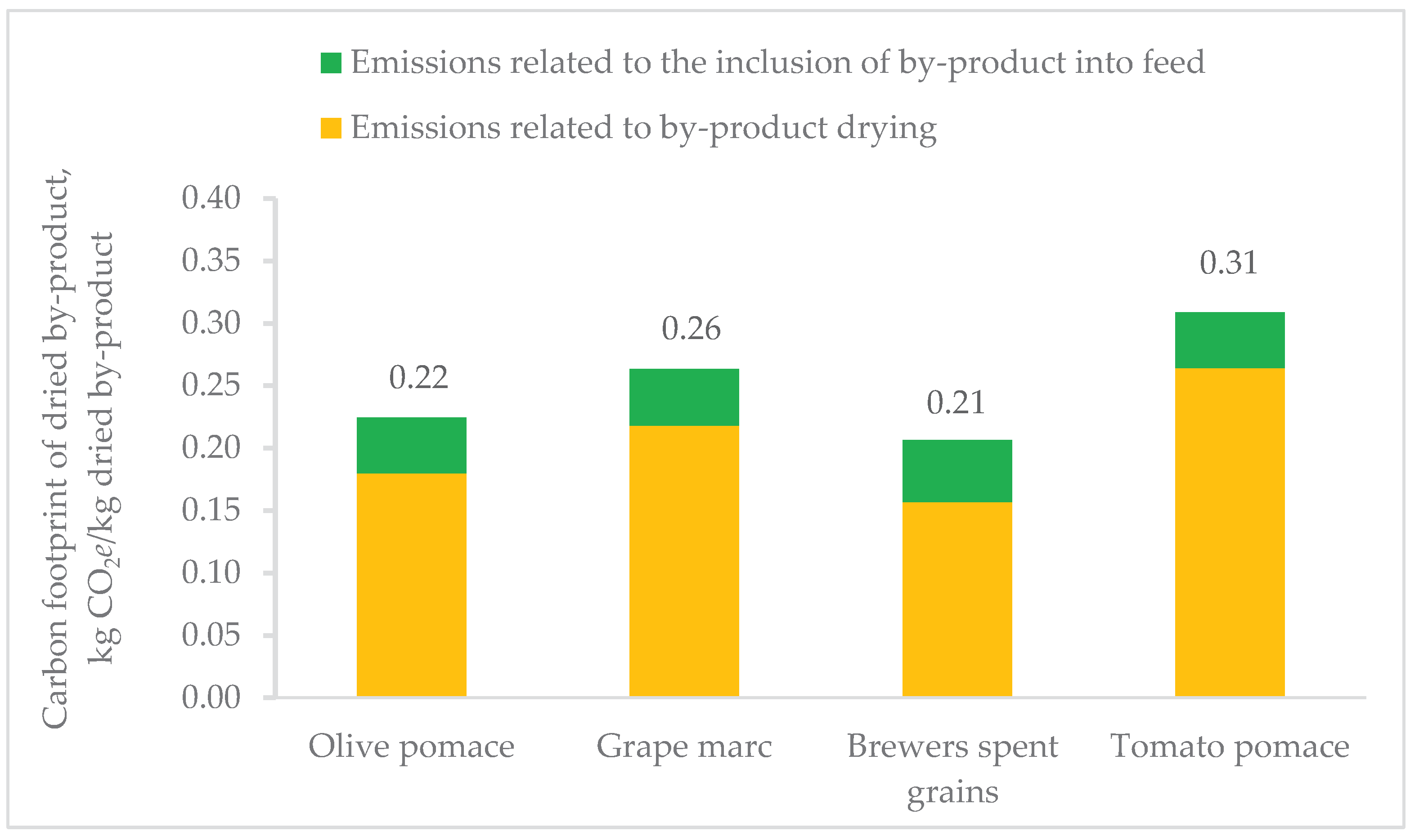

Table 1.
Initial and final moisture content (g/kg), and electricity required for drying process of grape, olive, and tomato pomace, and brewers’ spent grains.
Table 1.
Initial and final moisture content (g/kg), and electricity required for drying process of grape, olive, and tomato pomace, and brewers’ spent grains.
| Agro-industrial by-product |
Initial moisture content (g/kg) |
Final moisture content (g/kg) |
Electricity required for the drying process, kWh/kg by-product |
| Grape pomace 1 | 0.71 | 0.12 | 0.83 |
| Olive pomace 2 | 0.60 | 0.10 | 0.70 |
| Tomato pomace 1 | 0.88 | 0.10 | 1.03 |
| Brewers spent grains 3 | 0.81 | 0.20 | 0.57 |
Table 2.
Emission factors of the ingredients included in the diets of the considered studies (From GFLI [34]).
Table 2.
Emission factors of the ingredients included in the diets of the considered studies (From GFLI [34]).
| Substituted feed |
EF of replaced feeds, kg CO2e/kg feed |
| Alfalfa hay | 0.15 |
| Barley | 0.29 |
| Barley grain | 0.53 |
| Barley straw | 0.04 |
| Canola meal | 0.49 |
| Concentrate | 0.68 |
| Corn | 0.39 |
| Corn silage | 0.56 |
| Cotton seed meal | 0.63 |
| Soybean meal | 2.19 |
| Sugar beet pulp | 0.46 |
| Sunflower meal | 0.85 |
| Wheat | 0.51 |
| Wheat bran | 0.63 |
| Wheat straw | 0.04 |
Abbreviations: EF = Emission factor; CO2e = CO2equivalents.
Table 3.
Chemical composition of agro-industrial by-products derived from the wine, olive oil, tomato processing, and beer industries. Data are reported as mean, standard deviation (SD), minimum (Min) and maximum (Max).
Table 3.
Chemical composition of agro-industrial by-products derived from the wine, olive oil, tomato processing, and beer industries. Data are reported as mean, standard deviation (SD), minimum (Min) and maximum (Max).
| Item | Winery by-products 1 | Olive oil by-products 1 | Tomato by-product 1 | Brewers’ spent grains 1 | ||||||||||||
| Mean | SD | Min | Max | Mean | SD | Min | Max | Mean | SD | Min | Max | Mean | SD | Min | Max | |
| Moisture, % | 71.2 | 9.5 | 63.0 | 81.7 | 55.0 | 7.1 | 50.0 | 60.0 | 87.7 | 13.2 | 78.4 | 97 | 78.1 | 4.07 | 70.0 | 85.0 |
| Dry matter, % as fed | 92.3 | 1.7 | 88.6 | 95.0 | 85.7 | 8.0 | 77.5 | 94.7 | 92.7 | 2.5 | 90.3 | 95.2 | 90.0 | - | - | - |
| Protein, % DM | 11.6 | 1.8 | 8.5 | 16.3 | 8.0 | 0.7 | 7.2 | 9.2 | 16.0 | 2.6 | 11.7 | 19.1 | 22.8 | 4.96 | 14.2 | 31.0 |
| Fat, % DM | 6.8 | 2.1 | 3.9 | 11.4 | 10.4 | 5.6 | 5.4 | 16.5 | 10.8 | 6.0 | 5.4 | 22.2 | 8.6 | 3.29 | 4.5 | 13.0 |
| NDF, % DM | 44.0 | 7.3 | 32.0 | 55.8 | 61.65 | 2.4 | 58.4 | 64.1 | 58.4 | 4.5 | 55.2 | 61.6 | 49.9 | 0.07 | 49.8 | 49.9 |
| ADF, % DM | 37.2 | 5.8 | 29.8 | 49.2 | 51.0 | 3.4 | 45.9 | 54.4 | 48.5 | 3.2 | 46.2 | 50.7 | 20.6 | 4.45 | 17.4 | 23.7 |
| Ash, % DM | 7.0 | 2.8 | 2.1 | 12.1 | 9.6 | 5.2 | 3.7 | 13.6 | 4.1 | 0.7 | 3.1 | 4.8 | 3.2 | 1.1 | 1.1 | 4.6 |
Abbreviations: DM = dry matter; NDF = neutral detergent fibre; ADF = acid detergent fibre. 1 The average values were calculated by authors. Supported literature: Winery by-products: [6,10,36,37,38,39,40,41,42,43,44,45,46,47,48,49,50,51,52,53,54,55,56,57,58,59,60,61]. Olive oil by-products: [17,39,62,63,64,65,66,67,68,69,70,71]. Tomato by-products: [6,65,72,73,74,75]. Brewers’ spent grains: [76,77,78,79,80,81,82,83,84,85,86,87,88].
Table 4.
Estimated amount of agro-industrial by-products, crude protein and fibre available in Europe.
Table 4.
Estimated amount of agro-industrial by-products, crude protein and fibre available in Europe.
| Item | Winery by-products 1 | Olive oil by-products 1 | Tomato by-product 1 | Brewers’ spent grains 1 |
| Primary product, tons 1 | 21,087,560 | 9,359,670 | 15,416,020 | 50,307,660 |
| By-product from agro-industrial processes, % 2 | 21.3 | 42.5 | 5.0 | 19.0 |
| Agro-industrial by-product, tons (FM) | 4,481,107 | 3,977,860 | 770,801 | 9,558,455 |
| Agro-industrial by-product, tons (DM) | 1,289,662 | 1,790,037 | 94,809 | 2,092,240 |
| Available protein, tons | 149,878 | 176,935 | 15,177 | 477,703 |
| Available NDF, tons | 567,188 | 1,363,507 | 55,368 | 1,042,981 |
Abbreviations: FM = fresh matter; DM = dry matter. 1 Data referred to 2023 for winery, olive oil, and tomato by-products, and to 2021 for beer industry by-products. For winery, olive oil and tomato by-products, the quantity of grapes, olives and tomatoes processed were considered. Brewer’s spent grains were instead estimated based on total beer production from barley. 2 The average values were calculated by authors. Supported literature: Winery by-products: [41,89,90,91]. Olive oil by-products: [62,63,92,93]. Tomato by-products: [94,95,96]. Beer industry by-products: [76,83].
Table 5.
Estimated reduction (%) of the carbon footprint of different replaced feeds in the diets by the different by-products considered.
Table 5.
Estimated reduction (%) of the carbon footprint of different replaced feeds in the diets by the different by-products considered.
| References | Species | By-product | By-product inclusion, % of dietary DM | Substituted feed | Replacement level, % | Reduction of the CFP of replaced feed, % |
| [61] | Goat | Grape marc | 18.9 | Concentrate | 24 | -55% |
| [35] | Goat | Grape marc | 15.0 | Sugar beet pulp | 100 | -43% |
| [97] | Goat | Grape seed cake | 5.0 | Soybean hull | 50 | -76% |
| [98] | Goat | Tomato pomace |
24.0 | Wheat bran | 100 | -51% |
| [99] | Sheep | Grape pomace | 10.0 | Sugar beet pulp | 100 | -43% |
| [61] | Sheep | Grape marc | 19.6 | Concentrate | 27 | -53% |
| [9] | Sheep | Olive cake | 29.8 | Cotton seed meal | 100 | -65% |
| [65] | Sheep | Olive cake | 30.0 | Sugar beet pulp | 100 | -52% |
| [9] | Sheep | Tomato pomace | 29.8 | Sugar beet pulp | 83 | -19% |
| [9] | Sheep | Tomato pomace | 29.8 | Cotton seed meal | 75 | -2% |
| [11] | Sheep | Brewers spent yeast | 10.0 | Soybean meal | 100 | -90% |
Abbreviations: CFP = carbon footprint; DM = dry matter.
Table 6.
Estimated reduction of the carbon footprint of diets including grape, olive, and tomato pomace by-products replacing the sugar beet pulp or soybean meal compared to the control diet.
Table 6.
Estimated reduction of the carbon footprint of diets including grape, olive, and tomato pomace by-products replacing the sugar beet pulp or soybean meal compared to the control diet.
| Agro-industrial by-product | CFP CON diet, kg CO2e/kg diet | CFP treatment diet, kg CO2e/kg diet | Reduction of the diet CFP, % | Replaced feed | Level of feed replacement, % |
| Grape pomace | 0.80 | 0.77 | -4.52 | Sugar beet pulp | 100 |
| Olive pomace | 0.44 | 0.33 | -25.01 | Sugar beet pulp | 100 |
| Tomato pomace | 0.44 | 0.29 | -34.73 | Sugar beet pulp | 83 |
| Brewers’ spent yeast | 0.73 | 0.53 | -28.0 | Soybean meal | 100 |
Abbreviations: CFP = carbon footprint; CON = control diet; DM = dry matter.
Table 7.
Estimation of CO2 emissions saved using agro-industrial by-products in small ruminant diets.
Table 7.
Estimation of CO2 emissions saved using agro-industrial by-products in small ruminant diets.
| Agro-industrial by-product | Level of inclusion of by-product, kg/kg dietary DM | Avoided impact with the treatment diet, kg CO2e/kg diet | Avoided impact, kg CO2e/kg by-product included | By-product available, tons DM | Avoided emissions, Megatons CO2e |
| Grape pomace | 0.150 | 0.03 | 0.20 | 1,289,662 | 0.26 |
| Olive pomace | 0.298 | 0.11 | 0.37 | 1,790,037 | 0.66 |
| Tomato pomace | 0.298 | 0.15 | 0.50 | 94,809 | 0.05 |
| Brewers’ spent grains | 0.100 | 0.20 | 2.00 | 2,092,240 | 4.18 |
| Total | 5.15 |
Abbreviations: DM = dry matter.
Disclaimer/Publisher’s Note: The statements, opinions and data contained in all publications are solely those of the individual author(s) and contributor(s) and not of MDPI and/or the editor(s). MDPI and/or the editor(s) disclaim responsibility for any injury to people or property resulting from any ideas, methods, instructions or products referred to in the content. |
© 2026 by the authors. Licensee MDPI, Basel, Switzerland. This article is an open access article distributed under the terms and conditions of the Creative Commons Attribution (CC BY) license (http://creativecommons.org/licenses/by/4.0/).
Copyright: This open access article is published under a Creative Commons CC BY 4.0 license, which permit the free download, distribution, and reuse, provided that the author and preprint are cited in any reuse.


