
Submitted:
07 April 2026
Posted:
09 April 2026
You are already at the latest version
Abstract
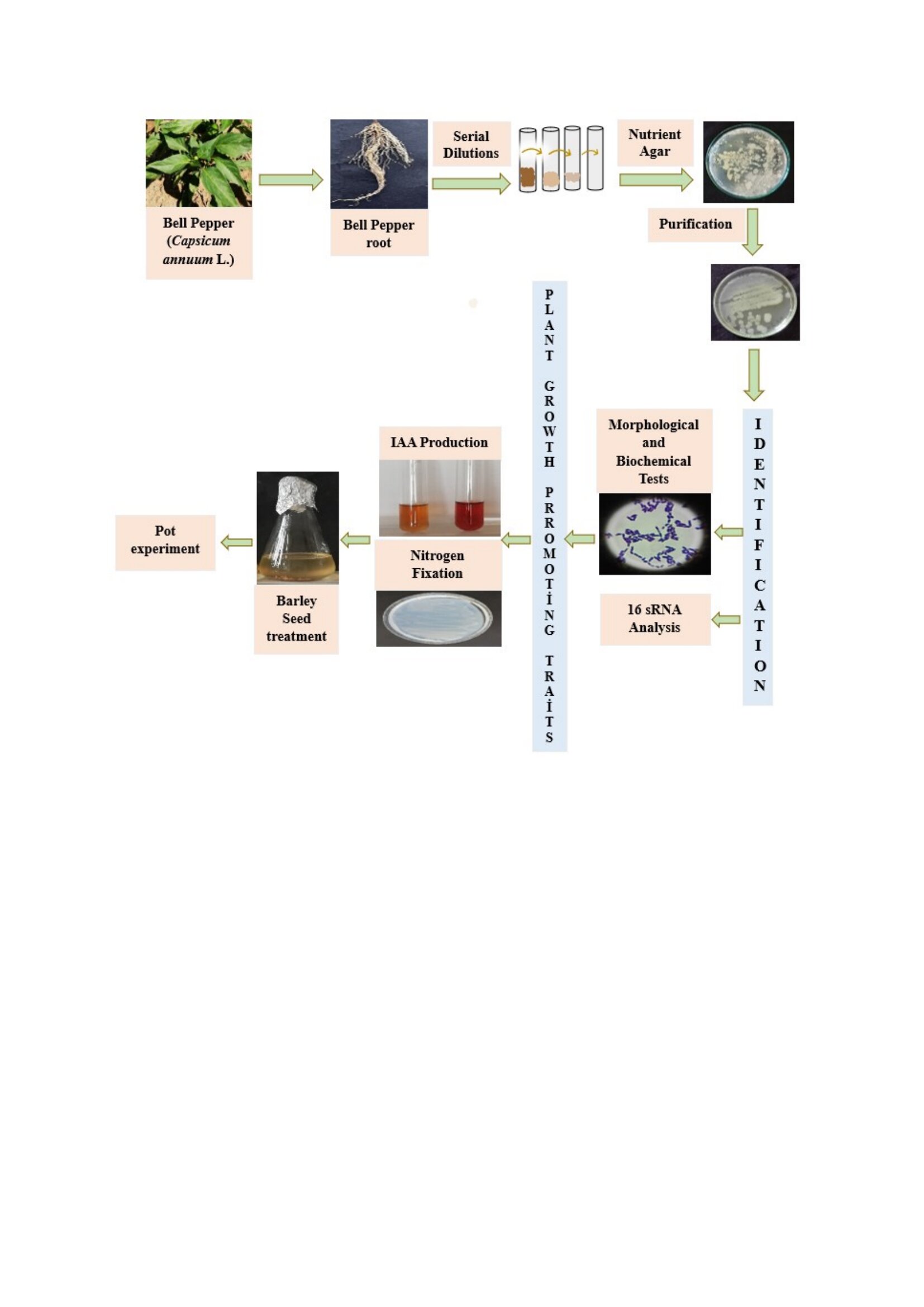
Endophytic bacteria are beneficial microbes that live within plant tissues and promote growth through nitrogen fixation, phosphate solubilization, and phytohormone production. Two endophytic isolates from bell pepper (Capsicum annuum L.) root were identified based on their morphology, and biochemistry properties using 16S rRNA gene sequencing. Winter barley (Hordeum vulgare L.) seeds were inoculated with two PGP (plant growth-promoting) bacterial strains (C-14 and C-27), previously characterized for IAA production and nitrogen fixation, and evaluated in a pot experiment with four treatments: A1(C-14), A2 (C-27), A3 (their consortium), and A4 (non-inoculated control). The results indicated that root and stem lengths increased in plants inoculated with bacteria compared to the uninoculated control. Among treatments, A2 produced the greatest root and shoot lengths (17.23 and 26.2 cm), while A3 showed the lowest (15.8 and 21.5 cm). SPAD values also increased by 6%, 10%, and 3.2% in A1, A2, and A3, respectively. This study clearly demonstrated that the endophytic isolates (C-14 and C-27) obtained from bell pepper roots significantly enhanced the growth and development of barley due to their abilities of IAA production and nitrogen fixation, thereby offering a promising alternate to chemical fertilizers.
Keywords:
barley
; endophytic bacteria
; Bacillus mycoides
; Bacillus tropicus
Copyright: This open access article is published under a Creative Commons CC BY 4.0 license, which permit the free download, distribution, and reuse, provided that the author and preprint are cited in any reuse.


