
Preprint
Article

This version is not peer-reviewed.

An Integrated Approach to Controlling the Al/H₂O Reaction in Hydrogen Generation

Submitted:

07 April 2026

Posted:

08 April 2026

You are already at the latest version

Abstract
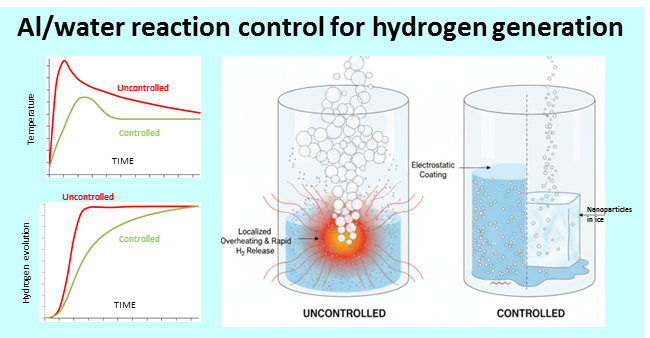
The reaction of aluminum with water is a promising method for producing hydrogen on-demand for autonomous energy systems. However, its practical implementation faces the challenge of process control due to high exothermicity, leading to particle sintering and thermal instability, especially when using highly reactive nanopowders. The goal of this study is to implement an integrated approach to controlling this reaction, aimed at minimizing these risks. The approach is based on the principle of spatial and temporal distribution of reactants to ensure uniform heat release. Two process management methods were investigated: electrostatic application of aluminum powder to the reactor walls with its gradual release and pre-treatment of a nanopowder-ice mixture. Using a macrokinetic mathematical model, calculations of the conversion kinetics and heat release were performed and compared with experimental data. The results showed that both methods prevent slurry self-heating and achieve uniform hydrogen generation at a constant rate. In particular, the use of a pre-frozen mixture ensured stable hydrogen production over a long period of time without additional heating or stirring. The proposed approaches can be used in the design of safe and efficient hydrogen generators for autonomous power plants.
Keywords: 
;  ;  

1. Introduction

Hydrogen is considered a key energy source for decentralized and autonomous energy systems due to its high energy density and the environmental friendliness of its combustion products [1]. However, its widespread use is hampered by problems with safe storage and transportation. In this context, the reaction of aluminum with water (Al + H₂O) is attracting increasing attention as a promising method for producing hydrogen on-demand [2,3]. Aluminum is an affordable, lightweight, and energy-intensive material (the theoretical H₂ yield is 1.24 l/g), and the reaction byproduct, aluminum hydroxide, is environmentally safe and recyclable [1,4].
Despite its thermodynamic advantages, the practical implementation of the Al/H2O reaction faces two fundamental barriers. The first is the presence of a dense oxide film on the aluminum surface, which passivates it and prevents interaction with water under normal conditions [5,6]. The second barrier, particularly relevant for highly dispersed powders, is the extremely high exothermicity and reaction rate after initiation, making the process difficult to control [7,8].
To overcome the barriers to reaction, various activation methods have been developed: the use of alkaline media (NaOH, KOH) to dissolve the oxide layer [9,10], mechanochemical activation with metal salts and oxides [11,12], alloying with low-melting metals (Ga, In, Sn) [13,14], as well as plasma and thermal treatment of particles [15,16]. These approaches successfully solve the problem of starting the reaction and achieving a high (up to 96–99%) hydrogen yield [17].
However, as rightly noted in a number of recent reviews and experimental works, the next critical challenge is process controllability [7,8,18]. The high reactivity of nanoaluminum, due to its huge specific surface area, leads to a rapid process even at room temperature [19]. The released heat (≈15.2 MJ/kg Al) can cause local overheating, water boiling, particle sintering and uneven gas evolution [20]. In the worst case, this can lead to uncontrolled acceleration of the reaction (thermal explosion) and premature termination of the reaction due to blocking of the reactants by a layer of products, which sharply reduces the yield of hydrogen [7,21]. For integration with low-temperature fuel cells (LTE-FCs), which are sensitive to fluctuations in pressure and hydrogen flow rate, a stable, predictable and adjustable gas flow, free from peak loads, is precisely what is needed [20,22]. This is critical for integration with low-temperature fuel cells, which are sensitive to even short-term pressure and flow peaks.
Thus, a contradiction arises: the material must be sufficiently active to react, yet the reaction must proceed “gently” enough to avoid thermal instability and sintering. Traditional rate control approaches, such as varying the alkali concentration or water temperature [10,23], are not always effective for highly reactive nanopowders and do not solve the problem of localized overheating. Clearly, reliable and safe generator operation requires not just an activated powder, but a comprehensive approach combining reagent preparation methods and interaction management, aimed at reducing heat generation and ensuring a uniform process.
The aim of this study is to implement an integrated approach to controlling the reaction of nanoaluminum with water, aimed at minimizing the risks of particle sintering and thermal instability. In this study, we demonstrate that a controlled reaction requires a gradual introduction of powder particles into water at a limited rate. We consider two methods for organizing the process: electrostatic powder deposition on the reactor walls with gradual release and pre-mixing of the nanopowder with ice. The common goal of these methods is the spatial and temporal distribution of the reactants to ensure uniform heat release, prevent local overheating, and achieve high hydrogen yields. The article presents theoretical calculations based on the developed macrokinetic mathematical model, as well as experimental results demonstrating the effectiveness of the proposed approaches compared to the traditional direct mixing scheme. The obtained data can be used in the design of hydrogen generation systems for autonomous power plants, including ground power stations for unmanned vehicles and portable energy sources.

2. Materials and Methods

2.1. Reaction of Aluminum Powder with Water

The object of the study is the reaction of aluminum powder particles with water. Aluminum reacts with water to form aluminum oxide or hydroxide.
The equation for the reaction of aluminum with water is as follows:
2Al + 6H 2 O = 2Al ( OH ) 3 ↓ + 3H 2
According to stoichiometric calculations, the reaction of 54 g of aluminum with water produces 67.2 liters of hydrogen (6 g at 0 °C and 1 atm) and 156 g of aluminum hydroxide. The oxide film prevents the interaction of aluminum with water at room temperature. However, with increasing temperature, as well as in the presence of alkalis, acids, and salts, the reaction rate increases significantly.
Aluminum nanopowder interacts with water differently than finer powders. This is due to the large surface area of the particles, their structural defects, and their accumulated energy [24]. The rate of H₂ evolution increases with the specific surface area of the aluminum: powder (0.91 m²/g) reacts significantly faster than foil (0.63 m²/g) in a NaOH/H₂O solution [8]. Finer powders with a larger initial specific surface area yield higher instantaneous rates of the Al–H₂O reaction [19].

2.2. Materials: Finely Dispersed Aluminum Powders

In this study, aluminum powders of varying degrees of dispersion, obtained by melt atomization, were used to produce hydrogen. Aluminum nanopowder, created by exploding conductors in an argon atmosphere, was also used. Distilled water, both liquid and frozen, served as oxidizers. The specific surface area of the particles was measured using the BET method based on low-temperature argon adsorption. The dispersion characteristics of the powders were determined using an OLYMPUS OMEC DC130 optical particle analyzer.
The characteristic particle sizes (D50) are 0.1-12.5 μm (Table 1, according to the author’s work [25]). Table 1 also presents some kinetic characteristics of the materials, and Figure 1 shows the SEM images of the particles. For aluminum nanopowder, the initiation temperature and time ti decrease, and the conversion degree increases, reaching αmax ~100%. The conversion degree increases approximately linearly with increasing specific surface area of the particles Ssp. [25]: from 0.22 for Ssp. = 0.58 m2/g to 0.98 Ssp. = 1.2 m2/g. With increasing specific surface area, the reaction rate also increases, and the temperature threshold decreases. The linear dependence of the activation energy E (kJ/mol) on the particle diameter D (μm) was approximated based on the experimental data of [26,27]: E = 0.889D + 64.552.
Thus, aluminum nanopowder allows for maximum conversion (and hydrogen yield) when reacting with water, at lower temperatures, and even in the absence of catalysts. However, controlling this reaction poses challenges. Self-heating and particle sintering must be prevented, and a uniform reaction rate and maximum hydrogen production must be achieved.

2.2. Reaction Kinetics: Single-Stage and Gradual Introduction of Aluminum into the Reactor

The interaction of finely dispersed aluminum particles with water is an example of a topochemical reaction that occurs in a limited region at the phase boundary. The Avrami-Erofeev equation [28] is used to analyze the rate of such reactions:
α = α m a x ( 1 exp ( k t n ) ) ,
where α is the degree of aluminum conversion (relative value), t is time, k is the rate constant, n is the kinetic parameter (Table 1). The reaction rate constant depends on the temperature in accordance with the Arrhenius law and is also proportional to the specific surface area of the particles [25]:
k = S s p . k 0 exp E R T ,
where R is the universal gas constant, k0 ~ 2000 1/(s · m2).
If the powder is not loaded into the reactor with water at one time, but is fed into the volume of water gradually (using some technological method), then at each moment in time the degree of conversion is expressed by the average integral value over time: α a v = 1 t 0 t α ( t ) d t .
Figure 2 shows the calculated conversion rate of Alex grade nanoaluminum powder at 293 K over time, with a single loading of 9 g of powder and with gradual addition of powder to water at a rate of Vm = 0.5 g/s. With gradual addition of powder, the reaction proceeds more smoothly, with a rate close to linear. This is preferable for practical implementation in hydrogen generators.
To ensure a uniform reaction, it is necessary to gradually introduce particles into the reaction chamber. This can be achieved, for example, by batchwise feeding of powder through the reactor wall. However, this method creates additional technological challenges, including potential reactor leaks, particle agglomeration in the feeder, and the inability to evenly distribute the particles throughout the reactor. Therefore, we will consider two other methods that allow the particles to be pre-loaded into the reactor but released gradually, reacting with water. These methods are:
  • Electrostatic powder deposition on the reactor walls;
  • Pre-treatment of a powder-ice mixture.
Thus, the idea is to introduce the particles into the reactor early, but gradually, rather than immediately, allowing them to react.

2.3. Experimental Setup

This study examined the reaction between aluminum powder and water using a pilot setup. The setup consists of a high-pressure reactor with a magnetic stirrer and optional heating: a TOP INDUSTRIE FR – 77013 Vaux Le Penil Cedex autoclave (Figure 3).
The required amount of reagents is loaded into a 78 mm diameter reactor with a volume of Vr = 0.8 liters. The reactor is then connected to a magnetic stirrer. The autoclave control system monitors and controls the pressure, temperature, and stirrer speed.
The hydrogen evolution rate and the completeness of aluminum conversion (α) are estimated by measuring the reactor pressure. With excess water (when its amount exceeds the stoichiometric value) in a constant-volume reactor at temperature T:
α = 2 M A l ( P P 0 ) V r 3 R T m ,
where MAl is the molar mass of aluminum, 27 g/mol, m is the mass of the powder, and P0 is the initial reactor pressure (atmospheric pressure). The mass of hydrogen produced is determined as follows:
m H 2 = M H 2 ( P P 0 ) V r R T = α 3 m 2 M H 2 M A l ,
where MH2 is the molar mass of hydrogen. Thus, by analyzing experimental data on reactor pressure as a function of time, we can determine the conversion depth and mass of hydrogen.

3. Results and Discussion

We present the results of calculations and experiments on controlling the reaction of nanoaluminum powder with water in the proposed methods.

3.1. Electrostatic Powder Deposition on Reactor Walls

To ensure the aluminum powder reacts gradually with water, it is first applied to the reactor walls using an electrostatic sprayer. This method has two key advantages:
First, electrostatic spraying breaks up agglomerates, which is especially important for powders that have been stored for a long time and have become caked. The finer the powder, the more complete the reaction is.
Second, the powder particles adhere to the reactor walls due to van der Waals forces. They are gradually released from the walls, ensuring a uniform process, similar to how a gradual addition of particles to water can be controlled.
To implement this idea, a START-50-combi electrostatic spray gun was used. It was used to spray ASD-10 and ASD-6 powders onto the walls and bottom of the reactor. Distilled water mixed with aluminum powder at a ratio of 100 ml of water to 9 grams of powder was used as the aqueous solution. After spraying the walls, the required amount of water was added to the reactor. In a control experiment, all the powder was poured onto the bottom of the reactor. Fine powders were used for the experiment, but not Alex nanopowder, as it can ignite during spraying from a spark discharge.
Figure 4 shows the dependence of the aluminum conversion degree and temperature in the reactor on time. The calculation was performed according to equations (1)-(2). The slight discrepancy between the calculated and experimental data may be due to the influence of agglomerate size, which is not taken into account in the model. These agglomerates may be wetted and separated from the wall differently than individual particles.
The calculations assumed a powder “feed” rate into the water (i.e., particle separation from the vessel walls and reaction) of Vm = 3 mg/s to ensure consistency with the experiment. This value is a free parameter of the model but can be further estimated based on the degree of particle adhesion to the vessel walls. Thus, within ~25 minutes, the powder will separate from the vessel walls and enter the water, reacting to the maximum conversion. The calculated and experimental results show that the reaction proceeds somewhat more uniformly in the case of preliminary electrostatic spraying, eliminating self-heating of the suspension.

3.2. Pre-Preparation of The Powder-Ice Mixture

Another method for gradually introducing particles into the reaction can be achieved by pre-mixing the particles with ice at temperatures below 0 °C, when aluminum does not react with water. Gradually heating the powder-ice mixture will initiate the reaction.
We will describe the experiment presented in the author’s paper [29]. Alex brand aluminum nanoparticles and frozen distilled water were used to prepare the mixture. At temperatures below zero degrees Celsius, the water was crushed into ice chips and thoroughly mixed with the aluminum nanoparticles. The ratio of water to hydrogen in the mixture exceeds the stoichiometric value. This pre-treatment of the components ensures a homogeneous mixture that can be stored indefinitely at sub-zero temperatures without changing the properties of its components or causing aggregation or sedimentation of the particles in the suspension. Using this mixture eliminates the need for additional stirring or heating.
Using pre-prepared starting materials in this manner guarantees a self-sufficient hydrogen production process. The mixture, placed in the reactor at room temperature, heats up and gradually begins to react, releasing hydrogen. There is no risk of self-heating or particle sintering. The reaction occurs gradually as the suspension heats up. It’s worth noting that the particles are uniformly distributed throughout the water beforehand. Using nanopowder ensures the maximum amount of hydrogen, corresponding to the volume of powder used.
Let’s present a mathematical description of the process. For the reaction to begin, the ice must heat up from its initial temperature (Ti) to Tml = 0 °C and melt. This will require a time that can be estimated as follows:
t m l = ρ i V r a t S r c i ln T 0 T i T 0 T m l + Q m l T 0 T m l ,
where Qml is the heat of fusion of ice, T0 is the ambient temperature, Sr is the heat transfer area, ρi is the suspension density, ci is the heat capacity, and at is the heat transfer coefficient [W/(m2 K)]. The oxidation reaction of the powder particles will then begin in accordance with the kinetic equation (1). The particles will not react immediately, but gradually, as they thaw and heat up (taking into account the temperature gradient in the reactor). The gradual nature of the particles’ entry into the reaction can be tentatively determined using the particle “feed” rate Vm, as was done above when modeling particles pre-applied to the reactor walls.
Since the reaction will initially proceed slowly, it is necessary to account for heat exchange with the surrounding environment throughout the entire time from the onset of natural heating of the suspension until the end of the reaction. Let’s write the heat conduction equation in integral form, including the term for heat input from the chemical reaction and heat exchange from the reactor walls W = a t T 0 T L , where L is the characteristic dimension (reactor diameter).
T = 0 t W c i ρ i + Q c i α max k n t n 1 1 α α max d t
where Q is the thermal effect of the reaction. Equations (1-3) will be solved jointly from the moment of ice melting t = tml, when the temperature T(tml) = Tml = 0 °C.
The results of the calculation using equations (3) and the experiment (based on data from [29]) are shown in Figure 5.
At room temperature (20 °C), the mixture, naturally heated from 0 °C, began to react after 7 hours. During this time, hydrogen evolution occurred at a constant rate of approximately 1 ml/s. The rate of hydrogen evolution gradually decreased by 20-21 hours, and the reaction ceased. The temperature of the mixture increased slightly during the reaction (9 K), after which it stabilized at ambient temperature. Using a pre-prepared mixture of nanoaluminum and ice allowed for uniform hydrogen generation without additional manipulations such as forced heating, stirring, or the addition of catalysts.
This method is distinguished by its simple reactor design, as it does not require heating or stirring. It is suitable for stand-alone systems without access to external power sources. However, it does have a drawback: a long reaction preparation time. This process can be accelerated by artificially heating the mixture. Furthermore, the reaction rate can be increased by using catalysts. For example, a slightly alkaline solution can be used instead of distilled water to prepare the ice.

4. Conclusions

In this study, we propose and experimentally validate an integrated approach to controlling the highly exothermic reaction of nanoaluminum with water, aimed at overcoming key issues associated with thermal instability and particle sintering. Unlike traditional methods, which focus primarily on process initiation (e.g., mechanochemical activation or the use of alkaline media), we shifted our focus to orchestrating the interaction itself. The results confirm our initial hypothesis: to ensure process controllability and safety, not only activated powder is required, but also a spatial and temporal distribution of reactants that ensures uniform heat generation.
The study allows us to draw the following key conclusions:
  • It has been shown that the instantaneous mixing of highly dispersed aluminum with water, especially in the case of nanopowders, leads to rapid, uncontrolled heating. The proposed methods – electrostatic deposition on the reactor walls and pre-mixing with ice – allow for the process to be transformed from explosive to stable and linear.
  • Experimental and theoretical (based on a macrokinetic model) confirmation that the pre-freezing method ensures the most “gentle” reaction regime. Natural thawing of the mixture at room temperature ensures gradual entry of the particles into the reaction, eliminating localized overheating (the temperature increase did not exceed 9 K) and ensuring a constant gas evolution rate over many hours.
  • The electrostatic spraying method, in addition to ensuring a gradual supply of reagent due to the desorption of particles from the walls, solves the important technological problem of powder disaggregation, which is especially important for materials subjected to long-term storage.
A comparison with the work of other authors, where the primary focus is on achieving maximum conversion at any cost [17,26], demonstrates a shift in research focus toward practical feasibility. Our data correlate well with the findings of recent studies [7,8,18], which point to the need for thermal control for integrating hydrogen generators with low-temperature fuel cells. The proposed approach enables achieving high hydrogen yields (characteristic of nanoaluminum), but in a form factor suitable for practical application. Thus, the proposed approach resolves the contradiction between the need for high nanopowder activity for maximum hydrogen yield and the requirement for a smooth, controlled reaction to ensure safety and stability.
The obtained results open up prospects for further research. In particular, it is of interest to study the possibility of intensifying the process in ice without losing its stability—for example, by using weakly alkaline solutions instead of distilled water or gentle external heating. Furthermore, an important area of research is scaling up the proposed technical solutions and adapting them to specific types of power plants (ground power stations for drones, portable power sources), where both compactness and predictability of operation are critical.

5. Patents

Kudryashova O.B., Morozova O.N., Titov S.S. Method for obtaining hydrogen. RU Patent RU2853862C1, 17 June 2025.

Author Contributions

Conceptualization, O.K.; methodology, O.M.; software, O.K.; validation, O.K., O.M.; formal analysis, O.K.; investigation, O.M.; resources, O.M.; data curation, O.K.; writing—original draft preparation, O.K.; writing—review and editing, O.M.; visualization, O.M.; supervision, O.K.; project administration, O.M.; funding acquisition, O.M. All authors have read and agreed to the published version of the manuscript.

Funding

This research was funded by Ministry of Science and Higher Education of the Russian Federation, topic No. FUFE 2024-0009.

Data Availability Statement

The data are contained within the article.

Acknowledgments

During the preparation of this manuscript, the authors used Nano Banana AI (to generate a schematic of the experimental setup (Figure 3c) and Grafical Abstract). The Perplexity AI tool was used to search for literature for the Introduction section. The authors have reviewed and edited the output and take full responsibility for the content of this publication. The work was carried out using the instrumentation base of the Biysk Regional Center for Collective Use of the Siberian Branch of the Russian Academy of Sciences (IPCET SB RAS, Biysk).

Conflicts of Interest

The authors declare no conflicts of interest.

Abbreviations

The following abbreviations are used in this manuscript:
Alex, ASD-6, ASD-10 Aluminum powder brands
SEM Scanning electron microscope

Nomenclature

α degree of aluminum conversion (relative value), dimensionless
αmax maximum conversion degree, dimensionless
t time, s
ti initiation time, s
tml ice melting time, s
k reaction rate constant, 1/s
k pre-exponential factor, 1/(s·m²)
n kinetic parameter (Avrami-Erofeev exponent), dimensionless
E activation energy, kJ/mol
R universal gas constant, J/(mol·K)
T temperature, K
Tml melting temperature of ice (0 °C), K
Ti initial temperature, K
T ambient temperature, K
Vm powder feed rate (mass flow), g/s
m mass of powder, g
MAl molar mass of aluminum, g/mol
MH₂ molar mass of hydrogen, g/mol
P pressure, Pa (or atm)
P initial reactor pressure (atmospheric), Pa (or atm)
Vr reactor volume, L
Sr heat transfer area, m²
Ssp specific surface area of particles, m²/g
D₅₀ characteristic particle size (median diameter), μm
Q thermal effect of the reaction, J
Qml heat of fusion of ice, J
ci heat capacity of suspension, J/(kg·K)
ρi density of suspension, kg/m³
at heat transfer coefficient, W/(m²·K)
L characteristic dimension (reactor diameter), m

References

  1. Bolt, A.; Dincer, I.; Agelin-Chaab, M. A Review of Unique Aluminum–Water Based Hydrogen Production Options. Energy Fuels 2021, 35(2), 1024–1040. [CrossRef]
  2. Elitzur, S.; Rosenband, V.; Gany, A. Study of Hydrogen Production and Storage Based on Aluminum–Water Reaction. Int. J. Hydrogen Energy 2014, 39(12), 6328–6334. [CrossRef]
  3. Huang, X.; Gao, T.; Pan, X.; Wei, D.; Lv, C.; Qin, L.; Huang, Y. A Review: Feasibility of Hydrogen Generation from the Reaction between Aluminum and Water for Fuel Cell Applications. J. Power Sources 2013, 229, 133–140. [CrossRef]
  4. Rosenband, V.; Gany, A. Application of Activated Aluminum Powder for Generation of Hydrogen from Water. Int. J. Hydrogen Energy 2010, 35, 10898–10904. [CrossRef]
  5. Sun, L.; Ji, X.; Zhou, Y.; Li, H.; Zhai, W.; Chen, B.; Dong, H.; Liu, Y.; Wang, T. An overview of hydrogen production from Al-based materials. Nanotechnol. Rev. 2023, 12, 20220521. [CrossRef]
  6. Xiao, F.; Yang, R.; Liu, Z. Active aluminum composites and their hydrogen generation via hydrolysis reaction: A review. Int. J. Hydrogen Energy 2022, 47, 365–386. [CrossRef]
  7. Feng, J.; Du, H.; Li, K. Current status of aluminium-water reaction for hydrogen production and cogeneration research. Adv. Comput. Eng. Technol. Res. 2024, 2, 273.
  8. Testa, V.; Gerardi, M.; Zannini, L.; Romagnoli, M.; Santangelo, P. Hydrogen production from aluminum reaction with NaOH/H2O solution: Experiments and insight into reaction kinetics. Int. J. Hydrogen Energy 2024, 83, 123–135. [CrossRef]
  9. Bolt, A.; Dincer, I.; Agelin-Chaab, M. Experimental study of hydrogen production process with aluminum and water. Int. J. Hydrogen Energy 2020, 45, 14232–14244. [CrossRef]
  10. Mezulis, A.; Richter, C.; Lesnicenoks, P.; Knoks, A.; Varnagiris, Š.; Urbonavičius, M.; Milčius, D.; Kleperis, J. Studies on Water–Aluminum Scrap Reaction Kinetics in Two Steps and the Efficiency of Green Hydrogen Production. Energies 2023, 16, 5554. [CrossRef]
  11. Davies, J.; du Preez, S.P.; Bessarabov, D.G. The Hydrolysis of Ball-Milled Aluminum–Bismuth–Nickel Composites for On-Demand Hydrogen Generation. Energies 2022, 15, 2356. [CrossRef]
  12. Prabu, S.; Wang, H.-W. Improved hydrogen generation from Al/water reaction using different synthesized Al(OH)3 catalyst crystalline phases. Int. J. Energy Res. 2021, 45, 9518–9529. [CrossRef]
  13. Fischman, J.; Godart, P.; Hart, D. Hydrogen generation via the reaction of an activated aluminum slurry with water. Int. J. Hydrogen Energy 2020, 45(35), 17118–17130. [CrossRef]
  14. Iturbe-García, J. L.; & Alvarez-Acosta, D. L. High Efficiency in Clean Hydrogen Production Using Water and AlLi Phases Prepared by Mechanical Alloying. Hydrogen 2024, 5(4), 987-1003.
  15. Urbonavičius, M.; Varnagiris, S.; Knoks, A.; Mezulis, A.; Kleperis, J.; Richter, C.; Meirbekova, R.; Gunnarsson, G.; Miličius, D. Enhanced Hydrogen Generation through Low-Temperature Plasma Treatment of Waste Aluminum for Hydrolysis Reaction. Materials 2024, 17, 2637. [CrossRef]
  16. Buryakovskaya, O.A.; Vlaskin, M.S.; Grigorenko, A.V. Effect of Thermal Treatment of Aluminum Core-Shell Particles on Their Oxidation Kinetics in Water for Hydrogen Production. Materials 2021, 14, 6493. [CrossRef]
  17. General Atomics. On-Demand Hydrogen and Heat Generation Systems. Available online: https://www.ga.com/on-demand-hydrogen-heat-generation-systems (accessed on 8 March 2026).
  18. Salueña-Berna, X.; Marín-Genescà, M.; Rosas-Casals, M.; Arias, M. Controlled and Safe Hydrogen Generation from Waste Aluminum and Water: A New Approach to Hydrogen Generation. Materials 2024, 17(23), 5885. [CrossRef]
  19. Zhang, X.; Wang, L.; Tao, G.; Guo, R.; Fang, J.; Zhang, J.; Mao, H. Hydrogen production from aluminum-water reactions at low temperatures: based on an in-situ two powders of different particle sizes. Front. Energy Res. 2024, 12, 1441155. [CrossRef]
  20. Trowell, K.A.; Goroshin, S.; Frost, D.L.; Bergthorson, J.M. Hydrogen production rates of aluminum reacting with varying densities of supercritical water. RSC Adv. 2022, 12, 12335–12343. [CrossRef]
  21. Amrani, M.A.; Alrafai, H.A.; Al-Nami, S.Y.; Obeidat, F.S.; Alwahbani, F.; Alhammadi, M.; Qasem, A. Green synthesis of size-controlled copper oxide nanoparticles as catalysts for H2 production from industrial waste aluminum. Int. J. Energy Res. 2022, 46, 14023–14035. [CrossRef]
  22. Gupta, M.K.; Selleri, F.; Ficarella, A.; Bocchetta, P. Hydrogen generation through metal waste corrosion: a systematic investigation on old/post-consumer scrap Al6063-series alloy. Mater. Renew. Sustain. Energy 2025, 14, 8. [CrossRef]
  23. HPQ Silicon. On-Demand Hydrogen Production. Available online: https: //hpqsilicon.com/technology/hydrogen-production/on-demand-hydrogen/ (accessed on 8 March 2026).
  24. Ilyin, A. P.; Korshunov, A. V.; Tolbanova, L. O. Application of aluminum nanopowder in hydrogen power engineering. Bulletin of the Tomsk Polytechnic University 2007, 311(4), 11-14.
  25. Morozova, O. N.; Kudryashova, O. B.; Antonnikova, A. A.; Pavlenko, A. A.; Titov, S. S. Macrokinetics for reaction of aluminum powders in water. South-Siberian Scientific Bulletin 2020, 3, 24-29.
  26. Antipina, S. A.; Zmanovskii, S. V.; Gromov, A. A.; & Konovalov, A. S. Oxidation of fine aluminum powders with water and air. Russian Journal of Physical Chemistry A 2017, 91(1), 52-58.
  27. Gai, W. Z.; Liu, W. H.; Deng, Z. Y.; Zhou, J. G. Reaction of Al powder with water for hydrogen generation under ambient condition. International journal of hydrogen energy 2012, 37(17), 13132-13140. [CrossRef]
  28. Korshunov, A. V.; Ilyin, A. P. Macrokinetics of Interaction of Electroexplosive Aluminum Nanopowders with Water and Alkali Solutions. In Applied Particle Technology Proceedings of an International Seminar 2009, 38-43.
  29. Kudryashova, O.B.; Morozova, O.N.; Antonnikova, A.A. Reactions of Nonaluminum with Ice: Theoretical and Experimental Study. Dokl Phys Chem 2024, 516, 62–69. [CrossRef]
Figure 1. SEM images of powder particles of the Alex brand (a) and ASD-10 (b).
Preprints 207019 g001
Figure 2. Calculation of the degree of conversion of Alex powder over time with a one-time loading of 9 g of powder into water and with a uniform supply of powder at a rate of Vm = 0.5 g/s.
Preprints 207019 g002
Figure 2. Experimental setup: (a) autoclave (1 – pressure gauge; 2 – gas outlet valve; 3 – magnetic stirrer drive; 4 – chromel-alumel thermocouple; 5 – reaction bowl; 6 – safety valve); ( b) laboratory model of hydrogen generation device (1 – pressure gauge; 2 – safety valve and gas outlet valve; 3 – multimeter with chromel-alumel thermocouple; 4 – reaction bowl; 5 – magnetic stirrer with heating); (c) hydrogen generator schematic with optional stirring and heating functions (generated by GenAI).
Preprints 207019 g003
Figure 4. Changes in the conversion depth of ASD-10 and ASD-6 powders with and without preliminary electrostatic spraying. Curves represent calculations, dots represent experiments.
Preprints 207019 g004
Figure 5. Dynamics of change in the depth of transformation (a), temperature (b) in the reaction of nanoaluminum powder pre-mixed with ice.
Preprints 207019 g005
Table 1. Dispersion characteristics and kinetic parameters of the reaction of finely dispersed aluminum powders in water.
Brand D50, µm Ssp., m2/g ti, s αmax n E, kJ/mol k, 1/s (293K)
ASD-6 2.5 0.58 30 0.22 2.4 67 1.3E-09
ASD-10 2.2 0.94 30 0.61 2.7 67 2.2E-09
Alex 1.8 1.2 10 0.98 6 64 9.4E-08
Disclaimer/Publisher’s Note: The statements, opinions and data contained in all publications are solely those of the individual author(s) and contributor(s) and not of MDPI and/or the editor(s). MDPI and/or the editor(s) disclaim responsibility for any injury to people or property resulting from any ideas, methods, instructions or products referred to in the content.
Copyright: This open access article is published under a Creative Commons CC BY 4.0 license, which permit the free download, distribution, and reuse, provided that the author and preprint are cited in any reuse.
Prerpints.org logo

Preprints.org is a free preprint server supported by MDPI in Basel, Switzerland.

Subscribe

Disclaimer

Terms of Use

Privacy Policy

Privacy Settings

© 2026 MDPI (Basel, Switzerland) unless otherwise stated